






Abstract
It is often assumed that parliamentary activity, by demonstrating MPs’ commitment and the diligent fulfilment of their duties, is viewed favourably by the electorate and increases their chances of re-election. Our results imply a more nuanced picture. Drawing on data from the Polish Sejm between 2005 and 2023, we find that parliamentary activity has no discernible positive effect on re-election for most MPs. We also document that MPs with the lowest activity levels retain a high likelihood of securing a seat in subsequent elections. These patterns are difficult to reconcile with voters rewarding parliamentary conduct. Instead, our evidence points to the decisive role of an MP’s position in the party hierarchy in shaping voter perceptions and electoral success. In line with this, re-election depends largely on an MP’s ranking on the party list, which remains remarkably stable over time. Overall, our findings suggest that party structures and internal selection processes can substantially constrain voter-driven accountability, even in electoral systems that allow voters to choose among individual candidates.
Introduction
It is widely posited that voters take politicians’ past performance into account when deciding whom to support (Ferejohn, 1986; Healy and Malhotra, 2013). In line with agency theory and retrospective voting, this performance serves as a low-cost signal of future conduct, equipping voters with a straightforward mechanism to select candidates, both across parties and within them.
A primary metric of this performance is parliamentary activity, which offers an intuitive dimension for evaluating whether MPs have used their term effectively (Sorace, 2021). From an MP’s perspective, such activity generates two distinct strategic advantages: a visibility effect and a credibility effect. First, speeches, interpellations, and statements can enhance visibility and recognisability among voters (François and Navarro, 2020). This matters because even poorly informed voters may favour familiar candidates, through media coverage of parliamentary proceedings or reports on active MPs (Edwards et al., 2015). Second, beyond mere name recognition, the electorate may interpret these efforts as tangible evidence of diligence. In this light, parliamentary activity signals dedication, work ethic, and competence (Papp and Russo, 2018). Additionally, higher activity can secure better ballot positions or leadership roles, both of which can further boost re-election chances (Däubler et al., 2018; François and Navarro, 2019; Put et al., 2024; Sorace, 2021). Taken together, these mechanisms justify hypothesising a positive association between parliamentary activity and electoral success.
The literature includes several papers supporting this relationship. That said, only a handful of studies credibly identify the causal effect of legislative activity on re-election (Atsumi, 2025; Fouirnaies and Hall, 2022; Loewen et al., 2014). Furthermore, these typically focus on single-member district systems, exploiting distinctive institutional features, such as elements of the electoral system (e.g., term limits in the U.S.) or specific traits of the legislative process (e.g., lotteries granting the right to propose a bill in the UK). In list-based proportional systems, by contrast, such quasi-experimental opportunities are largely absent, making clean causal claims infeasible. Nevertheless, a number of studies offer careful examinations of whether voters reward parliamentary efforts. The evidence from these works is mixed and context-dependent. Some find that voters reward such efforts (Däubler et al., 2016; François and Navarro, 2019; Marcinkiewicz and Stegmaier, 2019), others show no such boost (Däubler et al., 2018; Frech, 2016).
This variation in findings is often attributed to institutional factors, especially electoral systems, which differ in seat allocation to parties and candidates, and in voters’ agency to choose individuals over party lists (Klingemann, 2009). Consequently, voters’ ability to hold politicians accountable varies, with institutional details moderating the link between parliamentary conduct and re-election. In addition, research on ballot position underscores parties’ key role in candidate selection (see, e.g., Lutz, 2010; Meredith and Salant, 2013; Marcinkiewicz, 2014), often finding that re-election depends more on party-assigned rank than parliamentary activity.
This paper complements existing research by further examining the relationship between parliamentary activity and re-election in list-based proportional systems. Drawing on observational research design, we combine econometric analysis with descriptive methods to provide novel insights into Poland’s Sejm (lower house) from 2005 to 2023. The Polish case is interesting for several reasons. First, while much of the existing literature focuses on closed-list proportional or single-member district systems, our focus is on a quasi-list proportional system, a subtype of open list systems (Shugart, 2005). In the Polish context, voters select one candidate from their preferred party’s list. These preference votes then determine which candidates secure mandates, following the primary allocation of seats to parties that have cleared the statutory threshold. In principle, this limits parties’ control over which specific individuals are elected to parliament (unlike in closed list proportional systems, Shugart, 2005). Consequently, the Polish setting provides a particularly suitable environment for testing voter-driven accountability. At the same time, our analysis is situated in a context in which parties still retain significant influence by selecting candidates and setting list positions (Marcinkiewicz, 2014). These mechanisms can constrain voters’ choices despite their formal authority. We thus assess whether parliamentary activity draws voter attention and increases re-election prospects in this setting. Second, our 2005–2023 data span five consecutive terms, which is longer than most studies’ shorter time frames. This reduces risks of term- or year-specific biases. Third, and importantly, our dataset covers diverse activities, including speeches, queries on current issues, statements, questions and interpellations. This allows us to test whether effects vary by activity type (Marcinkiewicz and Stegmaier, 2019; Put et al., 2024). Voters may indeed value these differently, making some more beneficial for political careers than others. Finally, Poland has seen limited empirical scrutiny. While studies cover parliamentary activity’s electoral impact in the Czech Republic (Däubler et al., 2018), Hungary (Papp, 2019) and the Slovak Republic (Crisp et al., 2013), evidence for Poland is sparse, relying mainly on qualitative or comparative work (Czernek, 2018; Lewandowski, 2020; Piękoś, 2020). A notable exception is Bełdowski et al. (2024) but this study examines drivers of parliamentary activity rather than its implications for re-election.
Our results challenge the intuitive view that increased parliamentary activity is positively associated with re-election chances. Contrary to expectations, we find no evidence of electoral rewards for such activity in the Polish Sejm. Although our baseline models reveal a positive association for first-term MPs, we argue this stems from confounding factors. For more senior MPs, the link turns negative, strongly suggesting the presence of a confounder, as it is implausible that voters would consciously favour the less active representatives over diligent ones.
We identify an individual’s position in the party hierarchy as the key confounder. Our evidence clearly shows that established MPs, with higher likelihood of re-election, engage in less parliamentary activity than those with a weaker foothold. Thus, internal standing emerges as an overlooked driver of parliamentary engagement, enriching our understanding of re-election mechanisms. Our case study also yields a hypothetical Directed Acyclic Graph (DAG) model substantiating our interpretation and deepening the empirical results. It charts paths to refine the initial theoretical framework and flags methodological pitfalls in such analyses.
The remainder of this article is structured as follows. The next section outlines the Polish political context, focusing on the Sejm. The subsequent section describes the data, followed by a presentation of the empirical results. The penulitmate section discusses our findings and highlights potential pitfalls for future research. The article concludes with final remarks.
Background information on the Sejm and the study time span
The Sejm
The Sejm, the lower house of the Polish parliament, serves as the primary arena for legislative activity and the advancement of political careers in Poland. From the perspective of MPs’ incentives, it functions not merely as a law-making body, but also as a crucial stage where individual legislators demonstrate their competence, loyalty and usefulness to both their parties and the electorate.
The Sejm comprises 460 MPs elected for 4-year terms. 1 The electoral process employs a system of quasi party-list proportional representation conducted across 41 multi-member districts, with the number of seats per district determined by population size. Voters cast a single preference vote for a candidate within a party list, and seats are allocated to parties based on their total vote share in the respective district. Importantly, the order of candidates on the electoral lists is determined by the parties. Only parties that surpass the 5% national threshold qualify for seat distribution, while coalitions must secure at least 8%. 2
The time span of the study
This study spans the period from 2005 to 2023, encompassing parliamentary activity across five distinct terms (V–IX). This timeframe includes one shortened term (2005–2007) and four full terms (2007–2011, 2011–2015, 2015–2019, 2019–2023). Such an extensive horizon allows us to observe MPs’ behaviour across multiple electoral cycles and varying political contexts. Throughout this period, Poland’s political landscape was largely shaped by the rivalry between two parties: Law and Justice (PiS, Prawo i Sprawiedliwość) and Civic Platform (PO, Platforma Obywatelska), alongside their respective coalition partners. During the first term included in the study (2005–2007), PiS led the government, with PO serving as the main opposition. In the following two consecutive terms (2007–2011, 2011–2015), PO took power, and PiS became the main opposition force. Over the next two parliamentary terms (2015–2019, 2019–2023), the balance shifted once more, with PiS returning to government while PO resumed its role in opposition. Following the 2023 elections, the government was once again formed by PO and its coalition partners, with PiS becoming the main opposition party.
In the remainder of the paper, our focus is on MPs from these two parties. This choice is motivated not only by the fact that they consistently held the vast majority of seats in the Sejm, but also by the limited parliamentary presence of other parties during the period under study. Some, like Nowoczesna, appeared in the Sejm only once, while others, such as the post-communist SLD, were represented irregularly. As a result, analysing the relationship between parliamentary activity and re-election is not always feasible in these cases.
The lower temporal boundary of this study is defined by the emergence of the two primary parties of interest, PO and PiS, both established in 2001. During the IVth term (2001–2005), they did not yet represent the leading political forces in Poland. However, as noted above, from the 2005 elections onwards, they have decisively dominated the political landscape, consistently securing enough seats to form a government, either independently or as the senior partner in a coalition. The upper boundary of the study is 2023, coinciding with the most recent parliamentary elections. As these results are included in our dataset, our estimates can exploit the link between parliamentary activity during the 2019–2023 term and subsequent re-election outcomes in 2023.
Data
Data concerning MPs and their activities in the Sejm is publicly available and was retrieved from the official Sejm website. This dataset includes information on various aspects of parliamentary activity. For each MP, it contains data on the number of parliamentary questions, queries on current issues, statements, interpellations, and speeches. A notable limitation, however, is that the dataset does not account for the quality of these actions. This constraint must be considered when interpreting the results (Schobess, 2022). In addition, the dataset includes MPs’ personal characteristics, such as age, education level, academic title, and sex, alongside administrative details including attendance records, electoral districts, and their positions on the electoral list.
Our analysis focuses exclusively on MPs who served a full parliamentary term (those who entered mid-term or left office early are excluded). This ensures that every MP in the study had an equal opportunity to establish a reputation among voters. Given that our research spans multiple legislatures, the unit of observation is the MP-term. Consequently, individual MPs may appear more than once in the dataset if they sought re-election across different terms. In addition, we restrict our focus to MPs who stood for re-election from the same party lists through which they originally secured their seat. This approach accounts for the possibility that politicians who changed parties may be perceived differently by the electorate compared to those who remained loyal to their original grouping (Gherghina, 2016).
Overall, our data consists of 1377 individual observations of MPs who sought re-election during the period under study. Of these, 753 MPs (54.7%) represented PiS and 624 (45.3%) represented PO. The MPs in our sample account for 88% of all MPs from these two parties who served a full term. The remaining 12% did not seek re-election, either by choice or because they failed to secure their party’s endorsement. 3 As this proportion illustrates, the probability of re-selection among those completing their term was remarkably high. This pattern held for both parties. The re-selection rate for PiS was slightly higher at 91%, compared to 85% for PO.
Results
To assess the relationship between parliamentary activity and re-election, we adopt a stepwise strategy that progressively addresses both empirical associations and potential sources of bias. We begin with descriptive statistics before estimating baseline econometric models that examine the association between parliamentary activity and re-election prospects. Next, we extend the analysis by considering confounding factors that may shape this relationship, with particular emphasis on an individual MP’s unobserved position within the party hierarchy. Finally, we introduce a directed acyclic graph (DAG) to clarify our conceptual framework, support the interpretation of the empirical results, and highlight additional challenges that may arise in similar empirical settings.
Descriptive statistics
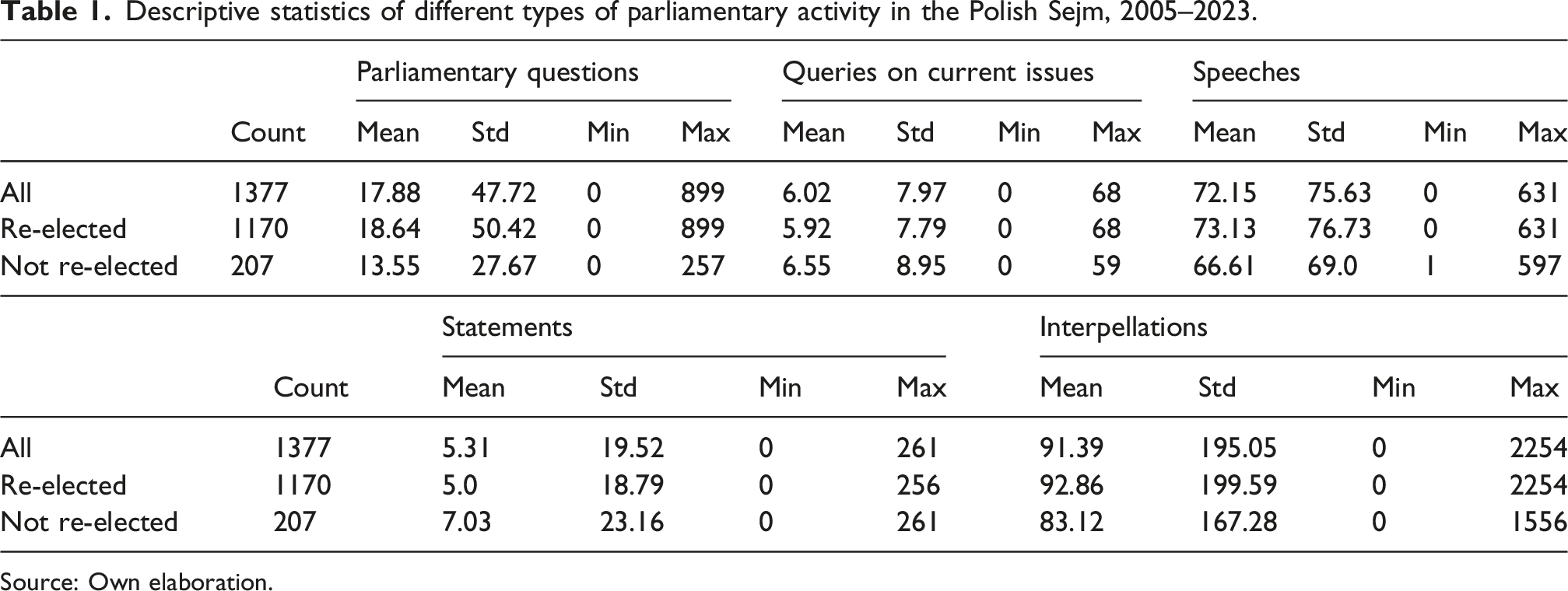
Descriptive statistics of different types of parliamentary activity in the Polish Sejm, 2005–2023.
Source: Own elaboration.
Two things seem particularly interesting. First, the share of MPs who won re-election among those who ran for re-election was very high, at 85% (1170 out of 1377) and this held for both PiS and PO MPs. 4 As a result, if politicians decided to run again and received their party’s permission, their chances of being re-elected were very high. This is important, as it raises the question of how much parliamentary activity can truly make a difference in such a context.
Second, and very much in line with this, the average parliamentary activity of MPs who were re-elected does not seem to be much higher than that of MPs who were not re-elected. In fact, while the former group shows a higher average for parliamentary questions, speeches, and interpellations, the latter group has a higher average for statements and queries on current issues.
Further information on the issue in question can be gleaned from Figure 1, which presents the electoral outcomes for both parties. The figure shows the number of MPs who were re-elected, those who failed to secure re-election, and those who entered the Sejm without having served in the previous parliament. The number of MPs from PiS and PO with and without re-election in the Polish Sejm, 2005–2023. Source: Own elaboration. Note. ‘re-elected’ denotes MPs who secured re-election, ‘not re-elected’ denotes MPs who sought re-election but were unsuccessful, and ‘elected’ denotes MPs who were newly elected (i.e., did not hold a seat in the previous term). The numbers presented in the graph refer to the number of MPs in each category for each of the two parties.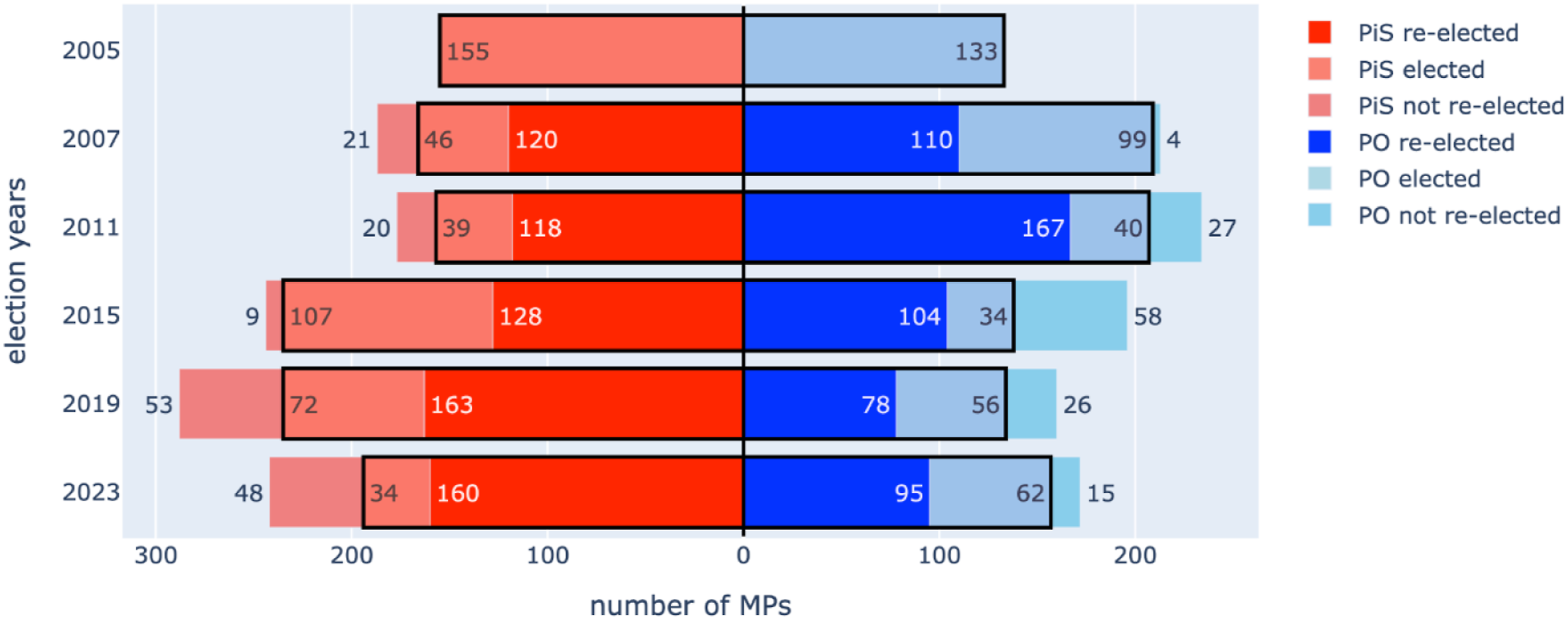
Two observations seem noteworthy. First, and perhaps unsurprisingly, the prospects of re-election were higher when a party improved on its previous result by gaining a substantial number of seats. 5 Conversely, the chances of re-election were notably lower when a party suffered a sizeable loss of seats. Second, we observe a higher proportion of MPs failing to secure re-election in cases where a party replicated its previous performance and many of those seeking re-election were first-term MPs. 6 Taken together, these patterns suggest that changes in the total number of seats held by a given party are likely to be the main driver of MP turnover. This, in turn, indicates that other factors, such as the parliamentary activity, may play only a limited role.
Econometric analysis
To gain further insights into this relationship, we next turn to an econometric analysis and estimate standard logit models of the following form:
The dependent variable is a dummy indicating whether or not MP
Across various model specifications, we include a vector of control variables
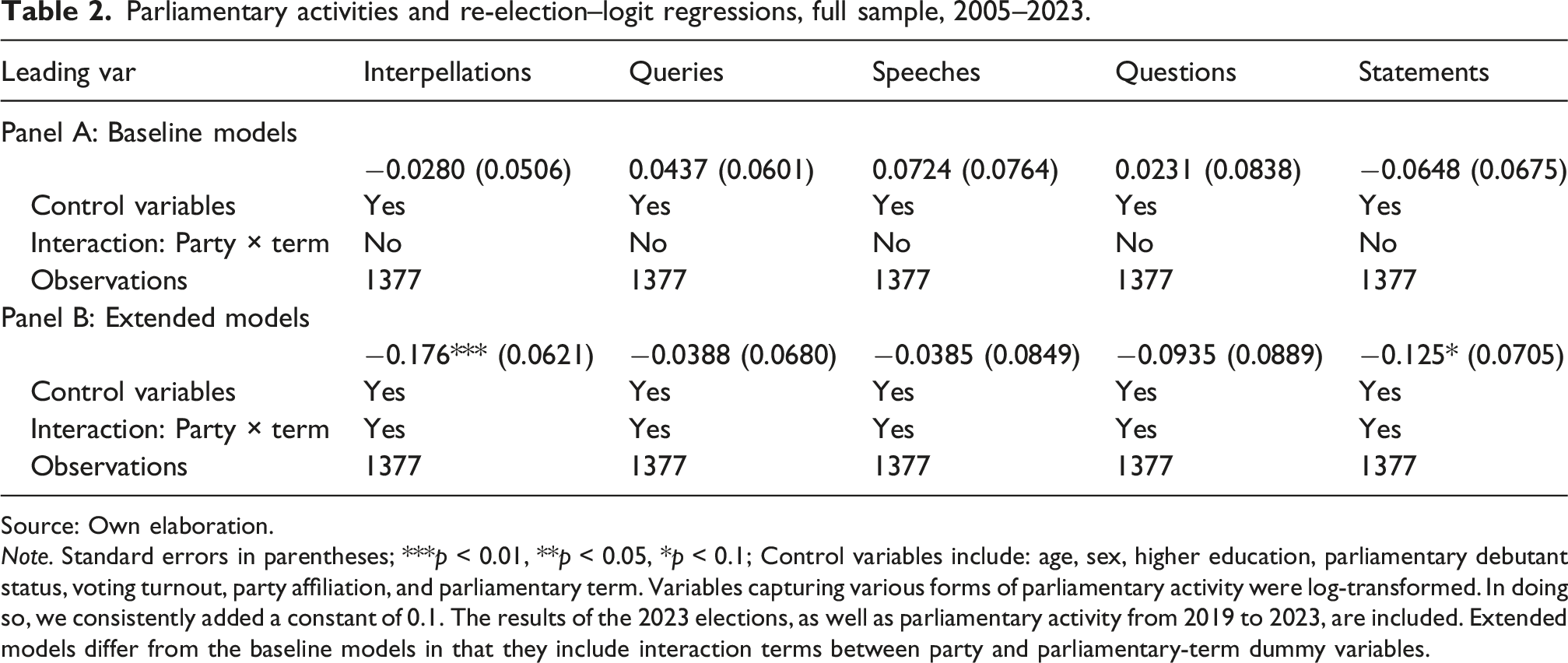
Parliamentary activities and re-election–logit regressions, full sample, 2005–2023.
Source: Own elaboration.
Note. Standard errors in parentheses; ***p < 0.01, **p < 0.05, *p < 0.1; Control variables include: age, sex, higher education, parliamentary debutant status, voting turnout, party affiliation, and parliamentary term. Variables capturing various forms of parliamentary activity were log-transformed. In doing so, we consistently added a constant of 0.1. The results of the 2023 elections, as well as parliamentary activity from 2019 to 2023, are included. Extended models differ from the baseline models in that they include interaction terms between party and parliamentary-term dummy variables.
The negative association is interesting. If parliamentary activity were a meaningful signal for voters, higher levels would be rewarded rather than associated with lower re-election prospects. The observed pattern therefore implies that parliamentary activity is unlikely to play an important role in voters’ electoral decisions. A more plausible interpretation is that electoral success is driven by party-mediated factors that are negatively correlated with parliamentary activity.
Concerning the auxiliary variables included in the estimated specifications, we find that re-election prospects are not related to MPs’ sex, attendance at parliamentary votes, or party affiliation. By contrast, they are positively associated with higher education, or prior parliamentary experience, and negatively associated with MPs’ age. The results also suggest that securing re-election was easier at the beginning of the period under study (5th term) than in subsequent terms. 8 As several of these variables may be endogenous, they are included solely as controls to mitigate bias in the primary coefficient of interest.
Limitations of the presented models
The models presented above have several limitations. Although they suggest the potential direction of the association between parliamentary activity and re-election, the estimated coefficients are likely to be biased by both unobserved confounding and the complexities inherent in the multi-stage nature of the re-election process. These issues are discussed in greater detail below.
With regard to the first issue, the concern is that re-election prospects may depend heavily on an unobservable characteristic that also affects MPs’ incentives to be active in parliament. A plausible candidate for such a confounding factor is an MP’s position within the party hierarchy. This position may influence MPs’ placement on electoral lists, which in turn directly affects their chances of re-election (assuming that those higher on the list are more likely to secure a seat). Consequently, it may also shape their motivation to gain visibility through parliamentary activities, such as submitting interpellations or posing questions.
Two distinct dynamics warrant consideration in this context. On one hand, MPs with a low probability of re-election (or those stepping down) may reduce their parliamentary activity, perceiving it as unlikely to increase their re-election prospects. 9 Conversely, MPs with a high probability of re-election may also feel less inclined to maintain high levels of activity, as their return to the Sejm is almost certain. Importantly, these mechanisms are not mutually exclusive and may operate simultaneously across different sub-samples. However, the central point is that these two scenarios imply opposing effects on the coefficient of interest. While the former suggests a positive correlation between parliamentary activity and re-election, the latter implies a negative one. Evidence for both mechanisms is provided below.
Turning to the second issue, the multi-stage nature of the re-election process, it is important to note that the re-election outcome is preceded by two earlier decisions. First, the MP must decide whether to stand for re-election. Second, the party must decide whether to include the candidate on its electoral list and determine their position on the ballot. To the extent that the residuals from these stages are correlated, a model focusing solely on the third stage (without accounting for these correlations) would yield biased estimates. Unfortunately, this multi-stage strategy could not be applied in our case. 10 It should be noted, however, that if the unobserved factors are positively correlated at both stages, a single-stage estimation procedure (omitting the Inverse Mills Ratio) would result in an upward bias in the coefficient of interest.
Comparing rookies and non-rookies in parliament
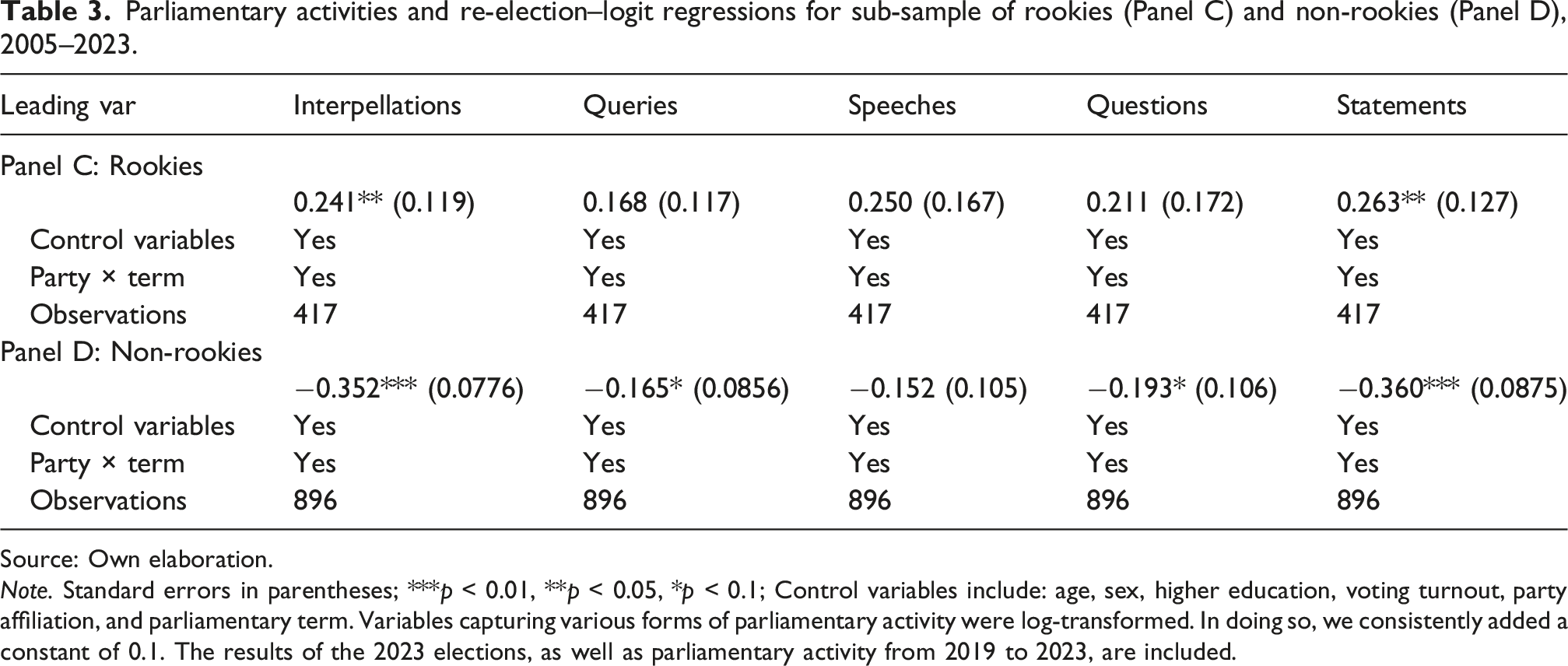
Parliamentary activities and re-election–logit regressions for sub-sample of rookies (Panel C) and non-rookies (Panel D), 2005–2023.
Source: Own elaboration.
Note. Standard errors in parentheses; ***p < 0.01, **p < 0.05, *p < 0.1; Control variables include: age, sex, higher education, voting turnout, party affiliation, and parliamentary term. Variables capturing various forms of parliamentary activity were log-transformed. In doing so, we consistently added a constant of 0.1. The results of the 2023 elections, as well as parliamentary activity from 2019 to 2023, are included.
In line with the abovementioned supposition, the results for these two groups differ markedly. For the rookie group, the coefficients of interest are consistently positive and are either statistically significant at conventional levels or close to being so. 11 This suggests that, for this group, active participation in parliamentary debate is positively correlated with the prospects of re-election. However, as argued above, this may reflect the fact that low-ranked MPs may reduce their activity in anticipation of a low probability of re-election. The estimated coefficient is, therefore, likely to be upward biased.
Moreover, this result may also be driven by an additional confounding factor in the form of unobserved innate activity. This can be understood as an MP’s baseline propensity for political engagement, both within parliament and beyond (for example, in the media, within the party, and in the local constituency). This propensity is not directly observed in the data but is likely to influence both activity levels as well as career outcomes. As this trait is expected to positively affect both parliamentary participation and re-election prospects, it would bias the coefficient of interest upwards. Hence, the observed positive association between parliamentary activity and re-election for rookies MPs may, at least in part, reflect this underlying effect. Notably, this confounder is likely to be particularly pertinent for less experienced MPs. Voters tend to be relatively less informed about this group, rendering individual traits more salient in electoral decisions. For more experienced MPs, by contrast, innate activity is likely to have been internalised at earlier stages of their political careers.
Interestingly, and in line with our earlier discussion, the results for non-rookies (Panel D) present a stark contrast. The relevant coefficients are consistently negative and, with the exception of speeches, statistically significant, suggesting that parliamentary activity is negatively associated with re-election prospects for this group. However, as with rookies, this pattern almost certainly reflects a confounding factor. Indeed, it is highly improbable that voters systematically monitor parliamentary activity in order to reward indolence. In this case, the confounder likely operates through the second mechanism previously described, whereby high-ranking MPs may pay little attention to their parliamentary activity precisely because their re-election is largely assured. 12
To provide additional evidence, the Annex presents results from models using continuous dependent variable. 13 Specifically, instead of using re-election dummy, we consider three distinct variables (always including electoral district fixed effects): the logarithm of the number of votes obtained by a given MP; the share of votes obtained within the party; and the logarithm of that share. This approach accounts for the fact that an individual’s re-election depends not only on their personal performance but also on the party’s broader electoral success. Consequently, it mitigates the concern that parliamentary activity may increase a candidate’s vote count, even if they are not ultimately re-elected. The relevant findings are reported in Tables A1-A3.
Each table reports the results for the respective dependent variable. The upper panel shows the results for the subgroup of MPs who succeeded in renewing their mandate, while the lower panel presents the results for the subgroup of MPs who did not. This distinction aims, at least in an imperfect way, to separate those with a higher party position/greater confidence of re-election from those with a lower party position/less confidence of being re-elected.
Overall, and in line with our main results based on the re-election dummy, we find that parliamentary activity is negatively associated with electoral support for MPs who succeeded in renewing their mandate. For MPs who were not re-elected, by contrast, we observe a positive relationship. Of course, these results should be interpreted subject to the same caveats as those applying to previous models.
First-position MPs versus lower-position MPs
This evidence clearly suggests that the relationship between parliamentary activity and re-election can be substantially affected by an individual MP’s position within the party hierarchy. To pursue this line of enquiry further, we look at the extent to which activity levels differ between MPs holding the first position on the electoral list and those seeking re-election from lower rankings. We assume that MPs at the top of the list enjoy a considerably stronger standing within the party than their peers.
To compare the behaviour of these two groups, we return to descriptive statistics. This choice is motivated by two considerations. First, descriptive statistics allow us to shed light on issues that cannot be fully explored through econometric models. For example, as we show below, there is no variation in the dependent variable among MPs placed first on the electoral list, as every individual in this category was re-elected. While this lack of variation precludes the use of econometric estimation for this specific group, descriptive statistics can still reveal the distinctive features of their parliamentary activity. Second, given the inherent limitations of the models employed, we treat descriptive statistics as being on an equal footing with the econometric results, rather than as a secondary or less informative source of insight.
The probability of re-election based on electoral list position: MPs from PiS and PO, 2005–2023.
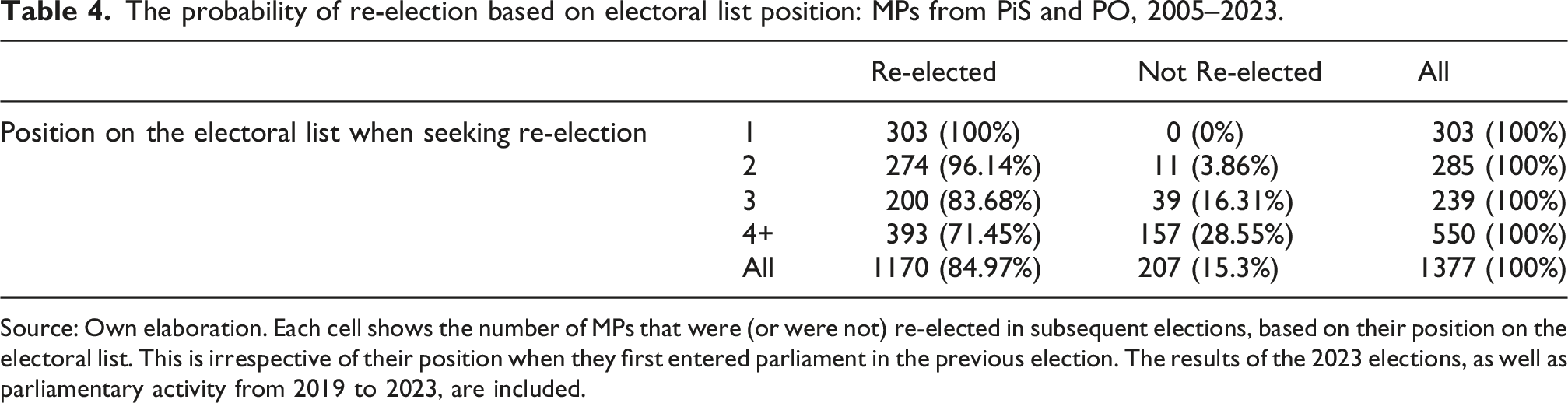
Source: Own elaboration. Each cell shows the number of MPs that were (or were not) re-elected in subsequent elections, based on their position on the electoral list. This is irrespective of their position when they first entered parliament in the previous election. The results of the 2023 elections, as well as parliamentary activity from 2019 to 2023, are included.
As shown, MPs from either PO or PiS who sought re-election from the top of the list always secured a mandate. Those positioned second also gained a seat with near certainty. While a third-place ranking did not guarantee re-election, it still offered a very high probability of success. 14 These observations strongly support the view that, for incumbent MPs, their standing within the party hierarchy (as proxied by their position on the electoral list) serves as a strong predictor of their electoral success.
Parliamentary activity of MPs (means) running for re-election and their position on the party list, 2005–2023.
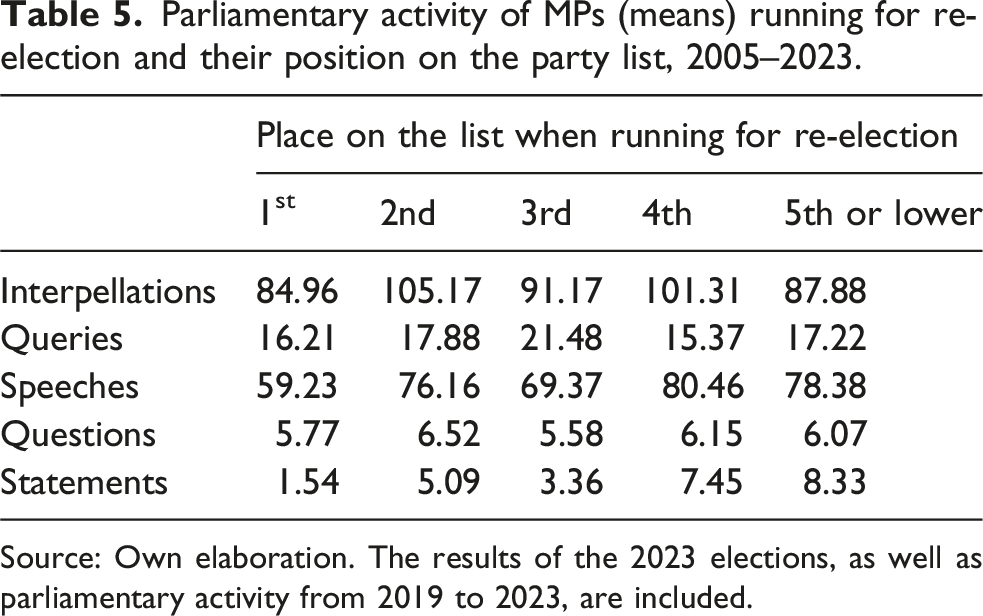
Source: Own elaboration. The results of the 2023 elections, as well as parliamentary activity from 2019 to 2023, are included.
Further evidence is provided in Figure 2, which presents the distribution of the log-transformed number of interpellations submitted by MPs elected from the first position on the list and those elected from lower positions. As shown, among the former group of MPs, there is a relatively large group with particularly low levels of parliamentary activity. In contrast, among MPs elected from lower positions, such a group is far less prominent. Importantly, a similar pattern emerges for other forms of parliamentary activity (the relevant histograms are presented in the Annex, see Figure A1). The distribution of the number of interpellations (logged) among MPs elected from the first position on the electoral list (left panel) and those elected from lower positions (right panel), 2005–2023. Source: Own elaboration. Note. Common logarithm function was used, with a constant of 0.1 added to each value.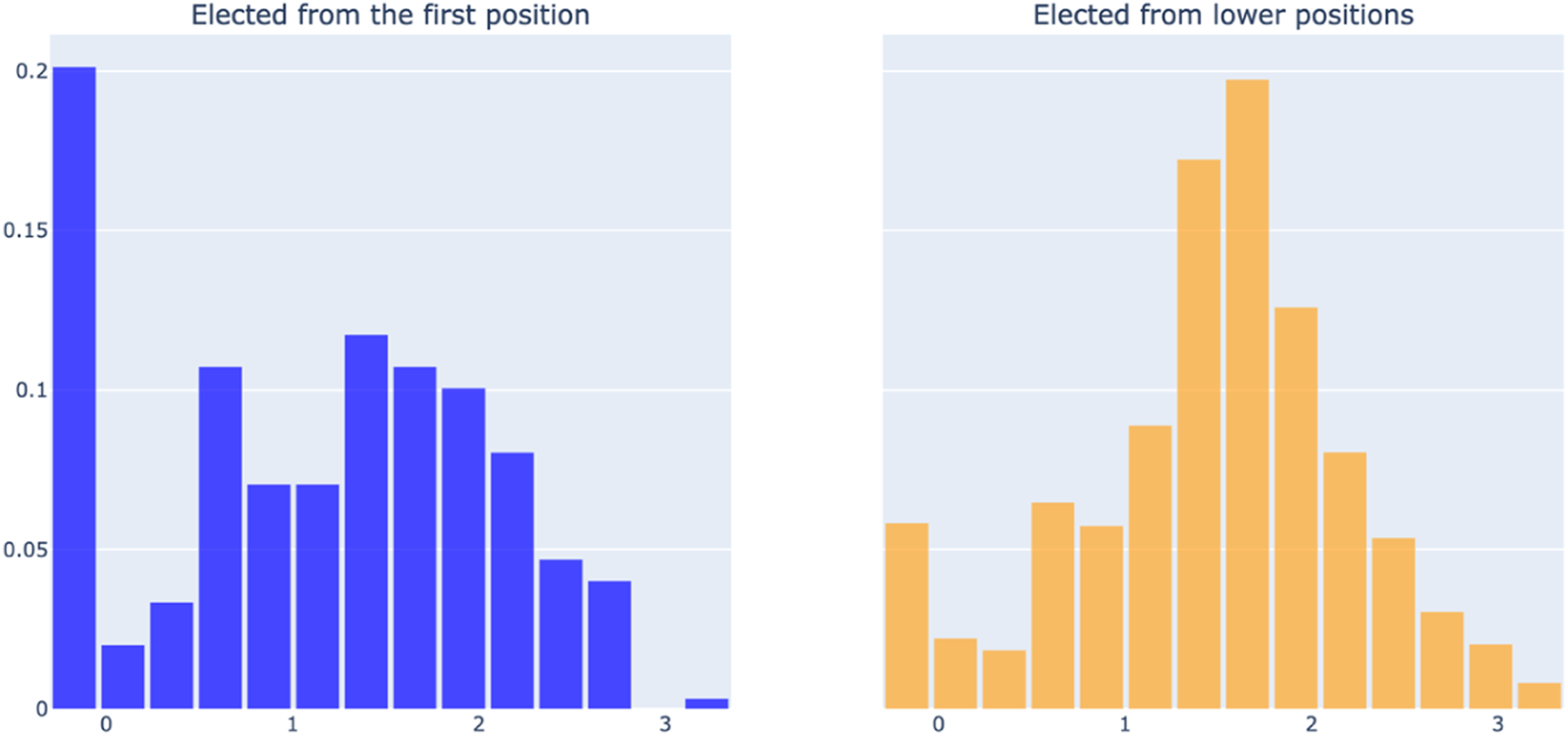
The two groups also exhibit significant differences in their voting attendance. Among MPs with a particularly high standing in the party, there is a consistently larger proportion who do not attend parliamentary votes regularly. This contrast is clearly illustrated in Figure 3, which shows the exponential of the share of votes attended by MPs elected from the first position (left panel) and those elected from lower positions on the electoral list (right panel). The distribution of the exponentiated percentage of votes attended by MPs elected from the first position on the electoral list (left panel) and by those elected from lower positions (right panel), 2005–2023. Source: Own elaboration. Note. The inverse of a common logarithm function was used.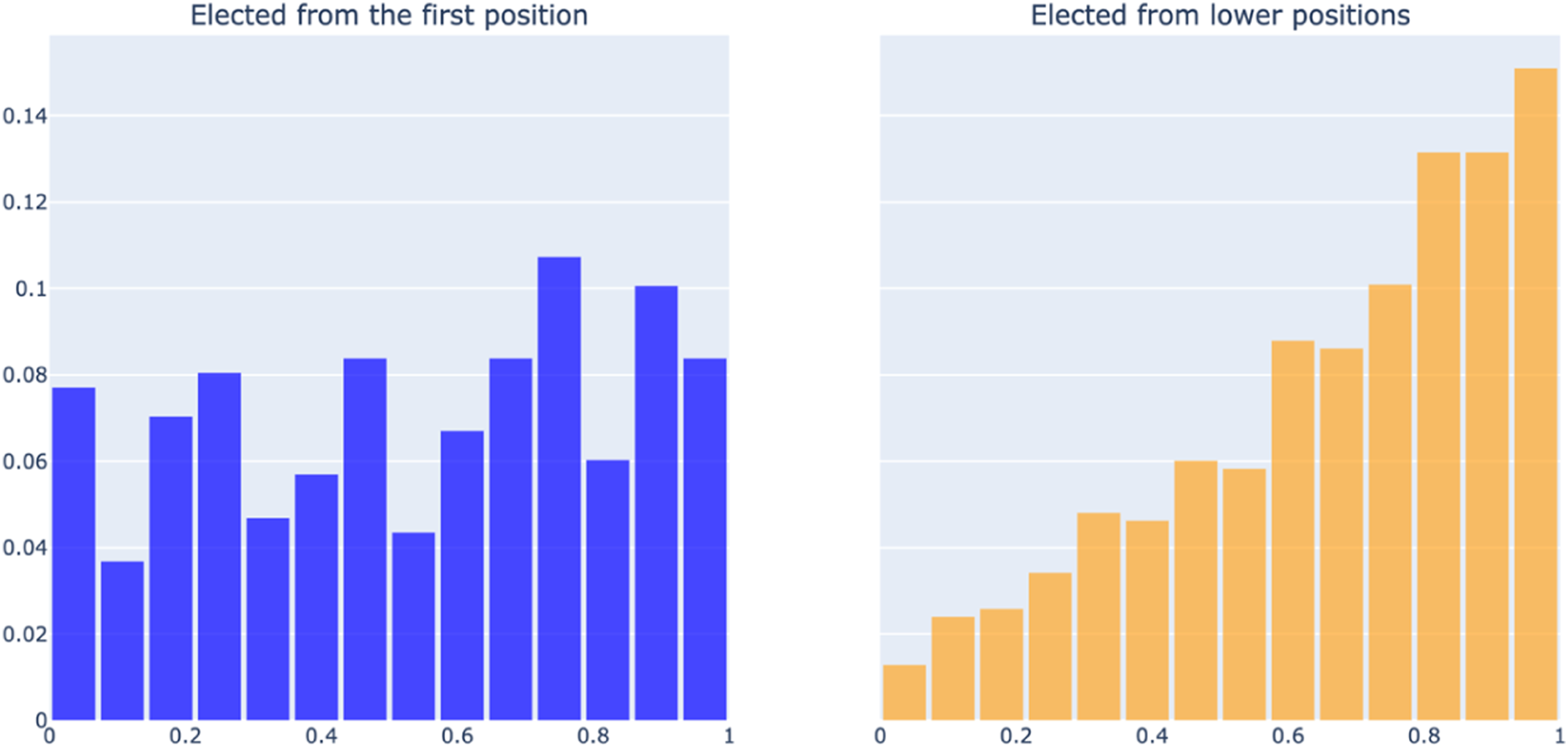
As this evidence clearly shows, MPs occupying the first position on the list not only can be certain to secure a seat in the subsequent elections. A large proportion of these MPs also differ markedly from MPs with lower positions on the list in terms of parliamentary conduct, showing lower levels of parliamentary engagement.
Limited reshuffling of electoral lists
Given the importance of list positions in Polish elections, in the next step we examine how frequently these positions change. Interestingly, in both parties, changes in list positions (and thus presumably in party hierarchy) were relatively rare. In other words, MPs who held favourable positions on the list in one election typically retained similarly high positions in subsequent elections. This pattern is clearly illustrated in Figure 4, which shows the incidence of changes in list position between successive elections. The top panel refers to MPs who were placed first on the electoral list, the middle panel to those ranked second or third, and the bottom panel to MPs who were fourth or lower. Changes in party list positions between subsequent elections for MPs from PiS and PO, 2005–2023. Source: Own elaboration. Note. The figure shows the number of MPs who held either first, second or third, or fourth and lower positions on party lists in elections at time t and t + 1.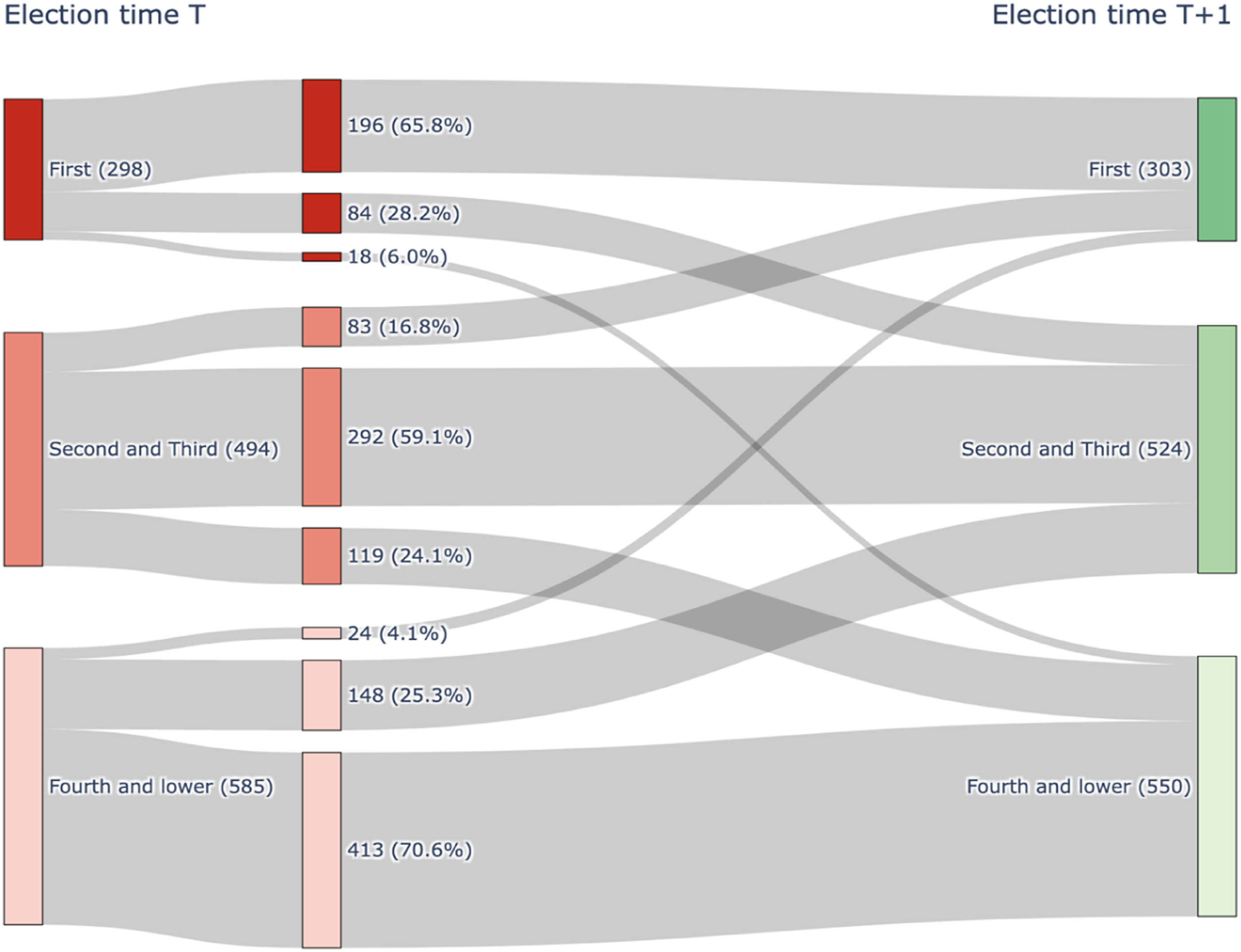
As shown, for the vast majority of MPs under consideration, their placement within a particular group has remained largely unchanged. In fact, at least 60% in each group retained their previous position on the list. Moreover, substantial shifts (such as moving from the bottom group to the top, or vice versa) were extremely rare. Among the 298 MPs who initially held the first position on the list, only 18 (6%) were moved to the fourth position or lower in the subsequent election. Conversely, just 4% of MPs who were initially ranked fourth or lower succeeded in reaching the top spot. Transitions between the top and the middle groups were somewhat more frequent but still relatively uncommon. It is also worth noting that the figures include cases in which a former list leader retired or moved to the European parliament. In such instances, the top position was vacated, and the replacement was, in effect, automatic. If these cases were excluded, the level of reshuffling on the electoral list would be even lower.
This relatively limited reshuffling may be important because it could have a demotivating effect on MPs with lower public recognisability. It suggests that active participation in parliamentary debate does not necessarily lead to a more favourable position on the electoral list. Consequently, this further calls into question whether, in the case under review, parliamentary activity can exert a positive effect on re-election.
Re-election among MPs with the lowest parliamentary activity
MPs with the lowest parliamentary activity and their re-election prospects.
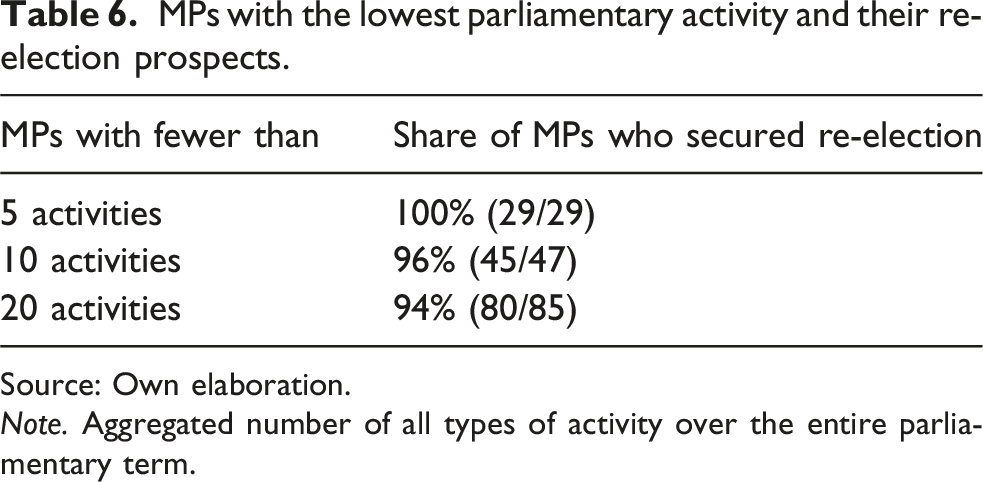
Source: Own elaboration.
Note. Aggregated number of all types of activity over the entire parliamentary term.
Furthermore, our data indicate that this least active cohort is predominantly composed of high-profile figures, including party leaders, prime ministers, ministers, and the speakers of the Sejm. Consequently, this provides strong evidence that parliamentary activity is inversely proportional to an individual’s position within the party hierarchy.
Discussion
Taken together, our results suggest that parliamentary activity did not enhance the re-election prospects of MPs from the two major parties, PiS and PO, in the Polish Sejm between 2005 and 2023. In fact, we find that representatives with the lowest levels of activity were among those most likely to secure a seat in subsequent elections. This is surprising given that, under the electoral system analysed, preference votes are the sole determinant of the order in which candidates are elected. We argue that this outcome is largely due to the strong influence of party-provided rankings of candidates on electoral lists on voter behaviour. This may occur because voters pay little attention to individual candidates, effectively casting their vote for a party, or because candidates lower on the list differ in quality from those at the top.
Regardless of the underlying motive, we believe that candidate rankings largely reflect internal party hierarchies. Those with an established standing are awarded safe positions on the electoral list, offering (an almost) guaranteed seat in parliament, whereas those with less influence are placed lower down. As our findings show, these hierarchies appear relatively static, as reflected in the limited variation in list placements over time. Consequently, parliamentary activity does not seem to translate into a stronger position within the party. This does not, of course, preclude the possibility that extra-parliamentary engagement (such as media presence or internal party campaigning) may be more important in this regard. While we cannot investigate it directly, this seems highly likely.
Overall, our results suggest that party hierarchies may substantially constrain the effectiveness of democratic accountability mechanisms. This finding is consistent with previous studies emphasising the limited decisive power of voters under proportional representation (Passarelli, 2020). It is also fully in line with the literature showing that ballot position, controlled by party elites, strongly affects re-election prospects (for analyses of Poland, see, for example, Marcinkiewicz, 2014; Marcinkiewicz and Stegmaier, 2015).
Furthermore, an MP’s unobserved standing within the party hierarchy introduces a critical confounding variable when modelling the impact of parliamentary activity. Because this standing determines incentives to engage in such work, for instance by influencing list placement, omitting it may lead to biased estimates of how activity actually affects electoral outcomes. This causal structure is illustrated schematically in the Directed Acyclic Graph (DAG) in Figure 5 (Pearl, 2009). Factors influencing re-election chances. Source: Own elaboration.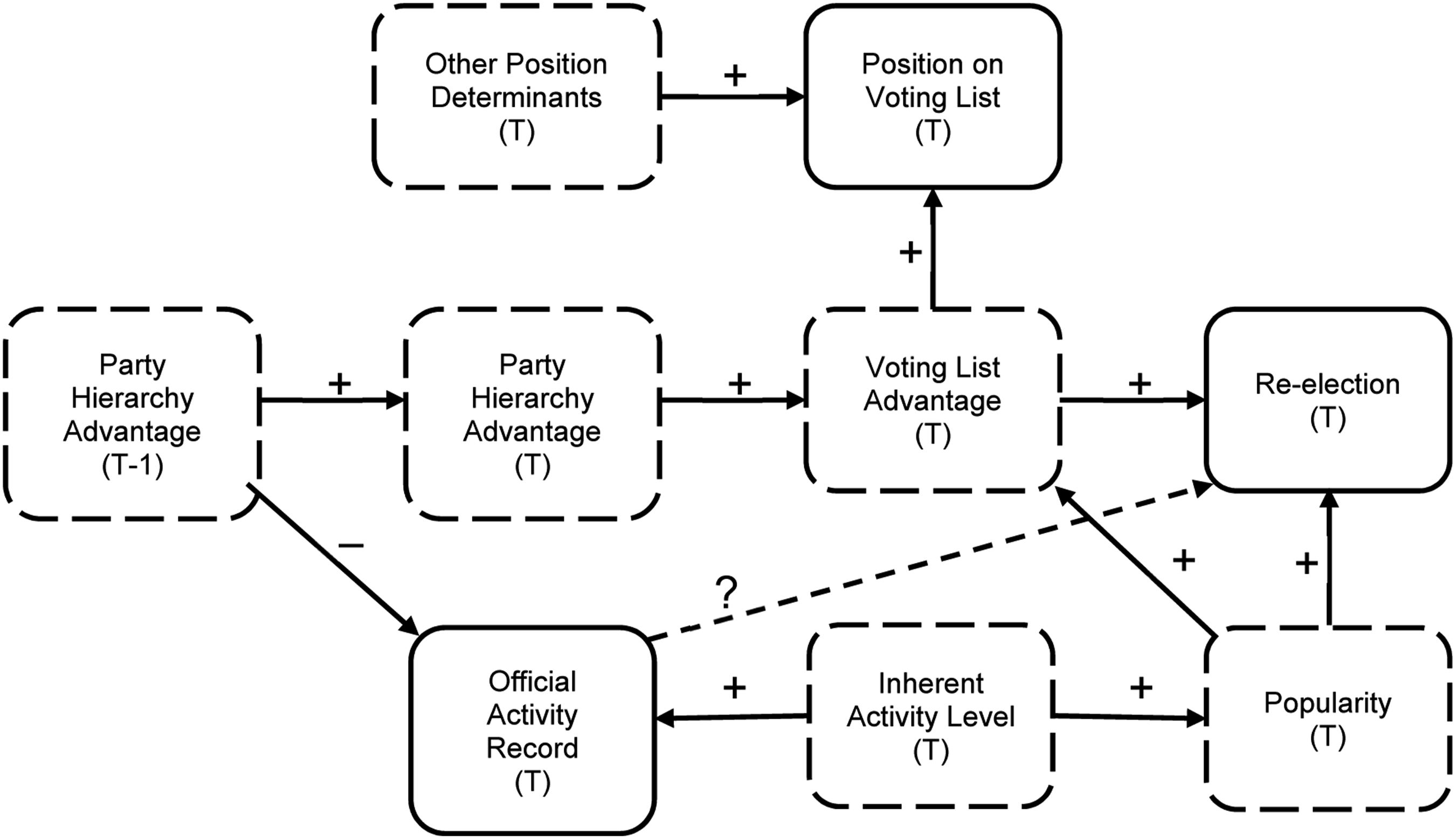
Before we proceed, two caveats are in place. First, we do not claim that the presented graph is fully specified (i.e., that it correctly identifies all possible relationships). 15 Rather, our point is that, even if not fully specified, the graph aligns well with our data and remains useful in highlighting potential challenges a modeller may encounter when analysing the relationship between parliamentary activity and re-election. Second, we acknowledge that the external validity of our graph may be limited, as it is designed to capture the specifics of elections to the Polish Sejm. Nevertheless, we believe that it can still be useful in highlighting issues that may also be relevant in other contexts. We therefore hope that it can serve as a guide, even if only a partial one, for future studies by indicating which mechanisms to examine and which challenges need to be addressed. As such, it should be viewed as a contribution to the broader discussion on modelling the relationship between parliamentary activity and re-election.
In the graph, we use the following notation. Observed variables are enclosed by a solid line, whereas unobserved factors are enclosed by a dotted line. Arrows represent direct relationships between the variables, with the direction of the arrow indicating the direction of causality.
Applying this method may be particularly useful, as it can clearly illustrate the key findings from our analysis and highlight the main implications they suggest. To begin with, it is typically assumed that both parliamentary activity and position on the electoral list independently influence re-election. However, our research points to a more complex scenario. First, we propose viewing the position on the electoral list not as a direct determinant, but rather as a proxy (and possibly an imperfect one) for a candidate’s position within the party hierarchy. Hence, our graph questions the existence of a direct relationship between list position and re-election. This is because what seems to matter for re-election is not the position on the list itself, but rather its interaction with the constituency from which an individual seeks re-election. As the Polish case clearly illustrates, being third or fourth on the list of PO or PiS may guarantee a seat in parliament from one constituency, but not necessarily from another. In our DAG, this is represented by the variable voting list advantage, which, in turn, is determined by a candidate’s position within the party hierarchy.
Moreover, our DAG incorporates not only the position within the party hierarchy at the time of election (time T-1), but also at the time of re-election (T). This reflects the fact that, as discussed earlier, changes in this position are relatively rare and can be considered an autoregressive process with a positive coefficient. Importantly, position within the intra-party hierarchy is unobservable (and cannot be directly measured), as indicated by a dotted box around these variables. As a result, it is not possible to include it explicitly in the modelling. Furthermore, as indicated on the graph, intra-party position can directly affect MPs’ incentives to engage in parliamentary activity, regardless of whether they are low-ranked or high-ranked. These characteristics, in turn, may have serious implications for estimating the impact of parliamentary activity on re-election outcomes. If rank within the party hierarchy affects parliamentary activity, then failing to control for position within the party is likely to confound the relationship between MPs’ activity and re-election prospects. For low-ranked MPs the confounding is likely to be positive, whereas for high-ranked MPs it is likely to be negative.
Importantly, our DAG also suggests a second source of bias in the estimated effect of MPs’ activity on re-election. This stems from our inability to account for inherent individual activity, which is also unobservable. It is reasonable to assume that MPs’ tacit skills and predispositions influence their parliamentary activity and can easily affect their popularity through various other channels. In turn, these two factors will impact individuals’ chances of re-election. The inability to account for inherent activity levels in the model would positively confound the relationship of interest.
Overall, it is difficult to predict which of the confounders will dominate. One might suspect that attempting to account for one, even imperfectly, is likely to amplify the apparent importance of the other. 16 Therefore, even partial control of both confounders cannot be assumed to bring the estimated coefficient closer to its true value. The quality of such control is unknown, and it is hard to guess which confounder would prevail.
Concluding remarks
To date, there has been limited international empirical research exploring the link between parliamentary activity and re-election, particularly in Central Europe and Poland. This paper aims to partially address this gap by investigating the relationship in question using data from the Polish Sejm covering the period 2005–2023. Our focus was on MPs from the two main parties: Law and Justice (PiS) and Civic Platform (PO).
Our results suggest that, within the Polish context, parliamentary activity does not systematically increase re-election prospects of the majority of MPs. In fact, our initial models indicate a negative association between activity levels and electoral success. We also find that MPs with the lowest levels of engagement maintain a very high likelihood of securing a seat in subsequent elections. These patterns are difficult to reconcile with the notion that voters reward parliamentary performance. Instead, our evidence points to the decisive role of an MP’s position within the party hierarchy in shaping voter perceptions and electoral outcomes. This is further illustrated by the strong influence of an MP’s position on the electoral list on their chances of re-election, with movement up or down the list being relatively rare, regardless of the party concerned. A possible extension of this study would be to analyse the conditions under which voters challenge the prescribed ranking on the ballot. Investigating whether parliamentary activity plays any role in this process would offer further insights into representative accountability.
Our results should be interpreted with the following points in mind. First, our focus is on activities undertaken within parliament, and the findings should not be generalised to all forms of MPs’ activity. It cannot be ruled out that, while voters may not reward parliamentary work in the form of queries or interpellations, they could be more responsive to efforts undertaken outside parliament (Bräuninger et al., 2024). Such activities include media appearances or direct interactions with voters at election rallies or in local constituencies. These forms of involvement are likely to be more visible to voters and may therefore carry greater electoral returns than parliamentary activity. In addition, online communication, which may substitute for activity within parliament, should also be acknowledged. Unfortunately, data limitations prevent us from analysing these forms of behaviour. One potential avenue for future research would be to integrate data on parliamentary activity with information on MPs’ interaction with their constituencies, including their use of social media.
Second, our analysis assesses parliamentary performance using only quantitative indicators. This is undoubtedly a limitation, as it overlooks the quality and effectiveness of parliamentary work (Schobess, 2022). To the extent that voters focus solely, or predominantly, on these qualitative aspects, this may help to explain our findings. Unfortunately, the nature of our data does not allow for such an analysis. Nor are we able to evaluate the extent to which different types of parliamentary activity are directed towards issues specific to a candidate’s electoral district. 17
Another important consideration when discussing our results is the identification strategy and relatively simple models we employ. Clearly, our approach does not fully address the issue of causality. However, it is worth emphasising that our findings do not support a positive relationship between parliamentary activity and re-election even in a correlational sense, which in itself is quite telling.
While our study does not resolve every ambiguity concerning the electoral consequences of legislative behaviour, we hope it offers a more nuanced understanding of the dynamics between parliamentary activity and re-election. At a local level, it contributes to the ongoing debate surrounding the Polish political landscape (Bełdowski et al., 2024; Czernek, 2018; Piękoś, 2020). More broadly, although our approach is tailored to the Polish context, it provides a methodological framework that can offer valuable insights for scholars investigating the relationship between parliamentary activity and re-election across diverse institutional settings.
Supplemental material
Supplemental material - The limited electoral payoff of parliamentary work: Insights from the polish parliament, 2005–2023
Supplemental Material for The limited electoral payoff of parliamentary work: Insights from the polish parliament, 2005–2023 by Jan Fałkowski, Przemysław Kurek, Jacek Lewkowicz, Adam Janczyszyn in Party Politics.
Footnotes
Acknowledgements
The authors are grateful to the participants of the 60th Annual Meetings of the Public Choice Society in Seattle, the European Public Choice Society 2023 conference in Hannover, and the 2023 World Interdisciplinary Network for Institutional Research conference in Catania. The views, thoughts, and opinions exposed in this text are those of the authors alone, and do not necessarily reflect those of their employers, affiliated organisations, committees or any other associated groups or individuals.

Funding
The authors disclosed receipt of the following financial support for the research, authorship, and/or publication of this article: This research has been financed under the Opus 19 Program of the National Science Centre (NCN), Poland (project no: UMO-2020/37/B/HS4/00787).
Declaration of conflicting interests
The authors declared no potential conflicts of interest with respect to the research, authorship, and/or publication of this article.
Supplemental material
Supplemental material for this article is available online.
Notes
Author biographies
References
Supplementary Material
Please find the following supplemental material available below.
For Open Access articles published under a Creative Commons License, all supplemental material carries the same license as the article it is associated with.
For non-Open Access articles published, all supplemental material carries a non-exclusive license, and permission requests for re-use of supplemental material or any part of supplemental material shall be sent directly to the copyright owner as specified in the copyright notice associated with the article.
