






Abstract
How does the provision of political appointments influence coalition support in multiparty presidential systems? While the importance of cabinet portfolios for coalition governments is well-established, lower-tier positions have received less attention being limited to compensations for weak policy-making capabilities. In multiparty presidential systems, however, these appointments also function as bargaining chips during coalition formation. I argue that bureaucratic appointments help sustain coalition support, especially during votes on bills issued by the executive power. Analyzing roll-call data from Brazil’s Chamber of Deputies (2003–2018) across 161 bills, I find that besides ministerial portfolios, lower-tier appointments strongly increase legislative support, highlighting the strategic use of patronage under high political stakes. These findings contribute to understanding coalition management strategies in fragmented presidential systems.
Introduction
How does the provision of political appointments influence coalition support in multiparty presidential systems? Research on coalition governments has largely focused on cabinet portfolios as the main tool for securing legislative support (Bäck et al., 2009; Baron and Ferejohn, 1987; Browne and Franklin, 1973; Carroll and Cox, 2007; Warwick and Druckman, 2001). Yet heads of government also rely on mechanisms beyond portfolio allocation, notably the appointment of party affiliates to leadership and operational roles in ministries and regulatory agencies (Kopeckỳ, 2011; Kopeckỳ and Mair, 2012). Appointments to lower-tier bureaucratic posts may be an underappreciated but potent means of consolidating legislative coalitions. This study expands the scholarship of coalition politics in multiparty presidential systems by examining the political value of such appointments in sustaining coalition support.
To explore how appointments influence coalition behavior, I adapt Strøm and Müller’s (1999) framework of party behavior to coalition governance in presidential systems. The authors classify political behavior into vote-, office-, and policy-seeking, noting that these profiles are not mutually exclusive, though actors may emphasize one depending on their goals. I focus on the office-seeking aspect but shift attention from cabinet portfolios to bureaucratic appointments to assess how these shape coalition dynamics.
Although most studies of coalition stability emphasize cabinet appointments (Albala et al., 2023; Freudenreich, 2016; Praça et al., 2011; Raile et al., 2011), less is known about the role of non-ministerial posts (Panizza et al., 2022). Research also remains centered on parliamentary regimes (Adams, 2012; Angelova et al., 2016; Fernandez-Vazquez and Somer-Topcu, 2019; König et al., 2022; Schermann and Ennser-Jedenastik, 2014; Sieberer et al., 2021; Warwick, 2001), even though presidential systems follow distinct patterns of coalition governance (Freudenreich, 2016). Recent studies extend attention beyond the cabinet (e.g., Batista, 2023; Batista et al., 2024; Kim, 2020; Mamshae, 2025; Toral, 2024). Among these, Bersch et al. (2023) examine how such appointments affect a president’s legislative capacity, yet the extent to which bureaucratic appointments function as bargaining resources to boost coalition support remains unclear.
Building on the literature on portfolio allocation, I argue that cabinet and non-ministerial appointments influence coalition support: parties receiving a greater share of posts are more likely to back the executive. Lower-tier appointments are effective because they attract less scrutiny and can be distributed more widely, offering patronage benefits at low political cost. I test these expectations using Brazil as a crucial case of coalition management under high fragmentation and recurring minority governments (Mainwaring, 1999; Mainwaring and Scully, 1995; Power, 2010). In such systems, legislative coalitions are sustained not by formal agreements but by informal contracts (Kellam, 2017). Instability rarely triggers government collapse and is instead managed through negotiation, often involving new ministerial posts or additional partners (Freudenreich, 2016). I combine two datasets: roll-call votes on 161 executive-initiated bills in the Chamber of Deputies (2003–2018) and records of bureaucratic appointments by coalition parties, assessing how post distribution correlates with legislative support. The regression models show that parties holding more appointments are significantly more likely to support presidential bills. Lower-tier appointments exert a particularly strong positive effect on legislative behavior.
Cabinet coalitions and political appointments in presidential systems
In presidential systems, legislative coalitions revolve around a reciprocal exchange of support for office payoffs (Batista and Lopez, 2021; Neto, 2006). Geddes (1994) argues that presidents seek to extend their governments’ survivability by building administrations capable of passing policies or securing legislative backing. I define support as the approval of bills favored by the president, as a means to improve efficiency and government approval rates (Elgie, 2016). In principle, coalition membership should guarantee legislative support proportional to the coalition’s seat share. In return, the government offers office payoffs to coalition partners, such as cabinet portfolios and discretionary budget allocations (Gamson, 1961; Raile et al., 2011).
While the literature emphasizes party-level dynamics, coalition payoffs often target individual legislators, who must balance electoral goals with coalition expectations (Carey, 2007). Legislators pursue visibility and reputation that shape their responsiveness to coalition incentives (Pereira and Mueller, 2004). In systems with personalistic politics and open-list proportional representation, legislators often prioritize constituency service over party loyalty (Ames, 2002; Desposato, 2006a). Those anticipating rewards for loyalty – or penalties for defection – are more likely to vote in line with the government (Neto, 2018).
The allocation of cabinet portfolios is central in coalition studies (e.g., Batista, 2017; Carroll and Cox, 2007), yet the importance of alternative payoffs, such as non-ministerial appointments, remains less explored. Gamson’s Law (Gamson, 1961) posits that portfolios are distributed proportionally to legislative seat share (Carroll and Cox, 2007; Ecker and Meyer, 2019; Warwick and Druckman, 2001). Other studies emphasize disproportionality based on coalition size (Browne and Franklin, 1973), electoral capacity (Snyder Jr et al., 2005), or the strategic implications of portfolio allocation (Warwick and Druckman, 2006).
Research on appointments beyond the cabinet is mostly framed through the lens of patronage, typically linked to corruption and inefficiency (Bach et al., 2018; Ennser-Jedenastik, 2016; Kopeckỳ et al., 2016). Yet Praça et al. (2011) show that patronage can also serve coalition management, particularly in fragmented party systems where legislative support is uncertain. Rather than focusing on its negative aspects, I emphasize the strategic use of appointments as a mechanism for securing legislative backing (Praça et al., 2022; Toral, 2024). Following Raile et al. (2011), I treat these appointments as a core component of the presidential “toolbox” for aligning individual incentives with coalition stability.
Institutional features of presidential systems often hinder proportional portfolio allocation, prompting presidents to combine direct and indirect payoffs to secure support (Albrecht, 2022; Batista and Lopez, 2021). Directly, presidents control ministerial appointments, the most visible and scarce rewards. Indirectly, through ministers, they influence lower-tier bureaucratic appointments, which are more abundant and flexible. Recent findings by Chaisty and Power (2024) show that Gamson’s Law rarely applies in presidential systems. Consequently, portfolio distribution alone cannot explain coalition stability (Kellam, 2015). Greater executive discretion and fragmented party environments make alternative forms of compensation essential (Neto, 2018; Raile et al., 2011). The goal is to ensure legislative approval for the administration’s agenda or block proposals that threaten it (Cheibub et al., 2004; Elgie, 2016; Raile et al., 2011).
Presidents frequently resort to non-ministerial appointments, such as posts in state-owned enterprises or regulatory agencies, to secure support from pivotal but under-rewarded partners (Batista, 2017; Bersch et al., 2023). These positions, along with other high-tier appointments, offer visibility, policy influence, and platforms for future campaigns (Chaisty and Chernykh, 2017; Lopez and Praça, 2015; Pereira and Melo, 2012; Praça et al., 2011). Most appointments, however, involve lower-level bureaucratic posts outside the cabinet and beyond senior party figures. While ministerial portfolios are powerful but limited, non-ministerial appointments give executives greater flexibility to reward allies (Gingerich, 2013; Lopez and Moreira, 2022). These can be allocated discreetly, often bypassing public scrutiny, which is an advantage in multiparty presidential systems where satisfying many actors without attracting criticism is essential.
Beyond short-term coalition management, non-ministerial appointments also serve as long-term tools of party management, strengthening institutional presence and clientelist networks (Kopeckỳ and Mair, 2012). Bersch et al. (2017) show that politicized administrative appointments sustain party control over state resources, further blurring the line between governing and campaigning. Thus, parties may accept lower-tier positions as opportunities to entrench influence within the state.
Expectations on the impact of appointment allocation over coalition support
Scholars have long examined how coalition stability depends on distributing bureaucratic positions among coalition members (e.g., Neto, 2018; Raile et al., 2011). Despite the prominence of portfolio allocation, its effect on party discipline and coalition support remains ambiguous in presidential systems (Couto, 2025; Negretto, 2006). Because coalition loyalty is never guaranteed, ideologically diverse coalitions pose challenges for governments seeking to pass legislation (Kellam, 2015). Although cabinet reshuffles and portfolio distribution help sustain coalitions, legislators may still have motivation to defect. I expect legislators to respond positively when their party gains portfolios, viewing them as recognition of strategic value.
Ministerial portfolios signal coalition hierarchy but are constrained by institutional limits and political costs (Carroll and Cox, 2007). Their impact lies partly in signaling inclusion: when parties gain additional portfolios, they acquire policy influence and symbolic standing within the coalition. Legislators interpret this as strategic compensation for loyalty (Morgenstern, 2004; Strøm and Müller, 1999; Warwick and Druckman, 2001), reinforcing party cohesion in roll-call votes.
Beyond symbolic inclusion, cabinet appointments confer institutional power that shapes policy outcomes and legislative strategy. Ministries control budgets, administrative resources, visibility, and policy agendas, heightening the political stakes of legislative behavior. Legislators may support the president not only out of loyalty but also to avoid reputational and policy costs of defection. Thus, ministerial appointments function as coalition-balancing tools and as nodes of agenda control that anchor legislative commitment.
The larger the share of portfolios a coalition partner holds, the more supportive of the president its legislators will be.
Although portfolio allocation is central to coalition bargaining (e.g., Verzichelli, 2008), non-ministerial appointments also play a crucial role in sustaining legislative support. In presidential systems, proportional distribution per Gamson’s Law often breaks down: parties are unequally represented in the bureaucracy, and demands for office payoffs persist (Chaisty and Power, 2024). I expect these appointments to be effective in maintaining coalition cohesion when allocated in response to emerging legislative needs. Parties benefiting from such posts signal their importance within the coalition and are more likely to deliver votes in return.
Bureaucratic appointments also reinforce intra-coalition commitment and help manage internal party dynamics by rewarding factions and regional elites. These posts are easier to distribute and can satisfy regional power brokers or second-tier operatives (Kopeckỳ et al., 2016; Panizza et al., 2022; Praça et al., 2022). I further classify these positions as upper-tier roles overseeing policy execution and lower-tier roles with operational functions. This mechanism aligns with theories of coalition maintenance in fragmented systems, where continuous “maintenance” through appointments reduces transaction costs in contexts of weak party discipline (Desposato, 2006a; Pereira and Melo, 2012). Therefore, bureaucratic appointments function both as rewards and as instruments of control and coordination within decentralized party structures.
Another channel through which non-ministerial appointments influence legislative behavior is clientelism, particularly via lower-tier positions tied to local resource distribution (Ames, 1995; Lyne, 2008). These posts strengthen incentives for legislators to align with executive preferences when their party benefits from them (Panizza et al., 2019; Pereira and Mueller, 2004). Unlike cabinet ministries, which shape broad policy areas, lower-tier appointments often serve constituency-oriented goals (Bersch et al., 2017; Toral, 2024). This mechanism is especially relevant in systems with weak programmatic linkages and high electoral volatility (Kitschelt et al., 2010). Thus, I expect non-ministerial appointments to help sustain legislative support as a presidential strategy.
The larger the share of upper-tier positions a coalition partner holds, the more supportive of the president its legislators will be.
The larger the share of lower-tier positions a coalition partner holds, the more supportive of the president its legislators will be.
Case selection
To test the hypotheses, I examine Brazil between 2003 and 2018. The country’s highly fragmented party system makes it nearly impossible for any president’s party to hold a legislative majority (Mainwaring, 1993; Power, 2010). Building coalitions is therefore essential for policy approval and government stability. This arrangement, known as Coalitional Presidentialism (Abranches, 1988), combines a powerful presidency with a fragmented multiparty system and weakly disciplined parties (Limongi and Figueiredo, 1998). Office payoffs serve as the president’s main currency to attract party support, often regardless of ideological or programmatic alignment (Power, 2010).
In Brazil, legislative coalitions are not necessarily pre-electoral alliances (Albala, 2021; Kellam, 2017). They are negotiated after elections and can shift as parties join or exit depending on political context, presidential performance, or public opinion. Figure 1 illustrates the composition of the Chamber of Deputies (Lower House) during the analyzed period.
1
No president’s party ever reached 20% of the seats, making coalitions indispensable for governability and policy passage.
2
Composition of Chamber of Deputies (2003 – 2018) (Source: NIPE CEBRAP, 2021).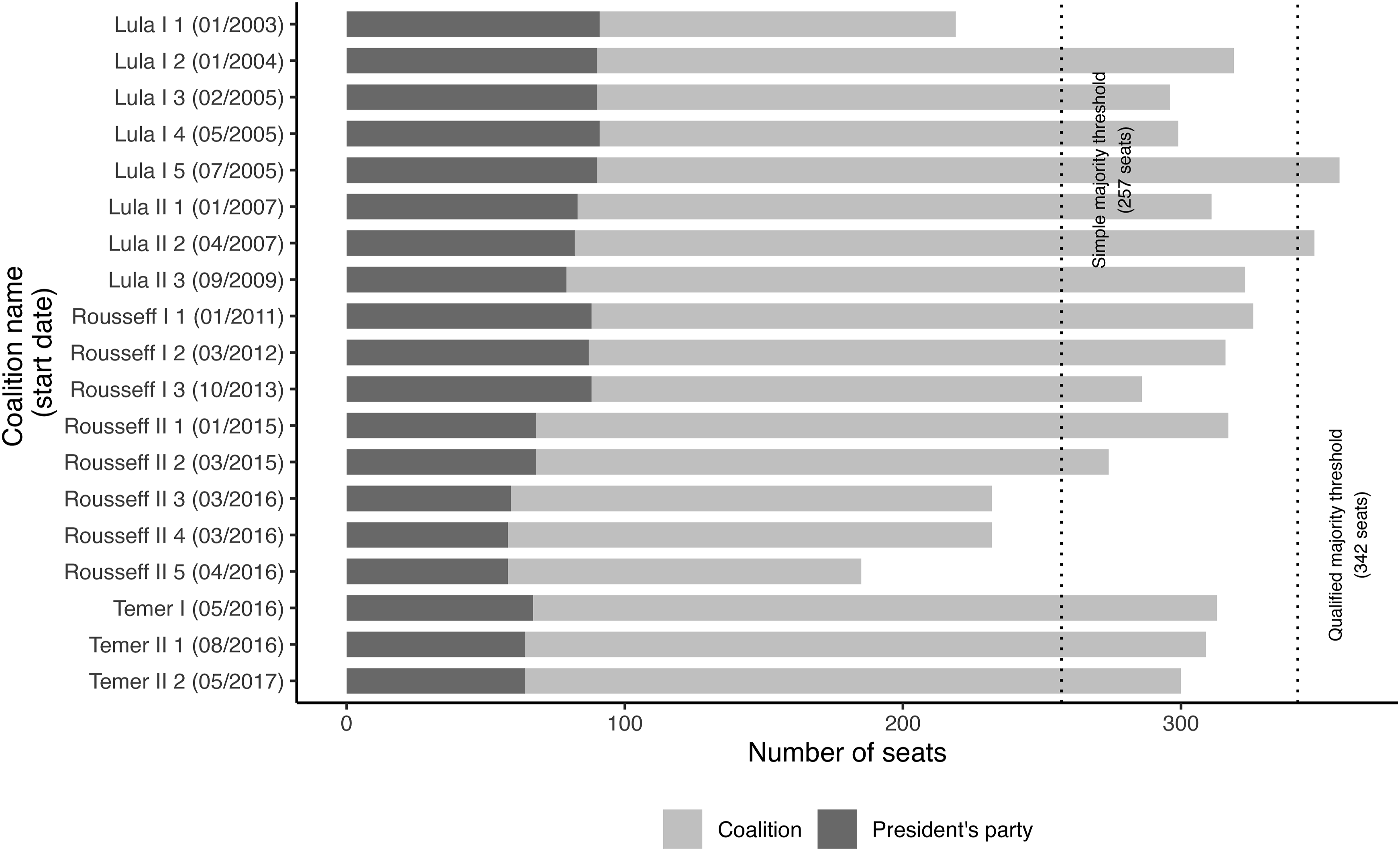
Coalitional presidentialism has characterized Brazilian governance since redemocratization, but its fragility often triggers dysfunction and political crises (Junior et al., 2015; Power, 2010). The system can collapse when coalition demands exceed presidential capacity to deliver. During Rousseff’s second term (2015–2016), coalition disobedience and societal pressure culminated in her impeachment under accusations of violations of fiscal law (Chalhoub et al., 2017). As shown in Figure 1, Rousseff’s coalition changed four times within a month as parties withdrew prior to her removal.
Coalition composition seldom follows ideological lines and is largely driven by the payoffs members expect for their support (Abranches, 1988; Ames, 2002). Only a few parties maintain consistent ideological positions (Zucco and Power, 2021), underscoring the limited relevance of programmatic labels that matter elsewhere. Borges and Ribeiro (2021) note that in systems dominated by strong presidents, legislative parties often exhibit low ideological cohesion, enabling executives to secure backing through pragmatic bargaining. This also explains frequent party switching, reinforcing perceptions of weak coherence.
Brazil is particularly suited to test these hypotheses given its extreme fragmentation and reliance on coalition governments (Mainwaring, 1999; Mainwaring and Scully, 1995; Power, 2010). The prevalence of non-programmatic parties prioritizing office payoffs over policy agendas underscores the role of appointments in coalition dynamics (Bolognesi et al., 2023; Desposato, 2006a; Lucas and Samuels, 2010). This dependence on loosely aligned partners compels presidents to continually negotiate legislative backing, often through patronage-based incentives (Pereira and Melo, 2012; Zucco and Lauderdale, 2011).
Methods and data
To test the hypotheses and assess how appointments influence coalition support, I analyze roll-call votes on 161 bills issued by the executive and discussed in the Brazilian Chamber of Deputies between 2003 and 2018. Several studies examine the power presidents hold in shaping the policymaking process (Alemán and Calvo, 2010; e.g., Alemán and Navia, 2009; Borges and Ribeiro, 2021). However, less is known about the extent to which presidents can influence support from coalition partners in detail. The dependent variable measures whether a coalition deputy supports a bill during a roll-call vote, coded 1 if the deputy follows the president’s recommendation and 0 otherwise (including abstentions). Data come from the Brazilian Center of Analysis and Planning (CEBRAP) (NIPE, 2021). These include all final roll-call votes, excluding procedural decisions (e.g., adjournments). 3 The dataset records each deputy’s vote and the president’s position for each bill, restricted to deputies from coalition parties during each vote. Details on the number of bills and votes by government and the number of coalition deputies attending roll-call sessions are available in the Supplemental Appendix. In Brazil, not all bills are subject to roll-calls; only specific types (e.g., constitutional amendments) require them. Most bills are decided symbolically, with party whips announcing their bloc’s stance and the Speaker proclaiming the result (Figueiredo and Limongi, 2001; Zucco and Lauderdale, 2011). Ordinary bills only have roll-call voting when requested by party whips. Roll-call votes are typically reserved for politically sensitive issues that reveal legislators’ behavior (Desposato, 2006b; Figueiredo and Limongi, 2000).
The main independent variable is the share of appointments a coalition party receives in a given year, measured as its proportion of total positions allocated to all coalition partners. Positions are divided into three categories: ministerial, non-ministerial upper-tier, and non-ministerial lower-tier. Political appointments follow the Senior Management and Advisory (Direção e Assessoramento Superior, DAS) framework, which classifies posts from DAS 1 (lowest) to DAS 6 (highest). Ministers distribute them among coalition partners in exchange for legislative support (Borges and Coêlho, 2015; Lopez and Moreira, 2022). These are discretionary positions of trust filled at the appointing authority’s discretion (Lopez and Praça, 2015; Praça et al., 2012, 2022). I classify DAS 1–3 as lower-tier appointments (operational functions), and DAS 4–6 as upper-tier appointments (managerial functions) (Lopez et al., 2015). Hypothesis H1 refers to ministerial appointments, while hypotheses H2a and H2b examine non-ministerial appointments, distinguishing between upper- and lower-tier positions. Data on appointments come from the Brazilian National School of Public Administration (da Escóssia et al., 2020; Equipe CGDADOS, 2019), which reports federal appointments and the appointees’ party affiliations between 2003 and 2018 4 .
Controls
Several additional variables account for factors that may influence coalition support in roll-call votes: Coalition size controls for legislative capacity and internal fragmentation: larger coalitions may secure broader support but face coordination and ideological challenges (Calvo et al., 2015; Meireles, 2016; Zucco and Power, 2021). Bill salience is a binary variable identifying bills with special procedures, namely provisional measures (MPVs) and constitutional amendments (PECs). I assign salience to these bills because of their specific purposes. MPVs are bills issued by the executive, often concerning urgent matters such as emergency financial packages, and which have immediate effect but require congressional approval within a limited period (Figueiredo and Limongi, 2000; Limongi and Figueiredo, 1998; Rennó, 2010). PECs aim to modify the constitution and typically demand broader congressional support due to their political significance (Freitas, 2016). Presidential approval, from the Executive Approval Project (Carlin et al., 2025), measures the effect of public opinion on coalition discipline, as higher approval correlates with stronger legislative backing (Pereira et al., 2005). Party cohesion captures the influence of party whips in enforcing discipline (Ceron, 2015; Lyne, 2008; Pereira and Mueller, 2004; Zucco and Lauderdale, 2011). It is calculated as the average vote alignment of party members during roll-calls, reflecting whip effectiveness during their tenure. After election (1
st
round) is a binary variable indicating whether a roll-call occurred after the first round of national or local elections, following studies showing that proximity to elections reduces support for government policies (Altman, 2000; Limongi and Figueiredo, 1998; Power, 2010). Months before BGL measures the number of months between each roll-call and the annual vote on the Budget Guidelines Law (Lei de Diretrizes Orçamentárias). Because legislators can submit amendments to the budget bill, this variable captures how proximity to the budget deadline shapes strategic behavior (Ames, 1995; Batista, 2017; Limongi and Figueiredo, 2005; Pereira and Mueller, 2004). Cabinet average ideology, distance to the president’s party, and coalition homogeneity derive from the Brazilian Legislative Survey (BLS) (Zucco and Power, 2019). The BLS provides party ideology scores on a left–right scale for each legislature (4-year period), and scores are assigned to all years within a legislature. Distance to the president’s party is the ideological distance between a given coalition party and the president’s party in that legislature. Coalition homogeneity is the standard deviation of coalition parties’ ideological scores, with lower values indicating more homogeneous coalitions. Centrão parties are center-right to right-wing parties that have historically functioned under pragmatic logic, prioritizing access to state resources over programmatic commitments (Melo and Pereira, 2024; Power and Rodrigues-Silveira, 2018; Testa et al., 2024). I interact this indicator with each appointment type to assess whether appointments operate differently for these parties.
To evaluate how appointments shape legislative support, I estimate logistic regression models using individual-level roll-call data. All models include party fixed effects to control for unobserved, time-invariant characteristics. Standard errors are clustered at the party-year level.
Results and discussion
In general, coalition legislators show high rates of support for the president in roll-call votes. Nevertheless, not all coalition members back every bill, indicating that presidential support is not automatic. As legislative defeats may carry high political costs, presidents are prompted to offer greater rewards to secure approval (Pereira et al., 2005). I present each model individually with the average marginal effects of all variables on the likelihood of coalition legislators supporting the president’s position, with bootstrapped 95% confidence intervals (
I begin with the impact of the share of ministerial appointments a party holds. As shown in Figure 2, the average marginal effect of ministerial share is positive and statistically significant, supporting H1. A one-point increase in a party’s share of ministries corresponds to an estimated 21 percentage point rise in the probability of supporting executive bills. This confirms that cabinet posts provide strong incentives for legislative loyalty and reflect the office-seeking logic underlying coalition behavior. Average Marginal Effect of Ministerial Appointments on Coalition Support.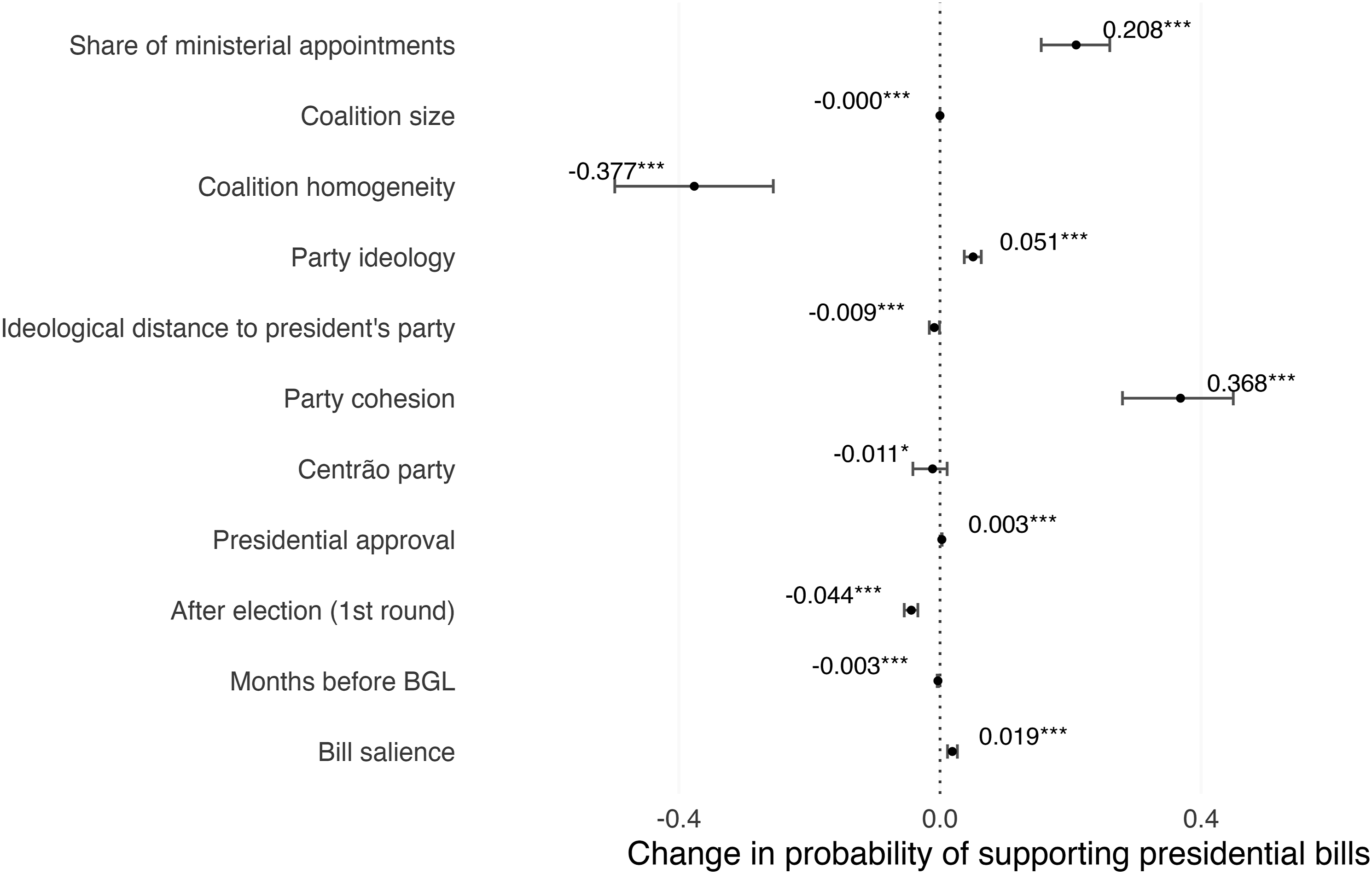
Among the controls, coalition size, party ideology, and presidential approval are statistically significant but produce modest substantive effects. While institutional and contextual factors shape legislative behavior, their influence is smaller than that of ministerial appointments. Party cohesion emerges as a strong predictor of support, underscoring the role of intra-party organization in maintaining discipline: cohesive parties follow leadership cues more closely, enhancing government unity in roll-call votes (Morgenstern, 2004; Neto, 2002). Cohesion, however, can also backfire as collective dissatisfaction toward the executive may lead to coordinated defections. Centrão parties show a small but marginally significant negative effect on support, which is discussed further below.
These findings support the argument that ministries are the most visible and valuable form of executive payoff, serving as key bargaining chips that encourage parties to deliver legislative support (e.g., Albrecht, 2022). Ministerial posts provide institutional authority, visibility, and policy influence, strengthening electoral prospects and internal leverage. This aligns with scholarship on portfolio salience and Latin American coalitions, which identifies ministries as the most contested and consequential political rewards (Chaisty and Power, 2024; Neto, 2018; Valenzuela, 2018).
Model 2 examines upper-tier appointments. As shown in Figure 3, these positions have a positive and statistically significant, though modest, effect on legislative support, supporting H2a. While upper-tier posts provide access to policymaking networks, their impact is smaller than that of ministerial control, with an estimated 9 percentage point increase in support per one-point rise in their share. Average Marginal Effect of Upper-tier Appointments on Coalition Support.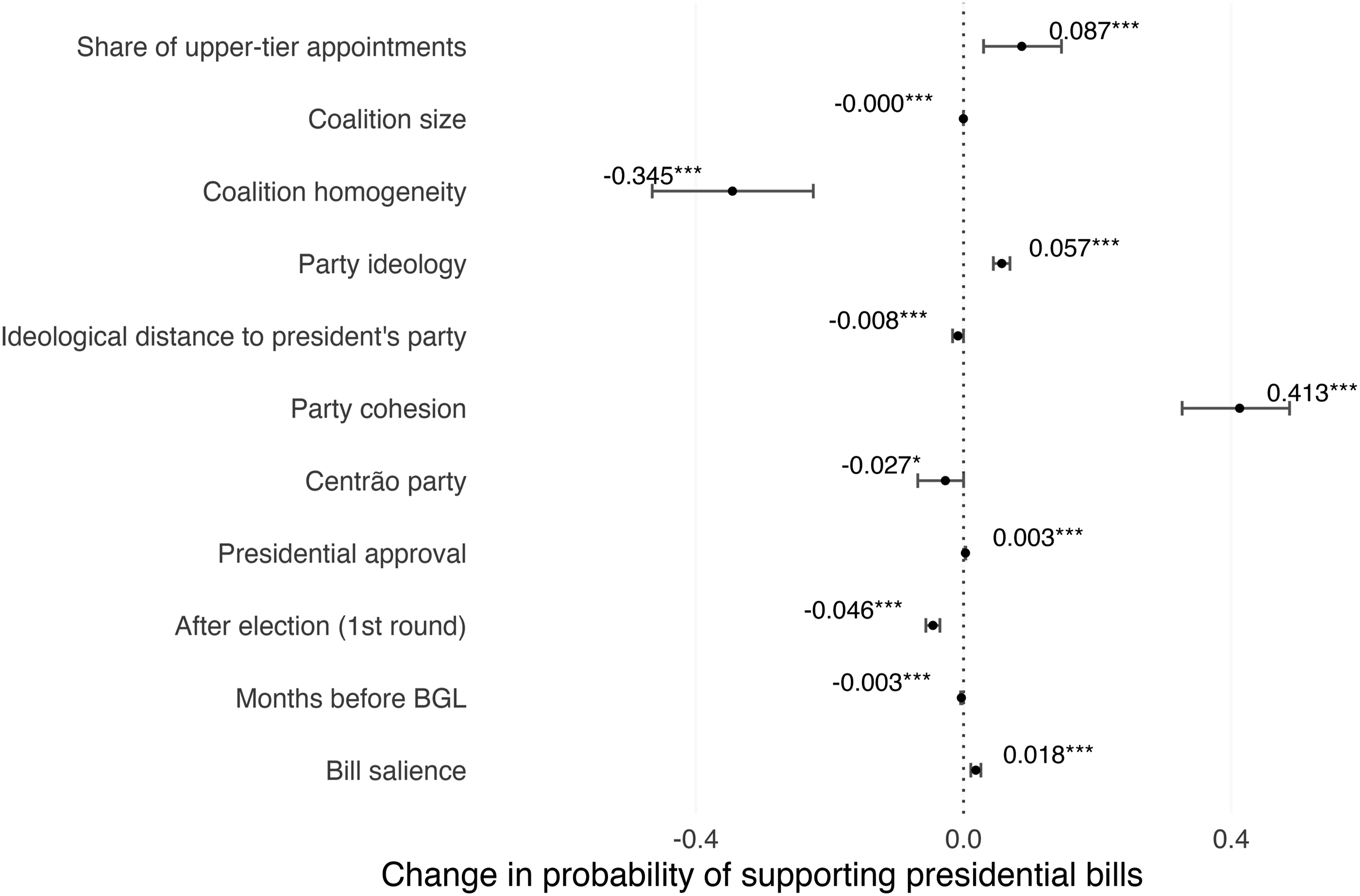
The pattern for upper-tier appointments suggests that these posts mainly function as symbolic instruments of inclusion rather than direct channels of patronage. They provide visibility and policymaking influence but remain limited in number and highly scrutinized. Such posts may also serve as consolation prizes for unelected politicians, recognizing electoral efforts (Lopez and Praça, 2015). Presidents often allocate them to reinforce alliances with pivotal partners, but their restricted supply limits distributive potential (Borges and Coêlho, 2015). This helps explain the modest effect in Model 2: upper-tier appointments help maintain balance within the coalition but do not substantially affect daily legislative behavior.
Model 3 tests the influence of lower-tier appointments. As expected, Figure 4 shows that a higher share of these posts significantly increases the likelihood of coalition deputies backing the president, supporting H2b. The effect is substantial: a one-point increase in the share of lower-tier appointments corresponds to an estimated 69 percentage point rise in support probability, suggesting that lower-tier appointments exert a particularly strong influence on legislative behavior. They facilitate reward distribution within party networks and allow presidents to compensate allies discreetly, making them particularly valuable in fragmented legislatures. Party cohesion again appears as a key predictor of support, consistent with previous models. Average Marginal Effect of Lower-tier Appointments on Coalition Support.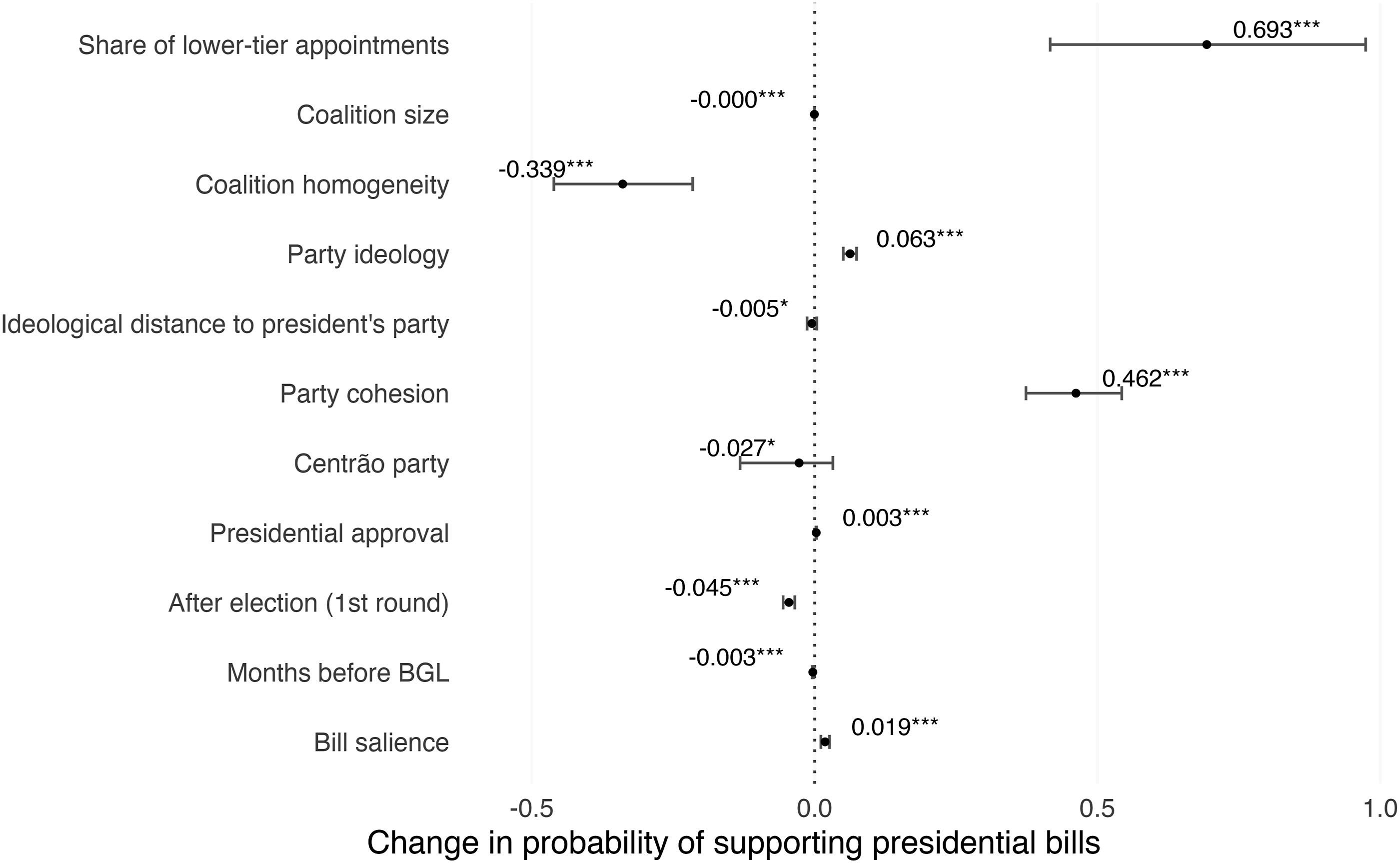
The magnitude of this effect highlights how patronage extends far beyond elite bargaining. Because these positions are numerous and flexible, they enable presidents to reward local brokers, strengthen clientelist linkages, and consolidate regional support (Lopez et al., 2015). In systems characterized by open-list proportional representation, such as Brazil, legislators depend on localized electoral bases, making these appointments an effective way to align coalition interests with individual incentives. This dynamic combines the distributive power of patronage with the credibility of recurring rewards, ensuring that coalition loyalty is continuously reinforced.
Overall, the divergent effects of upper- and lower-tier appointments suggest that not all political posts carry equal leverage. Lower-tier positions provide diffuse and flexible rewards that sustain intra-party cohesion, whereas upper-tier appointments are more constrained and visible. These findings support the broader argument that political appointments shape legislative behavior but reveal that their effectiveness depends on institutional context and internal party dynamics (Batista, 2017; Kopeckỳ and Mair, 2012).
Finally, Model 4 includes all three appointment types simultaneously. As observed in Figure 5, ministerial and lower-tier appointments retain strong positive effects on coalition support, at 33 and 69 percentage points respectively, while upper-tier appointments turn negative and marginally significant at –8 percentage points. This suggests that when controlling for other appointment types, upper-tier posts may function as substitutes rather than complements in fostering legislative loyalty. Because these posts offer limited political value and fewer direct patronage benefits, coalition members may perceive an imbalance in rewards, weakening incentives to follow presidential instructions. Centrão parties show a positive and significant effect in Model 4 (0.129), which warrants further discussion below. Average Marginal Effect of Appointments on Coalition Support.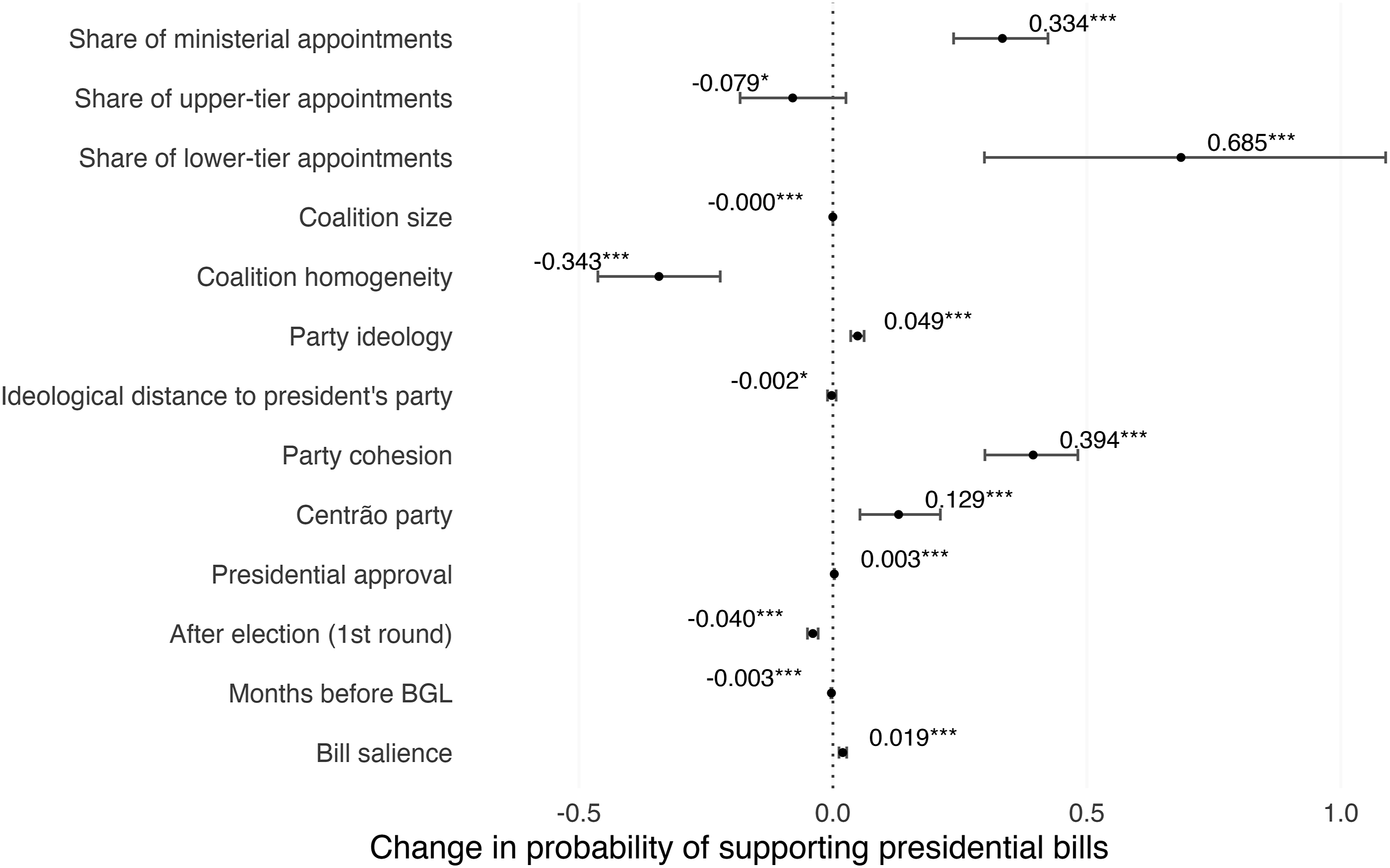
The results from Model 4 reveal a hierarchy of political returns across appointment types. Ministerial portfolios remain politically salient but scarce; upper-tier posts provide limited leverage, and lower-tier appointments emerge as the most effective resource for sustaining legislative cooperation. The negative coefficient for upper-tier positions likely reflects compensatory dynamics: when presidents concentrate rewards on a few elites, they risk alienating broader party networks (Geddes, 1994; Lewis, 2009). This reinforces that coalition management in multiparty presidential systems depends less on high-profile portfolios than on the continuous, low-visibility distribution of bureaucratic rewards.
The results also shed light on the role of centrão parties in coalition support. Across Models 1 through 3, centrão parties show a small but marginally significant negative average marginal effect on support, while Model 4 reverses this pattern with a positive and significant effect (0.129). These average marginal effects reflect the overall predicted difference in support between centrão and non-centrão parties, combining party fixed effects and interaction terms rather than a standalone coefficient. To directly assess whether appointments operate differently for centrão parties, I interact each appointment type with the centrão indicator. None of the interaction terms reach statistical significance in the coalition-only models, suggesting that appointments function as equally effective bargaining tools regardless of party type.
The results confirm the literature on the relevance of portfolios in coalition management (Desposato, 2006a; Kellam, 2015). They also support my expectation that lower-tier appointments are particularly effective in sustaining coalition loyalty. As Neto (2018) argues, political positions may be allocated as part of a reward package upon successful bill support, consistent with Cox and Morgenstern’s (2001) findings of Latin American legislatures as highly reactive to executive initiatives. The strong effects observed suggest that appointments, alongside consistent party cohesion across models, are key mechanisms for presidents to maintain stable coalitions in multiparty presidential systems (Bertelli and Feldmann, 2007; Chaisty and Chernykh, 2017; Hollibaugh Jr, 2017; Lewis, 2011). The timing of roll-call sessions also appears to play a role, although the effects are modest. Altman (2000) claims that support from coalition parties declines as the president’s term progresses, and the models indicate that once the risks of losing elections fade after their conclusion, coalition members may feel less compelled to back the executive.
Conclusion
This study examined how political appointments beyond ministries influence legislative behavior in multiparty presidential systems, where legislative coalitions are maintained not by binding agreements but through continuous bargaining between presidents and potential partners (Freudenreich, 2016; Kellam, 2015). Existing research on coalition governments has largely focused on cabinet portfolio allocation and proportionality rules such as Gamson’s Law (Chaisty and Power, 2024; Neto, 2018; Raile et al., 2011). I contribute by highlighting the evolving value of appointments in sustaining government support. Using data on political appointments and roll-call votes for 161 executive-initiated bills in Brazil (2003–2018), I show that ministerial and lower-tier non-ministerial appointments significantly affect coalition loyalty, confirming that position allocation is central to coalition management. This flexibility enables coalition parties to exchange legislative support for political rewards, revealing that coalition stability depends on the ongoing distribution of resources, including bureaucratic appointments and access to state payoffs.
Consistent with prior scholarship, ministerial portfolios have a strong positive effect on coalition loyalty, reaffirming their role as powerful instruments of executive bargaining (Desposato, 2006a; Silva, 2022; Zucco, 2009). Yet the most striking finding concerns non-ministerial appointments. Lower-tier positions, though often overlooked, are strongly associated with legislative support. These posts enable parties to reward local operatives, strengthen clientelist networks, and expand regional electoral bases (Batista, 2017; Silva, 2022). They function as effective bargaining tools that help prevent coalition breakdowns (Lupia and Strøm, 1995), particularly in fragmented systems where parties seek to maximize their influence.
By contrast, upper-tier non-ministerial appointments, such as high-level executive roles without ministerial rank, show different impacts over coalition support depending on the scenario examined. This suggests that not all appointments serve as equally effective bargaining instruments, perhaps reflecting the more technocratic or limited discretionary power of these posts (Bersch et al., 2023; Ennser-Jedenastik, 2014). Such positions may be too detached from grassroots politics or too few in number to shape legislative behavior systematically, and their value may depend on context-specific factors such as proximity to policymaking or symbolic prestige (Kopeckỳ and Mair, 2012).
These findings illuminate how informal incentives reinforce coalition discipline and shape legislative outcomes in presidential democracies. Future research could deepen this analysis in three directions. First, disaggregating lower-tier positions by function or geographic relevance (e.g., municipal vs federal postings) or by institutional type (ministries, regulatory agencies, state-owned enterprises) could reveal which appointments are most electorally or institutionally salient (Albrecht and Ribeiro, 2025; Ames, 1995; Lyne, 2008). Previous research shows that parties’ agenda preferences vary according to their electoral bases and institutional roles (e.g., Albrecht, 2022; Borges and Coêlho, 2015; Loureiro and Abrucio, 1999). Second, extending this framework to other multiparty presidential systems could test whether similar dynamics hold across countries with comparable institutional settings. Finally, examining how the distribution of appointments interacts with bill salience, both institutionally and across agenda types, could clarify whether governments strategically deploy appointments to secure support for crucial legislation (Pereira et al., 2005). Together, these avenues would advance understanding of how bureaucratic appointments operate as enduring tools of coalition management in fragmented presidential systems.
Supplemental material
Supplemental Material - Bureaucratic appointments and coalition support in presidential systems – An analysis of Brazil’s Chamber of Deputies
Supplemental Material for Bureaucratic appointments and coalition support in presidential systems – An analysis of Brazil’s Chamber of Deputies by Koichi Osamura in Party Politics
Footnotes
Acknowledgements
I would like to thank the editor and the three anonymous reviewers for their valuable comments and suggestions. Earlier versions of this paper were presented at the 2024 ECPR General Conference in Dublin, and at the 2024 ABCP/BraS Workshop. I am grateful to Bruno Carazza, Celina Souza, Cláudio Couto, Hallbera West, Ida B. Hjermitslev, Laurenz Ennser-Jedenastik, Michael Imre, Peter Heyn Nielsen, Sérgio Praça, and Thomas M. Meyer for their comments and suggestions at various stages of this project. All remaining errors are my own.

Funding
This research was funded in whole or in part by the Austrian Science Fund (FWF) [10.55776/I5876]. For open access purposes, the author has applied a CC BY public copyright license to any author accepted manuscript version arising from this submission.
Declaration of conflicting interests
The author declared no potential conflicts of interest with respect to the research, authorship, and/or publication of this article.
Data availability statement
Replication data for this article can be found at: https://doi.org/10.7910/DVN/QRV2EV (Osamura, 2026).
Supplemental material
Supplemental material for this article is available online.
Notes
Author biography
References
Supplementary Material
Please find the following supplemental material available below.
For Open Access articles published under a Creative Commons License, all supplemental material carries the same license as the article it is associated with.
For non-Open Access articles published, all supplemental material carries a non-exclusive license, and permission requests for re-use of supplemental material or any part of supplemental material shall be sent directly to the copyright owner as specified in the copyright notice associated with the article.
