







Abstract
This study investigates the impact of the international openness in tourism services trade on wage inequality between highly skilled, semi-skilled, and unskilled workers in the tourism industry. The sample covers 10 developed countries and expands over 15 years. A cointegrated panel data model and an error correction model were used to distinguish between the short- and long-run effects. The results are compared to those of openness of business services and manufactured goods. The findings point out that tourism increases wage inequality at the expense of the least skilled workers in the long run and the short run.
Keywords
Following the literature, international trade seems to have a significant impact on inequality in the case of developed countries, particularly through an increase in the wages of skilled workers relative to the wages of unskilled workers. However, the results depend on the sample of countries studied (Bahmami-Oskoee et al., 2008; Bensidoum et al., 2011; Harjes, 2007; Slaughter and Swagel, 1997; Wood, 1994, 1995).
Roine et al. (2009) confirmed this difference between countries using top income shares 1 data. More recently, Engelmann (2014) uses data from EU KLEMS (Centre for the Study of Living Standards 2011) to assess the effect of trade for 11 UK manufacturing sectors on inequality. The results show a structural change in the UK economy by the declined share of low-skilled workers and the increased share of medium-skilled and high-skilled workers over the years. These results should incite us to take into account the different specificities of each industrial sector when we estimate the effect of international trade on inequalities. This fact is supported by Cassette et al. (2012), who had estimated the specific impact of international trade in services on inequalities using three interdeciles ratio (D9/D1, D5/D1, and D9/D5).
The link between trade in tourism services and inequality has not really studied. Most of the time, this question is indirectly approached (see e.g. Blake, 2008; Wattanakuljarus and Coxhead, 2008). This empirical study is an attempt to feel this gap by estimating the direct link between international trade in tourism services and wage inequality. This will require to measure the impact of trade liberalization in tourism on skill premiums in the tourism sector, between highly skilled and semi-skilled workers, semi-skilled and unskilled workers, and between highly skilled and unskilled workers. The advantage of using skill premiums in the tourism sector (and not a general inequality index as Gini index) is that it is certain that the estimated effect is due to the characteristics of the tourism sector rather than due to an uncontrolled or misleading correlation effect.
Data and empirical strategies
Table A1, in the Online Appendix, summarizes the descriptive statistics and sources of the variables used for this article. Because there is limited data for the variables, we used a sample of 10 developed countries (Australia, Austria, Denmark, Finland, Italy, Japan, the Netherlands, Spain, United Kingdom, and United States) for the period 1980–2005.
The EU KLEMS database is used in this econometric analysis. This database provides the number of hours worked and wage bill, for each sector, for three categories of people: unskilled, semi-skilled, and highly skilled. Three indicators of skill premiums were developed between each category of workers. As it is possible to obtain the skill premiums by sector, these three indicators were calculated for the four aggregates of interest to us: total trade, trade in goods, trade in business services, and the tourism trade. 2
Concerning the independent variable, we chose to use the traditional indicator of trade openness. CEPII’s CHELEM (CEPII, 2006) database distinguishes three categories of services: transport services (air, sea, and others, freight and passenger), travel services, and “other business services.” The second aggregate includes catering, accommodation, entertainment, and tour operators. The statements for this category relate to a very large part of tourism revenues and spending. The last category covers communications, construction, insurance, financial services, computers and information, licenses and patents, other business services, cultural services, and government. This category is used as a variable of trade in business services. We test the link between the four categories of international trade (total, goods, business services, and tourism services) and inequality.
The control variables included in this study are as follows:
Education: A variable for the supply of skills is used, EDU
j,t
, representing the average number of years in education for the total population aged over 24. The level of education is assumed to reduce inequalities. Gross domestic product per capita: Gross domestic product (GDP) per capita, GDP
j,t
, may have an impact on inequalities, according to the mechanism originally explained by Kuznets (1955). Inflation: An inflation rate variable, INFL
j,t
, is included to control the macroeconomic environment. Inflation erodes real wages and disproportionately affects low incomes thus increasing inequality (e.g. Romer and Romer, 1999). Labor market—institutional context: Several variables were used to reflect the characteristics of the labor market and the influence of trade unions on wage formation. NETDEN
j,t
is the union density in a country. An indicator of government involvement in wage formation, GOVIN
j,t
, is also used. Finally, the Herfindahl index (HERF
j,t
) is used to measure the trade union concentration.
According to the Im–Pesaran–Shin test (Table A2 in the Online Appendix), all the variables are stationary at difference, except the education and inflation variables that are also stationary at level. Given the presence of unit roots in the main variables of this article, Pedroni’s (2000) panel cointegration tests were conducted to determine whether there is a long-term equilibrium between the variables. Testing the cointegration of a panel data model proceeds in two stages: First, a check to determine whether the dependent variable is cointegrated with each independent variable, and then a test of cointegration between each independent variable taken in pairs as it is not possible to use two independent cointegrated variables in a single regression with cointegrated panel methods. The test results are given in Table A3 in the Online Appendix. They show that there is no long-term relationship between the total trade openness and inequality between unskilled and highly skilled workers and between the openness of the tourism trade and inequality between unskilled and semi-skilled workers. Then, because only the GDP per capita variable, among the control variables, is I (1), there is no long-term equilibrium between inequality variables and other control variables. Moreover, the cointegration tests indicate that the GDP per capita variable is cointegrated with trade openness variables. To obtain an unbiased estimator of long-term parameters, the dynamic ordinary least square (DOLS) method uses parametric adjustment of errors by increasing the initial static regression based on the past, present, and future values of the regressors at first difference, which allows for control of the endogenous reactions (see Saikkonen, 1991). The standard deviations of the coefficients are obtained using the long-term variance of the residuals from the cointegration.
The second estimation step in this article involves estimating the long- and short-term relationships using a panel data model based on an error correction model (ECM). This is used to establish the way in which the short-term varies from the long-term relationship and, more specifically, how the economy adjusts itself following disturbances over time.
The specification of the corrected error model is as follows:

where
Results and discussions
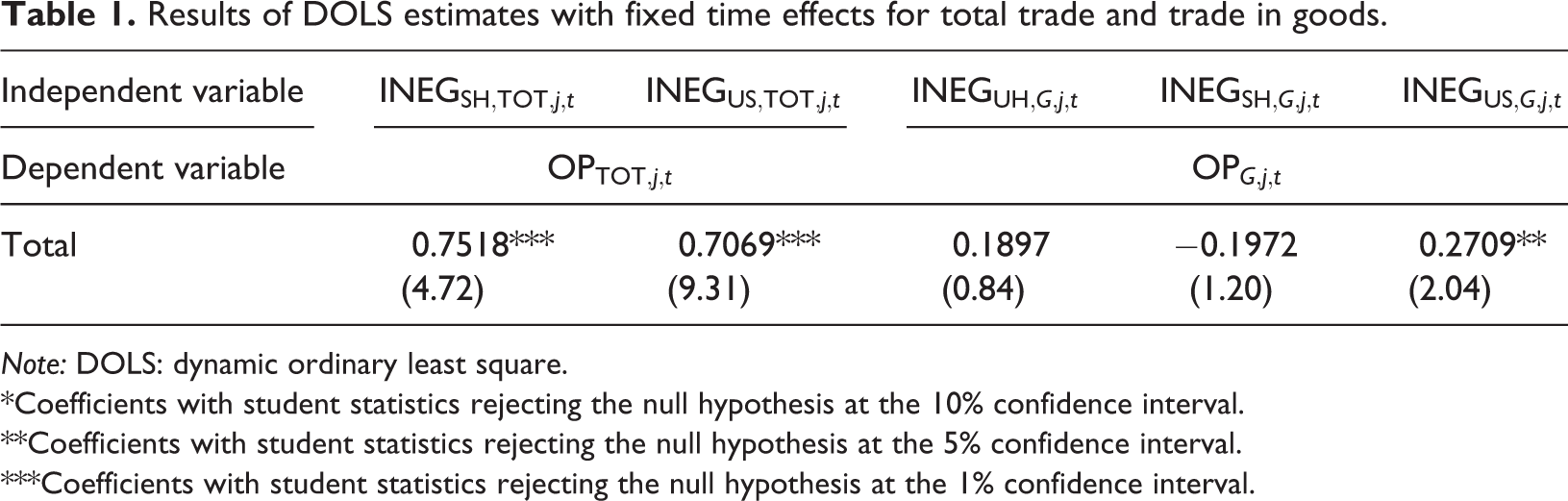
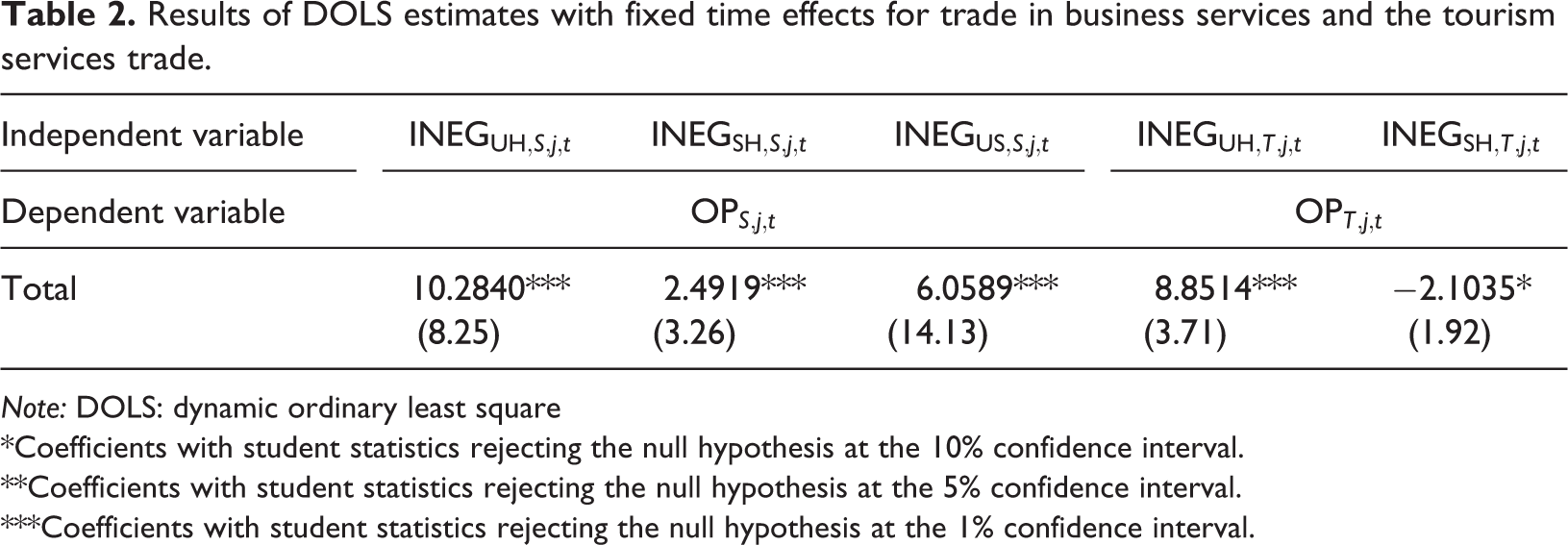
Tables 1 and 2 show the panel estimates using the DOLS estimator for the entire country sample during the period 1980–2005.
Results of DOLS estimates with fixed time effects for total trade and trade in goods.
Note: DOLS: dynamic ordinary least square.
*Coefficients with student statistics rejecting the null hypothesis at the 10% confidence interval.
**Coefficients with student statistics rejecting the null hypothesis at the 5% confidence interval.
***Coefficients with student statistics rejecting the null hypothesis at the 1% confidence interval.
Results of DOLS estimates with fixed time effects for trade in business services and the tourism services trade.
Note: DOLS: dynamic ordinary least square
*Coefficients with student statistics rejecting the null hypothesis at the 10% confidence interval.
**Coefficients with student statistics rejecting the null hypothesis at the 5% confidence interval.
***Coefficients with student statistics rejecting the null hypothesis at the 1% confidence interval.
To begin, we see that total international trade significantly increases wage inequality in the long run between highly skilled and semi-skilled workers and between semi-skilled and unskilled workers. However, the results for international trade in business services are much more settled as in the work by Cassette et al. (2012). In fact, this entails higher wage inequality between each category of worker skills. Moreover, the coefficients are of much greater magnitude than for total trade and trade in goods. Note also that, unlike trade in goods, the coefficient is positive and significant for wage inequality between highly skilled and semi-skilled workers in business service sectors.
With regard to tourism, the development of trade in this sector has a clear impact on wage inequality between highly skilled and unskilled workers in the long run. The coefficient is actually positive and significant at the 1% confidence level. Note also that this coefficient (8.814) is slightly lower than trade in business services but significantly higher than trade in goods or total trade. However, note that at the 10% acceptance threshold, the international tourism trade reduces wage inequality between semi-skilled and highly skilled workers. This can be partly explained by the fact that tourism production is unskilled labor intensive.
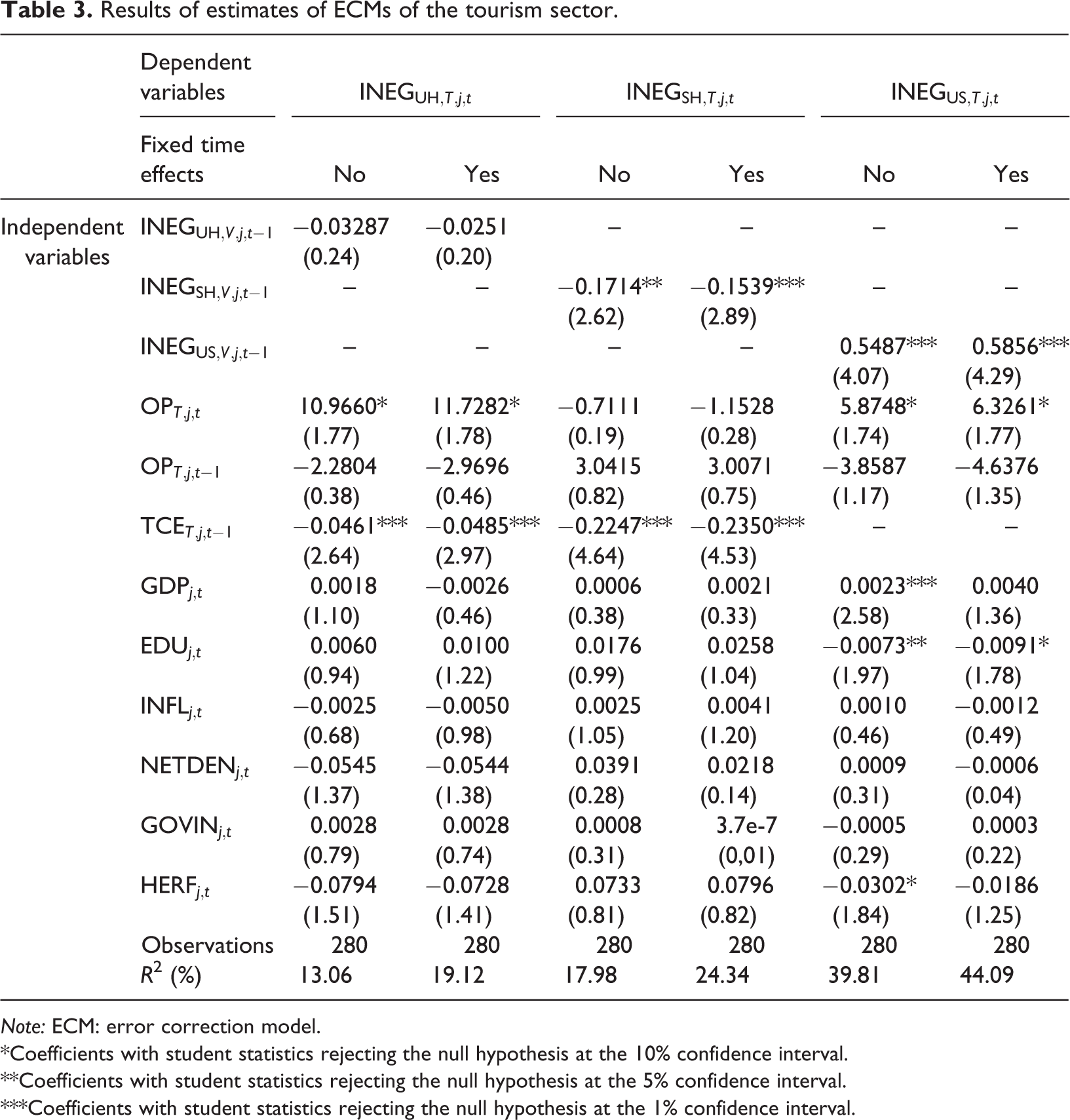
Table 3 presents the results of estimates of the ECMs for the tourism sector, while Tables A4 to A6, in the Online Appendix, address estimates, respectively, of total trade, trade in goods, and trade in business services (note that the multicollinearity has been controlled by a variance inflation factors analysis). The most significant result concerning the link between international trade and inequality is for the tourism trade openness variable. It is the only openness variable that has an influence on inequality variables. The effect of the tourism trade on wage inequalities in the tourism sector is immediate, contrary to the other aggregates (see Tables A4 to A6). If this effect is repeated in each period, then it would explain the significant long-term effect observed in the previous section.
Results of estimates of ECMs of the tourism sector.
Note: ECM: error correction model.
*Coefficients with student statistics rejecting the null hypothesis at the 10% confidence interval.
**Coefficients with student statistics rejecting the null hypothesis at the 5% confidence interval.
***Coefficients with student statistics rejecting the null hypothesis at the 1% confidence interval.
These results also indicate that the lagged inequality variable is a significant factor in two of three cases, which confirms the autoregressive form of equation (1). For inequality between semi-skilled and highly skilled workers, the lagged variable coefficient is negative. Conversely, the lagged variable coefficient of inequality between semi-skilled and unskilled workers is positive. This means that wage differentials for unskilled workers, relative to semi-skilled workers working in tourism, are increasing, while wage differentials between high-skilled and semi-skilled workers are reducing over time. This result can essentially be explained by the fact that tourist production is unskilled labor intensive. Accordingly, relative to unskilled workers, there are very few highly and semi-skilled workers. Wage differentials therefore tend to reduce between these categories of workers. The development of trade in tourism between countries leads to a relative deterioration in the wages of the poorest individuals. Table 5 shows that the coefficient of the TCE is negative and significant, 5 which validates the ECMs.
In light of these results, it appears that the main factors behind wage inequality in the tourism sector are a form of inequality inertia and the immediate- and long-term effect of tourism trade openness. The impact of international trade in tourism services on inequalities, as highlighted in this article, may suggest that the developed countries need to develop high-tech sectors (requiring highly skilled labor). Otherwise, wage inequalities in the tourism sector may continue to grow in the coming years.
Footnotes
Acknowledgement
The author thanks Jean-Jacques Nowak, Hubert Jayet, and Aurélie Cassette for their advice on this piece of research.
Declaration of conflicting interests
The author(s) declared no potential conflicts of interest with respect to the research, authorship, and/or publication of this article.
Funding
The author(s) disclosed receipt of the following financial support for the research, authorship, and/or publication of this article: The author(s) received a financial support from the community of the Lille Nord de France universities.

Notes
References
Supplementary Material
Please find the following supplemental material available below.
For Open Access articles published under a Creative Commons License, all supplemental material carries the same license as the article it is associated with.
For non-Open Access articles published, all supplemental material carries a non-exclusive license, and permission requests for re-use of supplemental material or any part of supplemental material shall be sent directly to the copyright owner as specified in the copyright notice associated with the article.
