







Abstract
The main purpose of this study is to investigate the attributes of capsule hotels preferred by individuals. To this end, a choice experiment (CE) was adopted; a CE is a systematic method used to determine individual preferences with regard to goods and services. A well-known advantage of CEs is their ability to capture a pecuniary value for target attributes in the form of marginal willingness to pay (MWTP). By comparing the sizes of MWTPs, we can recognize the order of preference among attributes. Amazon Mechanical Turk was used to collect the study data. We examined the magnitudes of the degree of preferences for “additional services provided,” “accessibility,” and “price.” The findings indicate that price is negatively associated with capsule hotel choice, whereas accessibility and service are positively associated with capsule hotel choice.
Introduction
The number of foreign tourists visiting Korea has increased steadily, surpassing 17 million for the first time in 2016 (Korean Tourism Organization, 2017). Based on this increased visitation, the Ministry of Culture, Sports and Tourism (2012) announced the “first year of quality growth regarding inbound tourism,” which aims at enhancing the stability of the tourism market by diversifying it and creating a favorable atmosphere for tourists in Korea (Tourism Knowledge and Information System, 2017). However, to create “a favorable environment for travel,” there is a clear need for tourism facilities to expand to accommodate foreign tourists (Darcy, 2010; Hwang and Chang, 2003). According to the Ministry of Culture, Sports and Tourism (2012), the number of foreign tourists in Korea increased between 2006 and 2010, and although the number of hotels in the metropolitan area increased by 2.9% at the same time, supply has not kept up with demand. In addition to the shortage of accommodations, tourism facilities are concentrated around Seoul, the capital of Korea. More than 80% of foreign tourists visit Seoul; therefore, the concentration of accommodations is reasonable (Korean Tourism Organization, 2017). Since tourism accommodation facilities require extensive investment in fixed assets, the shortage of accommodations in the Seoul metropolitan area is likely to continue for the foreseeable future.
In addition to the lack of accommodations, the tourism market environment in Korea has focused on free independent travelers (FITs) (Becken and Schiff, 2011; Caruana and Crane, 2011; Song and Hsu, 2013). According to the statistics released by the Korea Tourism Organization in 2016, 67.7% of tourists visiting Seoul were FITs (Korean Tourism Organization, 2017). FITs consider the accessibility to the most important factor for accommodation (Aksoy and Ozbuk, 2017; Becken and Schiff, 2011). In particular, both Japanese and Chinese FITs visiting Korea regard accessibility as the most important tourism element (Aksoy and Ozbuk, 2017; Zhou et al., 2014). FITs also prefer relatively inexpensive accommodations, compared to group tourists, because they book in advance (Tourism Knowledge and Information System, 2017). Given the value placed upon accessibility and affordability, accommodations targeting individual travelers such as guest houses are thriving in Korea. Thus, present conditions are favorable for increasing the supply of inexpensive accommodation facilities to meet the market demand.
On February 20, 2017, the first capsule hotel, Darak Hue, opened at the Incheon International Airport in Korea (Business Korea, 2016). In general, a capsule hotel, a concept originally developed in Japan, provides minimum capsule-shaped rooms where only one guest can sleep and provides minimal comfort facilities such as a shower or television (Albrecht and Johnson, 2002; Leslie, 2006; Life Style, 2016). Darak Hue is also notable as being the result of a government policy to promote competitiveness in the airline industry by actively responding to the decline in passengers changing flights at Incheon International Airport (Life Style, 2016; Yonhap, 2017). To enhance the quality of Incheon International Airport by 2020 as the world’s top hub airport, the Korean government aims to strengthen the demand from newly emerging economies such as China and India and greatly expand the airport infrastructure (Korean Tourism Organization, 2017). Accordingly, the Incheon International Airport Corporation is building a transit-friendly network. For this purpose, the government will establish a network of routes with high transit demand countries such as China during off-peak hours and peak times as well as an airport operating system that maximizes transfer convenience but minimizes transfer time to under 45 min (Incheon International Airport Corporation, 2017; Life Style, 2016). In line with these plans, Darak Hue is designed to increase the convenience of transit and accommodations for overnight passengers in Incheon Airport (Business Korea, 2016). The average reservation rate for Darak Hue is now near 90%, with an average demand of 400 people per day (Yonhap, 2017). Such strong interest may be the result of curiosity about the capsule hotel itself, but it may also be evidence of strong demand for this type of hotel.
Given (1) the lack of accommodations and centralization of tourists in the metropolitan area, (2) the importance of accessibility for FITs and their preference for middle-low-priced lodging, (3) the government’s strong commitment to creating “a transit-friendly network,” and (4) the high likelihood of a future demand increase for capsule hotels, the potential role of the capsule hotel in strengthening the competitiveness of Incheon International Airport (e.g. enhancing the convenience of transit and accommodation for overnight travelers) is considerable, inspiring several development plans for capsule hotels in Korea.
The choice experiment (CE) is a well-known systematic method for identifying respondents’ preferences. The main advantage of the CE is its ability to estimate respondents’ valuation of each attribute, given in the form of marginal willingness to pay (MWTP). By comparing the magnitudes of MWTPs, CE research can assess the priority of preferences for attributes (Grigolon et al., 2012; Lee and Yoo, 2015). The analytical superiority of CE has been acknowledged in tourism studies for the past 10 years and actively adopted to understand tourists/respondents’ preferences for a variety of multi-attribute tour/outdoor products and services (Hanley et al., 1998; Horne et al., 2007).
Despite the need for and relevance of capsule hotel studies, systematic research into preferences for capsule hotels remains sparse. Scientific research to identify preferences for capsule hotel attributes is necessary before the capsule hotel industry can begin operating in earnest in Korea. Therefore, the purpose of this study is to identify consumers’ preferred attributes of capsule hotels through a CE. We selected three attributes to represent capsule hotel characteristics based on expert opinions and evidence in the literature (Akbaba, 2006; Choi and Chu, 2001; Chu and Choi, 2000; Fernández and Bedia, 2005; Kim and Perdue, 2013; Ramsaran-Fowdar, 2007; Shankar et al., 2003): (1) price, (2) accessibility, and (3) number of services provided. By applying a CE and comparing respondents’ MWTP for each attribute, this study extends the literature on capsule hotels and has practical implications.
Methods and results
Amazon Mechanical Turk (MTurk) was used to collect the research data (https://www.mturk.com/mturk). MTurk is an Internet crowdsourcing site that associates a researcher (called “task creator”) with survey participants (called “paid task completers”). Researchers provide a monetary reward for participating in a survey (we paid 50 cents for completion of the study survey). MTurk is a reliable survey source for conducting research in psychology or other social sciences (Buhrmester et al., 2011) and has frequently been used in tourism research. Initially, we recruited and gathered 200 observations; however, we removed 35 participants’ data due to missing information. A choice set comprised alternative choices as substitute goods for capsule hotels, that is, guest houses and three-star hotels, and three common attributes: price, accessibility, and number of services provided. Respondents were asked to select the most preferred profile. We also used fractional factorial design, which is an experimental design consisting of carefully chosen subsets of all possible combinations. This method has the advantage of effectively estimating the main effects of a model with a few subsets at the expense of information loss. Eight subsets of 243 combinations were chosen via the statistical analysis system for the study. A total of eight sets were selected and presented to a respondent. A sample choice set is depicted in Table 1.
Illustration of measurements.
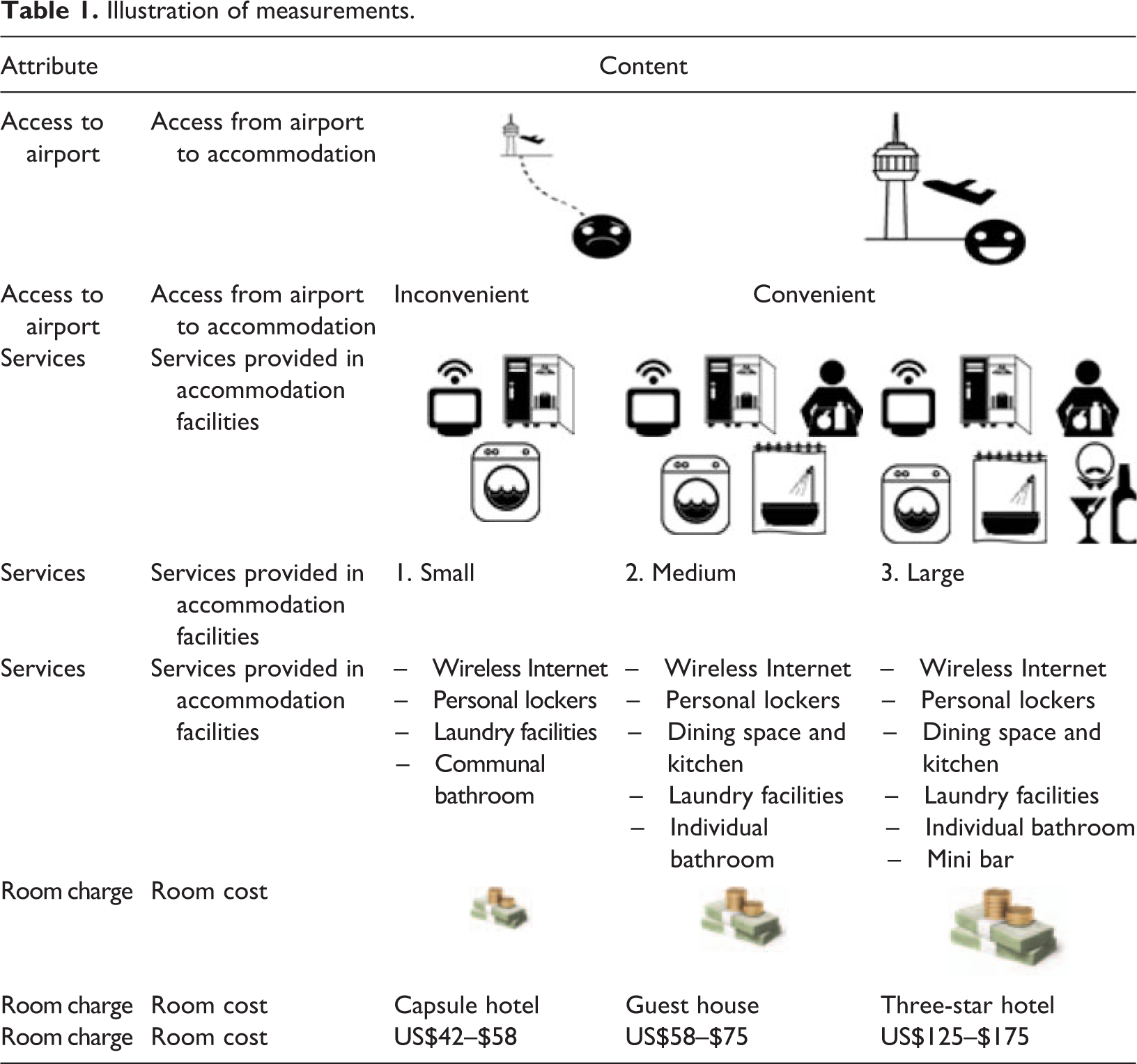
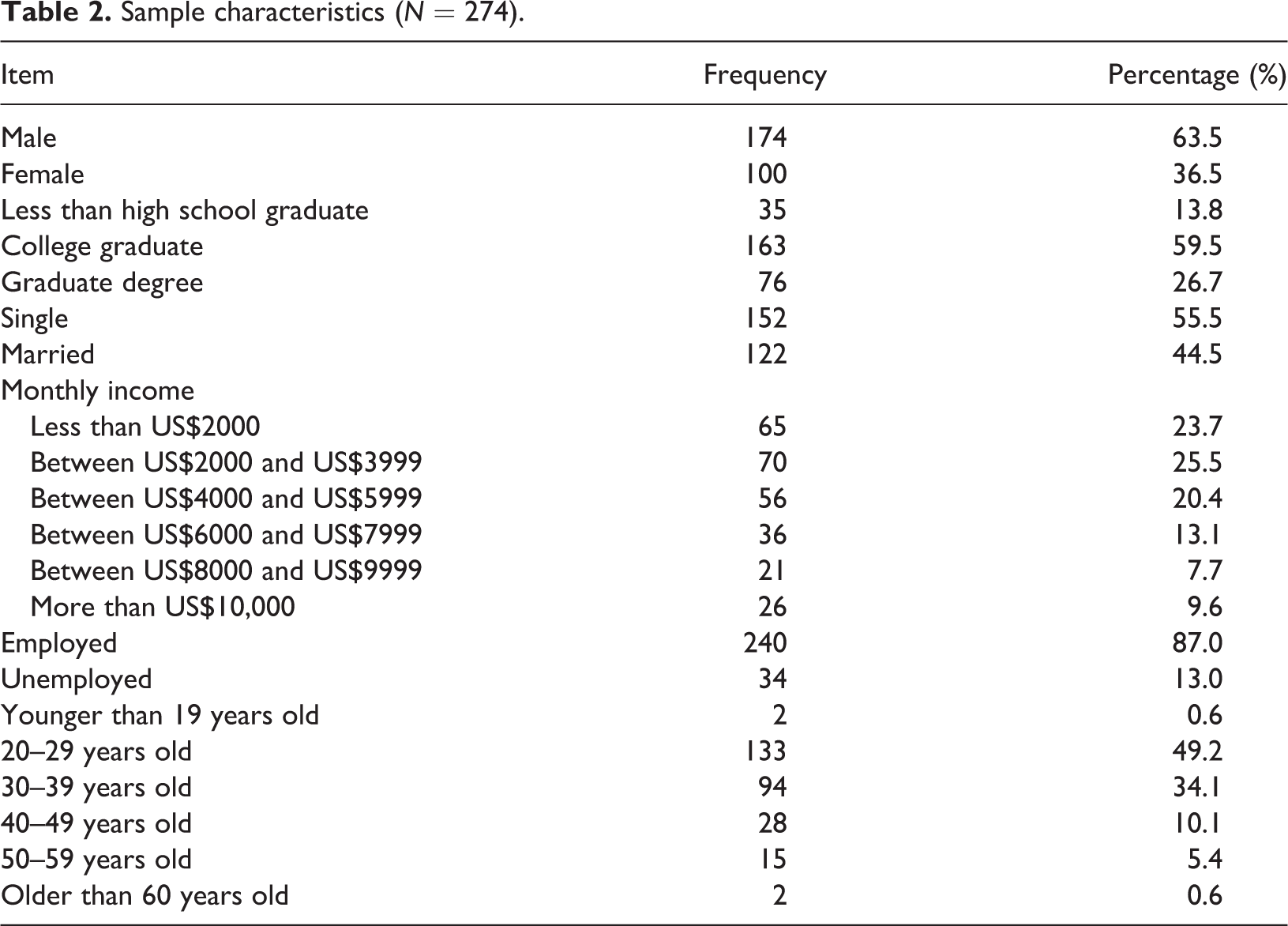
Table 2 presents the descriptive information of the sample. The total number of observations was 274. Regarding gender, 63.5% of respondents were male. Table 2 also shows the terminal degree to capture respondents’ education (less than high school graduate, 35; college degree, 163; and graduate degree, 76). With regard to marital status, 55.5% of participants were married. Among the participants, 87% were employed. Regarding age, 133 participants were between 20 and 29 years old, and 94 participants were between 30 and 39 years old.
Sample characteristics (N = 274).
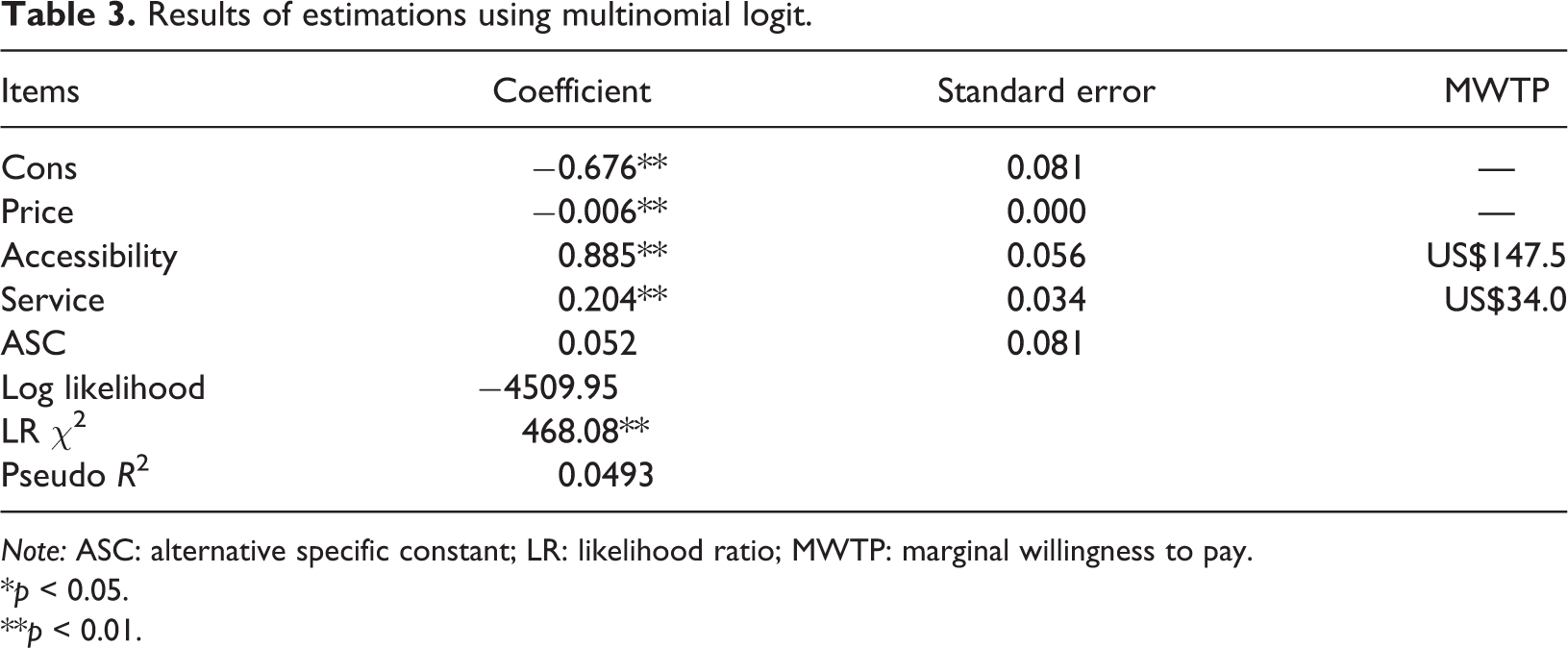
For the data analysis, a multinomial logit was conducted to acquire estimates. Table 3 provides the results of the multinomial model. Considering the results for the attributes, price is negatively associated with the individuals’ choices, which is an intuitively acceptable result (β = −0.006; p < 0.01). The higher the price is, the more negative its effect on individuals’ choices. Additionally, accessibility (β = 0.885; p < 0.01) and the number of services provided (β = 0.204; p < 0.01) were significantly and positively associated with individual choices. This finding indicates that the likelihood of selection will increase when the conditions of these attributes improve. The model is statistically significant (LR χ
2 = 468.08; p < 0.01). The accountability of the multinomial logit model is 0.0493. Based on the estimates, we can compute the MWTPs of the attributes as follows
Results of estimations using multinomial logit.
Note: ASC: alternative specific constant; LR: likelihood ratio; MWTP: marginal willingness to pay.
*p < 0.05.
**p < 0.01.
The MWTP of accessibility is US$147.5, while that of the number of services provided is US$34.0. This finding indicates that the individuals receive greater utility if it is convenient to use the hotel. In addition, we include alternative specific constant (ASC) variables in the study model. The coefficients of the ASC variables show the utility that individuals obtain when choosing each the two alternatives (e.g. guest houses and three-star hotels). The ASC variable is not statistically significant, indicating that the type of accommodation choice is not associated with individual choice.
Discussion and conclusion
Given the need for a capsule hotel preference study, we examined the attributes influencing the choice of capsule hotels. MTurk was used for data collection and 274 observations were used for analysis. The study results demonstrated that price negatively affects the choice of capsule hotels. This finding indicates that a high price is likely to deter consumers’ selection of a capsule hotel. Moreover, we found that service quality and accessibility were positively associated with capsule hotel selection. These results indicate that various services and the accessibility of capsule hotels increase the likelihood that a capsule hotel will be chosen. Among the three attributes, accessibility received the highest MWTP, which indicates that the location of the capsule hotel is the most important factor when selecting a capsule hotel.
This study contributes by filling a gap in the literature on CE studies in the tourism context. Although CEs are frequently used in the area of tourism management, there are few empirical studies examining the preferred attributes of capsule hotels. Moreover, the study results externally validated the three attributes accounting for consumer behavior in the domain of capsule hotels (Akbaba, 2006; Aksoy and Ozbuk, 2017; Fernández and Bedia, 2005; Huertas-Garcia et al., 2014; Kim and Perdue, 2013; Ramsaran-Fowdar, 2007; Zhou et al., 2014). This research has practical implications as well. Regarding the magnitude of MWTPs, accessibility is the essential factor in the selection of a capsule hotel. Capsule hotel guests are more interested in “accommodation function” than in the services offered. Thus, capsule hotel managers or planners should carefully consider the location during the planning stage. Given the significant importance of the other variables (price and service quality), maintaining a balance between adequate service delivery and pricing is also important for capsule hotel guests in their decision-making.
This research is not free from limitations. This study examined the determinants of capsule hotel choice using three attributes. Future research should thus consider more elements to account for capsule hotel choice and provide additional evidence to facilitate the success of the capsule hotel industry.
Footnotes
Declaration of conflicting interests
The author(s) declared no potential conflicts of interest with respect to the research, authorship, and/or publication of this article.
Funding
The author(s) received no financial support for the research, authorship, and/or publication of this article.
