







Abstract
This study aims to understand how corporate social responsibility (CSR) toward food, environment, employment, and community affects the dimensions of brand equity. It also examines the roles of size, segment, and brand identity in the relationship between CSR and brand equity in the restaurant industry. A set of five surveys with hypothetical CSR situations was used. The results of analyses indicate that CSR has a positive impact on brand equity depending on brand size, segment, and identity as well as a type of CSR. This study suggests that restaurants’ social responsibilities should not be simplified with a single measure of CSR as each type of CSR builds a particular aspect of brand equity. Brand attributes such as brand size, segment, and identity also extend the understanding of the CSR-brand equity relationship.
Keywords
Introduction
In response to increasing awareness of stakeholders regarding social responsibility, firm executives have begun to shift their attention toward developing active corporate social responsibility (CSR) practices (Luo and Bhattacharya, 2006). The restaurant industry, the second largest private sector employer in the United States, has a major impact on the US economy. In 2017, the industry contributed US$799 billion to the economy and employed 14.7 million personnel (National Restaurant Association (NRA), 2018). Not only are there more than 1 million restaurant locations in the United States, the US restaurant industry also occupies a significant number of physical stores, where diverse customers continuously interact with restaurant brands. It is critical for the restaurant industry to react to customers’ emerging expectation that restaurant firms engage in responsible CSR practices. Furthermore, in many locations, restaurants consume three times more energy per square foot than most other types of commercial buildings (Madison Gas and Electric, 2010). The significance and uniqueness of the restaurant industry portend the enormous impacts of the industry’s sustainability.
In order to achieve sustainability, restaurant companies are beginning to highly favor CSR practices. For example, McDonald’s restaurants served 30% more healthy food in 2014 than in 2012 and purchased 132,186 pieces of energy-efficient equipment, thus saving US$14.2 million in energy costs in recent years (McDonald’s, 2018). In its 2014 citizenship report, Darden Restaurants claimed that their restaurant management team consisted of 42% women and 31% minorities and that the firm internally promoted 99% of their general managers (Darden, 2018).
In addition to being an obligation, implementing CSR can also be a strategic management process for businesses. From a strategic perspective, CSR is often not a short-term investment that brings in better performance (Assaf et al., 2017); rather, it is an investment that creates a long-term economic, social, and environmental value. CSR practices gradually benefit business and build intangible value in the form of brand equity over time. In turn, brand equity, as an intangible asset, can foster a sustainable competitive advantage that is difficult to mimic and that can benefit business in the long term.
The objectives of this study are (1) to examine the impact of CSR activities on brand equity in the restaurant industry and (2) to test the relationship between CSR and brand equity according to three factors: brand size, brand segment, and brand identity. Specifically, this study aims to examine the impacts of CSR on restaurant brand equity by focusing on CSR practices relating to food, environment, employment, and community. Maloni and Brown (2006) claimed that food health and safety, labor and human rights, community, and environment are some of the essential aspects of CSR in food industry supply chains. Dimensions of CSR that have been developed for other industries would not give a clear understanding of CSR in food service businesses. Therefore, this study focuses on CSR practices that are closely related to the core operating activities of restaurant businesses. For example, food quality and healthy consumption are the core outcomes of the restaurant business and thus should not be neglected; however, the CSR literature has only addressed those topics in a limited way.
In addition to studying the direct relationship between CSR and brand equity, this study also investigates a moderating role of brand attributes. Namely, the effects of CSR could vary according to the physical traits, character traits, and personality traits of a brand: brand size, brand segment, and brand identity. As such, this study’s findings can equip restaurant operators with a better understanding of different aspects of CSR practices in the restaurant industry.
Literature review
Restaurant CSR
CSR has been a popular topic in business and has recently gained momentum. According to Dahlsrud (2008), the definition used most frequently for CSR is “a concept whereby companies integrate social and environmental concerns in their business operations and in their interaction with their stakeholders on a voluntary basis” (European Commission. Directorate-General for Employment, 2001). Food health and safety, labor and human rights, community, and environment are critical factors relating to CSR in food industry supply chains (Maloni and Brown, 2006). Therefore, this study focuses on four CSR categories that are key for the restaurant industry: food, employment, community, and environment. Food is the core product of the restaurant industry. If a food crisis or scandal arises for a restaurant, its brand could suffer from financial loss and disrepute (Ortega et al., 2011). Firms can also improve their bottom lines and reputations with positive acts for the quality of healthy food. On the other hand, the restaurant industry is a labor-intensive industry involving diverse labor and human rights issues. Since customers’ primary interactions with a restaurant brand are with employees on the frontline, food- and employment-related CSR practices are effective ways for a restaurant brand to build a reputation that can survive potential scandal. Darden Restaurants reported that its restaurants’ workforce consisted of 52% women and 45% minorities in 2016 and that the firm provided strong internal promotion for employees (Darden, 2018). McDonald’s has striven to increase its employees’ satisfaction, resulting in 83% of its managers considering McDonald’s to be a great place to work, according to the firm’s 2014 report (McDonald’s, 2018).
Community-responsive CSR practices revolve around local community support and financial donations. Since restaurants earn business from consumers who are physically near their locations, community-based CSR enhances consumer awareness of particular brands and increases immediate purchase intentions. Because the restaurant industry is a top energy consumer and waste producer, environmental sustainability has become one of its main priorities (NRA, 2018). The trend toward sustainability calls upon restaurant owners and managers to start reducing their businesses’ energy consumption and waste and to protect the environment. Environmental CSR practices can support restaurant brands by fostering a positive public image.
The stakeholder theory asserts that companies should serve the various interests of stakeholders rather than only seeking to maximize shareholder value (Freeman, 1994). This means that companies should take every entity involved in its business into consideration and that meeting stakeholder interests is a means for success and survival. In this regard, satisfying stakeholders’ needs supports companies in implementing CSR practices. On the other hand, the shareholder theory asserts that the primary goal of companies is to maximize stareholders’ value (Friedman, 1970). This goal may discourage CSR practices because such practices are associated with extra costs. Nevertheless, stakeholder theory also claims that a company can engage in profit-seeking CSR activities when the goal of adopting CSR practices is to maximize a corporation’s value over time (Harrison and Wicks, 2013; Luo and Bhattacharya, 2006; Servaes and Tamayo, 2013). As two theories argue the effect of CSR practices from different angles, the enlightened stakeholder theory, which is based on the premises of stakeholder theory, proposes that a company should seek value maximization goal, but with a long-term orientation (Jensen, 2010).
Brand equity
In the context of the fierce competition of the restaurant industry, brand equity is a key to adding value to businesses. Stronger brand equity can increase the long-term profitability of a corporation (Aaker, 1991). Brand equity is defined as “a set of brand assets and liabilities linked to a brand, its name and symbol, that adds to or subtracts from the value provided by a product or service to a firm and/or to the firm’s customers” (Aaker, 1991: 15).
Brand equity is generally viewed from three perspectives: the product view (Park and Srinivasan, 1994), the financial view (Simon and Sullivan, 1993), and the customer-based view (Aaker, 1991; Keller, 1993). The customer-based view evaluates brand equity in terms of customers’ familiarity with, awareness of, and preference for a particular brand (Ailawadi et al., 2003). The product view focuses on ongoing market activities in order to estimate brand equity, whereas the financial view draws upon current subjective management judgments and objective firm measures to assess brand equity in the future. Therefore, this study, which targets customers instead of market and management teams, adopted customer-based brand equity as the primary measure of brand equity.
Customer-based brand equity consists of four components: perceived quality, brand awareness, brand image, and brand loyalty (Hyun and Kim, 2011; Kim and Kim, 2005; Yoo et al., 2000). Perceived quality refers to customer judgments of the overall features of a product or service provided by a restaurant, and it focuses on subjective assessments of a product or service instead of objective measurements of quality (Yoo et al., 2000). This definition indicates that the level of brand equity can vary based on different customers’ perceptions of a product or service’s quality. Aaker (1996) defined brand awareness as “the strength of a brand’s presence in the customer’s mind.” Brand awareness emphasizes the recognition of a brand when customers purchase a product or service. Higher brand awareness leads to customers’ having higher purchase intentions (Aaker, 1991; Hutter et al., 2013).
Brand image refers to “perceptions about a brand as reflected by the brand associations held in consumer memory” (Keller, 1993: 3). Customer preference for a brand can create a positive brand image, which can, in turn, stimulate customers’ loyalty and enhance their word-of-mouth behavior (Jalilv and Samiei, 2012; Martenson, 2007). Finally, brand loyalty is defined as a deep commitment to purchasing favorable products consistently from the same brand in the future (Oliver, 1999). A high level of brand loyalty can result in customer retention, although other brands’ marketing strategies can encourage customers’ switching behavior. Furthermore, brand loyalty exerts a strong positive impact on a corporation’s profitability in the long term, which can add value to the corporation.
Relationship between CSR and brand equity
A halo effect refers to a cognitive bias that occurs when the measure of one trait influences the measure of another trait (Thorndike, 1920). In business, the halo effect can be a holistic or partial image of a corporation’s spilling over into a specific attribute. Practices of CSR can cultivate a halo effect on brand equity by extending CSR practices into other attributes (Klein and Dawar, 2004).
The resource-based view considers a firm to be a bundle of tangible and intangible resources that provide competitive advantages (Wernerfelt, 1984). Sustainable competitive advantages can be gained when those resources are heterogeneous, scarce, or immobile. CSR can cultivate a positive reputation and improve brand image and loyalty, which are dimensions of brand equity. Such intangible resources are difficult to mimic and can create a sustainable competitive advantage for a firm (Jones and Bartlett, 2009). Therefore, the relationship between CSR and brand equity contributes strategic value to a firm.
Moreover, CSR can positively influence brand loyalty through the mediating effect of functional and symbolic images (He and Lai, 2014), brand identity (He and Li, 2011), and customer satisfaction (Hsu, 2012). Lai et al. (2010) tested the direct relationship between CSR and brand equity as well as the indirect relationship between the two constructs via corporate reputation. Existing studies have found some evidence for the direct or indirect influence of overall CSR on brand equity. This study focuses on the immediate impact of CSR on each brand equity construct by providing scenarios that are specific to the restaurant industry. Therefore, the following four hypotheses were developed to examine whether the CSR practices affect brand equity.
Brand size
Brand size is a critical concept when examining the relationship between brand and other business components (McWilliams and Siegel, 2000) because a company attracts more attention from stakeholders as it grows (Burke et al., 1986). Large companies likely face more pressure to adopt CSR practices to satisfy their stakeholders.
Brand size can be measured by the number of employees, total assets (Peng and Luo, 2000; Schmidt and Fowler, 1990; Tsoutsoura, 2004), or the number of physical units within a particular brand (Fleischer and Tchetchik, 2005). Researchers have utilized brand size as a part of CSR studies. For example, Stanwick and Stanwick (1998) used brand size as an independent variable to examine its relationship with corporate social performance. McWilliams and Siegel (2000) tested the relationship between CSR and corporate social performance, with brand size as a mediator. Moreover, Chauvey et al. (2015) conducted a legitimacy analysis of CSR disclosures, with brand size as a major independent variable. In particular, Youn et al. (2015) specifically focused on the restaurant industry and investigated how firm size moderated the relationship between CSR and corporate financial performance (CFP). They found that firm size moderated the impact of positive CSR on CFP but that it did not moderate the impact of negative CSR on CFP in the context of the restaurant industry. Our study suggests that bigger firm size allows a brand to have more resources to invest in CSR practices (Gupta, 1969) and to attract public attention by reporting such investments (Blombäck and Wigren, 2009), which leads to a higher level of customer-based brand equity. Therefore, the following four hypotheses were developed to examine whether brand size affects the relationship between CSR and brand equity.
Restaurant segment
The restaurant industry is segmented according to the service customers receive in a restaurant or according to the average amount of the check (Knutson et al., 1996; Namkung and Jang, 2013). Restaurants in a segment tend to target similar markets and to compete for similar resources. In research on food service, restaurant segments play an essential role as a category for analyzing the different levels of dependent variables. It is not accurate to treat the restaurant industry as a whole when researchers intend to investigate customers’ perceptions or opinions. Empirical studies have shown that different restaurant segments have customers with divergent expectations regarding food and service quality (Harrington, 2001; Knutson et al., 1996). These differences could vary depending on how CSR practices explain brand equity. Youn et al. (2016) found that the positive effect of CSR initiatives was greater for fast-food restaurants than for full-service restaurants because of the increasing health concern in the fast-food restaurant industry. Moreover, Namkung and Jang (2013) found that perceived quality, green brand image, and customers’ green behavioral intentions had significant differences among different restaurant segments: upscale casual, casual, and fast food. Specifically, green practices focused on foods were more effective in creating a green brand image and behavioral intentions than practices with an environmental focus in upscale casual dining restaurants. Conversely, in the casual dining restaurants, green practices with an environmental focus (as opposed to a food focus) had a greater impact in enhancing restaurants’ green brand image and behavioral intentions. Therefore, the perceptions of CSR practices can vary across restaurant segments. In this study, restaurant segments are categorized as either limited-service or full-service restaurants. Based on the literature review, four hypotheses were developed to examine whether brand segment affects the relationship between CSR and brand equity.
Brand identity
According to social identity theory, an individual tends to search and identify with a social category that enhances this individual’s self-esteem (Brown, 2000). In other words, individuals try to connect with other favored social categories in order to satisfy their personal needs. This identification process can encourage an individual to behave positively.
In business, Bhattacharya and Sen (2003) argued that a firm or its brand could be an attractive and meaningful social category with which an individual can identify. Therefore, brand identity is defined as customer involvement with and acknowledgment of a specific brand. Customers with a strong brand identity are more willing to support a company and engage in its activities. He and Li (2011) tested the indirect relationship between brand identity and brand loyalty as mediated by customer satisfaction. Brand identity cannot relate to brand equity without actual company activities, such as CSR practices. This study argues that customers with higher brand identity may better react to a restaurant’s CSR practice and build brand equity accordingly. Based on the literature review, four hypotheses were developed to examine whether brand identity affects the relationship between CSR and brand equity.
Methods
The target population in this study was restaurant patrons in the United States. A self-administered survey was distributed via Amazon Mechanical Turk, which is a popular crowdsourcing marketplace. Each respondent received a small cash reward. The survey was comprised of three sections. It first asked respondents about their dining experience at the restaurant they had most recently visited. The second section randomly provided one of five scenarios suggesting that the restaurant that they had visited most recently engaged in a CSR activity (food, employment, community, or environment) or that it engaged in no CSR activity. Thereafter, questions followed about perceived quality, brand awareness, brand image, and brand loyalty. The last section consisted of demographic questions. According to the central limit theorem, each scenario having more than 30 respondents has a similar distribution regarding how respondents perceived brand equity of a particular brand (Feller, 2008). Therefore, the brand equity questions were not asked before the respondents were randomly assigned to a scenario.
The four CSR types (i.e. food, employment, environment, and community) used in developing the scenarios were identified based on industry news and previous literature (e.g. Choi and Parsa, 2007; Hartmann et al., 2013; Namkung and Jang, 2007; Oberseder et al., 2013; O’Connor and Spangenberg, 2008). Food-related CSR practices mentioned in the scenarios included providing nutrition information, offering healthy options, serving quality products, sourcing organic substitutes, and securing fresh ingredients. Furthermore, providing adequate training and fair pay, ensuring employee diversity and a great work environment, and responsibly managing employees were key CSR practices in the employment category. Community-related CSR practices mentioned in the scenarios included supporting local food sources and businesses, donating to charity organizations, volunteering in the community, and supporting education. Finally, environmental CSR practices mentioned in the scenarios included protecting environments, reducing energy consumption, limiting pollution and waste discharge, and investing in research and development for the environment. This study utilized all of these practices to formulate scenarios relating to CSR practices for the experiment manipulation. Respondents were given a hypothetical situation in which the restaurant that they had visited most recently engaged in a particular CSR practice. Respondents rated their perception of the brand according to the different dimensions of brand equity.
This study adopted previously justified and validated items for brand identity and brand equity from previous studies and modified them for this study’s scenarios. For survey measurements, all items used seven-point Likert-type scale questions, with 1 representing Strongly disagree and 7 representing Strongly agree. In the following examples, X represents the brand respondents choose. For brand identity, this study utilized He and Li’s (2011) measures. Instruments consisted of When someone criticizes X, it feels like a personal insult; I am very interested in what others think about X; X’s successes are my successes; When someone praises X, it feels like a personal compliment; and If a story in the media criticized X, I would feel embarrassed. In addition, this study investigated brand awareness, brand image, perceived quality, and brand loyalty with a series of seven-point Likert-type scale questions, with 1 representing Strongly disagree and 7 representing Strongly agree. Items included Some characteristics of X come to my mind quickly for brand awareness, This brand is familiar to me for brand image, The food quality of the restaurant is good for perceived quality, and I intend to visit this restaurant again for brand loyalty.
Brand size and restaurant segment were measured using secondary data from corporate 10-K reports. Brand size was measured by the number of physical units within a particular brand that a respondent specified in the survey. According to U.S. Food and Drug Administration (2018), a restaurant brand that has 20 or more locations is required to provide labeling that indicates calories. Thus, customers’ perceptions of larger restaurants’ brands may be affected because of their size and responsibilities to inform customers. Furthermore, physical unit information is accessible from corporations’ 10-K forms or from the websites of small and medium restaurants. Therefore, this study defined a restaurant brand that had more than 20 physical units in the United States as a large brand and a restaurant brand with fewer than 20 physical units as a small brand. Brand segment was determined based on the timing of payment in an eating place. Namely, restaurant brands that asked customers to pay after eating were categorized as full-service restaurants, while restaurants that required customers to pay before eating were categorized as limited-service restaurants (Barber et al., 2011).
For the data analysis, this study conducted Student’s t-tests and factorial analysis of variance (ANOVA). The Student’s t-tests examined the relationship between CSR and brand equity, testing hypothesis 1. Factorial ANOVAs were used to test hypotheses 2 to 4.
Results
Respondents’ demographic profile
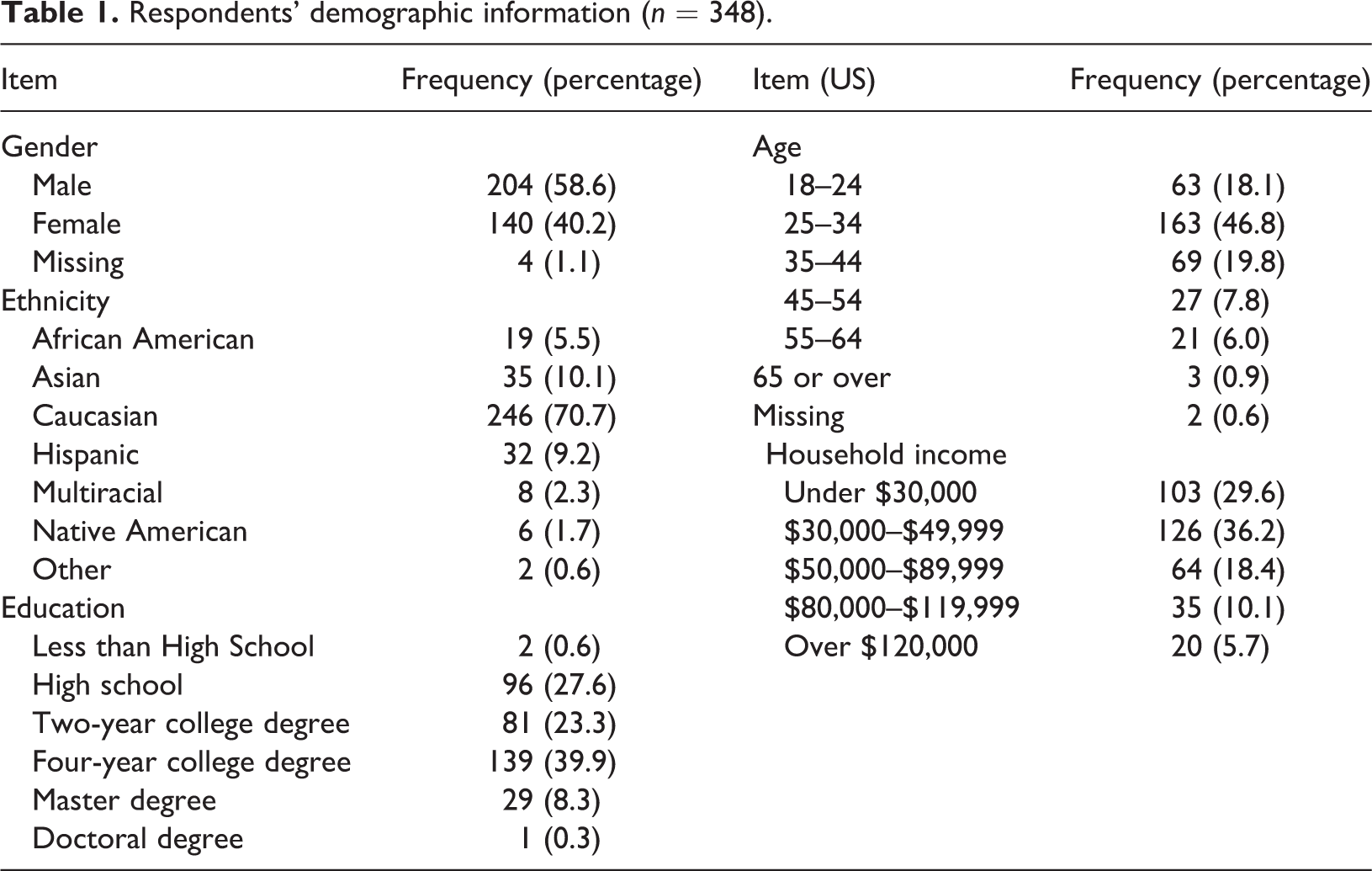
A total of 380 responses were collected, and 348 responses were usable. Table 1 lists the demographic information of respondents. This study had slightly more male respondents (58.6%) than female (40.2%). The majority of respondents were in the 18–44 age group (84.7%), followed by the 45–54 age group (7.8%), the 55–64 age group (6.0%), and the 65 or over age group (0.9%). Caucasians made up the majority of respondents (70.7%), and Asians and Hispanics accounted for 10.1% and 9.2%, respectively. Approximately two-third of the respondents (71.8%) had at least an associate’s degree, with 23.3% having a 2-year college degree, 39.9% having 4-year college degree, and 8.6% having a graduate degree.
Respondents’ demographic information (n = 348).
Measurements of brand equity
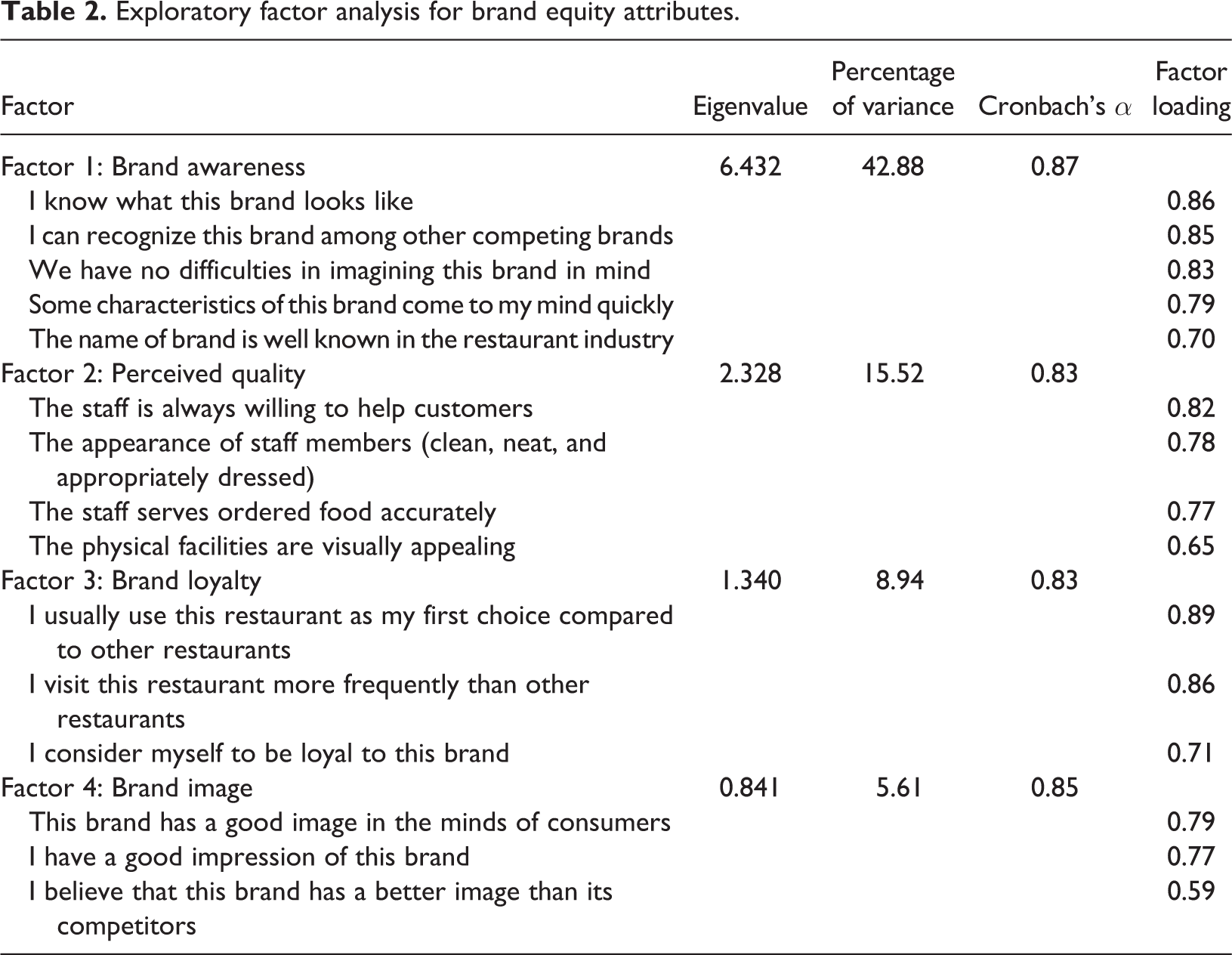
Exploratory factor analysis (EFA) was conducted in order to identify underlying dimensions of brand equity operationalized by 16 items, as presented in Table 2. Four factors were extracted by the EFA: brand awareness, perceived quality, brand image, and brand loyalty. These factors were matched with those in the previous literature. While the fourth factor had a contiguous eigenvalue (0.88), we used a scree plot to visually assess factors in the steep curve before the first point that started the flat line trend. The scree plot in this study’s factor analysis indicates that the fourth factor could be the turning point, like an “elbow” in the scree plot. Four factors accounted for 72.95% of the variance of all 15 items. The factor loadings of attributes varied from 0.59 to 0.89, which was above the recommended cutoff point of 0.3, which meets the requirements of statistical significance (Hair et al., 2006). The Cronbach’s α of the four factors ranged between 0.83 and 0.87, which was above the threshold of 0.7 indicating reliability and internal consistency.
Exploratory factor analysis for brand equity attributes.
Hypotheses testing
Differences in brand equity between non-CSR and CSR scenarios
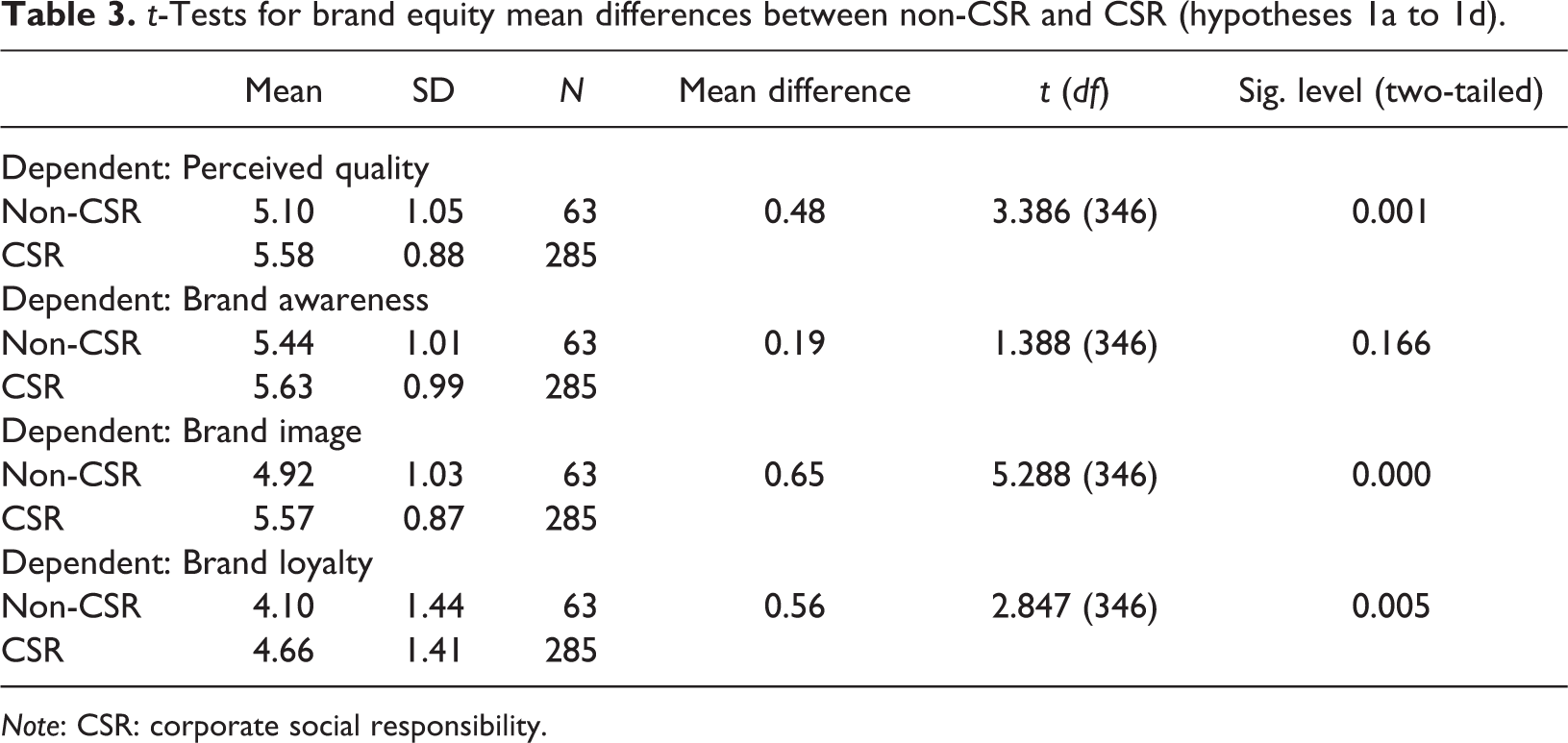
This study’s responses were collected from five different surveys that used different CSR scenarios in restaurants. The experimental conditions of using five scenarios in surveys led to a categorical variable with five categories: food, employment, community, environment, and non-CSR. Independent t-tests were used to examine mean differences in the four brand equity variables between non-CSR and CSR scenarios. Table 3 illustrates the results of the independent t-tests. The t-test result demonstrates that the mean difference of perceived quality between non-CSR scenarios and CSR scenarios was 0.48 (t(346) = 3.386, p = 0.001). Therefore, CSR scenario respondents perceived a significantly higher quality than non-CSR scenario respondents. On the other hand, the mean difference of brand awareness was not significant, at a 0.05 level (t(346) = 1.388, p = 0.1688).
t-Tests for brand equity mean differences between non-CSR and CSR (hypotheses 1a to 1d).
Note: CSR: corporate social responsibility.
In addition, the mean difference of brand image between non-CSR scenarios and CSR scenarios was 0.65 (t(346) = 5.288, p = 0.000). The mean difference of brand loyalty between non-CSR scenarios and CSR scenarios was 0.56 (t(346) = 2.847, p = 0.005). Hence, CSR scenario respondents had a significantly higher brand image and brand loyalty than non-CSR scenario respondents. Such results provided statistical support for hypotheses 1a, 1c, and 1d.
Moderation of the relationship between CSR and brand equity
Brand size as a moderator
The restaurants specified by respondents were grouped into small brands and large brands in order to create a dichotomous variable. The means of perceived quality, brand awareness, brand image, and brand loyalty for respondents who had visited small brand size restaurants were 5.56, 5.22, 5.62, and 4.73, respectively. The means for respondents who had visited large brand size restaurants were 5.46, 5.79, 5.39, and 4.48, respectively.
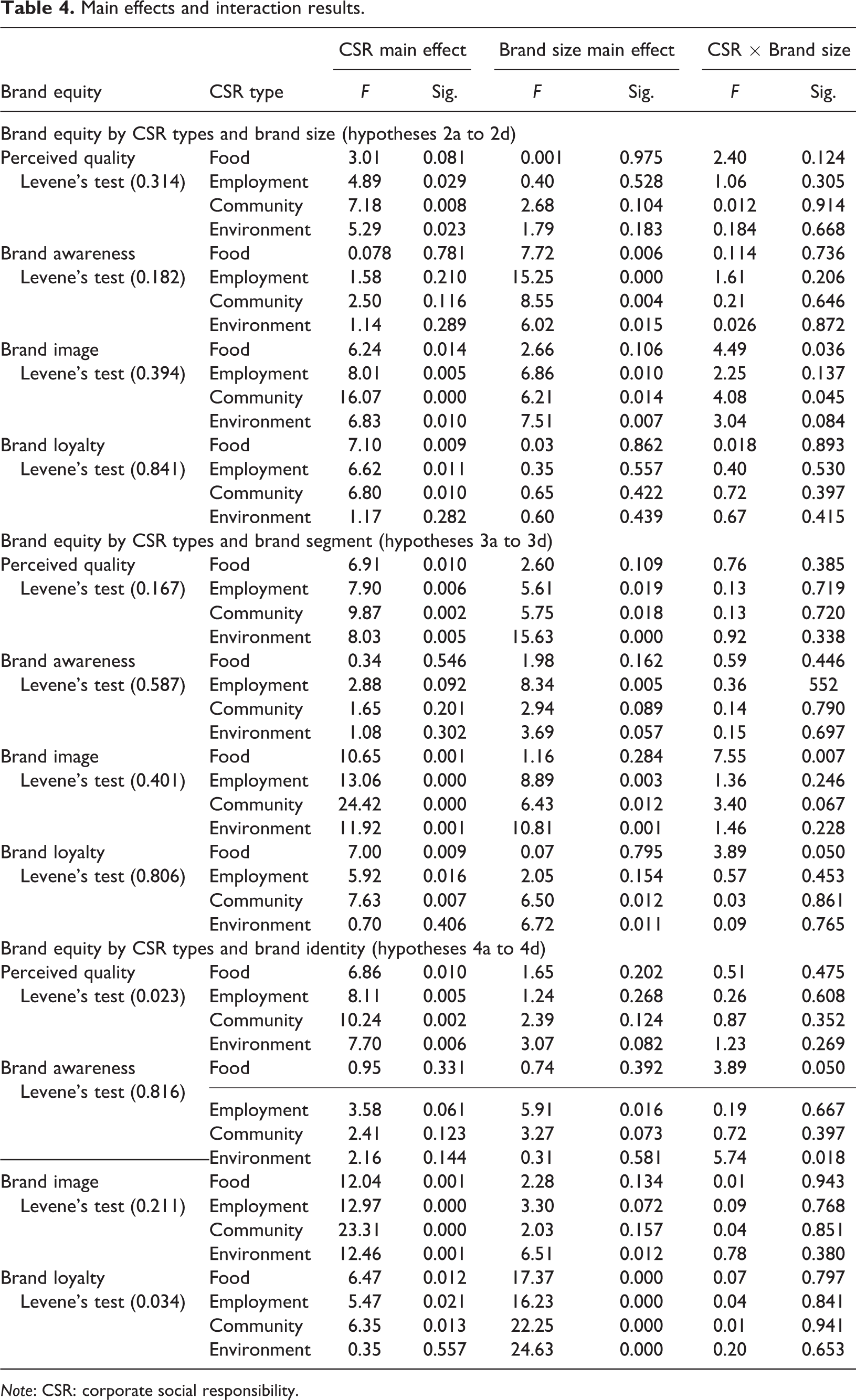
The results for main effects and interaction of CSR and brand size on brand equity are presented in Table 4. First, significant interactions were found between food-related CSR practices versus non-CSR and brand size (F = 4.50, p < 0.036) and between community-related CSR practices versus non-CSR and brand size (F = 4.08, p < 0.045) on brand image. Hypothesis 2c was partially supported, and hypotheses 2a, 2b, and 2d (including other brand equity variables) were not supported. As shown in Figure 1, brand image generally increased as food- and community-related CSR practices were conducted by a restaurant. However, a large restaurant’s improved image was higher than in a small restaurant. The main effects for those nonsignificant interactions were investigated and are presented in Table 4.
Main effects and interaction results.
Note: CSR: corporate social responsibility.
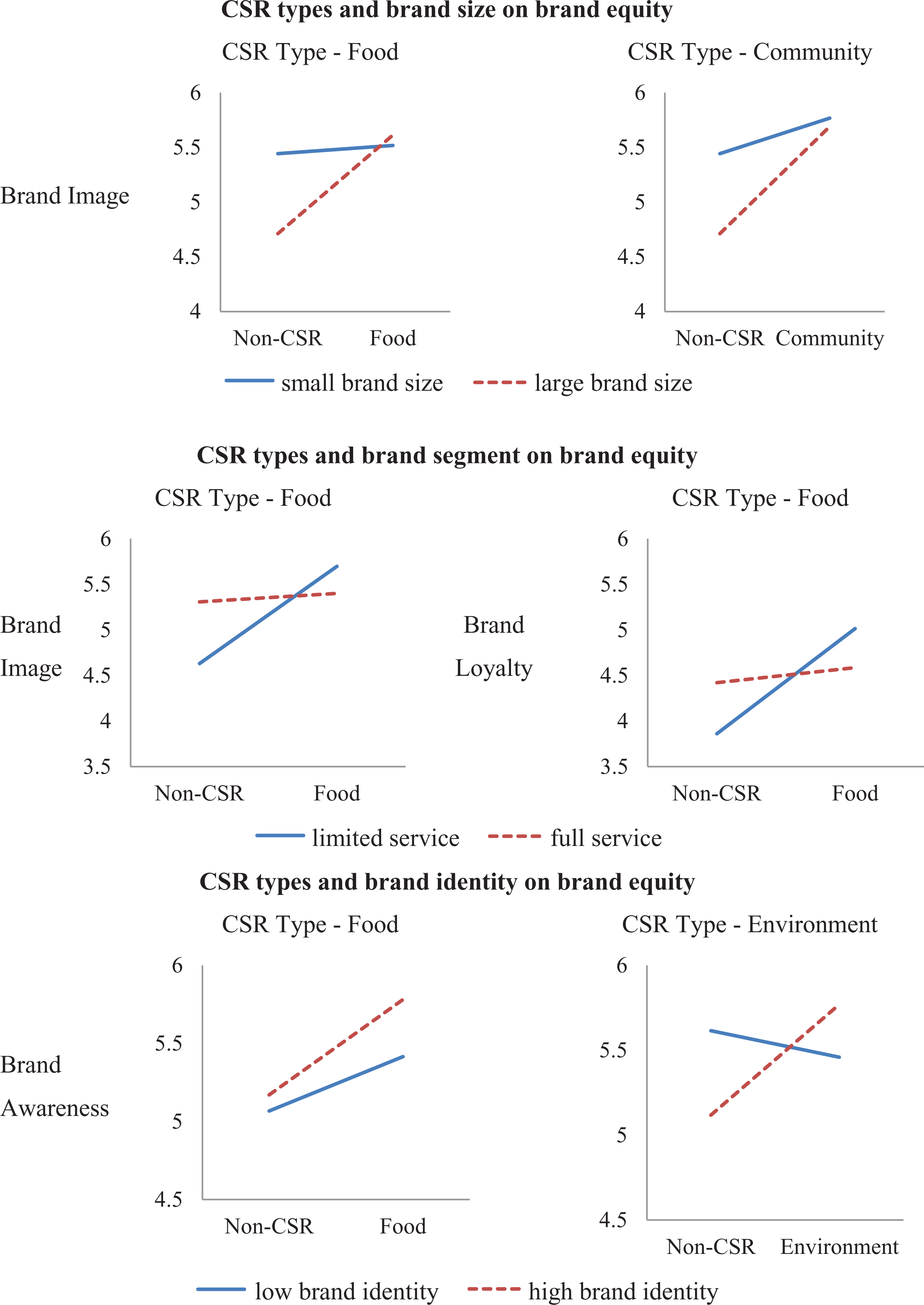
Interaction effects.
Brand segment as a moderator
Brand segment was coded as limited service and full service. The means of perceived quality, brand awareness, brand image, and brand loyalty for respondents who visited limited-service restaurants were 5.328, 5.729, 5.378, and 4.426, respectively. The means for respondents who visited full-service restaurants were 5.726, 5.419, 5.585, and 4.744, respectively.
According to the results of two-way ANOVA tests in Table 4, there were interaction effects between food-related CSR practices versus non-CSR and brand segment on brand image (F = 7.55, p < 0.007) and on brand loyalty (F = 3.89, p < 0.050). Therefore, the findings partially support hypotheses 3c and 3d, which state that brand segment moderates the relationship between CSR and brand image and brand loyalty. Hypotheses 3a (specifying perceived quality) and 3b (specifying brand awareness) were not statistically significant. As shown in Figure 1, the lines intersect, indicating disordinal interactions. Whether or not brand image and loyalty toward restaurants that engage in food-related CSR practices are higher than those of non-CSR restaurants depends on the restaurant’s segment. Non-CSR restaurants have higher levels of brand image and loyalty when they provide full services than when they provide limited services, but restaurants that engage in food-related CSR practices have higher levels of brand image and loyalty when they are in the limited-service industry than in the full-service industry.
Brand identity as a moderator
Brand identity was separated into low brand identity and high brand identity by the mean of the brand identity measures. The means of perceived quality, brand awareness, brand image, and brand loyalty for respondents with low brand identity were 5.35, 5.63, 5.31, and 4.10, respectively. The means for respondents with high brand identity were 5.70, 5.55, 5.68, and 5.19, respectively.
Table 4 lists the results of the main effects and interaction results for brand equity by CSR types and brand identity, thus providing statistical support for hypotheses 4a to 4d. First, the significant interactions between CSR types and brand identity were food CSR versus non-CSR and brand identity on brand awareness (F = 3.89, p < 0.050). Hence, hypothesis 4b was partially supported. In contrast, hypotheses 4a, 4c, and 4d were not supported. As shown in Figure 1, the lines do not intersect on the left, which would illustrate an ordinal interaction; instead, the lines intersect on the left graph, indicating a disordinal interaction. Brand awareness increased as food-related CSR practices were conducted by a restaurant. However, a high brand identity customer increase in brand awareness was higher than a low brand identity customer. Conversely, whether or not brand awareness of restaurants that engaged in environment-related CSR practices was higher than that of restaurants that engaged in no CSR practices depended on the brand identity. High brand identity customers had higher levels of brand awareness when they were exposed to an environment CSR restaurant than a non-CSR restaurant. However, low brand identity customers had higher levels of brand awareness when they were exposed to a non-CSR restaurant than an environment CSR restaurant.
Conclusion and discussion
This study investigated how CSR toward food, environment, employment, and community affect the dimensions of brand equity: perceived quality, brand awareness, brand image, and brand loyalty. It also examined the roles of brand size, segment, and identity on the relationships between CSR and brand equity in the restaurant industry. The results of the analyses indicate that CSR practices have a positive impact on brand equity. Furthermore, an increase in a particular brand equity dimension depends on whether a restaurant conducts a particular type of CSR, incorporating its brand size, segment, and identity.
The impact of CSR practices on brand equity
While CSR studies in the hospitality industry are limited to examining several CSR activities or one aspect of brand equity, this study examined how all the key operation-related CSR activities in the restaurant industry influence a multidimensional customer-based brand equity.
The results indicate that CSR practices relating to food, employment, community, and environment can increase customers’ perceived quality and brand image. CSR can provide a firm with value by signaling product quality. Such signals of product quality can spill over into other aspects of the firm as the halo effect occurs. Thus, restaurants conducting socially responsible practices can be seen as a brand offering high-quality products and services, and CSR activities could enhance the overall image of a restaurant’s brand. Among the impacts of the four types of CSR, restaurants undertaking community-related CSR programs attained the largest increase in perceived quality and brand image compared to restaurants not employing any CSR program. Community-related CSR practices, such as charitable donations and volunteer community services, can shorten the psychological distance between customers and a company. This is an effective way for a brand to distinguish itself from others (Brunk, 2010; Wu and Wang, 2014). Such activities may make people think that a certain restaurant contributes to their communities, thus creating a good impression of the brand for both existing and potential consumers. Therefore, community-related CSR practices can significantly influence restaurants’ brand image.
Further, food-related CSR practices can positively and significantly influence customers’ brand loyalty. Food is the core product of restaurants, and Selnes (1993) suggested that the performance of a core product is the primary driver for increasing brand reputation and brand loyalty. Food-related CSR practices ensure the freshness and quality of food, which offer a better perceived performance to customers. This performance can enhance a customer’s brand loyalty. Moreover, because loyalty is a behavioral attitude measure, choosing a restaurant repeatedly could largely depend on the core products that customers receive.
The impacts of brand attributes on brand equity
This study shows that the effects of CSR can vary with differences in brand size, segment, and identity. This study found that a restaurant can enhance its brand image by undertaking food- or community-related CSR practices and that the magnitude of the increase is higher for small restaurants. As companies grow, they attain more attention from outside stakeholders (Burke et al., 1986) and often plan to create brand awareness through advertisements and promotions, as opposed to smaller companies. As such, large restaurants in this study had a high level of brand image regardless of CSR. Therefore, the room to grow brand image through CSR was larger in small restaurants. Moreover, community and food are essential to small restaurants, and their businesses often rely on local food and communities.
This study also found that customers tend to focus more on types of CSR that can be easily observed, such as food- or community-related CSR practices. Environment or employment-related CSR practices mostly happen internally, indicating that it might be difficult for customers to observe those practices and to link them to their own lives and interests. Conversely, they directly experience food and community services. Therefore, linking brand size and CSR to evaluate brand image is likely to occur in the case of food- and community-related CSR practices. In conclusion, the results reveal that small brand size restaurants should pay more attention to food- and community-related CSR practices in order to enhance their brand image. Food is the core product of restaurants, and community services may be missing when a restaurant brand grows larger. Therefore, large restaurants should focus on maintaining good food quality and promoting a healthy and balanced eating style. Furthermore, they should concentrate on developing community services, donating to local charitable organizations, and sourcing local food and suppliers. Conversely, food- and community-related CSR practices could be an opportunity for small restaurants to effectively improve their image.
It is interesting to note that the findings of this study indicate that the types of food-related CSR impacts on brand image and loyalty depend on brand segments. Specifically, food-related CSR practices have a positive impact on brand image and loyalty for limited-service restaurants, but the opposite effect occurs for full-service restaurants. A possible explanation for this is that consumers using full-service restaurants, especially high-end markets or luxury brands, tend to think luxury and social responsibility are at odds with each other, so CSR practices may actually diminish the uniqueness of the experience (Jagoda, 2011). The uniqueness of customer experience is generally related to a restaurant’s brand image. Due to weaker brand image, brand loyalty can be affected in the long term.
For brand identity, food, and environment, when customers with high brand identity observed CSR, it led to a higher level of brand awareness than for customers with low brand identity. Customers with high brand identity are known to have a higher sense of belonging and brand acknowledgment. They are also proved to have a higher level of brand equity (He and Li, 2011). Organic food substitutes, healthy dining style, energy-efficient equipment, and waste control have been some of the top trends in restaurant innovations. These trends are mostly related to food- and environment-related CSR practices. Restaurants can encourage a high brand identity in their customers and raise their awareness to the restaurant brands if they start to follow those trends.
Theoretical contributions
Previous research has considered CSR practices as a single-dimension variable (e.g. He and Lai, 2014; Pai et al., 2015) or primarily limited to green practices (e.g. Namkung and Jang, 2013). This study focuses on four key dimensions of restaurants’ CSR. The restaurant industry is a heavy consumer of energy, water, and other resources. Moreover, it plays a major role in away-from-home foods, is labor-intensive, and fights food waste. Thus, the industry’s contribution to sustainability and the relevant benefits should be interpreted using an industry-specific categorization of CSR. Moreover, this study revealed the differences in the impacts on brand value dimensions, and the findings suggest that the effect of CSR cannot be simplified with a single variable.
Another contribution of this study is that it identifies brand characteristics that strengthen the effects of CSR on brand equity. Without the consideration of the moderating role of brand characteristics, the effect of CSR on brand equity may be biased. For example, this study added brand size and brand identity as relevant factors in explaining the relationship between different CSR practices and brand equity. Brand size often determines the amount of resources that a restaurant has and utilizes, and it offers more business development opportunities. Brand identity evaluates how customers become involved with and acknowledge a brand. It can foster a sense of belonging in customers and potentially increase their purchase behavior. This study utilized these traits to better understand the relationship between different CSR practices and brand equity.
It is important to note that these results may be unique for the restaurant industry because of the high percentage of the restaurant franchise among the total number of restaurants and the need to sell the brand. For example, the moderating role of brand characteristics may not be as pronounced in other industries that are less sensitive to the brand, such as those serving necessities like health care or agriculture products. Restaurant brands distinguish themselves from each other in order to stand out from their competition. Brand equity is an excellent indicator of brand success (Keller, 1993).
Managerial implications
This study should raise the attention of restaurant managers and owners regarding the impact of CSR practices on brand equity. All four types of CSR practices, especially food-related CSR practices, are worthwhile investments for enhancing perceived quality and brand image. This study suggests that a particular social responsibility activity can highlight different positive aspects of brand value. For example, food-related CSR practices, such as a healthy menu, fresh and nutritious ingredients, and organic substitutes, can increase customer brand loyalty.
Owners and operators could allocate scarce corporate resources to specific CSR activities according to their brand characteristics, such as brand size and segment. Large restaurant brands should choose food- and community-related CSR practices, whereas limited-service restaurants should focus on food-related CSR practices. Furthermore, restaurant managers should develop a relationship with their customers to increase brand identity, which can enhance customers’ perceived quality, brand image, and brand loyalty.
Finally, restaurant brand executives can encourage their franchisees to adopt CSR practices based on their brand characteristics. Such practices can enhance the equity of the whole restaurant brand. For example, McDonald’s, a large brand and limited-service restaurant, could focus on investing in food-related CSR practices in order to increase brand image and brand loyalty. Higher brand equity can be more attractive to a potential franchisee to join the franchise.
Limitations
Although this study provided multiple theoretical contributions and managerial implications, it was not free from limitations. First, this study did not consider the subsequences of the constructs of brand equity and viewed these constructs as parallel variables. Future studies could examine the relationship between CSR practices and the variables of brand equity with a certain subsequence. In this case, how CSR practices gradually strengthen brand equity could be observed.
Second, this study was distributed in Amazon Mechanical Turk. More than half of the respondents were considered as coming from low-income families (less than a US$50,000 annual income per household). These respondents may not accurately represent all restaurant patrons in the United States with regard to their understanding of social responsibility. For better generalizability of findings to the general population, studying different populations is recommended in future studies.
Footnotes
Declaration of conflicting interests
The author(s) declared no potential conflicts of interest with respect to the research, authorship, and/or publication of this article.
Funding
The author(s) received no financial support for the research, authorship, and/or publication of this article.
