







Abstract
As one of the most popular exchange intermediary for travel products, the online travel agencies (OTAs) compete fiercely. Previous studies on the OTA market efficiency focus on the travel product prices and distribution channels competition, but contradictions and paradoxes can be found between the theoretical explanations and empirical results. This article proposed a theoretical model by identifying two determinants of the OTA market efficiency: the matching ability and market size. The study shows that (1) the matching ability improves the market efficiency by enlarging the market size and increasing the effective range of competition; (2) the comparative advantage in matching ability of one OTA will lead to the efficiency occupation of other OTAs; and that (3) new OTAs or long tail travel products may reduce market efficiency, but it provides the opportunity to reconstruct the traditional industrial chain. This study enriches the economic theory of OTA and provides commercial guides for practice.
Introduction
As one of the most successful e-commerce application, the online travel agency (OTA) systems can be equipped with air flights, hotel, or car rental reservation systems to deliver travel-related products or services directly (Black and Kaynama, 2000; Buhalis and Law, 2008; Kim et al., 2007). Many tour agencies start to work with OTA platforms to enable travelers search for products or service with comparable prices (Kim et al., 2007; Koo et al., 2011). Airline companies and hotels also collaborate with OTAs and allocate the right capacity to the right travelers at the right time by analyzing past performance, reviewing current booking patterns, examining market trends, identifying emergencies, and forecasting the future demand (Del Chiappa and Balboni, 2013; Kim et al., 2007; Kimes, 2004; O’Connor and Murphy, 2008). Even the unique travel needs can be met by gathering and organizing the customized travel information through the mobile, social, and location-based OTA applications (Beritelli and Schegg, 2016; Carroll and Siguaw, 2003; Kim et al., 2007; Ling et al., 2014).
Billions of searching requests through OTAs are completed each year (Beritelli and Schegg, 2016; Christodoulidou et al., 2010). At the same time, the competition between different OTAs has become increasingly intense (Black and Kaynama, 2000). By comparing with traditional travel agencies, the long tail marketing strategies are widely adopted by OTAs for getting the competitive advantage—whether Expedia, Travelocity, or Orbitz, spares no effort to increase its travel product categories. In addition to delivering traditional travel services (e.g. hotel rooms, air tickets, etc.), OTAs started to provide the long tail travel products, including custom-made travel products, smaller and less well-known scenic spots tours, and other nontraditional products (e.g. homestay, accident assistances, shopping advices, one-stop visa service, currency exchange, phone cards, online local tours advices, transportation services, insurance and attraction tickets, etc.) Besides, new travel services are promoted on OTAs, such as wedding tour, study tour, private jet tour, or other “travel + X” product. New attractions could be found and developed with the combination of social network service (SNS) and OTAs. There are three reasons for the explosive growth of the OTA market size: The fast development of the computing technology and the convenient online coordination make the marginal cost of adding new travel products into zero. The growing number of knowledgeable travelers: The greater flexibility and spontaneity of knowledgeable travelers have driven OTAs to adopt an online presence with richer information (Reid and Pearce, 2008). The OTA pricing strategy: Due to the transparent online pricing, travel product providers can hardly use the traditional strategies to price-discriminate OTA consumers (Goldmanis et al., 2008). New travel bundles with the long tail products are stimulated to be provided online as the price information could be hidden. The combinations of different travel products make OTA product categories be larger.
The expansion of the OTA market brings a question: Whether the explosive growth promotes the competition and increases the market efficiency? As a destructive innovation mode, some long tail travel products or new OTAs (e.g. Airbnb) erode the traditional market share obviously. It is needed to discuss the relevant long tail effect on the OTA market efficiency. On the other hand, the searching tools, the intelligent reminder, and the SNSs enhance the matching ability and reduce the searching cost greatly. Instead of an exogenous variable in traditional market, the matching ability changes into an endogenous variable in OTAs. Thus, the matching ability becomes one of the most key factors affecting the OTA market efficiency. However, the searching cost of OTAs cannot be ignored due to the huge aggregation of travelers and travel products (Clay et al., 2001). It is necessary to fully explore the influence of matching ability on the OTAs’ competition and market efficiency.
The previous studies on the OTAs’ competition focused on discussing the travel product prices. As the searching results of most OTAs can be sorted by prices, some travelers tend to pay more attention to the price than other attributes. The price competition has increased (Granados et al., 2012) and lead to higher market efficiency (Bakos, 1997). Thus, the price dispersion will decrease (Ghose and Yao, 2010; Granados et al., 2011).
However, this conclusion is not supported by empirical results. Granados et al. (2011) found that the online price dispersion of hotel rooms increases. Lehmann (2003) validated the existence of price discrepancies and product differentiation on the air tickets offered by OTAs. It is also found that the ticket prices offered by different OTAs are significantly different for the same traveler requirement, even taking into account the ticket type (Lehmann, 2003). In other words, the price discrepancies and product differentiation still exist. The reasons for the OTA price deviation are multifaceted, including searching costs, service differentiation, market structure, travel product categories, and OTA suppliers’ responses on competition.
Some researchers also tried to explain the OTA market efficiency from the view of distribution channels. As the OTAs reduce the searching cost and transaction friction, travelers can easily check and compare prices across different platforms (Goldmanis et al., 2008; Granados et al., 2011). However, this research angle overlook the growing number of new OTA platforms or long tail travel products and ignored the relevant effects on the OTA competition.
The development of the OTAs shows that both the market size and the matching ability determine the OTA market efficiency. For exploring the OTA operation and competition, this study establishes a theoretical model by describing the dynamic OTA market size and the matching ability. This study will answer two questions: (1) What are the key factors for the OTA competition, especially taking into account the competition from the new type of OTAs? (2) What are the performances of OTA market efficiency in different competitive conditions?
There are two contributions of this study: First, in contrast to the traditional research mode focusing on the OTA prices or channels, this article proposes the matching probability density function to investigate the OTA market efficiency through the matching ability and market size. Second, this study contributes to long tail theory by considering the negative externality of the long tail travel product.
Literature review
Earlier research studies on the OTA market efficiency can be divided into two categories. Some studies focus on discussing the information efficiency of OTAs, while others focus on the competitive strategy of OTAs or OTA suppliers. These two aspects reflect the research domain of this study.
Travelers are the primary users of search engines, including travel meta-search engines (e.g. Kayak) (Beritelli and Schegg, 2016; Christodoulidou et al., 2010). The information displayed on OTAs includes a brief introduction, pictures, prices, the location information, comments from social media, and so on (Aluri et al., 2015). This information can be displayed as a list on the searching result pages, sorted by popularity, recommendation, price, or brands. Travelers can also search and compare travel products listed on different OTAs. The online searching, together with ubiquitous private information can provide full dynamic matching and bargaining opportunities (Beritelli and Schegg, 2016), so as to reduce the searching cost of OTAs to almost zero (O’Connor and Murphy, 2008). The lower searching cost and higher availability of information enable market be closer to perfect competition and bring the full efficiency (Granados et al., 2012).
The searching function and the information on OTAs affect travelers’ choices (O’Connor and Murphy, 2008). For example, the price is a primary strategic variable for the OTAs and travelers will search online for the lowest potential prices (Guizzardi et al., 2019; Kimes, 2016; Yang and Leung, 2018; Yelkur and Dacosta, 2001). The price transparency and the price competition may lead travelers to compare and wait for better deals quickly (Choi, 1991; Guizzardi et al., 2019; O’Connor and Murphy, 2008; Thompson and Failmezger, 2005). Thus, OTAs engage in fierce price competition and bring less dispersed prices. There will be a subsequent erosion of profits to the whole market (Bakos, 1997; Brynjolfsson and Smith, 2000; Granados et al., 2011).
In fact, most empirical analyses are not consistent with the above theoretical predictions, although exceptions could be found for price auction OTAs (Granados et al., 2012). The reason is that the increasing number of non-price information make more and more travelers start to concern on value-added services, by comparing with the price. Besides, search engines have stimulated the emergence of customer reference prices. Due to the perceived savings, travelers may continue to search for better price after a booking, or may stop searching, opting to save time rather than save money by considering the current price, the booking time spent, and whether the booking is guaranteed (O’Connor and Murphy, 2008; Suri et al., 2004). Thus, the rich product information leads to a higher searching cost (O’Connor and Murphy, 2008).
On the other hand, the traditional yield management faces challenges due to the 24/7 global accessibility to the OTA prices/product information and the complex OTA distribution channels (Masiero and Law, 2016; O’Connor and Frew, 2002; O’Connor and Murphy, 2008; Yin et al., 2019). The OTA suppliers intend to manipulate the distribution management by using the differentiation and bundling strategy (Carroll et al., 2007; Granados et al., 2011; Kim et al., 2009; Ropero, 2011). The combination of different travel components (e.g. flights, hotel stays, car rentals, transfers, ground transportation, parking, recreational activities, tours, etc.) can create lots of new bundling products with unique attributes and prices (Kim et al., 2007, 2009). These customized bundles will enlarge the price dispersion and increase the searching cost (Rianthong et al., 2016).
Considering the deviations between the theoretical predictions and the empirical results, including the paradoxes between theories, it cannot reflect the OTA competition only through the angle of price dispersion or the searching costs reduction. Both of them are impossible to measure the OTA market efficiency accurately. Therefore, it is necessary to develop a new theoretical model.
Another group of literatures focuses on the marketing channel competitive strategy of OTA suppliers. As Buhalis and Zoge (2007) noted, hoteliers who successfully manipulate online distribution can add value, develop brand, build traveler loyalty, and maximize exposure and market share (Beritelli and Schegg, 2016; O’Connor and Murphy, 2008; Toh et al., 2011). The competitive advantage can appear by the variety of alternative OTA distribution systems and the vast number of travel products (Beritelli and Schegg, 2016; Law and Jogaratnam, 2005; Toh et al., 2011) Thus, most travel products are promoted through multiple channels (Koo et al., 2011). Many literatures discussed the profit sharing and channel, traveler purchase behavior, pricing strategy, customer price preference, transaction costs, channel capabilities, competitive strength, channel performance, resource allocation, and the diversifying risks (O’Connor, 1999; Piga and Filippi, 2002; Sun et al., 2016; Van Riel et al., 2004; Rao and Smith, 2006).
However, the nature of OTA channel is to provide travelers information to support their purchase decision (Middleton and Clarke, 2001). A qualified distribution channel should deliver appropriate information and facilitate reservations (O’Connor, 2003). Since travelers are dependent on accurate, timely, high-quality information to differentiate the competing properties (Lu et al., 2015), it is necessary to study the competitive strategy of OTA channel from the perspective of information matching, so as to explain the performances of OTA market efficiency in different competitive conditions.
Besides, the existing literature insufficiently concerns about the negative externalities of the OTAs. There are two sources for the OTA negative externalities. First, the travel products on OTAs are provided by lots of suppliers. The intensity of competition depends on the total number and the time lag of the OTA suppliers’ responses (Chen and MacMillan, 1992). When OTAs compete, each OTA supplier faces unique competitive set domains (Peteraf and Bergen, 2003). The total number of OTA suppliers increases the number of competitive responses and leads to the fiercer competition reactions (Guizzardi et al., 2019). Turning to the OTA suppliers’ reactions, some of them will follow and match the competitor’s price cut, others will not react to price changes but add differentiated travel products (Chen and MacMillan, 1992; Li et al., 2017). Second, the large number of customers with diverse online behavior and preference lead to a complicated traveler segmentation. The discount policies of travel products may not work due to customers’ response. On OTAs, high-valuation travelers are inclined to pay higher prices, while leisure travelers are often “sufficiently patient to wait for last-minute deals” (Abrate et al., 2012; Dana, 1998; Guizzardi et al., 2019; Su, 2007). It is difficult to define the measurement standard on the travel product quality. The product differentiation strategies are widely adopted by OTA suppliers (Guizzardi et al., 2016). Bundles with long tail travel products are encouraged to provide to meet to the traveler segmentation. With a large number of products and travelers flocking to the OTA, the OTA market efficiency will be greatly reduced. Thus, the negative externality effect should be considered in the OTA market efficiency study.
Based on the above discussion, most previous studies discussed the OTA market efficiency based on the traditional enterprise competition view. The vagueness of the analytical perspective influences the rational judgment of both academia and industry on the current status of OTAs. On the other hand, some scholars regard the appearance of OTA as one economic transformation. However, the OTA is still developing with emerging travel product or service. There is a lack of theoretical analysis on the root causes of the OTA market efficiency and the OTA evolution.
To sum up, according to the shortcomings of the existing research, this study takes the search theory as a basis. This study explores the formation mechanism of the OTA efficiency by taking account of the negative externalities of the OTA market size, so as to enrich the existing theories on the OTA market.
The OTA market efficiency model
The measurement function of the OTA market efficiency
Based on the searching, selection, execution, and collaboration functions, OTAs can aggregate a variety of travel products and match the needs of both travelers and travel product providers with price transparency (Bakos, 1997; Choudhary et al., 1998; Lee and Clark, 1996; O’Reilly and Finnegan, 2005; Soh et al., 2006). In the foreseeable future, self-service order function can be added on the OTAs for delivering the right travel products quickly and efficiently through artificial intelligence and machine learning. The matching ability of the OTA reflects the searching cost, and the aggregation function determines the market size and the competition scope. Nowadays, the search engine improves the OTAs’ retrieval and matching ability of travel product information. The aggregation function makes the OTA market size far exceeds the traditional ones.
The search theory shows that the market efficiency depends on the interaction between competition and information searching (Christiaanse et al., 2004). In OTAs, only limited travel product providers could be contacted due to the searching cost and the increasing non-price information. This reality leads to the incomplete competition. It also distorts the information flow of market price and consumer preference. Therefore, the searching cost determines the degree of imperfect competition, thereby affecting the market efficiency (Salop and Stiglitz, 1977; Wilde and Schwartz, 1979). A stronger OTA matching ability will lead to a lower searching cost, a more complete transaction information, and a more competitive and efficient market. In this sense, the improvement of the OTA market efficiency will depend on the effective scope of searching activities and competition.
On the other hand, the growing OTA market size also affects the matching ability and the market efficiency. As the OTAs have a strong network externality, whether suppliers, such as hotels and airlines, or intermediaries, such as travel agents, are encouraged to provide the long tail products, travel packages, and new travel services to attract more OTA users, expand market size, and streamline the purchasing process. Travelers may also obtain significant savings by these “bundles” (Kim et al., 2009).
The expansion of market size increases the effective scope of the OTA market competition, so as to improve the market efficiency. However, a large number of suppliers, travelers, and long tail products gathered in OTA at the same time. Thus, the information asymmetry will be aggravated, resulting in a lower market matching ability and a higher searching cost. Grover et al. (2006) believe that the online price dispersion is a result of the overload information, as the overload information will affect the effectiveness of travelers searching and market allocation. Therefore, the mathematical model of the OTA market efficiency must include the two conflicting variables, the matching ability and the market size, by taking into account the interaction between searching capability and the negative externality.
Considering the importance of the travel product catalog size, this study proposes the viable trading scope on to measure the aggregation ability of the OTA. If the searching cost is zero, travelers will get all the potential trading opportunities in the OTA. However, due to the existing cost of the searching activity, the number of searching times becomes an important economic variable to determine the scope of a transaction (McCall, 1970). That is, the choice of trading in the OTA (the viable trading scope) is smaller than the potential market size.
From the above analysis, the OTAs’ viable trading scope is the function of OTA matching probability density
In this research, the matching ability is used to measure the searching cost of the OTA. The matching ability of OTA is described by the probability density function
As the matching friction in the OTA cannot be avoided, the matching ability and the viable trading scope are two interdependent factors to measure the OTA market efficiency. Thus, the OTA market efficiency can be expressed as

As the maximum OTA market efficiency expectation,
The competing OTAs and the market efficiency
To investigate the relationship between the matching ability and the OTA market efficiency, this study assumes that there are two OTAs: OTA A and OTA B. Similar travel products could be found on both OTA A and OTA B. The huge amount of travel products is uniformly distributed in a linear space with the length of Q (the potential market size). However, the searching capability of OTA A and OTA B is different. Thus, there are two different matching probability density functions (


where
If there is no trade friction, the maximum market efficiency of the two OTAs is
When

In [0,


In [


According to formulas (2) to (4)

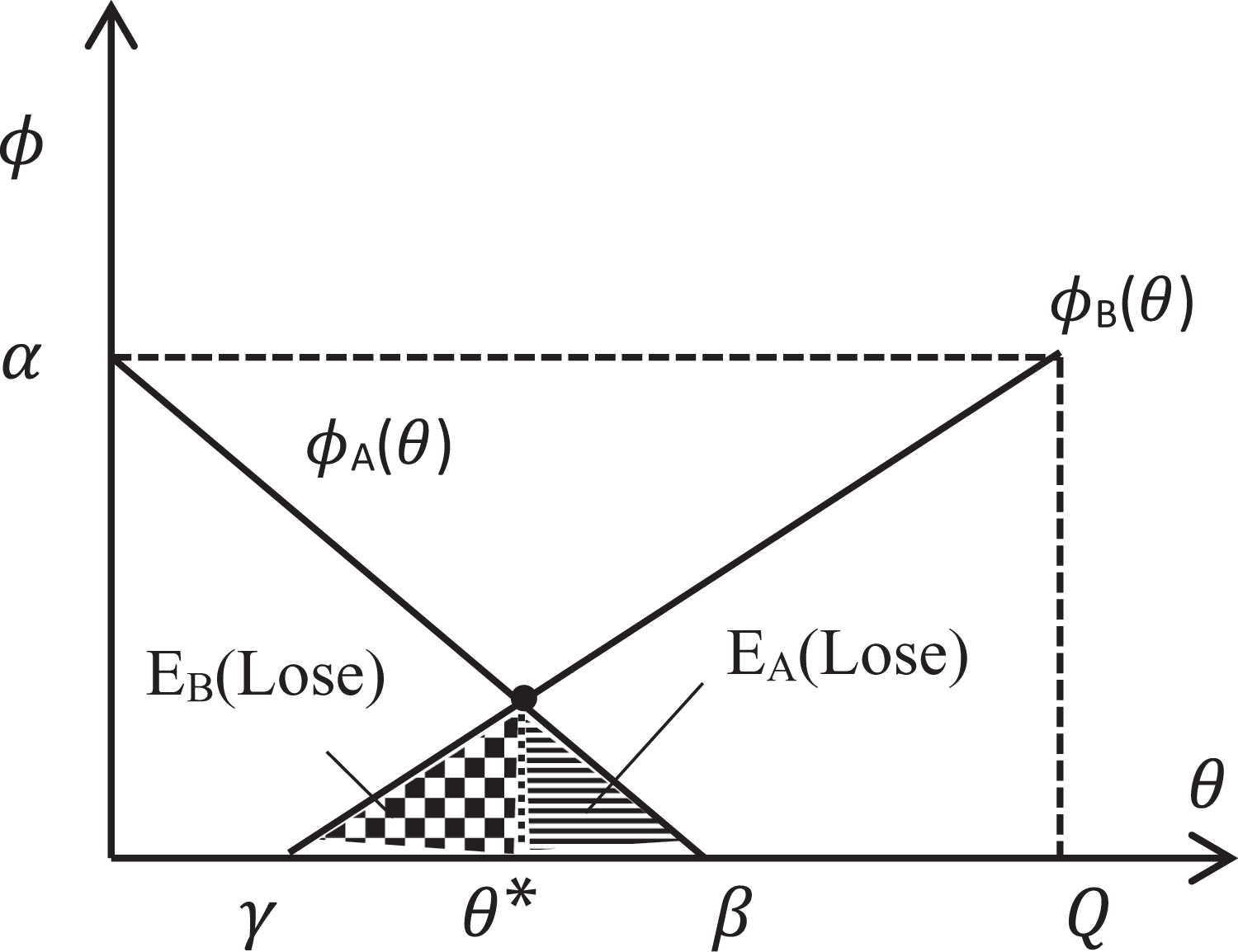
As described in Figure 1, due to the competition of matching ability, both OTA A and OTA B have the efficiency loss. Therefore, the OTA market efficiency is determined by the matching ability. Although there is market efficiency loss, the efficiency losses of two OTA are offset by each other. The total OTA market efficiency will increase in the competition. Thus, the following proposition is proposed.
The competing OTAs and the market efficiency. OTA: online travel agency.
Proposition 1 reveals that the OTA competition is the matching ability competition. The OTA market efficiency depends not only on the matching ability of its own, but also on the matching ability of the competitor(s). Specifically, the searching activity of the OTA has a strong externality effect. When one OTA’s matching ability is strong, the trading opportunity for other OTAs will be lower relatively and the viable transaction scope of other OTAs will narrow. It reflects the “crowding out” effect. At the same time, when the OTA searching capability is strong, the travel products can obtain more trading opportunities with uniform distribution. The competition will be more intense. It reflects the “active effect” of the OTA market.
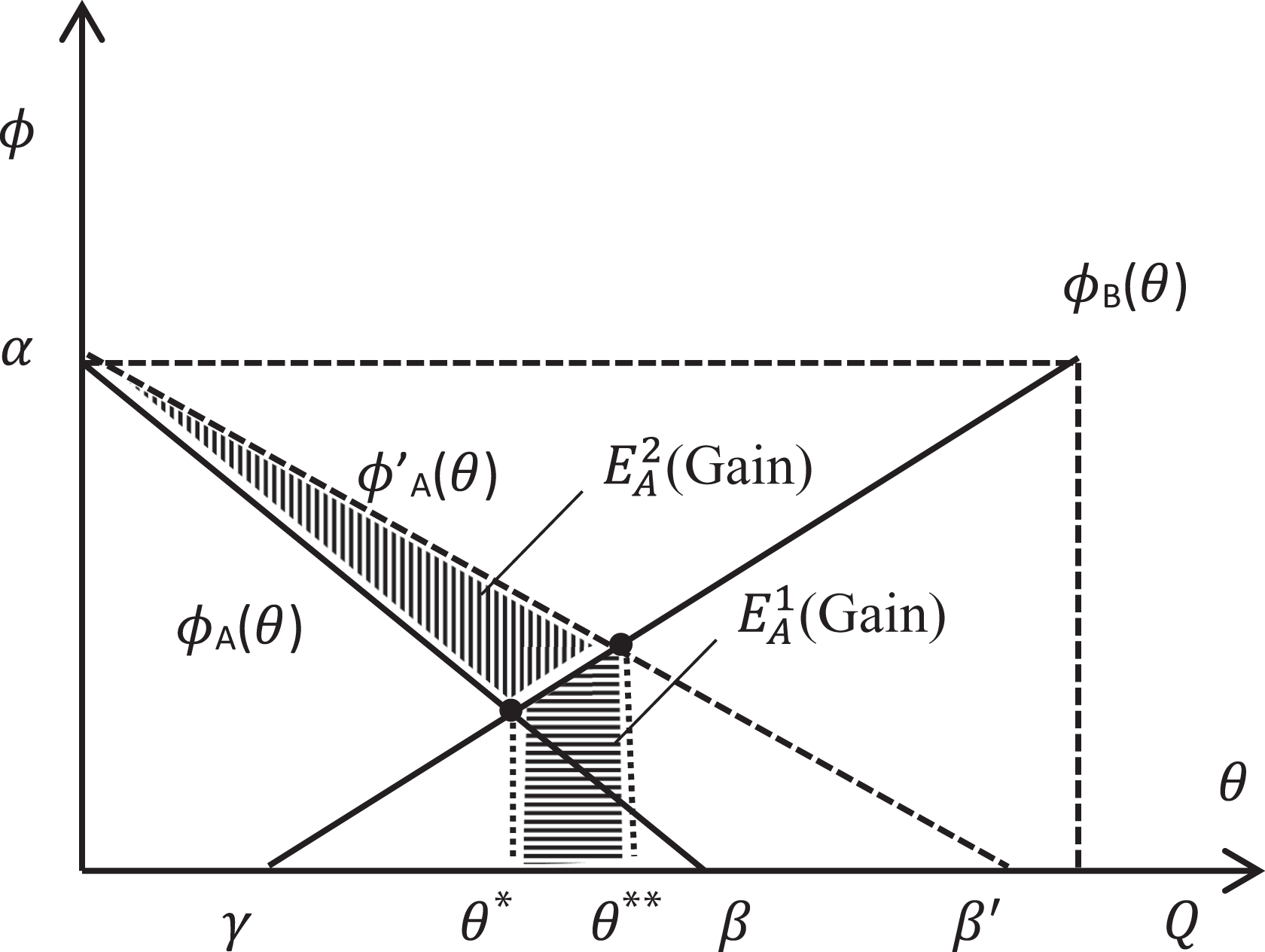
If the matching ability of OTA A improved and the matching ability of OTA B remained the same, then the matching probability density function curve of OTA A shifts to the right in the market space [0, Q], namely

As described in Figure 2, with the growth of the matching ability of OTA A, the intersection of the matching probability density curves of the two OTAs moves to
The effect of matching ability.



According to formulas (10) to (13)

Proposition 2 shows that the enhancement of the matching ability can change the distribution function of the OTA trading opportunities, alleviate the OTA information asymmetry, reduce the transaction friction, and thus achieve the improvement of the market efficiency. Moreover, the OTA searching competition is not a zero-sum game. The active effect generated from the enhanced matching ability improves the overall market efficiency and increases the travelers’ welfare. This effect is reflected in
The impact of long tail travel products
As a bilateral market, the OTAs have a strong network effect. Thus, the OTAs would like to increase the platform value by adding the long tail travel products. However, with the constant searching capability, the growth of long tail travel products will bring noises to the OTA inevitably, thereby the matching probability density function curve will descend. In order to maximize the OTA efficiency, it is necessary to balance the conflicts and contradictions between the positive externalities brought by the increasing long tail products and the negative externalities brought by the long tail noise that affects the OTA matching ability.
For analyzing the influence of the potential market size change on the OTA market efficiency, the study describes the potential market size of OTA A and OTA B as


where
It can be found that the two OTAs have the different potential market size. The matching ability of each OTA (
The OTA competition is the competition of the market efficiency maximization. As the OTA market efficiency is determined by both the matching ability and the market size, the optimization function on market size


The first-order condition for the maximum value of the above two formulas are as follows

The potential market size with the maximum OTA market efficiency will be

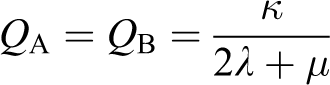
The OTA matching ability will be

In the equilibrium state, the market efficiency of the two OTAs will be

If
Proposition 3 shows that the OTA scale effect has both positive and negative externalities. Under the condition of the constant searching capability, the contribution of the positive externalities to the market efficiency decreases gradually with the expansion of the market size, while the negative externalities effect increases gradually. When the negative externality is equal to the positive scale effect (
In reality, a few large OTAs capture the main information flow by providing more and more “fragmented” products, by comparing with the traditional “Air ticket + Hotel” travel products. The market demand also gives birth to the competition between large OTAs. While, the probability for small OTAs to get website visitors declines and the operational cost increases. The rapidly growing long tail travel products have created an irregular Internet market, affected the orderly operation of traditional commerce, and caused the confusion and profit loss in the OTA industry. Proposition 3 explains the causes and consequences of this phenomenon. Under the premise that the searching capability did not improve, the huge amount of travel product aggregation can lead to a sharp reduction of the effective markets scope and a centralized distribution of information flow. The market efficiency will get worse.
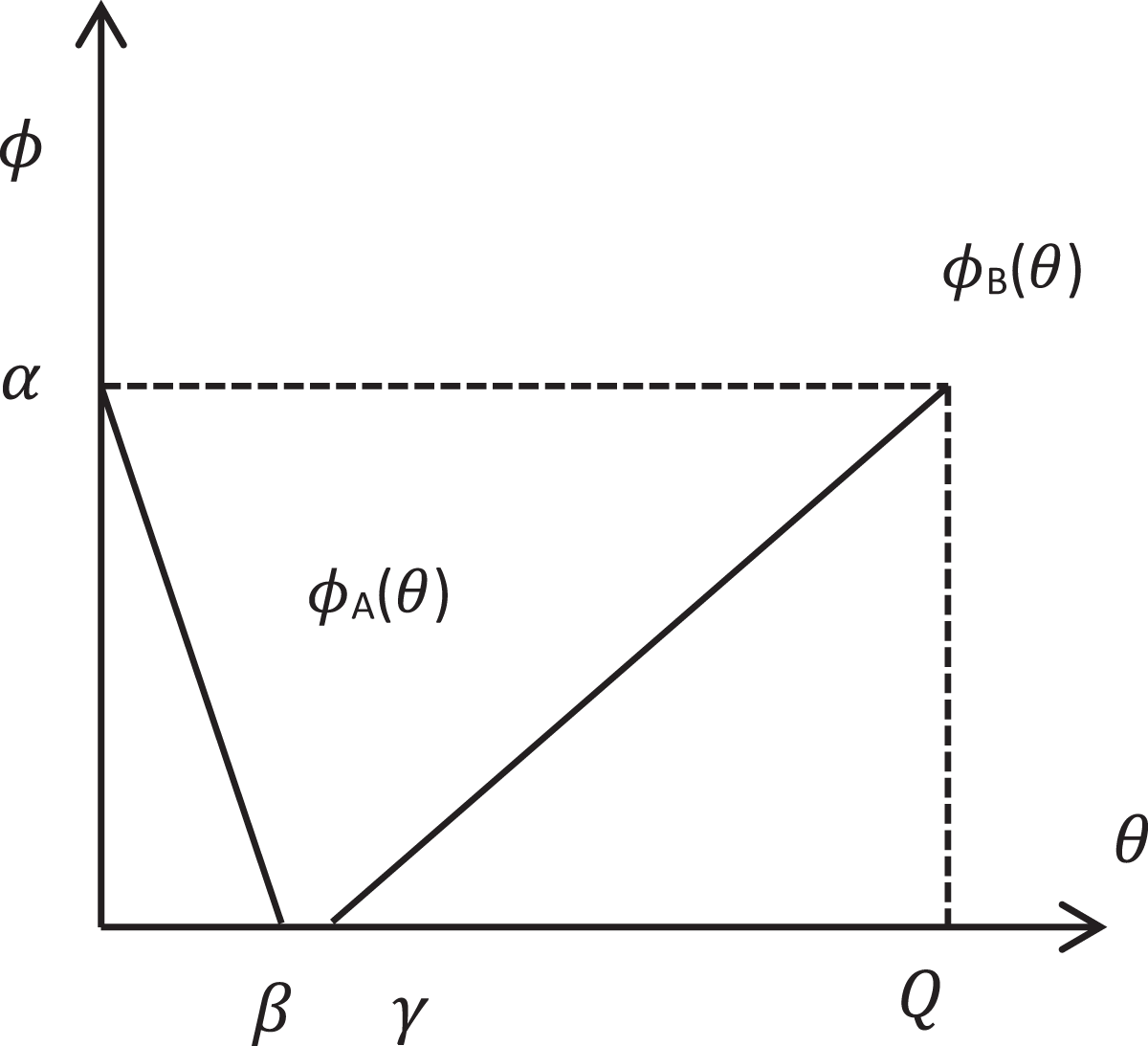
In addition to adding the long tail products on existing platforms, some OTAs started to operate a unique online platform by offering very different travel services, for example, the house-sharing of Airbnb. That is, in the potential OTA market space [0, Q], the searching and matching abilities of two OTAs (OTA A and OTA B) may not be sufficient to generate intersection of the viable trading scope, namely
The effect of new OTAs. OTA: online travel agency.


The maximum of the market efficiency for the two OTAs is

stating that
Then

In the absence of viable trading scope intersection between OTA A and OTA B, the maximum of the market efficiency of the two OTAs is
Proposition 4 shows that the OTAs cannot eliminate the information asymmetry. The pattern of market matching function leads to the uneven distribution of trading opportunities. However, the transaction probability of the niche travel products increases with the growth of the matching ability (
The expansion of the market size brought by the new OTAs has raised the competition among the OTA suppliers and inhibited the rise of the market price level. Thus, the welfare of the travelers and the OTA market efficiency is improved (Salop and Stiglitz, 1977). Proposition 4 links the matching ability to the efficiency of the OTA through the scope of the viable trading market and shows the decisive role of the searching activity and search cost to the market efficiency of the OTA. With the development of the new OTAs, there could be an intersection of viable trading scope for the new OTA and existing OTAs (similar as the situation described in Figure 1). The overall market efficacy will be higher. Thus, the OTAs should develop new travelers demand and expand the potential market size Q by making good use of its strength.
Implications and conclusions
Discussion and theoretical implications
OTA websites and search engines are the sources of travel information. Accessing information on informative and trusted OTAs plays a crucial role in planning a trip (Vyas, 2019). Different with the traditional travel agencies, the OTA has unique economic laws due to its characteristics, such as accessibility anywhere, the strong aggregation, and intelligent search function. Based on the function of OTA, the study establishes a measurement function of the OTA market efficiency by using the matching probability density function and analyzes the uniformly distributed travel products. This study develops a theoretical model of the three variables, including matching ability, market size, and the OTA efficiency. Few studies addressed the issue of both matching ability and market size in the same model.
This study conducts an in-depth discussion on the mechanism of the OTA competition and recognizes the matching ability as a moderate variable on the relationship between OTA market size and market efficiency. This study also considers the negative externality of long tail products in the OTA market and explores the effect of market size on the matching ability and OTA market efficiency, so as to analyze the interaction of matching ability, market size, and OTA market efficiency. This study provides a new theoretical explanation to understand the operation mechanism and competition strategy of the OTA market.
This study shows that the essence of the OTA competition is the competition of the matching ability. The OTA matching ability determines the market size and market efficiency. The market efficiency could be invaded by the competing OTAs and lead to an efficiency loss for each OTA, but the overall market efficiency will improve due to the competition of matching ability—the potential OTA market efficiency could be optimistically excavating by the search engine technology, travel product classification, website layout, and navigation mode. The competition of matching ability is not a zero-sum game. In addition, the OTA market efficiency or travelers’ welfare will not improve by expanding the travel product category or adding the long tail products only. The long tail travel product noise reduces the OTA matching ability and erodes the OTA market efficiency. In order to improve the OTA market efficiency effectively, the OTAs should provide the travel products with strong matching ability according to the capabilities and characteristics of its own searching and matching technique. The new OTA service could become a competitor to existing OTAs. Therefore, the OTAs should expand the potential market size Q and seek for the maximization of social welfare.
Managerial implications
The OTA competition and market efficiency depends not only on the market size and the travel product quantity, but also on the online presentation and searching. The searching and matching capability is the key factor to determine the market efficiency of OTA, including the new OTAs. The improvement of the OTA matching ability plays a key role in the OTA development by reducing the traveler’s searching cost and increasing the probability of finding preference travel products. It also increases the surplus of travelers. Thus, the website information matching and service quality offered by OTAs will affect the intention to visit or rebook via OTA websites. Particularly, Chang and Hsu (2019) pointed out that even the offline traveler behavioral intentions are influenced by online service quality. If the OTA cannot provide a powerful searching tool, travelers will be unable to reap the benefits of the long tail market. Therefore, the OTA needs to focus on technological and market mechanism innovation by improving the matching ability, in order to give full play to the potential of the OTA as a new trading medium. The OTA operators should pay attention to the keywords and search engine optimizing technology, so as to take the lead in the search rankings of specific travel products.
In reality, the OTAs aggregate traveler and travel product suppliers by using the positive externalities of bilateral platforms. A large number of suppliers enter the traditional market to provide travel products or services. As online users’ switching power is high, keeping travelers to hook on one OTA platform becomes imperative. Thus, some OTAs ignore the nature of OTA competition and increasingly reveal, conceal, bias, or distort market information they provide to travelers by using advanced technologies (Granados et al., 2012), for example, the phishing price or the automatic recommended bundles that travelers don’t need. However, this business model affects the searching result. At the same time, the huge amount options is harmful to information flow monetization and traveler satisfaction (Pan, Zhang, and Law, 2013). At the same time, it will increase the market noise and lead to a decline in searching and matching ability, so as to damage the market efficiency. In the long run, this kind of development does not conform to the economic law of the OTAs and the long-term goal of maximizing the profit of shareholders. It also reduces the welfare of travelers. The OTA operators and suppliers should focus on the travelers’ portfolio and delivering targeted products, instead of manipulating price and other information only.
Footnotes
Declaration of conflicting interests
The author(s) declared no potential conflicts of interest with respect to the research, authorship, and/or publication of this article.
Funding
The author(s) disclosed receipt of the following financial support for the research, authorship, and/or publication of this article: This research is supported by the National Social Science Foundation Project (16BJY090), MOE (Ministry of Education in China) Project of Humanities and Social Sciences (grant no. 18YJA630070), Sichuan Social Science Planning Fund Program (grant no. SC17B077), Sichuan Science and Technology Support Project (grant no. 2018ZR0124), Chengdu Social Science Planning Fund Program (grant no. 2018L07), and the FRG grant from the Macau University of Science and Technology.
