







Abstract
Mountain biking as a sport and recreational activity has grown rapidly over the previous two decades. Consequently, there has been growth recently in efforts aimed at stimulating mountain bike tourism through the development and marketing of mountain bike trails and parks. Various community advocates, academics, and industry practitioners have sought to quantify the economic impacts of mountain bike tourism to garner public and other financial assistance to aid the development of mountain bike tourism. This research critically reviewed 33 academic and practitioner studies reporting on mountain bike tourism economic impacts. Analysis revealed widespread inconsistency in instrumentation and variable measurement contributing to a fragmented body of knowledge pertaining to economic impacts of mountain bike tourism. Recommendations for improved rigor and consistency in future research measuring mountain bike tourism impacts are provided.
Introduction
Mountain biking has evolved from humble beginnings in the 1980s into a global sport and recreational activity (Kelly, 2014). Amateur cyclists now travel extensively to experience destinations known for iconic trail offerings such as Whistler in Canada and Derby in Tasmania, Australia (Courtney, 2018). Tourism strategies based around cycling tourism are frequently utilized as economic diversification and/or revitalization strategies in western countries, particularly in nonurban communities featuring desirable geographic terrain (Reis et al., 2014). Relatedly, investment in the development of trail systems and related resources to leverage the rising popularity of mountain biking is growing in such destinations (Freeman and Thomlinson, 2014). Mountain bike tourism strategies are typically focused on attracting visitors through hosting events and promoting general visitation to ride a variety of trail networks and/or specialized mountain bike parks (Moularde and Weaver, 2016).
Governments and, to a lesser extent, private sector organizations in countries such as the United States, Australia, the United Kingdom, and New Zealand offer grant schemes for community development projects likely to deliver economic, social, and/or health benefits (e.g. Jenkins, 2000; Moscardo, 2005). Applicants must compile and justify a convincing business case to attain such funding (Hodur and Leistritz, 2006). However, cycling tourism initiatives such as rail trail developments and mountain bike parks are commonly driven through a grassroots bottom-up approach, with networks of individuals and organizations pooling their skills and resources to champion such initiatives (Beeton, 2010). As we shall argue in this research note, community groups seeking to develop a business case for mountain bike tourism development funding are currently hampered by an incoherent body of empirical knowledge to effectively articulate the size and economic worth of the mountain bike tourism market.
Weed (2005) advocated that researchers should strive to construct “edifices” of knowledge (p. 78) that, through research synthesis, facilitate broader, more accurate understandings of economic impacts attributable to sport and tourism phenomena. However, doing so requires explicit attention being paid to existing literature and adherence to accepted methodological protocols for producing valid economic impact estimates (Hudson, 2001). As we shall demonstrate, improved understanding and synthesis of published research on mountain bike tourism impacts are needed to better enable communities to acquire resources, secure funding, navigate legislation, and gain stakeholder support to develop mountain bike tourism (Buning et al., 2019; Freeman and Thomlinson, 2014). Therefore, our aim in this research note is to critique existing academic and practitioner literature with regard to the measurement of mountain bike tourism economic impacts. By doing so, we seek to make a range of recommendations for facilitating a more coherent, comparable, and compelling evidence base to convey the scope and contributions of the mountain bike tourism segment globally and to aid communities in developing mountain bike tourism.
Method
This study reviewed published English language academic and practitioner literature addressing mountain bike tourism impacts. Using the process described in Moher et al.’s (2009) preferred reporting items for systematic reviews and meta-analyses (PRISMA) statement, records were identified, screened, and then assessed for eligibility in the review. Keyword searches were performed within several online databases to identify relevant sources which primarily included Google, Google Scholar, University Libraries, and Academic Search Premier. Online repositories of related reports assisted in the search process including the Headwaters Economics Trail Benefits Library (headwaterseconomics.org/trail/) and the International Mountain Bike Association (IMBA) Resource Hub (imba.com/explore-imba/resource-hub). Citation lists within the identified documents were also examined to identify additional relevant material. Search terms included variations of the main search term “mountain biking” (e.g. mountain bike, mountain cycle, and off-road cycling), combined with other relevant keywords including variations of “economic impact,” “visitor impact,” “tourism impact,” and “economy.” The tags “pdf” and “ppt” were also included as they directly returned several relevant practitioner reports. The search process returned a variety of academic journal articles, industry reports, government briefs, popular press articles, and presentation files.
Initially, document titles and/or abstracts were assessed for relevance, which returned 89 studies. The following criteria were used to qualify the documents for inclusion in the review: Documents returned from the search process which addressed cycling generally, and/or did not differentiate mountain biking from other forms of cycling, or were not specifically focused on tourism were excluded. Studies that did not directly report visitor spending from the study being reported were excluded. Studies that were deemed to not fit the definition of mountain bike tourism proposed by Moularde and Weaver (2016: 3) as “trips of at least 24 hours away from a person’s home environment for which active participation in mountain biking for recreational purposes is the primary motivation and determining factor in destination choice” were excluded. Documents that did not report empirical research findings such as popular press articles and other web-based documents (e.g. forum posts) were excluded. Duplicate reports of the same data sets such as summary documents were also excluded.
Consequently, 33 studies were included in the review and subjected to exploratory analysis to identify the range of mountain bike tourism impact variables measured in those studies along with variable measurement characteristics. The 33 studies were published in 21 industry reports, 2 government briefs, 4 academic journal articles, and 4 academic reports were included. The data were collected primarily in the United States (16), Canada (13), United Kingdom (1), New Zealand (1), and South Africa (1). The studies were focused around assessing visitor expenditure around events (11), trail systems (8), park/conservation areas (5), municipalities (3), regions (4), and state (1). The earliest studies discovered were published in 1997 and the latest in 2018.
A database was then created to record and summarize the results of each study with a focus on capturing the range of variables measured, along with intra-variable measures. Categories developed in the database included author(s), year of publication, title and type of study, sample size, respondents’ demographics, individual mountain biking characteristics, destination choice variables, mountain bike tourism travel characteristics, and mountain bike tourism expenditure.
Findings
In total, 26 variables were measured across the 33 studies (Table 1). The most prevalent variables measured were total expenditure during a mountain biking trip (90.9%), respondents’ age (69.7%), expenditure on lodging (66.7%), and gender (66.7%). The least prevalent variables were types of mountain biking (3.0%) and time spent mountain biking each day (3.0%). The largest number of variables measured within a study was 17 (Western Canada Mountain Bike Tourism Association, 2017), while one study only reported a single variable, total expenditure during a mountain bike trip (Tabor, 2014).
Variables included in reviewed mountain bike tourism economic impact studies (N = 33).
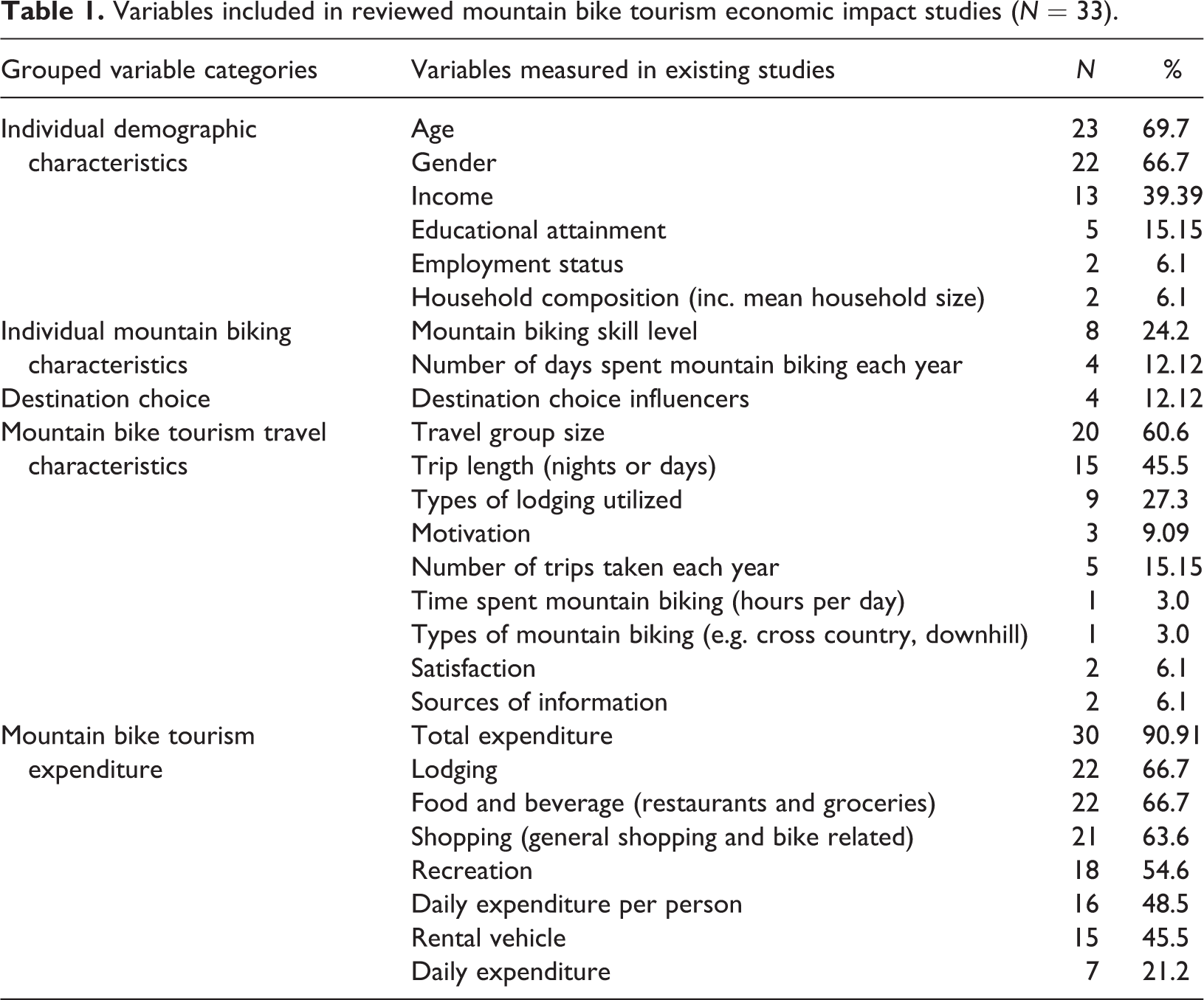
Most notably, our analysis revealed considerable inconsistency in the range of variables measured across the studies, particularly economic impact measures. For example, some studies measured visitor expenditure across multiple categories encompassing lodging, food and beverage, shopping, recreation, and/or rental vehicles to calculate total spending estimates (e.g. Dean Runyan Associates, 2013; Destination British Columbia, 2013; Western Canada Mountain Bike Tourism Association, 2006). In contrast, another study (Boozer and Self, 2012) only measured expenditure data on a per-day basis for two generic expenditure categories (lodging and non-lodging). Other studies measured a combination of total daily expenditure and total daily expenditure per person (e.g. Fix and Loomis, 1997), while others simply measured aggregate expenditure per trip (e.g. Chakraborty and Keith, 2000; Preez and Lee, 2016; Tabor, 2014). As will be elaborated upon later, this inconsistent approach to instrumentation intended to measure mountain bike tourism economic impacts is problematic.
Our analysis also identified inconsistency relating to the measurement and reporting of individual variables, particularly categorical variables intended to measure respondents’ demographic and mountain bike participation characteristics. There was also inconsistent use of categorical and continuous measures, along with considerable diversity in category responses offered. These conditions prevented a meta-analysis of the studies from being undertaken, as explained by Weed (2005: 80) “meta-analysis should only be used when studies are similar in terms of their population, address the same substantive issue, and use the same statistical procedure and manipulations.” For example, mountain biking skill level was a variable measured in eight (24.2%) of the studies. One of those studies, an academic consultant report by Sumathi and Berard (1997) measured skill utilizing a binary variable of novice/advanced, whereas an academic study of mountain bike tourism economic impacts conducted by Moran et al. (2006) measured skill utilizing a four-point scale (beginner, intermediate, advanced, and expert). This is but one instance of how comparisons among various studies on variables where divergent measures have been used, are compromised within this body of literature.
Conclusions and recommendations
Although our review identified a paucity of comparable estimates of mountain bike tourism economic impacts and associated knowledge, the prevalence of such studies highlights the rise in mountain bike tourism and related strategies generally. Our analysis suggests that the extant academic and practitioner literature addressing mountain bike tourism economic impacts consists of disparate studies constituting a disjointed body of knowledge around mountain bike tourism. Consequently, there is a lack of coherent knowledge which community advocates may draw upon to convince policy makers that investment in mountain bike tourism initiatives represents a prudent use of public funds likely to generate positive economic impacts for host communities (Crompton, 1995). We suggest that it is counterproductive for academic and practitioner researchers seeking to measure mountain bike tourism impacts to continually deploy bespoke data collection instruments. This approach is generating a fragmented global body of knowledge around mountain bike tourism impacts that is of limited use to community groups seeking to develop business cases for governmental financial assistance and other resources to develop mountain bike tourism.
Existing studies have largely restricted their analysis of economic impacts attributable to mountain bike tourism to elementary and inconsistent measures of expenditure associated with lodging, food and beverage, shopping, recreation, rental vehicle expenditures, and/or aggregate expenditure. Future studies require a more consistent approach to measuring mountain bike tourism economic impacts underpinned by principles of economic impact measurement as advocated within the broader tourism economics literature (e.g. Crompton et al., 2001; Frechtling, 1994; Preuss, 2005; Stynes and White, 2006).
Crompton (1995: 24) identified “failure to define the area of interest accurately” as 1 of 11 widespread contributors to inaccurate economic impact analyses in the context of sports facilities and events. Therefore, there is a fundamental need to apply a consistent technical definition of a mountain bike tourist to isolate and thus accurately assess economic impacts specifically attributable to mountain bike tourism (Lamont, 2009). Notably, none of the studies reviewed ascertained respondents’ main trip purpose, nor travel distance from home region to the destination, casting some doubt on the validity of visitor expenditure estimates. Future studies should ensure that local residents and tourists are unambiguously differentiated to exclude expenditure by local residents whose money is already circulating within a local economy (Crompton et al., 2001). There is also a need to ensure whether travel party size is measured to reduce erroneous data stemming from individual respondents paying for others and vice versa (Crompton et al., 2001). More rigorous economic impact data are vitally important to attract and justify the expenditure of public funds on developing infrastructure to support mountain bike tourism.
It is important to note that the studies reviewed tapped only into a limited number of variables pertaining to mountain bike tourists’ travel characteristics. Although 26 relevant variables were identified, other research and industry standardized measures that would contribute to an enhanced understanding of the mountain bike tourism market and improved validity and reliability of the published results have largely been omitted. Such variables include main trip purpose, visitor spending categories, and other behavioral/preferential measures (see Table 2). Other useful variables relating to mountain bike tourism travel characteristics that future studies may consider include mode of transport to the destination, whether the respondent brought their own bicycle or rented a bicycle at the destination, engagement with local cycling support services, travel group composition (e.g. friends and/or family), travel seasonality, and repeat visitation/travel history to the destination.
Suggested measurement of variables in mountain bike impact research.
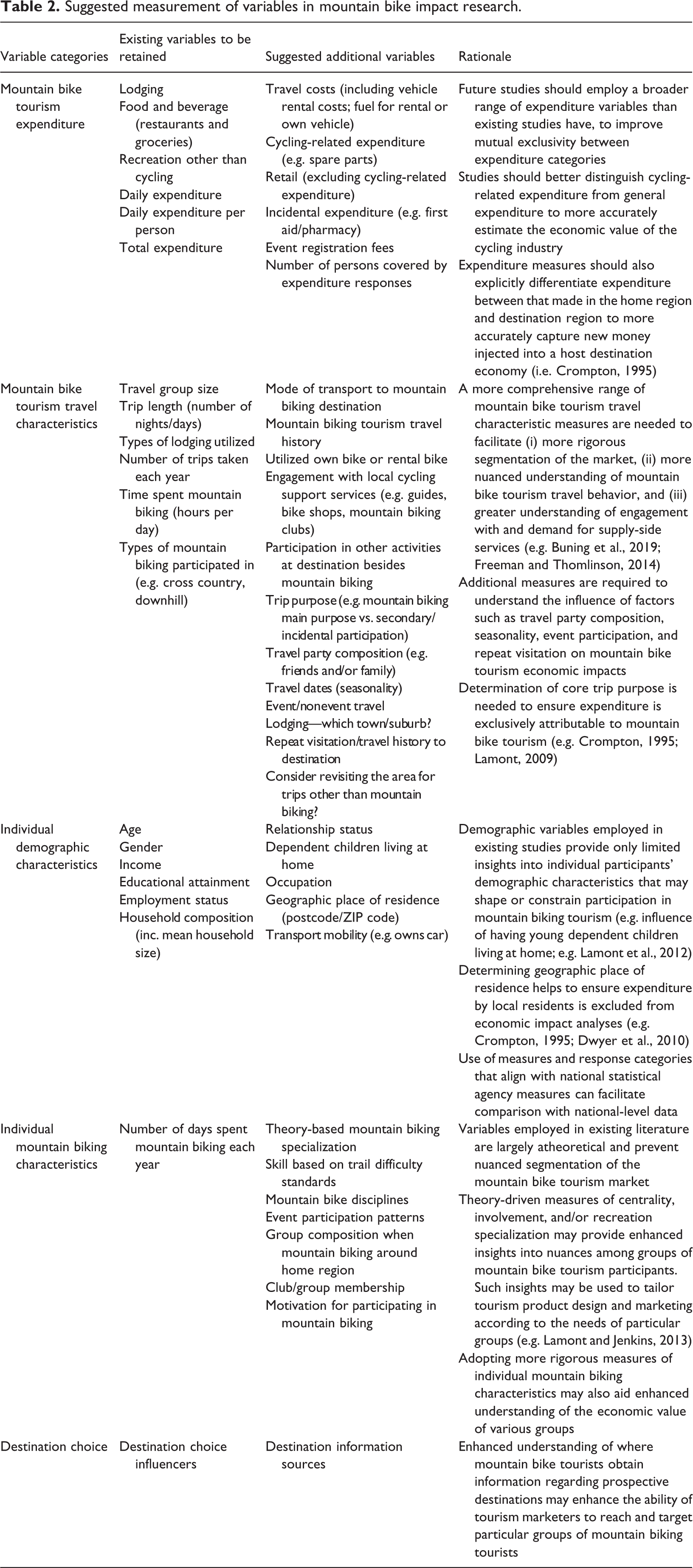
Further, Buning et al.’s (2019) study of US mountain bike tourists identified widespread heterogeneity in travel behavior and preferences across various demographic groups, particularly age categories. Such heterogeneity may have implications for understanding nuances in economic impacts stemming from mountain bike tourism. We, therefore, suggest that additional demographic variables be considered in future studies such as relationship status and number/age of dependent children living at home. Doing so would enable a more detailed analysis of the travel behaviors and impacts of subsegments of mountain bike tourists which may inform enhanced product development and marketing strategies (Buning et al., 2019). Future studies may also benefit from including variables and measures aligning with those adopted by national-level statistical agencies (e.g. United States Census Bureau and Australian Bureau of Statistics) and mountain bike industry organizations (e.g. IMBA) to facilitate comparison between different studies and also with data at national levels.
A variety of methods could also potentially be used in quantifying the tourism impact of mountain bike travel such as input–output and computable general equilibrium models or cost–benefit analysis (e.g. Dwyer et al., 2010). One such study employed the travel cost method to estimate economic benefits to Moab, Utah from mountain biking and found a consumer surplus of around US$200 per trip (Fix and Loomis, 1997). Still, the focus of this review was on direct visitor expenditure that is often used in persuading policy makers to fund community requests for financial support.
Footnotes
Acknowledgements
The authors would like to acknowledge the support of both Olivier Oren and Jessi Stass for their assistance with the review database.
Declaration of conflicting interests
The author(s) declared no potential conflicts of interest with respect to the research, authorship, and/or publication of this article.
Funding
The author(s) received no financial support for the research, authorship, and/or publication of this article.
