






Abstract
Urban shrinkage has become a global phenomenon. Although China is still experiencing rapid urbanization, population losses arise in an increasing number of cities. As a booming industry, tourism is expected as a mean to create jobs and curb population loss. Can tourism industry contribute to revive the shrinking cities? Based on panel data of 54 shrinking cities in China, this article explores effects of tourism development on shrinking cities. The results show that there is no evidence that tourism has a significant impact on the population of the shrinking cities. However, tourism shows positive effects on these cities in terms of many aspects, including urban economy, employment, investment, and consumption. This indicates that tourism can revive shrinking cities by economic boom, rather than population growth.
Introduction
Since the second half of the 20th century, many cities in the postindustrial countries like United States, Europe, and Japan have experienced population loss and economic recession. This phenomenon is called urban shrinkage (Audirac, 2018; Wichowska, 2019; Wiechmann and Pallagst, 2012). Specifically, urban shrinkage indicates persisting population decrease in the populated urban areas (Rieniets, 2009). The Shrinking Cities International Research Network (SCIRN) defines shrinking cities as the urban areas with the population of more than 10,000 that have experienced population loss for more than 2 years. Currently, urban shrinkage has become a global phenomenon (Haase et al., 2017).
The extant literature has widely studied the causes and consequences of urban shrinkage (Bartholomae et al., 2017; Deng et al., 2019; Hospers, 2013). However, few studies explore how to help shrinking cities to achieve urban revival. In fact, many measures have been taken to deal with urban shrinkage by city administrators, such as environment improvement (Camarda et al., 2014), housing reform (Conway and Konvitz, 2000), government cooperation (Hartt, 2017), and community reconstruction (Martinez-Fernandez et al., 2016). Unfortunately, the results of those measures are not satisfying.
The development of the industries with low barriers to entry, such as tourism industries, has become the preference for many cities to deal with population shrinkage. Manchester, the third largest city in England, developed the tertiary industry focusing on culture, leisure, and lifestyle, and then promoted economic and population growth (Project Shrinking Cities, 2004; Rieniets, 2009). Detroit responded to the shrinkage by developing entertainment and sports projects based on the gaming industry (McCarthy, 2002). Leipzig enhanced urban vitality through exhibition projects such as the Leipziger Buchmesse (Bontje, 2004).
Tourism development is an important way to create conditions for capital production and reproduction (Milano et al., 2019). By the increase of employment, resident income, and government taxation (Li et al., 2018), tourism can promote the destination’s socioeconomic prosperity (Mitra, 2019). Currently, tourism has developed as one of the largest and fastest growing industries in the world (Mitra, 2019). It is predicted that by 2030, the global tourism arrivals will reach 1.8 billion arrivals (UNWTO, 2017). The viewpoint that tourism can promote socioeconomic prosperity is supported by a growing number of academics (Liu and Wu, 2019; Lv, 2019).
Intuitively, tourism can attract a large number of floating populations to tourist destinations. By surveying of shrinking cities, it can be found in some regions, such as Greece, there is a positive relationship between population growth and tourism (Salvati, 2019). And in some regions, tourism played an important role in creating job opportunities, reducing unemployment and increasing employment (Rink et al., 2012). However, the extant studies have shown inconsistent results about the role of tourism. For instance, leisure-oriented tourism sectors have positive effects on economic development, while some tourism projects in many areas are difficult to attract international tourists (Camarda et al., 2014). Worse still, tourism boom in many regions has not promoted social development (Gal et al., 2010). For some shrinking cities, tourism development cannot reverse the shrinking cities’ population loss. For example, the tourism industry in Venice has tripled in the past 10 years, but the population has shrunk to half of what it was 40 years ago (Project Shrinking Cities, 2004). This causes us to rethink of the relationship between tourism and urban revival: Can tourism help to revive shrinking cities?
Compared with urban shrinkage characterized by a single population loss, shrinking cities’ revival is a multidimensional process. Although tourism has become a major industry in many places, it remains unclear whether tourism can help shrinking cities to achieve revival. This article aims to evaluate the impacts of tourism on shrinking cities in terms of population, economy, employment, consumption, and investment. To address the endogeneity problems, some instrumental variable methods are used in the article. Because the economy, consumption, and investment in prior years will affect that in current year, we conducted a two-step dynamic panel estimation using the system–generalized method of moments (system-GMM) estimators to address the endogeneity problems (Zhao and Dong, 2017). In addition, we use the two-stage least squares (2SLS) estimators to assess the influence of tourism on population and employment.
Chinese shrinking cities and tourism
In China, urbanization still maintains a rapid growth. According to official statistics, China’s urbanization rate will exceed 60% until 2019. However, more and more cities are shrinking in China (Long and Wu, 2016). From 2006 to 2017, 54 prefecture-level cities in China experienced shrinkage (by the definition of SCIRN). This means that approximately 20% of Chinese cities are experiencing shrinking.
On the other hand, China’s tourism industry is experiencing unprecedented growth and prosperity. In 2009, the State Council of China issued an opinion document on accelerating the development of tourism (No. 41 Document in 2009 of the State Council). After that, China’s tourism industry has developed rapidly. The proportion of tourism consumption in gross domestic product (GDP) has increased from 2.9% in 2009 to 5.7% in 2018, and the number of domestic tourism arrivals has increased rapidly from 1.9 billion in 2009 to 5.53 billion in 2018. 1 In 2019, the tourism industry accounted for 11.05% of GDP, and it is growing at a rate higher than the expected growth rate of GDP. 1
In general, the tourism development brought great economic benefits to local residents and local governments. However, in China, more and more cities are shrinking, which provides us with sufficient samples to analyze whether the tourism can help shrinking cities to revive.
Empirical strategy
The data on urban population mainly comes from the China Urban Construction Statistical Yearbook, and other data mainly comes from the China City Statistical Yearbook. The data started in 2007 only because the statistical yearbook lacks a large amount of tourism data in earlier years. Considering the availability and completeness of data, the article employs the research period of 2007–2018. According to the definition of Shrinking Cities International Research Network, we select prefecture-level cities as the research sample and screen out 54 shrinking cities (Figure 1).
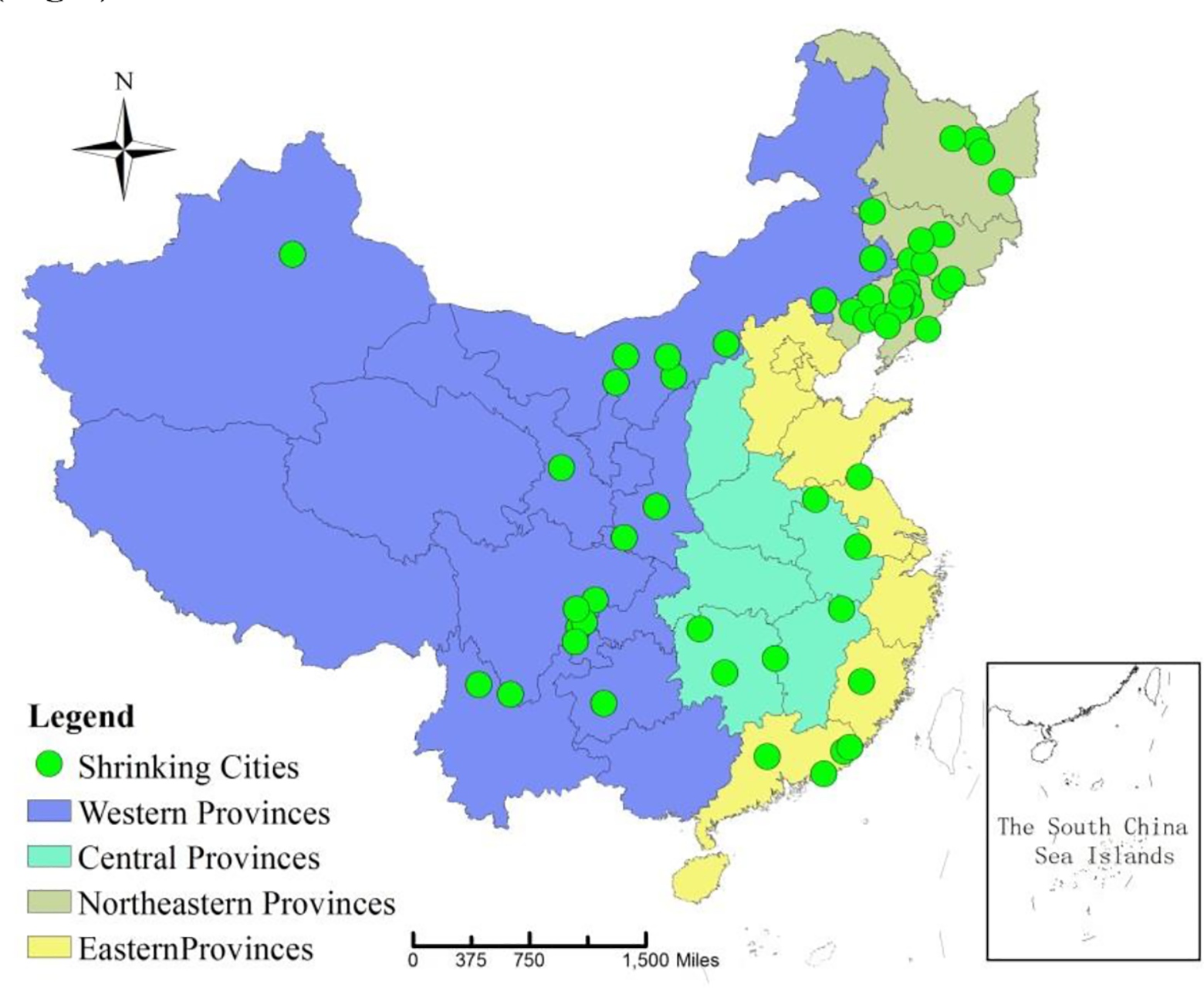
Spatial distribution of shrinking cities in China. Data source: China Urban Construction Statistical Yearbook (2007–2018).
This article uses multiple dependent variables to characterize shrinking cities’ revival. They are mainly urban population, city’s GDP, employment rate, urban investment, and urban residents’ consumption (POP, GDP, EMP, INV, CON, respectively). In the article, POP is measured by the urban population (10,000 people). GDP is the real gross regional product which takes 2006 as the base period. Due to the lack of out-of-the-box statistics on employment rate in the statistical yearbook, we use the following formula to calculate the employment rate:
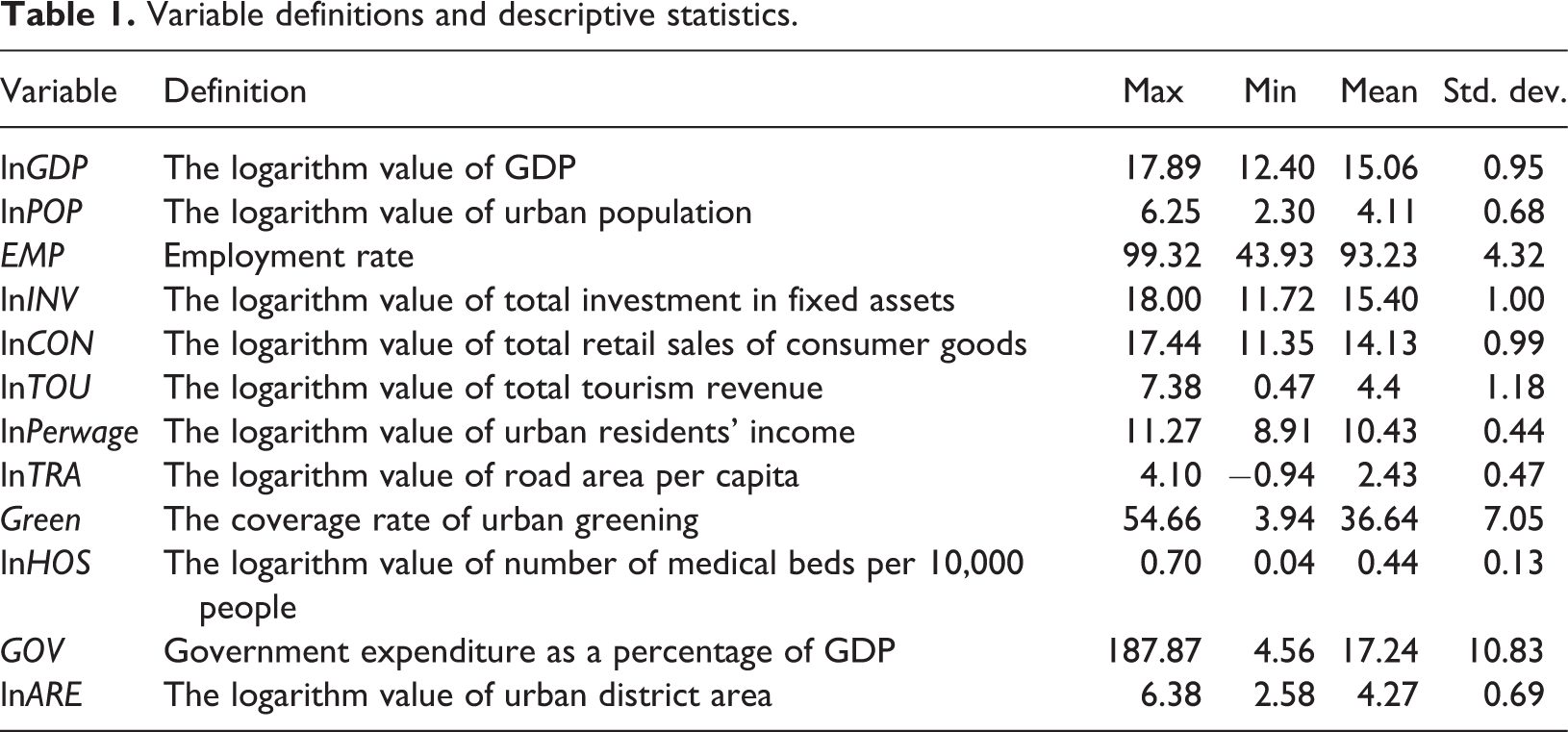
In order to reduce the estimation error caused by the omitted variables, we also select some determinants of urban revival as control variables. Control variables include Perwage, TRA, Green, HOS, GOV, and ARE. Perwage measured by urban residents’ income is embodiment of residents’ purchasing power which play an important role in consumption; TRA denotes convenience level of urban transport that measured by road area per capita; Green denotes urban environment that measured by the coverage rate of urban greening; HOS indicates the level of public health service that measured by the number of medical beds per 10,000 people; GOV indicates the degree of government intervention that measured by the proportion of government expenditure in GDP; and ARE denotes urban land size that measured by urban district area. In order to reduce heteroscedasticity, we have adopted logarithmic processing for some variables. And the descriptive statistics of the variables are shown in Table 1.
Variable definitions and descriptive statistics.
In order to study whether tourism can help shrinking cities revive, this article will test the following five models:
where i denotes city, t denotes time, and
Considering the endogeneity problem, we used an exogenous instrumental variable model to estimate the impact of tourism on urban revival. Tourism is largely determined by local natural and cultural characteristics (Faber and Gaubert, 2019). Therefore, we use the quantity of A-level scenic spots as the first instrumental variable of tourism. And we use the dummy variable of whether the city is an excellent tourist city as the second instrumental variable of tourism. When the shrinking city is an excellent tourist city, the value of the dummy variable is 1, otherwise it is 0.
Before doing regression analysis, we need to judge the correctness of models 3–5. We used the following model to determine the lag-length:
We use 2SLS method to estimate models 1 and 2 (Wooldridge, 2016). However, since models 3–5 are dynamic panel models, we use the system-GMM method to estimate them (Blundell and Bond, 1998).
Results
Table 2 reports the regression parameters of the tourism on different indicators of revival. The results show that the impact of tourism development on shrinking cities’ population (model 1) is positive. However, the regression coefficient is not significant at the 10% level, indicating that the tourism development cannot help shrinking cities to achieve population growth.
Effect of tourism development on cities’ revival.
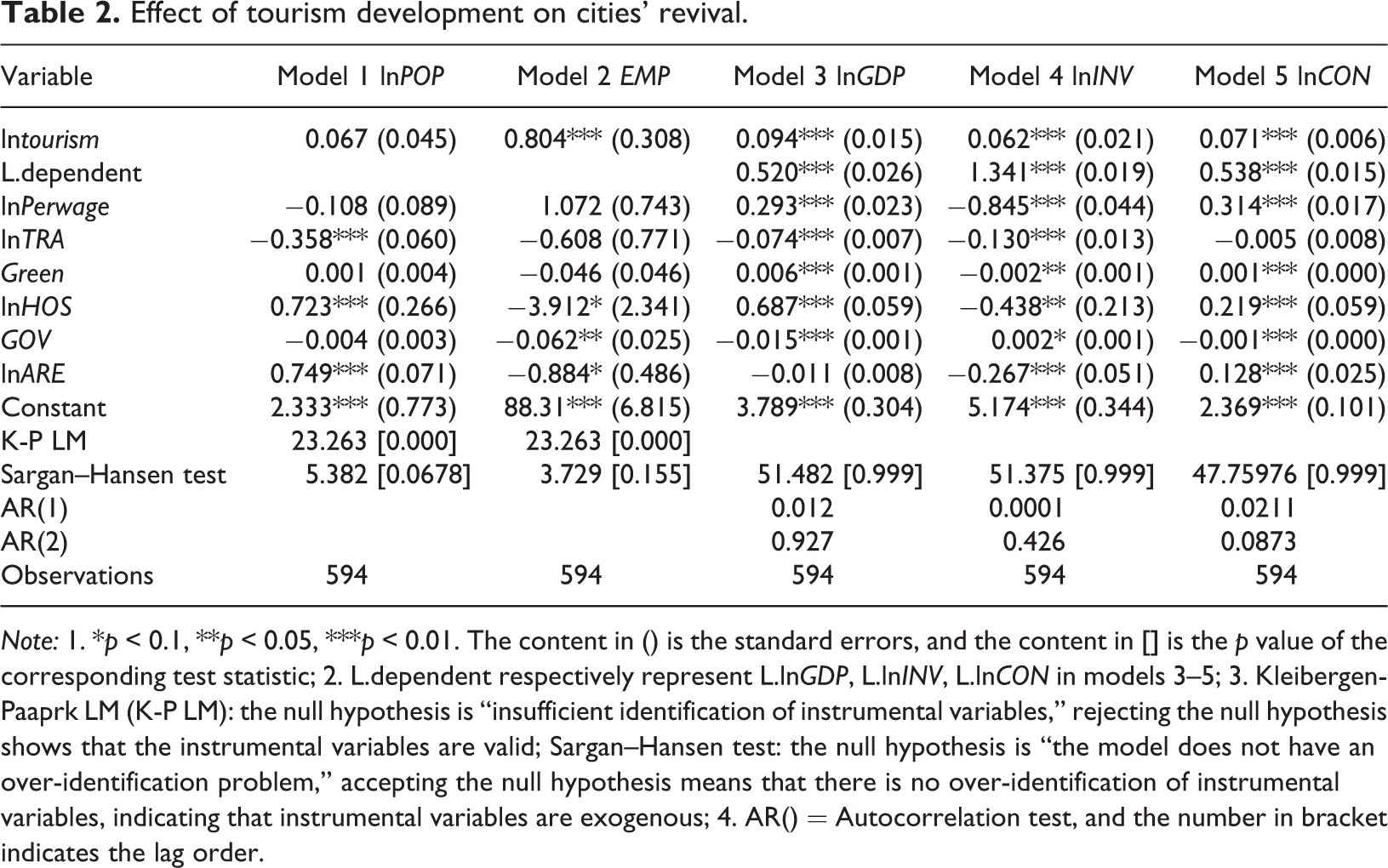
Note: 1. *p < 0.1, **p < 0.05, ***p < 0.01. The content in () is the standard errors, and the content in [] is the p value of the corresponding test statistic; 2. L.dependent respectively represent L.lnGDP, L.lnINV, L.lnCON in models 3–5; 3. Kleibergen-Paaprk LM (K-P LM): the null hypothesis is “insufficient identification of instrumental variables,” rejecting the null hypothesis shows that the instrumental variables are valid; Sargan–Hansen test: the null hypothesis is “the model does not have an over-identification problem,” accepting the null hypothesis means that there is no over-identification of instrumental variables, indicating that instrumental variables are exogenous; 4. AR() = Autocorrelation test, and the number in bracket indicates the lag order.
Tourism can indeed attract a large inflow of population, but the impact of tourism on population in shrinking cities may be more complicated. On the one hand, tourism can rebuild the wasteland or abandoned factories. The urban landscape will also be improved, making the city more livable. Moreover, tourism development brings more opportunities to upgrade infrastructure, such as outdoor recreation facilities, roads, parks, and public transport (Kim et al., 2013). Therefore, tourism can attract people to put down roots in the shrinking cities.
On the other hand, the improvement of the urban environment tends to increase house prices and rent. This will lead to rising cost of living for the people who don’t have housing in shrinking cities. It is a disadvantage for shrinking cities to attract the population, especially for young people who are unable to buy house. At the same time, tourism is a seasonal industry that there are many tourists in the tourism-peak season and a few tourists in the off season. This directly affects the income level of residents who employed in tourism. Facing the pressure of housing, many young people may choose other high-wage industries or move to other cities with considerable income levels. Therefore, tourism exacerbates the outflow of population in shrinking cities.
Overall, at this stage, the development of tourism has both a positive and a negative impact on the urban population, but the net effect on urban population in shrinking cities is still unclear.
We further evaluate the impact of tourism on employment rate, city’s GDP, urban investment, and urban residents’ consumption in models 2–5, the coefficients of which are significantly positive (0.804***, 0.094***, 0.062***, and 0.071***, respectively).
These results show that although tourism cannot help shrinking cities to achieve population growth, it can promote the prosperity of shrinking cities by increasing the employment, economy, investment, and consumption. This indicates that tourism can retrieve the shrinking cities by economic boom, rather than population growth.
Conclusion
Tourism is considered to be an important driving force for promoting regional economic growth and achieving industrial upgrading. Especially in shrinking cities, due to its low labor skills requirements and low environmental pollution, tourism has become the first industry to develop. More and more shrinking cities are also responding to shrinking by developing tourism. This article reports the impact of tourism on the revival of shrinking cities in China. This research note draws two main conclusions: First, tourism development will not promote population growth in shrinking cities. The main reason is that the impact of tourism on urban population has both positive and negative effects. However, the net effect is not significant. It implies that shrinking cities cannot achieve population growth through a single tourism industry. Second, tourism shows positive effects on these cities in terms of many aspects, including urban economy, employment, investment, and consumption, which mean that the tourism development could help shrinking cities to achieve socioeconomic prosperity.
At present, the problem of urban shrinkage in China is still in embryonic stage. And tourism is indeed an industry worth promoting in shrinking cities. However, in the face of rapid changes today, the relationship between tourism and cities has become more and more complicated. We cannot ignore other industries and blindly develop tourism. Especially when encountering public health emergencies, tourism is the first to bear the brunt, which is undoubtedly worse for shrinking cities dominated by tourism. For example, the outbreak of COVID-19 in 2020 has caused a major impact on the consumer economy that relies on tourism and entertainment. It has significant negative effects on the national economy and social development in the short term. However, with the effective control of the epidemic, the urban population and economy will gradually recover. We believe that with the introduction of the vaccine, the epidemic will eventually be brought under control, and the tourism industry will quickly recover and reach to its pre-epidemic scale.
Therefore, the development of tourism should be combined with local production sectors to explore unique tourism projects, such as production experience tours and ecological sightseeing tours. At the same time, we should also get out of the misunderstanding that urban revival is an increase in urban population. And we should pay more attention to improving the quality of urban residents’ life in shrinking cities.
Footnotes
Declaration of conflicting interests
The author(s) declared no potential conflicts of interest with respect to the research, authorship, and/or publication of this article.
Funding
The author(s) received no financial support for the research, authorship, and/or publication of this article.
