







Abstract
The COVID-19 has caused a dramatic fall in international tourism demand. Destinations within countries have revised their promotion strategies, intensifying the competition for the domestic market, less affected by mobility restrictions. This paper proposes a contest theory model for characterizing this new context. Two types of destinations, coastal (sun and sand) and rural, compete for the existing demand in terms of promotion spending. The competition is driven by two main factors: the relative strategic advantage of each destination in the international and domestic markets and the strategic value given to each market. The pandemic has likely modified these factors, reducing the traditional advantage of coastal destinations and shifting the valuation towards the domestic market. According to the model, these changes may increase competition for the domestic market, with destinations rising promotion spending even in a context of reduced demand, which is consistent with the empirical evidence.
Introduction
The COVID pandemic has impacted enormously in the tourism market (Papatheodorou, 2021; Škare et al., 2021; Yang et al., 2020). The interruption of mobility has led to an unprecedented drop in the 2020 global tourism demand of about 74% (UNWTO, 2021a). The estimated decline in international tourism is equivalent to a loss of about one billion arrivals and US$1.1 trillion in international tourism receipts and an estimated economic loss of over US$2 trillion, more than 2% of the world’s GDP (UNWTO, 2021b). Destinations have especially encouraged measures to retain/attract domestic tourism to compensate for the volume of international drop-offs (Gössling et al., 2021; Hall et al., 2020; Kreiner and Ram, 2020; Navarro et al., 2020). The UNWTO (2020a, 2020b) highlights that domestic tourism is the basis for the recovery.
In this context, destinations inside countries have intensified the competition for national (and proximity) tourists, as the international mobility has been drastically reduced. The promotion spending in the domestic market has increased even in a context of overall demand reduction, which is somehow paradoxical because promotion spending tends to move together with demand. This phenomenon is evident in Southern European countries. In Spain, for example, the different destinations focused the 2020 summer campaign on the domestic market, starting a race to capture domestic tourists. This increasing competition led to an expanding promotion spending with the objective of positioning their brand on this market, which has been widely reported by the press. 1
Simultaneously, the COVID-19 has also opened significant opportunities for rural tourism. Consumers are giving higher value to open spaces, less willing to visit typically crowded destinations such as coastal (sun and sand) or cities (UNWTO, 2020a). In this way, the pandemic has produced a shift in consumer preferences, favoring less populated destinations, such as rural or ecotourism (Maltseva and Li, 2020; Vashar and Štastná, 2020; Zenker and Kock, 2020).
The increasing importance of the domestic market and the change in the relative advantage of the different destination types may have broken the traditional competition dynamics, increasing competition in the domestic market in a context of a falling and demotivated demand. The question is how to explain these linkages from an analytical point of view, and providing a rationale for the strategic move towards the domestic market.
This paper addresses this question and builds a theoretical framework that can account for these empirical facts. Specifically, the paper proposes a game-theoretical model in which two different destination types within the same country (coastal vs rural) compete in terms of promotion spending to attract the largest possible share of the domestic and international markets. 2 Destinations are characterized by two fundamental factors: their strategic advantage/disadvantage to attract demand and their strategic value of the domestic and international markets. The destination’s market shares are captured by a Tullock’s contest success function (Tullock, 1980), which depends on the destinations' promotion efforts, which is costly.
According to the model, the increase in promotion spending in the domestic market is explained by the change in the existing status quo generated by the COVID-19. First, the pandemic has decreased the traditional advantage of coastal destinations over the rural destinations, previously materialized in terms of infrastructures, sun and sand, socialization, and cultural activities (Maltseva and Li, 2020; Vashar and Štastná, 2020; Zenker and Kock, 2020). According to the model, this shift in consumer preferences has favored competition in the domestic market, inducing a “leveling the playing field effect”. 3 Intuitively, the rural destinations increase their spending to attract domestic demand that “would not have come” under other circumstances, even with higher promotion spending. In turn, the coastal destinations also increase promotion spending to retain the shifting domestic demand that “would have remained faithful” if the circumstances were other, even without increasing promotion.
Second, the COVID-19 has raised the strategic value of the domestic market. Historically, coastal destinations have found higher strategic value on the international market because they could extract higher returns (Jafari, 1986; Jang and Chen, 2008; Sheldon and Dwyer, 2010). However, the mobility restriction imposed by the pandemic has shifted the strategic value towards the domestic market, less affected by mobility restrictions (Gössling et al., 2021; Hall et al., 2020; Kreiner and Ram, 2020; UNWTO, 2020a; 2020b). The increased strategic value of the domestic market has also induced higher competition for domestic tourists, complementing the decline of the strategic advantage of the coastal destinations. 4
Overall, the proposed model shows that these two effects led to a competitive war for the domestic market, explaining the escalation in promotion spending in a context of reduced demand, consistent with the empirical evidence.
Up to our knowledge, this is the first study applying contests theory to address strategic competition between touristic destinations, and there are just a few examples of game-theoretical approaches to study touristic markets involving promotion decisions (e.g., Tavares et al., 2015; Van Zyl, 2012). In this context, for instance, Zirulia (2011) considers a two-stage Cournot model of competition between and within touristic destinations with vertical and horizontal differentiation. It is found that an increase in competition induces competition for market share, which lowers profits. Our paper also studies competition between destinations, but in terms of promotion spending in a context of falling demand. Candela and Cellini (2006) consider a differential game of competition between destinations in terms of capacity to attract touristic flows. However, those flows are also detrimental to the quality of the destination. Their results guide strategic decisions like the choice between mass-versus elite-tourism or the optimal degree of product differentiation. See Kuokkanen and Bouchon (2021) for a recent survey and discussion on game-theoretical approaches in the context of revenue management and touristic destinations.
Similarly, contest theory has been widely used to study economic, political, and social problems, but not tourism. 5 The paper offers a novel microeconomic perspective on how destinations behave and adapt to a demand shock, such as the COVID-19 in strategic and competitive terms. Nonetheless, the proposed model is general and can be applied to the study of demand shocks other than the COVID-19.
The remaining of the paper is organized as follows. Model setup describes the model and notation. Model analysis presents the theoretical results. A discussion of the model findings in terms of Southern European countries is presented in Model predictions and empirical evidence. Finally, Conclusion concludes.
Model setup
Consider two touristic destinations within a country
The distinction between two destinations (coastal vs rural) is made to distinguish between destinations that are clearly losing with the COVID-19 pandemic (which most of them are coastal and urban destinations) and the destinations that might be gaining (or at least not losing so much) with the COVID-19 pandemic (which most of them are rural destinations). In this context, our analysis to coastal destination applies also to urban destinations. In some sense, and with the necessary specificities, those are crowded destinations, which in greater or lesser extent are facing similar realities regarding COVID-19 restrictions.
The Tullock (1980) rent-seeking contest success function is the natural approach to capture this relationship.
6
In our context, the Tullock contest success function does not have the usual probabilistic interpretation of success likelihood, but represents the share of destination

The intuition in the contest success function is that, all the rest constant, the higher the destination
Without loss of generality, let us assume that
Destinations may place different
Let
To summarize,
We further assume that touristic destinations are not budget-constrained and spend their funding rationally.
9
In this context, destination

Note that promotion spending typically has two effects: a market stealing effect from competitors and a market enlarging effect, which may add a positive spillover effect. In this paper, we focus on the market stealing effect and the associated competition between destinations.
Finally, to simplify the analysis, we assume that the two destinations face the same cost of promotion in market
Model analysis
After having presented the theoretical model, in this section, we try to understand how a shock like the COVID-19 pandemic affects the destinations' promotion and attraction strategies. In this context, we start by characterizing the obtained equilibrium. Then, in the following section, we integrate the theoretical analysis into the South of Europe reality, using Spain as an example. 11
In this paper, we look at the COVID-19 pandemic demand shock in more detail. Nonetheless, the proposed model is more general and can be applied to the study other types of demand shocks.
The solution of the system of four first-order conditions resulting from the touristic destinations maximization of expression (2) with respect to the promotion spending in the domestic and international markets, that is,
The unique Nash equilibrium solution of the problem
(2)
is given by
for
Ceteris paribus, the promotion spending increases with the absolute value of the market ( Proposition 1 also implies that, in terms of promotion spending, the touristic destinations treat the domestic and international markets as if they were independent, except when there are variations in the strategic value The following proposition studies the equilibrium in promotion spending when strategic advantage changes. The strategic advantage captures, to a great extent, the consumer’s preferences. COVID-19 pandemic may have reduced the advantage of the coastal sun and sand destinations over rural, making both destination types more even in terms of consumers preferences (Maltseva and Li, 2020; Vashar and Štastná, 2020; Zenker and Kock, 2020).

In equilibrium, the destination’s Recall that the destination Consequently, the result states that a change in the relative strategic advantage of one destination in a market raises the promotion spending of the two destinations if the change makes the destinations more equal in strategic terms. For example, consider that destinations have the same value for market Intuitively, there is a “leveling the playing field effect” that increases competition between destinations. The disadvantageous destination increases the promotion spending because it feels that now it can attract tourists that “would not come,” even if its promotion spending would have been higher. Simultaneously, the relatively advantaged destination, which now sees its comparative advantage to go down, also increases its spending to retain the demand that otherwise “would remain faithful,” even without increasing promotion. Thus, the model predicts a competitive war for consumers in terms of promotion efforts if a shock makes the two destinations more even in terms of strategic interest for that market. Figure 1 illustrates Proposition 2. The figure depicts the promotion spending of the two destinations in the domestic market as a function of their strategic advantage. The destination one is in the black line and destination two is in the gray line. The figure represents the case where Now, suppose that The COVID-19 pandemic has introduced flight and mobility restrictions, which may have reduced the strategic value of the international market relative to the domestic (Gössling et al., 2021; Hall et al., 2020; Kreiner and Ram, 2020; UNWTO, 2020a; 2020b). In the following result studies the touristic destinations equilibrium promotion spending when the strategic value of the markets changes.
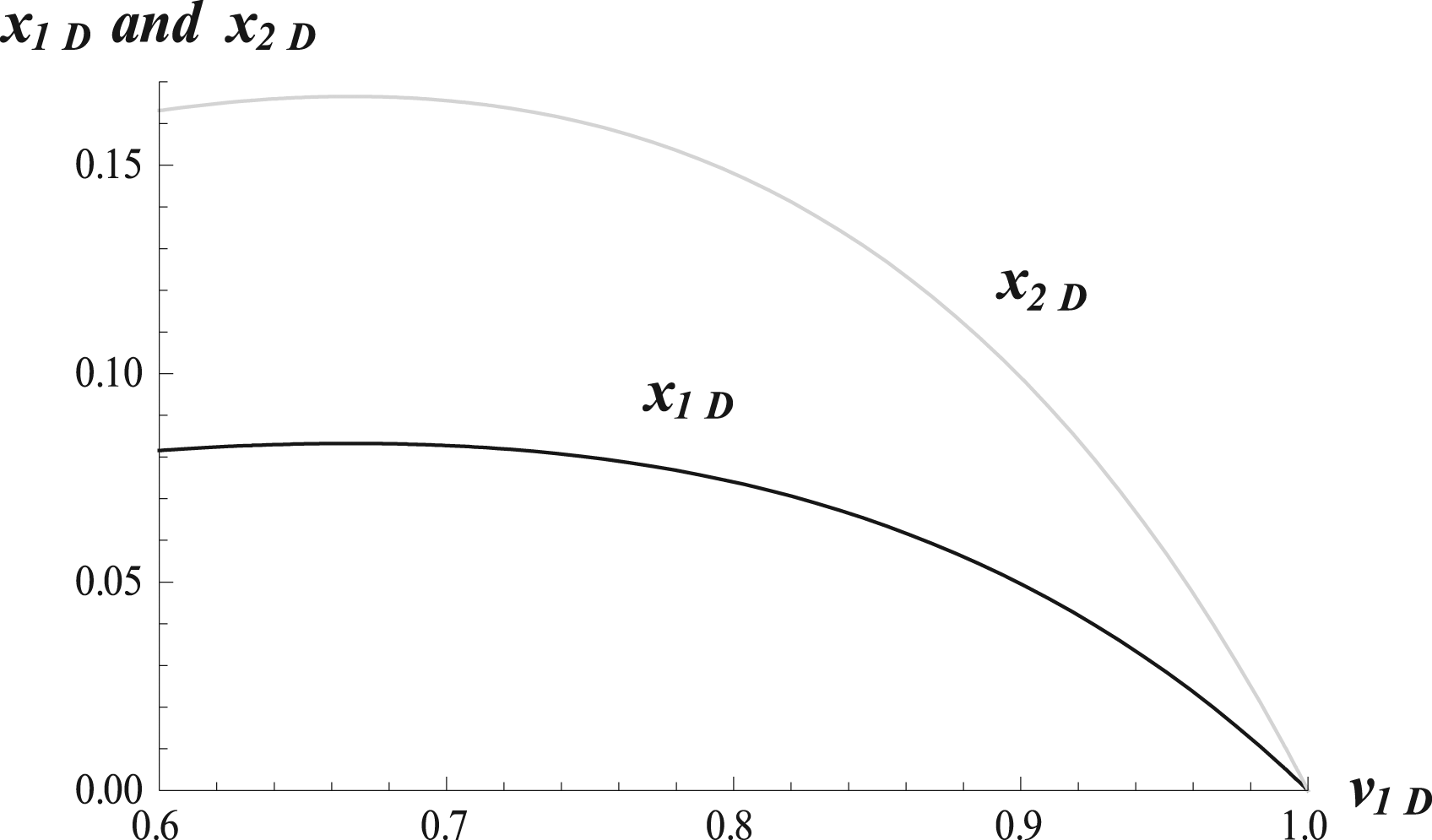
Illustration of proposition 2. The figure shows the increase in the promotion spending of the two destinations in the domestic market as the strategic advantage of the two destinations in that market become close to each other (i.e. when it falls from 1 to 2/3).
In equilibrium, the touristic destination
This result states that as the strategic value of destination Proposition 3 also helps explain the apparent paradox that promotion spending in the domestic market has increased in the context of falling demand. Although the magnitude of the domestic market has decreased due to the pandemic, its strategic value relative to the international market has increased, and thus the amount spent in promotion in the domestic market. The last proposition (Proposition 4) indicates that the destination’s promotion spending in each market is not independent of the other destinations' strategic value.
In equilibrium, the touristic destination This result implies that destination For instance, ceteris paribus, if no destination has a strategic advantage over the other in market Figure 2 illustrates Propositions 3 and 4. As before, the destination one is in the black line and destination two is in the gray line. Without loss of generality, let Suppose also that no destination holds a strategic advantage for the domestic market over the other, that is,
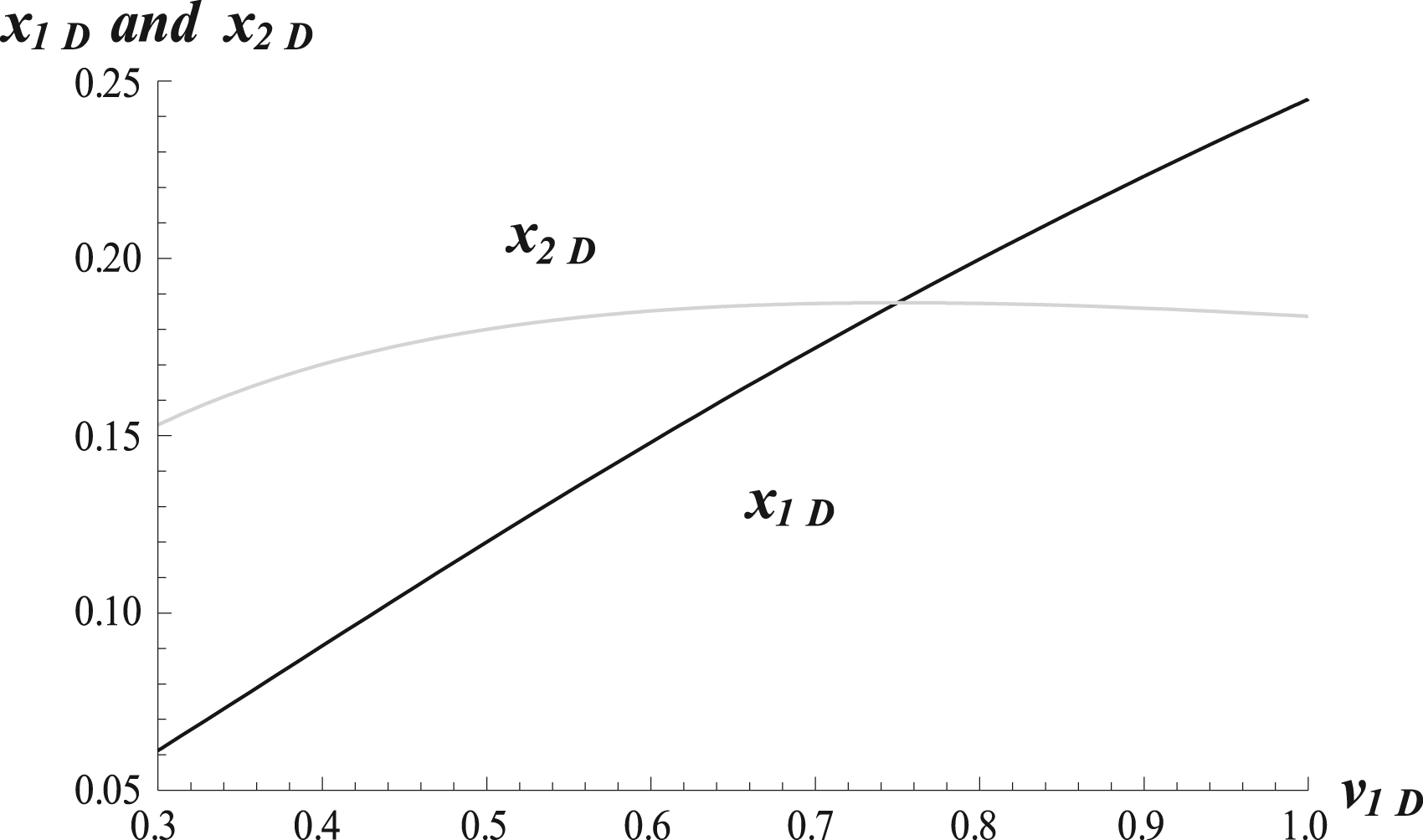
Illustration of propositions 3 and 4. An increase in the strategic value of destination one in the domestic market increases the promotion spending of destination one in this market, as stated in proposition 3. Destination two promotion spending raises only if the increase makes the strategic interest of the two destinations on this market closer to each other because of Proposition 4.
Model predictions and empirical evidence
In this section, we integrate our model in the context of the South Europe evidence, taking mainly Spain as an example for convenience (access of recent data and knowledge of the case). In fact, Spain received in 2019 84 millions of international tourist arrivals, located in the second position of the world’s top destinations (after France). We use this case to motivate and improve the understanding of our results. Nonetheless, the model is general and can be applied to study demand shock in the touristic market in other regions of the globe, and in particular, for instance, in other relevant Southern Mediterranean countries (like France, Italy, or Greece, for instance). In this sense, the demand shock induced by the COVID-19 pandemic is just one more application.
Let us start by characterizing the situation before the COVID-19 pandemic. After, we will discuss the changes that the pandemic has produced. Let
Before the pandemic, Spanish coastal touristic destinations enjoyed a strategic advantage over rural destinations in the domestic and the international market. In terms of the model of the previous section, this situation can be represented by a parametrization where
Moreover, coastal destinations had a higher strategic value for the international market than for the domestic market, that is,
Finally, the international tourists market demand was much larger than the domestic, that is,
The COVID-19 pandemic has introduced profound changes in the tourism market (Papatheodorou, 2021; Škare et al., 2021; Yang et al., 2020). Those changes can be translated in shifts in model parameters. In particular,
However, the pandemic has also introduced other profound changes in the tourism market (Papatheodorou, 2021; Škare et al., 2021; Yang et al., 2020). These changes translate to shifts in the structural parameters of the model and account for the observed increase in domestic market promotion spending in a context of declining demand, specifically the fall in the coastal destinations’ strategic advantage and the shift in the strategic value toward the domestic market.
As noted earlier, the COVID-19 has produced a reduction of the relative competitive advantage of coastal destinations because consumers are less willing to visit crowded destinations or gather in large groups (Maltseva and Li, 2020; Vashar and Štastná, 2020; Zenker and Kock, 2020).
14
The reduction in
In addition, the competition for the domestic market and the promotion spending may have increased because after the pandemic the strategic value that destinations place on the domestic market has increased, as stated in Proposition three and represented in Figure 2. The increase in the domestic market promotion spending is due to the increase in the strategic interest for this market might be higher for coastal destinations. The reason is two-fold. First, these destinations were placing higher strategic value on the international market before the pandemic, and now they had to shift. Second, the increase in strategic value may have an indirect cross-effect according to Proposition 4. Thus, larger the strategic value that rural destinations place into the domestic market, further it increases the promotion spending of coastal destinations because the strategic interest of both destinations become similar.
Overall, our model is compatible with the empirical evidence. The fall in the coastal destination’s strategic advantage and the shift in the strategic value toward the domestic tourists' markets may have compensated for the decrease in demand, leading to increased competition in the domestic market and higher spending in promotion. The prediction holds even if we assume that the strategic value of the domestic market has remained unchanged instead of increasing, as the “leveling the playing field effect” resulting from the decrease in the strategic advantage of the coastal destinations is likely to have been strong enough to compensate for the demand reduction. 15
The “leveling the playing field effect” between destinations and the increased value of the domestic market can also explain the increased competition of the domestic market in other parts of the world (UNWTO, 2020a; 2020b). Finally, notice that the effects discussed in this paper are not restricted to the COVID-19 crisis period, as it is likely that the changes in the competitive advantages and the strategic value of the domestic market might be prolonged in time due to the fears of future pandemics and of traveling to distant places may likely to have persistent effects (Arbulú et al., 2021).
Conclusion
This paper proposes a game-theoretical model that considers various destinations within the same country by assuming two typologies, coastal (sun and sand) and rural. The model characterizes the destinations’ promotion strategies on two fundamental factors, which have substantially changed due to the COVID-19 pandemic, namely, the competitive (strategic) advantage of the destinations and the strategic value attributed to the domestic and international markets. The model rationalizes the destination current strategic behaviors and provides a theoretical framework consistent with the recent evidence.
In particular, the model predicts an increase in promotion spending even in contexts of falling demand, such as the current one, consistent with the empirical evidence on the Southern European countries’ destinations, such as Spain. Thus, the pandemic might have substantially reduced the strategic advantages of crowded Southern European destinations, such as coastal destinations, and shifted strategic value toward the domestic market, less affected by the pandemic. Altogether, the model supports the existence of a competitive war for the domestic market between destinations within the same country, which has led to an increase in promotion spending, despite the fall in the aggregate demand.
This competitive war is mainly justified by the “leveling the playing field effect” generated by the change in consumer preferences toward open spaces, which is favoring rural destinations, and decreasing the competitive (strategic) advantage that coastal destinations had before the pandemic. On the one hand, rural destinations increased their promotion spending because they felt that they could attract a demand that under the usual circumstances “would not come,” even with high promotion spending. On the other hand, coastal destinations increased their promotion spending to retain the shifting demand that under the usual circumstances “would remain faithful.” Moreover, the increase in the strategic value of the domestic market produced by the COVID-19 pandemic might have also contributed to the increased competition, according to the model.
Our approach and findings may open new avenues of further research for the study of demand shocks in touristic markets, but they are by no means the last word on the subject. In particular, in order to obtain more granular predictions, it could be interesting to add more destination types and model the behavior of other economic agents like firms or consumers, or even consider that promotion spending may produce a market enlarging effect and positive spillovers. Regarding those agents, there are different types of touristic operators and tourists (distinct by age group, country of origin, preferences, etc.). In this paper, the promotion spending is carried out at the regional level (i.e., by destinations). However, promotion spending carried out at national or at firm level is also a possibility. For instance, if a centralized authority would decide the promotional spending, and the objective function is the total profit of the two destinations, there would be a corner solution, in which the promotional investment is made in favor of the destination which creates more value. In our context, it could be also interesting to integrate the increasingly important risk dimension in the analysis and to study potentially emerging new post-COVID-19 trends in the touristic markets.
Finally, the analysis presented in the current study is important because the COVID-19 effects on tourism markets are likely to be persistence or even permanent (Papatheodorou, 2021; Škare et al., 2021; Wut et al., 2021; Yang et al., 2020). Nevertheless, the model is general enough and can help researchers and policymakers to better understand tourism market competition in the presence of shocks affecting the demand and the touristic destinations in asymmetric ways, even after the COVID-19.
Footnotes
Acknowledgments
Financial support from the GRODE, Universitat Rovira i Virgili and Generalitat de Catalunya Project 2019PFR-URV-53, and the Spanish Ministry of Science and Innovation Project RTI2018-094733-B-I00 (AEI/FEDER, UE) and PID2019-105982GB-I00 is gratefully acknowledged is gratefully acknowledged. The usual caveat applies.
Declaration of conflicting interests
The author(s) declared no potential conflicts of interest with respect to the research, authorship, and/or publication of this article.
Funding
The author(s) received no financial support for the research, authorship, and/or publication of this article.
