






Abstract
As birth rates decline and populations age, coupled with the growing concentration of people in major cities, many regions are experiencing severe population loss, which is leading to the functional extinction of communities. Policymakers have recognized the economic benefits of tourism in addressing regional depopulation, as visitors can revitalize communities and support their economic sustainability. However, action plans often overlook the locally varying effects of different types of tourism expenditures across diverse regions. This study examined whether tourism expenditure can mitigate regional depopulation and identified key expenditure categories for each region. We analyzed six tourism expenditure sectors for domestic and international tourists using a geospatial model across all districts in the Republic of Korea, which are critically facing these crises. The results revealed significant regional variations in the impacts of domestic and international tourism expenditures. These findings can help policymakers develop localized tourism supply-demand strategies to effectively address regional depopulation challenges.
Introduction
Depopulation and the severe concentration of populations in certain large cities have become global challenges. For some countries, including Japan and the Republic of Korea (hereafter Korea), this represents a nationwide survival crisis. Traditional population migration theory, which addresses migration from rural to urban areas due to factors like living conditions and employment opportunities, cannot fully explain this crisis. This is because only certain large cities experience population concentration, while others—including rural areas, urban areas, and even some cities—currently face the threat of depopulation (Wolff and Wiechmann, 2018). Additionally, there is a concurrent natural population decline, as seen in Japan and Korea, where low birth rates and an aging population have resulted in natural increase rates of −0.7% and −0.2%, respectively (Population Reference Bureau, 2023).
Initially, each government attempted to attract new permanent residents to threatened areas through welfare policies (Korea Research Institute for Human Settlements, 2023), but these efforts have been hindered by challenging living conditions, leading to a focus on revitalizing regional economies through tourism expenditure (Ministry of the Interior and Safety, 2024). The Korea Tourism Organization (KTO) reported that the annual local expenditure of one resident (approximately US$5552) is equivalent to that of 14 domestic overnight tourists or 81 domestic day-trip tourists, underscoring the crucial role of tourism spending in offsetting the decline in local consumption due to depopulation (KTO, 2022). Given the significant impact that tourism expenditure can have on local economies, especially in areas facing population decline, maintaining a steady influx of tourism expenditure is increasingly important for offsetting the decline in resident-driven consumption and supporting regional economic circulation.
Although tourism expenditure can compensate for the decrease in local resident consumption, the effectiveness of tourism varies due to regional differences, differences in tourism resources, and disparities in infrastructure across different regions (Deng et al., 2022; Hiramatsu, 2023; Tanaka et al., 2023). Therefore, understanding the locally heterogeneous role of tourism expenditure on regional depopulation crises and identifying key tourism expenditure categories by region are crucial for effectively mitigating depopulation crises by region.
Using geographically weighted regression (GWR) models, this study aims to examine how different types of tourism expenditures affect depopulation by region, and to identify the key tourism expenditure categories for each region in Korea. By examining intra-regional spatial heterogeneity, this study aids researchers and local policymakers in understanding the role of tourism in mitigating regional depopulation crises in each region, thereby supporting localized crisis action plans based on targeted tourism expenditure impacts.
Methods
We focused on all districts (i.e., 250 districts) in Korea, where approximately 92.6% and 94.7% of the areas, respectively, are rapidly facing regional depopulation crises in 2022 and 2023 (Figure 1). Figure 1 illustrates the regional depopulation index—where the risk decreases as the index increases—provided by the Korea Employment Information Service (KEIS), which serves as the dependent variable in this study (KEIS, 2022; 2023). To examine the impact of tourism expenditure on mitigating regional depopulation, this study used the 2022 and 2023 tourism expenditure data from domestic and international tourists in six sectors: food, tour service, shopping, lodging, transportation, and entertainment. The expenditure data was collected from the Korea Tourism Data Lab (KTDL, 2022; 2023). KTDL used mobile phone data to examine the length of stay and frequency of visits at both the primary residence and specific destination areas, allowing for the classification of domestic, and international tourists. Additionally, based on each tourist’s credit card data, KTDL categorized their consumption into six expenditure sectors. To explore the spatial heterogeneity in the association between tourism expenditure and the local depopulation risk index, this study employed GWR analysis, which assumes that relationships between exogenous and endogenous variables differ by location. The GWR model is defined as: Regional depopulation risk levels across districts in Korea in 2022 and 2023.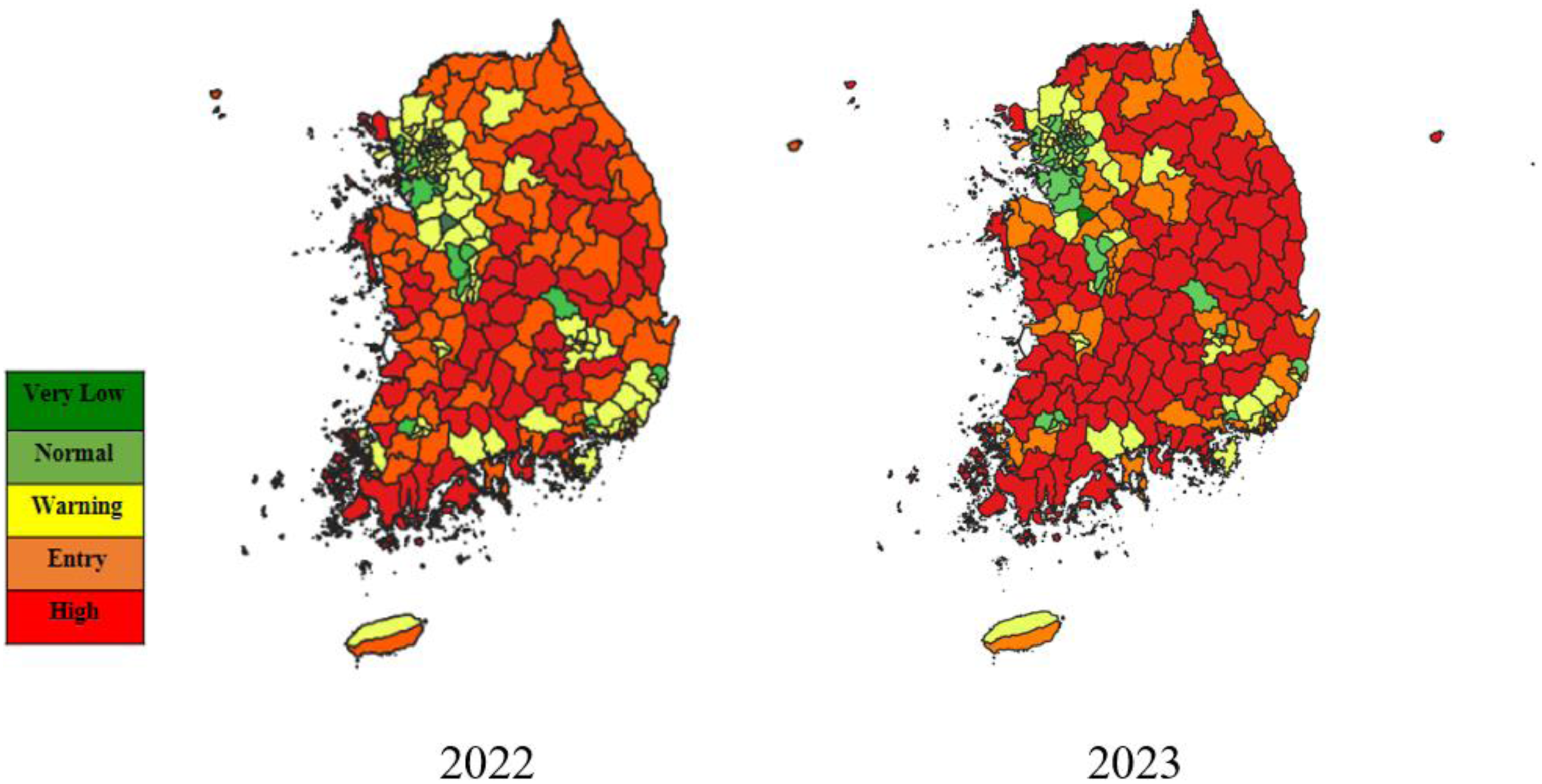
Results and discussion
Domestic tourism expenditure GWR model results.

Note: AICc: corrected Akaike’s information criterion; Max.: maximum; Min.: minimum.
International tourism expenditure GWR model results.

Note: AICc: corrected Akaike’s information criterion; Max.: maximum; Min.: minimum.

Domestic tourism expenditure in 2022 GWR model results.

International tourism expenditure in 2022 GWR model results.

Domestic tourism expenditure in 2023 GWR model results.

International tourism expenditure in 2023 GWR model results.
These results can be explained by a survey from the KTO, which found that shopping is the primary motivation for international tourists visiting Korea, with major shopping activities concentrated in these areas (KTO, 2020). However, likely influenced by the COVID-19 pandemic, the prolonged concentration of international tourists in these areas led to negative effects, which also explained why international tourists’ shopping expenditures showed a positive impact in these areas in 2023. This concentration of tourists often brings social and environmental problems to the local area (Koens et al., 2018), thereby leading to negative impacts, which precisely corroborates the findings of this study.
In terms of expenditure on entertainment, domestic tourists’ positive impact on mitigating depopulation was concentrated in risk areas, while international tourists generally exhibited an opposite pattern in 2022 and 2023. These results are supported by findings from a report by the Ministry of Culture, Sports, and Tourism (MCST) (2023), which noted that the primary reason for international tourists visiting Korea for entertainment increased from 4.5% in 2020 to 37.4% in 2022. The report also highlighted a significant rise in long-term stays (30 days or more) in regions such as Chungcheong-do (on the west-central side of Korea) and Gyeongsangbuk-do (on the east-central side of Korea). This shift has resulted in significant local impacts compared to the short-term travel of domestic tourists, leading to opposite patterns. Meanwhile, we also observed that, following the lifting of travel restrictions post-COVID-19, the mitigating effect of domestic tourists slightly decreased in 2023. This may be due to an increase in domestic tourists’ demand for outbound tourism (KTDL, 2023).
There are also differences in the impact of food, tour service, transportation, and lodging expenditures on mitigating depopulation across vulnerable regions. Specifically, in terms of food expenditures, domestic tourism expenditures show a positive impact on mitigating local depopulation nationwide in 2022 and 2023. Conversely, international tourism expenditures intricately affect depopulation. These complex impacts can be explained by the shift in the primary reason for international tourists visiting Korea from shopping in 2020 to food in 2022 (MCST, 2023). Regions that successfully responded to these changes and developed their food tourism offerings were positively affected by international food expenditures. In contrast, regions that did not effectively attract international tourists interested in Korean food were not positively affected by these expenditures.
In tour service and transportation, aside from the similar positive effect of domestic and international tourists’ transportation expenditure in a small part of the southeastern area in 2022, most areas exhibited opposite effects in 2022 and 2023. These findings reflect the spatially different travel and expenditure patterns of international and domestic tourists in Korea (MCST, 2023). For lodging, domestic tourists’ positive effects are primarily observed in a small part of the central region and southeastern coastal areas, while international tourists display negative correlations in some central areas but positive correlations in large areas of the eastern and western regions in 2022. International tourists tended to stay longer in regions such as Chungcheong-do, located on the west-central side of Korea (MCST, 2023), which positively influenced lodging but strained transportation in areas that did not provide international tourist-friendly transportation systems, such as public transportation and rental cars, resulting in negative effects. Meanwhile, a similar pattern appeared in 2023, with most negative impacts affecting local depopulation, suggesting the need to consider supply and demand related to lodging carefully.
Conclusion and implications
This study demonstrated the spatially heterogeneous roles of six types of tourism expenditures in regional depopulation crises, particularly detailing the impacts of expenditures by domestic and international tourists. Traditional population migration theories focus on the movement of residents and the resulting imbalanced regional development and decline. However, these theories have limitations when it comes to explaining the recovery of regions facing regional depopulation crises, particularly when such recovery is driven by expenditures from visiting populations. This study presents an alternative to traditional population migration theory by explaining how different types of tourism expenditures can either mitigate or exacerbate emerging regional depopulation crises, depending on the regional context and the nature of the expenditures. Furthermore, we distinguished between domestic and international tourists over different years to account for differences in visitor characteristics and their specific expenditure impacts on local depopulation. This theoretical framework offers valuable insights into the complex interplay between tourism and the evolution or decline of community functions, providing a more comprehensive understanding of how tourism-driven populations influence regional development beyond the scope of traditional migration theories.
Practically, the findings of this study provide valuable insights for local policymakers on how to effectively utilize international and domestic tourism expenditures to mitigate regional depopulation crises. By understanding the complex role of different types of tourism expenditures, policymakers can develop targeted tourism strategies that address the unique needs of each region. For example, creating designated shopping districts or routes in central regions that attract foreign tourists may help alleviate pressure on major cities. This approach not only distributes the economic benefits of tourism more evenly but also reduces the social and environmental strains on heavily visited certain cities. Additionally, increasing lodging facilities in regions such as Andong-si, Pohang-si, Boseong-gun, and Suncheon-si, based on tourist numbers and their duration of stay, will help meet demand effectively, ensuring a positive experience for visitors and supporting local economies.
By implementing these targeted regional strategies, policymakers can address local depopulation crises more effectively, fostering sustainable regional development and ensuring the long-term viability of vulnerable areas. For a more comprehensive understanding of local depopulation crises, future studies should conduct in-depth investigations into region-specific outcomes. Studies can explore why certain tourism expenditures significantly affect local depopulation mitigation, considering each region’s unique characteristics and the interactions between local residents and tourists. Additionally, it is necessary to continuously monitor the impact of future changes in tourism expenditure on local depopulation to help mitigate these crises.
Footnotes
Declaration of conflicting interests
The author(s) declared no potential conflicts of interest with respect to the research, authorship, and/or publication of this article.
Funding
The author(s) received no financial support for the research, authorship, and/or publication of this article.
