







Abstract
Doughnut Economics reimagines economic thinking, shifting away from the traditional focus on GDP growth, and instead emphasizes creation of an economy that meets human needs while staying within planetary boundaries. This paper explores the implications of the doughnut framework for tourism economics. It is argued that the model provides a robust foundation for rethinking tourism’s relationship with natural resources and ecological processes. The paper analyzes the pathways that can guide progress toward the goals of social and planetary wellbeing, emphasising the potential of Doughnut Economics to inform sustainable development pathways for tourism.
Keywords
Introduction
Economic development has been characterised by unprecedented material expansion alongside accelerating ecological degradation and persistent social inequalities. Rising greenhouse gas emissions, biodiversity loss, land conversion, freshwater depletion, and chemical pollution are pushing Earth systems beyond critical thresholds, undermining the biophysical conditions required for sustained human wellbeing (Rockström et al., 2021, 2024). Despite repeated commitments to sustainability, dominant development trajectories continue to overshoot planetary boundaries while failing to meet basic social needs for large segments of the global population (O’Neill et al., 2018).
This situation reflects a deeper theoretical limitation within mainstream economics with its continued emphasis on economic growth as the primary objective of development. GDP remains the dominant metric, guiding policy and institutional design, despite long-standing critiques that it is an inadequate indicator of human wellbeing, systematically ignoring environmental degradation, inequality, unpaid care work, and natural capital depletion (Costanza et al., 2020; Stiglitz et al., 2018). Empirical evidence further confirms that, beyond modest thresholds, additional economic growth yields diminishing wellbeing returns while intensifying ecological pressures (Easterlin and O’Connor, 2020). As a result, growth-centred economic frameworks struggle to reconcile human wellbeing with biophysical realism.
While tourism is routinely promoted as a vehicle for development and poverty alleviation, its expansion has been associated with rising emissions, ecosystem degradation, housing pressures, and widening inequalities within destinations (Dwyer, 2018; Miller and Torres-Delgado, 2023). Tourism is resource-intensive in respect of energy, water, land, biodiversity and technological efficiency gains and improved management have, to date, failed to offset these impacts at the scale and pace required (Tribe and Paddison, 2023). These failures expose the limitations of prevailing tourism economics frameworks that treat sustainability as a constraint on, rather than a redefinition of, economic success.
This paper makes a theoretical contribution by advancing recently developed Doughnut Economics (Raworth, 2017) as a foundational framework for re-orienting tourism economics to fulfill its potential to advance sustainable tourism development theory and practice. Doughnut Economics integrates an ecological ceiling, derived from planetary boundaries, with a social foundation based on internationally agreed minimum standards, defining a ‘safe and just space’ for humanity-meeting essential human needs without exceeding Earth’s biophysical limits (Fanning and Raworth, 2025). The Doughnut model can be used to reframe the purpose of economic systems away from growth maximisation and towards fostering human wellbeing within biophysical limits. While Doughnut Economics has gained traction in sustainability science and urban policy, its implications for tourism economics remain under-theorised and fragmented.
Tourism represents a particularly instructive domain for advancing Doughnut Economics theoretically and in practice. As a sector dependent on natural and cultural commons, highly exposed to climate risk, embedded in global mobility systems, and characterised by uneven distributions of costs and benefits, tourism provides a critical test case for assessing whether the Doughnut can function as an operational economic framework rather than a purely normative vision.
By articulating Doughnut Economics as an organising analytical framework for tourism economics, this paper advances theoretical debates on sustainability, growth, and wellbeing within the field. In doing so, it contributes to the ongoing rethinking of tourism economics in the context of ecological overshoot and social constraint. It contributes to tourism theory in three interrelated ways. First, it redefines the core objective of tourism economics, shifting the analytical focus from growth-centred performance indicators to destination wellbeing within planetary boundaries. This re-conceptualisation moves sustainability from a peripheral concern to a constitutive principle of tourism economic analysis. Second, the paper resolves long-standing tensions in tourism sustainability debates by adopting a growth-agnostic stance in opposition to the widely accepted, but flawed, green growth approach (Dwyer, 2023b), emphasising wellbeing, resilience, and equity outcomes regardless of whether tourism GDP rises or falls. Third, it operationalises Raworth’s seven pathways for twenty-first-century economics within a tourism context, demonstrating how Doughnut thinking challenges foundational assumptions in tourism demand modelling, policy design, business strategy, and economics education.
The paper proceeds as follows. Section 2 outlines the Doughnut Economics framework and situates it in relation to planetary boundaries and the United Nations Sustainable Development Goals. Section 3 examines the implications of Raworth’s seven pathways for economics, exploring their consequences tourism economics theory and practice. Section 4 explores how tourism economics can be aligned with Doughnut Economics, identifying a new vision for tourism economics, outlining the nature of the tourism firm from a Doughnut Economics perspective, overviewing the broader implications for tourism economics education, and proposing a research agenda for a Doughnut-informed tourism economics. Section 5 concludes with a recommendation that tourism economists could advance both theory and practice through investigating how their discipline may more closely align to Doughnut thinking.
Doughnut Economics
The economy (and tourism systems) can be conceptualised as embedded within society and the biosphere, operating between two binding constraints-ecological ceiling and a social foundation (Raworth, 2025).
The ecological ceiling represents biophysical limits beyond which human activity destabilises Earth systems, The ecological ceiling is defined by nine planetary boundaries that regulate the stability and resilience of the Earth system. These comprise climate change, biosphere integrity, land-system change, freshwater use, biogeochemical flows, chemical pollution, atmospheric aerosol loading, ocean acidification, and ozone depletion- (Rockström et al., 2021, 2024). Transgressing these boundaries increases the risk of abrupt, non-linear, and potentially irreversible environmental change.
The social foundation defines threshold conditions below which human deprivation occurs. It represents minimum standards of human wellbeing derived from internationally agreed goals, particularly the Sustainable Development Goals (UN, 2015, 2020). These include access to food, water, sanitation, health care, education, energy, housing, income and decent work, equity, political voice, social networks, and peace and justice (Raworth, 2017). The social foundation is also consistent with the Better Life Index developed by OECD, and widely adopted by destination managers seeking to promote social wellbeing (Dwyer, 2022; OECD, 2020).
Between these two boundaries lies a ‘safe and just space’ in which human needs can be met without exceeding planetary limits. Progress is not defined by output expansion, but by whether activities contribute to securing wellbeing within biophysical limits. The objective is to organise economic (including tourism) activity so that essential human needs are met without exceeding planetary carrying capacities (O’Neill et al., 2018).
The Doughnut model is illustrated in Figure 1 The doughnut model (adapted from Raworth (2025)).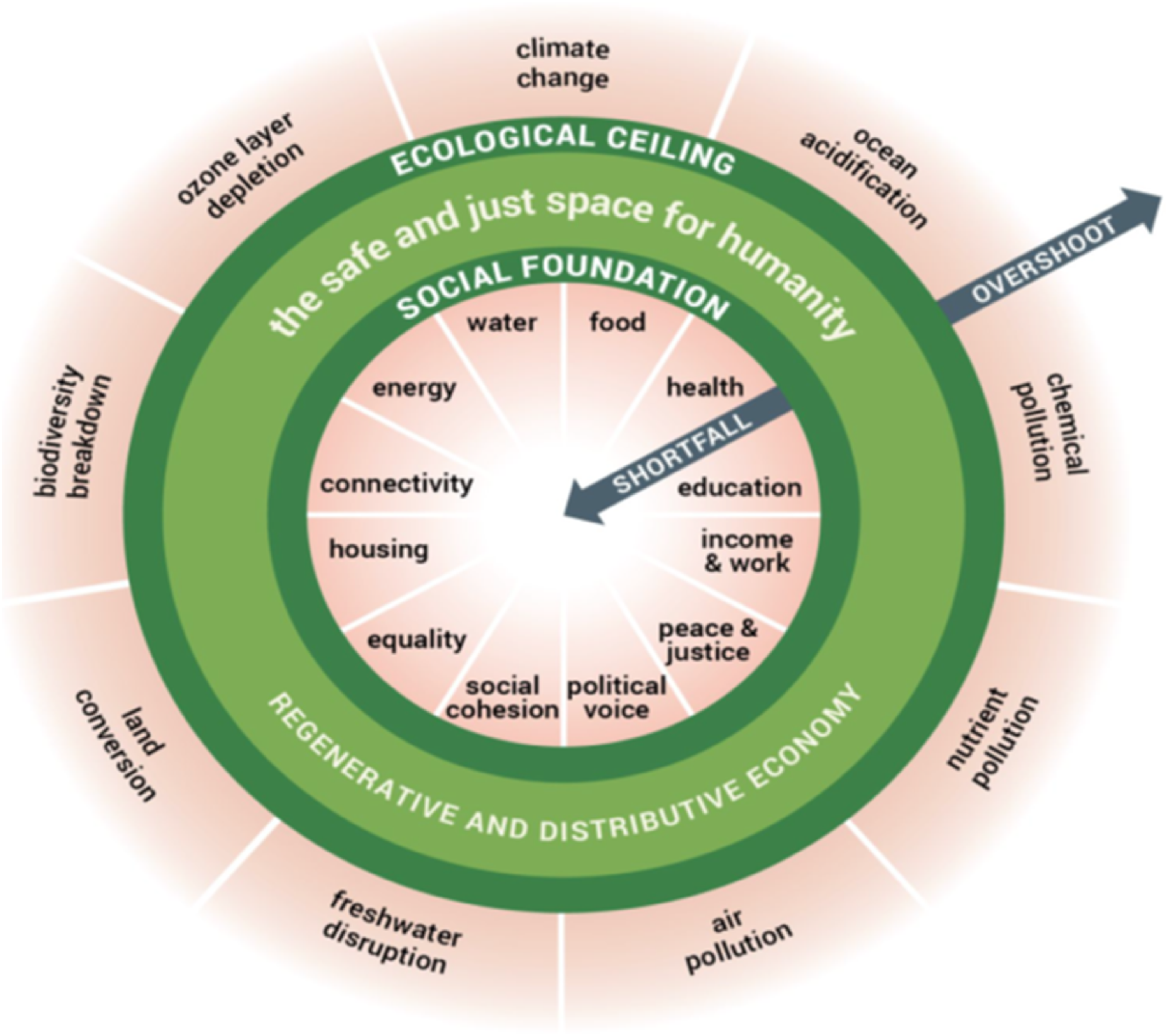
Tourism activity depends directly on circumstances such as stable climates, healthy ecosystems, functional infrastructure, and social licence from host communities. At the same time, it contributes to pressures on multiple planetary boundaries, while generating distributive tensions around housing, labour conditions, congestion, and access to shared spaces (Hartman and Heslinga, 2023). From a Doughnut perspective, tourism growth must be evaluated against its contribution to destination wellbeing and its cumulative pressure on planetary boundaries.
Unlike much of tourism economics that treats environmental impacts as externalities or constraints on otherwise desirable growth trajectories (Song et al., 2012), the Doughnut integrates social and ecological objectives within a single analytical structure. The Doughnut therefore provides a lens through which tourism can be analysed, not simply as an engine of growth, but as an economic system that operates within defined ecological ceilings while contributing to social foundations at destination, national, and global scales.
This position is consistent with the widely accepted view in the social sciences (excepting mainstream economists) that the key performance indicator of economic development is improvement of human wellbeing.
Moving into the safe operating space
Raworth (2017) identifies five key determinants shaping the ability of economies to move into or remain within the safe operating space: population, distribution, aspiration, technology, and governance. Population size influences the aggregate level of human needs that must be met, while the distribution of income and wealth shapes consumption patterns and resource use. Greater equity is therefore essential to reducing material throughput while securing social outcomes (O’Neill et al., 2018). Aspirations for rising incomes and profits continue to drive consumption growth, which is strongly associated with increasing environmental and social pressures (Wiedmann et al., 2020). Technology can reduce environmental impacts through efficiency gains, but reliance on technological solutions alone reflects undue confidence in the possibility of absolute decoupling between economic growth and ecological harm (Parrique et al., 2019). Governance plays a critical role across all scales, from local communities to global institutions, yet entrenched political and economic interests frequently obstruct the institutional changes required to align development with ecological limits (Bramwell et al., 2017).
While these factors influence outcomes, incremental adjustments are insufficient. Moving into the safe and just space requires a fundamental shift in economic purpose, values, and decision-making criteria-prioritising planetary health, social foundations, equity, and human wellbeing over output growth (Capmourteres et al., 2019). The challenge is compounded by the interdependence of social and ecological systems. Environmental degradation can intensify poverty, while social deprivation can drive resource overexploitation. Poorly designed policies risk addressing one boundary at the expense of the other. Conversely, integrated strategies can simultaneously advance social equity and ecological sustainability, enabling societies to move toward the Doughnut from both sides (Fanning and Raworth, 2025).
Comparison between the doughnut and SDG agenda
The Sustainable Development Goals (SDGs) agenda is widely recognised as the dominant global framework for evaluating progress toward sustainable development and is frequently invoked in tourism policy, destination strategies, and corporate reporting (UN Tourism, 2015, 2020). However, the SDG agenda places a disproportionate emphasis on socio-economic objectives. Of the 17 goals, the majority prioritise social and economic expansion, while only three-Goal 13 (Climate Action), Goal 14 (Life Below Water), and Goal 15 (Life on Land)-explicitly address biophysical limits (Eisenmenger et al., 2020). In practice, efforts to advance tourism-relevant SDGs, such as employment creation (SDG 8), infrastructure development (SDG 9), and destination competitiveness, often increase energy use, land conversion, water demand, and emissions, thereby intensifying pressure on planetary boundaries (Randers et al., 2019).
This tension is particularly evident in tourism indicators used for SDG alignment. Progress is commonly assessed through measures such as visitor numbers, tourism GDP contribution, export earnings, employment growth, or infrastructure investment-metrics that implicitly equate success with expansion. Environmental indicators, where included, tend to focus on efficiency improvements (e.g., emissions per trip, water use per guest night) rather than absolute ecological impacts. As a result, tourism destinations may report positive SDG alignment while simultaneously increasing total emissions, resource use, and pressure on local ecosystems.
Doughnut Economics offers a more analytically coherent alternative for evaluating tourism sustainability. By explicitly integrating an ecological ceiling with a social foundation, the Doughnut requires tourism activity to be assessed against thresholds, not aspirational targets. From a tourism perspective, this implies evaluating performance in terms of whether destination-level tourism systems operate within an ecological ceiling, while simultaneously contributing to social objectives.
Unlike the SDGs-comprising 69 targets and 231 indicators, many of which are loosely defined and weakly linked to biophysical constraints-the Doughnut framework is structured around a smaller set of clearly specified boundaries and social thresholds (Shao, 2025). This enables more transparent assessment of tourism sustainability across scales. For example, tourism emissions can be evaluated relative to destination-level carbon budgets aligned with climate boundaries; accommodation and infrastructure development can be assessed against land-system and biodiversity thresholds; and tourism employment and income can be evaluated against social foundations such as decent work and minimum income standards.
Crucially, whereas SDG-based tourism assessments typically estimate progress toward goals, Doughnut Economics establishes explicit benchmarks for determining whether tourism development is compatible with a safe and just operating space. This theoretical shift enables systematic comparison of tourism sustainability performance across countries and regions (Fanning et al., 2020), and increasingly at sub-national and destination scales. It also exposes trade-offs that SDG reporting often obscures-for instance, situations in which tourism growth supports employment targets while undermining climate, biodiversity, or housing outcomes.
While the SDGs remain an important reference point, their growth-centric orientation risks reinforcing development pathways that are incompatible with ecological limits. Doughnut Economics, by contrast, provides a boundary-based framework that directly challenges prevailing tourism performance metrics and growth assumptions. In doing so, it offers a more rigorous conceptual basis for rethinking tourism policy, modelling, and strategy evaluation.
The current situation
Empirical evidence confirms that no country currently operates within the ‘safe and just space'; instead, humanity is simultaneously overshooting ecological ceilings while failing to meet minimum social foundations (O’Neill et al., 2018). Countries that achieve higher social outcomes consistently exceed multiple biophysical boundaries, while those operating within ecological limits often fail to secure essential social thresholds. This pattern reflects the structural dependence of contemporary development models on resource- and energy-intensive growth.
Recent assessments indicate that six of the nine planetary boundaries have already been transgressed globally, with continued economic expansion intensifying pressure on the other thresholds (Richardson et al., 2023; Rockström et al., 2024). Integrated modelling further suggests that under business-as-usual trajectories, neither social nor environmental Sustainable Development Goals are likely to be achieved within planetary limits by mid-century (Randers et al., 2019). For tourism, these findings are particularly relevant given the sector’s reliance on carbon-intensive mobility systems, fragile ecosystems, and place-specific social relations.
Collectively, this evidence challenges the assumption that economic growth can reconcile social progress with ecological sustainability. Instead, it points to the need for a fundamental reorientation of economic purpose, metrics, and institutions-precisely the reorientation advanced by Doughnut Economics.
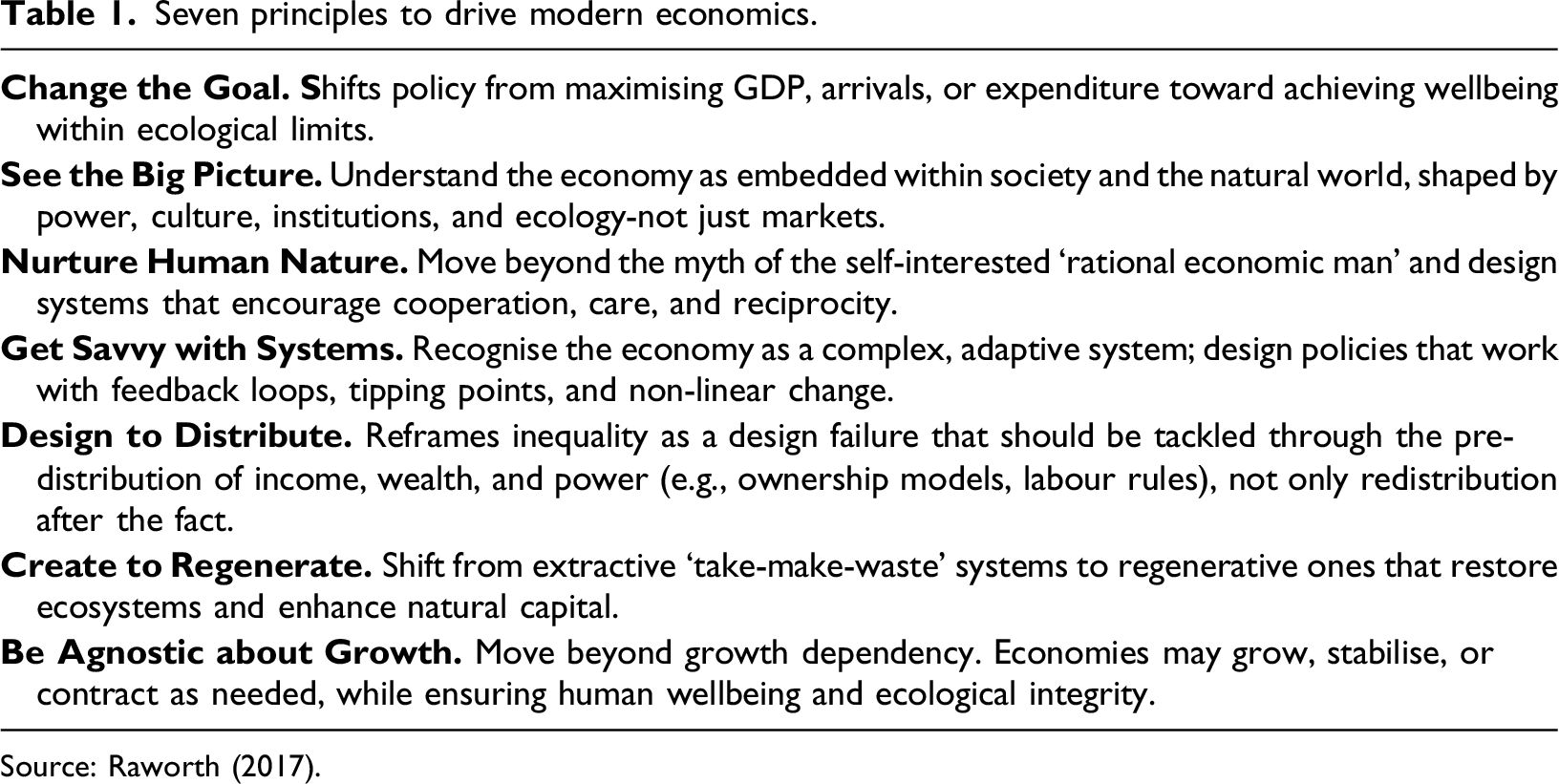
To address this challenge, Raworth (2017) articulates seven pathways for twenty-first-century economics that specify how the economist’s mindset must change if they are to help guide destinations into the safe and just space. The next section presents these seven pathways and explores their implications for tourism economics, showing how Doughnut thinking opens alternative analytical and policy trajectories for the tourism sector.
Implications for the tourism economist
Seven principles to drive modern economics.
Source: Raworth (2017).
These seven principles may be expected to drive application of Doughnut economics in respect of tourism economic analysis and policy. On this perspective, attention to the ecological ceiling can help to avoid environmental degradation caused by tourism activities, while attention to the social foundation helps to ensure achievement of equitable, inclusive, and culturally respectful tourism development fostering human wellbeing. The implications of each principle for economic analysis in general and tourism economics can be set out.
Changing the goal
This pathway advances a core theoretical contribution to tourism economics by re-specifying its objective function. Drawing on Doughnut Economics, it replaces growth-centred evaluation with the pursuit of human wellbeing within planetary boundaries. This directly challenges tourism policy frameworks that prioritise visitor growth, expenditure, and GDP contribution as indicators of success (Dwyer, 2023b).
Recognition of the deficiencies of GDP as the primary goal of economic development is consistent with the emerging Beyond GDP approach, developing broader measures of social progress and emphasising the need for a shift of emphasis from a production-oriented measurement system to one focused on the wellbeing of current and future generations (Dwyer, 2020, 2023b; Stiglitz et al., 2018). Proponents acknowledge that wellbeing encompasses economic ‘welfare’ but argue that ‘welfare’ cannot be equated with the broader multidimensional conception of ‘wellbeing’ advocated in the wider social science literature (Stiglitz et al., 2018; Tov, 2018). Indeed, the assumption that narrow welfare effects equate to personal or social wellbeing has presented a substantial barrier to real-world relevance of the type of economic modelling undertaken in the study of sustainable development (Costanza et al., 2020; Dwyer, 2023a).
Recognising the difference between welfare effects and well-being outcomes changes the evaluative criterion guiding tourism policy. Rather than asking whether tourism growth maximises aggregate surplus, a well-being lens asks whether tourism contributes to living well within social and ecological limits (Coscieme et al., 2019). This shift aligns tourism research with emerging wellbeing economy agendas and supports a more explicit engagement with distribution, sustainability, and quality-of-life outcomes (Fioramonti et al., 2022; Fioramonti et al., 2019). As the study of wellbeing has matured as a statistical and measurement agenda, it has become increasingly relevant as a policy ‘compass’ generating more meaningful metrics of social progress and embedding these metrics in public policy assessment (Durand, 2020).
Seeing the big picture: Embedding tourism within social-ecological systems
This pathway contributes to tourism economics by repositioning tourism as a subsystem embedded within wider social-ecological systems, rather than a self-contained growth sector. Dominant tourism models, grounded in demand, prices, and competitiveness, have tended to abstract tourism from ecological limits and social interdependencies (Song et al., 2012).
Tourism depends on stable climates, functioning ecosystems, public infrastructure, care economies, and social licence within host communities. Partial and linear indicators-such as arrivals, expenditure, and multipliers-systematically underestimate cumulative pressures, feedback loops, and threshold effects, allowing strategies that appear economically successful while generating systemic risks such as environmental degradation, housing displacement, and governance overload. A Doughnut-informed approach integrates ecological ceilings and social foundations directly into tourism analysis, treating rebound effects, spatial spillovers, and cross-sectoral competition as central dynamics rather than externalities (O’Neill et al., 2018; Wiedmann et al., 2020).
The theoretical contribution of seeing the bigger picture lies in advancing systems-based tourism economics informed by ecological economics and complexity science. This shift enables more realistic assessments of tourism viability under conditions of social and biophysical constraint.
Nurturing human nature: Reframing behavioural foundations in tourism economics
This pathway contributes to tourism economics by challenging the assumption of self-interested, utility-maximising actors and replacing it with a socially embedded conception of economic behaviour. Standard models of tourist and firm behaviour have limited capacity to explain resident support, labour relations, and destination conflict. Tourism decisions are shaped by norms, ethics, identity, trust, and place attachment, as well as by unpaid and undervalued care work that sustains destinations (Li et al., 2022).
A Doughnut-informed framework conceptualises tourism as a relational activity embedded in households, communities, and institutions. Wellbeing outcomes depend not only on income and consumption, but also on dignity at work, social cohesion, cultural continuity, and procedural fairness (OECD, 2020). Empirical studies show that resident attitudes toward tourism are driven more by perceived equity and institutional trust than by aggregate economic gains (Hadinejad et al., 2019).
The contribution of this pathway is to broaden tourism economics’ behavioural foundations through insights from behavioural, feminist, and institutional economics, improving explanations of contestation and strengthening the basis for socially legitimate tourism governance.
Getting savvy with systems: Introducing dynamics, thresholds, and lock-in
This pathway advances tourism economics by incorporating complexity, non-linearity, and irreversibility into its analytical core. Traditional equilibrium-based approaches struggle to explain abrupt tourism crises such as overtourism, ecological collapse, or resident backlash.
Tourism systems exhibit strong path dependence through sunk infrastructure, destination branding, and institutionalised growth promotion (Williams, 2013). Once ecological or social thresholds are crossed, impacts tend to emerge suddenly rather than incrementally, undermining assumptions of smooth adaptation (Wiedmann et al., 2020).
A Doughnut-informed tourism economics prioritises dynamic analysis encompassing cumulative emissions, ecological tipping points, and social tolerance thresholds (Hartman and Heslinga, 2023). Timing, sequencing, and precaution therefore become central policy considerations, as delayed intervention can lock destinations into unsustainable trajectories.
The contribution of this pathway is both theoretical and methodological: it legitimises scenario modelling, adaptive governance, and resilience-oriented indicators within tourism economics, reinforcing the need to manage scale, not merely efficiency, under uncertainty and constraint.
Designing to distribute: Making equity a structural criterion
This pathway contributes to tourism economics by elevating distribution from a residual concern to a core design principle. Mainstream economic analyses focus on aggregate benefits, routinely obscuring how tourism value is captured and by whom (Song et al., 2012).
Empirically, tourism growth often coexists with low wages, precarious employment, housing displacement, and rising inequality, particularly in urban and coastal destinations (Dwyer, 2018). Such outcomes erode social foundations and public support but remain weakly theorised in standard evaluation frameworks.
A Doughnut-informed perspective reframes tourism policy around ownership structures, labour conditions, taxation, and mechanisms that retain value locally. Cooperative enterprises, community ownership, and fair fiscal arrangements are treated as structural design variables rather than compensatory measures (Fanning et al., 2022; Raworth, 2017).
The theoretical contribution lies in integrating distributive and political-economic analysis into tourism economics. Equity thus becomes a defining success criterion, strengthening explanations of tourism conflict, legitimacy, and long-term sustainability.
Creating to regenerate: Moving beyond sustainability accounting
This pathway advances tourism economics by shifting evaluation from ‘harm minimisation' to ‘net ecological contribution'. Prevailing sustainability approaches, centred on efficiency and mitigation, are increasingly inadequate under conditions of ecological overshoot (Richardson et al., 2023).
Tourism depends on ecosystems under accelerating stress from climate change and biodiversity loss. A regenerative perspective reframes tourism as potentially contributing to ecosystem restoration and resilience, provided activity remains within ecological ceilings (Bellato and Pollock, 2025). This directly challenges assumptions of substitutability and reversibility embedded in neoclassical environmental economics. A Doughnut-informed tourism economics distinguishes regenerative from degenerative tourism forms, assessing net outcomes relative to planetary boundaries rather than footprint reduction alone (Fanning et al., 2022). Limits to substitution and ecological irreversibility become explicit analytical constraints.
The contribution of this pathway is to embed regenerative logic within tourism economic evaluation, strengthening the case for limiting scale, redirecting investment, and prioritising place-based, low-impact tourism models aligned with long-term ecological renewal.
Being agnostic about growth: Consolidating a post-growth paradigm
The final pathway consolidates the preceding six by reframing growth as a contingent outcome rather than a policy objective. Tourism economics has historically equated expansion with success, reinforcing growth lock-in even amid congestion, carbon intensity, and resident resistance (Song et al., 2012).
A growth-agnostic stance rejects both automatic expansion and prescriptive contraction. Tourism may grow, stabilise, or decline depending on whether activity enhances wellbeing within ecological limits (Fanning and Raworth, 2025). This reframing moves debate beyond polarised narratives of green growth versus degrowth. Analytical attention centres on sufficiency, demand management, qualitative development, and context sensitivity (Dwyer, 2023b). Growth becomes an emergent outcome rather than a guiding objective.
The above seven pathways characterise the paradigmatic reorientation proposed by Doughnut Economics, providing tourism economics with a coherent post-growth framework capable of addressing limits, legitimacy, and long-run destination viability.
Aligning tourism economics with doughnut economics
A new vision for tourism economics
Three key features distinguish Doughnut Economics from mainstream tourism economics. Doughnut framework redefines progress across three fundamental dimensions: conception, metrics, and directionality.
First, the conception of progress shifts away from narrow material living standards towards a holistic understanding of human flourishing within planetary limits. The metrics of progress extend beyond GDP to include a multidimensional set of social and ecological indicators. The Doughnut’s concentric circles in Figure 1 offer a clear visual articulation of this goal: meeting everyone’s essential needs without breaching Earth’s life-support systems (Fiorimonte et al., 2022).
Second, beyond its conceptual appeal, the Doughnut functions as a practical analytical and policy tool for assessing progress towards social wellbeing. By comparing social indicators against minimum social standards and ecological indicators against planetary boundaries, the Doughnut enables systematic monitoring of social shortfall and ecological overshoot at global, national, and sub-national scales (Fanning and Raworth, 2025).
Third, the directionality of progress is reoriented from perpetual economic growth and welfare effects towards simultaneous reduction of social shortfall and ecological overshoot to enhance wellbeing outcomes. Doughnut Economics offers a fundamentally different organising framework to mainstream economic theory and practice, by situating tourism activity between a social foundation and an ecological ceiling, reframing tourism not as an engine of growth, but as a provisioning system for wellbeing within limits (Capmourteres et al., 2019; Raworth, 2017).
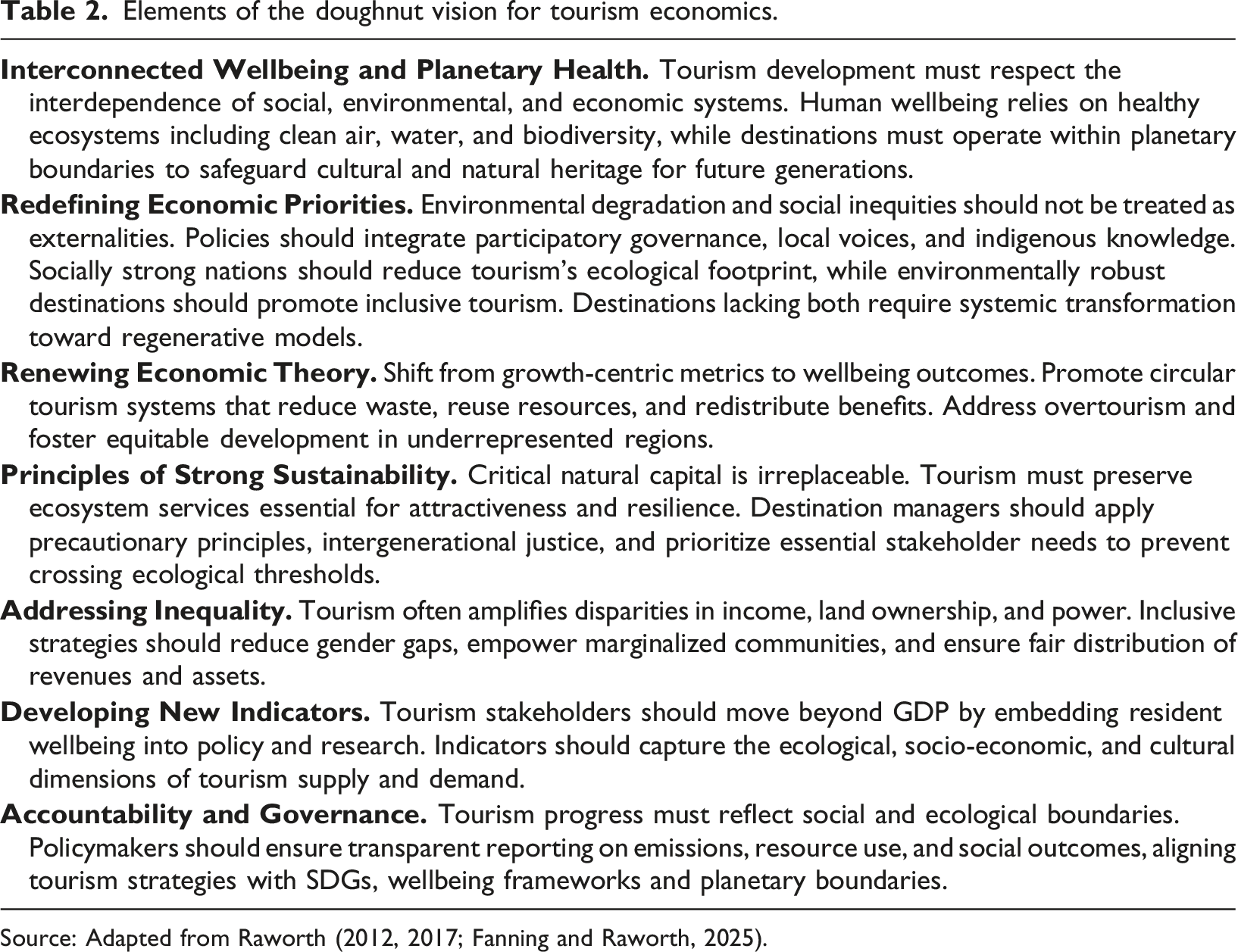
Elements of the doughnut vision for tourism economics.
Source: Adapted from Raworth (2012, 2017; Fanning and Raworth, 2025).
Alignment of tourism economics with Doughnut principles has several important implications.
An alignment with Doughnut Economics redefines the core purpose of tourism economics, shifting the analytical focus from maximising tourism growth to achieving human wellbeing within explicit ecological ceilings and social foundations. Doughnut-aligned tourism economics emphasises local ownership, shorter supply chains, cooperative and social-enterprise models, and regenerative business practices that retain value within host communities. Policy instruments that support locally embedded firms and enforce fair labour standards thus strengthen social foundations while reducing dependence on continuous expansion. In doing so, ‘sustainability’ transitions from an external constraint on tourism growth to a constitutive condition of economic success (Coscieme et al., 2019).
Alignment also provides conceptual integration across fragmented tourism literatures. Adopting the growth-agnostic Doughnut framework bridges long-standing divides between green growth approaches in tourism economics, degrowth and post-growth tourism scholarship, wellbeing and regenerative tourism perspectives (Coscieme et al., 2019). The Doughnut clarifies that tourism outcomes should be assessed by whether they remain within a ‘safe and just space’ rather than by whether tourism expands or contracts per se.
Alignment extends Doughnut Economics into tourism economics by systematically translating the seven pathways into tourism-specific analytical implications, as set out above. Doughnut thinking challenges foundational assumptions regarding rational behaviour, linear causality, efficiency-led policy design, firm-level growth dependence, and GDP-centred measurement-assumptions that continue to dominate mainstream tourism economic analysis.
Alignment advances theory by re-embedding tourism within coupled social–ecological systems, aligning tourism economics more explicitly with ecological economics and complexity science (Costanza et al., 2020). It shows how Doughnut Economics acknowledges feedback loops, distributional effects, rebound dynamics, and resilience-phenomena that conventional tourism growth models struggle to accommodate.
Internalising environmental and social costs constitutes a further outcome of alignment between tourism economics and doughnut Economics. Tourism has long benefited from implicit subsidies, including under-priced carbon-intensive transport, publicly funded infrastructure expansion, and weak regulation of environmental impacts (Zientara, 2026). Doughnut-aligned approaches support polluter-pays instruments-such as carbon pricing, environmental levies, and user fees-with revenues earmarked for ecosystem restoration, community services, and just-transition measures. Crucially, such tools should be used to constrain demand and correct price signals, not to legitimise further expansion.
A Doughnut-informed framework legitimises active demand-management instruments-including visitor caps, spatial and temporal zoning, differential pricing, and restrictions in ecologically sensitive areas-to maintain tourism activity within safe operating limits.). Destination management organisations are thus repositioned from marketing-led growth agencies toward the role of public-interest stewards responsible for balancing social foundations and ecological ceilings through participatory and reflexive decision-making (Bramwell et al., 2017). Alignment with Doughnut Economics advances tourism economics by clarifying the limitations of GDP-centric evaluation and proposing the Doughnut as a unifying assessment framework for integrating tourism satellite accounts, wellbeing indicators, natural capital accounts, and sustainability dashboards. It highlights the need for tourism research to adopt systems-based and distribution-sensitive indicators capable of capturing rebound effects, equity outcomes, and ecological thresholds-dimensions that are poorly served by conventional economic models (Jo et al., 2026).
The process of alignment can also help reframe tourism as a critical empirical test case for Doughnut Economics. Doughnut-aligned tourism economics prioritises locally embedded ownership, shorter supply chains, cooperative and social-enterprise models, and regenerative business practices that retain value within host communities. Tourism’s reliance on natural and cultural commons, its carbon-intensive mobility systems, and its uneven distribution of benefits and burdens, render it an instructive sector for evaluating whether economic frameworks can simultaneously address planetary boundaries and social justice.
In sum, a Doughnut-informed tourism economics provides a coherent framework for recalibrating tourism’s role in contemporary economies. It moves the tourism sector toward a purposeful contribution to wellbeing, resilience, and ecological integrity-conditions increasingly recognised as foundational to tourism’s long-term viability. In this manner, Doughnut-informed tourism economics provides a rigorous foundation for repositioning tourism as a contributory system for human wellbeing within planetary constraints (Fioramonti et al., 2019, 2022).
The nature of the tourism firm from a Doughnut Economics perspective
In the dominant neoliberal view of the firm, social and environmental impacts are treated as externalities, addressed through regulation or efficiency measures rather than embedded within organisational purpose. Firm boundaries are narrowly defined, time horizons are short, and success is assessed primarily through financial performance and growth metrics (Hausdorf and Timm, 2023).
Doughnut Economics offers an alternative theoretical lens by reframing the tourism firm as an economic actor embedded within social and biophysical systems, whose legitimacy depends on meeting social needs while remaining within planetary boundaries (Kapliar, 2025). Applied to tourism, this perspective redefines the firm as a place-embedded, multi-stakeholder institution whose long-term viability depends on sustaining the ecological and social conditions upon which tourism itself relies. Doughnut-aligned tourism business models imply transformation across all business model components, including value propositions, revenue logic, partnerships, governance, and performance metrics. Success is assessed not solely through financial indicators, but through contributions to destination wellbeing and reductions in ecological footprints, in line with wellbeing and Beyond GDP approaches to tourism policy (Dwyer, 2025a, 2025b).
Sustainable business models (SBMs), aligning closely with Doughnut thinking, are being developed in the economics, management and wider social science literature (Reinhold et al., 2019). SBMs conceptualise firms as embedded socio-economic actors operating within social-ecological systems. SBMs explicitly recognise ecological limits and social responsibilities as binding constraints on business behaviour, internalising sustainability within value propositions, governance structures, and strategic decision-making (Lozano, 2018).
Despite their relevance, these business models remain under-examined in tourism economics and weakly reflected in dominant measurement frameworks. The absence of explicit attention to ownership structures, governance models, and value-distribution dynamics represents a significant gap in tourism economics, given tourism firms’ central role in delivering wellbeing outcomes and advancing the SDGs. Reconceptualising the tourism firm through a Doughnut Economics lens can thus provide a coherent foundation for aligning business behaviour with wellbeing, sustainability, and long-term destination resilience.
Reorienting tourism economics education through the doughnut framework
Applying the Doughnut framework to tourism economics education requires re-specifying core learning outcomes while retaining analytical rigour. Doughnut-informed economics education reframes tourism as a socio-ecological provisioning system that must operate within ecological ceilings while contributing to social foundations. This perspective challenges the implicit growth norm that has long underpinned tourism economics and replaces it with a pluralist, limits-aware economic logic aligned with ecological and wellbeing economics (Fernández-Villarán et al., 2024).
Rather than displacing mainstream economic tools, the Doughnut framework reorients how they are framed, applied, and evaluated. Some examples can be offered (Chen et al., 2022). Demand analysis will shift from growth optimisation to demand governance under constraint: students will examine price elasticity, seasonality, and substitution alongside policy tools such as visitor caps, congestion pricing, taxation, and marketing restraint, treating demand as endogenously shaped by governance. Cost–benefit analysis will be extended beyond narrow efficiency criteria, with students critically engaging assumptions involving discounting, distributional neutrality, and market valuation, incorporating wellbeing outcomes, non-market environmental costs, and threshold effects linked to ecological limits. Impact assessment broadens from GDP and employment multipliers to multi-indicator evaluation, including carbon intensity, biodiversity pressure, housing affordability, labour precarity, and resident wellbeing. Policy instruments and governance become central analytical objects, with students evaluating regulatory, fiscal, and institutional tools across scales. Across all learning outcomes, systems thinking underpins analysis, strengthening students’ capacity to identify feedback loops, trade-offs, rebound effects, and unintended consequences (Raworth, 2017).
In such manner, the Doughnut framework thus aligns tourism economics education with heterodox economic traditions and contemporary sustainability transitions, while preserving its analytical foundation, positioning graduates to engage critically with post-growth, regenerative, and wellbeing-oriented tourism futures rather than reproducing growth-centric orthodoxies.
A research agenda for doughnut-informed tourism economics
Building on the preceding theoretical and conceptual contributions, a revised research agenda can help to reposition tourism economics around the goal of securing social wellbeing within planetary limits, rather than maximising tourism growth.
A central research challenge lies in reframing the objective function of tourism economics, which has traditionally prioritised growth in arrivals, expenditure, GDP and productivity. Doughnut alignment requires the development of objective functions that prioritise wellbeing, equity, and ecological integrity, and that conceptualise efficiency and performance within bounded, rather than expansionary, systems (Sangha et al., 2022); Fanning and Raworth (2025). Further research is also needed on demand management, post-growth dynamics, and the governance conditions under which destinations can shift from growth promotion to stewardship (Bramwell et al., 2017).
A further challenge concerns operationalising the Doughnut at tourism-relevant scales. Tourism systems operate across multiple, overlapping scales-global markets, national aviation policy, regional ecosystems, local communities, with fragmented governance authority. While global planetary boundaries are well established, their allocation across places, sectors, and actors raises unresolved questions about fairness, responsibility, and cumulative impacts in multi-scalar tourism systems. Developing robust methods for downscaling planetary boundaries to tourism systems remains a critical methodological challenge (Dearing et al., 2015). In particular, governance and transition pathways pose significant challenges. Aligning tourism economics with the Doughnut requires governance arrangements capable of enforcing ecological limits, redistributing value, and mediating conflicts between growth-oriented interests and community wellbeing objectives (Bramwell et al., 2017). The pro-growth mindset is deeply embedded in political institutions, cultural norms, and economic education, creating structural and ideological barriers to transformational change. Path dependencies, short-term political cycles, and institutional inertia further constrain policy interventions (Williams, 2013).
Addressing these challenges requires a combination of bottom-up social mobilisation and top-down regulatory action, highlighting the importance of multi-level governance in post-growth transformation. Research is needed on institutional capacity, power asymmetries, policy lock-in, and the conditions under which destinations shift from growth promotion to stewardship roles.
Integrating social foundations into tourism economic analysis remains underdeveloped. There is also a need to advance distribution-centred tourism economics (Miller and Torres-Delgado, 2023). Future research should move beyond aggregate indicators of output and growth to examine how tourism-generated benefits, risks, and environmental burdens are distributed across residents, workers, firms, visitors, and future generations. This includes developing policy-relevant indicators of sufficiency (Käyrä and Kuhmonen, 2024).
Tourism economics scholarship must strengthen systems-oriented empirical approaches capable of capturing feedbacks, rebound effects, and non-linear dynamics. Integrating Tourism Satellite Accounts with emissions inventories, natural-capital accounts, and a wellbeing dashboard is essential for assessing whether tourism trajectories remain within a destination’s safe and just operating space over time (Dwyer, 2025a, 2025b). Such integration is especially important when evaluating efficiency- or decarbonisation-focused policies whose indirect effects may undermine stated sustainability objectives.
Overall, this research agenda positions Doughnut Economics, not as a technical adjustment to tourism economics, but as a paradigmatic shift redefining what tourism is for, how success is measured, and whose interests tourism systems are designed to serve (Kapliar, 2025). Addressing these challenges requires tourism economics to engage more deeply with heterodox economics, sustainability science, and political economy (Sangha et al, 2022) Aligning tourism with Doughnut Economics is not a marginal technical adjustment, but a paradigmatic shift that redefines what tourism is for, how success is measured, and whose interests tourism systems are designed to serve.
Conclusions
Tourism economics requires a more fundamental theoretical reorientation than is offered by incremental sustainability or green growth approaches. In an era of ecological overshoot and persistent social shortfall, frameworks that continue to emphasise economic growth as the organising principle of tourism development are increasingly untenable. Aligning tourism economics with Doughnut Economics provides a coherent framework for progressing tourism theory, research and practice.
The central theoretical contribution of the paper lies in demonstrating how Doughnut Economics reframes tourism economics at the level of core purpose, analytical framing, and evaluative criteria. By defining success as achieving destination wellbeing within planetary boundaries, the Doughnut moves tourism economics beyond growth management, toward an explicitly bounded, distributive, and wellbeing-oriented framework. This represents a decisive shift away from treating environmental and social impacts as externalities, and toward embedding tourism activity within biophysical and social limits from the outset.
The paper has further shown that Raworth’s recommended seven pathways to be followed by economists, offer a structured agenda for transforming tourism economics. These pathways challenge foundational assumptions regarding rational behaviour, linear causality, efficiency-led policy, and firm-level growth dependence. When applied to tourism, they expose the limitations of green growth narratives, highlight the inadequacy of GDP-centric measurement systems, highlighting the importance of systems thinking, equity, regeneration, and resilience.
Importantly, Doughnut Economics provides conceptual clarity to debates that have become polarised between tourism growth advocates and degrowth proponents. By adopting a growth-agnostic stance, the Doughnut framework shifts attention away from aggregate expansion and toward the conditions under which tourism contributes to a good life for all within ecological limits. In doing so, it establishes common ground between wellbeing economics, ecological economics, and regenerative tourism scholarship.
The paper demonstrates that adopting Doughnut Economics in tourism is not merely a matter of policy adjustment but of paradigm change. Entrenched institutional structures, growth-dependent infrastructure, dominant business models, and mainstream economics education all serve to reinforce path dependencies that inhibit transformation. Overcoming these barriers will require coordinated action across policy, research, professional practice, and education.
For tourism economics as a discipline, the implications are clear. Remaining relevant in the Anthropocene requires moving beyond growth-centred analytical models and embracing frameworks capable of addressing biophysical limits and social justice simultaneously. Doughnut Economics offers such a framework, but its potential will only be realised through sustained theoretical development, empirical operationalisation, and critical engagement within tourism scholarship.
Future research should therefore focus on operationalising Doughnut boundaries for tourism destinations, integrating wellbeing and planetary indicators into tourism accounting systems, examining distributive outcomes along tourism value chains, and analysing firm-level transitions toward regenerative and non-growth-dependent models. Addressing these challenges will position tourism economics to contribute meaningfully to the broader transition of destinations toward a wellbeing economy.
Doughnut Economics provides a robust theoretical foundation for re-designing tourism economics for a finite planet. By redefining success, clarifying limits, and prioritising wellbeing and equity, it offers a compelling pathway for aligning tourism with the ecological and social realities of the Anthropocene. The arguments advanced have sought to reposition tourism economics as a discipline capable of addressing the dual challenge of human wellbeing and ecological integrity, and establish Doughnut Economics as a coherent theoretical platform aligning with tourism policy, firm-level analysis, and research.
