







Abstract
In this study, we investigate the impact of physical and transition climate risks on international tourism demand in Europe. Using monthly data from 31 countries for the period 2005-2024, we find that both types of climate risk are significant determinants of tourism demand in Europe. Notably, the influence of physical risk is stronger than that of transition risk. The findings highlight the susceptibility of European tourism to climate change and have important implications for policymakers and industry stakeholders.
Introduction
Tourism plays a vital role in Europe’s economy, accounting for about 50% of international tourist arrivals and roughly 10% of employment in the region (UNWTO, 2024; WTTC, 2024). Given its economic importance, researchers and policymakers have shown growing interest in understanding the determinants of tourism demand. As a result, a considerable body of research has emerged, focusing primarily on how macroeconomic fundamentals and uncertainty shocks shape tourist arrivals (Demir and Gozgor, 2018; Doğan et al., 2022; Tiwari et al., 2019). More recently, attention has turned to climate risk, which poses a significant threat to the tourism industry by causing both immediate environmental damage and far-reaching economic consequences (Dogru et al., 2019; Gössling and Scott, 2025; Rosselló-Nadal, 2014). Motivated by the emerging strand of studies that use news-based indices to analyze the effects of uncertainty on tourism demand, this study examines how climate risk shapes inbound tourism across Europe.
Climate change can affect tourism in two broad ways: physical and transition risks. Physical climate risks refer to the direct losses and damages caused by extreme events, such as heatwaves, floods, hurricanes, sea-level rise, and droughts (Bua et al., 2024). These risks can make a destination less attractive, damage tourism infrastructure, and reduce travelers’ perceived safety, thereby discouraging visits. Transition risks, on the other hand, stem from the economic and societal transformations required to combat climate change, such as implementing new climate policies, adopting new technologies, and shifting consumers’ preferences toward sustainability (Bua et al., 2024). These factors can indirectly impact tourism by, for example, increasing travel costs (via carbon pricing or regulations) or elevating environmental consciousness, which may lead individuals to alter their travel practices. European tourism is vulnerable to both the physical impacts of climate change and the economic shifts related to the green transition (Steiger et al., 2023), emphasizing the importance of understanding how these climate risks affect tourism demand.
A growing body of literature explores the relationship between climate change and tourism, documenting how extreme weather events, temperature changes, and policy debates influence destination appeal, travel behavior, and tourists’ willingness to visit long-haul destinations (Scott et al., 2012; Steiger et al., 2023; Zhou et al., 2024). Early evidence from Hamilton et al. (2005) shows that climate change can substantially redraw the global map of tourist flows, while more recent work documents that climate-related shocks, carbon-pricing policies, and sustainability concerns also reshape travel decisions (Steiger et al., 2023). A recent study by Apergis et al. (2023) examines the link between climate policy uncertainty and U.S. outbound air travel and finds that heightened uncertainty spills over into tourism by reducing travelers’ propensity to fly. Despite these advances, the literature still lacks empirical evidence on how transition and physical climate risks shape tourism demand. This study addresses that gap by examining the effects of both climate risks on inbound tourism in Europe. Our results show that transition and physical climate risks both reduce inbound tourism, with physical risks exerting a larger effect, indicating that tourists are more sensitive to direct environmental hazards such as floods, wildfires, and extreme heat than to policy-related transition narratives. The findings are consistent across alternative model specifications and align with prior work emphasizing the role of risk perception and destination safety in shaping travel behavior (Zhou et al., 2024).
Data and methodology
To examine the impact of climate risk on inbound tourism in Europe, we analyze a panel of 31 countries (see Table A1 in the Appendix) spanning January 2005 to December 2024. The selection of countries depends on the availability of data for all variables. Monthly tourist arrivals are obtained from Eurostat. Our novel predictors are the transition and physical climate risk indices developed by Bua et al. (2024), which are constructed from textual analysis of Reuters news articles. The indices are obtained from https://www.policyuncertainty.com/.

Summary statistics.
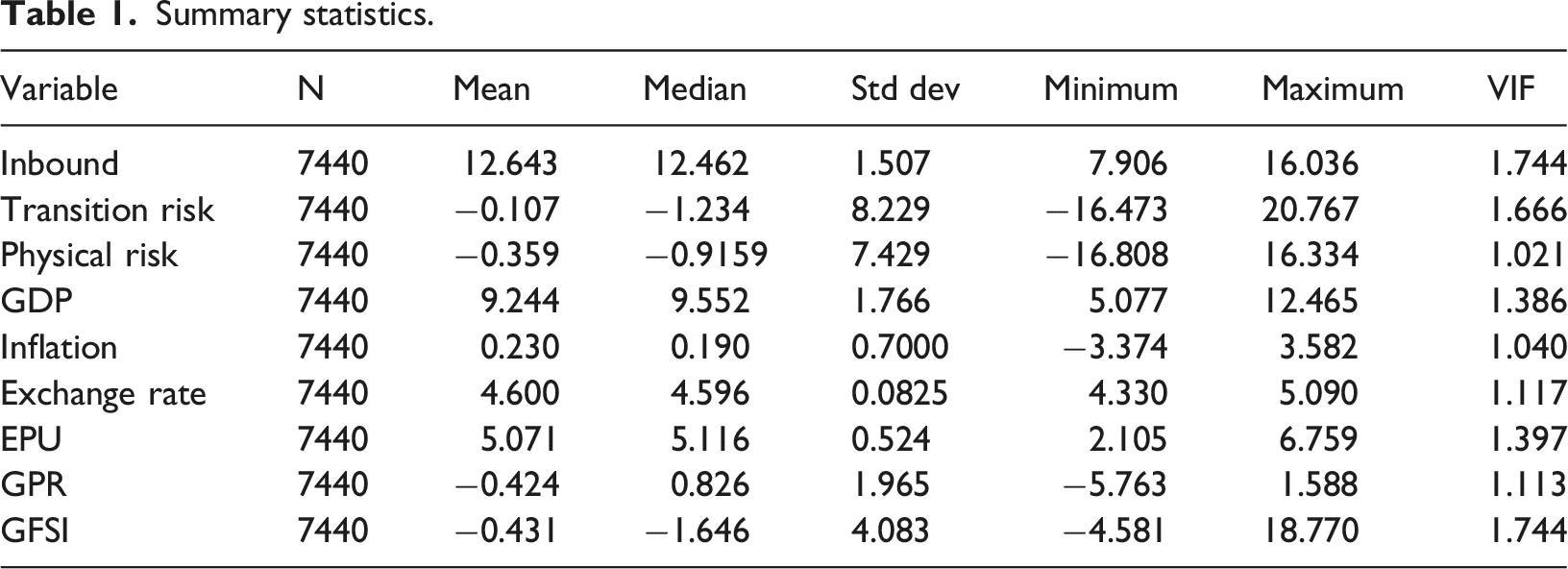
We estimate our model using fixed effects and the bias-corrected least squares dummy variable (LSDV) approach developed by Bruno (2005). Although GMM estimators are often used in tourism research, they can produce biased results when the panel has relatively few cross-sectional units, as in our study (Bruno, 2005).
Empirical results
Regression results.
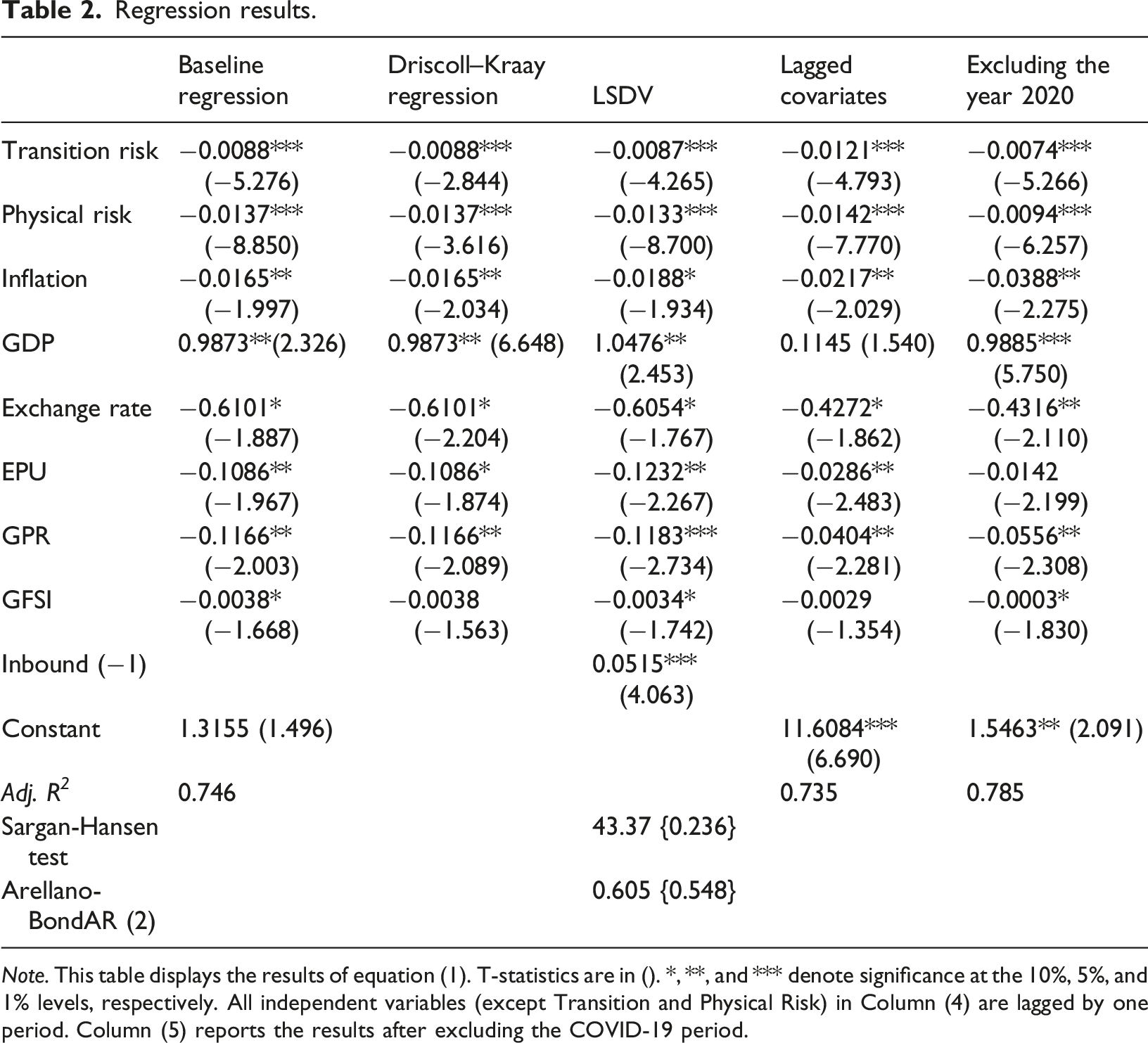
Note. This table displays the results of equation (1). T-statistics are in (). *, **, and *** denote significance at the 10%, 5%, and 1% levels, respectively. All independent variables (except Transition and Physical Risk) in Column (4) are lagged by one period. Column (5) reports the results after excluding the COVID-19 period.
Column 3 presents the results from the LSDV estimator. Diagnostic tests confirm the validity of this model. The Sargan-Hansen statistic confirms the validity of the over-identifying restrictions, while the Arellano–Bond test indicates significant first-order autocorrelation but no evidence of second-order autocorrelation. Both transition risk and physical risk coefficients remain negative and statistically significant, supporting the robustness of the results across different estimation methods. Furthermore, we conduct the Pesaran CD test for cross-sectional dependence, the modified Wald test for groupwise heteroskedasticity, and the Wooldridge test for serial correlation in panel data. The results reveal the presence of heteroskedasticity, serial correlation, and cross-sectional dependence in the panel. To address these issues, we re-estimate the baseline model using Driscoll and Kraay (1998) standard errors (Column 2 of Table 2). The diagnostic test results are reported in the Appendix (Table A2). The transition and physical risk coefficients remain negative and significant, confirming the robustness of our main inferences. We further check robustness by re-estimating equation (1) with one-period lags on all explanatory variables except transition and physical risk; this specification helps mitigate potential joint endogeneity concerns. The results are shown in Column 4. The estimated coefficients for both transition risk and physical risk remain consistent with those in Column 1. Column 5 shows that the findings continue to hold after excluding the COVID-19 period.
The estimated coefficients for the control variables are consistent with prior studies (Demir and Gozgor, 2018; Doğan et al., 2022; Tiwari et al., 2019). Inflation has a negative impact on inbound tourism. The GDP coefficient is positive and significant. The coefficient of the real effective exchange rate is negative, indicating that currency appreciation in a source country makes travel more expensive for foreign tourists, thereby reducing inbound tourism 1 . EPU, GPR, and GFSI have negative effects on inbound tourism, as they increase uncertainty regarding economic stability, safety, and travel costs.
Based on these findings, our study shows that climate risks pose a significant barrier to the sustainable growth of the tourism industry. This study provides the first empirical evidence of the adverse effects of climate-related risks (captured through transition and physical risks) on tourism development. These findings suggest that addressing climate risks could enhance stability and resilience in the tourism sector, supporting its long-term growth.
Conclusion
This study explores the effect of climate risk on inbound tourism across European nations. We demonstrate that climate risk has a negative impact on international tourist arrivals. Specifically, physical risk, associated with weather shocks and natural hazards caused by climate change, and transition risk, related to uncertainty from policy and regulatory changes toward decarbonization, both act as barriers to inbound tourism. Our results expand the broader body of research on uncertainty and tourism demand by showing that environmental and climate-related risks are critical determinants of international tourism demand.
From a policy perspective, we recommend that policymakers focus on strategies that reduce exposure to climate-related disruptions while ensuring a smoother transition to sustainability. Lowering uncertainty and enhancing resilience can help protect the tourism sector, which is vital for economic growth, employment, and regional development. For future research, a more comprehensive analysis can be conducted by examining regional differences, exploring how climate risks interact with other global shocks, such as geopolitical tensions, and assessing the effectiveness of adaptation strategies at the destination.
Supplemental material
Supplemental material - Physical and transition climate risks and tourism demand
Supplemental material for Physical and transition climate risks and tourism demand by Hajam Abid Bashir in Tourism Economics
Footnotes

Funding
The author received no financial support for the research, authorship, and/or publication of this article.
Declaration of conflicting interests
The author declared no potential conflicts of interest with respect to the research, authorship, and/or publication of this article.
Data Availability Statement
The data that support the findings of this study are available from the corresponding author upon reasonable request.
Supplemental material
Supplemental material is available online.
Note
Author biography
References
Supplementary Material
Please find the following supplemental material available below.
For Open Access articles published under a Creative Commons License, all supplemental material carries the same license as the article it is associated with.
For non-Open Access articles published, all supplemental material carries a non-exclusive license, and permission requests for re-use of supplemental material or any part of supplemental material shall be sent directly to the copyright owner as specified in the copyright notice associated with the article.
