







Abstract
Digital payments are reshaping tourism in ways that extend beyond convenience or transaction efficiency. This research note argues that payment plays distinct yet interrelated roles across the tourism system: as an experiential touchpoint shaping tourists’ cognitive and affective evaluations, as a social access mechanism influencing inclusivity and perceived equity, and as a structural force that reconfigures power relations across the tourism value chain. By articulating these three conceptual propositions across micro (experience), meso (market access, equity, and participation), and macro (industry structure) levels, this note positions payment as an increasingly important yet underexplored research agenda for understanding the future of tourism.
Keywords
Introduction
The tourism industry has been rapidly reorganized through digital technology. Despite these developments, payment has received limited attention in tourism research and is often treated as a peripheral or purely technical component (Cheng et al., 2021; Wang and Chan, 2025). This research note addresses this gap by positioning payment as a central mechanism shaping tourism experience, access, and industry structure. The entire travel process, from search, reservation, transportation, stay, and review sharing, has been affected, leading to a new paradigm: smart tourism (Lee et al., 2020, 2025). Payment methods have become increasingly diversified over time, including manual or ex-ante systems (cash, credit cards), automated or platform-mediated systems (mobile wallets, QR codes), and programmable or institutionally embedded systems (CBDC, blockchain-based payments) (Wang and Chan, 2025). As a result, consumers and providers alike face the complexity of choice and adaptation. The use of QR-based mobile payment has spread, even before the credit card infrastructure was fully established in some countries. This change cannot be explained simply by consumers’ adoption intention. Suppliers also must bear the transaction and compliance costs of payment terminal installation and maintenance to offer new payment methods, which can be a huge barrier for small tourism enterprises and individual businesses. For instance, payment methods such as central bank digital currency can provide a variety of advantages, including low transaction costs, real-time payment, and security, but diffusion may be delayed if suppliers lack the infrastructure investment and institutional support to begin the actual adoption process (Kim et al., 2022). Among consumers, mobile payment adoption is influenced by complex factors such as individual motivations, social influence, and coping strategies. Thus, payment innovation is not merely a technological possibility; it can operate effectively only through a balance between consumers’ acceptance and providers’ burden. Nevertheless, payment has often been treated as a mere technical transaction, exogenous to broader tourism scholarship. This omission is notable in tourism economics as well, although evidence suggests that method of payment (e.g., cash vs. card) can be associated with variations in tourists’ total trip expenditure (Thrane, 2015), beyond prices and income alone. However, payment functions as a critical touchpoint across the tourism journey, occurring before, during, and after consumption, and shaping tourists’ perceptions of inclusivity and equity in tourism consumption (Cheng et al., 2021; Thrane, 2015). Studies on tourism payments have progressed from technology acceptance models examining mobile payment adoption (Hameed et al., 2024) to tourism experience (Hosany et al., 2022), financial inclusion (Gopalan and Khalid, 2024), and broader reviews of emerging payment methods (Wang and Chan, 2025). Yet despite growing scholarly interest, payment-related frictions remain a tangible challenge for tourists in practice. To provide empirical support, Figure 1 presents the distribution of payment related complaints based on tourism complaints reported by international visitors to Korea in 2025 (N = 1,744) (Korea Tourism Organization, 2026). Payment-related complaints by sector (N = 440, total complaints N = 1,744).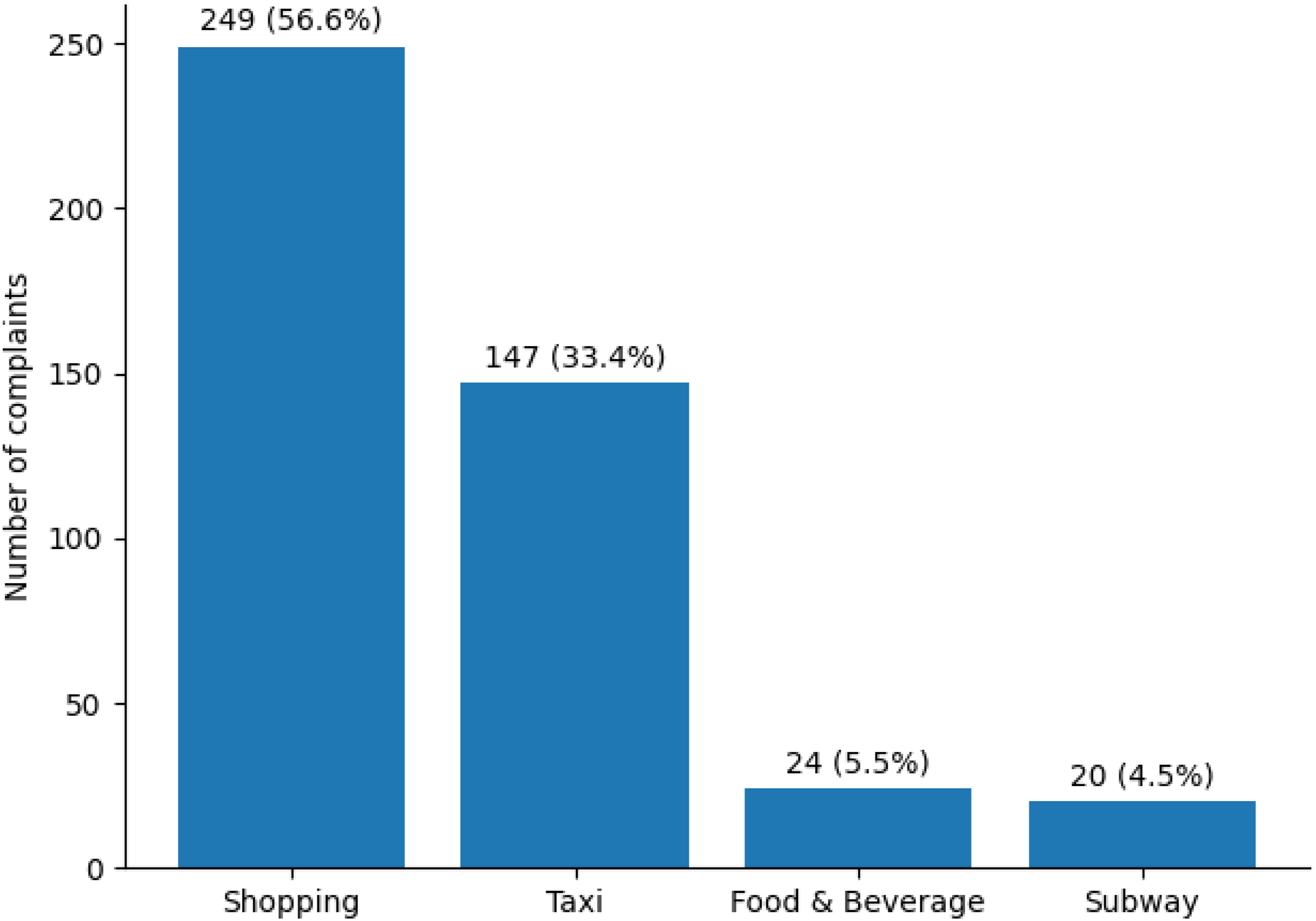
Payment related issues account for 440 cases (25.2%) of total complaints, highlighting their central role as a critical friction point in the tourism experience. These issues largely reflect mismatches between the payment methods tourists carry and those accepted by local providers, including transaction level frictions (contactless card limitations, card authentication issues, and billing errors) and accessibility barriers (inability to use international cards in public transport and the need to purchase and recharge local transit cards). Such tourist-provider payment mismatches are not unique to Korea, but represent a structural challenge common across destinations where payment infrastructure diversification outpaces standardization (Wang and Chan, 2025).
Payment experience as part of tourism experience
Tourists experience various transactions throughout the travel journey, such as airline ticket purchase, accommodation booking, transport use, food & beverage purchase, and attraction ticket purchase, all of which involve the payment process (Cheng et al., 2021). The payment experience is often overlooked in the literature, but it is a key touchpoint that repeatedly appears throughout the tourism journey (Cheng et al., 2021; Wang and Chan, 2025). For example, a mobile payment failure in a restaurant can lead to negative memories coloured by embarrassment, anxiety, and even broader travel-related evaluations, extending beyond mere inconvenience (Hameed et al., 2024). Conversely, when currency conversion is automatically performed and payment is instantly approved, tourists develop a positive impression of seamless travel (Kim et al., 2022). According to recent studies, payment-related service experiences significantly influence consumers’ cognitive evaluations (e.g., satisfaction, trust, and perceived value) (Wang and Chan, 2025) and emotional responses (e.g., joy, relief, and embarrassment), which have a significant effect on the overall perceived quality of the tourism experience (Hosany et al., 2022; Kim et al., 2022). In particular, the sequential adoption model of payment → awareness → interest → evaluation → trial → adoption, proposed by Kim et al. (2022), suggests that payment is not merely a technological adoption, but a multi-layered experiential process. Tourists become aware of the new payment method, are interested in it, evaluate its value, gain experience through trial, and ultimately adopt it (Cheng et al., 2021; Hameed et al., 2024). Therefore, payment can function as part of the servicescape by influencing how tourism consumption is subjectively experienced at the point of transaction. Tourism research should thus examine how payment encounters may strengthen or weaken tourists’ overall experience quality throughout the travel journey (Hosany et al., 2022).
Payment, inclusivity, and equity in tourism
Payment functions as a core component of the tourism experience, extending beyond efficiency, convenience, and security. However, the quality and meaning of that experience can vary significantly depending on who is granted access to payment systems and who remains excluded. Payment forms an invisible boundary that differentiates tourists. While mobile wallets and QR payments are familiar to younger generations and digitally savvy consumers, they become entry barriers for older tourists and financially vulnerable groups (Hameed et al., 2024). In particular, when destinations adopt cashless systems, certain groups may lose access to tourism services or experience perceived unfairness, even when they can physically access them. These inequalities stem from the technological and financial burdens that both consumers and suppliers face when adopting the payment methods (Wang and Chan, 2025). Cashless policies in Nordic countries provide tourists with a fast and secure payment environment, whereas Asian and Latin American tourists who are familiar with using cash experience significant inconvenience. In contrast, the adoption of multi-currency e-wallets and central bank digital currency reduces anxieties about currency conversion and payment failures and provides opportunities for international tourists to enhance perceived accessibility and transactional trust (Kim et al., 2022). Tourism research should thus connect payment transactions to questions of access and participation, such as who is included and who is excluded (Gopalan and Khalid, 2024). This highlights the social role of payment as a mechanism that structures access and perceived fairness across different groups of tourists.
Payment innovation and the restructuring of power in the tourism industry
Tourism industry research has long investigated the power structures of intermediaries such as Online Travel Agencies (OTAs). However, payment itself has recently emerged as a new potential arena of power. Who controls payment systems determines how revenue and power are distributed across the tourism value chain. If platform companies construct proprietary payment ecosystems, tourists are limited to the payment methods and refund policies provided (Gawer, 2022). At the same time, small tourism enterprises and local businesses may become constrained by the high commission rates and strict regulations imposed by the platforms. This dynamic is evident in destinations where large-scale operators have adopted global mobile payment platforms such as Alipay or GrabPay, while small independent businesses remain limited to cash or domestic card systems, creating competitive asymmetries within the local tourism economy (Cheng et al., 2021). In contrast, the use of decentralized payment systems based on blockchain and cryptocurrency presents the possibility of decreasing the influence of intermediaries and increasing the autonomy of independent operators (Manahov and Li, 2024). Therefore, payment is not merely a technological innovation but a strategic coordination mechanism that reorganizes the industry structure and the power distribution of the tourism value chain.
As summarized in Figure 2, these three propositions illustrate how tourism payments shape tourist experience quality at the micro level, structure market access and equity at the meso level, and reconfigure power relations among industry stakeholders at the macro level. A multilevel framework of tourism payments.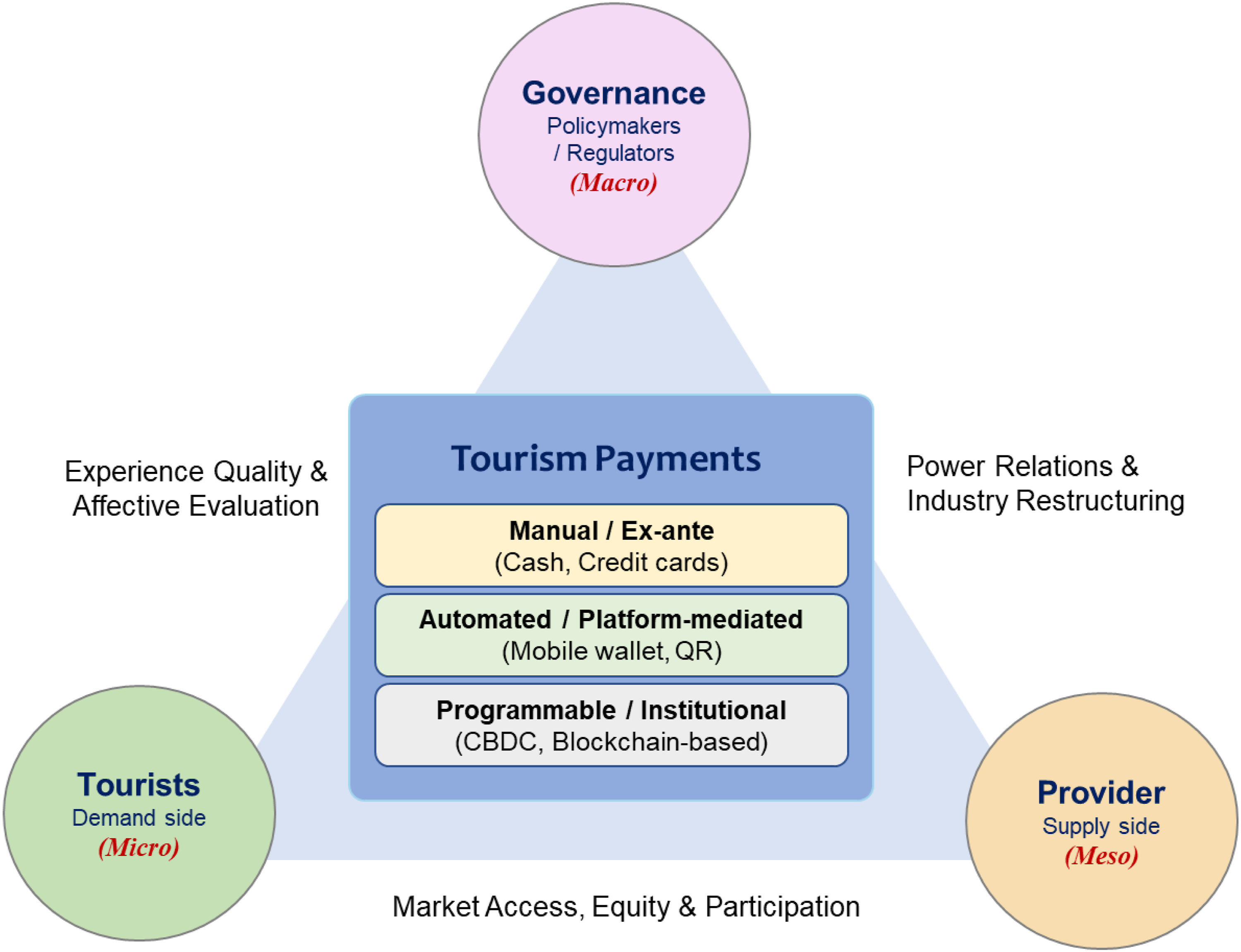
Conclusion
Tourism research has approached payments largely in terms of adoption and system efficiency. However, as this research note argues, payment is not merely a financial transaction. It is a key factor in determining tourism experience quality, with the potential to influence market access and to affect the industry power relations. We propose payment as a promising research agenda in tourism across micro, meso, and macro levels. Future studies should first investigate how different payment experiences influence tourists’ emotional and cognitive responses and how these responses may shape their broader experience evaluations and observed spending behavior. They should also explore the social implications of payment infrastructures, particularly how they affect patterns of access and participation within the tourism ecosystem. In addition, future studies should examine how payment innovations may reconfigure industry structures and power relations, revealing the broader institutional and distributional consequences of digital payment transformation in tourism.
Footnotes

Funding
The author disclosed receipt of the following financial support for the research, authorship, and/or publication of this article: This work was supported by the Ministry of Education of the Republic of Korea and the National Research Foundation of Korea (NRF-2023S1A5C2A03095253).
Declaration of conflicting interests
The author declared no potential conflicts of interest with respect to the research, authorship, and/or publication of this article.