






Abstract
Tourism represents a significant source of economic activity in many European regions, yet its role as a channel for public investment–driven value creation remains insufficiently explored within Cohesion Policy evaluations. This study examines the effects of ERDF-funded public investment on tourism development in 194 NUTS2 regions between 2014 and 2019. Using a dynamic panel data approach (System GMM and Fixed Effects), it analyses the impact of the four ERDF thematic objectives, Smarter, Greener, Connected, and Social Europe in the tourism-related gross value added. The results indicate that total ERDF investment does not generate immediate increases in tourism value added, but exerts a positive effect in the short term, supporting the presence of a time-to-build mechanism. Connectivity-related investments emerge as the most effective driver of tourism value creation, especially in transition and intermediate regions. By contrast, Smarter investments show no aggregate impact and generate negative short-term effects in rural and emerging areas, reflecting absorption and implementation constraints. Coastal, urban, and highly competitive (leader) regions display limited responsiveness to ERDF interventions, suggesting the dominance of private market dynamics and potential saturation effects. These findings reveal strong territorial heterogeneity in the capacity of public investment to generate tourism-related economic value, underscoring the need for place-based Cohesion Policy strategies.
Keywords
Introduction
Tourism plays a pivotal role in economic growth and regional development, generating employment, boosting wages, and stimulating local economies through strong multiplier effects (Dwyer and Kim, 2003; Panfiluk, 2015). Its spillovers extend to multiple sectors, fostering socioeconomic progress and enhancing regional competitiveness (Estol and Font, 2016; Llorca-Rodríguez et al., 2021; Pearce, 1988). These effects are particularly relevant in peripheral, rural, and less developed areas, where tourism often represents one of the few viable growth engines (Baptista et al., 2019).
Despite its economic relevance, tourism development rarely results from purely market-driven processes. The sector is shaped by structural constraints, most notably indivisible infrastructure needs, accessibility gaps, coordination failures and pronounced seasonality, that justify a sustained role for public intervention, particularly in peripheral and lagging regions (Bull, 1999; Nash et al., 2006). Public investment has accordingly been instrumental in structuring tourism trajectories, mainly through the provision of basic and complementary infrastructure and improvements in connectivity, which empirical evidence links to enhanced tourism performance, employment creation and local diversification (Brandsma et al., 2014; Giua, 2017; Hjalager, 1996; Panfiluk, 2016).
In this context, the European Union has progressively assumed a relevant role in shaping destination trajectories through its Cohesion Policy framework. Although historically lacking a dedicated budget line and initially operating as a subsidiary tool for basic infrastructure provision, the ERDF has supported tourism since its inception, gaining explicit recognition in 1999 (Reg. (EC) No 1783/1999). Since then, it has been progressively linked to environmental quality, cultural heritage, and sustainable employment, and more recently integrated into regional smart specialisation strategies (RIS3) during the 2014–2020 period (Brandano and Pinate, 2025). This paradigm shift recast the sector from an isolated vertical industry into a transversal domain capable of driving regional innovation, digitalisation, and cross-sectoral synergies. Building on this trajectory, the 2021–2027 framework (EU Regulation, 2021/1058) introduced a specific objective for tourism and culture-dependent regions, emphasising sustainable tourism’s as a fundamental pillar for evolutionary resilience and territorial transformation.
Despite the growing strategic importance of the European Regional Development Fund in shaping tourism trajectories, the empirical literature evaluating its macroeconomic impact remains fragmented. Nonetheless, a growing body of research has documented the local impacts of these interventions and identified several channels through which tourism contributes to economic development, including rural diversification (Hjalager, 1996), improvements in infrastructure and accommodation (Bull, 1999; Panasiuk, 2007), heritage valorisation (Brandano and Crociata, 2023), stakeholder cooperation (Stoffelen and Vanneste, 2017), innovation in business models and digital tools (Radu et al., 2021), and more sustainable, climate-resilient tourism practices (Valente and Medeiros, 2022).
However, existing evidence suggests that the effectiveness of these mechanisms depends strongly on additionality and institutional capacity (Bull, 1999; Stoffelen and Vanneste, 2017). While some studies document gains in investment efficiency (Panfiluk, 2016), others highlight persistent weaknesses in planning, evaluation and territorial adaptation (European Union, 2021; Vayà and González, 2023), particularly in less developed regions where institutional capacity gaps hinder effective resource use and may even lead to unsustainable outcomes or widening regional disparities (Bachtrögler et al., 2024; Maroto-Martos et al., 2020; Shepherd and Ioannides, 2020). These patterns are also consistent with the results obtained in previous empirical analyses focusing on national contexts. More specifically, Suárez-Tostado et al. (2026) analysed French and Spanish regions using a disaggregated classification of ERDF objectives and a dynamic panel approach, finding that the effectiveness of Cohesion Policy investments varied significantly across territorial profiles, reflecting differences in regional institutional capacity and structural conditions.
While this earlier work advanced the understanding of how Cohesion Policy relates to tourism development, its geographical coverage remained limited, restricting the generalisation of findings. Building on this earlier contribution and addressing this limitation, the present study constructs a novel harmonised dataset based on microdata from the Kohesio platform. This approach makes it possible, for the first time, to operationalise executed ERDF investments related to tourism as a continuous variable across 194 European NUTS-2 regions. By disaggregating these investments into the main Cohesion Policy objectives (Smarter, Greener, Connected and Social) and incorporating indicators of institutional quality and human capital, the analysis examines how tourism public investment translates into economic value generation across EU regions during the 2014-2019 programming period.
The empirical strategy combines System GMM to estimate contemporaneous effects with fixed-effects models including lags to capture short-term dynamics and heterogeneous territorial profiles. Although the 6-year panel limits the identification of long-term effects and requires a 1-year lag structure, the analysis provides new insights into the short-term dynamics of public investment in tourism development, which remain largely unexplored in the literature. In doing so, this study offers one of the first EU-wide evaluations of the impact of ERDF-funded interventions on regional tourism development.
The remainder of the paper is organised as follows. Section 2 reviews the theoretical and empirical background, Section three presents the dataset and methodology, Section 4 reports the empirical results, and Section 5 discusses the main findings and policy implications.
Public investment in tourism and economic growth: A literature review
Mechanisms and challenges of tourism-led growth
Tourism is widely recognised as a key driver of economic growth, particularly in regions facing structural constraints or limited opportunities for industrial diversification (Biagi, Ladu, et al., 2017). The literature on the Tourism-Led Growth Hypothesis (TLGH) provides substantial empirical support for the view that tourism activity can contribute to economic growth through multiple virtuous mechanisms (Alcalá-Ordóñez and Segarra, 2025; Brida et al., 2016). Thus, tourism has been identified as a contributor to economic growth through a set of demand and supply-side mechanisms (Brida et al., 2016; Croes, 2013). On the demand side, inbound tourism increases expenditure on accommodation, transport, catering and leisure services, generating direct income and employment while triggering multiplier effects across related sectors such as agriculture, manufacturing and services (Biagi, Brandano, and Pulina, 2017; Romão, 2020). Tourism also represents a relevant source of fiscal revenues and investment incentives, fostering public and private expenditure in infrastructure and support services that enhance sectoral activity (Sahni et al., 2023). On the supply side, tourism operates as an unconventional export that generates foreign exchange, alleviates external constraints and facilitates the import of capital goods and advanced technologies through the so-called tourism-capital-import-growth channel (Nowak and Sahli, 2007; Schubert et al., 2011). Exposure to international demand may also improve productivity and efficiency through competition, economies of scale and higher managerial standards, thereby strengthening service quality and value creation within the sector (Croes et al., 2021). These dynamics can also stimulate human capital accumulation as destinations progressively professionalise their workforce to sustain competitive advantage (Biagi, Ladu, et al., 2017; Croes et al., 2021).
However, the effective impact of these mechanisms is strictly conditioned by the structural characteristics of each region. In territories characterized by an excessive reliance on static comparative advantages, tourism may cease to contribute to growth and instead severely constrain it (Pearce, 1988). This paradox is commonly conceptualised through the Beach Disease hypothesis (Capo et al., 2007; Copeland, 1991). In highly specialised areas, an uncontrolled demand driven tourism boom triggers a resource movement effect, displacing capital and labour from tradable, knowledge-intensive sectors toward non-tradable activities with lower relative productivity, such as traditional hospitality and construction (Chao et al., 2006). This reallocation process deindustrialises the region, erodes learning by doing externalities, and locks the economy into path-dependent trajectories characterised by low productivity and severe structural vulnerability (Capo et al., 2007; Holzner, 2011; Inchausti-Sintes, 2015). From a dynamic perspective, when tourism is relatively labour-intensive and characterised by lower productivity growth, these reallocations may constrain aggregate capital accumulation and lead to diminishing returns, particularly in highly specialised and seasonal destinations (Chao et al., 2006; Torvik, 2001). Empirical evidence supports these mechanisms, showing that beyond certain thresholds of dependency, additional tourism specialisation is associated with weak or even negative marginal effects on economic performance, reduced resilience and limited scope for long-term value creation (Lanzilotta et al., 2025; Nowak and Sahli, 2007; Perles-Ribes et al., 2017). In a similar vein, Tegui (2026) shows that destinations with concentrated tourism structures, both in terms of customer origin and spatial distribution, exhibited weaker post-pandemic recovery, reinforcing the argument that excessive specialisation constrains resilience.
To correct these structural dysfunctions and transform stagnant economic structures, public sector involvement in tourism operates as a complementary mechanism that addresses market failures and shapes the conditions under which tourism generates economic value, through a combination of regulatory, organisational and economic instruments (Bramwell, 2011; González, 2011; Panasiuk, 2007), supported by information, promotion and coordination tools (Baptista et al., 2019; Bernini and Pellegrini, 2013). Among these economic instruments, public investment plays a central role alongside private capital, acting not only as a provider of basic infrastructure but also as a strategic lever for territorial transformation capable of breaking structural lock-in effects and supporting long-term competitiveness (Dominiak, 2019; Sakai, 2006).
Tourism contribution to regional growth via ERDF
Within a multilevel governance framework, the largest critical mass of tourism public funding originates at the supranational level. Although not initially a political priority and despite lacking a dedicated budget line, tourism has become increasingly integrated into EU policies and is now considered as strategic for regional development and cohesion (Estol and Font, 2016). This transition has largely been orchestrated through Cohesion Policy, with the European Regional Development Fund (ERDF) as its main instrument (Dominiak, 2019; Torres et al., 2025a, 2025b), which has evolved from supporting basic services to promoting digitalisation, sustainability, and innovation, while also financing cultural heritage, green transitions, and connectivity (Arena et al., 2026; Brandano and Crociata, 2023). This evolution culminated in a specific objective for tourism-dependent regions under Regulation (EU) 2021/1058. Between 2007 and 2020, €10.7 billion were allocated to tourism-related projects, with a strong concentration in Central and Eastern Europe, while Southern countries also benefited substantially. As Torres et al. (2025a) note, this distribution pattern reflects a clear prioritisation of lagging and peripheral beneficiaries, aiming to use tourism funding as a strategic lever for territorial catch-up. In contrast, Western and Northern members received significantly less, highlighting the ERDF’s role in fostering cohesion and convergence (European Union, 2021).
Previous theoretical debates have extensively synthesised the rationales for public investment, particularly emphasising the provision of publicly funded infrastructure and collective goods such as transport accessibility, basic services, and environmental quality (Dwyer and Kim, 2003; Ritchie and Crouch, 2003). However, this theoretical consensus has not been matched by robust quantitative evaluations capable of isolating how specific types of public investment drive structural transformation (Brandsma et al., 2014; Dominiak, 2019; Panasiuk, 2007), as existing assessments remain largely descriptive and often lack rigorous ex post evaluation (Dominiak, 2019; European Union, 2021).
Initial efforts concentrated on countries with stronger evaluation traditions, such as the Nordic countries and Scotland (Bull, 1999; Hjalager, 1996; Nash et al., 2006), before expanding to major beneficiaries in Central and Eastern Europe, particularly Poland (Dominiak, 2019; Panasiuk, 2013; Panfiluk, 2016) and Romania (Radu et al., 2021), in line with EU enlargement. More recently, the literature has evolved toward the application of advanced quantitative techniques, such as PLS, SEM and the SCM, to assess policy effects, beneficiary satisfaction (Arena et al., 2026; Brandano and Crociata, 2023; Radu et al., 2021). In Southern Europe, especially Spain and Portugal, the focus has shifted toward rural development programmes such as LEADER, PRODER and FEADER (Figueras et al., 2022; Vayà and González, 2023), as well as the environmental and tourism impacts of POSEUR assessed through TIA approaches (Valente and Medeiros, 2022).
Despite recent methodological advances, most evaluations of European funding remain overly aggregated, geographically constrained, and methodologically static, overlooking interactions between policy priorities and regional characteristics. Consequently, the literature still lacks a coherent data driven framework to explain the transmission mechanisms of public investment and its actual causal effect on regional value creation. These limitations are compounded by persistent barriers such as excessive bureaucracy, limited private sector involvement, rigid cooperation structures, and evaluation practices that fail to capture causal mechanisms or long-term effects (Shepherd and Ioannides, 2020). Only a limited number of studies have attempted to explicitly capture these dynamics. Notably, Suárez-Tostado et al. (2026) analysed French and Spanish regions by adopting a disaggregated approach that differentiates investments according to their underlying transmission mechanisms. Using dynamic panel data models combined with regional heterogeneity analyses, the authors accounted for context dependent effects across territories. Their findings revealed a significant contribution of connectivity related interventions to regional tourism gross value added, while other types of investment did not exhibit immediate impacts, consistent with their long-term orientation. The study further highlighted pronounced territorial disparities, demonstrating that coastal and more developed regions were better positioned to benefit from these interventions. However, despite representing a clear methodological advancement, its geographical scope remained strictly limited to two countries.
Building on previous evidence from French and Spanish regions, the present study broadens the geographical scope from two countries to 194 NUTS2 regions across the 27 EU Member States, enabling an EU-wide evaluation of ERDF effects on tourism value creation. To support this extension, the identification of tourism-related projects is refined through a procedure applied to microdata from the European Commission’s platform, combining the identification of core tourism investments, of enabling investments, and the application of an inclusion-exclusion dictionary; and the empirical specification is complemented with a short-term analysis based on lagged investment variables. Together, these methodological refinements enable the study to provide new evidence on three issues. The role of time-to-build dynamics, the territorial conditionality of ERDF interventions, and the differentiated effects of investments across territorial contexts. These findings reposition the debate on Cohesion Policy effectiveness toward a place-based reading in which the same investment category can yield positive, neutral or adverse outcomes depending on regional structural conditions.
To address this gap, this study is grounded in a structured conceptual framework that differentiates public investment according to its dominant transmission mechanisms and temporal effects. From a theoretical perspective, these mechanisms can be broadly differentiated according to their dominant channels of impact. Investments oriented towards large-scale infrastructure, accessibility, and connectivity, operate through direct spatial effects, alleviating infrastructural bottlenecks, reducing transport and transaction costs, and generating crowding-in dynamics that facilitate immediate regional integration (Albalate and Fageda, 2016; Cascetta et al., 2020; Ren et al., 2023). By overcoming these spatial barriers, these interventions act as a critical precondition to activate the demand side multiplier effects of tourism activity. Others act through more indirect, capability-based channels, particularly those targeting the productive ecosystem through innovation, digitalisation, and direct support to SMEs, whose effectiveness depends on the maturity of regional innovation systems and the absorptive capacity of local firms (Romão and Nijkamp, 2019) in order to successfully trigger the supply side efficiency gains and technological upgrading required to escape low productivity lock-in scenarios. In parallel, additional forms of intervention are primarily oriented towards long-term structural transformation channels, fostering human capital accumulation, institutional strengthening, environmental quality, and destination resilience rather than immediate increases in demand (Brandano and Crociata, 2023; Valente and Medeiros, 2022). Ultimately, by addressing structural vulnerabilities, these interventions mitigate the detrimental resource movement triggered by the Beach disease effect, guaranteeing that tourism specialisation drives resilient and long-term macroeconomic progress.
In this regard, a growing body of literature shows that the effectiveness of these investments is highly context-dependent and shaped by regional structural conditions, leading to significant variation in how similar interventions translate into tourism value creation across territories. As Torres et al. (2025a) highlight, the allocation of substantial financial resources does not automatically ensure regional convergence. Instead, outcomes depend critically on the capacity of regions to absorb and effectively implement these funds.
In this sense, factors such as institutional quality, multilevel governance, and the availability of advanced human capital play a central role in defining regional absorptive capacity (Fratesi and Wishlade, 2017; Romão and Nijkamp, 2019). Indeed, institutional quality acts as a direct mediator of all local public interventions, meaning that subpar institutional frameworks can easily undermine even the most carefully designed development efforts (Rodríguez-Pose, 2013). Beyond absorptive capacity, the pre-crisis structure of tourism demand itself shapes resilience outcomes. Regions with higher geotourism diversity and a balanced mix of domestic and international visitors have been shown to recover more robustly from exogenous shocks (Tegui, 2026). Moreover, translating these strategies into successful outcomes requires robust multilevel governance structures capable of bridging traditional boundaries both vertically, across tiers of government, and horizontally (Barca et al., 2012).
Furthermore, the pre-existing productive specialization plays a critical role; in highly specialized mature destinations, public funding risks reinforcing path dependent trajectories and pushing territories into regional development traps characterized by economic stagnation (Rodríguez-Pose et al., 2024), crowding out knowledge intensive activities, a dynamic closely associated with the Beach disease effect (Capo et al., 2007; Inchausti-Sintes, 2015).
Operationally, the lack of territorial adaptation frequently translates into space-blind or one-size-fits-all policies, where regions uncritically replicate generic high-tech strategies regardless of their actual productive base (Barca et al., 2012; Foray et al., 2015). Combined with excessive bureaucracy and administrative short-termism vision, such rigid approaches frequently degenerate into a subsidy culture and ’strategies of waste’ (Barca et al., 2012), fostering rent-seeking behaviours rather than genuine bottom-up entrepreneurial discovery (Biagi et al., 2021; Foray et al., 2015; Romão and Nijkamp, 2019). To overcome these structural dysfunctions, contemporary place-based frameworks, most notably Smart Specialisation Strategies, advocate for the definitive abandonment of one-size-fits-all interventions. Instead, they emphasize the necessity of driving regional economic transformation through a genuine bottom-up entrepreneurial discovery process. Rather than uncritically imitating external high-tech models, this interactive mechanism engages local actors to uncover the unique latent capabilities of the territory, fostering related diversification and directing public investment toward domains with genuine potential for high value-added growth (Foray et al., 2015; Rodríguez-Pose et al., 2024).
Finally, within the business ecosystem itself, the tourism sector remains fundamentally supplier dominated and highly atomised (Hjalager, 2010), with a demonstrated structural tendency to favour incremental and adaptive improvements over radical technological disruptions (Suárez-Tostado and Petit, 2026). Consequently, forcing advanced innovation-oriented investments into traditional local enterprises generates severe adjustment costs.
As regions attempt to prematurely transition into more complex technological activities without possessing the necessary local capabilities, they frequently encounter severe operational deficiencies (Rodríguez-Pose et al., 2024). This results in a short-term productivity drop or J-curve effect, which confirms that technological upgrading requires a significant time-to-build mechanism before long-term structural benefits can fully materialize (Biagi et al., 2021; Brandsma et al., 2014).
This framework guides the empirical analysis, helping to interpret how different types of ERDF investment affect tourism across regions. To address existing gaps, the paper builds a novel harmonised dataset from the Kohesio platform and adopts a comparative regional approach, capturing how public investment translates into tourism development across 194 European regions under different territorial conditions.
Data and empirical strategy
Data
This study examines the impact of ERDF-funded public investment on tourism development across all NUTS-2 1 regions of the European Union between 2014 and 2019. The period is intentionally limited to 2014–2019, as including 2020 would bias the results: the COVID-19 outbreak generated a structural break in tourism activity characterised by highly heterogeneous recovery patterns across territories (Tegui, 2025), while ERDF resources were simultaneously complemented and partly redirected through instruments such as NextGenerationEU, complicating the isolation of their specific effects. The dependent variable is the natural logarithm of tourism-related gross value added (ln_gva_tour_i), from Eurostat’s regional accounts. Used in prior research (Croes et al., 2021; Romão, 2020; Romão and Nijkamp, 2019), it proxies the economic significance of tourism, capturing its direct contribution as output minus input costs (Ivanov and Webster, 2007).
Investment data are sourced from the European Commission’s Kohesio platform, which provides microdata on all operations financed under EU Cohesion Policy. The initial dataset comprises 206,508 ERDF-funded projects for the 2014–2020 programming period. Investment variables are disaggregated according to the four strategic objectives of the ERDF: Smarter Europe (ln_smarter), covering investments in innovation, R&D, digitalisation and support to SMEs; Social Europe (ln_social), including interventions related to employment, education, social inclusion and institutional capacity; Greener Europe (ln_greener), focused on environmental sustainability, energy efficiency, climate action and the protection of natural resources; and Connected Europe (ln_connected), which encompasses transport and digital connectivity infrastructures aimed at improving accessibility and territorial integration, as illustrated in Figure 1(a)–(d). These investments are co-financed by EU and regional authorities, with varying contribution shares. Tourism-related projects were identified through a two-step strategy combining ERDF intervention categories and structured text mining. ERDF investments by strategic objective (2014–2019) and the availability of workforce, wage dynamics, and employment flexibility are closely tied to tourism development patterns (Alegre et al., 2019). The unemployment rate also reflects broader economic conditions that may influence both tourism demand and the effectiveness of public investment interventions. (a) Smarter Europe; (b) Social Europe; (c) Greener Europe (d) Connected Europe.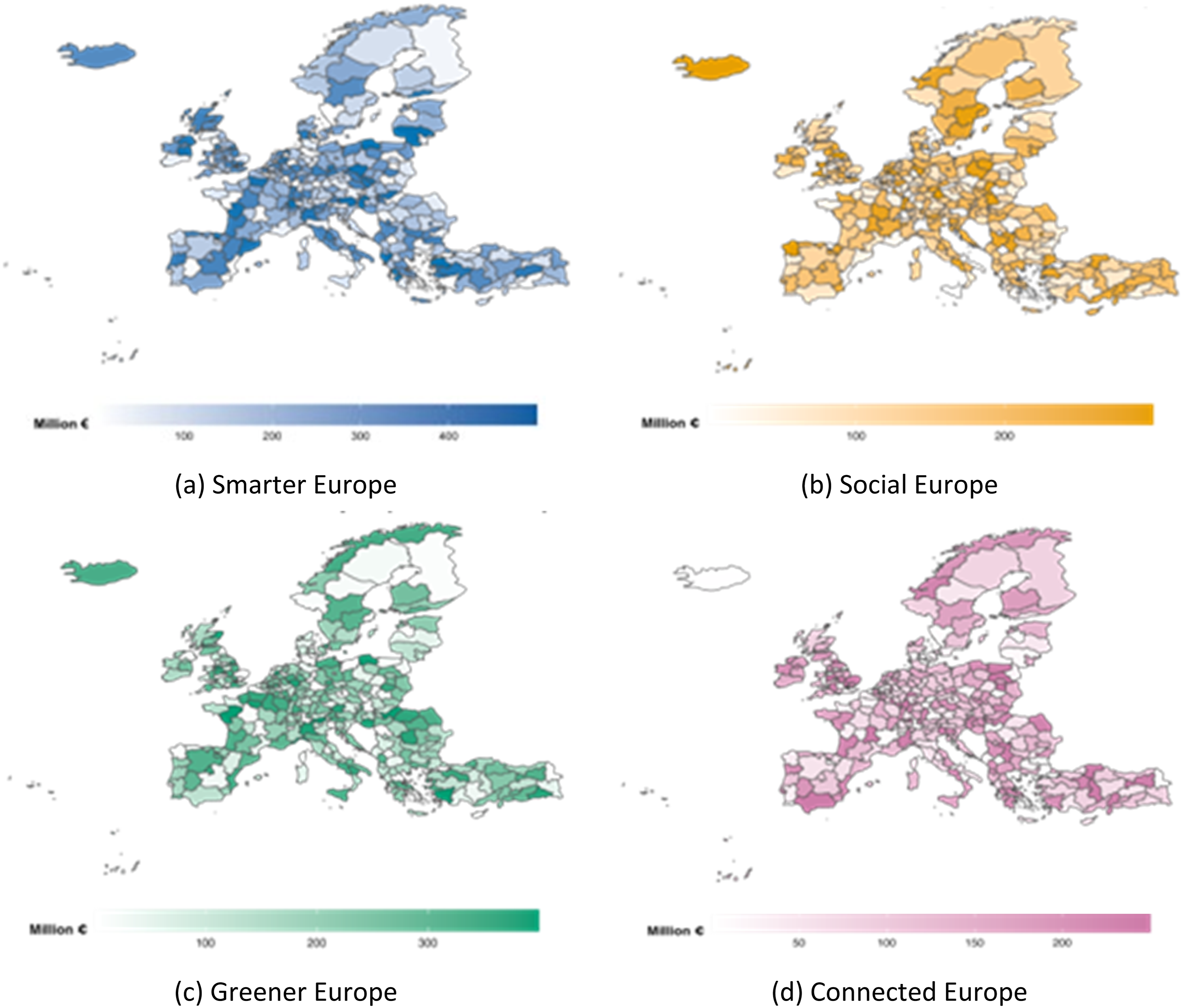
To improve the identification of tourism-related ERDF-funded projects, a two-step procedure was applied. First, projects were selected using the intervention categories available in the European commission database. Second, this selection was complemented with a text-based analysis of project titles and descriptions using a tourism-specific dictionary inspired by UNWTO and Eurostat classifications (Table 9). The dictionary included terms related to core tourism activities, cultural and natural heritage assets, recreational activities, and tourism-enabling investments such as accessibility, signage, visitor facilities, and digital tourism services. Exclusion terms were also incorporated to avoid incorrectly classifying projects belonging to unrelated sectors, such as housing, education, healthcare, energy, or manufacturing.
Projects were classified into core tourism investments (e.g. accommodation, cultural and natural assets) and enabling investments, particularly transport and accessibility infrastructure, while a keyword-based algorithm with strict exclusion criteria was used to eliminate false positives. This procedure identified more than 21,000 tourism-related projects (around 10.5% of total ERDF operations).
Investment amounts were aggregated annually at the NUTS-2 level, with multi-objective projects proportionally allocated to avoid double counting, using official NUTS correspondences. All variables were expressed in constant 2015 euros and log transformed. Figure 1 shows strong territorial heterogeneity shaped by EU eligibility rules and regional capacities: less developed regions prioritize infrastructure and capacity building, while advanced regions focus on innovation, digitalization, and green transitions. Smarter investments (Figure 1(a)) cluster in urban/advanced regions, Greener (Figure 1(b)) spread across rural and sensitive areas, Social (Figure 1(c)) concentrate in Southern and Eastern Europe, and Connected (Figure 1(d)) target peripheral territories. These spatial patterns highlight the territorialized nature of ERDF implementation.
To control for factors influencing tourism development, our model includes variables related to human capital, labour market dynamics, institutional quality, and cultural heritage assets.
First, the education ratio measures the share of the population aged 25-64 with tertiary education (ISCED levels 5-8), sourced from Eurostat’s regional education statistics. This variable captures regional human capital endowment, which has been identified as a key determinant of tourism sector performance, innovation capacity, and the ability to absorb complex public investments (De Vita and Kyaw, 2017; Romão and Nijkamp, 2019). Regions with higher educational attainment typically exhibit stronger absorptive capacity for innovation-oriented and digitalisation interventions, as well as more sophisticated destination management capabilities. In our framework, this variable effectively proxies the regional absorptive capacity, acting as a critical precondition to minimise short term adjustment costs when implementing capability-based investments.
Second, the unemployment rate (in percentage of active population aged 15–74) serves as a proxy for regional labour market conditions. Tourism is a labour-intensive sector.
Third, institutional quality is proxied by the European Quality of Government Index (EQI), developed by the Quality of Government Institute at the University of Gothenburg (Charron et al., 2019). The EQI combines survey-based assessments of corruption, rule of law, and government effectiveness at the regional level. Institutional capacity and governance quality have been shown to critically influence the effectiveness of EU Cohesion Policy interventions, as weaker governance structures often constrain the ability to design, implement, and monitor public investment projects effectively (Charron et al., 2019; Rodríguez-Pose, 2013).
Fourth, we control for the stock of UNESCO World Heritage Sites (logarithm of the cumulative number of sites inscribed as of each year), sourced from the UNESCO World Heritage Centre database. Cultural and natural heritage assets represent key attractors for tourism demand and contribute directly to destination appeal, tourism receipts, and value creation (Cuccia et al., 2017). The stock variable captures the cumulative endowment of heritage resources, which may interact with public investment in generating tourism-related economic benefits.
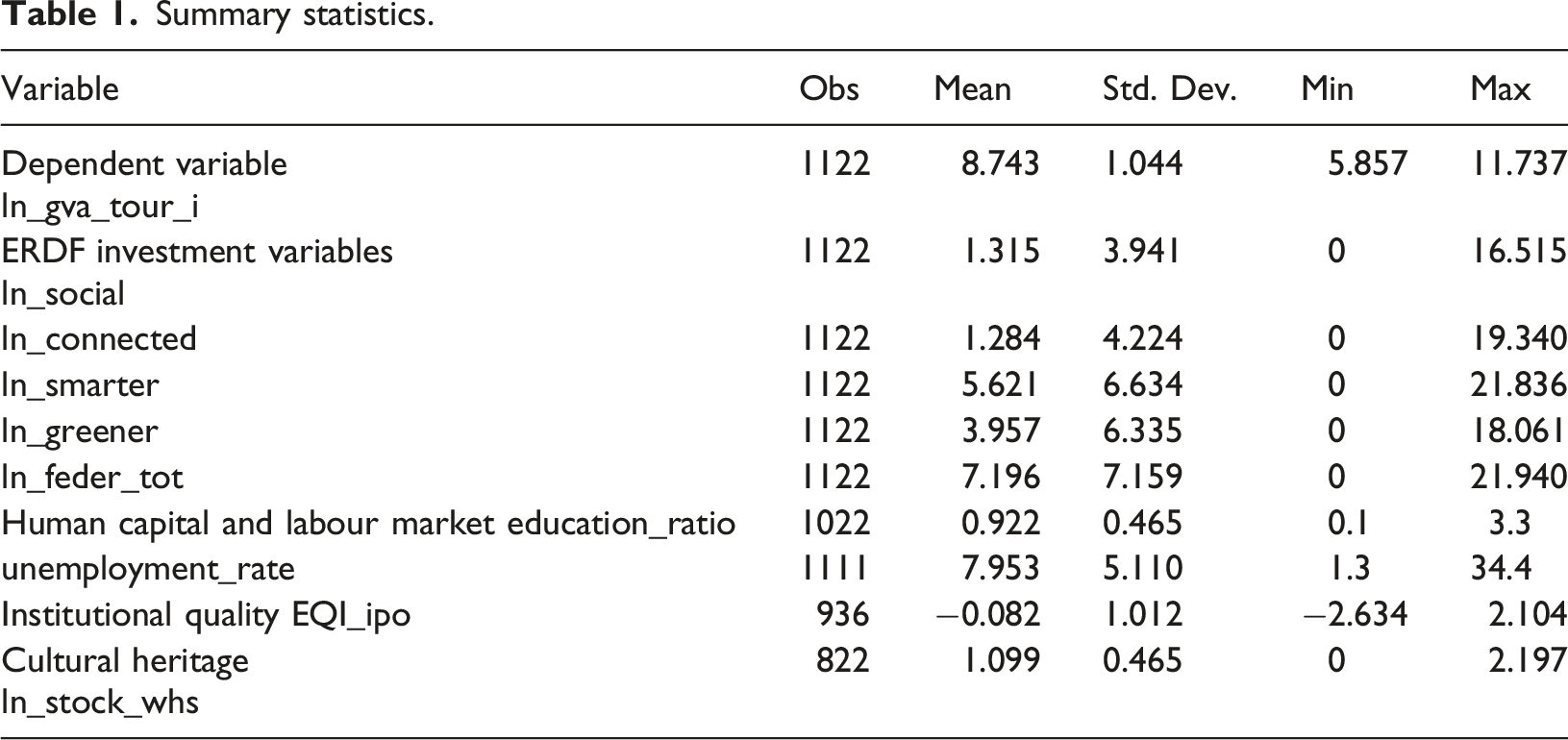
Summary statistics.
Empirical strategy
Two separate models were used to estimate the impact of public investment on tourism development. First, a Generalised Method of Moments (GMM) model to capture the immediate effects between public investment and tourism development. Second, a fixed effects (FE) model to analyse the short-term effects between these two issues.
The immediate effects of public investments were estimated using a Generalised Method of Moments estimator in system (GMM system), more specifically the two-stage model of Blundell and Bond (1998) with error correction of Windmeijer (2005). This estimator is specifically designed for dynamic panels with small T and larger N that may contain fixed effects and, separately from these fixed effects, idiosyncratic errors that are heteroskedastic and correlated within individuals but not between them (Blundell and Bond, 1998.
Roodman (2009b). This methodology is justified by the fact that we suspected a strong endogeneity bias in our data, due in particular to a simultaneity bias.
This approach allows us to address potential endogeneity issues arising from reverse causality between public investments and tourism development. Indeed, despite the potential impact of public investment on tourism development, regions with high tourism value added could attract more public investment to support and develop the tourism industry. There is then a possible simultaneity bias resulting from the fact that public investment and tourism value added could be determined simultaneously by underlying factors such as regional development policies or government economic preferences. In addition to correct for the possible endogeneity of the dependent variable, this methodology allows us to circumvent the Nickel bias associated (Nickell, 1981) with the use of traditional fixed-effects estimators in the presence of a lagged variable (Da Silva and Cerqueira, 2017).
Thus, the model is estimated using a two-step procedure that is robust with respect to autocorrelation and heteroscedasticity in the data. The validity of the instruments used in the GMM framework was verified through the Hansen test for overidentification, while the Arellano-Bond test was used to check for serial correlation in the residuals. This ensures the reliability of the estimated coefficients for immediate effects. However, given that the use of the two-stage estimator can, in small samples, lead to a significant downwards bias in the standard errors (Roodman, 2009b; Windmeijer, 2005), we have used Windmeijer (2005) variance correction for a finite sample to obtain a more accurate inference. Following Bond (2002) and Roodman (2009b), we also test the stationarity condition • i = 1,…,N is for region and t = 2014,…,2019 corresponds to time unit, • |δ| < 1 and d
lt
a time-dummy that takes the value 1 when l = t and 0 otherwise, • The disturbances µ
i
and ϵ
it
respectively correspond to fixed effect specific to region i and residual error term for region i at year t and are not cross-correlated, • ln (gva_tour_i
it
) represents the logarithm of gross value added in tourism for region i at year t, • ln (gva_tour_iit−1): The lagged effect of one period of the gross value added in tourism, captured by the coefficient α. • ln (P
it
): can refer to ln (smarter), ln (greener), ln (connected), or ln (social). • 
To capture the short-term effects of public investments, we employed a Fixed Effects (FE) model. In this model, we introduced a one-period lag of the public investment variables to explicitly account for the time to build mechanism. This lag captures the operational gestation period and the short-term adjustment costs required before public investments, particularly those relying on capability-based channels, can translate into tangible macroeconomic outcomes in the tourism sector.
This model, widely used in econometric analyses of panel data, is particularly suitable for this study as it controls for unobserved heterogeneity and omitted variables that could bias the estimates in a pooled ordinary least squares (OLS) regression (Imai and Kim, 2019, 2021). In the context of this study, regional characteristics such as historical tourism infrastructure, cultural heritage, or climatic conditions are likely to influence both the level of tourism development and the allocation of public investments. By including region-specific fixed effects, the model effectively removes the bias arising from these unobserved factors. Similarly, the inclusion of time fixed effects ensures that the model accounts for common shocks or temporal trends, such as economic cycles or major policy shifts at the European level, which could otherwise confound the relationship between public investments and tourism development. The estimated model for short-term effect is therefore as follows: • ln (gva_tour_i
it
) represents the logarithm of the gross value added in tourism for region i at year t, • ln (Pit−1): can refer to the lagged value of ln (smarter), ln (greener), ln (connected), or ln (social), • Z
kit
is for the Vector of K control variables for entity i at time t, • µ
i
and λ
t
respectively correspond to individual and time fixed effects, capturing unobserved time-invariant characteristics of entity i and time-specific shocks or trends affecting all entities, • ϵ
it
is the error term of the model.
This allows us to isolate the short-term effect of public investments on tourism development. However, due to the limited depth of our panel dataset (only 6 years), we restricted the lag structure to a single year. Including longer lags (for example two or 3 years) would have significantly reduced the degrees of freedom, compromising the robustness of the results. Furthermore, while models, such as error correction models (ECM) are widely used in econometrics, their application requires a dataset with sufficient temporal depth to reliably disentangle short-term and long-term dynamics. Given the limited time span of our panel dataset (2014–2019), these models would be prone to specification errors or overfitting, as the number of available time periods is insufficient to accurately capture long-term trends while accounting for short-term variations.
To sum up, our empirical strategy provides a distinction between immediate effects (captured via system GMM) and short-term effects (estimated using lagged variables in a fixed effect model). To recall, the time span of the panel (2014–2019) limits our ability to explore long-term impacts. We do not include data from the 2021–2027 programming period, as project execution and reporting are still ongoing. Conversely, the 2007–2013 period is excluded due to significant differences in regional classification and policy objectives under the EU cohesion framework. Future research could investigate ways to reconcile data across programming periods in order to build longer time-series and better assess medium-to long-term effects of public investment on tourism development.
To ensure the reliability of the results, we performed robustness checks for both the immediate and short-term effects. For the GMM model, we employed different specifications by varying the set of instruments used. These alternative specifications yielded consistent results, reinforcing the reliability of the estimated immediate effects. Following Roodman (2009a), it should be noticed that all the specifications have less instruments than cross-groups to avoid over specification that may bias the statistics of the instrument validity tests. Then, for the short-term effects estimated with the FE model, we complemented the analysis with a Least Squares Dummy Variables (LSDV). As the traditional LSDV model includes fixed effect for individuals, we add time fixed effect to account for common shocks in the panel. This approach explicitly controls for unobserved heterogeneity across regions and time, serving as a robustness check for the FE model. The results from the LSDV model were also consistent with the FE model, confirming the validity of the short-term effects.
Finally, model performance was evaluated through information criteria. Their purpose is to identify the model that provides the best trade-off between goodness of fit and parsimony (Cameron and Trivedi, 2005). The fixed effects model in levels consistently exhibited lower AIC and BIC values than the lagged counterpart, indicating a more favourable trade-off between explanatory power and parsimony. Consequently, the level specification was retained and estimated using GMM, while the lagged model was preserved to analyse short-term effects.
Results
This section presents the results from the System GMM models for contemporaneous effects and fixed-effects models with lagged investment to capture short-term dynamics. Prior to interpreting the coefficients, we report the results of post-estimation diagnostic tests to assess the validity of the dynamic panel specifications. The Arellano-Bond test for second-order autocorrelation in the first-differenced residuals (AR (2)) consistently fails to reject the null hypothesis of no autocorrelation, confirming the absence of residual serial correlation beyond the first lag. Conversely, AR (1) results show the expected first-order autocorrelation due to the differencing procedure. In all GMM estimations, the Hansen test of overidentifying restrictions yields p-values above conventional thresholds (p > 0.1), indicating that the set of instruments employed is valid and the model is not overidentified. Collectively, these diagnostics confirm the internal consistency of the estimation strategy and the robustness of the empirical results. As for FE models, the within R2 values demonstrate strong explanatory power for intra-regional variations, further reinforcing the robustness of the estimates.
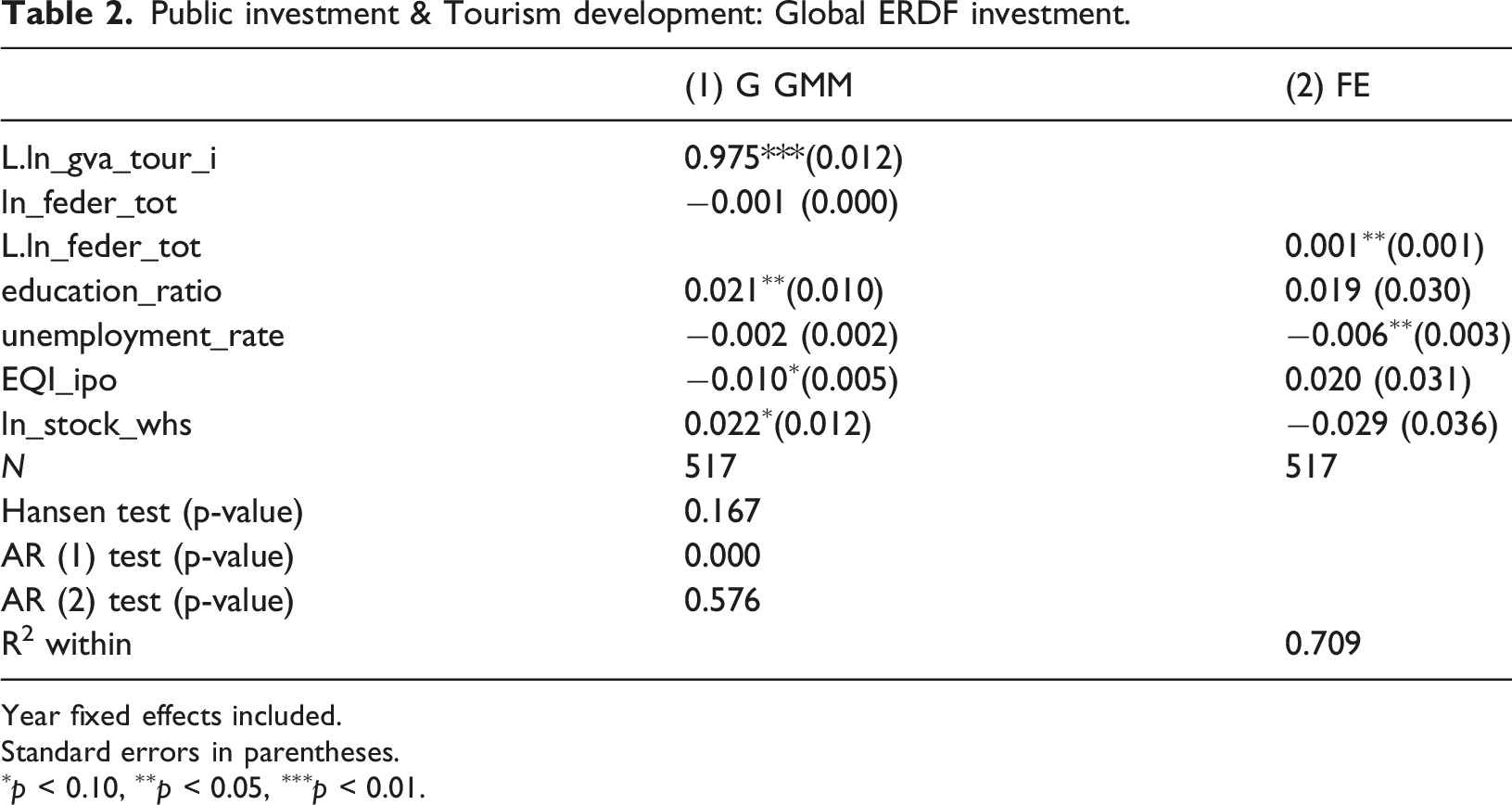
Public investment & Tourism development: Global ERDF investment.
Year fixed effects included.
Standard errors in parentheses.
∗p < 0.10, ∗∗p < 0.05, ∗∗∗p < 0.01.
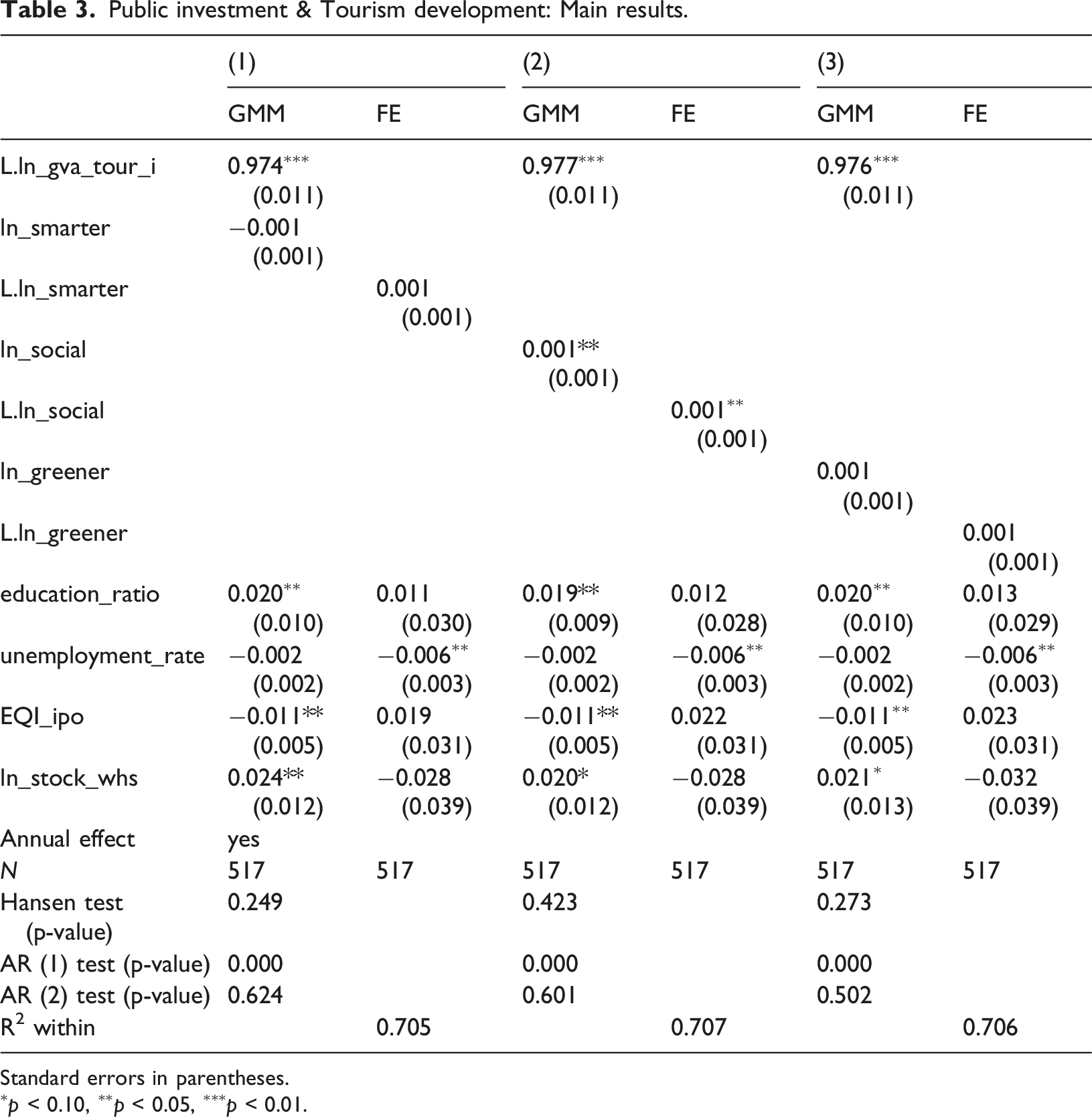
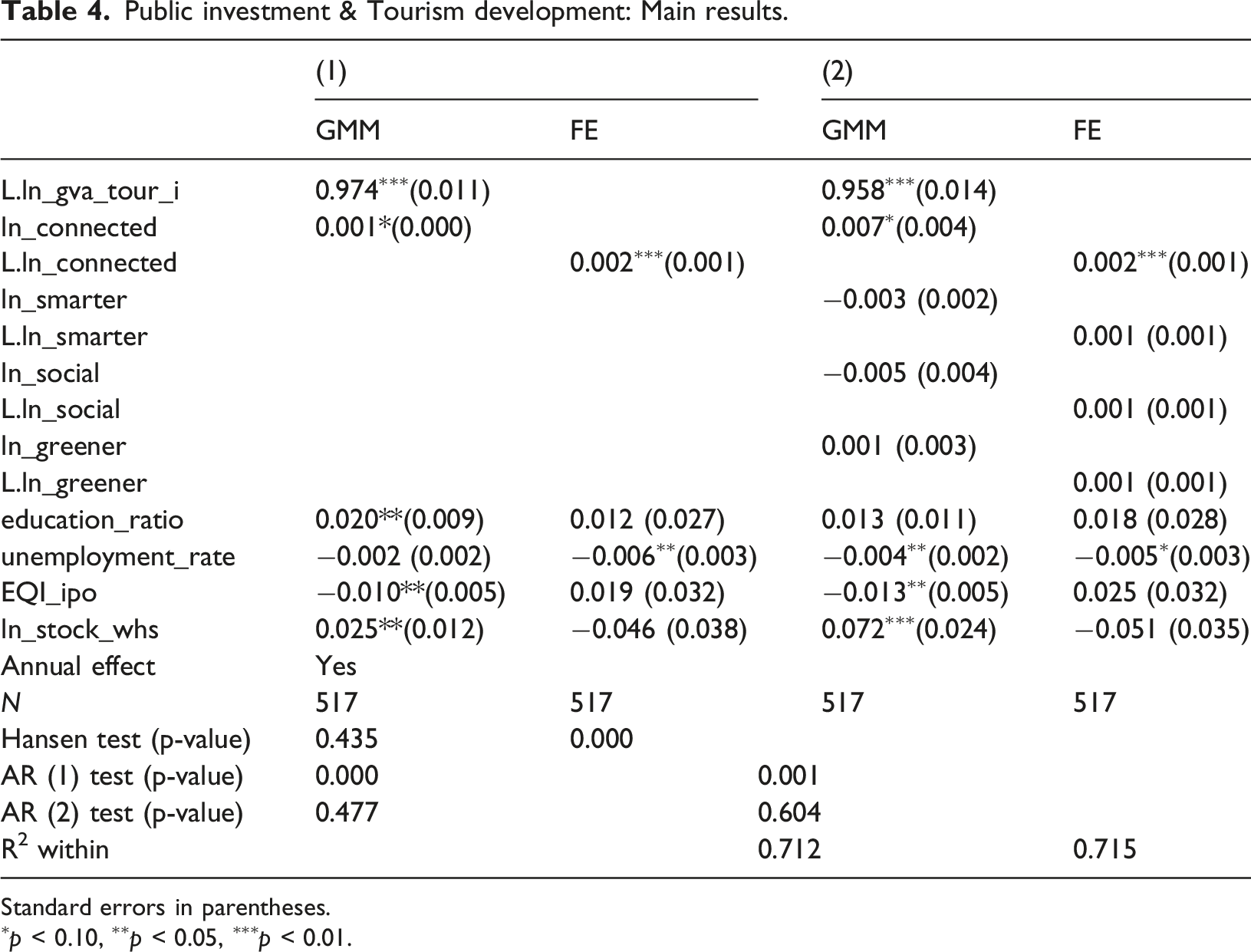
Public investment & Tourism development: Main results.
Standard errors in parentheses.
∗p < 0.10, ∗∗p < 0.05, ∗∗∗p < 0.01.
Public investment & Tourism development: Main results.
Standard errors in parentheses.
∗p < 0.10, ∗∗p < 0.05, ∗∗∗p < 0.01.
Table 2 examines the relationship between total ERDF investment and regional tourism GVA, revealing a distinctly time-dependent impact of Cohesion Policy. The contemporaneous GMM coefficient for total investment (ln_feder_tot) is negative but not statistically significant, indicating that public investment does not generate an immediate aggregate boost to tourism value added. Rather, its effects appear to unfold gradually, as structural investments require time for implementation, absorption and operationalisation before translating into measurable economic outcomes (Brandano and Crociata, 2023; Brandsma et al., 2014). Consistent with this interpretation, the one-period lagged coefficient in the fixed-effects specification is positive and statistically significant, providing empirical support for a time-to-build mechanism. This pattern suggests that the contribution of Cohesion Policy to tourism development materialises primarily in the short-to-medium term, in line with evidence documenting delayed yet persistent effects of EU-funded investments (Giua, 2017).
Tables 3 and 4 further disaggregate the analysis by ERDF thematic priorities, namely Smarter, Greener, Connected, and Social Europe, revealing differentiated effectiveness patterns across investment types. Investments under the Connected Europe objective, which primarily target transport infrastructure and digital accessibility, exhibit the most robust and consistent impact on tourism development. The results show positive and statistically significant effects both contemporaneously and with a 1-year lag. In quantitative terms, a doubling of connectivity-related investment is associated with an increase of up to 0.7% in tourism GVA contemporaneously and 0.2% with a 1-year lag in the full model specification. This indicates not only immediacy but also persistence of the effect, with the magnitude varying according to model specification. This result is consistent with the literature showing that connectivity and transport investments reduce spatial barriers and transport costs, thereby enhancing regional accessibility and tourism performance in both the short and medium run (Albalate and Fageda, 2016; Brandsma et al., 2014; Cascetta et al., 2020). The findings suggest that improvements in accessibility generate immediate gains while also producing persistent benefits as regions become more integrated into wider tourism and economic networks.
By contrast, investments classified under Smarter Europe, including R&D activities, digitalisation and support for SMEs, do not display statistically significant effects on tourism GVA in either contemporaneous or lagged specifications. This lack of aggregate effects may reflect substantial heterogeneity in the channels through which innovation-oriented investments translate into tourism performance across regions, as well as the presence of constraints related to skills, absorptive capacity or sectoral structure that limit short-term impacts (Brandano and Crociata, 2023). The absence of immediate returns does not necessarily imply ineffectiveness but rather reflects a J-curve effect where short-term adjustment costs precede structural benefits. As recent micro-level evidence across Europe confirms, technology adoption in tourism SMEs often remains reactive and superficial, failing to translate into structural innovation unless supported by long-term capability building (Suárez-Tostado and Petit, 2026).
Investments under Social Europe display a positive and statistically significant contemporaneous effect, which persists in the short term. While the magnitude of these coefficients is modest, the temporal profile suggests that investments focused on employment, education, social inclusion and institutional capacity contribute to tourism development through both immediate and sustained channels. This finding indicates that enhancing human capital, reducing social exclusion and strengthening institutional frameworks can support tourism sector performance, although the effects remain more contained than those observed for connectivity interventions.
Finally, Greener Europe investments, focused on environmental sustainability, energy efficiency, climate action and the protection of natural resources, follow a pattern closer to that observed for total ERDF spending. While they do not produce statistically significant immediate effects, their coefficients become positive in the short term, although not reaching conventional significance thresholds in the univariate specification. This temporal profile suggests that investments focused on environmental quality and sustainability require a longer adjustment phase before generating measurable economic returns (Brandano and Crociata, 2023; Valente and Medeiros, 2022). Their contribution to tourism development therefore appears to operate through delayed channels, consistent with the idea that such interventions enhance resilience, quality of life and destination attractiveness over time rather than producing instant output effects (Bramwell, 2011). Overall, these results support a time-to-build interpretation, whereby the economic effects of cohesion funded investments, particularly those targeting social and environmental objectives, materialise only after a period of adaptation and operationalisation.
The control variables provide additional insights into the factors influencing tourism development. While the lagged dependent variable remains dominant in the GMM specifications, confirming strong path dependency, other factors play a notable role. The education ratio consistently exhibits positive and significant effects in the GMM models across different specifications, highlighting the importance of human capital endowment for tourism sector performance. The unemployment rate shows negative and significant associations with tourism GVA in the FE models, suggesting that labour market conditions matter for tourism development. The quality of governance (EQI_ipo) also displays negative coefficients in the GMM specifications, reflecting the targeting principle underlying EU Cohesion Policy. Under this policy framework, regions with weaker institutional capacity receive proportionally larger allocations of ERDF funds to promote convergence (Barca et al., 2012). The negative association may, thus, captures the fact that less advanced regions, despite facing governance challenges, exhibit relatively higher tourism dependency as a structural characteristic, which the model picks up through the governance proxy. The stock of World Heritage Sites (ln_stock_whs) shows positive and significant effects in several GMM specifications, confirming the role of cultural heritage assets as drivers of tourism value creation.
The results remained consistent with changes in the specification of the GMM model or the use of a different estimation method (LSDV instead of FE models). The robustness tests reported in Tables 10 to 12 in the appendix confirm the positive and significant immediate and short-term effect of investment in connectivity projects on tourism value added. They also validate the same temporal patterns for the other ERDF thematic objectives, reinforcing the reliability of our main findings.
Heterogeneity analysis
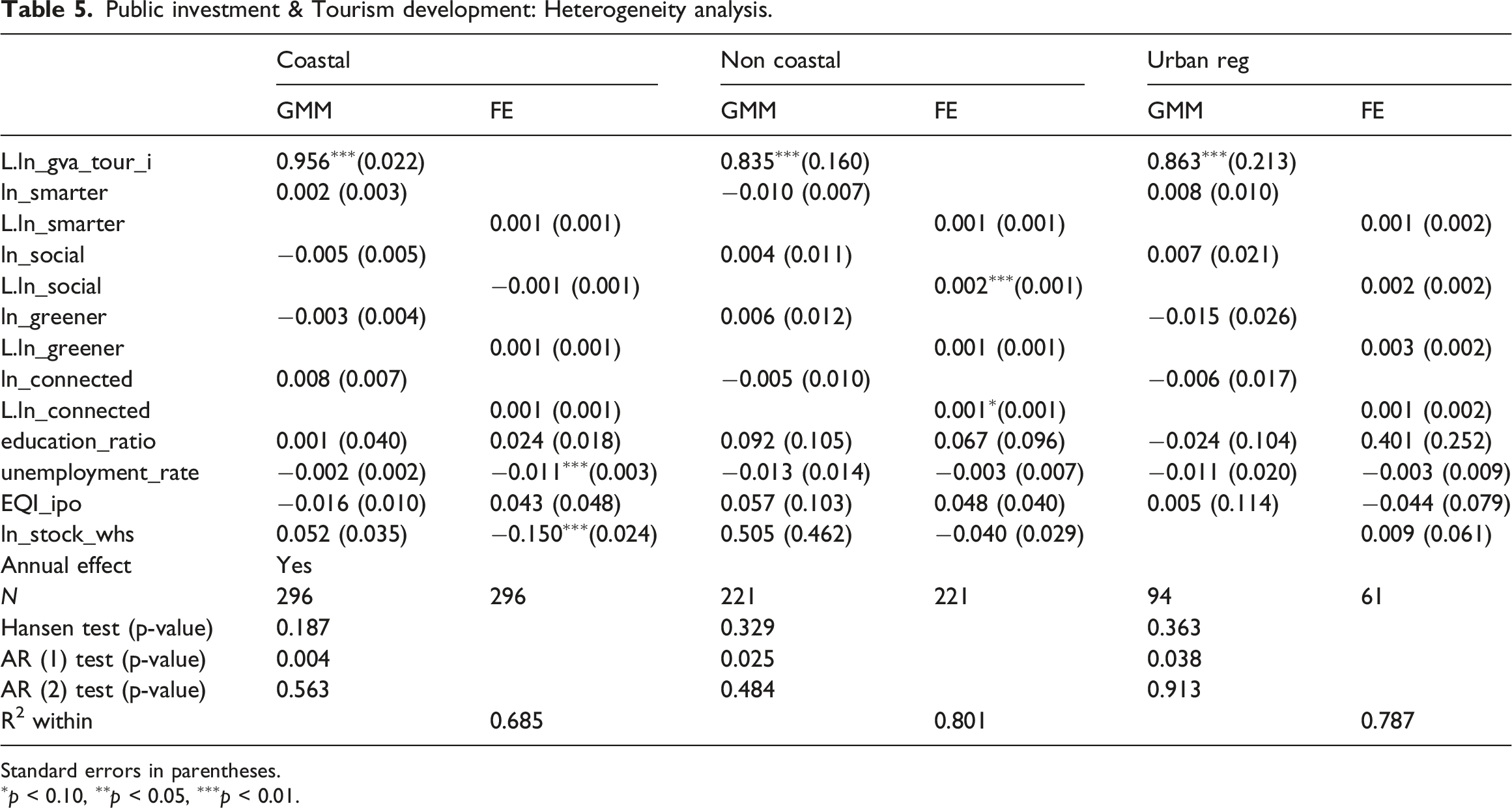
Public investment & Tourism development: Heterogeneity analysis.
Standard errors in parentheses.
∗p < 0.10, ∗∗p < 0.05, ∗∗∗p < 0.01.
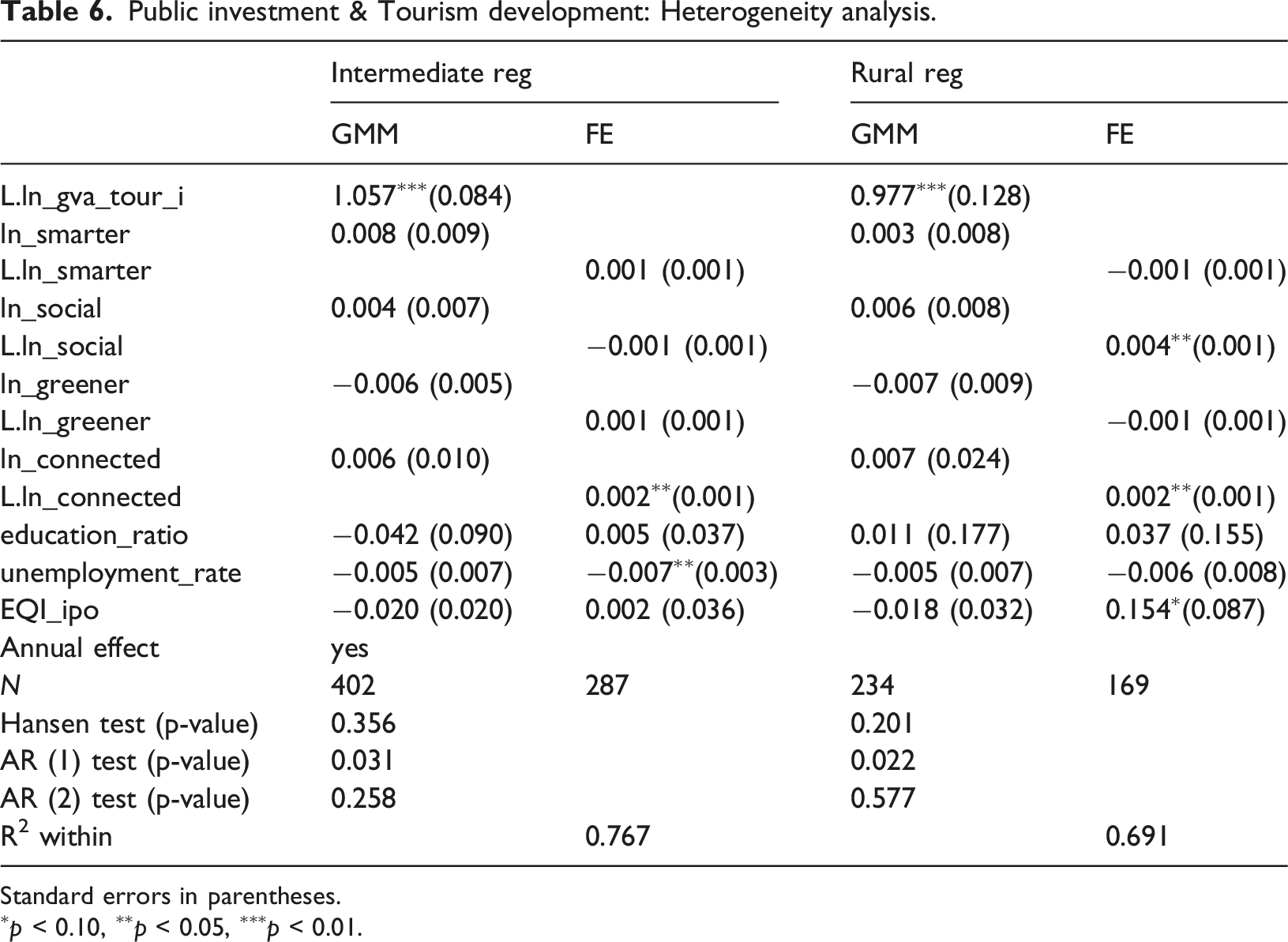
Public investment & Tourism development: Heterogeneity analysis.
Standard errors in parentheses.
∗p < 0.10, ∗∗p < 0.05, ∗∗∗p < 0.01.
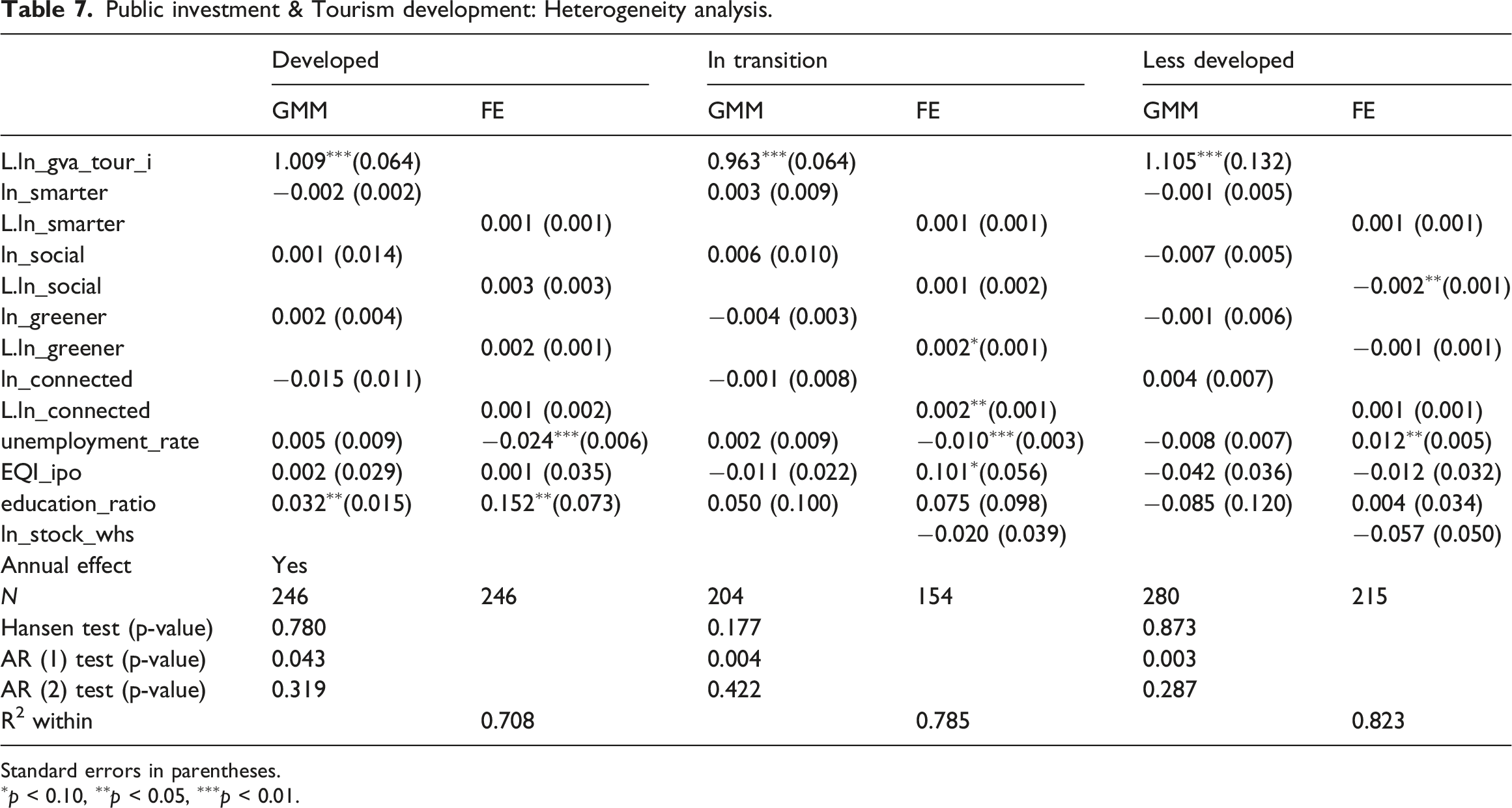
Public investment & Tourism development: Heterogeneity analysis.
Standard errors in parentheses.
∗p < 0.10, ∗∗p < 0.05, ∗∗∗p < 0.01.
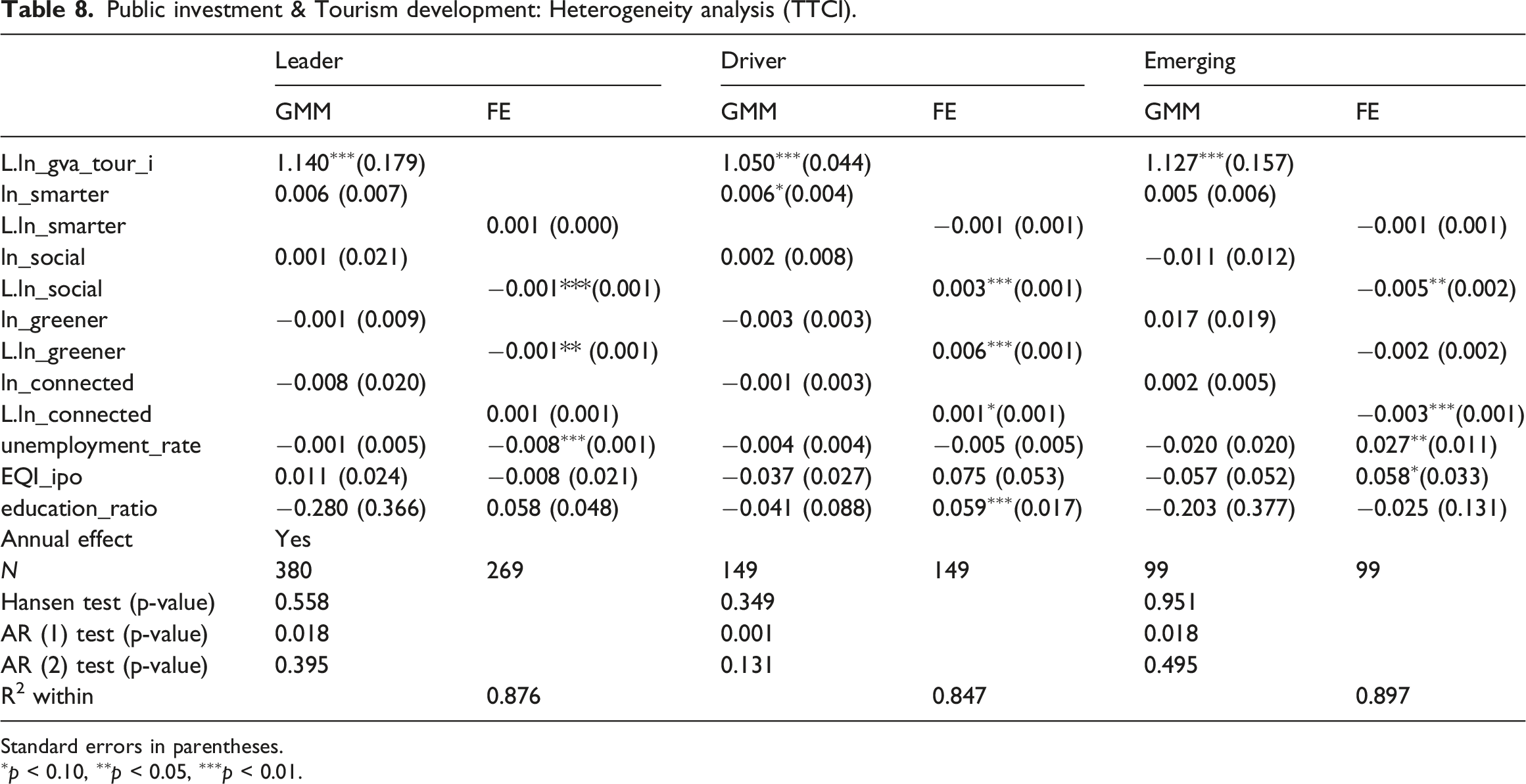
Public investment & Tourism development: Heterogeneity analysis (TTCI).
Standard errors in parentheses.
∗p < 0.10, ∗∗p < 0.05, ∗∗∗p < 0.01.
Before presenting the empirical results, it is important to note that these territorial typologies are not arbitrary but deeply anchored in the theoretical framework outlined in Section 2.2. The divisions based on geography and density (Coastal/Non-coastal; Urban/Rural) test the spatial transmission mechanisms and agglomeration economies. Meanwhile, the segments based on development levels and TTCI operationalize the theories of regional absorptive capacity and institutional quality, demonstrating the limits of one-size-fits-all policy designs.
According to the territorial assets (Coastal vs. Non-coastal), Table 5 reveals a striking divergence in the effectiveness of ERDF investments based on coastal geography. In coastal regions, no specific ERDF investment category yields a statistically significant positive effect on tourism GVA, neither immediately nor in the short term. This finding suggests a potential saturation effect or indicates that tourism dynamics in mature coastal destinations are driven primarily by private market forces rather than by public cohesion funds. Conversely, non-coastal regions appear substantially more responsive to targeted EU interventions. While they show no immediate effects, they benefit significantly in the short term from a diversified investment mix. Social investments generate positive and significant lagged effects, and Connected investments also show positive coefficients, although the magnitude remains modest. This indicates that inland or less traditional tourism areas are successfully leveraging EU funds to diversify their tourism offer, improve accessibility, and enhance social capital to boost their tourism sector. The strong path dependency observed in both subsamples confirms that historical tourism development trajectories continue to shape current performance, although non-coastal regions demonstrate greater plasticity in responding to public investment.
Tables 5 and 6 reveal that the effectiveness of ERDF investments is strongly conditioned by regional density and agglomeration economies. Urban regions, characterised by high population density and economic concentration, display limited responsiveness to most ERDF interventions in the short term. The lagged coefficients for Smarter, Social, and Greener investments remain statistically insignificant, while Connected investments show a positive but non-significant coefficient. This pattern may reflect the fact that urban tourism economies are already well-integrated into broader service and innovation networks, reducing their marginal dependence on EU-funded interventions. The absence of significant effects does not imply that urban regions fail to absorb ERDF funds but rather suggests that the marginal contribution of these investments to tourism GVA is diluted within more diversified and mature economic structures. Intermediate regions rely on different drivers, showing significant short-term benefits from Connected investments.
This result aligns with the notion that regions characterised by medium density and polycentric urban structures benefit particularly from infrastructure improvements that enhance inter-regional connectivity and reduce spatial transaction costs. The positive effect of connectivity investments in intermediate regions supports the view that accessibility remains a binding constraint for tourism development outside major metropolitan areas and established coastal destinations. In rural regions, however, the picture becomes more complex and, in some respects, concerning. While these territories also benefit from Connected and Social investments in the short term, Smarter investments show no significant impact in either contemporaneous or lagged specifications. This absence of positive returns from innovation-oriented investments in rural contexts likely reflects a fundamental mismatch between high-tech or digitalisation-heavy policy agendas and local absorptive capacities, including limited human capital, weak institutional frameworks, and insufficient critical mass in the tourism sector (Stoffelen and Vanneste, 2017). However, it is worth noting that rural territories exhibit greater resilience to exogenous shocks compared to metropolitan areas, driven by domestic tourism demand patterns (Tegui, 2025, 2026), suggesting that their tourism development model, while less responsive to innovation investments, may be more stable over time.
The level of regional development in Table 7 highlights how economic maturity shapes the capacity of regions to absorb and translate ERDF investments into tourism-related economic value. While contemporaneous effects remain largely insignificant, the lagged specification reveals positive returns from Social investments (though not reaching conventional significance thresholds) and Greener investments. Their strong institutional frameworks, higher human capital endowment (as evidenced by the positive and significant education ratio coefficient), and more diversified economic structures likely enable these regions to capitalise on complex thematic objectives that could require longer implementation periods and coordination across multiple stakeholders. Regions in transition show a more targeted pattern of responsiveness. Connected and Greener investments in these regions generate positive short-term effects. For these regions, which are characterised by intermediate development levels and ongoing structural transformation, closing the accessibility gap appears to be a prerequisite for tourism value creation. The positive effect of connectivity investments suggests that reducing spatial barriers and improving integration into trans-regional networks remains a constraint, the alleviation of which generates measurable economic returns within a relatively short timeframe.
Less developed regions face substantial and persistent challenges in translating ERDF investments into tourism value added. Not only do they lack immediate positive effects across all investment categories, but they also exhibit negatively significant lagged coefficients for Social investments. This concerning pattern suggests that in regions facing profound structural constraints, including weak institutional capacity, limited human capital, insufficient entrepreneurial ecosystems, and fragmented governance structures, certain types of EU-funded interventions may suffer from severe implementation inefficiencies, fail to achieve additionality, or even generate short-term disruptions without producing commensurate economic returns (Bachtrögler et al., 2024). The negative coefficient may also reflect crowding-out effects, whereby public investments displace private activity or absorb scarce managerial and institutional resources without generating sufficient spillovers into the broader tourism economy. These findings underscore the importance of complementing financial transfers with capacity-building measures and tailored governance support in the most disadvantaged regions (Rodríguez-Pose, 2020).
When examining regional tourism competitiveness as measured by the Travel and Tourism Competitiveness Index (TTCI), the estimates presented in Table 8 corroborate and extend the development-level findings. Driver regions, characterised by high tourism competitiveness, strong destination management, and well-developed tourism value chains, successfully leverage public funds across multiple investment categories. Social investments generate positive short-term effects, Greener investments show robust lagged returns, and Connected investments display positive coefficients. This comprehensive responsiveness suggests that in highly competitive destinations, the marginal returns to public investment remain positive across thematic areas, as these regions possess the institutional capacity, skilled labour force, and entrepreneurial ecosystems necessary to translate financial resources into tangible tourism sector improvements. The education ratio shows a particularly strong effect in driver regions, confirming the complementarity between human capital and public investment effectiveness. Leader regions, which represent the most advanced tourism economies in the sample, exhibit a more nuanced pattern.
While Smarter investments show a marginally positive contemporaneous effect, Social and Greener investments display significant negative lagged coefficients. This counterintuitive finding may reflect several mechanisms. First, in highly mature and competitive destinations, additional public investment in social or environmental dimensions may not translate into immediate tourism value added, as these regions have already achieved high baseline levels in these domains. Second, these investments may target structural societal challenges, such as social inclusion, affordable housing, or environmental restoration, that are unrelated or even negatively correlated with short-term tourism performance, particularly if they involve regulatory constraints on tourism activity or capacity limitations to address overtourism concerns. Third, the negative association may indicate crowding-out effects in saturated markets, where public investment competes with established private sector dynamics. Emerging regions mirror the struggles observed in rural and less developed areas. Smarter investments show no significant contemporaneous effects, and more problematically, Social investments are associated with negative short-term outcomes, while Connected investments also display negative lagged coefficients. These results highlight the substantial difficulty faced by early-stage destinations in implementing advanced policy agendas designed for more mature tourism economies. The lack of absorptive capacity limited institutional quality, insufficient coordination among stakeholders, and weak destination management structures constrain the ability of these regions to transform financial resources into effective tourism development outcomes (Brandano and Crociata, 2023; Stoffelen and Vanneste, 2017).
Across almost all regional categories, particularly in the short-term fixed-effects specifications, the control variables provide consistent evidence on the structural determinants of tourism value creation. The unemployment rate exhibits significant associations across most subsamples, with predominantly negative coefficients in developed and competitive regions, and more ambiguous or positive effects in less developed territories. The quality of governance shows varied patterns, with positive effects emerging in specific contexts such as transition regions and emerging destinations, where institutional capacity may act as an enabling factor for development. The education ratio, where included, consistently displays positive associations, reinforcing the critical role of human capital in supporting tourism sector performance.
Overall, the heterogeneity analyses confirm that the effects of public investment on tourism development are highly dependent on territorial context, institutional capacity, and preexisting tourism competitiveness. The same type of investment can yield positive, neutral, or even negative outcomes depending on the region’s structural conditions, development stage, tourism maturity, and governance quality. Developed, intermediate (for connectivity), and driver regions appear better equipped to absorb and capitalise on EU funds, particularly through investments aligned with their strategic priorities and existing capabilities. In contrast, less developed, rural, urban, coastal, and emerging regions often experience limited or even adverse short-term effects, especially when investments are not tailored to their specific needs, capacities, or development trajectories. The case of connectivity investments is particularly illustrative. They generate robust positive returns in non-coastal, intermediate, rural, and transition regions, precisely the territories where spatial barriers and accessibility constraints remain binding. Conversely, innovation-oriented investments under the Smarter objective show positive returns only in driver regions and display no significant or even negative effects in rural and emerging contexts, revealing a fundamental mismatch between policy design and local absorptive capacity. These findings underscore the importance of designing differentiated, place-based investment strategies that account for regional disparities in institutional quality, economic structure, and tourism development stage. Cohesion Policy must not only promote convergence through financial transfers, but also respond strategically to the diverse trajectories, challenges, and opportunities that characterise Europe’s heterogeneous territorial landscape.
Discussion and conclusions
This study provides new empirical evidence on the role of European Regional Development Fund (ERDF) investments in fostering economic value creation through tourism across EU NUTS-2 regions during the period 2014-2019. It is among the first to assess how the four ERDF thematic objectives influence tourism gross value added (GVA), considering immediate and short-term effects. By proposing a conceptual framework that recognises how the effectiveness of public funding is strictly conditioned by the territorial context in which its underlying transmission mechanisms operate, this study addresses the lack of quantitative, generalisable evaluations in a field historically dominated by case studies and perception-based analyses. Shifting from a purely descriptive perspective to a mechanism-oriented empirical design, and integrating both thematic and territorial dimensions, the paper sheds light on the varying effectiveness of different types of public investment in driving tourism value creation across Europe’s diverse regional landscapes.
Building on Suárez-Tostado et al. (2026), which focused exclusively on France and Spain, this EU-wide analysis both corroborates and extends earlier evidence on the role of ERDF-funded investments in tourism-related value creation. Consistent with the previous study, connectivity emerges as the most robust and systematic driver of short-term gains in tourism GVA. However, by expanding the empirical scope to 194 regions, the analysis reveals a more nuanced pattern across other thematic objectives. Investments under the Smarter and Social axes, while showing no aggregate short-term effects in the earlier national-level study, now display positive contemporaneous or lagged outcomes in specific territorial contexts—namely advanced, urban, and driver regions, whereas rural, less developed, and emerging territories tend to face absorption constraints and, in some cases, short-term negative effects. In addition, the EU-wide perspective uncovers differentiated responses associated with regional tourism competitiveness (TTCI), urbanisation levels, and governance quality, dimensions that could not be explored in the earlier two country analysis.
At the aggregate level, the analysis reveals a positive and statistically significant relationship between total ERDF investment and tourism GVA in the short term, although no immediate contemporaneous effect is observed. This evidence underscores the capacity of EU Cohesion Policy to support tourism as a driver of place-based economic growth, in line with previous work on structural funds and regional performance (Capello and Perucca, 2018; Crescenzi and Giua, 2020). The time-to-build mechanism documented here reinforces the idea that bundling investments across smart innovation, connectivity, green transition, and social cohesion generates synergies that amplify their individual contributions. In other words, when investments are planned and implemented in a coordinated manner across thematic priorities, the overall impact on regional tourism development is significantly enhanced, although this materialises with a temporal lag reflecting implementation, absorption, and operationalisation periods.
Among the four thematic strands, investments under the Connected Europe objective, focused on transport and digital accessibility, emerge as the most consistent and robust driver of tourism-related value creation. These effects are observed both contemporaneously and with a 1-year lag, particularly in non-coastal, intermediate, rural, and transition regions, where improvements in accessibility help to overcome structural spatial constraints. This pattern corroborates the findings from France and Spain reported in Suárez-Tostado et al. (2026) and extends them to the EU level, showing that connectivity plays a critical enabling role where tourism development is constrained by geographical isolation rather than market saturation. Improved accessibility enhances tourism performance by reducing spatial barriers and integrating destinations into wider travel networks, in line with long-standing evidence in the literature (Albalate and Fageda, 2016; Cascetta et al., 2020; Ren et al., 2023). The robustness of connectivity effects across multiple territorial typologies and development levels underscores its key importance for tourism competitiveness in peripheral and less integrated regions.
By contrast, investments classified under Smarter Europe, including R&D activities, digitalisation and support for SMEs, display highly heterogeneous and context-dependent effects. While they generate positive returns in driver regions and show marginally significant contemporaneous effects in some specifications, they produce no significant aggregate impact and, more problematically, are associated with limited or even negative short-term outcomes in rural, less developed, and emerging regions. This pattern reflects substantial differences in absorptive capacity, institutional quality, and the alignment between innovation-oriented policy instruments and local economic structures (Brandano and Crociata, 2023; Stoffelen and Vanneste, 2017).
The absence of immediate returns does not necessarily imply ineffectiveness but rather suggests that the benefits of such investments may require longer gestation periods, complementary capacity-building interventions, or operate through indirect channels not fully captured by our empirical framework. This evidence points to clear limitations of space blind or one-size-fits-all policy designs. Imposing innovation-oriented agendas in territories with limited absorptive capacity may disrupt local dynamics without generating immediate economic gains. In fact, recent cross-national evidence shows that European tourism firms tend to engage more in experience-based and organisational innovation, while lagging behind in the more radical, R&D-intensive profiles often assumed by such policy frameworks (Suárez-Tostado and Petit, 2026). Taken together, these results point to a mismatch between the design of Smarter Europe interventions and the structural realities of less advanced territories, calling for more tailored and sequenced approaches that account for regional specificities.
Investments under Social and Greener Europe objectives follow a temporal profile closer to that observed for total ERDF spending. While they do not produce immediate effects in most specifications, their coefficients become positive and statistically significant in the short term for specific territorial categories. Social investments generate positive lagged effects in non-coastal, rural, and driver regions, suggesting that interventions focused on employment, education, social inclusion, and institutional capacity contribute to tourism development through sustained rather than immediate channels. However, the emergence of negative lagged coefficients for Social investments in less developed regions and emerging regions raises important concerns about implementation effectiveness and absorptive capacity in structurally constrained territories. Similarly, Greener investments display positive short-term effects in driver regions but negative associations in leader regions, suggesting that environmental and sustainability interventions operate through complex mechanisms that depend critically on destination maturity, governance frameworks, and the balance between tourism growth and environmental conservation objectives (Brandano and Crociata, 2023; Valente and Medeiros, 2022).
The heterogeneity analysis further confirms that territorial characteristics critically shape the capacity to absorb and translate public investment into tourism-related economic value. Developed, intermediate (specifically for connectivity), and driver regions are better positioned to capitalise on ERDF interventions, particularly when investments align with existing strategic assets and are supported by strong governance structures and adequate institutional capacity. Conversely, coastal regions and highly mature tourism destinations (leader regions) display limited or ambiguous responsiveness to Cohesion Policy investments, suggesting that tourism value creation in these areas is largely driven by private market dynamics, path-dependent specialisation patterns, and, in some cases, may face saturation effects or regulatory constraints aimed at managing overtourism pressures (Bergantino et al., 2026). The EU-wide analysis also shows that tourism competitiveness profiles, as captured by the TTCI, mediate investment outcomes in predictable ways: highly competitive regions benefit more consistently from ERDF support across multiple thematic areas, while lagging and emerging destinations face adaptation gaps, limited short-term returns, and in some cases negative effects reflecting absorption failures.
These differentiated effects carry clear policy implications. While connectivity investments deliver immediate and measurable gains across a wide range of territorial contexts, the long-term potential of Greener, Social, and Smarter interventions should not be underestimated. Their effectiveness depends critically on tailoring interventions to regional realities—through careful sequencing, complementary institutional support in weaker regions, and strategic alignment with local tourism development strategies and smart specialisation priorities. Moreover, evaluation frameworks must evolve beyond output-focused indicators to capture not only immediate economic returns but also long-term outcomes in terms of resilience, environmental sustainability, social inclusion, and destination quality. This aligns with the place-based approach emphasised by Barca et al. (2012) and Rodríguez-Pose (2020), who stress the need for territorially sensitive policies that account for regional capabilities, governance structures, and development trajectories, dimensions that are particularly relevant in tourism, where local context decisively shapes outcomes and where the balance between growth and sustainability remains a central policy challenge.
The study is not without limitations. Although it offers robust evidence for the 2014-2019 period using regional data and dynamic panel methods, it remains constrained by the relatively short time span of the panel, which limits the ability to capture medium and long-term effects of public investment. The reliance on 1-year lags, necessitated by data availability, may underestimate the true gestation period of infrastructure and capacity-building interventions, which often require multiple years to generate measurable economic impacts. Furthermore, the analysis does not extend to the post-2020 period, as the COVID19 pandemic generated a structural break in tourism activity characterised by highly heterogeneous recovery patterns across territories (Tegui, 2025), while ERDF resources were simultaneously complemented and partly redirected through extraordinary instruments such as NextGenerationEU, complicating the isolation of their specific effects. The absence of harmonised data on post-COVID interventions and on projects launched under the 2021-2027 programming cycle prevents a comprehensive assessment of recent policy adjustments.
Additionally, while our fixed-effects and System GMM models effectively control for unobserved time-invariant heterogeneity and common temporal shocks, unobserved, granular factors such as destination management quality, stakeholder coordination capacity, or tourism policy coherence at the national and regional levels may influence the effectiveness of ERDF investments in ways not fully captured by the available proxy variables. Future research should address these limitations by extending the temporal coverage of the analysis, incorporating additional waves of ERDF programming periods, and developing more granular measures of institutional capacity, governance quality, and policy implementation effectiveness. The integration of qualitative case study evidence with quantitative panel analysis could provide deeper insights into the mechanisms through which public investments translate, or fail to translate, into tourism value creation in different territorial contexts.
Moreover, examining the interactions between ERDF investments and national or regional tourism policies, smart specialisation strategies, and destination management frameworks would enhance our understanding of the conditions under which EU funds generate additionality and synergies versus crowding-out or substitution effects. Finally, assessing the differential impacts of the COVID-19 recovery instruments, particularly in relation to sustainability transitions and digital transformation, represents a critical avenue for future inquiry, as these interventions may have fundamentally altered the relationship between public investment and tourism development in ways that remain to be empirically documented. In sum, ERDF-funded investments can support tourism-led growth and contribute to regional convergence, but only when they are strategically aligned with territorial needs, institutional capacities, and long-term development trajectories. The evidence presented here suggests that while connectivity remains the most robust and generalisable driver of short-term tourism value creation, the effectiveness of other investment strands is profoundly contingent on regional characteristics, governance frameworks, and competitiveness levels. Achieving the dual objectives of economic convergence and sustainable tourism development will require not only adequate financial resources but also differentiated, place-based approaches that recognise and respond to the diversity of Europe’s regional tourism landscapes. Policymakers must move beyond uniform policy prescriptions and embrace territorially sensitive strategies that combine financial support with capacity-building, institutional strengthening, and adaptive governance mechanisms tailored to the specific challenges and opportunities of each regional context.
Policy implications and future directions
The findings of this study provide relevant lessons for policymakers engaged in the design and implementation of Cohesion Policy. At the European level, they speak directly to the formulation of investment priorities and monitoring frameworks. At national and regional levels, they inform managing authorities responsible for adapting operational programmes to territorial realities and smart specialisation strategies. At the local level, they offer guidance to municipalities and destination managers who play a growing role in aligning EU investment with tourism development. While the evidence derives from the 2014-2020 programming period and focuses on short-term effects observable within a 6-year timeframe, its value lies in shaping the ongoing 2021-2027 framework and informing longer-term strategic orientations, particularly as Cohesion Policy faces intensified demands linked to resilience, sustainability, and citizen engagement.
A first implication concerns the differentiated impact of investment categories. Connectivity projects clearly stand out for generating direct and measurable short-term gains in tourism-related economic value, particularly in non-coastal, intermediate, rural, and transition regions where accessibility constraints limit development potential. These results underline the importance of maintaining adequate support for transport and digital connectivity as a prerequisite for tourism competitiveness in structurally constrained territories. By contrast, Smarter, Greener, and Social interventions tend to display weaker, delayed, or highly context-dependent effects. This does not reduce their relevance but rather highlights the need to adapt Cohesion Policy more closely to territorial conditions and absorptive capacities. In less developed, rural, and emerging regions, implementing innovation-oriented or complex sustainability interventions without adequate preparatory measures risks generating limited returns or even short-term disruptions, as evidenced by the negative coefficients observed in these contexts.
Therefore, sequencing investments, strengthening institutional capacity, embedding projects within coherent local tourism strategies, and ensuring sufficient human capital endowment appear crucial to enhance effectiveness. This perspective is consistent with the place-based approach emphasised by Barca et al. (2012) and Rodríguez-Pose (2020), which stresses that investment outcomes depend on regional capabilities, governance quality, and implementation capacity rather than on uniform policy prescriptions. Indeed, the vulnerability and resilience of destinations are shaped by unique territorial combinations of economic structure, governance frameworks, and tourism competitiveness profiles, requiring strategies tailored to local specificities (Tegui, 2026). The evidence reveals stark differences between urban and rural contexts, between coastal and inland regions, and across development levels that cannot be addressed through standardised interventions.
Moreover, Cohesion Policy should move beyond a narrow emphasis on financial absorption and project outputs and further develop evaluation frameworks that capture outcomes such as resilience, environmental transition, social cohesion, and destination quality (Bachtler and Mendez, 2020). The short-term focus of the current analysis, while providing valuable insights into immediate and near-term effects, also highlights the need for longer-term impact assessments that can capture the full lifecycle of investments, particularly for interventions in environmental sustainability, innovation systems, and institutional capacity that may require multiple years to generate measurable returns. Evaluation approaches must therefore combine quantitative performance metrics with qualitative assessments of governance processes, stakeholder engagement, and strategic alignment to provide a comprehensive understanding of policy effectiveness.
Beyond these findings, the study offers specific guidance for the current 2021-2027 programming period. The present framework gives greater weight to the green and digital transitions as well as to the objective of bringing “Europe closer to citizens” (Policy Objective 5). Evidence from the 2014-2020 period suggests that these priorities will only translate into sustainable tourism-related development if they are implemented in a territorially sensitive manner and supported by adequate institutional capacity building, particularly in weaker regions. Smarter, Greener, and Social projects should therefore be designed in close synergy with connectivity investments and embedded within broader regional innovation and tourism strategies, rather than pursued as isolated interventions. Moreover, recent evidence highlights that promoting domestic tourism and ensuring a balanced spatial distribution of tourist flows across metropolitan, urban and rural areas within destinations constitute effective resilience levers that should be explicitly integrated into Cohesion Policy design (Tegui, 2026). Achieving this requires not only financial resources, but also effective governance arrangements, participatory mechanisms involving local stakeholders and tourism sector representatives, and evaluation tools that ensure interventions respond to genuine local needs while contributing to broader European objectives of convergence, sustainability, and resilience.
The introduction of a dedicated Policy Objective for tourism and culture-dependent regions under Regulation (EU) 2021/1058 represents an important recognition of tourism’s strategic role, but its immediate effectiveness may depend on carefully navigating the structural and absorptive constraints identified in this analysis. In particular, policymakers must resist the temptation to apply innovation-heavy or digitally intensive interventions uniformly across all tourism regions without considering their varying absorptive capacities and development stages. Instead, differentiated implementation pathways should be designed: advanced and driver regions can pursue ambitious Smarter and Greener agendas, while less developed and emerging territories should prioritise foundational connectivity improvements, basic infrastructure provision, and governance capacity building before transitioning to more complex thematic objectives. Intermediate and transition regions may benefit from hybrid approaches that combine accessibility enhancements with targeted innovation support in domains where local capabilities already exist.
By focusing on tourism, a sector often overlooked in regional policy research (Brandano and Crociata, 2023), this study contributes to ongoing debates on how Cohesion Policy can balance efficiency and equity objectives. The findings suggest that maximising aggregate returns to EU investment would favour concentrating resources in regions already possessing strong institutional capacity and tourism competitiveness. However, such an approach would undermine the fundamental convergence and territorial cohesion objectives that justify Cohesion Policy’s existence. The challenge, therefore, is not to choose between efficiency and equity, but to design context-appropriate intervention logics that can generate positive returns across the full spectrum of European regions, recognising that the pathways to success, the relevant investment priorities, and the necessary supporting measures differ profoundly across territorial contexts. More broadly, the evidence suggests that Cohesion Policy will only fulfil its transformative ambitions if tourism is treated not as a marginal beneficiary of investment, but as a strategic field for testing and refining place-based approaches to resilience, sustainability, and citizen engagement across Europe’s diverse regional realities.
Supplemental material
Supplemental Material -The role of public investment in tourism value creation: Evidence from ERDF-funded interventions in European regions
Supplemental Material for The role of public investment in tourism value creation: Evidence from ERDF-funded interventions in European regions by Yvan Tegui, Marta L Suárez-Tostado, Ana Belén Ramón Rodríguez in Tourism Economics.
Footnotes
Acknowledgements
The authors would like to thank the anonymous reviewers and editors of Tourism Economics for their constructive comments and valuable suggestions on an earlier version of this manuscript. Special thanks are also extended to thesis advisors Nicolas Peypoch, Sauveur Giannoni and Ana Belén Rodríguez for their continuous support and guidance. Finally, the authors express their gratitude to the researchers and members of the International Association for Tourism Economics (IATE) for their insightful feedback and discussions.

Funding
The authors received no financial support for the research, authorship, and/or publication of this article.
Declaration of conflicting interests
The authors declared no potential conflicts of interest with respect to the research, authorship, and/or publication of this article.
Supplemental material
Supplemental material for this article is available online.
Note
Author biographies
References
Supplementary Material
Please find the following supplemental material available below.
For Open Access articles published under a Creative Commons License, all supplemental material carries the same license as the article it is associated with.
For non-Open Access articles published, all supplemental material carries a non-exclusive license, and permission requests for re-use of supplemental material or any part of supplemental material shall be sent directly to the copyright owner as specified in the copyright notice associated with the article.
