






Abstract
This study examines the determinants of agritourism participation and willingness to pay (WTP) for locally produced food. Using survey data from 374 residents in Georgia, U.S.A., the study employed a binary logit model to identify participation drivers, structural equation modeling (SEM) to test attitudinal relationships, and a multinomial logit (MNL) model to profile WTP segments. Findings of the study suggest that environmental concern, health awareness, and personal image positively influence attitudes toward agritourism, which in turn predict WTP for local food. The MNL analysis segments consumers, showing that younger, educated, married, and employed individuals are more likely to belong to higher WTP categories, while household income is not a significant predictor. The study advances theoretical understanding of agritourism participation and WTP for local food while offering strategic marketing guidance for practitioners.
Keywords
Introduction
Recent statistics indicate a growing number of farms offering agritourism opportunities, mirroring a global pattern of growth (United States Department of Agriculture, 2019). Agritourism, which refers to the intersection of agricultural production and tourism, has been recognized as a crucial instrument for rural economic development, agricultural sustainability, and consumer education (Chase et al., 2018). Farm-based tourism gives visitors hands-on exposure to agricultural life while helping farmers diversify income and reduce dependent on volatile commodity markets (Schilling and Sullivan, 2014; Vaquero-Piñeiro et al., 2025). Notably, agritourism growth aligns with consumers’ increasing interest in learning about food origins, supporting local economies, and engaging in sustainable consumption practices (Khatami et al., 2020; Pérez Gálvez et al., 2017). Consumers perceive locally produced foods as fresher, healthier, and more environmentally and socially responsible (Dedeoğlu et al., 2022; Feldmann and Hamm, 2015). Consequently, agritourism has become a crucial avenue for farmers to establish a direct relationship with consumers, connecting them to their products (Brune et al., 2021). Understanding agritourism consumers has, therefore, become essential for sustainable development of both the sector and rural communities.
Previous work has identified various factors that encourage agritourism participation. Internal desires to enjoy rural settings influence visitor decisions, as agritourism provides unique experiences (Joyner et al., 2018). Growing tourist interest in experiencing different lifestyles and farm activities also accounts for important motivations. Consumers visit farms to purchase fresh products directly from producers (Che et al., 2005). Importantly, agritourism experiences shape visitors’ behavior toward local food consumption (Brune et al., 2021), as local food serves as an important ingredient of authenticity that connects consumers with the place and culture (Sims, 2010). These positive experience and connections may translate into purchasing behavior, influencing consumers’ WTP premium for locally produced foods, as increased knowledge and involvement with products are associated with purchasing them at higher prices (Campbell et al., 2014). Although increasing interest in consumers’ perspectives on local food and their purchasing behavior has been documented in the context of European and Asian countries (e.g., Domi and Belletti, 2022; Musa and Chin, 2022), empirical evidence examining consumer behavior in agritourism contexts in U.S. remains limited (Ammirato et al., 2020).
Moreover, while prior studies have examined agritourism participation and local food purchase intentions in relation to sociodemographic characteristics, personal motivations, and attitudes toward sustainability (e.g., Govindasamy and Kelley, 2014; Testa et al., 2019), the mechanisms through which these factors influence participation and payment decisions remain insufficiently understood. Existing literature tends to treat attitudes and motivations as broad composite measures, analyze participation and payment decision, or WTP separately, and offers limited understanding of how specific belief constructs such as environmental concern, health awareness, personal image, and perceived product quality shape attitudes towards local food and influence WTP. In addition, few studies examine market heterogeneity by segmenting consumers into distinct behavioral segments. These limitations highlight the need for behavioral approaches that capture both the direct and indirect pathways linking beliefs, attitudes, and purchasing behavior in agritourism settings.
Therefore, this study addresses these gaps by examining: (1) sociodemographic, motivational, and barrier determinants of agritourism participations; (2) behavioral pathways through which environmental concern, health awareness, personal image, and perceived product quality shape attitudes toward locally produced food, which in turn influence WTP premiums; and (3) sociodemographic profiles of distinct WTP segments. By combining structural equation modeling (SEM) with a multinomial logit (MNL) analysis, the study estimates latent attitudinal construct and identifies distinct WTP segments, clarifying how sociodemographic factors, attitudes, and payment willingness interact.
Using survey data collected from Georgia, U.S.A. as the empirical context, this study contributes to both academic literature and practice by demonstrating how psychological factors and attitudes shape consumer valuation of local food in agritourism contexts. Specifically, the study advances the application of the TPB by decomposing consumer attitudes into specific belief constructs and testing their indirect effect on WTP through SEM. In addition, the study advances the current knowledge through addressing both agritourism and WTP outcomes within a unified conceptual framework, modeling full relationships from participation drivers through attitudinal formation to WTP segmentation. By combining SEM with a multinomial logit analysis, the study estimates latent attitudinal relationships and profiles distinct WTP consumer segments. The findings of the study provide a basis for market targeting and offers recommendations for agritourism operators, marketers, and policymakers.
Literature review and theoretical framework
Agritourism and local food
Agritourism represents a form of tourism in which agricultural production and visitor experiences intersect, offering opportunities for participation in farm activities while providing farmers with additional income streams (Chase et al., 2018; Rauniyar et al., 2021). This contributes to rural development by adding income streams for farmers and support local economies (Schmidt et al., 2023; Vaquero-Piñeiro et al., 2025), while also helping preserve agricultural landscapes and cultural heritages (Ammirato et al., 2020). Activities such as farm stays, pick-your-own operations, orchard visits, and agricultural workshops enrich visitor experiences by encouraging direct engagement with production practices and rural environments (Ammirato et al., 2020; Chase et al., 2018).
A major dimension of agritourism is its integration with local food systems. Many agritourism enterprises sell farm products directly to visitors, creating short food supply chains that reduce physical and social distance between producers and consumers and promote stronger engagement with local agriculture (Schmidt et al., 2023). Importantly, previous work supported that agritourism can enhance local food systems by nurturing trust, authenticity, and closer interaction between visitors and producers (Brune et al., 2021; Domi and Belletti, 2022). Moreover, agritourism has grown alongside increasing consumer interest in authenticity, sustainability, and experiential food encounters (Brune et al., 2021). Beyond economic functions, agritourism contributes to rural vitality by supporting local enterprises, strengthening community networks, and encouraging environmentally conscious consumption through visitors’ direct interaction with food production processes (Schmidt et al., 2023). Because agritourism provides direct exposure to local foods (Brune et al., 2021), understanding participation behaviors is essential for explaining subsequent valuation and WTP for these products.
Overarching theory: Theory of planned behavior (TPB) and push-pull motivation theory
The TPB (Ajzen, 1991) is widely applied to explain consumer decision-making in tourism and food systems. It posits that behavioral intention is influenced by three factors: attitudes toward the behavior (a favorable or unfavorable evaluation), subjective norms (perceived social pressure), and perceived behavioral control (the perceived ease or difficulty of performing the behavior). In agritourism, positive attitudes toward agritourism, such as valuing rural environments, local food, or sustainability, are strong predictors of participation intention and WTP (Brune et al., 2021; Zhao et al., 2022). Following earlier applications of the TPB in tourism and food consumption, this study operationalizes attitudes toward local food through established belief constructs, including environmental concern, health awareness, personal image, and perceived product quality.
Environmental values have been shown to shape attitudes toward sustainable food choices and agritourism (Zhao et al., 2022), while environmental concern has also been linked to stronger personal norms toward organic and sustainable food purchasing (Koklic et al., 2019). Health concern and social prestige motivations have similarly been identified as drivers of local food consumption in agritourism settings (Testa et al., 2019). Personal image and perceived quality have been linked to agritourism participation and local food valuation (Testa et al., 2019). Social influences, including peer approval and social expectations strengthen subjective norms toward local food consumption (Dedeoğlu et al., 2022), while perceived behavioral control encompasses barriers such as cost and accessibility that affect consumers’ ability to act on those intention (Dedeoğlu et al., 2022).
Travel decision is shaped by a combination of internal motivational states and destination-specific attributes, commonly theorized through the push-pull framework (Crompton, 1979; Dann, 1981). Push factors are internal, psychological drivers that predispose individuals to travel while pull factors are characteristics unique to a destination that attract them. In agritourism context, push factors include the desire to escape routine, seek relaxation, pursue nature-based experiences, and strengthen family or social bonds. Pull factors, by contrast, represent the specific characteristics of agritourism destinations such as farm activities, rural landscapes, and local food. Dann (1981) emphasizes that push factors are analytically prior to pull factors, meaning destination choice is a secondary decision made in response to pre-existing motivational needs rather than a primary driver of the travel decision itself. In this study, the push-pull framework is used to interpret how internal travel motives and perceived destination attributes combine with visitors’ sociodemographic characteristics to influence agritourism participation. Push factors initiate the desire to seek rural experiences, while pull factors guide that decision toward specific farm destinations (Kim et al., 2019).
This study combines the TPB and the push–pull framework into a behavioral model in which motivations, destination attributes, and visitor characteristics influence agritourism participation, inform beliefs about environmental benefits, health, social image, and product quality, and thereby form attitudes toward purchasing locally produced food that affect WTP. This integrated perspective provides a conceptual basis for the hypotheses connecting agritourism participation, latent attitudinal constructs, and WTP tested in the empirical analysis.
Drivers of agritourism participation
Research indicates that sociodemographic, motivational, and structural factors influence participation in agritourism. First, sociodemographic variables include factors such as age, income, education, and place of residence. Higher household income has been associated with a greater likelihood of agritourism participation, while higher educational attainment is linked to stronger interest in sustainable practices and locally sourced food (Kim et al., 2019; Kim and Park, 2014). In addition, people living in urban areas prefer agritourism locations that are conveniently located for short trips or weekend vacations (Zhao et al., 2022).
Internal push factors also play a key role in determining participation in agritourism. Empirical evidence suggests that visitors are not only seeking leisure but also authentic experiences, relaxation, cultural heritage, and opportunities for family bonding (Tseng et al., 2019). Agritourism offers a way to engage with rural heritage and reestablish a connection to agrarian roots, which makes farm activities and rural stays appealing (Tseng et al., 2019). Along these internal motivations, destination-level pull factors further shape participation. Regions with good transport links and infrastructure that make farms easily accessible from urban centers tend to attract more visitors (Zhao et al., 2022). Supportive public policies, including incentives for agritourism development and investment in rural infrastructure, also play an important role in promoting sector growth (Khanal et al., 2019). Beyond push and pull dynamics, participation is also constrained by social barriers. Specifically, the absence of interested companions acts as a significant deterrent to engagement (Choo and Petrick, 2014). Given the influence of sociodemographic characteristics, push and pull factors, and social constraints on participation, we propose the following hypothesis.
Sociodemographic characteristics, push-pull motivational factors and perceived constraints significantly influence the likelihood of agritourism participation.
Willingness to pay (WTP)
WTP estimates the highest price an individual is willing to pay for a good or service (Printezis et al., 2019). In tourism and food consumption contexts, consumers often express WTP premiums for foods that signify local culture, traditions, and sensory qualities (Tiganis and Chrysochou, 2024). This premium is particularly pronounced when local cuisine is perceived as fresh, authentic, and environmentally beneficial (Li and Kallas, 2021). However, WTP for local food is heterogeneous and context-dependent, shaped by perceived quality, cultural identity, and sustainability attributes (Feldmann and Hamm, 2015; Tiganis and Chrysochou, 2024).
Understanding what drives these WTP premiums requires examining the psychological mechanisms underlying valuation decision (Li and Kallas, 2021). Consistent with TPB, consumer beliefs about local food, including environmental concern, health awareness, personal image considerations, and perceived product quality, are theorized to influence WTP indirectly through their effect on attitudes toward locally produced food (Campbell et al., 2014; Zhao et al., 2022). Agritourism represents a particularly compelling context for examining these dynamics, as it integrates experimental engagement with local food consumption (Kim et al., 2019). Experiential activities such as pick-your-own activities and farm tours increase consumer engagement with local food systems, while direct interactions build trust and perceived value (Brune et al., 2021). Consumers associate agritourism experiences with superior quality, authenticity, and sustainability (Brune et al., 2021), potentially influencing consumers’ WTP, yet limited research has examined how psychological motivations and consumer characteristics shape WTP in agritourism settings.
The current study addresses this gap by investigating how consumer belief constructs: environmental concern, health awareness, and personal image and perceived product quality influence attitudes toward locally produced food, and whether these attitudes mediate their effect on WTP. Moreover, given the well-established heterogeneity in WTP, the study examines whether sociodemographic characteristics differentiate consumer segments. Accordingly, the second and third hypotheses are developed:
Attitude toward locally produced food mediates the positive relationships between (a) environmental concern, (b) health awareness, (c) personal image, (d) perceived product quality, and WTP, such that these belief constructs indirectly influence WTP through their effects on attitude.
Sociodemographic characteristics significantly differentiate consumers across low, medium, and high WTP segments for locally produced food in agritourism contexts.
Methods
Data collection
This study employed a cross-sectional survey design to examine the determinants of agritourism participation and WTP for locally produced food. Data were collected through an online survey administered in Georgia, U.S.A. The survey instrument was hosted on Qualtrics Survey Software and distributed to respondents recruited through an online consumer panel provider. Screening criteria ensured that participants were at least 18 years old. Participation in the survey was voluntary, and all respondents were presented with a consent statement outlining the purpose of the study and their right to withdraw at any time. No personal identifiers were collected, ensuring anonymity and confidentiality throughout the data collection process.
After data cleaning to remove incomplete or inconsistent responses, the final sample consisted of 374 respondents. This exceeds the recommended minimum for structural equation modeling (SEM) based on the “10-times rule” (Hair et al., 2017), which suggests at least 10 cases per indicator or structural path. To minimize coverage error, the panel provider utilized diverse recruitment sources. The sample size is sufficient for the statistical models applied in the study.
Variables and measures
The study incorporated a combination of categorical outcomes, demographic predictors, and latent attitudinal constructs to examine agritourism participation and WTP for locally produced food.
Dependent variables: agritourism participation was measured as a binary outcome (1 = participated, 0 = did not participate). Agritourism was defined in the survey through a list of specific farm-related and rural recreation activities to ensure respondents had a clear, consistent understanding of what constitutes agritourism. Participants were asked how often they had visited attractions such as U-pick fruit and vegetable farms, ranches, Christmas tree farms, corn mazes and pumpkin patches, farmers markets, farm stays, wineries, breweries, or distilleries. For analysis, agritourism participation was coded as 1 if a respondent reported visiting any of these attractions and 0 otherwise. These activity categories reflect widely accepted components of agritourism in the literature and align with established typologies defining agritourism through on-farm recreation and hospitality services (Ammirato et al., 2020; Chase et al., 2018).
WTP was measured using a stated-preference payment card question included in the survey. Respondents were asked: “To what extent would you be willing to pay more for locally produced foods?” and selected one of seven ordered categories: 0 = I am not willing to pay more for locally produced foods; 1 = up to 5% more; 2 = up to 10% more; 3 = up to 15% more; 4 = up to 20% more; 5 = up to 25% more; and 6 = 25% or more. For the multinomial logit (MNL) model, these responses were grouped into three WTP segments based on stated premiums: Low WTP (0%–5%), Medium WTP (10%–20%), and High WTP (25% or more), with Low WTP serving as the base outcome. For the SEM analysis, WTP was modeled as a continuous observed variable using the percentage premium for each chosen category, with higher values indicating greater WTP.
Rather than asking respondents to state an exact dollar amount, the survey used a percentage-based payment card because prices for locally produced foods vary widely, and open-ended formats in online surveys are prone to nonresponse and unrealistic outliers. Using structured percentage categories reduces cognitive burden (Mitchell and Carson, 1989), aligns with common stated-preference practice, and constrains answers to plausible ranges, helping partially mitigate hypothetical bias and extreme overstatement of WTP. Although conventional contingent valuation approaches, such as dichotomous choice or open-ended formats, are often used for welfare estimation, a full contingent valuation design was not employed in this study because the objective was to analyze behavioral pathways and classify respondents into broad WTP segments rather than to estimate precise monetary values. This approach is consistent with stated-preference best practice for behavioral studies (Printezis et al., 2019) and is appropriate for the empirical models applied in this study.
Independent variables: demographic and household predictors included gender (male = 1, female = 0), age (category midpoints), household income (category midpoints), education (1 = some college or higher, 0 = high school or below), marital status (1 = married, 0 = not married), and employment status (1 = employed, 0 = unemployed). Trip type was categorized as day trip, overnight trip, both, or none.
Latent constructs: environmental concern, health awareness, personal image, and attributes were modeled as latent variables, measured with multi-item 5-point Likert scales (1 = strongly disagree to 5 = strongly agree). Attitudes toward local food were measured, adopting the instrument by Chen et al. (2023). Cronbach’s alpha values exceeded 0.70 for all scales, indicating acceptable reliability.
Controls: To capture the underlying drivers of participation, three composite indices were constructed based on survey questions measured on a 5-point Likert scale (1 = not at all/strongly disagree to 5 = very important/strongly agree). • Motivational Factors: This index aggregated pull factors capturing interest in scenic landscapes, touring and sightseeing opportunities, rural or small-town attractions, farmers’ markets, ecotourism activities, and wineries, breweries, or distilleries. • Participation Barriers: This index aggregated structural constraints, including distance to farms, difficulty of transportation, lack of facilities (e.g., restrooms), lack of modern amenities (e.g., internet), and high visitation costs. • Social Constraints: This includes interpersonal barriers such as a lack of interest from family or friends, a lack of a travel companion, and concerns about social acceptance in rural areas.
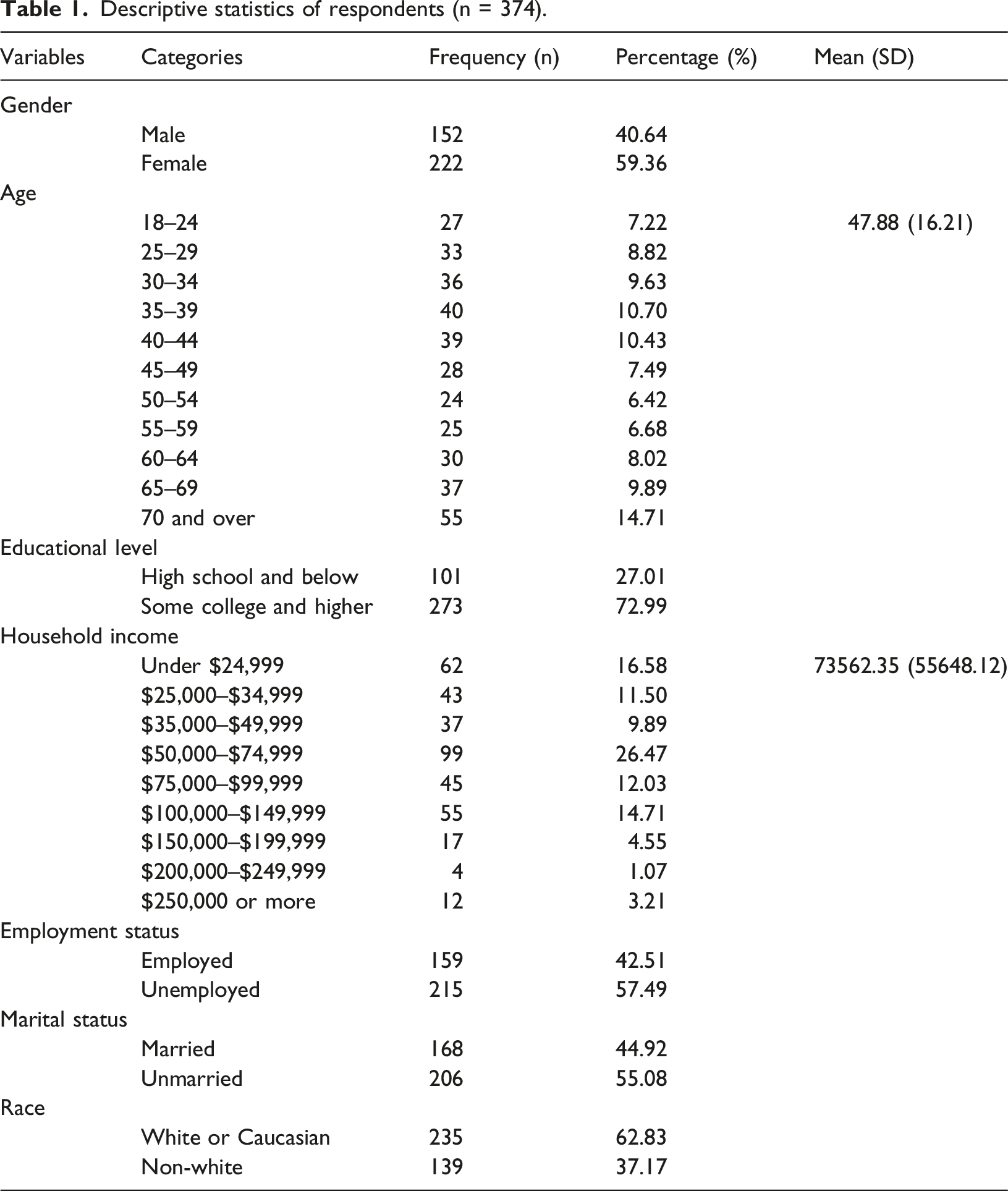
These variables were included in robustness checks to assess whether the core attitudinal and demographic effects remained stable. In addition, respondents are more likely to be female, to have some college education or higher, and to fall into middle- and upper-income brackets. To address the potential influence of these sampling differences, key sociodemographic variables such as age, gender, income, education, employment status, and marital status were included as control variables in the models.
Analytical strategy
This study employed a combination of logistic regression, structural equation modeling (SEM), and multinomial logit (MNL) models to examine agritourism participation and WTP for locally produced food.
Logistic regression for agritourism participation
To estimate the probability of participating in agritourism activities, a binary logistic regression model was employed. The dependent variable, participation, was coded as 1 if a respondent reported engaging in any agritourism activity and 0 otherwise. Logistic regression is appropriate in this case because the outcome is dichotomous, allowing for the estimation of log odds of participation as a function of individual characteristics and behavioral drivers.
The model was specified as:

Binary logistic regression was applied because the dependent variable is dichotomous (participation vs non-participation). The model was estimated using maximum likelihood estimation (MLE), which ensures efficient and unbiased parameter estimates. Results are presented as odds ratios, allowing for straightforward interpretation of the relative influence of each predictor on agritourism participation.
Structural equation modeling for willingness to pay
Structural Equation Modeling (SEM) was applied to investigate the attitudinal and demographic drivers of WTP for locally produced food, with emphasis on the mediating role of consumer attitudes. SEM is suited for this analysis because it simultaneously estimates a measurement model, which links latent constructs to their observed indicators, and a structural model, which specifies relationships between constructs. Latent constructs included environmental concern, health awareness, personal image, and perceived product quality.
Validity was assessed through Confirmatory Factor Analysis (CFA). Indicators with standardized loadings above 0.50 were retained, confirming that each adequately represented its latent construct. Internal consistency was supported by composite reliability values above the 0.70 threshold. The general form of the measurement model is:

The structural model specified the relationships among latent constructs, demographic covariates, and WTP. Attitudes were modeled as an endogenous construct influenced by environmental concern, health awareness, personal image, and product quality. Attitude, along with demographic variables, explained variation in WTP. The relationships can be expressed as:


The SEM model was estimated using Maximum Likelihood Estimation (MLE) based on the covariance matrix of observed variables. Model fit was assessed using multiple indices. The Root Mean Square Error of Approximation (RMSEA) and Standardized Root Mean Square Residual (SRMR) values below 0.08 indicated acceptable fit, while Comparative Fit Index (CFI) and Tucker–Lewis Index (TLI) values above 0.90 suggested good model fit. These results confirmed that the specified SEM adequately represented the data and provided a robust framework for testing the hypothesized relationships.
Multinomial logit model for WTP segmentation
To identify the factors influencing WTP for locally produced food, a Multinomial Logit (MNL) model was employed. The MNL framework is appropriate because WTP was classified into three unordered categories: Low WTP (0%–5% premium), Medium WTP (10%–20% premium), and High WTP (25% or more). The Low WTP group served as the reference outcome, and the model estimated the relative likelihood of individuals being classified into the Medium or High WTP categories. This approach captures the heterogeneity in consumer preferences by linking sociodemographic and attitudinal predictors to categorical WTP outcomes.
The MNL model is specified as follows, based on the formulation by Greene (1997) and Long (1997), the probability that individual i selects WTP category j is expressed as:

The MNL model was estimated using Maximum Likelihood Estimation (MLE), which provides consistent and efficient parameter estimates. Model adequacy was assessed using the Akaike Information Criterion (AIC), Bayesian Information Criterion (BIC), and likelihood ratio chi-square tests. Lower AIC and BIC values indicate better relative model fit, while the chi-square statistic evaluates whether the predictors jointly improve model explanatory power.
This specification allows for an examination of how consumer attitudes, motivations, and demographic factors jointly shape segmentation into higher WTP groups relative to the baseline. The use of MNL is suited for this study because WTP categories are treated as unordered, and the model does not impose the restrictive proportional odds assumption inherent in ordered logit models. This use of MNL is consistent with prior applications in tourism and consumer behavior research (Varghese et al., 2024), further supporting its suitability for analyzing WTP in this study.
To facilitate interpretation and comparability across predictors, continuous variables (age, household income midpoint, motivation, participation barriers, and social constraints) were standardized prior to estimation (mean = 0, SD = 1). This transformation allows coefficients to be interpreted as the effect of a one-standard-deviation change in the predictor on the outcome, rather than raw unit changes. Logistic regression results were further summarized using average marginal effects (AMEs), providing a more intuitive interpretation of how standardized predictors influence the probability of agritourism participation. In the SEM framework, standardized predictors ensured that estimated path coefficients could be compared directly in terms of relative magnitude and effect size.
Results
Descriptive statistics of respondents
Descriptive statistics of respondents (n = 374).
Determinants of agritourism participation
Logistic regression analysis of agritourism participation.
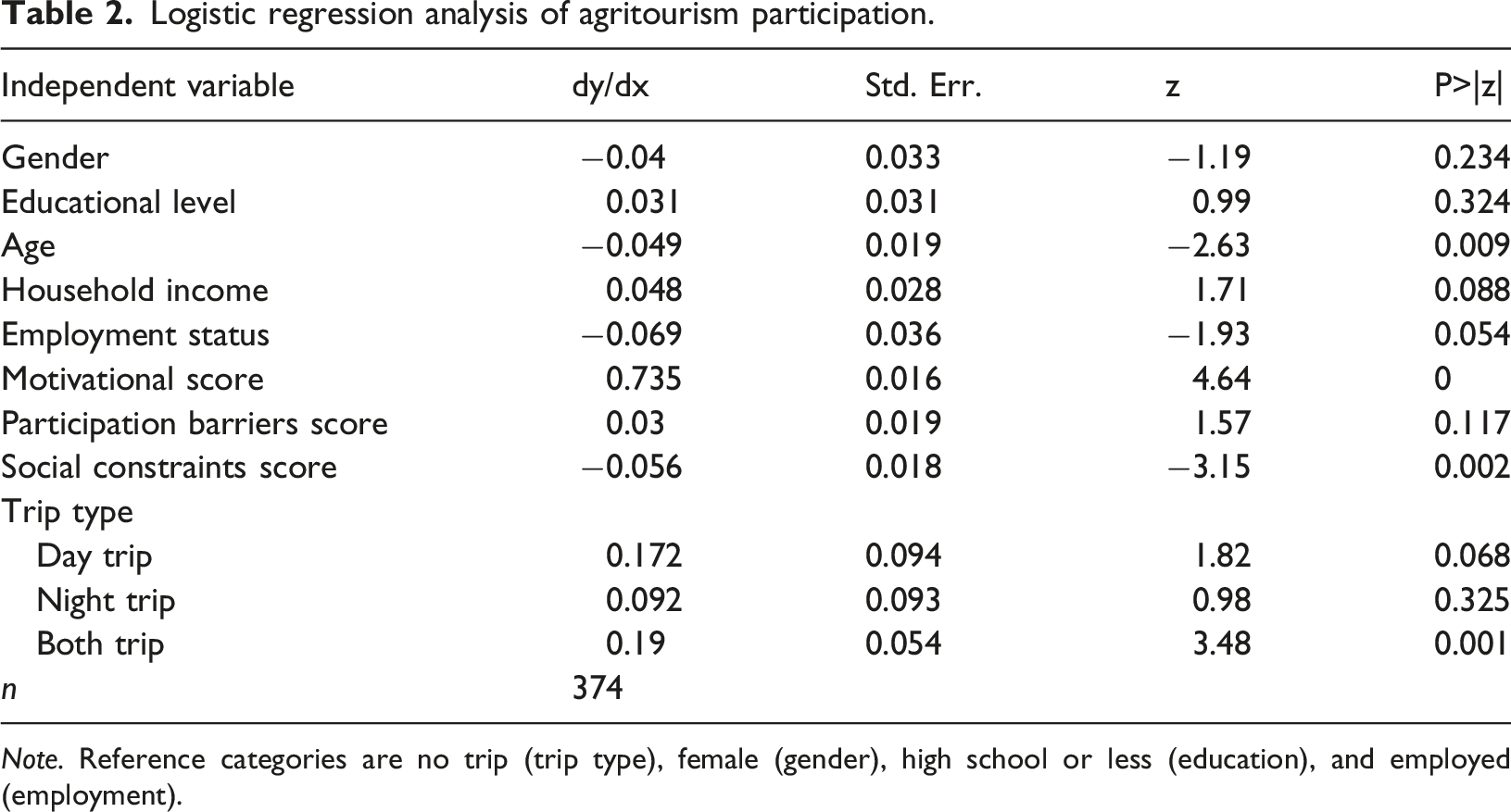
Note. Reference categories are no trip (trip type), female (gender), high school or less (education), and employed (employment).
The results showed that age had a significant negative effect, indicating that older individuals were less likely to participate in agritourism (β = −0.049, p < 0.01). In contrast, household income was positively associated with participation (β = 0.048, p < 0.10), suggesting that individuals with higher incomes were more likely to engage in agritourism. Employment status showed a marginally negative effect (β = −0.069, p < 0.10), indicating that unemployed individuals reported a higher likelihood of participation. Individuals who were not employed, including retirees and those with more flexible schedules, tend to show higher participation compared to those in active employment.
Motivation score emerged as a significant predictor of agritourism participation (β = 0.735, p < 0.01), indicating that individuals with stronger pull-based experiential motivations were more likely to engage in agritourism activities. This construct, which aggregated desires for scenic landscapes, rural exploration, and cultural amenities validates the importance of destination attributes.
Participation barriers were expected to discourage engagement; the results indicate that this index was not statistically significant (β = 0.03, p = 0.117). This suggests that structural constraints, such as distance to farms, transportation limitations, inadequate facilities, lack of modern amenities, and perceived visitation costs, did not significantly deter engagement. Social constraints, however, had a negative and statistically significant effect on participation (β = −0.056, p < 0.01). This indicates that interpersonal dynamics, such as limited interest from family or friends, difficulty securing travel companions, and concerns about acceptance in rural settings, influence participation decisions. Individuals without companions or encouragement are less likely to visit agritourism sites.
Structural equation modeling results
A Structural Equation Model (SEM) examined how latent constructs such as environmental concerns, health awareness, personal image, and product quality influence consumer attitudes toward locally produced food and, in turn, shape their WTP. The reliability tests indicated that all latent constructs demonstrated acceptable to good internal consistency (Cronbach’s α ranging from 0.705 to 0.787), supporting their measurement validity. Model fit statistics showed that the SEM achieved an overall acceptable fit to the data (χ2(56) = 140.55, p < 0.01; RMSEA = 0.064; SRMR = 0.037; CFI = 0.946; TLI = 0.899), relying on the threshold by Hu and Bentler (1999), suggesting that the hypothesized structure was reasonable for interpreting the relationships.
The results show that attitude toward locally produced food is a key determinant of WTP (β = 0.789, p < 0.01), confirming their mediating role in the behavioral mechanism. This suggests that consumers with more positive attitudes toward local food are more willing to pay for it. Among sociodemographic variables, age exhibited a significant negative effect on WTP (β = −0.216, p < 0.05), indicating that younger respondents were more likely to pay for local products. Employment status also had a positive and significant influence (β = 0.534, p < 0.01), indicating that employed individuals were more willing to pay, due to their greater purchasing power. Gender (β = 0.301, p < 0.10) was marginally significant, suggesting a weak association with WTP and indicating that WTP does not differ between male and female consumers. Education (β = 0.335, p < 0.10) had a positive but only marginally significant effect on WTP, suggesting that higher educational attainment may increase awareness of sustainability, health, and food quality attributes that encourage support for local produce.
Structural equation modeling estimates for WTP.
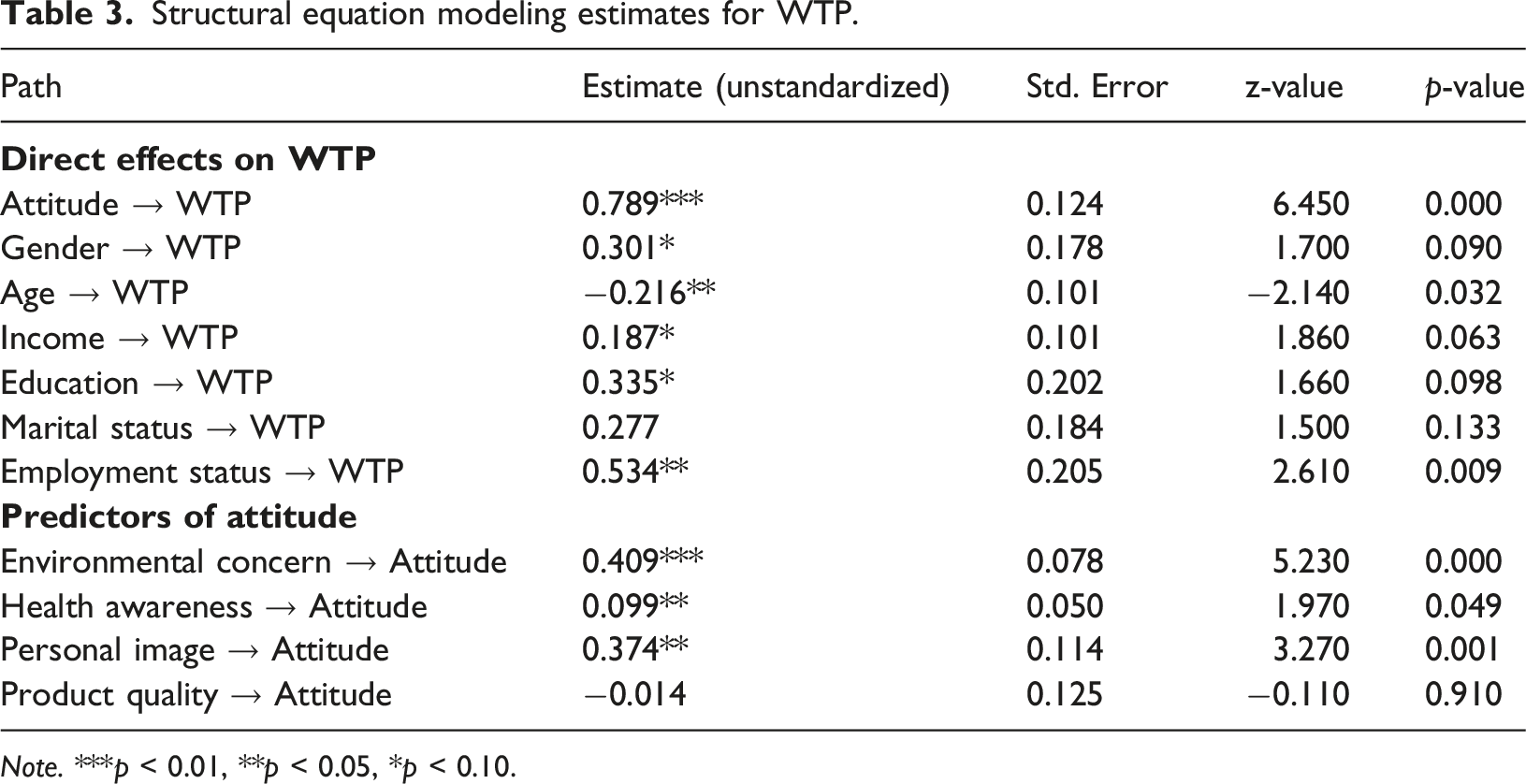
Note. ***p < 0.01, **p < 0.05, *p < 0.10.
Multinomial logit results for WTP segments
About half of the respondents (50.5%) were classified as low WTP, indicating that they were either unwilling or only willing to pay up to a 5% premium. Another 34.8% fell into the medium WTP category, indicating a moderate WTP between 10% and 20% more, while 14.7% were in the high WTP group, showing a readiness to pay 25% or more. These results suggest that although most consumers are price-sensitive, a large minority expresses moderate to strong WTP premiums for locally produced food.
Multinomial logit regression estimates for WTP categories.
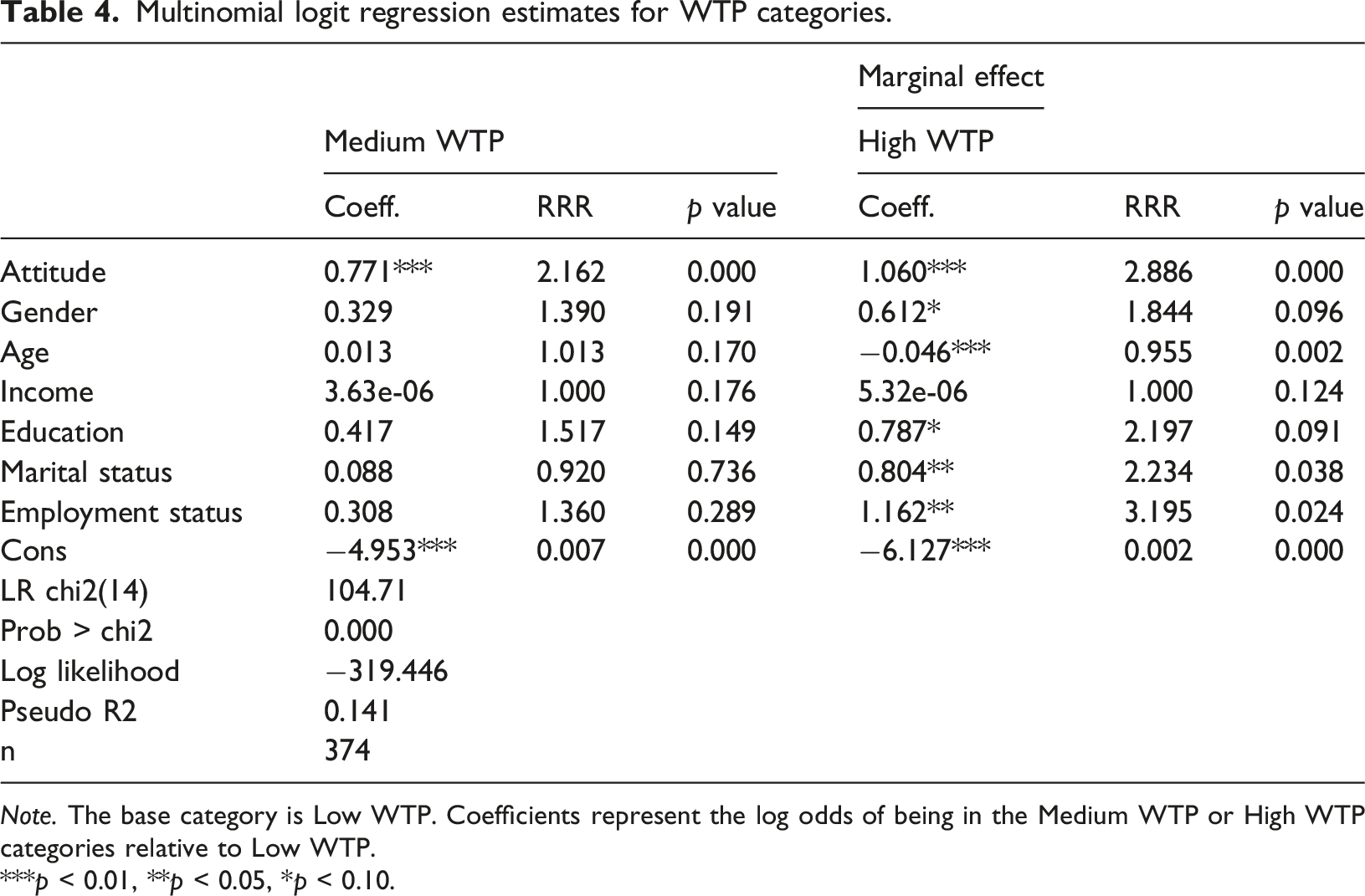
Note. The base category is Low WTP. Coefficients represent the log odds of being in the Medium WTP or High WTP categories relative to Low WTP.
***p < 0.01, **p < 0.05, *p < 0.10.
For the medium WTP group, attitude toward locally produced food was the only significant predictor: a more favorable attitude increased the likelihood of being in this group rather than the low WTP group (RRR = 2.162, p < 0.01). Sociodemographic factors such as gender, age, income, education, marital status, and employment showed no significant effects.
For the high WTP group, attitude again had a strong positive effect (RRR = 2.886, p < 0.01). Gender (RRR = 1.844, p < 0.10), education (RRR = 2.197, p < 0.10), marital status (RRR = 2.234, p < 0.05), and employment (RRR = 3.195, p < 0.05) also positively influenced high WTP, while age had a negative association (RRR = 0.955, p < 0.01), indicating younger, educated, and employed individuals are more willing to pay. Income remained insignificant.
Overall, attitude is the strongest driver of WTP, with demographics playing a secondary role. These findings suggest marketing and policy efforts should target younger, educated, and employed consumers who already hold favorable views of local food.
Discussions
Conclusions
This study integrates two related stages of the agritourism consumer journey: participation in agritourism activities and the subsequent WTP a premium for locally produced food. The findings reveal a sequential behavioral pattern in which sociodemographic and motivational factors influence participation, while core psychological values (environmental concern, health awareness, and personal image) shape attitudes that drive the economic valuation of local food.
Pull motivations, captured through the motivation score and reflecting interest in scenic landscapes, rural exploration, and farm-based attractions, emerged as the strongest predictor of agritourism participation, validating the pull dimension of the push-pull framework and aligning with Flanigan et al. (2015). Structural participation barriers such as distance and limited amenities were not significant predictors, suggesting that for this sample, the motivation to visit overcomes logistical constraints. Social constraints, however, significantly deterred participation, indicating that agritourism is a shared leisure experience whose value depends on the presence of willing companions, consistent with Choo and Petrick (2014). The finding that younger individuals are more likely to participate contrasts with Govindasamy and Kelley (2014), who observed higher engagement among older demographics, suggesting that the agritourism market may be shifting toward younger, experience-seeking consumers. Demographic factors including age, education, marital status, and employment status play meaningful roles in participation, while household income exerts only limited influence.
Regarding WTP, the SEM results confirm that attitude functions as the primary mediating mechanism between belief constructs and premium valuation. Environmental concern, personal image, and health awareness were identified as the principal drivers of favorable attitudes toward locally produced food. Perceived product quality, however, was not a significant predictor, diverging from the broader local food literature in which taste and freshness are typically primary WTP drivers (Feldmann and Hamm, 2015). This suggests that agritourists assign value to local food for symbolic, ethical, and wellness-oriented reasons rather than physical product attributes. The multinomial logit analysis further demonstrates that younger, educated, and employed consumers are more likely to fall into medium and high WTP categories, although household income itself does not differentiate WTP groups, this suggests that willingness to pay is driven more by attitudes than by economic factors in this context.
Theoretical implications
The study makes several theoretical contributions to the agritourism literature. First, it extends the TPB to WTP as an outcome variable, advancing beyond the behavioral intention focus that has prevailed in agritourism research. Existing TPB-based agritourism studies have primarily examined intentions to visit a farm or purchase local food (e.g., Dedeoğlu et al., 2022; Shin and Hancer, 2016). The present study demonstrates that attitude, shaped by environmental concern, health awareness, and personal image, functions as the mediating mechanism linking to premium WTP as well as agritourism participation. This distinction is important, as visit intention and WTP represent distinct behavioral outcomes. The study therefore establishes that attitudinal formation is economically consequential.
By decomposing attitude into its antecedent belief components, the study operationalizes the expectancy-value basis of attitude formation consistent with the TPB’s theoretical foundations (Ajzen, 1991). This approach identifies which specific beliefs are most productive in an agritourism setting, with environmental concern and personal image emerging as stronger attitude drivers. This finding connects to the work of Dedeoğlu et al. (2022), who demonstrated that as tourists’ sense of responsibility increases, they are more influenced by social approval to eat locally. This study expands understanding how environmental and identity-oriented belief specifically activate attitudinal mechanism in the context of agritourism.
The non-significance of perceived product quality offers an important theoretical insight. In agritourism setting, consumers may evaluate products less on physical attributes and more on value-based considerations. This contrasts with findings from the broader local food literature, where taste and freshness are usually key drivers of consumers’ WTP premium prices (Feldmann and Hamm, 2015). A plausible explanation lies in the direct interaction between producers and consumers. This perspective is consistent with evidence that agritourism facilitates direct interaction between producers and consumers, conveying richer information about quality attributes and building trust that can substitute for conventional quality signals (Domi and Belletti, 2022; Grillini et al., 2025).
Lastly, the integration of push-pull theory with the TPB and WTP models provides a more comprehensive behavioral framework for agritourism consumer research than either model offers individually. Push-pull theory explains motivational antecedents and destination selection, while the TPB clarifies how attitudes formed through farm visits translate into behavioral outcomes. Agritourists’ motivations influence outcomes differently depending on whether the result is visitor satisfaction, attraction loyalty, or destination loyalty (Leo et al., 2021). This suggests that motivational and attitudinal processes unfold across multiple stages of the consumer journey rather than at a single decision point. The findings of the study also align with Schmidt et al. (2023), who argued agritourism and direct-to-consumer sales reinforce each other, helping explain why farms that offer agritourism activities often achieve stronger local food marketing revenues.
Practical implications
The findings of the current study provide insights for agritourism operators and relevant stakeholders seeking to strengthen markets for locally produced food. Marketers should foreground experiential features, such as scenic landscapes and on-farm culinary activities, to associate with intrinsic motivations and increase participation. Younger adults and those with fewer time constraints, such as retirees or individuals not currently employed, are more likely to participate; motivation is a strong driver, while social constraints deter engagement. Household income relates to participation only marginally, suggesting outreach should emphasize experience and companionship, including family and friends packages rather than price alone.
Creating favorable attitudes is critical because attitude serves as the psychological bridge that transforms a recreational visit into economic support. The results indicate that consumers do not pay premiums for local food in isolation, but for the values and identity that the food represents including sustainability, health, and personal image. Thus, whether a farm visitor becomes a paying customer depends largely on whether the visit reinforces these values. Agritourism operators should prioritize customer service focusing on creating positive experience, while emphasizing the ethical, health-related, and identity attributes of their products, such as sustainability, local origin, and wellness, rather than focusing solely on physical quality. Given that high WTP is also associated with being younger, more educated, married, and employed, while household income itself is not a significant predictor of WTP, marketing efforts should target their groups through channels and messages that match their values and lifestyle preferences. Digital marketing campaigns emphasizing health and environmental benefits, for instance, can effectively influence younger and educated consumers who prioritize sustainability and wellness (Orea-Giner and Fusté-Forné, 2023).
Limitations and future research
Although this study provides new evidence on agritourism participation and WTP, several limitations constrain the generalizability of findings. The use of cross-sectional, self-reported survey data restricts the ability to establish causal relationships. Given the complex nature of decision making in tourism, these conventional measures may oversimplify the underlying cognitive and behavioral processes (Torquati et al., 2017). In addition, potential endogeneity between attitudes and WTP must be acknowledged. Attitudes may be influenced by the same demographic and experiential factors that also influence WTP. Therefore, future studies could employ longitudinal or experimental designs to rigorously test causal relationships and address endogeneity issues.
Because the data were collected from an online panel of adults in Georgia, USA rather than from a probability sample of all agritourism visitors, caution is warranted when generalizing the findings. The online-based survey method may systematically underrepresent individuals without reliable internet access who nevertheless participate in agritourism. Also, out-of-state tourists who visit Georgia’s agritourism are not captured in this sample, limiting insights into visitor diversity.
Consistent with patterns commonly observed in agritourism and food surveys, respondents in this study were more often female, more educated, and from middle- and higher-income households. While sociodemographic controls were included in all models to mitigate this, the findings are best interpreted as describing relationships among more engaged agritourism consumers rather than the general population. Future research using stratified or probabilistic sampling methods would strengthen external validity and provide more comprehensive understanding of heterogeneity in agritourism participation and WTP across diverse consumer segments.
Footnotes

Funding
The authors received no financial support for the research, authorship, and/or publication of this article.
Declaration of conflicting interests
The authors declared no potential conflicts of interest with respect to the research, authorship, and/or publication of this article.