







Abstract
The possibility of relatively anonymous communication involving no physical proximity means that Internet discussion forums offer opportunities for cross-gender communication that do not necessarily violate Saudi Arabian rules for behavior. This article studies participation in a public discussion forum for expatriate Saudi students. Building on a previous article that established the extent to which participants disclose their gender in the forum, it investigates the extent to which participants take advantage of the opportunity for mixed communication online, their attitudes towards it, and their reactions when it occurs. It analyzes in detail the cross-gender exchanges that occur in the corpus, together with remarks made by participants about this issue, in order to determine the circumstances under which mixed communication is seen as appropriate in this forum.
Keywords
Introduction 1
Gender segregation in Saudi Arabian society extends to almost all aspects of private and public life: banks and universities have separate entrances for men and women; restaurants and public transport are segregated; and unrelated men and women are forbidden from communicating socially. Where such exchanges are avoidable, for example, in professional contexts, they are expected to be kept to a minimum (Al-Lily, 2011; Baki, 2004).
In this cultural context, participation in public Internet discussion forums is of particular interest, for such forums enable largely anonymous communication without visibility or physical proximity (Al-Saggaf, 2012; Al-Saggaf and Williamson, 2004). This raises questions about the kinds of online communication possible and acceptable in Saudi culture. Unlike the clear rules enforced in the face-to-face context, the conventions of online communication continue to represent a gray area of permissible behavior, with Islamic scholars still debating the appropriateness of male–female communication in such a situation (Al-Saggaf and Weckert, 2004).
In some contexts, electronic communication is seen as an acceptable alternative to face-to-face contact in a physical setting. Pharaon (2004) notes, for example, that the Internet enables Saudi women to do business online without having to meet male customers in person. Similarly, there is wide acceptance of the appropriateness of videoconferencing and electronic discussion as a method of instruction in universities in Saudi Arabia (Albalawi, 2007; Almalki, 2011; Al-Saadat and Afifi, 1990), the United Arab Emirates (Naaj et al., 2012), and Kuwait (Al-Fadhli, 2008). This typically allows communication between male instructors and female students or between an instructor and both a men’s class and a women’s class simultaneously. Such an arrangement is however less accepted at primary and secondary school level, where e-learning is modified to limit interaction between male and female pupils, while permitting interaction between pupils and tutors of the opposite sex (Almalki and Williams, 2012; Mohamed et al., 2008).
The potential anonymity of Internet communication is said to provide women with opportunities to circumvent gender restrictions imposed by conservative societies (Pharaon, 2004; Sharif and Al-Kandari, 2010), which is not universally welcomed. In interviews with Saudi Arabian forum participants, Al-Saggaf and Weckert (2004), Al-Saggaf (2004), and Al-Saggaf and Begg (2004) identified positive effects of Internet anonymity, including participants thinking more flexibly, and becoming more mindful of social diversity, less inhibited about the opposite gender, and more self-confident (cf. Al-Fadhli, 2008). On the other hand, they also noted negative effects, which included contravening cultural values and feeling less constrained by social standards of language and behavior.
Various researchers identify significant use of chat (Pharaon, 2004; Sait et al., 2007; Simsim, 2011) and discussion forums (Sait et al., 2007) among the Saudi population, particularly among young users, and several remark on the avenue for cross-gender communication made available by the Internet in Saudi Arabia: Sait et al. note the lack of feasible possibilities for curtailing it, and Pharaon observes that ‘the Internet affords a new, anonymous space for meeting the opposite sex, and the temptation is great’ (2004: 365). Although Teitelbaum notes a press report that young Saudis are eagerly using mixed chat rooms (2002: 234), no clear picture of the extent of mixed communication emerges from scholarly investigations of Internet discussion among Saudi users. Alebaikan and Troudi (2010) focused on only female university students and instructors, and the extent to which Ministry of Education forums were segregated was not explicit in Al-Jarf’s (2006) study of online discussion for teachers. 2 Beyond educational settings, Al-Saggaf’s study of a social forum (2004; cf. Al-Saggaf and Begg, 2004; Al-Saggaf and Weckert, 2004) found that Saudi men and women appreciated the opportunity for cross-gender dialogue, which was said to make the participants feel less inhibited about the opposite gender, but the proportion who took advantage of this opportunity was not stated. More recently, Al-Saggaf (2011) noted a lack of female participants in political online forums.
This article contributes to the understanding of the extent of mixed Saudi online communication where it is available and attitudes toward it. It explores these issues in the context of a public Internet discussion forum for Saudi Arabian students temporarily studying in Brisbane, Australia. Building on a previous article on the disclosure of gender identity in the forum, it investigates the extent to which participants take advantage of the opportunity for cross-gender communication online, their attitudes toward it, and their reactions when it occurs. It analyzes in detail the cases of cross-gender communication that occurs in the corpus, together with remarks made by participants about this issue.
Data and method
Data
The discussion forum of the Saudi Students Association Brisbane is open to public view. Participants are Saudi University students studying in Brisbane, Australia, and their spouses, along with past and intending students. Most of the students are sponsored by the Saudi government through a generous scheme of scholarships. Although the forum is financed by the Saudi Arabian Cultural Mission at the Saudi Embassy in Australia, it has an independent web address, was designed by students, and is administered and moderated by (male) students. The language of the forum is Arabic, although occasionally messages are posted in English. A wide range of topics is discussed.
The research focuses on two subforums: المنتدى العام [the General forum] that is open to all registered participants, and منتدى حواء [the Eve forum] that was created as a women’s space. While all participants have the technical capacity to post messages in both forums, and messages can be read by all, the right to post messages in the Eve forum is understood to be reserved for women. Other subforums are devoted to topics such as education, religion, scholarships, and items for sale; however, there is no forum specifically designed for men. The forum has few explicit rules, none of which mention gender. 3
The data set consists of all postings to the General and the Eve forums during the period March 2005 to July 2008, making a total of 1968 threads (comprising 9818 individual messages). This comprises postings from 133 participants in 1623 threads (8689 messages) to the General forum and from 58 participants in 345 threads (1129 messages) to the Eve forum. The postings from this period have since been archived, and the Eve forum has been superseded (a change discussed later in the article).
Identification of gender of participants
In order to register and post messages, participants provide their e-mail address, age, location, educational level, area of study, and gender and create their own user name and password. Of these elements, only the user name is visible to other forum participants. The forum thus offers the possibility of anonymous communication and of presenting a gender-neutral identity.
4
A separate article (Madini and de Nooy, 2013) details the analysis of the extent to which these possibilities are taken up. Postings to the forum were examined for clues signaling participants’ gender. Such clues were abundant in: user names: ‘Abdullah1’; ابو محمد [Father of Muhammed]; المغتربة [The foreigner (-fem.)]; اميرة الورد [Flower princess] greetings: اخواتي الحبيبات [my beloved sisters] closings اخوكم خالد [your brother Khalid]; اختكم شوكلاتة [Your sister Chocolate] and message content: انا طالب مبتعث Ana taleb mobtath [I am a sponsored student (-masc.)]; لزوجتي [for my wife]; شاكر [thank you (-masc.)].
5
The analysis showed that in the overwhelming majority of messages, the gender of the writer is disclosed. Gender remains unknown in less than 10% of cases, none of which occur in the Eve forum.
It is important to note that the researchers did not question the truth of any personal details given, including gender, unless other forum contributors did so. In their chapter on ‘Virtuality and data,’ Mann and Stewart indicate that although the ‘tendency to deceive might be more associated with CMC [computer-mediated communication] than other forms of communication’ in the public imagination, ‘deliberate deception is unusual online’ (2000: 212). Certainly the researchers cannot guarantee the truthfulness of information given by online participants about their identity or their opinions; however, the same issue arises in all qualitative research where researchers rely on the word of informants. Ultimately, as Mann and Stewart explain, researchers of both online and face-to-face communication need to make assessments about the authenticity of their data and of the ‘candour’ of participants (2000: 212). In the case of Internet forum discussion, the researchers are not alone in making this judgment, because all the participants in the forum are constantly doing the same thing: Any contributors suspected of presenting themselves untruthfully are likely to be challenged within the forum (cf. Hanna and de Nooy, 2009: 119–134). Where posts are accepted as credible by other participants, there is a good reason for the researchers also to accept them as legitimate forum contributions.
Identification of instances of cross-gender communication and discussion of the issue
The identification of the gender presented by the forum participants makes it possible to judge the extent of self-imposed gender segregation where there is the opportunity for mixed online communication and to identify both instances of cross-gender communication and exchanges where a user gives no information regarding their gender identity. The latter are potentially instances of cross-gender communication.
In addition, a search for key words enabled the researchers to identify discussions of cross-gender communication in the corpus. Key words were selected using system thinking (Boyatzis, 1998) and included expressions related to the topic both at the manifest level (directly observable in the information), such as ‘mixing’ [اختلاط], ‘separate’ [منفصل], ‘women only’ [للنساء فقط] and ‘men only’ [للرجال فقط], and at the latent level (underlying the phenomenon), such as ‘men’ [الرجال], ‘women’ [المرأة,النساء], ‘Eve’ [حواء], ‘forum’ [منتدى], ‘the Eve forum’ [منتدى حواء], and ‘the General forum’ [المنتدى العام]. In this way, six exchanges discussing the issue were identified.
Results and analysis
Extent of gender segregation
The analysis of user names showed that a large majority of contributors (74%) choose user names that clearly indicate gender, which alerts other participants to the gender of the writer even before they read the message posted. Making gender obvious from the user name ensures that other participants will be in a position to limit their social contact with the opposite sex. Unambiguously gendered user names are particularly common in the Eve forum (81%), reassuring others that their audience is feminine. Emphasizing femininity in this forum has the effect of discouraging male respondents, even though they may read the exchanges. In comparison, more than a quarter of the user names in the General forum are gender neutral.
Further investigation of message content demonstrated that most participants in the General forum present themselves as men and only eight as women. On the other hand, almost all participants in the Eve forum write as women, and of the five who introduce themselves as men, three contribute in their official capacity as forum moderators (Table 1). Revealing gender in either user name or message content limits the chances of unintended cross-gender communication occurring.
Disclosure of participants’ gender in user name and/or message content.
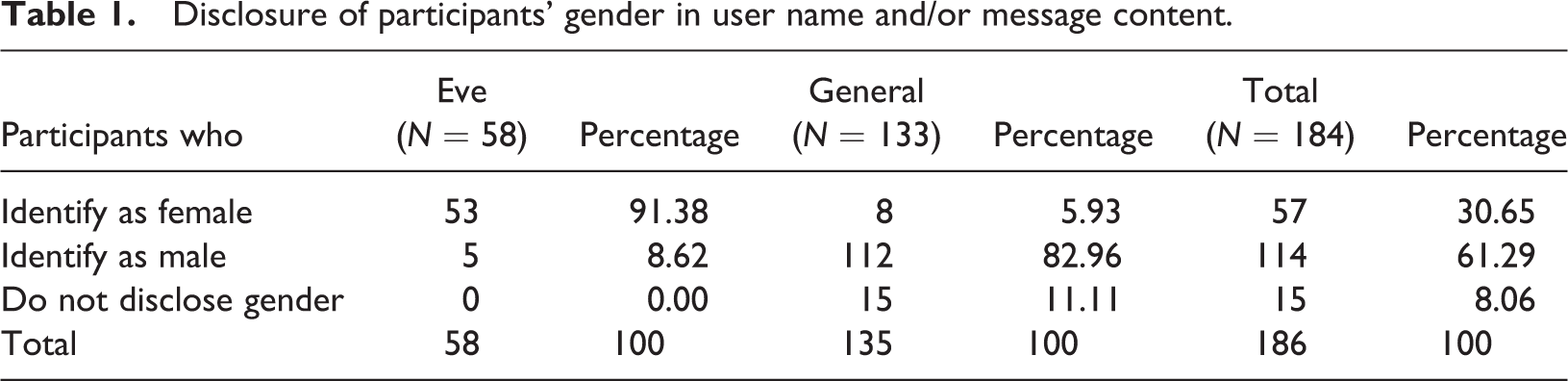
The fact that the General forum admits both men and women participants indicates that mixing online may be socially acceptable in Saudi culture, because it does not involve physical presence. But the fact that it is available does not necessarily encourage cross-gender online communication. Although there are no explicit rules discouraging women from posting in the General forum, very few participants identify themselves as female in that forum, and they only start 7 out of the 1358 threads in that forum. Rather, open participation by women tends to occur in the feminine environment of the Eve forum. The presence of male moderators in the discussion forums, who have the power to edit and delete participants’ messages, may discourage openly mixed communication.
On the other hand, there is a greater occurrence of gender-neutral identity in the General forum than in the Eve forum. These tend to be short messages asking a quick question. Researchers studying communication among university students in the United States and in Scotland have noted that women mask their gender in Internet discussion and user name choice more than men (Jaffe et al., 1999; Miller and Durndell, 2004; Pagnucci, 1999), and this may be the case in the General forum. It is quite possible that some of these messages are posted by women who conceal their gender in order to avoid attracting attention or harassment in a mixed gender environment. In sum, minimal cross-gender communication is apparent in the forums. Unrelated men and women are expected to minimize communication with each other off-line and that expectation seems to transfer to online communication.
Perception of gender-neutral identity
Fifteen participants present a gender-neutral identity, all in the General forum. Although there is no pressure to reveal name, age, marital status, and so on, reactions to their messages show that clues to gender are considered essential in all but the briefest exchanges. When ‘Studious’ requests information about business management courses, and ‘Volcano’ asks where parents can obtain certificates for their children’s Arabic courses, their messages provoke no particular reaction, indicating that when participants request simple impersonal information in the General forum, it is not considered necessary that they reveal their gender.
On the other hand, when participants of ambiguous gender voice opinions, argue, or complain, they tend to attract criticism. For example, when ‘just me’ complains of the forum moderators using his/her private e-mail address without permission, ابو سديم Abo Sadeem comments: ملاحظه / ليش الواحد فينا اذا كان معصب دخل باسم مستعار؟؟؟؟ [Comment/why when someone is angry, does he/she enter with a pseudonym????] (March 18, 2008, 11:03 PM). A similar reaction occurs when ‘green’ discusses the difference between advice and comments (October 18, 2007, 7:30 PM). No such remarks are made about user names such as ‘Mr. no’ or Alb6al [The hero] despite the fact that they reveal little about the identity of the user other than connoting masculinity.
Indicating gender in the forums is expected. It may not matter in a simple request for information, but when opinions and complaints are voiced, participants want to know more about their interlocutor and, in particular, their gender.
Forum discussions of cross-gender communication
In face-to-face communication among Saudi Arabians, the topic of cross-gender communication tends to be avoided because of the risk of generating conflict. The issue is, however, discussed in the online forum for Saudi students on half a dozen occasions during the period studied. Only one of these discussions takes place in the General forum: ابو سعد [Father of Saad], a moderator, posts a survey about whether participation in the Eve forum should be restricted to women only and announces that the survey will be open to participants for the next 5 days (June 9, 2008, 01:32 PM).
The 40 participants who responded were almost evenly divided, as shown in Table 2, with the narrowest possible majority opposed to male participation in the Eve forum. Note that the question of mixed participation in the General forum is not raised, implying that it is already an accepted behavior.
Results of survey initiated by ابو سعد [Father of Saad], June 9, 2008, 1:32 PM.
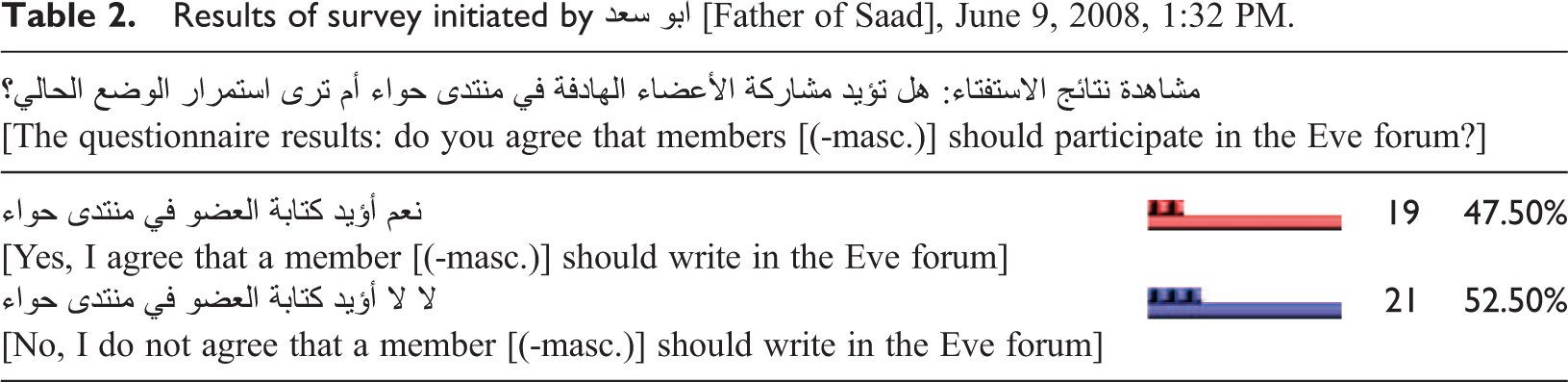
It is not possible to know how many of these votes were cast by men or by women, however eight men 6 posted additional comments on the issue. They show diverse views: three support male participation in the Eve forum, four disagree, and one discusses the expectations raised by the name of the forum.
Those who support the proposal all refer to standards of behavior. Two approve with the caveat that polite behavior is required لا ارى مانع من مشاركة الاعضاء في منتدى حواء شريطة ان يكون هناك التزام بأدب الحوار [I do not mind the participation of members [(-masc.)] in the Eve forum, except that they need to show good manners in their communication]. (ابو رند [Father of Rand], June 9, 2008, 12:13 PM) انا مع المشاركة ولكن بحدود الادب [I am for participation, but only if it is combined with manners]. (فارس Faris, June 9, 2008, 1:18 PM) المنتدى ليس كمثل المنتديات الاخرى المفتوحة والأعضاء هنا معروفين و نحن نحسن الظن بالجميع [This forum is not like other open forums, the members here are known, and we have high expectations
7
of everyone]. (ابو نيروز [Father of Nirooz], June 9, 2008, 1:45 AM) ارى منع الرجال من الكتابة في منتدى حواء وبعدين اخاف ندخل في قضية الاختلاط الالكتروني [I think men should be prohibited from participating in the Eve forum, because I am a bit concerned about the problem of electronic mixing between genders]. (ابو سديم [Father of Sadeem], June 9, 2008, 08:32 PM) لا اؤيد الفكرة خصوصا و المنتدى يحمل اسم حواء يعني منتدى خاص للنساء فقط [I disagree with the idea, especially since the name of the forum “Eve” means for females only]. (تميمي نجد Tamimi Najd, June 10, 2008, 08: 40 PM) اذا كانت الاخت ترى ان سؤالها عام فتضعه في المنتدى العام و اذا كانت تريد الخصوصية فحواء لهن [If the sister sees that her question is general she can put it in the General forum, and if she seeks privacy then Eve is for her]. (ابو انس [Father of Anas], June 10, 2008, 10:00 PM) لا اؤيد مشاركة الاخوان في منتدى حواء وذلك لتشجيع الاخوات في المشاركة [I do not agree about the participation of brothers in the Eve forum because we need to encourage the sisters to participate]. (“Ahmed in Australia”, June 9, 2008, 04:33 PM) المشكلة الرئيسية هي تسمية المنتدى بمنتدى حواء وهو يعطي ايحاء للمرأة بان مشاركاتها ايا كانت لابد ان تقتصر على هذا المنتدى و يعطي ايحاء للرجل بان لا يتعدى اسوار هذا المنتدى [The main problem is naming the forum the “Eve forum” which makes women feel that their participation should be limited to this forum, and also makes men feel that they should not cross the boundaries of this forum]. (June 10, 2008, 06:03 PM)
Rather than supporting or opposing mixed communication, ربما [Maybe] explains that the name of the forum discourages it among both men and women. As we shall see, this name was later changed to a gender-neutral name.
No women comment on the topic of cross-gender communication in the General forum during the period 2005–2008, despite the fact that it affects them directly. The issue was however discussed repeatedly in the Eve forum during the years preceding the poll in the General forum, with debate resurfacing in May 2005, July 2006, October 2007, and March 2008.
In 2005 التائبة [The regretful one] posts a thread under the title ايها الرجال [Men], in which she argues that men should be prevented from participating in the Eve forum: الافضل هو ان يكون هذا المنتدى خاص بالنساء كتابة و ردا للمواضيع [The best idea is to restrict writing and responding to topics in this forum to women only]; ان للرجال ما يخصهم و لنا نحن النساء ما يخصنا [Men have their own issues and we as women have our own issues]. (May 5, 2005, 07:38 PM) ارى ان يكون هذا المنتدى خاص بالمرأة و بكل ما يهمها [I feel that this forum should be private for women only, and all the things that interest them]. (May 5, 2005, 11:59 PM) الحل الانسب هو عدم مشاركة الرجال [The best solution is not to allow men to participate]. (May 11, 2005, 05:18 PM) الذي يريد ان يدخل الى المنتدى يدخل بكل احترام و ادب فنحن في النهاية اسرة واحدة [Anyone who wants to enter the Eve forum should enter with respect and morality because in the end we are one family]. (May 11, 2005, 01:10 PM) نحن اغلب النساء لا نفضل مشاركة الرجال او ردودهم على مواضيعنا [We, most of the women, do not want men’s participations and responses to our topics]. (May 11, 2005, 09:54 PM) اعتقد اني وضحت وجهة نظري بوضوح [I think that I explained my point of view quite clearly]. (May 12, 2005, 12:34 PM)
A year later, ‘Brisbane,’ a male moderator, posts a thread in the Eve forum with the subject line منتدى حواء لحواء فقط [Eve forum is for Eve only], and announces: رأت ادارة المنتدى ان يكون عالم حواء لبنات حواء فقط من باب الحفاظ على الخصوصية [The forum administration feels that the world of Eve should be for Eve’s daughters only, in order to maintain privacy]. (July 20, 2006, 09:52 AM) اي مشترك باستطاعته قراءة المواضيع [Any participant can read the topics] اي خصوصية فنحن في ساحة عامة لن نتحدث عن شيء لا يمكن لفئة معينة قراءته [What privacy, we are in a public space, we cannot discuss anything that cannot be read by others]
Like ابو نيروز [Father of Nirooz] in the General forum, she believes that participants in the forum community would behave appropriately if the forums were mixed. الجميع هنا على درجة عالية من الاخلاق و الاحترام [The people here are highly moral and respectful]. (August 3, 2006, 09:56 AM) اتفق معكي اختي لكن الادارة لها وجهة نظر من خلال خبرات سابقة ورأت ان الافضلية بان تكون المشاركات مقتصرة على حواء فقط [I agree with you sister, but the forum administration has a point of view based on their previous experiences and accordingly sees that it is better for the Eve forum to be for females only]. (August 3, 2006, 11:41 AM)
Another year later, a moderator again feels the need to intervene on this subject. خالد الحربي Khalid Alharbi, a forum manager, posts a message in the Eve forum to thank those who participated in the Eid festival and finishes his message as follows: نرجو من الاخوة الرجال احترام قرار النادي في تخصيص منتدى حواء لحواء والأمر بذلك بالأخوات في عدم مناقشة الامور النسائية في المنتدى العام [We hope that our male participants will respect the forum decision about restricting the Eve forum to women, and also that our sisters will respect it by not discussing any feminine topics in the General forum]. (October 16, 2007, 06:14 PM)
In 2008, ندى الفجر [Morning dew] adds to the thread from 2006 and thereby continues the debate. She complains about Brisbane’s thread and questions his posting under the title منتدى حواء لحواء فقط و احترموا الخصوصية [Eve forum is for Eve only and respect privacy]: لماذا اختار الرجال بان يكون منتدى حواء للنساء فقط و من له الاحقية في حذف المشاركات الرجالية من المنتدى ومن غير اذن النساء؟ [Why do men determine the Eve forum to be a female only environment, and who has the right to delete any post written by men in the Eve forum without women’s permission?]. (March 1, 2008, 08:22 PM) عندما تشارك المرأة في المنتدى العام فهي لا تحصل على اي قدر من الحرية او التشجيع من جانب الرجال بل انها تكون هدفا للمهاجمة وهو ما يؤثر على مصداقيتها [When a woman participates in the General forum (a mixed environment), she does not have much freedom or encouragement from the men’s side, but instead she can be the target of attacks and assaults which challenge her sincerity and authenticity]. (March 24, 2008, 1:10 PM), عندما تشارك المرأة في المنتدى العام تصبح مسؤولية النساء الاخريات الدفاع عنها من هجمات الرجال وهو ما يؤثر على حريتها و اختيارها للمواضيع [When a woman participates in the General forum other females assume that their responsibility is to protect that woman from men’s attacks, which can affect the woman’s liberty and choice of topics]. (March 24, 2008, 1:10 PM).
Interestingly, participants do not discuss the issue with the opposite sex in the forums, except when Cinnamon directly challenges the moderators’ decision. On the other hand, since men can read the Eve forum messages, a certain amount of ‘eavesdropping’ on women’s conversations must occur, which constitutes a form of indirect communication between the genders. Indeed, Cinnamon’s statement quoted earlier that participants in the Eve forum ‘cannot discuss anything that cannot be read by others’ raises the possibility that women may use the Eve forum to communicate their opinions to men without addressing them directly. Men may be reluctant to reply or even to refer to conversations in the Eve forum, since they cannot readily admit to reading the messages posted there. The fact that men scarcely participate in the Eve forum does not, however, mean that they are unaware of the discussions that take place there.
A further discussion of cross-gender forum communication occurs when the controversial topic of Saudi women driving is discussed. Saudi Arabia is the only country in the world where women are not permitted to drive. After a number of men present their (conflicting) views on the question in the General forum, the need for women to air their views is raised. الكراني Alkarani suggests that women should express their opinions in the Eve forum: يا جماعة النساء فيهم المثقفات و المتعلمات وهم اجدر منا بمناقشة احتياجاتهم كما اتمنى ان يفتح الموضوع هذا في منتدى حواء لمناقشته [Hey people, there are some intelligent and educated women who have the right to discuss their own needs, and I hope that this topic will be open in the Eve forum for discussion]. (November 11, 2007, 05:07 PM). ليس هناك ما يمنع من ان يناقش الموضوع هنا و من ارادت من الاخوات الكريمات الادلاء بدلوها في الموضوع فعلى الرحب و السعة [There is nothing to prevent this topic from being discussed here and if one of our generous sisters wants to give her opinion on this topic she is quite welcome]. (November 12, 2007, 05:15 PM) هناك الكثير من النقاش و الجدل بين مؤيد و معارض و اشكر جميع من شارك برئيه في هذا الموضوع فانه تقرر اغلاق الموضوع [There is a large amount of debate and conflict which varies from agreeing to disagreeing and I thank everyone who participated by giving an opinion on this topic, therefore we decided to close the topic]. (November 12, 2007, 08:27 PM)
Cases of cross-gender interaction in the forums
In the Eve forum, the only male contributors other than moderators are العطشان [Thirsty] and متردد [Hesitant]. العطشان [Thirsty] asks where he can buy an abaya [woman’s over-garment] suitable for wearing in Australia (August 5, 2006, 12:34 PM), while متردد [Hesitant] seeks information in order to apply for a scholarship for his wife (February 4, 2007, 8:43 AM). In other words, they request information on behalf of their wives. Cinnamon replies to العطشان [Thirsty] with the name of a shop and adds that most of the Saudi shops that sell abayas would be able to help (August 2006, 4:45 PM). The reply is brief and remains strictly on topic. Despite the scruples suggested by the user name متردد [Hesitant], none of the Eve forum participants respond to his message.
In the General forum, on the other hand, there are eight participants who openly identify themselves as women. Seven start a new thread with their post and one posts a message as a reply. As we shall see, their purposes differ.
دانه الامورة [Cute Dana] requests practical information about studying English in Australia universities and reveals some personal information in her message, including her gender (دانه Dana is a woman’s name), her educational background (عندي بكالوريوس في اللغة الانجليزية [I have a bachelor’s degree in English language]), marital status (متزوجة [married]), and number of children (لي ثلاث اطفال [I have three children]) (December 11, 2007, 11:39 AM). In response, men show support and offer help: اخت دانه حبيت اقلك ان استراليا تشجع على الدراسة و خاصة للنساء اللي يحافظون على حجابهم [Sister Dana, I’d like to tell you that Australia encourages studying especially for those women who wear the hijab]. (حميدي Hamidi, December 11, 2007, 01:52 PM) ممكن ادلك على مكتب في الرياض يساعدك على ايجاد القبول وهذا عنوانهم [I can guide you to an office in Riyadh that can find you an offer, and this is their address]. (فوزان Fozan, December 15, 2007, 04:10 PM)
ام ريو [Mother of Rio] requests suggestions for employees who want leave of absence to study abroad without losing their jobs. She too introduces herself by mentioning her marital status and number of children (December 4, 2006, 09:29 AM). As in the previous case, men respond with messages of support and assistance: الله ييسر امورك [Allah ease your situation]. (ابو لانا [Father of Lana], December 4, 2006, 2:36 PM) اعتقد انه بإمكانه ان يأخذ اجازة للدراسة من غير مرتب [I think he (Mother of Rio’s husband) can take leave without pay]. (ابو يزيد [Father of Yazeed], December 4, 2006, 06:20 PM) اكثري من الدعاء بان ييسر الله لك الخير [Increase your prayers to Allah, may Allah ease the way that is best for you]. (ابو انس [Father of Anas, December 6, 2006, 09:45 AM)
As well as the men who respond, ‘Malak’ [Angel] (woman’s name), replies, suggesting that she should not travel unchaperoned: انصحك ما تجي لوحدك من غير زوجك [I advise you not to come alone without your husband]. (December 4, 2006, 09:48 PM)
Finally شروق [Sunshine]
8
posts a suggestion in the General forum: ماذا عن فكرة ملتقى سعودي لتعلم اللغة الإنجليزية [What about a Saudi forum for learning the English language]. (August 29, 2008, 8:30 AM) شكرا اختي الكريمة سوف يرفع اقتراحك لإدارة المنتدى [Thank you my generous sister. Your suggestion will be raised with the forum management]. (ابو سعد [Father of Saad], August 29, 2008; 12:45 PM)
These messages start threads to request simple information related to either education or the forum itself, and men respond to them with short suggestions or prayers. Malak too restricts her reply to simple advice. Additionally, دانه الامورة [Cute Dana] and ام ريو [Mother of Rio] reveal not only their gender but also their marital status and number of children at the outset of their messages. This enables them to set clear boundaries of interaction and avoid any cross-gender communication that could be interpreted as socializing.
There is also apparent acceptance of another kind of message posted by women in the General forum. البارونة Albaronah (the inflection marking the name as feminine) shares religious knowledge under the thread title لماذا يضع الرسول يده تحت خده وهو نائم [Why does the prophet put his hand under his cheek when he is asleep?] (December 31, 2007, 04:10 PM). Similarly عطر الحنان [Tenderness perfume] shares religious knowledge by posting a picture about two rivers mentioned in the Quran whose different colors do not mix (March 23, 2008, 7:33 PM). These postings are not controversial but disseminate Quranic teaching, a safe topic in Saudi culture, and men respond to them with ritualized phrases: جزاك الله خير [Allah bless you with what is good]. (عامر Amer, December 31, 2007, 06:35 PM) سبحان الله [Allah is great]. (زياد Ziyad, March 25, 2008, 08:46 PM)
However, when a woman’s purpose of participation in the General forum strays from narrow information seeking and the sharing of religious teachings to more general discussion, she can become the target of attacks. ام اية [Mother of Ayah] provides ideas in her message on how men should treat their wives and encourage loving relationships. This, however, attracts scorn: موضوعك اشبه ما يكون للخيال و انا ضد كل ما ذكرتي [Your topic is rather fanciful and I am against all that has been said in your message]. (الباشق Al Bashiq, February 21, 2008, 09:45 AM) هههههه لا خوش رجال [Hahahah, what a man]. (February 21, 2008, 09:45 AM) يا الله يا ام اية على الموضوع الجميل [Oh Allah, Mother of Ayah, that’s a lovely topic]. (ام بنوسة [Mother of Banosah], March 20, 2008, 10:57 AM) الله يسلم هاليدين يا ام اية على كتابة هذا الموضوع [Allah bless your hands, Mother of Ayah, for typing this message]. (ندى الفجر [Morning dew], April 11, 2008, 05:30 PM)
These responses indicate that the didactic style is acceptable among women, but for a woman to use this style with men provokes hostility, doubtless because it is seen as a challenge to their authority. Although ام اية [Mother of Ayah]’s style of participation is consistent in both forums, the reactions she receives are quite different.
There is one example of a woman participating in the General forum in order to complain. التائبة [The regretful one (-fem.)] protests that the moderators have deleted her forum post commenting on مهرجان مرحبا [Marhaba festival]: هذا ينافي ابسط الحقوق في ابداء رائي النسائي [This is against a basic right which is sharing my feminine opinion]. (May 23, 2007, 08:40 AM) كان يجب ان يتم اخبارك ولو برسالة خاصة عن سبب الحذف [You should be told, even by a private letter, about the reason for deletion]. (ابو انس [Father of Anas], May 23, 2007, 08:47 AM) الحذف لا يكون إلا لما يخالف عقيدتنا اما غير ذلك فسوف يفقد المنتدى عنصر حرية التعبير [Deletion should only be for messages that are against our religious values, otherwise it will make the forum lose the freedom to express opinions]. (ربما [Maybe], 23 May 2007, 10:05 AM)
A further message is posted by a moderator, ابو سعد [Father of Saad], who lists reasons why messages are deleted, without specifying why her particular message was removed: هناك تكرار للموضوع [Topic was repetitive] منافي لشروط المنتدى [Against the forum rules] أخطأتي في اختيار العنوان المناسب لهذا الموضوع [Message title was inappropriate]. (May 23, 2007, 09:40 AM)
9
This cross-gender exchange of opinions is possibly deemed appropriate because it relates directly to forum activity and is thus less likely to be interpreted as socializing than an exchange on a current affairs topic, for example.
When we study the rare occasions where women contribute in a visible way to the General forum, we see that responses tend to be brief and confined to information and thanks. Messages requesting information about studying and those sharing religious knowledge are well received, while an attempt to address and advise men directly is derided. Interestingly, a complaint from a woman about the moderators receives support from male participants. This is the closest we find to a cross-gender exchange of opinions or ideas in the forum, however it remains very brief. Exchanges where the gender of a participant is ambiguous may constitute unacknowledged cases of cross-gender communication. However, these messages must remain brief and focused on education-related information or the anonymity is challenged.
Changes to the Eve forum
In August 2009, the name of the ‘Eve’ forum was changed to the ‘Social’ forum, comprising three sections: family, health and nutrition, and kitchen. At the same time, the rule restricting participation to women was lifted. The change created confusion, as men were unsure of their eligibility to participate in this new forum, and some women rejected their contributions: وصلتني شكوه من احد المشاركين يقول اني تخطيت حدودي بالرد على احد المشاركات [I received a complaint from a participant saying that I crossed the line with one of the female participants when I responded to her]. (محمد الموسى Muhammad Al-Mosa, September 23, 2009, 09:30 AM).
The Eve forum had been a lively venue for women to discuss any issues of interest to them, whereas the Social forum was a mixed environment with a limited choice of topics. The name Social is itself problematic, because it could function either as an invitation for men and women to socialize together (a violation of Saudi norms) or as a warning about the possibility of cross-gender communication, so that participants take care to avoid transgressing the limits of acceptable contact.
In replacing a women’s forum with forums on family, health, and cooking, the moderators appeared to stereotype women’s preoccupations. The Eve forum was previously a space for women to negotiate a range of controversial issues in addition to domestic topics. However, after the change to the Social forum, discussion was restricted to the latter. It is not clear whether this was the goal of the moderators but the change certainly affected the range and depth of topics discussed.
After the change, cross-gender communication did occur to a limited extent in the Social forum: A few men posted messages related to family, health, and cooking, but there was no increase in the overall number of postings. One year later, a further change occurred: The Social forum was dismantled altogether and replaced by forums primarily to request or provide information, possibly to eliminate socialization. A close analysis of these changes is beyond the scope of this article, but they are worth noting. It seems that the existence of forums attracting discussion by women, or enabling cross-gender communication beyond professional purposes, is problematic for this Web site.
Conclusion
The analysis demonstrates that although the Brisbane Saudi students’ discussion forums provide opportunities for extensive cross-gender contact, minimal cross-gender communication is apparent. Participants rarely avail themselves of the opportunities for mixed exchanges and instead minimize direct communication with the opposite sex, mirroring Saudi conventions of off-line communication. Although all of the forums are apparently open to women, little female participation is evident beyond the feminine environment of the Eve forum. Segregation is thus largely maintained. On rare occasions where cross-gender communication occurs openly in the forums, it is clear that postings are expected to remain brief and information focused. This parallels the face-to-face environment, where cross-gender communication for professional purposes is more acceptable than that for social purposes.
These findings contrast to some extent with those of Al-Saggaf (2004) whose online interviews with forum participants in Saudi Arabia suggested that they welcomed the opportunity to communicate online with the opposite sex and to overcome their separation. Al-Saggaf’s research focused on interview data and did not attempt to quantify cross-gender communication. Nonetheless he observed that ‘in the online community males and females are discussing their concerns and social problems and together proposing solutions to them’ and several interviewees remark on this dialogue (p. 9). It is possible that participants in the Brisbane Saudi students’ forum appreciate the opportunity for cross-gender discussion, however very few take up that opportunity in a visible way, although they may read postings by the opposite sex (an indirect form of cross-gender communication) and post messages without declaring their gender.
Several reasons for this contrast in findings are possible. Firstly, willingness to communicate online with the opposite sex may be limited by the institutional association of this particular forum: although administered by students, it is financed by the Saudi Embassy. Participants provide some personal information during registration, and the presence of moderators who have the authority to view these details may encourage self-censorship among participants. Secondly, Al-Saggaf’s study involved participants physically located in Saudi Arabia, where cross-gender communication could be seen as exotic or a novelty, and possibly attractive for that reason, whereas the expatriate students of the present study are located in a mixed society where segregated communication may be seen by Saudi students as familiar and reassuring.
Although little cross-gender communication takes place in the forum, the issue of mixed online communication is discussed on several occasions. Opinions vary but are fairly evenly divided. Online forums are thus a space where uncertain social rules can be tested and discussed in a critical way. This is not common in face-to-face communication among Saudis, where there is a clearer consensus about what is appropriate. Moreover, since all messages are accessible to Arabic speakers of either gender, forum postings enable women to deliver their voice indirectly to men, which is an opportunity that is not easily found in face-to-face communication. In these ways, despite comparatively little uptake of direct cross-gender communication, the online forums extend the horizons of mixed communication among Saudi Arabians.