







Abstract
The domination of mass media is exemplified by candidates’ camps attempting to gain media exposure as a top priority of their campaign strategies; however, the popularity of social media has gradually changed this trend. This article used the 2012 Taiwan presidential election to examine the relationship between social media and mass media. By interviewing campaign staffers, journalists, and scholars, this article developed the concept of the candidate’s frame to distinguish from the media frame and employed frame contest to view the interplay. The findings demonstrate that candidates attempted to view their Facebook pages as the headwaters of mass media and intermediation can be broadened under this situation.
Introduction
The use of new media in election campaigns, whether through the use of Web sites, blogs, microblogs, or social media, is widely accepted by candidates who enthusiastically embrace social media due to its usefulness regarding networking. Intriguingly, even though candidates utilized new media or social media in nearly every recent election, it seems as though mass media still played a dominant role in these election campaigns. Whether the use of new media or social media can compete with mass media in election campaigns remains unclear. When discussing the role of social media in election campaigns, two major trends seem to be present: first, the role of social media users (Holt et al., 2013; Woolley et al., 2010) and second, the role of social media and its practitioners. In terms of the second trend, scholars have attempted to explain the popularity of social media (Himelboim et al., 2012), how and why candidates have adopted social media as an election tool (Adams and McCorkindale, 2013; Klinger, 2013; Williams and Gulati, 2012), and the role of social media in campaigning media mix (Skovsgaard and Van Dalen, 2013). Scholars have even tried to examine whether social media can be used as an indicator for election outcomes or political cynicism (Franch, 2013; Hanson et al., 2010). Interestingly, the relationship between the use of social media and mass media in election campaigns has received relatively little attention – the only exception being Broersma and Graham (2011) who investigated the use of Twitter as a source for newspaper coverage of the 2010 British and Dutch elections. Broersma and Graham found that politicians’ tweets became a source for journalists to gather and develop news stories. Existing research still seems to point to the domination of mass media in election campaigns along with the belief that social media lacks the capability to adequately challenge the current situation. The research mentioned above explains part of the relationship between the use of social media and mass media but is insufficient.
Two statistics from the 2012 Taiwanese presidential election are worth noting. First, the number of people who clicked ‘like’ on each of the two main presidential candidates’ Facebook pages: incumbent president Ma Ying-jeou attracted 1,311,887 ‘likes’, while the challenger, Tsai Ing-wen, attracted only 618,260 likes (Facebook.com, 2012). Each Facebook like represents a link between two users, and any updated message is always shared to the user’s newsfeed. The effect of the ability to like a Facebook page, photo, or post allows Facebook to be a type of ‘pull media’ (Maras, 2000). People who liked candidates’ pages could receive messages from candidates automatically. Also, Facebook itself attracts 8 million unique visitors each day in Taiwan (GoogleTrends, 2012), which means that one-third of Taiwan’s population regularly visits Facebook. Since a tremendous number of Taiwanese people use Facebook on a daily basis, and each like helps to convey candidates’ messages, the number of likes on these two presidential candidates’ pages is of some representative importance.
The main advantage of Facebook is that it really achieves the idea of being able to ‘bypass the gatekeepers’ (Bimber and Davis, 2003; Brundidge and Rice, 2009). Yet, from the perspective of winning the election campaign, how to integrate mass media and social media is more important than the actual competition. The traditional method of campaigning is to provide news releases to journalists (Wicks and Souley, 2003). This is because the visibility of new media tools increases with the help of mass media. Furthermore, Klotz (2007) indicates that campaign Web sites provide pre-written letters and encourage net users to send these letters to editors or their friends as plagiarized participation. The interaction involves campaign staffers, ‘netizens’, and editors. The intention to influence mass media is obvious. Intriguingly, mass media can also influence new media tools. New media depends on having mass media content available to discuss (Dustin and Tremayne, 2007). The relationship tends to be that candidates’ use of new media heavily relies on mass media. However, the role of mass media, as an external factor that influences the use of social media in election campaigns, seems to be rarely identified by scholars – especially when the interactions between campaign staffers, netizens, and journalists are involved. Additionally, previous research has shown that mass media has traditionally dominated election campaigns, and the effect of using social media to influence mass media has been limited. Nevertheless, the popularity of candidates’ Facebook pages has created a possibility to change this situation in Taiwan. In light of this, this article proposes the following research questions: Does the increasing popularity of candidates’ Facebook pages change the relationship between social media and mass media in election campaigns? If so, are there any new patterns that emerge from this change?
By studying these research questions, this article attempts to provide a new perspective from which to view the relationship between the use of social media and mass media in election campaigns. Communicative action theory (Habermas, 1984), framing, and frame contest will be discussed in the literature review and will be used to establish a theoretical framework. In-depth interviews with candidates’ staffers, journalists, and scholars are applied to answer the research questions. The findings and discussion will be presented in the fourth section, and the conclusion will immediately follow this section.
Literature review
Being a part of third-wave democracy (Huntington, 1991), Taiwan started holding democratic presidential elections in 1996, and two major political parties have competed for the office of the president since then. These are the Kuomintang Party (KMT), whose Chairman Ma is the incumbent president, and the Democratic Progressive Party (DPP), which ruled Taiwan between 2000 and 2008. The primary candidates in the 2012 Taiwan Presidential election were incumbent Ma Ying-jeou, representing the KMT, and DPP nominee Tsai Ing-wen.
Apart from the political situation, the environment of mass media in Taiwan is competitive. There are seven 24/7 news channels, four major newspapers, and other types of news organizations. Most television channels are commercial, and, according to the World Press Freedom Index (Reporters Without Borders, 2014), the press freedom ranking of Taiwan is 50, which is similar to the United States (47). The government regulations on political campaigns mainly focus on the use of television and radio as election campaigning tools. These regulations require television and radio to treat each candidate fairly. The competition is especially fierce among news channels due to the demand for a large amount of news stories, which creates a niche that allows the interaction between mass media and social media. As a result, it is common to have social media content being produced as news stories on mass media.
Communicative action theory
The networking nature of social media leads scholars to conduct research that mainly focuses on the perspective of the audience (e.g. Erikson, 2008; Holt et al., 2013; Robertson et al., 2009; Valenzuela et al., 2008; Vitak et al., 2009; Woolley et al., 2010; Wu, 2009) and then the perspective of candidates (e.g. Adams and McCorkindale, 2013; Aparaschivei, 2011; Compton, 2008; Macnamara, 2011; Macnamara and Kenning, 2011) when discussing election campaigns. The level of interactivity is stronger in social media than in any other new media tool, and it relies on netizens’ engagement. Hence, scholars focus on the perspective of audience. However, from the perspective of the audience, it is insufficient to examine the use of social media. This is because, in terms of political communication, candidates employ social media more for disseminating information and persuasion than for dialogue (e.g. Adams and McCorkindale, 2013; Klinger, 2013). That said, ‘strategic communication’ (Holbert and Benoit, 2009) plays a significant role in election campaigns. The candidates’ intentions determine the use of social media and the interactions between social media and mass media. However, the befriending nature of social media can reduce the strategic elements of candidates’ social media pages, and it can be deemed as simply an everyday communicative practice. This article attempts to employ Habermas’s communicative action theory (1984) to find an explanation for these complex issues.
Prior to the introduction of the theory, however, the normative nature of communicative action theory should be noted. Communicative action theory is derived from the idea of the public sphere and is usually linked to deliberative democracy that rejects strategic orientation interest struggles (Dahlberg, 2007; Gunaratne, 2006; Kim and Kim, 2008; Wiklund, 2005). Yet, through the formation of communicative action theory, Habermas differentiates strategic action from communicative action. This key differentiation is what allows for the possible interplay between them, which will be discussed in great detail throughout this article.
Habermas (1984) categorizes social actions into two types of action orientations, namely orientation toward success and orientation toward reaching understanding. Orientation toward success could be seen as a strategic action. It is related to a success-oriented reciprocal influence of one another in a purposive-rational manner. Orientation toward reaching understanding, known as communicative action, also has a rational basis. It leads to a process of reaching agreement, through communication, among members of a lifeworld. Communicative actions should be nonpurposive, nonstrategic, and nonsuccess oriented (Haas and Deetz, 2000; Kim and Kim, 2008). Finlayson (2005) explained that, in Habermas’ view, the primary function of speech is to coordinate the actions of agents and provide a conflict-free interaction manner because the meaning of utterance rests on reason. Habermas (1984) elaborates that locutionary acts refer to the surface meanings, whereas illocutionary acts refer to intentions and perlocutionary acts refer to the effect of utterance. All participants pursue illocutionary aims; communicative action can only be established when intentions are identified and accepted. Strategic action can be developed when at least one participant desires to produce a perlocutionary effect. Strategic actions offer an actor an opportunity to calculate the success of the anticipation of decisions on the part of other goal-directed actors.
Communicative action theory was criticized by scholars due to its dichotomous distinctions between strategic and communicative actions; scholars have suggested that people do not follow this rule in real life or political actions (Dahlgren, 2001; Langsdorf, 2000; Plot, 2009). This article views that candidates can either select strategic or communicative actions depending on their calculations when employing social media and mass media; the aforementioned calculation can be seen as a transaction cost that is one of the elements of intermediation.
The concept of intermediation was originally an economic theory that assumed that intermediaries, or middlemen, play a role in reducing transaction costs within an imperfect market (Figure 1). Hess and Walter (2006) employed ‘content intermediation’ to view media content trading, and they deemed media companies as producers and suppliers of media content. With the rise of the Internet, Sarkar et al. (1995) proposed a concept, namely ‘cybermediaries’, to describe how middlemen operated on the Internet. Chircu and Kauffman (1999) identified various types of Internet intermediaries and employed an intermediation–disintermediation–reintermediation cycle (IDR cycle) to evaluate the strategies. Even though these scholars discussed intermediation regarding media and the Internet, their work was conducted mainly from the perspective of producer–consumer relationships and their focus was on goods. This article attempts to adopt intermediation to examine the relationship between candidates, social media, mass media, and voters. In traditional election campaigns, campaign messages are the goods, and mass media can be seen as the intermediary between candidates and voters. Social media allows candidates to reach voters without the intermediation of mass media and, as such, becomes an intermediary. However, not only are social media platforms the intermediaries between candidates and voters, they also serve as intermediaries between candidates and mass media. How candidates select intermediaries is based on their strategic action and skills that rely on the idea of frame contest.
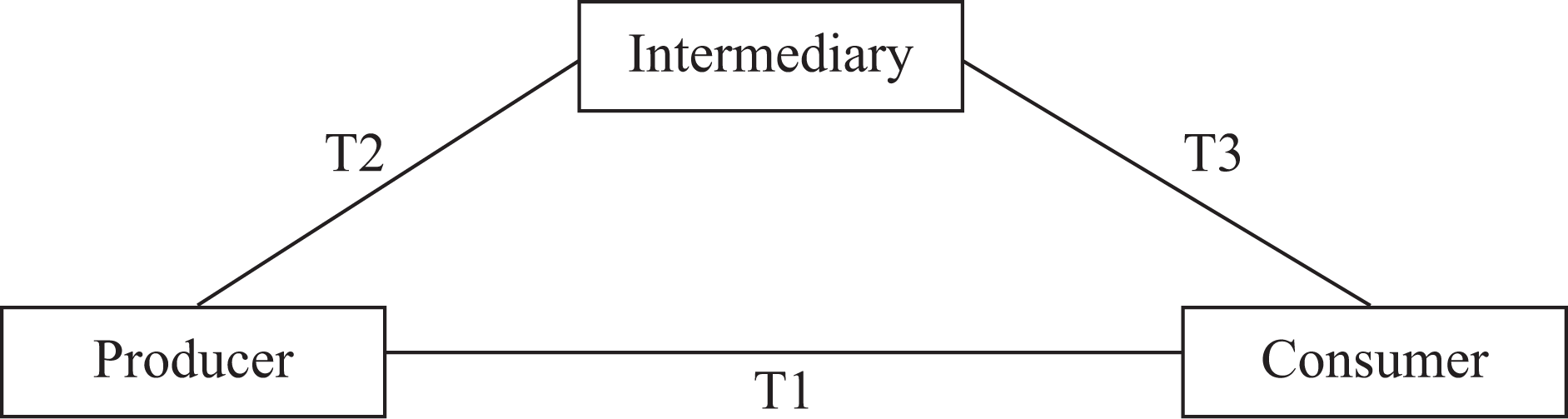
The intermediary between producer and consumer. T1, T2, T3 = transaction costs. T1 > T2 + T3 intermediation; T1 < T2 + T3 direct contact. Source: Hess and Walter, 2006.
Framing and frame contest
Since the visibility of candidates’ Facebook pages relies on mass media exposure, the relationship between candidates’ camps (including the candidate, staff, and the Facebook page) and journalists is crucial. This article adopts ‘framing’ to examine the above interactions, because it allows for a distinction between both cooperative and competitive relationships. The creator of framing, Goffman (1974), proposed the concept of the primary framework, which established the foundation of framing. Entman (1993: 52) states that ‘to frame is to select some aspects of a perceived reality and make them more salient in a communication text, in such a way as to promote a particular problem definition, causal interpretation, moral evaluation or treatment recommendation for the item described’. Carragee and Roefs (2004) indicated that framing processes are central to the production of hegemonic meanings and to the development of counter-hegemonic ways of seeing. Framing processes are seen as the interaction between textual features and the interpreter’s social knowledge (Rhee, 1997).
In communication studies, frames are usually divided into media frames and audience frames (Carragee and Roefs, 2004; De Vreese et al., 2001; Gamson, 1992; Luther and Xiang, 2005; Nelson et al., 1997; Scheufele, 1999; Tankard, 2001; Valkenburg et al., 1999). Media frames emphasize how issues are presented and covered in news stories, while audience frames focus on how individuals perceive, organize, and interpret events and issues. When discussing media frames or audience frames, the theory helps to explain the impact of media effects. The traditional way to distinguish framing research, however, demonstrates the missing link: Borah (2011) found that the production of frames was rarely discussed in framing communication studies within the last decade. Notably, the production of frames involves multiple social actors, but researchers usually view this as a part of media frames and ‘reduce frames to story topics, attributes or issued positions’ (Carragee and Roefs, 2004: 217). Media frames become the cognitive consequence of news presentations with particular frames (Zillmann et al., 2004).
The production of frames plays a crucial role in the framing process. Pan and Kosicki (1993) juxtaposed sociological conceptions and psychological conceptions to define framing as both internal structures of the mind and devices embedded in political discourse. Framing may be studied as a practice of constructing and processing news discourse or as a characteristic of the discourse itself. Van Gorp (2007) indicates that framing involves the interplay that occurs in textual levels (frames applied in media), cognitive levels (the interpretation of audience), and external levels (the discourse of frame sponsors). The production of frames can be seen as part of both the internal structures of the mind – at the cognitive level where the audiences interpret news stories – and the external level where the elites offer their ‘frames’ to influence journalists through discourse. The relationship between elites and journalists is a neglected area of framing research that Carragee and Roefs (2004) emphasized as the production of hegemonic meanings which means journalists and editors usually serve elites to maintain hegemony. Even so, political elites can only influence journalists and editors by offering them information, and the presentation of media frames is still controlled by journalists and editors. These elites can be seen as frame sponsors.
A similar term to frame sponsors, ‘advocate frame’, is proposed by Tewksbury et al. (2000). An advocate frame refers to policy advocates such as politicians, interest groups, public relations practitioners, and so forth, who possess their own frames that influence the production of media frames. The interaction between journalists and news source providers can be seen as an interaction between frames. The frame sponsor, to some extent, does not highlight this relationship. However, whether the concept of a frame sponsor or an advocate frame is used is relatively inconsequential because both of these two terms are within the category of the media frame. The frames can only be examined based on media content (Ben-Porath, 2005), but this situation changes when candidates employ social media.
When candidates, or their staff, employ social media, they are the people who directly control the content posted on their pages. In other words, candidates’ camps here play a role similar to that of journalists and editors, and their frame can be presented without any intervention. As argued above, frame sponsor or advocate frame models cannot be identified through the presence of news stories; these models can only be viewed as mental cognition. This research, therefore, identifies the frame in social media as a ‘candidate’s frame’ because the frame can be distinguished by viewing candidates’ Facebook pages. The term candidate’s frame refers to both candidates and their staff. The characteristics of the candidate’s frame are similar to those of the advocate frame because experience, knowledge, culture, and other factors influence both the candidate’s frame and the advocate frame. This article views the candidate’s frame as independent of the media frame, due to the fact that it can meet the unique characteristics of social media when candidates employ it.
Since the candidate’s frame is independent of the media frame, the interaction between these two kinds of frames becomes important. The project borrows the concept of a ‘frame contest’ (Meyer, 1995) from social movement studies because this concept allows us to understand the interaction. Entman and Rojecki (1993) viewed journalists as processors who select and convey information about social movements and have their own judgments that affect the movement’s ability to build a consensus and mobilize participation. From the perspective of social movement, journalists are usually cautious about the opinions of social movements and function as processors who evaluate social movements. Journalists rely more on elites than social movements to gather information; this means that these elites are in a better position to allow their own frames to become strategically competitive. In this article, the candidate’s frame plays a role similar to that of social movements that use their frames to influence journalists. The ways to influence journalists can be divided into two types: one is the presentation of the candidate’s frame, which consists of content candidates have posted on social media, and the other is the interaction between candidates and journalists anywhere other than on social media. Theoretically speaking, candidates are the elites whom journalists trust more and, as such, view their frames with less discernment. Yet, when the candidate’s frame is presented on social media, it becomes a solid form that journalists either accept or reject. This new situation leads to frame contests.
Methods
The 2012 Taiwan presidential race attracted three candidates. Besides the primary candidates Ma and Tsai, James Soong got a ticket to enter the race by collecting the required number of citizens’ signatures. Soong joined the race in early December 2011 (the voting day was January 14, 2012) and was less active on Facebook. His Facebook page only received approximately 14,000 likes from netizens, therefore, this article excluded Soong as a research subject in this study. I have defined this article as ‘exploratory research’ (Babbie, 2004; Schutt, 2004) because it tries to understand what meanings political actors, including campaign staffers and journalists, give to the use of Facebook in election campaigns. To answer my aforementioned research questions, this study conducted in-depth interviews with campaign staffers, journalists, and scholars. The qualitative sampling followed the theoretical criteria outlined by Jensen (2002), which means the selection of interviewees tended to be purposive. Campaign staffers represent the candidates’ frames – those of incumbent president Ma and challenger Tsai. This research identified these campaign staffers, whose responsibility was relevant to (in charge of) the use of social media (or new media), as potential participants. Only eight people meeting these requirements were in Ma’s camp and six in Tsai’s camp. The number of selected participants was four in each camp, covering more than half of the potential participants. Journalists represent the media frame based on their experience and expertise. To be included as participants in this category, journalists must have had 5 years of journalistic experience, must have covered the 2012 Taiwan presidential election, and must have written news stories about the use of social media in election campaigns. To find journalist participants, I approached news agencies (including newspaper, radio, television, and others) to identify potential interviewees in each agency; one journalist from each agency was randomly selected to participate in the study. I included journalists from different agencies to present a normal distribution of opinions. Scholars who have considerable experience in conducting new media research on political communication can offer academic observations. This research identified Taiwanese scholars by their publications through the Communication & Mass Media Complete database and the Index to Taiwan periodical literature system of the National Central Library of Taiwan. Seven scholars met the aforementioned requirement and were invited to participate in this research. Three of the seven invited scholars agreed to participate and finished the interviews. By employing different perspectives, this research attempted to facilitate a triangulation (Berg, 2001; Stake, 2010) so that multiple lines of thought could be used to broaden our understanding of social media and political communication. The total number of participants was 19, including 8 campaign staffers (C1–C8), 8 journalists (J1–J8), and 3 scholars (S1–S3). The interviews were conducted face to face in Taiwan. They lasted between 32 and 83 min (mean = 55) and were all carried out within a period of 6 weeks between November 2011 and January 2012.
Findings and discussion
The exposure of mass media plays a significant role in election campaigns (e.g. Takens et al., 2013). A similar situation occurred in the use of Facebook in the 2012 Taiwan presidential election, and the way candidates connected social media and mass media rose to a higher level. One of the factors that enabled candidates to create this connection depended on both the political culture of, and media competition in, Taiwan. To identify this factor, one has to approach the issue from two perspectives, namely the perspective of candidates and the perspective of journalists. From the perspective of journalists, their routine of gathering news stories determines their performance. Facebook is a significant news resource. If Ma or Tsai updates any posting, I will definitely watch and try to find some points to allow me to produce news stories. Actually, surfing the Internet and continually clicking ‘refresh’ to explore news stories has become my everyday routine. (J3)
Journalists consistently followed postings from candidates in order to gather clues for news production, which is similar to the situation in the United Kingdom (Broersma and Graham, 2011). Intriguingly, candidates did not act as a sole resource for journalists in Taiwan. The media frames guide journalists to seek clues on the Internet, and the benchmarks of searching for clues are based on news values. In other words, candidates still needed to compete with other types of news sources to gain mass media exposure. However, candidates possess the ability to lower the threshold of media exposure. It is harder to explore news stories about incumbent President Ma than challenger Tsai. We usually compensate in this situation by following President Ma’s page and producing news stories of Ma [from these]. (J2) Prior to the period of the presidential election campaign, we hardly saw President Ma on a daily basis. Even if we are in the same building (the Office of the President), we can only see President Ma through his Facebook page—which only communicates the image that he wants us to perceive. (J8)
The journalists’ demands for news stories, and the candidates’ unique situations, create an environment where a simple action has the potential to generate positive effects; consequently, it is in the best interests of candidates to strategically operate their Facebook page. In the event of President Ma nominating a controversial candidate for ‘Grand Justice’
1
, Ma explained that he did not know that the nominee was controversial, and he decided to withdraw the nomination on his Facebook page. This posting was an hour earlier than the official news release from the office of the President. (J8)
From the interpretation of campaign staffers, President Ma announced a big decision through his page that can be seen as something that aims to ‘reach an understanding’ of (Habermas, 1984) or ‘befriend’ (Sweetser and Lariscy, 2008) netizens; however, this situation is rare, and strategic considerations normally dominate candidates’ pages. Additionally, strategic actions go beyond the candidates’ pages. They usually inform us by phone before they have a new updated posting. Campaign staffers always think the posting is significant and operate in this way, especially in the early stages of employing Facebook. (J3)
The intentional operation indicates that, in terms of intermediation, candidates’ camps selected their Facebook pages as intermediaries to gain mass media exposure as well as encouraged journalists to accept their thoughts by informing them of Facebook posts. In the above example, even if campaign staffers take actions to maximize the influence of their postings, the journalists’ media frames can reject it. In the process of a frame contest (Meyer, 1995), the candidate’s frame failed to guide the media frame. In terms of bypassing the gatekeepers (Bimber and Davis, 2003; Brundidge and Rice, 2009), candidates’ camps do dominate their pages, but the purpose of wanting to gain media exposure leads candidates’ camps to alter their frames. The alteration of a candidate’s frame can happen smoothly because the standards of media frames are based on news values. Experienced candidates and staffers understand how to attract journalists according to news values off-line, and the situation on Facebook is just a replication of this. Tsai posted a photo that depicts a note (attached to a donation from a person) that says ‘I am poor and this is the only money I have’. I think she tries to attract attention from journalists because this posting contains certain news values that traditional mass media would like to cover. This evaluation is based on my professional experience, and I think their evaluation should be similar to mine. (C5)
The photo provides an insight into the candidate’s frame. The dominant news value in the candidates’ frames is human interest, and this is in accordance with media frames. When Ma’s camp set up the Taiwan Bravo page, they created an event by showing King’s family photo on the page. Since King Pu-tsung is President Ma’s most important aide, and his private life remains secret from mass media, the exposure of the photo successfully attracted the attention of the mass media. (J5)
Candidates manage human interest without hesitation, and this management successfully gains mass media exposure. Yet another news value, namely conflict, sometimes creates a contradiction between the candidate’s frame and the media frame. A DPP politician named Hung criticized the DPP vice presidential candidate Su on Facebook. This kind of tempest in a teapot attracts attention from mass media and in this case it led to Hung becoming influential in the DPP. (J4)
J4 indicates that media frames seek conflicts in a camp, but the camp does not enjoy this kind of media exposure. This contradiction between media frames and candidates’ frames rarely causes candidates to adjust their frames. The strategic purpose behind candidates’ attempts to gain media exposure is to control the message as discussed by Kaid’s (2004) writings on political advertising. Based on this, candidates intentionally develop their Facebook pages as the headwaters of mass media by controlling its content. As discussed above, both social media and mass media can be seen as intermediaries in the process candidates use to convey messages to voters. However, when Facebook is developed as the headwaters, it represents that the transaction cost of using Facebook is lower than directly approaching mass media. Notably, the use of Facebook does change the production of news stories to some extent. The TVBS news channel produced a special program by showing presidential candidates’ Facebook pages and the host selected some interesting comments and discussed them. People gain their own experience by using social media; it is hard to imagine that mass media mediated social media to facilitate their audience to have such experiences. (S1)
The idea of shaping Facebook pages as the headwaters of mass media allows candidates to avoid the problem of conflict, but it does not always work. The results of frame contests lead to changes in both the candidates’ and the media’s frames. The postings on Facebook are insufficient to produce news stories on television. We can only employ Facebook postings as a supplement and develop news stories by discovering more information. (J2) We have tried to design our postings to be the source of stories for mass media, but the characteristics of Facebook differ from mass media. Usually when journalists discover some interesting points in our postings, they require us to provide more information to allow them to produce news stories. (C4)
The relationship between mass media and social media appears, therefore, to be a parallel one. This point of view is similar to the findings of Dustin and Tremayne (2007) who found that although bloggers often think of themselves in opposition to traditional media, they are dependent on it for much of the content they discuss. From the perspective of journalists, this parallel relationship exemplifies the frame contest and enables them to perceive candidates’ strategic purposes. Yet, from the perspective of the candidates, the parallel relationship points to a need to increase the influence of their Facebook pages because the pages’ popularity indicates how online and off-line environments intertwine with each other. Macnamara (2011) found that the popularity of a politician in real life determines the popularity of his or her presence on social media. This Australian finding can also be applied to Taiwanese political climates. President Ma received more than 300,000 likes within 3 days based on his incumbent status and popularity in Taiwan. Even so, merely relying on Facebook makes it impossible for candidates to increase their fan numbers without significant limitations. This is because candidates’ ‘pre-existing social networks’ (boyd and Ellison, 2008) have a boundary, and the strategic drive of candidates reduces the potential for befriending. It appears as though the limits of social media may account for why candidates may also seek exposure through mass media. Through exposure on mass media, messages can be redirected back to social media and then a circle can be developed that can accumulate attention from the electorate. (C5)
According to the interviewees, both journalists and campaign staffers were able to identify the candidates’ camps’ intentions. The idea of employing mass media to redirect netizens to the candidates’ Facebook pages seems to contradict the original reason why candidates use Facebook. Candidates and campaign staffers view social media as a venue where they can reach those people they cannot otherwise meet. To gain mass media exposure is one of the traditional strategies that candidates regularly employ. This means the audience of mass media differs from netizens to some extent. That is to say, candidates’ frames were still strongly influenced by their previous election campaigning experience, which led them to expect mass media to cover most of the electorate. When candidates put their commercial films (CFs), a traditional campaign tool before social media, on their Facebook pages, they effectively create a bridge that links social media and mass media. When a camp prepares to publicize a new CF on their page, they usually provide the CF to a certain media outlet as an exclusive news story first. It is an added value action for candidates because the exposure on mass media allows their CF to be known more widely than [if it were] only [viewed] through Facebook and, consequently, the viewing rate did increase. (J6)
This case demonstrates a twofold meaning of media exposure. On the one hand, CFs are tools that shape candidates’ images; and the more people watch the CF, the more benefits candidates earn. Media exposure helps increase the visibility of the CF and makes it salient. On the other hand, the candidate’s page is a platform to play the CF, and it can also benefit from this media exposure. When supporters of the candidate get to know the CF through mass media, they can turn to the candidate’s page to watch the CF. The more the supporters visit the candidate’s page, the more the influence of the page increases. Once the page becomes popular, it turns into a hub on the social network and mass media needs to cover it. Ma’s camp provided the CF of visa-free achievement to mass media outlets and that CF was produced as a news story. The viewing rate increased visibly. However, the DPP employed different ways to promote their CFs. The CFs of the DPP usually circulated among netizens and became popular on Facebook prior to be reporting by mass media. However, both ways can achieve the goal of attracting a large number of people to view their CF. (C3)
The widely circulated CFs represent the content expressed by candidates and accepted by netizens. It not only works to disseminate the positive image of candidates by both social media and mass media but also empowers the candidates’ Facebook pages. The popularity of the pages can encourage netizens to view their postings. The influence is mutual between mass media and Facebook. Figure 2 shows that, because of mass media reporting, netizens who had not visited candidates’ pages could still be informed of, and redirected to, candidates’ pages. Thus, the visibility of the pages increases. This kind of media exposure can be achieved by the candidates’ strategic operations. However, mass media filters candidates’ actions based on media frames, mainly news values, and in order to make their strategic operations effective, candidates’ frames are altered accordingly. Intriguingly, when a posting on a candidate’s page gains sufficient attention, mass media has to cover it, even if the candidate’s camp does not strategically use it as a source of mass media coverage. Netizens’ aggregate power makes the postings salient and influences mass media. Based on Figure 2, neither candidates nor mass media have dominant power, and the frame contest is dynamic. Certainly, when candidates make their pages visible and popular on Facebook, they increase the effectiveness of their election campaign.
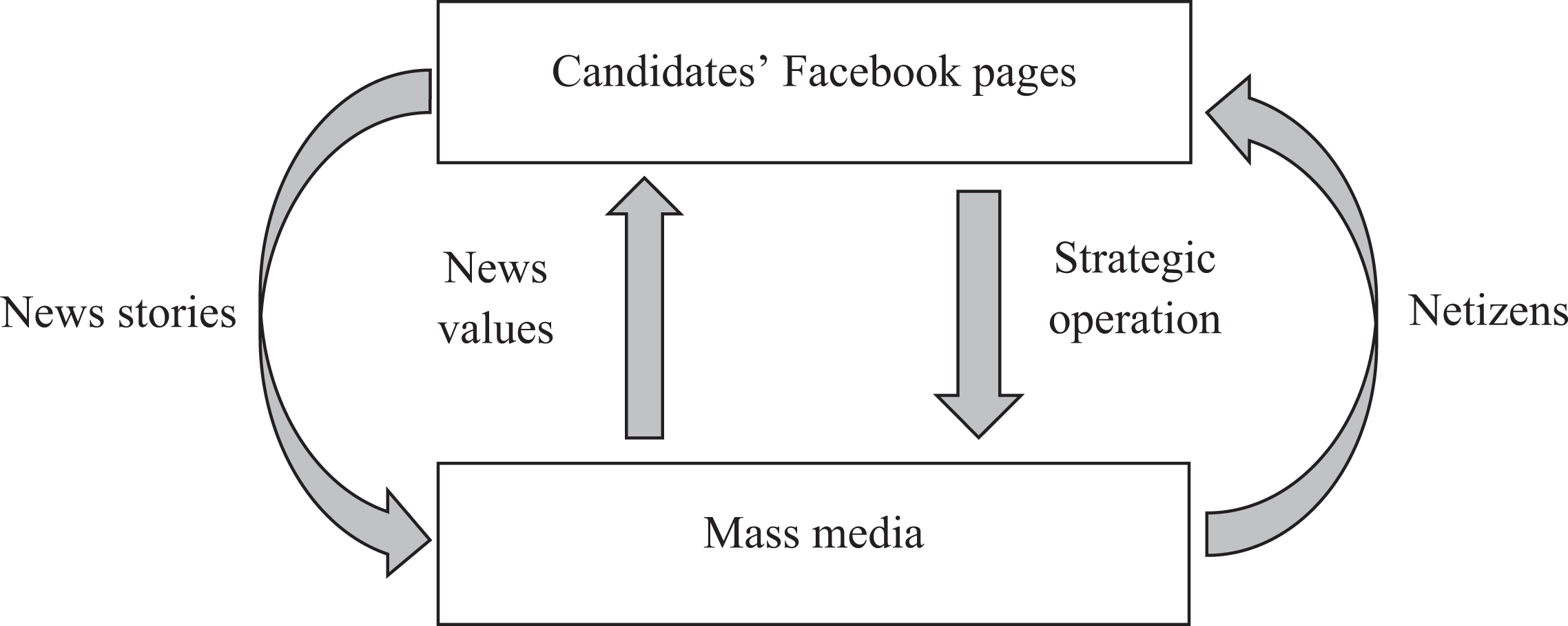
The relationship between mass media and Facebook. Source: Author.
Frame contest defines whether social media can be the headwaters candidates seem to hope it will be as they employ strategic actions to manage the effect of frame contest. As discussed above, candidates sometimes accept the concept of reaching understanding with netizens when the expected effect is higher than strategic action. In terms of intermediation, the expected effect represents transaction cost. How candidates decide to employ mass media or social media is depicted in Figure 3.
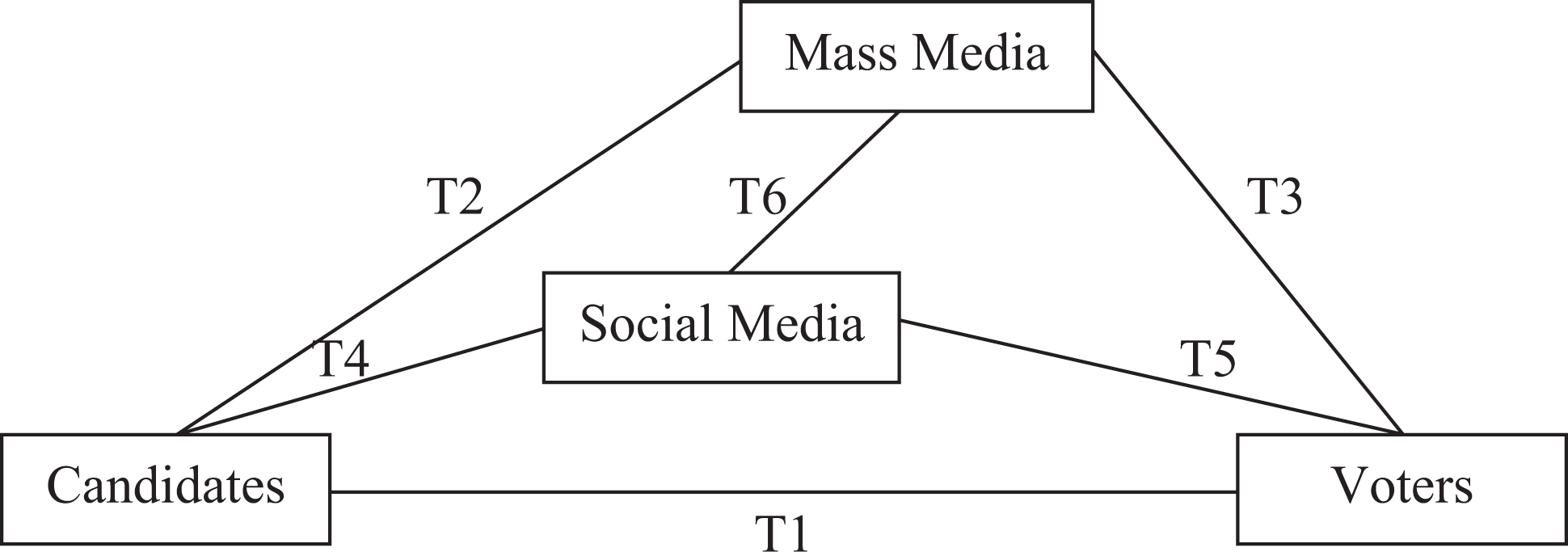
The intermediaries between candidates and voters. T1∼T6 = transaction costs. T1 > T2 + T3 mass media intermediation; T1 > T4 + T5 social media intermediation. T4 + T6 + T3 < T2 + T3 social media intermediation. Source: Author.
Since the relationship between social media and mass media is parallel, candidates can select either mass media or social media to convey their message to voters based on transaction cost. If T1 is higher than T2 + T3, candidates will likely select mass media as an intermediary; if T1 is higher than T4 + T5, candidates will likely select social media. Intriguingly, candidates seem to view their social media pages as the headwaters of mass media; therefore, social media can be the intermediary between candidates and mass media as long as the transaction cost of T4 + T6 is less than T2 (Figure 3). Unlike Figure 1, two types of intermediaries co-exist in Figure 3, and the selection of intermediaries tends to be dynamic. Under Figure 3’s model, candidates can select either approach according to the message’s characteristics. Due to the frame contest and the networking nature of social media, T6 becomes reciprocal between social media and mass media. In the IDR cycle (Chircu and Kauffman, 1999), when multiple intermediaries are involved in the transaction, they tend to dis-intermediate each other. Intermediation may have originally focused on the trading of goods, but under the situation of election campaigns, candidates always appear to maximize the effect of using intermediaries. This article views that both intermediaries can either cooperate or compete with each other; this observation can broaden our current understanding of intermediation.
Conclusion
The in-depth interview data appear to suggest that the domination of mass media in previous election campaigns has been challenged due to the rising popularity of Facebook; this effect was observed in the 2012 Taiwan Presidential election campaign. The dynamic interplay between social media and mass media appears to have become a significant factor that drives election campaigns. This article employed frame contest and Habermas’ (1984) communicative action theory to examine, approach, and better understand this dynamic interplay. The research found that candidates’ camps alter their attention and strategies according to the rising influence of social media in order to maximize its benefits.
The original idea of frame contest refers to the cognitive mental processes of social actors. The use of Facebook in election campaigns, however, involves not only the cognitive level but also the textual level and external level. This article developed the candidate’s frame to specifically account for the use of Facebook in election campaigns: the concept identifies how candidates and their staffers perceive reality when they use Facebook. Unlike frame sponsors or advocate frames (Carragee and Roefs, 2004; Tewksbury et al., 2000), the candidate’s frame is not reliant on media frames; instead, it seeks to engage and influence media frames. The candidate’s frame can be exemplified in both the content of Facebook pages and the campaign staffers’ strategies. The interplay between the candidate’s frame and media frame can, therefore, be addressed as a frame contest. The frame contest between candidate frames and media frames involves the relationship between journalists and candidates’ camps, Facebook content and journalists, and mass media content and candidates’ camps.
This research also identified that candidates attempted to view their Facebook pages as headwaters of mass media; this view allows social media to operate as an intermediary between candidates and mass media. Significantly, the results of this research seem to demonstrate that multiple intermediaries can co-exist, which broadens the scope of intermediation. Candidates’ choices of employing intermediaries – social media or mass media – were made according to their calculations. These calculations were dynamic and depended on candidates’ strategic actions which closely connected to frame contest.
The concepts of a candidate’s frame and frame contest provide a new way to examine the relationship that defines the use of social media and mass media in election campaigns, especially in regard to Taiwanese politics. Further research can employ quantitative content analysis to identify how these two frames converge to establish patterns that describe the frame contest outlined in this article.