







Abstract
Apart from the exchanging of information, an important role of conversation and communication is to promote social harmony through the maintenance of relationships. This is referred to as the ‘phatic’ function of communication. Indeed, digital communications technologies, and social media in particular, have been lauded for their potential to promote activism and social change through ‘raising awareness’ of injustices, their ability to motivate people into political action and the facility to organize and coordinate that action for maximum effect. In this article, I build upon previous arguments, which suggested that the rise of social networking demonstrated that online culture and communication had become increasingly phatic and less dialogic. Here I use previous empirical work to challenge the above claims of digital politics enthusiasts. I then suggest an alternative theoretical account of the function of digital media activism which better suits these empirical findings. I suggest that digital politics demonstrates a rise of ‘phatic communion’ in social media. Incorporating Heidegger’s notion of ‘idle talk’, I further suggest that the rise of a phatic online culture in social media activism has atrophied the potential for digital communications technologies to help foster social change by creating a conversational environment based on limited forms of expressive solidarity as opposed to an engaged, content-driven, dialogic public sphere.
Keywords
Introduction
There has been a powerful assumption within academic and popular discussions of digital culture that the shift from ‘broadcast’ analogue communications (or the ‘one-to-many’ communications model) to ‘narrowcast’ digital communications (the interactive ‘many-to-many’ model) would spell the end of a politically unengaged mass society. That the advent and spread of digital communications has set the framework for an understanding of digital communications as a politically progressive, politically engaging and even revolutionary set of technologies.
Social media enthusiasts generally see three interrelated features of communication technologies, and social media in particular, as central and fundamental to the vision of new media as politically progressive and engaging. First, the ease of production and distribution of digital media has resulted in an increased amount of information, meaning that alternative, minority and dissenting accounts of the world and the events in it now have a potential mass and worldwide audience in a way not previously possible. The potential consequence here is that state and corporate media oligopolies do not have the same kind of hegemonic grip over the production and circulation of news and political debate in popular culture as they did in the past. Thus, we see the rise of, for example, Indymedia, political blogging, video documentary and citizen journalism as alternative accounts to mainstream corporatist or state-sponsored accounts. Second, there is the increased ability to connect with others across space, and thus to organize, motivate and mobilize political action and resistance, ultimately leading to more numerous and, more effective, political actions. Last, there is the increased ability to express one’s own views and converse with others on political matters, leading to the reinvigoration of a conversational public or public sphere.
Although it is important to be aware of Pariser’s (2011) concerns over ‘filter bubbles’ or the negative effects of personalization technologies on online information exposure, and of McChesney’s (2013) warnings of increased new media oligopoly in the online sphere, the first of the above points is to a certain extent beyond discussion. There is no doubt that digital information and communications technologies (ICTs) have increased the amount of information sources, and thus information choice, available to the average citizen in advanced economies. 1
Whilst there can be little doubt that new media have dramatically opened up the number of information sources, political or otherwise, to the general public, this article critically engages with the latter two points above, namely, the power of conversation and the power of mobilization, and will unpack the implicit assumption that the ability of technology to connect people necessarily leads to an activism that involves dissent or resistance. Indeed, I will suggest the opposite that such connection can (and usually does in current circumstances) lead to forms of communion which tend to maintain the status quo, not undermine or challenge it.
Whilst the position I am offering here has some points in common with the position of authors such as Gladwell (2010) and Morozov (2010), my argument will concentrate on the relationship between talk, togetherness, the relationship to transformative politics and how that is or is not enacted by the use of social media.
Specifically, I want to put forward the suggestion that we need to be a bit more considered in thinking about social media politics and what functions the gestures of social media politics actually fulfil. Despite the large academic and popular debate surrounding social media politics, there has actually been very little discussion or empirical investigation around the content and purpose of the acts of social media activism, which has relied either on the coincidence between large-scale political events (such as the Arab Spring) and the rise of social media (thus assuming, in a somewhat technologically determinist way, that connective technologies lead to increased activism) or on the assumption that increased Internet traffic (in the form of tweets, likes and statements of support with a political content) is a sign of increased political engagement.
In this article, I first intend to use existing empirical research to undermine both of these assumptions. I will demonstrate that there is little evidence to suggest that communications technologies and increased connection lead to more political action and that the role of social media in major political actions (such as the Arab Spring), or indeed in the creation of political dialogue, has been widely exaggerated or misunderstood.
Challenging the dominant narrative of social media activism, I will instead offer an alternative account of what digital politics actually is and does. This account will emphasize the importance of understanding what kind of interactions these are, and what kinds of interactions are encouraged, before we can assess their political or transformative potential. I point out a problem of definition in terms of how we can define the acts of social media politics (Christensen, 2011; Loader and Mercea, 2011), posit whether or not social media political gestures can be considered political action/participation or whether they are merely political communication (Hoffman, 2012). Such definition is important because how we see these acts and how we decide what they are, epistemologically speaking, determine whether or not they will be viewed as significant, important or even ‘political’ at all.
I further submit that many of these communications are not even particularly political in intent. What I mean here is that, in large part, the gestures of digital activism constitute part of an overall conversational ecology (Boyd et al., 2010; Christensen, 2011), which are as much practices of social inclusion and recognition as they are expressive political statements designed to send a message, organize activism or create an impact. Whilst these gestures may be political in content, much of the time, the content of these gestures is somewhat irrelevant as compared to what can be called their phatic function. By ‘phatic’ I am referring to Malinowski (1923) and Jakobson’s (1960) notion of speech which is used to express or maintain connection with others in the form of shared feelings, goodwill or general sociability, rather than to impart information exchange.
Thus, my overall argument is that the kinds of interactions and activism which occur in social media politics should be seen as a form of talk and that the kinds of political talk which are encouraged through social networking sites (SNSs) are not in general transformative or politically goal-oriented but fulfil a function of being together in which the expression of convivial solidarity with others ultimately takes precedence over political action or goals. Thus, social networking technologies promote a more passive, convivial political subject as opposed to an active, oppositional or transformational one.
This article will demonstrate this first through a brief general review of the narrative and logic of social media activism, in which I spell out the case for the importance of social media in political activism. The second section will look at the more systematic empirical evidence of the role of social media in events such as the Arab Spring and austerity protests, with a particular focus on studies that analyse the content of social media messages during political activism. Then I discuss the role of ‘phatic communion’ and ‘idle talk’ in social media politics and present a suggestion that these forms of sociable talk function to sustain the status quo more than transform it.
The narrative of social media activism: From micro-activism to social transformation
You are probably already a micro activist and don’t even realize it. Have you ever told a friend about a cause you support? Have you ever given a small amount of time or money to a cause with which you agree? Have you ever sent an email, tweeted or liked something on Facebook to support something that you felt was important? If you have done any of these things, you have participated in micro activism. While it can be difficult for an individual to change the world, it is possible (and much easier) for an individual to do something which appears to be small in itself, but when combined with many others doing that same small thing creates something huge. A river is nothing more than a lot of drops of water all moving together in the same direction. (http://www.microactivist.com/)
This passage makes the case for changing how we conceive of ‘activism’. Rather than making a hierarchical distinction between ‘online’ and ‘real-world’ activism, the suggestion is that we need to broaden what we consider activism to include technological activities such as posting links, retweets, ‘liking’ campaigns, joining social media groups, making statements of support and forwarding emails or video links, which were not possible before digital communications technologies.
The logic here is based on what can be called ‘low investment politics’: Little acts, which take a minimal amount of effort, cost little in terms of time, money or other form of sacrifice, are easily achievable for the average citizen and allow people who otherwise might not get involved in political activism to play a part in such activism and thus contribute to social change. After all, we are all already online anyway, especially using Facebook and Twitter, and we need to say something to participate fully in these environments, so why not join the conversation and support the causes we care about and at the same time revitalize a new public sphere?
Such behaviour involves a re-conception of terms such as activism away from ‘actual’ political action as traditionally understood and more towards (virtual) discursive interventions and symbolic demonstrations of solidarity for causes or groups (Papacharissi, 2010; Peretti and Micheletti, 2011). Essentially, this collapses the distinction between political communication and political action, as the communication itself becomes a form of activism. This new type of digital activism has been referred to in academic circles as ‘micro-activism’ (Blood, 2001; Marichal, 2010), ‘micro-contributions’ (Garrett 2006), ‘sub-activism’ (Bakardjieva 2009) or more pejoratively in the popular press as ‘clicktivism’ or ‘slacktivism’.
Traditional, more cyber-sceptic observers such as Gladwell (2010), Morozov (2010), Shulman (2009) and many others tend to view these acts solely as communications and not as forms of activism. Indeed, those who are more sceptical of the political importance of social media suggest that micro-activism actually works against activism and real social change by asking so little of its practitioners in terms of effort or risk (Bertolotti et al., 2011; Gladwell, 2010; White, 2010). These writers see measuring success in terms of digital ‘participation’ or ‘awareness’ as an accomplishment built on asking people to do as little as possible. In addition, they suggest that such gestures satisfy the need for the digital citizen to feel as though they have ‘done something’ to help, without actually doing anything at all. Indeed, as such sceptics argue that the gestures of Internet activism can be considered pointless at best and at worst counterproductive or distracting, luring nascent activists away from more meaningful serious and practical efforts to effect change.
But in many respects, the logic of micro-activism makes sense. If we, as suggested above, water down the notion of activism to include these small gestures, then levels of political participation in recent years have definitely grown under digital activism. For example, PEW Internet (2013) has recently shown that the proportion of American adults who took part in ‘political activities’ 2 on SNSs during the federal election years had grown from 26% in 2008 to 39% (66% of all SNS users) in 2012. Furthermore, one only has to point to Invisible Children’s (in)famous ‘Kony 2012’ campaign, in which that video gained over 93 million views on YouTube alone, including an incredible 43 million views in 72 h of March 2012, to demonstrate how successful a campaign can be in terms of ‘raising awareness’ for a cause.
Furthermore, it can be suggested that from these small gestures, big things can happen. When done by substantial amounts of people, these conversations create the networked, information-sharing environment that inspires people to mobilize and act out in larger, more coordinated ways which fuel social change. In other words, small gestures, when multiplied, can lay the groundwork for transformational events.
There is, of course, a large leap from the gestures of micro-activism to the large-scale, real-world phenomena of the Occupy movement, the Spanish Indignados or the Arab Spring protests, but it is clear that social networking is not only used for micro-activism but can also be used in resistance or transformational events, and it is not unreasonable to suggest that an ecology of information sharing, mobilization and connection/coordination can be built upon these technological foundations and communicative gestures. These assumptions are reflected in commentaries such as Castells (2012) who suggested that in mass protests as far flung as Iceland, Tunisia and Egypt, the original spaces for protest were located on the Internet but that these movements ‘went from cyberspace to urban space’ (Castells, 2012: 45). A similar narrative of non-hierarchical, digitally led spontaneous uprisings is provided by Howard and Hussain with regard to North Africa (2011, 2013). This sentiment is also articulated by Shirky: For political movements, one of the main forms of coordination is what the military calls “shared awareness”, the ability of each member of a group to not only understand the situation at hand, but also to understand that everyone else does, too. Social media increase shared awareness by propagating messages through social networks. (2011: 5)
Indeed, Hardt and Negri (2000) have suggested networking-inspired awareness, realization of the common and demonstrations of the strength of the multitude in common are in themselves forms of revolution in the post-industrial society.
Critiquing the relationship between social media, politics and protest
The narrative proposed by those who can be considered optimistic about the role of digital media in sociopolitical change makes logical sense. It seems entirely plausible that social media, by connecting people together, usurps the implicit hierarchies of established political structures and broadcasts media outlets by first creating an ecology of political conversation, which in turn ferments dissent and eventually mobilizes/organizes spontaneous, ramshackle, technology-led resistance. Radio and television have long reached most Arabs, but only 10 to 20 percent of those living in a typical Middle Eastern or North African country can easily gain access to the Internet. Yet this minority is a strategic one, typically comprising an elite made up of educated professionals, young entrepreneurs, urban dwellers, and government workers. These are the people who formed the networks that initiated, coordinated, and sustained successful campaigns of civil disobedience against authoritarian rule. Looking at the other side of the coin, the countries with the lowest levels of technology proliferation have also tended to have the weakest democratization movements. (Howard and Hussain, 2011: 47)
But claims such as the one above are strong ones which are unfortunately not backed up by systematic evidence. For example, the last sentence of the above passage is simply false. There is little relationship between technology proliferation and democratization movements (or the success of them). At best, there is a complex relationship between Internet penetration rates and political activism, usually contingent on other social factors being present. This has been demonstrated a number of times (Alterman, 2011; Couldry, 2014; Noveck, 2000; Xenos and Moy, 2007) and even recently again by Ang et al. (2014) who demonstrate this in their large, cross-national study of anti-government protests in 153 countries over 26 years. They found that on its own, the variable of ‘technological penetration’, or the increased availability to use ICTs in protest, was associated with reduced protest count, suggesting increased apathy as opposed to activism with increased technological means. Only when technological means were fused with structural conditions (such as a large youth demographic) is technology associated with increasing activism. They conclude that: The “year of the protester” is situated in a larger structured pattern of protest behavior, and that youth bulges and ICT affect protest activities in a more complicated and nuanced manner than the conventional wisdom suggests. (Ang et al., 2014: 1240)
Even in a more comparable region such as the Middle East and North Africa (MENA), Aday et al. (2012) demonstrated that the highest Internet and social media penetration rates are in the United Arab Emirates, Bahrain, Qatar, Lebanon and Kuwait, only one of which has had any sizeable protest movement, let alone any Arab Spring successes. Outside MENA, Barakovic’s (2011) study of the unsuccessful Facebook revolution in Bosnia and Herzegovina supports this claim by arguing that despite high social media use, several online attempts at online mobilization to protest high unemployment and austerity measures failed to motivate any coordinated offline action.
More importantly, there is a lack of any persuasive evidence that can demonstrate a causal relationship between social media and protest. Often the evidence presented in support is methodologically weak, depending on journalistic accounts, anecdotes or interviews with social media activists who over-represent the importance of social media. This has been particularly true with regard to the dominant narrative of the importance of social media in the Arab Spring uprisings (e.g. Howard and Hussain, 2011). Another tendency has been to focus on coincidences of increased Twitter traffic during a large-scale social action to imply that Twitter was thus instrumental in an event occurring (Globe and Mail, 2011). More systematic data demonstrate that traffic is created and shared between actors, bringing journalists, spectators and activists into a ‘conversation’ but does not fully demonstrate what kind of communications are taking place, merely that there is a lot of traffic during these times, particularly among journalists (Lotan et al., 2011).
However, chatter does not make a revolution and neither do journalists reporting on a revolution which has already begun to take place. In order to determine the actual part social media played in such events, and indeed, the importance of social media politics more generally, what is needed is systematic investigations into what media is actually deemed important to the majority as well as into content and use of social media messages during these times.
For example, one particularly detailed survey into Tahrir Square activists, which seems likely to have methodologically over-represented well-educated tech-savvy activists at the expense of working-class protesters,
3
suggests that by far the largest medium in which protesters first heard of events taking place was through face-to-face conversation (Tufekci & Wilson, 2012). In fact, using the same survey, Wilson and Dunn (2011) found that: An initial review of frequencies for general users and protest-media users supports a dismissive understanding of digital media’s role in the Egyptian protests. Traditional media, such as telephone, satellite television, and print media, dramatically outscore social media, blogs and E-mail…. (Wilson and Dunn, 2011: 1252)
Upon closer investigation, respondents in this study listed the following as the ‘most important’ medium for protest activity: phone (62%), face-to-face conversation (48%), Facebook (28%), satellite TV (24%) and email (14%), with Twitter coming in at an insignificant 6%. Similarly, respondents listed the following as their ‘most used’ protest medium: face-to-face conversation (49%), satellite TV (40%), Facebook (36%), phone (30%) and email (8%), with Twitter again coming in at a lowly 5%.
Indeed, Wilson and Dunn’s (2011) analysis of the #jan25 tweet set convincingly demonstrates that during the Egyptian uprising, Twitter was not used in any significant motivational or organizational ‘on-the-ground’ capacity but in the main used by a small group of people largely outside Egypt to connect with events going on in the country
4
: It also appears that the resulting discourse was dominated by a relatively small group of power users within a massive group of relatively passive users who offered expressions of support, shared related content, and retweeted power user content … These characteristics suggest a model in which a small group of Twitter users in Egypt generated a significant amount of content that was consumed and mobilized by a small group of transnational actors, spawning discourse with a very broad and largely passive population. (Wilson and Dunn, 2011: 1269)
This supports the conclusions of Aday et al.’s (2012) systematic study of Arab Spring events in Tunisia, Egypt, Bahrain and Libya, which found little evidence to demonstrate that new media had a significant part to play in these protests motivationally or organizationally in terms of collective action. Again, they found, using Twitter data, that tweets were more likely to originate and have an audience outside the country and region and that the primary role of new media, for Twitter in particular, was as a bridge to mass media (where mass media journalists would use social media as a data source; see also Aouragh and Alexander, 2011), which was more influential in terms of motivation to participate in protests. They refer to this as the ‘megaphone effect’. They also suggested that there was a large gap between well-educated, techno-savvy middle-class activists (who often did use social media and who often get the credit for inspiring and organizing the protests in Western accounts of these events) and the bulk of working-class protesters who were often motivated and organized by traditional organizations such as unions or the Muslim Brotherhood.
Such findings undermine the traditional techno-optimist narrative of the Arab Spring protests as manifestations of technological connection and social media use. However, studies outside of the Arab Spring have also come to similar conclusions. Theocharis et al.’s (2013) investigation of the content of tweets around the Occupy movement in the United States, the Indignado protests in Spain and the Aganaktismenoi protests in Greece found in their content analysis that tweets related to direct motivational issues (call for participation or action in protests) were a tiny proportion of all tweets across all three countries and those that were predominantly by organizations as opposed to individuals. Tweets related to organizational matters were even less frequent, say 1.4% of the sample.
By contrast, Theocharis et al. (2013) found that by far the most frequent content of tweets related to political conversation or political statements. The next most popular set of tweets were in relation to reporting, confirming the link with journalism. Overall, the authors conclude that during these protests, Twitter acted much less as a networking agent or organizing mechanism within the protest and more as a window on the protest space (Theocharis et al., 2013: 13), or indeed a ‘conversational ecology’ (Boyd et al., 2010; Christensen, 2011) surrounding the event of protest.
What can be gained from studies such as these, studies which look at what protesters actually use, and the content of what social media messages entail, are first that social media use among protesters, either as a motivational tool for people to take to the streets or as an organizational tool to coordinate effective protest, has been very highly exaggerated, even in the substantial events of the Arab Spring. Whilst there may be some impact and use among small groups of activists who are invested in the use of social media for these purposes, most protesters rely on traditional media and face-to-face discussion for motivation and organization, respectively. This undermines the narrative that technologies of communication are, through their ability to connect people, inherently politically destabilizing or revolutionary. This is not to say that social media was completely insignificant in these events or is insignificant as a political tool in general. The studies above do demonstrate its place in sharing information (e.g. through links to YouTube videos of protests and police violence), as a source for more influential broadcast media and for broadcasting events to the international journalism community. But social media’s role in political action itself, fermenting and organizing protest, is doubtful.
Online publics, performance and expression
If empirical evidence suggests that social media is not particularly important in motivating protestors to real-world action, or organizing the action that takes place, it is important to ask what all of this online activity does, apart from allowing journalists a look into international events. So what are these tweets, likes, status updates and such actually doing?
One argument that is often put forward is that social media allows for the creation of a public sphere (Habermas, 1989) through dialogue, debate and information exchange. As Shirky (2011) has suggested, ‘The potential for social media lies mainly in their support of civil society and the public sphere’ (Shirky, 2011: 31). In that sense, the opportunity for dialogue, created through technology, and connection provides the groundwork for political change by engaging citizens through dialogue, debate and information exchange. However, again such arguments become more difficult to accept when systematic content analysis demonstrates very little in the way of dialogue or interaction in politically oriented social media.
Marichal (2010) found in his content analysis of political groups on Facebook that only a small minority of political group pages (2 of 250) were constructed with the view of creating dialogue, and very few had stated any real-world political goals or objectives (e.g. calls to action). Instead, the vast majority of such groups existed to express a voice or opinion to which like-minded people would approve. Similar to Theocharis et al. (2013), the empirical findings indicate that social media is used in the main to express political statements or opinions, not necessarily to ferment or organize real-world change or to open up some sort of dialogue indicative of a public sphere. Marichal concluded political communications on Facebook to be performative. That is, it allowed the creation of a digital front stage as part of a collaborative, participatory identity process, which involves the expression on one’s voice as prioritized over actual achievements, stated goals or even dialogue with others.
Fuchs (2013) also questions the notion of Twitter as a public sphere through his analysis of #wikileaks and #jan25 (Egypt uprising) Twitter data sets in 2010, in which he found few indications of the sorts of activities which would be indicative of a public sphere such as debate, interaction or two-way communication. Another analysis of UK Member of Parliament Twitter accounts conducted by DEMOS in early 2015 found only 17% of 60,000 tweets were ‘conversational’ in the sense that they were replies or spawned dialogue. Such findings suggest that social media act in a much more traditional broadcast fashion than one would expect from platforms that are seen as epitomizing connection and dialogue.
It is perhaps not surprising that within these contexts, many writers interested in the relationship between social networking and politics such as Marichal (2010) have focused on the increased importance of expression (as opposed to dialogue or goal-oriented action) to the late-modern, digitized citizen. Similar to Marichal, Bertolotti, Bardone, and Magnani (2011) suggest that the duty of the cyber citizen is to be in a constant state of activist alert for potentially useful or interesting information and to share this information onward. Thus, new digital activism can be seen as ‘representational activism’ (Aouragh 2012), which revolves around the act of demonstrating support or raising awareness for causes and for disseminating information about such causes.
The work of Svensson (2011) is quite informative here in that he demonstrates how the digital citizen uses political expression not only as a means of creating and managing identities but also how such expressions are used to connect to others, simply for the sake of connections and ‘being together’. For Svensson, responsiveness and connectedness are the key features of the digital citizen, who must be continually aware of what is talked about and able to participate in the talk by forwarding information on, or offering opinion or support.
What these studies call into question is the legitimacy of the suggestion that the notion of political action should be expanded to include the gestures involved in social media politics (i.e. micro-activism or clicktivism). The conflation of political communication and political action, as it occurs in discussions of micro-activism and similar forms of digital activism, is problematic because their functions, and thus potential outcomes, are different. Activism, in the traditional sense, leans primarily towards a goal of some sort of social transformation, whilst communication can predominantly have as its function the goal of broadcasting personal expression or the creation or maintenance of connection to others. This arguably makes the political content of political communication potentially superfluous as the conversation taking place may well emphasize the expressive and/or connective function of communication which does not particularly encourage meaningful conversation, dialogue or a public sphere, let alone social change. The next section will elaborate on this rather counter-intuitive suggestion by suggesting that in order to understand the actions of digital activism, we need to see past their ‘content’ and consider their role as sociable gestures and not political ones.
Critiquing a phatic public sphere: There are ‘conversations’, and then there are conversations
‘Conversation requires us to recognise the other, which in turn requires us to recognise ourselves more carefully and completely. In conversation, we are held responsible for what we say, required to defend our position, even to change our point of view. (Menely, 2007: 108)
Conversation has long been portrayed as central to the democratic political process. What is generally considered to be central to a functioning democracy, and the roots of democratic revolutions of the past, is the notion of a politically informed public engaged in rational and free discussion as the basis for government (or the foil for unjust government). Thus, conversation is central to the notion of a healthy public sphere as articulated by Habermas (1989) and, indeed the lack of a credible public sphere, one in which there is a healthy debate and exchange of ideas among a conversational public in modern times has been lamented as one of the key problems with representative democracy over the past century (Habermas, 1989; Dewey, 1927). Such is the concern for conversation in contemporary times that Schudson (1997) suggests a veritable ‘obsession’ with the term everywhere from postmodern philosophy on down to the public journalism movement (Schudson, 1997: 298).
The optimistic view of social media as a revolutionary political tool places a lot of faith in social media to revitalize a moribund public through its ability to connect people in conversation and transform them into political subjects which in turn would foster social transformation. Social media, using Rorty’s terminology, can be seen as ‘a conversation of mankind’ (Rorty, 1999; Van den Eede, 2010). Again, as Schudson suggested, conversation is key. Indeed, Shirky (2011: 35) even suggests that ‘access to information is far less important, politically, than access to conversation’. This emphasis on political dialogue has been a key element behind the optimism for online politics for three decades now.
The online environment is definitely full of people talking, and certainly there are a lot of people talking politics of one form or another. However, the thing that very few people ask is ‘what kind of conversations are they having?’ In the last section, I suggested that little of the talk on social media, even during large-scale mass protests, was about mobilizing or organizing political action in a real-world sense and that most of the talk revolved around political statements which had no practical goal (mobilization or organization of protest) and no intent at dialogue (creating a public sphere). Instead, I suggested that such gestures provided the functions of identity performance or expression as well as a connection to others. Thus, I argued that it was a mistake to confuse these communicative gestures or ‘political communications’ with ‘political action’, as they potentially have different intents and therefore outcomes.
Schudson (1997) and Scheufele (2000) note this as well and make a distinction between ‘sociable’ or ‘casual’ conversation and ‘problem-solving’ or political conversation. In the former, the conversation has no end outside of itself, and it has no goal or conclusion but is a kind of adventure based on conviviality. It entails the pleasure of interacting with someone else for its own sake, with the dominant function of that interaction being social connection. The latter is based on dialogue, argument and is often uncomfortable or awkward. Still such interaction has a purpose outside of itself; a means to an end, a goal of transformation. Similarly to the conflation of ‘communication’ and activism in social media politics discussions, the distinction between ‘social talk’ and ‘political conversation’ in social media tends to be ignored. However, it is crucial to recognize that the former emphasizes the importance of expression and connection, whereas the latter emphasizes dialogue and goal orientation.
In a previous article (Miller, 2008), I suggested that the rise of social networking and microblogging in online environments epitomized a shift to a phatic online media culture. Phatic communion was a term used by Malinowski to describe communicative gestures that do not exchange meaningful information or facts about the world. The purpose of phatic exchange is to acknowledge presence, to express sociability or to maintain connections or bonds. As a result, such gestures are concerned with the process of communication (or potential communication), not the transmission of thought or substance. Thus, in most contexts, the casual greeting of ‘how are you?’ is not considered a sincere inquiry as to the state of an individual and generally does not foster a heartfelt or detailed response. The intention of phatic communication is not to provoke thought in the listener or recipient but to build or maintain a connection. Later on, Roman Jakobson (1960) functionalized this idea by referring to the phatic function of spoken language, which denotes that function of language is channel oriented in that it contributes to the establishment and maintenance of communicative contact. In either case, the focus of phatic gestures is on the maintenance of a sociable connection, or the enablement of a future potential connection through mutual recognition or ‘going through the motions’ of sociability, rather than a meaningful exchange of thoughts or information.
I suggested that social networking environments, and increasingly the Internet in general, were becoming dominated by forms of communication in which the content was superfluous, and the real intent of these gestures was to maintain networking linkages through different forms of acknowledgement or requests for acknowledgement. Brief and somewhat trivial status updates, ‘pokes’, ‘likes’ and the like are all online examples of the kinds of phatic communications that maintain online sociability and a recognition of others without the effort at purposeful conversation or dialogue. I suggested that the structure of social networking itself (e.g. the 140-character limit on twitter) was emphasizing and encouraging phatic gestures and that the rise of social networking as the predominant form of social media (e.g. over blogging) suggested a prioritizing of networking or ‘connection over content’.
More recently, the role of the phatic in online culture has been receiving more and more discussion, empirical testing and nuanced analysis (e.g. André et al., 2012; Dann, 2010; Frosh, 2011; Hopkins, 2014; Kulkarni, 2014; Schandorf, 2012; Radovanovic and Ragnedda, 2012). Among these studies, there seems to be a general agreement that online culture is very phatic in its communications, although there is a certain amount of debate over whether or not this is a good or a bad thing. Many have pointed out quite rightfully that phatic communion is not ‘trivial’ and indeed is an important part of creating affective bonds which in turn create a sense of belonging, intimacy and community, so increased phaticism can be positively viewed as signs of togetherness in online environments (Sarjanoja, Isomursu and Häkkilä, 2013; Varis and Blommaert, 2014).
I do not disagree with this, but it is important to question what kind of togetherness this is and, in the case of online politics and activism, what potential relationship this has to social transformation. One could equally posit that instead of encouraging or evidencing a revitalized communion that was being lost, the rise of phatic culture is indicative of a post-social state in which our forms of communication are increasingly devoid of substantive content and true dialogue. If this is the case, as many of the content studies in the previous section suggest, this can have political implications of its own.
American literary theorist Tobias Menely (2007), in an evocative essay entitled ‘Forgive me if I am forthright’, demonstrates how the phatic element of language and normative codes of politeness have the primary function of maintaining social harmony and cultivating the status quo. For Menely, the phatic function of language acts as a social adhesive that achieves social harmony by directing conversation to the least controversial topics, where the actual content of what is said has little consequence or informational value in comparison to its use as a social glue. These topics serve the role of tactfulness, softening the edges of difference among persons and leaving very little room for disagreements in everyday social interactions.
Radovanovic and Ragnedda (2012) make a similar point through engagement with ‘balance theory’, which suggests that it is easier to maintain balance in a community, or growth in a network, if one enforces relationships of conformity and harmony and avoids potentially conflictual relationships, which have the potential of reducing interaction. So, for example, Facebook has a ‘like’ button but not a ‘dislike’ button as that threatens to induce conflict and therefore may impede network growth. Thus, they argue that social networks steer towards the phatic to be as inclusive as possible in terms of participation whilst at the same time avoiding topics that could cause disruption.
Menely suggests that a cultural logic which encourages us to remain in the safe domains of phatic engagement is one that precludes us from free conversation. Veering away from these phatic issues is risky because it creates the potential to upset social harmony. So, Menely sees phatic communications as a kind of closing off of dialogue. An expressive form of communication (expressing ‘I’m still here’), as opposed to a conversational or dialogic form of communication where information is exchanged in order to transform the other.
This difference between ‘expression’ and conversation here is fundamental. Expression emphasizes the acknowledgement speaker and the process of connection; therefore, Menely argues that expression does little more than broadcast the status quo, 5 whereas conversation is dialogue which not only recognizes or acknowledges the participants in the interaction but also has a goal to produce change. It demands more than just acknowledgement. It demands transformation. Thus, if we believe the assertion that the communications culture of social media is increasingly phatic and less dialogic, then arguments relating to social media’s inherent ability to create political change run into a bit of a problem.
From phatic communion to ‘they-self’: Idle talk and the status quo
The discussion about the relationship of ‘talk’, being together and the maintenance of the status quo finds an unlikely ally in Martin Heidegger (1962). Indeed, in Being and Time, Heidegger donates a substantial section to a consideration of the kinds of public awareness generated through mass-mediated forms of conversation and what he calls idle talk (Van den Eede, 2010).
By idle talk, Heidegger refers to a kind of inauthenticity achieved when one takes on mediated, ‘average’ or ‘mass’ understandings of the world without question or appeal to one’s own unique understanding: In this inconspicuousness and unascertainability, the real dictatorship of the “the they” is unfolded. We take pleasure and enjoy ourselves as they [man] take pleasure; we read, see, and judge about literature and art as they see and judge; likewise we shrink back from the ‘great mass’ as they shrink back; we find ‘shocking’ what they find shocking. (Heidegger, 1962: 164)
This becomes problematic because one loses one’s own particularity and uniqueness in terms of judgements, decision-making and opinion forming. Effectively, ‘everyone is the other and no one is himself’ (Heidegger, 1962: 165). Individuals cease to fulfil their potential as distinct entities who express ‘care’ in any meaningful way and instead replicate and sustain the ‘great mass’ of ‘they-self’ of the mediated public.
Heidegger’s description of idle talk seems akin to the concept of phatic communion in that he is suggesting that the process of communication or ‘passing the word along’ takes precedence over the content of the talk, which itself becomes simply a way of being together. Similar to Menely’s (2007) view of the phatic, idle talk helps to ‘close off’ authentic or real understanding because it takes us away from the ground of what is talked about and towards the talk itself (Heidegger, 1962; Van den Eede, 2010). The relationship becomes with the talk as opposed to what the talk is about, closing off any meaningful understanding of the topic at hand or the formation of considered individual opinion.
Thus, idle talk substitutes individually attained knowledge gained through an embedding in the world with shallow and superficial average mass understandings, such as an understanding gained through forwarded links, retweets, likes and the like. In this light, the gestures of social media activism can be placed into a context in which people feel the need, or even obligation, to express opinions or preferences on matters of which they have little or no first-hand knowledge and to do this through the mediated accounts of others as part of a process of being together as they-self.
In such a state, Heidegger suggests, novel expressions of agreement take precedence, and thus the public as maintained through idle talk is one that never dwells or tarries on a subject for long enough to be fully considered, cared about or analysed from the depth of one’s own perspective, let alone for such talk to be turned into action. Instead, one bit of talk becomes as important as the next in an endless pursuit for novelty. Idle talk, as well as the restless curiosity associated with it, makes sure that nothing ever happens: Even supposing that what “they” have surmised and scented out should some day be actually translated into deeds, ambiguity has already take care that interest in what has been realised will promptly die away. Indeed, this interest persists, in a kind of curiosity and idle talk, only so long as there is a possibility of a non-committal just-surmising-with-someone-else. (Heidegger, 1962: 218)
Such passages invoke the memetic, viral nature of social media in general and digital activism in particular. Awareness-raising campaigns such as ‘Kony 2012’ and meme’s like ‘We are the 99%’ take the social media world by storm, achieving mass interest, mass awareness, even mass agreement and solidarity on a planetary scale, in a remarkably short period of time. Figure 1, which shows the digital interest in several prominent social media events (Kony, protests in Egypt, Occupy and Gangnam style), demonstrates the rather fickle nature of online activism and awareness quite well where massive and sudden peaks of interest are followed by almost equally rapid declines.
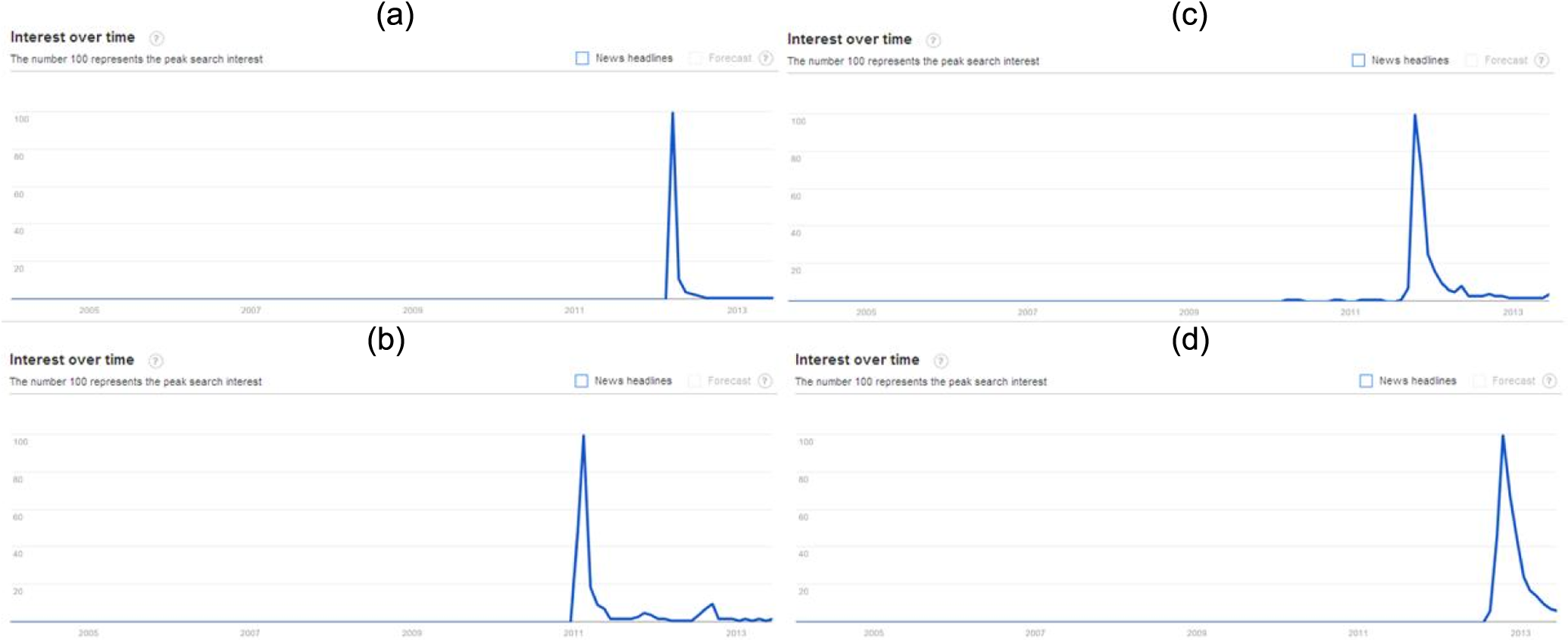
Google trends results measuring interest over time for search terms: (a) Kony, (b) protest in Egypt, (c) Occupy and (d) Gangnam style (accessed 27 June 2013).
Whilst writers such as Shifman (2014) celebrate political memes such as We are the 99% that successfully achieve mass awareness as political actions in their own right, such actions seem doomed only to disappear from the radar after a few weeks when the public moves on to a new topic of interest. In the wake of these declines, in interest, it becomes difficult to discern what ‘action’ has actually been achieved (Couldry, 2014), or what is actually achievable, in the kind of environment where the main expectation is passing the word along in solidarity with everyone else.
Conclusion
In June 2013, Crisis Relief Singapore launched an ad campaign entitled ‘Liking isn’t helping’, which highlighted the gap between the gestures of social media activism and the need for actual volunteers (Figure 2). The image is essentially a depiction of what online activism or clicktivism would look like if literally translated into the offline realm. It evokes the sense of frustration one can imagine on the part of aid workers when activism is redefined to include the kinds of communicative gestures endemic in social media. This campaign followed a similar UNICEF campaign earlier that year called ‘Likes don’t save lives’ (https://www.youtube.com/watch?v=2_M0SDk3ZaM). Both campaigns play off the increasingly cynical view of social media activism as a guilt-assuaging pastime, which ultimately leads to little impact or social change.
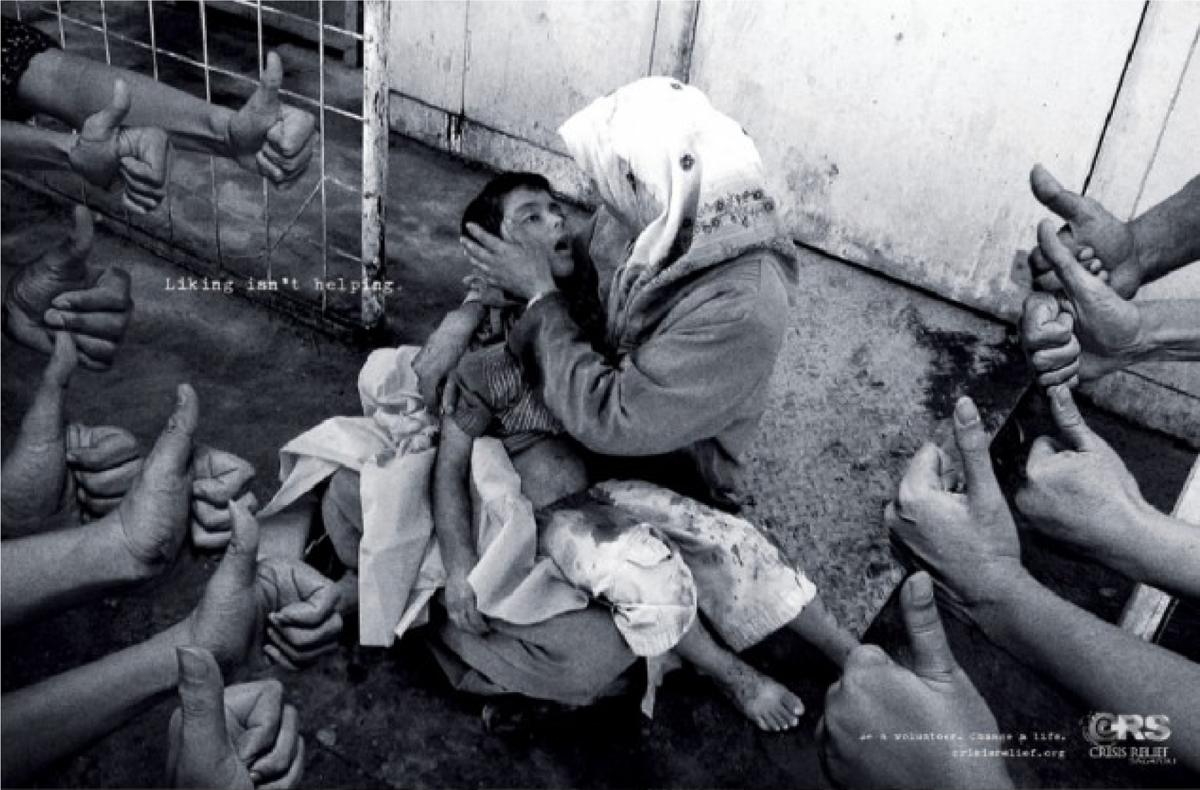
Liking isn’t helping (Crisis Relief Singapore, 2013).
Whilst there is little to be gained by being overly cynical about the good intentions of social media activism and politics, it is important to continue the critical evaluation of these forms of activism and the implicit assumptions on which the optimism for social media politics is based. It is also important not to overinflate their current effectiveness or attribute too much credit to them, as has often been the case in depictions of transformational events such as the Arab Spring.
This article started with a critical review of recent empirical research regarding the role of social media in political activism. This review demonstrated that despite a great deal of belief in the importance of social media in contemporary political protests, and the generation of a great deal of political traffic on social media platforms, there was little systematic evidence which proved that social media played a significant motivational or organizational role in prominent protest such as the Arab Spring uprisings or anti-austerity protests as compared to face-to-face interactions and/or traditional media. Instead, social media such as Twitter and Facebook were seen to act more as windows on the events, and vehicles for the expression of support, by those outside the event. Further research into social media political platforms and pages demonstrated very little two-way communication or dialogue, suggesting a model more akin to broadcasting rather than the development of a conversational or dialogic digital public sphere.
To explain this empirical discrepancy of large amounts of political traffic, but little in the way of motivation, organization or dialogue, I have proposed a theoretical argument that social media activism can be seen primarily as a kind of conversational ecology where the lion’s share of communicative acts are not attempts at motivating action, or even attempts at engaging in political dialogue, but gestures that involve attempts at communion with others. Perhaps controversially, the implication here is that in this type of phatic communion, the political content of such gestures becomes relatively unimportant in the face of their function as acts of sociability.
To put it simply, what I am suggesting is that a large part of the motivation behind participation in social media politics is talking for the sake of convivial recognition as opposed to talking to change the world through political motivation, organization or dialogue. Furthermore, I suggest that such communicative acts because of their nature as acts of phatic communion by and large are more likely to reproduce the status quo than to emphasize conflict or transformation. Thus, it is important not to conflate, as some enthusiasts of social media would suggest, political communication on the Internet with political activism in a more traditional sense, as these two actions have different motivations and therefore potentially different outcomes. Conflating these is to accept dramatically lessened expectations of what activism is and what it can be expected to achieve.
Indeed, more research needs to be done which focuses on the intents and the actual content of social media gestures in order to understand more fully what people are actually doing when they engage in social media activism and express their support for causes and issues. It is a mistake to merely assume that traffic and participation in these modest forms in itself imply meaning, care or concern. This is not to say that social media cannot or will not be an important transformational political force in the future but that, at the moment, we need to accept how social media is currently used by most people, and this is largely as a series of communicative acts designed to achieve communion through passing the word along.