







Abstract
This article analyses media production projects run by football supporters in Brazil. From in-depth interviews and analysis of the material produced by fans of a singular club, Clube Atlético Mineiro (also known as Atlético-MG or Galo, its nickname), the article explores the ways supporters appropriate the journalistic language and create innovative narratives that enrich and pluralize the media environment. Formats vary from blogs to running web radios with regular programming. Motivations for engaging in the projects are also diverse, from improving writing skills to helping the club. The supporters and initiatives here considered promote innovative approaches especially in three ways: (1) placing ordinary supporters at the centre of their narratives; (2) adopting unconventional methods of reportage that challenge the dependency of journalism on regular productive routines and that are able to provide unusual angles of sport-related stories; and (3) creating texts that resort less to the increasingly rational and bureaucratic language that has notably characterized sporting chronicles over the past few decades. Besides, these texts and their parallel circuits of fan production have played an important role in sustaining contemporary alternative football fan cultures in an increasingly hypercommodified football context.
Keywords
Introduction
In recent years, many publications in the fields of communication and cultural studies have turned to investigating the implications of the Internet and new technologies for fandom practices (Bore and Hickman, 2013; Gray et al., 2007). Grounded on concepts such as ‘participatory culture’ and ‘convergence culture’, studies in this area have followed the developments in terms of structures and functionalities characterizing information and communications technologies. As a result, investigations about online fandom cultures have, for instance, changed their focus from the Usenet and other message boards (Baym, 1999; Jenkins, 2006 [1995]), to fan-run and fan-fiction websites (Cumberland, 2002; Hellekson and Busse, 2006). More recently, academic interest has turned to how fans have used social networking systems such as MySpace, Facebook and Twitter (Booth, 2008; Bore and Hickman, 2013; Wood and Baughman, 2012).
Most studies about digital fandom investigate pop culture fan practices. More recently, though, researches in the sport and, particularly, in the football area, have approached online communities of supporters and the uses that they make of new technologies for everyday fan practices (Millward, 2013; Ruddock, 2013; Ruddock et al., 2010; Wilson, 2007). These works have contributed for a better understanding of the implications of technological changes for the formation, practices and sociality modes of supporter groups. However, there is still a relative lack of studies that analyse particularly the textual productivity of football supporters, defined by Fiske (1992) as those texts produced by fans which resemble more closely artistic productions.
In contraposition to semiotic and enunciative fandom productivity – respectively, those forms of meaning production that are subjective/interior and those shared with a restricted public in everyday conversations – textual productivity describes the more creative objects produced by fans that are circulated more broadly within fan communities. In the pre-Internet era, fanzines were the clear example of this. Today, blogs and podcasts play a similar role. From in-depth interviews and an analysis of the material produced by supporters of a single club, Clube Atlético Mineiro (also referred to as Atlético-MG or Galo, its nickname), this article discusses the regular formats, reported motivations/aims and the approaches/styles found in football fan texts (in the broader sense of the expression because here a range of media, such as blogs, podcasts, digital radio stations, vlogs and images is included). The purpose in this article is not to exhaust all forms, motivations and approaches that exist in the Brazilian context, especially because the empirical data includes only material related to a single club. The aim is, rather, to pave the way, to start a conversation that may take us to a better understanding and debate about the creative uses that football fans make of Web 2.0 tools. I begin the discussion with a literature review of works that investigate sport fans and their use of new technologies.
Textual productivity
In 2010, a paper published by Soccer & Society called attention to the fact that football–fan interactions on the Internet were not being taken seriously by academics. The authors, Gibbons and Dixon (2010), using Crawford’s (2003, 2004) arguments as a starting point, identified a knowledge gap (i.e. a lack of studies addressing online sports fandom practices) and pointed out a series of historical and theoretical reasons sustaining it. They perceptively indicated that in most research about sports fandom, the ‘authentic’/’traditional’ supporter was overvalued, and other sports fans were downgraded as inauthentic and only ‘consumers’. Combined with the rigid separation between ‘virtual’ (online) and ‘real’ (offline) worlds still in vogue in this field at that time, online communities were receiving less attention than they deserved because they were regarded at some level as inauthentic.
Nowadays, we have a significant body of literature that addresses the relationship between sport fans and new technologies. Wilson (2007: 381), for instance, explored Internet discussion boards devoted to the US Major League Soccer (MLS), paying particular attention to how discussion boards provide a way for MLS followers ‘to build virtual communities around a league that lacks traditions and a strong identity, and teams that have no history of generational or geographically based loyalty’. Ruddock et al. (2010), on the other side, analysed the website MyFootballClub (MFC), which purchased 75% of Ebbsfleet United, an English semi-professional club from Gravesend, Kent, and offers to its members the possibility of selecting the team, tactics, transfers and ticket price online by popular vote. Recently, Millward (2013) adopted Manuel Castells’ theoretical framework to investigate Manchester United fans’ responses in an Internet forum to their club’s takeover by the US-based Glazer family; and Ruddock (2013: 161) used the concepts of performance, media practice and opinion leading to explore how, in the digital era, highly engaged fans have claimed their ‘authority not only by leading chants in the stadium, but also through online discussions and by competing with commercial news media in “breaking” news about player signings’.
Most of these studies focus on exceptional practices, like the innovative MFC, or on what Fiske (1992) called enunciative productivity. Enunciative productivity is the term used by him to describe the regular chat that fans engage in concerning their objects of devotion. Enthusiasts of any type engage regularly in conversations about their interests. Fans of pop culture or sports are no different. They often interact with other fellow fans in person or on the Internet. In this article, the focus of analysis is however on the regular creative types of content that football fans produce or what may be called fan writing.
The textual productivity of fans is a popular topic of analysis in the literature about pop culture fandom (Bacon-Smith, 1992, 2000; Hellekson and Busse, 2006; Hills, 2013; Jenkins, 1992; Lewis, 1992). In the pre-Internet era and today, scholars have dedicated their efforts to understand fan cultures and their own systems of production and distribution of content – what Fiske (1992) refers to as a ‘shadow cultural economy’ in contraposition to the conventional economy of the cultural industries that produce the objects from where the former takes its inspiration. Football fandom cultures, on the other hand, have still not been significantly explored from the objects produced by football supporters. Perhaps, this is because football fandom cultures were historically based more on oral communication and, as such, have generated fewer material practices based on words and textual content. Besides such immateriality, the incorporation/resistance paradigm from audience studies research is still dominant in the works that analyse football fan cultures (Abercrombie and Longhurst, 1998; Crawford, 2003). Because the supporter is rarely seen as a producer and is always studied in her acts of resistance/incorporation to a hegemonic media, a vast range of objects that have been produced by football fans have gone unnoticed by researchers in this area.
One of the few exceptions is Haynes’ (1995) work, which focuses in a pre-Internet era though. The author investigates the football fanzine culture that emerged in the context of the disasters of Bradford, Heysel and Hillsborough in the 1980s in England. According to Haynes (1995), such fanzines were motivated by the ethos of the do-it-yourself (DIY) culture and by a conviction among the supporters that it was necessary to give ‘ordinary’ fans a voice to express their grievances and also to discuss latent political issues related to football at that particular time. The style of language adopted in the fanzines excelled in humour, irony and creativity. The often-bizarre titles paid homage to club traditions, obscure football anecdotes and regularly resorted to comic transgressions of dominant values and ideas on football. All that was combined with a strong dose of the punk culture sensibility. For Haynes (1995), these publications represented an incipient postmodern style of football writing that emerged in the late 1980s and gained strength in the early 1990s: from about 22 titles published in 1988 to more than 600 in 1992.
A few recent studies have explored the developments of sports fanzine culture with the introduction of Web 2.0 tools. This literature has mostly focused on blogs dedicated to sports other than football and has found that many sports bloggers do not attend the matches they write about (Kian et al., 2011); they do a job that may be considered ‘inferior’ to conventional journalism due to an absence of formal training and access to traditional sources and methods of reportage (Hardin and Ash, 2011); and most of them do not include ‘original reporting’ elements in their texts – that is, material resulting from attending games and news conferences, or interviewing athletes or coaches – (Pennsylvania State University, 2009). On the other side, there is also evidence that fans augment and supplement the quotidian sports coverage because many of their posts deal with history, non-play stories and individual athletes (McCarthy, 2013); and most sports bloggers consider their work a type of sports journalism with an independent approach that sports fans do not find elsewhere (Pennsylvania State University, 2009). For McCarthy (2013), in general, sports fan productivity often dialogues with journalism, with fan bloggers taking their cues from modern mainstream sports journalism.
While pop-culture-fandom studies that analyse fans textual productivity often focus on more literary forms of content, investigations about sports fan texts have often focused on blogs and more journalistic accounts produced by supporters. In the latter, most of the time it is established a type of dialectic between journalists and bloggers, which in some level prevents us of understanding such fan projects in their own creative dimension and as part of their particular systems of production and distribution of content. The proposal here, on the other side, is to bring together the sensibility of popular culture studies when approaching fandom communities and the particular aesthetics of fan texts, digital media studies and journalism studies in an innovative way.
Particularly, this article expands the discussion about how sports fan texts supplement the traditional media coverage, stressing that supporters not only address distinct topics and offer more independent commentaries but also adopt innovative styles of writing. They place ordinary fans at the centre of their narratives and their ‘shadow economies’ also allow them to adopt unconventional methods of reportage that challenge the dependency of journalism on regular productive routines. As a result, they are able to address unusual angles of sport-related stories. Moreover, the fan texts analysed here, as part of such parallel cultural economies, are also empirical evidences of vivid alternative supporter cultures in Brazil and how digital media technologies have been used there to sustain bottom-up fan communities.
The next section sets the scene for the empirical analysis with a brief discussion of the sociopolitical setting of football in modern-day Brazil and a succinct commentary about the club in question.
Contextualization of the study: Brazilian football
The domestic football industry in Brazil has undergone profound changes in the last decade. Neo-liberal values and a business orientation started to take shape in this sector in the late 1980s (Helal and Gordon, 2002; Ouriques, 1999; Proni, 1998, 2007; Rodrigues, 2007), but it is only in the first decade of the 21st century that football showcases clear signs of what it is called hypercommodification in Brazil (Giulianotti, 2002). Since the first presidential term of the leftist Lula, there has been a significant increase in the amount of money circulating in the sector (BDO, 2014; Grafietti et al., 2014; Somoggi, 2014) and an expansion of the consumer culture in the country (Yaccoub, 2011). Particularly, the recent escalation in the top clubs’ media revenues due to a renegotiation of broadcasting rights (2011) and the increase in the revenues coming from ticket sales advanced by the high-priced seating stadiums built or renovated for the 2014 FIFA World Cup were turning points to a transition in the political-economic organization of the industry that closely resembles that witnessed in England with the creation of the Premier League early in the 1990s (Vimieiro, 2015).
Hypercommodification processes are part of the sector as a whole but have been especially experienced by the top clubs, with the renegotiation of TV rights having an impact in Brazil of enlarging even more the gap between the big clubs (mostly from state capitals and from the South and Southeast of the country) and middle-size and small teams (Santos, 2013a, 2013b). The club whose supporter practices are analysed here is one of these top clubs whether the parameter is the size of its supporter base, its financial performance or its titles conquered. Atlético-MG is a traditional club created back in 1908 in Belo Horizonte (BH), the capital of the economic powerhouse state of Minas Gerais, being indeed the oldest football club in the state still alive. Atlético’s torcida is known for its devotion, active participation and support, with its fans arguably valuing attendance to matches more than most fanbases. Even though Atlético has won only one time the Brazilian League and is in the 6–10th range in terms of size of its supporter base (depending on how this is measured), the club has had the largest annual average attendance in nine editions of the tournament since 1971 – only two clubs, Corinthians and Flamengo, by far the most popular in Brazil, have had more times the largest annual average attendance than Atlético (Revista Placar, 2015). Besides this, it is important to highlight that Atlético’s torcida is highly concentrated in BH, with its identity being strongly locally based. Atlético’s biggest city rival, Cruzeiro, has more supporters in the whole state of Minas Gerais, but Atlético dominates the capital with 35.2% of the football fans in the city (CP2 Pesquisas, 2012).
Analysis: The digital productivity of Galo supporters
A couple of methodological notes are also needed before the empirical material is explored. It is important at this point to indicate that this investigation is part of a larger project that strongly influenced the selection of the supporters to be interviewed and the objects to be analysed here. This project, which consisted of two subsequent and interlinked research stages, adopted a mixed-methods approach, both in the collection and in the analysis of the data. In the first phase, more quantitative, 7.4 million tweets related to the 12 top Brazilian clubs posted between September and November 2013 were collected. This data set was explored using digital methods and the analysis had two purposes: assist the researchers to understand the rhythms of football fans’ online conversations and work as an input for the subsequent phase of the project, which included in-depth interviews with supporters producing popular original content about one of the clubs – this is the material that grounds the analysis developed in this article.
These supporter-producers were selected among the central hubs in the network of interactions about Atlético-MG, from the most shared URLs of alternative media found in the data set of this team and from suggestions made by the initial participants of other supporter-producers of popular original content within this club’s supporter base. Particularly, the suggestions of the supporters were incorporated in a search for a greater variety of modes of expression (e.g. the fan photographers presented below were not part of the most central hubs or the most shared websites, although they were cited countless times by many of the interviewees).
In total, 22 supporters were invited and 11 accepted taking part in the research. All interviews took place between May and August 2014, and these interviews were later transcribed, which became around 300 pages of text. Such material was then explored with the software NVivo 10 (NVivo), and this analysis sought to list (1) the distinct media formats, (2) the motivations that led these supporters to create or take part in such enterprises and (3) the styles and approaches embraced in the texts. Table 1 sums up all of the formats, motivations and styles that are discussed below.
Digital productivity of football fans and their distinct formats, motivations and styles of writing.
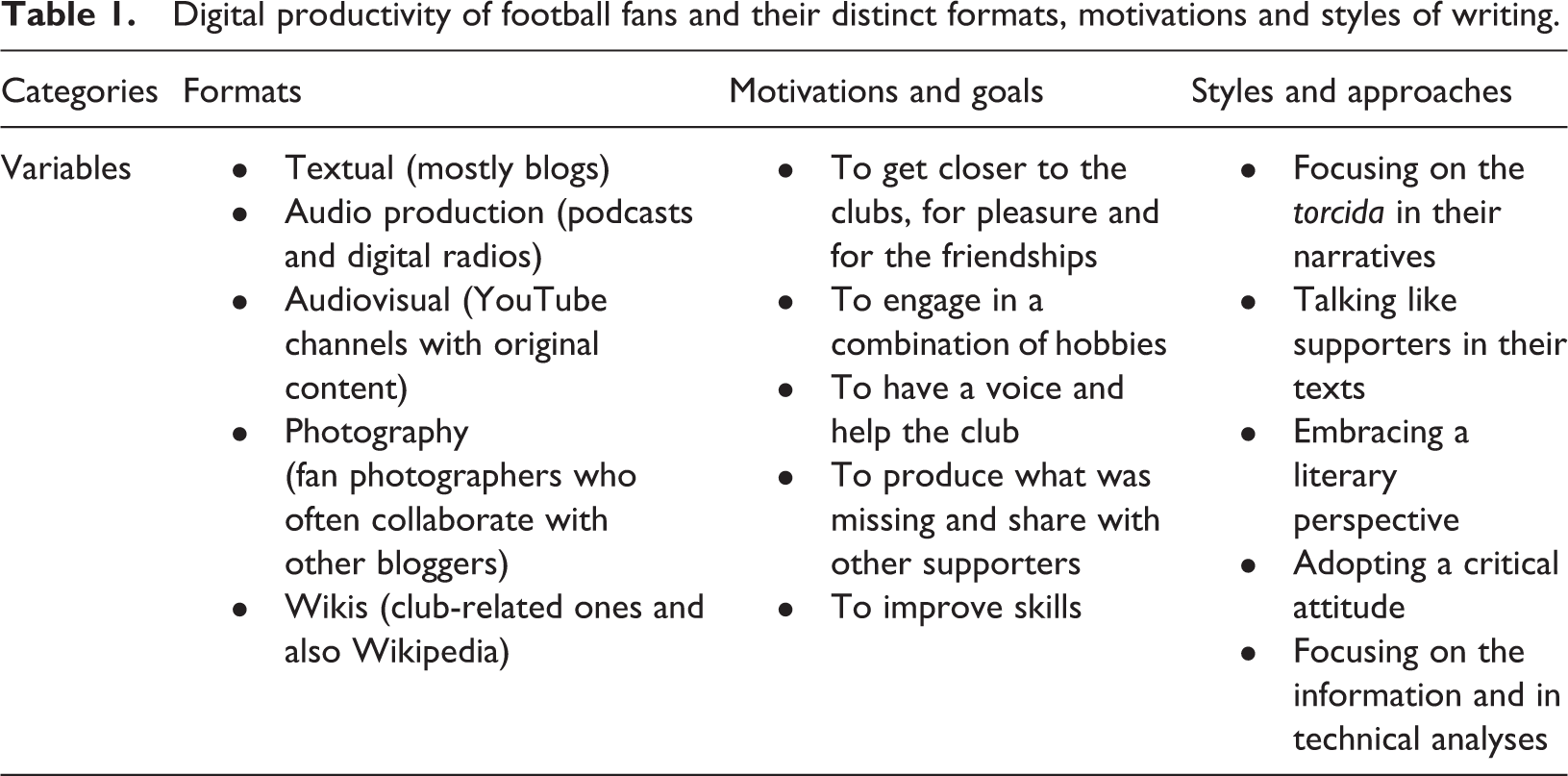
The analysis of the texts was done from observations made by the supporters themselves about their works and their peers’ works. When possible, the analysis is illustrated with examples also mentioned by the interviewees themselves.
Formats
Football supporters have produced an extensive variety of simple and complex digital content. From blogs and podcasts to live radio coverage, flogs, vlogs and other types of audiovisual productions. Not to mention the projects that are intended to preserve the memory and history of football clubs, such as wikis and YouTube channels that retrieve and organize goals, matches and the teams’ other historical moments.
Among those producing mostly textual content, there are countless fan columnists who collaborate in blogs such as NotiGalo, 1 one of the most popular within Atlético’s supporter base. NotiGalo was created in 2010 by Rodolpho Victor, who is currently a journalism undergraduate student but was only 15 years old at the time. Textual content is the more accessible format for fan producers, above all the newcomers, which spread over countless small blogs that generally have very few page views. Texts (here in the narrow sense), in comparison with other formats, demand less investment in terms of time, travel, equipment, training, mobilization and so on. But there are also many experienced fan producers who use the written word as their main mode of communication. Rodolpho is one of these, as is Elen Campos, currently a blogger at CAMikaze, 2 Galo’s space at ESPN FC – an exclusively user–generated content division at the website of the Entertainment and Sports Programming Network (ESPN) Brasil. Elen has produced texts about Atlético since 2009, when she started to collaborate with other fans, including Christian Munaier, at Terreirão, 3 a blog dedicated to Atlético at the section reserved for fan-generated content at the Globoesporte platform – the flagship online portal of Grupo Globo, the largest media network in Brazil.
Digital radio stations have also proliferated within football supporter bases in Brazil. Among atleticanos (supporters of Atlético in Portuguese), the most popular one is Web Rádio Galo (WRG), 4 which produces regular original content (mostly weekly programmes) and also provides live commentaries for its audience during Atlético’s matches. WRG, created in 2011, did not arise in a vacuum. Numerous other radio stations with similar models have dedicated their work to other Brazilian clubs, including Web Rádio Verdão (Palmeiras), São Paulo Digital (São Paulo), Rádio Coringão (Corinthians), Rádio Guerreiro dos Gramados (Cruzeiro), Web Rádio Lusa (Portuguesa), Rádio Santista (Santos), Rádio Estação Coral (Santa Cruz), Rádio Alvinegra (Ceará), Rádio Avaí (Avaí) and Rádio Paraná Clube (Paraná). 5 The production of a radio station generally requires some investment in terms of equipment (e.g. better computer sound cards) and the demand associated with transportation is also high because the supporters behind WRG, for example, make live match commentaries directly from the stadium. A radio station still might involve investment in training (the creators of WRG took professional sports-announcing courses) and a high level of mobilization because many of them rely on many collaborators.
Similar to radio stations, and many times part of them (with the distinction that radio stations in general have live programming), podcasts are also very popular. One of the most celebrated by Atlético supporters is Galocast, 6 created in 2008 with the political function of exerting pressure over the then president of the club, Ziza Valadares. Later, Galocast began discussing the weekly events involving Atlético and even had a reporter doing daily coverage from the training centre of the club. Currently, it is split up into two projects: TerreirãoCast 7 (a podcast led by ‘Couttinho’, one of the former members of Galocast) and Espora Afiada 8 (a vlog by ‘Zeca’, the creator of the enterprise). Both projects are currently part of Terreirão and other former members of Galocast are still around, such as Igor Assunção and Léo Gomide, both journalists working for conventional media networks in BH.
Indeed, vlogs and other videos form one of most consumed types of fan-generated content among atleticanos. Besides Espora Afiada, channels such as the one of the blog Cam1sa Do2e 9 at YouTube 10 demonstrate the strength and esteem among fans for the audiovisual form. Rafael Lima, the supporter behind Cam1sa Do2e, produces numerous programmes and series about Atlético’s torcida and its characters since 2009. The blog has more than 3100 subscribers and almost 4.5 million views in the channel (data from October 2014). Rafael has, for instance, made videos of the crowd performances in the section Vídeos da Massa (Videos of The Mass) 11 and told incredible supporter stories in the episodes of the documentary series #NãoPosso Tem Jogo do Galo (#ICan’t Galo is playing). 12
Supporter bases have also witnessed the spread of fan photographers. Among Atlético supporters, some of them are Gabriel Castro, 13 who, since 2010, has been registering matches and other events involving Galo’s torcida; Daniel Teobaldo, 14 who, since 2012, has also been recording supporters and games for the project Soul Galo; 15 and Moacir Gaspar, who photographs particularly the club’s largest organized supporter group, Galoucura. 16 These supporters publicize their works on their personal websites and on social media platforms. They also collaborate with countless other blogs – or, as they call it, with the Galosfera, in a pun with the words Galo and blogosfera (blogosphere) – where their photos are posted side-by-side with textual content produced by other fans.
Beyond these formats, supporters have also involved themselves in projects designed to archive and preserve the memory of the club. For instance, even though the project Galo Digital 17 (a wiki that archives, organizes and provides information about the history of the club) is an enterprise of the Centro Atleticano de Memória 18 (a non-for-profit organization that works in cooperation with Atlético), it still counts on the collaborative efforts of supporters to recover and retrieve information about the club. Others often get involved in updating the club’s page at Wikipedia as well as developing their own projects, such as Matheus Soares 19 , who catalogues historic and rare matches and goals in a YouTube channel that he has maintained since 2008 and that has around 1300 subscribers and 2.7 million views (data from October 2014).
Motivations and purposes
Supporters’ motivations for producing original media content can be individualistic (e.g. to improve their writing skills) or altruistic (e.g. to help the club). Many fans cite more than one reason, but all of them stress the pleasure that they feel in doing what they do.
To get closer to Galo, for pleasure and for the friendships
For Wilson Franco – the previously mentioned Zeca – the main reason to produce what he produces is pleasure itself: ‘first of all, it is the pleasure that I feel because I am a fanatic supporter of Atlético and I really enjoy talking about it’’ Eduardo Guerra, the creator of WRG, asserts that the work is important for him to be ‘with Galo’. Roberto Guerra, Eduardo’s brother and co-founder of the radio station, asserts that the task is ‘pleasurable. Because if it wasn’t, I would have already given up. Chatting about football is good. Many people enjoy it and would like to have a place to do it’. For Rafael Lima, from Cam1sa Do2e, there is a personal satisfaction that comes with working with something that you like so much. For Gabriel Castro, photographer, it is a ‘matter of being with Atlético, being closer to Atlético’.
The pleasure that most supporters mention is strongly associated with the collaborative character of such projects. These initiatives are built on the contact with other supporters and formed from relationships that are less hierarchical than those found between mainstream media organizations and their audiences. One of the greatest motivations for the supporters interviewed comes from the companionship of other supporters or from the sociability, to use Simmel (1950) terms, found in the quotidian conviviality with an audience that here is clearly not separated from the producers. Resulting from interactions with no pragmatic purposes, sociability is the essence of association, of the associative process as a value and as a satisfaction in itself. It is, above all, as Simmel (1950) says, about the pure pleasure of companionship and differs tremendously from the results of instrumental communication.
Those taking part in the initiatives described above are strongly motivated by two types of communities: those formed on popular social media platforms and the subcommunities found around specific projects. WRG, for instance, was created because of a deep curiosity and motivation to produce something about Atlético that was already being done by supporters of other clubs: I was watching CQC [a television show], and there was an award, I don’t remember the name, but they were showing the award ceremony. And there was Cléber Machado [a journalist at Rede Globo], [who won] best commentator and so on. And then they said something about a web radio station, Web Rádio Lusa, dedicated to Portuguesa, which had won [an award]. […] Then…best web radio…[I thought:] ‘What, what is that?’ Then I went to my computer, [searched for] Web Rádio Lusa, and then I found their site. In a little while, I realised what they were. […] They broadcast the matches with live commentaries. […] I thought it was very cool. […] Then I came to Beto [his brother]. Beto is a singer and he works mostly evenings and early mornings, then I said: ‘Hey Beto, if Portuguesa has one bro, Atlético must have one too.’ […] And then we started to study and we thought it was very cool and we decided to create Web Rádio Galo, but like that, out of the blue. We had never done anything like that. (Eduardo Guerra, personal communication, 21 July 2014)
To engage in a combination of hobbies
Some of the interviewees stressed that they felt passion both for the club and for their content-production activities. For Leide Botelho, a collaborator at WRG and NotiGalo, her passion for writing is one of the things that motivated her. This combination of passions is also what is behind the work of fan photographers such as Gabriel Castro and Daniel Teobaldo. Daniel, for instance, was doing a photography course when he started to photograph the stadium, a place that he had attended since early in life: [It] started as a hobby […]. Since 2012, I take my camera with me to the stadium. But I took it to the stadium aimlessly, only to take photos [personal photos]. […] And then I began to take photos of the action before the match and people started to ask me: ‘Hey, where is it going to be published?’ And I didn’t have a website. Then I decided to create my site and I created this name, Soul Galo, because I like our torcida. […] It started as a hobby and it’s still a hobby. It’s something that de-stresses me. (Daniel Teobaldo, personal communication, 12 August 2014)
To have a voice and help their club
Other supporters reported motivations of a more political nature. This is the case with Zeca and the aforementioned podcast, Galocast. This supporter has been part of online communities related to Atlético since the 1990s, when fans exchanged messages via Bulletin-board systems (BBSs) and electronic mailing lists, through the period dominated by Orkut, to the current distributed age with Twitter, Facebook, YouTube and other social network sites taking the lead. Zeca explains that his aim today, with his vlog Espora Afiada, is to contribute in his own way for the club and for the decision-making processes that define Atlético’s policies, above all, those related to its supporters: So, I want to have my opinions heard. […] I feel the need to contribute to something. Like, the season ticket, I try to be a channel to improve our program. We know that we can’t do much because Kalil [then the president of the club] is a centraliser, but we do say things. Maybe a new president will come and he will listen [Galo was about to have an election]. Indeed, some people from Atlético’s board of directors follow me on Twitter. […] Then, my main aim is this: taking part in Galo’s life. (Wilson Franco [known as Zeca], personal communication, 5 August 2014) What I expect from a project like this is to have a voice, you know? First and foremost because I’m a woman. I guess that if I wasn’t a woman, I wouldn’t have such a need because I’m going to tell you, it changes everything, it changes a lot when you write. When you’re in a group of male fans, you’re not heard. Even if your opinion is the most sensible and correct, they don’t take you seriously. When you’re on the other side, when you write, people give you so much more attention and they reflect more deeply about what you’re saying. […] So it’s indeed almost a responsibility. Because I think that many women have already done so much for so many things and I don’t do anything. And I consider myself a feminist. Then, in the universe that I like most, football, I need to contribute in some way. (Elen Campos, personal communication, 3 August 2014)
To produce what was missing and share with other supporters
Those who live apart from their clubs (in the countryside, other states or countries) do not have easy access to news about their teams on TV as most sports fans have in a daily basis. Rafael Lima lived his childhood and early adulthood in the countryside – the programming and coverage of regional network affiliates are relatively distinct from capitals’ networks in Brazil – and, at some point, he realized he was not the only one who needed an alternative media channel to follow his club more closely: I realised that supporters from the countryside are really in need of content and I blamed the TV that gave 30 seconds to us, and we wanted more than that. And that was the moment that I thought about doing a blog that would be a connection between BH and Galo with those that are far away from them. And then, Cam1sa Do2e was born. (Rafael Lima, personal communication, 7 July 2014)
To improve skills
Lastly, supporters also reveal that their labour is related to a personal pursuit for skills. This is the case with Douglas Pereira, a 19-year-old computer science undergraduate student who has maintained the blog Galo Forever
20
since 2009, when he was only 14 years old: Actually, I was, I am still very bad when it comes to writing. Then I said: ‘Well, the only way to get better is to practice.’ Then I thought about doing a blog and I asked myself: ‘About what?’ And I decided to write about the thing that I know most: Atlético. […] I was a high school freshman but I was already thinking about vestibular
21
. (Douglas Pereira, personal communication, 14 July 2014)
Styles and approaches
The styles adopted in the digital projects of football supporters are as diverse as their formats and motivations. Some content producers are seen as ‘poets’ by their peers, whereas others express, in a rather intense way, the passion of football supporters. Among them all, partiality and passion are two of the most used expressions to characterize their work.
Focusing on the torcida in their narratives
A fundamental characteristic of some of the aforementioned projects is exactly the change of focus that they promote in comparison with traditional journalistic coverage of football: In the centre of the narratives, we find the supporters, not players and football leaders. Many of Rafael Lima’s fellow Galo supporters, for instance, feel that he ‘turned his back on the game and only talks about the torcida’. In Rafael’s work, supporters’ stories are told, for example, in the already mentioned series #NãoPosso Tem Jogo do Galo (#ICan’t Galo is playing). 22 In these short documentaries, Rafael interviews fans about the unusual and complicated situations that they have experienced because of Atlético’s matches. In the episode with the most views – Episódio especial (Não posso. Tem milagre do Victor!) [Special episode (I can’t. Victor is making a miracle!)] – many supporters are interviewed about the day of the ‘miracle of Saint Victor’. This fateful match was against Tijuana (Mexico) in the quarter-finals of the 2013 Copa Libertadores da América. During this match, the goalkeeper of the team, Victor, defended a penalty kick in the extra time of the second half of the game. This penalty, if converted, would have eliminated Atlético from the competition. As Galo became the champion of that year’s tournament, the goalkeeper turned into a mythological character. For Galo supporters, ‘Saint Victor’s Day’ is one of the most legendary in the club’s history and the narratives of the supporters interviewed by Rafael accurately express the suffering, pain, agony and redemption they experienced on 30 May 2013.
Indeed, this same match was used by Gabriel Castro to exemplify how his own work also focuses on the torcida: For instance, I didn’t go there to take photos of Riascos kicking the penalty against Victor. I didn’t have the courage, you know? And I looked behind me and saw myself in that bunch of atleticanos […]. And instead of taking photos of the move, I took photos of the torcida. Then, I have sequences of photos of when the penalty occurred; […] there were so many people with hands on their faces, many people on their knees, already crying. […] And then, in a two-minute interval, I had people crying to the greatest joy that someone ever had in life. Then, I think this was the point when I identified myself with the supporter and this is when the supporter became more important than what was going on in the field. (Gabriel Castro, personal communication, 14 August 2014)
Talking as supporters in their texts
This perspective could also be used as a broader approach because it actually defines the texts produced by most of the interviewed supporters. However, the specific focus here is the use of a more radical and passionate language, which resort most of the time to rivalry, especially to jokes with Cruzeiro supporters, as the raw material for the text. It is a more aggressive style of speech, loaded with qualifying adjectives for both the players of the team and those of the rival. It is not a simple rude name-calling or an injurious attack to someone’s honour; it is rather a discourse that reflects a bar conversation, the rage before a missed goal and the pure irrationality that surrounds football supporting.
In this sense, texts in which their authors talk as ordinary supporters have a radicalism that only indeed a fan may express. This type of approach, for Leide Botelho, is what makes atleticanos so addicted to content produced by other supporters: There, he sees himself. He is facing a mirror. In the rage and in happiness, he is facing a mirror. He is seeing himself there. It’s the same thing: Who can huff and talk about my son? It’s me and only me. If any other person says anything, it will bother me. ‘Don’t talk about my mum, but I can.’ It’s similar to that. (Leide Botelho, personal communication, 8 August 2014)
Embracing a literary perspective
‘Fan poets’ differ by taking particular care with the aesthetics in their texts. For many of those interviewed, the key example was Roberto Drummond, a writer from Minas Gerais who portrayed, as nobody else was able to, the soul of atleticanos. Elen Campos, who the interviewees very often cited as a representation of this poetic spirit, does not worry so much about having first-hand information or the originality of the topics she discusses: I will rarely say something that nobody else has said yet because I am not here for that. But, maybe, I will talk in another way and that’s what I like most […]. I enjoy writing unusual things. I don’t like to write about tactics or the match itself. That’s not what interests me. What interests me most are the stories behind football. (Elen Campos, personal communication, 3 August 2014)
Adopting a critical attitude
Other supporters have taken on a more critical attitude in their work. The focus in this case is often on topics such as the season ticket programme, Atlético’s contracts with sportswear manufacturers and stadiums’ management companies, the media coverage about the club, and political issues surrounding the organization of tournaments in the country. As I asserted earlier, the podcast Galocast was a regular project that focused on political issues related to the club: Because, for Galocast, I had the idea of doing a podcast about Galo, but a more critical podcast because at that time it was Ziza [the president] and Ziza was only doing silly things. […] I was a moderator at the Galo’s community on Orkut. […] Then, I gathered a small group. […] And in the very beginning, it [our motivation] was that: to charge Ziza. But these guys, these other guys, they already wanted to talk more about football itself. Then, let’s do a mix, a little bit of pressure over the board of directors and talk about football. And then, Ziza left and we ended up talking more about Galo. (Wilson Franco, personal communication, 5 August 2014)
Focusing on the information and in technical analyses
At last, we have the perspective that may be considered the least innovative in the sense that it does not invert that much the logic of the conventional football coverage done through the traditional media. Many blogs reproduce – many times in their own words, I must say – the journalistic style of reporting events involving the club (e.g. ‘Galo plays against X today’, ‘Tickets for the game Z are on sale tomorrow’). Besides, some supporters also make technical and tactical analyses of the matches and schemes used by the team over the season. In all these cases, supporters are in fact doing a similar job to that of conventional media.
Discussion: Journalism, literature and postmodern chronicle
Some parallels can be traced between the texts produced by football fans and conventional sports journalism. Particularly, the last two styles of writing presented above, critical- and information-based approaches, are both very similar to traditional modes of sports journalism as discussed by Rowe (1992). Rowe distinguishes four types of sports writing: hard news, soft news, orthodox rhetoric and reflexive analysis. Hard sports news focus on events and adopt a relative impersonal tone, reporting traditionally on results, match statistics, individual performances, transfers of players and so on; soft sports news are more entertainment oriented, often emphasizing biographies, experiences, tastes and opinions of star sports personnel; orthodox rhetoric is in some sense the opposite of hard news, with texts frequently enunciating the distinctive subjectivity of the writer, adopting a more editorial function and recognizing the political aspects of sport; at least, texts with reflexive analyses, which are the least common type of sports writing, are close to forms of orthodox rhetoric in their criticism, but instead of being directed at the reader by the professional analyst, they focus on shared experiences and affectivity, creating a closer connection between writer and reader.
Information-based approaches adopted by fans are exactly like traditional hard sports news. The more critical accounts above-explored are very similar to the orthodox rhetoric of sports journalism, with the difference that its emphasis is generally on ‘services’ offered to fans of that particular club or team. The analyses of such services are often more complex than simply assessing them as good or bad, with fans discussing in details the politics behind the prices and practices of stadium management companies, sportswear manufacturers and so on.
Those texts that ‘talk about the torcida’ and those that focus on textual aesthetics, on the other hand, are close in terms of their content and form to traditional sports accounts that embrace a reflexive analysis. Particularly, the fan texts analysed here provide alternative approaches that enrich and pluralize the media environment in two ways: (1) placing the supporters at the centre of the stories and (2) adopting unconventional methods of reportage that are able to uncover the unusual, ordinary, passionate and ultimately more engaging stories told by supporters. In fact, unlike the findings of the Pennsylvania State University’s (2009) report mentioned earlier, the projects that are popular within Atlético’s supporter base often involve elements of original reporting, although these elements are not the methods traditionally adopted by conventional media organizations, which would not send their reporters over to the middle of the stands, where Rafael Lima, for instance, goes to tell the supporter’s stories.
But the transformative character of supporter texts goes beyond the established contributions of such rare reflexive sports accounts. Their importance, in the Brazilian context, lies also in reviving the passionate and literary style of Brazilian sporting chronicles that has been disappearing since the 1980s and in their important role in sustaining contemporary alternative football fan cultures in an increasingly hypercommodified football environment.
During the 20th century, Brazilian sporting chronicle constituted one of the most notable and prominent spaces of discussion about the national identity (Capraro, 2007). In the first decades, the civilizing issue prevailed; between 1940 and 1970, the debate focused in the ginga and malandragem issues; and over the last years, a professionalized and globalized style has dominated the texts (Capraro, 2007). For Brauner (2010), modern-day sports chronicle in Brazil has restricted itself to a specialized discourse, tending more to the journalism side and moving away from literature. Information and the ‘truth of the facts’ expressed in synthetic and objective texts have replaced the epic games and the magical dribbles that characterized the ecstatic descriptions of the distant past. According to Brauner (2010), fiction and hyperbole lost ground and the talent of the writers was replaced by the bureaucrat of the tactical analysis, the tipster of results.
The analysis developed here, on the other hand, suggests that the sporting chronicle with a more passionate and emotional nature, which characterized the golden years of José Lins do Rego, Nelson Rodrigues and Armando Nogueira, seems to be re-emerging. Now, it is turning into a style that expresses and reflects less about grand narratives such as the national identity and the civilizing issue in Brazil (as its predecessors) to restrain itself to the universes shared by fans of individual clubs. It is more postmodern, in this sense, in expressing and articulating not a search for metanarratives about the nation and football, but rather pieces, fragments and micro-universes that go unnoticed by those who are not part of such cultures. Sporting chronicles, in the alternative circuits of fan production, have become peripheral and regional, and the idols and supporters of the central clubs from Rio de Janeiro and São Paulo are no longer the only ones to matter – which used to be the case with the traditional literary style. In this sense, even football itself disappears, before a narrative that replaces a single culture (football culture) as a canon to be inspired by diverse cultures of clubs and torcidas, here elevated to the centre of the narratives.
Conclusion
This article explored the digital productivity of Brazilian football supporters, particularly from projects developed by fans of a single club, Atlético-MG. Supporters running the most popular productions within Galo’s supporter base were interviewed and evidences here presented have pointed out that they are unlike pop culture fans. Pop culture fans often seek to explore alternative plots, less important characters and new narrative lines in their texts, regularly resorting, therefore, to fiction, to dialogue with the universe set in the canon. However, football supporters build their stories more in contraposition to journalism, as McCarthy (2013) had already indicated.
This study sought to understand in precisely which ways football supporters’ texts augment and supplement the content produced by mainstream media and, by linking those projects to the communities and cultures behind them, my analysis found out that these enterprises are innovative mainly because they place ordinary supporters at the centre of their narratives, therefore, making their stories more engaging and appealing to other fans; they adopt unconventional methods of reportage that challenge the dependency of journalism on regular productive routines and that are able to address unusual angles of sport-related stories; and they are recreating that passionate and literary Brazilian sporting chronicle in a more postmodern fashion.
Other researchers studying digital cultures have argued that users in produsage communities formed around Flickr, Linux, Second Life and YouTube are challenging professional media providers, media norms and the cultural authority of ‘legitimate knowledge’ through continuous collaboration and through creative decentralized ‘co-creation’ with a clear democratic and transformative appeal (Bruns, 2008; Burgess and Green, 2009). However, Hutchins and Rowe (2012), who have researched sports and new technologies, are not convinced about the possibilities of finding this type of collaborative communities specifically in the sports environment. This article demonstrated the existence of such digital creative practices within the supporter base of the Brazilian club Atlético-MG, but further research is necessary to investigate whether this is an isolated case or the same type of productive collaboration is found in the context of other clubs, sports, leagues and countries.