







Abstract
Creating successful newsgames requires effective boundary work between journalists and game developers. Both groups come to the job with different professional vocabularies, technical know-how, and work cultures. Our goal was to understand how they approach these challenges as they create a product that satisfies their professional expectations and the demands of media organizations and audiences. This article presents the results of semistructured expert interviews with pioneers in German newsgame production. We found that effective newsgame creation entailed complex coordination efforts. However, expected clashes between the different professional cultures did not occur. Conflicts were eased by a general agreement on news as a public service and by emphasizing nonhierarchical decision-making in teams. Our interviews detail the economic and technical obstacles that have resulted in newsgames not making major inroads. The decline of newsgames was related to the development of other digital media forms that matched journalistic conventions more closely. These findings led us to extend the model of journalistic boundary work to a more interactional concept that highlights the contributions of both sides while acknowledging the obstacles of operating in a larger media system.
Keywords
Creating successful newsgames requires effective cooperation between journalists and game developers. Both professional groups have to resolve what journalism scholars would call ‘boundary work’ (e.g. Carlson and Lewis, 2015). The teams come to the job with different expectations about the production and the presentation of content. They also diverge with regard to their professional vocabulary, technical know-how, and work cultures. This study investigates how journalists and game developers approach these challenges when making a product that satisfies their professional expectations and the demands of media organizations while also appealing to audiences.
This article presents the results of a series of semistructured expert interviews with pioneers in German newsgame production conducted in 2017. The goal was to understand this boundary work, that is, attitudes and coordination processes impacting newsgame production in general while allowing participants to reflect on the cooperation in specific newsgame projects.
Our study finds that effective newsgame creation entailed complex coordination efforts. We expected clashes between the different professional cultures (Hermida and Thurman, 2008); however, they did not occur. Often, developers and journalists had practical experience in each other’s professional field, acquired in previous work on interactive media content. Conflicts were eased by a general agreement on news as a public service and by emphasizing nonhierarchical decision-making regarding game design.
Our interviews and observations also brought to light the economic and technical obstacles that have resulted in newsgames not making major inroads in overall media production. It became evident that the decline of newsgames was related to competition from other digital media forms that matched journalistic conventions more closely. These findings led us to extend the model of journalistic boundary work to a more interactional concept that highlights the contributions of both sides while acknowledging the obstacles of operating in a larger media system in transition.
Recognizing both the potential and (increasingly) the shortcomings of newsgames as a media form, our interviews provide important insights into the creation of multimedia content from the stage of (often-hyped) innovation to a more mature phase under the real-world conditions of an industry in crisis.
Journalism and interlopers
There is a wealth of research on the ongoing struggle of journalists to integrate new technologies into their workflow. One central explanatory concept is boundary work. For instance, Carlson and Lewis (2015) utilized this idea to analyze how journalists and journalism as a field are constantly called upon to defend their professional status and position in relation to external forces. Boundary work is a way of coping with changing work routines triggered by new technologies or the challenges of external competitors such as bloggers or user-generated content. Eldridge (2014, 2018) demonstrated two mechanisms at play within journalism during moments of disruption. Boundary maintenance happens when journalists face episodic and occasional failures such as the phone-hacking scandal at the British tabloid News of the World. It is shaped by reactions that happen ‘rapidly and overtly to counteract the failings of the professional in-group’ (2014: 14). Interloper media reactions are different. When out-group interlopers (such as Wikileaks) claim belonging to the in-group journalism, the boundary defenses move ‘more protracted, more covert, and subtler, and in its cumulative effect enforc[e] a sense of ‘being’ journalism’ (p. 14).
Belair-Gagnon and Holton (2018) examined data analytics companies as specific long-term interlopers in the newsroom. Interviewing web analytics professionals, they demonstrated that successful collaboration required a careful give and take between the group in a ‘milieu of experimentation’ (p. 505), which incrementally led to a change in newsroom practices and attitudes. While respecting newsrooms norms and routines, these interloper media nevertheless subtly nudged journalism toward transformation to a more direct profit-oriented attitude and continuous proactive audience connections (p. 505).
During more than two decades of digital disruption in the journalism field, numerous studies have delineated the degree of transformations the profession has experienced (e.g. Anderson, 2013; Usher, 2014). By now, digital, multimedia storytelling directed toward interactivity and hyperlinking has eroded previous boundaries between print and broadcast journalism. User-generated content and concurrent financial pressure on the news business has led to an increasing de-professionalization of the field. All this has triggered waves of questioning the future of journalism accompanied by debates on defining the profession. However, Deuze and Witschge (2018), among others, recently cautioned researchers not to hold on to rigid ideological demarcations of journalism at a time when the actual lived experience of professionals is increasingly freelance-based, precarious, entrepreneurial, or otherwise atypical. Lewis and Westlund (2015) offered a helpful new model for analyzing digital journalism that moves away from understanding journalistic work as the unique output of a specially defined profession. Instead, they proposed a matrix that integrates technical and atypical contributions with journalistic work. For them, journalism becomes the outcome of ‘cross-media news work as a system of actors, actants and audiences engaged in a complex set of media activities […] carrying with them key implications and concerns for business/commercial and professional/normative interests alike’ (p. 33). Their approach guided this case study; it allowed us to link the technological and journalistic aspects of newsgame production as they are experienced in real live while freeing us from tedious attempts to highlight professional distinctions.
Intricacies of newsgame production
Given the relative novelty of newsgames in the digital production process, a critical attitude by journalists is understandable (Foxman, 2015: 42–44). Moreover, game design is complex, often time-consuming, and expensive, taking resources away from other newsroom priorities. Nevertheless, newsgames can be a valuable addition to digital journalism. As journalistic outlets seek to attract younger users – and audience engagement measures displace simpler metrics like unique visits and page views – games may present new opportunities to reach and retain audiences (e.g. Eveleth, 2016: 10). More sustained audience engagement in turn benefits news institutions (Foxman, 2015; Meier, 2018; Vobič et al., 2014).
Well-received newsgames have to cross two thresholds: they have to lead audiences to a profound interaction with nontrivial journalistic topics, but they should also be appealing and even fun to play. Yet most journalists only bring limited gaming experience and programming or game design skills to the table. It is difficult to acquire the various skills necessary to produce computer games on top of everyday journalistic operations. While there is a variety of free or inexpensive programs that help with producing interactive texts or videos (such as Twine or Adventr) or even more advanced games (e.g. Game Maker), newsrooms benefit from the support of professionals such as game or graphic designers or programmers. The cooperation with these professionals removes creative stumbling blocks; however, it can also add to the complexity of the production process.
The list of challenges is long. Game design is not a linear process. There are typically a variety of parallel work steps and influencing factors to consider. As a result, the course of action cannot always be planned in advance (Klug and Schell, 2006). Many designers describe game development as an iterative process. To adequately implement ideas, after each step, the contents must be tested for their functionality and possibly revised through so-called systematic playtesting (Fullerton, 2008; Zimmerman, 2013). According to O’Donnell (2014), this method often includes creating specific tools for the respective game. Moreover, in newsrooms, the production of newsgames has to be integrated into the traditional news production cycle. Tight deadlines and limited resources of media organizations make the production of newsgames even more difficult (Eveleth, 2016: 11; Foxman, 2015: 48). Additionally, newsgames demand changes in journalistic working culture as the developers and engineers who create these interactive features need to not only become part of the editorial process but of the newsroom as well (Foxman, 2015: 44; Silverman, 2015). For example, if the media company has an in-house development team, it needs to be discussed where its members are to be located to facilitate communication between them and the editorial staff. Organizing the cooperation between the professional groups becomes even more of a challenge when the media company decides to hire outside experts. In turn, newsworkers have to open up to external logics of media production, even if this ‘decreases newsworkers’ autonomy, as they have less power to define and assert what news is’ (Ferrer Conill, 2018: 241–242).
Research on newsgames so far has focused on design and content aspects and in general supported a potentially positive connection to journalistic use (e.g. Bogost et al., 2010; Plewe and Fürsich, 2018; Sicart, 2008; Treanor and Mateas, 2009). Studies on the production conditions of digital journalism in general have dealt with the differentiation of tasks or changing working conditions in newsrooms triggered by convergence strategies (e.g. Franklin and Eldridge, 2016; Schreiber and Zimmermann, 2014). These types of convergence studies tend to prioritize the structural and professional transformations for journalists (e.g. Plesner and Raviola, 2016). Investigations of the actual cooperation process between journalists and external professional groups during the production of new types of journalistic content are less common. The goal of this study was therefore to understand both sides of this collaborative process. Using the framework of boundary work, we contextualized these efforts within organizational and reception structures of real-world cases of newsgame creation.
Method
The analysis is grounded in the first author’s extended involvement in newsgame production in Germany since 2013, leading to lasting contacts with digital journalists and game developers and sustained networks in the newsgames and serious games communities. For this study in particular, semistructured expert interviews were conducted with German journalists and game developers who have been involved in newsgames projects. Guiding these interviews were two research questions:
Following Meuser and Nagel’s advice (2002) that to successfully conduct expert interviews, the interviewer has to have distinct knowledge of the respective field, our engagement included a range of immersive moments: extensive research in the fields of both game design and game studies, attending various German and international developer meetings and events on game design (e.g. Gamescom or Talk & Play), participating at conferences on the cultural and societal impact of computer games (e.g. Clash of Realities or PLAY-Festival), and joining game jams to gain practical insights into game creation. Reflecting on this immersion phase and informally talking to a wide variety of people at the nexus between games and journalism helped us to focus this study on six pivotal stakeholders in this stage of German newsgame development. Our criteria for the selection of interviewees were multifold: We included interviewees from both professions who all were directly involved in the planning, design, or technical implementation of one or more newsgames. Moreover, the participants’ projects represented the widest range possible of differently designed newsgames (Lindlof and Taylor, 2011: 112–114). This selection allowed us insights into the production processes of a very large portion of newsgame projects in Germany between 2014 and 2017. Despite being given the option of anonymity, all participants agreed to be named in publications. This decision reflects the rapport that the interviewer 1 established with the interviewees, many of whom he had engaged in several informal conversations over the course of the project. Being named may have led the participants to be less forthcoming about conflicts that happened in teams. However, the interviewees appeared to us as very open, often frankly discussing problems encountered.
The participants of our study were newsgame pioneers in Germany, the largest media market in Europe. They produced newsgames for the top-ranked news platforms of the two national public broadcasters ARD and ZDF, the statewide public broadcaster BR, as well as the newsmagazine Der Spiegel. Their games reached a potential audience of millions of users. While newsgames had only played a minor role in German news media up the point of our study, the novelty of the genre sparked a lot of interest among fellow journalists, scholars, and innovators in journalism. The German media system is divided into a public broadcasting sector almost completely financed through a monthly broadcasting fee and a private sector mainly financed by advertisement. The majority of newsgames produced in Germany were published by public broadcasting outlets and only very few by private television companies or print publishers. This is striking since public broadcasters initially were slow in introducing innovative digital media content on their online sites. Der Spiegel represents an internationally renowned weekly newsmagazine that has seen its print profits and circulation starting to stutter while eagerly hoping to monetize its top-ranked online sites.
In the interviews, we learned that our group of experts embodied a unique professional double-identity: Most of our interview participants (see Table 1) had a professional background in journalism as well as in digital media production or game development. Marcus Bösch was a journalist for public broadcasting for 10 years before he became a game designer and produced some of the first German newsgames (like PRISM – The Game). He collaborated on the release of several games (like Metadatensauger) for the German satire news program ZDF Heute Show with media producer Jochen Voß, who had also worked in journalism before. Game designer Eric Jannot was another innovator of the genre and released several newsgames including one (No Male Heroes) based on the Gamergate controversy (e.g. Nieborg and Foxman, 2018; Massanari, 2017; Perrault and Vos, 2018). Besides his degree in game design, Jannot also holds a degree in journalism and communication. Online journalist and game developer Henry Lai and his team produced a newsgame (Shitstorm Fighter) on social media shitstorms for the public broadcaster ARD. Former journalist and head of multimedia at German news magazine Der Spiegel, Jens Radü, and digital developer Ulrich Buckenlei cooperated on a popular newsgame (Das SPIEGEL-Spiel über das Spielen) on the potential of digital games.
List of interview partners, their professional affiliations, and their newsgames.
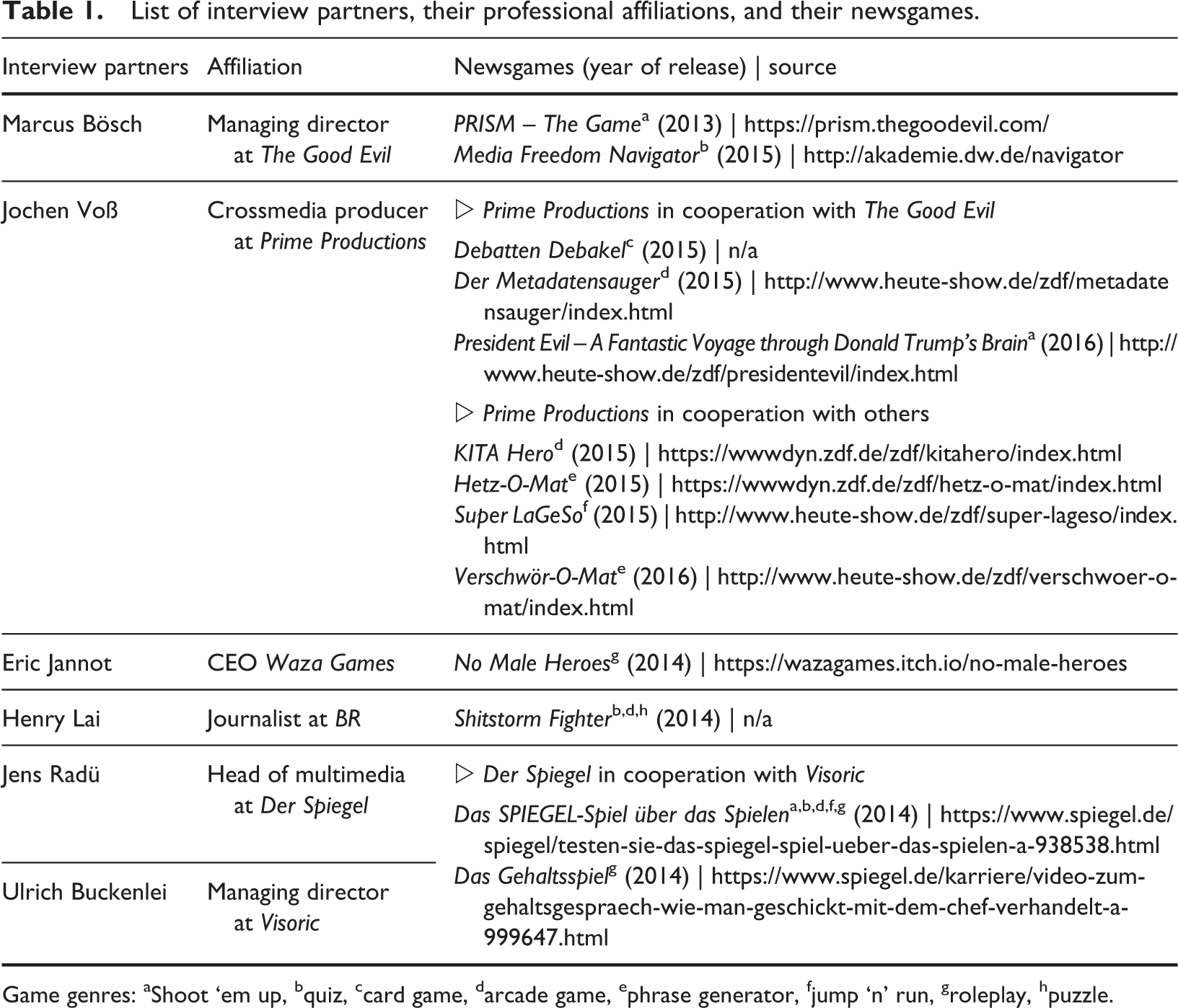
Game genres: aShoot ‘em up, bquiz, ccard game, darcade game, ephrase generator, fjump ‘n’ run, groleplay, hpuzzle.
The newsgames produced by our interviewees used a visual style similar to other web-based games found on online game platforms such as newgrounds.com . All of them were designed to generate an interactive, playful experience related to the journalistic content they were about. The games’ genres varied between role-playing; action-oriented genres such as jump ‘n’ run or shoot ‘em ups, arcade games, puzzles and quizzes, as well as entertaining phrase generators; or a combination of various genres. Some of these games utilized a design technique called ‘procedural rhetoric’ (e.g. Bogost, 2010; Treanor and Mateas, 2009). Developers use this strategy of combining game mechanics and textual features to direct the players’ experience. In our case, certain setups intentionally led players through the games in a way that conveyed a specific, often critical viewpoint on the topic portrayed. In some cases, these games were even made deliberately difficult or even impossible to win, to stimulate a critical debate on the topic beyond the game by employing a ‘rhetoric of failure’ (e.g. Bogost, 2010; Lee, 2003).
Following the established procedures of semistructured expert interviews (Galetta, 2013; Lindlof and Taylor, 2011), we addressed the research questions in an interview guide that afforded the interviewees the opportunity to report openly on their relevant personal experiences with further probing, if necessary. After transcribing the interviews, we employed established strategies of qualitative research and grounded theory using a process of open, in vivo and axial coding to move from data reduction to conceptual analysis and interpretation (Lindlof and Taylor, 2011).
Enabling newsgame development
Following iterative design procedures
All projects that the participants in our study considered to be successful had in common that both the journalistic and the game staff showed a strong commitment to adhering to a systematic design process regardless of their other work routines. While the conditions and resources of the game projects diverged from each other, the basic production phases resembled each other closely and followed the iterative method that experts in the method literature of game design recommend (e.g. Fullerton, 2008). It began with the selection of topics and a basic conception of the game designs. Early ideas were then tested with prototypes and implemented if approved by all. By constantly reviewing and improving the prototypes, the games continued to be optimized until they met the developers’ expectations and could be published. As some interviewees emphasized, meticulous planning during the very first phase of game development was particularly important because the earlier the details about the concepts were debated and settled, the easier these ideas could be implemented later. Nevertheless, despite the elaborate early phase, there were still a lot of changes in the subsequent implementation and testing phase. Prototypes played an especially important part. These did not have to be digital models right away but could simply be outlined on paper. The teams used them to test the functionality of the game mechanics, often in small increments. This approach allowed the developers to achieve fast interim results, which they could test and redesign. Playtesting in terms of functionality and usability was mainly carried out in-house or by the external developers on the teams.
Out-group as in-group
Another aspect that came as a surprise was the fact that all involved journalists and game developers had previous professional or academic background in the respective other occupational field. Accordingly, there were no outright ‘culture clashes’ during the cooperation.
Generally, there was a good knowledge of tasks and technical aspects of the work of the other professional group. Bösch, Lai, and Jannot even had significant experience in both fields. Given the pioneer phase, the participants were genuinely interested in the perspective of the other side. The journalists did not see the game developers as interlopers, but the teams worked on the common goal of testing the potential of gamified news. However, some interviewees also cautioned that projects could fail if this high level of openness and familiarity in teams were absent. Buckenlei, for example, explained: I could imagine that if you’d ask larger game companies that only specialize in shooter or extensive adventure games, they couldn’t do anything with journalists’ requests. I could imagine that they would continue to pursue their usual approach but that journalists might expect something different. (Interview Buckenlei (33″13′ to 33″58′))
Working in teams
Communication among participants played an important role in the creation of a product that satisfied different professional demands. It was helpful to get together with everyone involved in the early phases of the project to establish a common working basis. According to the interviewees, successful teamwork happened when more than just one side was able to ‘set the tone’ and various perspectives were accepted.
A prerequisite for effective communication in such an interdisciplinary working environment was to engage with the technical language of all professional groups and agree on a common vocabulary as early as possible. This made it easier for the participants to express and accept criticism and suggestions for their respective specialist areas.
Several interviewees emphasized the importance of early and direct feedback by addressing possible obstacles transparently. For example, game developer Buckenlei argued that it helped in his projects to communicate clearly with his clients and to explain how feasible their specific wishes were.
Voß explained further how such teamwork played out. Unlike in traditional newsrooms, for the work on newsgames, it made sense that all team members proactively participated in the creative phases and paid attention beyond their area of responsibility. Similarly, other interviewees experienced creative and professional exchange in the joint planning and design of the games as very productive. According to Radü, this intensive cooperation within designated areas of expertise led to results which were ‘better than what any individual could ever think up’ (Interview Radü (39″53′ to 40″11′)). Importantly, news itself was not the ‘boundary object’ in contention. Instead, all participants saw themselves in an experimental phase of creating an innovative product for the new delivery of and engagement with news.
Nonhierarchical organizational structure
Effective cooperation also required a convincing leadership style by the project manager(s) who had to understand and manage multiple positions. They had to consider options from various technical and journalistic perspectives. Transcending possible boundaries, they had to be able to explain design decisions in a generally understandable way to convince all those involved. Forward-looking managers who integrated different input in the early planning phase improved the course of action of the staff in the later phases of the project. This task could become tricky. Since not all ideas could be implemented, the project managers had to weigh which features would be given priority. According to the interviewees, valued project managers not only expressed appreciation for the expertise of all and encouraged equal participation but clearly and consistently communicated the central editorial goals of the games.
Successful teams worked on creating an inspiring environment that encouraged employees to be engaged. It helped when project managers fostered an appreciative and nonhierarchical structure in which each position was considered valuable, even if many suggestions did not make it into in the final game design. This preference for a nonhierarchical work environment and open exchange was probably the central contribution that game developers brought to the projects.
Attitudes and compromises
Boundary negotiations became most obvious in the often-voiced statement that a willingness to compromise was essential for successful team work. Several participants emphasized that it did not help to insist on an idea; instead, they had to be able to discard it if it did not work or was not accepted. Many also saw a need to learn to express and categorize criticism correctly.
However, we found that the attitudes on criticism varied among game developers between those who considered themselves independent and those who saw themselves as service providers. Jannot – as an example for the former group – would accept feedback on content by journalists as long as it aimed to improve an unclear presentation of the games’ core message. Yet he was wary of general criticism regarding the use of procedural rhetoric in game design, as he considered it essential for delivering the message of the game. He was also ready to counter more general criticism of the computer game as a medium. What worked for him was to highlight the advantages of the interactive presentation of contents, as well as to explicate the differences and similarities of newsgames in comparison to conventional journalistic forms of representation. For clashes between journalists and game developers over how to communicate content in accordance with the journalistic intention, Jannot recommended to link the presentation of the newsgame to extra commentary or corresponding information that transparently explained the intentions of the game while leaving the gaming experience intact.
By contrast, game developers, who saw themselves as service providers, were more willing to adapt their game design according to their clients wishes. Bösch, for example, explained that he focused on client satisfaction. According to him, developers have to be willing to discard even cherished ideas in the conception phase, in order to be able to respond to the requirements of the journalistic clients. Similarly, Lai emphasized the importance of conceptual flexibility: ‘You shouldn’t insist on your own ideas - especially when it comes to newsgames. The medium is still so unexplored that you can’t even know yet what’s wrong and what’s right’ (Interview Lai (21″09′ to 22″37′)).
Buckenlei also recommended restraint in the early phases. Instead of pushing their concepts, game developers should listen to the journalists’ ideas to fully reap the benefits of such a cooperative creative process. Overall, the degree of prioritizing journalistic preferences varied among the game developers but was generally driven by an effort to learn from the other side.
Content issues
The interviewees mentioned two aspects regarding the choice of topics and content for newsgames. First, participants agreed that the key is to spotlight topics that are timely but beyond the daily news cycle. By focusing on the long-term relevance of the topics and the reduction of complexity in their presentation, the teams were able to manage the immediate production pressure for all people involved. Content had to remain timely for a significant period to survive the production cycle. Thus, instead of using breaking news content, many recommended to deal with current, overarching topics (e.g. the Trump presidency or the Gamergate controversy). However, allowing for a longer time frame did not mean to engage in these topics in all their complexity. The interviewees had to limit newsgames to central aspects of each topic to keep the production effort manageable and to convey clear information or messages within the game.
Second, certain types of content made cooperation easier. According to Voß, for example, it worked well on the newsgames for ZDF Heute Show because its satirical content did not hold as much potential for conflict. In the end, it is important to us that the factual basis is correct. […But] we use a completely different approach […] than if we were to manage the domestic policy beat of a large German daily. You shouldn’t forget that we are tackling news topics from a fun or comedy perspective. (Interview Voß (44″05′ to 45″07′))
Challenges to newsgame development
Production conditions
The conditions surrounding the newsgame creation varied quite substantially. The size of the team and the structure of the media organization often influenced the projects. Not surprisingly, if there were more people involved in the projects, the initial development phases of the newsgames became more complex. Smaller teams were able to discuss issues face-to-face and make basic decisions together. The newsgame projects of Der Spiegel and the public broadcasters, however, involved a large number of persons or external partners, making this direct approach less feasible. In these cases, a select group of editorial staff or a few cooperation partners worked on basic ideas before a joint kick-off meeting. In this meeting, the rest of the team was introduced to these concepts and invited to give feedback.
Production conditions also varied with regard to time and money. The available time differed among the projects depending on their complexity and the experience of the developers. It took several months to finish projects such as the Spiegel games President Evil or No Male Heroes, while games like PRISM – The Game or Super LaGeSo were done in just a few days.
Newsgame teams within major media companies could tap into more sustained financial, human, and technical resources than smaller, mostly independent newsgame teams. The latter usually only had very small budgets and few employees, who took over several areas of responsibility. For example, Jannot’s Cargo – The Hidden Fleet did not have a large budget and needed financial support from third parties. However, the team found it impossible to receive funding from nonprofit organizations or public media boards that typically fund artistic projects such as films and television work in Germany. Since the game focused on controversial social and political issues with little commercial potential, it deterred potential sponsors.
In contrast, larger media companies such as Der Spiegel or ZDF had much fewer financial restrictions and were able to commission external firms for specific tasks in the process. However, even this major publisher and the public broadcaster shied away from larger financial commitments beyond these pilot projects. Similarly, a newsgame project of the Bavarian public broadcaster Bayerischer Rundfunk (BR) was not implemented for financial reasons, as hiring external programmers was considered too expensive.
Audience impact and usability
Developers in smaller projects were especially frustrated by the lack of user feedback regarding their games’ design. They mostly did playtesting themselves with a focus on the technical functionality of the games. The teams could have tested if players enjoyed the newsgames or if they understood the procedural rhetoric and editorial core statements at all, but this kind of playtesting with potential users almost never took place.
After the games were launched, the larger media outlets did receive comments from some users via e-mail or social media, which were mostly positive. Some user groups gave feedback because newsgames such as Shitstorm Fighter or Kita Hero addressed their specific situation (in these cases, social media managers or preschool teachers). As Lai remembered: ‘We got pretty good reviews [for Shitstorm Fighter]. But when we looked at where all the reviews came from – especially the positive tweets – they were all from social media managers or people who were professionally involved in social media’ (Interview Lai (07″29′ to 08″58′)).
Criticism related mostly to compatibility: Games had to work with a variety of different devices, which was not always possible (see below). In terms of user experience, the interviewees saw an increased need for media literacy. Users sometimes had difficulties in accessing the content and following the procedural rhetoric. This was especially true of older users who were not familiar with the intuitive handling of computer games and the use of stylistic devices of procedural rhetoric (such as the rhetoric of failure).
Overall, questions on the impact of newsgames remained. Some interviewees reported that they observed that newsgames gave users an incentive to engage more intensively with news topics. But it was less clear what information actually became relevant for players of newsgames. Many participants advocated for more academic user studies on the effects of newsgames.
Technical issues
Compatibility issues did not only frustrate users (see above), they also became a major creative stumbling block and time-consuming struggle for developers. The main problem was having to assure compatibility with a broad range of mobile devices. In the case of the big media companies, the lack of basic programming frameworks and problems with integrating new games into already existing news applications resulted in difficult technical processes. Since the newsgames were supposed to work on as many (even older) mobile devices as possible as part of the organizations’ daily media offering, the teams had to accept many compromises in the implementation phase. For example, developers painstakingly had to find a way to program their game design ideas in H
In addition, newsgames were threatened by other multimedia formats. The allocation of limited resources to digital content created competition between newsgames and other forms of online news presentation that media organizations did not want to miss out on. As a result, during our observation time, several newsgame projects that had already begun development remained unfinished or unpublished. Newsgames production was very resource-intensive for all organizations. Another reason why newsgames had a difficult time competing against 360° videos, interactive graphics, and online photo galleries was that the linear narrative structure of the latter resembled more closely the traditional presentation of journalistic content. Moreover, their production was cheaper and faster than newsgames while they also potentially led to more intensive online user engagement that advertisers prefer.
Discussion: Boundary experiences and the future of newsgames
What makes this study unique is the fact that we observed pioneers of a new journalistic genre. This approach influenced the attitudes and answers that we heard. There was an exceptional openness for experimentation on both sides and a commitment to engage with a totally new presentation form on the side of the journalists. Earlier studies on the acceptance of nonjournalistic input such as user-generated content in news organizations found that journalists adjusted but mainly upheld their gatekeeping role in controlling content (Hermida and Thurman, 2008). In our case, however, all journalists emphasized that they were eager to engage in these projects, to understand how to utilize newsgames for their own reporting, and to learn what it takes to create a newsgame. Developers were interested in experimenting and trying out new production and design options. The expected ‘culture clash’ between journalists and game developers was not very pronounced among the groups we observed and interviewed. Journalists and game developers moved actively into a boundary experience where they were willing to engage in new professional routines. The reflective and active participation we observed cannot be explained as boundary maintenance (Eldridge, 2014) – since the digital-native, gaming-savvy journalists did not present a stringent ideological position that they felt needed to be defended. The game developers did not act nor were they treated as interlopers (Belair-Gagnon and Holton, 2018) that had to be discursively challenged since they demonstrated an equal commitment to current events and news as a public service.
Established models of boundary work tend to emphasize the antagonistic relationships between journalists and newcomers. Our work shows that these models overlook the interactional component of current news production in boundary experiments. Problems we encountered relating to communication, teamwork, or product management are not unlike the issues faced by any other multidisciplinary team inside and outside the media. Following the move to convergence production for online content, an increasing number of newsrooms has initiated tighter cooperation of various professional roles (graphic designers, social media producers, web analytics teams, journalists, etc.). Questions regarding the coordination of these cross-functional teams and digital production processes are no longer an exception (e.g. Larrondo et al., 2016) or unique to journalism but routine for many information workers in the digital age.
Our findings echo the issues encountered by Lewis and Usher (2014) in their case study on the collaboration of journalists and technologists in the Hack/Hacker network. As in our newsgames study, effective innovation relied on ‘shared working space, opportunities for informal collaboration, and common goals’ (p. 386). Yet, while in their case, efforts foundered because of the loose and inconsistent organizational structure in voluntary meetups, in our case, the lack of sustained institutional support was most detrimental.
As we observed the lived experiences and interviewed media workers during the implementation of a new technological genre, we reevaluated some of the common assumptions of scholarship on cross-media work. We found that it may be outdated to approach the study of newsgame development and other cross-media work as a struggle between two professional fields – journalists and technologists – that only reluctantly give up established routines.
In our case, the journalists were very interested in the development of games and some even had relevant coding, programming, or game design know-how that triggered them to initiate these projects at their media companies. Concurrently, the game developers had some background in journalism or had even worked as journalists in the past, which made them forerunners in German newsgame development. During more than a quarter century of digital innovation, it seems a new generation of digital native media workers has reached professional positions that influence project development. By situating human actors in relation to technological actants (Lewis and Westlund, 2015), two issues became clear: First, boundary work was, if at all, aimed at expansion. The guiding principle was a joint understanding that the public sphere needs to be enlivened and complex news items require innovative storytelling. We would argue that here the teams accepted a journalistic premise. Second, the participants overcame frustrating technological and narrative obstacles in constructive cooperation, when a gamer attitude took hold. Playfulness, an open-minded trial-and-error production logic, and nonhierarchical decision-making made this a productive time for game developers and journalists alike.
While other research on convergence newsrooms often found human factors and ambivalent professional attitudes to be stumbling blocks of successful integration (e.g. Robinson, 2011; Larrondo et al., 2016), our study of newsgame pioneers seem to suggest a shift to more flexible professional role perceptions. In our case, neither coordination problems in cross-functional teams nor individual resistance but limited resources (mostly financial) made creating newsgames for all stakeholders difficult. In-house resources, such as regular Information Technology staff, were usually not skilled enough to create the games. But the expenses for external programmers were very high, which is why only larger media companies could or would afford it. Moreover, even within larger media companies, newsgames competed with other multimedia online formats which could be easier and more cost-effective to produce. The interactive, yet more linear narrative style of the latter corresponded more with traditional journalistic requirements and audience expectations.
Several other reasons hinder an optimistic outlook. It continues to be difficult to demonstrate the effectiveness of communicating journalistic information in newsgames; their production is currently unprofitable, and expenses are often considered too high during financially dire times in the industry (see also Foxman, 2015). In addition, bureaucratic structures especially at the German public broadcasters had projects fizzle out even after much initial effort. Our interviewees, therefore, were generally skeptical if newsgames would prevail in the future as a journalistic genre and if there would be more sustained collaboration between journalists and game developers. The fact that we could narrow our selection to only six interview participants while still representing most serious newsgame endeavors in the largest European media market also illustrates the continued small footprint of newsgames in the industry as a whole. While this situation has left us with a narrow empirical sample, it also epitomizes the problems and opportunities of these efforts.
Still, both journalists and game developers in our study continued to defend the potential of newsgames and criticized the unwillingness of board rooms in major media companies to engage in significant innovation. Their statements on the future of the genre speak to the problems of newsgames in general. Bösch, for example, saw the initial enthusiasm for newsgames significantly reduced by the end of 2017. He asked for more willingness to innovate and experiment in German news organizations. According to him, the full potential of newsgames as a journalistic genre cannot be achieved unless more money is invested in its further development. He hoped for a more active production of attractive content to arouse interest instead of only focusing on user engagement for advertisers. Nevertheless, he also warned that newsgames ‘are not a panacea for all the problems of contemporary digital journalism’ (Interview Bösch (14″06′ to 14″23′)).
Lai, similarly, was skeptical that newsgames will prevail in journalism. Production and follow-up costs were simply too high compared to other journalistic genres. For him, the option to produce cheaper, but less technically refined newsgames was not an alternative because audiences and developers would find them unattractive. Radü suggested that ‘regularly publishing newsgames in newsrooms, for example, at Der Spiegel Online, only works if you use ready-made templates like quizzes that you only have to fill with content’ (Interview Radü (45″44′ to 46″14′)). However, since Der Spiegel aspires to introduce innovative content continually, a simple rehash of gaming templates seemed unappealing. He saw the issues to solve compatibility with older mobile devices as a major problem, since it forced programmers to reduce visuals. As the competition for sophisticated digital content on the Internet is high, Radü questioned if these downscaled but compatible games would be attractive to users.
Jannot, finally, reminded us of the important and unique potential of newsgames. As he argued, newsgames will not save or revolutionize digital journalism. But they can be ‘a very important contribution to exploring very different perspectives, completely different aspects of news, and making things visible that would not be visible by simply receiving news. This makes [newsgames] without a doubt a very important contribution’ (Interview Jannot (43″08′ to 43″37′)).
It was striking that all interviewees – journalists and game developers alike – demonstrated a strong commitment to creating a deeper, more relevant news experience. The apprehension of some critics that newsgames would be ‘all play’ and trivialize news content (see, e.g. Reid, 2013) was challenged by the self-critical and reflective engagement of all participants of this study and echoed in informal and public discussions during fieldwork. The more central area of conflict played out on a different plane – the financial situation and interests of the media organizations. This interwoven relationship between journalism, technology, and profits is not unique to newsgame creation but standard for all convergence production as Quinn explained in 2004. Sixteen years later, we agree with his conclusion that successful convergence has to fulfill ‘the twin aims of good journalism and good business practices’ (2004, p. 109).
Starting with concepts of boundary work, over the course of this project, we realized that this concept provided a limited theoretical framework for what we observed. Neither quick boundary maintenance nor ongoing interloper media reactions could fully explain what we experienced (Eldridge, 2014, 2018). The productions of newsgames in Germany happened in the larger context of what it means to deliver news to an audience that is alienated from traditional news. The boundary object was not news per se – all participants agreed on its public and civic value beyond direct monetization.
Some statements echo findings of Belair-Gagnon and Holton (2018) on successful interlopers. Several game developers, who saw themselves as service providers, strategically privileged journalistic design choices. But the specific professional constellations we encountered complicated the picture. All game pioneers in our study accepted a priori the professional journalistic ideology of elite journalism in Germany that understands news as a quintessential element of civic participation. Having significant background in journalism allowed game developers to speak the professional language and adopt the civic and public idea of news that their clients espoused – not as interlopers but as fighters for the same cause.
Overall, it became clear that newsgame production in Germany could not expand to its full potential. Neither in-group nor out-group concerns hindered the innovation process, but significant contextual aspects (e.g. time, money, complexity, competition from other digital projects). As early studies on innovation in journalism (e.g. Boczkowski, 2004) have demonstrated, inventive achievements are not the result of cookie-cutter formulas but vary depending on specific internal and external conditions in the respective media outlet. In our case, the failure of sustained intervention was related to the fact that the observed innovation happened in a separate boundary experience that neither the journalists nor the game developers could translate or integrate into everyday news production. Their boundary experience championed two main disruptions: First, using innovative narrative elements such as game logic and playful engagement in news formats. Second, implementing innovative organizational elements such as the iterative, trial-and-error logics and a nonhierarchical structure aimed at innovation. Neither intervention was ultimately accepted by the main news outlets as something worth integrating into everyday production. These projects were more experiments on the side than an impetus for sustained transformations. Long-term impact would have entailed dedicated translation work from the projects to the arguably bureaucratic systems of German public service broadcasters and elite print journalism. What we observed was journalism and news enthusiastically and effectively ‘at play’ (Bogost et al., 2010) but regrettably only for a limited time.
