







Abstract
Thumbnails, the small artworks used to visually sort the user interface on Video-on-demand platforms, are personalised and customised for users on prominent Subscription Video-On-Demand platform Netflix. This content strategy of customisation falls in line with other content strategies from Netflix’s past and is reflective of the increased personalisation of the consumer experience in the age of digital distribution. A pilot survey of Netflix user thumbnails gathers an initial set of data on the breadth of thumbnail personalisation on Netflix, and reflects on the ways that thumbnails, understood as paratexts, can demonstrate divergent content appeals to users, broadening the available ways to understand film and television texts and platforms themselves. This research centres the role of the thumbnail as a paratext that frames understanding of content and the broader platform, and in doing so visualises and humanises a vital aspect of algorithmic culture.
Introduction
Consumer of film and television in the streaming era are increasingly faced with highly customised and personalised engagement with content. Personalised user interfaces across Video-on-demand (VOD) platforms offer viewers targeted content, with customised rows and genres pushing users towards titles that algorithms have selected for them. Within these rows, the visual signifiers of the texts, the small artworks known as thumbnails, sit on the virtual shelf, updating and evolving on Netflix with different versions to target users with different aspects of the text. Netflix thumbnails have received some attention by Lobato as important sites of meaning (2019). This article responds to Johnson’s (2017, 2019) call for further visual interface research on VOD platforms that better understands the User Experience and Graphical User Interface (GUI) aspects of the streaming era by merging her suggested textual analysis approach with literary theorist Gerard Genette’s (1997) paratext paradigm. This approach textually and contextually studies the elements of the platform interface that occupy transitional zones between audiences and content. This research draws on a pilot survey of Netflix thumbnails from six users across five selected titles on the platform to explore the divergent content identities presented, and the emergent platform identities that are constructed by each profile.
Complex algorithms drive the hyper-personalisation present on Netflix (Alexander, 2016; Hallinan and Striphas, 2014). These algorithms work to provide users with the most appealing titles based on a range of input factors, computing text favourability from things like a watch history. Recently, the algorithms on Netflix have also been deployed to personalise the thumbnail sites to introduce viewers more personally to titles. As such, thumbnails are excellent sites for research as they are a tangible embodiment of these algorithmic processes in action, providing a face to something that is often lost in the world of big data. Subscription Video-on-demand service (SVOD) Netflix is at the forefront of content strategies in the VOD landscape, and given it is synonymous with internet-distributed television in the minds of consumers, is a natural starting place for research into thumbnail customisation and other personalisation strategies. Furthermore, Netflix’s experimentation with personalised thumbnails is on a scale that is inaccessible by small scale SVODs and is not yet implemented on other large SVODs.
According to Netflix, thumbnails target individual users with aspects of shows that data-driven frameworks determine will produce the most clicks. Indeed, it is financial and business concerns that underpin the thumbnail, much like almost all other aspects of Netflix (Lotz 2017, 2019). Thumbnails are also extensions of the algorithmic processes that keep users engaged with the platform, assisting with the process of marathoning flow (Perks, 2015). As a type of paratextual feature (Genette, 1997; Gray, 2010), thumbnails frame content for audiences prior to watching. This research contextualises the thumbnail as a site of meaning that visually represents changing corporate strategies and mass personalisation projects. This article adopts Gray’s (2010, 2015) focus on the importance of paratexts, in this instance Netflix thumbnails, as constitutive elements of the meanings conveyed by the platform. A focused pilot survey of Netflix thumbnails was conducted to highlight the platform’s personalisation tactics and heighten the understanding of the individualised nature of customisation in the streaming era. Personalisation and customisation are only possible due to the use of big data and algorithmic decision-making. Visualising the result of big data and personalisation algorithms opens an under-explored area of VOD research and returns humanistic elements to the discussion. On the level of consumption, the individual is, at once, enhanced and lost in the streaming age through a process of meticulous algorithmic personalisation and amidst the waves of big data underpinning it.
Andrejevic’s ‘post-comprehension’ paradigm proposes that the reliance on big data to customise user experiences has resulted in the emergence of a world of knowledge that has become ‘too big’ to comprehend (Andrejevic, 2013: 16). Andrejevic states that ‘the sheer volume of the data that we generate, and use gets in the way of our being able to comprehend it’ (Andrejevic, 2013, 35). A major aspect of social and cultural automation has been the displacement of comprehension by correlation (Andrejevic, 2020: 30) where data is not intrinsically understood but correlated and leveraged against other data often to create economic value.
Andrejevic suggests that the multitude of algorithms that are behind customisation operate on a gigantic scale, interpolating and collating information, in the case of Netflix from over 205 million subscribers worldwide, in a way that ‘exceeds the limits of human comprehension’ (Andrejevic, 2013: 21). This research focuses instead on a small scale manifestation of these systems from a handful of users across five titles, seeking to comprehend data and turn it into deliberative analysis on a humanistic level.
Post-comprehension speaks to some of the dangers of big data use on VOD platforms that go beyond merely changing patterns of distribution, production and consumption. Cultural shifts in who controls knowledge are loftier questions. Netflix’s collection of ratings, reviews and other user engagement data has allowed the company to build a more personalised service but has also revealed the impermanence of this collected cultural data. Knowledge is hard to retain and comprehend when the cultural engagement takes place entirely within proprietary platforms and is prone to be lost forever to the digital void at the flip of a switch.
The thumbnail as paratext
On Netflix, the suggested rows that populate the visual interface are filled with several content thumbnails representing titles. These rows appear visually similar to a catalogue or shelf in a library or store, with titles available for perusing (Johnson, 2019: 109). The individual elements of the GUI add up to what Johnson terms the overall ‘frame’ (2019). As the frame is literally a framing device for all user engagement with the platform, Johnson contends that these visual elements play a critical role in shaping audience understanding of the platform and its content offerings (2019, 109). Johnson notes that one of the difficulties in studying user engagement on VOD platforms is that ‘there are no established methodologies within TV studies for studying interfaces,’ such as a platform’s GUI (2017: 124). Johnson (2017) therefore adopts a familiar television studies method of textual analysis to interpret the user interfaces they research across multiple VOD platforms, a method also used by Lobato in reference to the process of curation and advertising strategies around VOD catalogues (Lobato, 2019: 42). This article uses textual analysis broadly for discussing the VOD platforms as texts themselves and for the elements that make up the GUI frame, most importantly in this case the thumbnail.
To understand the thumbnails themselves, this article uses the lens of Gerard Genette’s paratexts, or ‘accompanying features’ (Genette, 1997: 1). Originally in reference to literary texts, Genette defines paratexts as productions that surround an underlying text, existing between the internalised world of the text and the external discourse that surrounds the text – as such, they are a ‘threshold’ between the text and the world and guide the movement of interpretation across this threshold acting as a bridge between audiences and texts (1997: 1–2). In media and television studies, Gray has called for centralising the study of paratexts to fully understand the impact that texts have on society and the circulated meanings surrounding texts (Gray, 2010; 2015). Paratexts ‘are regularly constitutive, central and absolutely important’ (Gray, 2015: 230) as textual features and help to reveal ‘textual imprints on society’ (Gray, 2015, 236). With this ability to help curate social understandings of texts, paratexts like thumbnails are windows into Andrejevic’s position that automation has outsourced the social world to algorithmic processes (Andrejevic, 2020: 45).
While SVOD thumbnails are new features of the media landscape, paratexts themselves are not new elements of entertainment culture. Kelly (2018) notes the importance of various paratexts like trailers and posters in film advertising and marketing and the important role that such paratexts have played for entertainment industries. Gray characterises film marketing through paratexts as ‘early portals to frame expectations’ which ‘structures a sense of the what the text is actually about’ (Gray, 2017: 199). Paratextual features have a ‘contextual framing’ effect on texts, whereby items such as ‘reviews, posters, trailers, and interviews,’ and thumbnails, can ‘heavily influence the viewers’ expectations long before they actually see’ a text (Klecker, 2015: 406). The power of paratexts like thumbnails to structure and shape understandings is in some ways enhanced on streaming platforms. Alongside and within the broader VOD frame that Johnson (2019) describes, thumbnails act as gatekeepers of content – no content on Netflix can be accessed without clicking through the thumbnails and as such the constitutive and centralised power of the paratext cannot be ignored.
Netflix and the experimentation with thumbnail personalisation
An important aspect of the ‘on-demand culture’ associated with video streaming (Tryon, 2013; Smith-Rowsey, 2016) is that all titles are available at once, a library of content to be leveraged not in a broadcast moment, but over time (Lotz, 2017). To respond to this growing library and content availability, different visual appeals attempt to gain attention at the moment of title selection. User interfaces share common design aspects across VOD platforms, with Johnson terming these shaping visual features of the platform the ‘frame’ (Johnson, 2019: 109). Beginning with a walkthrough (Light et al., 2018) of the Netflix GUI helps to situate the thumbnail alongside the other interface elements of the frame.
All VOD platforms operate through web browser portals or Internet-connected applications, whereby users access their content over the internet. Over-the-top (OTT) services deliver content directly to consumers through third-party infrastructure, in this instance the internet. Once a user logs into a VOD portal, they are met with their homepage. Each homepage on streaming platform Netflix is structurally the same, presenting users with a series of rows collating different kinds of content, often by genre, sub-genre or micro-genre tags. Madrigal (2014) counted 76,897 micro-genres on Netflix (2014) – which in various combinations structure the kind of content that appears in a row. Each row, organised as a targeted subsection of content organised by specific tags contain half-a-dozen different titles, represented by a visual thumbnail. This thumbnail artwork is most simply understood as an image related to the text – often stills from film or TV shows, marketing shoots or poster-like offerings. In Figure 1, this recurring structure of rows can be seen with four different rows drawn from the author’s Netflix account; ‘Because you watched Line of Duty ’; ‘Crime Movies based on Books ’; ‘Comedies ’ and ‘Watch it again’. These broad structural guides to the platform are a combination of genre tags, like ‘comedies’ and utility provisions like ‘watch it again’ that resurface already viewed titles. Netflix rows. Screenshot from author’s Netflix account.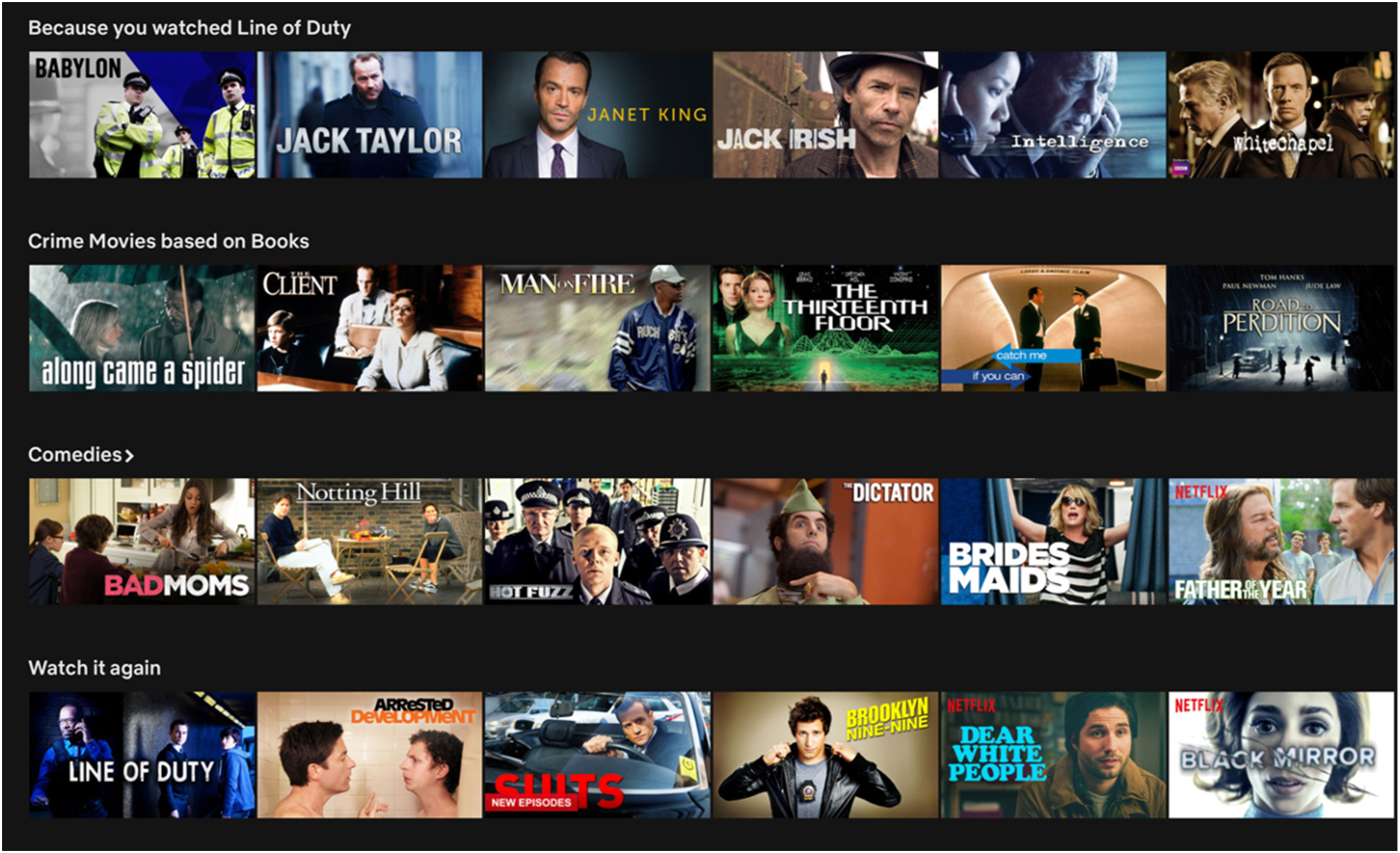
Xavier Amatriain, a leading engineer behind Netflix’s algorithms, describes the personalised rows as being generated from three core user feedback factors: ‘implicit, explicit, or hybrid feedback’ (Amatriain, 2013: 4). Implicit feedback factors are those generated from ‘recent plays, ratings, and other interactions’ and hence come from audience engagement with the platform (Amatriain, 2013: 2). Explicit factors are often generated during the creation of a Netflix account, with the ‘taste preferences survey,’ where users are asked to select their favourite kind of content, thereby beginning to construct their unique recommendations (Amatriain, 2013: 2). Hybrid factors build combinations of explicit and implicit factors. In Figure 1, most of the rows are formed from implicit or hybrid factors. The top two rows are based on a recent play item, British police drama Line of Duty (2012), while the third row is based on a genre preference for comedy, which comes from watch history and the initial taste preference survey. The final row encourages a return to previously watched content.
There are four levels of personalisation within each row. Amatriain identifies three; the row itself, the constitution of the six titles in the row, and the order that the titles are arranged, with those placed furthest to the left indicating a higher probability of enjoyment (Amatriain, 2013: 4). Structurally, this combination of different rows with different embedded titles will occur for all Netflix users, and is a feature on many other streaming platforms, like Amazon Prime Video and Disney+. While the structure is ubiquitous, it is likely that the visualisation of titles would be almost completely unique for every Netflix user. Even if two users were given the same title recommendations, appearing left to right in the same order, there is every chance that this recommendation will still visually differ. That is due to the fourth level of personalisation, the thumbnail itself, which Netflix describes as customised images designed to target individual users.
Driven by a desire to retain subscribers and to express a positive visual identity of the platform to users, Netflix ventured into the area of thumbnail personalisation, experimenting at the crossroads of algorithmic culture and artwork. In 2016, Netflix’s Gopal Krishnan wrote in a tech blog post about the untested nature of customised thumbnails for internet-distributed content, stating that it had been ‘a largely unexplored area at Netflix and in the industry in general’ and that Netflix would generally be given images that were created for other content, from DVD covers to billboards (2016). As Netflix’s creative services team generated thumbnails, Netflix engineers started to experiment with the intent, as Krishnan states, ‘to develop a data-driven framework through which we can find the best artwork for each video’ (Krishnan, 2016). In this instance, ‘best’ is the artwork which will most appeal a user and keep them happy within the platform’s internal ecosystem, ensuring that another month’s subscription is paid. Thumbnails were appealing sites to develop algorithmic experimentation as earlier Netflix research from 2014 found that 82% of users’ overall focus on the online portal was directed at thumbnails (Nelson, 2016). Netflix has since fine-tuned its systems with the aim of creating the most appealing visual signifier for each piece of content, contextually framing titles in the most appealing way.
Along the way, certain truisms have emerged about commonly well received thumbnails. Netflix’s Global Manager of creative services, Nick Nelson, reported that ‘polarizing characters’, especially villains, on thumbnails generated greater engagement (Nelson, 2016). Nelson also noted that thumbnails containing more than three people drastically reduced engagement (Nelson, 2016). Netflix’s experiments with personalised thumbnails, where thumbnails are algorithmically tailored to individual users, is a recent phenomenon and driven by the vast data systems that Netflix maintain. This personalisation of thumbnails at Netflix has been driven by an algorithmic system called the ‘contextual bandit,’ which is commonly used across the internet to personalise content (Li et al., 2010). Contextual bandit algorithms operate by analysing previous engagement and creating custom profiles to predict future user needs. In a blog post, Netflix engineers noted that ‘this project is the first instance of personalizing not just what we recommend but also how we recommend to our members’ (Chandrashekar et al., 2017).
Netflix claims that thumbnail customisation is about connecting users to content, not misrepresenting content to retain subscribers; however, given the underlying economic imperatives of the service, the truth no doubt lies in the grey middle. Netflix’s Krishnan noted that a major goal was to ‘ensure that we don’t misrepresent titles’ (2016). Krishnan posited that their ultimate question was how they could ‘make it easy for our members to evaluate if a piece of content is of interest to them quickly’ (2016). In another Netflix tech blog post, Chandrashekar et al. write that they want thumbnail assets to be ‘engaging, informative and representative of a title to avoid “clickbait”’ (2017). Netflix articulates that thumbnail personalisation revolves around making content discoverable for audiences. However, visually demonstrating an appealing content library is a vital step in retaining subscribers – a primary motivating factor for Netflix. Indeed, with Netflix’s key economic imperatives driving thumbnail creation, and all other parts of their business, it is fair to posit that truth and objectivity in thumbnail creation are not first-order concerns.
Thumbnail personalisation is an essential area for research because it marks a drastic shift in the way that audiences can be engaged. DVD and Blu-ray covers can vary, and often special-edition releases of films or television show boxsets would utilise a new cover, although these are primarily static appeals. Once a DVD or Blu-ray is put on display in a brick-and-mortar store, the visuals used to attract buyers remains the one that the item was produced with. The innovation of personalised thumbnails is as if every DVD or Blu-ray cover in a store could change to most appeal to whoever was currently looking at that title.
Thumbnails, the visual signifiers of different titles, are calculated selections made by algorithmic processes to most appeal to individual users. The Netflix Tech Blog states: ‘If the artwork representing a title captures something compelling to you, then it acts as a gateway into that title and gives you some visual “evidence” for why the title might be good for you’ (Chandrashekar et al., 2017). Personalised thumbnails visually demonstrate the appeal that a title might have to a user, and can tap into a user’s specific genre preferences, past watch history, or actor preferences.
Thumbnail user research
The empirical research for this article is based on surveys that invited six participants to explore the thumbnails on their Netflix accounts. These surveys act as a pilot study of personalisation of paratexts on Netflix to provide initial qualitative insight. This survey was designed with a small number of participants to capture a humanised sample of the textual identities of content that was being offered to a handful of Netflix users. This methodological approach is intended to foreground the value in the paratexts themselves, and to explore the variety of conveyed content identities and what these speak to for the platform’s own identity. The process involved building user profiles from their thumbnails. These user profiles are not just reflective of Netflix’s understanding of the individual, but they are very basic attempts by the platform to also convey its own identity to the user.
Five Netflix titles were selected to explore thumbnail personalisation. These titles – Annihilation (2018), Arrested Development (2003), Brooklyn Nine-Nine (2013), Good Will Hunting (1997), and Stranger Things (2016) –span two feature films and three television programmes. Importantly, these titles also reflect a range of Netflix Original content – productions like the TV show Stranger Things and the feature film Annihilation – as well as content licensed by Netflix – the film Good Will Hunting and the TV show Brooklyn Nine-Nine. Licensed content was a major selling point early in the lifespan of Netflix; however, original content has become increasingly important in differentiating the service from other SVODs and in building the Netflix brand. Exploring how thumbnail customisation is operating across this important divide in Netflix’s library is illustrative of the way that importance is increasingly placed on original content. Participants were given several options for the thumbnail of each title, gathered as preliminary data through desk research, and were asked to select which appeared on their Netflix account, or to screenshot their own thumbnail if it was not listed in the survey. The group of participants were limited to a small pool who accessed Netflix’s Australian platform.
Participants were given a series of images gathered through desk research on the variety of thumbnails presented for the different selected texts. This was in part sourced from the author’s engagement with the Netflix interface and in part from industry sources, such as Netflix’s expose on their thumbnail customisation for Stranger Things. Participants were also given an opportunity to select ‘other’ as their thumbnail for a title. Participants then screenshotted the thumbnail that Netflix had presented them and attached it to the returned survey. Participants also answered a brief set of questions where they self-identified their genre preferences and were invited to provide any additional comments about their engagement with thumbnails on Netflix.
At the time of the study, there are several elements to note about each selected title. Arrested Development’s fourth season had undergone a revolutionary re-editing process, with the season being rereleased on streaming five years after the original release with an altered episode count of 22, largely stemming from the creative decision to flatten the original release’s sporadic runtimes across the 13 episodes. This rerelease had been released in early 2018 ahead of the first half season five later in the year. As such, Arrested Development’s marketing strategy was highly dependent at this time on the fourth and fifth seasons. Director Alex Garland’s Annihilation had been released in 2018 in American and Chinese cinemas by Paramount pictures, however a global theatrical rollout was not offered, with the film instead becoming a small-screen first-run exclusive for Netflix in most international marketplaces, including the Australian market. Garland’s film represented an alternative theatrical release strategy and was a prestige acquisition for Netflix. Brooklyn Nine-Nine aired its fifth season on FOX in 2017 and 2018, with Netflix picking up the streaming licence several months after airing. As such, Brooklyn Nine-Nine’s third season had recently made its way to Netflix during this research. The most recent season of Stranger Things at the time of this research was season two, which came to Netflix in 2017. This additional information on the titles selected helps set the scene for the kind of thumbnails that were discovered – as the thumbnails represent the convergence of the user with a particular point in time and the associated industrial strategies.
This research did not include information on gender or age, which is a limitation of the findings. Future research using larger datasets would benefit from data on age, gender identity, location, race and sexual identity amongst other demographic identifiers. However, the focus here is on humanising the recommender system behind the personalisation of thumbnails and qualitatively exploring a small dataset of thumbnails.
According to Netflix Vice-President of Product, Todd Yellin, age, gender and location are ‘garbage’ for predicting user preferences (Morris, 2016). While Netflix does not actively collect particular demographic data from users, Netflix’s recommender system is not blind to these factors. These factors are reconstructed through the watch history process, which can produce what is in effect a facsimile of these demographic insights. As Chun notes, algorithmic neighbourhoods lump individuals in with similar individuals – in effect replicating many base demographic groupings (Chun, 2016: 120). This was demonstrated during the period of the 2009 Netflix Prize, where de-identified user viewing history was relinked to an individual, in the process outing a queer person to their community (Hallinan and Striphas, 2014). Race is another demographic factor that can be inferred by the recommender system as individuals who express racial or ethnic content preferences can find themselves targeted by further content of the same ilk. This includes being targeted with thumbnails that highlight diverse casts, even if the titles do not feature these characters for extended periods of time (Zarum, 2018). This provides further evidence that thumbnail customisation is driven more by the need to brand the identity of the platform than by truth and objectivity.
Thumbnail survey results
For Netflix’s hit original title Stranger Things, a range of thumbnails evoking a range of content identities were identified. The identities evoked in the thumbnails range from branded ones, foregrounding the title of the show, to genre identities, evoking horror and mystery, to more playful identities conveyed by the main characters in wacky costumes. One such wacky thumbnail (Figure 2) shows the main child stars in Ghostbuster costumes, evoking a Steven Spielberg-esque story of children solving mysteries in small-town America, replete with a nostalgic pop culture reference to Ghostbusters, 1984s, trading on the power of nostalgia that has been so central to the success of Stranger Things. Another thumbnail shows the town’s policeman shining a flashlight over a field of disease-ridden pumpkins as a full moon shines brightly through a late-night fog, which evokes a sense of fear and foreboding, containing many of the recognisable visual elements of the horror genre. The rotted pumpkins hint at something unnatural festering in the town. Each thumbnail conveys an aspect of the show, contextually framing the title differently; in this case, ranging from a more light-hearted romp where the children solve a mystery, through to a dark and scary detective story with a supernatural angle. Select thumbnails from Stranger Things and Arrested Development. Screenshots, collected from surgery.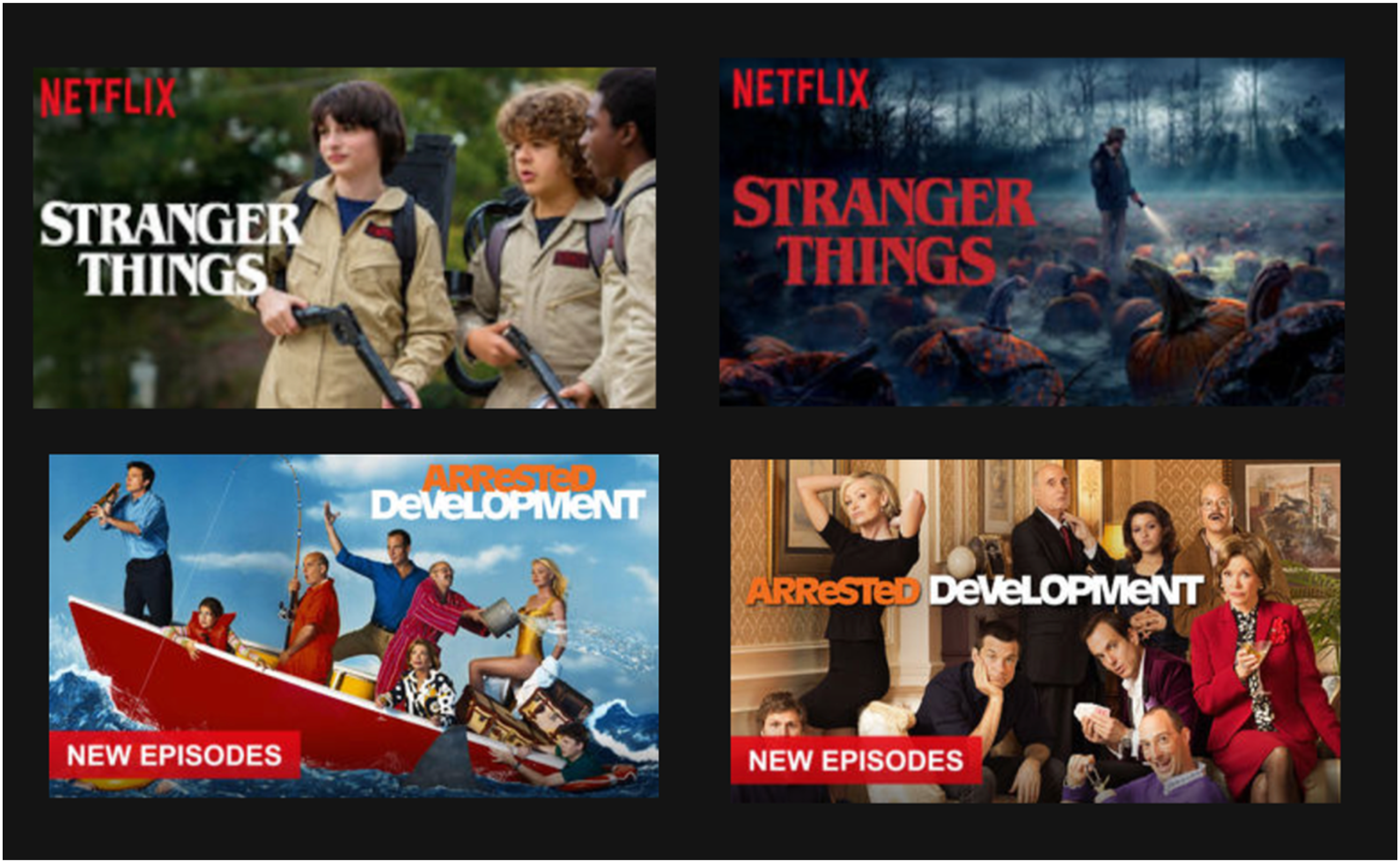
Thumbnails for Arrested Development, the Fox–turned-Netflix comedy series contained a similar number of alternating content identities, again demonstrating a wide variety of appeals. One thumbnail shows the starring Bluth family poorly photoshopped onto a boat on the ocean (Figure 8, bottom left). Each family member is engaged in exaggerated antics, from Tobias throwing a bucket of water over his wife, Lindsay, to George Michael wearing a floatie and barely holding onto the boat from the water. This conveyed sense of the text is humorous, and none too serious – indeed, the poor photoshop in some ways replicates the poor green screen and other VFX that is intentionally cut to in Netflix’s fourth season of the title. Another thumbnail for Arrested Development shows the Bluth family in a Vogue-like magazine shoot. Glossy production values and a professional lighting setup shows the family off as they pose in fancy clothing surrounded by ornate furniture. While this is a grander and more serious aesthetic, the comedy is still present – Buster Bluth’s face is lit up with joy while he stokes his hook hand while Michael Bluth rests his head on his hand, presumably over the antics of his family. The veneer of perfection, with the photoshoot reminiscent of the aesthetic of Scandal or The Good Wife is broken by these comedic elements scattered through the frame. While the comedy remains, there is a stark contrast between the Bluth boat and the cover shoot thumbnails, each typifying the radically different ways that thumbnails can contextually frame content for individual audiences. While the Boat thumbnail highlights a rag-tag comedic identity, the cover shoot is more reminiscent of Schitt’s Creek (2015), where a well-to-do family find themselves without a paddle. The cover shoot plays up the Bluth family as the rich Republicans from Orange Country, California.
There was a particularly high contrast between the thumbnails of Participant One (P1) and Participant Six (P6), with no thumbnail shared between them, which is worth reflecting on to explore how thumbnail profiles can drastically differ per user. P1’s results saw four out of their five thumbnails populated with female characters: Lena from Annihilation, Lucile Bluth from Arrested Development, Rosa Diaz from Brooklyn Nine-Nine, and Joyce Byers from Stranger Things (Figure 3). P1’s thumbnails also stand out due to the frequency of human faces appearing; at least one in every thumbnail. In contrast, P6’s thumbnails heavily featured male characters: Michael and George Michael from Arrested Development, Captain Holt from Brooklyn Nine-Nine, and Will from Good Will Hunting (Figure 4). Both P6’s Annihilation and Stranger Things thumbnails showed inhuman monsters rather than human characters. For P6’s Annihilation thumbnail, the antagonistic villainous presence of ‘The Shimmer’ is represented by a broken human skeleton, ripped apart by long strands of colourful floral viscera. For P6’s Stranger Things thumbnail, the gargantuan, demon-like monster known as ‘the Mind Flayer’ is represented as a graphite drawing. P6’s profile, therefore, relies heavily on monsters and men. The presence of monstrous characters speaks to Nelson’s assertion that villainous characters often drive-up engagement levels (2016). Villains are often visually recognisable parts of story worlds and can come with unique appearances. But the appeal to monsters is not universal. The lack of monsters in P1’s thumbnails suggests that the Netflix algorithm is targeting this user with more emotive and humanistic appeals. Participant One thumbnail survey results. Screenshots, collected from survey. Participant Six thumbnail survey results. Screenshots, collected from survey.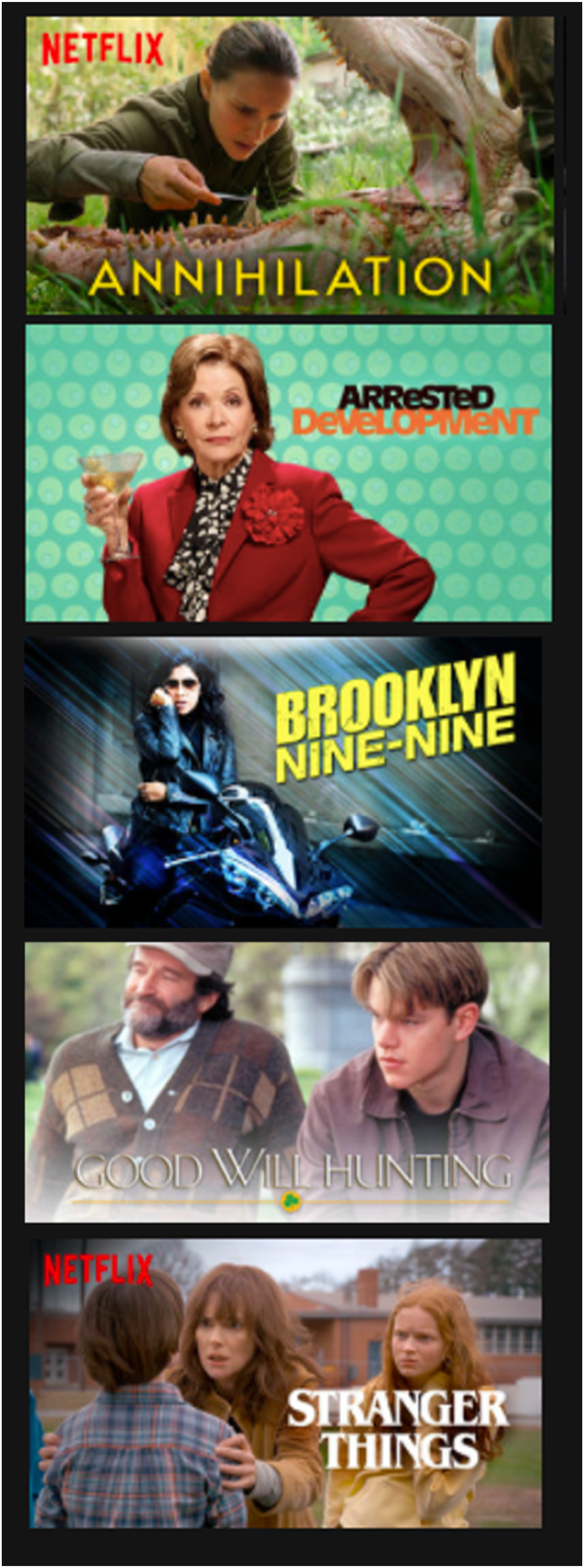
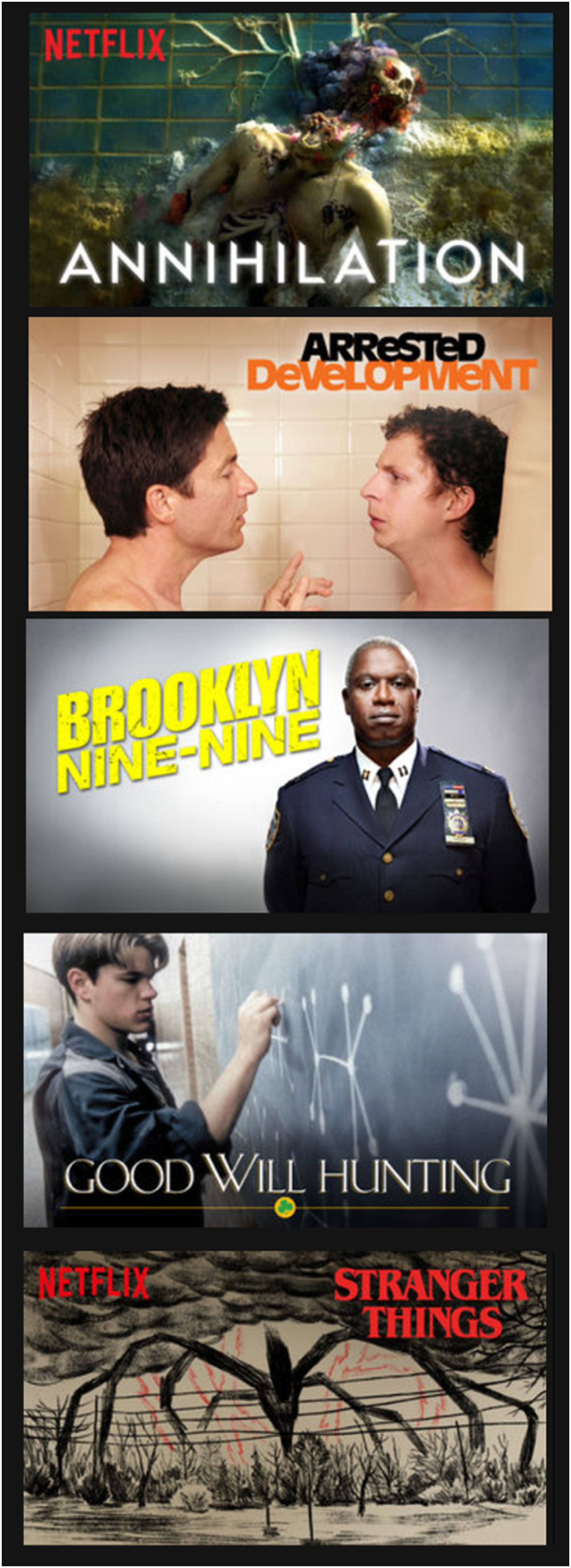
The contrasts between P1 and P6’s Stranger Things thumbnails speak to the wide range of appeals thumbnails cultivate around content. P6’s thumbnail showcases a hand-drawn sketch of ‘The Mind Flayer’ from Will Byers’ nightmare – a drawing of the monster from the boy haunted by it in the text. This stands in stark contrast to P1’s thumbnail; where Joyce Byers, mother of Will, has her hands firmly on her son. In this image, Joyce Byer is flanked by Maxine Mayfield, another female character, introduced in season two of Stranger Things. Both female characters look towards the camera, and by extension the user perusing the thumbnails, while Will Byers, although in frame, is faced away from the camera and the user. The human emotion presented to P1 juxtaposes the monstrous antagonist shown to P6. In this case, the algorithm has determined that human faces, emotion, and female characters will appeal most to P1. For P6, these determinations are almost inverted to try to appeal to the user by showing monstrous villains and male characters. The algorithmic profiles of the users have been translated into thumbnails that contextually frame the same titles in divergent ways. Jenner notes that while not ‘necessarily weaponised’ through intentional misdirection, ‘algorithmics construct increasingly individualised versions of television’ (Jenner, 2018: 95). Thumbnails are playing important roles in these fragmented and individuated television identities, sitting on the threshold of the text and the user.
One of the major fears inherent to the personalisation of thumbnails is that the algorithmic process that drives the recommender systems and the thumbnails selected for users will have the effect of misleadingly advertising content to entice subscribers to remain subscribers. None of the thumbnails show to participants in this research misrepresented their respective shows. However, each title could receive a vast array of identities. Arrested Development was advertised to P6 through the father-son relationship, with Michael and George Michael pictured together on the thumbnail. In contrast, it was advertised to P1 through the family matriarch, Lucille, who stands alone in the foreground sipping on a martini. Each image represents one element of the show: the first of the father-son story, the second of the sarcastic mother. Both are accurate to the show, and yet they are also divergent appeals.
While none of the content identities conveyed by the thumbnails were misleading for each title, it is worth reflecting on how the ‘frame’ itself can become an entity that provides a particular conception of the platform to audiences. Misleading thumbnails are quickly rooted out for shows. It does not take long into Arrested Development to understand the joke that the vogue cover shoot is making, and very soon into season 1 of Stranger Things, a viewer will understand that the main characters are four boys and a girl – not the mother Joyce Byers. However, en masse, assembled in their rows in the frame, these thumbnails show a conception of the platform itself. This conception must tell users that the platform is worth staying subscribed to (Johnson, 2019) and in the process, it is easy for distinctive platform identities, borne from the variety of thumbnails presented, to nudge a viewer’s understanding of the service. P6, if presented their five thumbnails alongside similar ones filling out a frame focusing on men, monsters, and action, might ultimately conceive of Netflix through this process as a service with a high portion of content in that vein. P6’s thumbnails highlight the role that villains and monsters play in driving engagement (Figure 5). Meanwhile, P1 could see their five thumbnails alongside others that highlight women in titles, and more emotive thumbnails that focus on human interactions. In turn, their conception of Netflix as a platform may become one that considers it to be a gender equitable service, with plenty of content featuring women. The Monsters. Screenshots, collected from survey.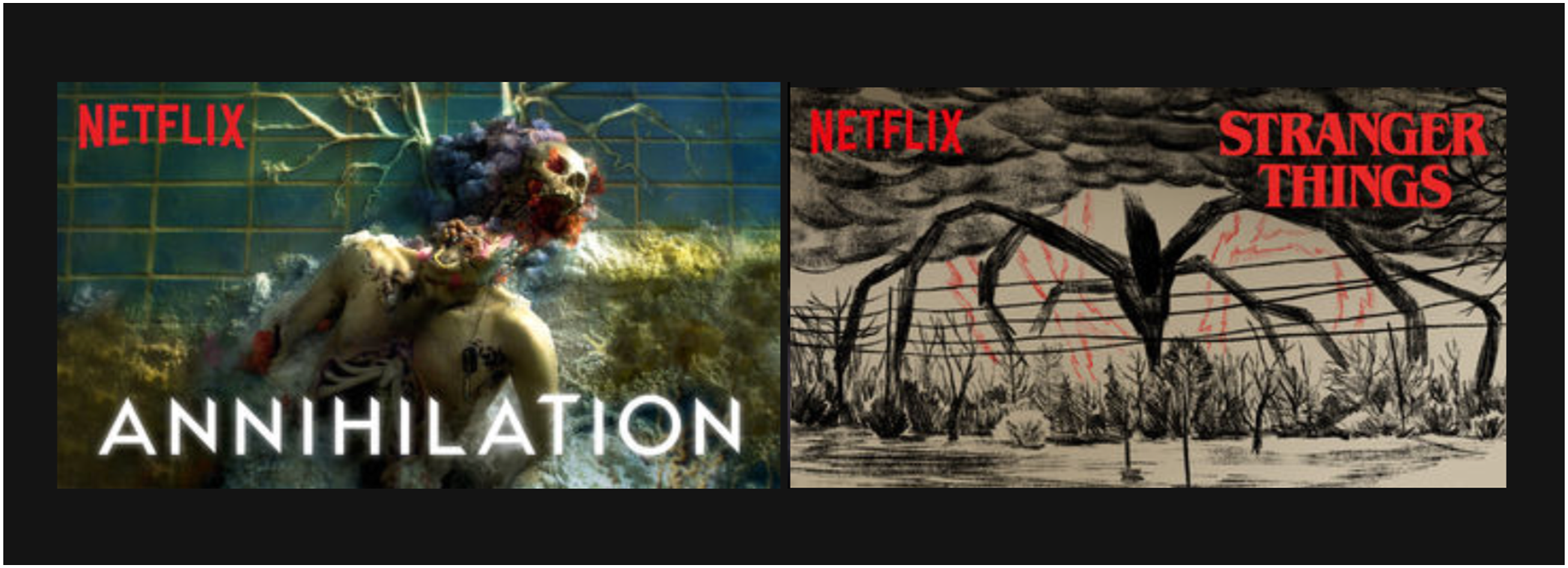
Andrejevic notes that, ironically, a non-human platform, Netflix, knows what our movie preferences are better than our human friends do (Andrejevic, 2020: 142). While Netflix may know our deeper, truer self, what do we know of Netflix? If we consider Netflix as one of the friends in our group, then their knowledge of us is impressive, but sooner or later it becomes disconcerting that everything we like is met by an ‘oh my gosh, me too!’. The identity of the platform that thumbnails convey is varied and curated, but coddled, lacking in the ability to stand up for their own preferences. Thumbnails frame and shape understanding of particular texts on SVODs like Netflix, but they also do the in many ways more powerful work of shaping how the platform itself is understood. The question of ‘what is Netflix?’ (Lobato, 2019) is a major driving force behind research into the platform. This has manifested through research exploring the size and shape of various national libraries, the nature of Netflix’s content acquisition strategies, the service’s disruption of old media, examining discourses expressed in corporate documents and many other ways. It is worth adding to this driving question that, shaped by the personalisation power of elements like thumbnails, the visually conveyed idea of what Netflix is to audiences is fragmented, divergent, and results in a ‘platform friend’ with a mirror identity to our own. Chun took this idea to its extreme – through our user habits in response to new media, ‘users become their machines’ and here the machine becomes you (Chun, 2016: 2).
Distinct preferences or algorithmically curated chaos?
Genre is a useful way to consider the thumbnail profiles explored in this research. Participant Five (P5) identified drama as their most-watched genre in comments in the survey. P5’s thumbnails were all human faces; the scared Lena watching her suffering husband for Annihilation, the shocked Nancy for Stranger Things; and the cool and chic Bluth family in the Vogue style Arrested Development thumbnail (Figure 6). Conversely, Participant Two (Figure 7) (P2) noted that one of their most-watched genres was horror. And indeed, P2 was shown ‘The Mind Flayer’ and ‘The Shimmer’ thumbnails for Stranger Things and Annihilation, like P6 (see Figure 5). Genre preferences are one of the metadata points that contextual bandit algorithms use to identify what individuals might best respond to. Genre metadata co-exists alongside other fields, such as actor preferences, user watch history and other implicit and explicit feedback. Even something as innocuous as how long a user scrolls over a title can be measured, recorded and leveraged to create a personalised profile with personalised and targeted thumbnails (Amatriain, 2013: 4). Participant Five thumbnail survey results. Screenshots, collected from survey. Participant Two thumbnail survey results. Screenshots, collected from survey.

Johnson notes that frames on platforms are ‘transient and peripheral’ and subject to constant changeability, which is one of the struggles in researching them (Johnson, 2019: 109). This challenge is held true with Netflix thumbnails. P1, after completing their survey, emailed the researcher one week later to note that their thumbnails had almost entirely changed from what had been reported. P3, writing in the survey comments section, noted that their Arrested Development thumbnail was ‘Figure 5 the first time I looked, and then Figure 6 the second time’, referring to two different options in the survey. Unlike the DVD or Blu-ray case and cover in a brick-and-mortar store, thumbnails on Netflix target the individual, and significantly, do not stay static. The algorithms behind these thumbnails and other avenues of personalisation of Netflix are also constantly being updated and refined. The thumbnails shown in this survey then become like artefacts. We can construct preference profiles based on each user and their reported thumbnails; however, there is every possibility that not one week later each user could be faced with an entirely new set of thumbnails tailored to their latest engagement with the platform.
Illustrative of this, the author’s own thumbnails, changed dramatically across three different points of collection (Figure 8). The Annihilation thumbnail went from showing the Shimmer-addled skeleton, to an extreme close up of Lena’s eye, through to a close-up of a yearning Lena as she watches her husband suffer from an unknown disease – with appeals moving from monsters to engaging and aesthetic visuals, to emotion. The Stranger Things thumbnails went from the Mind Flayer monster to the lonely Will Byers isolated in a school corridor. While it is perhaps captivating to suggest that this change demonstrated a broader change in watch preferences away from monsters and magic and towards human emotion and experience, the more likely explanation is that this is evidence of a constantly changing algorithm that is incessantly seeking to gain attention by flashing up a new identity in a world where attention is the scarce commodity (Beck and Davenport, 2001; Thompson, 2012). The author’s evolving thumbnails. Screenshots from author’s Netflix account.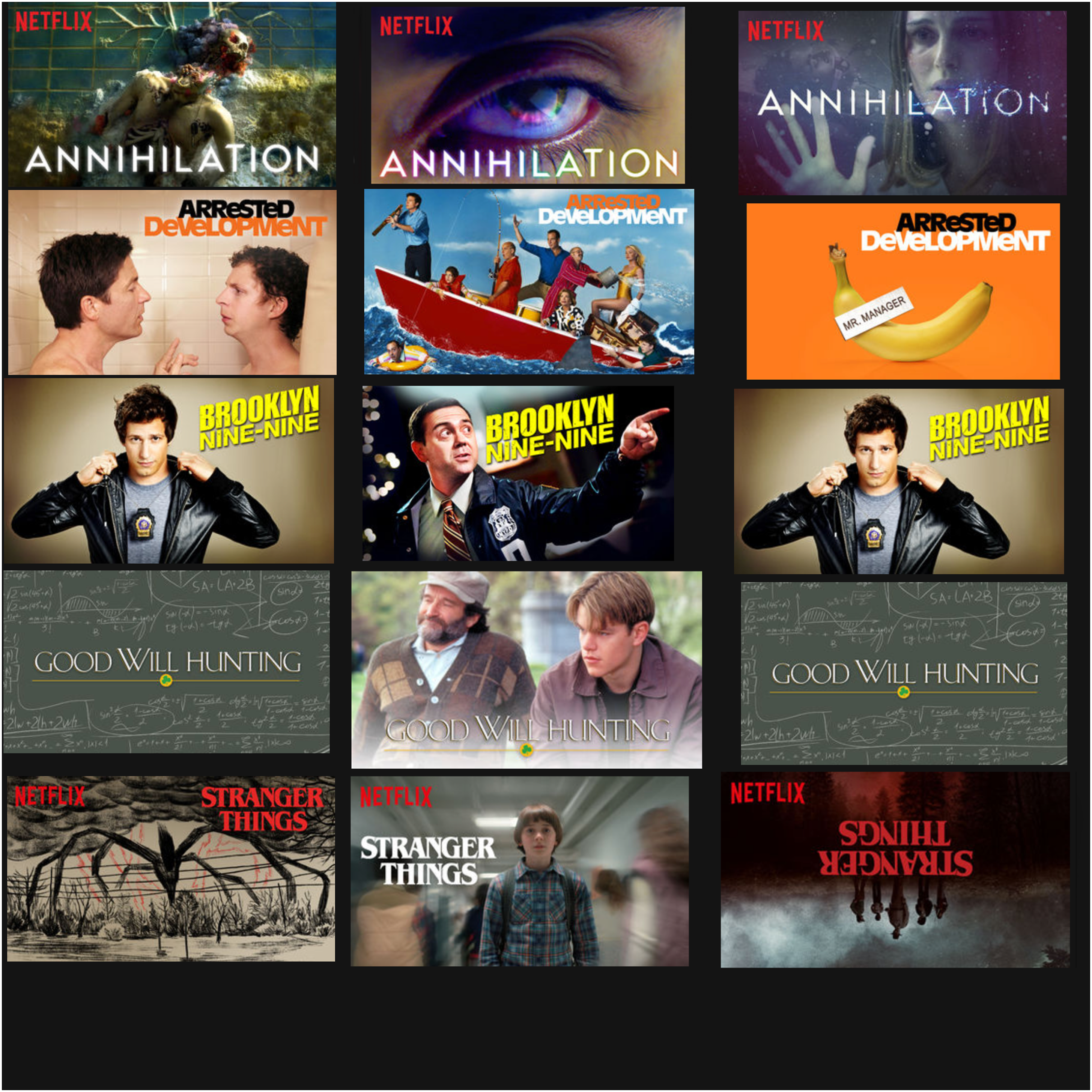
Each thumbnail is complicated by the transience Johnson notes – and the overall thumbnail strategy itself is potentially subject to similar levels of instability. In 2013, Netflix announced Netflix Social: a personalisation avenue which involved linking your Facebook profile to Netflix. This allowed Netflix to curate content based on your social media engagement and that of your friends. This partnership ended only a few years after it began. Likewise, user reviews of content had been a selling point of Netflix since 1998. The platform had allowed users to rate and review their titles, in a push to align their platform with active consumption and user interaction. In 2017, Netflix changed its five-star rating system to a binary ‘thumbs up’, or ‘thumbs down’ measure, and in 2018, Netflix completely removed online reviews, erasing every single user review that was written (Spangler, 2018). While personalised thumbnails are the new and exciting tool that Netflix is using to drive its customisation, there is every chance that this paratext and advertising strategy will go the way of those previous thought-bubbles of personalisation. In that regard, this study can be seen as not just evidence of the personalisation of consumption in the streaming age, but as a record of a corporate strategy and a cultural moment. The company permanently deleted hundreds of thousands of Netflix user review as they changed strategy in 2018 – emblematic of what Lotz (2017) notes as nascent streaming era strategies that can quickly fall by the wayside. This thumbnail study is then also a record of a mere moment in cultural time, acting as a bulwark against the ravages of digital impermanence (Rosenzweig, 2003) and changeable corporate strategy.
Changing platform strategies
I conducted one final check on my own Netflix thumbnails, some months after the initial group research. The change, or lack thereof, is intriguing. With the release of the third season of Stranger Things in 2019, the thumbnails on offer were indeed updated to reflect the most recent season. My thumbnail was now Will’s mum Joyce Byers and town policeman Hopper – a screengrab from season three.
Arrested Development, after a licensing imbroglio, finally released its fifth season on Australian Netflix in 2019. Despite its status as a Netflix Original, Foxtel had first-run streaming rights to the show in 2018. Consequently, Australian Netflix has only just updated in 2019 to reflect the ‘new’ fifth season. My new thumbnail showed the children George Michael and Maeybe Fünke walking through a retirement village together – again a screengrab from the new season.
Brooklyn Nine-Nine has experienced a difficult history since the middle of 2018, with the show cancelled by original distributor Fox. However, it was picked up by NBC and given a new lease on life with another season. My Brooklyn Nine-Nine thumbnail remains Captain Holt in his stoic pose. It is also intriguing that the Netflix Original shows have received updated thumbnails from the creative services team, however Brooklyn Nine-Nine, despite also having a new season, still had the original thumbnail. This is perhaps further evidence of the favouring of original programming exhibited by Netflix. This is an acute question for further research on thumbnail personalisation – the investment into generating new artworks is undoubtedly a more efficient proposition if it is limited to exclusive or original platform content. As a part of this push towards original content, time and resources devoted by the content team to thumbnails will undoubtedly prioritise the Netflix Original content – the titles explored in this study like Arrested Development, Annihilation and Stranger Things. It is already clear that there are more thumbnail paratexts on display for the original programming, while thumbnails for licensed content, like Good Will Hunting and Brooklyn Nine-Nine is more static, only updated with the release of new seasons in the case of Brooklyn Nine-Nine.
Changes for thumbnails of the two films were also explored. The Annihilation thumbnail remained the same – the floral viscera skeleton – furthering this line of thinking to not just originals, but ongoing originals, generally television, being favoured sites for thumbnail investment. The Good Will Hunting thumbnail no longer exists on the platform. Netflix no longer had the rights to stream the film in Australia – a salient reminder of the underlying industrial tensions occurring in the streaming industry and a confirmation that gathering data like this will possibly have quasi-archival implications for the near-future.
With a greater range of thumbnail paratexts, Netflix originals will also have access to a greater range of content identities promoted through the platform, thus creating an imbalance between the circulated meanings associated with Netflix originals and licensed content. Netflix’s marketing has traded on the idea of on-demand content accessible without being anchored to a living room television with the slogan ‘Anytime, Anywhere’. This finding suggests a third word might well join this assonant phrase – Anything. With so many ideas that can be attached to Netflix originals through the multitude of paratexts, the meaning of Netflix originals look to be increasingly framed in a variety of ways, opening up what understandings of these texts are ultimately imprinted on society.
A final visual change to note is the absence of the small ‘Netflix’ logo that adorned the thumbnails of Netflix originals during the research period in 2018. This has been replaced with a small ‘N’ that sits in the same upper-left hand corner. This is a part of the Netflix soft rebrand that occurred in the beginning of 2019 that included the change from the iconic jumping logo with the two-tone beat at the start of content. The new version includes the same sound but is now accompanied by an ‘N’ that rushes towards the screen, turning into a rainbow of lines.
Thumbnails are excellent visual indicators of Netflix’s branding strategy, having undergone small changes alongside changes to the opening logo. They also tie into issues of content pullback and broader industrial trends of first-party streaming, and further, demonstrate themselves to be highly adaptable paratexts that can easily evolve for new content offerings within established Intellectual Properties.
Aside from the change in the individual thumbnails, there have been broader shifts in the way that the thumbnail is operationalised at Netflix. Considering Hesmondhalgh and Lobato’s (2019) exploration of streaming device ecologies, it is also worth noting that the streaming interfaces differ by device. In another unannounced platform change, the Netflix Xbox app altered their thumbnail aspect from landscape to portrait, with thumbnails through the console app appearing with a distinct verticality that aligns them more with DVDs and Blu-rays and makes the user experience through platform far more akin to browsing a brick-and-mortar store or a library. It is a curious change given that the thumbnail as a visual icon initially took audiences away from the iconography of home media to show that Netflix had matured beyond its early days as a DVD mail-out service.
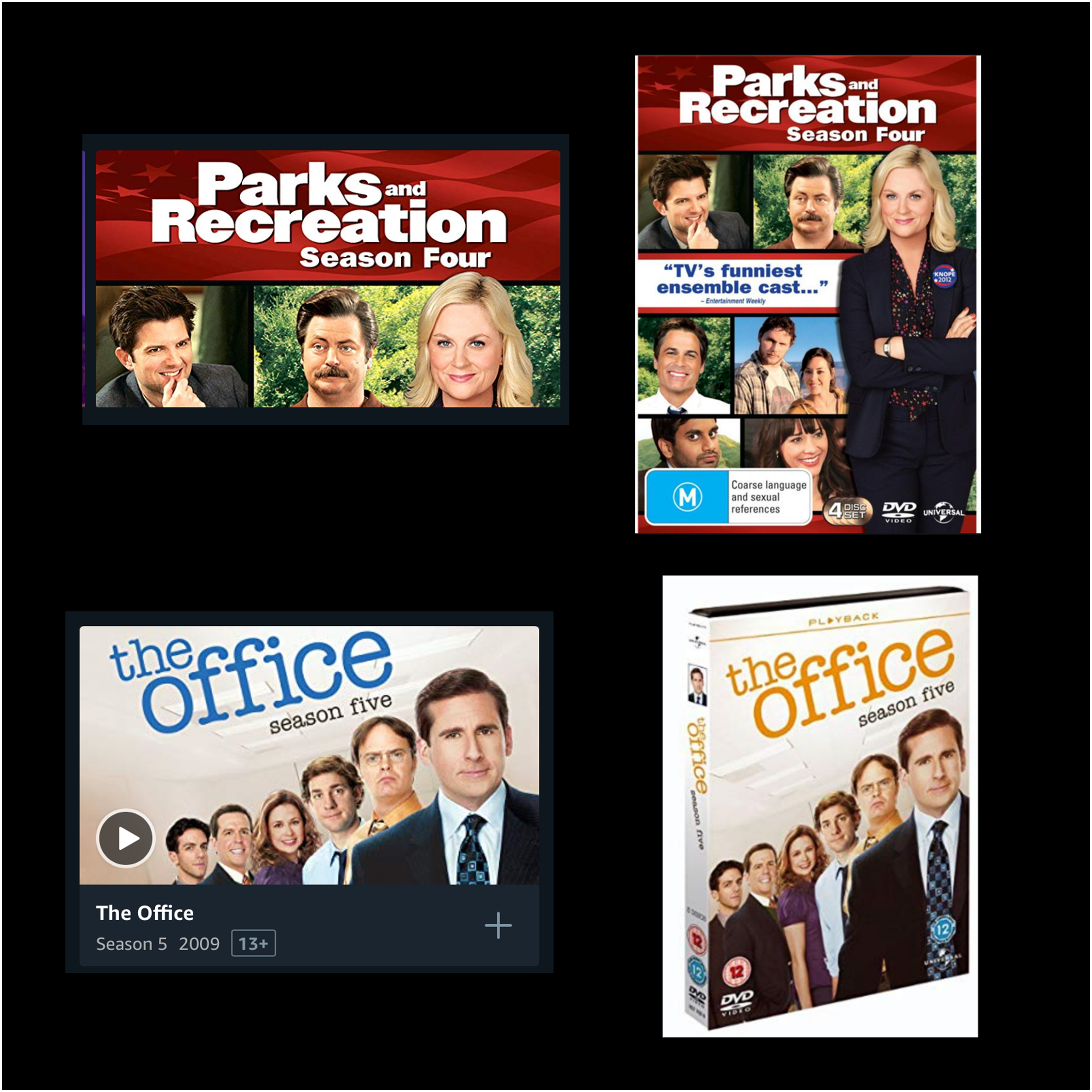
Across other streaming platforms, there is a substantial lag behind Netflix’s thumbnail strategies. As of early 2021, Disney+ seems content to mass market titles with their brand power rather than rely on personalised and tailored paratexts. While Disney SVP of Data Laura Evans has discussed the robust metadata collection on Disney+ and the plan for more tailored row offerings (Forbes Insights, 2020), thumbnail personalisation is still not in effect. The thumbnail variations on Disney+ appear only in effect as a mass group project, not as personalised appeals. Special events alter every user’s thumbnail for select content – May the 4th and the associated Star Wars (1977) holiday was signified with special artwork, concept work from the renowned Ralph Macquarie, deployed to replace thumbnails for Star Wars content (Figure 9). The release of Black Widow, the Marvel superhero film in July 2021 was accompanied with stylised thumbnails for Marvel’s other films that featured the Black Widow character, showcasing her appearance from that film. Amazon Prime Video appears to not invest much in thumbnails and continues to prioritise the use of cover art from DVDs and Blu-rays for licensed content. For instance, Amazon Prime Video uses the home media release images for TV shows Parks and Recreation (2009) and The Office (2005) (Figure 10). Small single-territory SVODs often lack the economic power and scale to either compete with the Netflix recommender system or to investment extensively in customised thumbnail artwork. A Ralph McQuarrie concept piece on Disney+.From Disney+ Press Release, May 1,2020.https://www.starwars.com/news/disney-plus-concept-art. Amazon Prime video thumbnails for Parks and Recreation and the Office (left) and corresponding DVD covers (right).Screenshots from author.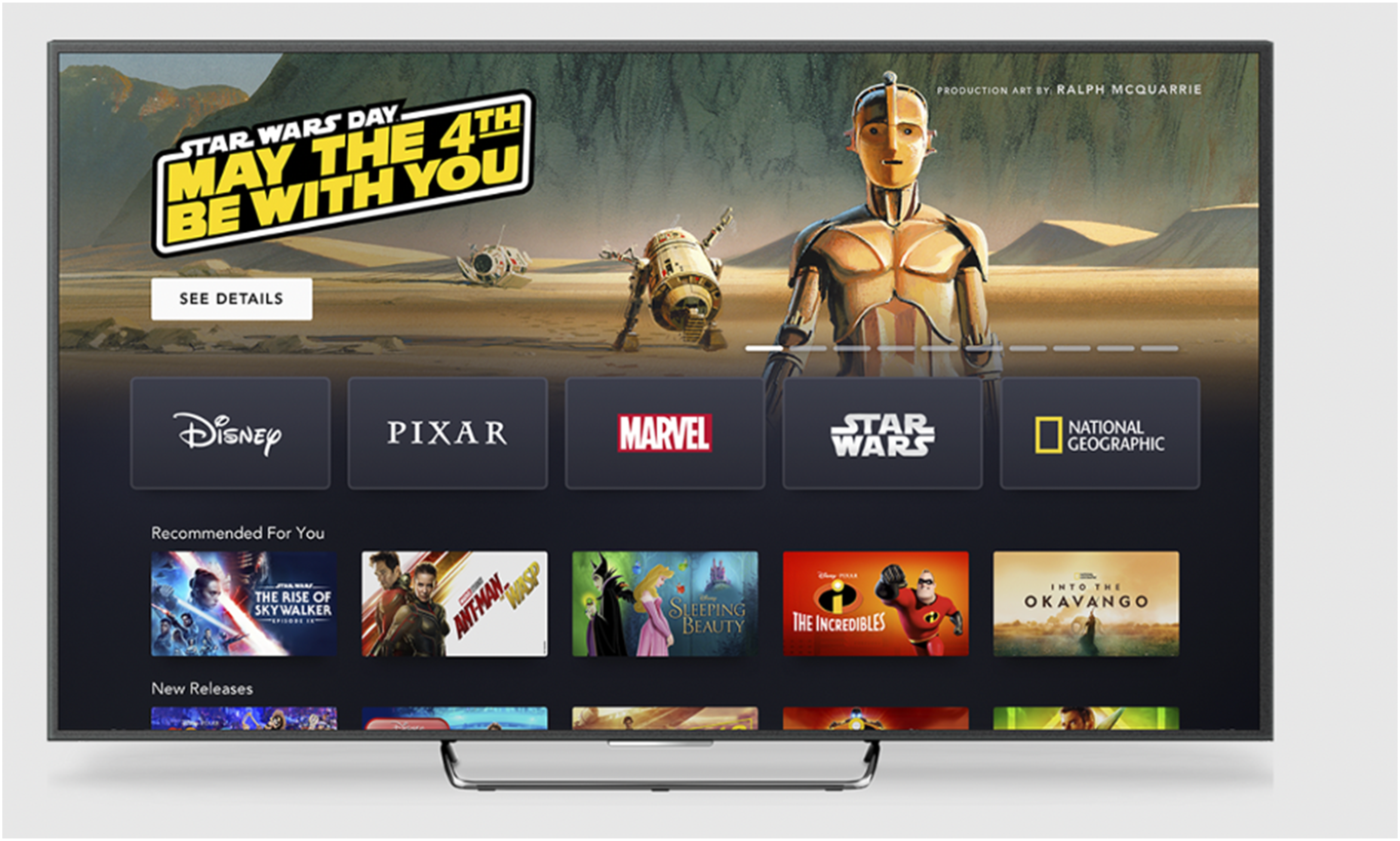
While Pajkovic (2021) suggested that Netflix thumbnail customisation would become commonplace on all SVODs, this is not yet the case, and there is reason to caution against this claim. It could be that thumbnail personalisation remains the sole realm of Netflix as one of the only pure play SVODs. Disney+, as an extension of the Disney brand, and Amazon Prime Video, an add-on to the Amazon suite of services, are both different types of SVOD to Netflix and to each other, in terms of their content offerings and the role that the service needs to play within a broader business (for Netflix, this broader business need is moot). In recognition of this, leading SVOD scholar Amanda Lotz called Netflix a ‘Zebra among the horses’ (QUT, 2020), noting that a highly unique set of goals and activities underpin the platform. For thumbnail personalisation, the Zebra’s stripes may keep changing – thumbnail personalisation driven by complex algorithmic systems will undoubtedly continue for Netflix, evolving to become more targeted or with a greater range of thumbnails offered – however, the horses in the field, the Disney+ and Amazon Prime Video-like players, may find themselves content to keep carrying on without personalised thumbnails. Indeed, Netflix’s need to market itself as a universally appealing service is not shared by other platforms. Disney+ does not need to be everything like Netflix – it can just leverage the brand power of Disney.
Conclusion
This article has furthered initial research into Netflix’s visual elements (Lobato, 2019) and has responded to Johnson’s call (2017; 2019) for greater focus on user interface research on VOD platforms by foregrounding the role of paratexts on Netflix. This reinforces that VOD platforms like Netflix are engaged in gargantuan efforts of personalisation and has helped to provide a visual understanding of what this process of algorithmic culture (Alexander, 2016; Hallinan and Striphas, 2014) looks like. Netflix employs a range of thumbnails for each title, which they target to members, and use to convey different ideas about title. In the process, Netflix also conveys an idea of itself to viewers, often a mirrored image of what users have already expressed an interest in.
While the sample size in this research has been kept small to aid the pilot research, the findings on thumbnail personalisation reflect a markedly different environment from the mass-produced paratextual appeals of DVD and Blu-ray covers, illustrative of the social implications of the shift from mass to automated culture that Andrejevic charts (2020). Indeed, the glut of data that enables Netflix’s thumbnail customisation allows the platform to usurp what has traditionally been a social role – the friend with movie recommendations. The visual and ever-changing nature of thumbnail customisation means this recommendation and personalisation project is often intentionally obscured and relegated to the background and hidden from users. The generation of custom thumbnails becomes particularly concerning when the underlying economic imperatives of the platform, realised through these big data strategies, are considered. Just how many truthful identities of a text can be created before you are tricking users rather than connecting them to content?
Prior static appeals of a Blu-ray cover in a store are replaced in the Netflix era by targeted and changeable appeals from thumbnails, which can respond to user engagement with the platform to highlight the most accessible aspect of that text that the algorithm thinks the user will go for. While powerful and important text-by-text, with many different content ideas conveyed through thumbnail paratexts, perhaps an even greater power comes from thumbnails en masse, and the conveyed identity of the platform that they direct to different users – fragmenting many answers to the question of ‘what is Netflix?‘.
Future research can build greater understandings of the range and variety of Netflix thumbnails and can explore other SVOD thumbnails – does the Disney route of ‘event thumbnails’ start to play a larger role in creating mass marketing moments while still providing fresh ways to capture attention visually? Or do personalisation strategies for thumbnails emerge in more platforms.
Consumption in the streaming age is defined by its ironic position as both highly personalised and mass-targeted through big data. Understanding thumbnails in conjunction with Andrejevic’s post-comprehension paradigm highlights broader dangers for the internet in a correlation society versus a comprehension society. Jenkins (2006) wrote that one of the core challenges moving into a globalised, converged media environment was ensuring that people stay aware of the processes affecting them. Awareness must remain crucial, as the very processes behind thumbnail personalisation work in the background without ‘bothering’ the user. The myriad of identities that content can assume through thumbnail paratexts to appeal to users means there are potentially manipulative dangers for audiences unaware of their thumbnail personalisation processes. If digital society and the streaming landscape has come to reflect ‘post-comprehension’, then perhaps the awareness that Jenkins argues for has become a little harder to find. Indeed, it is often far easier to lie back and let the customised personalised Netflix experience wash over you; customised genres, rows, thumbnails and all.
With an overwhelming amount of content on display across a dozen or more streaming services, the evolution of personalised thumbnails speaks to how fragmented and divided experiences of content like film and television has become. While watercooler television conversations may have died with the finale of Game of Thrones (2011) and Berman (2019), would it still be possible to come together and discuss shared content experiences in the same way? If content identities are increasingly framed differently at the outset, by the likes of Netflix’s personalised paratexts, is the ability to hold those mass media discussions diluted? What changes may come from further projects of personalisation in the paratextual landscape of SVODs like targeted trailers and synopses? Discussing whether the Muppet Bert was ‘evil’ was a touchstone moment in the literature for the idea of digital scarcity (Rosenzweig, 2003) and for convergence culture (Jenkins, 2006) – a possible metaphorical evolution awaiting us here is fragmented discussions around whether Bert was wicked, bad, wrong, misguided, misled, or just had a bad day. Paratexts like thumbnails on Netflix are important markers of personalisation strategies and the increasingly diverse imprints of content and platforms on society.
Footnotes
Declaration of conflicting interests
The author(s) declared no potential conflicts of interest with respect to the research, authorship, and/or publication of this article.
Funding
The author(s) received no financial support for the research, authorship, and/or publication of this article.
