







Abstract
Despite a predominantly digital, 21st century music production landscape, analogue hardware professional audio technologies persist. In the discoursal throes of the leading online audio technology message forum Gearslutz, such technologies are routinely objectified, sexualized, fetishized and socialized into gear. Situated in a contemporary critical, interdisciplinary framework of fetish, masculinity and sexuality studies, this research interrogates how audio technologies manufactured and intended for music production contexts become sexy. Applying a mixed-mode methodology, including an intensive discourse, image and material-semiotic analysis of an ‘epic’ sexy gear thread, we collated extensive data about technological fetishization. Sexy gear discourse articulates themes of voyeurism, acquisition, control and animation – linking the fetish value of technological objects and their connoisseurship with the erotic potential of sexualized objects. Such discourses ultimately serve to maintain social order, and become sites for performing the maintenance work of hegemonic masculine formations. This research provides new insights into how hegemonic masculinities depend upon the organization of online and offline sociability around fetishized material objects. Furthermore, our findings align with those of current scholarship focused on representational politics of technoculture.
Keywords
One excited user on Gearslutz has been staring at a Neve Portico microphone preamplifier for a little too long. It’s ‘really gettin’ my wang hard these days,’ he sighs ‘All those flashy lights… Sometimes I just look at it for extended periods of time….’
On 12 February 2021, after more than six decades work in the professional audio technology industry, pioneering electronics engineer and equipment designer Rupert Neve passed away aged 94. Neve’s legacy is inextricable from the transformative nature of his technologies: his mixing consoles and microphone preamplifiers are synonymous with analogue aesthetics, build quality and, within professional recording studios, the so-called ‘golden age’ of British sound recording history. Consistent recognition with audio industry awards secured Neve’s legacy as audio technology pioneer, yet an unintentional, parallel facet of Neve technologies endures: Neve gear is sexy.
This article examines sexy gear discourse, with a particular focus on the ubiquity and intensity of technological objectification on audio technology platform Gearslutz. Here, Neve is a frequently occurring audio technology brand; there is something about the way it looks and feels. The ‘Shelford blue’ RAF colours evoking WWII, the knobs – so many big knobs! – and, as our excited Gearslutz user suggests, the ‘flashy lights’. Curiously, where Neve technologies are mentioned on Gearslutz, they are rarely framed in historical, musical or even audio industry contexts. Even curiouser, these technologies are not situated in workplace or practice-based contexts either. In some conversational threads, the sound of such equipment – for which Neve-the-designer-and-brand is so renowned – is never mentioned at all. Here, deep in the discoursal throes of a Gearslutz thread, musical sound is nowhere to be heard. The look, feel and haptic ideation of gear, however, is everywhere.
Such professional audio technologies are manufactured and intended for the professional audio industry, its sites and workflows. The intensity of such extraaudible discourse on Gearslutz is misaligned with these intended uses, which led us to a number of research questions: Why does some gear become sexy, and how does attending to sexiness, as a property of technologies, affect our understanding of technological uses and meanings? How does gear sexiness constitute online sociability? How does sexiness, materiality and individual sensory experience converge on gear in message forum discourse?
Gearslutz (renamed Gearspace in 2021) is a threaded message forum built upon vBulletin software, which is currently organized into several dozen forums and subforums. All posts are publicly viewable yet the site is designed to be a mostly self-contained space, as the only permitted external links are to embedded YouTube videos and SoundCloud tracks, or to manufacturers’ websites. Post order is strictly chronological, meaning that ‘liking’ does not affect the in/visibility of a post. Most users post anonymously or pseudonymously, excepting manufacturer representatives or ‘gear pimps’ (distributors and retailers) and some professionals working in production trades. Gearslutz.com is the world’s most popular audio engineering forum, and one of the most popular message forums concerning musical equipment topics in general. Since its founding in 2002 by Julian Standen and Meg Lee Chin, over 403,000 members have initiated over one million threads and authored 13.2 million posts. 1 From Chin’s recounting of the early history, Standen wanted to have a place to talk about gear but lacked web development experience. 2 Chin, a technically proficient industrial musician herself, liked the idea of gear chatting and was not keen on Standen’s chosen Gearslutz name (she ironically refers to it as ‘edgy’), but agreed to handle the web development and hosting labor, managing the site for several years before being forced out by Standen. Gearslutz has surpassed or supplanted many other specialty message forums and listservs that cover electronic music production, live and location sound, mastering, and acoustic design. It is a commercial forum that runs as a business; the site pays for its technical costs and salaries for owner/co-founder Standen (username: ‘Jules’) through banner ads and between-post text ads, and to a lesser extent AdWords revenue from the several hundred videos on their dedicated YouTube channel). 3 Not surprisingly, considering its name of 19 years, the site generates controversy, typically on account of ‘exclusionary discourses’ surrounding the fetishization of what, within the community, is termed ‘gear porn’ (Bennett, 2012; Farmelo, 2014), which in tandem with a general lack of professionalism on the part of many members led it to being nicknamed the ‘4chan for audio.’ 4 The site’s renaming to Gearspace happened in 2021 after an online change.org petition that received nearly 5000 signatures, although previous calls as early as 2006 had been sharply refuted by Jules and several moderators.
In the context of Gearslutz, the term ‘gear’ refers to audio technological objects and some musical instruments, however, as our research demonstrates, not all such objects are universally regarded as being ‘gear’. Rather, gear encompasses a subset of recording studio equipment which goes beyond necessary technical/musical functions and, through its fetish nature, arouses feelings of desire, lust, jealousy – ultimately inspiring anthropomorphisms and allegorical, metaphorical and/or analogical references. From an outside perspective, no clear logic underpins the transformation from ‘mundane’ object to ‘gear’; some high-end or vintage rackmount audio equipment (preamps, compressors, EQs) makes the cut while other objects that perform similar tasks do not. However, the more expensive an object is in relation to other objects that nominally perform the same task, the more likely it will be discussed as gear. Computers and effects plugins, which in most cases are the most widely used contemporary technologies for particular tasks, are rarely considered to be gear. Therefore, we investigate the process whereby certain technical objects become fetishized as gear, and the relation of the gear fetishization process to the maintenance of an online social group within a message forum environment. For an object to transition from mundane technological object to gear involves both individual processes of valuation, and collective processes of connoisseurship.
Gearslutz is one of many milieux where sociability is centered around audio technology objects: a gear culture. Such cultures are largely aspirational in nature, evident both nationally and online, at trade shows, in manufacturing circles and cut across amateur, emergent and professional audio industry personnel. The audio technology gear cultures we examined include multiple types of personnel: amateur and professional recording engineers, journalists, gear designers and manufacturers, trade show hosts, consumers, retailers and web forum moderators. On Gearslutz, gear takes on excessive meanings over and beyond its intended use, purpose and functionality. Instead, gear is imbued with all kinds of peculiar and misplaced ideas, and routinely analogized using military, sexualized and narcotic terminologies. As an example of a gear culture, Gearslutz is predominantly a manosphere: a site where hegemonic masculinity is performed, maintained, defended and policed.
We have stared at Gearslutz for perhaps a little too long and in doing so, we find an extraordinary culture of masculine sociability around gear. Pultec equalizers are described as ‘pure porn,’ Manley compressors are lusted and drooled over, and Shadow Hills GAMA preamplifiers apparently exhibit a unique, highly desirable sex appeal in lengthy, passionate and fantastical discussions. Following Lakoff and Johnson, we approach such metaphors, allegories and similes to understand how they structure cultural cohesion and index ‘deeply embedded’ values (1980: 22) – and therefore how they are performative of social relations and reflective of hegemonic masculine cultures. To that end, we do not consider this discourse simply ‘play’; some of the discussion serves, overlaps with – and certainly reinforces – the exclusionary nature of the broader audio technology industry (Brooks et al., 2021), even as this may be experienced by some participants as having a joking and/or play register too. How this quite often ‘vintage’ gear converges with discussions in contemporary online forums is of particular interest and as such, we draw on a range of scholarship from modern, interdisciplinary perspectives including commodity fetishism, masculinity and sexuality studies.
Gear sexiness is a flashpoint where we observe the complex relations between materiality, sensoriums and online social interaction. This discourse articulates an explicit linkage between the fetish value of the commodity and the erotic potential of the sexual fetish object. Much of the social mediating work in this online space is delegated (Latour, 2005) to hardware, audio technologies – not as instruments capable of making music, but as fetishized, reified objects stripped of their use value. In this message forum manosphere (almost all actively contributing Gearslutz users post as men), gear comes to stand in for the missing women, and gear discussion and image sharing perform ‘maintenance work’ for a hegemonic masculine formation (Connell and Messerschmidt, 2005). Individual multisensory engagements with material technologies (haptic, gaze, tactile, discursive) contribute to a previously understudied manifestation of objectophilia; we will attempt to show how the connoisseurship evinced in the article’s epigraph is part of a commonplace practice of maintaining social order within the manosphere.
First, we explicate our three-part theoretical framework alongside general observations about online gear, focusing on the kinds of fetishization at play, the concepts of hegemonic masculinities and manosphere online, and how the multisensory engagements with gear relate to objectophilia. Second, we discuss our multi-mode research methodology, sampling strategy and data. Third, our findings and discussion map the language of gear vocabularies to gear experiences, and then examine discourses and practices around connoisseurship. Finally, we investigate how sexy gear vocabularies constitute one key strategy for maintaining social order and the site-specific hegemonic masculinity.
Fetishization
Online discussions/displays of gear articulate the formation and socialization of ‘personal phenomenologies of aesthetic or sensuous experience’ (Hornborg, 2014: 120), and within a community fetishization constitutes a ‘transmutation and deflection of the agency of other humans’ (Hornborg, 2014: 129). The fetishization of audio technologies (Bates, 2020) and sexual fetishism employ similar languages since both derive from the ways objectification creates social alienation (Simondon, 2017): people confuse the ‘social’ relations between objects (Latour, 2005), and between people and the products of their labor (Marx, 1906: 83), as being akin to the social relations between people. The attribution or delegation of agency to technological objects (Law, 2009), whether the object is a crafted fetisso designed to resist Portuguese colonialism (Pietz, 1985), a mixing console that indexes desires amongst South African recording studio professionals to participate more fully in a global music market (Meintjes, 2003), or a piece of gear regarded as ‘sexy’ in an online forum, involves the intersection between the crafting of object aesthetics and industrial-era animist forms of magic.
Another way in which gear becomes ‘sexy’ is connected to the pursuit, obtaining and ultimately, ownership of gear. Whilst this is intrinsically linked to the concept of gear acquisition syndrome (Annetts, 2015; Herbst and Menze, 2021) which we explore elsewhere, the ‘chase’ process involved in acquiring gear is heavily invested in by both the acquirer and the online community. We see Veblen’s concept of conspicuous consumption play out within the large proportion of posts displaying ‘sexy’ gear images: these serve to ‘prove’ ownership or to illustrate the object of pursuit. In this milieu framed around conspicuous consumption, since such ‘tangible evidence of prowess’ becomes a means of demonstrating ‘preeminent force’ (Veblen, 1899: 16) and successful aggression, gear fetishization alludes to conquest. Additionally, Veblen recognized how tangible, lasting products embody the results of the labor required to make them. This is especially useful when we consider the types of gear more likely to be fetishized: it is no coincidence that expensive, professional audio technologies designed for the recording studio are synonymous with build quality, attention to detail and specific manufacturing geo-localities, for example ‘Made in England’ (Bennett, 2012). Such labor identities manifest in the finished object and often play out in the frequency of terms including ‘classic,’ ‘class’ and ‘classy-looking’; similar terms are used in discourses orbiting classic cars and digital/film cameras. Here, such words encapsulate both embodied labor and projected ideas of ‘sexiness’. Baudrillard recognized how structures of production and consumption are linked to ‘the representation of the body as capital and as fetish (or consumer object)’ (1998: 129). He also noted how the body is always present in economic and physical investments in consumer objects. On Gearslutz, the ever-present objectified body – the female body – is, ironically, the same one that is missing as a discussion participant. Metaphoric descriptions of gear including its ‘sleek curves,’ ‘beautiful legs’ or visual aesthetics analogous to women’s clothing, including ‘blue dress’, all function to define gear as standing in for the female form. Yet, the formation and socialization of ‘sensuous experience’ (Hornborg, 2014: 120) in the form of ‘sexy gear’ discourse on Gearslutz comes to stand in for the primary, intended functionality of professional audio technologies.
Hegemonic masculinities and the manosphere
All gear-centric forums that we have analyzed – whether the gear in question is consumer listening technologies, studio or field recording equipment, electronic musical instruments, or photography gear – become sites where a hegemonic masculinity is a primary constitutive social force. This aligns with Annetts’ findings about hegemonic masculine discourses within audio technology magazine publications during the same time period (2015). By hegemonic masculinity, we refer to Connell and Messerschmidt’s updated version of the concept where ‘masculinities are configurations of practice that are accomplished in social action, and, therefore, can differ according to the gender relations in a particular social setting’ (2005: 837). Hegemonic masculinities might not represent the majority ideology amongst participants in a space, but by being hegemonic (in the Gramscian sense) they accomplish the ‘demobilization of whole [social] classes’ (831) and precipitate an ‘active struggle for dominance’ (832). The result is that subordinate groups – women, LGBTQ+ participants, and men who identify with other masculinities – by participating in the space must consent to the hegemony (Richardson, 2010). We found no evidence of sexy gear discourses in 1990s professional audio newsgroups or crowdsourced gear databases (e.g., rec.audio.pro, Harmony Central, and ProSoundWeb); they began in 2003, concurrent with the ‘masculinity crisis’ in broader society (Roubal and Cirklová, 2020).
In a forum that for its first 19 years – until May 2021 – was called Gearslutz, where each user was discursively marked as a ‘slut’ by default, and where equipment dealers who posted there were known as ‘gear pimps’, sexualized language is permissible by default. The peculiar ways in which gear became sexualized appear to have originated at Gearslutz, and despite sex talk the site is not a sex positive or inclusive space. A hegemonic masculine appropriation of ‘slut’ as an identity does nothing to lessen its derogatory and misogynistic implications, typically connoting women with multiple, casual sexual partners (Farvid et al., 2017): this view of women is only reified. ‘Slut shaming’ always disparages, but when compounded, it serves as a means of promoting and actualizing violence against women (Gong and Hoffman, 2012; Papp et al., 2015) in online and offline spaces within what is widely recognized as rape culture (Rentschler, 2014). Whereas the forum is nominally about audio and music technologies, its ‘Gearslutz’ name takes on much darker meanings strongly aligned with the control of women and their bodies. However, when voiced by dominant men to subjugate other men within a manosphere (Ging, 2017), the terminology does double duty as a form of ‘pacificatory’ joking (Collinson, 1988: 418), an example of the incessant ‘maintenance work’ (Connell and Messerschmidt, 2005: 844) necessary to maintain the hegemony.
Where our work deviates from much of the hegemonic masculinities and social media studies literature concerns the material that holds this network together – and not just the infrastructure of ICTs. In this case study, we find extraordinary amounts of audio recording equipment, electric/electronic instruments and recording studio infrastructures. Hegemonic masculinities, as configurations of practice in social settings, are not simply chains of enunciations that can be understood for their meanings. Even as late as 2017 Massanari (2017) noted that hegemonic masculinity studies had only begun to examine the role of images in online masculine formations. Images are extremely important on gear forums – indeed a popular adage on Gearslutz is ‘pics or it didn’t happen’ – but pictures on gear forums go beyond objectification and gaze, as they stand in for technological objects, materiality, tactility and haptic experiences.
Objectophilia
Many sexy gear posts objectify technologies. Due to ambiguities about whether an object of desire is sexual or technological, we see obvious parallels with objectophilia research within queer and sexuality studies. Objectophilia, or objectùm-sexuality (a term coined by Eija-Riitta Eklöf and used by others including Erika Eiffel, see Terry, 2010), is widely referred to as a ‘non-normative’ form of sexuality (Motschenbacher, 2014) and generally refers to an individual’s erotic desire for inanimate objects. While Marsh suggested that objectophilia was ‘genuine though rare’ (2010), the rampant enthusiasm for objectophilic discourse on Gearslutz suggests it is no longer rare; the forum acts as a safe space, at least for the enactment of such discourse. But what specifically about a technical object is a turn-on? As Rachel Plotnick has shown with recourse to tactile buttons, the power and pleasure of the button begins with sensation of touch leading up to the activation of that interfacial control, and continues to the user’s haptic experience of arousal on account of being touched by the control (Plotnick 2017). A ‘tactile’ interface (Richardson and Hjorth 2019), then, is one that ‘invites to touch’ through the promise of a haptic response to follow. That said, both the tactile object and images of objects can be turn-ons, as we see in our opening example where our poster is sexually aroused not by touching but by staring at a Neve Portico preamplifier. We use the concept of haptic ideation to refer to imagined or fantasized haptic responses that are inspired by images of objects and discourse around them. Unsurprisingly, sexy gear threads intersperse pictures of technical objects (gear) with pinups (women) and, when available, pictures that feature both, for example, ‘babes’ holding electric guitars, women leaning on recording equipment and one compressor which features a pinup on a swing behind illuminated VU meters. Therefore, the ‘sorting’ of technologies according to tropes of sexiness is entangled with—and difficult to distinguish from—the sorting of objectified women according to masculine ideas of ‘worth’ (Sweeney, 2014). Due to men’s competitive approach to objectification, individuals often calibrate their personal preferences according to the group discourse. The same goes for the objects of objectophilia. Despite the veneer of a libertarian ‘free speech’ ethos, in practice nothing is free or liberatory about such fora: in order to avoid ridicule and humiliation all active posters must conform to one hegemonic standard regarding object-sorting, whether it is objectified women or reified/fetishized technological objects. Hence, we are especially attuned to the practices of connoisseurship and valuation—and how they are socially constitutive.
In sexy gear discourses, objectophile sexualities play out in the context of broad, heteronormative discourse. However, this discourse is at times queered. For example, descriptions of gear as ‘intimidating’ resulting in ‘weakness’ reference dominant/submissive roles in fetish and BDSM culture. One user prefaced their idea of sexy gear with ‘If I was gay…’ and there are numerous references to sex work, including stripping and analogies of peep shows. In line with the declining relevance of the closet, Seidman recognized a marked shift in the late 1990s, not in the normalization of homosexuality, but in a renegotiation of heteronormativity. Seidman argued that heterosexuals not conforming to heteronormativity, which privileges ideas of sex within monogamous relationships, are ‘polluted’ in the same way as homosexuals, thus creating a hierarchy of ‘good and bad sexual citizens’ (2001: 322). On Gearslutz, we see examples of this ‘good and bad’ sexual citizenry play out and, while not a queer forum, such sexy gear threads reflect queered heterosexualities as have been broadly identified in queer and sexuality studies.
Methodology
This research is part of a broader study on audio technologies which aims to explicate the modes of sociability around technological objects. This has included multi-sited participant observation, interviews and survey techniques, research in engineering archives, and discourse analysis on a number of technology-specific platforms and social media sites. For this case study, we used a mixed methods approach, taking advantage of the co-authors’ differing positionalities. Bennett has actively avoided participating on the website but has been professionally involved with many of the fields the site represents. Bates was an active user intermittently from 2003 to 2018, and while not primarily undertaking participant-observational research purposes then, did accumulate experience that contributes a semi-insider perspective. Contrasting perspectives allow additional insights into those factors that keep some of its most active users engaged, and those that exclude others from participation.
Towards our first research question, we began by conducting year-by-year, forum-wide word frequency analysis of several dozen keywords and word pairs to understand how likely certain adjectives such as ‘sexy’ might be found in relation to different kinds of technological objects – from software to hardware. In order to address research question two and matters of how sexy gear discourse constituted online sociability, we conducted discourse analysis on 50 of the most popular threads in the forum’s 19-years history where the sexualization of gear – and/or ‘sluttiness’ of users – was the central framing device. This criterion sampling furthermore provided necessary contextualization to understand interactional norms, user motivations and connoisseurship trends.
For the third research question, and to provide a more nuanced understanding of the first two questions, we found one ‘epic’ sexy gear thread that was an obvious contender for intensity sampling. This ‘epic’ thread had been active over a 7-year period of Gearslutz’ history, and featured a wide range of users ranging from anonymous lurkers to pseudonymous forum ‘power-users’, from forum moderators contributing as members to one of the forum founders. While the majority of thread participants listed their location as in the US, others listed a location in first-world anglophone countries (US, Canada, UK, Australia, New Zealand), with one or more each in Norway, Sweden, Denmark, Switzerland, Germany, Austria, Czech Republic and Mexico.
We did eight coding passes through the thread, first doing word frequency analysis and cloud visualization, then identifying all specific examples of audio technology (either mentioned by name and/or model number, or implied through embedded or linked photos). Then we tagged all adjective–noun word pairs where affective or interpretive, metaphoric or allusory relations to technologies were suggested. In the fourth pass, we created detailed synopses of each post, focusing most of all on interpreting the sexualization discourses and performances of masculinity. Seeing as many users recounted their fixation on looking at and touching gear for long periods of time, we supplemented the synopses to account for posts describing multisensory encounters with objects – including what Pink labels as ‘sensory consumption’ (2012: 52).
This led us to hypotheses concerning the factors that kept the thread active, including the regularity with which new sexy gear vocabularies were introduced, the periodic legitimation of the thread by forum power-users, and the frequency with which new pictures were contributed. We did three more passes through the thread to assess these, and adjusted our initial interpretations when necessary. Images were equally, if not more, significant to text in inspiring these conversations, users would distinguish between pictures of their gear versus gear that they desired to own, and these image-laden conversations would often inspire users to acquire said gear at considerable expense, later ‘proving’ ownership with images (Figure 1). Finally, we employed Meredith’s modified online conversation analysis (2019), analyzing how text, emojis, text layout/presentation and image embedding – understood now as turn-based cues – kept conversation going and reaffirmed power dynamics between users. In sum, we found it was possible to draw significant correlations, not only between the types of technologies being discussed and objectified, but also how the sorting of such technologies and analogizing of them in relation to women’s bodies upholds the supremacy of a hegemonic masculinity. Racks of gear in the School of Music Recording Studios, The Australian National University (2020).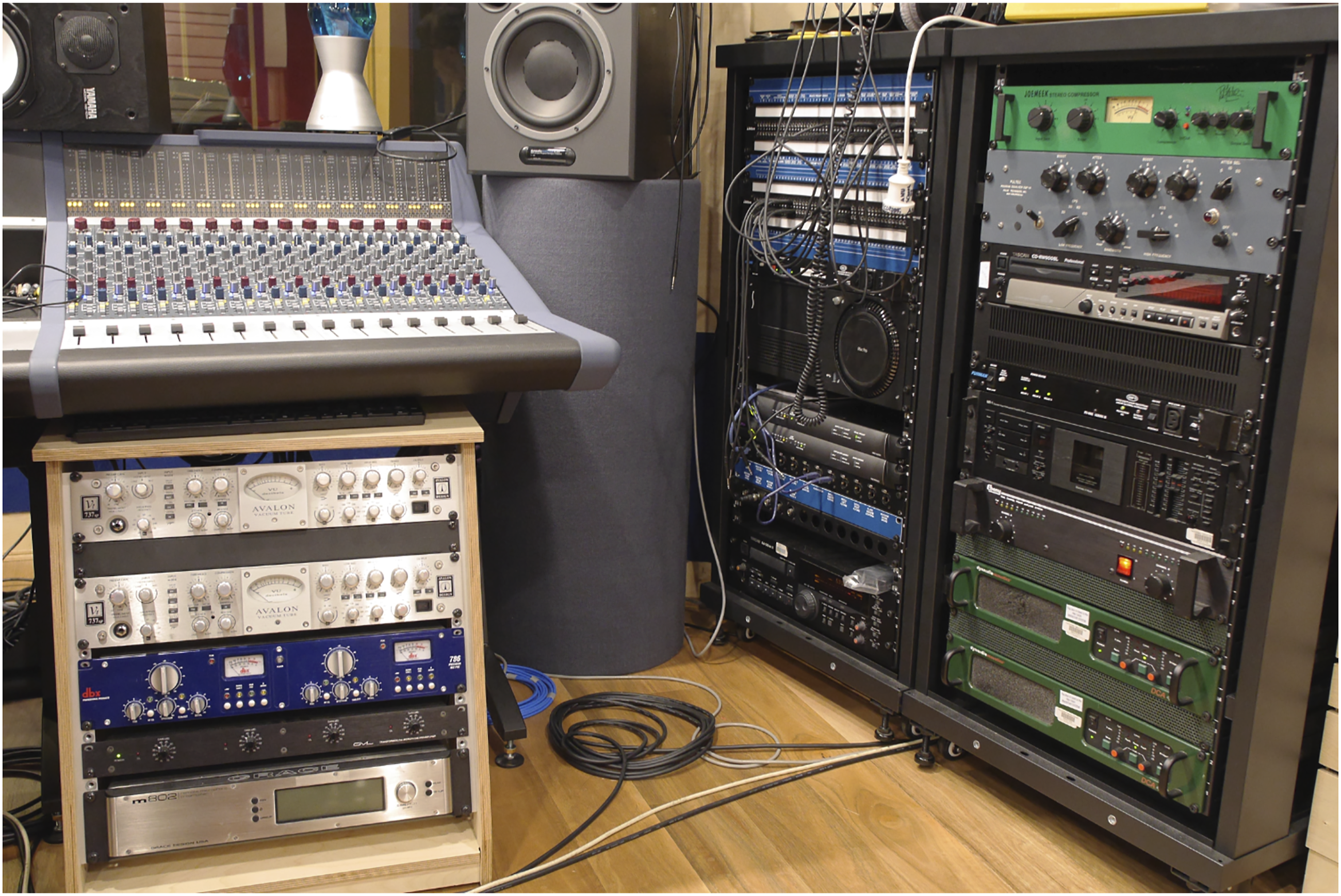
Gearslutz is a public message forum that has always been indexed in major search engines, and as such participants maintain little expectation of privacy. The site TOS does not guarantee users security or privacy of any information they transmit or post, waives responsibility for Personal Data posted on Gearslutz being shared on other sites, and notes that users waive all moral rights to the content that they post. 5 Most users use pseudonyms that appear to be specific to this forum. We took an approach similar to that of Reilly and Trevisan (2016), in that, we do identify the owner and moderators – public figures associated with the site – but avoid identifying regular site users in our analysis, even though the pseudonym convention considerably reduces the risk of reputational harm. Following Sugiura et al., we regard researcher engagements with publicly accessible, indexed forums such as this as ‘public documents rather than ethnographic interactions’ (2016: 190).
Gear vocabularies, gear experiences
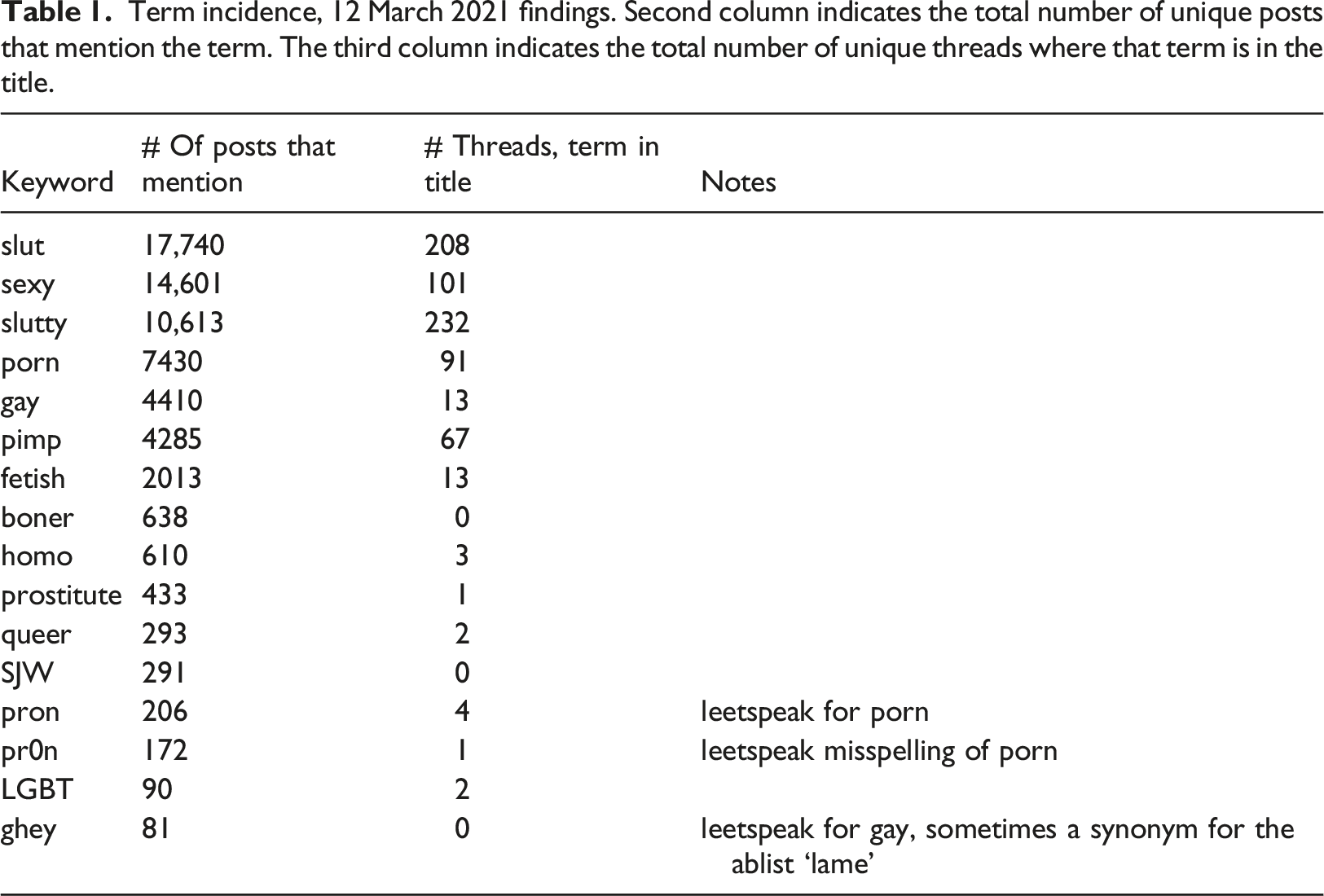
Term incidence, 12 March 2021 findings. Second column indicates the total number of unique posts that mention the term. The third column indicates the total number of unique threads where that term is in the title.
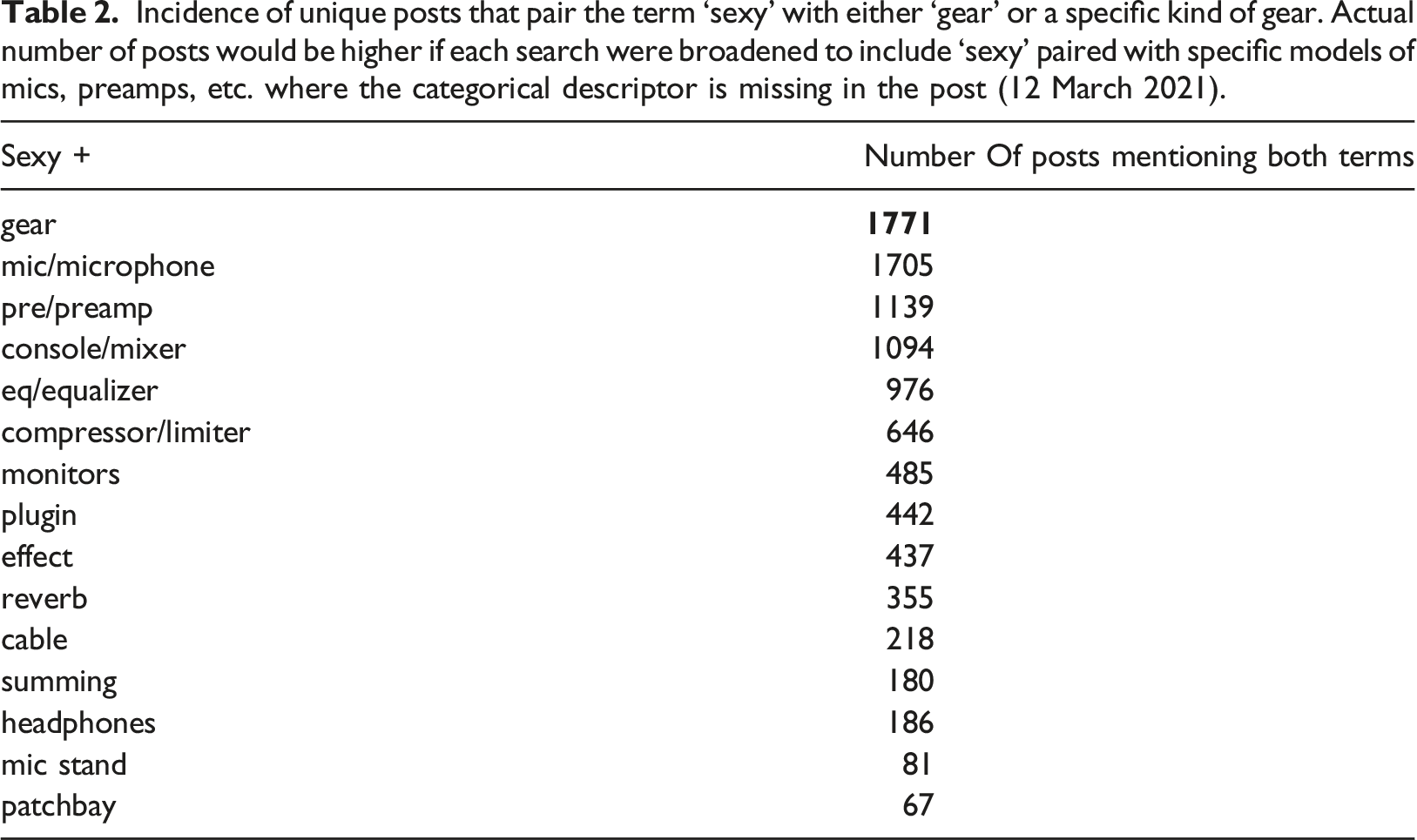
Incidence of unique posts that pair the term ‘sexy’ with either ‘gear’ or a specific kind of gear. Actual number of posts would be higher if each search were broadened to include ‘sexy’ paired with specific models of mics, preamps, etc. where the categorical descriptor is missing in the post (12 March 2021).
The preceding section covers certain site-wide vocabularies, but how does this vocabulary get used in context, and what other kinds of discursive moves are made? In the ‘epic’ sexy gear thread, we found recurring words broadly categorized around four distinct themes (numbers in parentheses indicate the number of posts that feature this word): 1. 2. 3. 4.
Grouped into these four themes, and considering the occurrences of specific brands, we begin to see patterns in how sexy gear discourse involves the performance of a particular lexicon of extraaudible terminologies.
Whilst no user suggests they are in a relationship with a piece of gear, the intensity of voyeuristic vernacular, as well as clear moves from ‘looking’ and ‘seeing’ gear to ‘feeling’ and ‘touching’ it, at least represent objectophile fantasties. Throughout there is an obvious fixation on visual aesthetics and the ‘look’ of the gear. A broad range of voyeuristic discourse refers to gear that simply has a ‘sexy look’ (Groove Tubes Vipre), to ‘cool as hell looking’ (Shadow Hills GAMA). The discourse extends to recognizing aspects unique to specific gear relative to other devices in the broader audio technology realm, gear that ‘has developed a look of its own’ (Smart AV Console). Furthermore, many posts implicate that looking at gear for extended periods of time elicits intense, erotic feelings; objects singled out this way included ‘vintage tube gear’ and ‘vintage microphones’. In these examples, looking is inextricable from ‘vintage’ visual aesthetics, so is intrinsically linked to age. ‘Sexy’ may also be linked to hygiene, for example, when the Mercury 66 Limiter is described as ‘so simple, clean and basic’, but also pubescent sexuality when the Retro Instruments Sta-Level tube compressor was referred to as something ‘to hang on the back of my bedroom door’. Users noted on several occasions that sexy gear can be sexed up by appropriate manufacturer packaging, for example, ‘side panels’, or velvet-lined wooden microphone boxes and user staging – ‘racking’ their gear, sometimes in ‘wooden boxes’.
Gear acquisition is bound up in its fetishization – a significant discursive feature in this forum, and in online gear communities more generally (Luo and Johnson, 2019). Posts move quickly from voyeuristic discussion to ‘wanting’, ‘needing’ and ‘getting’ gear. For example, one poster expressed their ‘wanting’ and ‘lusting’ for a Minimoog synthesizer. Another post featured an image of a studio control room packed with racks of professional audio equipment and two mixing consoles, including a Wunder Audio Sidecar. Affirming this image, one user suggests this gear makes forum users ‘better sluts’. Later on, a poster refers to Burl Audio, a professional audio technology manufacturer, simply stating ‘I want it…I want it all.’ Single gear objects are simply not enough: these examples of insatiable gear appetites result in the most engagement, particularly when accompanied by images. Acquisition begins with individual objects but results in quantities: ‘rack full’, ‘compressor racks’, ‘racks out’ are common examples (Figure 2) Racks of Manley Labs gear at The NAMM Show, Anaheim, January 2020.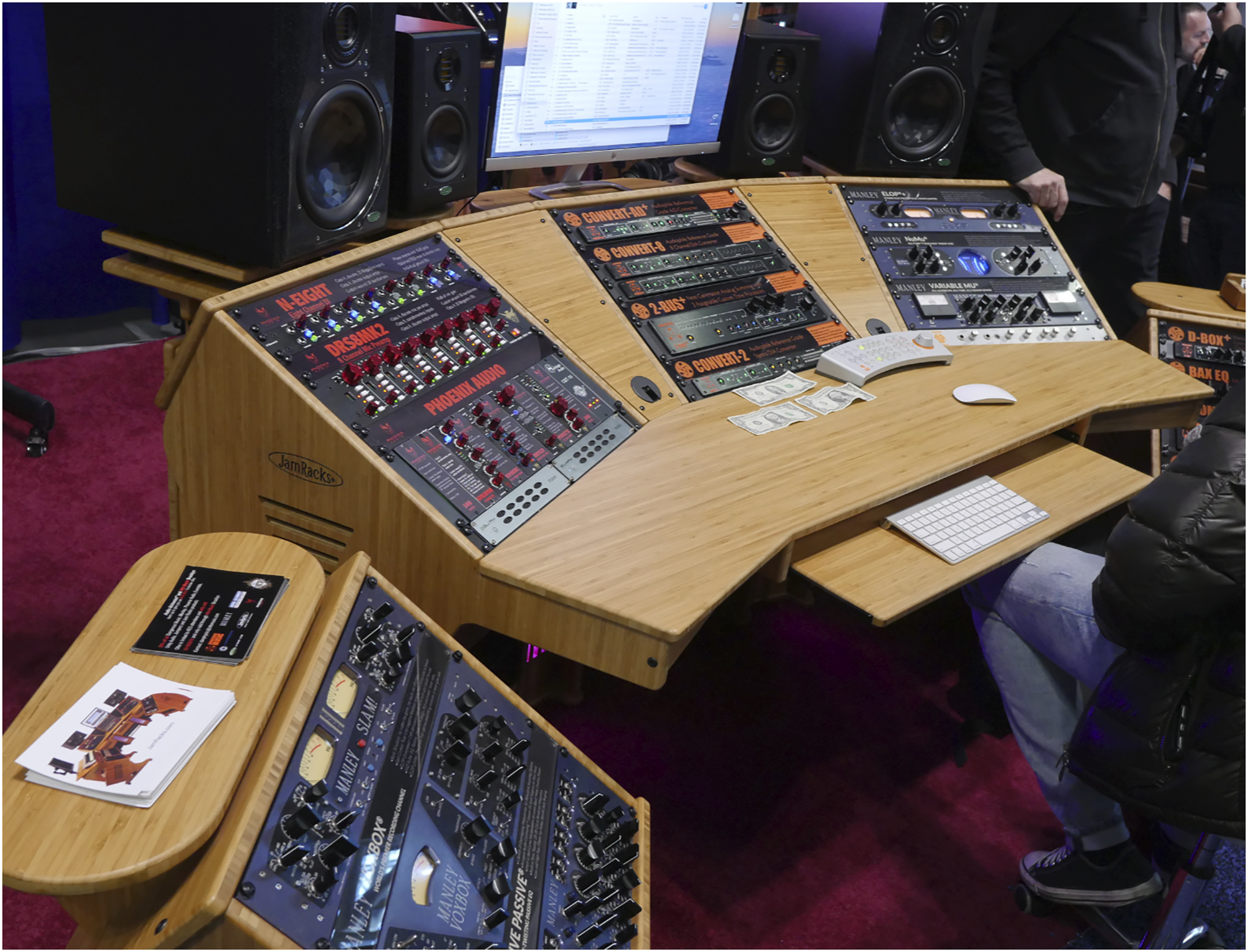
‘Look at all those big knobs!’ our title proclaims, in reference to the imagined tactility and haptic ideation around knobs. One user describes touching his volume knob on a Grace m906 monitoring controller, thus moving the discussion from voyeurism to physical interaction, alluding to foreplay. The state of arousal from physical contact continues when another user describes the Shadow Hills GAMA as a ‘wood producin’ box,’ analogizing erections (just as in our opening epigraph) and female genitalia. In neither case, the knob in question is one that would frequently need to be turned in a recording session. As a high frequency word, ‘knobs’ present all kinds of discursive opportunities, not least because of their dual meaning as both a rotary potentiometer cover and a UK English slang term for penis, and less frequently as slang for breasts and/or nipples. The thread is littered with ideations around high quantities of knobs, big knobs, stepped knobs, black knobs, volume knobs, brand-specific knobs (e.g. API) and specific plastics (e.g. Bakelite knobs). Knobs are often mentioned in relation to touching – and even licking – or to visual features of sexy gear, particularly lights. Knobs serve an important purpose in sexy gear threads. As both a gear control and phallic allusion, they give users the opportunity to explore sexual fantasies through gear discourse whilst keeping the gear discussion seemingly on track.
Our opening Neve Portico example is framed in relation to pornography, erection and masturbation. It also highlights a peculiar fetish for animate, vibrant or ‘glowing’ gear; flickering fairy-style lights and illuminations of LED’s, ‘plasma’ meters and other indicators. ‘Lights’ are often singled out as the main aspect of desire: the highest frequency visual feature occurring in one sexy gear thread, followed by ‘orange lights’ and ‘blue lights.’ In numerous examples, the ‘glow’ and ‘afterglow’ of lights in dark settings or, specifically, where room lights are dimmed or turned off are of particular objectophilic interest. Since this discourse is intensively sexual in its framing, and since much of it is fantastical in nature, parallels may be drawn between the focus on lights and glow-in-the-dark features, and sex work signage. Indeed, in three other threads posters explicitly invoked a ‘red light district’ through a picture of gear with red lights, or discussed ‘Red Light District’ as a prospective studio name. Additionally, striptease and peep show metaphors are common in the threads. In her Baudrillardian analysis of neon lights and fetish, Davis suggested that brightly colored lights are synonymous with – and ubiquitous in – sex work signage, and as such, lights are ‘an ideal form of marketing for sexual activities, as well as, environments’ (2017: 17). In sexy gear threads, gear lights and ‘glow’ discourses serve ‘scene setting’ functions, creating imaginary environments in which room lights are dimmed, gear lights flicker in the dark and sexual activities may occur. This ‘scene setting’ discourse is, however, hardly innocent. Such discussion serves to further oppress (female) sex workers; Davis recognized the value of a light is often ‘treated with more regard’ than the lives of sex workers themselves (2017: 17). References to body parts – ‘face,’ ‘hands,’ ‘legs,’ ‘body’ and ‘curves’ – appear regularly. Further, humanizing and frequently occurring terms include ‘shadow,’ ‘energy,’ ‘warm’ and ‘radiate’ which animate gear features, eliciting emotional responses in users. Here, in the Baudrillardian sense (1998: 129), we see how representations of the body manifest in fetish objects in gear discourse structures, as well as how gear is almost always gendered female so as to stand in for absent women in the manosphere.
Connoisseurship
During the period this thread was active, consumer tastes in technologies had returned to objects from a ‘golden era’ of ‘vintage’ gear—tastes that continue today. Concomitantly, the audio technology industry was substantively changing, as many new companies produced lower-cost ‘clones’ of vintage gear, and software developers coded ‘plugin’ versions of the same. For one user, who identified the LA-2A compressor as being ‘sexy,’ sexy gear is about ‘its refusal to bow’ to the ‘paradigm’ of Digital Audio Workstations. But which LA-2A? The original Teletronix device would cost approximately $10,000USD in 2021, whereas reissues are $4,300, clones range from $449 to $1895, and plugins cost between $29 and $149. Unsurprisingly, the sexy LA-2A is the vintage original, and not a plugin emulation or clone. During a time when almost all recording, editing and mixing involved computers (Bell, 2018), ‘sexy’ gear was old, or based on old parts, often inessential or marginal to computer-based recording production, and detached from mainstream technology consumption. By ‘refusing to bow’, sexy gear is discursively linked to subversion and non-mainstream technoaesthetics (Simondon, 2012).
While assessment of sexiness suggests individual valuation, connoisseurship here acts as a social practice. In fine art connoisseurship, the ability to accurately attribute artworks to histories, genre, and artists (Ebitz, 1988: 207) demonstrates ‘a commitment to the evidence of style’ (Neer, 2005: 1). Gear connoisseurship does not revolve around one-of-a-kind artworks, even though vintage ‘originals’ are rare and prohibitively expensive on the second-hand market, but connoisseurs similarly must accurately identify significant objects and makers within gear history as being technological style exemplars. Similar to languages around coffee and wine tasting, where connoisseurship vacillates between ‘demonstrating status and performing good taste, and the sense of “good enough”, in audio too, we find a ‘hollowing out of what connoisseurship means, so that the performance is grander, the knowledge is smaller, and the language more of a game’ (Elliott, 2006: 235). The focus on connoisseurship in sexy gear discourse, while it might appear to be playful, is far from innocent; it serves to reinforce exclusionary structures of the audio industry on a broader level (Born and Devine, 2015). The availability of cheaper products, although not considered gear in this realm, make more expensive, ‘studio-quality’ technologies more attainable, while accumulated listening and experiential expertise in a studio, with musicians, is not. Performative connoisseurship involves the rehearsal of the precise knowledge of model numbers and used market pricing to promote only the most expensive technological objects to the status of gear. This obvious gatekeeping ensures that the incursion of consumers of cheaper recording technologies does not threaten the elite status of vintage gear owners. As such, there are obvious classist implications.
Connoisseurship language often adopts nationalist discourses (‘Made in England,’ ‘Made in the USA’), where the perceived geographical origin of technologies is correlated with build quality, attention to detail and artisanal rather than automated assembly labor (Bennett, 2012: 130). Our opening anecdote highlighted ‘Neve’ technologies, and elsewhere in the thread the Neve brand name – whether referencing products of UK-based Neve Electronics from 1961–1985, those subsequently produced by the company AMS Neve which Rupert Neve was not directly involved with, or those from Rupert Neve Designs in Texas – was that most commonly associated with sexy gear.
But what about gear that is not sexy? The first eight posts of our ‘epic’ sexy gear thread established that ‘sexy’ gear consisted of microphones, analog outboard equipment, or electric/electronic instruments. In post nine a user suggests the D Control: a hardware digital controller used in conjunction with a DAW. A lengthy row of dots trails into the ‘runs and hides’ emoji. While the D Control was a widely used DAW controller at the time, and has no shortage of knobs, lights and faders, the user clearly anticipates this suggestion will neither be popular nor affirmed. He is right: his comment is ignored. As a computer domain, digital device, it falls outside of the connoisseurship conventions; the D Control is definitely not sexy!
Threads and social order
The average Gearslutz thread attracts 30 responses, yet our ‘epic’ sexy gear thread garnered 186 responses and 22,502 views – considerably more than most. It even survived three outright attempts to derail or discredit it, and several diversionary joke posts. What factors maintained interest in this thread, and how did it reproduce the social order of the site? For threads to succeed, they need to quickly attract contributions by forum regulars and respected members of the community: in this case, three forum moderators, a Gearslutz founder, several professional gear designers and retailers, and pseudonymous users with the highest post counts. Such members need not do much; simply dropping a popcorn emoji can serve as a dog whistle (Bhat and Klein, 2020).
Successive posts need to introduce a sufficient amount of new terminology – metaphors, analogies, adjectives – in order to keep the topic interesting and fresh. Over 100 other threads that followed the formula of ‘help a slut out with their sexy gear purchase’ failed to attract more than five responses each. Posts also need to mention a sufficient number of different objects, including well known ones, unusual or rare ones and even ironic/joke examples. However, we found in practice different objects means different manufacturers or models of similar objects, for example, dynamics processors, mixing consoles, microphones and preamplifiers. Embedding pictures and requesting new images achieve such renewal, suggesting an addiction to novelty similar to that in porn consumption (Patterson, 2004). Some users even suggested the image of the gear was sexier to them than the gear itself, implying that gear are fantastical and aspirational objects not always owned. Other users were careful to indicate personal ownership of gear or gear that they had owned in the past and since sold. One long-standing aspect of Gearslutz is that many regular users remember in detail what gear other users own – and expect other users to remember too. In other words, it is not just the qualities inherent in the picture itself – the aesthetic features of the object that might suggest sexiness or not – but the capacity of that picture to articulate the specific relation between object(s) and user.
A careful analysis of the turn-based communications reveals other aspects central to the social ordering on the site. We differentiate between first-person user responses emphasizing personal/intimate experiences and attitudes, and third person ‘categorical’ responses that reveal little about their feelings; the former provoke more responses than the latter. Regarding responding, Gearslutz threads are full of ‘affirmation’ responses; in the absence of an upvoting/downvoting system that has any substantive effect (such as on Reddit), this is the only tool available to perform consensus-building work.
Threads often become derailed by off-topic posts, trolling or gaslighting. Despite off-topic posts here, users banded together to reorient the thread back on topic. If any of the attempts to discredit the very premise had been successful, it would have likely killed the thread long before it got to 186 responses. The first attempt noted that one ‘can’t have sex with gear’, and in a patronizing tone adpoted the self-appointed role of masculinity advice counselor to help his fellow forum members ‘get laid’. This was quickly countered by a post that ramped up the conversation into the discursive framework of rape culture – ‘gear never says no’. Despite the strategic use of face-saving contradictory emojis, this highlights how such threads quickly move beyond objectification into dangerous rhetoric. Both users then apparently attempted to backpedal, neither renouncing their provocative statements nor insisting on them being axiomatic – and saving face in the process. Other attempts to derail the thread also balanced aggressive masculine posturing with an attempt at a ‘saving face’ escape route.
Such threads, although detached from ‘professional’ discussion, are essential for social cohesion in a forum such as Gearslutz. In addition to the aforementioned post styles we found several appeals to the community of Gearslutz, often done in a way action researchers describe as ‘local theory building’ (Genat, 2015): these demonstrate the poster’s own familiarity with the site’s history and cultural characteristics, require readers to reconcile their own latent beliefs with the values presented.
Conclusion
Our opening anecdote, of a Gearslutz user aroused after staring at a Neve Portico microphone preamplifier, exemplifies the convergence between gear fetishization and the hegemonic masculinities of message forums. Online gear forums are extensions of the manosphere where sexualized discourse serves two key functions: it stands in for the missing workplace and workflow context(s) the gear was intended for and, objectified gear stands in for the missing women – in both the forum and wider audio industry (Cowie, 1999; Gaston-Bird, 2019; Nakamura, 2014). Such threads uphold hostility to women and gender diverse people, substantiating recent findings that 96% of professional audio production personnel are cis-gendered men, and sexual harassment and microaggressions in the recording workplace are rife (Brooks et al., 2021). Therefore, our work shows how some of these problems reside outside of matters of who works in studios, and pertain to the complex representations and significations of technical objects online.
Analyzing Gearslutz reveals richly detailed discourse where performed connoisseurship, objectophilia and haptic ideation surpass technological ‘use’ far beyond normative sound-related needs. Instead, gear acts as surfaces of erotic encounters, projected fantasies and to the social formation as a materialization of hegemonic masculinity. Multivalent modes of gear fetishism, including value, age, scarcity, and antithesis to present-day computer-based technologies (which are definitely not sexy), are called upon to perform boundary maintenance of the hegemonic masculinity, even as objectophile fantasies threaten to queer it.
Our research has broader implications for the study of online masculinities. Gear sexiness is only maintained when reinforced with images; these evince a reorganization of the material and economic world around thousands of privately acquired hordes of technological objects. A high maintenance, collective technological gaze is enacted via this ordered, socialized and expertly maintained manosphere; the gear itself is at the epicenter of this social formation. The posited questions and executed methodology may be useful in other technological milieu where ‘sexiness’ discourses can be found. For example, the framework may be applied to how musical instruments are discussed online, specifically, synthesizers, guitars, guitar pedals and amplifiers. Additionally, similar data sets could be drawn from broader technological discourses to include digital and film photography (and its associated reblogging sites), overclocked computer and lanparty subcultures, sports and outdoor activities, classic cars and more. We know that sexy gear fetishes are found beyond audio technological gear cultures as we know them. In saying that, our next area of research will explore the competitive acquisition of gear (GAS). We hope our method of analyzing sexy gear online can be adapted for the study of other technology-focused online communities. Future research in similar technology forums may show the extent to which other hegemonic masculinities depend upon the organization of online and offline sociability around fetishized material objects.
Footnotes
Declaration of conflicting interests
The author(s) declared no potential conflicts of interest with respect to the research, authorship, and/or publication of this article.
Funding
The author(s) received no financial support for the research, authorship, and/or publication of this article.
