







Abstract
This paper seeks to shed light on the EU regulation and policy for prominence and discoverability of EU works and of services of general interest from the point of view of main European audiovisual agents as represented by corresponding organisations. Their positions are characterised following a stakeholder analysis and in relation to the advocacy coalition framework. The study draws on evidence from statements and positions, policy documents, reports and other secondary source materials, as well as findings from interviews. After a brief conceptual introduction and a legal and policy review, an explanation of the analytical framework used follows, together with a structured analysis of stakeholders’ views regarding the content, implementation and impact of EU regulation and policy for prominence and discoverability of EU works and of services of general interest. Conclusions revolve around the existence, or not, of advocacy coalitions, emerging key policy issues, and challenges to be met.
Keywords
Introduction
In an online scenario of abundance of content, audiovisual works and services need to not only be available to be consumed, they must first of all be found. And in order to be discovered, they need to stand out. Discoverability and prominence are therefore key for the success of any content. At the European Union (EU) level, regulation and policy regarding prominence and discoverability of audiovisual works offered on demand have been mainly supported by the Audiovisual Media Services Directive (AVMSD) since 2007. Following the amendment of the norm in 2018 (Directive EU 2018/1808; (EU European Union, 2018)), two types of prominence provisions are included in the AVMSD, namely prominence of European works and of services of general interest.
This paper seeks to shed light on their current implementation and impact from the point of view of the principal European audiovisual agents affected by these provisions. Such agents are classified and their positions characterised following a stakeholder analysis and in relation to the advocacy coalition framework. The main research questions are: What are the different viewpoints of these stakeholders regarding prominence and discoverability? Which advocacy coalitions can then be identified? What are the key policy issues and challenges emerging related to this topic?
The relevance of this enquiry is justified in a context in which, after the European Commission (EC) stressed the need for an effective and consistent implementation of the revised AVMSD (EC, 2020), the Council of the EU (CoEU) invited Member States to promote strategic approaches for the online discoverability of European cultural content (CoEU, 2022a) and the European Parliament (EP) adopted its report on the implementation of the AVMSD (EP European Parliament, 2023). This report highlighted the importance of measures to ensure the prominence of audiovisual media services of general interest, as well as the prominence of European works, vis-à-vis relevant user interfaces and platform services established in other territories.
Audiovisual agents affected by the AVMSD have been advancing their positions on the matter in different forms and related forums at the European level. 1 In this vein, the fact that the European Coalitions for Cultural Diversity, supported by Members of the Cultural Creators Friendship Group 2 as well as many organisations, set up the first European Forum on Discoverability and the Conference on Discoverability & Artificial Intelligence, in March and November 2023, respectively, is an indication that there is very much at stake for many players.
In line with recent studies that have already been examining the regulatory and practical implementation of the AVMSD regarding prominence and discoverability (Capello, 2022; EC et al., 2022), which add to the work carried out within the European Regulators Group for Audiovisual Media Services (ERGA) since 2018, the analysis presented here aims to contribute to the research into this matter.
The article is organised into seven sections including this introduction. After a brief review of the notions and perspectives regarding prominence and discoverability, a descriptive overview of rules as well as the state of play for prominence and discoverability of EU works and services of general interest are presented. The explanation of the analytical framework used follows, detailing sources and methods, together with a structured analysis of stakeholders’ views regarding the content, implementation and impact of EU regulation and policy for prominence and discoverability of EU works and of services of general interest. Conclusions revolve around the existence, or not, of advocacy coalitions, emerging key policy issues, and challenges to be met.
This text is written in the critical tradition of studies dedicated to media regulation and policy (for an introduction, see e.g. Van Cuilenburg and McQuail (2003); Mansell and Raboy (2011); Mastrini et al. (2013)), with a focus on the EU and the audiovisual sector (Albornoz and García Leiva, 2019; Donders et al., 2014; Ranaivoson et al., 2023) as well as on the policy process and the configuration of coalitions of actors within this domain (see e.g. Van Den Bulck and Donders (2014) from an advocacy coalition perspective; Vlassis (2023) from an actor-centred constructivist approach). At the same time, it is encompassed within a relatively new line of research dedicated to issues regarding the prominence and discoverability of digital contents to which it seeks to contribute (García Leiva et al., 2024; Hesmondhalgh and Lotz, 2020; Lobato and Scarlata, 2022; Mazzoli, 2020, 2021; McKelvey and Hunt, 2019).
Audiovisual prominence and discoverability
Determining which kind of prominence is given to what content is not a simple task, especially when it is offered online and on demand. Many questions must first be answered before any decisions can be made. For example: what does it mean for a content to be prominent (and how does this relate to its discoverability), and how should that content be chosen. The audiovisual sector is not exempt from these challenges, which show how the strategies of the past (prime time television, screen quotas…) need to be rethought with digitalisation. For instance, what began as a concern about the position of channels in electronic program guides (EPGs) has become a debate about how software-based applications are configured to provide access to contents and services.
Following previous research (Desjardins, 2016; Mazzoli and Tambini, 2020; MCC & MC, 2020; OCCQ, 2017), prominence can be understood as the location and prioritised placement of contents/services compared to others in time and/or space on a given interface, whereas discoverability refers to the likelihood of coming across content/services (ideally, also serendipitously; García Leiva and Mazzoli, 2023). That said, it should be noted that although prominence may contribute to discoverability, the discovery process depends necessarily, but not exclusively, on the prominence attribute (García Leiva, 2021). In fact, discoverability and prominence should be understood as outcomes of prioritisation processes, defined as the range of design and algorithmic decisions that positively discriminate and promote content (Mazzoli and Tambini, 2020).
Since the amendment of the AVMSD took place in 2018, two main types of opposing perspectives have been organised around prominence and discoverability issues: a market freedom, non-interventionist and technological deterministic perspective, on one hand, and a market interventionist perspective, on the other, based on the grounds of social values but guided by technological neutralism/scepticism.
From the point of view of the market freedom/technological determinist perspective, prominence must be given only to contents that respond to consumers’ tastes and preferences. Algorithms represent the best possible solution to facilitate content discovery and make personalised recommendations respecting both consumers’ choice and providers’ freedom to organise their offering. These ideas, prone to economic and self-regulatory principles, have been represented not only by providers of audiovisual services with a commercial aim and business associations, but have also been expressed by consultants, experts and, to a lesser extent, some institutions and related agencies involved in developing and implementing policies – without necessarily ascribing to this position in full (see e.g. Dialogic, 2019; ERGA, 2020; European VOD Coalition, 2020; Farchy et al., 2022).
On the contrary, for the market intervention/technological neutral/sceptics perspective, prominence should be secured for contents fulfilling public interest and cultural diversity criteria within offerings presented to consumers. The rationale is that algorithms and personalised recommendation systems lack transparency and accountability and can therefore be used in the sole particular interest of those who control them, hindering the discovery of third parties’ content. Regardless of the technology in place, intervention is needed to establish a level-playing field for all stakeholders and to defend the diversity of the cultural expressions principle. With different nuances and intensity, this perspective can be linked to public service media, associations advocating for citizens’ and culture professionals and creators’ rights, as well as experts (see e.g. AAVV, 2023; EBU, 2023; EPC, 2022; García Leiva, 2021; Mazzoli and Tambini, 2020).
These two opposing perspectives must, in turn, be understood in light of the four central tensions that have underpinned the struggle to regulate audiovisual markets since the predecessor of the AVMSD, the so-called Television Without Frontiers Directive (89/552/EEC; TVWFD), was born in 1989 (Ranaivoson et al., 2023: 11–12). Firstly, the tension between public and market interest objectives; respectively, protecting cultural diversity and sustaining a European production industry. Secondly, the one between liberalisation and protectionism; namely, keeping regulation to a minimum versus deploying it to protect state and European audiovisual industries (via, e.g. content quotas). Thirdly, the tension between the supranational and national levels, in fact at the core of EU audiovisual policies since the beginning; that is to say, enforcement of mandatory EU rules versus flexibility left to Member States to transpose provisions or to even choose not to do so when they are not binding. Fourth, the tension between creating a level-playing field for all players within existing regulation and developing new technology-specific rules.
As the following sections illustrate, these tensions have been barely dealt with or overcome in the case of prominence and discoverability, resulting in an uneasy fit.
Regulatory overview
In 2018, the Council of Europe incorporated the need to establish mechanisms that ensure due prominence of general interest contents in relation to the issue of diversity content in its Recommendation CM/Rec(2018)1[1] on media pluralism and transparency of media ownership. Its Steering Committee for Media and Information Society adopted a Guidance Note on the Prioritisation of Public Interest Content Online in December 2021(CDMSI(2021)009). Nevertheless, within Europe the fundamental debate has taken place at the EU level and in relation to the notion of prominence contained in the AVMSD.
But prominence is not an entirely new concept: its use in the specific area of the European audiovisual regulation can be traced back to the 1990s and must be linked to the approval of the AVMSD in 2007 (2007/65/EC; García Leiva, 2021). Since non-linear services were included then within the scope of the norm, requirements were put in place to ensure that their providers would promote the production of and access to European works, stating that such promotion could be linked to the sharing and/or prominence of European works (Article 3i).
This wording was preserved in Article 13 of the 2010 revised Directive (2010/13/EU), which included in Recital 69 examples of how the production and distribution of European works could be promoted. Due to the fact that the 2010 AVMSD presented prominence initiatives as one possibility among others to promote European works, and the incorporation of the notion was through a vaguely defined term open to varied interpretations, the transposition of prominence rules by EU Member States occurred unevenly (Attentional et al., 2009, 2012). By the mid-2010s, the most commonly used method by video on demand (VOD) service providers to give prominence to European works was promoting and showing European film trailers on homepages; special recommendations through an algorithm were employed by a few as well as the search function by country of origin (Grece et al., 2015: 33). The reporting on the application of Article 13 for the period 2015–19 showed little had changed (EC European Commission, 2023).
With the amendment of the norm in 2018, a few further steps were taken: Article 7a recognises that Member States may take measures to ensure the appropriate prominence of audiovisual media services of general interest, to meet objectives such as media pluralism, freedom of speech and cultural diversity (Recital 25). In addition, Article 13(1) indicates, as a specific way of promoting European works, that VOD service providers not only have to respect a 30% minimum share obligation for their catalogues but they also have to ensure that these European works are given prominence. Examples of how to do this are listed in Recital 35, which mentions that prominence involves promoting European works by facilitating access to them through various means, such as a dedicated section that is accessible from the service homepage, search functions, and other promotional efforts such as banners or similar tools. This provision therefore presents a two-tier approach, where prominence accompanies the obligation of a quota that has to be implemented, whereas Article 7a points to a possibility and does not necessarily have to be pursued.
In short, even though there are two types of provisions included in the AVMSD, prominence remains a rather loosely defined term. What appropriate prominence means for European audiovisual works and for services of general interest has never been clearly defined in the Articles. Furthermore, while all Member States have included prominence provisions for European works on services on demand because the norm indicates that they shall ensure them, there is wide divergence regarding how many Member States regulate the prominence of services of general interest, a provision that they may ensure, as well as how they regulate it (García Leiva and Mazzoli, 2023: 198–199). Article 7a does not prescribe any particular form of prominence, and whether or not to introduce measures remains entirely up to the discretion of Member States.
From legislation to implementation
The fact is that the actual effectiveness of these provisions has yet to be seen since transposition and implementation have been conditioned by some – sometimes significant – delays, and secondary legislation or similar to ensure effective realisation of measures, in practice, remains largely lacking.
According to the European Audiovisual Observatory, 3 as of November 2023 only 10 EU countries introduced prominence of general interest services in their legislation (four without further explanation of how prominence should be achieved or how to define such services); and only 13 went beyond the general prominence rule for audiovisual works explicitly mentioning, for example, the adoption of specific tools such as the provision of a dedicated section on the main access page or a specific category for the search for works in catalogues (Lacourt et al., 2023). In other words, a definition of prominence remains largely missing in the transposition processes. Furthermore, regarding the implementation of Articles 7a and 13(1), ERGA’s work has revealed a scenario that is quite fragmented and widely varied (ERGA 2021a, 2021b, 2022).
The EC (EC European Commission, 2024) has not added further information. Awaiting the presentation of its reporting on the implementation of prominence obligations under the revised AVMSD, covering the years 2020–21, the EP as well as the CoEU have been highlighting not only the importance of prominence of European audiovisual works and services of general interest but also that of their discoverability. In December 2022, the CoEU adopted the Resolution on the Work Plan for Culture 2023–26 which, under the priority ‘Culture for the people: enhancing cultural participation and the role of culture in society’, makes reference to the discoverability of diverse European cultural content beyond mere availability online (CoEU, 2022b). The EP has, in turn, made reference to prominence and/or discoverability in different resolutions: in Europe’s Media in the Digital Decade (EP, 2021), in the implementation of the revised AVMSD (EP, 2023a) – where the need to develop guidelines in relation to Article 7 of the AVMSD for a harmonised European approach in this matter is stressed – and in amendments to the European Media Freedom Act (EMFA) proposal (EP, 2023b).
The latter brings to the forefront the fact that the Digital Services Act (EU, 2022) and the EMFA (CoEU, 2024) warrant a closer look since there are voices that highlight that they could interplay with the AVMSD and have an impact on the promotion of audiovisual media services of general interest (ERGA 2022; Ledger, 2023; McGonagle, 2023). For instance, the proposed EMFA (Article 19) introduces the right for users to customise the media offer according to their interests or preferences, without affecting national measures implementing Article 7a and b of the AVMSD, and refers to the importance of having guidelines for national measures established under this article (Recital 28, Article 15). The DSA (Article 27) states that providers of online platforms that use recommender systems shall set out in their terms and conditions the main parameters used as well as any options for the recipients of the service to modify or influence those main parameters.
Analytical framework and methodology
To study the views of European audiovisual agents affected by the AVMSD on the regulation and policy for prominence and discoverability of EU works and of services of general interest, the investigation focused mainly on actors listed in the EU Transparency Register.
4
Considering only those with a stake in the matter, and leaving aside governmental institutions and related agencies involved in developing and implementing policies, agents were classified into three groups of stakeholders identified on the basis of the type of players they represent: • European associations and federations advocating for industrial players, whatever their size and market power: Association of Commercial Television and Video on Demand Services in Europe (ACT), The European VOD Coalition, European Broadcasting Union (EBU), International Federation of Film Producers Associations (FIAPF), Motion Picture Association EMEA (MPA EMEA), EuroVOD, International Federation of Film Distributors’ and Publishers’ Associations (FIAD), Europa Distribution, Europa International, European Audiovisual Production association (CEPI), Eurocinema and European Producers Club (EPC). • Organisations representing media and entertainment creators and professionals: Federation of European Screen Directors (FERA), Federation of Screenwriters in Europe (FSE), Society of Audiovisual Authors (SAA) and UNI Global Union, Media, Entertainment & Arts (UNI-MEA). • Organisms voicing citizens’ interests: European Association for Viewers Interests (EAVI) and European Coalitions for Cultural Diversity (ECCD), together with the Cultural Creators Friendship Group.
Stakeholder analysis, with roots in the political and policy sciences and in management theory, aims to evaluate and understand agents from the perspective of an organisation or to determine their relevance to a project or policy; and its scope can range from broad with a strong retrospective dimension, to working towards a more immediate well-defined policy implementation goal, or to prospectively outlining more long-term and broadly focused policy directions (Brugha and Varvasovszky, 2000). Specifically focussing on the groups of stakeholders outlined, classified on the basis of their relevance regarding prominence and discoverability issues, this article takes stakeholder analysis as a flexible analytical lens and point of departure to characterise views and positions in relation to a particular topic rather than to assess a policy.
Evidence was drawn from statements, policy documents, reports and other secondary source materials, issued between 2019 and 2023, as well as on findings from interviews. Even though institutions and agencies involved in developing and implementing policies were left aside, attention was also paid to evidence provided by two organisms with a somehow indirect involvement in the matter: the European Film Agency Directors association (EFAD) and the ERGA. This is due to the fact that they have been collecting valuable information on some stakeholders’ views for many years. The fieldwork took place between September and November 2023.
Nearly 70 documents were reviewed (without counting news releases), such as statements, positions, reports and policy briefings, within which only the content of those with relevant information was analysed (a total of 44). This evidence was studied by means of a detailed reading to search for expressions of the opposing perspectives described in section two of this paper, thus detecting the position of each stakeholder. Additionally, semi-structured qualitative interviews were conducted mostly face to face in Brussels (Belgium), after contacting the agents listed. Oral feedback was collected from those willing to participate in the study (see details in Appendix 1). 5 Where agreed, the interviews were recorded solely for the purposes of data analysis. Aggregated and anonymised input is used in this article where relevant due to the fact that most interviewees specifically asked not to be named in relation to literal statements.
This methodological approach is justified since document analysis offers an efficient, cost-effective means to access information and debates (Karppinen and Moe, 2019), while expert interviews are a rewarding instrument to generate uncodified knowledge (Van Audenhove and Donders, 2019). The resulting portrayal of stakeholders’ views is firstly used to establish similarities and differences between and within the three types of groups of agents identified and, secondly, to be sifted through the sieve of the advocacy coalition framework (ACF) to detect if stakeholders with similar values and beliefs have some degree of coordination and form alliances. The ACF is a framework of the policy process developed by Sabatier and Jenkins-Smith in the early 1990s that defines advocacy coalitions as groups of actors that share beliefs and coordinate their action (for the latest update, see Weible and Sabatier (2018); for an excellent introduction to its use in the field of media, shortcomings included, see Van Den Bulck (2019)).
So-called core policy beliefs are normative values and perceptions of the policy problems, whereas coordination of action is defined as some degree of working together to achieve similar policy objectives (Sabatier and Weible, 2007). Due to the fact that coordination does not always follow from sharing beliefs, the ACF categorises different types of coalitions. Satoh et al. (2023: 190) offer a summary: an adversarial coalition is the ideal-typical advocacy coalition because its members exclusively collaborate with like-minded actors; in cooperative coalitions members also collaborate with actors whose beliefs differ from their own; groups characterised by actors that do not coordinate their actions despite belief similarity form disconnected coalitions; and intermediate groups exist wherein actors form ties with those who do not hold similar beliefs. When intermediate groups are connected to several coalitions, they, or some of their members, can serve as brokers in the policy process since they are usually more moderated in their beliefs than actual coalition members. No clear-cut definitions and methods exist for identifying brokers, but the idea is that they mediate the connections between coalitions and make compromises possible.
Although the aim of this article is not to unveil or assess a policymaking process and therefore characterise all the actors with an interest in the broad policy area of audiovisual media to explain policy change over a long period. It is here argued that the combination and application of a stakeholder analysis with the ACF in a flexible and broad way is a useful and rigorous way to detect and characterise competing sides regarding a very specific topic within a policy area. In short: stakeholder analysis, which serves to identify agents that hold similar beliefs and values via their views and positions, is the basis for detecting the existence (or not) of advocacy coalitions.
Stakeholders’ views and alliances
The following pages summarise the views of main European audiovisual stakeholders on the regulation of prominence of European audiovisual works and audiovisual media services of general interest, as well as their implementation and impact, with Articles 7a and 13(1) of the AVMSD at the centre of their arguments. Such views can be indeed explained by the existence of beliefs linked to the two opposing perspectives on prominence and discoverability issues already outlined: the market freedom non-interventionist and technology deterministic perspective, and the market interventionist and technology neutral/sceptical one.
Beliefs behind the former refer to the fact that intervention is not needed because market failure does not exist or, when it takes place for circumstantial reasons, it can be remedied by applying technological developments. Technology, especially digitalisation, offers opportunities for all, therefore the state should not intervene. Prominence/discoverability requirements must be avoided because agents can self-regulate. Otherwise, personalisation and users’ freedom of choice can be affected and system integrity undermined; requirements go against innovation and distort competition. Mandating some solution to secure prominence/discoverability would likely benefit some while putting others at a disadvantage. Freedom of choice as well as business freedom and competition must be guaranteed.
The interventionist perspective is fed by beliefs that understand that social responsibility and values should be at the core of action because the aim is to serve the public interest. The rationale is that social benefit should coexist with commercial profit. In other words, the idea is that when deciding what type of works and/or services must benefit (or not) from obligations of prominence/discoverability, the criteria be that the values and objectives are essentially sociocultural and not merely commercial. Audiovisual diversity should be guaranteed, regardless of and despite the technologies in place.
The existence of these beliefs does not, however, appear to have led to the formation of corresponding coalitions. Although at first glance it might seem straightforward to assign the different stakeholder groups to two adversarial coalitions (industrial players vs creators and professionals and citizens’ representatives), the evidence does not point in that direction. A close look at stakeholders’ views speaks of complex processes in place that involve a web of values and beliefs for which, in fact, the lack of coordination stands out. At best, one could speak of loosely defined alliances. Interestingly, cooperative relations as well as brokerage can be foreseen.
Preliminary remarks
There is general consensus among the different groups of stakeholders identified about the fact that prominence is a key concept as regards the visibility and findability of audiovisual content online. Nevertheless, some note that when it comes to including it in the regulatory domain, the notion falls short of addressing the broader issues that revolve around the discoverability of such content.
Interestingly, even though almost all stakeholders share concerns about the need to further clarify prominence provisions included in the AVMSD, not all of them are able to neatly express how prominence can or should be defined. Those who do so, mainly belonging to creators and professionals’ organisations, also reflect on discoverability and even serendipity issues, referring to prominence as a noticeable placement and to discoverability as the process behind the possibility of encountering a content, even without specifically looking for it. They also underline the need to better articulate prominence rules and measures under the wider umbrella of promotion in the online and offline worlds.
The strongest views detected refer to Article 13(1), rather than to Article 7a of the AVMSD. Most stakeholders have few concerns about the latter which for several is either perceived as a provision somewhat removed from their interests or as one for which they do not have a clear position. It is also worth noting that views on prominence of European works are inextricably linked – as is indeed the wording of the provision – to opinions on the 30% quota of such works that on demand media services must fulfil.
Existing provisions: Needed but vague
While polarising views exist regarding the understanding and assessment of prominence rules related to audiovisual works, prominence of general interest audiovisual services causes fewer disagreements. In any case, and with a few exceptions, Articles 7a and 13(1) of the AVMSD are valued as a step forward. Having said that, they are broadly characterised as being insufficiently clear. Nevertheless, not many are able to or even want to share clear proposals for improvement.
Divergent assessments
In relation to the reference to prominence contained in Article 13(1) of the AVMSD, while a minority of stakeholders, the big and powerful industrial players, are radically against it, insisting on no obligations or fewer ones along with greater flexibility to comply, arguing that consumer choice and innovation must not be discouraged with stricter rules, most stakeholders celebrate its existence. Notwithstanding, some of these stakeholders characterise the provision, an essential minimum measure, as being insufficient because it has brought little (or nothing) to the table, due to the vagueness and lack of clarity in its wording.
More specifically, in turn, within this majority that understands that the provision is improvable, two subgroups can be identified. Some industrial players, notably those acting in the production and/or distribution link of the audiovisual value chain, believe there is a need for more specific requirements without being too prescriptive. This is because in their view there is no ‘one size fits all’ solution. They argue that there are many different types of services offered on demand by different types of providers who prioritise content in many ways. Others, who belong to the creators and professionals’ as well as citizens’ groups, advocate for greater and more prescriptive detail, even expressed in quantitative and sanctioning terms. This second subgroup actually goes even further, linking any real advance in the prominence of audiovisual works to the incorporation of related provisions that improve transparency (i.e. in how algorithms work and affect prominence).
Article 7a of the AVMSD seems to generate swifter consensus regarding its existence, although stakeholders point to the fact that it is a much more elusive provision than the one contained in Article 13(1) because it does not only include the notion of prominence but that of general interest as well.
Among those having a position on this provision, mainly within the group of industrial players, most advocate for binding rules with a few totally opposing such a change. The latter also disagree as to where the limit of mandatory rules should be if they were to exist: the first selection level or the entry point of any user to the services in question. In their view, as commercial service providers, any other mandate that could reach the content level or refer to algorithmic and recommender systems is unacceptable because it would imply interference with editorial and business freedom. On the contrary, those advocating for clearer and mandatory provisions regarding prominence for general interest services are notably service providers with a public service remit and/or a small-scale. They state that prominence must be secured at the first selection level of all relevant user interfaces, to cover the various ways in which consumers access content, and that curation should only be permitted according to transparent and objective criteria that need to be available for informative purposes as well as for supervision. Their reasoning is that services of general interest must be secured within offerings and that anticompetitive practices such as, for example, self-preferencing, should be avoided. 6
Ideas for improvement
The majority of stakeholders demand more clarity regarding the concept on prominence in general, and in relation to Article 13(1) in particular.
Among this majority, approximately half are very cautious about describing how this provision should be improved, stating lack of expertise for doing so or, more broadly, the need to first have further evidence to assess the effectiveness of existing provisions. These players also point to Member States in general, and the ERGA in particular, as having a leading role to play in this respect.
The other half is open to sharing concrete ideas, which are listed below, under the premise that European works will not be given due prominence unless clear, stricter and binding rules are in place. These stakeholders also share a sense of urgency to act. • Establishing binding quantitative rules for prominence obligations. • Mandating more transparency on how and why service providers prioritise certain contents (especially when algorithms are used) as well as on viewership data. • Regulating anticompetitive practices to prevent actions such as self-preferencing. • Encouraging best practices, and their exchange, for monitoring, assessment and reporting. • Putting clear sanctions in place for addressees that do not comply.
Both halves of this majority are constituted by agents existing across the three different groups of stakeholders identified.
Regarding Article 7a, more clarity is also demanded by players that express a need to have this provision improved via binding rules. In the short term they are also in favour of pursuing guidelines that can facilitate implementation issues.
Implementation: Slow, fragmented and varied
There are three words most frequently found among all stakeholders’ views regarding the implementation of prominence provisions in the AVMSD: delay, fragmentation and heterogeneity. Many cite the ERGA’s and EAO’s reports, which are also referenced, to complain about the fact that implementation is still at an early stage despite the directive having been reformed in 2018. Some even point out that prominence provisions are for instance barely implemented, either because of the optional nature of Article 7a or due to the literal transposition of Article 13(1) in most Member States without adding further detail.
An overwhelming majority of agents, cutting across all the groups of stakeholders identified, point to the need for more detailed information about what is going on across Member States and service providers to be able to assess implementation properly. Nonetheless, that being said, the majority perception among stakeholders is that European works are not prominent in the supply of on demand audiovisual services in Europe, and that European audiovisual services of general interest are not prominent either in the wider digital environment.
More specifically, several stakeholders among creators and professionals’ organisations are able to share what they call their perceptions regarding the implementation of Article 13(1): • Prominence for European works via dedicated sections (like the ‘European films’ label in a row or the ‘European series Collection’ in a banner) is a measure identified as extensively displayed by the industry, although it is characterised as being insufficient as a standalone solution and one that should not prevent European works from standing out in different locations within catalogues. • European works are not perceived as being prominently placed, in general, or when using search tools and menus, or as the outcome of recommendations, in particular. • When European works stand out, they seem to respond mainly to a pattern: high-end productions, developed and produced by providers themselves, in Europe and with European talent, frequently labelled as ‘originals’ or ‘exclusives’.
In more general terms, across all the groups considered, approximately one third of stakeholders point to France, Germany and Italy as the most interesting countries to observe in the near future due to the way in which they are implementing the AVMSD regarding prominence provisions. Adding to this observation, some highlight the fact that even though political will is a sine qua non condition to achieve effective implementation, a well-equipped and supported regulator is needed to formulate precise and clear instructions for addressees.
It is worth noting that some propose concrete measures to boost and improve implementation, such as recognition, dissemination and awards for best practices, and the creation of a shared tool to monitor progress.
Impact: The great unknown
As with implementation in practice, stakeholders across all the groups identified clamour for more information about how prominence provisions are impacting the offering and consumption patterns across Europe. Some even complain about the lack of a much-needed evaluation. Therefore, impact remains the great unknown that continues to raise so many question marks.
This has not prevented a few from taking a clear stand regarding this aspect, either to assert that prominence provisions are having a negative impact on the market or, on the contrary, to state that this impact has been very limited. These polarised positions, notably observed within the group of industrial players, align with the corresponding views on the necessity and scope of such provisions.
In any case, several stakeholders, representing creators and professionals but also independent and/or non-commercial producers and service providers, voiced their concerns about potential impacts with negative outcomes if prominence rules are not widely translated into concrete measures soon. The issues that concern them most are cultural diversity and pluralism, together with fair competition. For them, securing prominence for diverse and plural works and general interest services goes hand in hand with preventing anticompetitive practices of companies with enough market power to block others’ contents and services while prioritising their own.
Concluding remarks
This paper has summarised the views of main European audiovisual stakeholders, as classified into three groups, on the regulation of prominence of European audiovisual works and audiovisual media services of general interest, as well as about its implementation and impact, with Articles 7a and 13(1) of the AVMSD at the centre of their arguments. In doing so, it shed light on beliefs and values behind opinions and perceptions about what prominence and, to a lesser extent, discoverability of European audiovisual works and services of general interest mean for them; how regulation is coping, or not, with issues affecting them; and what should be done in this respect as well as why it should be done, if that is the case.
Evidence does not suggest that there are blocks of shared core beliefs among stakeholders that correspond with the three groups identified, and therefore it is not possible to confidently argue for the existence of advocacy coalitions. Even though there are shared beliefs among organisations representing media and entertainment creators and professionals, as well as citizens, it has only led to a loosely defined alliance on their side. Within industrial players there is little consensus. There is no advocacy coalition on their side because no coordination or even core beliefs can be spotted among and even within the different types of stakeholders that make up this group (differing views exist among and within producers, distributors and service providers). This scenario demonstrates the impossibility of subdividing associations and federations advocating for industrial agents into more different neat groups; and it also explains why others, with different views, have had no incentive to seek further coordination.
In short, where belief similarity exists among stakeholders – which can in fact be identifiable across all the groups considered – it is not generating coordination. Nor does any intermediate group exist. Having said that, a limited degree of working together can be detected between organisations representing creators and professionals, some independent and/or small-scale industrial players and the ECCD. This not-for-profit European association, which promotes diversity of cultural expressions, could in fact be seen as a contributor to potential coalition formation due to its active role in favour of cooperative relations. Furthermore, beyond its explicit support of a market interventionist perspective on the grounds of general interest values, a ‘brokerage spirit’ can be foreseen, which is also attributable to those industrial stakeholders defined by their interaction with both producers and service providers.
After the significant number of years since the AVMSD revision, this research reconfirms some of the anticipated clashes among audiovisual stakeholders (Ranaivoson et al., 2023; Vlassis, 2023). It also depicts a moment in which they do not perceive that their opponents are pooling resources to form alliances around prominence/discoverability issues. In addition, this analysis contributes to the literature and understanding of the issue in several ways: it identifies where the bottlenecks for reaching consensus are and provides some early hints about how audiovisual stakeholders will position themselves regarding future regulation and policy. The views identified also reveal that stakeholders have a good knowledge of the regulation in place and of the state of play, but they call for further and more detailed information, especially regarding the impact of provisions in place on the discoverability of European audiovisual works and services of general interest. It can also be observed that, with differing intensity and scope, and sometimes in opposing directions, they all express a need for change. Whereas the stakeholders’ particular goals are clear, their means are a work in progress. The evidence also shows that not all of them wish to voice their concerns publicly, and that some are not willing to talk to the rest.
The information gathered, together with the legal and policy review presented, allows us to make conclusions about key policy issues and challenges emerging. Regarding the former, two nascent policy stakes can be highlighted in relation to prominence and discoverability of European audiovisual works and media services of general interest: the format and origin of such works and services, and the lack of transparency on decisions that make some works/services more prominent than others.
Views on prominence of European works are inextricably linked to an ongoing discussion about the type of works that should be given prominence, both regarding their format and origin. There is increasing concern, especially among creators and professionals’ organisations, but also independent producers, that unscripted content as well as co-productions between the US and the UK can be overwhelmingly used to fulfil the share of European works required to be given prominence. Additionally, many are the voices demanding greater transparency on how and why service providers, as well as device manufacturers and interface providers, prioritise certain works/services. This is not only due to the fact that the provision of content is increasingly governed by barely known algorithms, which condition prominent placement and, with it, audiovisual discoverability, but also because they operate under the same industrial and commercial secrecy that rules negotiations between and within content providers and third-party technology providers.
As for the main challenges that EU regulations and policy on audiovisual prominence and discoverability have to face, the following five are highlighted: timely monitoring and assessment, clarity and coherence of related rules, varying degrees of commitment between countries, heterogeneity of stakeholders with often opposing views, and emerging market practices and technological processes that have yet to be fully understood.
To begin, it is rather obvious that the current state of implementation, which is slow, quite fragmented and widely varied, hinders proper monitoring and assessment, in terms of market impacts as well as societal ones. This is not only attributable to delayed transpositions of the AVMSD, but also to the very same nature of a somewhat vague implementation that is derived, in turn, from the loose definition that prominence has in the norm’s wording.
In a scenario where other acts, like the DSA or the EMFA, can interplay with the AVMSD, the clarity of provisions affecting audiovisual prominence is key to reaching coherent policies and norms. This could help counterbalance the different commitments detected among countries, which can be rooted back (or not) to previous concerns regarding this matter (García Leiva, 2021). It would also help to foster the coexistence of positive content and services discrimination to safeguard cultural diversity and pluralism, on the one hand, and fair competition as well as political neutrality, on the other.
This will be very much needed in a scenario with increasingly sophisticated technological and market dynamics, where audiovisual stakeholders, notably those in the private commercial sector, exhibit a wide range of interests that seem difficult to reconcile. This is especially the case when the scale and jurisdiction of their operations is heterogeneous. Polarising reactions about very specific issues may distract regulators and policy makers from pursuing the application of overarching goals. They could also detract deserved attention away from civil society organisations and professionals.
As regards phenomena yet to be fully comprehended, the lack of understanding and transparency about how some technical processes and industrial and consumer practices take place (i.e. the functioning of algorithmic-driven user interfaces and recommendation systems, but also consumption patterns…), to ensure (or not) that some audiovisual works and services stand out among many others, threatens to become exacerbated in the face of new developments such as generative artificial intelligence.
Nevertheless, beyond these challenges and policy issues, and others that may arise, the two fundamental questions behind any decision regarding audiovisual prominence and discoverability remain the same: how to define prominence for audiovisual works and on different services; and how to determine to which works and/or services, and the itineraries leading to them, positive discrimination should be granted. It is here argued that any answer must serve to prevent the mismatch between the private commercially driven logics behind prioritisation measures and the public general interest objectives enshrined in European and national audiovisual regulation and policies.
Footnotes
Declaration of conflicting interests
The author(s) declared no potential conflicts of interest with respect to the research, authorship, and/or publication of this article.
Funding
The author(s) disclosed receipt of the following financial support for the research, authorship, and/or publication of this article: The support of the Spanish Ministry of Universities (‘Program for mobility stays of professors and researchers in foreign higher education and research centers’, grant no PRX22/00211) and of the Media Economics & Policy Unit of the imec-SMIT group (Vrije Universiteit Brussel, Belgium), and the generosity of those who participated in the interviews conducted for the preparation of this article is gratefully acknowledged. This text has been informed through ongoing research as part of the project ‘Diversity and Subscription On-Demand Audiovisual Services’ of which the author is co-principal investigator (PID2019–109639RB-I00; MCIN/AEI/10.13039/ 501100011033).

Notes
Appendix 1: List of interviews conducted
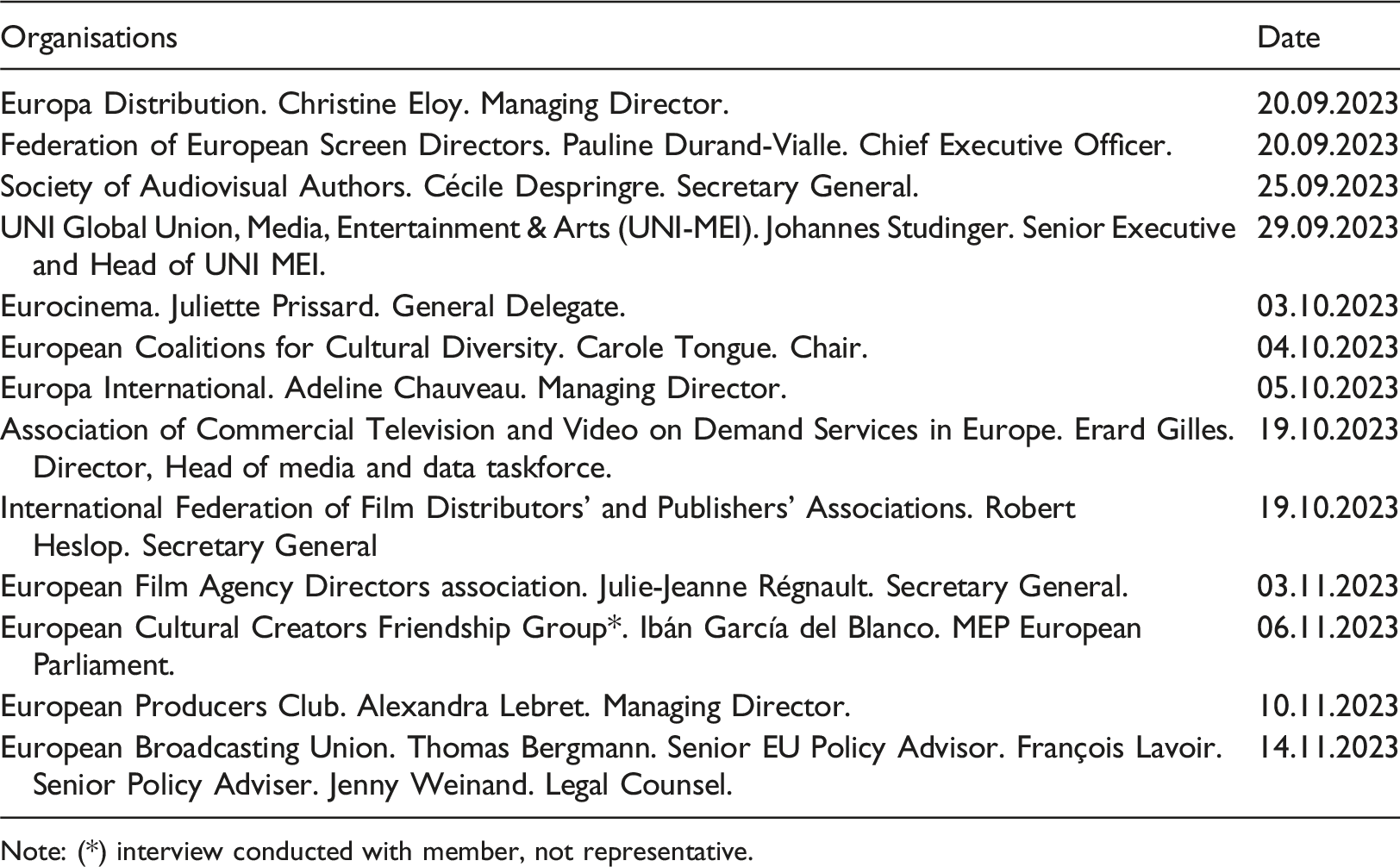
| Organisations | Date |
|---|---|
| Europa Distribution. Christine Eloy. Managing Director. | 20.09.2023 |
| Federation of European Screen Directors. Pauline Durand-Vialle. Chief Executive Officer. | 20.09.2023 |
| Society of Audiovisual Authors. Cécile Despringre. Secretary General. | 25.09.2023 |
| UNI Global Union, Media, Entertainment & Arts (UNI-MEI). Johannes Studinger. Senior Executive and Head of UNI MEI. | 29.09.2023 |
| Eurocinema. Juliette Prissard. General Delegate. | 03.10.2023 |
| European Coalitions for Cultural Diversity. Carole Tongue. Chair. | 04.10.2023 |
| Europa International. Adeline Chauveau. Managing Director. | 05.10.2023 |
| Association of Commercial Television and Video on Demand Services in Europe. Erard Gilles. Director, Head of media and data taskforce. | 19.10.2023 |
| International Federation of Film Distributors’ and Publishers’ Associations. Robert Heslop. Secretary General | 19.10.2023 |
| European Film Agency Directors association. Julie-Jeanne Régnault. Secretary General. | 03.11.2023 |
| European Cultural Creators Friendship Group*. Ibán García del Blanco. MEP European Parliament. | 06.11.2023 |
| European Producers Club. Alexandra Lebret. Managing Director. | 10.11.2023 |
| European Broadcasting Union. Thomas Bergmann. Senior EU Policy Advisor. François Lavoir. Senior Policy Adviser. Jenny Weinand. Legal Counsel. | 14.11.2023 |
Note: (*) interview conducted with member, not representative.