







Abstract
This study focuses on the Chinese micro-drama industry, conceptualizing its cultural production as a new form of traffic game – the conversion game. Distinct from the subscription and visibility games, the conversion game operates on a production logic aimed at short-term commercial monetization. Based on methods including production ethnography and in-depth interviews, this study finds that the conversion game is a closed-loop system centered on conversion rates: creatively, it employs data-driven recombination of motifs; narratively, it engineers emotional conversion through gratification points and paywalled cliffhangers; operationally, it relies on a horse-racing mechanism for high-speed mass production; and ultimately, its outcome is determined by a distribution game where ‘distribution is king’. This study challenges the ‘control-resistance’ binary, revealing how the state, platforms, and creators, in their shared pursuit of traffic, form a coupled structure that is functionally interdependent yet marked by a power imbalance. This paper theorizes the conversion game as an extreme form of platform capitalism. By systematically uncovering its operational mechanisms and power dynamics, it offers a new perspective for a critical understanding of the evolutionary trends in the global digital cultural industries.
Introduction
In the contemporary digital entertainment landscape, a new form of audio-visual content has emerged at an astonishing pace. Consider a common trope: a deposed princess is reborn and returns, with dramatic conflicts such as slapping scenes and betrayals unfolding in rapid succession within a mere minute. Just as the audience anticipates the protagonist’s comeback, a link appears on the screen: ‘Unlock the rest of this episode by making a payment’. This model, combining highly condensed narratives with an immediate pay-to-view mechanism, is a quintessential feature of China’s micro-dramas. These vertical-screen productions feature extremely short single episodes, revolve around high-stimulus motifs like ‘rebirth’ and ‘the overbearing CEO’, and have a core commercial logic centered on the rapid conversion of user attention into quantifiable economic returns.
The scale and influence of micro-dramas are substantial. As of June 2025, the user base of Chinese micro-dramas reached 696 million, and the annual market size is projected to reach 63.43 billion RMB (China Netcasting Services Association, 2025a). Simultaneously, its influence is rapidly expanding across national borders, with works like Never Divorce a Secret Billionaire Heiress sparking widespread discussion in Western markets. Micro-dramas represent not only an innovation in content but also a compelling case study that forces us to re-examine the mechanisms of cultural production and power relations in the platform era.
The concept of the ‘game’ is crucial for understanding cultural production in the platform era, explaining how actors interact with technological systems under rule constraints to achieve specific goals (Sax and Wang, 2025; Ziewitz, 2019). Academia has predominantly focused on two prevailing paradigms. The first is the subscription game, typified by streaming platforms, where the core objective is to maximize the long-term retention value of users by producing high-quality content and personalized recommendations, with retention rates as the key performance indicator (Gomez-Uribe and Hunt, 2016). In China, this game manifests as a top-down hierarchical structure involving the state, platforms, and creators. The second is the visibility game, represented by social media influencers, where the goal is to maximize engagement metrics such as likes, comments, and shares to accumulate visibility as a core form of capital (Cotter, 2018). In the Chinese context, this power dynamic is embodied in a multi-layered agency-regulatory structure, where platforms and multi-channel networks (MCNs) act as dual agents for both state and commercial interests, collectively disciplining creators.
However, neither of these frameworks can fully capture the underlying logic driving the development of micro-dramas. This emerging form, described by The Economist (2024) as ‘a cross between TikTok and Netflix’, has given rise to a more extreme traffic game. It pursues neither the long-term user value cultivated in the subscription game nor the social capital for accumulating personal influence found in the visibility game. Instead, its sole objective is to convert traffic into immediate, quantifiable economic benefits, with its success measured by core metrics such as payment rates, ad click-through rates, and merchandise conversion rates. This paper conceptualizes this set of practices as the conversion game. This raises a critical question: how does this game, oriented towards immediate conversion, influence the rules of audio-visual production and reconfigure a new type of power structure?
Traffic games in a platformized context: From subscription and visibility to conversion
The rise of micro-dramas occurs against the backdrop of the profound platformization of the cultural industries. As new cultural intermediaries, platforms fundamentally reshape the power dynamics of cultural production by constructing multi-sided markets and establishing rules of interaction (Van Dijck et al., 2018: 40). This has led creators into a state of widespread platform dependency, where their work must constantly adapt to the ever-evolving technologies, policies, algorithms, and business models of the platforms.
The subscription game and the visibility game
Academia has widely conceptualized this strategic interaction over traffic as a ‘game’, wherein actors seek to maximize their own interests within rule-based constraints (Petre et al., 2019; Ziewitz, 2019). In contemporary digital content production, this traffic game primarily manifests in two dominant modes: the subscription and the visibility games. Although their mechanisms differ, at the level of power relations, both can be summarized as a structure of tension centered on ‘control-resistance’. The core objectives of the state, platforms, and creators are fundamentally different, leading to continuous contestation and confrontation.
The core rule of the subscription game is to maximize long-term user retention and paid subscriptions by producing high-quality content and personalized recommendations (Pajkovic, 2021). In China, major video platforms exemplified by iQiyi commonly adopt a hybrid business model centered on subscriptions. This model employs a dual-engine approach combining advertising and subscription, ecosystem integration, and data-driven strategies to maximize the commercial value of user attention (Zhang, 2022; Zhao, 2021). Under this model, power relations manifest as a top-down hierarchical structure. The state, through the National Radio and Television Administration (NRTA), implements strict pre-approval and licensing systems to maintain absolute political control (Wang and Lobato, 2019). Platforms, acting as both extensions of the state’s censorship will and market-oriented gatekeepers, leverage their monopoly on channels and data to shift censorship pressures and market risks to upstream production companies through models like revenue sharing series.
In the visibility game, power relations evolve into a more complex, multi-layered agency-regulatory structure. The core rule of this game is that creators (influencers) engage in continuous strategic labor in exchange for visibility, which serves as their core capital. The outcome of this labor is reflected in a series of engagement metrics such as likes and comments (O'Meara, 2019). In China, due to the low barrier to entry for content production and the dispersed nature of creators, the state adopts a governance strategy combining bottom-line supervision with post-hoc punishment. The state not only intervenes in platform algorithms and guides ‘positive energy’ content through legislation from various departments, including the Cyberspace Administration of China (CAC), but also transforms MCN agencies into key nodes of state governance through regulation. Platforms and MCNs, acting as dual agents for both state imperatives and commercial interests, constrain practitioners using ‘algorithmic black boxes’, the discourse of platform paternalism (Petre et al., 2019), and complex brokerage contracts. Simultaneously, the state retains the power to intervene directly, bypassing platforms, which leaves individual creators directly exposed to multiple layers of regulation, where their personal speech and even their fan communities can become targets of control.
Chinese micro-dramas and the conversion game
As a new form of digital entertainment, micro-dramas are officially defined by China’s NRTA as having a single episode length from tens of seconds to about 15 minutes, a relatively clear theme and main storyline, and a fairly continuous and complete plot (China National Radio and Television Administration, 2022). Typologically, micro-dramas can be divided into horizontal-screen dramas (primarily broadcast on long-form video platforms) and vertical-screen dramas (disseminated on short-video platforms, mini-programs, and standalone apps). This study focuses on vertical-screen micro-dramas for two primary reasons. First, in terms of market share, vertical-screen micro-dramas hold an overwhelmingly dominant position, accounting for over 90% of the market. In 2024, 2657 horizontal-screen micro-dramas were launched, compared to 36,400 vertical-screen micro-dramas (NRTA Think Tank, 2025). Second, compared to horizontal-screen dramas, which still carry the inertia of traditional production, vertical-screen micro-dramas better represent innovation in production models within the screen industry amid the digital transformation.
To understand the core driving force behind this emerging industry, it is essential to introduce the analytical framework of the conversion game. This game is not an internal evolution of the traditional screen industry but a cross-industry transplant from the field of performance marketing. Its developmental trajectory begins with performance marketing’s ultimate pursuit of the conversion rate – the measure and optimization of the efficiency with which users complete a specific action, such as a click or purchase (Gudigantala et al., 2016; McDowell et al., 2016). This logic was subsequently adopted by the online literature industry, giving rise to a freemium business model centered on free reading and paywalls (Zhao, 2016). Amid fierce traffic competition, the online literature industry developed a highly efficient traffic acquisition tool: in-feed story ads. These ads adapt the climactic plots of novels into hook videos, with the sole purpose of driving users to complete the ‘click-redirect-pay’ conversion loop within seconds.
Ultimately, the hook videos originating from novel advertisements evolved into standalone entertainment products – micro-dramas – and gave rise to the conversion game, which is oriented towards short-term monetization. This extreme pursuit of immediate returns is realized primarily through two business models. The first is the In-App Purchase (IAP) model, which radicalizes the paywall mechanism of online literature. It acquires users through ad spending, sets up a paywall around the 4th to 15th episode, and uses the return on investment (ROI) from ad spending as the sole criterion for a project’s survival. The second model is In-App Advertising (IAA). This model attracts a massive user base with free content and then efficiently converts their attention into advertising views or e-commerce revenue; its core metrics focus on ad impressions, click-through rates, and purchase conversion rates. The success of this model has even led to the creation of branded micro-dramas.
Whether through direct payment (IAP) or ad monetization (IAA), the core principle is to use content as bait to achieve a high-efficiency conversion of user traffic into short-term economic returns. This is the essence of the conversion game. Although it originates from the freemium model, its strategic focus has undergone a fundamental shift, abandoning the patience required to cultivate long-term user value. Therefore, the concept of the conversion game proposed in this study is not intended to describe a specific business model but to theorize an underlying logic of traffic production.
Methodology
Research design and data collection
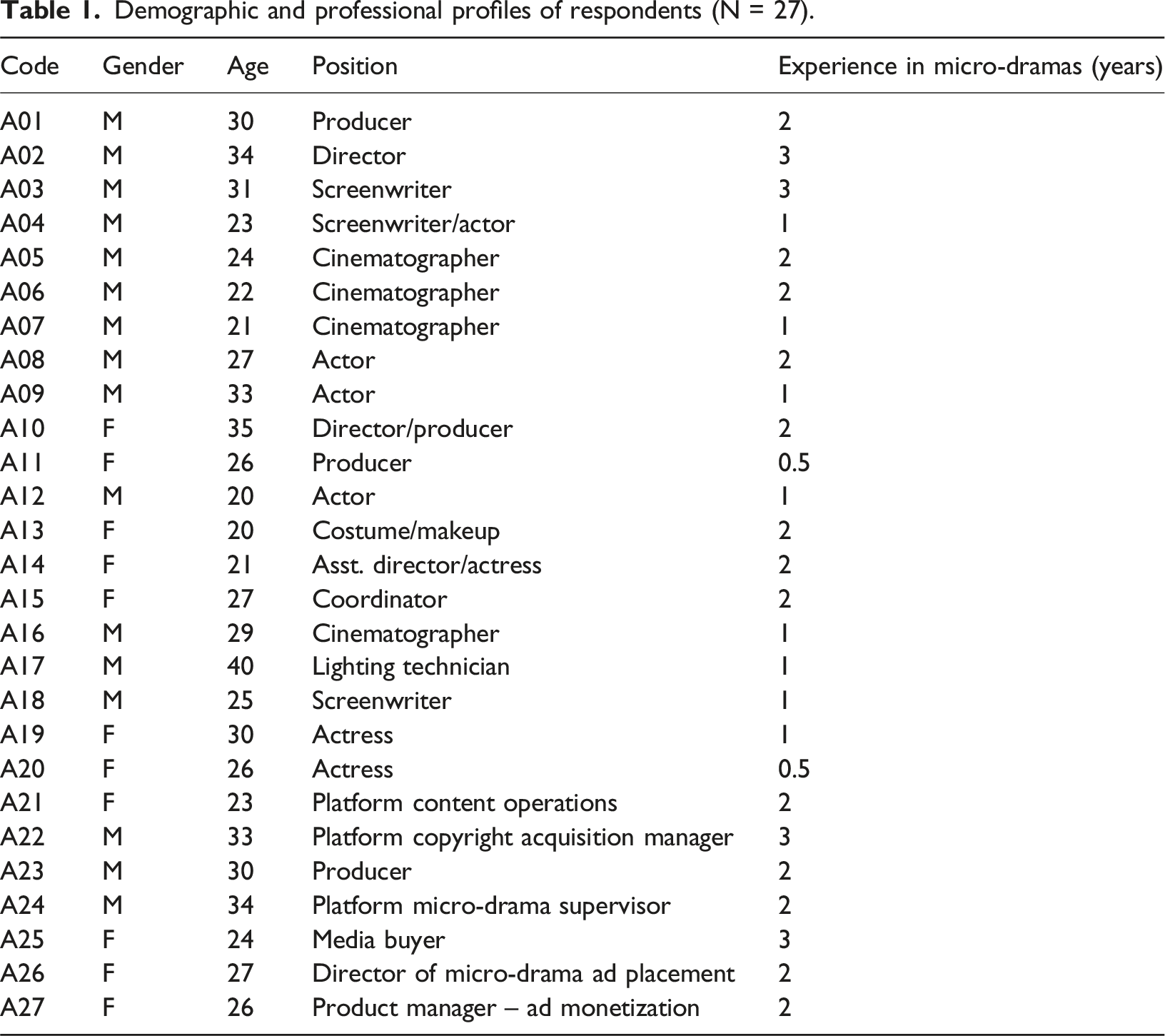
Demographic and professional profiles of respondents (N = 27).
Case selection
Comparison of case study fundamentals.
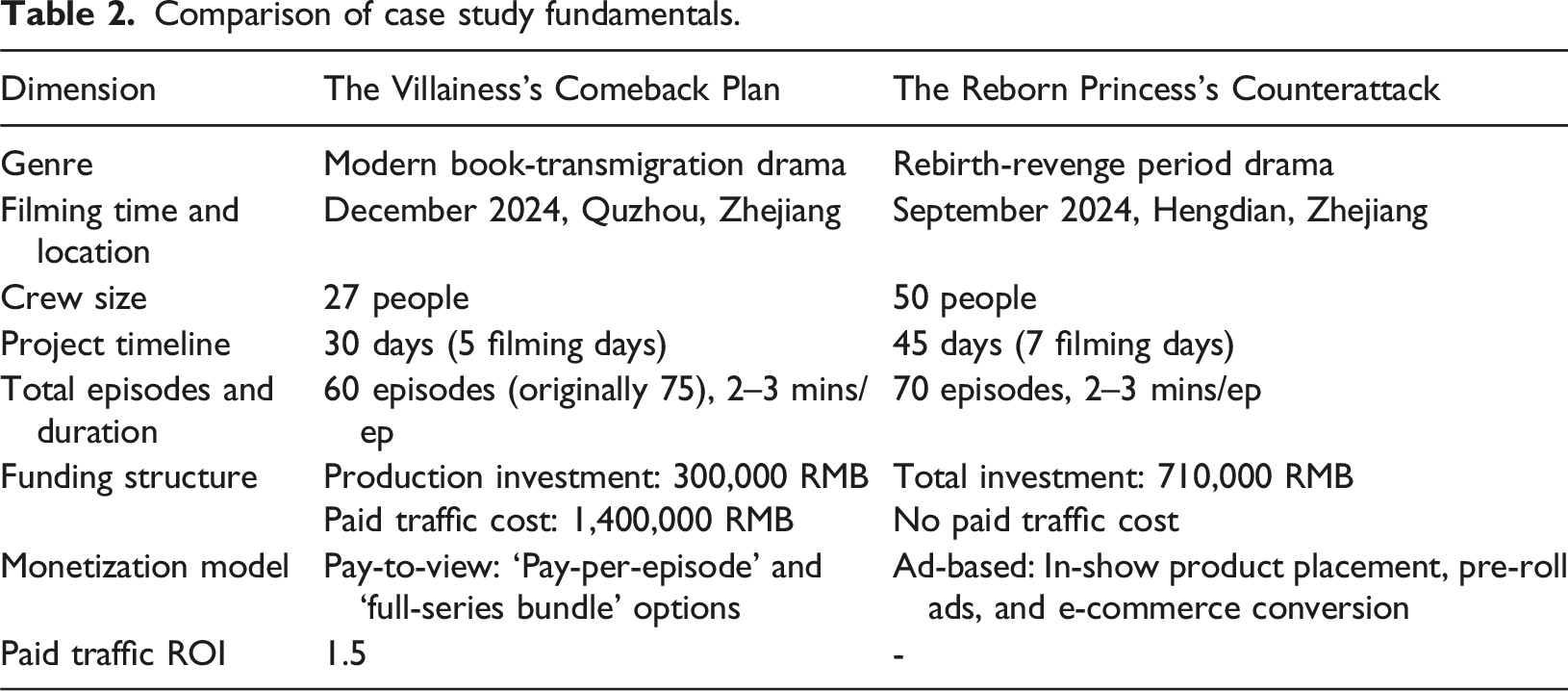
Case one, representing the IAP model, is The Villainess’s Comeback Plan. The drama was filmed in Quzhou, Zhejiang, in December 2024 with a lean production team and a production budget of 300,000 RMB. The drama was released before the Spring Festival and, due to its comedic elements, ultimately generated 2.1 million RMB in gross revenue from user payments. This was driven by a substantial paid traffic cost of 1.4 million RMB. After deducting the paid traffic expenses, the gross profit was 700,000 RMB. However, this profit was subject to further deductions: the platform charged approximately 8% of the total gross for channel and payment processing fees, amounting to 168,000 RMB. Consequently, the net profit available for distribution was only 532,000 RMB. After subtracting the initial production cost of 300,000 RMB, the final net profit was 232,000 RMB.
Case two, representing the IAA model, is The Reborn Princess’s Counterattack. This drama was filmed over 7 days in Hengdian, Zhejiang, in September 2024, with a team of nearly 50 people and a total production budget of 710,000 RMB. During the project’s pre-production phase, the production team secured an exclusive partnership agreement with the H Short-drama platform (pseudonym). The core of this collaboration was a ‘minimum guarantee + ad revenue sharing’ model. H platform provided a minimum guarantee of 600,000 RMB, covering over 84% of the production costs and significantly mitigating the production company’s financial pressure and market risk. In exchange, the production company granted H platform exclusive online broadcasting rights. Owing to its debut on the H platform, its paid traffic cost was zero. This unique financial structure allowed the team to allocate more of its budget to content production itself. According to the agreement, after deducting the platform’s technical service fees and the platform’s recoupment of the 600,000 RMB guarantee from the advertising revenue, the remaining profit was split between the production company and the platform at a 3:7 ratio. Ultimately, the production company’s net profit was approximately 134,000 RMB.
Ethical considerations
This study strictly adhered to academic ethical standards. All participants were informed of the research purpose, methods, and their rights before the interviews. To protect their privacy, the research data have been de-identified to ensure confidentiality and anonymity.
The operational mechanisms of the conversion game
In traditional cultural production, commercial monetization is typically a downstream stage that follows content completion. In the conversion game, however, the commercial goal of immediate conversion is repositioned upstream to become the overriding principle and organizational tenet that governs everything.
Motif recombination: Data directives as the creative source
Unlike the subscription-based streaming model, which emphasizes originality and cultural value, the conversion game implants an inverted, data-driven logic from the very inception of production: motif recombination. Creative work no longer stems from artistic inspiration or social insight; instead, it involves systematically mining and recombining market-validated tropes by analyzing web novel rankings and competitors’ advertising data. This logic was evident in both of our case studies. The script for The Reborn Princess’s Counterattack, along with its period and revenge theme, derived from the production team’s analysis of prevailing micro-drama trends. Data indicated that in the first half of 2025, revenge, period, and CEO were the top three trending motifs (DataEye, 2025a). Similarly, The Villainess’s Comeback Plan was a direct imitation based on the concept of ‘Chuanshu’ (transmigration into a novel, a setting where the protagonist travels into a book to become a specific character), which was going viral at the time.
These motifs are viewed as predictable codes for traffic generation. Their emotional cores, character archetypes, and plot paradigms are meticulously deconstructed into conversion elements that can be flexibly deployed. This deconstruction and recombination of existing elements form a logic akin to formulaic programming (Cawelti, 1976: 8–12). The conversion game pushes this generic industrial logic to a more extreme dimension of commercial pragmatism. Creators no longer create based on artistic vision but arrange and combine successful elements based on real-time ROI. As one screenwriter (A03) stated: ‘We don’t write stories; we write data. Whichever genre has a high ROI, that’s what we write’. This logic is ultimately institutionalized through the paywall structure outline. Before a project is greenlit, script evaluation standards are reduced to purely convertible metrics. The outline must precisely mark the distribution of gratification points and paywalled cliffhangers for each episode. This document effectively functions as the production bible (Keane et al., 2007: 59–78) of the micro-drama industry, serving as the decisive basis for investment.
This mechanism is rooted in a production philosophy of risk aversion and immediate gratification. Faced with immense output pressure and market competition, relying on formulaic motifs becomes an economic necessity to ensure a baseline conversion rate. This causes the value orientation of micro-drama production to run counter to the traditional film industry’s ideal of innovation, prioritizing repetition and replication instead. Under this logic, micro-dramas push the ‘content recycling’ mode (Stelmach et al., 2022) long relied upon by Hollywood to a more data-driven and formulaic extreme.
Emotional conversion: The narrative design of gratification points and paywalled cliffhangers
The dissemination characteristics of micro-dramas dictate that their content must rapidly seize user attention within seconds amidst social media feeds, driving a behavioral conversion from scrolling to clicking. The objective is no longer to tell a complete story but to precisely manipulate emotions, efficiently transforming the audience from passive information receivers into active consumers. This is achieved by first igniting interest with gratification points and then precipitating conversions through paywalled cliffhangers.
The narrative of immediate gratification is the core technique responsible for user acquisition and retention within this mechanism. This narrative paradigm derives from the mature Chinese web novel industry. Today, this production mechanism of gratification – characterized by classic tropes such as humiliation before triumph, golden finger (a term for an overpowered ability), and counterattack – is being reshaped into narrative logic through parametric transplantation. To some extent, it suspends criteria emphasized by classical narrative theory, such as clear causality and reasonable motivation (Thompson, 1999: 10–14). Instead, it pursues extreme immediate attraction, allowing the audience to experience intense emotional shocks of revenge, success, or superiority in the shortest possible time. Data shows that plot twists (46%), foreshadowing (44%), immersion (34%), and conflict (33%) are the explicit plot preferences of users (DataEye, 2025b).
Complementing the narrative of immediate gratification and ultimately closing the commercial loop is paywall logic. This design also stems from the payment models of web novels; its essence lies in precisely pinpointing the peak of audience emotion to erect a paywall. In the first 10 free episodes of The Villainess’s Comeback Plan, the script densely lays out humiliating plot points, such as the protagonist being framed by her stepmother and abandoned by her fiancé, to accumulate audience anger. However, in Episode 11, at the exact moment the protagonist prepares to fight back and raises her hand to slap the antagonist at a banquet, the episode ends abruptly. As Jason Mittell (2015: 17–54) points out, the structure of commercial television is constrained by strict screen time, compelling screenwriters to ‘squeeze’ serialized stories into frameworks cut by act breaks to accommodate commercial breaks. Effective television narrative exploits this structural limitation by creating ritualistic cliffhangers to bridge the temporal gaps caused by advertisements, thereby sustaining audience reaction and anticipation. The conversion game deeply binds this classic narrative technique with the immediate payment capabilities of the mobile internet. The paywalled cliffhangers in micro-dramas deliberately manufacture narrative interruption and anxiety with the sole purpose of inducing users to complete a direct financial payment within seconds. The commercial effectiveness of this design is significant; reports indicate that approximately 31.9% of micro-drama users have paid to unlock subsequent episodes (China Netcasting Services Association, 2024).
This precise calculation regarding gratification points and paywalled cliffhangers evolved into a more complex strategy in The Reborn Princess’s Counterattack, which operated under the IAA model. Unlike the IAP model, which drives immediate payment by building intense suspenseful tension, the core demand of the IAA model is to maximize the user’s completion rate and dwell time. Therefore, The Reborn Princess’s Counterattack deliberately added emotional dimensions such as ‘warmth’ and ‘touching moments’. At the end of episodes without advertisements, micro-suspense was set to ensure users instinctively swiped to the next episode; meanwhile, before ad insertion points, the narrative pushed towards a minor climax of emotion or conflict to retain the user during the advertising disruption.
The horse-racing mechanism: Rushed schedules and hollowed-out production
Faced with market uncertainty, the cultural industry typically follows the repertoire model (Garnham, 1990: 122), constructing a vast product library to spread risks and relying on a few hits to cover overall costs. However, unlike Hollywood’s resource-concentration strategy centered on high-budget blockbusters, micro-dramas have opted for a low-budget, high-volume trajectory. This production logic, which abandons risk avoidance through resource concentration in favor of playing the probabilities, has ultimately spawned a horse-racing mechanism. It entails mass-producing content at extreme efficiency and subsequently identifying potential hits through paid traffic acquisition. Should a drama underperform in data metrics, it faces the imminent risk of outright elimination.
The immense output volume is the most direct manifestation of the horse-racing mechanism; in 2024 alone, the total number of micro-dramas launched on mini-programs and apps exceeded 35,000 (China Netcasting Services Association, 2025b). Under the crushing weight of the horse-racing mechanism, the production process has been reshaped into two core strategies: rushing the schedule and hollowing out the content. First, rushing the schedule implies the industrial limit of production efficiency. In our fieldwork, the shooting cycle for The Villainess’s Comeback Plan was compressed to 5 days, and The Reborn Princess’s Counterattack to only 7 days, with the crew’s daily working hours generally exceeding 16 hours. This extreme squeezing of labor time renders the conflict between efficiency and content quality irreconcilable, with the former always taking precedence. For instance, during the filming of The Reborn Princess’s Counterattack, a coordination error caused the schedule to lag. To strictly control the shooting cycle, the team did not choose to extend the filming time; instead, the director cut script content directly on set. The director (A02) helplessly stated, ‘I had just finished rewriting a scene, and they immediately started filming it over there. I was terrified I made a mistake in the rewrite… Everyone had almost no time to deeply understand the script’.
Secondly, accompanying the rushed schedule is the production strategy of hollowing-out. Practitioners revealed that all resources are designed around the paywalled cliffhangers; the best equipment and performances are dedicated to content preceding the paywalled cliffhangers (A10). Once the key conversion node is crossed, production rapidly shifts to minimalist fixed cameras and shot-reverse-shot setups (A06). This strategy is reflected most profoundly in the acting arts, which can be viewed as a form of ‘degradation’ as described by Braverman (1974: 29). Actor A08 recalled: ‘The director said, You don’t need to worry about it, just stare. Staring, opening your mouth – these are all prescribed… What is being acted is not a character, but segments of emotion’.
Distribution is king: The data-driven distribution game
‘If content is king, then distribution is King Kong’ (Cunningham and Silver, 2013: 4). In the conversion game of micro-drama, this assertion is pushed to the extreme. The distribution mechanism has transformed from an auxiliary channel for content into the sole arbiter determining a work’s fate, with its importance thoroughly overwhelming content creation itself. The success or failure of a drama no longer depends on word-of-mouth or traditional promotion but is determined by data-driven traffic speculation.
The IAP model is the most financialized manifestation of the ‘distribution is king’ rule, completely transforming micro-drama promotion into a financial game centered on traffic buying. Under this model, paid traffic is the sole pathway to reach users (A26). This model leads to a fundamental inversion of the cost structure, where 80% to 90% of the budget is allocated to buying traffic, while production costs are compressed to the extreme. Taking The Villainess’s Comeback Plan as an example, its traffic costs reached 1.4 million RMB, nearly five times its production cost of 300,000 RMB. Media buyers continuously optimize placement strategies based on real-time data such as cost-per-click and click-through rate. In fact, this game follows a brutal 80/20 rule, where approximately 80% of projects operate at a loss, and only a minority of top-tier projects achieve profitability (21st Century Business Herald, 2024). Although The Villainess’s Comeback Plan successfully achieved a gross revenue of 2.1 million RMB, after layers of platform deductions, the net profit received by the production company was merely 232,000 RMB.
The IAA model embodies another form of distribution hegemony: deep dependence on platform algorithms. In this model, the key to success lies in producing algorithm-friendly content to leverage the platform’s massive organic traffic. Platforms here act as private governors (Srivastava, 2019), using data-ranking tools like trending lists to translate their opaque algorithmic preferences into clear, quantifiable metrics that creators must chase. The profitability of The Reborn Princess’s Counterattack exemplifies this operational logic. The drama debuted on the H Platform, allowing it to seamlessly tap into the vast internal traffic ecosystem of its parent tech giant. However, this also meant that The Reborn Princess’s Counterattack had lower creative freedom; it had to strictly adhere to the platform’s algorithmic preferences, such as specific pacing and a specific density of gratification points, to ensure it remained on the charts.
The political economy of the conversion game
The conversion game is not merely a production mechanism centered on immediate monetization; it constructs a highly unequal yet functionally interdependent coupled structure of power involving the state, platforms, and creators. The state’s macro-development needs, the platform’s logic of capital accumulation, and the creators’ individual survival strategies are tightly coupled by a set of seemingly neutral technical and economic rules centered on traffic conversion. In pursuing their own interests, all parties unconsciously reproduce and reinforce these rules, causing power relations not to manifest as open confrontation but to be diffused within the rules defined by the platform.
The state as a meta-player: Selective Co-optation and a dual-track market
In China’s unique industrial ecosystem, the state is not only a regulator but also a meta-player in the conversion game. Its governance strategy initially manifests as a combination of boundary-setting and active utilization. On one hand, it demarcates ideological red lines through special rectification campaigns to crack down on pornographic, vulgar, and wealth-worshipping content; on the other, it promotes the ‘Micro-drama +’ strategy (e.g., the Travel with Micro-dramas initiative) to guide the industry’s powerful traffic conversion capability to empower the real economy, such as cultural tourism and consumption. However, with the explosive growth of the industry, this campaign-style, reactive governance model has become unsustainable.
The classified and tiered review system.
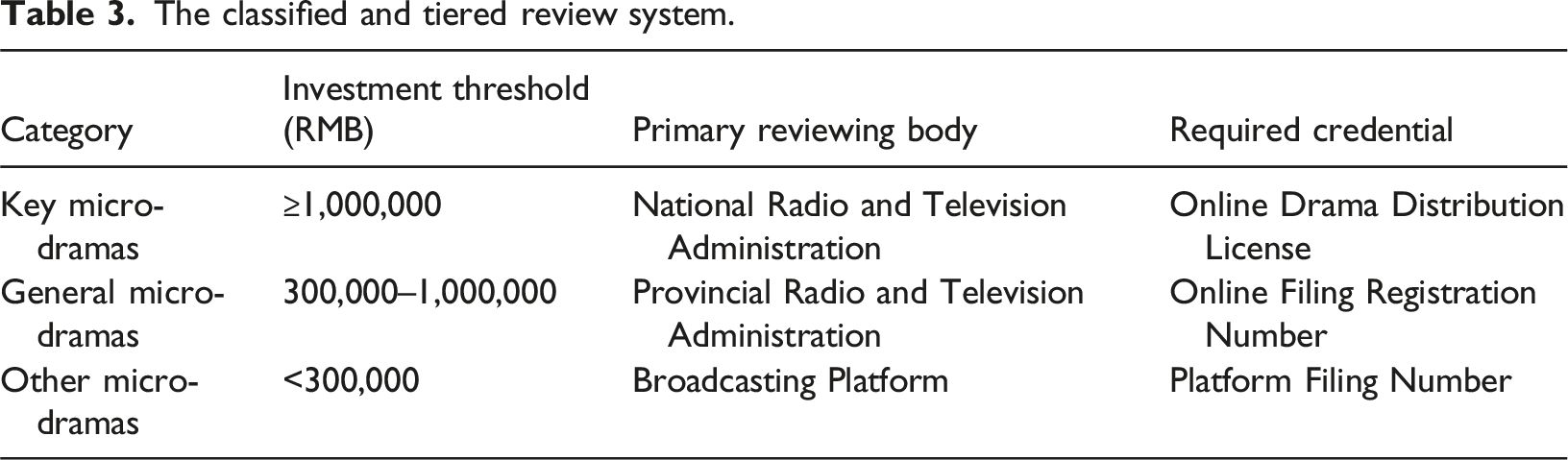
This institutional design has created and solidified a dual-track market. One track is the high-quality development lane, directly supervised by the state. By controlling the premium productions with investments over 300,000 RMB, the state can guide mainstream values and advance its cultural export strategy. This selective co-optation allows the state to efficiently steer the industry’s direction and public agenda at a very low administrative cost. The other track is the market-oriented lane, where regulatory responsibility is delegated to platforms. This move largely preserves the flexibility and commercial vitality of the market’s lower tier, allowing the vast majority of small- and medium-budget producers to continue playing the high-risk, high-return conversion game under platform rules.
Under these rules, The Reborn Princess’s Counterattack, with an investment of 710,000 RMB, was classified into the general micro-drama regulatory bracket. This meant it had to undergo review by the provincial radio and television bureau and obtain a planning filing number (a mandatory pre-approval registration code). To ensure approval, we observed in the field that the producer (A23) repeatedly requested the toning down of overly bloody revenge scenes. In contrast, The Villainess’s Comeback Plan, with an investment of 300,000 RMB, fell into the ‘other micro-dramas’ category, requiring only the broadcasting platform’s internal review to obtain a filing number. Situated in the ‘lower-track’ market with relatively loose regulation, this series managed to retain more high-stimulation but gray-area tropes such as face-slapping and clothes-ripping. Ultimately, this combination of selective co-optation and a dual-track system achieves a highly cost-effective new governance model: it ensures ideological security and strategic implementation while maintaining the market’s commercial dynamism and economic scale by outsourcing grassroots-level regulation to platforms, thus avoiding the depletion of administrative resources.
The Platform’s systematic exploitation: The empowerment illusion and gig sets
Unlike the gatekeeper role of streaming platforms or the paternalistic management of social media, the power of micro-drama platforms operates more covertly. It constructs a seemingly open and fair empowerment illusion to attract a massive influx of creators, ultimately integrating them into a structure of systematic exploitation.
This illusion is first manifested in the democratization of access. To some extent, micro-dramas dismantle the traditional film and television industry’s reliance on capital and connections, offering grassroots creators from diverse backgrounds a chance to directly engage with the market. This feature is particularly evident in the two cases of this study. The core creative teams included not only non-professional acting enthusiasts but also web novelists attempting to transition, and even part-time university students. These marginalized groups, who struggled to gain a voice under the traditional film system, were captured by the platform’s promise of low barriers and high returns. They rapidly filled the immense gap in content production capacity in an atomized form, willing to exchange high-intensity labor for an entry ticket without basic security guarantees. This leads to the second illusion – the ‘fair’ competition of ‘survival of the fittest’. Platforms publicize key data like revenue rankings and popularity scores. They institutionalize ‘micro-drama top lists’, fostering a professional ideology where traffic determines professional worth, and data metrics replace the vague seniority-based evaluations of traditional industries. As screenwriter A03 puts it, ‘Now, whoever can write a blockbuster is the master’.
However, the true function of this system, which seemingly grants creators autonomy, is to serve capital accumulation while completely externalizing market risks. Its exploitation mechanism is therefore more concealed; it is not the passive algorithmic dependency of short-video influencers, but an active, organized industrial embedding. Platforms typically hide behind intermediaries like film companies to indirectly guide production, while creators are integrated into fluid gig sets – temporary teams assembled for a project and dissolved immediately after shooting (Tian, 2024). The crew of The Reborn Princess’s Counterattack is a typical example. Although it was a medium-sized team of 50 people, its organizational structure was extremely fragile. After the 7-day shooting period ended, the entire team dissolved immediately, and the vast majority of practitioners did not even receive screen credit for the work. Therefore, platform control is no longer manifested as direct discipline of individuals by algorithms, but as an indirect, structural shaping of the entire production organization through the metric of conversion rate.
The final result is a widespread predicament for workers. According to an industry report (51job and DataEye, 2025), in economic terms, as many as 39% of practitioners reported that their ‘income is decent but profits are slim’, while another 22% faced ‘income failing to cover expenses’. In terms of professional identity, because multi-dimensional values such as artistic and social merit are systematically suspended by a singular commercial goal, practitioners commonly view their work as ‘financial products’ or ‘fast-food culture’, leading to a strong sense of professional alienation. 41% of respondents planned to change jobs within a year, with problems like plagiarism (50%) and poor benefits (41%) being prevalent, and 21% even experienced professional stigma.
Creators’ survival strategies: The paradoxical traffic mētis
Facing the dual disciplinary pressures of the state and platforms, creators at the bottom of the power structure are not entirely passive. They have developed a unique practical wisdom, which we conceptualize as ‘traffic mētis’. This concept is derived from the ancient Greek ‘mētis’, which refers to ‘a wide array of practical skills and acquired intelligence in responding to a constantly changing natural and human environment’ (Scott, 1998: 313). Scholars have already adopted it to analyze user-algorithm interactions (e.g., algorithmic mētis; Zeng and Zhang, 2025). Drawing on this concept, we use traffic mētis to refer to the comprehensive set of traffic conversion tactics developed by creators to cope with opaque algorithms, capricious rules, and a high-pressure production environment.
First, to balance the dual demands of commercial traffic and content security, creators have developed the technique of keyword splicing. They skillfully stitch together market-validated blockbuster elements such as ‘rebirth’ and ‘flash marriage’ with policy-encouraged ‘positive energy’ labels like ‘female independence’ and ‘workplace struggle’ to strike a dynamic balance between commercial conversion and content safety. Second, on the traffic distribution front, their strategies manifest as a dual path of personal brand building and community collaboration. On one hand, creators leverage the flexibility of the micro-drama set, using live-streams, vlogs, and other formats to open up the filming process to the public, actively converting drama traffic into personal influence. During the filming intervals of The Villainess’s Comeback Plan, we observed the lead actress frequently using her personal Douyin account to live-stream from the set. They view micro-dramas as a key platform for building their personal brand, enhancing their bargaining power by accumulating fan loyalty across multiple channels. On the other hand, facing the uncertainty of platform rules, an information-sharing culture has formed within the practitioner community. Through WeChat groups and offline discussions, they exchange ‘cheat codes’ for navigating the system, such as genre trends, changes in censorship standards, and the placement of paywalled cliffhangers. This collective wisdom, to some extent, compensates for the information asymmetry individual creators face against platforms.
However, the paradox of traffic mētis lies in the fact that creator agency constitutes the very core mechanism for the refinement of the platform’s power. Through their panoptic monitoring systems, platforms rapidly capture, analyze, and datafy all the traffic mētis produced by creators in practice, whether it be market-validated keyword splicing or blockbuster genres discovered through information sharing. Subsequently, the platform abstracts and codifies these ‘tactics’ derived from individual survival wisdom into universal rules or tools. For example, upon identifying the personal brand building strategy, a platform might update its algorithm to restrict it, co-opt these accounts, or launch official accounts, thereby squeezing the monetization channels for practitioners. The result of this cycle is that creators’ spontaneous explorations are systematically co-opted, becoming free research and development for the platform to optimize its control systems and commercial products. Individual breakthroughs end up perfecting the rules rather than challenging them.
Conclusion and discussion
This study proposes the analytical framework of the conversion game and, through it, reveals that micro-dramas are not only an innovation in audio-visual formats but also a symptom and microcosm of the evolution of platform capitalism. It demonstrates how, when the value of cultural products is thoroughly reduced to immediate, quantifiable commercial conversion efficiency, a more extreme logic of capital fundamentally reshapes the processes, values, and power relations of cultural production. The core contributions and findings of this study can be summarized in the following three points.
First, this study defines the conversion game as another paradigm of cultural production in the platform era, following the subscription game and the visibility game. As Srnicek (2017: 40) argues, the core of platform capitalism is the extraction and utilization of data as the new oil. The conversion game compresses the process of data extraction and value realization to its logical extreme. It neither pursues the long-term accumulation of cultural assets nor settles for the indirect monetization of visibility; its goal is to simultaneously capture traffic and harvest value in an instant. This game places the conversion rate at its absolute center and systematically suspends the intrinsic value of content through the datafied creativity of motif recombination, the narrative design of emotional conversion, the accelerated production of the horse-racing mechanism, and the algorithmic hegemony where ‘distribution is king’.
Second, the power analysis in this study moves beyond the ‘data-driven’ versus ‘creative freedom’ binary (Navar-Gill, 2020) and existing perspectives characterized as authoritarian determinism (Guan, 2019). The research finds that the conversion game has fostered a coupled structure comprising the state, platforms, and creators. Within this structure, the shared pursuit of traffic binds the three parties’ originally conflicting objectives together as never before, forming a symbiotic entity that is imbalanced in power yet aligned in interest. The state acts as a meta-player, and its strategy transcends the contradiction where it discredits the logic of traffic in rhetoric but utilizes it in practice (Chen et al., 2023). On one hand, it actively utilizes traffic to disseminate mainstream values, stimulate the economy, and even promote cultural exports. On the other hand, it implements efficient governance through selective co-optation and a dual-track market, ensuring both ideological security and a controlled space for the commercial vitality of the conversion game. The platforms externalize risks by constructing an empowerment illusion and gig sets, and they consolidate their market position and the legitimacy to discipline creators by assuming the role of censorship agents. Meanwhile, creators at the bottom become active participants in this system through their survival strategy of traffic mētis. The paradox of this participation is that the more adept they become at catering to the system to survive, the more they reinforce the legitimacy of the game’s rules, ultimately locking themselves deeper into this structure. This coupled structure heralds a more sophisticated model of digital governance, where power operates not just through suppression and confrontation but by establishing a win-win game in which all parties voluntarily participate in the pursuit of traffic to realize their interests.
Finally, using the case of the conversion game, this study offers a critical reflection on the fundamental question of what constitutes valuable content in the platform era. As Horkheimer and Adorno (2002: 125–131) warned, the primary value of mass-produced cultural products under capitalism is exchange value, not artistic or critical value, and their quality is determined by their marketability. The conversion game marks the radicalization of this value system: the conversion rate becomes the sole and instantaneous measure of content’s worth. The meaning of traffic shifts from a procedural metric to a terminal event. Under this logic, traffic no longer means being seen but is directly equivalent to being harvested. This evolution makes the control of platform capitalism more direct and efficient than ever before, as it bypasses all complex negotiations over cultural value and reduces content production to a mere numbers game of conversion rates.
This study also has limitations. The micro-drama industry is rapidly evolving, and future regulatory and market shifts may reshape the rules of the game. This study focuses on the Chinese market, and more comparative research is needed to test the applicability of the conversion game in different cultural and political contexts. Nevertheless, the findings of this study hold significant theoretical and practical importance. It not only provides a theoretical explanation for the rise of China’s micro-dramas but also captures and elucidates an emerging and extreme trend in the global digital cultural industries. It serves as a warning that when the logic of traffic shifts from visibility to immediate conversion, the transformation of the cultural production sphere by platform capitalism may have entered a new phase, one that raises profound concerns about the dignity of creative labor, the definition of cultural value, and the covert operations of power in the digital age.
Footnotes

Funding
The authors disclosed receipt of the following financial support for the research, authorship, and/or publication of this article: This work was supported by the National Radio and Television Administration (CN) Fund: ‘Value Co-creation and Sharing Network Construction of “Online Micro-drama+”: A Practical Pathway Study’ (ID No. GD2407).
Declaration of conflicting interests
The authors declared no potential conflicts of interest with respect to the research, authorship, and/or publication of this article.