







Abstract
This article defines and critically examines the ‘pink game’ as a gendered design category in commercial video games targeted at young girls. Drawing on feminist game studies, we analyse eight PEGI 3–7 titles published by Outright Games, using the MDA Framework, Schell’s Elemental Tetrad, and a visual analysis to identify how femininity is encoded through mechanics, aesthetics, narratives, and avatar design. Our findings show that pink games are structurally defined by minimal mechanical complexity, low risk play, and aesthetics rooted in relational behaviour, beauty ideals, and emotional labour. By contrast, games marketed to boys encourage mastery, autonomy, and competitive engagement. We argue that pink games reproduce a narrow vision of girlhood that limits agency and reinforces gender stereotypes through design rather than narrative alone. This article contributes an empirically grounded definition of the pink game and offers a structural critique of how gender is materialised in children’s play experiences.
Introduction
Since the 1990s, the video game industry has been criticised for its marginalisation of femininity and its persistent orientation around a presumed masculine player base (Cassell and Jenkins, 2000; Chess, 2017; Vanderhoef, 2013). The Girl Games Movement emerged as an attempt to challenge dominant industry logics after the commercial success of Barbie Fashion Designer (Digital Domain, 1996), advocating for games that reflected girls’ identities, interests, and values (Cassell and Jenkins, 2000; Ochsner, 2015). The movement was ultimately constrained by what Cassell and Jenkins (2000) called a ‘pragmatic compromise’: a design strategy that prioritised profitability by distilling femininity into a narrow set of visual and thematic tropes. Rather than disrupting hegemonic assumptions about gender and play, this compromise reaffirmed femininity as aesthetic, passive, and commercially viable.
Contemporary research in feminist game studies continues to interrogate how gender norms are embedded into game design, mechanics, and player experiences (Chess, 2017; Fron et al., 2007; Vanderhoef, 2013). Building on this, Megan Condis (2018: 3) argues that ‘gender politics are being filtered through and produced by the logic of video games,’ emphasising that games do not merely reflect existing social hierarchies but actively participate in their reproduction. From this perspective, dominant patriarchal ideologies are not external to games but are co-constitutive of game systems themselves, shaping the rules, affordances, and expectations through which play is structured and experienced. Notably, Siara Chess argues that the industry constructs two distinct imaginaries of players. ‘Player One’ is typically conceptualised as white, heterosexual, abled, and male – remains the assumed default player, while ‘Player Two’ is the presumed feminine or ‘other’ player (Chess, 2017). These distinctions not only shape representational politics in games but also influence who is considered a competent or legitimate player (Bryce and Rutter, 2005; Jenson and De Castell, 2010).
This paper builds upon these critical perspectives to ask: What exactly constitutes a ‘pink game?’ While the term has historically been used pejoratively to describe games targeted at girls using stereotypically feminine themes or visuals, it remains under-defined in scholarly literature. We aim to offer an empirically grounded definition of ‘pink games’, based not solely on surface aesthetics but on the behavioural, narrative, and structural features that distinguish games marketed to young girls from those targeted at boys.
To do so, we analyse eight PEGI 3–7 rated titles published by Outright Games, a publisher known for its cross-media children’s properties based on franchises. By focussing on games explicitly designed for younger audiences, we explore how gender is encoded in early gameplay experiences. Drawing on the Mechanics, Dynamics, and Aesthetics (MDA) framework (Hunicke et al., 2004), Schell’s (2008) Elemental Tetrad, and a visual content analysis, we examine how femininity is represented through game mechanics, aesthetics, narratives, and avatar design.
Our analysis is guided by three central research questions: • • •
Ultimately, we argue that pink games are characterised not simply by colour palettes or themes, but by a broader design logic that limits mechanical complexity, risk, and autonomy in favour of aesthetic expression, relational play, and normative beauty standards. This paper contributes to feminist game studies by offering a conceptual and methodological foundation for identifying, critiquing, and potentially reimagining what games for girls could be.
Situating pink games in feminist game studies
Feminist game studies have long critiqued how digital games reflect, reproduce, and entrench gendered ideologies through their design, marketing, and play affordances. Rather than treating gender as a demographic variable or aesthetic theme, scholars in this field interrogate how power operates through the construction of avatars, mechanics, and player-bases. This approach frames our study, which seeks to define and critique the ‘pink game’ as a gendered design category that persists in the early gaming experiences of children.
The legacy of the girl games movement
The Girl Games Movement of the 1990s emerged in response to a male-dominated industry and the widespread perception that girls were not ‘natural’ gamers or interested in technology. Key figures such as Brenda Laurel and Theresa Duncan sought to create alternative games that reflected girls’ interests and values, often through narrative-driven, non-violent, and relational play (Cassell and Jenkins, 2000; Ochsner, 2015). While titles like Rockett’s New School (Laurel, 1997) and Barbie Fashion Designer (Digital Domain, 1996) achieved commercial success, the ‘pragmatic compromise’ resulted in the failure ‘to dislodge the sense among both boys and girls that computers were “boys” toys and that true girls did not play with computers’ (Jenkins and Cassell, 2008: 13).
Interventions and programmes have aimed to enhance the quality of game experiences for girls without compromising their interests or needs; however, these rarely assimilate the inevitable limitations that emerge from such chosen approaches (Ochsner, 2015). Many feminine-coded games rely heavily on visual aesthetics and relational narratives while avoiding complexity, competition, or risk; traits presumed to appeal to boys. Theresa Duncan herself criticised this direction as ‘perfunctory feminism’, likening it to ‘slapping a pink bow on Pac-Man’ and ‘meaningless’ (Cassell and Jenkins, 2000: p. 24).
Post-digital play reimagines the potential of traditional toys by integrating physical play with digital experiences (Giddings, 2024). The 2000s saw a surge in console popularity with the release of platforms such as PlayStation 2 (PS2), Xbox, Nintendo DS and Nintendo Wii. However, these consoles were predominantly marketed towards male-oriented markets. In response, toy manufacturers responded to the contemporary digital adaptability and evolving play habits of children by reimagining the capabilities of toys (Giddings, 2024). Notably, girl-oriented toy manufacturers began to evolve play for girls through electronic toys such as the Pixel Chix, Tamagotchi, and Girl Tech’s Password Journal. These toys engaged girls with technology and its possibilities by incorporating voice recognition, near-field communication, locative play, and camera interfaces.
During the Flash game era, toy manufacturers continued to adapt to the evolving play habits of children. Pre-existing media properties can be evaluated using ‘toyetic logic’ (Fleming, 1996), facilitating markets in assessing their suitability for becoming toy lines. While ‘toyetic-logic’ has resulted in major franchises like Harry Potter and Star Wars becoming tangible playthings, the opposite happened during the Flash game era, where converting toy products into digital experiences was common. The ‘toy-to-life’ approach was incorporated into plush products by providing a unique code that could unlock a digitalised version online by manufacturers such as Webkinz, Build-a-Bear(ville) and TY (Beanie Babies 2.0). Much like electronic toys, the incorporation of digital technologies into toy product lines marketed towards girls reinforces efforts to engage girls with technology.
Nevertheless, cultural gender norms persist in digital play experiences; whether that be through aesthetic ‘pinkification’ (Fisher and Jenson, 2017), gendered marketing, stereotype signalling, and/or tropes (caregiver, ‘girly-girl’, ‘good girl’, etc.), reinforcing gender expectations. These tensions between market logic and feminist intent continue to animate critiques of gender in games today.
Gendered design and the construction of player identity
Feminist game scholars argue that the gendering of games is not simply a matter of content or marketing; rather, it is embedded in mechanics, affordances, and assumptions about play itself. Chess (2017) proposes the dyad of Player One 1 and Player Two: the former is coded as white, male, heterosexual, and abled, and is treated as the normative gamer; the latter encompasses all those positioned as ‘other,’ often through feminisation, infantilisation, or casualisation, becoming the ‘counterpart’. These ideological affordances elevate masculinity in gaming culture, creating a gendered hierarchy that devalues and marginalises femininity (Cassell and Jenkins, 2000; Vanderhoef, 2013).
‘Real gamers’ often consider the casualisation and feminisation of video games for ‘non-gamers/others’, presuming that this threatens the legitimacy and quality of video games. This, in turn, creates a hegemony of play (Fron et al., 2007; Vanderhoef, 2013). Dominant cultural ideologies and societal presumptions further separate boys and girls by reinforcing what is considered appropriate behaviour and interests for each gender (Bryce and Rutter, 2005; Millett, 1971). When cultural ideologies and societal presumptions are embedded into video game designs and culture, the ‘other’ player, and their games, are marginalised, reinforcing the cultural politics of gender exclusion and resistance in these spaces (Kocurek, 2015; Shaw, 2014; Vanderhoef, 2013). These presumptions and the player roles persist through differences in genre, platform, skill expectations, and narrative stakes (Kubik, 2012; Vanderhoef, 2013).
Research shows that gendered design has noteworthy effects on players’ confidence, engagement, and sense of belonging. Feminine players are often less likely to engage confidently in mixed-gender activities and are considered to be less competent in competitive or rule-based play spaces (Booth and Nolen, 2012; Jenson and De Castell, 2010). These disparities are not connected to performance ability; rather, to socially conditioned nurturing that reinforces expectations of gendered behaviour and impacts self-efficacy when embracing competition in mixed-gender settings (Booth and Nolen, 2012; Gneezy et al., 2003; Niederle and Vesterlund, 2007).
Play arenas, whether competitive or not, provide essential opportunities to refine motor skills, engage with imagination and creativity, establish a sense of self and emotional understanding, and participate in social roles and situations (Piaget, [1952], 2013; Erikson, 1950; Goffman, 1974; Henricks, 2008). The preference towards the normative player disadvantages the ‘other’ player through a lack of possibility to engage in rule-based competitive play arenas and have gratifying experiences based on their preferences. Cultural associations between femininity and emotionality or aesthetics influence the kinds of interactions girls are expected to value, often at the expense of agency, mastery, or transgressive play (Bryce and Rutter, 2005; Lucas and Sherry, 2004).
Representation, identification, and embodiment
Another focal point in feminist game studies is avatar design and the politics of representation. Avatars not only mediate player identity but also shape how players perceive themselves within a game’s world. Research consistently shows that feminine avatars are more likely to be sexualised, infantilised, or limited in agency, especially in mainstream games (Dietz, 1998; Ivory, 2006; Jansz and Martis, 2007; Lynch et al., 2016). These tropes persist even in games intended for young audiences, often through visual exaggerations of beauty ideals (e.g. enlarged eyes, hyper-stylised bodies) and gendered behaviour expectations.
Minority groups are overtly underrepresented in video game character design, whilst Whiteness is perpetuated as the default standard of representation (Williams et al., 2009). Disproportions in character representations align with presumed consumer demand, systematic inequalities, and designers’ identities (Williams, 2006; Williams et al., 2009). The underrepresentation continues to marginalise minority identities and constructs the presumption that the ‘cultural map is white’ (Gray, 2020: 25). When minority groups are represented, their designs reinforce compliance with racial beauty hierarchies which value White-normative idealised beauty and Eurocentric features (Gray, 2020; hooks, 1992).
Gendered and ethnic narratives are shaped by prominent cultural ideas reinforce patriarchal ideologies that position females and minorities as subordinate (Bacchilega, 1997). Correlations between feminine tropes and gendered and ethnic representations suggest that these tropes exist to conform to the dominant belief systems and the status quo in gaming culture. An example of this character type is exemplified through the ‘Damsel in Distress’, who is prevalent in video games and depicts female characters as passive bystanders or victims that are not agents in the narratives, but rather compliant to stereotypical gender norms (Sarkeesian, 2013).
In contrast, ‘girl-power’ representations emerged alongside women’s increasing financial independence and rising incomes, developments that ultimately served the interests of consumer culture (McRobbie, 2009). Within this feminine consumer culture, the notion of ‘glamorous individuality’ is promoted as a key value that enhances visibility, social status, and opportunity (McRobbie, 2009: 125). Women are encouraged to engage in self-modification and conform to cultural beauty standards through practices of self-regulation and bodily discipline (Bordo, 1993; Goffman, 1974). As a result, thinness, cosmetics, and fashion become normalised measures of cultural and social value, shifting importance away from social orientation and towards alignment with contemporary aesthetic ideals (Bordo, 1993).
The impact of these designs goes beyond surface aesthetics and narratives. Avatar identification is closely tied to flow states and enjoyment, particularly among younger players offering a ‘fluid, novel or creative [way]’ to express identity’ (Vanderburg and Loveland, 2025:90; Soutter and Hitchens, 2016). Further, game characters fulfil player experiences and can temporarily reposition players’ perceptions of valuable goals, traits and perspectives (Klimmt et al., 2009). When gender and ethnic representation are narrow or stereotyped, it limits the kinds of imaginative engagement and skill development that games might otherwise foster. This is especially significant in PEGI 3–7 titles, which are often children’s points of contact with digital play and shape their early conceptions of gender, agency, and technological interaction.
From legacy to critique: Why define pink games now?
Although the Girl Games Movement failed to affect and transform the industry, its commercial legacy persists in what are often called ‘pink games’. Despite widespread use of the term in scholarly papers (Jansz et al., 2010; van Reijmersdal et al., 2013; Ochsner, 2015; Fisher and Jenson, 2017, etc.), book chapters (Jansz and Vosmeer (2009); Westscott, 2016; Richard (2016); Cunningham (2018), etc.), and journalism discourse (Cook, 2012; Hernandez, 2012; Verberne, 2022, etc.), few studies have rigorously defined what a pink game is, how it functions, or how it is experienced by players. Furthermore, the definitional obscurity runs the risk of perpetuating a narrow vision of girlhood and stereotypical play as more ‘pink games’ are published.
Our work intervenes in this gap by offering a systematic analysis of contemporary pink games, focussing on their design architecture, narrative themes, and representational strategies. Rather than dismissing them outright or defending them solely based on inclusion, we examine how their structural design shapes the play possibilities available for feminine-coded players. This approach not only builds on earlier feminist critiques but also provides a framework for evaluating children’s game-based play arenas where gender ideologies are both learned and lived.
Methods
This study employs a comparative qualitative analysis of eight commercial video games marketed to young children and released between 2020 and 2023. All titles were published by Outright Games, a company known for its licensed, family-oriented content across multiple platforms. Despite attaining a reputable status in the children’s games genre, Outright Games’ catalogue remains relatively unexplored in current literature compared to other publishers such as Sega and Nintendo. Through limiting the focus on a singular publisher and a specific date range, the study pursues a contemporary understanding of defining ‘pink games’. By engaging with the gameplay through playing each game, our goal was to investigate how gender is encoded in the mechanics, aesthetics, and representational logics of these games, particularly as they relate to normative constructions of femininity.
Sampling strategy
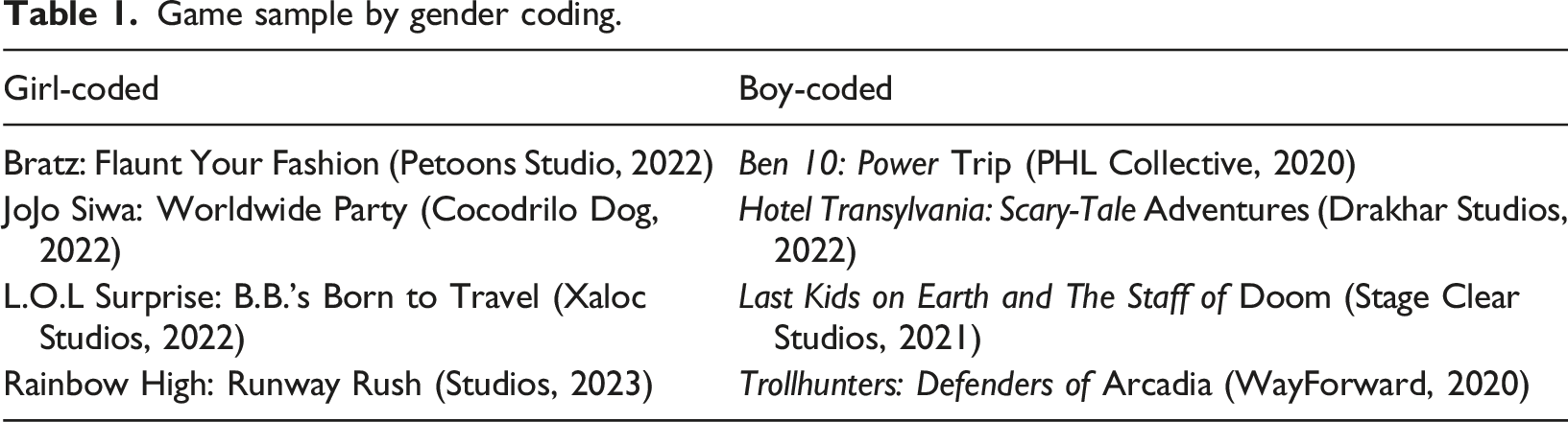
The game samples were selected based on the following criteria: • PEGI 3–7 rating, ensuring the games were designed for young children and not teens or adults. • Human-form avatars, excluding anthropomorphic or abstract representations to focus on gendered human embodiment. • Gender-coded marketing, with clear positioning toward a presumed boy or girl audience, based on box art, character design, promotional materials, and narrative framing. • Cross-platform availability, with gameplay captured on PC via the Steam client to ensure consistency in analysis.
Game sample by gender coding.
Analytical framework
We used a three-part analytical framework combining established models from game studies and visual culture to evaluate the samples:
(a) MDA framework (Hunicke et al., 2004)
The Mechanics, Dynamics, and Aesthetics (MDA) is applicable for analysing the experiential affordances embedded in the design of any game-based activities. The MDA framework was used to compare the structural game design elements between girl and boy-coded games to explore the perpetual approaches to ‘pink games’. Analysis proceeded in three stages: • Mechanics: Identifying rules and systems (e.g. combat, navigation, customisation). • Dynamics: Observing how players interact with those systems (e.g. cooperation, risk, repetition). • Aesthetics: Interpreting the implied emotional and experiential responses encouraged by gameplay (e.g. competition, expression, fellowship).
This framework was particularly effective for analysing RQ1, which focused on how play is structurally configured and experienced across gendered design.
(b) Elemental Tetrad (Schell, 2008)
Jesse Schell’s (2008) Elemental Tetrad – a framework used in game-based activity design – provided a complementary lens to analyse: • Aesthetics (visual and audio design, omitting smell, touch and taste to avoid ambiguity in analysis) • Narrative (story structure, themes, protagonist roles) • Technology (input/output devices, game engines, interface representations)
This framework helped explore
We omitted the mechanics element of the Elemental Tetrad to avoid repetition with the MDA framework. Further, the technology aspect of the Elemental Tetrad was excluded because of limited access to technical specifications. However, rather than analysing technology at the level of hardware or software systems, given the limited access to technical specifications and the constraints of black-box design (Rainie and Anderson, 2017), we reinterpret the technology component at the level of representational and experiential affordance. Specifically, we examine how technology is framed within the game world and encountered by the player, distinguishing between (a) familiar, everyday digital technologies (e.g. smartphones, social media interfaces, in-game apps) and (b) fantastical or speculative technologies (e.g. magical weapons, alien devices, sci-fi artefacts). This reinterpretation allows us to analyse how different technological imaginaries position players in relation to agency, creativity, and mastery, and how these imaginaries are differentially gendered across girl- and boy-coded games. Notwithstanding the omission of the two components, the Elemental Tetrad further develops the insights provided by the MDA Framework, beyond experiential affordances.
(c) Visual and representational analysis
To address • Avatar characteristics: body shape, facial proportions, clothing, hair, makeup, and implied age. • Behavioural norms: agency within narrative, goals, player tasks, and emotional tone. • Cultural coding: indications of Western norms, diversity, and gender roles.
The focused visual analysis elaborates on design elements that go beyond the experiential affordances, narratives, sensory immersion, and technological familiarity uncovered through the MDA Framework and Elemental Tetrad. Feminine avatars were identified based on a combination of explicit gender markers (name, clothing) and visual signifiers commonly associated with femininity in media representation. One primary avatar per game was selected for close analysis, with supplementary notes made on non-playable characters (NPCs) and secondary avatars where relevant.
The three-part analytical framework allowed for the deconstruction of mechanics, dynamic systems, experiential, and aesthetic elements that provided definitional traits of ‘pink games’, beyond ambiguity.
To enhance transparency, our analysis followed a structured, iterative process combining close playthrough, note-taking, and thematic coding. Each game was played for a minimum of 6 hours (or ‘until core gameplay loops and narrative arcs were observed’), with sessions recorded through written logs and screen capture where necessary. During initial playthroughs, we produced descriptive field notes organised around the three frameworks (MDA, Elemental Tetrad, visual analysis). In a second stage, these notes were coded inductively using thematic categories aligned with our research questions, such as mechanical complexity, risk/failure conditions, forms of player interaction, aesthetic cues, and narrative role expectations.
For example, the following excerpt illustrates how raw observation was translated into analytical coding:
Player is tasked with helping NPC choose outfit; no time pressure; no failure state; reward = praise + unlockable clothing item. → coded as: low risk, relational task, aesthetic reward, affirmation-based progression
Similarly
Combat encounter requires timing, enemy pattern recognition, health management; failure resets progress. → coded as: high challenge, system mastery, risk/failure, skill progression
These coded instances were then synthesised across the dataset to identify recurring patterns within and between girl- and boy-coded games. Rather than quantifying frequency, the goal was to establish consistent design logics and experiential tendencies. This process enabled us to move from situated gameplay observations to broader claims about gendered design structures.
Results
Mechanics, dynamics, and aesthetics in gendered games (RQ1)
A comparative analysis using the MDA Framework (Hunicke et al., 2004) reveals stark differences in the design architecture of girl- and boy-coded games, particularly in mechanical complexity and the emotional tone of gameplay.
Mechanics: Structural simplicity versus systemic richness
The boy-coded games were systematically rich through incorporating a broad range of mechanics, including combat, multiplayer modes, resource management, and dynamic progression systems. By contrast, the girl-coded games were structurally simpler. Although the girl-coded games included navigation, character customisation, and objective-completion mechanics, there was a marked absence of combat, time pressure, or failure conditions. This aligns with longstanding critiques of ‘pink games’ as risk-averse, non-competitive, and lacking stimulation (Fron et al., 2007; Chess, 2017). While multiplayer modes were found in L.O.L Surprise: B.B.’s Born to Travel, they were not present in the other girl-coded games. The variance between the consistent feature of multiplayer modes in the boy-coded games compared to the girl-coded games exemplify the presumption that girls are isolated player’s and are unlikely to be valuable additional players (Jenson and de Castell, 2010).
These disparities suggest a continuation of what Cassell and Jenkins (2000) identified as the ‘pragmatic compromise’: a reduction of femininity to aesthetic and relational elements while withholding access to mechanics that promote agency, collaboration, challenge, and mastery. Through withholding access to these systems mechanics, the girl-coded samples encourage passive play styles, failing to stimulate skill development and encourage the utilisation of refined motor skills (Piaget, 2013/2013; Vanderhoef, 2013:1).
Dynamics: Player interactions and feedback systems
The mechanical differences generated distinct gameplay dynamics discrepancies between the boy- and girl-coded games. In boy-coded games, players engaged in open-route navigation, real-time combat, and multiplayer cooperation or competition. Progress was rewarded through scoring systems, unlockable content, and scaling difficulty. These dynamic systems encourage persistence, experimentation, mastery, and strategic thinking.
Conversely, the girl-coded games’ dynamic systems focused on collection, personalisation, and repetitive task fulfilment. While the boy-coded games featured open-route navigation, the navigation dynamics in the girl-coded games featured teleportation or guided routes. Similarly, the objectives in the girl-coded games were guided by either checklist-based task management or embedded in relational tasks (e.g. helping NPCs). Without competitive systems or failure conditions, these dynamics reinforce presumptions about gendered capabilities and the feminine association with caretaking, order, and passivity (Jenson and de Castell, 2010).
Aesthetics: Designed emotion and player affect
The implied emotion-fuelled experiential aesthetics that emerged from these dynamics reflect deep-seated gender assumptions. The aesthetics that emerged from the mechanics and dynamics, align with the archetype of ‘Player One’ (Chess, 2017), whose value is affirmed through heroism, mastery and progress. These traits can be identified as part of the Jungian universalising archetype of the hero, that is only achievable by men in the Jungian system (Du Preez, 2000). The boy-coded games assembled experiences based on challenge, competition, and fellowship, features that encourage players to measure performance against systems, enemies, or peers.
Challenge was driven through difficulty curves and game pacing, which revolved around combat and action mechanic systems. Through comparative metrics such as in-game statistics and worldwide leaderboards, competition was encouraged by enabling players to assess their performance against others. Further, heroism fosters a sense of fellowship, with clear objectives that differentiate between good and bad. The emotion-based experience is built around the idea that good prevails; achieving the objectives results in celebration and reward, while failing to achieve hinders progression to becoming the narrative champion.
By contrast, the girl-coded games evoked expression
Character attachment and identification aesthetics were simulated through the curated replicas of the franchises’ mediated and tangible properties. The gamified replicas, such as secondary characters and NPCs, enhance the players’ experience by fostering familiarity whilst continuing to develop the character’s identity and the players’ understanding of the relational connections, intensified through the narratives. For example, upon completing JoJo Siwa Worldwide Party, the narrative reinforces that newfound friendships are always attainable. Likewise, Bratz Flaunt Your Fashion and Rainbow High: Runway Rush’s narrative objectives focus on relational reconciliation after interpersonal conflict; whereas the boy-coded games’ narratives focused on crucial community-driven resolution. Ultimately, the themes across the narratives support player identification and character bonding, provoking a mirroring of the value systems embedded into the characters’ designs (Klimmt et al., 2009).
Gendered experience and worldbuilding in Children’s games (RQ2)
Beyond the mechanic, dynamic systems and emotion-fuelled experiential affordances, Schell’s (2008) Elemental Tetrad was used to analysed how aesthetics, narrative, and technology shape the player experience in boy- and girl-coded PEGI 3–7 games. Expanding on from the MDA Framework findings, these elements work together to construct distinct play worlds that not only visualise gender but structure how it is enacted, rewarded, and sensed.
Aesthetics: Colour, style, and white normativity
All coded games across both sample categories employed cartoon aesthetics and bright colour palettes, but the girl-coded titles were saturated with traditionally feminine signifiers, such as pastels, pinks, purples, and rainbows. These visual codes reinforce hegemonic femininity by aligning beauty with softness, sweetness, and emotional legibility. In contrast, boy-coded games used darker, bolder colours (e.g. green, blue, black) and sharper contrasts, creating a visual language of energy, urgency, and risk. Feminine signifiers were found in Trollhunters: Defenders of Acadia through Claire’s armour being purple, visually signalling femininity. And, in Ben 10: Power Trip to transgress into hyper-masculine behaviours and traits provoked through antagonistic figures, exemplifying the adaptability of feminine signifiers in boy-coded games.
Stylistically, girl-coded games were more strongly influenced by commercial toy culture. Titles like Bratz: Flaunt Your Fashion, L.O.L. Surprise! B.B.s Born to Travel and Rainbow High: Runway Rush replicated the aesthetics of their toy counterparts, effectively gamifying tangible play experiences. Even in the case of JoJo Siwa Worldwide Party, which leverages JoJo Siwa’s celebrity image and personality, the game perpetuated a toyetic femininity that encourages fashion-centric, appearance-based self-definition. Thus, maintaining contemporary childhood play through intangible digital experiences that incentivise feminine players by reinforcing cultural norms around appearance and its contributing role in self-worth (McRobbie, 2009; Giddings, 2024).
Gamified replications of the Western world were prominent in most titles, except Hotel Transylvania: Scary Stories Adventures and JoJo Siwa Worldwide Party, which were based on fictional worlds. Replicas of European countries and the United States of America were prominent across the samples; however, L.O.L. Surprise! B.B.s Born to Travel replicated other countries outside the Western world, such as India, Egypt, and Japan. Bratz: Flaunt your Fashion and L.O.L. Surprise! B.B.s Born to Travel represent countries through replicas of recognisable landmarks and modern buildings, and reference cities associated with significant gentrification (Gneezy et al., 2003).
White normativity was prevalent and personified through larger quantities of White representing avatars compared to those with diverse skin tones and distinctive ethnic features. While players were often restricted to the White avatar skin tone, Bratz: Flaunt Your Fashion and L.O.L Surprise! B.B.s Born to Travel enabled players to transgress between diverse skin tones at any point during gameplay. The underrepresentation of skin tones in the girl-coded samples uncovers the White-normative undertones of these games, and when aligned with the game environments, it signifies the conception of a White cultural map and White-normative gamified experiences (Gray, 2020).
Narrative: Helping, healing, and heroism
In this study, narrative analysis does not refer to a single formalised model (e.g. classical narratology or branching narrative analysis), but to a theory-informed interpretive approach that examines how story structures, character roles, and goal orientations produce meaning within gameplay. Drawing on work in game studies that understands meaning as emerging through rule-based systems and player interaction (e.g. Bogost, 2010; Juul, 2011), alongside feminist media theory on the performative construction of identity (Butler, 1990; De Lauretis, 1987), we focus on three dimensions: (1) narrative goals (what the player is asked to achieve), (2) forms of conflict or its absence, and (3) modes of resolution and reward. This approach allows us to identify how narratives are operationalised through gameplay systems rather than treated as purely representational or cutscene-driven elements. In this sense, narrative is understood as something enacted through play, not simply told to the player. The narrative analysis elaborates on the emotion-fuelled aesthetics explored through the MDA Framework in finer detail, further supporting the gender divide in game design. Across the girl-coded sample, plots consistently revolved around helping others, restoring relationships, and achieving success through collaboration and emotional labour. These narratives reinforce the idea that achieving ‘good girl’ status is self-fulfilling and maintained through duties that are attentive to other people’s needs (Goffman, 1974). In Rainbow High: Runway Rush, for example, narrative progression is tied to helping friends resolve interpersonal issues and coordinating group tasks in a school setting.
Likewise, in Bratz: Flaunt Your Fashion, gameplay involved coordinating group tasks; however, the motivation revolved around career growth as opposed to reconciliation with beauty and fashion being fundamental to that success. Therefore, social importance and opportunities are closely tied with glamourised individuality and obligations to helping others (McRobbie, 2009). JoJo Siwa: Worldwide Party’s gameplay involves non-competitive, performance-based dance challenges that champion self-confidence, which is affirmed by the audience. Similarly, affirmation through service emerges throughout the gameplay in L.O.L Surprise! B.B.s Born to Travel upon successfully completing objectives. These narratives construct femininity as relational, service-oriented, and affirming – qualities often associated with ‘soft power’, ‘girly girl’ or ‘good girl’ tropes in children’s media (Butler, 1990; Goffman, 1974).
In this context, ‘affirming’ refers to the way narrative progression is structured around receiving positive feedback – such as praise, applause, gratitude, or social approval – for compliant, supportive, and emotionally regulated behaviour. For example, in JoJo Siwa: Worldwide Party and L.O.L. Surprise! B.B.s Born to Travel, success is marked not by overcoming risk or opposition, but by audience affirmation or the satisfaction of having helped others, reinforcing femininity as valuable insofar as it is positively received by others. However, these constructions are also culturally narrow, relying on implicitly Western and white-normative imaginaries of girlhood in which emotional labour, self-regulation, and social harmony are presented as universal and desirable traits. In this sense, Western-centrism in the girl-coded sample operates through ideals of care, stability, and affective responsibility rather than through overt action or conflict.
By contrast, boy-coded games followed traditional hero narratives structured around conflict, danger, and triumph. In Ben 10: Power Trip and The Last Kids on Earth and the Staff of Doom, players defeat antagonists, rescue friends, and navigate threats using power-based progression. Even when storylines include collaborative moments, they are framed by competition, danger, and mastery over adversity, aligning with masculinised ideals of independence and control. While these narratives are similarly grounded in Western-centric frameworks, this cultural normativity is expressed through heroism, conquest, and individual agency rather than emotional labour or social maintenance. Thus, both boy- and girl-coded games rely on Western and white-dominant narrative assumptions, but they mobilise them in gender-differentiated ways.
The feminine representation of avatars in the boy-coded games reinforced the same tropes identified in the girl-coded game samples; however, they were less focused on beauty and more on intelligence and skill. Without assigning value to beauty and fashion, the ‘girly girl’ trope (Holland and Harpin, 2015) is replaced with the ‘smart girl’ (Pomerantz et al., 2017). The ‘smart girl’ is not concerned about glamourised individuality, instead values overachieving. Overachieving is exemplified through the character June in The Last Kids on Earth and the Staff of Doom who is described to be ‘good at everything’ (McRobbie, 2009; Stage Clear Studios, 2021). And the ‘smart girl’ trope is further demonstrated through Gwen in Ben 10: Power Trip, who works behind the scenes to understand unknown entities behind the scenes.
These divergent narrative frameworks reinforce the idea that boys are active agents in unstable, risky worlds, while girls operate in stable, safe environments where personal growth is tied to social cohesion, emotional maturity, and interpersonal understanding (Erikson, 1950; Goffman, 1974). Further, through visual and narrative signifiers, masculinity is alluded to and referenced in some way in the girl-coded sample, reaffirming the position that boys have in girls’ lives starting from early infancy. One genre encourages rule-breaking to overcome adversity; the other encourages rule-following to maintain order. In both cases, however, the range of culturally legible childhood identities remains limited, reinforcing not only gendered expectations but also a narrow, Western-centred vision of who games are for and how children should relate to the world.
Technology: Familiarity versus fantasy
The girl-coded games also featured specific everyday digital technologies, such as smartphones and social media, positioning their players as aspiring young consumers and digital creators within recognisable cultural frames. Bratz Flaunt Your Fashion and L.O.L. Surprise! B.B.s Born to Travel both integrated phone-based interfaces to manage tasks, goals, and progress, mirroring apps that young players may already use or observe. This realism reinforces the idea that girls’ interaction with technology is social and expressive, rather than technical or inventive. The technology store features empathised with the sense of consumerism in the girl-coded samples by encouraging the player to engage with in-game shop features to maximise rewards.
In contrast, the boy-coded games referenced fantasy or sci-fi devices, such as Ben 10s Omnitrix and Jim Lake Jr.’s magic-fuelled Sword of Daylight, emphasising adventure, power, and escapism. This divergence points to a gendered split in imaginative space: while boys are invited to explore fictional worlds whilst engaging with creativity and imagination, girls are often tethered to consumerist and domestic realism (Piaget, 2013). Even within simplified control schemes for younger audiences, the symbolic weight of the technology differs: girls are framed as users of tech, while boys are framed as inventors or masters of it. Boys are encouraged to think innovatively about what technology can become, whilst girls are still developing technological competence of simpler technology.
This contrast reflects broader gender norms in STEM culture and play. While girls are given access to digital tools in games, those tools rarely require logic, experimentation, or systems thinking. Instead, they are designed for aesthetics, communication, and organisation – echoing the gendered division of technological competence noted in educational and media research (Bryce and Rutter, 2005; Ochsner, 2015).
Femininity in avatar design and play behaviour (RQ3)
A visual and narrative analysis of avatar design and player agency across the sample revealed that femininity is both hyper-visible and tightly constrained in girl-coded games, while it is marginal and underdeveloped in boy-coded games. This section expands on the findings discussed in the previous sections, reframing the discussion on how ideals of femininity are materially encoded in characters’ bodies, faces, clothing, and narrative roles, and how these representations shape which kinds of play behaviours are encouraged or excluded.
Physical representation: Beauty ideals and stylised femininity
Across the girl-coded titles, feminine avatars adhered closely to Westernised beauty standards. Characters were thin, with disproportionately large eyes and heads, smooth skin, long styled hair, and carefully curated outfits. These proportions and stylisations align with the tangible properties of the franchises (Bratz, L.O.L. Surprise! and Rainbow High) and with the visual conventions of popular social media filters and beauty influencers.
These play arenas have their own set of ‘cultural’ norms embedded into their design, mirroring the same beauty expectations and understandings of real life which was generally discussed in the aesthetics section of the Elemental Tetrad. More specifically, facial features were uniformly standardised across diverse skin tones, erasing ethnic specificity and reinforcing Eurocentric ideals (Dietz, 1998; Gray, 2020; Jansz and Martis, 2007). While some games allowed players to select different skin tones, options to modify hair textures, facial structures, or other ethnically coded features were absent. This aligns with the game-based play arena environment designs, where inclusion is skin-deep; visual diversity without meaningful ethnic difference, and the idealising of beauty coded as Whiteness and Eurocentric features (Gray, 2020; hooks, 1992).
The avatar population in the girl-coded games were feminine except for a few masculine representing avatars that were found in Bratz: Flaunt Your Fashion. Likewise, feminine avatars in boy-coded games were underrepresented, often relegated to secondary roles, as seen through June in The Last Kids on Earth: The Staff of Doom and Claire in Trollhunters: Defenders of Arcadia, or to progress the games’ narratives. Further, the feminine representing avatars in the boy-coded games were designed with less stylisation or glamorisation when compared to the avatars in the girl-coded games. Characters like Gwen in Ben 10 Power Trip! or June in The Last Kids on Earth and the Staff of Doom had simplified designs with neutral expressions, practical clothing, and were visually outshone by their male counterparts. This suggests that femininity, when present in boys’ games, is functionally included but narratively and visually subordinated.
Clothing, makeup, and fashion
Clothing in girl-coded games was not only fashionable but often revealing (short skirts, crop tops, and tight-fitting silhouettes), aligning with pre-existing critique on feminine avatar sexualisation (Jansz and Martis, 2007). However, while clothing was not overtly sexualised in the girl-coded games in an adult sense, these outfits reproduced the appearance-focused scripts of adolescent femininity. Through such designs, children are introduced to self-regulatory practices via the customisation mechanics which offer clothing styles that align with bodily discourse (Goffman, 1974).
Makeup was commonly depicted through bold lashes, colourful lips, and eyeshadow, mimicking commercial beauty norms. Even avatars designed to represent babies (L.O.L. Surprise!) embedded stylised makeup and elaborate fashion, highlighting how early these ideals are introduced. The player is guided to self-modify by aligning with cultural aesthetic ideals to achieve glamourised individuality, reinforcing its enhancement of visibility and social importance (Bordo, 1993; Goffman, 1974; McRobbie, 2009).
By contrast, clothing for feminine characters in boy-coded games was practical, strengthening their secondary narrative role, as previously exemplified through the avatar analysis of June and Gwen. Femininity in the girl-coded games demonstrates that conceit and vanity are fundamental in girlhood, whilst in the boy-coded samples favour the ‘natural girl’. The disparity between appearance-driven femininity and function-driven masculinity was therefore encoded not only in the characters themselves, but in the design and incentives offered to players.
Narrative roles and agency
This section further elaborates on the general narrative experiential analysis introduced in the Elemental Tetrad section, shifting direct focus onto specific narrative roles and player agency. One of the clearest distinctions across the sample was the degree of narrative agency afforded to feminine avatars. In girl-coded games, the player character was always female and held complete narrative control. However, this agency was rarely used for disruption, competition, or personal ambition. Instead, it revolved around helping others, resolving social problems, and self-improvement via external affirmation (e.g. receiving praise, compliments, or gratitude).
For example, in Rainbow High: Runway Rush, gameplay is structured around completing collaborative school-based tasks such as gathering materials for fashion projects, helping classmates prepare outfits, and coordinating elements of runway shows. Progression is tied to resolving minor interpersonal issues (e.g. assisting a friend who has lost an item or needs help completing a design task) and contributing to collective creative outcomes rather than overcoming systemic obstacles or adversaries. Similarly, in JoJo Siwa: Worldwide Party, core gameplay revolves around rhythm-based dance performances and exploratory mini-games in which players collect items, unlock stages, and perform choreographed routines. Success is measured through maintaining performance streaks, expressing enthusiasm, and sustaining ‘positive energy’, with feedback delivered through applause, visual effects, and character affirmation rather than through competitive scoring or failure states. Across both titles, player action is oriented toward sustaining social harmony, completing event-based goals (e.g. preparing shows, completing performances), and embodying affective positivity rather than engaging in conflict, risk, or transgressive play. These behaviours align with stereotypical ‘feminine’ traits such as empathy, helpfulness, and emotional regulation, echoing Judith Butler’s (1990) notion of gender as performance governed by repetition and social reward.
As already seen, the boy-coded games’ feminine avatars were often non-playable, support characters, or optional secondary choices. However, upon closer analysis, the feminine representing avatars exemplify stark gendered differences. June in The Last Kids on Earth and the Staff of Doom is one of the few playable female characters in the sample, but she is statistically weaker than her male counterparts, offering less defence and damage output. Gwen in Ben 10: Power Trip supports the narrative as an assistant to the male protagonist but has no playable role. Even in Hotel Transylvania: Scary-Tale Adventures (2022), where players alternate between Mavis and Drac, their quests differ significantly. Drac engages in adventurous, self-directed tasks, while Mavis helps others and is continually reminded to be cautious.
The result is a hierarchy of play: boys are positioned as autonomous protagonists with power and risk, while girls, even when they lead, are expected to serve, support, or beautify. As Dietz (1998) and Ivory (2006) have argued, this unequal agency persists across ratings and genres, but its presence in early childhood games signals how deeply such scripts are embedded.
Narrative satisfaction in the girl-coded games often hinged on being aligned with beauty standards, a good friend, helping a team, or restoring social harmony (Lucas and Sherry, 2004; Bryce and Rutter, 2005). While this promotes empathy, it limits the range of player behaviour by disincentivising competition, independence, or transgression. In contrast, boy-coded games invited experimentation, calculated risk, and self-interest as valid or even heroic traits. This distinction reflects broader concerns in feminist media critique: when girls are always asked to be kind, helpful, and emotionally available, they are discouraged from being curious, messy, ambitious, or confrontational. Despite each player base expressing interest in challenge and competitive rule-based play, ‘pink game’ players are denied the opportunity to engage in play-based challenge (Blumberg and Sokol, 2004). These restrictions are amplified when embedded in interactive systems that reward conformity and discourage rule-breaking, key avenues through which games can foster agency and creativity (Jenkins, 2000).
Conclusion
This article has offered a critical definition of the ‘pink game’ by analysing how femininity is encoded through mechanics, aesthetics, narratives, and avatar design in PEGI 3–7 games marketed to young girls. Through a comparative study of eight titles, we have shown that pink games are not solely defined by surface elements such as colour or fashion, but by deeper structural and ideological patterns that shape how femininity is imagined and enacted through play.
Our analysis reveals that pink games tend to minimise mechanical complexity, eliminate risk, and emphasise social harmony, aesthetic self-expression, and relational behaviour. These features position the feminine player as expressive rather than strategic, relational rather than autonomous, and aesthetically oriented rather than systemically skilled. While such games may offer safe, affirming spaces for certain forms of identity play, they also reinforce a narrow and domesticated vision of girlhood. This is a definition that limits agency, devalues challenge, and prescribes behaviour aligned with stereotypical gender roles.
While previous work has often focused on representational politics or player reception, our contribution lies in connecting gendered ideology to the structural composition of games themselves. In doing so, we also revisit the legacy of the Girl Games Movement, arguing that its central tensions, between commercial inclusion and ideological compromise, remain unresolved in contemporary children’s games.
Our methodology is qualitative and interpretive, combining inductive observation with theory-driven coding. We do not attempt to measure player response or impact directly but instead analyse how the games construct ideas of gender, identity, and play through design. We acknowledge the limitations of working with a small, genre-specific sample within a single publisher’s catalogue. However, our focus on PEGI 3–7 titles fill a gap in feminist game studies by centring early childhood games, an area often overlooked despite its formative influence.
Future research could build on this work by expanding the sample beyond Outright Games, examining higher PEGI-rated titles to track how gender design logics evolve with age, and incorporating reception studies to explore how young players interpret and negotiate these gendered systems. Cross-cultural comparisons could also shed light on how different markets frame girlhood and femininity through games. Furthermore, future analyses could investigate how players directly interact with mechanics, dynamic systems, and aesthetics, such as the duration spent customising and completing objectives, and their personal interpretations of the narrative structures.
Footnotes

Funding
The authors received no financial support for the research, authorship, and/or publication of this article.
Declaration of conflicting interests
The authors declared no potential conflicts of interest with respect to the research, authorship, and/or publication of this article.