







Abstract
Public service media (PSM) in Australia operate with an unusual absence of articulated expectations, including enforceable minimum levels of Australian content. The ABC and SBS have legislated charters that codify broad purposes and protect editorial independence, yet there is no structured mechanism to review remit, performance, or resourcing. This article argues that the resulting ‘independence’ is double-edged: it limits direct ministerial direction while enabling policy neglect and episodic politicised intervention in digital conditions. Using national drama as a lens, we trace how the dismantling of commercial broadcasters’ content obligations, the fragility of advertiser-funded mainstream media, and the rise of global streaming platforms have shifted cultural responsibility toward the ABC and SBS without commensurate funding or clear obligations. A comparative framework shows how Australia diverges from systems such as the United Kingdom, where Charter renewal and regulator-led reviews create recurring opportunities to justify public value and recalibrate scope. Placing SBS alongside the ABC, we show how divergent histories and funding models produce uneven adaptations to digitisation and internationalisation yet share the same structural exposure to drift. We conclude by advocating deliberative reform: formal review cycles, clearer public value expectations (including around high-cost forms of Australian content), and resourcing aligned to expanded civic responsibilities in platform-dominated conditions.
Keywords
Comparative work on public service media (PSM) tends to treat ‘remit-setting’ and ‘remit-renewal’ as part of the institution: not just what PSM is, but how its purposes are periodically restated, contested, and made legible to publics, regulators, and governments. Across many jurisdictions, this happens through recurring mechanisms such as charter renewals, operating licences, public value tests, periodic reviews, or statutory reporting requirements that are specifically tailored to PSM rather than to public entities in general. The point is not that these mechanisms prevent political interference (as we will show below, they rarely do), but that they create structured moments in which purpose, priorities, and trade-offs must be argued for and where under-resourcing can be narrated as a governance problem rather than a managerial failure. In the UK, for example, Ofcom’s operating framework and operating licence bind remit to review cycles, compliance monitoring, and periodic assessment of distinctiveness and audience service (OFCOM, 2017; 2025a; 2025b).
A second, related strand of international scholarship treats PSM not as an ‘exception’ to media markets, but as part of a wider institutional settlement. Research from Norway, for example, has theorised this dynamic as a ‘media welfare state’, where universal service principles and cultural policy objectives are built into durable governance arrangements (Syvertsen et al., 2014). A third tradition, rooted in comparative media systems analysis, suggests that the scope and vulnerability of PSM cannot be understood without attention to political–media relations and the institutional mix of markets, parties, regulation, and state capacity (Hallin and Mancini, 2004) Together, these perspectives foreground the basic claim that PSM’s resilience in digital conditions depends less on declared independence than on whether there are institutionalised processes that repeatedly clarify (and revise) obligations, resources, and accountability.
Australia is a sharp counter-case. PSM in Australia suffer from an absence of structured mechanisms to define, review, or publicly debate expectations, including minimum obligations around Australian content and the allocation of resources across services. The operational and editorial independence of the Australian Broadcasting Corporation (ABC) and the Special Broadcasting Service (SBS) is enshrined in their respective Charters, but not only has that independence failed to insulate them from political pressures, it also has helped normalise the absence of formalised, recurring review of their remits. The result is a paradox: two national public media organisations with legislated purposes that have become effectively ‘frozen’, largely insulated from the recurrent scrutiny that elsewhere forces recalibration in response to technological and industrial change.
For much of the late twentieth century, this governance gap was partially masked by Australia’s broader media settlement. Before digitisation, cultural policy levers for national representation on screen were concentrated on the country’s dominant and profitable commercial broadcasters. Those arrangements no longer hold. The recent watering down of commercial broadcasters’ local content obligations, and the rise of global streaming platforms and technology firms have transformed the ecology in which the ABC and SBS operate. As commercial broadcasting weakens, public service media are left carrying greater responsibility for culturally valuable programming, including national drama (Potter and McCutcheon, 2025). In this new environment, independence is invoked to keep the ABC and SBS outside routine policy oversight and remit review. That stance persists even as the collapse of older policy settlements greatly expands their cultural and social responsibilities.
In the following essay, we take national drama as our analytical lens because it is expensive, culturally significant, and structurally vulnerable when linear broadcasters lose scale and advertising. 1 From the late 1960s, Australian policy makers used quotas on commercial broadcasters as a central lever to secure high-cost forms of scripted local content such as Australian drama, documentary and children’s programs and, crucially, to build an independent production sector. Since 2021 those quota arrangements have largely disappeared, rendering the absence of any equivalent, formalised content obligations for PSM newly consequential both culturally (for the availability and distinctiveness of national storytelling) and economically (for the stability of the independent production sector).
Our contribution to comparative debates begins from a deliberately uncomfortable proposition: Australia now offers a case of how not to govern PSM in digital conditions. Where other systems embed periodic remit-setting and review, however imperfectly, Australia lacks a stable mechanism through which purposes are updated, functions debated, and resources aligned. We argue that this absence of regular review leaves Australia’s PSM with expanding responsibilities, including for the provision of national drama, without formalised expectations and, critically, without resourcing commensurate with those new and growing obligations.
A second intervention is internal to the Australian context. Scholarly and political attention has disproportionately treated the ABC as the primary site for analysing public service broadcasting in Australia. Bringing SBS into the same analytic frame clarifies how two public institutions, founded with different purposes and organisational logics, have nonetheless been rendered similarly vulnerable by a policy environment that avoids systematic remit renewal. It also complicates an implicit Eurocentric baseline in some comparative work. SBS is neither a minor variant of a ‘BBC model’ nor simply a multicultural add-on. It is a structurally significant institution whose hybrid funding model and contested remit make visible the political-economic limits of ‘PSM-as-independence’ in a marketised media system.
The article proceeds as follows. We first sketch the origins and institutional purposes of both broadcasters, establishing the underlying logics that continue to shape their operations. We then place Australia against an international backdrop of PSM governance and oversight. Questions of remit renewal, accountability, and political pressure are contested across jurisdictions, but they are particularly acute in Australia because the older commercial settlement has eroded without any new mechanism to restate purpose or align obligations with resources. On that basis, we show how ‘independence’ operates as a double-edged governance arrangement: it provides formal protections against direct government direction while also being mobilised to justify the absence of routine remit review. At the same time, it leaves the broadcasters vulnerable to episodic interventions that (paradoxically) take on highly politicised and unpredictable forms. Finally, we situate the ABC and SBS within a digitised, internationalised marketplace in which commercial retreat and platform dominance reallocate cultural responsibilities onto public institutions, without the policy infrastructure required to make those responsibilities enforceable, fundable, and publicly contestable.
Origins and state of play
First established as a national network of radio services in 1932, the ABC was modelled on the BBC as a universal service, a statutory authority responsible to parliament and charged with providing ‘adequate and comprehensive services’ to all Australians. Unlike the BBC, however, the ABC never operated as a monopoly. It has always competed with profitable and politically powerful commercial broadcasters in a highly concentrated media ownership environment, while also serving a dispersed population across a vast territory. Australian governments also resisted the BBC’s ‘cultural uplift’ ethos, preferring a ‘non-partisan but loyal’ national service oriented to communication and cohesion (Davis, 1988 p. 36). The ABC launched its television service in 1956 and now offers a range of radio, television and online services including a 24-h dedicated news channel and on-demand player iView.
The Broadcasting Act of 1983 contains the ABC’s first and only Charter, which defines its responsibilities broadly and leaves key matters largely unspecified. It requires comprehensive, high standard services while the ABC operates without monopoly protections and faces recurring commercial claims of unfair competition. It also asks the ABC to contribute to national identity while reflecting cultural diversity, without clear mechanisms for reconciling those priorities (Davis, 1988). The Charter contains few specifics about resource allocation and no codified minimum obligations for Australian content. It has barely changed in four decades, aside from a 2013 amendment authorising digital services, added largely to counter commercial claims that the ABC was exceeding its remit. 2 Although intended to operate independently, the ABC is governed by a board appointed through government-led processes that are frequently politicised; the Charter’s breadth enables wide discretion and has at times been used to limit transparency about internal resource allocation (Dalton, 2017).
SBS emerged on different institutional terms. Developed from community and ethnic ratio initiatives in the early 1970s and formalised alongside multiculturalism as public policy, SBS was designed as a multicultural and multilingual public service rather than a generalist national broadcaster. Its 1991 Charter commits to multilingual and multicultural services that inform, educate, and entertain all Australians while reflecting Australia’s multicultural society. SBS began as a radio service in 1977, launched television in 1980, expanded nationally in the mid-1980s, and now delivers news, current affairs, drama, and entertainment in more than 70 languages across six free-to-air channels, an extensive digital audio network, and its on-demand platform, SBS On Demand.
Like the ABC, SBS’s independence was codified in legislation, but its governance architecture reproduces similar weaknesses: a Charter not subject to routine review or renewal, limited clarity about priorities, and no enforceable content obligations, including in drama and children’s programming. Board appointments are also often highly politicised. SBS is much smaller and structurally underfunded relative to the ABC and has long operated with a hybrid funding model in which government appropriations are supplemented by advertising and commercial partnerships. This model is persistently contested, with critics arguing it can incentivise a drift toward broader entertainment and younger audiences at the expense of multicultural commitments (Ang et al., 2008; Lawe Davies, 2002; McLean, 2008). Campaigns such as Save Our SBS emerged in the 2000s in response to concerns about advertising expansion and remit dilution.
Because both broadcasters rely on government appropriations, they remain exposed to changing governments, politicised inquiries, and attacks from powerful commercial media, including Murdoch outlets hostile to PSM on economic and ideological grounds. Funding has historically offered limited stability – annual budgets until 1986, then triennial cycles that often tracked electoral rhythms – before a shift to 5-year funding cycles in 2023 intended to strengthen independence and reduce political interference. Both organisations also operate within whole-of-government accountability frameworks, including the Public Governance, Performance and Accountability Act 2013, annual reporting, and Senate Estimates. The latter tend to be highly politicised and combative although they do occasionally yield useful information around, for example, resource allocation. These arrangements can create an appearance of heavy oversight, but most requirements are generic to Commonwealth entities rather than tailored to PSM purpose, remit, and public value.
Digitisation has now pushed these settlement pressures to an inflection point. Global streaming platforms increasingly shape production finance and discoverability, while policy reform over the past 15 years has largely focused on saving all three commercial broadcasters by reducing their operating costs (Potter and McCutcheon, 2025). SBS is especially exposed: its advertising base is under pressure as content costs rise, intensifying questions about how to sustain a multicultural mission with limited resources and an unsettled remit. The ABC, meanwhile, is planning to become an ‘integrated digital operation’ (ABC, 2023) by 2028 as broadcast audiences decline, but this transition is proceeding without any commensurate re-scoping of funding arrangements or Australian content expectations, sharpening uncertainty about its role in a rapidly changing media system.
Structural vulnerabilities of public service media
The challenges facing Australian PSM are neither new nor unique; rather, they reflect wider international patterns in which PSM have long confronted funding pressures and politicised governance arrangements. These pressures have been exacerbated by the rapid expansion of global digital distribution technologies, which have dramatically widened audiences’ access to international media services and intensified competition for attention (Doyle, 2023). This shift has eroded the national reach of domestic PSM, particularly among younger audiences, while accelerating the need for organisational transformation and driving up the costs of producing culturally significant content such as national drama, a core element of many PSM mandates (D’Arma et al., 2021; Raats and Jensen, 2021; Johnson et al., 2025). Governance and funding systems have come under additional strain in countries experiencing rising populism and far-right influence, especially where political actors hold centralised oversight powers, as seen in Sweden (Christensen and Stiernstedt, 2025).
Governance reforms in some countries have brought increased risks: in Spain, for example, 2024 changes lowered the parliamentary threshold for appointing RTVE board members from a two-thirds supermajority to a simple majority, ending the need for opposition consent and prompting widespread concern about political capture of the national broadcaster (Cañedo and Rodríguez Castro, 2024). Annual appropriations in Canada and Denmark similarly leave PSM exposed to shifting political priorities by tying funding to yearly budget decisions, undermining financial stability and long-term planning (Born and Lewis, 2025). In contrast, systems that embed civil-society participation, such as those in Germany, Switzerland, and Austria, demonstrate how structured public involvement can reinforce legitimacy and provide protect against politicisation. Germany’s broadcasting councils and Austria’s Audience Council incorporate a broad range of social actors into governance, shaping programming and appointments in ways that secure greater accountability and independence from political interference (Sehl & ZeitelBank, 2025; Trappel and Tomaz, 2025). Such models underscore growing arguments that PSM should be recognised as essential media infrastructure, given their role in supporting civic engagement, social cohesion, and democratic life (Doyle, 2025). Of all European countries, Germany’s Media Council potentially represents the strongest governance model because it embeds independent expert oversight directly into its regulatory framework, ensuring evaluations of PSM performance are conducted at clear arm’s-length from politicians. The Media Council is able to provide a stable, depoliticised mechanism for accountability, more resistant to political capture than systems reliant on parliamentary appointments or short-term advisory bodies (Born and Lewis, 2025).
Despite the well-recognised shortcomings of existing PSM governance systems and the surface appeal of legislation that appear to safeguard institutional independence, such as the Charters of the ABC and SBS, the continued failure to recalibrate and modernise their mandates does both broadcasters a profound disservice. Each has been left to navigate shifting political, economic, and technological environments without a coherent policy framework. The consequences of this neglect have been uneven and unpredictable for decades. At times centre-left governments have increased funding or backed innovation, while at other moments centre-right governments have imposed cuts and withdrawn support. To illustrate these dynamics, we examine three interrelated dimensions that reveal how political interference and policy inertia have shaped their trajectories: the paradox of independence, the instability of funding and exposure to market logics, and the challenges posed by digital transition and internationalisation. Taken together, these themes demonstrate how the absence of long-term vision has left Australia’s PSM subject to the shifting tides of political expediency, market pressures, and technological change.
Independence as a double-edged sword
Independence has long been central to the legitimacy of Australia’s PSM, but it has also functioned as a structural vulnerability. Both the ABC and SBS have operational and editorial independence enshrined in their respective charters, which prohibit government direction except in cases of national interest. Yet in practice, successive governments have repeatedly tested this boundary, both through their power to appoint board members and through their capacity to instigate highly politicised inquiries and reviews. This has been particularly pronounced in the case of the ABC. In 1976, for instance, centre right prime minister Malcolm Fraser attempted to dismiss the entire board, eventually stacking it with political allies (Inglis, 1983). Governments have a further powerful tool at their disposal: without formal processes of Charter renewal, politicians can initiate ad hoc independent inquiries with which both broadcasters are compelled to cooperate, and which create significant opportunities for political interference in their management (Davis, 1988).
The final two decades of the 20th century were especially turbulent for the ABC, as successive governments adopted increasingly critical stances toward public service broadcasting. This hardening of attitudes coincided with the rise of neoliberal economic policies and the growing belief that digitisation would eliminate media scarcity (Miragliotta and Errington, 2012). As a result, the ABC came under mounting pressure to align with corporate values and adopt managerial practices more typical of private enterprise. During the 1980s, the ABC continued to produce drama in house including telemovies, series, and short, experimental plays fostering new creative talent but by 1986 its annual hours of Australian drama were at an all-time low, at around forty (Inglis, 2006). Television audiences had also fallen sharply, in part because of the soaring popularity of the Australian drama commercial broadcasters were now compelled to provide (Jacka, 1991). In response, the ABC adopted a new drama strategy: commissioning long-running, popular series such as GP (1989–96), set in a Sydney medical practice, externally and entering into co-production arrangements with independent producers who could access newly available sector rebates while using ABC facilities (Jacka, 1991). These arrangements expanded the ABC’s Australian drama hours but introduced reliance on international sales and distribution to finance national drama. The absence of any formal obligations to invest in Australian drama contributed to a sharp decline in output during the late 1990s however as the ABC shifted its reduced resources to its digital transition – they would fall to just 6 hours in total in 2005.
The SBS owes its existence to national cultural policy shaped by demographic change and contested ideas of multiculturalism. In the 1970s, the Whitlam Labor government’s cultural policy activism expanded public investment in media and the arts, supporting experimental forms of ethnic broadcasting and a growing community radio movement that demonstrated strong demand for multilingual services. After this government lost power, the Fraser Centre-right government established SBS in 1978, formalising these experiments not as a radical project of inclusion but as a pragmatic tool of political consolidation. Multiculturalism was adopted as official policy to recognise migrant communities symbolically while cultivating their support within the political mainstream. As Jackubowicz (1987, p. 19) observed, the creation of SBS offered ‘an opportunity to respond to the demand for cultural recognition that the ethnic middle class had for so long been denied in Australia’, while also enlarging the ‘naturally conservative’ bloc Fraser sought to consolidate. Yet this foundation lacked an enduring consensus. The Keating Labor government that followed pursued multiculturalism through ‘mainstreaming’, replacing targeted services with universalist reforms (Ho, 2013; Jackubowicz, 1987), while the Centre-right Howard government then decisively reframed it within neoliberal discourses of efficiency and competitiveness during the 1990s. In this reconfiguration, multiculturalism was effectively abandoned as a social policy project and repurposed as an economic tool. Here diversity was valued less as a platform for democratic participation than as a resource for labour market integration and national competitiveness (Ho, 2013).
Without clear policy guidance or structured reassessments of its remit, SBS has struggled to define what multicultural storytelling should look like on screen, experimenting with forms and narratives that alternately sought to serve ethnic communities, appeal to broader national audiences, and satisfy shifting political expectations As Ang et al. (2008, p. 20) observe, multiple versions of multiculturalism ‘have coexisted throughout SBS’s history, [each underpinning] divergent, sometimes conflicting, philosophies of what SBS should do, whom it is for, and how it should deliver on its charter’. These unresolved tensions have frequently spilt into public controversy, with communities themselves often targeting the broadcaster’s programming decisions as objects of concern (O’Regan and Kolar-Panov, 1993a). In the early 2000s, for example, the broadcaster faced fierce opposition from the Vietnamese-Australian community after airing state-produced bulletins from Vietnam, which many regarded as politically offensive and unrepresentative of their experiences of displacement (Sydney Morning Herald, 2003). Muslim leaders initiated boycotts in response to certain episodes of Insight (1995 --), which they argued framed debate in ways that reinforced marginalisation rather than fostering understanding (Roose and Akbarzadeh, 2013). SBS’s documentary series Struggle Street (2015-2017) provoked outrage from residents in Western Sydney, who condemned the program as exploitative ‘poverty porn’ and staged protests outside the broadcaster’s headquarters (ABC News, 2015; Aubusson, 2015). More recently, SBS’s decision to use Indigenous place names on weather maps drew mixed responses with some viewers criticising the move as confusing and overreaching (News.com.au, 2024).
In both cases, independence has proved a double-edged sword for the broadcasters. While it formally protects them from direct state control, it has left each vulnerable to partisan manoeuvring, managerial reform, and shifting ideological agendas. For the ABC, this has frequently translated into recurring, unpredictable and frequently highly politicised reviews that have generated much criticism of its offerings and services. For the SBS, independence offers little insulation from the ideological baggage that has long accompanied multiculturalism, leaving its remit repeatedly contested and its programming subject to criticism. Neither broadcaster benefits from regular, structured mechanisms to recalibrate their roles and Australian content obligations in line with social or technological change, with ‘independence’ functioning less as a shield than as a rationale for policy neglect.
Funding fragility and market logics
If independence is a double-edged sword, funding has been a much sharper blade. Both the ABC and SBS rely primarily on government appropriations, but neither has been properly insulated from political or funding pressures. This has meant that both have struggled to balance the demands of financing the kinds of high-cost programming that distinguish PSM while making the digital innovations critical to maintaining their relevance in current conditions. At the same time, episodes of relative investment – SBS’s growth in the 1990s and the post-2009 funding boost for ABC drama – demonstrate that both broadcasters reliably generate high-impact, distinctive programming when resources are commensurate with their obligations.
Budget reductions have long constrained the ABC, with its operational revenue declining by almost 30% in real terms between 1985–86 and 2019-20 (Dawson, 2020). While intermittent injections, such as Labor’s 2009 digital expansion package, offered temporary relief, these gains were quickly eclipsed by successive cuts. Drama, as a high-cost genre has always been impacted by budgetary cuts as well as the ABC’s willingness to divert resources to other areas including news and current affairs (Dalton, 2017). Against this backdrop, the Labor government’s 2009 digital expansion package marked a significant intervention. For the first time, funds were specifically allocated to programming priorities: $67 million for a new children’s channel and $70 million for local drama. Those funds and a decision to outsource all drama production to the independent production sector transformed the ABC’s drama output, which had been averaging around 20 hours a year, far lower than its commercial counterparts.
This new model combined ABC licence fees with taxation subsidies and screen agency funding, enabling a surge in scripted content commissioning. Without the pressure to attract advertising revenue faced by commercial broadcasters, the ABC had far more freedom to create drama for smaller and more diverse audiences. By 2012–2013, it had invested $75 million in 30 drama series, including culturally significant titles such as The Slap ( 2011 ), a suburban family drama exploring the fallout from a single violent incident; The Straits ( 2012 ), a crime-family saga set in Far North Queensland and the Torres Strait; and Anzac Girls ( 2014 ), a historical drama centred on the experiences of Australian and New Zealand nurses during the First World War. The ABC also established an Indigenous Television Department in 2010, commissioning landmark series such as Redfern Now (2012–2013), a ground-breaking anthology depicting contemporary urban Indigenous life; Cleverman (2016–2017), a dystopian sci-fi series drawing on Aboriginal storytelling; and Black Comedy (2014–), a sketch show led by Indigenous writers and performers, all of which significantly expanded First Nations representation on screen and behind the camera (Dalton, 2017; Potter and Lotz, 2022).
These changes positioned the ABC as a key commissioner of drama during this triennial budget period. However since 2009 and the decision to permanently outsource all drama commissions, the Australian drama in which the ABC invests must be commercially viable, regardless of its contribution to public service values. In current conditions, Australian producers typically secure around 40-50% of program budgets from international partners, with the remainder sourced from ABC licence fees, tax rebates, and subsidies from national and state screen agencies. Consequently the stories in which Australia’s most significant commissioner of national drama invests must also appeal to audiences beyond Australia. This reliance on international investment challenges the production of culturally distinctive storytelling traditionally associated with public service media (Potter and McCutcheon, 2025).
Due to the independence enshrined in the ABC’s Charter no structural guarantees exist to protect investment in high-cost forms of programming including local drama and children’s programming. The ABC’s refusal to accept content quotas (ABC, 2021) in order to preserve its editorial independence is understandable however it allows the organisation to shift resources internally with little or no public scrutiny when under financial pressure. For example the ABC scaled back its investment in its Australian drama output from 2013 without public disclosure or accountability, shifting resources to other parts of the organisation even before the harsh cuts to its funding implemented by the centre-right Liberal government in 2014 (Dalton, 2017; Potter and Lotz, 2022).
SBS’s funding story is different and even more fragile. From its inception, it operated with the smallest budgets in Australian broadcasting, modest staffing, and limited facilities (O’Regan and Kolar-Panov, 1993b). Chronic underfunding pushed SBS toward strategies of frugality and commercialisation. Imported programs were cheaper to acquire, and SBS’s multicultural orientation allowed it to source international, foreign language titles that neither the commercial networks nor the ABC pursued. This gave the broadcaster privileged access to subtitled European dramas, Asian films, and later ‘prestige’ cable series, aligning with its multicultural and multilingual scope while differentiating its schedule. These acquisitions not only filled programming gaps but also forged international relationships that became increasingly valuable as global drama markets matured in the post-network era.
While SBS’s frugality made imported films and drama the backbone of its schedule, it also underscored the limits of what the broadcaster could achieve without targeted support. This changed with the Labor government’s cultural policy Creative Nation in 1994, when for the first time SBS received dedicated production funds to commission multicultural drama, documentaries, and features. Prior to this intervention, in-house drama projects were rare and poorly resourced, often criticised for their limited production values (Ang et al., 2008). Administered through the newly established SBS Independent (SBSi), the $13 million fund was designed to commission around 30 hours annually of multicultural content, stimulate the independent sector, and create opportunities for people from non-English-speaking and Indigenous backgrounds.
SBSi quickly became a hub of innovation, linking the broadcaster more closely to Australia’s independent screen industry by investing in high-end entertainment formats. As one of the only Creative Nation programs to be re-funded under a new government in 1996, SBSi’s output in the mid-90s and 00s marked a creative highpoint for the broadcaster (Cunningham, 2009; see also Smaill, 2003). By supporting culturally and linguistically diverse, Indigenous, and emerging filmmakers, it demonstrated the creative potential that could be unlocked when cultural policy treated SBS not as a marginal broadcaster but as a central cultural institution. Dramas such as R.A.N. [Remote Area Nurse] (2006), which focused on life in a Torres Strait Islander community, and East West 101 (2007–2011), a police drama exploring race and religion in contemporary Sydney, became touchstones of multicultural storytelling. The Circuit (2007–2010) provided a ground-breaking portrayal of Indigenous justice in remote Western Australia. SBSi also supported a range of documentaries exploring issues of identity, intimacy, and cultural belonging, alongside award-winning animation and provocative feature films. The unit further backed a steady flow of experimental shorts, which offered emerging filmmakers opportunities to develop distinctive voices and test new aesthetic forms, often under the guidance of more experienced producers. 3
SBSi’s role was often compared to Channel 4 in the United Kingdom, which had been established a decade earlier with a remit to diversify broadcasting and foster independent production. Both organisations acted as incubators for distinctive voices, embedding cultural diversity into the DNA of public service broadcasting. But the comparison also underscored SBSi’s structural fragility. Whereas Channel 4 operated within a stable broadcasting settlement, SBSi remained dependent on episodic policy attention and vulnerable to shifts in political and managerial priorities. Its closure in 2007, amid restructuring and commercial pressures, starkly illustrated the precariousness of SBS’s achievements. While its brief success showed the cultural impact that targeted policy could unlock, its dismantling highlighted how quickly such gains could be undone in the absence of sustained commitment.
The last dramas to air immediately after the shutdown had all been greenlit under SBSi, with no new projects initiated once the unit was absorbed. This left a conspicuous gap in scripted output. It was not until Better Man in 2013, a four-hour mini-series recounting the trial and execution of Vietnamese Australian Van Tuong Nguyen in Singapore, that SBS returned to original drama. Crucially, Better Man was the broadcaster’s first wholly new commission since the shuttering of SBSi, marking both the end of the SBSi legacy slate and the beginning of a more sporadic, ad hoc approach to drama commissioning, with two to four titles a year at most.
Despite these differences, both broadcasters exemplify how Australia’s non-interventionist policy stance left PSM to navigate programming commitments without adequate safeguards or financial certainty. The ABC was compelled to operate more like a diversified corporation, shifting resources in line with managerial priorities, while SBS was forced to rely on advertising revenue and imported content to survive. The brief flourishing of SBS Independent in the 1990s and the surge in ABC drama output following the 2009 funding injection illustrate what can be achieved when resources are targeted, but also how quickly those gains unravel in the absence of sustained commitment.
Digital transition and internationalisation
The shift to digital broadcasting and, later, to on-demand and streaming services marked a profound disruption for both Australia’s public service media organisations. While the ABC and SBS each used the digital transition to innovate, their capacity to sustain distinctiveness was steadily eroded by the combined pressures of globalisation, platformisation, and the policy vacuum that accompanied these transformations. For the ABC, digital technology initially expanded its reach and cultural role. The broadcaster was an early innovator online, launching its first news website in 1995 and later pioneering on-demand viewing in Australia. The introduction of iView in 2008 as a 14-day catch-up service for prime-time programming made the ABC the first national broadcaster to offer a comprehensive streaming platform. iView quickly became central to the ABC’s digital strategy: it was used to fast-track high-profile drama series, extend the life of prime-time programs beyond linear schedules, and experiment with solely online content intended to attract younger audiences. Alongside iView, the ABC launched multichannel offerings such as ABC3 for children and ABC News 24, positioning itself as a leader in Australia’s digital transition. The short-term boost to funding provided by the Rudd government part of which was specifically tied to drama allowed the ABC to not only boost drama production levels but also to ensure their availability on demand to Australian audiences.
SBS, by contrast, used digital platforms to amplify its multicultural remit and differentiate itself from both commercial broadcasters and the ABC. By the mid-2010s, SBS had shifted decisively toward a strategy of commissioning a small number of titles designed to make cultural statements while also appealing to broader audiences. The Family Law (2016-2019) was especially significant in this regard. As the first prime-time comedy centred on a Chinese-Australian family, it broke new ground by weaving themes of ethnicity, sexuality, and family life into a familiar sitcom format. It was a strong example of SBS successfully combining Charter-driven storytelling with mainstream visibility, signalling that multicultural narratives could sit comfortably within conventional genres. Later series such as Safe Harbour (2018) and New Gold Mountain ( 2021 ) carried this approach forward. The former interrogated asylum-seeker policy through the lens of a yachting accident, while the latter revisited nineteenth-century Chinese communities on the Bendigo Goldfields.
Alongside these selective commissions, SBS increasingly leaned on its content acquisitions strategy to deliver reach and relevance. Acclaimed imports such as The Bridge (2011–2018), Borgen (2010–2013, 2022), and The Fall (2013–2016), while subtitled series from Europe, Asia, and the Middle East gave SBS a clear market niche unavailable elsewhere on free-to-air television. It was in this context that SBS On Demand emerged in 2011 as a new platform through which the broadcaster could assert its distinctiveness. Initially a catch-up service, it evolved into a streaming destination with one of the largest catalogues of non-English language drama available for free in Australia. SBS On Demand now boasts some 13 million active registered users and more than 15,000 hours of content in its catalogue, the vast majority in languages other than English. It remains one of the country’s most popular catch-up television platforms (second only to ABC iView) and, as SBS repeatedly highlights in its Annual Reports, the highest-rated streaming app across iOS and Android in Australia.
SBS’s reliance on licensed programming in this period reignited debates about commercial drift, particularly when acquisitions appeared to stretch the boundaries of its multicultural remit. In the late 1990s and early 2000s, the broadcaster drew criticism for screening South Park, whose irreverent treatment of race, religion, and sexuality was seen by some as incompatible with its Charter. More recently, the global success of The Handmaid’s Tale ( 2017 ) raised questions about whether SBS was distinguishing itself as PSM or competing directly with commercial and subscription services. Such acquisitions demonstrated SBS’s ability to capture cultural moments but also reinforced persistent anxieties about its role. At the same time, however, SBS invested strategically in digital reach and audience engagement, using SBS On Demand to both broaden its appeal and reaffirm its cultural mission. Curated collections tied to community events – Bollywood films for Diwali, Indigenous features for NAIDOC Week, Pride programming for Mardi Gras, showcases for Refugee Week or Lunar New Year – linked viewing experiences to civic and cultural calendars.
Nevertheless, the fragile policy settlement underpinning SBS has been increasingly exposed to structural change in the wider media environment, especially in the last 15 years. The twin forces of broadband diffusion and the rise of the World Wide Web began to unravel the broadcaster’s distinctive value proposition, first by widening access to international content and later by normalising subtitled drama and film through global streaming platforms. These transformations were not purely technological but deeply political-economic. They reflected the liberalisation of media markets, the influx of global capital, and the ascendancy of scale-driven corporate models that privileged market power over cultural remit (Lotz and Sanson, 2021; see also Turner, 2018). What had once set SBS apart was steadily eroded as viewers migrated to Netflix, Australian provider Stan, and other subscription services from 2015 onward. Yet at precisely the moment when the rationale for SBS required renewed articulation, policy makers failed to act. No equivalent investment in public service media was pursued, nor was there any attempt to recalibrate SBS’s remit to withstand the digitisation and internationalisation that have reshaped the sector. Instead, SBS was left to compete in an environment transformed by global capital, where its cultural mission was undercut by commercial logics and its institutional fragility deepened by the absence of meaningful policy intervention.
Taken together, the digital transition reinforced both the potential and the precarity of Australia’s public service broadcasters. The ABC demonstrated how digital expansion could bolster universality but also revealed the costs of resisting formal obligations; SBS leveraged its distinctiveness but found its niche eroded by global scale. In neither case did government recalibrate charters, remits, or funding to align with internationalisation and platformisation, leaving the broadcasters to navigate seismic technological change without structural protection.
The disappearing commercial bargain
Across these three dimensions: independence, funding, and digitisation, the trajectories of the ABC and SBS reveal a consistent pattern: public service media in Australia has been left to weather profound political, economic, and technological shifts without structured policy renewal. Independence, once a safeguard, has instead justified inaction; funding arrangements have been politicised and inadequate; and digital transformation has been embraced operationally but not underpinned by recalibrated mandates. While the ABC and SBS began with very different institutional logics, the absence of long-term vision that characterises much Australian communications policy making, which is often highly politicised and influenced by powerful commercial stakeholders has left both equally vulnerable in a globalised, platform-dominated media environment.
Over the last 15 years, Australian governments have largely adopted a non-interventionist stance toward public service media. This has spared the ABC and SBS from the most intrusive excesses of previous reviews, but it has done little to prompt serious debate about their future roles, responsibilities to provide culturally valuable content, and place within Australia’s screen production ecology, or about how these should be safeguarded and resourced. The neglect of the national broadcasters also needs to be understood in relation to Australia’s broader media policy settlement, in which governments have historically placed the burden of delivering Australian drama, onto commercial rather than publicly funded broadcasters.
The 2009 introduction of new digital multichannels fundamentally destabilised Australia’s commercial broadcasting model, expanding free-to-air services from five to roughly sixteen and sharply fragmenting audiences while driving up programming costs without any corresponding increase in advertising revenue (Potter and Lotz, 2022). As advertisers moved to search and social media, commercial television’s share of national advertising expenditure collapsed from nearly half of all spending in 2006–07 to just 18% by 2020–21, undermining the economic foundations of local content production. In response, the commercial networks dramatically reduced their investment in Australian drama, cutting spending from 14% of program expenditure in 2002-3 to just 2.71% by 2022-3 (ACMA, 2024). Broadcasters’ problems were compounded by the rapid uptake of global streamers: Netflix alone secured 2.2 million Australian subscribers in its first year and now approaches seven million; by 2024, fewer than half of Australians watched any free-to-air television at all (ACMA, 2024).
Keen to protect the viability of the three commercial broadcasters, governments of both political persuasions embraced a deregulatory agenda during the 2010s that prioritised industry survival over cultural policy objectives (Potter and McCutcheon, 2025). Measures included cuts to broadcast license fees and limiting content obligations to their main channels. The deregulatory approach for commercial broadcasters reached its peak in 2020–21 when Australian content rules were rewritten. Instead of specific requirements for drama, documentary and children’s, broadcasters were given a flexible annual target that could, in practice, be met by a single long-running soap. In other words, the rules were diluted to the point where the minimum could be satisfied without commissioning any new Australian drama. This was a marked retreat from the cultural policy goals of the 1980s and 1990s, when access to broadcasting spectrum was tied to substantive, high-cost local content.
The consequences for Australian drama have been severe (see Figure 1). Alongside the effective withdrawal of commercial broadcasters from local drama production, the ABC, facing sustained budget pressures, commissioned only 45 hours of new Australian adult drama in 2022–23 and just 36 in 2024-5, far less than a decade earlier. Across all commissioning platforms, including streamers, only 180 hours of new Australian drama were produced in 2024, a catastrophic fall from historical norms of 300–500 hours a year from commercial broadcasters alone (including soaps). In the absence of content quotas on the ABC or SBS, it is unclear to what extent Australia’s PSM should deliver Australian screen stories and with what resourcing. Although SBS has contributed a small slate of dramas in recent years, its investment is far too limited to offset commercial broadcasters’ withdrawal, and the cultural distinctiveness it once claimed is increasingly challenged by the abundance of global streaming content. Yearly total titles and hours of adult drama by provider type. Source: Potter & McCutcheon (2025).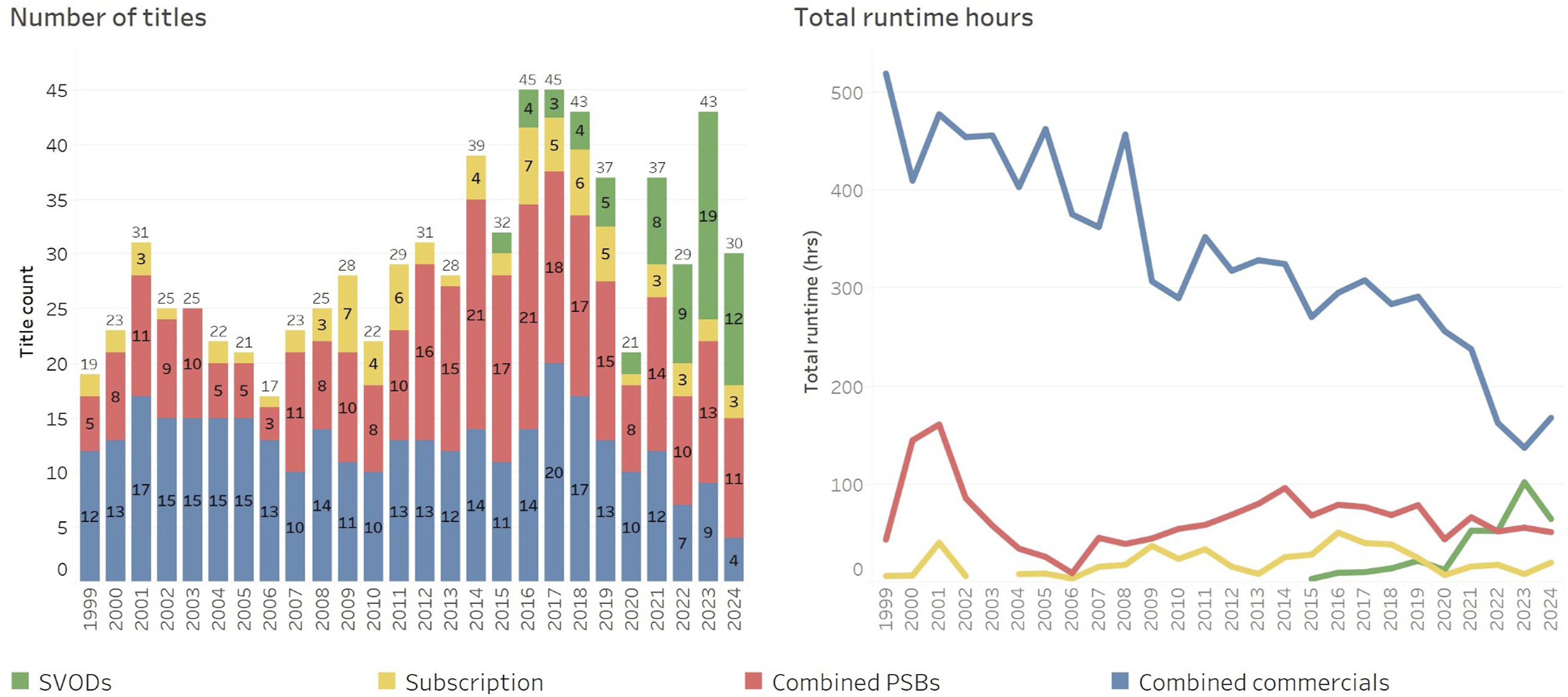
Rather than confront the collapse of drama investment by commercial broadcasters, recent policy attention has turned to the global streaming platforms as part of a lobbying effort by the Screen Producers Association to secure local content quotas on Netflix and others. After more than eight government inquiries between 2017 and 2022 and Labor’s 2023 Revive cultural policy document, the government finally agreed in November 2025 to impose a 10 percent investment quota on streaming services, a requirement most services already meet based on their current spending levels in the market. 4 Once again, few industry stakeholders have acknowledged the disproportionate responsibility now borne by the ABC, preferring instead to focus on the potential riches promised by global streamers that largely commission drama for audiences outside Australia.
Taken together, these developments have left Australia’s national broadcasters structurally central yet politically marginal to contemporary cultural policy. Policy debate has largely circled around the commercial survival of private broadcasters and the prospective contributions of global streamers, while leaving the ABC and, to a lesser extent, SBS to shoulder an unspoken, uncodified obligation to sustain Australian drama without the required funding. In a platform-dominated environment, this silence is not neutral: it normalises a settlement in which the institutions best equipped to deliver Australian stories to diverse publics are expected to underwrite cultural outcomes on an increasingly precarious foundation.
Conclusion: A case for deliberative reform
Set against the comparative frames opened at the outset, the Australian case is instructive less for its exceptionalism than for the clarity with which it exposes a wider governance problem. Comparative scholarship suggests that PSM resilience rests not simply on formal independence or the existence of a charter, but on regular opportunities to reconsider remit, obligation, accountability, and resourcing in public. Australia performs poorly on this measure. The ABC and SBS have legislated purposes and formal protections, yet lack durable mechanisms for remit renewal, obligation-setting, and the periodic alignment of public purposes with material capacity. Under these conditions, responsibilities grow by default, obligations stay indistinct, reviews occur sporadically, and shortfalls are recast as managerial problems rather than recognised as failures of policy design.
This is most visible in national drama, the lens through which this article has traced the effects of policy inertia. As the older commercial settlement has weakened, and as governments have relaxed the local content obligations once imposed on commercial broadcasters, greater responsibility for culturally significant Australian storytelling has fallen to public institutions. That shift has not been matched by any restatement of the ABC’s or SBS’s remits, by enforceable expectations about levels of provision, or by stable resources tied to those expectations. This, we argue, is the central comparative point. In Australia PSM is now central to cultural reproduction but no mechanisms exist that can specify what that importance entails in practice, including for the independent production sector.
Bringing the ABC and SBS into the same frame sharpens the argument further. Their histories, missions, and funding models differ, but both now operate in the same structural setting, one that treats independence as sufficient and leaves the work of renewal undone. In the ABC’s case, this has meant a lack of clarity about the allocation of its limited resources, with clear consequences for investment in high-cost genres. For SBS, the same setting has produced sharper exposure to hybrid funding pressures, remit contestation, and the accumulated political conflicts attached to multiculturalism. Comparative analysis shows these are not isolated institutional problems. They are connected outcomes of the same governance failure: there is no settled process through which purposes are clarified, trade-offs argued through, and obligations matched with resources.
Reform, then, should be understood as a condition of independence in digital circumstances rather than as a threat to it. What Australia lacks is PSM-specific review infrastructure: regular, arm’s-length processes through which remit can be reassessed, performance judged against clearly articulated public purposes, and resource needs identified in public. The international comparisons matter here. We are not suggesting that European models can simply be imported, or that they are untouched by politicisation. They do show, however, that recurring review, independent expertise, and clearer obligation-setting provide a firmer basis for legitimacy than reliance on ageing charters and episodic controversy. A German-style independent expert panel is one possible institutional form. Its value lies not in offering a perfect template, but in indicating how evaluation might be regularised, held at greater distance from day-to-day politics, and tied to the question of what PSM should do under changing technological and industrial conditions.
Australia’s current settlement is increasingly difficult to sustain. In a platform-dominated media system, where commercial broadcasters have retreated from expensive local production and global services organise distribution around scale rather than national cultural obligation, PSM cannot be treated as a residual inheritance from the broadcast era. Questions of discoverability, diversity, and distinctiveness now belong at the centre of governance. Without formal mechanisms specifying obligations in areas such as Australian drama and other high-cost public-interest content, the ABC and SBS will continue to carry expanding cultural responsibilities on weakly codified terms.
Australia therefore offers a cautionary comparative case of policy abstention presented as independence. The lesson is straightforward. Independence without renewal leads to drift. Broad purposes that are never restated generate ambiguity. Expectations that remain uncodified and under-resourced put culturally valuable forms of content at risk. Deliberative reform would do more than protect existing institutions. It would establish a public and repeatable way of deciding what the ABC and SBS should do, for whom, and with what support. That is the comparative issue this article has aimed to foreground. The future of Australian PSM will depend less on preserving charter language inherited from an earlier settlement than on building the governance machinery needed to renew public purposes under contemporary conditions.
Footnotes

Funding
The authors disclosed receipt of the following financial support for the research, authorship, and/or publication of this article: This research was conducted as part of the Australian Research Council Discovery program (DP210100849), a collaboration with Amanda Lotz.
Declaration of Conflicting Interests
The authors declared no potential conflicts of interest with respect to the research, authorship, and/or publication of this article.