







Abstract
This article critically examines the vernacular web as a notion that exists in conceptual ambiguity between Media and Internet Studies, Web History, and artistic and activist practice. Drawing on Ruth Levitas’s argument that utopian implications are often embedded within the Social Sciences and can be critically excavated (2013), it argues that the vernacular web operates across two registers: an analytical concept describing amateur, non-institutional, and ostensibly autonomous forms of online practice, and a temporally grounded imaginary that invests the early web with utopian value. By analysing the reciprocity between these two registers, the article traces how utopian assumptions about autonomy, participation, and digital well-being circulate across scholarship, historical narratives, and activist practice. Through the cases of Olia Lialina's essays and The Yesterweb, it identifies three constituent values of functional autonomy, while arguing that this imaginary remains half-baked: oriented towards aesthetics and affect rather than a reflection on the feasibility, limitations and potential risks.
Keywords
Registers of the vernacular web
In a 2024 BBC article on StumbleUpon, a 2001 initiative designed to let users ‘stumble upon’ websites of shared interest, one interviewee recalls, ‘[t]here was almost a utopian feeling to it. The internet was an inviting, cool place where you could literally stumble upon concepts and ideas that were fun’ (Paul, 2024). The sentiment that everything was better in the past can often be read between the lines of reports and commentaries covering the internet of the 1990s. The early web is remembered, or imagined, with affective longing as a period preceding standardisation, commercialisation, and centralisation – a stark contrast against today’s platformised and datafied digital environment. This retrospective vision increasingly informs contemporary initiatives that seek to recreate aspects of the early online experience, for example, bottom-up networks in the Fediverse (Roose and Newton, 2026).
Within Internet Studies and Web History scholarship, this imagined liberatory potential of the early web has received sustained attention and is sometimes framed through the concept of the vernacular web, which foregrounds grassroots and creative practices associated with 1990s internet cultures (e.g. De Seta, 2018; Howard, 2008). Here, ‘vernacular’ refers to non-institutional modes of online production and participation that resonate with these nostalgic accounts. What is collectively described as the early web, or the vernacular web, thus takes shape at the intersection of media theory and hopeful, utopian imaginaries, forming the central object of analysis in this article.
We argue that the vernacular web operates across two intertwined registers. On the one hand, it functions as an ontological research notion used to study practices, materiality, and modes of production or participation. Albeit loosely defined, scholarship has mobilised the framework of the vernacular, or vernaculars, to account for such approaches to Web History and media theory (e.g. Druckrey, 2006; Ernst and Schröter, 2021; Kluitenberg, 2011; Natale and Balbi, 2014). On the other hand, a temporally oriented vernacular web imaginary mobilises these same practices as fragments of a better past (now lost) and as resources for imagining alternative digital futures. Sustained through personal websites, manifestos, digital preservation initiatives, and activist design practices, this imaginary positions itself as a counterpoint to platform capitalism and values the early web for its amateur-driven ethos and perceived openness and authenticity. The imaginary is invoked not only as a way of narrating the past but as a model for possible futures, shaped by affective visions that influence contemporary activism through nostalgic practices focussing on reconstruction and repair.
This article offers a stepping stone for disentangling these two registers of the vernacular web, primarily by examining it as simultaneously an ontological notion and a temporally grounded imaginary. Drawing on Ruth Levitas’s formulation of utopia as a method (2013) already often implied in scholarship, the article approaches scholarly and artistic attention to the vernacular web as a site where normative assumptions about the necessary elements of a ‘good life’ are articulated, often implicitly. That vernacular web tends to be seen in a positive light is not incidental: the notion of ‘vernacular’ arrived in Media and Cultural Studies already coded as a site of agency and resistance, and a critical interrogation of texts mobilising the term in relation to the web is needed to avoid assuming this inheritance uncritically. As this article will show, two registers of the vernacular web are often closely intertwined across scholarship, art, and activist practice; making the internal contradictions of this entanglement explicit and tracing where it leads is precisely what an excavation of utopian elements allows.
The article proceeds in the following steps. First, Levitas’s approach to utopia is introduced, which would be further used as an analytical lens. Then, the article turns to the question of what ‘the vernacular web’ refers to, disentangling its ontological and temporal dimensions, showing how the term is being used to describe both particular characteristics of social practice and a historically situated phenomenon. The third part examines how this ambiguity becomes operative in the artistic and activist practice of Olia Lialina’s essays and The Yesterweb social movement. Finally, based on these explorations, we attempt a conceptualisation of the vernacular web as imaginary, identifying three constituent values: a freedom to configure the medium, a freedom to participate playfully, and a freedom from commercialisation. This constellation is not treated as a pronounced utopian vision but as a half-baked utopia, one that knows what it wants to escape more clearly than what it wants to build, and whose exclusive focus on liberation sidesteps harder questions of collective self-governance, harm, and political disagreement. We close with proposed questions for scholarly discussion on whether (and if, then how) the vernacular web can be utilised as a historical notion.
Utopia as method
We understand ‘utopia’ in a broader sense, drawing on Ruth Levitas’s book Utopia as Method (2013), where she conceptualises utopia as an attemptive mode, extending the definition beyond literature or political activism and tracing utopian thinking as a long-existing method within the Social Sciences. Levitas suggests that utopia can be seen as a method by giving it an alternative name: an ‘Imaginary Reconstitution of Society’, pointing to the effort of scholars to imagine or assume what is good for society, and what is necessary to achieve it. For Levitas, utopia is not limited to a particular literary form, a totalitarian political goal, or a clear blueprint for a desired social order. A utopia (or utopian) can be defined as ‘the expression of desire for a better way of living and of being’ (4), which does not have to be holistic, but can include various genres and modes of engagement with the topic of social good and desired social order. While utopia does not convert automatically into social change, neither should it be seen as an empty dream. Utopian thinking, in any form it is being expressed, is a fundamentally real phenomenon within the practices of social imagination. Following Levitas, utopia is not opposed to research. On the contrary, she argues that Sociology, as well as a range of other disciplines, has long employed utopian imagination as a method, illustrated through scholarship on values such as meritocracy, civil society, or GDP. Levitas does not stop at this observation, but further argues that utopia, as both a research and speculative method, should be normalised and theorised, and acknowledged as an already existing set of modes within scholarship. Recognising utopia in this way is not contradictory to the values and practices of scientific objectivity.
Archaeological mode of utopia
Theorising utopia as a reconstitution allows Levitas to distinguish three (interconnected) modes of utopian imagination within Social Science scholarship: archaeological (what has been said or misunderstood about the social good); ontological (what is needed for social well-being); architectural mode (how does one achieve this). For this present article, Levitas’s archaeological mode is of most interest and is understood as an act of excavation, critique, and reconstruction of ideas of the good society from scattered fragments of political and cultural artefacts. Archaeology undertakes excavations and reconstructions of both artefacts or cultures, based on a mixture of evidence, deduction and imagination, representing as whole something of which only shards and fragments remain. Where images of the good society are buried and denied, they are rendered partial and fragmentary. Utopia as archaeology entails the imaginary reconstitution of the models of the good society underpinning policy, politics and culture, exposing them to scrutiny and critique. (Levitas, 2013: 25).
Utopia as an archaeology of previous ideas can mean both supporting and critiquing them. Levitas suggests that utopian thinking within the Social Sciences includes practices of exposing utopia to judgement, be it in the spirit of suspicion or faith (154). Analysing practical artistic engagements with the history of the web, including reconstructions of historical aesthetics and practices, allows these interventions to be understood as utopian in their impulse. Media archaeological interest in the materiality of the early web can similarly be read as an imaginary reconstitution of models of the good society, particularly when such engagements position the early web as a preferable alternative to contemporary web ecologies.
Read in this way, a utopian impulse has long been embedded in Media Studies and Internet Studies, where questions of social, psychological, and political well-being with media have consistently shaped scholarly agendas, as this special issue seeks to show. This article focuses more narrowly on scholarship addressing the web during its first decade, alongside later retrospective accounts of web history. Approaching the vernacular web through utopia as a method allows us to see how critique and reconstruction operate across different social practices, circulating between Media and Internet Studies, artistic critique, and practical experiments. The sections that follow begin with an excavation of utopian narratives in early web scholarship, first through historical accounts and then through later media-historical reflections. We then trace how these utopian fragments are articulated through the concept of the vernacular web and, more broadly, through the vernacular, before turning to contemporary artistic and activist practices in which such elements are reassembled more explicitly.
Utopian fragments of the early web
The period of the 1990s was richly optimistic about the novel technology and what was to come. As Wendy Chun notes, it was ‘the future’; bold and utopian, described in ‘upbeat yet paranoid commercials promising an end to racial discrimination and the beginnings of a happy global village’ or ‘must-read cyberpunk novels or films outlining its gritty, all-encompassing nature’ (2008: 150). Such depictions were not limited to mass media, as popularised or widely read academic publications about the web are rich with utopian promises, advancing narratives of impending revolution frequently couched in digital utopianism, even when accompanied by cautionary notes. Authors introduced and popularised concepts such as ‘virtual community’ (Rheingold, 1993) and ‘network society’ (Castells, 2001) – terms that migrated from academic discourse into policy, law, and popular culture, where they continue to resonate. Following Levitas’s idea of an archaeological mode (2013), these early texts can be read as fragments of imagined good societies.
A digital hermeneutical analysis of intellectual books that discuss the social impact and significance of the internet, published between 1994 and 2006, shows that certain thematic threads recur (Fridzema et al., 2024). Accordingly, discussions of ‘virtuality’ often emphasised its contrast with physical reality, focussing on immersion, spatial metaphors, and the internet’s perceived capacity to reconfigure social bonds. At the same time, the web was presented as inherently social; a networked space enabling new forms of connection across geographic and cultural boundaries. These early narratives helped set the stage for later debates, establishing a shared vocabulary that bridged scholarly analysis, activism, and public imagination. Among the most emblematic examples of this early digital optimism is Howard Rheingold’s The Virtual Community: Homesteading on the Electronic Frontier (1993). Despite the book being published by the MIT publishing house, Rheingold was not a traditional academic but a self-described ‘native informant’ and ‘uncredentialed social scientist’ (16), blending personal experience with analysis in what he called a ‘do-it-yourself anthropology’ (11). Drawing on his own involvement in pioneering online forums such as the WELL, he envisioned cyberspace as a new frontier, borrowing imagery from Frederick Jackson Turner’s frontier thesis (1920), to suggest that users were digital settlers who built novel forms of social life. The book’s tone alternates between hopeful and cautionary; while championing the internet’s connective and democratic potential, Rheingold warned against commercialisation, censorship, and the erosion of user autonomy (300). His portrayal of ‘fiercely independent enthusiasts’ forging ‘closely knit communities and a rich culture online’ (cover copy) reframed the internet from a technical system into a space of everyday sociability (Flichy, 2007). Later commentators such as Manuel Castells (2001) and Fred Turner (2006) engaged with the concept of ‘virtual community’ more critically, questioning whether it accurately captured the looser, individualised forms of association emerging online. Yet even in these more sceptical accounts, the underlying image of a participatory, user-driven internet persisted. Seen through utopia’s archaeological mode, ‘virtual community’ functions as a fragment of the good society; an imaginative construct excavated from the early web’s discursive landscape, carrying with it ideals of decentralisation, creativity, and shared authorship.
Rheingold’s The Virtual Community (1993) is among the most frequently cited works on the internet and web’s significance published before 2006 (Fridzema et al., 2024), and its impact on scholarly discourse is hard to overstate. As with the vernacular web, the concept of ‘virtual community’ did not remain confined to academic writing, as it circulated into activist practice and shaped web development from the mid-1990s onwards. One striking example is De Digitale Stad (DDS, or The Digital City), the Netherlands’ first online network on the early web. Established to open internet access beyond professional and academic users, DDS sought to recreate the social and spatial qualities of Amsterdam in a virtual environment. The overlap with Rheingold’s vision was clear, and in 1995, he even took part in an open discussion organised by DDS (1995). A tangible reminder of his visit survives; on the title page of one of his books, he wrote, ‘For the Digital City Folks. Keep up the great work, building democracy and community in cyberspace’ (Amsterdam Museum, 2013). The alignment between DDS’s grassroots ethos and Rheingold’s utopian framing illustrates how conceptual visions developed in academic and intellectual circles could directly inform, and be reinforced by, activist projects. In this sense, DDS exemplifies how utopian imaginaries travel between scholarship and practice, generating feedback loops of critique and aspiration. (Figure 1) Signed title page of Rheingold’s book The Virtual Community. Source: Amsterdam Museum (2013). Sadgirl’s early manifesto version (https://sadgrl.online/newoldweb/manifesto.html), Internet Archive snapshot from February 2021.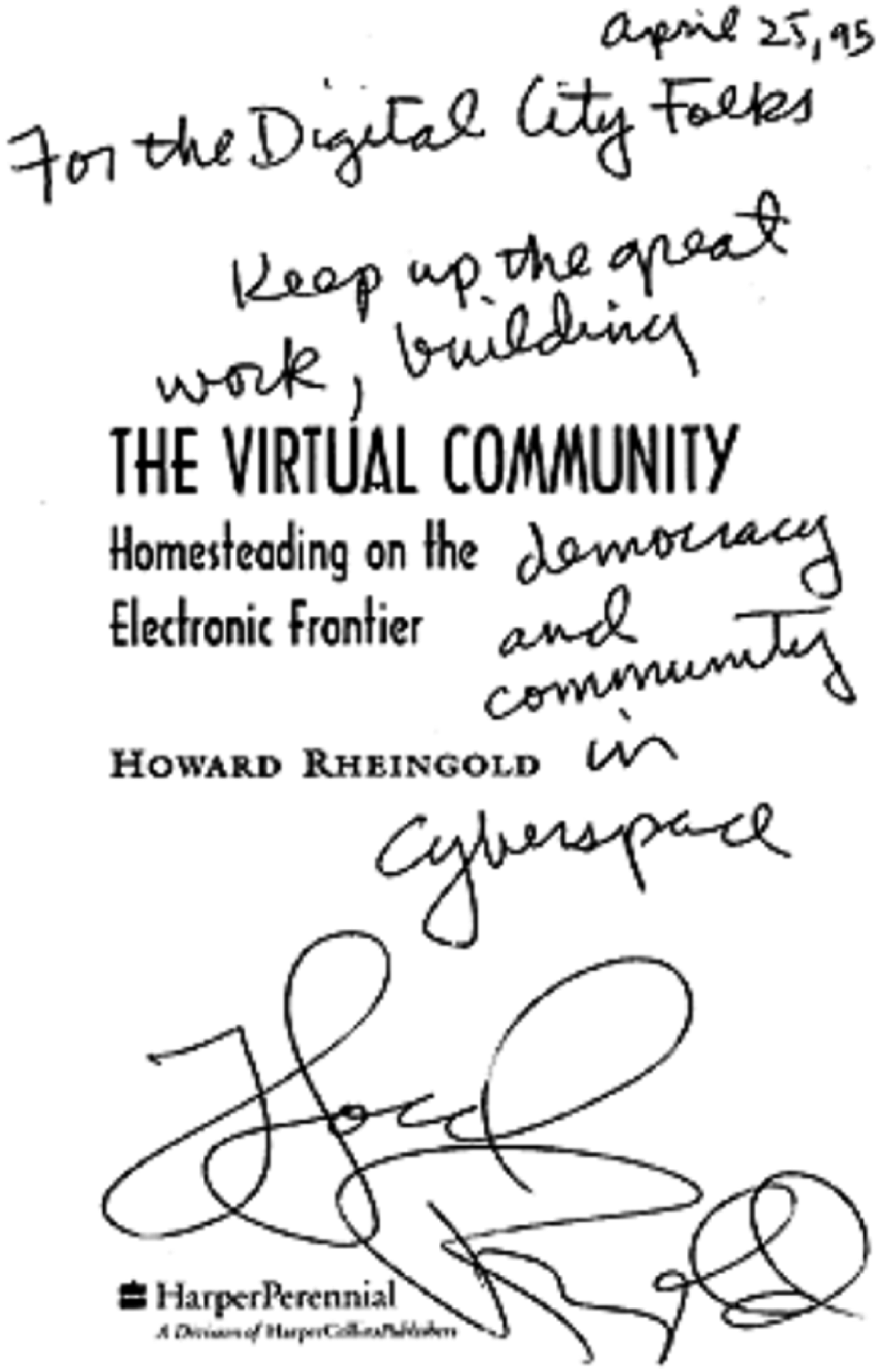
Utopian narratives of the web are not only found in historical accounts; they are also (re)produced in contemporary historical scholarship. Web History, a fast-growing field, enriches our understanding of the early web while often engaging critically with familiar utopian tropes like exploring virtual communities such as GeoCities (Mackinnon, 2022; Milligan, 2017). One topic that has encouraged such critical, historical exploration is the emergence of so-called Web 2.0 (Ankerson, 2018: 100–101). Popularised by Tim O’Reilly in his essay What is Web 2.0 in 2005, the metaphor is positioned to signal a turning point after the dot-com boom. He opens the essay writing: Many people concluded that the web was overhyped, when in fact bubbles and consequent shakeouts appear to be a common feature of all technological revolutions. Shakeouts typically mark the point at which an ascendant technology is ready to take its place at center stage (O’Reilly, 2005: 1).
The operational logics conceptualised as Web 2.0 were emphasised by O’Reilly as becoming central in how people should understand digital reality: platformized, commercialised, and user-driven. By presenting Web 2.0 as a paradigm shift, the essay implicitly casts what came before as outdated, retroactively framing the past web as something that is ceasing to exist. Critical accounts have emerged on O’Reilly’s utopian framing of Web 2.0. Marianne van Den Boomen (2008), in particular, argues that the web is discursively shaped by such performative metaphors. Similarly, she argues that ‘virtual community’ too was a cultural construct, emphasising a utopian vision of the 90s web as social and democratic. Van de Boomen states that Web 2.0 is not indicative of a technical revolution but can be best understood as a discursive marketing move; the same participatory ideals that existed prior were now selling points attaining to the commercial logic of platforms.
We can detect other strands of van den Boomen’s utopian critique, highlighting how Web 2.0 rebranded pre-existing participatory ideals under a commercial logic. Historians such as Ankerson (2015) and Stevenson (2016, 2018) approach this dynamic not through the lens of marketing discourse but by excavating continuities in practice and design. Their accounts demonstrate that the ideals associated with Web 2.0 – participation, sociability, user-driven creativity – were already present in the early web, further complicating O’Reilly’s rupture narrative. Michael Stevenson (2016) challenges the assumption that Web 2.0 marked a new paradigm of participation by tracing the history of HotWired, which was Wired magazine’s web-only publication launched in 1994. ‘The case shows how debates about the value of amateur participation vis-à-vis editorial control have long been fundamental to the imagination of the web’s difference from existing media’ (1331). Participation, in other words, was not a technological effect suddenly unleashed by Web 2.0 but a contested ideal negotiated within the institutional and commercial frameworks of the 1990s web. Similarly, Megan Ankerson (2015) developed a similar critique by questioning the historical boundary between ‘read-only’ and ‘social’ eras of the web. She writes that ‘the discourses of “read-only publishing” and the “social media revolution” can be reframed not as exclusively oppositional logics, but rather, as mutually informing the design and development of today’s social, commercial, web’ (1).
Through Levitas’s archaeological approach to utopian implications (2013), we can notice implied assumptions about what constitutes the good networked society scattered through web historic scholarship; in its earliest accounts through the framework of ‘virtual communities’ and later, as a critique, when questioning revolutionary rhetoric related to Web 2.0. Regarding the latter, the critical arguments regarding Web 2.0 as a point of discursive technical rupture, simultaneously resurrect and underpin utopian ideals of Web 1 through emphasising values like participation and democracy. This line of thinking perhaps relates to a broader trend in Media Studies that resists linear narratives of technological revolution. As scholars such as Chun et al. (2004) and Gitelman (2008) have shown, so-called ‘new’ media rarely emerge as genuine breaks, but are constituted through continuities, cultural negotiations, and recurring utopian tropes. In this sense, utopian implications operate on two levels: as an object of critical analysis in web history, and as a stance that shapes the discipline itself.
What, where, or when is the vernacular web?
Before turning to explicitly utopian projects of the vernacular web, this section clarifies what the term names in scholarly usage, and how its shifting ontological and temporal meanings shape the ways it can be mobilised in critique and imagination. As noted earlier, the vernacular web is a notion that is increasingly mobilised in Internet Studies and Web History, with the phrase appearing sporadically in recent conference calls and research descriptions (ACM, 2024; IIPC, 2024).
The term ‘vernacular’ itself has a longer trajectory. In linguistics, it refers to the language or dialect spoken by ordinary people in a particular region, as opposed to formal or official forms (Labov, 1973). Its uptake in Media and Cultural Studies gained momentum through Jean Burgess’s work on vernacular creativity, which reframed everyday media practices as a central object of cultural analysis rather than a residual category (Burgess, 2006). In Burgess’s formulation, vernacular creativity is explicitly tied to normative concerns within media scholarship. Reflecting on digital storytelling practices, she argues that changing uses of media in the 2000s carry ethical and methodological implications for Cultural Studies, particularly in relation to cultural agency and value. Her work articulates what she describes as the ‘democratic potential of a participatory cultural studies approach’, crystallised in the concept of vernacular creativity (2006: 201). She later defines vernacular creativity as ‘a productive articulation of consumer practices and knowledges (…) with older popular traditions and communicative practices’ (207).
Within scholarship on digital media, ‘the vernacular’ quickly becomes an abundant yet convoluted concept, touching on participation, connectivity, amateur production, and bottom-up cultural dynamics. Its growing prominence in Media Studies since the turn of the century corresponds with the expansion of networked platforms and related social expectations for the new role of media in everyday life. As Gabriele de Seta observes in his overview of vernacular creativity on the Chinese web, the popularisation of internet access and digital platforms moved everyday communicative practices to the centre of social life, narrowing the boundary between producers and consumers. It was, however, the spread of the World Wide Web in the mid-1990s that enabled vernacular creativity to be taken up by larger populations of amateur users (De Seta, 2018).
Vernacular creativity is a central thread in de Seta’s work on web culture, where it functions as a way to account for how users make themselves at home in changing media environments while simultaneously shaping political-economic conditions. Rather than treating vernacular practices as marginal, de Seta frames them as generative forces that open unexpected spaces for experimentation with forms, genres, and communicative opportunities (2018; 2020; 2024). From this perspective, vernacular creativity becomes ‘a productive category through which to rethink where the boundaries of the web lie today’(De Seta, 2024: 23). It offers a way to approach the web not merely as an infrastructure or archive of artefacts, but as a set of bottom-up practices through which the web is continuously enacted and reconfigured.
Beyond creativity understood primarily as everyday practice, ‘the vernacular’ (in relation to the web) also appears in attempts to theorise participatory platforms and networked media more broadly. Robert Howard (2008) introduces the notion of the vernacular web to describe how blogs and wikis hybridise institutional and non-institutional discourse. He argues that such environments enable ‘individual agents [to] dialectically invoke the vernacular as an authority alternate to that of any institution’ (Howard, 2008: 491). Importantly, Howard does not frame the vernacular as external to institutions, but as emerging within specific infrastructural conditions that complicate the opposition between bottom-up and top-down media. A related move can be found in Martin Gibbs et al.’s theorisation of platform vernaculars defined as ‘shared (but not static) conventions and grammars of communication, which emerge from the ongoing interactions between platforms and users’ (Gibbs et al., 2015: 257). Here, vernacularity is tied less to creativity as such and more to situated communicative practice shaped by platform architectures.
Another strand of scholarship connects the vernacular web to questions of online community and shared cultural worlds. Daniël De Zeeuw and Marc Tuters (2020) introduce the notion of the deep vernacular web to describe anonymous subcultural spaces such as 4chan, which they trace back to cyber-separationist spaces within early internet culture. In this context, ‘vernacular’ refers to a group-based discourse characterised by highly innovative expressive forms that are often deliberately opaque to outsiders (De Zeeuw and Tuters, 2020: 216). This emphasis on group-specific language echoes the original linguistic sense of the vernacular as a dialect tied to belonging, whether native or acquired. It is particularly apt for internet cultures, where participation often hinges on fluency in shared aesthetic, memetic, or linguistic conventions that are difficult to decipher from the outside.
Taken together, and following Levitas (2013), the focus of scholarship on the vernacular can be seen as at least partially methodologically utopian. In this respect, interest in the vernacular web resonates with a longer trajectory in Media and Cultural Studies that locates critical and utopian potential in the ordinary, from Raymond Williams (1960) to Stuart Hall (2013). It excavates everyday practices to surface alternative modes of cultural production, while simultaneously projecting possibilities for collective and participatory forms of digital life.
Asking what or where the vernacular web is means interrogating what kind of phenomenon it names and which assumptions are embedded in that naming. Across scholarship, the vernacular web appears variously as a sociological metaphor for participatory media, creative or communicative practices, as a group-specific creative practice, and as a constellation of (often memetic) aesthetics. Its meaning is not fixed but depends on context and period. Recent research on automation and artificial intelligence underscores this point; vernacular creativity continues to shift alongside changing media logics, giving rise to new forms of lore as users respond to algorithmic systems, creating algorithmic folklore (De Seta, 2024: 238).
The term ‘lore’ may therefore offer a useful umbrella for grasping the breadth of what vernacular web research attends to. The focus on digital vernacular creativity has strong roots in Digital Folklore Studies, where the vernacular traditionally denotes practices, beliefs, and narratives circulating outside formal institutions (De Seta, 2020). In Folklore and the Internet, Trevor Blank (2009) frames the internet as a dynamic site for vernacular expression, extending folkloristic inquiry into digitally mediated environments. As de Seta notes, approaching digital folklore through vernacular creativity ‘gives precedence to practices over objects, to the ambiguous position of users over the generalised identity of “the folk,” and to the social production of genres over the accretion of repertoires’ (De Seta, 2020: 10).
The temporal condition of the vernacular web then becomes conflated, as answering when it was or is remains challenging. Howard, for example, suggests that the vernacular web had ‘fully emerged’ by 1995, focussing on developments in the late 1990s and early 2000s (Howard, 2008: 501). Yet his usage of the notion of ‘the web’ is closer to the notion of social networks than the WWW. Other accounts discussed above all discuss a dimension of vernacularity and the web at a different state, therefore, functioning less as a singular temporal marker than as a way of grasping context-specific modes of expression. De Seta’s work on the Chinese web underscores this approach specifically by presenting an ‘episodic chronology of Internet use’, tracing how vernacular creativity shapes ‘the adoption of the technology before, during and after the popularization of the World Wide Web’ (2024: 3).
It is predominantly through Olia Lialina's work (2005, 2007, 2010), operating at the intersection of media theory and media art, that the vernacular web becomes a concept explicitly tied to the 1990s web and thus an explicit temporal notion, later reproduced in other artistic and activist narratives. The following section will dig into Lialina’s writings.
Olia Lialina’s vernacular web: Restoration of aesthetics and ethos of the early internet
A Vernacular Web (2005), Vernacular Web 2 (2007), and Prof. Dr Style: Top 10 Web Design Styles of 1993 (Vernacular Web 3) (2010) form a collection of essays by Olia Lialina, a media artist, archivist, and media art theorist. Under the notion of the ‘vernacular web’, Lialina refers to the personal, idiosyncratic style of the early WWW: hand-crafted homepages, glitterish GIFs, and playful design that was ‘bright, rich, personal, slow and under construction’ (2005). The essays treat early websites as vernacular artefacts, akin to folk art, and trace how elements like starry backgrounds, animated GIFs, and guestbooks emerged from the collective creativity of internet users during the late 1990s. For example, free graphic collections (ribbons, bullets, background tiles, MIDI files) are described as ‘the soul of the vernacular web’ that were enabling a spirit of sharing and expression (2005). Searching for the words to describe the unique character of her subject, she turns to metaphors and juxtaposes the ‘indigenous’ web of the 1990s with the corporate, ‘professional’ web that followed (the dot-com era and beyond); One could say it was the web of the indigenous…or the barbarians. In any case, it was a web of amateurs soon to be washed away by dot.com ambitions, professional authoring tools and guidelines designed by usability experts (2005).
Whether intentional or not, comparing early web users to barbarians and explorers, and framing the web as an open construction site, extends an imaginary of the ‘electronic frontier’, with users cast as ‘settlers’, as suggested by Howard Rheingold (1993, cover copy). While Rheingold used the metaphor to describe processes contemporary to him, Lialina turns to the same period retrospectively (roughly the 1990s and early 2000s), but approaches it from a position defined by historical distance and by media-archaeological curiosity. This gives the vernacular web a particular historical dimension, as it is predominantly addressed as a phenomenon of the past.
The vernacular web, as described in the three essays, is also understood as a specific ethos, a set of values. This becomes more prominent in the third and last essay, which focuses on how certain web design traits that emerged in the 1990s remained present after Web 2.0; an approach similar to the one used by Ankerson (2015) as discussed prior. Lianina’s third essay (2010) focuses on the personal websites of university professors in particular, pointing to a certain ethos behind it which she describes with just one boldly typed word: ‘independence’. Here, the essay shows a more pronounced normative position, as it criticises how the expertise in graphic design became more important than the expertise in web design, leading to the loss of user independence to constitute their own digital environment. Knowledge of web design is pictured in a positive light, as it gives one the possibility to, for example, resist corporate identity; web pages in the style of the early internet are seen by Lialina as a practice of aesthetic freedom.
The way the vernacular web is discussed in the three essays offers a unique perspective on the notion, which combines aesthetic and ethical, ontological and historical elements. Firstly, vernacular web is used as a reference to a particular aesthetic phenomenon. Lialina’s work approaches the notion of ‘web’ in a material and not metaphorical way, as a matter of web design. Unlike Howard (2008), ‘the web’ in her essays is not treated as a sociological metaphor for social connections, but as a technical-historical reference: The World Wide Web.
Secondly, the essays draw from a small part of the history of the internet, a particular aesthetic of amateur HTML programming, especially present within GeoCities. Essays resurrect and discuss different elements and practices from the web history, which in their totality are meant to serve as a practical inspiration, if not a model. Looking at GeoCities, these essays excavate and holistically present a set of values about how one can relate to the internet, present oneself online, or approach online sociality. This creates an intense proximity between a media-historical practice and the question of what constitutes a good life with the internet. Lialina’s essays approach the topic of a desired life by recovering, analysing, and reevaluating phenomena from the web’s past, which are found sympathetic–with a focus on design aesthetics, design practice, and ethos.
Thirdly, the essays connect interests from different fields, which results in the notion being picked and interpreted in various directions simultaneously. The vernacular web is approached as: a phenomenon within the history of the web; an example of digital vernacular creativity; an illustration of historical approaches to web design; a reference to inspire future net art and web design practices.
Altogether, the usage of the notion has qualities of the ontological understanding of ‘vernacular’, while also positioning the phenomenon within the past. This implied duality is mirrored in the scholarly reception of the text. On the one hand, Lialina’s approach to the internet’s history finds resonance among Web History scholars; in 2019, she gave a keynote lecture at The Web That Was RESAW conference (Lialina, nd), commenting on the aesthetics of an early web practice of self-hosted lists and collections. On the other hand, Lialina’s works have influenced scholarly discussions of vernacular creativity in other time periods, for example, in the works of de Seta, who draws theoretical inspiration from her co-edited publication Digital Folklore for his research on vernacular creativity (2019; 2024).
The Yesterweb: Restorative nostalgia and its limits
If Lialina’s approach to the web’s history discursively reconstructs certain aesthetic and ethos (2005; 2007; 2010), such internet social movements like The Yesterweb attempt a more hands-on approach to resurrecting some elements of the early web. The Yesterweb movement began in February 2021 during the coronavirus pandemic and ongoing lockdowns in several countries. First, a Discord server and a website; it later expanded into a webring, a zine, and a forum (The Yesterweb, nd). The title is a combination of the words ‘yesterday’ and ‘web’, referring to the nostalgia about the web’s history as the main theme of the movement. However, the nostalgic approach was eventually rejected as limiting and misleading.
By late 2021, the community grew rapidly, spearheading an anti-Web3 campaign and publishing an explainer titled Keep the Web Free, Say No to Web3 (The Yesterweb, 2021a). Through 2022, activity spread across Neocities and peripheral spaces, including the publication of multiple zine issues (The Yesterweb, 2021c-2023). As reported by members, the Discord counted roughly 5000 participants, the forum about 600, and the webring over 800 sites (Melonland Wiki, 2023; Seirdy, 2023). Tensions over scale, moderation, and future steps culminated in the shutdown of the Discord in February 2023 (The Yesterweb, nd). On May 1, 2023, the forum was closed, and the organisers declared an indefinite hiatus of The Yesterweb as a collective project (The Yesterweb, nd).
The Yesterweb participants rarely used the notion of the vernacular web, but they did refer to the ‘old web’, which is understood similarly as a web of non-commercial, bottom-up creative and social practices. The old web is seen as the one with a spirit of user agency over the internet, an assumption expressed right within the call to join the movement. The Yesterweb is made up of netizens who acknowledge that today’s internet is lacking in creativity, self-expression, and good digital social infrastructure. We do not wish to ‘go backwards’, by condoning hate speech and discrimination, and/or gatekeeping users of the net. We wish to forge a new path forward, one that aligns more closely to the ideals of the early internet in terms of user-owned and operated pages, ad-free spaces and community building. Find us on Discord (The Yesterweb, 2021b).
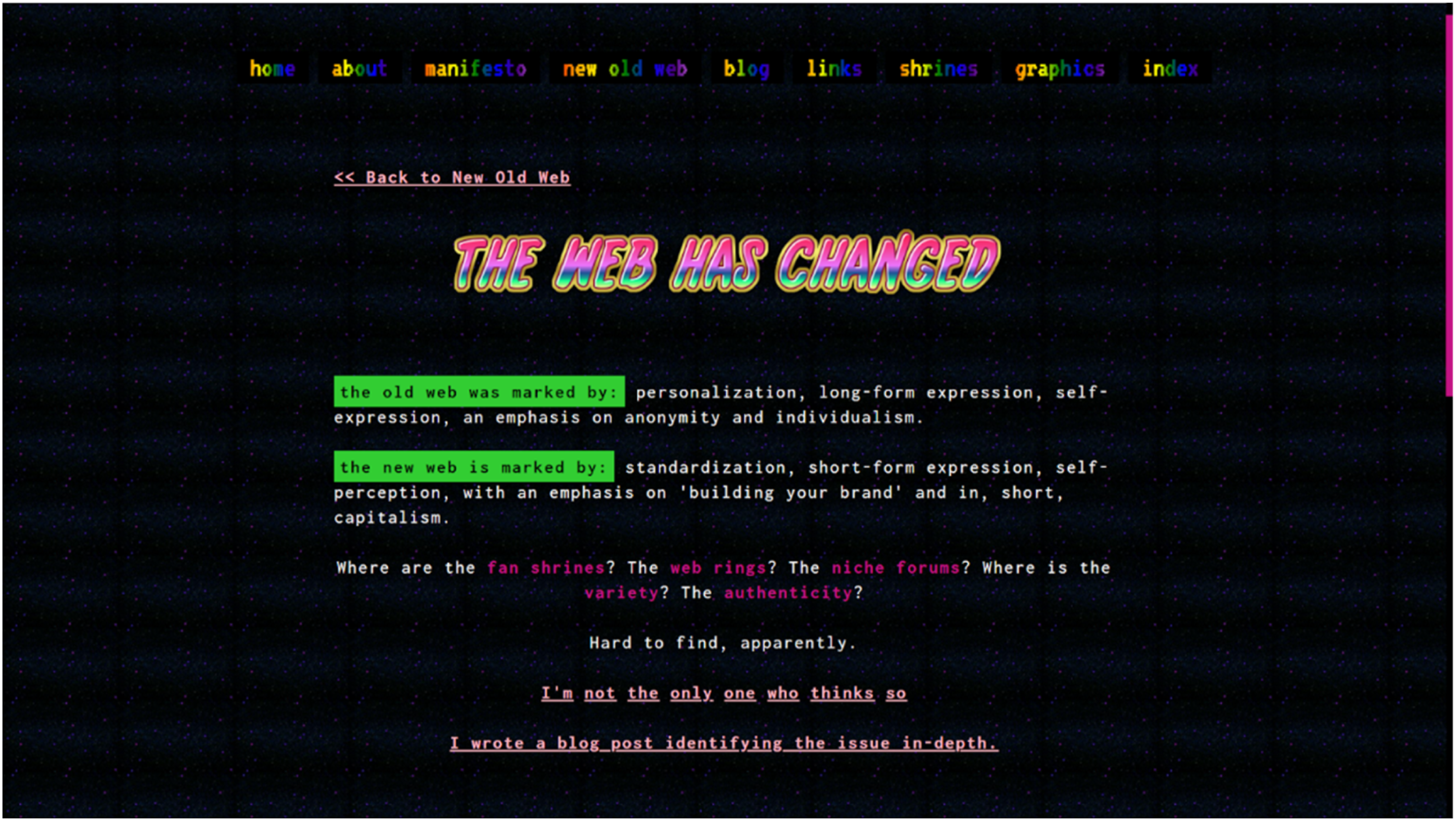
The old web is thus seen as defined by ideals and design elements that are not present in the contemporary internet as strongly anymore. The interest in the internet’s past has a clearly utopian goal and serves as a source of inspiration for a ‘path forward.’ One of the earliest texts about ‘the old web’ within The Yesterweb discourse was the Internet Manifesto published by a user under the nickname Sadgirl, which became one of the most quoted texts of the movement, encapsulating some of the main sentiments and critical points (Sadgrl.online, 2021, 2022, 2023).
The text was published in a series of iterations, where both its design and its content have changed multiple times, yet the main matter of concern remains the same Figure 2. The text distinguishes between two webs, or two states of the web: the web of today is pictured as harmful and unsatisfactory, and deserves critique. The other web is sketched as an alternative; the old web, or, more precisely, the practices of using the web in the past. While ‘the past’ does not have a strict definition here, there are characteristics used to refer to what is seen as the core elements of the old web: its communal nature; horizontal and reciprocal communication (in contrast to parasocial experience of following celebrities on social platforms); extended possibilities for creative engagement with web design; independence from market (the old web is referred to as a space separate from commercial practices, data collection and targeted advertisement).
The Yesterweb’s focus on vernacular elements of the web parallels Olia Lialina’s attention to personal webpages, though their orientations differ. Both draw on empirical traces of early user-made websites: Lialina’s essays centre on personal pages from Geocities (1994–2009)–the international hosting service remembered for its neighbourhoods of non-commercial, amateur design and writing practices–and The Yesterweb communities built their sites on Neocities, a platform launched in 2013 with the explicit aim of reviving the creativity, independence, and playful aesthetics of the 1990s web. While Lialina’s work situates vernacular pages within an artistic and historiographical exploration, The Yesterweb positions them within an effort to rebuild the web that was lost. In this sense, both artistic initiatives are in dialogue through their shared focus on personal homepages, yet their utopian impulses diverge: one reflects on the past as heritage material and ethos, the other mobilises it as an inspiration for a practical effort of (re)shaping the web. The main activity was tied to homepages and blogs. Members used plain HTML to manually design their online spaces through personal and collective websites, blogs, manifestos, often generously sprinkled with pixel art, frames, GIFs, playful or informational banners. Speaking with Levitas’s distinction between different modes of utopian imagination, The Yesterweb members’ practice was not just archaeological (reconstructing ideas or values), but architectural (using said values for prototyping or hands-on experimenting). Both are utopian practices and impulses; however, in The Yesterweb practice, the latter is based on the former, as the potential for building a good society is positioned in the past.
The ‘old web’ here is a discursive construct, but simultaneously also a layer in the ever-changing web ecology palimpsest. Plain HTML, as a part of the internet infrastructure and a tool for amateur design practice, has never fully gone away; the contemporary platformised ecology has simply standardised and simplified its front end for everyone to easily join most social media platforms. This creates a special situation of proximity to history, as contemporary users can engage with both ‘old-style’ coding and with archives of the early web, for example, Sadgirl hyperlinks some websites from the 1990s. Material artefacts that mediated the internet 20 years ago can seem very close, and thus, again, one can experience that they can be restored or reclaimed. The political engagement within The Yesterweb is a manual operation of digital material objects, close to the aesthetics of the early amateur web with its common ‘under construction’ banners. But in the 2020s, instead of the rhetoric of a collective construction work, authors turn to the image of repair, restoration, and reconstruction.
The turn to an imaginary past in The Yesterweb’s texts can be better understood via the theoretical exploration of nostalgia, suggested by the cultural theorist Svetlana Boym (2001). Boym distinguishes two types of nostalgia: a restorative and a reflective. Restorative nostalgia turns to the past as if it is possible to access it as it was, ‘to rebuild the lost home and patch up the memory gaps’ (Boym 2001: 41). Reflective nostalgia, in contrast, is grounded in the idea of an unbridgeable separation between the past and the present, which allows for a special kind of longing. Boym’s account of nostalgia also helps to understand the confusion about whether the vernacular web is a temporal phenomenon or not, as nostalgia itself brings a combination of both a spatial and temporal dimension; ‘nostalgia appears to be a longing for a place but is actually a yearning for a different time’ (2005: xv).
The perspective on the web’s past and future via a nostalgic sentiment was eventually problematised within The Yesterweb. As a social movement, its texts express a wide range of opinions about internet problems and possible solutions, and specifically, the role of nostalgia in relation to political change was one of the contested topics. The Yesterweb’s Manifesto (nd) summarises the debate, among other things, problematising an uncritical imaginary of the early web: Many users would express a desire to return to an “old web” that did not exist, often with beliefs that the old web was inherently less bigoted, less consumerist, and less restrictive. While some of this is true depending on where you look, users would become hyper-focused on returning to a past that never existed rather than wanting to pursue a future that fit their values (The Yesterweb, nd).
The manifesto concludes that the imaginary of the old web, in their case, proved to be ineffective for a collective action as it was attracting people with both conservative and progressive ideas about a path to a better web, which made it hard to agree upon the further practical steps. Yet the imaginary was highly mobilising, producing a response not just from people of different political views, but also from different generations, including younger people who have never experienced the early years of the web themselves.
While The Yesterweb participants seemingly did not have the resources at the time to solve the tension between a longing for the past and the desire to shape the future, the case itself poses an interesting question about the role of nostalgia for the utopian imagination. By picturing the early web years as more vernacular, The Yesterweb authors use a nostalgic imaginary of the past to mobilise a broader public and consolidate a longing for a better life online. The imaginary treats web history as an archive of culturally available practices that could be restored and re-embedded into contemporary life online, including interfaces, styles, and social configurations like guest books or forums. By this attention to the past, the imaginary consolidates and expresses certain collectively shared values and needs, and creates images of what a good life online could (or even should) be. Beyond a purely aesthetic interest, the vernacular web articulates collectively shared values, projected onto the elements of the old web that could be an answer to a deeper dissatisfaction with the internet’s present condition. An imaginary of the vernacular web can be thus seen as an attempt at an answer to the question: what relationship with the internet is good for its users?
The vernacular web as a utopian imaginary: Three values constituting a functional autonomy
To summarise, we can define the vernacular web as an imaginary of a particular mode of existence online, with the web that relies on a freedom of bottom-up and amateur-friendly social practices, aesthetics and web design practice. This utopian thinking is grounded in the idea that such a web was more possible in the past, and historical interest can be used as a guiding tool for a contemporary utopian, architectural (in Levitas’s sense) practice.
Why is it important to highlight the vernacular web as an imaginary? We argue that approaching it as such helps see it as not purely a question of an accurate (or not) interpretation of web history, but as a fundamentally utopian question of a common good–both in scholarship, art, and within social movements. Levitas, speaking with David Harvey, argues that discussion about desired forms of society thrives within the context of dialogical forms, as imaginaries require ‘both confronting the hidden utopianism and resurrecting it to act as conscious architects of our fates’ (Harvey cited by Levitas, 2013: 154–155). We do not attempt to side with or against the vernacular web imaginary, but to make its implied values explicit and open to debate. Our position is grounded in the idea that there is a need for a continuous discussion on the necessary conditions for a good-quality life with digital technologies. The three values identified below should be read in that spirit.
Further, Levitas argues that ‘any proposal for a better world necessarily entails claims about what is good for people and makes them happy’ (2013: 174). Applying an archaeological approach in Levitas’s spirit would then mean a reconstruction of built-in implications about a good life. Having done so, we argue that the vernacular web’s understanding of a good life can be defined as an aspiration for functional autonomy. As Johan Soderberg and Maxigas (2022) define it in their inquiry into hackers’ political history, functional autonomy is ‘the capacity of a collective to determine its own goals and rules of conduct and then to remain true to those goals and rules no matter what the cost’ (17). They define three pillars of autonomy: technical skills, historical memory, and shared values. While nostalgia provides a gateway to technical skills and, with some limitations, to historical memory, shared values are less explicitly articulated. In the next section, we identify three values and related assumptions within the imaginary, each being a specific kind of desired individual or collective freedom. Each of those freedoms comprises assumptions of what it means to feel good online (e.g. feelings of safety, belonging, creative inspiration), and what is necessary to feel good online (e.g. access to non-commercial social online spaces).
Freedom to define the medium
One recurring value in the vernacular web imaginary is freedom to configure the medium, as Ankerson (2015) calls it: the possibility to tinker with the code, and thus, the arrangement of online spaces, interfaces, and aesthetics. This freedom requires a certain technical curiosity, but also infrastructures that invite or at least allow modification. In practice, as The Yesterweb case shows, it can be achieved through peer-learning, prototyping, or what might be called a hands-on media-archaeological approach, retrieving and repurposing older technologies and design practices from internet history.
Lialina’s essays repeatedly tie amateur web design to the topic of independence, while also describing bottom-up engagement with the web as carrying ‘the meaning of a close, true relationship in between users and their medium’ (2010). The revival of hand-coded HTML on Neocities echoes this impulse; by working directly with the material of the web, users reclaim the tools of production. This closeness to the medium fuels a hope for a certain empowerment. As Kendal Beynon puts it, ‘individuals can subvert the power structures that typically regulate mainstream digital spaces, creating platforms that reflect their values and ideals’ (2024: 35). Freedom to configure the medium is defined relationally; in the 1990s Rheingold contrasted the early web (mainly BBS) to the dominance of mass media corporations (1993), while later revivalist movements contrast the amateur-friendly web with a platformised, datafied ecology. In both cases, the vernacular web imaginary promises (whether or not it is realistic) a different kind of closeness to the medium, and through it, the ability for more democratic discussions via a bottom-up arrangement of diverse, various discussion spaces.
Freedom to playfully participate
A second built-in value is the freedom to play; to experiment collectively in non-professional, non-instrumental ways, and to treat the web as a space of exploration rather than optimisation. Play here is both aesthetic and social, as playful interactions create a feeling of belonging and togetherness. It can include design tinkering – for example, the playful aesthetic derived from Digital Folklore (Lialina and Espenschied, 2009) – but also contemporary cultural expressions through stories and characters created through generative AI (De Seta 2024), as well as reciprocal practices like guestbooks or forums. The feeling of safety is both a prerequisite and a result of playfulness, and is seen as a crucial element of a good life online.
The folkloric roots of this idea are significant. In Folklore Studies, the vernacular denotes traditions and expressions that circulate horizontally, outside official institutions, which is extended by Blank to the internet, where vernacular expression thrives in memes, rituals, and user-generated genres (2009). The vernacular web imaginary draws on precisely this sense of folklore; the idea that culture online is made bottom-up, through playful exchanges and shared repertoires. This value has deep roots in Media and Internet Studies. Rheingold’s Virtual Community (1993) described the internet’s promise as the creation of convivial environments for discussion and mutual support, while Howard (2008) framed the vernacular web as participatory media between institutional and non-institutional actors. De Zeeuw and Tuters (2020) later extended this to the deep vernacular web, where playful sociolects and in-group creativity bind communities together. In more recent revivalist discourse, The Yesterweb’s Manifesto cast playful engagement as an antidote to the problem of ‘optimisation of algorithms to drive engagement (and ultimately revenue) at the cost of mental and social well-being’ (nd). The freedom to play can mean the ability to disengage from what is perceived as unsafe or harmful places, be they offline or online. Whether expressed through digital folklore, communal invention, or reciprocal exchange, the vernacular web imaginary frames play as a prerequisite for feeling safe, creative, and at home online.
Freedom from commercialisation
A third recurring value in the vernacular web imaginary is the possibility of disengagement from commercialised environments, and the cultivation of spaces where participation is not premised on advertising, monetisation, or platform control. In this framing, a good life online means access to environments outside of profit and optimisation logics. This critique can appear at the rhetorical level; Marianne van den Boomen, as discussed, exposes how Web 2.0 repackaged older ideals of participation as marketable upgrades, masking continuities behind the rhetoric of a technological revolution (2008). Historians such as Stevenson (2016) and Ankerson (2015) have shown similar dynamics from another angle: what O’Reilly casts as the dawn of a new participatory web was in fact the re-labelling of practices already alive in the mid-1990s. In both cases, commercialisation did not erase participatory ideals but co-opted and resold them. The vernacular web imaginary positions itself against this capture. Lialina’s writings (2005: 2007: 2010) can be read as part of the same critique; her celebration of independence and amateur design implicitly rejects the professionalised, corporate identities of the dot-com era. Similarly, revivalist movements such as The Yesterweb struggle for the ability to inhabit spaces ‘free from advertisements, commercialization, recommendation systems, and monopolization’ (The Yesterweb: nd). Their manifesto highlights an entanglement between data extraction, privacy loss, and the erosion of agency and argues that well-being online requires forms of sociality not mediated by the market.
Freedom from commercial ecologies is therefore both a rhetorical and practical concern. It entails the right to exit optimised platforms but also the hope of controlling one’s digital traces, such as deciding when and how data persists, moves, or disappears. The vernacular web imaginary claims that social flourishing depends on the existence of non-commercial, user-determined spaces where participation, not profit, defines belonging, yet the meaning and practicality of a true ‘ownership’ of digital content and platforms remains fraught.
The half-baked utopia
It should be pointed out that the shared values defining this functional autonomy are all based on the ideal of individual liberation. The utopian impulse rests on an assumption that distance from government, market, and professional internet experts would allow for a more peaceful, socially fulfilling, and joyful life online. The predominant focus on individual liberation raises questions about the imaginary’s sustainability and a lack of shared values that could guide limitations of an individual’s freedom for the collective good, prevention, or reparation of harm, and strategies for the defence of such autonomy against further commercialisation. Similar critique is expressed in an essay by Daniel Chávez Heras, who describes a general rise of interest towards minor tech and small-scale practical interventions into digital environments as grounded in an overly-romanticised image of a simpler, agentic, cosy way of being online: ‘the digital pastoral’, as he calls it (2023: 1). The pastoral, as a genre, imagines a more innocent life outside the corrupting forces of modernity, and tends to obscure more than it reveals. Applied to the vernacular web imaginary, this means that the warm aesthetic and affective attachment to the past substitutes for a genuine political programme. Without a more nuanced discussion of political organisation and the boundaries of individual freedom, such utopia risks staying only ‘half-baked’, attending only to the potential goods and avoiding discussion of potential harms, thus remaining open to politically opposite appropriations: anarcho-communalist ideals on one side, libertarian ideals on the other – a tension explored and critiqued by others, for example, in Fred Turner’s From Counterculture to Cyberculture (2006).
This ambivalence, however, is not unique to contemporary activist communities as it is structural and traceable to how the concept of the vernacular entered Media and Cultural Studies in the first place. As noted earlier in this article, there is a longer tradition that has positioned everyday, amateur, and non-institutional practice as the primary site of cultural agency. The vernacular arrived in web scholarship already often coded as the underdog worth championing, or at least getting charmed by. The bias toward the vernacular as rather positive is, in this sense, a disciplinary inheritance, which is precisely why the very normative grounds guiding the scholarly interest in the early web and the vernacular tend to go unreflected. One does not argue for the goodness of something one has already assumed.
This article is not exempt from that inheritance. Choosing to disentangle the concept of the vernacular web exemplifies our bias towards the academic worth of this discussion, and potentially the concept itself. Prior to deciding to write the article, we have noticed how the notion slips uncritically into the informal discussions within Web History – including our own – especially when historical grassroots phenomena are discussed. But before considering the notion as analytically productive, one has to make visible its long utopian trace, spanning across different fields of practice. Furthermore, a utopian archaeology performed on this article’s own arguments would likely uncover other inherent commitments: to conceptual precision, to the value of historically grounded analysis, and to the idea that making implicit normative assumptions visible is itself a form of scholarly responsibility. Those are positions about how web history scholarship ought to work, and they animate this article no less than utopian thinking animates the practices examined here.
What motivates the critique, then, is not scepticism toward the imaginary but something closer to care. We find it politically meaningful when people actively think about better conditions for their lives with the internet, and that investment is present in this article, too. At the same time, any uncritical romanticisation of the past risks simplifying the conditions needed for well-being online and reaching for easy resolutions where harder questions remain. Especially when the vernacular web is understood as a utopian model for a good life online, the historical accuracy of the assumed characteristics of the early web should remain subject to critical scrutiny. This is why we have attempted a dialectical stance that takes the vernacular web seriously enough to hold it to account: not to dissolve it, but to provide critique that could potentially make it more durable, more self-aware, and more precise across both artistic and scholarly practice.
Conclusion
This article has examined the vernacular web as a notion that operates across two intertwined registers: as an analytical concept used to describe modes of cultural production, and as an imaginary through which the early web is invested with utopian value. The former understanding attains a more ontological function, whereas the latter reveals a temporal dynamic honed in the past. However, by defining utopia as a method of doing research, both scholarship and artistic or activist practice can be seen as utopian – where specific understandings of autonomy, reciprocity, and creativity are excavated from the web’s past and mobilised in critique of the present. Rather than treating these impulses as either naïve or misplaced, the article has tried to make visible how they function and where their limits potentially lie.
The iterative dialogues that create the vernacular web in various spaces expose the complexities of using the past to imagine the future. If the internet’s past serves as inspiration for imagining a better web, the historical accuracy of that past matters less than its ability to mobilise values and paths forward. But if the imaginary is conflated with history, the danger arises of trying to rebuild something that never truly existed. As Svetlana Boym describes it, ‘the nostalgic desires to obliterate history and turn it into private or collective mythology, to revisit time like space’ (2001: xv). This temporal slippage underpins the ambiguity of the vernacular web; both an ontological condition and a temporal object. Here, restorative nostalgia risks becoming dogmatic. The early web had its own challenges and imperfections (as scholars and activists referenced here have pointed out). That this tension is not merely an academic observation but an active site of contestation in contemporary practice is illustrated by the initiative Error 417 Expectation Failed, a 2026 open call for critical net art, taking as its explicit subject what it terms ‘netstalgia’: the selective and idealised remembering of earlier phases of the internet. The call positions this nostalgic mode not as harmless sentiment but as a mechanism that repackages nostalgia as critique while leaving data extraction, corporate control, and structural inequalities untouched; whose histories are remembered and aestheticised, and whose are erased or marginalised? As the open call essay points out, for many younger users, the early web exists not as a personal lived history but is experienced through a mediated archive. The vernacular web imaginary, in other words, increasingly operates as an inherited affect rather than a lived memory, which raises uncomfortable questions about what is actually being longed for, and whether the past being mobilised ever corresponded to anyone’s experience at all. That Olia Lialina, whose essays on the vernacular web form one of the central cases examined in this article, sits on the jury for this call is less a biographical footnote than a sign that the ambivalence traced here is not something imposed on the imaginary from outside; it is being worked through from within (Murcia, 2026).
More dialectical dynamics between media research and media practice, such as Error 417, could allow for richer and multiple narratives about the continuity between past and present, beyond the imaginary of a lost paradise. References to the past can alternatively be used as part of ‘a statement of the continuity of struggle, of repetition that is not repetition’, as Levitas mentions in one of her cases (2013: 192). Maybe in artistic and activist practice, the vernacular web is best understood archaeologically, not as a past to be reconstructed, but as a repertoire of fragments, including those that failed or were overcome, that can be re-engaged as material for utopian imagination.
At this point, the question from the perspective of Web History arises: can ‘the vernacular web’ also be an operable historical concept? We see how it increasingly slips into web historical discussions, being interpreted and applied in ways that are not always compatible with one another. Rather than offering definitive answers, we propose that media scholars and practitioners approach the notion through a set of open questions: (1) (2) (3) (4)
The archaeological approach to utopian thinking within scholarship is about excavating fragments of hopes or values and picturing them as a whole, but it is also about critically putting this whole under scrutiny. This article argues that whether scholars like it or not, a hopeful imaginary of a good early web is already there. The next necessary step, if we stay with Levitas’s understanding, would be a more substantial, more diverse critique of the utopian promise of both the early web and the vernacular characteristics of the web, identifying false assumptions, knowledge gaps, and an inquiry into the values and needs that drive people to turn to the internet’s past with hope. This is where the vernacular web’s internal contradictions and a complex position between history, theory, and imaginary can be productive.
Footnotes
Acknowledgments
The authors thank the editors and reviewers for their constructive comments and pointed suggestions, which helped strengthen the article considerably from the very start and challenged us to adequately think through the argument. They also want to thank those who provided feedback on an early conceptual version presented at the ReDICo conference in 2025, including Fergal Lenehan, Luisa Conti, and Kendal Beynon. Thank you, Alessandro Longo, for providing feedback on the first draft.

Ethical considerations
No ethical approval or informed consent was required for this study, as it did not involve human participants or animals.
Funding
The authors received no external financial support for the research, authorship, and/or publication of this article. This research received no specific grant from any funding agency in the public, commercial, or not-for-profit sectors.
Declaration of conflicting interests
The authors declared no potential conflicts of interest with respect to the research, authorship, and/or publication of this article.
Data Availability Statement
The data that support the findings of this study are available in the public domain. No new data was created.