






Abstract
Older adults are often perceived as vulnerable to digital exclusion, a notion exacerbated by the Covid-19 pandemic and the increased reliance on digital technology. This study investigates how older users perceive their own digital inclusion and explores whether they are influenced by stereotypes associated with older individuals and digital technology. Through an analysis of 37 semi-structured interviews with older users in Belgium, this research reveals that older individuals interpret their digital inclusion through a life course lens. Previous education and professional experiences contribute to their current level of digital inclusion. However, participants demonstrate awareness of ageist stereotypes and use them to differentiate themselves from older non-users. Interestingly, while they actively challenge and refute these stereotypes in their own digital engagement, they occasionally unintentionally employ the same stereotypes when describing individuals who do not use EICT.
Introduction
The everyday practices of most people have become permeated with digital technologies, this digitalization of everyday life has accelerated in the aftermath of the Covid-19 pandemic. As it was instrumental in embedding the use of digital technology in the daily lives of people (Seifert et al., 2021). Older adults are often discussed in terms of digital exclusion (Weil et al., 2021), and during the pandemic those aged 65 and older were often seen as an especially vulnerable group in regard to social and digital inclusion (Seifert et al., 2021; Van Deursen, 2020; Van Dijk, 2020). For older adults in Belgium a study found that those 74-year and older are more at risk to be digitally excluded (Faure et al., 2022) and in Flanders (Dutch-speaking part of Belgium) 83% of those aged 75 and older state that they are experiencing some form of difficulties while using digital technology (De Marez et al., 2022). However, research on the Belgian population indicates that older adults are not the only ones at risk of digital exclusion; 46% face this risk due to stagnation in their digital skills (Koning Boudewijnstichting, 2022). However, the narratives surrounding ageing and technology tend to assume that older adults are not tech-savvy or frequent users of digital technology (Comunello et al., 2023; Ivan and Cutler, 2021). Moreover, older adults are often portrayed as illiterate digital immigrants when it comes to their digital technology use (Loos et al., 2017; Rasi, 2022). In response to these ageist stereotypes older adults refrain from engaging with digital technology to avoid reinforcing or validating these stereotypes (Mariano et al., 2020). Various studies have explored what is necessary to become a successful older user (Olsson and Viscovi, 2020; Silver, 2014; Vulpe and Crăciun, 2020) and have explored the impact of the ageist stereotypes on non-users and occasional users (Kania-Lundholm, 2023; Kania-Lundholm and Torres, 2015; Köttl et al., 2021). However, this article explores the impact of the ageist stereotypes on the technology engagement of older users. It aims to answer the following questions: 1. How do older adults explain their own digital inclusion? 2. What role does ageism play within these narratives of digital inclusion?
We begin with a short background of the digital inequality research and a reflection of the role of age in digital inequality research. Then we introduce the conceptual framework which includes an examination on the role of ageism within digital inequality and the age identity, the concept of everyday information and communication technologies and the ageing experience as fundamental for the identity of older adults. This section will also detail the used methodology. Next we present our findings followed by a discussion with a focus on answering the research questions. We will conclude our article by proposing that it is necessary to approach old age and digital inclusion from a life course perspective to ensure that digital inequality can be better understood in later life.
Background
Digital inequality
The research field of digital inequality research started by focussing on a dichotomous approach to access to Information Communication Technologies (ICTs). As initially the access to new technology is limited to those with financial or institutional means ‘and the great distinction is between haves and have-nots’ (DiMaggio and Hargittai, 2001: 4). This was termed the digital divide (Van Dijk, 2005). However, as the internet and related ICTs became more ubiquitous and affordable other differences became the locus of research, meaning that it was no longer about having or lacking access, but it became about skills and usage (Attewell, 2001; DiMaggio and Hargittai, 2001; Hargittai, 2003; Van Deursen and Van Dijk, 2011), and outcomes derived from usage (Van Deursen and Helsper, 2015, 2018). Figure 1 represents the three different levels of digital inequalities as discussed by the above authors. Different levels of digital inequalities.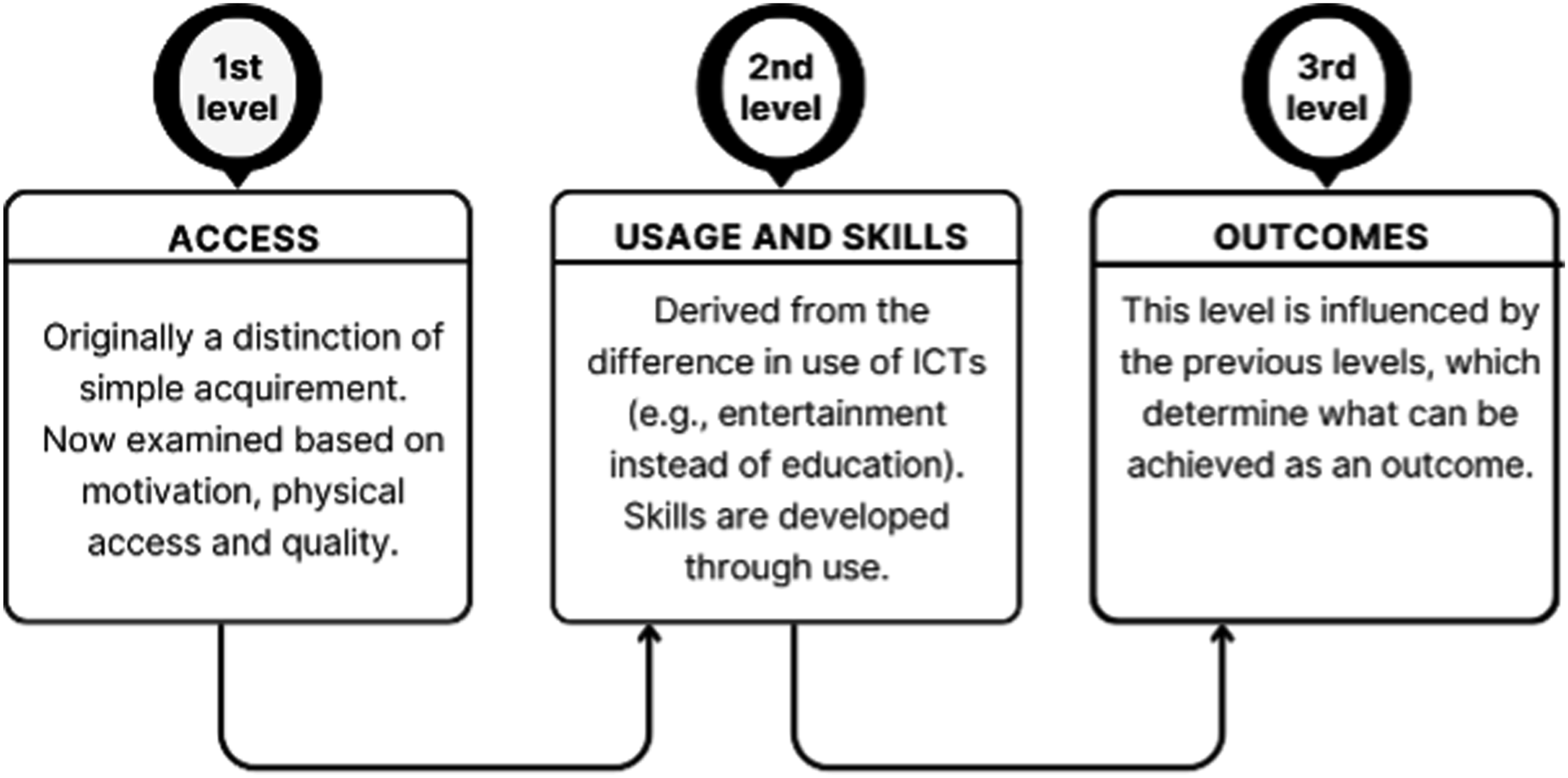
The shift from digital divide to digital inequality was motivated by research into usage and skills, which needed to have a more nuanced approach in contrast to access (DiMaggio and Hargittai, 2001). This was triggered by observed differences in skills which created unequal impacts among user groups (DiMaggio and Hargittai, 2001; Hargittai, 2003). These were further influenced by non-digital factors, exacerbating the disparities (DiMaggio and Hargittai, 2001; Hargittai, 2003). An example of a non-digital factor that influences the acquisition of digital skills was identified in how one’s socio-economic status in childhood influenced internet use in later adulthood (Silver, 2014). The realization of the impact of non-digital factors prompted a re-evaluation of their influence on access. For example, the quality of the access determined both the skill development and the usage of ICTs (Attewell, 2001; Hargittai, 2003; Van Dijk, 2005). Helsper (2012) proposed the corresponding field model as an approach to understand the relation between social exclusion and digital exclusion. This model identifies ‘four fields of offline resources – economic, cultural, social and personal – and argues that they are linked most strongly to corresponding fields of digital resources’ (Helsper, 2012: 30). Meaning that a lack of social network offline corresponds with a similar lack in digital social network.
Digital inclusion has become a focus within the field of digital inequalities studies, examining the interaction between social and digital factors. These interactions lead to differences in access, skills, and usage, ultimately impacting the outcomes an individual might experience from their engagement (or lack thereof) with EICTs (Asmar et al., 2022; Van Leeuwen et al., 2023). In the next section this will be further discussed for specifically older adults.
Digital inclusion and older adults
Digital inequalities scholars have considered older adults at-risk for digital exclusion, given that a significant number of this group were traditionally non-users. (Czaja et al., 2006; Van Deursen and Helsper, 2015). Arguably the omnipresence of technology has made true non-use virtually impossible, resulting in older non-users adopting strategies to deal with technology, such as appropriation strategies which involves learning to use the internet from their support network (Gallistl et al., 2021). This support network has been identified as essential for engaging with digital technology (Asmar et al., 2020; Courtois and Verdegem, 2016; Dolničar et al., 2018; Gallistl et al., 2020; Hunsaker et al., 2019, 2020; Luijkx et al., 2015). The inability to use digital technology necessitates engagement with the support networks in age-specific ways. More recently, Duque and Otaegui (2023) have concluded that the combination of active ageing policy and successful ageing discourse has resulted in older adults experiencing their digital dependency on their family as a burden. They further found that older adults choose to engage in more professional support to obtain the necessary skills to communicate with their families (Duque and Otaegui, 2023). It is clear that in terms of digital technology skills warm experts still play an important role (Hänninen et al., 2020; Olsson and Viscovi, 2018). Here the warm expertise is defined as more skilled users who assist those with lesser skills in their digital technology interactions in an informal setting (Bakardjieva, 2005; Duque and Otaegui, 2023). The work on digital dependency aligns with the mismatch observed by Geerts et al. (2023) in formal and informal assistance for older adults and the struggles that older adults might have with informal support (Korpela et al., 2024).
When considering older users, various studies have explored the engagement of older individuals with digital technology. Older users typically possess extensive lifelong experience with technology (Kania-Lundholm, 2023; Kania-Lundholm and Torres, 2015; Olsson and Viscovi, 2020; Vincent, 2023). Similarly, Olsson and Viscovi (2020) found that the older users that they interviewed tended to have a long history with digital technology and Vulpe and Crăciun (2020) determined that there were three distinct profiles of older users within the European population based on their way of using digital technology to communicate. Additionally, studies examining the habits of digitally included older adults revealed that ease of use and usefulness were primary drivers for technology adoption (Czaja et al., 2006; Mitzner et al., 2010; Quan-Haase et al., 2018). Finally, the social aspect of digital technologies should not be underestimated as intergenerational contact has been demonstrated to be a motivation for full or partial technology adoption in old age (Gonzalez and Katz, 2016; Van Leeuwen, 2025; Gallistl et al., 2021). Kania-Lundholm and Torres (2015) found that older users believe that age does not determine if one is digital excluded or not. However, these same users did perceive their age as relevant when it can be used to explain their digital expertise and the effect of the life course on digital technology adoption (Kania-Lundholm and Torres, 2015). This collaborates with findings that for digital proficiency the key indicators in older adults were education and previous work-experience (Olsson and Viscovi, 2020); which accumulate over the life course.
Conceptual framework and methodology
This next section sets out the conceptual framework and the methodology used in this study. The conceptual framework served as a foundation for the thematic analysis.
The first concept is age discrimination or ageism. The impact of ageism on digital technology use and adoption has been studied extensively (e.g. Barbosa Neves and Amaro, 2012; Barrie et al., 2021; Ivan and Cutler, 2021; Köttl et al., 2021; Mannheim et al., 2023; Mariano et al., 2020; McDonough, 2016, 2020). The concept of digital ageism itself has been used to refer to the age-related discrimination found throughout the digital technology eco-system from biases in development (Chu et al., 2022; Manor and Herscovici, 2021; Svensson, 2023; Stypińska, 2023) to the stereotypes regarding the role of digital technology use in the daily lives of older adults (Amaral and Flores, 2023; Ivan and Cutler, 2021). Expressions of self-ageism were commonly found in focus groups with Swedish older non-users or occasional users, as they used stereotypes related to age to explain their non-use (Kania-Lundholm, 2023). The stereotypical imagery was similar to other studies examining digital in/exclusion of older adults (Manor and Herscovici, 2021; Rosales and Fernandez-Ardevol, 2020). Moreover, Kania-Lundholm (2023) states that in their findings older adults have a clear old/young approach to technology use. This means that they determine that their use is inappropriate or incorrect in comparison to the younger generations. Social comparison has been examined as a means for older adults to obtain a sense of subjective well-being, by comparing their situation with contemporaries who they deem to be worse off, in other words in a downward contrast to themselves (Graham Beaumont and Kenealy, 2004). To paraphrase the downward contrast results in a more positive view on the self based on a comparison to those considered worse off (Arigo et al., 2024; Graham Beaumont and Kenealy, 2004; Suls et al., 1991; Wood, 1996). It can be argued that stereotypes and social norms are involved in creating the basis of these expectations on which a social comparison can be made, these can be called age norms (Calasanti, 2005; Dannefer and Feldman, 2017; Harris, 2016).
Barrett (2022) contends that age identity is formed through processes akin to those shaping other social identities, emerging from individuals’ alignment with particular social categories, such as gender and race. This formation involves internalizing externally produced, subjective meanings and interpretations into one’s own worldview (Berger and Luckmann, 1991). In the context of later life, individuals construct a sense of old age by adopting culturally embedded meanings associated with ageing, such as the age norms and age-specific stereotypes. Furthermore, age identity is neither linked to chronological age or immutable (Barrett, 2022; De São José and Timonen, 2025; Wilkinson and Ferraro, 2002), instead it ‘has social meaning that is a product of culture and varies across time and space’ (Johfre and Saperstein, 2023: 341). The co-construction can result in the inclusion of negative stereotypes within self-identity, and cause technophobia and self-ageism in older adults (Xi et al., 2022), which in turn cause disengagement and lack of adoption of new digital technologies (Köttl et al., 2021; Nimrod, 2020; Xi et al., 2022). Which in turn is reflected in the earlier mentioned avoidance of dependency on family when it comes to digital technology (Duque and Otaegui, 2023). The extent to which self-ageism and social comparison play a role in the digital ageing experience of older adults will be examined in this article.
We use the concept of Everyday Information and Communication Technologies (EICTs) to analyze the technology use of our participants. Thus, the study is focused on devices and applications which are used to engage in everyday activities such as online banking, gaming, video-calling or online shopping (Köttl et al., 2022). In addition, ageing is conceptualized as a ‘construct to investigate – one that emerges in social, political, and economic structures that vary across cultural and historical contexts’ (Barrett, 2022: 214). It can be argued that by approaching ageing as such it is possible to investigate it as a source of (digital) inequality along the dimensions of identity, performance, and institution (Barrett, 2022). We focus on the dimension of identity as a source of possible inequality in this work. According to Barrett (2022) age identity functions to provide people a means to identify with a certain category, however in doing so it strips away other markers of identity (Gullette, 2004) and thus it can have a ‘negative impact on one’s sense of self’ (Barrett, 2022: 226). In this work, we will explore the interplay of societal ageism and its effect on the age identity of the individual when it comes to digital technology use. By doing so we move beyond the assumption that ageism functions solely as a deterrent to technology use. Instead, we explore how societal stereotypes and digital technology practices interact and can generate new markers of identity among older users. The aim of this work is to investigate how these three concepts are operationalized within the ageing experience of older adults.
Online interviews
The Digital Ageing project received funding in May 2020, and investigated the influence of digital technology on the lifeworld of the older adult. The project included three PhD researchers, with a variety of backgrounds in Communication Studies, Gerontology and Sociology, responsible for the collection of data via semi-structured interviews. These interviews occurred during the COVID-19 measures of January to May in 2021 in Belgium. For the participants this means that although contact in social bubbles (groups of 4 designated people) was allowed, there was still a restriction on gatherings in enclosed spaces with those outside of the bubble (Rankin, 2020). Especially for those deemed vulnerable, the advice was to limit travel as much as possible. To facilitate interviews with this group during this period a research design was proposed which focused on interviewing older adults who could engage with the researchers via online platforms. Below, we provide additional context on the COVID-19 pandemic in Belgium to highlight the necessity and inevitability of conducting online interviews instead of in-person interviews.
Demographic information of participants.
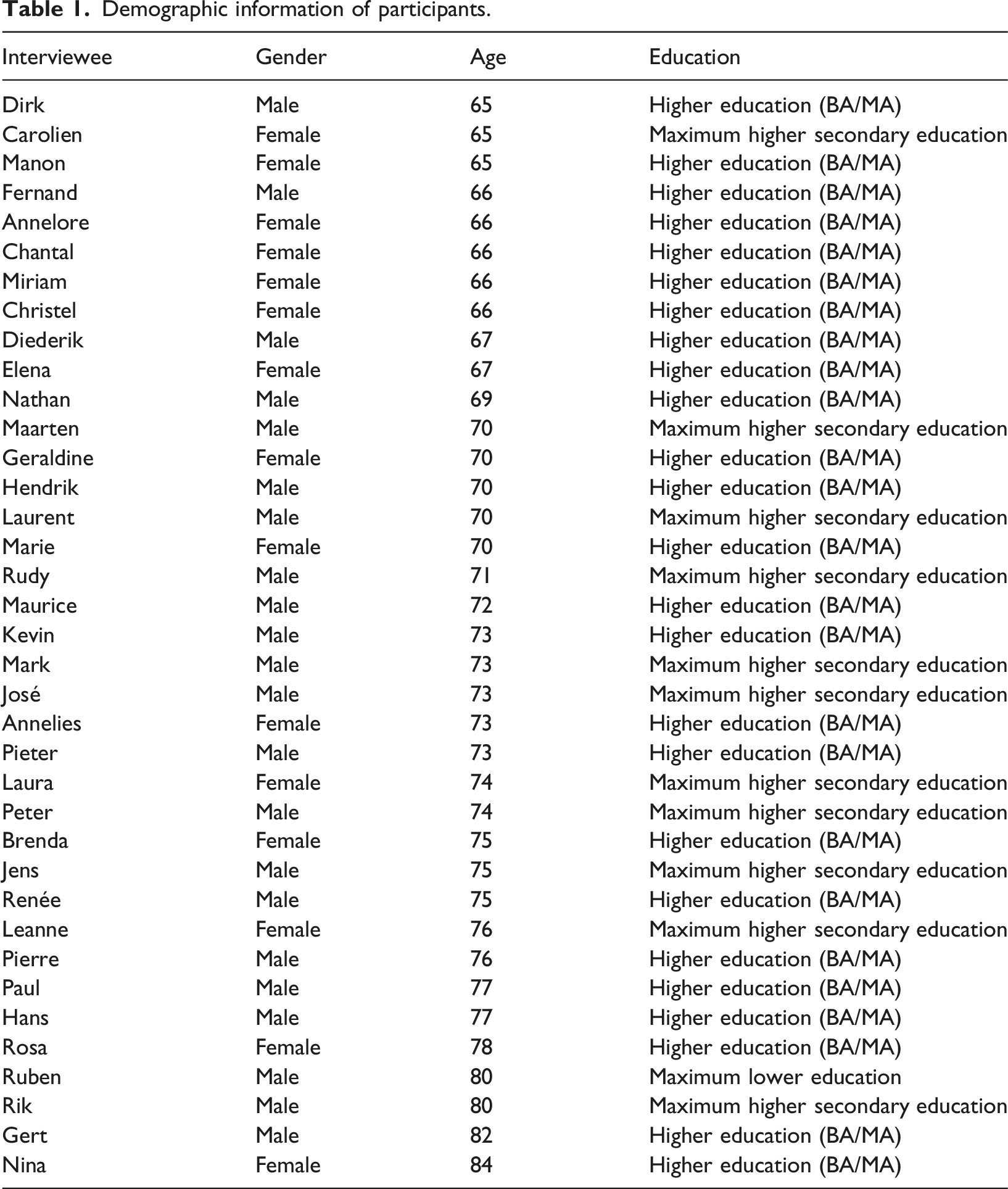
During the interviews we encountered various challenges which differ from challenges encountered in-person interviews. Some of these could be countered by the training the interviewers received, such as non-verbal ques to avoid interruption due to asynchronous communication caused by connectivity issues. Others involved a divided co-presence as described by Cabalquinto and Ahlin (2023). For example, the researchers discussed how to handle interruptions during interviews that might arise from others being physically present in the older adult’s home. We further fine-tuned and discussed our methods during the 5 months that we conducted the interviews. This involved several de-briefings in which we shared experiences, challenges and solutions. We acknowledge that although the data is valuable it is also inherently from the perspective of older users with above average skills during an extraordinary time.
COVID-19 and digital inclusion of older people in Flanders, Belgium
According to a summary of Luyten and Schokkaert (2022), the first reported case of the virus in Belgium was in early February 2020. Following the first death on the 10th of March stricter measures were imposed on the 12th of March, 2020. Finally, lock-down measures (i.e. social distancing, no unnecessary travel between municipalities, and closed borders) were imposed a week after. These conditions were extended multiple times until a relaxation on the 5th of May, 2020. This allowed for more social contact as long as masks were worn and people contained their contact to a bubble of four (Rankin, 2020). Finally, in June 2020 travel was no longer restricted. This more relaxed stance continued until a rise of new cases was observed from September onwards, which resulted in a new lock-down in October 2020, which lasted throughout the Christmas period and beyond. Although limited social gatherings in bubbles were permitted, they had to adhere to social distancing rules and were subject to potential fines (Rankin, 2020). In December 2020 the first vaccines arrived in Belgium and older adults were among the selected individuals to receive these. The vaccination campaign continued throughout the year and 73,5% of the population was vaccinated with at least one dose by the 12th of September 2021 (Mathieu et al., 2020). The vaccination programme was based on both the health risk and the year of birth. This means that for the participants of our interviews the invitation to vaccinate would have arrived between January to May 2021. However, the researchers would only receive theirs from June 2021 onwards.
The role of digital technology in Belgium in the COVID-19 pandemic is not only related to providing a safe way to communicate outside of the bubbles. In order to contain the virus various digital technologies were developed, such as an app to store vaccination certificates (i.e. CovidSafeBE-app) and an app to act as an alert for exposure (i.e. Coronalert). Additionally, existing functionalities on your phone like the QRscanner or bank-app to make interactions contactless were promoted or required. In terms of everyday digital technology use, it is important to note that these applications are all functional on a SmartPhone, and require at least some skill to both install and update the various versions of the applications. In order to use these technologies one needs basic digital skills, access and motivation. The Imec.Digimeter is a yearly representative survey which provides an ‘overview of the digital transformation of the Flemish Citizen’ (Sevenhant et al., 2022: 9). According to this survey 99% of the Flemish population had access to the internet in 2020 and 2021 and 93% had access to a smartphone (Sevenhant et al., 2022). The overall interest in digital technology of those aged 65+ in 2021 had a jump of 10% in comparison to 2020 (58%) (Sevenhant et al., 2022). However, this was not a lasting interest as it wained to 49% in 2023 and 52% in 2024 for those aged between 65 and 74 and 39% in 2023 and 41% in 2024 for those over the age of 75 (De Marez et al., 2025). Although not explicitly stated it is possible to posit that COVID-19 caused a temporary increase in terms of interest in digital technology by older adults.
Analysis
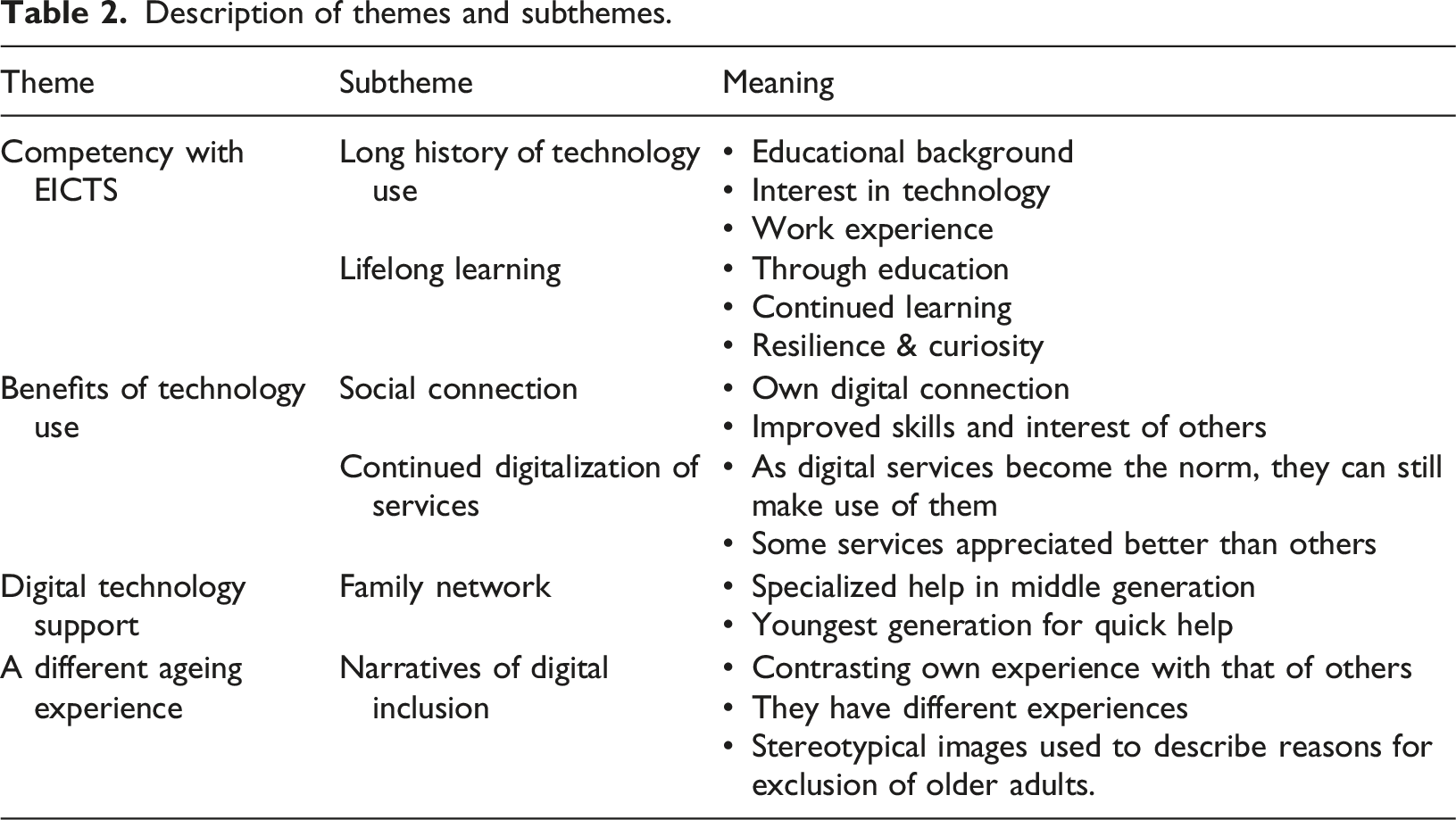
The interviews were transcribed and the analysis – carried out by the first author using qualitative software MAXQDA 2022 – focused on how older adults described their interaction with EICTs. The first author used the Reflexive Thematic Analysis (RTA) as proposed by Braun and Clarke (2006, 2019). As it can be argued that this method offers a means to discover similarities and differences in perspectives of participants in data (Nowell et al., 2017). Initially all the transcripts were read and reread to observe the patterns. The second step consisted of creating codes to capture how older adults described their relationship with EICTs. The open coding process generated initial codes that stayed close to the transcript, such as ‘was unable to do official uni self-educated by access to library’ (Maarten, M, 70). As the coding progressed the first author organized the codes according to the patterns that were developing, during meetings with the other authors these patterns were discussed and clarified with memo descriptions such as shown in Figure 2 which shows the initial pattern [expert user image]. Details of memo of theme.
Description of themes and subthemes.
Findings
We will present our themes in an interpretative story in this section. The four themes tell the story of how older adults use their interactions with EICTs to create an identity for themselves which contrasts with those not having digital technological skills. The quotes were translated by the first author into English from the original Flemish.
Competency with EICTs
The participation of older adults was based on the self-proclaimed proficiency in using EICTs. Our participants described their personal history with EICTs to demonstrate their competency, such as the one detailed below: Yes. I grew up in the period that the word ‘computer’ did not exist, to say it plainly. Okay? But I had an enormous affinity with science and technology. My degree played a role in that. So I was already confronted with computers in the 1960’s and 1970’s via the university. And when the first personal computers became commercially available I was already comfortable with them. Also in companies for which I worked in the eighties and the nineties, those were informatica companies. So indeed, internet, I still remember in 1998 or there abouts and we could go online via providers, enfin, I had been connected previously with other network technologies (Hendrik, M, 70).
This passage illustrates how participants leveraged their professional experience and historical interest to establish their credibility as a competent user of digital technologies. Additionally, most participants credit their ability to adopt new EICTs to their long-established technological interest. Laurent (M, 70), for example, says: ‘I have always been interested in everything related to electronics. I have also been an amateur radiobroadcaster for many years. And yes, the computer is a logical follow-up, that naturally follows up on it’.
Not all participants had an intrinsic interest in technology, for some the interest came from a feeling of inevitability. Annelore (F, 66) says ‘I still remember that I then thought: okay, I am not getting to my pension without learning how to handle that stuff, uhm, on the internet and mails and such’. Others saw it as progress which needed to be joined, such as Diederik (M, 67) ‘You have to participate in the progress. You can… The progress cannot be stopped. […] So it is better to try to participate a little, than to stay still, yes, that is what I think’. Irrespectively if it was due to foresight or apprehension, the participants showed a resilience and curiosity in their encounters. Resilience is evidenced in comments in which they describe the learning curve and in which they continued to use the EICT even if the progress was slow. For example, Leanne (F, 76) says ‘I used to think that I did things wrong and of course I did, but meanwhile I learned that it can also be the computer, the network or the connection and such which can do things wrong’. Our participants would mention that they knew how to solve problems and that they were willing to go to others only after they have tried to solve the problem themselves. This ability is also linked to their previous education experiences. Either in their youth in which they received a technical education (e.g. Hans, Hendrik) or when they followed formal classes aimed at older adults (e.g. Marie, Jens). The desire to continue learning was also evident in the fact that various participants continued to follow courses, such as Hans (M, 77) who enrolled in a course on artificial intelligence.
Benefits of technology use
In this theme, the pandemic was often mentioned as our participants experienced that their efforts to remain competent in EICT use through the years, ensured that they were able to adjust to a mostly digital environment.
One benefit which was mentioned often was the ability to maintain connections over distances and during lock-downs. Hendrik (70), for example, states that the only change in his usage is visible in his use of video conferencing tools or in his words ‘You are barely able to visit your children, so you use [video calling]. And it gives you a fairly good feeling. It is as if you are meeting each other [in person]’. Remaining in touch or creating new relations is a benefit that our participants found, ‘especially now during the corona period I am extremely happy that it is possible to continue with my Spanish course via the Zoom. Because otherwise there is not a lot left he’ (Geraldine, F, 70). This feeling of ‘it is better than nothing’, is echoed by many of our participants. In other words, they would prefer the face-to-face contact but if there are no other options, they prefer to have the online communication channels, or as Laura (F, 74) explains: I would rather that they come visit me, cause in the end when you use social media, nice, yes fine, it is possible to keep that up for, uh, half an hour, threequarters of an hour, but you will not use that the whole afternoon, to uh sit and have tea and have a bit of a chat.
The ease and acceptance of these conference applications has been enormous also in their experiences with more casual users, as explained by Kevin (M, 73) to give one example, when I used to want to have a chat with Jan, or Piet or Klaas I had to drive to them. What do I do now? I send out a message ‘do you wanna chat?’ And then we open Jitsi or Zoom or whatever you can think off. It will become a video call similar to the one we have now.
Overall, our participants display a wide variety of ways in which they use video communication; some use it exclusively for one-on-one communication, while others use it to connect with large families, or even as a monitoring device to assist with babysitting while social distancing. WhatsApp is another often mentioned platform, where they have new types of interactions since the start of the pandemic. For example, Maurice (72) mentioned a special WhatsApp group organized to keep an eye on the more vulnerable single older adults in his neighbourhood. Additionally, several participants mention that their children recently set up dedicated family groups to facilitate easier intergenerational communication.
Another benefit which was more reluctantly taken up was shopping online. Kevin (M, 73) for example says that ‘Yes, shopping digitally. A little bit, so. I do that as little as possible, shall I put it like that? Because I prefer to go to the physical store but if there is no other option’ and for Christel (F, 66) it was ‘one of the first times that I had to do some online shopping’. The benefit was in that they were able to make use of it during the pandemic. The fact that they have the ability to access online banking services was seen as a benefit of digital technology use, as Nina (F, 84) explains: Cause being able to do the payments via internet is an advantage for me. I think the same for heaps of people. If you are not so able [bodied], that you do not have to go to the bank every time to do [payments], that can of course be an advantage. I am still able to go, but I find that, it is easier to do it from home.
The autonomous use of technology is important for our participants, as in the words of Carolien (F, 65) ‘independence, yes. It is in part about independence’. For this reason, José (M, 73) was really focused on ensuring his wife was able to engage with e-banking services as ‘it is not going to get less he…it will only get higher. So, you will have to slowly but surely start working at it’. This feeling is echoed by others and will be discussed further in the section about ageing differently.
Digital technology support
As discussed in the previous theme autonomy and independence are important for the older users. This is also evident in their digital technology support needs. Often the older user would explain that they will find the solution themselves, such as Gert (M, 80): To be honest, I have to, without being pretentious, I have never had anything happen that I could not solve myself. Course, it did take some detective work. Yes, and the texts are often in English and, and, you cannot find the translation immediately and such. But gosh, … you should not become nervous.
And if they cannot find a solution themselves, they know how to ask for assistance from family. However, the individuals they seek assistance from vary and can be divided into two categories. The first category comprises those who seek help from a family member belonging to the middle generation who has a certain perceived expertise. Elena’s (F, 67) nephew, for example, is an ICT professional and Diederik (M, 67) describes his son as ‘being involved in informatics business. He designs apps’. However, Elena (F, 67) also talks about the shame she feels for wasting her nephew’s time. This reluctance to burden these particular family members often leads to the second category, involving the youngest generation, namely, the grandchildren. They are seen as the ideal solution for less complicated issues and for quick introductions to new applications. Moreover, the grandchildren are perceived to be comfortable and skilled with the technology as Kevin (M, 73) says ‘they laugh with it. It is unbelievable. I do not know [why they are as fast with technology]. It is written in the genes’. The intergenerational support was available to the older users but most of the participants expressed that they did not really need extensive assistance due to their own expertise. In fact, some participants are the digital support in their family. Such as Annelore (F, 66) who assist her older mother and her husband when they have questions. Although she does tease her husband with the knowledge that she acquired through courses: ‘Yes, but then he often gets the response of, “I’ve already shown that 20 times. If you still don’t know it by now…” [taking a screenshot] that’s something I had learned on those courses’. And another, examples of being a warm expert can be found in Dirk (M, 65) I failed, for example, to get my parents … so my father is ninety-two, or was ninety-two, my mother is eighty-eight – to get them … to use a smartphone. I never succeeded. The regular phone – no problem at all, but the smartphone…
It is evident that the expertise displayed by our participants is important for them and enables their intergenerational contact beyond the digital support provided or received. Maarten (M, 70) states that the internet provided him with a means to see his family despite the pandemic. Without that he says ‘I would find that difficult, I think. Because then I wouldn’t see my children, physically, haha. Because then [with the internet] you see them anyway’.
A different ageing experience
This final theme is related to the role of internalized ageism within the narratives of digital in/exclusion as used by the participants. As these interviews were conducted during the Covid-19 measures this featured a lot in the narratives used by our participants to discuss issues of digital exclusion. For example, Hans (M, 77) explained how he invited an older friend over to his house to attend a meeting of a senior citizen organization. If he had not done so the older man would not have been able to participate. Other participants have similar stories about digital exclusion experienced by others. These experiences sharply contrasted with their own digital inclusion. Overall, our participants had the tendency to differentiate between the digitally excluded and themselves. This was achieved by: (1) stating that it only applied to those over the age of 85, (2) by placing themselves outside of their age group, or by (3) ascribing characteristics to the outgroup that would not apply to them. An example of this can be found in the story that Annelore (F, 66) tells about an experience where an older man (85) had been unable to use the computer to make an appointment and on top of that had forgotten his debit card. Annelore (F, 66) ends her story with the wish ‘I do not want to end that way’. Ruben (M, 80) states that: people between 85-and 90-year-old and older they do not have a computer or mobile phone at home. At least the majority of them at least, and them I do not see, cognitively, if I can say it like that, the possibilities to be capable to learn that.
In this example he applies all three of the contrasting techniques to distance himself from the negative stereotypes of old age. To examine how older users perceived non-users we asked them about their experiences with less digitally active friends and family. The participants overwhelmingly concluded that those not using technology expressed disinterest or feelings of being too late to join in. For example, Gert (M, 82) said ‘to start now [as an eighty-year-old] that is not possible, the train has left the station. It is not possible to jump on it’. Furthermore, this according to our participants was often combined with a lack of perceived benefit for those not using technology, for example, Dirk (M, 65) says: as soon as people enjoy the outside life, and are busy, is the internet still not important. I mean, someone who enjoys sitting in the garden, […] or who likes to hike or does a lot of sports I think that those people do not get further than using the iPhone or WhatsApp. And that should be about it, I think. Of the older generation he.
Others discussed how risk avoidance and/or fear dissuades people from using certain services. Brenda (F, 75) describes her brother-in-law’s refusal to use e-banking services out of fear of fraud, however she says that ‘you cannot continue to walk to the bank with your little cheques. Firstly, because they are often closed or you have to make an appointment and so forth’. The examples used are confirming the stereotypical narratives of old age and technology. We will discuss this further in the next section.
Discussion
The findings explain how older users use their digital technology use and social comparison to construct their ageing identity in comparison to that of the non-digital older adult. Starting with the incentive to use digital technology, it is evident that our participants obtained and retained their motivation through their experiences with education (attainment level and later formal lessons) and their inherent interest in technology. This is in line with the findings of others (Olsson and Viscovi, 2020). Additionally, participants often had previous work experience which had resulted in an introduction to the computer and were able to maintain their skills through retirement. What was evident in these users is that their intrinsic interest in technology translated into continued use even if when it was no longer necessary to complete their tasks at work. Thus, they were able to translate the technological skills obtained earlier in life into newer technologies. For example, the introduction of a personal computer via their work paved the way to a laptop at home and other personal devices. The transition to communication apps such as WhatsApp was not experienced as jarring or a disruption in their routines. Only Maurice mentioned that the introduction of WhatsApp was a conscious choice during the pandemic, while for others these kind of interactions with digital communication applications was experienced as a natural progression of their daily interactions with technology. It is important to stress that the participants perceived their competency and engagement with digital technology as an essential part of themselves, as well as part of their routines or habits. Furthermore, the participants stressed that they were able to counter any new technologies by applying both their existing technology skills and their learning skills. As made evident in the section on digital support, these participants are resilient in finding their own answers and use more expert help if the problem is beyond their own excellent skillset.
The interviews took place during COVID-19 pandemic, as discussed this determined who was able to participate in the online interviews and excluded non-users out of necessity. And although they were less affected by digital exclusion it became clear that the pandemic did result in changes in their digital behaviour. Changes such as Maurice who started to use WhatsApp, but also online shopping and online meetings. And although most of the older users were positive about these digital possibilities, they were also very much aware that they were privileged in comparison to others. This resulted in many comparisons to non-digital others. The explanation regarding their digital inclusion included narratives and imagery which resulted from this early interest and foresight to maintain their skills. Tellingly many of our participants pointed out that an inherent lack of interest and an inability to see benefits of technology could be the reason why many of their age-mates were not online. Thus, setting themselves apart from their peers. This downward contrast by social comparison enables these digital older adults to counter negative stereotypes related to old age and technology use (Xi et al., 2022). As they see their own use as better ageing and thus avoid disengagement and avoidance which could be caused by negative stereotypes (Ivan and Cutler, 2021). And although they observed a change in their peers, due to COVID-19, they used ageist stereotypes to explain why this change was too late. As many expressed the belief that it might have been too late to start using technology after the age of 80. We made the choice not to specifically explore the role of gender as it did not emerge as a relevant theme within these interviews. However, we would like to propose that for further research it would be imperative to examine in more detail how a gendered difference in historic opportunities to engage with education and the workforce continues to cause differences in digital engagement and outcomes. Not only in later life but arguably across the lifecycle. Therefore, an intersectional approach to the life course would be recommended for future research to ensure that not only gender but other intersections with long historical impact are examined.
If we compare our participants to those described in Gallistl et al. (2021), we see that they describe similar appropriation practices. For example, our participants have developed learning strategies and indicated a familial support network. However, unlike the non-users they mostly do not fear impatience from their middle generation family members. Any reluctance seems to be from a fear of overburdening them. In that sense they echo the fear of dependency as noted by Duque and Otaegui (2023). This same reluctance is not present when it concerns the grandchildren. As those interactions seem to be based on spontaneity and willingness to engage, similar to the findings of Luijkx et al. (2015). Moreover, there was a perception that the youngest generation was more ‘native’ in the digital world and were able to introduce new apps both due to their innate skill and their time and interest in digital technology. This opens up an avenue for future research as it is unknown if (a) these grandchildren have the required innate skillset necessary to assist their grandparents as well as (b) the validity of the statement that the young have innate digital skills in the first place, as this has been questioned in the past (e.g. Helsper and Eynon, 2010). Additionally, the work on digital dependency implies that that their engagement with the middle generation could be related to avoiding proof that they are failing to age well (Duque and Otaegui, 2023). However, this is disputable as the skill level of this particular group of older adults rather results in their belief that their questions require specific assistance which they can only obtain from those with a more applied technical knowledge. Which explains their tendency to engage with warm experts in the middle generation to answer their questions.
This leads us to the discussion of social comparison and the role ageism played in the narratives of digital inclusion. It is evident that the ageist stereotypes of older adults are known to the older users. They apply these when they need to explain their own digital inclusion and the digital exclusion of others. The contrasting that they apply focuses on what sets them apart: a combination of digital skills obtained across the life course and their cognitive ability to maintain their skills. By mobilizing ageist stereotypes in this way, participants contrast their own ageing experience with that of stereotypes of non-users, enabling them to position their own ageing trajectory as more favourable than those associated with negative societal stereotypes. This can be seen as a downward social comparison as discussed by Graham Beaumont and Kenealy (2004). The older adults tend to do a peer group comparison to determine how their digital inclusion is related to that of non-users. Helsper (2017) argues that one is more likely to acquire skills when one sees that similar others are able to do so. However, for these older adults the dissimilarity to non-users and avoidance of digital dependency are more likely to act as motivation for continued EICT engagement. This is reflected in their portrayal of non-users through ageist stereotypes, which attribute their inability to adopt new skills primarily to a perceived decline in cognitive ability, by suggesting that learning becomes impossible at a certain age. The older users used examples of non-users to highlight their own digital inclusion narratives. This positioning results in a more favourable position as they show their independence and autonomy. The participants of Pirhonen et al. (2016) compared themselves based on mental autonomy, while in the current study the contrast is based on digital technology usage and skills. It will appear as if older users require non-users to make sense of their own digital inclusion, as they compare themselves to other ageing experiences. They navigate their relationship with digital technology, often challenging and refuting ageist stereotypes. Simultaneously, they might inadvertently use these very stereotypes when describing individuals who do not use EICTs.
Conclusion
We have explored the ageing experience of older adults in relation to digital technology in Belgium and discussed two research questions: How do older adults explain their own digital inclusion and what role does ageism play within these narratives of digital inclusion. We have answered these questions and were able to determine how social comparison and the life course are essential for older adults to understand their own digital inclusion.
As discussed above, older users take a life course perspective on their own digital inclusion. They see it as a result of the various choices that they made. They acknowledge that they were able to make use of the right opportunities that circumstances offered them. However, it is clear that the agency and independence for these older adults is essential for a positive ageing experience. Their digital inclusion is seen as positive in comparison to that of their non-digital peers. The circumstances under which these older adults were interviewed were extraordinary, however digitalization has not slowed down. Thus, older users continue to see their digital skills as a benefit in comparison to the digital dependency of others.
Stereotypes of older adults in digital technology would suggest that they are incompatible, however this group of older users use these stereotypes as a negative benchmark to compare their own digital experience against. Thus, ageism becomes a tool to explain their own digital inclusion. Furthermore, these older users show that chronological age does not have to be a static factor when it comes to digital technology use. Rather their age should be perceived as a multifaceted representation of their life’s course resulting from a lifetime’s worth of choices and opportunities in many facets of their lives. It is undeniable that their enthusiasm and resilience in the face of the digital transformation of society makes it necessary to view age beyond a demographic marker. Furthermore, the way that older users themselves use societal stereotypes to provide a downward social comparison shows the necessity for changing the narratives surrounding the digital inclusion of older adults across generations.
Our research highlights the need to consider age not as a deterministic barrier to technology use, but as a multifaceted construct shaped by a lifetime of opportunities, experiences, and choices. We argue that this lifetime perspective plays a foundational role in the various educational and professional pathways which culminate in later life digital technology use. Therefore, we encourage future researchers to move beyond viewing old age as a binary category and instead to acknowledge its heterogeneous nature. In order to address digital inequality in later life, it should be understood as a result of both individual decisions and broader societal influences.
Footnotes
Acknowledgements
The Digital Ageing Consortium comprises researchers from Vrije Universiteit Brussel and the University of Antwerp: Ignace Glorieux, Dimitri Mortelmans, An Jacobs, Anina Vercruyssen, Nico De Witte, Ilse Mariën, Werner Schirmer, Bram Spruyt, Cora van Leeuwen, Jorrit Campens, and Nelly Geerts. The authors would like to thank the other members of the Digital Ageing Consortium.

Funding
The authors disclosed receipt of the following financial support for the research, authorship, and/or publication of this article: The research reported in this article was supported by SBO grant S005221N, funded by the Research Foundation—Flanders FWO.
Declaration of conflicting interests
The authors declared no potential conflicts of interest with respect to the research, authorship, and/or publication of this article.