






Abstract
Brainrot is a meme genre that collects the detritus of the internet, both aesthetically and intellectually speaking. It is a catch-all term for low-quality content that is produced online in an attempt to claim a stake in the attention economy. Slop is a term that has gained traction in the last year as a way to refer to the constant and overwhelming output of generative artificial intelligence (GenAI). Slop is engaged with lazily, sloppily and spontaneously, not created with the aim of embodying a particular aesthetic mode, but rather mimicking others. Recently, both terms have collided during the viral internet meme genre of “Italian Brainrot”. However, brainrot and slop stand in completely different aesthetic lineages and thus represent completely different modes of production and distribution. This article provides an analysis of the evolution of brainrot and slop as aesthetic phenomena by placing them in the context of meme culture and expanding on their role in the digital economy. It argues that the difference between brainrot and slop is crucial to make going forward, as we see more and more slop content being circulated by both platforms and users. Spam has become the key logic of production in this GenAI-fuelled slop economy, which threatens to flatten and homogenise cultural expression. Brainrot content in meme culture, however, is presented here as the antithesis of the slop economy due to its aesthetic creativity and ongoing acts of cultural remediation.
Introduction
In early 2025, Italian brainrot memes began to take over the internet. These images, generated by artificial intelligence (AI), combine random animals with equally random concepts, all topped off with outlandish names that evoke Italian intonations. The outputs are hybridised cactus-elephants, cappuccino-assassins or goose-fighter jets, that are given names such as “Bombardiro Crocodilo” or “Bombombini Gusini”. The results are not monstrous, Frankensteinian creatures, or maybe they are, conceptually, but not aesthetically. Aesthetically, they are sleek, glossy depictions of surreal figures. As a meme, they are overlaid with an enthusiastic presenter, simulated by a text-to-speech AI voice generator, naming each creature in a triumphant voice: catchy for TikTok’s musical-driven algorithm.
At the level of prompt, output and aesthetic, what has been labelled as Italian brainrot content by users creates nothing new or fundamentally different from AI Slop. Slop is a term that has gained traction in the last year as a way to refer to the constant and overwhelming output of generative AI (GenAI) (Crawford, 2025; Madsen and Puyt, 2025; Stanusch et al., 2025). Slop spams our landscape with high-resolution and uncanny images that have little to say. Brainrot, on the other hand, refers to a genre of online posting that collects the detritus of the internet. It is a catch-all term for low-quality content, either in terms of resolution or aesthetic appearance, which has no cultural value and is generally engaged with through a short video format (Owens, 2025; Yousef et al., 2025). However, many have painted brainrot and slop with the same brush since the rise in popularity of Italian brainrot memes (Yalcinkaya, 2025).
From the point of view of meme aesthetics, the distinction between brainrot and slop is fundamental to make. Brainrot stands in the aesthetic lineage of shitposting (Daviess, 2019; Woods, 2023), trolling (Phillips and Milner, 2018) and internet ugly (Douglas, 2014), while slop primarily uses the aesthetics of kitsch (Chateau, 2024) and cute (Dale et al., 2016; Ngai, 2012) to spam the internet (McCracken, 2025). This article provides context about the evolution of these two aesthetic modes, brainrot and slop, by situating them within meme culture. This allows the social relation between the two aesthetic modes to come to the forefront, one situated firmly in the digital cultural economy. Though distinct, and speaking to each other across the same cultural landscape, brainrot and slop enter into dialogue with each other because they are divergent aesthetic responses to the contemporary algorithmically mediated mode of content consumption on the internet (Huang and Ye, 2023; Stanusch et al., 2025). Slop can be understood as a grammar of spam rooted in the logics of cute and kitsch objects that attempts to catch the algorithm’s attention in the current context of algo-maxxing (Galip, 2025), while brainrot enacts a more active process of cultural remediation through provocatively ugly or deteriorated aesthetics common in meme culture. Precedents are given in meme culture to make sense of the phenomena of brainrot and slop, leading to an analysis of the Italian brainrot genre and how it differs politically, aesthetically, and structurally from brainrot culture. Finally, the slop economy is analysed as a logic of commodification dependent on spam production through GenAI tools.
The digital cultural economy has caused aesthetic categories to emerge that are an assemblage of human and machine aesthetic judgements. These are complex aesthetic categories that are made up of ambivalent human responses, ranging from the affective overload to the disgust and repulse, but also structured by encounters with algorithmic logics and platform structures. As such, they are part and parcel of algorithmic folklore, new practices, objects and form of relationality that arise in the encounter between creativity and automation (De Seta, 2020b). The tendency to interpret slop and brainrot as the two sides of the same coin prevents a critical theorisation of each mode. The underlying suggestion within this dominant view is that the online cultural economy is an economy that can be understood unilaterally as a model of production based on a common circulatory apparatus. In this paradigm, the digital cultural economy is being supplied with AI-generated content (slop) that trickles through the same process of distribution and reception as other media online, while brainrot is taken to describe the resulting cognitive effects produced downstream by that same economic structure. However, my differentiation of slop and brainrot helps me challenge this account. I argue instead that divergent modes of distribution and reception are present in brainrot and slop. This attest to the diversity of modes of content production, interpretation and reception that make up parallel but often overlapping circulatory logics in the digital cultural economy.
This article places brainrot and slop in the context of meme culture to address claims made in creative scholarship that GenAI has “distinct cultural context and material affordances that make it a unique new artform” (Epstein et al., 2023). It argues that current uses of GenAI to produce digital cultural objects are actually tangible expressions of the lineage of digital aesthetics, rather than signalling a departure from them. The evolution of the digital cultural economy, including the algorithmic imaginary, the attention economy and meme culture, can explain both the current use of GenAI as a slop-generating machine in today’s digital environment and the emergence of brainrot. Furthermore, it addresses concerns about the downstream cognitive impact of the attention economy and salvage the potential of brainrot as a site of remediation. In the midst of growing concerns about synthetic data generation and GenAI creating its own cannibalistic mode of cultural production and flattening cultural expression and diversity (Crawford, 2025; Madsen and Puyt, 2025), it is becoming urgent to address GenAI slop as an economy, and not only a mode of production, and look to meme culture as a powerful antidote.
Memes in digital capitalism
Memes are aesthetic forms that are unique to the economic, social and political conditions of our age (Chateau, 2024). They have emerged online due to the participation of the public in the digital cultural economy and the wider cultural structures that have birthed the conditions for this participation. The role that memeing plays in the production and distribution of images and the formation of digital aesthetics cannot be underestimated. Scholarship on memes in its early days by meme scholars like Ryan Milner (2016) or Limor Shifman (2014) is often characterised by an admiration and enthusiasm for the productive potential of meme culture: “In an era marked by ‘network individualism’ people use memes to simultaneously express both their uniqueness and their connectivity” (Shifman, 2014: 30). Then, memeing as derivative reproduction (the replication of an original with new elements) was framed as an active process of mimicry and remixing made possible by the autonomous potential of the web. The perceived democratising power of the internet has given the tools to millions of web users to experiment with creative forms of textual remixing themselves. Formally and politically speaking, DIY aesthetics, sampling and remix culture are a necessary part of the history of the meme. The aesthetic composition of the meme is endowed in this way to the politics of bricolage, and other symbolic forms of resistance that play with editing and remixing as a subversive act, such as “parody,” “pastiche,” “remix,” “textual poaching,” “mash-up,” and “hybridity” (Schmidt and De Kloet, 2017).
Now, when we think of digital images, we most likely think of viral images, images that are already memetic in their form. The evolution of the web and the growing influence of platformisation and algorithmic logics have drastically changed how a meme can expect to circulate through the internet in the last decade. Overall, signs of human interference in editing and remixing the image have evolved to encompass machinic, circulatory and algorithmic interference as well. The label of algorithmic folklore (De Seta, 2020b) accounts for this new organisational category of digital ephemera. What has transpired in the networked image is that emergent experimental aesthetics no longer account for memeing as a logic of reproduction but as a logic of production. They pre-empt both distribution and the gradual process of derivative reproduction that makes a meme what it is, meaning they shape an image according to its projected process of circulation (Bailey, 2013; Cox et al., 2021). The process of becoming an aesthetic object online is caught up within a wide web of invisible economic, political and techno-social forces. Never have images been catapulted across global networks of circulation and distribution so fast. At the same time, never have they been more out of our grasp, controlled by the ebbs and flows of digital culture.
Meme aesthetics serve as a meeting place for the operational logics of digital capitalism. It is within the nature of digital capitalism to be intrinsically interested in mediating and accelerating this flow (Cox et al., 2021; Dyer-Whiteford, 2015; Fuchs, 2020; Steyerl, 2009). This article adopts a Marxist perspective on digital capitalism as an economic logic that generates profit from users’ labour on social media platforms and by selling their attention, but also by holding the reins of the digital communication networks that connect users. Any interaction between users along digital capitalism’s lines of communicative flows will not recover any dialogic debate aimed towards democratic consensus, but ones programmed to accelerate the production of extractable surplus value by technological means (Fuchs, 2020). The algorithmic context has only served to accentuate and intensify the manifold tensions between users balancing vernacular creativity with visibility labour and platform-mediated precarity (Huang and Ye, 2023).
The methodology adopted here to study and extract memes as emblematic of meme aesthetic movements is rooted in digital ethnography informed by the ideas of digital folklore (De Seta, 2020a; 2020b). Internet memes have emerged within a digital culture that is constantly subject to change, governed by the rules of platforms and flow of networks. Digital folklore and digital ethnography keep up with these changes, and dispel the idea that there can be any conclusions or predictive theories that will ever fully encompass the breadth and range of behaviours, interactions, subcultural formations and cultural production. The meme ethnographer must stay immersed in the field while acknowledging their positionality within it. The memes analysed here are a part of a wider longitudinal engagement with meme culture that accounts for ephemerality, literacy, collecting and cataloguing as “troubles” that the meme researcher must stay with. In what follows, I outline important meme aesthetic movements of the last decade from this positionality and argue that we can see these aesthetics as mediating a form of aesthetic rebellion rooted in social disposition that is tied to the logic of image circulation within the context of digital capitalism. Memes of this genre often use montage, a technique that stands alongside DIY, bricolage and remix in the aesthetic lineage that uses collage as a form of art creation. The purpose of such aesthetic composition is often to hijack and interrupt media to use it against itself. The aesthetics of montage are less stylistically fixed and can take a range of forms. This context is the one from which a brainrot culture was born, and we can see the aesthetic lineage of brainrot memes in these earlier aesthetics, which include internet ugly, trolling, shitposting and purposefully poor images.
Meme aesthetics from ugly to shitposting
Nick Douglas coined the aesthetic “Internet Ugly” in a 2014 article. Internet Ugly is a byproduct of the internet’s culture of open access and privileging of the speed of content consumption over quality. It celebrates “the sloppy and the amateurish…. an imposition of messy humanity upon an online world of smooth gradients” (314-5). Douglas analyses memes of the time, notably rage comics, through this lens. Internet Ugly promotes “irony and self-deprecation” (Douglas, 336) and gives attention to those who have no skills, corrupting the very idea of proficiency. Here, refusal to comply with aesthetic norms and expectations of what digital objects should look like is expressed through a celebration of the amateurish, the not-good-enough, the slapdash and haphazard, but this aesthetic disobedience is also something that this aesthetic revels in as a form of play. It “include[s] freehand mouse drawing, digital puppetry, scanned drawings, poor grammar and spelling, human-made glitches, and rough photo manipulation” (Douglas, 314–315). Douglas defines it as a companion to trollpunk, a “movement focused on the drama that occurs when you fuck shit up on the internet” (Chen, 2013). Though meme culture is famously characterised by its ephemerality, Internet Ugly has had a staying power concordant with the continued relevance of trolling as an aesthetic. Still now, ugly is a creative and ironic choice expressing subcultural auteurship and aesthetic play (Chateau, 2022; Galip, 2021).
The introduction of the Internet Ugly aesthetic in the early days of memeing saw an aesthetic sensibility based on subversion and satire come to the forefront. Shitposting and trolling are sensibilities that share the same tenets, but have come to define a period of memeing often associated with the alt-right movement and an extreme ideology based on white masculinity and provocation (Daviess, 2019; Phillips and Milner, 2018; Urbańczyk, 2019). During Donald Trump’s first presidential campaign, shitposting became a logic of political support drenched in irony. In this vein, shitposting was “the act of throwing out huge amounts of content, most of it ironic, low-quality trolling, for the purpose of provoking an emotional reaction in less Internet-savvy viewers” (Evans, 2019). However, scholars have also been writing against the canon of shitposting as an alt-right male practice exclusively since. For these scholars, shitposting is a constructive act integral to community formation. Peter Woods’ contribution on shitposting as public pedagogy argues that shitposting possesses a “potential for contributing to the democratic aims of critical media literacy education, but the appropriation of that practice by large corporations and individuals imbued with political power jeopardise that already fraught potential” (Woods, 2023: 359). Other approaches that have covered shitposting as having transformative potential include Krogh et al. on girl culture and shitposting (2024) and Urbańczyk’s theorisation of shitposting as a mode of fan production (2019).
Woods’ definition offers a definition that acknowledges the aesthetics of shitposting as integral to its purpose: “a specific kind of ‘meaningless’ post (often in the form of a meme) that replicates the rhetorics of social media sites like Twitter and Facebook as a means to unsettle online discourses through lo-fi or unpolished media or texts” (2023, 360). Shitposting as an aesthetic is mostly shaped by the logic of provocation and fast-paced consumption. It does not bother to polish its appearance because it is aware of its own short-term shelf life, and subsequently does not take itself seriously. Shitposting is “disrespectful and can be understood as an act of refusal to treat anything with the seriousness it might deserve” (Urbańczyk, 2019: 217), including aesthetic standards or a cohesive aesthetic grammar. It acts instead as a behavioural catch-all for a variety of transgressive content from heterogeneous communities with varied goals. In this way, a wide range of styles and forms of aesthetic expressions fall under this umbrella term. Shitposting can therefore be conceptualised not only as an aesthetic category, but as a sensibility towards creating content that goes against the norm, resulting in an “unpolished” aesthetic style. Through this refusal of normativity, a firm rootedness in their social disposition defines shitposting cultures.
New forms of aestheticisation are evidently made possible by the circulation of images online in meme culture. German film theorist and philosopher Hito Steyerl’s concept of the “poor image” (2009) is also a key concept in this regard. The poor image is a dilapidated version of an existing image that has undergone various transformations over its lifetime. It is made poor by virtue of its own circulation. Steyerl writes of the poor image: “Poor images are thus popular images—images that can be made and seen by the many. They express all the contradictions of the contemporary crowd: its opportunism, narcissism, desire for autonomy and creation, its inability to focus or make up its mind” (Steyerl, 2009). As it stands, the internet is continually creating poor images. They take the form of bot-generated imagery or advertising profiles, but are also created when an image travels through networks. In this transitional process, the image loses resolution, context, or maybe even gains new elements or layers of meaning. By this logic, all memes are poor images, but not all poor images are memes. Purposefully poor images, however, are memes that are created blurred, pixelised, cropped or warped to acquire the look of deterioration.
The aesthetic of the poor image, a degraded and low-resolution image that bears the markers of impoverishment and violation as it is passed around from user to user, network to server, server to platform, has become a staple in meme culture. This aesthetic grammar is overall one of poor quality, low-resolution images that have been distorted by their own circulation. Figures 1 and 2 are both purposefully poor images that feature the markers of over-circulation: low resolution, high pixelization, and excessive image saturation due to unrestrained filtering. They both emphasise and draw our attention to their own altered appearances; the text that has been added to Figure 1 does not even attempt to hide the text that was there previously. In Figure 2, the gross disfigurement of the famous laughing-crying emoji provokes a certain level of discomfort. The malaise and uneasiness these images arouse within the viewer is strategic. Impoverishment is both intrinsic to and constructed in the “purposefully poor meme” genre (Chateau, 2022). In this meme culture, images are produced with the intention of recreating the look of the organic poor image to comment on their disposability within the digital cultural economy. Purposefully poor memes comment on their own over-circulation. Tumblr, https://p3rson27.tumblr.com/post/613410409143222272 February 8, 2022 [downloaded April 26 2023]. Purposefully poor memes comment on their own over-circulation Tumblr, mister-boss.tumblr.com/ (account deleted) Sep 21, 2017 [downloaded September 20 2024].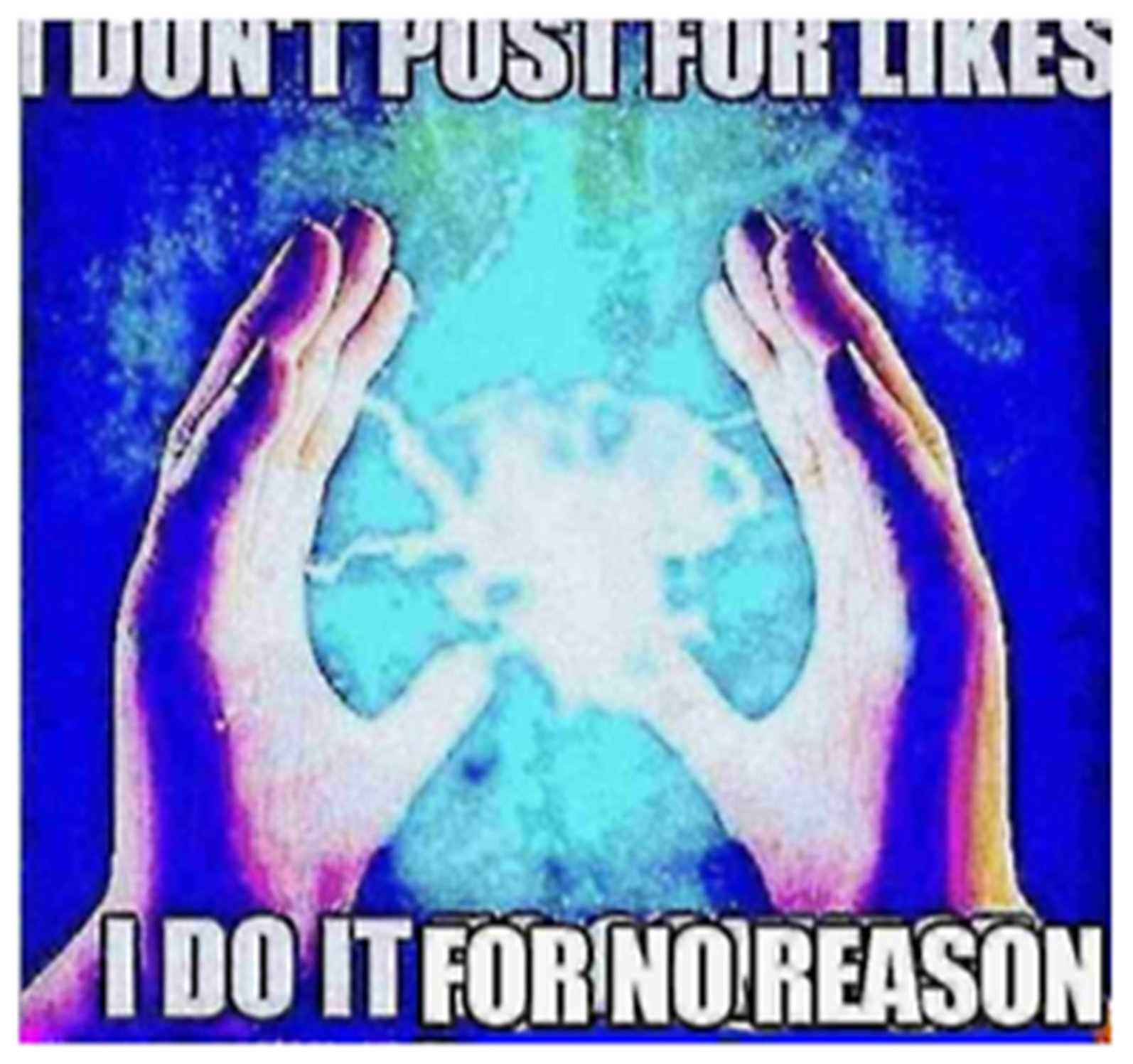

In their aesthetics, purposefully poor memes comment on their own alienation from “the class society of the image” (Steyerl, 6). Degraded aesthetics evoke the limits of a medium, but, more than that, the limits of subjectivity itself. Purposefully poor image producers intentionally mobilise the aesthetics of degraded images and use blurred, confused, glitched or otherwise discontinuous images to materially mediate feelings of alienation. Figure 2 is one such example. The state of mind or mood this image is meant to convey is unclear. It is a frantic image, combining a symbol we know with a haunting, unsettled look brought on by glitching and deterioration. It has a twitchy feel, conveying intensity but only able to exist as a shadow of itself, aware of its place and limitations within the class society of the image. Similarly, the text in Figure 1 comments on its inability to take up space within the digital cultural economy. It finds “no reason” to post but is still inexplicably driven to.
In The Paradoxes of Digital Photography, Lev Manovich concludes that digital photography produces an image that is too “perfectly real- all too real” (1995, 18), and that, to figure within our representative landscape, a more approachable “reality” has to be performed. Digital images’ high level of detail and resolution gives them a hyperreal feel; “more perfect than human” (1995, 17). The reality that digital images produce is not a reflection of our own, but a reflection of their technical prowess. It is the creation of technological innovation, racing ahead of our own human capacities for perception. In fact, we must tame technology, mitigate its inhumanity. To show that the digital image is also real, we must perform its poverty. In meme culture, this becomes a symbolic act that allows for the grassroots and crowdsourced valorisation of images, instead of giving in to the natural ebbs and flows of image distribution. We observe a struggle over the appropriation of creative practices at the level of aesthetic form in these aesthetic movements within meme culture. Purposefully poor images, shitposting and ugly memes should be interpreted as objects that critique aesthetic standards within their aesthetic form. They are more than ugly, as has been characterised by certain scholars; they rebel against the perfectly high-resolution, the smoothly rendered machinic image. They are the assertion of the crowd over an image pre-packaged for consumption and integration into the flows of digital capitalism. In this way, they are the precursors to brainrot.
Brainrot and its aesthetics
You may be familiar with brainrot content in its most infamous iteration: a human-head toilet fighting an army of humanoids: this is the plot of the now infamous “Skibidi Toilet” YouTube mini-series (McKinnon and Harmon, 2024). At the time of its popularisation, it spread like wildfire amongst generations Alpha and Beta, but grew to capture the attention of the entire world for its irreverent and crass subject matter, off-putting visual style and absurd dialogue (Rufo, 2024). Skibidi toilet was not an isolated incident. It is “an epicentre of Gen Alpha sensibility” (Glitsos et al., 2024), or the face of brainrot culture. Brainrot is also a language, with a grammar composed of catchphrases and internet slang made popular on platforms like TikTok, and it’s very own moral panic.
Brainrot was elected as Oxford’s “word of the year” of 2024, where it is defined as “the supposed deterioration of a person’s mental state or intellectual state, especially viewed as the result of overconsumption of material (online content) considered to be trivial or unchallenging” (OUP, 2024). Brainrot draws our attention more specifically to the mental health concerns around the perceived deterioration of our mental state, which correlates here with spending too much time online. I will argue two things here. Firstly, brainrot is a response to a context of consumption. Secondly, the aesthetic lens is mostly missing from scholarship on brainrot, often overshadowed by concerns about deteriorating mental health and attention spans (Mehta, 2024; Rufo, 2024), and looking at the aesthetic of brainrot actually reveals a creative form of play that can be placed in the lineage of the memetic aesthetics mentioned above.
The root causes of brainrot identified by scholars are excessive screentime, doomscrolling and an overconsumption of online content, and its symptoms manifest as “poor concentration, a sense of mental cloudiness, and diminished cognitive function” (Yousef et al., 2025). However, as a context of consumption, it is important to note that brainrot defines a mode of consuming entertainment mediated by social media platforms. Attention to this is crucial because the important ways that the platform economy is re-shaping content production come to the forefront in this approach. In this algorithmically mediated digital economy, quantifiable markers such as “traffic rewards,” “algorithmic visibility,” and “advertiser satisfaction” have all become the benchmarks for content creation rather than autonomous cultural production (Huang and Ye, 2023). Content production is now destined for algorithmic consumption, rather than human. As such, Idil Galip has used the term “Algo-Maxxing”: “the strategic creation, formation and timing of online content specifically designed to gain algorithmic favour rather than primarily serve human interests or authentic expression” (Galip, 2025). In this context, human users are working for the algorithm to produce content, no longer the lay producers of knowledge and creativity. Algo-maxxing, then, refers to an intention to hack the algorithm, understanding its logic, likes and dislikes, and creating content that may curry favour with it.
Brainrot is both an acknowledgement of, and coping mechanism for, this context of consumption. Brainrot has been argued for as a genre of participation, or a set of practices that structure interaction (Ito, 2019; Owens, 2025). Genres of participation is a theoretical frame that helps us understand the historical and cultural situatedness of youth practices. Genres of participation as a framework, therefore, includes an analysis of the historical context, but steers clear of moral panic narratives, choosing rather to focus on social life in a digitally over-saturated environment. Specifically, Emilie Owens theorises brainrot as a decompression-based genre of participation: “a collection of non-serious, non-beneficial, and non-productive practices that are necessary as personal acts of decompression, that is, reduction of personal, social, or cultural pressure” (2025, original emphasis). This analysis helps me situate brainrot as an aesthetic mode of remediation based on a context of consumption, rather than a meaningless activity. Here, I turn to the aesthetics of brainrot in meme culture to push this definition further into an active critique.
Brainrot in memes can take many forms. As an aesthetic, brainrot refers to a genre of online posting that collects the detritus of the internet. It is a catch-all term for low-quality content, either in terms of resolution or aesthetic appearance, which is perceived as having no cultural value and is generally engaged with through a short video format. However, what is often treated as digital waste actually contains within valuable traces of preceding aesthetic and artistic lineages. Neither the aesthetics nor the mode of production of brainrot are new. In it, we can see the trademark composition and circulation of shitposting, trolling and internet ugly, or the posting of something that is purposefully absurd, provocative and goes against the norm. Brainrot tries to take up space in the crowded attention economy by being provokingly ugly, bad or stupid. I focus here on the accelerated and intensified forms of collage and degradation that brainrot celebrates and makes central to its aesthetics, and that tie it to the lineage of ugly and deteriorated aesthetics that remediate culture structures through their aesthetic assembly.
In Figures 3 and 4, we find embodied a concern with a post-digital mental deterioration. Both images are montages featuring an excessive amount of symbols and stimuli. In Figure 3, former U.S. President Barack Obama is pictured offering a blue pill to the user by extending his hand, overlying a background of conspiratorial depictions of the military industrial complex, including images of vaccines and popular media broadcasting networks. This highly paranoid image is accompanied by a text symbolising what the image is meant to convey: “How it feels to enjoy a catchy pop song”. Figure 4 employs similarly paranoid aesthetics, depicting a puppy whose brain is being injected with or influenced by various substances such as Wi-Fi, Aluminium or Ritalin. What these memes comment on is an over-stimulation of an already fraught and vulnerable mental state, intensified by hyper-commodification and the feeling of being out of control. These conspiratorial aesthetics are similar to the frantic states of earlier deteriorated images, but comment on more than their over-circulation. They emphasise the post-digital consciousness as one undergoing constant stimulation, but gesture to their entrapment within these circuits of consumption where users are no longer addressed as human, but nodes within a network that rely on their compliance with algorithmically organised consumption. Brainrot memes featuring post-digital montage: Instagram, @the_soundgeist, May 5, 2025 [Screenshotted 17 August 2025]. Brainrot memes featuring post-digital montage: Tumblr, https://vvizzerd.tumblr.com/post/190504916983 April 25, 2023 [Downloaded 28 April 2023].
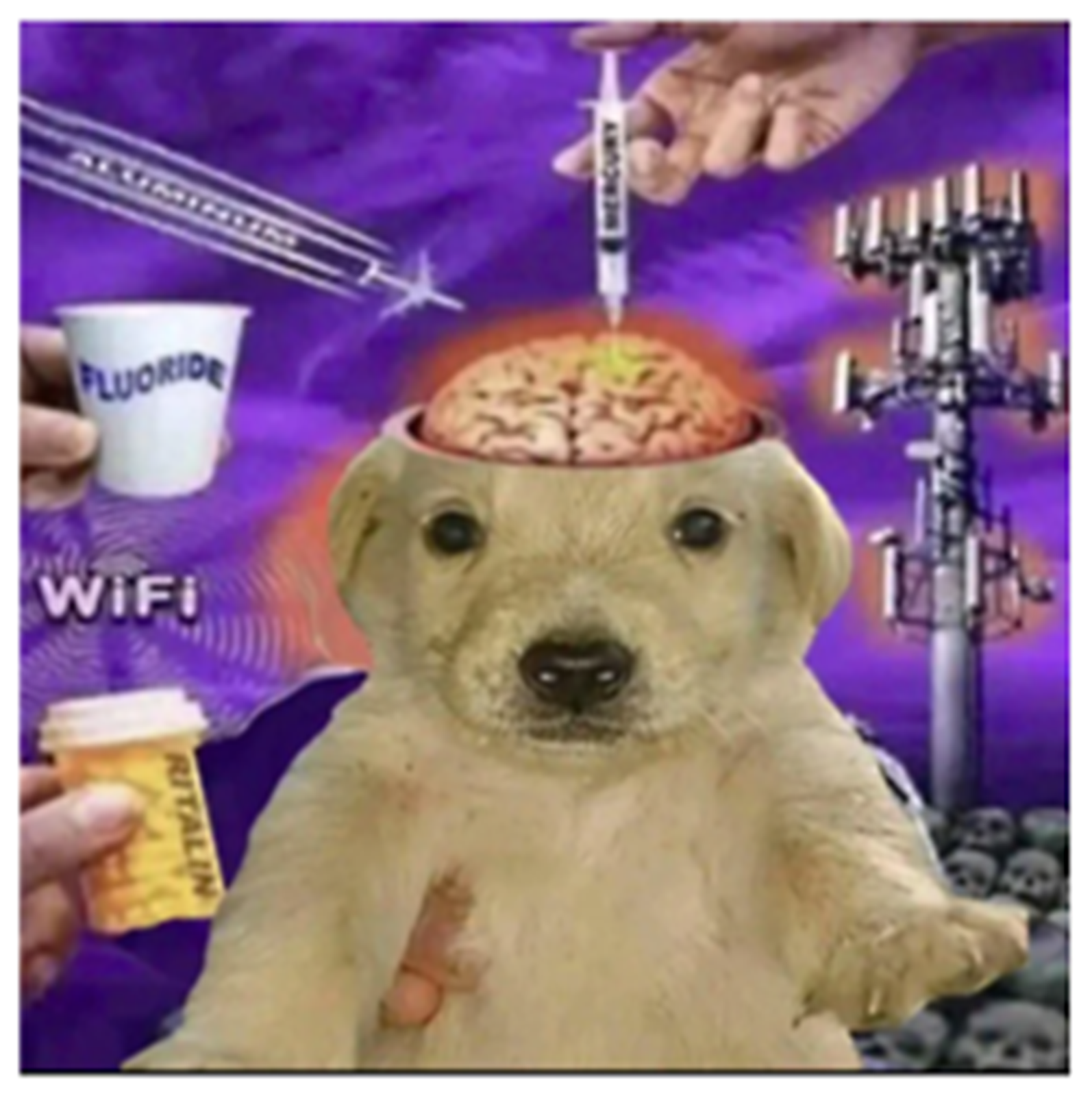
The very act of creating such a collage is an active site of creation and reclaiming artistic practices. Within meme culture, cultural remediation serves as an active logic of play. The use of paranoid aesthetics comes to serve as a point of connection and can be mobilised to comment on a collective state of “brainrot”- when one feels that listening to music or enjoying a pop song has also become a consumptive site of force-feeding rather than a human act based on desire. It is important to note that these aesthetics are not meant to reject or contest algorithmic organisation or curation in its entirety, a futile endeavour in the contemporary landscape anyway. However, they engage users through provocation, ugliness, and deteriorated montages. Brainrot aesthetics employ the shock factor to grab our attention during the frenetic act of scrolling because they look so different to the other images we are used to being fed. In doing so, they remediate these cultural objects, and create new meaning atop them. Therefore, ugliness is once again a strategic choice that seeks to hack the hegemonic form of cultural production.
Before slop: Cute and kitsch as dominant aesthetic categories
Having given the precursors to the aesthetic structures underlying brainrot, I turn now to the predominant aesthetic tendencies that are reflected in slop. I choose here two dominant aesthetic categories: kitsch (Botz Bornstein, 2019; Chateau, 2024) and cute (Chateau, 2024; Dale et al., 2016; Maddox, 2022; Ngai, 2012). These aesthetic categories are chosen as exemplary cultural structures that underlie contemporary politics and influence both culture and the economy. Rather than list prior aesthetic movements in meme culture that embody these traits, and therefore in contrast with the first half of this article, the aim of this section is to interrogate the political and economic phenomena that have fuelled the rise of kitsch and cute.
For modernist critics of kitsch, such as Clement Greenberg and Theodor Adorno, kitsch is the debasement of true culture, thriving off the mass consumer’s lack of taste (Adorno, 1970; Greenberg, 1939). Kitsch things devalue not only true artistic craft and skill but also the laws of aesthetic form. Therefore, it renders us insensitive to, or unable to recognise, true art. However, I want to focus here on an author whose analysis of the fascist use of kitsch as utopian world-making is most relevant to contemporary uses of kitsch. Czech author Milan Kunderá’s 1984 novel The Unbearable Lightness of Being set during the invasion of Czechoslovakia by the Soviet Union, provides the backdrop for his theorisation of totalitarian kitsch.
Kundera describes kitsch as an aesthetic ideal used by the USSR in its propaganda that rejects all that does not conform to excellence. Politically, kitsch is “the aesthetic ideal of all politicians and all political parties and movements” (132). Aesthetically, kitsch presents itself as the purest aesthetic form: “Kitsch is the absolute denial of shit… Kitsch excludes everything from its purview which is essentially unacceptable in human existence” (Kundera, 130). Kitsch is the performance of an unwavering faith in an absolute truth, mediated by sentimentality. Here lies the broad appeal of kitsch. Kundera lists the themes and motifs utilised by kitsch: the familial, the fatherland, love (131). Kitsch appeals in its universality: “The feeling induced by kitsch must be a kind the multitudes can share” (131). When kitsch is universalising, it is therefore de-culturalising. Thorsten Botz-Borstein theorises that kitsch is “a culturally empty type of beauty” that “happens when aesthetic values are separated from cultural context” (2019, 8). This enables us to conceive of kitsch as something that extends beyond a mere aesthetic category; “More than a quality that inheres within specific art objects, however, kitsch can also act as a kind of ‘cultural structure’” (Belevan, 2022). Moreover, the utopian impulse embedded in kitsch is essential to its function as a cultural structure; “In a milieu governed by the dictates of kitsch, believing in these kinds of ‘absolute truths’ is a moral necessity, and the dominant affect can be disconcertingly ingenuous and infantilising” (Belevan, 2022).
The use of kitsch by the USSR paves the way for the use of GenAI Slop by contemporary totalitarian regimes. Gareth Watkins writes of AI as “the new aesthetics of fascism” (2025). In his article, he argues that the far-right leaders of this age have quickly and fulgurously adopted AI for its ability to produce “depthless imagery that yields only the reading that its creator intended” (Watkins, 2025). In this way, the adoption of AI to produce campaign and other political imagery is precisely chosen because it aligns with the political ideology of the far-right: “If art is the establishing or breaking of aesthetic rules, then AI art, as practiced by the right, says that there are no rules but the naked exercise of power by an in-group over an out-group” (Watkins, 2025). Slop as a visual style is employed to communicate politics in a frictionless way. The authoritarianism of AI art then rings true to the authoritarianism of kitsch. It is a self-serving image that demands nothing more than to be taken at face value. I will continue expanding on this in the following section.
The second dominant category I want to address is cute. Cuteness is the lifeblood of consumption. In her work, Sianne Ngai explores cuteness as one of her aesthetic category that indexes how our aesthetic experience has been transformed by capitalism, alongside the interesting and the zany. Cuteness is an aesthetic that explicates the complex relationship between the pleasure of powerlessness and the power of the commodity. The ambiguity of cuteness as an aesthetic comes from its integration of power and powerlessness. The cute object present as passive object, a defenseless thing that triggers in us the intuition to covet and protect it. It creates an illusion of proximity. Cuteness, in this way, speaks to the fetish character of the commodity: Cuteness, an adoration of the commodity in which I want to be as intimate with or physically close to it as possible, thus has a certain utopian edge, speaking to a desire to inhabit a concrete, qualitative world of use as opposed to one of abstract exchange. (Ngai, 2012, 12-23)
In this way, Ngai likens cuteness to a commodity fetish: “with its exaggerated passivity, there is a sense in which the cute thing is the most reifed or thinglike of all things, the most objectified of objects or even and “object” part excellence” (2012, 93). The objective objecthood of cute is what sets it up to be a perfect vector for virality.
Online, cuteness is the lifeblood of virality. The algorithm loves and rewards cute, especially cute animals (Maddox, 2022; Page, 2016). Famously, some of the first viral memes were of animals. “Advice animals” memes were characteristic of the early days of memeing. Like kitsch, cuteness has a universality that explains its vital role in contemporary digital culture. Cute objects have a ubiquitous appeal and, unlike memes, require neither ironic nor digital literacy to understand. They can be used and discarded by all. They appeal to users, regardless of familiarity with digital culture. Indeed, the ease of sharing cute content online gives cuteness its characteristically contagious factor. Cute scholars such as Jessica Maddox and Joshua P. Dale argue that the internet has not only increased the capacity for propagation but also the need for cute content (2022; 2016). Cute things act as a source of relief and sensory intermission in the emotional dysregulation that keeps us scrolling addictively. In a context of brainrot and doomscrolling, cute content offers a brief respite from the negative affect flooding the economy and provides microdoses of joy and happiness.
Cute objects’ “capacity to elicit compassion and complicated affects through uncomplicated sincerity” (Dale et al., 2016: 17) affirms their central role in digital communication online. Such scholars argue that indulging in and communicating through cuteness provides an “important coping strategy for subjects caught up in the precariousness inherent to neoliberal capitalism, and is thus central to the establishment of contemporary (inter)subjectivities” (Dale et al., 2016: 13). Our need to look at cute kittens and puppies is therefore an adaptive response. In short, the attention economy relies on the metaphorical “cute economy” (Maddox, 2022: 17) to help manage emotional precarity, counter the strain of information overload, and offset the constant stream of serious news, distressing reports, and the generally anxiety-inducing atmosphere of the internet. This explains the emergence of cute as a dominant aesthetic category that not only structures individual responses, but social relations in a context of consumption (Wittkower, 2012). It is in this context that we see the category of slop emerge as a new logic of relationality on the web.
Slop
Slop refers to the unwanted or almost spam-like character of the AI-generated content polluting our internet landscape. Although it did not garner as much attention as the aforementioned brainrot, slop also did land a spot on Oxford’s list of words of the year for the year of 2024. There, it is described as “art, writing or other content generated using artificial intelligence, shared and distributed online in an indiscriminate or intrusive way, and characterised as being of low quality, inauthentic or inaccurate” (OUP, 2024). Slop therefore shares the same context as brainrot, but is produced and engaged with differently by users. AI slop differentiates itself from other synthetic images due to its to its subject matter and its trademark aesthetic. It would therefore be unfair to say that all AI-generated images are slop, and more pertinent to understand slop as a mode of production situated in a cultural economy which fosters the conditions for slop to manifest in its current form. In what follows, I argue that slop is a symptom of a world currently dominated by the cultural structures of kitsch and cute, which uses spam as a logic of production in a crowded media environment.
Slop is not created to embody a particular aesthetic mode, but rather mimics others. Indeed, that is the magic of GenAI. It is a remixing machine that produces variations on a theme, any theme we ask it to, from Van Gogh to Studio Ghibli. Its subject matter can be anything: cartoonish images of celebrities, fantasy landscapes, anthropomorphised animals. However, it is always polished and smooth. Despite the connotations of the word being messy and clumsy, the output of GenAI is characteristically not. It is high-resolution, sleek and disquietingly hyperreal. It fits into our digital economy smoothly and seamlessly because it is frictionless. Its subject matter, though, demands closer analysis.
Slop often puts cute objects like kittens and babies in random situations (Bharadia, 2025). Why does it do this? It does so because kitsch and cute are paramount to its distribution. Cute objects have a distinctly democratic appeal due to their very low barrier to entry. At its core, the act of sharing cute content relies on the assumption of a common interpretive framework, in which others are expected to respond in much the same way. Cute calls “forth not only specific subjective capacities for feeling and acting but also specific ways of relation to other subjects and the larger social arrangements these ways of relating presuppose” (Ngai, 2012: 11). Cuteness builds affective bonds with others based on pleasure and communion. Cuteness therefore presents itself as a particular way of communicating, and assumed that others feel the same. Fundamentally, it is based on the consumption of the object of cute.
Kitsch and cute are intimately connected with the aesthetics of mass consumption. Over time, consumer culture has increasingly blurred the boundaries between these two categories, effectively merging them. To Thorsten Botz-Borstein Kitsch is “a tasteless copy of an existing style or the systematic display of bad taste or artistic deficiency,” often accompanied by “an exaggerated sentimentality, banality, superficiality, or triteness” (Botz-Borstein, 6). Botz-Borstein points to the strategic use of cuteness as a façade of innocence. To him, cuteness is a subcategory of kitsch: Cuteness is the most innocent strategy of deculturation. When kitsch is cute, it is excusable. Even more, kitsch can be disguised as the innocent search for freedom. This is one reason why the internet has submerged cuteness. (70)
The assumption that both cute and kitsch are innocent, juvenile or unrefined aesthetic modes is wherein their power lies. Kitsch and cute are aesthetic categories that distribute images that are irrefutably objects to consume. They put us into direct relation with an object, a simple relation predicated on an emotional exchange. In doing so, they exert, they power over us, whilst gaining value from us. They are the perfect image commodity for the digital economy.
The case of AI Slop on Facebook encapsulates how slop uses kitsch and cute to make a space for itself in this crowded media environment, encouraged by platforms. On Facebook, slop is constantly produced by AI-powered “users,” which are accepted and promoted by parent company Meta (McCraken, 2025). Commentators have criticised this move as a last-ditch attempt to drive engagement on a dying platform (Al-Sibai, 2025). Indeed, the slop business is profitable; it certainly gets users clicking. The answer as to how it does this is that AI-bot profiles produce slop imagery in a kitsch style that appeals to our sentimentality. Here, I return to the definition of kitsch as the performance of an unwavering faith in an absolute truth, mediated by sentimentality, which uses an aforementioned set of tropes: first love, the vulnerable elder, an innocent child. AI imagery on Facebook indulges in these tropes fervently.
The images generated by AI profiles are exemplified in Figures 5 and 6. They include depictions of 122-year-old grandmothers having baked their own birthday cakes or sad, mutilated children on a distant stormy shore, unhappy to not have their birthdays celebrated. This imagery is kitsch. It appeals manipulatively to our sentimentality, demands attention, affection, and engagement. It appeals to us to rectify a wrong in the world; those who deserve love have not received it. It performs this unwaveringly, knowing it is demanding a devotion to an absolutely universal truth. On the platform, Meta also complements these images with its Meta AI bot to further drive engagement. The Meta AI bot urges other users (or other bots) to click on AI-generated questions to gain further insight into the image. These questions are often reductive or meaningless: “An image of a bearded gent who carved a crib for his grandchild—only to discover that ‘Nobody Likes It :(’—is accompanied by suggested questions such as ‘Why is it unliked?’ and ‘Baby’s reaction to crib’” (McCracken, 2025). AI Slop on Facebook: Dogs Love Club, Facebook [Screenshotted August 4 2025]. AI Slop on Facebook: mast, Facebook [Screenshotted August 5 2025]. :( 

As an economic model, slop is incredibly successful (Crawford, 2025; Knibbs, 2024; Microsoft, 2023). Slop shines in the clickbait economy especially, as demonstrated above. To get users clicking and making money on their platforms, Meta relies on the pillars of clickbait: “social engineering, sensationalism and embellishment” (Haber, 2024). However, it does this in a far more enhanced way, employing user tracking data and targeted advertising to pinpoint which controversial issue would capture a given user’s attention, or which emotional manipulation techniques would provoke them into engagement. In this way, provocation is a logic it shares with brainrot, though it manifests very differently in the aesthetics of the image. It does not catch our attention by asking us to find it repulsive or ugly, but appeals to our sentimentality. Moreover, it posits itself as the one irrefutable interpretation of itself, daring us to react to it with a different emotion than pity, concern, or relief. It poses as a moral truth dressed up in infantilising or placating cuteness. However, moving from its mode of engagement to its mode of production, slop responds entirely differently to the context of algo-maxxing. It responds as spam rather than as a circuit-breaker, as brainrot did. To demonstrate this, I turn to the internet phenomenon of Italian brainrot, and the slop economy it sparked.
Italian brainrot
At a certain point, slop and brainrot seemed diametrically opposed on the aesthetic spectrum. While brainrot looks appalling, dirty, provocative, slop looks too clean, too high-resolution, too uncanny. They were opposites in how they looked, but also in how they were consumed and how they came into existence. Brainrot claims our attention through aesthetic provocation, and slop manipulates us by tugging on our heartstrings. And then, the two converged. In early 2025, Italian brainrot memes began to take over the internet.
Italian brainrot is a viral phenomenon that took off on TikTok. It had all the makings of a viral movement, inviting engagement; AI-generated kitsch imagery, a catchy soundbite made using a text-to-voice AI generator, and endlessly remixable, often cute, characters. Brainrot characters include Tralalero Tralala, a shark pictured on a beach wearing sneakers, or Tung Tung Tung Tung Sahur, an animate stick-shaped man carrying a bat. The original video posted by user @eZburger401 spawned the creation of many other such characters (KnowYourMeme). Since their initial conception, the brainrot characters have been the subject of much remixing as users have had the GenAI tools to generate similar images at their fingertips. Italian brainrot is here the starting point for a wider “Sloppification” of the economy. Specifically, there is an imminent threat that Italian brainrot makes clear. Slop is coming to take over the current digital cultural economy, and not even its more ironic, irreverent subcultures of avid memers can resist this. Or can they? In the following, I argue that meme culture can serve as a counterbalance to this sloppification. First, I will dispute its label of “brainrot,” arguing instead that we should categorise this phenomenon as slop based on my above theorisation of slop. Secondly, I will address the commodification of Italian brainrot as symptomatic of a mode of production that is entirely different from those that can be found in meme culture.
Though Italian brainrot has incited worldwide attention, few have commented on its misnomer. One of the few aesthetic investigations of Italian brainrot as a form of art makes a compelling parallel with the Futurist movement of the 20th century (Yalcinkaya, 2025), but its uncritical adoption of the brainrot label indiscriminately analyses both brainrot memes and Italian brainrot slop as “brainrot,” instead of addressing them as diverging aesthetic styles. Italian brainrot, as users have come to label it, is AI-generated slop. We can see the aesthetic traits of slop in Figures 7 and 8. The depiction of these anthropomorphised animals and objects offers up high-resolution, uncanny images that serve as a reference to nothing but themselves. The original images are flat, self-referential. They do not exist as a reference to other subcultural structures of meaning or remediation, as is the case with meme culture, but are utterly deculturalised. In this way, they embody kitsch as Botz-Bornstein defines it; a cultural structure that “normalises “formulaic” thought, behaviour, and language, exaggerated statements and expressions, and a pervasive sense of ‘inappropriateness’” (New Aesthetics 47-8). Because these are aesthetic of consumption. Characters of Italian Brainrot: Tralalero Tralala (KnowYourMeme, 2025). Characters of Italian Brainrot: Cappucino Assassino. (KnowYourMeme, 2025).

However, Italian brainrot does differ from previous uses of kitsch as described above. It is neither totalitarian, as is the case with fascist kitsch, nor appealing to our sentimentality, such as in cute. Instead, it performs its kitschiness from its own specific standpoint within the circuits of the attention economy. In its particularly mimetic structure, this type of kitsch slop is most of all a “shared aesthetic ordeal” (Belevan). Kitsch slop is produced, consumed and distributed by those who use it as an expression of group belonging. It is crucial to reiterate that group formation here is contingent of assemblage of human and machine aesthetic judgements. As an image born within the context of algo-maxxing, kitsch slop is aware of the preconditions for its birth. In order to survive, it must catch the attention of the algorithm and set itself up for success. However, catching the algorithm’s attention once is not enough. It must do so many times to become sticky and be deemed a mainstay in internet culture. In order for it to travel, it must appeal to human users, which will, in turn, remix and replicate it themselves. It uses human users as carriers of its virality, like all memes, but, due to its place within algo-maxxing culture, this mediation is primarily based on the algorithm as a mode of consumption. The target of such kitsch slop thus differs from the target audiences of forms of kitsch that precede it. Totalitarian kitsch and cute kitsch have universalising, homogeneising appeal. They both have bigger ambitions in terms of totalising their captive audiences. Here, the target audience is a niche one, one that will be constituted around the experience of aesthetic. The intended recipients of kitsch slop is an audience that is already brainrotted. It is one that already lives in a context of constant image consumption, and can only be reached through the algorithm.
Italian brainrot thus emerges as a different logic of production within the same context of algo-maxxing as brainrot. This is where the difference lies in terms of aesthetics. Italian brainrot responds differently aesthetically to these same conditions as brainrot memes, precisely because its mode of production is not the same. Here, the new logics of production entailed within GenAI mean that constant and endlessly productive output is possible. No circuits of remediation, pastiche or collage are necessitated. No circulating through the creativity and play of other users, only the production machine and the algorithm. GenAI memes mean getting rid of the middleman. However, in this case, the middleman is exactly what makes meme culture valuable. Therefore, Italian brainrot truly espouses the label of “slop”: kitsch objects mechanically produced by GenAI created to accumulate value in the form of engagement and distributed through spam.
Italian brainrot memes acquired the label of “brainrot,” rather than slop, precisely due to the conditions from which they emerged. As a phenomenon, it came to the forefront during a period marked by an urgency around mental health and time spent online, and the way that Italian brainrot seemed to spread like wildfire only confirmed that content such as this represented a real hijacking of our brains. However, it is not only algorithmic re-distribution that was to blame for the fulgurous spread of Italian brainrot. Users themselves quickly became aware of the power of Italian brainrot, and with GenAI tools in their hands, they could quickly and easily get a slice of the pie. Italian brainrot’s success can be partly attributed to its mode of production and propagation: market oversaturation of online content of the same type through automated production. Thus, the label of brainrot was added to a slop aesthetic because of its mode of propagation and consumption online.
The Slop Economy
Following the spread of Italian brainrot on the internet, commodification came quickly and as an onslaught. As is classic with the circulation of internet content, the characters and figures of Italian brainrot content were also quickly recuperated by brands and companies using memes for engagement with their online presences (Kontopanos, 2025). Then, Italian brainrot quickly leaked out of the online space and into the offline, as both memetic and spam content are wont to do. Italian brainrot toys now spam Temu and Amazon, and a musical production of the popular internet genre has drawn masses of children. Indeed, it is important to note that it is not only the ironic or memetic absurdity that was responsible for Italian brainrot’s instant commodification. It is principally their aesthetics. Their cute and kitsch appearance makes them hugely appealing to all, kids to grandparents, those with no digital access to those terminally online. Kids are, in fact, the target audience for Italian brainrot, cartoon-like and reminiscent of other kid’s AI-produced content that spams YouTube.
Italian brainrot has birthed its own algo-maxxing economy, a market structured by a multitude of players seeking quick profits (Le Van, 2025). On TikTok and Instagram, brainrot creators create videos featuring Italian brainrot characters that rack up millions of views, hoping for that payout that platforms hand out to creators whose content goes viral. More than that though, brainrot influencers also instruct each other. The sale of online training courses is popular in this community. One TikTok user who goes by “Mr Trallaloo” sells a PDF guide for €35 titled: “Create and master your own brainrot universe. The ultimate visual guide to blowing up on TikTok” (Le Van, 2025). Others sell access to private Discord servers, populated by users who are there to learn how to “hack” the algorithm. Learning what works and doesn’t work to catch the algorithm’s attention is key here, and that key is often only uncovered by spam.
Spam is the dominating logic of the production of slop in the algo-maxxing economy. Furthermore, spam is only made possible because of the development of GenAI tools. Spam, the constant and unceasing output of content, would not be feasible without GenAI working as an endlessly remixing machine. Slop’s logic is “the more it repeats, the more it spreads (Madsen and Puyt, 2025). Spam proliferates in the hope that one of its millions of outputs will be picked up by the algorithm. In the slop economy, spam is legitimate and encouraged social media use from all actors. The case of platforms benefiting from slop, as seen in the case of Meta’s encouragement of AI profiles on their platform, is predictable. GenAI slop generates content for their platforms and their algorithms, driving engagement up in a cannibalistic self-sustaining loop (Crawford, 2025). This slop economy dispenses with the user altogether. Large parts of the SEO industry have pivoted entirely to AI-generated content, as has some of the internet advertising industry, most notably in the case of mobile ads (Broderick, 2025). However, as in the case of Italian brainrot, users stand to benefit from using spam logic too.
Slop culture is a culture born out of algo-maxxing, and embraces it uncritically. Though born in the same context as brainrot, it no longer sees internet content as a possible cause for concern but a market opportunity. It responds to algo-maxxing through constant production. In this economy, there are many actors, including platforms, marketers, but also user who produce slop-generated content to claim their own slice of the profits. Along with the variety of epistemic threats that GenAI slop represents (Klincewicz et al., 2025), greater attention and emphasis should be given to the cultural threat that “AI slop” symbolises. As it stands, slop threatens to restructure the digital cultural economy more radically than the introduction of any online technology in the last 15 years. Recent research has shown that AI is often used as a tool working within the parameters of platform governances and reproducing normativity. In their work on synthetic imaginaries, Pilipets and Geboers have found that AI produces visual content that is aligned with platform content moderation policies, resulting in “synthetic imaginaries steered by safety protocols and normative value alignments” (2025), while Rettberg and Wigers have noted that stories written by GenAI prioritise narrative homogenisation and emphasise stability over change (2025). As Madsen and Puyt write, “originality becomes roadkill on the algorithmic highway” (2025). If we continue to allow the unregulated use of GenAI slop to take over the digital cultural economy, we stand to lose cultural diversity and forms of creative expression that are complex, multi-layered, ironic and often ugly, in favour of algorithmically mediated normativity and aesthetic homogenisation.
Conclusion
The difference between brainrot and slop aesthetics is crucial to make because they represent two completely different politics. Brainrot memes intentionally gather all the detritus of the internet through an ongoing and constant remediation, while slop culture uses GenAI tools as spontaneous remixing machines that produce variations on a theme for the purpose of instant commodification. Subcultural structures, irony and having cultural capital in memetic circles are key to making brainrot, but mainstream appeal to all and the ability to go viral are key to producing slop. Brainrot figures in an aesthetics lineage that resists commodification through its use of ugliness and deterioration. It is a critical sensibility that responds to a context of consumption. In its mode of production, it values shock, the ability to comment on the contemporary algo-maxxing condition, and the aesthetics of collage. On the other hand, slop spams the internet landscape and uses the vehicles of kitsch and cute to reproduce itself unendingly. It responds to the same context of consumption through spam. We encounter then two fundamentally different structures behind each mode of production.
Online, social relations between users of digital culture are often orchestrated by the cultural structures of kitsch and the cute. Hyperconnectivity has facilitated the hyperconsumption of commodified aesthetics, yet this same dynamic has also generated the ironic frameworks characteristic of meme culture, steeped in subcultural relationality. Irony complicates the flattening tendencies of kitsch and cuteness, introducing layers of depth and dimensionality. Studying this aesthetic history and context of brainrot and slop helps us understand the role that memes serve as an effective counterbalance to the growing influence of AI. Many endorse the virtues of GenAI as a vision of the future, but AI aesthetics merely recycle the past. They repeat it so often that all of history is folded into the present, slowing time into an eternal and stagnant now. This now is defined by algorithmic standardisation, narrative homogeneisation and cultural normativity. We see this unavoidable slouching towards cultural homogenisation in the cute and kitsch aesthetics of GenAI creations. However, meme culture maintains an aesthetic engagement that reminds us of the power of the aesthetic form as a tool for critique. The meme’s embedding within social contexts, its function as social commentary and its role in social bonding, all point to the unavoidable sociality of the meme form. There is no better cultural structure to confront the seriousness of kitsch than irony, and no better subculture than meme culture. Return to Glitsos et al.’s argument about the original brainrot, Skibidi Toilet, the authors wrote: “In all its bizarre, monstrous glory, Skibidi Toilet can be read as Gen Alpha’s creative expression of the ‘trouble’ brought about by emergent artificial life forms and our (potential) dystopian futures” (2024). Aesthetically, brainrot memes stay with the trouble. They create zones of friction and tension, resisting the authoritarianism of kitsch and its self-serving narcissism.
Footnotes

Funding
The author received no financial support for the research, authorship, and/or publication of this article.
Declaration of conflicting interests
The author declared no potential conflicts of interest with respect to the research, authorship, and/or publication of this article.