







Abstract
Many young people in Sweden stop participating in club sports during their teens, but some continue. Drawing on a longitudinal study, the aim of this article is to highlight some of the characteristics of teenagers who continue with club sports and to discuss the relation between club-sport participation and social and cultural conditions, with the help of Bourdieu’s theoretical framework. This is done by studying the characteristics of teenagers who do club sports at 13 and 16 years of age and comparing them with non-participants at the age of 16. In focus are girls and boys (n = 289) who participated in both 2004 and 2007 by answering self-reported questionnaires on sporting activity in their leisure time, their academic success and the social position of their families. The conclusion is that young people who possess specific dispositions and certain assets in terms of a habitus with a taste for sport and a cultural capital remain more often in club sports.
Introduction
Over 80% of all children and young people in Sweden participate in club sports at one time or another during their childhood or youth (SCB, 2003; Trondman, 2005). However, far from all are still participating in club sports in their late teens. International studies also show a diminishing participation in club sports during adolescence (Coakley, 2003; Coakley and Pike, 2009; De Knop et al., 1996; Findlay et al., 2009; Pratt et al., 1999; Scheerder et al., 2002; Seabra et al., 2007; Weinberg and Gould, 2007). Different factors, such as social class (Blomdahl and Elofsson, 2006; Engström, 2004b, 2008, 2010; Laakso et al., 2008; Larsson, 2008; Wagnsson, 2009; Wright et al., 2003), gender (Coakley and Pike, 2009; De Knop et al., 1996; Vilhjalmsson and Kristjansdottir, 2003) and parents’ own interest in sport (Coakley and Pike, 2009: 103; Scheerder et al., 2005b), are related to teenagers’ club-sport participation.
Some studies show, however, that sport participation among young people is not correlated with the socio-economic status of their parents (Mota and Silva, 1999; Scheerder et al., 2005b). Although boys participate more often than girls in organized sports, there is a growing tendency for girls to be more active in organized sports (Laakso et al., 2008; Scheerder et al., 2002, 2005a; Seabra et al., 2007; Telama and Yang, 2000; Wagnsson, 2009). Scheerder et al. (2007) have shown that socio-economic conditions, sporting parents and the choice of subject specialization influence to what extent girls participate in sporting activities. A study of young sport participation in Flanders shows that they, to a greater extent, choose humanities programmes rather than technical and vocational programmes (Scheerder et al., 2005b). In other words, taking part in club sports seems to be related to a number of prerequisites and background variables. Which teenagers continue with club sports then? The focus in this article is on young people who participate in club sports during their teens and their relation to physical activity, doing sport with their parents and academic success.
Club sport and acquired dispositions
School sports activities in Sweden are not common outside the physical education and health (PEH) curriculum (www.skolverket.se), and most organized sports activities are therefore to be found in sports clubs belonging to the Swedish Sports Confederation (Larsson and Redelius, 2010; Seippel et al., 2010). Sweden, with a population of about 9 million people, has around 20,000 sports clubs; organized club sport has been part of the development of the welfare state and Swedish welfare policy since the beginning of the 20th century (Bergsgard and Norberg, 2010; Norberg, 2004). Today, the sports movement’s role is emphasized as an important factor that benefits democracy, equality and public health (Government bill, 1998/99: 107; Statens offentliga utredning (SOU), 2008: 59). In the Swedish Sports Confederation’s policy document (www.rf.se), it is stressed that the sports movement is open to all, irrespective of recreational or competitive ambitions. Activities should be adapted to young people with different levels of ambition, and participation in both recreational and elite sports is to be encouraged (www.rf.se). It should, in other words, be possible for anyone who wishes to participate in club sports.
Our point of departure is that sport, however, constitutes a cultural and social practice and that specific dispositions are required if a person is to be comfortable with and wants to continue this practice (see, for example, Bourdieu, 1978, 1984; Brown, 2005; Engström, 2004b, 2008, 2010; Shilling, 2005). This means that we regard lifestyle as something that is linked to cultural and social conditions. The sociologist Pierre Bourdieu was interested in the relation between social position (cultural and economic capital) and lifestyle, and we have been inspired by his theoretical framework, especially the concepts of habitus and capital, with a view to analysing the relation between participation in sport and social position.
Habitus should be seen as a system of dispositions that are embedded in people’s minds and bodies through experiences of social situations and collective memories that determine people’s ways of moving, thinking and acting (Bourdieu, 1984). Bourdieu writes: The habitus is both the generative principle of objectively classifiable judgements and the system of classification (principium divisionis) of these practices. It is in the relationship between the two capacities which define the habitus, the capacity to produce classifiable practices and works, and the capacity to differentiate and appreciate these practices and products (taste), that the represented social world, i.e., the space of life-styles, is constituted. (Bourdieu, 1984: 170)
How the world is understood is determined by an individual’s habitus. Every individual is equipped with a habitus because every individual constructs his or her own image of the social world in which he or she finds him- or herself. The individual’s incorporated structures, the individual’s habitus, are related to the structures that the individual is surrounded by, which, in turn, affects the creation of her or his identity. Applied to sport as a social practice, it means that in order to adapt, be comfortable with and want to continue to take part in organized sports, a certain habitus is required. By doing sport spontaneously, in school, together with their parents, and in a club, young people acquire experiences that, in different ways, help to shape and reshape habitus, with different tastes for sport.
Habitus is something beyond what has been directly learnt; something more than the incorporation of knowledge, skills and values; and something beyond socialization at a conscious level. The dispositions are unconsciously incorporated into the body and are expressed in, for example, liking or disliking a certain situation or activity, or by the individual feeling comfortable in a specific context and uncomfortable in another.
An individual’s habitus is especially formed during childhood and adolescence, when a person is particularly open to impressions and influence. Even though an individual has his or her own habitus, common patterns of habitus emerge at group and class level when people live and develop under similar conditions. Habitus should also be seen in relation to Bourdieu’s other key concepts: field and capital. In this study, the relation between habitus, cultural capital and club-sport participation is of special interest.
Capital can be made up of economic, social, cultural and bodily assets that provide different opportunities for power and influence (Bourdieu, 1984). In the following study, young people’s academic success, for instance credits and choice of upper secondary school, as well as parents’ educational background, have constituted the indicators of cultural capital. 1 The economic resources of the family have been used as an indicator of economic capital. Moreover, young people must be endowed with a habitus, incorporating dispositions that are valued in the sport they are practicing.
The aim of the study
Inspired by the above theoretical framework, the hypothesis of this study is that a certain capital, as well as a habitus negotiable within the sports movement (the sport and the club in which one takes part), increase young people’s opportunities to feel comfortable and remain in club sports.
Drawing on a longitudinal study, the specific aim is to investigate some of the characteristics of those who participate in club sports at both the ages of 13 and 16 and those of non-participants at the age of 16. This is done by comparing characteristics between the two groups with reference to their approach to club sport, perceived level and intensity of physical activity, previous experience of doing sport with their parents, PEH grades, credits and social and economic position. By using Bourdieu’s theoretical framework, the relation between sports participation and social position among teenagers who participate both at the ages of 13 and 16 is analysed in terms of a habitus with a taste for sport, as well as indicators of cultural and economic capital.
The study’s format and methodology
Sample
This study is part of a longitudinal and multidisciplinary project in which a total of 1976 students aged nine, 13 and 16 from 48 randomly selected Swedish schools took part (Engström, 2004a). In the first data collection (2001), 585 out of 642 nine-year-old students took part, that is, 91%. The study is based on the follow-up to the base study’s original nine-year-old students, who continued to be monitored at the ages of 13 (in 2004) and 16 (in 2007). In 2004, the number of students surveyed was 576, of which 386 (67%) responded. Three years later, in 2007, 373 students responded (65%). The total number of young people who took part in both the 2004 and 2007 surveys was 289, which constituted 50% of the original group – and this is the group on which this article is based. As several studies show, it is during adolescence that there is the largest drop in club-sport participation (Coakley, 2003; Coakley and Pike, 2009; De Knop et al., 1996; Engström, 2004b; Findlay et al., 2009; Pratt et al., 1999; Scheerder et al., 2002; Seabra et al., 2007; Trondman, 2005: 9; Weinberg and Gould, 2007); therefore, we have focused on the 13–16 age range in this study. The dropout analysis, in which the responses from the students who participated in the study both in 2004 and 2007 were compared with those who did not take part in 2007, showed no significant differences (chi-square test) with regard to involvement in club sports and the extent of sporting and physical activity at the age of nine. The selection on which this article is based is therefore representative regarding sporting activities at the age of nine.
The 2001 base study and the 2007 follow-up study were carried out in Stockholm, Gothenburg and Malmö. For the follow-up study in 2004, when the young people were 13 years of age, the questionnaires were sent to them by post.
The questionnaire and measurements
For both of the surveys, the students answered the same standardized questionnaire created and checked by a team of researchers and submitted to test for reliability and validity (Brun Sundblad, 2006; Ekblom, 2005; Engström, 2004a). The survey included questions about living habits, the socio-economic status of the family, recreational activities, attitudes to PEH, credits and plans for further studies and future occupations. The questionnaire items that are of interest in this study concern participation in club sports, the perceived extent and level of intensity of physical activity, grades in PEH and other school subjects, parental education level and the family’s economic resources.
The test–retest reliability was carried out in the spring of 2007 with a class of 16-year-old students, from which a correlation of 0.87 was obtained with regard to the key issue of the extent of physical activity. Before the study started, parental permission was obtained, and ethical guidelines have been followed. Each study was approved by the Ethical Committee at Karolinska Institutet, Stockholm (Ref.no.00-416).
Participants and non-participants
Club-sport participants are defined as those who are active participants in a club sport at both the ages of 13 and 16. This was investigated by posing the following question: Do you currently participate in a club sport and have you done so during the last year? From this question, four groups were formed: participants at 13 and 16 years of age (n = 157, girls = 67, boys = 90), participants at 13 but not at 16 years of age (n = 63, girls = 37, boys = 26), non-participants at 13 but participants at 16 years of age (n = 13, girls = 7, boys = 6) and non-participants both at 13 and 16 years of age (n = 51, girls = 23, boys = 28). These groups, apart from the 13 individuals who had started after the age of 13, were then categorized into two new groups: club-sport participants at the ages of 13 and 16 (n = 157) and non-participants at the age of 16 (n = 114). In the data processing presented here, participation in a club sport is used as a dependent variable. Since no significant differences were found between boys and girls, they are reported together.
Perceived level and intensity of physical activity
To measure physical activity, the young people referred to their perceived level and intensity of physical activity. They were asked to answer the following question, which had five alternatives: Which person do you resemble the most? (Ekblom, 2005; Engström, 2004a): I’m a person who exercises very little (PAA); exercise quite a lot but never to the extent of getting sweaty or out of breath (PAB); exercise quite a lot and sometimes get sweaty and out of breath (PAC); exercise so that you get sweaty and out of breath several times a week (PAD); exercise so that you get sweaty and out of breath every day or almost every day (PAE).
They could include all physical and sporting activity, organized and non-organized, as well as PEH as a school subject. In the regression analysis, indicators of physical activity from 13 years of age were divided into two groups. One group (PAA–PAC) indicates a low level of physical activity (PALow) and one group (PAD–PAE) indicates a high level of physical activity (PAHigh).
Grades and academic success
Not until after compulsory schooling (after Year 9) can students choose either academic or vocational upper secondary school programmes. The choice of upper secondary school programme is made based on the credits obtained by the students in their final marks (Year 9). A high number of credits can therefore be seen as a sign of academic success and an indicator of cultural capital. In the Swedish school system, the grades in all Year-9 subjects are as follows: No grade awarded (PDS1), Pass (PDS2), Pass with distinction (PDS3) and Pass with special distinction (PDS4). When students finish their compulsory schooling, their total number of credits is between 0 and 320: a Pass is worth 10 credits; a Pass with distinction, 15 credits; and a Pass with special distinction, 20 credits. When being admitted to an upper secondary school (at the age of 16), the credits from 16 subjects are totted up, the maximum being 320 credits. The variable has been divided into four levels: 0–195, 200–235, 240–280 and 285 or more. For the regression analysis, the credit levels were divided into three: CRLow (0–190 credits), CRMedium (195–235 credits) and CRHigh (240–320 credits). If a student has a CRHigh, this means that he or she has, on average, obtained a Pass with distinction in all subjects. The student’s plans for after compulsory school were measured by a variable with two levels: continuing one’s studies at upper secondary school in the form of either a vocational or an academic programme.
Activities with parents
To obtain knowledge of parents’ influence on their children’s physical activity, a question was asked about the sports that students had, at the age of 13, done with their parents. The question included the following activities: swimming, skiing, skating, football, badminton, table tennis, tennis, golf and sailing, plus open-ended alternatives where they could state the activity themselves. Activities such as cycling and walking were not included. The number of activities was divided into two categories: zero or one (PA ≤
Socio-economic background
Furthermore, the 16-year-old students answered questions about the highest educational level of each parent, and the family’s economic capital was measured by questions about its physical property (Ekblom, 2005; Engström, 2004a). Based on this information, the highest educational level of each parent was obtained using the variable groups: low educational level, LowEL (compulsory school); medium educational level, MediumEL (upper secondary school); and high educational level, HighEL (university). In order to obtain some idea of the economic capital, the students were asked questions about their families’ assets, such as (a) a house, (b) a summer house or cabin, (c) a car or (d) a boat in which they can sleep. Each was worth 1 point: low economic capital, LowEC (0–1 pts.); medium economic capital, MediumEC (2 pts.); and high economic capital, HighEC (3–4 pts.). For students living in two places, for example due to their parents having separated, any of these items in either of the two homes were noted.
In the study, the information concerning cultural and economic capital included questions about credits obtained in the last year of compulsory schooling, plans to study at an upper secondary school, parents’ educational level and the family’s economic resources.
Statistical analysis procedures
The questionnaires were converted into a database using the SPSS (Statistical Package for the Social Sciences, SPSS 17.0, Chicago, IL, USA) computer software. By way of quality control, the questionnaires were reread and compared with databases to achieve the highest possible level of accuracy. In order to determine whether there were any differences between participants and non-participants in club sports regarding earlier physical activity and socio-cultural characteristics, such as academic success and socio-economic status, chi-square was used for examining group differences with the following level of statistical significance: p < 0.05 (*), p < 0.01 (**) and p < 0.001 (***).
In order to control for mutual relationships between various independent variables associated with the dichotomous dependent variable, participation or non-participation in club sports, a multivariate logistic regression analysis was conducted. Logistic regression modelling examines the relationship between various covariates and the odds ratio of the outcome by estimating the probability of the event happening (e.g. participation in club sports). Odds ratios greater than 1.0 show the increase in odds of an outcome of ‘1’, whereas odds ratios less than 1.0 show a decrease in the odds of an outcome. The odds ratios are statistically tested and a 95% confidence interval is also shown.
Results
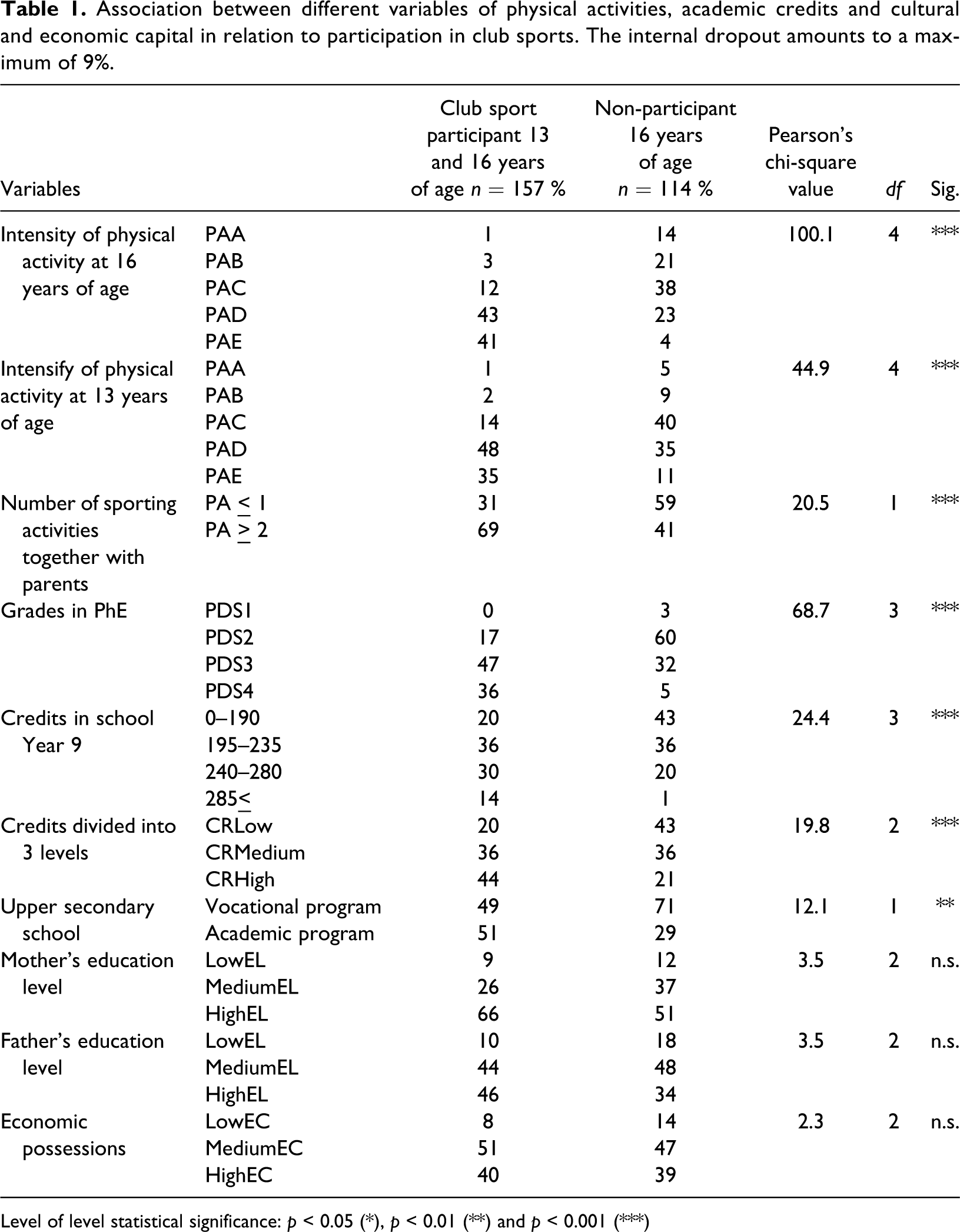
The presentation starts with a description of the characteristics of the participants (n = 157) and non-participants (n = 114) concerning their perceived level and intensity of physical activity, credits, plans to study at upper secondary school and families’ cultural and economic capital (Table 1). Thereafter, an examination of the indicators of a habitus with a taste for sport is presented, together with the relation between indicators of cultural capital and participation in sport (Tables 2 and 3 ). The results section concludes with an overall analysis of indicators of ‘sporting disposition’; in other words, a habitus with a taste for sport (Table 4 and Figure 1).
Association between different variables of physical activities, academic credits and cultural and economic capital in relation to participation in club sports. The internal dropout amounts to a maximum of 9%.
Level of level statistical significance: p < 0.05 (*), p < 0.01 (**) and p < 0.001 (***)
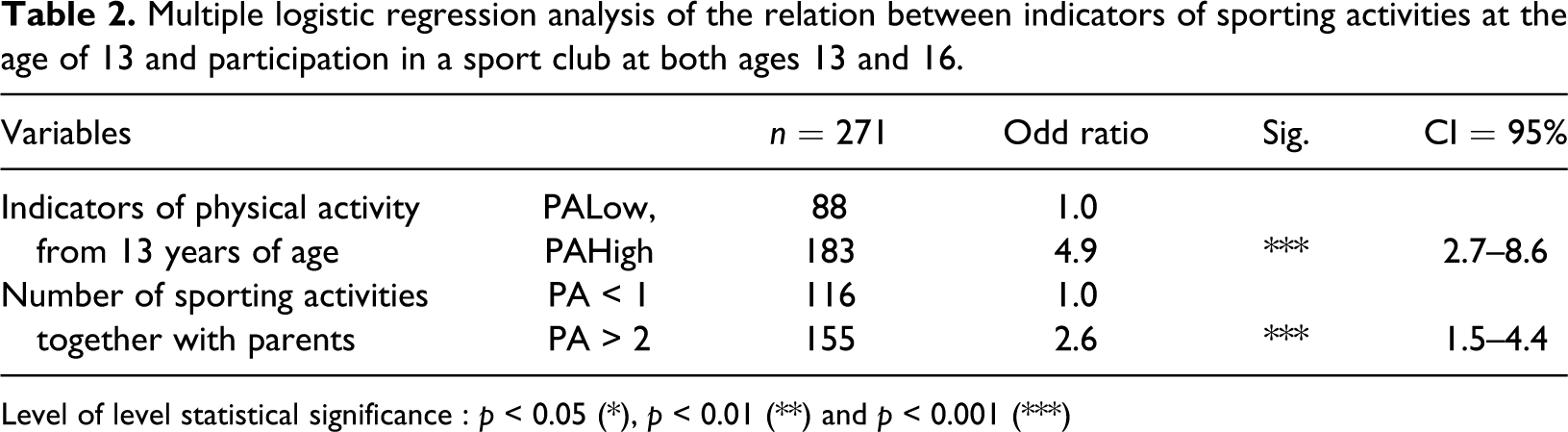
Multiple logistic regression analysis of the relation between indicators of sporting activities at the age of 13 and participation in a sport club at both ages 13 and 16.
Level of level statistical significance : p < 0.05 (*), p < 0.01 (**) and p < 0.001 (***)
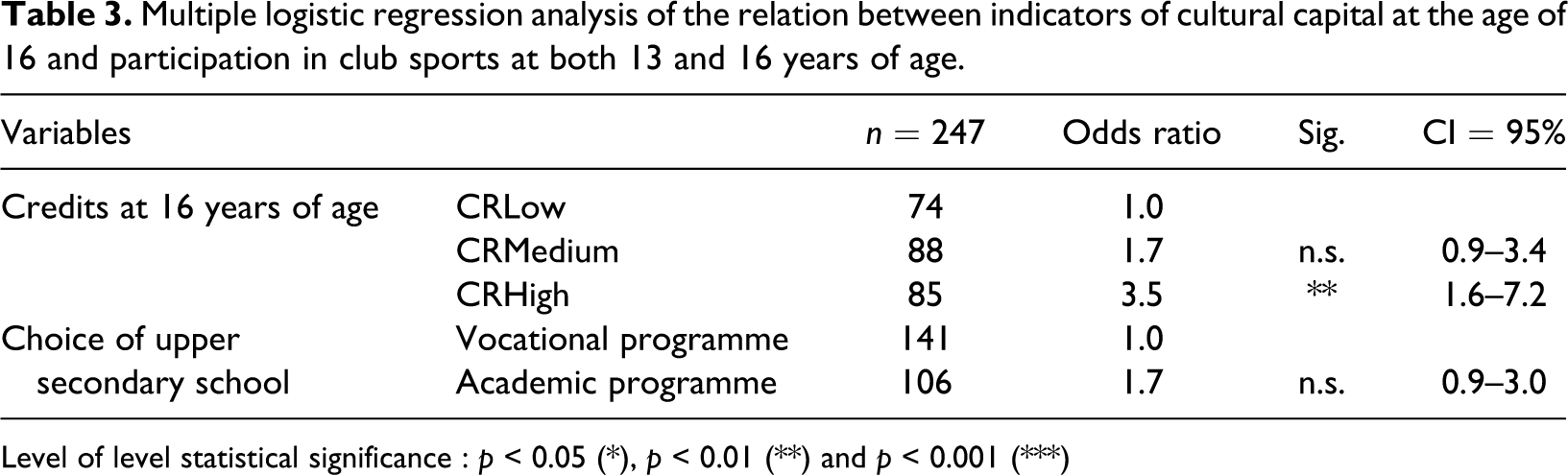
Multiple logistic regression analysis of the relation between indicators of cultural capital at the age of 16 and participation in club sports at both 13 and 16 years of age.
Level of level statistical significance : p < 0.05 (*), p < 0.01 (**) and p < 0.001 (***)
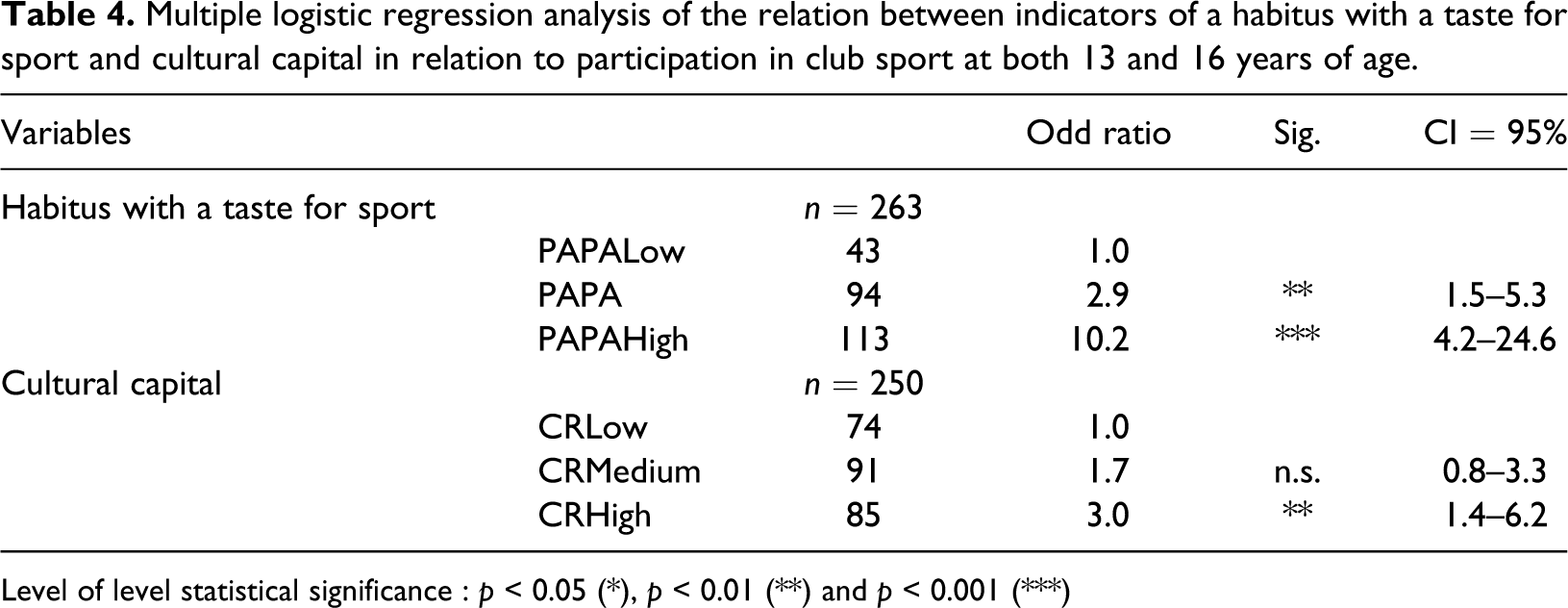
Multiple logistic regression analysis of the relation between indicators of a habitus with a taste for sport and cultural capital in relation to participation in club sport at both 13 and 16 years of age.
Level of level statistical significance : p < 0.05 (*), p < 0.01 (**) and p < 0.001 (***)
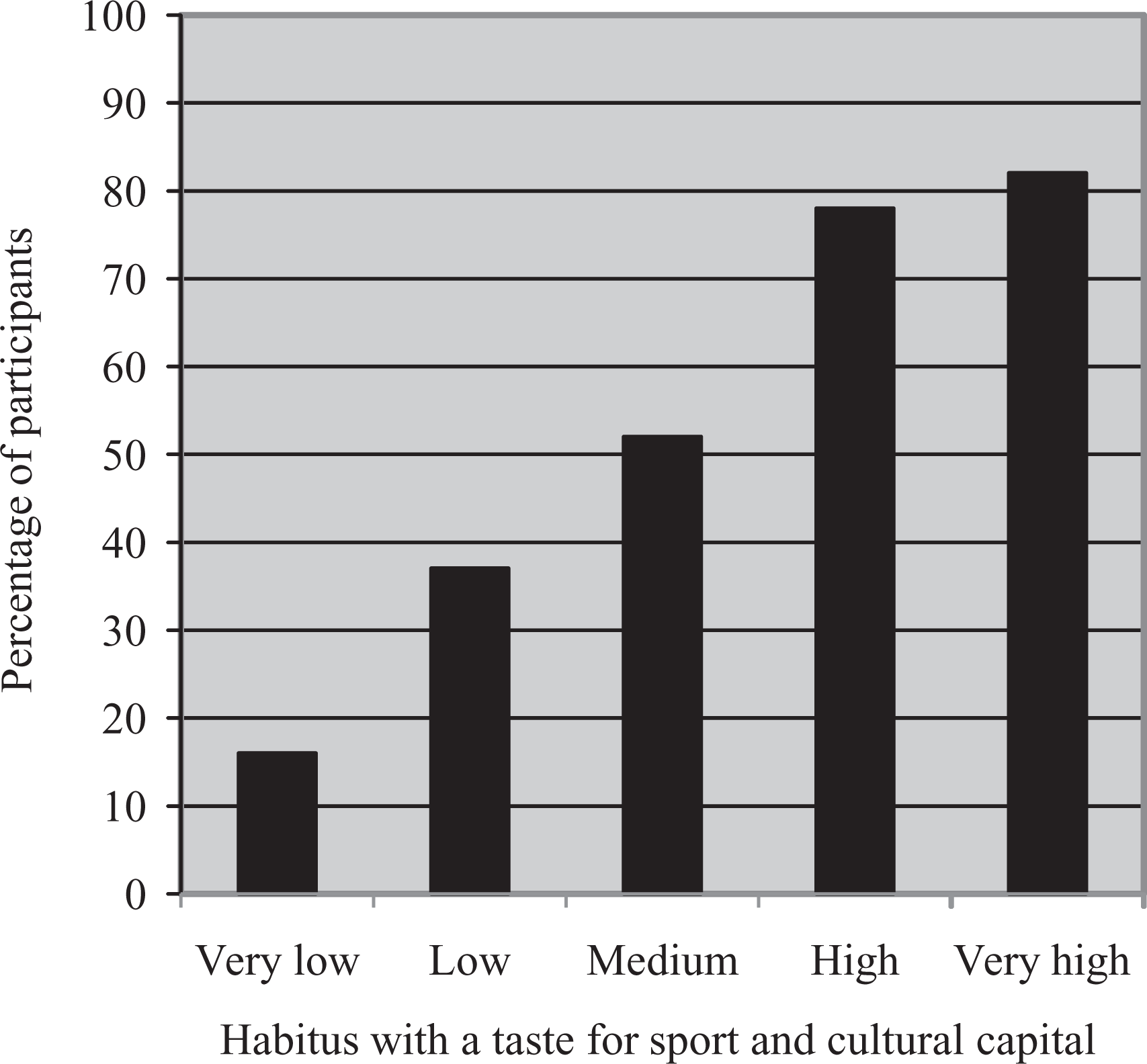
Percentage of participants in club sports at both 13 and 16 years of age in relation to a variable where habitus with a taste for sport and cultural capital are combined.
Perceived level and intensity of physical activity at 16 years of age
The results show that club-sport participants perceive themselves as more often physically active and with a higher level of intensity than the group of non-participants.
The variable intensity of physical activity at 16 years of age shows that 84% of those who were active in club sports at both the ages of 13 and 16 state that they most resemble someone who is very physically active (group PAHigh), compared with 27% of those who were not involved in club sports at 16 years of age. It should be noted that the young people included the subject PEH, which every student involved in the study had on average twice a week (Lundvall and Meckbach, 2004). Relatively few outside the sports movement, under their own steam and by studying PEH, perceive that they are physically active to the extent that they become sweaty and out of breath several times a week.
If we compare the same question and the answers from the same respondents at the age of 13, we see that twice as many of the participants (83%) regard themselves as being very physically active compared with 46% of the non-participants. The majority of those who still participate at the age of 16 consider themselves as being very physically active at 13 years of age. Apparently taking part in club sports makes it possible to be physically active during one’s teenage years and those who do not participate do not seem to be physically active on their own. It should also be noted that a higher percentage of non-participants see themselves as physically active at the age of 13. Many of them could have participated in club sports when they were 13 and they might also have been doing more sport spontaneously. Among the group of non-participants at age 16, there was, however, a sharp drop in the percentage that regarded themselves as physically active.
Grades in physical education and health
Grades in PEH could be seen as an indicator of knowledge of and ability and competence in physical activity and sport. Not surprisingly, we found that the grades in PEH varied among the groups. More than one third (36%) of those who took part in club sports obtained a Pass with special distinction in PEH. Of those who did not take part in club sports at the age of 16, only 5% achieved this grade. If the two highest grades (PSD3 and PSD4) are combined, the differences are also striking: 83% of participants and 37% of non-participants in club sports achieved these grade levels. Grades in PEH are thus clearly related to active participation in club sports.
Taste for sport
In order to obtain an indicator of how the interest in and taste for sport have developed, the students said to what extent during their childhood they had participated in sports with their parents.
As Table 1 shows, 69% of those active in club sports were, at the age of 13, doing two or more sporting activities with their parents, compared with 41% of non-participants in club sports. It is obvious that the young people who, at a younger age, had been doing several sporting activities with their parents were also more active in club sports as teenagers.
Credits and plans for future studies
As illustrated in Table 1, 14% of those who are active in club sports are in the category ‘285 credits or more’, which amounts to the majority having a Pass with special distinction in all subjects. This is in comparison with 1% of those who are not involved in club sports. If we add those who have more than 240 credits, the equivalent of a Pass with distinction or higher as an average in all subjects, we find 44% of the club-sport participants in this category compared with 21% of those who do not take part in club sports, or more than twice as many.
In total, 71% of the non-participants and 49% of the participants were planning to choose a vocational programme after having finished their compulsory schooling.
Parents’ educational level and economic capital
According to the investigated variables of the parents’ educational level and the family’s resources in relation to participation in sporting activities, no significant differences are found (see Table 1).
Club-sport participants, habitus and cultural capital: an in-depth analysis
We can ascertain that students who are active in club sports at the ages of 13 and 16 are and have been more physically active and have higher grades in PEH than those who are no longer involved in club sports. They have, at the age of 13, also done sports with their parents to a greater extent and consider themselves more physically active in their free time at this age. Furthermore, they have a higher number of credits in Year 9. The first question now is which relation is obtained if an analysis is done where indicators of physical activity and the number of sporting activities done with parents in relation to participation in club sports are mutually controlled and tested. A multiple logistic regression analysis gives the following responses.
Both the physical activity level and the amount of sport done with parents at the age of 13 show mutually controlled significant relations with participation in club sports. Those who report a high physical activity level at this age (PAHigh) are almost five times as likely to take part in club sports as those who are not as active at the same age. Similarly, those who have done sports with their parents several times (PA ≥
Table 1 illustrates that academic credits in Year 9, as well as plans for further study after having completed compulsory schooling, have a significant connection with participation in club sports. Now, the question is whether these two variables when mutually controlled have a significant relation to participation in club sports at the ages of 13 and 16.
The analysis shows that credits are significantly linked to participation in club sports but not to plans for further studies after having completed compulsory schooling. Those who receive a high number of credits (CRHigh) are three and a half times as likely to be active in club sports as those who do not have a high number of credits.
Overall indicator of a habitus with a taste for sport
In order to increase the understanding of the characteristics of young participators in club sports, the two indicators, the number of sporting activities done with one’s parents and the extent and intensity level of physical activity at the age of 13, are combined (PAPALow, PAPAMedium or PAPAHigh). This new variable is used as an overall indicator of sporting disposition, or expressed differently, a habitus with a taste for sport. Furthermore, we explored whether this variable when controlled for academic credits was of significance for participation in club sports at the ages of 13 and 16.
The analysis shows that both a habitus with a taste for sport at 13 years of age and credits at 16 years of age when mutually controlled are significantly linked to participation in club sports, where the former seems to be the most important. Inspired by using the analytical tools of Bourdieu, we combine these two variables and a new one is obtained consisting of five scale steps, where the lowest value indicates a habitus with weak taste for sport and a low number of credits (cultural capital) at 16 years of age. Inversely, a high value means a habitus with a strong taste for sport and a high number of credits (cultural capital).
Figure1, indicates that those who consider themselves to be very physically active at the age of 13, have done a variety of sports with their parents, have a high number of credits at 16 years of age are club-sport participants to a much greater extent than the non-participants. At both the ages of 13 and 16, 82% are still active in club sports. The corresponding percentage of those who have low physical activity levels at the age of 13, do little sport with their parents and also have a low number of credits was 16%. The analysis shows that the activity level and the extent to which a child, at the age of 13, does sport with his or her parents constitute a strong indicator of continuing participation in club sports. The grade total achieved in Year 9 is seen as cultural capital and further supports this indicator. It is apparently the combination of both a habitus with a taste for sport and a cultural capital that produces the outcome.
Discussion
The specific aim of this study was to investigate some of the characteristics of those who participate in club sports at both the ages of 13 and 16 and those of non-participants at the age of 16. The discussion of the results is mainly inspired by Bourdieu’s concepts of habitus and cultural capital. Even though the study is focused on Swedish young people, we believe that the results are also valuable for an international audience, in terms of increasing the understanding of what is required to remain physically active within organized club sports. The latter is particularly noteworthy in the light of recent efforts by Western societies to increase physical activity among children and adolescents (Kirk, 2005; Malina, 2001; Smith and Biddle, 2008; SOU, 2008: 59; WHO, 2002).
Before discussing the results, a few points should be noted concerning the type of measurements used in the study. The extent to which the submitted responses reflect ‘reality’ can never be determined, particularly as every person’s perception of ‘reality’ is different. As researchers, we are obliged to accept the responses submitted. Having said that, however, the strong association that exists between the answers provided at different ages and, in particular, the fact that the predictors based on the stated theory are empirically replicable, clearly indicate that the information gives a reasonably high level of statistical reliability and validity. By this, we mean that the statements are consistent and the information provided, for example about the perceived extent and intensity of physical activity and sporting habits, corresponds with actually doing sports.
It became apparent that it was not just anybody who continued participating in organized sports. Even if almost all children in Sweden start in a sports club, it is a certain group that remain as club-sport participants and among them some specific patterns emerge. Those who continued with club sports at the age of 16 consider themselves very physically active already at 13 years of age and have done various sports with their parents to a greater extent than non-participants at the age of 16. This means that they have more experience and a greater repertoire of different kinds of physical activity and sport, which, in the long run, increases physical competencies, as well as a special taste for sport.
Previous studies show that socio-cultural factors in sport, for instance parents’ educational level, interest in sport and social class, have an influence on children’s involvement in sport. In this study, no significant relations were found between parents’ educational level and economic capital and young people’s continued participation in club sports, which corresponds with the findings of, for example, Scheerder et al. (2005b). One interpretation is that the sports movement reaches a lot of young people in Sweden by way of it, for example, being easy to join, and, in many instances, at a low cost. The social and economic backgrounds do not play a decisive role. Another interpretation is that since there is a broad middle class in Sweden, whence the majority of young people come, the percentage from social groups with low or high social and economic capital is very low and therefore not of decisive importance in this study. A further possible interpretation is that the way of measuring is flawed, for example young people have little knowledge of their parents’ educational level and, as a consequence, have not given the correct answers. Nonetheless, using Bourdieu’s analytical tools, the findings show that it is not only enough to participate in sport at the age of 13 in order to continue as a 16 year old. Instead, you must preferably like sport; do a lot of it, both with your parents and under the auspices of the sports movement; and, in addition, be academically successful in order to thereby increase considerably your chances of participating in club sports at both the ages of 13 and 16. It is thus the interplay of a number of different factors.
The conclusion is that the group of young people who are active members seem to possess specific dispositions (and certain assets) in terms of a habitus with a taste for sport and a specific cultural capital. Club-sport participation is, in other words, not simply dependent on an individual’s physical capacity and interests. To be able to participate, young people must conform to the culture of the sports club. Organized sport is not tailored to the different requirements of young people. This is not in line with the objectives of the state and the sports movement, where equal rights and public health are objectives. All those who wish to should be able to take part regardless of their own requirements. If the interpretations of the results are reasonable, the sports movement and the state face a number of challenges to encourage more young people with different levels of ambition to remain participants in club sports.
We are of the opinion that club sport in Sweden has great potential to develop motor learning and provide the opportunity to be physically active. At the same time, the findings indicate that young people who remain in organized sport are dependent on a specific habitus with a taste for sport and a specific cultural capital in order to be able to continue. If the aim for society in general, and for the sports movement in particular, is to get as many children and young people to be physically active and develop a lifelong interest in sport, which, according to the Swedish Sports Confederation, must be tailored to young people with different interests and levels of ambition (www.rf.se), it is important by way of continuous research to further highlight the conditions that exist within children’s and youth sport. Among the important questions to be answered are: How can the variety of activities be tailored to all girls and boys who want to participate and not just to those who have particular individual and social resources to meet the demands made within the sports movement? Which values and logics in the experience of sport appear to be central to different categories of young people? How must club sport be organized in order to tailor the activities according to the different requirements and levels of ambition of young people? Based on an equality perspective, does the teaching of PEH in Swedish schools need to be revised so that all students have the opportunity to learn and develop both a breadth and depth in their movement ability and motor skills in order to make it possible to participate in organized sports or to be physically active on their own? One way to foster developing and learning physical activity and sport is for schools and the sports movement to work more closely together so that all young people are given the opportunity to do physical activity both in school and during their leisure time, and not only those who have the specific prerequisites to be able to participate.
Footnotes
Acknowledgements
We would like to thank the two anonymous reviewers who provided invaluable criticism and helpful advice on how to further develop and improve this article.