







Abstract
Advances in technology have created new opportunities for enhanced delivery of teaching to improve the acquisition of game skills in physical education (PE). The availability of a motion-tracking system (i.e. the A-Eye), which determines positional information of students in a practice context, might offer a suitable technology to support pedagogical approaches in the teaching of movement skills in game situations. This paper explores the possibility and potential of using this technology to augment pedagogical practices in PE. Using examples from its implementation in sports science investigations and pilot work in a Singapore school, we discuss how such motion-tracking systems can be incorporated in schools, assisting practitioners in refining pedagogical practices. The implications of its wider use in a PE context will also be discussed.
Introduction
Rapid advancement in technology over the last two decades has provided an exciting platform to enhance teaching and learning in schools (Davis and Loveless, 2011). Undoubtedly, teachers and students have benefited from the influx of information and communication technologies (ICT) as part of the pedagogical tools to make teaching and learning more interesting and relevant (Flecknoe, 2002). The myriad of ICT tools available is broad and it has indeed become a challenge for practitioners to not only keep up with current developments but to also apply such tools appropriately in order to enhance pedagogical practices (Watson, 2001).
The growth and rapid evolution of the information technology landscape in our society has also clearly impacted all aspects of life as we know it. In relation to education, government agencies involved in the planning and delivery of educational policies have certainly acknowledged the critical role that meaningful ICT can play to support an effective curriculum within the school system. For example, Singapore, which is known for its focus on developing education, has actively incorporated ICT in delivering a meaningful curriculum in its schools. To date, the Ministry of Education (Singapore) has launched three ICT ‘master plans’ spanning over nearly two decades (1997–2008) that has seen close to S$6.4 billion invested in Singapore schools to establish basic ICT infrastructures. The initiatives were intended to help integrate ICT into lessons and the curriculum and to develop relevant interactive learning environments to strengthen thinking among students (Koh and Lee, 2008). Such a large investment into the Singapore school system signals the significant and expanding role of ICT in Singapore schools. Undoubtedly, the impact of the expanding ICT infrastructure has influenced the way content and knowledge has been delivered in the schools (Moktar et al., 2007). However, there has been little discussion about the potential impact of such ICT initiatives in specific core subjects such as physical education (PE).
In this paper, we first review pertinent literature showing how ICT can be potentially infused in the teaching and learning of PE. We then aim to demonstrate how the use of a motion-tracking system in a PE setting provides possible practical implications for moulding the design of learning activities and assessment of learning objectives. Exemplars from empirical work undertaken to research movement behaviours using the motion-tracking system in sports science will be discussed to provide insights concerning how such an ICT system may be effectively used in a school setting.
Support for the use of ICT in PE
In recent years, technology standards have been developed and articulated to ensure that the expectations are clear in how teachers, administrators and students can be supported from the significant investment made by schools in technology (Ince et al., 2006). Specifically, the national educational technology standards for teachers (NETS-T) were developed by the International Society for Technology in Education (ISTE) (2000) to provide professional expectations for teachers and teacher training institutions. In addition, organizations such as the National Association for Sport and Physical Education (NASPE) have also targeted physical educators with standards related to technology (e.g. NAPSE (2003)).
In the last decade, studies in PE have addressed the integration of technology such as examining the current types of technology available and their application in PE (Dunn and Tannehill, 2005; Mohnsen, 2005; Trout and Zamora, 2005; Wegis and Van der Mars, 2006; Woods et al., 2008). The available ICT tools in schools can be adapted for use in most subject areas and includes computers, video recording equipment, projectors, audio systems and computer productivity software programs (Woods et al., 2008). Additionally, Woods et al. (2008) also highlighted types of technology that are specific to PE. For example, exercise equipment can provide information electronically linked to speed, distance and time, etc. (e.g. treadmills and cycling trainers), body composition (e.g. electronic skin-fold callipers) and physical activity (e.g. pedometers and heart rate monitors). Such ICT equipment can be used to provide objective and valid information about physical fitness, health-related indices pertaining to body fat composition and physical activity levels (although the level of objectivity and validity depend upon numerous confounding variables such as exercise mode, intensity, duration, etc.) (Woods et al., 2008).
Several studies have also examined PE teachers’ perceptions of ability and the usage of technology (Ince et al., 2006; Thomas and Stratton, 2006; Woods et al, 2008). These studies have documented teachers’ attitudes, as well as their perceived benefits and challenges of using technology in PE. For example, a number of perceived difficulties have been identified including cost and accessibility of technology (Woods et al., 2008), training time needed for teachers and/or students to learn, develop skills and understand its use (Silverman, 1997; Thomas and Stratton, 2006; Woods et al., 2008) and also its lack of direct relevance to the activity time and active classroom that PE teachers are in (Thomas and Stratton, 2006; Woods et al., 2008).
Despite such issues, teachers perceive themselves as competent in some PE specific technology such as timing devices and activity monitors (Woods et al., 2008) and they perceive technology as a valuable teaching tool in promoting effective teaching and learning as it can aid the visual learner, facilitate individual development and can be useful for assessment purposes (Thomas and Stratton, 2006; Weir and Connor, 2009; Woods et al., 2008). There is evidence to suggest that teachers and students who get exposure to and support for using technology can gain technological competency, as well as affinity to technology (Ince et al., 2006; Thomas and Stratton, 2006; Weir and Conner, 2009). For example, in the use of video ICT in PE, Thomas and Stratton (2006) reported that teachers attributed effective learning using ICT to several factors such as a more professional approach being adopted by the staff and being accepted by the students in this technological era. In addition, students are empowered to take more responsibility for their own and their peers’ learning especially when trained and taught to use video analysis ICT. The use of digital video in PE in the learning process was also reported to have attitudinal and motivational benefits on students (Weir and Connor, 2009). While it is not the purpose of this paper to examine teachers’ perceptions to how such an ICT system can impact PE, this is an important issue that deserves attention in future work.
The use of ICT in teaching PE is not new; however, more research is needed to examine the integration of ICT in PE to enhance the teaching and learning of games. In the last few decades, conceptions about teaching and learning in PE have changed from a teacher-centred approach to a more student-centred approach (Lee, 2003; Richard and Wallian, 2005). The student-centred approach has shifted games learning from a traditional highly structured, technique-based emphasis to a more student-based approach that is focused on contextual, game-simulated practice to develop game knowledge and understanding, as well as skill acquisition. Examples of such approaches can be evidenced through the application of the teaching games for understanding (Bunker and Thorpe, 1982), the tactical-decision learning model (Gréhaigne et al., 2005), play practice (Launder, 2001) and the tactical games model (Mitchell et al., 2006).
Although attempts have been made to measure game ability (French et al., 1996; Gréhaigne et al., 1997; Jones and Farrow, 1999; Oslin et al., 1998; Turner and Martinek, 1992, 1999), Memmert and Harvey (2008) emphasized that the shift to games teaching that focus on tactical dimensions of game play has resulted in the need for sound, authentic assessment tools for measurement of game performance. In other words, tools are required that can discriminate more- and less-advanced levels of game playing ability and also assist teachers in their assessment of what has been taught. Related work conducted to measure game ability has resulted in two widely accepted game performance instruments in the literature, namely the game performance assessment instrument (GPAI) (Oslin et al., 1998) and the team sport assessment procedure (TSAP) (Gréhaigne et al., 1997). These instruments are developed to provide teachers and researchers with a means of observing and coding game performance behaviours (e.g. returning to base for court coverage in tennis, gaining possession of the ball in soccer, disposing the ball in rugby, etc.). According to Mitchell et al. (2006), both product and process measures can be used for the evaluation of game performance. They noted that instruments such as the GPAI and TSAP are primarily product measures; these measures make it easy for observers to identify the effectiveness of the performance (e.g. a student’s low score on supporting teammates and passing can be indicative that more work is needed on those particular skills). While these tools have been widely accepted, there is still a need to assess process measures that examine the execution of movements or skills, using other tools (e.g. checklists and rubrics) that look at critical elements of specific movements or skills (Mitchell et al., 2006).
As noted by Memmert and Harvey (2008), a widely examined phenomenon in PE in recent years, and one likely to remain so in future decades, is the measurement of game performance. Key problems identified in measuring game performance are closely related to validity and reliability issues (Memmert and Harvey, 2008; Mitchell et al., 2006). Several researchers have proposed some solutions to address such concerns. For example, training of observers needs to be extensive and adequate to ensure that they can use the instrument reliably (e.g. achieving the conventional level of acceptance of 80% of the inter-observer agreement) (Oslin et al., 1998; Memmert and Harvey, 2008). The criteria stated for observation should also be specific and observable for such instruments to be used reliably (Mitchell and Oslin, 1999; Mitchell et al., 2006). Additionally, Mitchell and Oslin (1999) highlighted that such game performance instruments can be used more effectively for some net/wall games and striking/fielding games because they are played at a slower pace, which allows the observers an opportunity to score or tally every event of game performance components either in live settings or from recordings (Memmert and Harvey, 2008; Mitchell et al., 2006). It is however impossible to use such instruments effectively for other games (e.g. invasion games and some net/wall games), because of the tempo, flow and unpredictability of those games (Mitchell and Oslin, 1999; Mitchell et al., 2006).
Memmert and Harvey (2008) proposed that advancements in technology and the use of computerized software equipment can enable researchers and practitioners to record and code game performance components more effectively. In recognizing the difficulty in the measurement of game performance, it is important to explore the use of ICT devices that can better record and determine game performance more easily, objectively and reliably. In this paper, we propose the development of a fully automated-tracking system that is accurate and efficient to enhance research in game analysis; it can further help researchers and practitioners access critical information about decision-making processes and the acquisition of game skills. Additionally, there is also a need for empirical research to validate the benefits of integrating ICT in PE (Thomas and Stratton, 2006). Below, we present some of the empirical investigations undertaken in sports science to highlight the possibility and potential of its use in examining players’ movement behaviours in game-like situations for games such as net-barrier and territorial games. It is beyond the scope of this study to examine PE teachers’ perceptions on how such an ICT system can impact PE; this is an issue that could be addressed in a future paper.
Advancement in technology: development of a motion-tracking system
A variety of technologies can be used to record and analyse movement behaviours which in turn can provide valuable information about decision-making processes and game dynamics. For example, affordable motion-tracking systems are readily available in many different forms such as global positioning system (GPS), radio, video and accelerometers. In the area of sports expertise, video-based notational analysis techniques have been regularly used to provide useful information about behaviours of individual players and the team during game situations (Hughes and Bartlett, 2002; Lees, 2003).
Notational analysis refers to an objective process of recording and analysing player movements during a game so that important factors such as position, action, time and outcome of an event in a game can be quantified validly and consistently (Lees, 2003; Nevill et al., 2008). Notational analysis provides a greater understanding about physiological and technical demands of sports such as analysis of movement, tactical evaluation, technical evaluation, database development and modelling as well as educational use for players and coaches (Hughes, 1998). Developments in technology have changed the methods of notational data collection in recent years progressing from manual, labour intensive and time-consuming procedures to recent efforts in automatic tracking of players (Lees, 2003). Manual notational analysis involves the subjective quantification of the movement of players by a researcher to investigate activity patterns and techniques in various sports such as rugby, squash, badminton, football, netball and basketball (Barris and Button, 2008). Different methods of notational analysis ranging from written observations to more sophisticated systems involving video and computers have been employed by researchers (Glazier, 2010). In racket sports, the hand notation method for sequential stroke analysis in squash was developed to gather positional information (Sanderson and May, 1977) and winning and losing patterns of squash players (Sanderson, 1983). Subsequently, computerized movement tracking in squash, by entering positional data, was used to calculate distance, velocity and acceleration time-series (Hughes and Franks, 1994). Eventually, this technology progressed on to an even more advanced notational system recording players’ position, time taken per shot and type of shot with a graphical user-interface (Hughes and Clarke, 1995).
Specifically, both manual-tracking systems and more recently automated-tracking systems have been widely used by sport coaches and human movement scientists to examine the interaction between teammates and opponents while in competition (Barris and Button, 2008). For example, such motion-tracking systems have enabled researchers to study patterns of movement behaviour in attacker–defender interactions in rugby (Passos et al., 2008), the interaction of squash match-play in terms of radial distance from the ‘T’ position on the court (McGarry et al., 2002) and the synchronization of two tennis players in terms of their movement on the court (Palut and Zanone, 2005).
Recently, a number of commercial systems have become available in the market for analysis of movement behaviour in game play such as TRAKPERFORMANCETM (Sportstec Australia) and ProZoneTM (AMISCO, France) which provide accurate player tracking information but require operators to manually track player positions before obtaining information such as distance travelled, speed, work to rest ratios and position specific information (Barris and Button, 2008). Although manual tracking can provide information on the movement of players during a game, player tracking by commercial software often requires individuals to wear signal emitting devices which are impractical or regulated against in competition (Barris and Button, 2008). Moreover, this process is often labour intensive and time consuming as it requires operators to track each player frame by frame. In addition, the reliability of data in terms of inter-observer consistency, especially when multiple operators are involved in data entry procedures, is a cause for much concern (Barris and Button, 2008).
In contrast to manual-tracking systems, automatic vision-based tracking systems do not require human operators to locate and continually record positions of tracked objects (Pers et al., 2002). Automatic tracking involves the detection of moving targets in captured videos, followed by processing and segmentation of images before shape models are fitted and foreground shapes are obtained from the complete image (Barris and Button, 2008). Lastly, locations and shapes of identified objects are predicted by further filtering and tracking procedures (Barris and Button, 2008). Several automatic detection functions in tracking systems include image pixels to form blob-like entities on the basis of proximity and visual appearance to detect movement of the human body (Wren et al., 1997) as well as detection of object shape and colour (Utsumi et al., 2002) and the background-subtraction method (Araki et al., 2000) to detect player’s positions and movement behaviour during a game.
However, although supposedly automatic, these systems still face many challenges including the limited number of objects/players they can track, frequent collisions between players resulting in mis-assignment or occlusions requiring manual intervention, error due to movement of player extremities (e.g. vertical movements recorded as horizontal movements) and radial distortion occurring at the boundaries of the captured image (Barris and Button, 2008). While the use of notational analysis tools has progressed significantly from primitive hand notation analysis to the advancement of automatic motion-tracking programmes, the development of a fully automated-tracking system will help researchers and practitioners access accurate, objective information about decision-making processes and the acquisition of game skills in a sport setting or even in a PE context.
Recently, an automated, colour-recognition, motion detection system (A-Eye) was designed and developed for the analysis of multiple players in a sporting environment (Barris, 2008). The A-Eye motion-tracking system is affordable, user-friendly and has a number of simple straightforward installation options (e.g. selection of tracking area and size of tracking objects). The basic A-Eye components comprise custom-written software (already developed from open access programs on the web in Matlab), a high-definition, digital video camera, camera mountings and a personal computer to store and process the data. The optimal data collection procedure involves the installation of a static video camera fixed directly above the capture area (to reduce the incidence of occlusions). This set up is particularly useful for indoor settings like a sports hall in which games such as basketball, netball, badminton and mini-tennis can be captured. The system has also recently been used successfully in a covered stadium to track small-sided soccer games (Stannard, 2012).
Once elevated video footage of a game is captured, the A-Eye software is used to automatically track the movement of players off-line (i.e. post data capture). Initial data processing with the A-Eye software involves the correction of radial distortion present in the original video footage (i.e. correction of the fish eye effect associated with using a wide angle lens), labelling of coordinates to calibrate the video and to convert the video footage pixels to distance in metres, masking areas which will be excluded in the analysis and defining the settings for the objects to be tracked (e.g. colours of players, ball, etc.) (Barris, 2008). Once the settings are defined, objects captured in the video clips, such as players, can be automatically tracked continuously and simultaneously, using a dual background-subtraction, colour-recognition identification method. Since the A-Eye software uses colour-recognition as part of its processing, it is favourable that players wear specific coloured clothing during the game. Each player does not need to wear different coloured clothing but opposing teams should wear a different top. If any issues arise during the tracking, such as occlusions or object mis-assignments, amendments can be easily conducted subsequently using a manual-tracking function. The software provides spatio-temporal trajectories of the objects (in terms of x- and y-coordinates established from actual ground distances in the captured area) throughout the video sequence (Barris, 2008). The change in position of tracked object(s) throughout the captured frames can provide useful information relating to distance travelled, velocity and even the coverage of the playing area. While the software does not analyse the data as it is being captured, ready functions included within the A-Eye software to determine relevant displacement variables can be used to provide information on players’ behaviour quite quickly. This may include heat signatures of a player or a team’s displacement profile and there is no need to select the kind of view you require prior to filming. Different views can be established from the raw video footage and its corresponding displacement data.
Barris (2008) also investigated the suitability of the A-Eye by securing a static camera to the roof above a basketball court to record a continuous video footage of a complete competitive game, allowing all players to remain within the field of view at all times. A colour-based tracking method was used in the investigation because of the consistent nature of the players’ uniforms which allowed continuous tracking over a long period of time (see Perš J and Kovačič, 2000a, 2000b). All players were automatically tracked simultaneously and any problems, such as player occlusion or tracker confusion were corrected post processing (Barris and Button, 2008). If issues arise and amendments are needed to be made during post processing, it can be done quickly, manually and with little training required. From the program’s output, one can easily calculate descriptive statistics such as distance covered, average speed, inter-player distance or more complex features such as but not limited to relative phasing between players/teams and use of space.
There are considerable potential benefits of using a motion-tracking system such as A-Eye to examine sports performance. For example, perhaps the use of such technology can help us better understand how movement behaviour changes with learning in a PE setting. How will playing patterns alter after the manipulation of task constraints such as instructions or equipment? How will the movement behaviour of the team change during different phases of game play? In the following section, various examples of how the A-Eye system has been used in a sports science context will be shared to exemplify its potential application in PE.
Use of motion-tracking system for research in sports science
The A-Eye was developed to allow the positional displacement of sports participants to be easily tracked in competition. The effective use of the A-Eye to track positional data was evident for various contexts to address specific research questions emerging from the discipline of sports science. While we recognize that the A-Eye has so far been used to examine its relevance to determine game play behaviours/ training in teams and individuals, the context in which the A-Eye can be used could be transferred to investigate the impact of instructions in PE. Below, we share some of the empirical investigations undertaken in sports science to highlight the possibility and potential of its use in net-barrier and territorial games.
The game of badminton is a common net-barrier game played on a hard court and usually indoors where the objective of the game is to hit a shuttlecock and have it land in your opponent’s court to win a point. Coverage of your own court is critical to ensure that return shots are effectively made to possibly turn defence into attack. An effective strategy would be for the players to return to a base position for better court coverage. As shown in Figure 1, this position is located in the centre of the court and approximately one metre behind the centre line (Brahms, 2010). Focusing on this central position would allow the player to reach the furthest four corners of the court with equal amount of quickness (Brahms, 2010). Thus, returning to this ‘base position’ after each shot, and likewise, preventing the opponent from returning to his ‘base position’, is a crucial tactical element in badminton (Brahms, 2010).
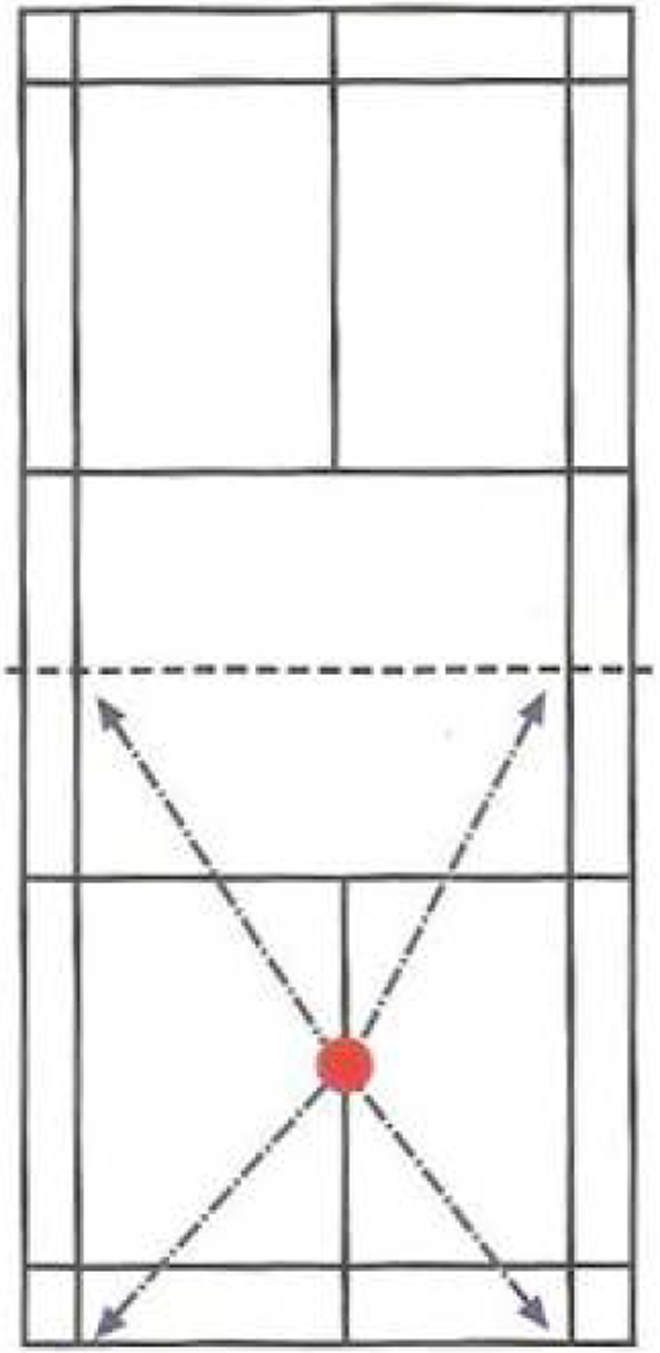
Base position (indicated by the red dot) in a badminton court.
With the use of the A-Eye system, displacement data of skilled adult female players in a singles game (one v. one) was captured and the information provided valuable insights to the movement pattern behaviours of individual players as well as the interaction between the competing players (Chow et al., 2014). Information on court coverage and temporal lags (i.e. time lag of movement between the players involved in the game) between players in returning to the base position was distinctly different when players were playing cooperatively (i.e. players attempt to rally for as long as possible) as compared to a competitive context (i.e. players attempt to win a point). See Figure 2 as an illustration on the different displacement behaviour between cooperative and competitive play. Notice the greater displacement variability of the players in the competitive play condition. It was observed that the players tend to use a limited variation of strokes (usually the overhead clear) and remained at the base position for cooperative play (Chow et al., 2014). Conversely, in competitive play, players used a greater variation of strokes (e.g. clear, drives, drop shots, smash) to force their opponent away from the base position so that they can play the shuttlecock into a space not covered by the opposing player (Chow et al., 2014). The data was captured and processed by the A-Eye system and was available in a matter of minutes to allow a researcher to provide effective individualized feedback to players on the court. From the software, qualitative feedback in terms of information on court coverage and variability of displacement around the court can be given to the players. It can also be seen from the captured clips the variation of the strokes executed by the players during the rallies in the game.
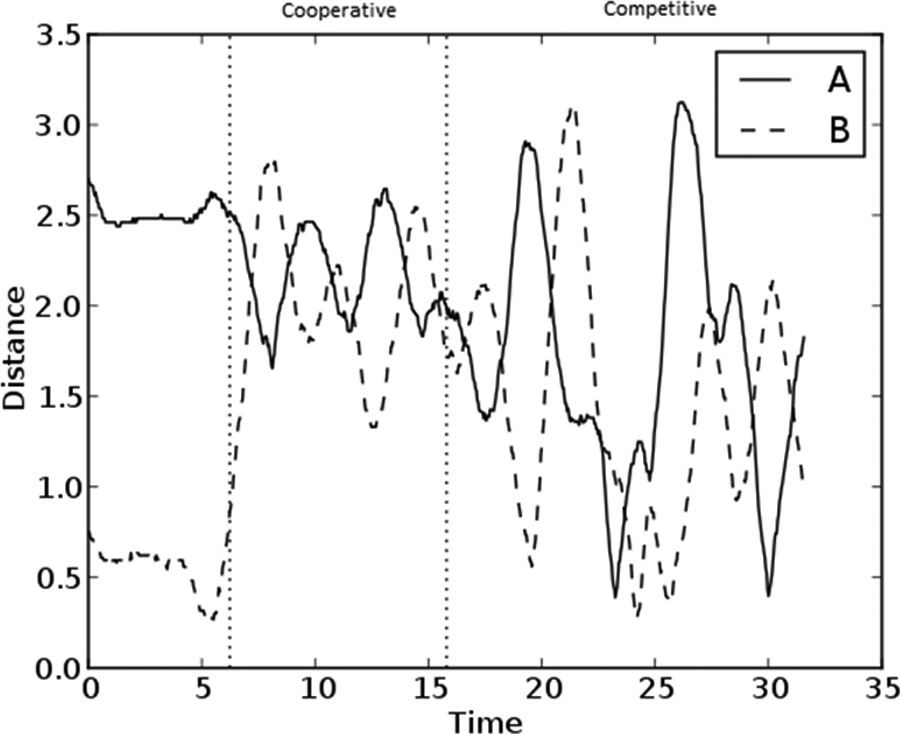
Radial distance from point of origin as a function of time highlighting the distinction between cooperative and competitive play conditions.
The A-Eye system was also used to examine a modified tennis game (Foo et al., 2013), another example of net-barrier game, commonly taught in PE in schools. The playing court was smaller and both the racket as well as the ball used for the game was modified to accommodate the adjusted dimensions of the playing area. In this pilot work, differences between skilled and less-skilled players were determined. With the use of the A-Eye, it was observed that the skilled players had more stable and less variable movement about the base point (which was a positional point along the baseline on the court) during cooperative rallies as compared to the less-skilled players (Foo et al., 2013) (see Figure 3). However, the skilled players were able to cover their own half of the court more effectively (i.e. bigger court area coverage at appropriate moments to defend against attacking shots) during competitive rallies. It was also observed that the skilled players used more varied types of strokes to try to ‘move’ their opponents off the base position in their respective court (similar to the playing characteristics displayed by the skilled badminton players in the earlier example provided) to try to win a point (Foo et al., 2013). Through the use of the A-Eye, it can be determined that key differences in terms of court coverage and execution of functional tennis strokes allowed the skilled players to perform more effectively than less-skilled players. The implication for teaching and coaching is to recognize the key features that skilled players possess and provide the necessary practices, instructions and feedback to help less-skilled players acquire these features of play to improve their game (Foo et al., 2013). Although it is possible that the teacher can observe certain behaviours of students without the use of technology (e.g. moving the opponents away from the base position), the A-Eye provides quantifiable records that the teacher can access and use when required for themselves or as a form of extrinsic feedback to the students.
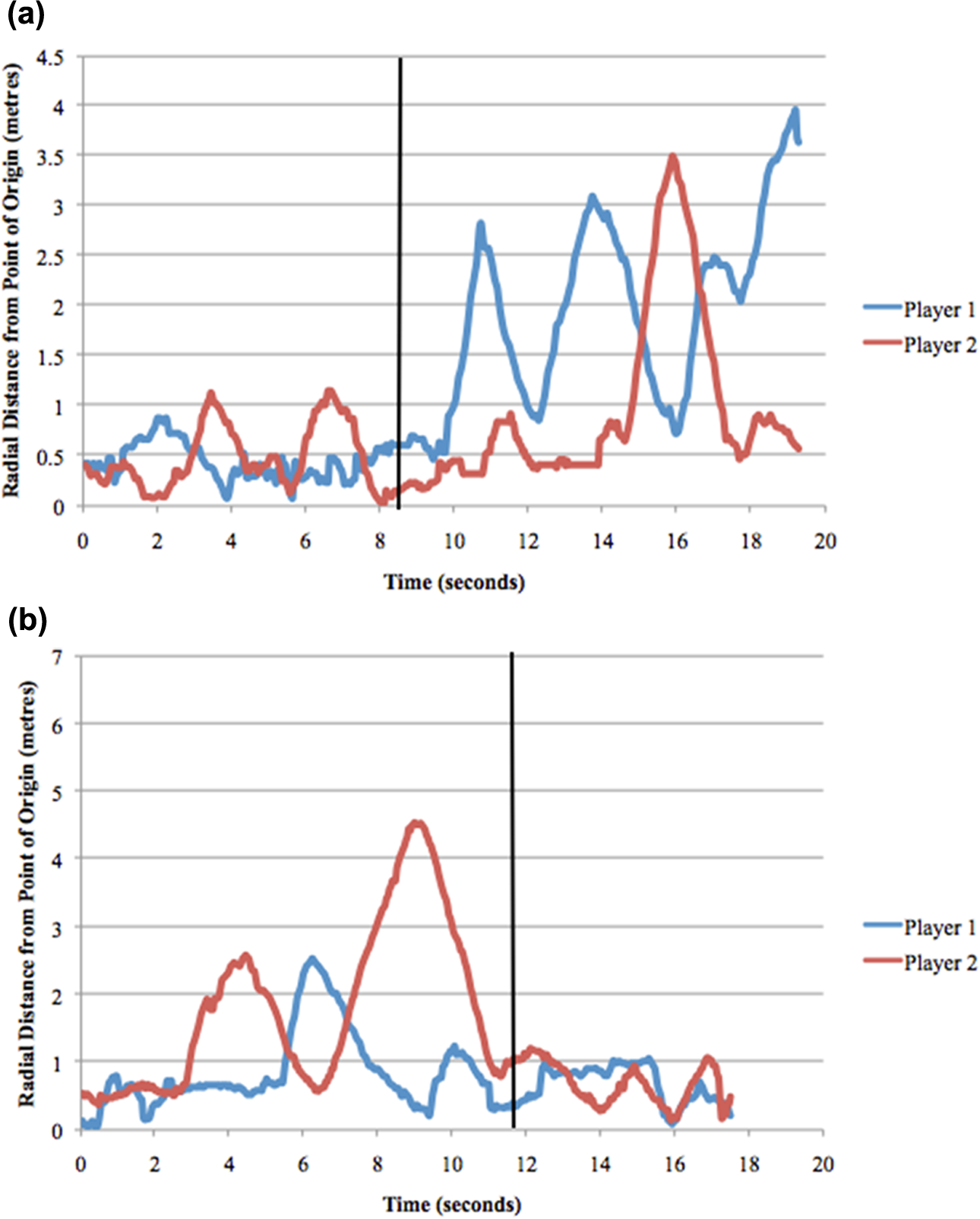
Radial distance from point of origin as a function of time: (a) a representative pair of skilled players and (b) a representative pair of less-skilled players.
The A-Eye motion-capture system can also be effectively used to examine players’ behaviours in invasion or territorial games like rugby, football, basketball or netball. In our laboratory, Ng and Chow (2012) have used the A-Eye to examine key performance features of skilled female netball players and to compare differences to less-skilled female netballers. With the A-Eye system, important performance variables like area of coverage on the court, distance travelled, average speed of movement and percentage of successful passes were determined to examine performance differences as a function of skill as well as playing position. Specifically, performance variables were compared between players in the wing defence, wing attack and centre positions. The A-Eye system provided real-time information and displacement data that could be easily retrieved for further analysis to examine performance proficiency. For example, a ‘heat map’ can be produced to determine the area of coverage and common occupation points on the court for individual players (see Figure 4).
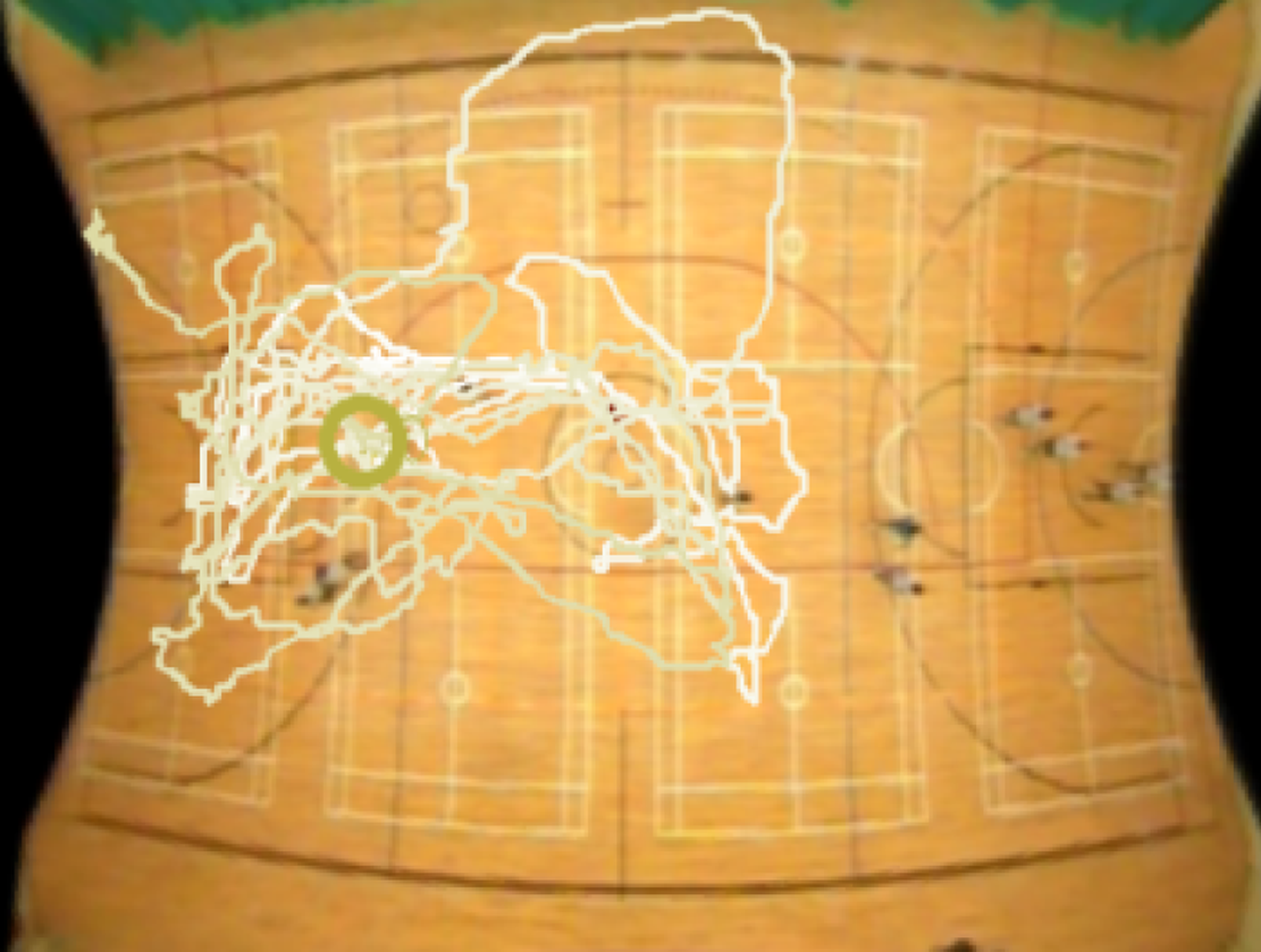
Heat map of players’ court coverage.
From the work on netball, it was interesting to observe that skilled players actually covered less distances than less-skilled players in a simulated game. It is possible that the skilled players make better decisions and execute only the necessary runs to receive a pass or to be in an effective defensive or offensive position as compared to the more random movements of less-skilled players (Ng and Chow, 2012). In terms of position, it was found that the centre covers the most distance and this is aligned to the expected role that a centre would play in relation to being the key play maker to distribute the passes for the team (Shakespear, 1997). In addition, the skilled players demonstrated more effective passing and receiving than less-skilled players in all positions (by almost 15%) (Ng and Chow, 2012). Such information that can be derived from the A-Eye is useful for a coach or a teacher in making decisions on practices or strategies that can address the area of improvement for a player or the team. In a PE setting, the teacher could potentially use the information to assess the effectiveness of various activities within a lesson by examining students’ movement behavioural changes after the provision of instructions. Additionally, and more importantly, the teacher could capture such information on movement behaviour of students within a team over a number of lessons; this allows the PE teacher to track the students’ changes over time and provide feedback on how they have progressed with practice.
Besides netball, the A-Eye has also been used to examine game dynamics in basketball by evaluating the changes to players’ movement in a team at different phases of a basketball game (i.e. offence or defence) (Tay and Chow, 2013). With the A-Eye system, the position of all players on the court (i.e. 10 players concurrently) can be tracked and displacement data can be obtained to determine the position of each player at any instance (see Figure 5). Collectively, specific variables that best represent the behaviour of the team such as the team centroid (TC) (i.e. a point that represents the centre position of the team) and the stretch index (SI) (i.e. an indicator for the dispersion of players within a group of players or a team of players) can be established (Bourbousson et al., 2010). These variables provide an insight to the collective movement behaviour of the team. Specific characteristics of team behaviours were observed under offence and defence situations in a game. For skilled basketball players, the teams demonstrated a larger SI which indicated the players using a larger active playing area. In contrast, the less-skilled team exhibited a smaller SI and players tended to congregate together around the ball (Tay and Chow, 2013). The A-Eye system will also allow an examination of the position of each TC in relation to the ball. In territorial and invasion games, the ball can become a ‘strong attractor’ for the players and it is a major factor in shaping the herding behaviour. For less-skilled players, it is likely that both TCs will be very close to the ball as compared to the skilled players. This herding behaviour is typically observed among young children in territorial games such as football as well (Button et al., 2011). The use of the A-Eye system allows practitioners to easily determine instances of herding behaviours and provide a viable tool to assess the impact of task constraints manipulation such as changing equipment, playing area or instructions to reduce the occurrence of such ineffective grouping of players in territorial games. For example, the teachers can explore relevant interventions (e.g. having multiple goals, increasing the playing area and encouraging students to make consecutive passes) to reduce this herding behaviour.
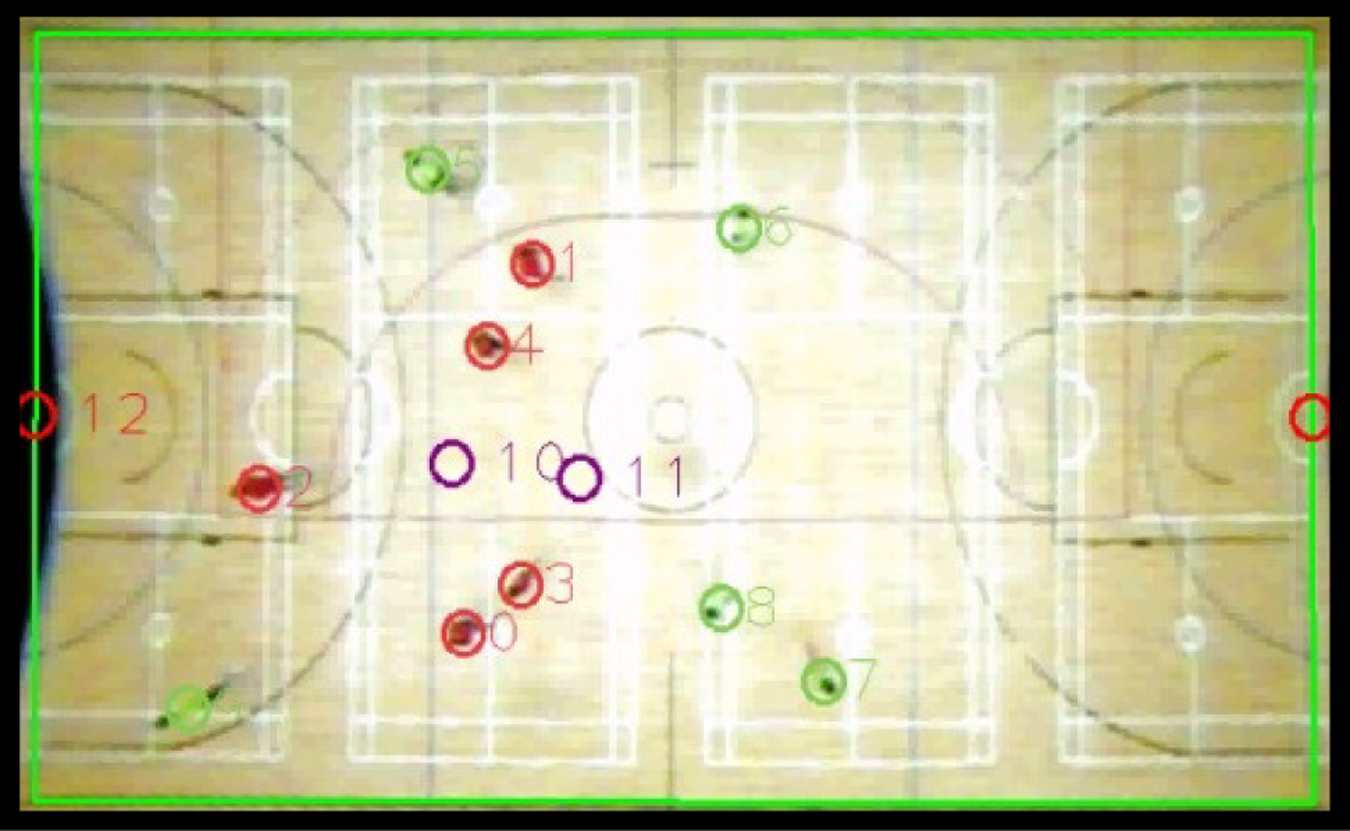
Screen shot of A-Eye capturing individual players in a basketball game setting.
Collectively, the studies shared in this section provide evidence for the use of the A-Eye system in supporting empirical investigations on examining players’ movement behaviours in game-like situations for net-barrier and territorial games. The relevance and validity of using the A-Eye to examine performance proficiency is strong. Below, we exemplify an example on how the A-Eye system could be used in a school setting to examine movement behaviours of students.
Implications for use: a case study in a Singapore school
The demonstrated application of the A-Eye system in different sports in the previous section provides evidence for its use in capturing movement information of players in sports contexts. Moving beyond the realm of sports science, the use of the A-Eye motion-tracking system has huge potential in the school setting. While it should be noted that the context for examining game performance using the A-Eye and determining the impact of instructions on game play behaviour is not the same, the examples shared so far can provide an indication on the potential use of A-Eye in PE.
Pilot work on the deployment of the A-Eye system was undertaken in a Singapore primary school to examine its potential in terms of the practical applications of the system. A key concern is to ensure that such a system can be widely used in a school setting. The ease as well as reasonable cost of setting up such a system will encourage school leaders to install such a system in their schools. For the pilot work, a closed circuit television (CCTV) camera was installed in the school indoor hall where most PE lessons are conducted. The camera was located 10 m above the floor and provided a capture area of approximately 9 m x 13.5 m (specific to the camera specifications and height). Cables were laid to connect the CCTV with a laptop such that all captured video clips were directly imported into the laptop installed with the A-Eye software. The cost of the setting up and purchase of the CCTV was less than US$2500 (translated from Singaporean dollars). This amount is relatively affordable from a research perspective but may be more challenging for a typical school. A school will thus need to plan ahead and set aside this sum of money to install such a system in the school. See Figure 6 for a visual image of the capture area with the A-Eye system.
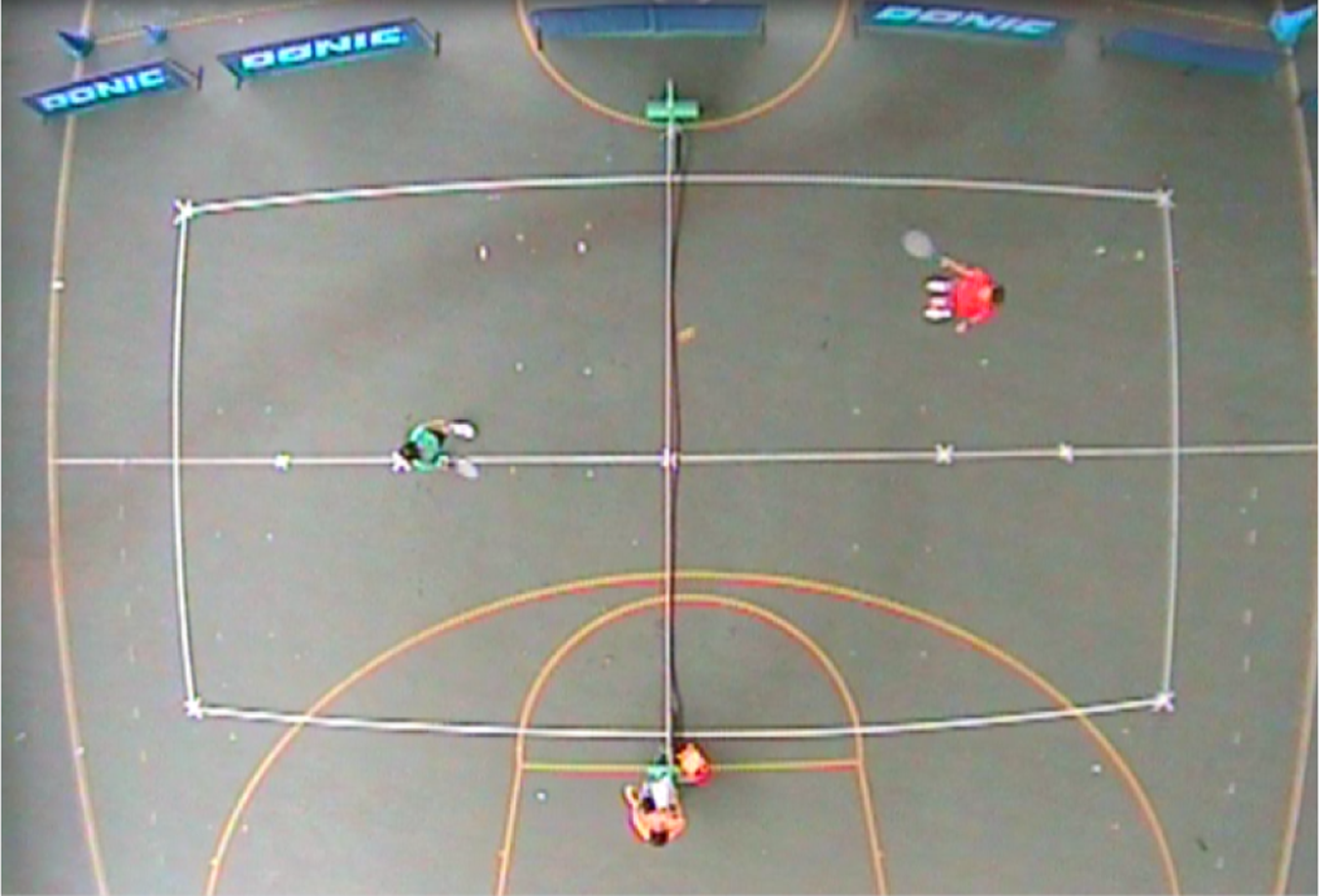
Visual image of the capture area with the A-Eye system in a school hall.
The purpose of setting up the A-Eye system in the school was part of a larger research project to examine the impact of delivering a nonlinear pedagogical approach to teaching game skills to students (Chow et al., 2007; Tan et al., 2012). With the A-Eye system, specific information with regards to students’ movement behavioural patterns can be tracked, recorded and analysed to determine changes as a consequence of exposure to different instructional constraints. Specifically, for this study, primary four students (age 9–10 years old, n = 24) were tasked to learn to play a modified game of tennis. Students were paired (i.e. one v. one) in a singles game and were taught how to acquire game skills related to modified tennis from either a more typical instructional model where the emphasis is on a repeated, prescriptive and teacher-centred pedagogical approach as compared to a more exploratory, variable practice-oriented and student-centred pedagogical approach (i.e. nonlinear pedagogy). In order to encourage a duration of stable rally, the game started with four cooperative rallies followed by competitive shots where players tried to win a point.
From the work that was conducted in this school, data related to positional displacement in terms of x- and y-coordinates were obtained from the recorded video clips of each pair’s singles game play. From the x- and y-coordinates available, other performance variables such as court coverage, average speed of movement, distance covered and displacement about a base location can be derived. Such information can be easily plotted using Excel software to generate meaningful graphs that show behavioural patterns for each pair of players not only within each practice session but also over different practice sessions. The information is useful for the teacher to better understand how movement behaviours, decision making and processes underpinning information-movement couplings of the students have altered with the provision of instructional constraints. In addition, the students can view the information as a form of feedback relating to knowledge of performance. While it may be difficult for the students to understand the feedback directly from the A-Eye software, the teacher can articulate the key observations in a manner that is easier for the students to comprehend. For example, the teacher could highlight the relevance to return to the centre of the court to be ready for the next return.
Similar to the less-skilled players in the modified tennis study mentioned in the earlier section, the students who had no background in tennis displayed unstable and variable movements during the cooperative rallies especially in the initial few sessions. Generally, the initial stages of learning were characterized by short rallies (about two to three shots) often ending with an unforced error. The position of the players on the court concentrated mainly in the middle of the court or nearer the net, rather than at the baseline for effective court coverage (refer to Figure 7). It is concluded that the students stood nearer to each other to try to facilitate hitting controlled shots and maintaining a cooperative rally. For a pair selected based on ability to hold the most number of cooperative rallies at post-test, the distance between the players at the first shot between pre-test (6.773 m ± 0.306) and post-test (9.281 m ± 0.706) were significantly different [t(9) = −11.343, p < 0.001)]. Movement away from this preferred position was frequently observed as a result of attempts to return an unsuccessful or poorly controlled shot from the partner during the cooperative rallies.
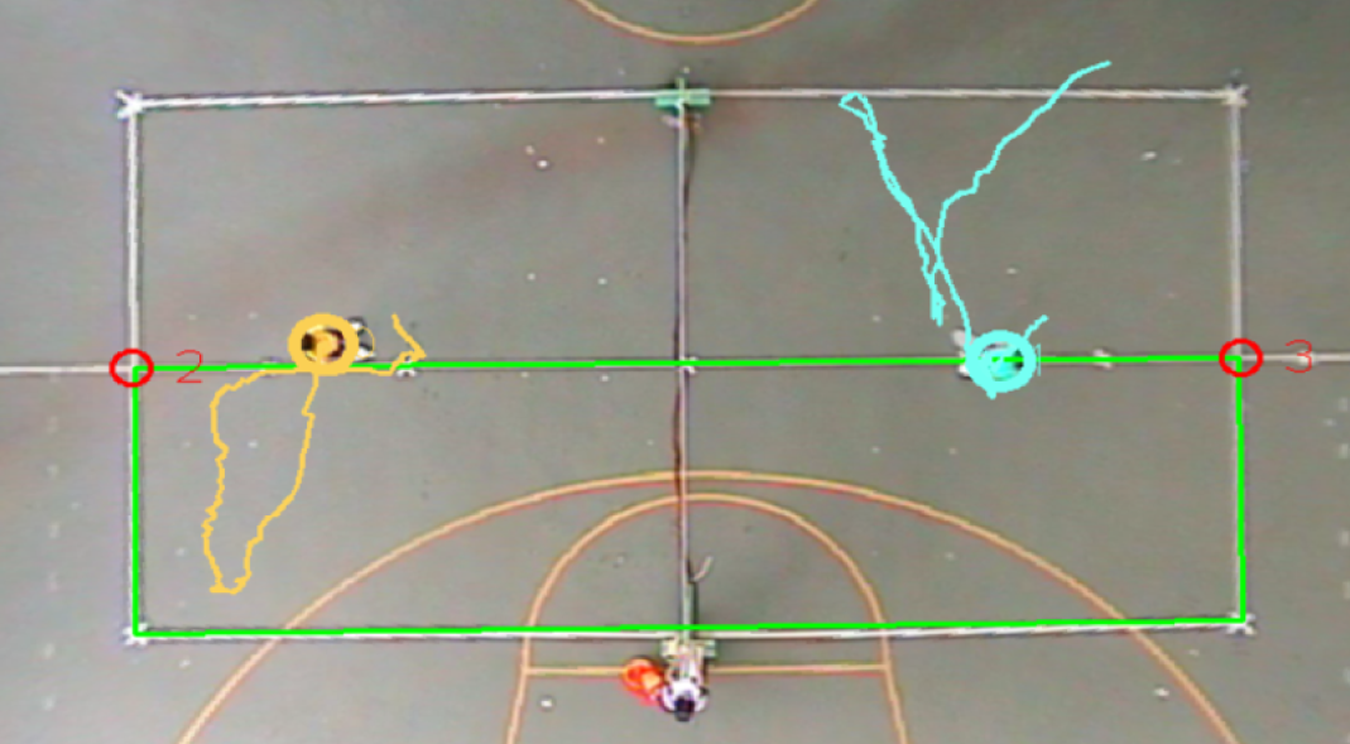
Visual image of A-Eye showing positions of individual participants in a modified tennis game.
Following seven weeks of modified tennis practice, the movement behaviours of the players started to show some resemblance, although not entirely, to that of the skilled players as seen in the earlier example of the modified tennis study. The singles games consisted of longer cooperative rallies, some of which progressed to the competitive rallies (i.e. more than four continuous rallies). Analysis of several of these longer rallies showed that some students were able to cover the court more effectively, such as standing nearer the baseline to protect their space and returning to the mid-baseline after each shot to get ready for the next shot. For example, the results of the same pair of students showed that the distance between the receiver and the mid-baseline at the winning shot was significantly less (p = 0.049) at post-test (1.843 m ± 0.918) as compared to pre-test (2.453 m ± 0.548) [t(9) = 2.275, p = 0.049]. Moreover, there was evidence that the better players were able to utilize strategies, such as hitting away from the opponent, making the opponents move and using advanced stokes such as the lob to win the rally. While it is likely that a teacher can visually observe changes to movement patterns of students in the game, the use of the A-Eye provided objective displacement information that can be readily accessed and retained for future comparison with other students. Such a motion-tracking system assists the teacher to better determine effectiveness of intervention strategies at low cost and with less time spent for data processing than is typical in some ICT devices.
Implications for the use of motion-tracking system in PE
Empirical work with the A-Eye has provided evidence of its relevance and potential to capture movement information in sports settings as well as in the school PE settings. Noting the limitations of available instruments such as the GPAI and TSAP, as previously discussed, the A-Eye system can enable practitioners and physical educators to better record and access information about decision-making processes and the acquisition of game skills. Specifically, a motion-tracking system such as the A-Eye system is simple to use and can be easily set up. It can be used to automatically track the movement of players and, as such, collect data more easily and objectively of students’ game performance, such as decision making and motor skills in the teaching of games in PE over several lessons. Such information can assist PE teachers both formative and summative assessments of what has been taught. If we are to promote the integration of this technology in PE, several implications are relevant. In light of the findings of other researchers in the use of ICT in PE as mentioned earlier in this paper (e.g. uses of ICT, barriers, challenges, teachers’ attitudes, etc.), we offer several practical implications.
The use of this technology allows for authentic assessment of the more student-centred approaches to the teaching of game performance and skills execution in PE. For example, an establishment of the SI or TC of a team in basketball or rugby from the A-Eye could be insightful to the teacher or coach about the behaviour of the team in a game situation. Such information will be particularly useful to facilitate a better link of what is taught to what is assessed. Improvement in the measurement of game performance can aid in regulating the teaching, planning and learning process of games teaching. For example, with the A-Eye system, important performance variables like the area of coverage on the court, distance travelled, average speed of movement and percentage of successful passes were derived from the raw data (i.e. displacement data and recordings) to examine performance differences such as skills and playing positions. While the system does not collate the number of passes (for example), the teacher can use the system to provide valuable feedback on the nature of the passes and the relative position of teammates or opponents. It could also be used to highlight specific game play principles such as moving into space to create a channel for a pass or other strategies to keep possession of the ball in an invasion game. PE teachers can use the information to assess the effectiveness of various activities within a lesson by examining students’ movement behavioural changes after the provision of instructions. This information is also useful for planning, such as making decisions on necessary practices, designing tasks and games that provide students with opportunities to explore and find movement solutions, providing instructions and feedback that can address the area of improvement of individuals or groups of students. Furthermore, we foresee that teachers could gain added pedagogical value by later analysing simple characteristics of the data with children in the classroom, helping to develop metacognitive understanding of key game-related concepts (i.e. finding space, marking opponents, optimal locations of shots, etc.).
The use of the A-Eye system can also provide objective and quantifiable data on the positional locations of a teacher during a lesson. This is particularly useful in PE since the teacher should be able to move around different groups of students during the course of a lesson to provide instructions and feedback. The A-Eye system can effectively capture a teacher’s displacement pattern and provide a profile of his instructional behaviour (this is dependent on the initial capture area demarcated by the camera as well). Coupled with the use of a voice recorder attached to the observed teacher, the effectiveness of verbal instructions with the teacher mobility profile during a lesson can be interfaced to provide a comprehensive picture of the teaching processes present in a lesson. Such information will be meaningful for mentoring teachers or for school leaders to use as a quantifiable and objective source of data to provide feedback to a teacher on teaching efficiency.
It should be noted that the discussion on the use of A-Eye in this paper is just an example of how a motion-capture system that provides quantifiable and objective displacement data can be useful in a PE setting. Similar inexpensive motion-tracking systems set up in a school setting which provides real-time data can also be equally effective.
For successful integration of this technology in PE, training can be provided for PE teachers by sports scientists or PE teachers with strong ICT expertise on how to use and integrate this new technology in ways that support and enhance their instructional goals without inhibiting them. ICT users who are not proficient in the use of ICT in PE must be provided with the understanding of its use and the necessary skills to apply, integrate and adapt technology in their teaching (Ince et al., 2006; Thomas and Stratton, 2006). Research has also highlighted several other training factors that need to be considered. For example, training for teachers must highlight timesaving features of the technology effectively (Woods et al., 2008), such as its ability to automatically track the movements of players continuously and simultaneously and the direct relevance to the active classrooms that PE teachers live in (Weir and Connor, 2009). Training should also be considered for both in-service as well as pre-service teachers. Ince et al. (2006) highlighted that improved training at both pre-service and in-service levels is key to improving teachers’ use of technology as well as teachers’ attitudes toward technology. Lastly, teachers have suggested that the follow-up support provided was important to their ability to implement the technology into their instruction (Lewis, 1999; Ince et al., 2006). As such, training needs to be followed with on-going support for successful integration of ICT in teaching.
Nevertheless, the use of video capture and monitoring of behaviours should not transcend to a situation where it becomes a ‘big brother’ issue such that teachers or students may become fearful that they are constantly being monitored or that they have ‘to be seen’ making effort to earn credits in PE (Tinning, 2010). The rationale for the use of such video capture of motion-tracking devices must be sound and properly communicated to the teachers/students so that they can better understand how it is used and the role that they play within such monitoring contexts.
For example, schools will need informed consent from students and staff prior to using such motion-tracking system for any data collection. Teachers should also be clear of the purpose and usefulness of the A-Eye as well as the intended learning outcomes for the series of lessons. Specifically, teachers need to recognize that while the A-Eye is an effective measuring device, the interpretation and meaningfulness of the data is dependent on how they use it to relate to teaching effectiveness. They can choose to use the A-Eye, for example, to capture relevant data that can inform them of the effectiveness of the lessons. Teachers, however, should be mindful that the information gathered with regard to students’ learning should not be made redundant with the use of ICT if observations can be clearly captured with simple manual coding measurements of behaviours. Other issues that need to be considered for capturing video data of teachers and students in the school include seeking ethics, maintaining confidentiality and anonymity of participants and restricting access to the images.
Indeed, ICT devices should assist teaching and learning processes and not be seen as sophisticated equipment that complicates teaching practices. Based on the earlier discussion, the A-Eye as a motion-tracking system is one possible tool that adequately captures and provides relevant information about students’ movement behaviour at a relatively low cost and with little time and effort invested for the set up as well as data interpretation. It objectively tracks changes in movement behaviour that the teacher may find difficult in quantifying outcomes related to learning.
Conclusion
In this paper, we proposed a fully automated-tracking system that is accurate and efficient to enhance research in game analysis. More specifically, we discussed and provided insights into how the A-Eye motion system, through exemplars from empirical work, can help researchers access critical information about decision-making processes and acquisition of game skills; it can be used to measure game performance and movement behaviours more effectively, objectively and reliably. The motion system has good potential in addressing difficulty in the measurement of game performance to enhance the teaching and learning of games in PE.
Further research, however, is needed to validate the use of the motion system as a suitable ICT measure for game performance and motor skills for student-centred approaches to the teaching of games. If we are to promote teacher integration of ICT in PE, more empirical evidence of what works and how teachers might do this with their students is needed (Ince et al., 2006); more empirical research is needed to validate the benefits of integrating ICT in PE.
Indeed, improving the measurement of game performance behaviours can enhance our ability to make firmer conclusions about the effects of interventions (Memmert and Harvey, 2008). The benefits of a valid and reliable measurement of game performance are obvious; researchers and practitioners can have one globally recognized system that could be used to gather standardized scores for all children across developmental levels, gender, cultures or countries (Memmert and Harvey, 2008).
Footnotes
Funding
This research received no specific grant from any funding agency in the public, commercial or not-for-profit sectors.