







Abstract
The purpose of this study was to examine the effects of a 1-minute stretching programme and 5 weeks of detraining on sit-and-reach score among schoolchildren aged 5–6 years in a physical education setting. Forty-five schoolchildren 5–6 years old from two classes were clustered randomly assigned to an experimental group (n = 23) or a control group (n = 22). During the physical education classes, the students of the experimental group performed a 1-minute stretching programme twice a week for 8 weeks. Subsequently, these participants underwent a 5-week detraining period. The classic sit-and-reach test was performed at the beginning and at the end of the development programme, as well as at the end of the detraining period. The results of the two-way ANOVA showed that the intervention programme increased significantly the students’ sit-and-reach scores ( p < 0.001). However, after 5 weeks of detraining, children’s flexibility reverted back to the baseline levels ( p > 0.05). Although an only 1-minute stretching programme seems to develop the schoolchildren’s flexibility, after the 5-week detraining period students’ score reverts back to its initial level. This knowledge could help physical education teachers to design programmes that permit students to increase and maintain flexibility levels along the entire academic year.
Keywords
Introduction
Flexibility is a well-recognized component of health-related physical fitness (National Association for Sports and Physical Education, 2005). For instance, the lack of hamstring muscles extensibility conditions a decrease in pelvic mobility (Kendall et al., 2005; López-Miñarro et al., 2012; Muyor et al., 2012). Therefore, when individuals with low hamstring extensibility perform a maximal trunk flexion with knees extended an increase in spinal flexion and posterior pelvic tilt occur (López-Miñarro et al., 2012; Muyor et al., 2012). This invariably leads to the biomechanical changes in the pressure distribution in the spine and consequent spinal disorders (Carregaro and Coury, 2009; Kang et al., 2013). Particularly among young people, poor hamstring extensibility seems to contribute to the increase in the risk of low back pain (Feldman et al., 2001; Jones et al., 2005; Sjölie, 2004) and neck tension (Mikkelsson et al., 2006).
Nowadays it is well known that hamstring extensibility decreases significantly during school age (Chiodera et al., 2008; Kanásová, 2008; Rodríguez et al., 2008). However, Ramos Espada et al. (2007a, 2007b) found that hamstring muscles shorten at an early age, and so they concluded that flexibility exercises should be performed even at these ages. Shortened hamstring is the locomotor pathology more likely to be addressed proactively in physical education (PE) because of its high prevalence and because its treatment is based on the realization of stretches and postural correction (Santonja et al., 2004, 2007; Thacker et al., 2004). Therefore, PE teachers should include stretching exercises within their classes (Kanásová, 2008; Peiró Velert and Devis Devís, 1995; Rodríguez et al., 2008; Sainz de Baranda et al., 2006; Santonja et al., 2007).
Previous studies found that PE-based stretching programmes carried out for 5–7 minutes improve hamstring extensibility in elementary school students (Coledam et al., 2012; Rodríguez et al., 1999, 2008; Sainz de Baranda et al., 2006; Santonja et al., 2007). However, as in many other countries, Spanish PE teachers must also ‘deliver’ a large volume of curricular contents during each academic course (Ministerio de Educación y Ciencia, 2006). Therefore, since stretching programmes cannot be allocated a large part of PE time, the application of shorter stretching programmes could be more suitable. Unfortunately, to our knowledge there are no studies examining the effectiveness of few-minute stretching programmes in the PE setting.
In the PE setting another problem related to flexibility is that it is expected decrease after a period of detraining (Rancour et al., 2009; Willy et al., 2001). However, many PE teachers conceive planning as ‘watertight drawers’ that they have to fill with curricular contents (Siedentop and Tanehill, 2000). Furthermore, another related limitation is due to the fact that the academic year is frequently interrupted by several holiday periods. Therefore, PE teachers carry out stretching exercises in their classes only for a few weeks, and when they cease doing them, they do not know how long the effect will last. Currently, as there is a lack of scientific information about stretching detraining effects among children, research in this area is required.
Consequently, the purposes of this study were: (a) to evaluate the effects of a 1-minute PE-based stretching programme on sit-and-reach (SR) score in schoolchildren aged 5–6 years; and (b) to examine the effects of a 5-week period of flexibility detraining on SR score in schoolchildren aged 5–6 years.
Material and methods
Participants
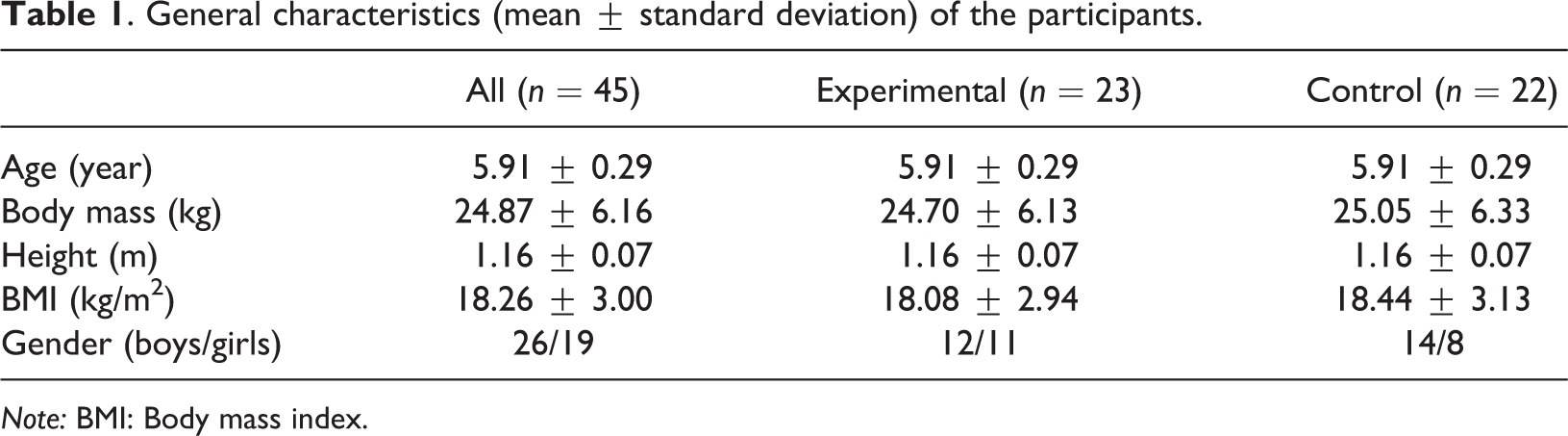
Forty-five apparently healthy children 5–6 years old from two different first-grade PE classes of a public primary school participated in this study (Table 1). For practical reasons and the nature of the present study (the intervention was focused on natural groups in a school context) a cluster randomized controlled trial was used (Mayorga-Vega et al., 2013b). Natural classes were assigned randomly to form one of the study groups: control group (CG) or experimental group (EG).
General characteristics (mean ± standard deviation) of the participants.
Note: BMI: Body mass index.
All the participants were free of orthopaedic disorders such as episodes of hamstring injuries, fractures, surgery or pain in the spine or hamstring muscles over the past 6 months (López-Miñarro et al., 2009). The inclusion criterion was to have an attendance rate of 90% or higher for PE classes during the intervention period. Children and their parents or legal guardians were fully informed about all the features of the study, and were required to sign an informed-consent document. The Ethical Committee of the University of Malaga approved the study protocol.
Measures
Participants’ flexibility was assessed by the classic SR test (Mayorga-Vega et al., 2014b). The SR test was used before and after the stretching intervention programme (pretest and posttest, respectively) in order to examine the possible changes produced. Subsequently, after 5 weeks of flexibility detraining, a reassessment was performed in order to observe the levels of retention (retest). The SR test was applied by the same tester using the same equipment. The measures were performed in an indoor sports facility under the same environmental conditions, on the same day of the week and at the same time for each student. No warming up exercises were performed prior to the flexibility measurements.
The SR test was administered using a wooden box with a ruler at the top (the score 15 cm corresponded to the tangent of the feet; accuracy 1 cm). At the beginning of the test, children stood in front of the box, sat with their hips flexed, knees extended and both hands on the top of the ruler. The feet were placed to the width of the hips and ankles at 90°. The knees were fixed in extension with the help of the tester. The hands with the fingers extended were placed parallel. From this position, the children had to bend the trunk forward slowly and progressively (no rebounds) in order to reach the furthest possible distance and to remain still for at least 2 seconds. Two trials were performed 1 minute apart, and the average was retained (Mayorga-Vega et al., 2013a).
Procedures
A stretching intervention programme was applied to the EG during the PE classes. Firstly, the EG participants performed a development stretching intervention programme twice a week on nonconsecutive days for 8 weeks. Subsequently, coinciding with the Christmas holiday, the EG participants underwent a 5-week period of flexibility detraining. The stretching programme was conducted and supervised by the same PE teacher of the group. Based on previous studies carried out in the PE setting (Sainz de Baranda et al., 2006; Santonja et al., 2007), the EG students performed hamstring stretches utilizing the static technique for 1 minute during the cool-down period (Mayorga-Vega et al., 2014a).
Four different stretching exercises (standing with feet together, sitting with feet together, standing with feet shoulders width apart, and sitting with feet shoulders width apart) were designed and alternated during the intervention programme (Figure 1). Standing and sitting stretching exercises were alternated between sessions. Each intervention session included three sets of one stretching exercise. For all the stretching exercises, the children flexed forward at the hip, trying to maintain the spine in neutral position as much as possible until a gentle stretch was felt in the hamstrings. The knees were fully extended and toes pointed to the ceiling with no hip rotation. The stretched positions were held gently until the end point of the range was reached (i.e. stretch to the point of feeling the tightness of the hamstring muscles but no pain). Once this position was achieved, the children held it for 20 seconds.
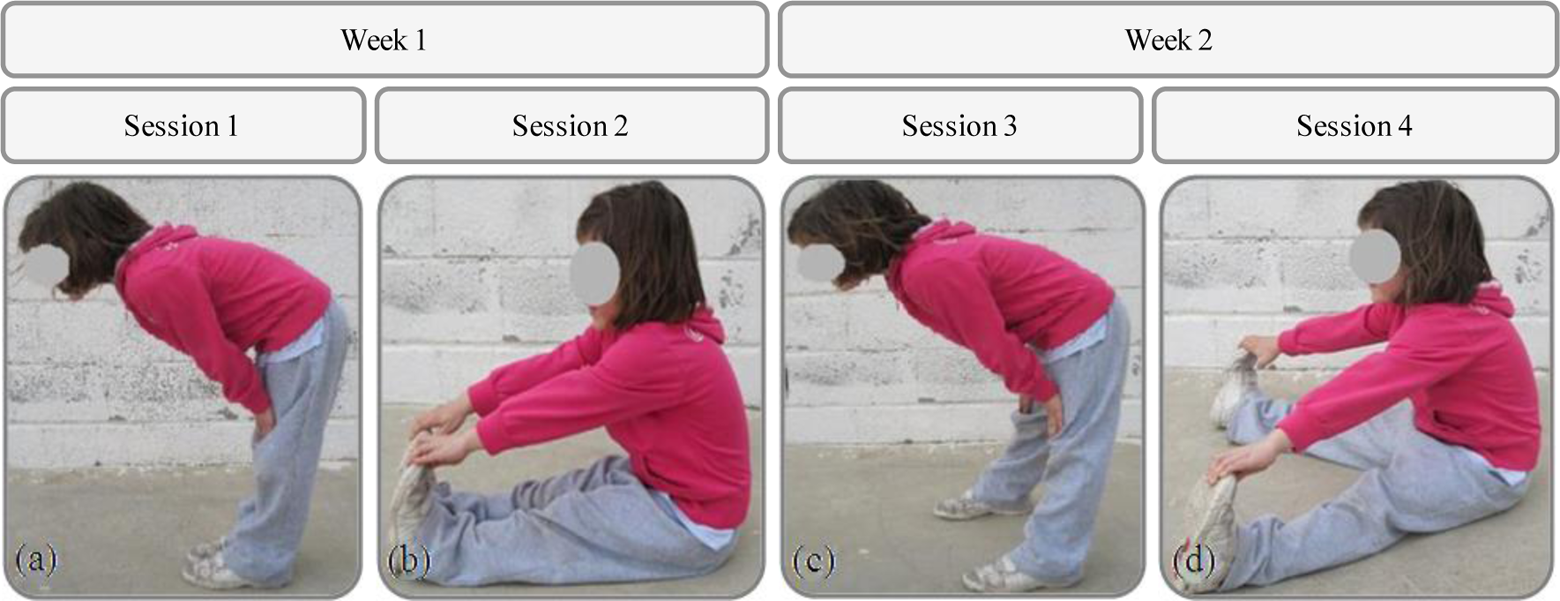
The four stretching exercises performed during the intervention programme: (a) standing with feet together; (b) sitting with feet together; (c) standing with feet shoulders width apart, and (d) sitting with feet shoulders width apart. An example of the distribution for the two first weeks.
All the participants were urged to maintain their normal levels of physical activity outside of the supervised setting during the research period. Five children in the EG (22%) and seven children in the CG (32%) regularly participated (at least twice per week) in organized extra-curricular sport programmes. During the stretching programme period the EG and CG students participated in traditional games. However, the CG followed the standard PE programme without performing hamstring stretches. Furthermore, the participants in the CG were unaware of the purpose of the study.
Analysis
Descriptive statistics (means and standard deviations) for age, body mass, height, body mass index, and SR scores were calculated. A one-way analysis of variance (ANOVA) was used to study the differences of the general characteristics and pre-intervention SR scores between groups. In addition, chi-squared analyses were carried out to test the ratio differences of gender and extra-curricular sport practitioners between the two groups. Afterward, a two-way ANOVA was applied over the SR scores using the groups (CG, EG) and time factors (pretest, posttest, retest). For the post hoc analyses, α values were corrected using the Bonferroni adjustment. Then, the minimal detectable change at 95% confidence (MDC95) was calculated in order to examine if the change score due to the intervention was true and reliable rather than measurement error (Haley and Fragala-Pinkham, 2006). Moreover, the Hedges’ g effect size was used to determine the magnitude of treatment effects (Hedges, 2007). Finally, the test–retest reliability of SR test was estimated using both the intraclass correlation coefficient from two-way ANOVA (ICC, including the 95% interval of confidence) (Shrout and Fleiss, 1979) and the Bland and Altman’s 95% limits of agreement (LOA) (Bland and Altman, 1986). All statistical analyses were performed using the SPSS version 15.0 for Windows (SPSS® Inc., Chicago, IL). The statistical significance level was set at p < 0.05.
Results
All the participants completed the development training programme according to previously established attendance norms. The EG participants obtained an average attendance of 99% in the development training programme. The one-way ANOVA results did not show statistically significant differences in the general characteristics and pretest values between EG and CG ( p > 0.05). In addition, the chi-square analyses showed that the two groups had a balanced representation of boys and girls (χ 2 1 = 0.606; p = 0.436) and a balanced representation of extra-curricular sport practitioners and non-practitioners (χ 2 1 = 0.584; p = 0.445).
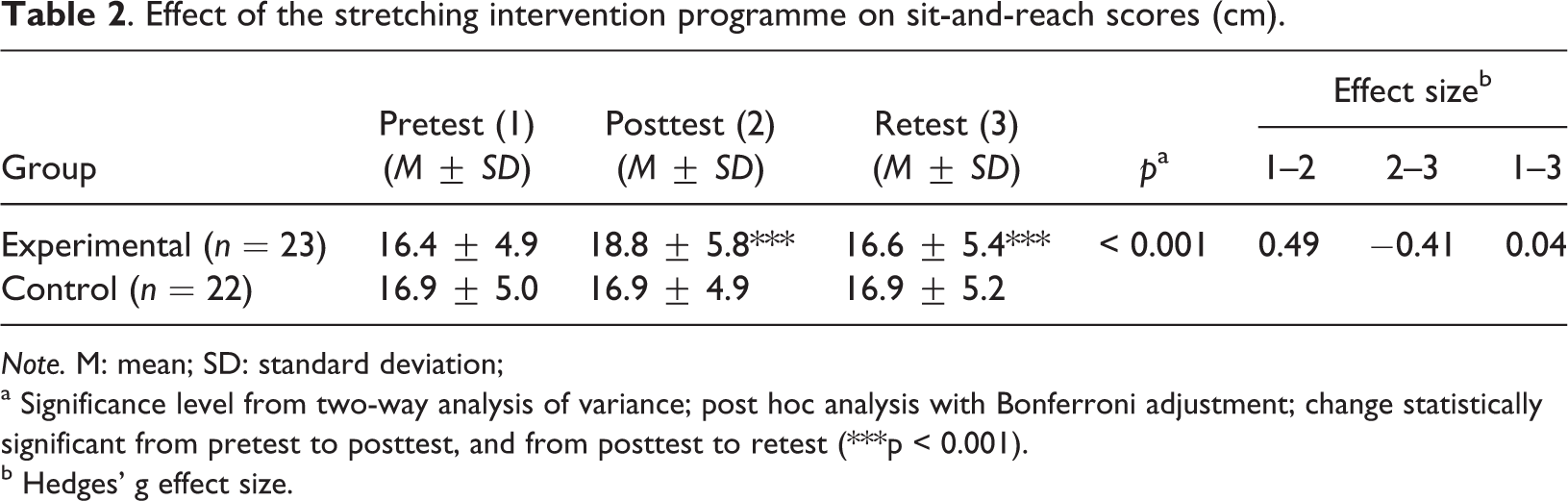
The results of the two-way ANOVA on the average obtained in the SR showed interaction effects between the group and time variables [F(2, 86) = 18.625; p < 0.001; η 2 p = 0.302; P = 1.000] (Table 2). For post hoc analysis, the ANOVA with the Bonferroni adjustment showed that the EG increased statistically significant from pretest to posttest ( p < 0.001). However, for the EG flexibility levels from posttest to retest decreased statistically significant ( p < 0.001), and statistically differences between the pretest and retest were not found ( p = 1.000). For the CG no significant differences were found ( p = 1.000). The MDC95 value of the SR score was 1.39 cm, when the average increase in the EG was 2.44 cm. The test–retest reliability for the SR score was very high: ICC, 0.99 (0.98-1.00); LOA, 0.0 ± 1.7 cm.
Effect of the stretching intervention programme on sit-and-reach scores (cm).
Note. M: mean; SD: standard deviation;
a Significance level from two-way analysis of variance; post hoc analysis with Bonferroni adjustment; change statistically significant from pretest to posttest, and from posttest to retest (***p < 0.001).
b Hedges' g effect size.
Discussion
The first purpose of this study was to evaluate the effects of a 1-minute PE-based stretching programme on the SR score in elementary schoolchildren. The results of the present study show that it is possible to develop children’s flexibility by means of an only 1-minute stretching programme in the PE setting. Previous studies in which elementary schoolchildren performed a PE-based stretching programme found a significant improvement in flexibility (Coledam et al., 2012; Rodríguez et al., 1999, 2008; Sainz de Baranda et al., 2006; Santonja et al., 2007).
In the preceding studies the EG students carried out the stretching intervention programme for 5–7 minutes (i.e. from 10–14% of the total session time for a standard class of 50 min) (Coledam et al., 2012; Rodríguez et al., 1999, 2008; Sainz de Baranda et al., 2006; Santonja et al., 2007). Nevertheless, since many curricular contents must be developed in a school year (Ministerio de Educación y Ciencia, 2006), the application of a single curricular content such as the flexibility cannot be allocated a large part of PE time. Therefore, the application of shorter stretching programmes as in the present study could be more suitable in order to facilitate teachers the development of PE contents. The results of the present study showed the effectiveness of a stretching programme carried out for only 1 minute per session (i.e. 2% of the total session time for a standard class of 50 min).
Regarding the magnitude effects of the intervention, the effect size of the present study was moderate indicating that the stretching programme was effective. In contrast with the current results, all the previous studies carried out with elementary schoolchildren obtained large effect sizes (g = 0.85–0.94) (Coledam et al., 2012; Rodríguez et al., 1999, 2008; Santonja et al., 2007), except for a study with a very large effects size (g = 2.06) (Sainz de Baranda et al., 2006). In addition to the time of stretching per session, other training factors such as the duration of the programme and frequency might clearly influence the magnitude effect of the intervention. Apart from the higher time per session allocated to stretching, the intervention programme of all the above-mentioned studies had a significant longer duration, lasting from 16 weeks (Coledam et al., 2012) to a whole academic year (31–32 weeks) (Rodríguez et al., 1999, 2008; Santonja et al., 2007; Sainz de Baranda et al., 2006). In any case, according to Valentine and Cooper (2003), we have to be aware that in education research even lower values of effect size (0.30) could be considered as of practical relevance. In addition, the results of the MDC95 analysis showed that the increase in the SR score due to the intervention programme was true and reliable rather than measurement error.
As regards frequency, although in all the previous studies participants carried out the intervention programme twice a week, Santonja et al. (2007) also found that when the children performed four sessions per week instead of two, the magnitude effect doubled (twice a week, g = 0.85; four times a week, g = 1.53; both 5 minutes per session, 31 weeks of duration). However, in many countries such as Spain, since PE teachers are limited to a low frequency of two sessions per week (Ministerio de Educación y Ciencia, 2006), the application of intervention programmes with higher frequency is not possible in the PE setting. In this line, the increase of active time for learning in extra-curricular periods would represent an excellent strategy in order for PE teachers to pursue important objectives such as the improvement of flexibility. However, because this strategy mainly depends on the students’ autonomy, in many cases such as with the students at these early ages it seems to be impractical.
Another obstacle in PE planning is that after a period of detraining the flexibility gains obtained are expected to decrease (Rancour et al., 2009; Willy et al., 2001). Generally, PE teachers carry out stretching exercises in their PE classes only for a few weeks, and when they cease doing them, they do not know how long the effect will last. Furthermore, a common situation in PE setting is the alternation of academic and holiday periods. Unfortunately, to our knowledge there are no previous studies examining the loss effects of flexibility during detraining periods among schoolchildren. Although most previous studies evaluated the effects of an entire academic year (Rodríguez et al., 1999, 2008; Santonja et al., 2007; Sainz de Baranda et al., 2006) they only examined the global effects, ignoring the changes on flexibility during relatively long detraining periods such as Christmas holiday. Hence, one of the most important outcomes of the present study was the verification that after a detraining period of 5 weeks, children’s flexibility reverts back to the baseline level. Therefore, as after 5 weeks of detraining the effect of the stretching programme has completely vanished, PE teachers should continue training students’ flexibility after a shorter detraining period in order to maintain the gains obtained in the previous semesters.
For all the above-mentioned reasons, it would be beneficial for PE teachers to know the minimum duration of a flexibility programme to achieve significant improvements, how long it takes to lose the improvements achieved after this development programme, and how a maintenance flexibility programme for schoolchildren should be applied. Thus, a limitation of the present study was a lack of monitoring of the detraining effect in several periods of time (e.g. also after 2 or 3 weeks) or a lack of applying a maintenance programme (Mayorga-Vega et al., 2013b). Future research interventions should examine the effect of different detraining periods among schoolchildren, as well as the application of different maintenance training programmes in order to maintain previous flexibility gains obtained. This knowledge could help the PE teachers to design programmes that guarantee the maintenance of previous flexibility gains. In addition, future studies research should further examine the magnitude effect of different volumes per session or frequency per week.
Finally, in the present study there were some limitations that should be considered when examining its results. The main limitations of this study were related to the validity of the test used. Flexibility is typically characterized by the maximum range of motion in a joint or series of joints (McHugh et al., 1998). Therefore, the angular test that specifically measures hip flexion (straight leg raise test) has been widely considered the criterion measure of hamstring extensibility (Mayorga-Vega et al., 2014b). Nevertheless, as in the present study, when the use of this angular test is limited due to practical issues such as the time constraints, the classic SR test has shown to be a useful alternative to estimate hamstring extensibility (Mayorga-Vega et al., 2014b), even among children at these ages (Hartman and Looney, 2003).
The first factor that could affect the validity of the SR test is the differences in length proportion between the upper and lower limbs (Hoeger et al., 1990). However, since in the present study the pre-intervention values were assessed, any change in the participants’ flexibility was compared with their baseline level. In addition, another potential limitation of using a lineal test might be due to the change in the proportion of the anthropometric parameters and/ or in the position of the spine between the pretest and the following measures in the posttest and retest. Nevertheless, besides the relatively short period between the measures taken, the study design included an equivalent CG (i.e. characteristics such as age, height, body mass, gender ratio, extra-curricular sport practitioners ratio or pretest values were equivalent between groups). Therefore, we could assume reasonably that any change in the proportion of the anthropometric parameters and/ or in the position of the spine should be similar in both groups.
In conclusion, to our knowledge this study is the first one that examines the effect of a 1-minute stretching programme and its subsequent detraining on SR score among schoolchildren. The results of the present study suggest that it is possible to develop schoolchildren’s flexibility through an only 1-minute stretching programme in the PE setting. However, after a 5-week detraining period, children revert back to their initial flexibility levels. Hence, due to the fact that after 5 weeks of detraining the effect of the stretching programme has completely vanished, PE teachers should continue exercising students’ flexibility after a shorter detraining period in order to maintain the gains obtained in the previous semesters.
Footnotes
Acknowledgements
We thank Anna Szczesniak for the English revision. Results were prior published, in abstract form, in the proceedings of 6th Baltic Scientific Conference Sport Science for Sustainable Society April 23-25, 2013 Riga, Latvia.
Funding
This work was supported by the Spanish Ministry of Education, Culture and Sport [grant number AP2010-5905 (second author)].