







Abstract
Grounded in self-determination theory and achievement goal theory, this quasi-experimental study evaluated the effectiveness of a teaching intervention programme to improve predisposition towards physical education based on developing a task-oriented motivational climate and supporting basic psychological needs. The final sample consisted of 35 secondary education students, aged 15–17 (M age = 15.35, SD = 0.49), divided into two groups: control (n = 15) and experimental (n = 20). The intervention programme was applied in the experimental group to 12 acrosport unit lessons based on motivational strategies by means of TARGET areas (i.e. Task, authority, recognition, grouping, evaluation and time). Firstly, the experimental group obtained significantly higher values in perceived support of the basic psychological needs and in the perceived task-oriented motivational climate in the acrosport unit. Secondly, this intervention was effective in generating a significant increase in predisposition towards physical education in the experimental group. Noteworthy is the need to generate interventions in different content areas that may improve students’ predisposition towards physical education, which could contribute to them adopting a more active lifestyle.
Keywords
Introduction
Despite the considerable amount of evidence that shows how important it is for adolescents to perform physical activity (PA) on a regular basis, there are studies that point out that this population group does not engage sufficiently in moderate to vigorous PA to improve their health (Hallal et al., 2012). For this reason, the school environment, and more specifically physical education (PE), is considered to be an ideal context that can positively impact children’s PA behaviour, and promote lifelong activity habits and prosocial values (Holt et al., 2012). Consequently, to study this topic, two motivational theories have been widely addressed in the PE context: self-determination theory (SDT) (Deci and Ryan, 1985) and achievement goal theory (AGT) (Nicholls, 1989). According to a substantial body of research in PE contexts, variables derived from these two frameworks could be integrated (see Duda, 2013; Soini et al., 2014) to achieve a better understanding of motivational outcomes.
Grounded in SDT (Deci and Ryan, 1985), different authors have highlighted the figure of the teacher as a key element to have an impact on the degree of satisfaction of students’ basic psychological needs (BPN) (i.e. autonomy, competence and relatedness) (Aelterman et al., 2014). In addition, SDT (Deci and Ryan, 1985) considers motivation as a continuum that includes the following regulations, going from the highest to the lowest level of self-determination: intrinsic motivation, based on the interest and enjoyment produced by carrying out the activity itself; extrinsic motivation, which corresponds to behaviours executed in order to achieve results that are outside the activity itself; and amotivation, relating to the lack of intrinsic and extrinsic motivation.
Different studies conducted with adolescents in a PE context have shown that higher levels of self-determined motivation (i.e. intrinsic motivation, integrated regulation and identified regulation) (Sánchez-Oliva et al., 2014) are associated with positive and more adaptive cognitive (e.g. academic performance) (Ntoumanis and Standage, 2009), affective (e.g. well-being) (Standage et al., 2012) and behavioural (e.g. engagement in PA) (Moreno et al., 2010) consequences. Conversely, the least self-determined motivation levels (i.e. introjected regulation, external regulation and amotivation) are negatively related to these outcomes, creating less adaptive behavioural patterns (e.g. oppositional defiance) (Haerens et al., 2015).
Several studies show that the use of multi-dimensional teaching intervention programmes (i.e. support of the three BPN) can improve the satisfaction of three BPN (Aelterman et al., 2014). In this sense, support of autonomy implies that teachers allow students to make decisions and be guided by their motivations. Support of competence refers to teachers’ behaviour that optimizes the perceived ability of their students. Finally, support of relatedness means that the teacher favours the formation of heterogeneous groups of students to help them become integrated in their group and with their classmates (Stroet et al., 2013).
Consistent with SDT (Deci and Ryan, 1985), AGT (Nicholls, 1989) proposes that the motivational climate (i.e. situational factors that refer to the context in which the activity takes place and that can be decisive for students’ optimal involvement) generated by the PE teacher can also be considered as a decisive social factor for developing the variables integrated in SDT (see Braithwaite et al., 2011; Duda, 2013). Some authors (e.g. Duda and Hall, 2001) have discussed the need to assess the role of different motivational strategies traditionally used by PE teachers to modify motivational climate. Trying to surpass oneself, assuming mistakes as part of the learning process, being interested in learning new things or making progress in one’s own skills are some of the characteristics that are perceived in the task-oriented motivational climate. By contrast, competing against classmates, comparing results with those of others or placing too much importance on being more successful in the tasks than all the other students are some of the characteristics that are detected in the ego-oriented motivational climate. In this regard, different strategies related to TARGET areas (i.e. Task, authority, recognition, grouping, evaluation and time) developed by Ames (1992) can be very useful to manipulate the motivational climate of the classroom, managing to develop optimal learning atmospheres (Gray et al., 2009). The following dimensions refer to the elements of design and teaching skills that teachers can modify both before and during their lessons.
Task area: design a variety of activities and objectives adapted to students’ specific needs and level.
Authority area: create opportunities for students to make decisions.
Recognition area: distribution of positive feedback and rewards.
Grouping area: student learning groups are varied, mixed and heterogeneous.
Evaluation area: criteria focused on the process and effort of the students and not exclusively on the end results.
Time area: appropriateness and relevance of the child’s own learning priorities and pacing.
In turn, some intervention studies in PE, based on the TARGET areas, have increased the perceived task-oriented motivational climate (Almolda-Tomás et al., 2014; Hastie et al., 2014; Sevil et al., 2015) and positive consequences such as enjoyment (Almolda-Tomás et al., 2014; Sevil et al., 2015), effort (Wallhead and Ntoumanis, 2004) and predisposition towards PE (Gray et al., 2009). From a practical perspective, the results found by Barkoukis and Hagger (2013) imply that the application of interventions, such as TARGET areas, may be effective in fostering adaptive motivational responses in terms of participation in PA both in school (i.e. PE) and out of school (i.e. leisure time). Thus, PE teachers can generate an optimal motivational climate (i.e. support of the BPN and task-oriented motivational climate through TARGET areas) in their interventions, creating achievement contexts that get their students involved in personal improvement and effort, thus being able to trigger positive and more adaptive consequences, such as predisposition towards PA outside the school context (Cecchini et al., 2014).
In line with SDT (Deci and Ryan, 1985) and AGT (Nicholls, 1989), predisposition towards PA is understood as a consequence of the interaction of factors that increase the probability of young people engaging in PA (Belton et al., 2014; Welk, 1999). In this sense, predisposing factors such as cognitive attitude (i.e. benefits of participating in PE) and affective attitude (i.e. interest in PE), self-efficacy (i.e. perceived success when carrying out PE), enjoyment (i.e. liking of PE) and perceived competence (i.e. feeling of ability to carry out PA) have been described as being responsible for adherence to engagement in PA (Belton et al., 2014; Hilland et al., 2009). Likewise, the same predisposing factors can be extrapolated to the PE context (Hilland et al., 2009). More specifically, students who have greater predisposition towards PE are more likely to continue engaging in PA outside school (Hilland et al., 2009).
Based on the Hierarchical Model of Intrinsic and Extrinsic Motivation (HMIEM) proposed by Vallerand (1997), social factors (e.g. support of the BPN and motivational climate) trigger more self-determined motivation levels and consequences in the different action contexts (e.g. predisposition towards PE and PA) (Belton et al., 2014; Hilland et al., 2009; Zhang et al., 2012). Therefore, within the educational environment, the situational level is understood to be when a student is motivated towards a specific activity or a content area (e.g. doing a choreographic sequence or developing an acrosport unit in PE). The contextual level focuses on motivation and its consequences in terms of one or several curricular subjects (e.g. PE, mathematics, languages, etc.). Finally, the global level is associated with motivation transferred outside the school environment to other contexts during the students’ leisure time (e.g. motivation towards PA, doing a sport as extracurricular activity and leading an active lifestyle) (Vallerand, 1997).
Furthermore, this model indicates that these levels (i.e. situational, contextual and global) are strongly related to each other, and that a modification of the motivational variables (i.e. motivational climate, support of the BPN or self-determined motivation) in one of them (e.g. situational level) may have effects on the next level up (e.g. contextual level) or vice versa (Vallerand, 1997). Thus, this model further emphasizes the role of PE teachers in getting their students to develop more active lifestyles. In this sense, a student who develops more self-determined levels of motivation and more positive experiences in a certain PE activity, lesson or teaching unit is more likely to engage in that activity again outside the school context (Barkoukis and Hagger, 2013; Belton et al., 2014; Hilland et al., 2009). The consequences triggered in the students will not only be at a motivation situational level, but the motivation could also be extended to a contextual level, acquiring a positive predisposition towards PE, which could lead to greater adherence to engagement in PA.
Based on the theoretical frameworks, evidence and previous studies, the application of teaching intervention programmes in different teaching units that support both the motivational climate (e.g. Hastie et al., 2014) and the BPN (e.g. Amado et al., 2014), seems to be crucial to develop less explored variables, such as predisposition towards PE at the contextual level. There are very few studies in PE that, applying an intervention programme, have measured two hierarchical levels of motivation. To our knowledge, there is only one study to date (see Moreno et al., 2010) that has analysed the effects of an intervention programme on two different motivational levels: in the same teaching unit (i.e. traditional games) and at the contextual level (i.e. PE). However, the intervention programme developed by Moreno et al. (2010) was based only on autonomy support. Therefore, the main novelty of our research is the implementation of an intervention programme based on task-oriented motivational climate and support of the three BPN with the aim of increasing predisposition towards PE at the contextual level. Furthermore, to our knowledge, no intervention studies have examined the effects of manipulating the task-oriented motivational climate and support of the three BPN in increasing predisposition towards PE. Thus, this study tries to show the scientific community the effect on predisposition towards PE produced by an intervention carried out in a specific teaching unit.
The objectives of this study were as follows: (a) assess the effectiveness of the application of a series of strategies based on TARGET areas to generate perceived task-oriented motivational climate and perceived support of the BPN; and (b) assess the effect of this intervention programme on predisposition towards PE. The first hypothesis postulates that the strategies developed in the intervention programme, applied in the acrosport unit, will generate greater perceived support of the BPN and a greater perceived task-oriented motivational climate in the experimental group. The second hypothesis proposes that the intervention programme applied in this acrosport unit, based on support of BPN and task-oriented motivational climate, will generate an increase in the five factors of predisposition towards PE (i.e. cognitive attitude, affective attitude, self-efficacy, enjoyment, perceived competence) in the experimental group.
Methods
Participants
A total of 41 Spanish students belonging to two different fourth-year secondary education classes from the same school initially participated in the study. These students were divided by the high school into two classes following standard criteria (i.e. age, gender, class size, school achievement and students with special needs) at the beginning of the academic course. Class A comprised 22 students (11 boys and 11 girls), whilst class B comprised 19 students (10 boys and nine girls). One of the classes (i.e. class A) was randomly assigned as the control group. After applying the inclusion criteria (i.e. attendance at 10 of the 12 acrosport unit lessons and completion of all questionnaires relating to the study variables), six students were eliminated from the final sample: three students were injured and three did not attend the minimum of 10 sessions. Consequently, the final sample was reduced to 35 students (16 boys and 19 girls), with ages varying between 15 and 17 years old (M age = 15.37, SD = 0.49). Finally, the control group (n = 20) comprised 10 boys and 10 girls (M age = 15.35, SD = 0.49), whilst the experimental group (n =15) comprised six boys and nine girls (M age = 15.40, SD = 0.51). The acrosport unit was given by two different male PE teachers with the same training in Sport and Exercise Science, and with experience at high school level. Before starting the study, neither of the PE teachers had any knowledge of the theories and motivational strategies.
Research design
A quasi-experimental design was used with a non-equivalent control group (Campbell and Stanley, 1966). The independent variable was the intervention programme implemented in the experimental group, based on teaching strategies geared towards the development of a task-oriented motivational climate and support of the BPN. The TARGET areas proposed by Ames (1992) were used as a reference to apply these teaching strategies.
The dependent study variables were assessed to evaluate the effectiveness of the intervention at the end of the acrosport unit. These acrosport unit variables were perceived support of the BPN (i.e. autonomy support, competence support and relatedness support) and perceived motivational climate (i.e. task-oriented motivational climate: pursuit of progress by pupils and promotion of learning by teacher; ego-oriented motivational climate: pursuit of comparison by pupils, worries about mistakes; and promotion of comparison by the teacher). No pre-test measurement of these acrosport unit variables was conducted because the students had no previous experience in the PE context in this content area. The students’ lack of practice in this content area may be due to several reasons. Firstly, acrosport is not a very common unit within school teaching programmes in Spain, due to teachers’ lack of training, knowledge and experience in artistic activities, which often leads to them being excluded from the syllabus (Robles et al., 2013). Secondly, artistic activities such as acrosport are not too common among teenagers in PA outside school, as there is a prevalence of other activities, such as football or basketball (Chillón et al., 2002).
On the other hand, the dependent variable, predisposition towards PE (cognitive attitude, affective attitude, self-efficacy, enjoyment and perceived competence) was used to measure the effects at the contextual level (i.e. PE subject). Possible differences between groups were assessed in the pre-test on predisposition towards PE in order to ensure group equality before the intervention. Likewise, to assess possible changes in predisposition towards PE, a post-test was conducted after the unit, analysing within-group differences (see Figure 1).
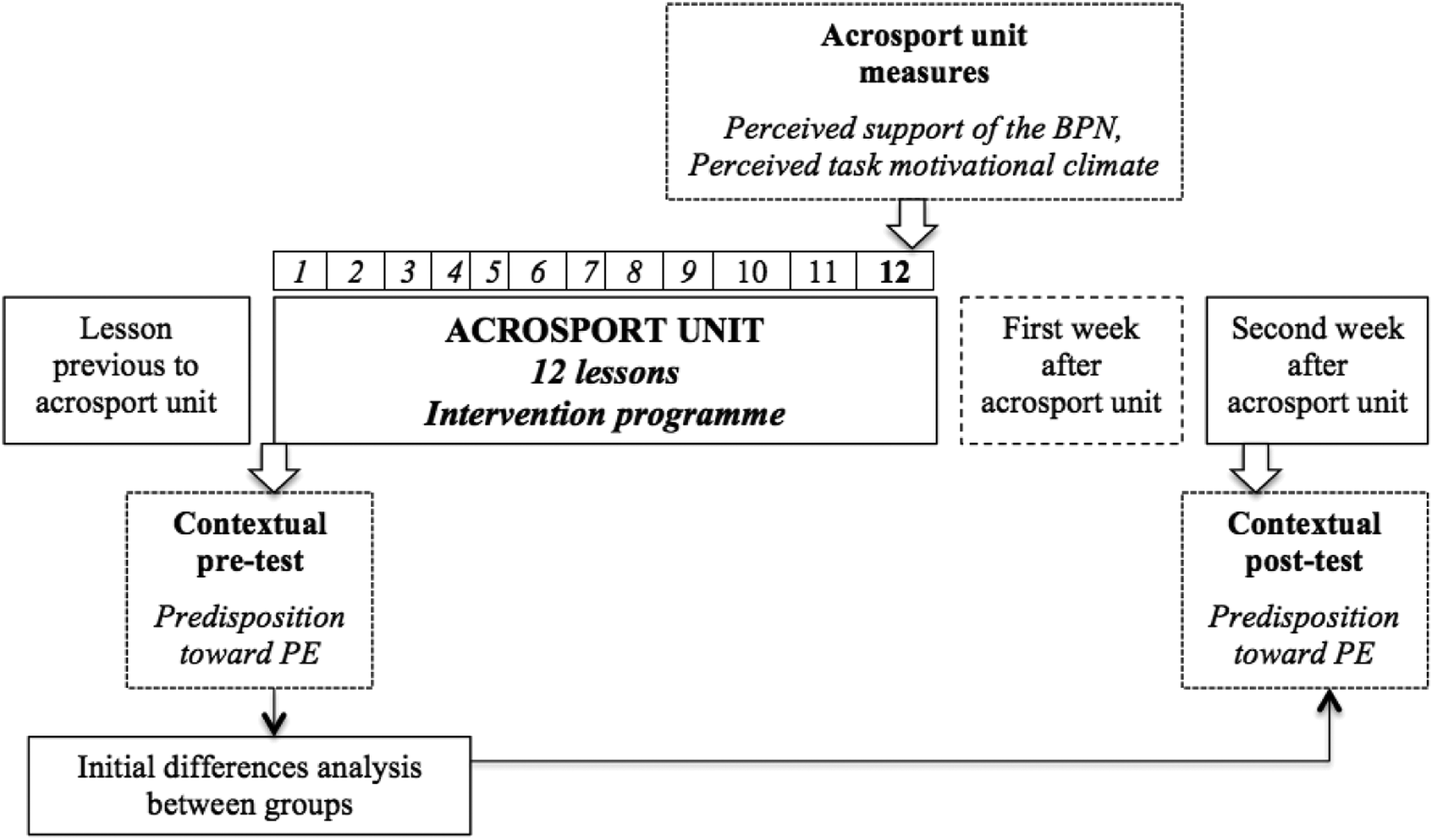
Design and research measures. BPN: basic psychological needs; PE: physical education.
Instruments
Perceived Motivational Climate Scale
The Perceived Motivational Climate Scale (PMCS) developed by Biddle et al. (1995) was used, translated into Spanish and adapted by Gutiérrez et al. (2011). This instrument, which was adapted by modifying the initial sentence to the acrosport content, contained the following heading: “In my acrosport unit lessons…”, followed by 19 items divided into five factors: five items for the perceived pursuit of progress by pupils (e.g. “The pupils learn new things and feel pleased”), four items for the perceived promotion of learning by teacher (e.g. “The PE teacher is pleased when each pupil learns something new”), three items for the perceived pursuit of comparison by pupils (e.g. “Pupils try to do better than one another”), four items for perceived worries about mistakes (e.g. “The pupils worry about making mistakes”) and three items for the perceived promotion of comparison by the teacher (e.g. “The PE teacher only bothers with those who do well in sport”). The reliability analysis reflected Cronbach’s alpha values of .81 for the perceived pursuit of progress by pupils, .88 for the perceived promotion of learning by the teacher, .82 for the perceived pursuit of comparison by pupils, .68 for perceived worries about mistakes and .68 for the perceived promotion of comparison by the teacher.
Questionnaire to assess support of basic psychological needs (Spanish acronym CANPB)
The CANPB validated to PE (Sánchez-Oliva et al., 2013) was used. The introductory question was adapted to the acrosport unit: “In the acrosport lessons, the PE teacher…”. The CANPB comprises 12 items grouped into three factors (four items per factor): perceived autonomy support (e.g. “Often asks us about our preferences with respect to the activities we carry out”); perceived competence support (e.g. “Offers us activities based on our skill level”); and perceived relatedness support (e.g. “Encourages positive interactions among all pupils”). The reliability analysis showed Cronbach’s alpha values of .68 for perceived autonomy support, .68 for perceived competence support and .77 for perceived relatedness support.
Physical Education Predisposition Scale
The Physical Education Predisposition Scale (PEPS) (Hilland et al., 2009), translated into Spanish, was used, following the usual procedures (Hambleton, 2005), including the forward-translation and back-translation method. It comprises 18 items grouped into five factors: three items measure cognitive attitude (e.g. “The things that I learn in PE seem important to me”); four items measure affective attitude (e.g. “The things I learn in PE make the subject pleasant”); three items for self-efficacy (e.g. “I have sufficient confidence to participate in PE”); five items for enjoyment (e.g. “I enjoy doing PE”); and three items for perceived competence (e.g. “I am quite skilful in PE”). The questionnaire was preceded by the heading “In the PE subject…”. Before starting the intervention study, and as a pilot test, the factorial validity of the questionnaire was tested with a sample of 138 secondary school students of the same characteristics. To this end, a confirmatory factorial analysis (CFA) was performed, testing the same theoretical model presented in the validation study by Hilland et al. (2009). The results of the CFA indicated a good adjustment of the data for a five-factor structure (i.e. cognitive attitude, affective attitude, self-efficacy, enjoyment and perceived competence) through the different adjustment indices assessed (χ2 = 204.36, p < .001; χ2/g.l. = 1.63; RMSEA = .07; SRMR = .06; CFI = .95; TLI = .94). The reliability analysis of the study sample, both in the pre-test and in the post-test, obtained Cronbach’s alpha values in each variable of .77 and .74 for cognitive attitude, .87 and .85 for affective attitude, .79 and .61 for self-efficacy, .87 and .89 for enjoyment and .85 and .90 for perceived competence.
In the case of the factors that obtained reliability of under .70, internal consistency may be accepted due to the small number of items that comprise the factor (Hair et al., 1998). The response format used in each one of the measurement instruments was indicated on a Likert scale of 1–5, where (1) corresponded to totally disagree and (5) corresponded to totally agree with the formulation of the question.
Procedure
Insofar as the ethical standards are concerned, the guidelines of the Ethics Review Committee of a university were followed. Written informed consent was obtained from parents or tutors, and from the school management, due to the participants being under age. The guidelines of the Declaration of Helsinki (2008) were followed with respect to consent, confidentiality and the anonymous nature of the responses.
Two PE teachers participated simultaneously in the study. Before starting the study, the teacher that delivered the intervention programme in the experimental group underwent 60 hours of training, following the guidelines explained below and indicated by Braithwaite et al. (2011) in order to guarantee that the subsequent intervention programme was correctly implemented. The experimental teacher training was developed by a group of experts in didactics and motivation in PE comprising three male university teachers. Two of the group members had extensive teaching experience in the PE context, having carried out numerous acrosport interventions and similar content areas with high school students. Thus, to implement these interventions, they had conscientiously designed motivational strategies based on TARGET areas in order to create a task-oriented motivational climate that integrated support of the three BPN. Moreover, one of them was responsible for developing the PE curriculum of the new education law in the region where the acrosport unit was applied. This meant that he had in-depth knowledge of the skills and goals to be attained by the students. Finally, a third expert had published articles in scientific journals referring to similar interventions based on the application of TARGET areas to generate a task-oriented motivational climate that supported the BPN. This expert also has a broad knowledge of the theoretical framework of motivation in PE.
The 60 hours of training were divided into three phases. In the first phase, lasting for 20 hours, the teacher received specific training in motivational theories (i.e. SDT and AGT) and strategies associated with the theoretical knowledge about TARGET areas (i.e. task, authority, recognition, grouping, evaluation and time; Ames, 1992) and support of BPN. Other points addressed during this phase included an explanation of the constructs of the two theoretical frameworks, the benefits of placing emphasis on developing a task-oriented motivational climate and support of the BPN, and the importance of not adopting a motivational climate ego. Likewise, practical lessons in acrosport were given to learn how to implement different teaching intervention strategies. In the second phase, lasting for another 20 hours, the same group of experts in didactics and motivation in PE drew up the unit to be carried out, together with the experimental group teacher. The strategies to be applied in each session were designed during this phase. Different teaching videos and curricular material were also prepared to facilitate the implementation of all teaching strategies (e.g. assessment tool, music, or notebook of acrosport figures). Moreover, a set of videos with different PE content areas was analysed to recognize and effectively differentiate educational intervention strategies. Finally, in the third phase, the experimental group teacher met with the members of the group of experts twice a week to review the development of the 12 acrosport unit sessions, to re-focus and implement the intervention strategies in the most efficient manner. This phase lasted for 20 hours.
The unit was integrated into the PE teachers’ curricular programme. In the first lesson, it was verified that none of the students had procedural knowledge or experience of this unit. To this end, students answered the following questions: “What is acrosport?” and “Have you ever done acrosport?”. The unit was divided into four learning situations that became increasingly more difficult, with the ultimate goal of preparing a group choreographic sequence with music support. Moreover, at least one motivational strategy within each one of the TARGET areas (i.e. task, authority, recognition, grouping, evaluation and time) was implemented in each of the lessons that made up the acrosport unit. The intervention was supervised by the same group of experts in PE didactics in order to verify compliance with the design and teaching behaviours related to the training programme. Both the teacher from the experimental group and the teacher from the control group used a methodology based on the tactical games model (TGM) (see O’Leary, 2014). However, the control group teacher had no knowledge of the theories and motivational strategies, so that the only difference was the intervention programme based on TARGET areas. The control group followed a similar structure that included 12 acrosport unit lessons. Moreover, the control group also prepared a group choreographic sequence as the final reference situation to end the acrosport unit with an artistic goal.
The study was carried out during the second term of the school year, and at the same time in both groups. There were 12 lessons in all, and two were given each week, each one lasting for 55 minutes. To compile the research data, three different measurements were carried out, two at the contextual level and one in an acrosport unit. Firstly, the contextual pre-test (i.e. predisposition towards PE) was performed during the lesson prior to the acrosport unit. Secondly, the acrosport-related measures (i.e. perceived support of the BPN and perceived motivational climate) were carried out at the end of the last lesson of the content unit. Finally, the contextual post-test (i.e. predisposition towards PE) was performed two weeks after the end of the acrosport unit (see Figure 1). Approximately 10–15 minutes were given over to completing data, depending on the compilation (i.e. 10 minutes for contextual measures and 15 minutes for acrosport unit measures). This was done in the classroom, in an optimal working environment and with the presence of the researcher to clarify any possible doubts that might have created confusion. The PE teacher was not present in order not to influence the students’ answers.
Intervention
The independent variable of the study was the teaching intervention programme. The intervention programme was adapted to the current curricular programme of the high school PE department, which envisaged the development of an acrosport unit. Acrosport is an acrobatic sport performed in groups, combining human pyramids, acrobatic jumps and choreographic elements. As a teaching unit, acrosport has valuable characteristics (e.g. cooperation, teamwork, students knowledge of their own limitations and skills and understanding of classmates’ characteristics) for application in PE. Thus, the ultimate goal of the acrosport unit proposed in this research was to create a choreographic sequence in a group, providing an artistic component to the content. This programme, applied to the experimental group, was based on the following guidelines related to the TARGET areas (Ames, 1992), which were designed to support the students’ BPN and generate a task-oriented climate. Task area: emphasis was placed on informing students about the objectives they had to achieve, so the teacher pointed out the objectives proposed before each lesson. In addition, the teacher implemented a wide variety of activities and images related to acrosport throughout the unit. This variety of didactic elements helped students create the choreographic sequence in groups. Authority area: the aim was to involve all individuals in the decisions, letting them choose, among other things, the weighting of the different sections in the appraisal, the assessment method or the delivery dates for the different projects. Furthermore, in order to place emphasis on autonomy support, the PE teacher progressively passed on the decision-making responsibility to the students, allowing them to choose the warm-up and cool-down tasks, groups, clothing and music for the final choreographic sequence. Recognition area: comparison between students and working groups was avoided at all times. In addition, the teacher gave positive (e.g. “You are making a great effort, congrats”) and cognitive-interrogative feedback (e.g. “What figure could be improved to achieve a better choreographic sequence?”) to both individual students and to working groups. Grouping area: students were distributed in a flexible and heterogeneous way, assigning different random groups during the first lessons, varying the number of members and the composition. Later on, they were given responsibility to establish stable working groups, according to their own criteria, to prepare the acrosport choreographic sequence in the final lessons, thus trying to encourage relatedness support. Evaluation area: each student was evaluated individually in order to verify their progression, and provide specific and adapted information about the learning process. Furthermore, the effort and progress of each working group were assessed, avoiding comparisons. Moreover, students could choose the percentage of each element to be assessed (i.e. individual work and group work, attitude and choreographic sequence) within a range previously established by the teacher. They also carried out a self-assessment of progress and the final choreographic sequence, and they were able to discuss and compare the final score with that assigned by the teacher. Time area: an adequate time was established for progress, and each working group established its own learning pace. Students were provided with a folder with acrosport images that progressively increased in difficulty, for this to represent a personal and group challenge to be achieved, in order to support perceived competence.
Data analysis
Univariate normality (i.e. the Kolmogorov–Smirnov test) and multivariate normality (i.e. Mardia’s multivariate kurtosis) were checked, indicating the need to use parametric statistics. Homogeneity between the control group and experimental group was checked by Levene’s test (p > .05). Afterwards, the reliability analysis of the items was performed, with the Cronbach’s alpha coefficient. Later on, the descriptive analyses of all the variables included in the study (M and SD) were performed. Firstly, a one-way multivariate analysis of variance (MANOVA) for the contextual pre-test variables (i.e. five predisposition factors) was conducted to ensure no initial differences between groups before starting the intervention programme. In order to evaluate the first hypothesis of the study, two one-way MANOVAs were carried out (Group; experimental/control) in the acrosport unit variables (i.e. the first one for perceived support of the BPN and the second one for perceived motivational climate). To verify the second hypothesis, a two-factor MANOVA (Group × Time) was used, with repeated measures (RMs) on one factor (Time, pre-test/post-test). The different analyses were performed using the statistical software SPSS 20.0.
Results
The results showed no initial differences between groups (experimental versus control) in the predisposition variables pre-test (Wilks’ Lambda = .904; F (5, 29) = 0.616; p = .689; η 2 p = .096). Secondly, related to the first hypothesis, one one-way MANOVA (Group) was performed with the variables of perceived support of the BPN and another one-way MANOVA (Group) with the perceived motivational climate. A main effect was obtained on the different BPN support variables at the end of the unit (Wilks’ Lambda = .514; F (3, 31) = 9.76; p < .001; η 2 p = .486). The analysis of differences comparing both groups (see Table 1) reflects significant differences, with higher values in the experimental group in the perceived support of the three BPN. Related to perceived motivational climate, a main effect was obtained at the end of the acrosport unit (Wilks’ Lambda = .594; F (5, 29) = 3.96; p = .007; η2 p = .406). The differences analysis (Table 1) showed significantly higher values in the experimental group in the factor of perceived pursuit of progress by pupils (i.e. perceived task-oriented motivational climate) and significantly lower values in the experimental group in the factor of perceived promotion of comparison by the teacher (i.e. perceived ego-oriented climate).
Descriptive statistics and differences analysis of the acrosport unit variables after the intervention programme.
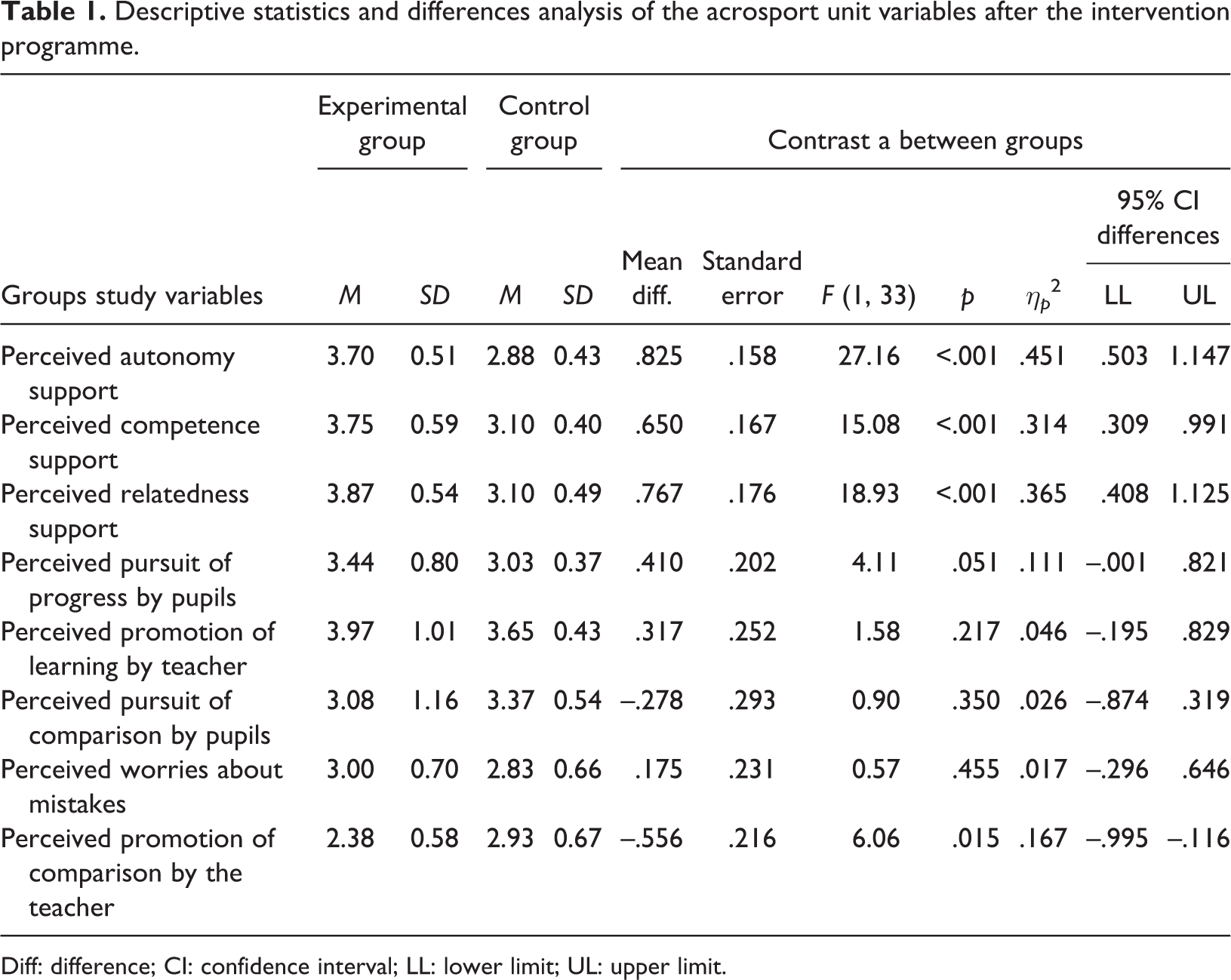
Diff: difference; CI: confidence interval; LL: lower limit; UL: upper limit.
The second hypothesis, related to predisposition towards PE, was tested through a two-factor MANOVA (Group × Time). The results indicated an interaction effect (Group × Time) in predisposition towards PE with an important effect size (Wilks’ Lambda = .635; F (5, 29) = 3.33; p = .017; η 2 p = .365). The analysis of within-group differences of the experimental group (Table 2) reflects significant increases in the five factors regarding predisposition towards PE (i.e. cognitive attitude, affective attitude, self-efficacy, enjoyment and perceived competence). In the control group, no significant increases were shown (Table 2), reflecting a significant decrease in the factor related to enjoyment in PE.
Descriptive statistics and analysis of within-group differences of predisposition towards physical education.
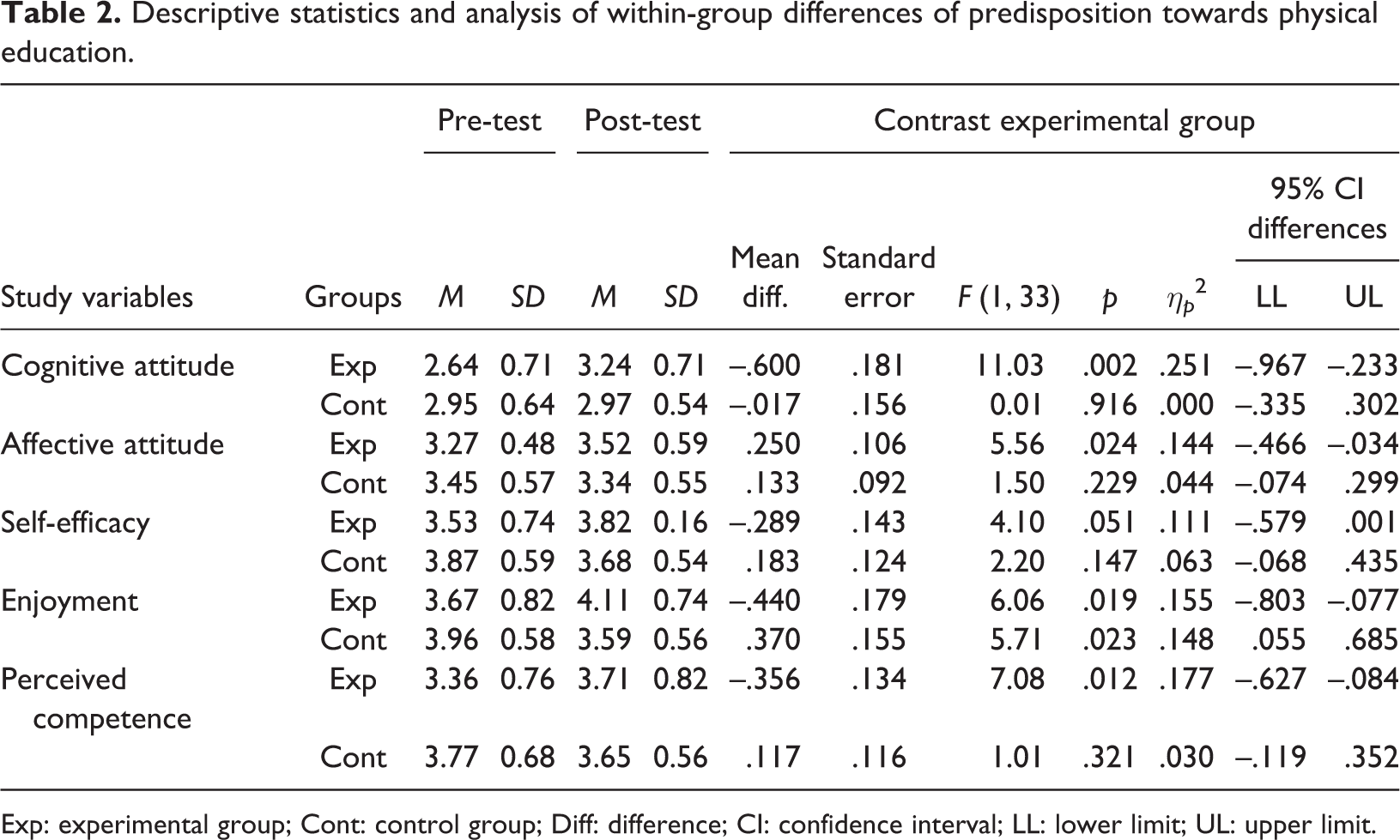
Exp: experimental group; Cont: control group; Diff: difference; CI: confidence interval; LL: lower limit; UL: upper limit.
Discussion
Based on the postulates of SDT (Deci and Ryan, 1985) and AGT (Nicholls, 1989), the objective of the research was to evaluate the effectiveness of a teaching intervention programme to improve predisposition towards PE based on developing a task-oriented motivational climate and supporting the BPN. The first hypothesis was that the strategies developed in the intervention programme in an acrosport unit would generate greater perceived support of the BPN and a greater task-oriented climate in the experimental group. The results reflected significant differences, with higher values in the experimental group in the perceived support of the three BPN. These results are in line with other studies in the field of PE, which have shown the importance of the teacher supporting the BPN due to the association of this variable with the satisfaction of the three BPN (Sánchez-Oliva et al., 2014). Other authors have only found significant differences in autonomy following a multi-dimensional intervention programme in dance lessons (Amado et al., 2014), as well as relatedness after an intervention in different curricular activities (i.e. badminton, table tennis, softball and basketball) (Tessier et al., 2010). In this sense, a meta-analysis comprised of 22 PE intervention studies (Braithwaite et al., 2011) showed that the time (e.g. from one day to seven months), the curricular content (e.g. football, basketball, hockey, volleyball) and the components (e.g. application of one, several or all TARGET areas) may explain the different effects of the interventions, from one study to another. Thus, the duration of the intervention programme and the supervision of the development of the unit may have mediated in the results obtained, highlighting the effectiveness of the motivational strategies to support the BPN.
In this line, experimental studies in PE showed that a teaching intervention based on autonomy support had a positive relationship, not only with perceived autonomy, but also with perceived competence and with relatedness (González-Cutre et al., 2014; Leptokaridou et al., 2014). On the other hand, Julián et al. (2014) established that one of the key aspects for students to perceive competence is to provide sufficient practice time to improve their individual and group skills. Preparing a choreographic sequence requires considerable time. Therefore, the 12 lessons appear to be sufficient, following the number of lessons proposed by Braithwaite et al. (2011) for adequate learning. Finally, the effectiveness of relatedness support may have been due to the application of different groupings during the entire unit, maintaining their structure long enough for integration and interpersonal relationships to be good (Tessier et al., 2010).
With respect to the perceived motivational climate variable, the results showed the effectiveness of this intervention in the acrosport unit with significantly higher values in the experimental group in one perceived task-oriented climate factor and significantly lower values in one perceived ego-oriented climate factor. These findings are in line with other results obtained following the development and implementation of the TARGET areas in a corporal expression content area (e.g. Sevil et al., 2015). Thus, the use of the TARGET areas may generate a task-oriented climate and support of the BPN in PE lessons, as occurred in recent studies in other curricular activities (i.e. orienteering, basketball, handball) (Almolda-Tomás et al., 2014; Hastie et al., 2014). These research studies have obtained significantly higher values in variables included in these two social cognitive theories (e.g. Almolda-Tomás et al., 2014; Gray et al., 2009; Hastie et al., 2014). Similarly, Cecchini et al. (2014) found significant differences in social-contextual factors concerning the motivational climate, following an intervention for which they implemented strategies based on TARGET areas in a PE context.
Following the HMIEM (Vallerand, 1997), the second objective proposed at the contextual level was to evaluate the effectiveness of an acrosport unit intervention programme on predisposition towards PE. The respective hypothesis postulated was that the intervention programme applied in an acrosport unit, based on support of the BPN and task-oriented climate (through implementation of TARGET areas), would generate an increase in the five factors of predisposition towards PE (i.e. cognitive attitude, affective attitude, self-efficacy, enjoyment, perceived competence). The results showed significant increases within the experimental group in all factors of predisposition towards PE. Moreover, the enjoyment of students from the control group in PE significantly decreased, thus confirming the hypothesis initially established. These results are consistent with previous studies in the field of PE. For instance, a study carried out by Sevil et al. (2016) found a positive relationship between perceived support of the three BPN and predisposition of students towards different curricular content areas (i.e. futsal, acrosport and rugby). Consequently, these findings reinforce the importance of the PE teacher due to the association between support of the BPN in different teaching units and predisposition towards the subject of PE. Furthermore, cognitive attitude, affective attitude, self-efficacy and perceived competence could be decisive and positive factors that could, to a certain extent, increase engagement in PA outside the school context (Van der Horst et al., 2007), reinforcing the importance of the results obtained.
Thus, after evaluating the results obtained in the experimental group, the significant increase of the cognitive attitude factor must be highlighted. In agreement with Hilland et al. (2009), the experimental intervention carried out in the acrosport unit could produce a positive change in the students’ perception of PE. With regard to all other predisposition factors (i.e. affective attitude, self-efficacy, enjoyment and perceived competence), the results of the analysis were similar for the cognitive attitude factor. This could mean that if students like PE and enjoy doing it, and they also perceive themselves as being self-efficient and competent, they could get further involved in the subject (Hilland et al., 2009). Moreover, they could also, to a certain extent, transfer these positive perceptions towards PE to other similar contexts or to higher levels established in the Vallerand (1997) model. The existing relationship between some of the factors that make up predisposition towards PE (i.e. cognitive attitude, affective attitude, self-efficacy and perceived competence) and the levels of engagement in PA (Van der Horst et al., 2007) highlight the possibility of increasing predisposition towards PE as a possible method that could promote PA. However, these results should be interpreted with caution because the relationship between predisposition towards PE and predisposition towards PA are still inconclusive. In a study conducted by Fairclough et al. (2012) with female teenagers, no significant relationship was found between perceived PE worth (i.e. cognitive attitude) and predisposition towards PA. In contrast, they found a positive correlation between perceived PE ability (i.e. affective attitude, self-efficacy and perceived competence) and PA. In this sense, it seems that more research to clarify these relationships is needed.
Reinforcing the results of our research, Moreno et al. (2010) found similar outcomes. After applying an intervention programme in a teaching unit based on autonomy support, they found higher values in the autonomy of students in that teaching unit and in PE. In another study, González-Cutre et al. (2014) showed the existing relationship between the autonomy support perceived by the students in the PE lessons and the promotion of active and healthy habits to carry out PA outside the school context. Thus, PE could become an effective resource to provide adolescents with the necessary knowledge, skills and attitudes to facilitate their adherence to PA (Dauenhauer and Keating, 2011). In addition, the PE teachers’ behaviour in the classroom becomes an important factor in terms of engaging their students in PE lessons. Consequently, their attitude in the classroom could also have a certain relationship with how adolescents use their free time (Barkoukis and Hagger, 2013; González-Cutre et al., 2014; Haerens et al., 2015).
Finally, some limitations as well as perspectives and opportunities for future studies must be highlighted. Firstly, one limitation of the study was carrying out a single post-intervention measurement of the acrosport unit variables (i.e. perceived support of the BPN and perceived motivational climate). Consequently, future research should include a pre-test of all motivational variables measured at different levels. Secondly, the sample used in the control and experimental groups was not very large and, therefore, the results obtained should be verified on a larger sample to ratify the promising effect of the intervention. Thirdly, due to the final goal of the unit (i.e. corporal expression), the students’ gender could have been assessed as a second independent variable or covariate. Thus, future studies should include gender and an increase in control. Fourthly, the group of experts checked the implementation of the intervention programme and strategies used in the control group, but they did not use any systematic recording. Future studies should incorporate observational methodology to compare the two teachers with certainty and increase internal validity. Another possibility could be to establish this study in different units, designing specific interventions for each type of content area in the PE subject. On the other hand, it would be interesting, in future studies, to evaluate the “dark side” of the motivational processes, adding variables such as thwarting and frustration of the BPN to verify their influence on students’ predisposition towards PE. Finally, the limited number of intervention studies that include predisposition towards the PE variable has made it difficult to compare and discuss the results obtained. Therefore, knowing that there is a relationship between this variable and the time engaged in PA outside the classroom, future research to study this is considered important, with a view to establishing solid associations between the teaching task in PE lessons and the adoption by students of a more active lifestyle.
Conclusions
Several conclusions can be drawn from this study. Firstly, it is important to develop an optimal learning environment that supports the task-oriented motivational climate and the three BPN. In particular, the results obtained show the importance of integrating support of the three BPN during teaching units such as acrosport, as this may increase the predisposition of students towards PE. Thus, the study shows how this type of intervention could allow students to identify the value of the PE subject. This could help them understand some benefits of PA and facilitate its incorporation into their lifestyles. Furthermore, the effects that have occurred in the acrosport unit may produce positive consequences at the contextual level; in other words, the manipulation of the teaching intervention in the acrosport unit may generate greater predisposition towards PE at the contextual level. Thus, it is necessary to educate future teachers in theories and motivational strategies such as TARGET areas that can be applied in each content area, in order for them to become agents who promote PE and active lifestyles in children and adolescents.
Footnotes
Acknowledgements
We would like to acknowledge all external participants who have made it possible to conduct this intervention study. Firstly, we acknowledge the expert team for their collaboration. Secondly, we acknowledge the PE teacher who developed the intervention. Finally, we would like to acknowledge the participation of all students who made up the study population.
Funding
The author(s) disclosed receipt of the following financial support for the research, authorship, and/or publication of this article: This work was supported by a grant from the Government of Aragón and the European Social Fund.