







Abstract
Public schools in the United States (US) have become more linguistically diverse. With the rise of English as a global language, English Language Learners (ELLs) experience “transnationalism”, which requires them to gain a critical and reflective knowledge of diverse cultures and the valuing of a new language and culture. Many teachers do not recognize the importance of language as a tool for teaching academic subjects. Teachers struggle to shape and guide conversations using language to help ELLs further their development. The purpose of this study was to explore elementary physical education (PE) teachers’ experiences with teaching ELLs. Based on positioning theory, this study employed an interpretive case study research design. Six PE teachers volunteered to participate in the study. Data were collected from a survey questionnaire, face-to-face interviews and follow-up e-mails. Three major interrelated and complex themes emerged from the data analysis. These recurrent themes were (a) race and cultural-based stereotype, (b) social inclusion and communication challenges, and (c) PE teachers’ learning experiences. Although each of the PE teachers expressed the view that there were challenges in working with ELLs, they believed that they should implement effective pedagogical methods (inclusive pedagogy), address social justice and diversity issues of ELLs, and develop a positive learning atmosphere for all students.
Introduction
Public schools in the United States (US) have become more linguistically diverse (Shapiro, 2008). With the rise of English as a global language, English Language Learners (ELLs) experience “transnationalism” that requires them to gain a critical and reflective knowledge of diverse cultures and a valuing of a new language and culture (Khatib, 2008). The term English Language Learner is defined as an individual who is in the process of actively acquiring the English language, and whose primary language is one other than English (National Council of Teachers of English, 2008). According to a report by the National Center of Statistics (2015), the enrollment of ELLs over the previous year had increased from 4.2 million to 4.5 million in K-12 public schools in the US between 2013 and 2014. The ELL population in mainstream classrooms encounters critical barriers that are associated with the technical terms used in instruction as well as experiencing cultural and religious differences creating dissonance between the ELLs, their families, and the culture of the schools (Sato and Sutherland, 2013).
Teachers from a variety of academic subjects (e.g. physical education (PE), mathematics, and science) have been asked to serve as both language teachers and content specialists when ELLs are enrolled in their classes (Reeves, 2006). PE teachers must engage in reflective action, which involves first identifying, and next critically challenging their initial assumptions (e.g. stereotypes or prejudice) about teaching ELLs (Sato and Hodge, 2017). Many teachers display a mismatch with ELLs in terms of cultural understanding (Erickson, 2001), because they have different views and perceptions about diversity, social justice, and sociocultural issues in PE (Flory and Walton-Fisette, 2015). Burden et al. (2012) and Sato et al. (2013) assert that in order for PE teachers to engage in culturally relevant pedagogy, teachers must be prepared on five dimensions— attitudes, learning, climate, curriculum, and family involvement—through effective intercultural communication and the infusion of social justice content and concepts into the curriculum. Unfortunately, these five dimensions are minimally taught, if at all, in PE programmes (Burden et al., 2012). Due to this lack of content knowledge on culturally relevant pedagogy, there has been a prevalent concern that ELLs are not always served well by the public school system (McGlynn, 2009). Flory and Walton-Fisette (2015) suggest that it is important that PE programmes should analyze how PE teachers use critical pedagogy in their teaching and how professional development programmes address sociocultural issues in K-12 schools.
When PE teachers educate students with diverse backgrounds, some struggle to modify the curriculum and find relevant pedagogy related to language and cultural relations (Knop et al., 2001). For example, Sato and Hodge (2016) studied six elementary PE teachers’ initial experiences and challenges in teaching newly coming ELLs in American public schools. They found that the six PE teachers encountered numerous challenges when teaching elementary-aged ELLs. Their primary struggles had to do with language differences, the technical languages used in PE instruction, and cultural and religious differences. These differences created a dissonance between the ELLs and their families as well as with the culture of the schools. Although the PE teachers had various challenges to overcome, they were all seeking best practices (e.g. social inclusion, student directed activities, metacognitive skills between teachers and students) for effectively teaching ELLs in PE. Ernst-Slavit and Mason (2011) found that the meanings of movement phases in PE, such as non-locomotor and locomotor skills, are easily understood by English-speaking elementary-age students, but are much more difficult for their ELL peers. Communication and language differences may have negative implications for teachers and ELLs in PE environments (e.g. Burden et al., 2013; Columna and Lieberman, 2011;Wong Fillmore, 2004). For example, movement terminology specific to content regarding motor skills was especially difficult for ELLs to understand, because of linguistic and cultural differences (Sato and Hodge, 2016). Based on a high-quality of PE programme at the elementary level, each PE teacher is responsible for providing best practices for ELLs and addresses the needs of students with varied learning styles (standard 1.2) (Society of Health and Physical Educator, 2010). These PE concepts and practices do not match the learning and problem-solving styles and processes of ELLs. Many elementary ELLs are not prepared for the unique linguistic demands in various subject areas such as PE, English, and mathematics (Wong Fillmore, 2004).
ELLs deserve appropriate and equitable instruction, yet this is often problematic because “many ELLs spend their school day with American children and students in the classrooms in which many teachers have little or no training in the differential learning and developmental needs” (Herrera and Murray, 2005: 6). Scholars have argued that inadequate professional preparation to address language differences has negative implications for PE teachers and their ELLs (Burden et al., 2013; Columna and Lieberman, 2011). Thus, it is important to gain an understanding of the problems facing these students and their teachers and how higher education faculty in PE teacher education can help them solve these problems and challenges.
Purpose and theoretical framework
The purpose of this study was to describe and explain experiences and pedagogical practices (about teaching ELLs) of PE teachers in elementary PE programmes. The research questions guiding the study were: “How did PE teachers position their own values and actions in teaching ELLs of diverse backgrounds in elementary schools?” and “What were PE teachers’ experiences in interacting with ELLs during elementary PE classes?” This study is grounded in positioning theory (Harré and van Langenhove, 1999).
Positioning theory
Positioning theory focuses on social behavior that highlights the patterns of dynamic and changing assignments of rights and duties among groups of social actors (Varela and Harré, 1996). The term positioning means to analyze interpersonal and intercultural encounters, focusing on a micro rather than macro level of engagement (Hollway, 1984). This framework allows researchers to explore the mutual cooperation in the positioning and the reasons why it is occurring (Harré and van Langenhove, 1999). This study explains the phenomena of how teachers negotiate and implement PE curricula and individual lessons with ELLs and local (English-speaking) students. Positioning theory helps us understand how the PE teachers perceive themselves, others, and each other based on their own personal experiences, which influences their philosophy in teaching students from culturally, ethnically, and linguistically diverse backgrounds, especially ELLs.
One perspective of positioning theory is intentional self-positioning (Yoon, 2008), which explains how individuals view the world from a certain subjective position in an educational setting (Hollway, 1984). The theory incorporates both a conceptual repertoire and a location for persons within the structure of rights and duties (Yoon, 2008). Hermans (2001) identified two factors that position an individual to manage the environment and time—i.e. internal and external factors of self-positioning. An internal factor refers to a position within the inner circle that the individual feels socially and emotionally accepted as part of her or himself (e.g. I as a PE teacher). An external factor refers to a position within the outer group (e.g. my ELLs). Both internal and external factors mutually influence self-positions, because individual self-positioning is extended to the team, group, language(s), and culture that reflect his or her personal experiences in the environment (Hermans, 2001). Self-positions identify the complex shifts between internal and external factors that help to describe an individual’s professionalism, teaching behaviors, and challenges in a variety of meanings in teaching (Hermans, 2001).
Davies and Harré (1990) use the term “reflective positioning,” which is useful in analyzing how teachers position their own values, roles, and actions as physical educators. The term “reflexivity” refers to how teachers critically monitor and understand the role of the self in teaching. Reflective position is closely related to the personal interpretative framework (in particular, teaching task perception) or the normative assumption about good teaching that is the basis on which individuals ground their decisions for actions in particular situations (Vanassche and Kelchtermans, 2014). Teachers’ reflective positions shape how they demonstrate their roles and duties in education (Yoon, 2008). Teachers must combine different positions and roles as being teachers, facilitators, or helpers (Jones, 1999). Although they might consciously understand that they serve various roles when teaching ELLs, they may unintentionally and unconsciously position ELLs as isolated and powerless learners, which may lead to negative consequences such as marginalization of these ELLs (Yoon, 2008). Teachers’ reflexivity is determined by “indexing one’s statements with the point of view one has on its relevant world” (Harré and van Langenhove, 1999: 62). This indicates that teachers’ experiences and backgrounds influence their positioning and actions in teaching (Yoon, 2008).
According to Davies and Harré (1990), interactive positioning is “how one person positions another” (p. 48). Teachers’ positioning in certain ways limits or extend to what person can say or do (Adams and Harré, 2001) and provides options and choice of speaking forms, actions, and thoughts, which may limit or extend his or her rights (Harré and van Langenhove, 1999). Interactive positioning helps to identify teachers’ self- and other-positioning based on interaction among the teacher, students of diverse backgrounds, and ‘others’ (e.g. students, parents, and other teachers). Andreouli (2010) asserts that an interactive position emphasizes the other as an integral part of the positioning process. Individuals jointly (re)produce relational meanings so that they may see the world from one point of the position, such as storylines and concepts that may or may not be relevant to others. Interactive positioning explains teachers’ decision-making processes (e.g. how PE teachers choose teaching techniques, lesson content, or materials) that contribute to positive academic and social experiences for ELLs or lead to cultural dissonance. This means that a student may behave appropriately based on the student’s cultural norms and upbringing, but the teacher who has a different culture and ethnic background might interpret and respond to the student’s behavior as being inappropriate (Hodge et al., 2012). In such cases, a teacher may identify students as good or bad based on the teacher’s positioning (Harré and Moghaddam, 2003). Some teachers are not aware of how to support students of diverse backgrounds including ELLs (Columna et al., 2010). Positioning theory is, therefore, a powerful lens to examine how teacher candidates position themselves in educational settings.
Methodology
This study utilized an interpretive case study research design (Merriam, 1998). Interpretive qualitative research focuses on understanding the way people interpret and make sense across approaches and the world in which they live (Merriam, 1998). The focus of this study centered on understanding PE teachers’ experiences, positioning, and reflection in educating and interacting with ELL students. This study was a second study made as a follow-up to the initial study of Sato and Hodge (2016) using the same participants and schools. The researchers conducted a follow-up 1–2 years after the initial study in which there were different findings from the Sato and Hodge (2016) study.
Research sites and participants
The research sites were public elementary school districts in Ohio. The researchers contacted eight school districts in Ohio, seeking PE teachers who taught ELLs in elementary schools. The school districts we studied recently accepted and increased the number of ELLs. However, the teachers in the school districts have not received any ELLs’ background documentation or notifications about the ELLs prior to meeting them on the first day. The researchers asked PE teachers to identify students who need schools’ language support services due to their limited language proficiency in speaking, reading, writing, and understanding English. A total of six PE teachers voluntarily agreed to participate in the study. Pseudonyms were used to identify all of the participants. Of the six participants, all were White Americans, five were females (Betty, Cathy, Hanna, Helen, and Katy) and one was male (Vince). All participants taught first through fifth graders in PE. Their teaching experience ranged from one to 29 years (See Table 1).
PE teachers’ demographic data.
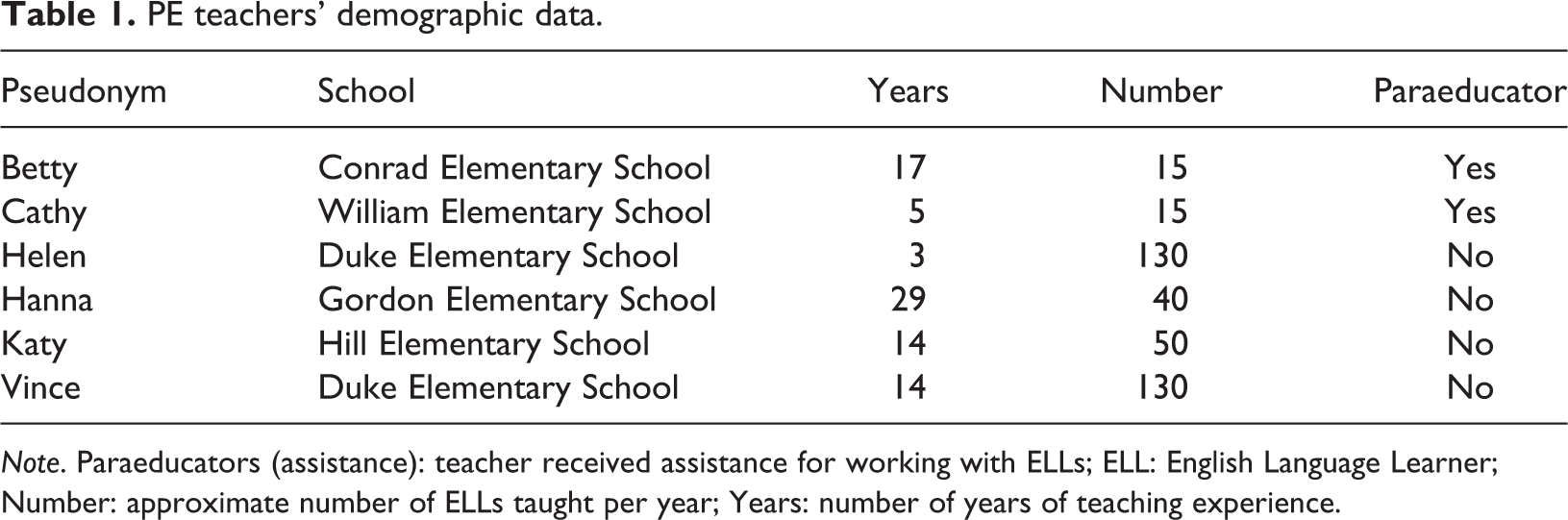
Note. Paraeducators (assistance): teacher received assistance for working with ELLs; ELL: English Language Learner; Number: approximate number of ELLs taught per year; Years: number of years of teaching experience.
Data collection
Data were collected from a survey questionnaire, face-to-face interviews and follow-up e-mails. Data collection occurred over a period of 18 months. In this study, 50% of the participants’ ELLs did not stay and study at their schools and had to return to their home countries within 6 months.
Survey questionnaire
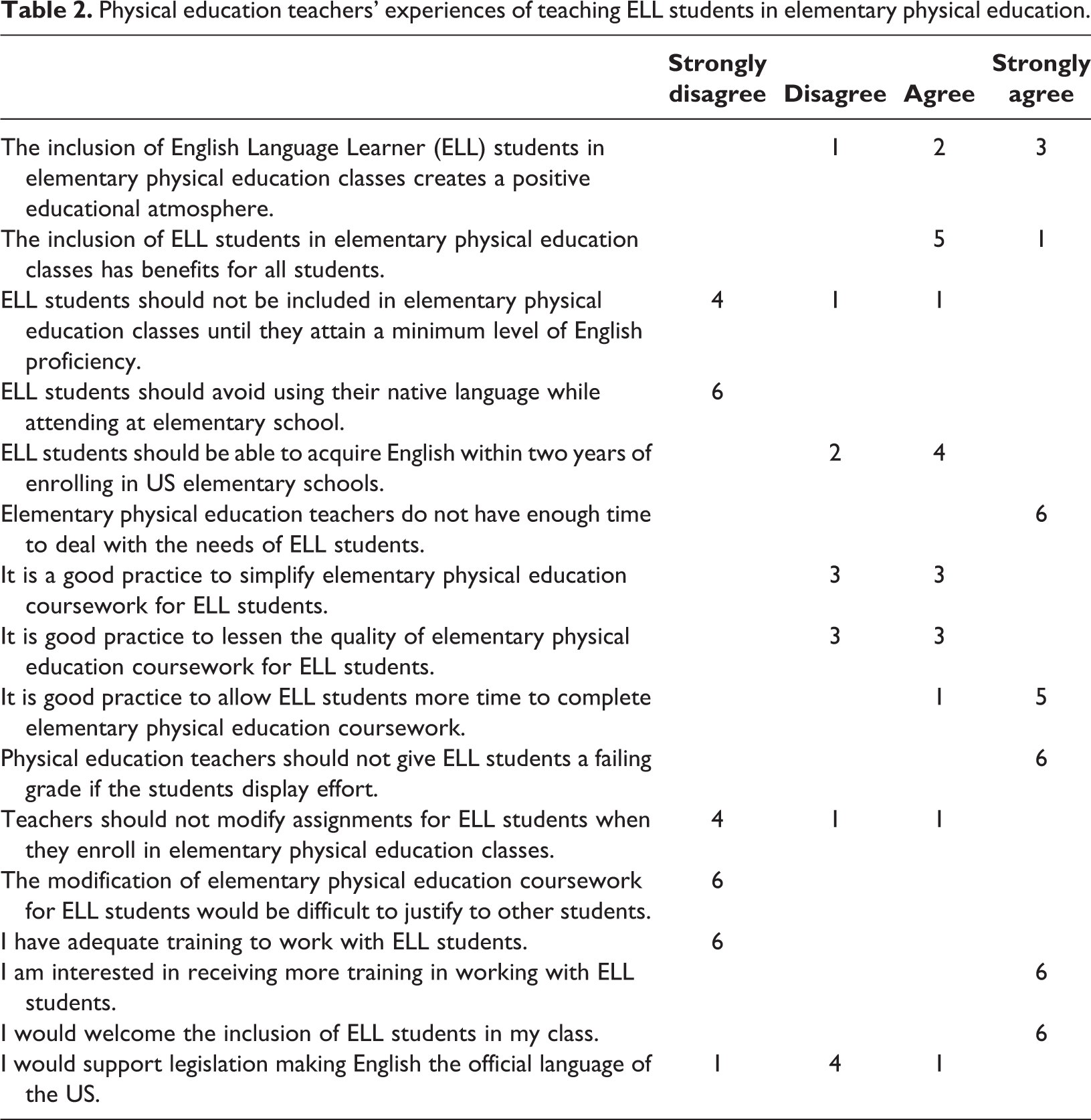
The survey scale titled, English as Second Language Students in Mainstream Classroom (Reeves, 2002, 2006) was modified (e.g. the term “Second Language Students” was changed to “ELL”) and used to collect survey data on the participants. English as a Second Language (ESL) defined as students who came to live in an English-speaking country, and do not speak, read, and write English well (Reeves, 2002, 2006). This modification was necessary to avoid terminology conflicts defined by Ohio Department of Education and this survey questionnaire. This questionnaire was designed to measure teachers’ experiences of teaching ELLs. Two ESL teachers and a professor reviewed and evaluated the modified questionnaire to ensure that the revised questions did not change the meaning or intended content. This instrument is designed to assess teachers’ experiences in teaching ELLs. The results of the survey questionnaire are presented in Table 2.
Physical education teachers’ experiences of teaching ELL students in elementary physical education.
Face-to-face interviews
A face-to-face interview approach (Yin, 2003) was used to gain insight into the participants’ opinions and experiences associated with teaching ELLs in PE. The researchers had two jobs in conducting the interviews: (a) to follow the interview study protocol developed by Reeves (2002), and (b) to ask probing questions for further meaning and to provide additional information about teachers’ experiences. Each participant was interviewed on two different occasions, which lasted approximately 60–90 minutes each. Topics of the interview questions included participants’ past experiences, diverse perspectives, and how they teach PE in elementary school settings in which ELLs participated. The authors modified the protocol based on results from a pilot study. The semi-structured protocol included questions that focused on the PE teachers’ positioning and experiences in teaching ELLs in PE. Examples of interview questions included: (a) How have your experiences in teaching ELL(s) in elementary PE changed over time? (b) What are the challenges of including ELL(s) in your elementary PE classes? Did you use any instructional techniques or strategies for overcoming these challenges? (c) In what ways could your school district or colleagues (e.g. language teachers) serve your educational needs and help solve issues and concerns you are facing in teaching ELLs in PE?
Follow-up e-mails
Follow-up questions and/or clarification of teachers’ comments were asked via e-mail (Meho, 2006), as warranted. Once this process was completed, the researchers transcribed the interviews and returned all transcribed data to participants for member checking (Lincoln and Guba, 1985; Patton, 2002) via e-mail (Meho, 2006). When there was a need to clarify the content of the interviews in written format, the researcher and peer debriefers asked each participant to respond by e-mail. In this study, 10 e-mail messages were sent to five participants, which included inquiries about their ethical and unethical behaviors of teaching ELLs in PE.
Data analysis
A constant comparative method (Boeije, 2010) was used to interpret the data. The basic strategy of this analytical process is to do what its name implies—i.e. constantly compare pieces of data. More specifically, each potentially meaningful piece of data within the transcripts from the first set of interviews with each participant was coded independently by the peer debriefers (who helped to seek meaning and pursue clarity of interpretation from researchers), and the differences were discussed until agreement was reached. The second set of interviews, follow-up e-mails, and demographic information were initially coded by the lead author and then checked by the peer debriefers. The survey data were analyzed based on three different sections: (a) teachers’ strength of agreement and disagreement for teaching ELLs in PE, (b) the frequency of teaching behaviors among teachers with ELLs in PE, and (c) information concerning benefits and challenges of ELLs in PE. These peer debriefers reviewed the codes to avoid potential researcher bias. Further coded data from both sets of interview transcripts, follow-up e-mails, and the survey questionnaire from each participant were compared to identify similarities and differences. The researchers grouped the codes into thematic categories, which were then refined into recurring themes (Boeije, 2010).
Trustworthiness
Strategies employed to enhance trustworthiness were triangulation, member checking, and peer debriefing. Triangulation involved the use of multiple perspectives, such as data from the survey questionnaire, interviews, and e-mail responses. Member checking was used to reduce the impact of subjective bias (Patton, 2002). The lead researcher mailed all copies (saved disks) of the transcribed interview data and e-mail exchanges to the address of the individual participants. The participants’ acknowledgment of the accuracy of the data and the researchers’ interpretations of the data ensured that trustworthiness was established (Merriam, 1998). Peer debriefing is a process of exposing oneself to a distinguished peer in a way paralleling an analytic session, with the purpose of exploring aspects of inquiry that might remain only implicit in the inquirer’s mind (Patton, 2002). For this study, two university supervisors known by the current researchers and with expertise in qualitative research agreed to serve as peer debriefers.
Results
Three major interrelated and complex themes emerged from the data analyses. These recurrent themes were (a) race and cultural-based stereotype, (b) social inclusion and communication challenges, and (c) PE teachers’ learning experiences. The themes are reflective of meaning that the participants ascribed to their experiences.
Theme One: race and cultural-based stereotype
All participants experienced eye-opening and positive learning experiences during their teaching of ELLs in PE. However, based on the survey questionnaire data, all participants were in strong agreement that elementary PE teachers do not have enough time to deal with the needs of ELLs (See Table 2). Furthermore, during their individual interviews, they expressed that they have race and cultural stereotypical beliefs and made judgments of ELLs’ behavior based on their own cultural norms and understanding of different races and cultures. The stereotypes described by Katy and Vince, for example, may lead to future problems such as racial discrimination, mistreatment, and parental arguments. The other teachers, Cathy, Hanna, Helen, and Betty mentioned that they used race-based stereotypes of their African ELLs that may show aggressive and violent behaviors, because they have similar ethnic and cultural backgrounds of African American children. Betty, for example, expressed: When I see new students (ELLs), I knew they are from foreign countries, but they look similar with [other] Hispanic and African American students. Sometimes, I forgot those students are international students, because they look the same. I treat them like American students based on their own ethnicity. I had a Korean American student who showed a short temper, so when I had [other] Korean students (ELLs), I worked hard to control their behavior even if they do not show them. That is bad (Betty, interview).
Helen and Cathy explained that race-based stereotypes related to how local students included or did not include ELLs when participating in different sport and physical activities in PE. Helen explained: When I taught track and field to the 5th graders, many local students asked me to invite African ELLs as their teammates when I taught basketball. It seems that my students (local students) also had race-stereotypical beliefs about certain sports. I think this topic became significant inclusion issues and concerns, especially for students in 4th and 5th grades. I realized that when local students welcome ELL students it is when they understand the ELL students may contribute to winning the competition of the sport or physical activity. However, when I taught how to play baseball, my students (local students) ignored the African (ELL) students. They did not allow African students to swing bats during the activities. I did not ask why my students (local students) ignored them, It is hard to judge ethical and unethical actions of the students (Helen, interview).
Theme Two: social inclusion and communication challenges
All six participants experienced numerous challenges in creating opportunities for social inclusion for ELLs and American-born children in PE. In this manuscript, social inclusion is being defined by how students have full and fair access to educational resources and activities, maintain social relationships with teachers and friends, and develop a sense of group belongingness (Cobigo et al., 2012). The participants felt that ELLs were physically included in the classroom, but they were socially separated or segregated from the PE environment. The ELLs had a hard time communicating with teachers and local students in both written and oral forms.
All teachers often used pair activities as an instructional strategy when they taught movement skills (e.g. warm-up activities) and object-control skills (e.g. rolling a yarn ball to his or her partner). There were several situations, the participants explained, when the ELLs could not find their partner for the pair activities. The ELLs expressed to the teacher, “I do not have a partner, teacher”. The participants asked a few American-born children to work with the ELLs. They found that many local students were unwilling to work with ELLs in PE. Cathy, for example, shared, to: My local students do not want to work with ELL students, because they have their own friends. They want to work in pair activities with their friends all the time. I asked and assigned a few local students to pair up with ELLs, but as soon as the pair activity is over, local students went back and sat next to their friends. It seems that ELLs are left alone. I do not know how to fix it. (Cathy, interview). When I teach pair or group activities, I have two things to remember. One was that I need to find talkative children as the pair or group partners. Second, I learned that I never ask students as pair activity partners when the students need attention from other classmates. I do not mean to say that they do not care about others, but I found that they had a hard time to accept and learn diversity from other classmates. I watched the class and some children pushed ELLs further and further out of the group. That is not good (Betty, interview).
Helen, Vince, Katy, and Cathy learned that there were many ELLs who were quiet and positioned themselves as the mode of self-presentation in PE. For example, when the ELLs had difficulty speaking, writing, or understanding the English language, the participants viewed the ELLs as either silent or quiet students. Simultaneously, they also labeled ELLs as troublemakers, because they had a hard time finding ELLs’ unique needs. They believed that the way ELLs and teachers position themselves in PE is important, because one’s positioning has consequences of social interaction that can create negative or positive learning environments. For example, participants shared that it seemed that their ELLs showed less motivation or interest in learning new content in PE, which caused them to become frustrated when dealing with their ELLs. In hindsight and through self-reflection, they realized that their lack of communication adversely affected their teaching behaviors and ultimately their ELL students (Davies and Harré, 1990). Helen shared her experiences when teaching Asian students: I really struggled to find what my Asian students want and need from me. I had to use tactical words of my object-control lessons. I was sure that many Asian students were not familiar with the terms. I asked “do you understand what this means?” Many of them were so quiet and silent and then no reaction. It makes me really anxious and nervous when they do not give any reactions to what I am saying (Helen, interview). I think my ELLs have been treated as outsiders or invisible students, because they were so quiet and they did not show any reactions. Sometimes, they did not participate in my lessons. Other students looked at them and treated them as weird students. I feel that I create a teaching environment that makes them lonely (Vince, interview).
Theme Three: PE teachers’ learning experiences with ELLs
PE teachers believed that teaching ELLs was helping them to explore new diverse perspectives that lead to new teaching techniques (e.g. culturally responsive teaching) (Young and Sternod, 2011) and effective discussion with other teachers from different academic subjects. For example, the five female teachers had been targets of disrespectful comments by parents of ELLs from Middle Eastern countries when they started to teach ELLs. These comments from the parents made the teachers realize that their lessons and activities were not helpful and relevant enough to their ELLs. Since they did not know how to make their lessons relevant, they asked for help and collaborated with ESL, math and special education teachers for developing a teaching tips manual that included native language use in PE, visual aids and different technology sources, picture samples, and creating a culture of peer assistance for ELLs. Hanna learned that “diversity” is about how to mix students’ personalities, cultures, and backgrounds. In the questionnaire, all participants were in strong agreement that they are interested in receiving more training in working with ELLs and welcoming the ELLs in their classes (See Table 2).
The participants learned how to handle individual differences and similarities between ELLs and local students in the classroom. For example, Katy and Betty found that integrating math and literacy with PE content was beneficial and valuable. Katy shared: I could teach math and spelling concepts using poly spots with numbers and alphabet letters in PE. I have poly spots with numbers on the head side and English letters (A, B, C) on the tail side. So I spread out poly spots on the gym floor randomly. I showed the cards of “How many apples do you see on the card?”. Then I wrote “cuántas manzanas ves en la tarjeta?” in Spanish. All students quickly found the poly spots with the right number they saw on the card….I felt that ELLs started to model what other students were doing. I learned so much about linguistic diversity from the classroom teachers and ELLs. (Katy, interview). Several special education teachers taught me how to motivate students using a token economy technique. For example, I am not allowed to give candy during my PE time, so I used old animal beanbags to teach about movement concepts. My students (ELLs) liked frogs and spiders. I could teach concepts of jumping and crawling. I asked my students (ELLs) to demonstrate how to jump. When students (ELLs) could explain the concept of jumping successfully, they are allowed to take the beanbags to their home for a week. I wrote a note to their parents that they need to return the beanbags…It has been working well, because it seems that my students (ELLs) teach the concepts of jumping to their brothers and sisters using the beanbags. I think that is a good thing (Hanna, interview).
The teachers found that the many ELLs did not understand the concept of how to share equipment with others. For example, Vince, Katy, and Hanna were extremely frustrated when the ELLs refused to share their equipment with other students during the lesson. Vince talked with other classroom teachers and learned that there were many refugee ELLs that had been traumatized during previous life experiences such as war-related trauma or life-threatening experiences. Vince said that the “concept of sharing had not been a part of ELLs’ survival skills in their countries.” He also expressed: I am not sure my comments are right or not, but I am sharing with you that I think….my students (ELLs) had horrible tragic lives when they were in their native countries. They had not been in a safe living environment. If they found food, they never learned how to share. If they did not eat, they would die. Daily activities are the part of human survival in their previous experiences. When I allow all students to choose one ball from four different colors, many ELLs chose a color they liked. But they never chose a ball of red. When ELLs were in the situation that they had to choose a ball from colors they did not like, they stopped participating in the activities (Vince, interview). I learned that my students (ELLs) had faced different types of belonging in PE. Fortunately, there was no local student who made fun of ELLs, but I think they are still in an uncomfortable learning environment. I think that they are unique and different from other students such as lack of English-speaking competency, socioeconomic status, ethnic backgrounds, and religion. I think that these complexities may cause different types of social interactions within students and teachers in PE. We need to analyze and find unique needs of ELLs. I am thinking about fund-raising programs that support ELLs’ learning (Katy, interview). I should not try to solve issues and concerns by myself. We have to use collaborative approach and overcome various challenges and obstacles, because if I tried to solve the problems related to ethnicity, religion, habits, and languages, I may unconsciously conduct unethical treatment or intervention to my ELLs. Every action I take must be discussed with my colleagues and supervisor.
Discussion
The findings indicate that these six PE teachers experienced a range of challenges when teaching elementary-aged ELLs in PE. Their struggles centered on how to include ELLs socially, overcome communication barriers, and minimize race-based stereotypes caused by exclusion or isolation between ELLs and local students. However, the PE teachers learned various collaborative strategies from special education, math and literacy teachers to help overcome these challenges. Participants were all seeking best practices (e.g. social inclusion, student directed activities, metacognitive skills) to effectively teach ELLs in PE.
All PE teachers found that when they taught PE, they had negative or misleading stereotypes about a specific racial group of students and ELLs. For example, they positioned the ELLs from Asian countries as troublemakers (e.g. showing short-temper behaviors) based on their past experiences of working with Asian American students. The notion of Asians as trouble makers gives the false impression that no positive behaviors exists among Asian ELLs (Eagleman, 2011). Gray (1995) explains that teachers seek a “cultural signifier” of different racial and ethnic groups based on new, current, and past interactions in the classrooms. This is evident in the portrayal of teaching events as “other”, because of ELLs’ ethnic heritage. The teachers also felt that overcoming race-based stereotypes about physical activities and sport for ELLs is difficult. Race-based stereotypical views about athletic capabilities suggest that Africans are portrayed as achieving success due to uncontrollable factors like natural talent, or physiological or biological advantages in basketball, football, and track and field (Eagleman, 2011; Sato and Hodge, 2012). By contrast, ELLs from European and South American countries are portrayed as achieving success in baseball and soccer. The teachers believed that local students begin to understand sociological and cultural phenomena of how race, ethnicity, physical features, ancestry, and nationality are positioned in sport media that is relevant to student learning and PE (Haslanger, 2000). Some ELLs were hesitant to learn different types of sports, particularly those that are considered to be dominated by American students. This resulted in the ELLs, at times, feeling isolated from their classmates in PE (Van Camp et al., 2009).
All of the PE teachers found that many ELLs were quiet and could not find peer mentors or partners during pair (peer) activities. They hoped that ELLs would feel valued, their differences respected, and their basic needs met so they can live in dignity (Cappo, 2002). Unfortunately, local students’ positioning was to exclude or ignore the ELLs’ social or communication opportunities and isolate the ELLs (Harré et al., 2009). These PE teachers struggled to overcome segregated inclusion (i.e. refers to time when students with disadvantages were separated from classmates in terms of proximity) and social isolation (i.e. referred to group separateness between students with and without disadvantages) (Place and Hodge, 2001). Therefore, many ELLs could not minimize gaps in their linguistic competence, understand the meaning of lessons and practices, and switch or translate between new and past PE discourse through interacting with local students (Norris and Ortega, 2006; Sato and Hodge, 2016). Miller (2010) asserted that “if students cannot be heard representing themselves and enacting of exclusion from social interaction seems inevitable” (p.73). Therefore, the way local students and teachers position themselves and others in a classroom setting was important, because their positioning affected the nature of ELLs’ interactions and their access to learning opportunities in PE. Interactive positioning occurs in the moment of academic and social interaction, but it is also contextually tied across interaction or scale of class activities (Kayi-Aydar, 2013, 2014).
This study also found that the ELLs were treated by local students as incompetent and as uninvited guests (Sato and Hodge, 2016), because they were quiet or silent and rarely communicated with other classmates (not nurtured in the same spirit of caring at the elementary schools). Based on the participants’ experiences, it seems that many local students did not see the ELLs as fitting in, because they did not understand the ELLs well. The lack of communication and understanding of ELLs’ academic, social, and cultural backgrounds situated them in a position as an outsider of the social groups. If teachers, such as those in this study, could not use the cultural relevancy in educating the ELLs, the cultural relevancy in educating the ELLs, it seemed that the teachers automatically positioned their ELLs to self-segregated situations in the absence of a planned preventive and culturally relevant educational approach in the classrooms (Hodge et al., 2012; Van Acker et al., 1996). The goal is for teachers to position ELLs in a way that can lead to putting them in an inclusive position (van Langenhove and Harré, 1999).
All participants had opportunities to study their students’ backgrounds and behavioral tendencies, as well as observe the instructional strategies and lesson modifications by the teachers from different academic subjects. Teachers’ experiences of how they ‘fit’ into the integrated culture of PE experiences are important to executing various responsibilities (e.g. teacher, facilitator, and care-giver) (Jones et al., 2013). It is particularly important to note that an integrated culture refers to PE teachers receiving frequent support and interacting with teachers from different academic subject areas across experience levels (Jones et al., 2013; Kardos et al., 2001). The teachers believed that it was beneficial to develop a positive professional responsibility for improving ELLs’ learning when collective responsibility (for students’ academic and social progress) influenced and returned to individual levels (Jones et al., 2013). For example, they had the opportunity to interact with special education classroom teachers who explained what and how to use token reinforcers to modify students’ behavior by rewarding specific behaviors with items of extrinsic interest (Damayanti and Sunil, 2011; Lavay et al., 2006). The PE teachers were pleased to demonstrate token economy reinforcement that helped ELLs exhibit behavior that aids in improvement in their on-task behavior (Charlop-Christy and Haymes, 1998) in PE. In this study, all PE teachers learned that ELLs improved their motor and social skills and that they should continually reorganize their lessons plans for instructing ELLs while using token reinforcement (Lavay et al., 2006). They believed that collaborating with teachers from different academic subjects helped them open their eyes and develop their self-confidence of teaching ELLs in PE.
The PE teachers had an opportunity to teach ELLs who came from war and violent living environments in their native countries. Consequently, these ELLs had a hard time adjusting to the PE environment, because the ELLs struggled to share equipment with their peers. Connelly and Kelloway (2003) explained that sharing behaviors involves mobility of minds (i.e. shifting multidimensional of belongings), bodies (frequent movement across places, spaces, and different interactions), and boundaries (shifting territorial, political, cultural, economic, social, and individual boundaries) among the members (students) of groups. The teachers continuously work with ELLs who were victimized by re-experiencing negative memories (e. g. traumatic memory of violent images), avoidance symptoms (e.g. restricting thoughts and trusts), and hyperarousal symptoms (e.g. irritability) and therefore positioned themselves according to the belief that possessive behaviors are necessary for their survival (Sato and Hodge, 2016). The teachers experienced ELLs’ diversity of different references of academic and social backgrounds. They learned that the ELLs may be able to position themselves as independent learners while simultaneously acknowledging that they may have different versions of shifting and multidimensional positions that accommodate differences, commonalities, mobility, and immobility at the same time (Sicakkan, 2008).
Recommendations and conclusion
PE teachers are concerned that they often face pedagogical challenges that exacerbate difficulties in including ELLs and adjusting to the academic, social, and cultural backgrounds of ELLs. Below are some recommendations to help PE teachers have meaningful and successful teaching experiences with ELLs.
First, PE teachers should discuss expectations with ELLs’ classmates and encourage interaction among all students. Curtis (2003) recommends a few steps to create a positive social inclusion climate that PE teachers should follow: (a) encourage all students to learn and use students’ names and know something about each student; (b) provide opportunities for all students to participate in cooperative activities and non-competitive activities in PE, so that all students know that they are valued and respected members of the learning community; and (c) ask all students to provide positive feedback regarding peers’ efforts and practices. PE teachers and students should also hold a reflective closure at the end of every class to help build a sense of belonging and have opportunities for conversation among students.
Second, school districts must offer and require cultural and behavioral scaffolding workshops for PE teachers. The workshop must include content knowledge and culturally relevant theoretical knowledge. School psychologists can also offer sessions about communication strategies with parents of ELLs and local immigration services and find information about any tragic events (e.g. war trauma), offensive or defensive actions and behaviors, and academic and social supports for ELLs (Bransford et al., 1999). This study also recommends that school districts should invite international college and university students and ask them to speak about language barriers, cultural adjustments, political issues of their native countries, and behavioral and social patterns of ELLs.
Third, school districts must recruit and hire culturally diverse PE teachers and infuse race, ethnicity, and sport and physical activity awareness approaches that minimize race-based stereotypes in PE (Burden et al., 2004). Schroeder (2010) explains that it is important to note that culturally diverse PE teachers understand the culture and subcultures about how these elements influence the school districts’ and PE programmes’ values of the history, tradition, and mission of the school districts.
Although the PE teachers expressed the view that there were challenges in teaching ELL students, they believed that they should implement effective pedagogical methods (inclusive pedagogy), address social justice and diversity issues of ELLs, and develop a positive learning atmosphere for all students. We need to consider how school districts and PE teacher education programmes collaborate and offer professional development opportunities that can help PE teachers overcome challenging instructional situations. Burden and colleagues (2012) assert that school districts’ advocacy of social justice and diversity could potentially increase teachers’ cultural awareness, understanding, and pedagogical competence of ELLs. In future research, we must observe their teaching and professional experiences after they receive professional development workshops of how PE teachers instruct ELL students.
Footnotes
Declaration of conflicting interests
The authors declared no potential conflicts of interest with respect to the research, authorship, and/or publication of this article.
Funding
The author(s) disclosed receipt of the following financial support for the research, authorship, and/or publication of this article: We gratefully acknowledge the grant funding support of Ohio Association for Health, Physical Education, Recreation, and Dance.