







Abstract
The purpose of this study was to conduct a literature review on the motivational processes in a Sport Education curriculum model among high school-aged students using self-determination theory and achievement goal theory as theoretical frameworks. Literature for analysis was searched through electronic databases including Academic Research Complete, ERIC, PsycINFO, SPORTDiscus, and Web of Science by entering ‘Sport Education’, ‘physical education’, and ‘high school’ or ‘secondary school’ as keywords. Articles for review were then selected using the following criteria: (a) written in English; (b) published in a peer-reviewed journal; (c) a Sport Education curriculum model implemented in high school settings with three season phases; (d) providing empirical findings; and (e) investigating motivational variables as main outcomes. A total of 18 articles were identified of moderate and high quality based on a quality assessment. A systematic review of the articles resulted in three main findings: (a) self-determination theory and achievement goal theory strongly support the positive motivational influence of Sport Education; (b) Sport Education is relatively consistent in promoting motivational outcomes across genders, grade levels, sports, and motivational profiles; and (c) more research with long-term follow-up data and teacher participants in diverse school settings is needed to examine potential differences in the motivational impact of Sport Education programs.
Introduction
Sport Education (Siedentop, 1994) is a widely used physical education (PE) curriculum model that has been linked to positive psychological outcomes among students, such as increased competence, affiliation, motivation, and enjoyment (Hastie et al., 2011; Wallhead and O’Sullivan, 2005). The philosophy of Sport Education is to (a) provide opportunities for students to engage in sport more authentically; (b) enhance the chances for students to learn sport more completely; and (c) create more important and relevant experiences for students (van der Mars and Tannehill, 2015). Siedentop (1994) created this student-centered curriculum model with the goal of building by integrating six features—seasons, affiliation, formal competition, record keeping, culminating event, and festivity—which can enhance student motivation in PE and physical activity (PA) through satisfying their basic psychological needs (e.g. Wallhead et al., 2014). Further, increased motivation in PE can lead to other educational benefits including the development of social skills, confidence, and behavioral persistence (Ntoumanis and Standage, 2009; Van den Berghe et al., 2014).
Since the first published study in Sport Education using a motivational framework by Wallhead and Ntoumanis (2004), there has been a growing body of Sport Education research on motivation that shows the positive influence of this curriculum model in motivational responses in PE (Hastie et al., 2011). The motivational processes in PE are important for adolescents because their PA declines with age worldwide, evidenced by an average of 7% annual decrease in PA levels (Dumith et al., 2011). Additionally, most high school students in Western countries do not meet the recommended daily PA guideline (Kann et al., 2014; Schranz et al., 2016) and have decreased motivation toward PE (Ntoumanis et al., 2009). For these reasons, this systematic review examines how Sport Education can potentially enhance the motivational processes within the context of high school PE.
Self-determination theory and achievement goal theory
In order to understand the motivational impact of Sport Education, it is first relevant to review the related theoretical frameworks – self-determination theory (SDT) (Deci and Ryan, 1985) and achievement goal theory (AGT) (Nicholls, 1984) – which have been widely used to examine motivational processes in PE. These two theories are particularly useful in explaining the social–contextual factors in PE that contribute to student motivation and related outcomes (Ntoumanis et al., 2009).
Self-determination theory proposes that motivation exists on a continuum, ranging from intrinsic motivation—to different forms of extrinsic motivation (i.e. integrated, identified, introjected, and external regulations)—to amotivation (an absence of motivation). When behavior is regulated by motivation forms toward the higher continuum (i.e. intrinsic, integrated, and identified), adaptive responses in PE such as greater engagement and enjoyment follow (see Van den Berghe et al., 2014). In contrast, when behavior is regulated by motivation forms toward the lower continuum (i.e. introjected and external) or amotivation, maladaptive consequences and disengagement in PE may occur. In addition, SDT addresses three basic psychological needs (i.e. autonomy, competence, and relatedness) as essential elements for optimal functioning in any social contexts (Deci and Ryan, 1985). Autonomy is the need to experience a sense of control and volition, competence is the feeling of mastery and effectiveness, and relatedness is a connection with significant others (e.g. teachers and classmates) in a social context. Research shows that Sport Education can satisfy students’ basic psychological needs, which in turn enhance motivation in PE and leisure-time PA (Hastie et al., 2011; Wallhead et al., 2014).
Achievement goal theory (Nicholls, 1984) also has application in understanding motivational responses in PE. The original dichotomous AGT proposes that individuals view competence in terms of two distinct goal orientations: performance/ego-based; and mastery/task-based. Performance orientation views competence as demonstrating ability relative to others, whereas mastery orientation views competence as developing self-improvement and gaining mastery of a task. These two orientations are related to behavioral and affective responses in PE (Wallhead, 2012).
Moreover, instructional structures in PE constitute different motivational climates that can influence students’ goal orientations. Motivational climate refers to the social environment that operates in achievement contexts and is fostered by significant others such as PE teachers. Specifically, the TARGET framework—Task, Authority, Recognition, Grouping, Evaluation, and Time—represents six dimensions teachers can structure to create a mastery instead of a performance climate for enhancing students’ intrinsic motivation (Ames, 1992): (a) tasks are meaningful and include variety and diversity; (b) authority is given to students for choosing strategies to complete a task; (c) recognition is provided when students demonstrate appropriate behaviors including putting forth effort and engagement; (d) grouping is based on interest and individual differences are encouraged; (e) evaluation is guided by progress and improvement instead of normative comparisons; and (f) time is managed based on the pace of each individual. Sport Education involves task variety, student decision-making, team celebration, grouping for mixed abilities, self-evaluation for improvement, and ample practice time, thus providing the structures for enhancing students’ mastery orientation and motivation (Wallhead, 2012).
Purpose and significance
Positive experiences in PE can help students transfer motivation within PE to outside of PE for regular PA participation (Hagger et al., 2005). Nevertheless, many high school PE programs adopt a traditional teacher-centered approach in which students with lower skills are marginalized and thus experience low autonomy, competence, and relatedness (Wallhead et al., 2014). Conversely, Sport Education programs might provide an optimal motivational environment to facilitate high school student learning across various levels of ability and interest (Perlman, 2010). Therefore, a review of extant Sport Education literature on motivation can help researchers and PE teachers identify specific characteristics that contribute to various motivational outcomes among high school students. This understanding will hopefully lead to greater implementation of effective Sport Education programs that can improve student motivation in PE and PA participation.
Since the inception of Sport Education in 1994, three literature reviews have examined its impact on learning outcomes in PE (Araújo et al., 2014; Hastie et al., 2011; Wallhead and O’Sullivan, 2005). However, these reviews neither provided detailed information about the contribution of Sport Education to specific motivational constructs, such as basic psychological needs and goal orientations, nor reported effect sizes from previous research findings. Therefore, the first purpose of this study was to systematically review and synthesize the Sport Education studies regarding the motivational impacts on high school students based on SDT and AGT. The second purpose was to summarize the strengths and weaknesses of the literature, directions for future studies, and practical implications of Sport Education for promoting student motivation in high school PE.
Methods
Search strategies
A systematic search of the literature was completed through five electronic databases (Academic Research Complete, ERIC, PsycINFO, SPORTDiscus, and Web of Science), with published articles from the inception of Sport Education (Siedentop, 1994) to January 2017. The keywords of “Sport Education” AND “physical education” AND (“high school” OR “secondary school”) were used in the database search. The initial search resulted in a total of 947 articles, in which 610 non-duplicate abstracts were retrieved. Each abstract was reviewed and screened for eligibility for a full review. The citations and reference lists in the eligible articles were further investigated to identify more potential articles not extracted in the initial literature search.
Article selection and quality assessment
The additional article selection criteria were chosen as follows (see Figure 1): (a) written full-text in English; (b) published in a peer-reviewed journal; (c) Sport Education programs implementation in high school (upper secondary) settings with three phases within a season (e.g. skill practice, officiating/scrimmage, and formal competition/game play; Hastie et al., 2011); (d) provision of empirical findings; and (e) examination of motivational variables as main outcomes. This process eliminated 585 article abstracts, leaving only 16 articles eligible for full review. Two more articles (Gutiérrez et al., 2013; Perlman, 2012b) were identified in the article reference lists, resulting in a total of 18 articles for review.
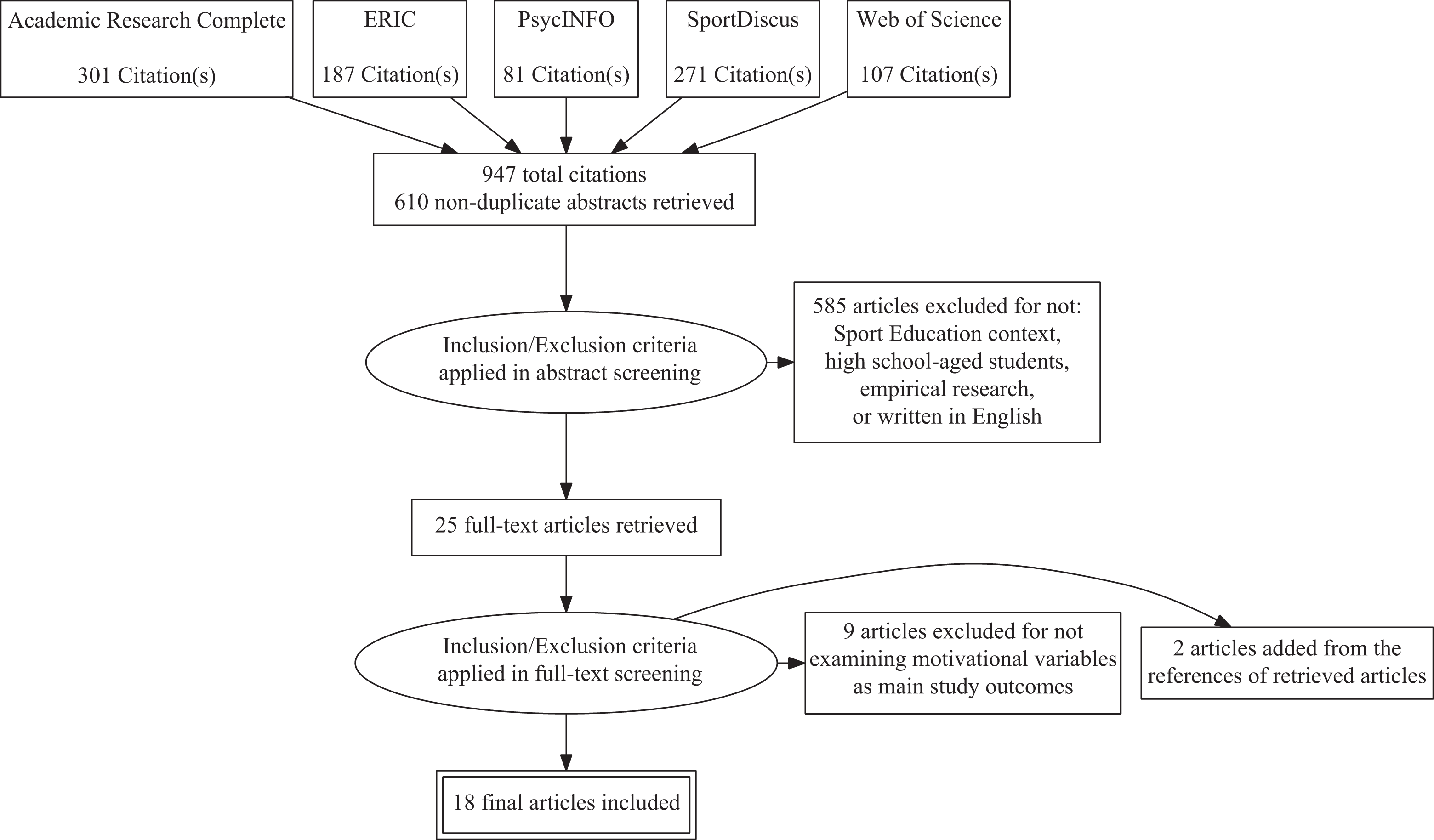
Article search and selection process.
An adapted checklist from the Strengthening the Reporting of Observational Studies in Epidemiology (STROBE) statement (Vandenbroucke et al., 2007) was used to assess the research reporting quality of the extracted articles. The higher the reporting quality of an article is, the more rigorously it can be analyzed to identify its strengths and weaknesses. Nine assessment criteria were selected with reference to the typical publication structure in this line of research: Background: description of the Sport Education program and rationales for the study. Participants: inclusion of eligibility criteria and selection of participants (e.g. student and teacher experience). Setting: description of the PE setting (e.g. data collection period and location) where Sport Education was implemented. Study design: presentation of the study design and intervention protocol (lesson content, duration, and control group selection.). Data collection: inclusion of the data sources and assessment details (validity and reliability for quantitative studies; credibility and trustworthiness for qualitative studies). Data analysis: appropriateness of statistical techniques related to the study objectives. Results: report of intervention fidelity and internal validity (effect sizes for quantitative studies; triangulation methods for qualitative studies). Discussion: discussion of results with reference to the study objectives and extant literature. Implications: interpretation of the findings for theoretical and practical implications, with consideration of the limitations.
Each criterion was rated in a dichotomous manner by both authors, with 1 representing an appropriate presentation of the criterion components, and 0 representing missing information or inappropriate presentation. The authors achieved an initial interrater consistency of 98.1%, followed by a discussion over the inconsistent ratings to come to an agreement. The ratings were then summed to a total score to indicate the overall reporting quality: (a) 0–3 for low quality; (b) 4–6 for moderate quality; and (c) 7–9 for high quality. Any low-quality articles would be eliminated from this review, but no extracted articles in this review scored lower than 4 to be eliminated. Of the 18 articles, five achieved moderate quality and 13 achieved high quality in research reporting (see Table 1).
Quality assessment summary of extracted articles.
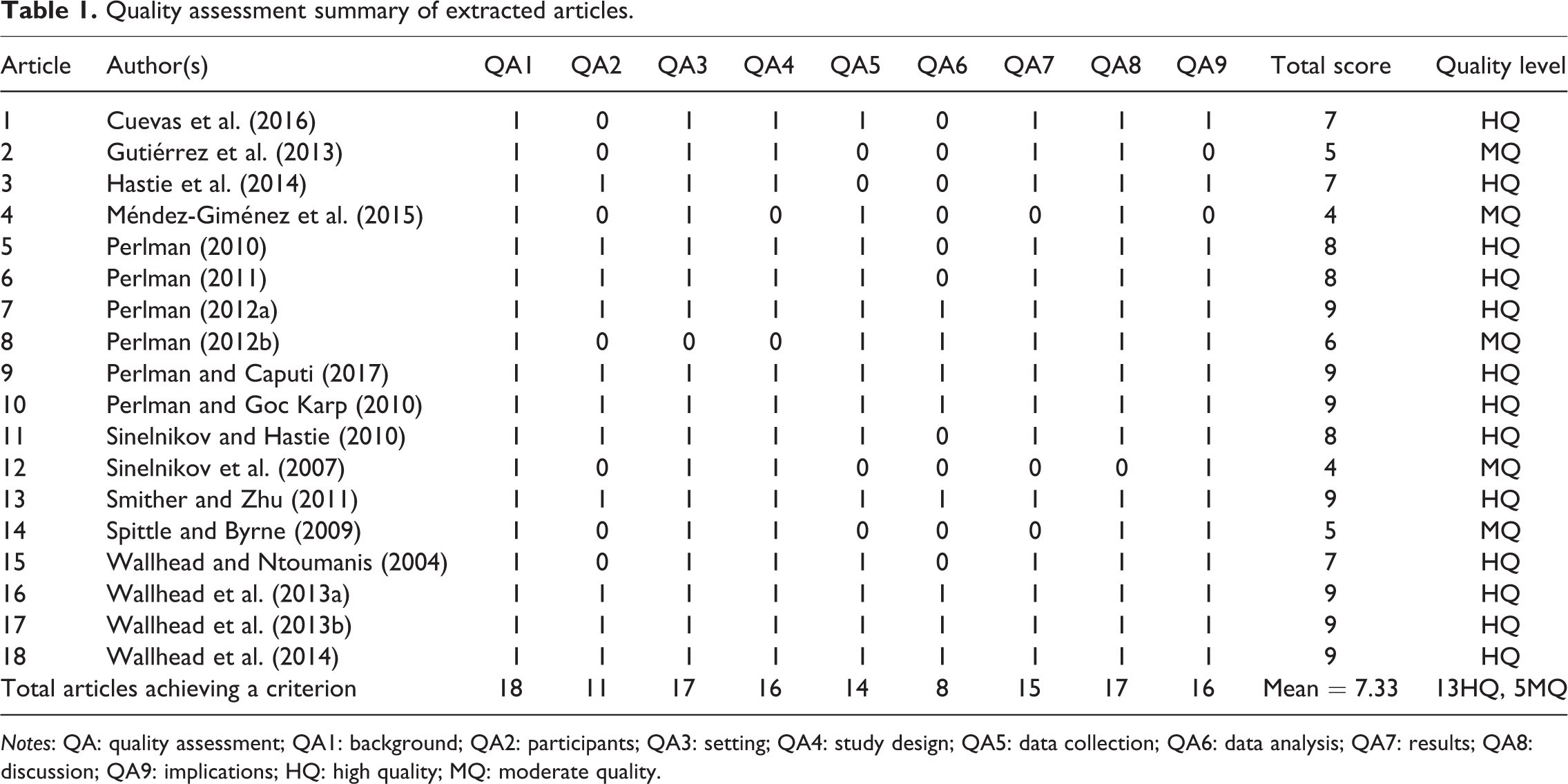
Notes: QA: quality assessment; QA1: background; QA2: participants; QA3: setting; QA4: study design; QA5: data collection; QA6: data analysis; QA7: results; QA8: discussion; QA9: implications; HQ: high quality; MQ: moderate quality.
Data extraction
Information was extracted using content analysis of the articles based on a systematic review guideline (Harris et al., 2014). Review categories were defined a priori by the first author based on previous PE curriculum review studies (Hastie et al., 2011): authors; study focus; theoretical frameworks; research design; country; participants; teacher experience; sport(s) played in Sport Education; season length; data sources; analysis; results; and effect sizes. The studies were then analyzed based on how the Sport Education curriculum was implemented (e.g. phases and sports) and what motivational frameworks were used in the interventions. All review categories and the results are listed in Tables 2 and 3.
Background, participants, setting, and design of extracted articles (n = 18).
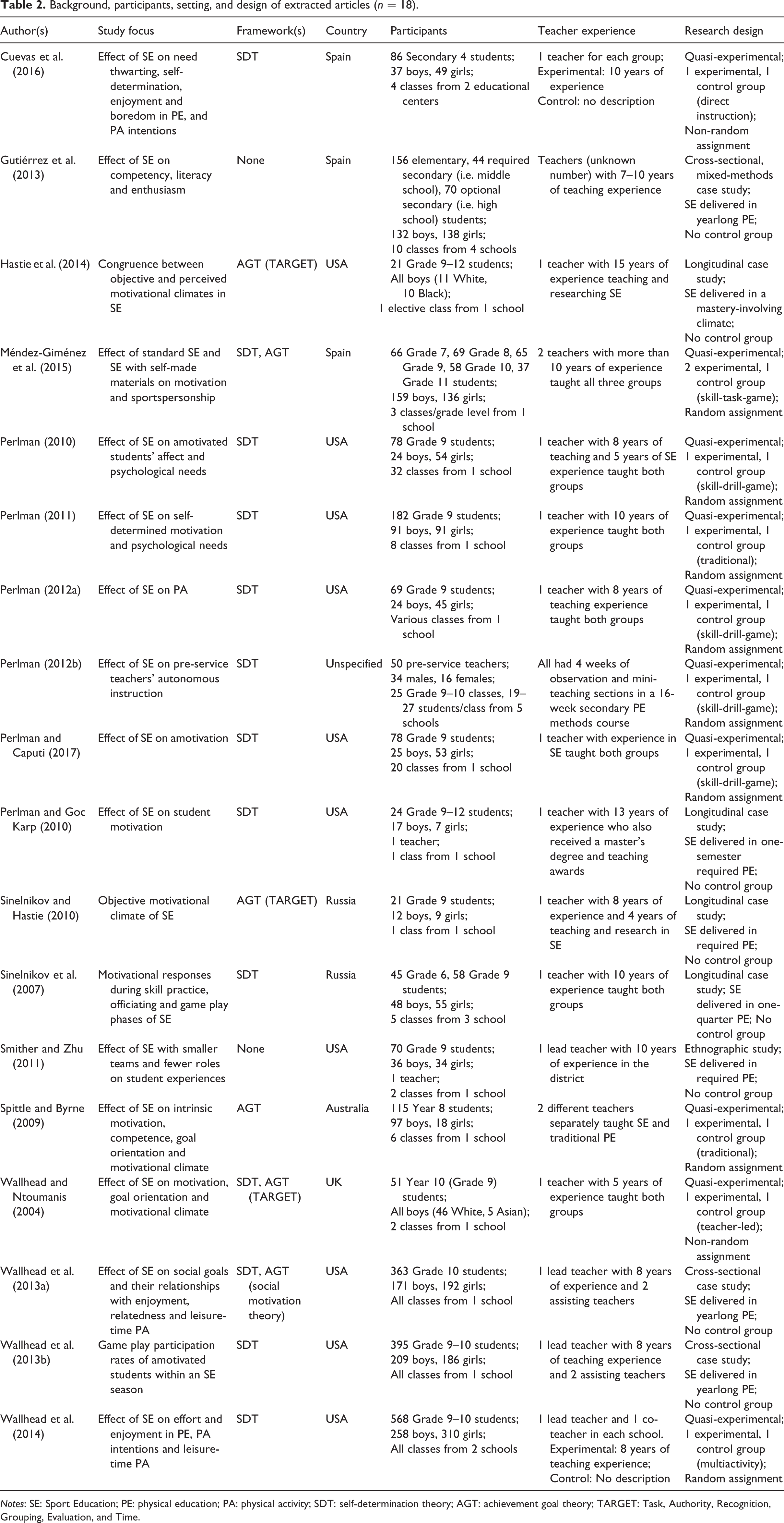
Notes: SE: Sport Education; PE: physical education; PA: physical activity; SDT: self-determination theory; AGT: achievement goal theory; TARGET: Task, Authority, Recognition, Grouping, Evaluation, and Time.
Sport Education implementation, study methods, and results of extracted articles (n = 18).
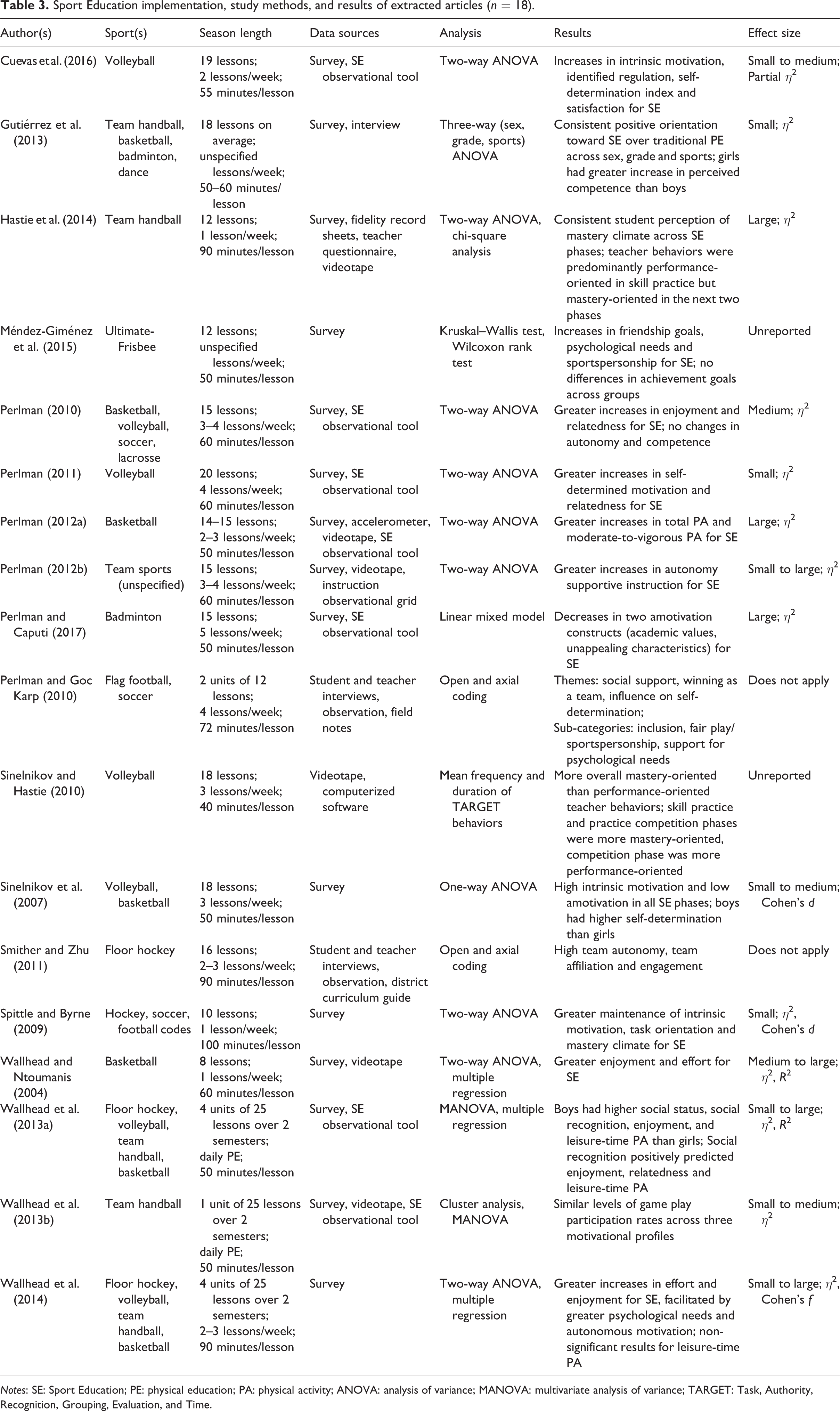
Notes: SE: Sport Education; PE: physical education; PA: physical activity; ANOVA: analysis of variance; MANOVA: multivariate analysis of variance; TARGET: Task, Authority, Recognition, Grouping, Evaluation, and Time.
Results
Overview of articles and study background
The majority of the 18 extracted studies were conducted in a Western country, with more than half in the US (10), followed by Spain (3), Russia (2), Australia (1), and the UK (1). One study did not report in which geographic area it was conducted (Perlman, 2012b). All except two studies (Gutiérrez et al., 2013; Smither and Zhu, 2011) used a theoretical framework of motivation in their investigation.
Regarding the study background and rationales, all 18 studies included descriptions of Sport Education, as well as discussed how the Sport Education programs were related to the motivational frameworks and study objectives, such as facilitating motivation and enjoyment in PE (7), social affiliation (4), PA participation (2), and other motivational outcomes (5). This assessment criterion was achieved by the greatest number of articles.
Participants and setting
Seventeen studies used students as study participants (Smither and Zhu (2011) also included teachers). One study focused only on teacher participants to examine pre-service teachers’ instruction in Sport Education (Perlman, 2012b). The total student sample was 2789 (1412 boys, 1377 girls). Ninth grade (aged 14–15) was the most frequently studied grade level, included in more than half of the studies and exclusively in seven studies (Perlman, 2010, 2011, 2012a; Perlman and Caputi, 2017; Sinelnikov and Hastie, 2010; Smither and Zhu, 2011; Wallhead and Ntoumanis, 2004). While most studies examined Sport Education in a co-educational PE context, two examined only boys in a single-sex PE context (Hastie et al., 2014; Wallhead and Ntoumanis, 2004). Moreover, only four studies described the racial/ethnic composition of the participants (Hastie et al., 2014; Perlman and Goc Karp, 2010; Smither and Zhu, 2011; Wallhead and Ntoumanis, 2004).
Seven articles did not describe the eligibility criteria and selection of participants. The majority of them included information about teacher experience in Sport Education and/or PE, but did not report student experience and how the participants were chosen. This assessment criterion was achieved by the second lowest number of articles. One plausible reason is that the STROBE statement was developed in the medical literature context rather than the educational literature context. Moreover, it is generally easier to recruit participants with specific selection criteria in a laboratory setting than a field setting such as PE, which consists of intact groups of students with diverse background and characteristics.
Regarding the PE settings, all except two studies (Perlman and Goc Karp, 2010; Sinelnikov and Hastie, 2010) included more than one class up to 32 classes (Perlman and Caputi, 2017). Thirteen studies included only one school, four included two to five schools (Perlman, 2012b), while one examined the setting of two secondary educational centers instead of regular schools (Cuevas et al., 2016).
Program design and implementation
Ten studies used a quasi-experimental design to investigate the motivational impact of a Sport Education program by including one intervention and one control group, except for Méndez-Giménez et al. (2015) who designed two different intervention groups. The term “traditional approach” was the most commonly used for the control group, although some studies had more specific descriptions such as “skill-drill-game” (Méndez-Giménez et al., 2015; Perlman, 2010, 2012a, 2012b; Perlman and Caputi, 2017) and “multiactivity” (Wallhead et al., 2014).
Eight studies used a case-study design, including three cross-sectional studies (Gutiérrez et al., 2013; Wallhead et al, 2013a, 2013b) and five longitudinal studies (Hastie et al., 2014; Perlman and Goc Karp, 2010; Sinelnikov et al., 2007; Sinelnikov and Hastie, 2010; Smither and Zhu, 2011). Three case studies implemented qualitative methodologies: (a) Smither and Zhu (2011) conducted a structured interview with one teacher and four interviews with 12 students; (b) Perlman and Goc Karp (2010) conducted weekly individual interviews with one teacher and 24 students, as well as recorded daily field notes; and (c) Gutiérrez et al. (2013) conducted focus group interviews with students from three classes beyond collecting survey data. These case studies implemented an inductive research design, whereas the other 15 applied a deductive research design to test a priori assumptions.
In terms of sport selection, half of the studies included only one sport, and the other half included two to four sports in their program. With respect to the program duration, 15 studies examined one season, while Perlman and Goc Karp (2010) investigated two seasons and Wallhead et al. (2013a, 2014) investigated four seasons in their research. The season length ranged from 8 to 25 lessons (mean = 16.38), and from three weeks to a half semester (about 6–8 weeks). The lesson frequency showed a large variability, ranging from one to five lessons per week. The lessons were mostly 50–60 min long, although some programs used a double-lesson format of 90–100 min (Hastie et al., 2014; Smither and Zhu, 2011; Spittle and Byrne, 2009; Wallhead et al., 2014).
The Sport Education programs were mostly delivered by one to three teachers who had sufficient teaching experience. All teachers had at least five years of teaching experience except the pre-service teachers studied by Perlman (2012b). However, less than half of the teachers had previous teaching experience in Sport Education. Three studies reported having additional assisting teachers with unspecified experience in Sport Education program implementation (Wallhead et al., 2013a, 2013b, 2014). Of the 10 studies that included a control group, six included both the intervention and the control groups taught by the same teacher. Four studies included the two groups taught by different teachers, yet those teachers who taught the control group were not described. Seven studies used random assignment and three used non-random assignment for the intervention or the control group.
Data collection and analysis
Various types of data collection and analysis strategies were used across the extracted articles. Survey measures were included in all quantitative studies, using the native language of the country being studied. Data collection was mostly conducted once at the beginning and once at the end of a Sport Education season. Interviews with students and/or teachers and observations were conducted in the three qualitative studies to identify themes that represent student experience and motivation in Sport Education. Two studies applied triangulation to compare interview responses with curriculum guides, field notes, and participant verification to enhance trustworthiness and credibility (Perlman and Goc Karp, 2010; Smither and Zhu, 2011).
The majority of the studies (15) included objective data such as videotapes and a benchmark checklist (Ko et al., 2006) to assess their fidelity in implementing Sport Education. Through program design and/or fidelity check, Sport Education programs in all studies attained the curriculum standard by demonstrating five key features: the teacher (a) plans the unit around a “season”; (b) promotes “affiliation”; (c) promotes “responsibility” taking among students; (d) uses “formal competition” within the program; and (e) utilizes a form of “record keeping.” Three observational studies also videotaped and analyzed teacher behavior in Sport Education programs.
Regarding data analysis, 11 studies employed analysis of variance (ANOVA), three used multiple regression, and two used multivariate analysis of variance. 2 × 2 ANOVA was the most frequent choice for assessing the main effects and interaction effects between time and intervention on student motivation in PE. Additionally, four quantitative studies investigated individual differences in motivational outcomes (Gutiérrez et al., 2013; Sinelnikov et al., 2007; Wallhead et al., 2013a, 2013b). Gender was the most frequent comparison (3), followed by grade level (2) and motivational profile (1). All quantitative studies reported effect sizes, including (partial) eta-squared (η2), Cohen’s d, and/or Cohen’s f, to interpret the practical influence of Sport Education on motivational outcomes.
Regarding qualitative analysis, all interviews were transcribed verbatim and coded into categories and subcategories. Only Perlman and Goc Karp (2010) included additional information about trustworthiness by implementing intercoder consistency, peer debriefs, and search for negative cases. This assessment criterion was achieved by the lowest number of articles, since less than half addressed both fidelity and trustworthiness within their studies.
Motivational outcomes
Because SDT was the most frequently used theoretical framework in the extracted articles, this review focused on SDT constructs including motivation and basic psychological needs in PE, while also discussing AGT constructs briefly based on the findings of six related studies. Moreover, individual and group differences, such as across gender and sports, in these motivational constructs were examined. The quantitative studies reported a combination of effect sizes in the results with varying magnitudes in the motivational outcomes: nine studies included small effect sizes, eight studies included medium effect sizes, and seven studies included large effect sizes.
Motivation/self-determination
From the results of six studies conducted in various countries, Sport Education programs consistently produced a positive effect on students’ self-determined motivation in PE when compared to traditional PE programs, including both trait motivation (Cuevas et al., 2016; Perlman, 2010, 2011; Spittle and Byrne, 2009; Wallhead and Ntoumanis, 2004) and state motivation (Sinelnikov et al., 2007). This evidence implies that Sport Education has positive motivational impacts on interest and enjoyment in PE at both global and situational levels. Worth noting is that the significant impact of Sport Education on intrinsic motivation in Spittle and Byrne’s (2009) study was indeed a maintenance effect (i.e. similar levels before and after intervention), whereas intrinsic motivation decreased in the control group using a traditional PE approach. Two studies examined students’ amotivation in PE and found positive effects of Sport Education in reducing amotivation (Perlman and Caputi, 2017; Sinelnikov et al., 2007). The only nonsignificant finding was shown in a case study focusing on pre-service teachers’ instructional behaviors (Perlman, 2012b). Although student perceptions of autonomy-supportive instruction increased across four time points of a Sport Education season, changes in student motivation were not significant. The researcher attributed this to a lack of intervention time (four weeks) for pre-service teachers to make a significant impact on student motivation.
Autonomy
Mixed evidence exists among the five studies examining student autonomy. Perlman and Goc Karp’s (2010) qualitative findings support that students achieve a higher level of autonomy through responsibility taking in Sport Education, and thus have a sense of control in PE (Siedentop, 1994). From students’ interview responses, autonomy also included choosing to play fairly and supporting classmates. This idea is further supported and referred to as “team autonomy” in another qualitative study (Smither and Zhu, 2011). The two Sport Education programs designed by Méndez-Giménez et al. (2015) had positive effects on autonomy, although the program using self-made equipment (Frisbee disc) promoted autonomy to a greater extent than the standard program did. Through decision making on equipment characteristics (e.g. color), students had additional choices in contrast to using equipment being provided.
Competence
Four studies (Gutiérrez et al., 2013; Méndez-Giménez et al., 2015; Perlman and Goc Karp, 2010; Spittle and Byrne, 2009) support a main goal of Sport Education in developing “competency” (Siedentop, 1994), because every student can improve skills and play an important role in a team. The perceived ability to do a task well in Sport Education is especially beneficial for students who may not possess good sport skills, because those students are able to accomplish various assigned roles and tasks successfully (e.g. officiating). Nevertheless, three studies found a nonsignificant effect of Sport Education on competence. The short duration of a Sport Education season was the most common interpretation of this finding (Perlman, 2011; Wallhead and Ntoumanis, 2004). Meanwhile, Perlman (2010) interpreted this nonsignificant effect as a result of competitive game play in which the amotivated students might not have felt supported in their ability belief.
Relatedness
Relatedness is the most prominent psychological need in Sport Education research on motivation. All four studies examining relatedness indicated its significant increase after a Sport Education season (Méndez-Giménez et al., 2015; Perlman, 2010, 2011; Perlman and Goc Karp, 2010), even for programs that did not promote autonomy and competence (Perlman, 2010, 2011). Amotivated students whose relatedness was enhanced through Sport Education also reported greater enjoyment in PE (Perlman, 2010). Albeit not using the term relatedness explicitly, Smither and Zhu (2011) provided quotes on how students engaged in problem-solving together through Sport Education, which in turn promoted team affiliation and previously mentioned team autonomy. Satisfaction of relatedness needs was also evidenced through their interviews with students (e.g. “As captains, we had to keep everyone involved and help get their skills up”) and teachers (e.g. “All kids can learn and each kid deserves to be treated with a certain amount of dignity”) (Smither and Zhu, 2011: 212).
Motivational climates and goal orientations
Six studies examined AGT variables, and five showed a positive effect of Sport Education on student perceptions of mastery climate and mastery/task orientation (Hastie et al., 2014; Sinelnikov and Hastie, 2010; Spittle and Byrne, 2009; Wallhead and Ntoumanis, 2004; Wallhead et al., 2013a). Additionally, Sport Education facilitated more mastery-oriented teaching behaviors based on the objective video analysis in two studies. Specifically, Sinelnikov and Hastie (2010) revealed more mastery-oriented than performance-oriented teaching behaviors in the skill practice (54% vs. 41%) and practice competition (59% vs. 32%) phases, but not in the competition phase (44% vs. 50%). On the other hand, Hastie et al. (2014) found more mastery-oriented than performance-oriented teaching behaviors in the practice competition (42% vs. 39%) and the formal competition (60% vs. 26%) phases, but not in the skill practice phase (35% vs. 45%). Sinelnikov and Hastie (2010) attributed their findings to the inherent performance focus of the competition phase, while Hastie et al. (2014) explained their results in relation to more teacher-directed tasks at the beginning of a Sport Education season. Only one study found nonsignificant differences in achievement goals between Sport Education and traditional PE programs (Méndez-Giménez et al., 2015).
Individual and class/school differences
Group differences have been examined in terms of gender, grade level, and sports played in Sport Education, although nonsignificant results in motivation, psychological needs, and motivational climates were found in most of these comparisons. When including participants from multiple schools, Gutiérrez et al. (2013) did not find any grade level differences, but girls generally reported greater increases in competence than boys did after the Sport Education program. Sinelnikov et al. (2007) showed that boys had higher situational self-determination than girls across different phases of the Sport Education season. Furthermore, Wallhead et al. (2013a) revealed that boys had higher social goals than girls after a yearlong Sport Education program. These gender differences might be attributed to the socialization processes in which males rather than females are encouraged to participate in sports as a representation of social status and recognition (Fredricks and Eccles, 2002).
Discussion and conclusions
The purpose of this systematic review was to examine the motivational processes in Sport Education programs among high school students. The findings of the 18 extracted articles revealed that Sport Education programs generally promote greater mastery climate and student perceptions of autonomy, competence, and relatedness than traditional PE curricula, which in turn facilitate students’ self-determined motivation in PE. Therefore, empirical evidence largely supports the claim that Sport Education has a positive impact on motivational outcomes in PE based on SDT and AGT.
The extracted articles collectively offer practical implications for PE teachers in implementing Sport Education. While Sport Education enhances student autonomy through personal responsibility (Siedentop, 1994), teachers can further facilitate students’ volition and sense of control by using an autonomy-supportive teaching style instead of a teacher-directed style (Wallhead, 2012). For example, teachers can offer students choices in fulfilling different team roles including players, coaches, and referees based on their previous experience and interests. Moreover, teachers may provide opportunities for students to create and/or modify game rules and make their own equipment (Méndez-Giménez et al., 2015). In regard to competence as a primary goal of Sport Education, students should be provided with opportunities to understand and execute appropriate strategies in game play. Teachers can create a mastery climate by dividing up students into equally competitive teams and emphasizing self-improvement within a season, especially during the competition phase that shows a greater performance orientation than the skill practice and practice competition phases (Sinelnikov and Hastie, 2010). Furthermore, ensuring fair play (Perlman and Goc Karp, 2010) and having a longer season with at least 12 lessons (Hastie et al., 2014; van der Mars and Tannehill, 2015) are important for developing a mastery climate and student competence.
Based on the findings of the extracted articles, relatedness is the most prominent psychological need resulting from Sport Education. This result supports social motivation theory (Allen, 2005) and previous findings in PE (Cox et al., 2009) that social affiliation, social recognition, and relatedness are key factors of motivation in PE, especially during adolescence in which peer influence increases. While cooperation is embedded in Sport Education, teachers may further promote relatedness by forming teams that last for a whole season and teaching students to provide both positive and constructive feedback to teammates (Perlman and Goc Karp, 2010). Smither and Zhu (2011) also suggested creating smaller teams with more opportunities for active learning and problem-solving in Sport Education, which could promote team affiliation. By adequately supporting the three psychological needs in Sport Education programs, teachers are likely to enhance students’ self-determined motivation and other positive motivational responses in PE.
There are some limitations that need to be addressed for future research. First, the literature is overwhelmingly found in Western PE settings. This may be due to the inclusion of only English articles in this review. More research in Eastern countries is needed to examine if Sport Education can universally enhance students’ motivational outcomes. Moreover, more than 80% of the participants in this review were in Grade 9 and Grade 10. It is imperative to conduct more research on Grade 11 and Grade 12 students (junior and senior high school), because research has demonstrated that students in this age group begin to become less physically active and adopt sedentary lifestyles (Kann et al., 2014). In addition, PA and sport participation at this age would likely carry over to adulthood (Kjønniksen et al., 2008). When participating in a Sport Education program, not only can students experience enhanced satisfaction of basic psychological needs in PE, but they are also likely to have self-determined motivation to engage in leisure-time PA and adopt a physically active lifestyle (Hagger et al., 2005; Wallhead et al., 2014), as well as to develop social skills, confidence, and behavioral persistence (Ntoumanis and Standage, 2009; Van den Berghe et al., 2014).
Whereas students have been shown to perceive the motivational impact of Sport Education as positive, teacher perceptions were not included in most of the studies in this review. Future investigations should further study teacher motivation in implementing Sport Education. It is possible that, alongside students, teachers who are in the process of designing and implementing Sport Education also have higher motivation in teaching (Perlman and Goc Karp, 2010); this increased teacher motivation is likely transferred to student motivation in PE (Taylor et al., 2008).
In terms of study design and implementation, the majority of the studies only investigated team sports in Sport Education programs. Therefore, more research is needed to study whether implementing individual sports in Sport Education leads to different outcomes from team sports. This investigation is critical, because the PA literature shows that adults engage in fitness activities and individual sports more often than team sports (Kjønniksen et al., 2008). If high school students have a positive experience engaging in individual sports during a Sport Education program, they may participate in those sports more regularly, and this participation may carry over to adulthood (Tammelin et al., 2003).
Most studies included only one teacher teaching both the intervention and the control groups, or two teachers teaching two groups separately. This difference in study design may serve as a confounding factor, because two different teachers’ motivational styles can cause differences in students’ motivational outcomes between the intervention and the control groups. Therefore, information about the teacher-created motivational climate should be examined for potential differences in the motivational impacts of Sport Education taught by different teachers. Previous PE research has shown differences in students’ preferred teacher behavior (Haerens et al., 2013), so it would be interesting to see whether this effect applies to Sport Education. Most studies compared Sport Education to an unmotivating, traditional PE approach, so the positive motivational impact of Sport Education was promising. More evidence in studying Sport Education together with other PE curriculum models, such as Outdoor Education and Cultural Studies, is warranted in order to understand how Sport Education facilitates motivational outcomes differently than other curriculum models. Such findings would aid in the curriculum decisions of teachers and school administrators across high school PE settings.
Regarding the data collection processes in Sport Education research, longer time periods should be used in future studies, especially for the post-assessment after an intervention. More follow-up data can show long-term gradual changes in motivational outcomes beyond the immediate effects of Sport Education. In addition to ample quantitative evidence, more qualitative and observational studies are needed to extend the understanding of motivational outcomes in Sport Education. For example, researchers might interview students with varied backgrounds and characteristics, especially the marginalized populations such as obese students and physically inactive adolescent girls, in order to understand how the motivational processes in Sport Education vary across marginalized groups. While current Sport Education literature has used the BEST software (Sharpe and Koperwas, 1999) to assess TARGET teaching behaviors, future research could implement SDT observational instruments to observe need-supportive (Haerens et al., 2013) and need-thwarting (Van den Berghe et al., 2013) teaching behaviors. Furthermore, collecting and analyzing objective data such as motor skills, physical fitness, and PA using accelerometers could provide further evidence on the actual behavioral changes resulting from the motivational impacts of Sport Education.
Most studies used ANOVA and multiple regressions to analyze motivational outcomes in PE. Yet, these univariate analyses should be substituted with multivariate analyses, including descriptive discriminant analysis (Barton et al., 2016), to provide a more comprehensive understanding of which motivational outcomes have stronger effects than others in Sport Education. To further enhance the quality of data analysis and the generalizability of future research findings, larger sample sizes and various units of analysis should be used. As students are nested in classes, and classes are nested in schools, these clustering factors should be examined and accounted for in order to help us understand the differential impacts of Sport Education on different types of schools and PE classes, and vice versa. Given that no studies in this review have examined these critical factors, it is recommended that future studies apply advanced statistical techniques of hierarchical linear modeling and multilevel structural equation modeling in assessing different levels of influence in Sport Education. Moreover, future qualitative research should implement and describe the methods for enhancing trustworthiness and rigor of their findings. Whereas researchers may use traditional methods including intercoder agreement for qualitative analysis, member checks, and peer debriefs (Lincoln and Guba, 1985), there are recent arguments that other methods such as member reflections, dialogues with critical friends, and clarifications of epistemology and ontology should be used instead (see Smith and McGannon, 2017).
When assessing motivational outcomes, the literature generally supports that Sport Education enhances students’ self-determined motivation, satisfaction of basic psychological needs, and mastery orientation. However, Sport Education research has yet to tap into the latest SDT and AGT constructs. Future investigations using SDT should include psychological need thwarting and need frustration in PE to examine how Sport Education may influence these negative motivational constructs (Van den Berghe et al., 2013). In addition, research using AGT should include self- and task-based goals based on the latest 3 × 2 AGT model (Elliot et al., 2011).
In conclusion, this review shows that Sport Education is aligned with SDT and AGT in promoting motivational outcomes among high school students. To enhance student motivation in PE and leisure-time PA, teachers are encouraged to implement Sport Education instead of traditional, short units in teaching various sports. Further, teachers should exhibit need-supportive behaviors within Sport Education to further facilitate satisfaction of basic psychological needs and PA enjoyment among students. In this vein, we have a chance to reverse the current trend of declines in motivation and participation in PA among adolescents by adequately implementing Sport Education in high school PE.
Footnotes
Declaration of Conflicting Interests
The author(s) declared no potential conflicts of interest with respect to the research, authorship, and/or publication of this article.
Funding
The author(s) received no financial support for the research, authorship and/or publication of this article.