







Abstract
While movement toward the education of students with disabilities in integrated physical education has now become common internationally, it is not without concerns. Notably, scholars have questioned whether instruction in integrated physical education settings provides inclusive experiences for students with disabilities. The purpose of this exploratory study was to explore certified adapted physical educators’ (CAPEs’) perspectives on barriers and facilitators to students with disabilities experiencing inclusion in integrated physical education. A sample of 99 CAPEs (74.7% female) across the United States provided valid responses to an online survey form. Guided by the established two-step coding protocol, two independent reviewers coded the responses to open-ended questions. In total, 460 barriers and 473 facilitators that fell into seven categories were identified. Among these, both teacher-related barriers and facilitators were more commonly reported than other factors, such as environmental and policy barriers/facilitators. As such, it appears that the participants placed onus on ensuring the inclusiveness of integrated physical education classes largely on the shoulders of the teachers. In addition, codes related to programmatic or equipment-related factors were underreported, suggesting that even in integrated physical education classes where adapted equipment (i.e. equipment facilitator) and personnel support (i.e. programmatic facilitator) are available, inclusive experience may not be. These findings suggest inclusiveness of integrated physical education is complex and influenced by numerous factors.
Introduction
According to the United Nations Educational, Scientific, and Cultural Organization (UNESCO; 2005), disability of any kind cannot disqualify students from general, integrated education. Integrated education, for the purposes of this article, is defined as a placement or setting in which all students, regardless of unique educational needs, are educated in the same space (Haegele, 2019). In alignment with UNESCO’s assertions, education experts suggest that more restrictive placements (i.e. self-contained education) should be phased out in favor of fully integrating all students into general education (Wilson et al., 2020). The underlying belief among these experts is that educating students with disabilities in the same contexts as those without disabilities is “the right thing to do” (Yell, 1995: 389).
Consequently, more students with disabilities are being integrated in general education contexts, with students without disabilities, than ever before (United States [US] Department of Education, 2018). For example, the US Department of Education (2018) reported that 63.1% of students with disabilities were educated in integrated settings at least 80% of the time in 2018, which is more than double (30%) the percentage in 1990. Like other educational contexts, the shift toward integrated education is also reflected in physical education (Hodge et al., 2012; Qi and Ha, 2012), which has been identified as being among the first school-based courses where students with disabilities are integrated into classes with peers without disabilities (Alquarini and Gut, 2012). As such, scholars internationally suggest that the majority of students with disabilities are educated in integrated physical education classes (Coates, 2012; Heck and Block, 2020).
While movement toward the education of students with disabilities in integrated physical education has now become common internationally, it is not without concerns. Notably, and similar to other educational contexts (Shah, 2007), physical education scholars have raised concerns about the discriminatory nature of integrated physical education classes (Fitzgerald and Kirk, 2009; Haegele et al., 2020; Petrie et al., 2018), which can fail to facilitate full access to the curriculum or resources for individuals with disabilities. This may, in part, be due to physical educators celebrating the existence of students with disabilities in a general education space as being a success, rather than focusing on creating an environment where those students achieve success or enjoy their experience (Fitzgerald, 2009). The discriminatory nature of physical education may also be highlighted in instances where, as Kirk (2010) suggests, teachers are resistant to change and unwilling to adapt or rethink the nature of activities to facilitate access to their classes. For example, and as described by Petrie and colleagues (2018), physical education classes that are structured around competitive sports and games (that are not adapted) may communicate specific ideals about what abilities and bodies are valuable within physical education contexts (Azzarito, 2009; Evans, 2004), and those who do not match up with those ideals, who may include those with disabilities, are removed, limited, or discouraged within activities (Fitzgerald and Kirk, 2009; Haegele and Zhu, 2017). In addition, concerns related to the bullying and social isolation of students with disabilities, which may be informed by teachers’ implicit communication about the inabilities of those with disabilities in integrated settings (Haegele and Zhu, 2017), have emerged in the literature (Coates and Vickerman, 2008; Fitzgerald, 2005; Healy et al., 2013). Thus, although students are positioned in the same physical spaces (e.g. integrated physical education classes) as those without disabilities, they may experience phenomena in those spaces quite differently (Wilhelmsen et al., 2019). These types of experiences are critical to informing students’ understanding of their abilities and bodies as being incapable or undesirable in physical education settings (Azzarito, 2009), and can lead to self-removal from future physical education and leisure-time activity opportunities later in life (Haegele and Zhu, 2017).
Given the challenges associated with integrated education, it is unsurprising that scholars have questioned whether instruction in integrated physical education settings provides inclusive experiences for students with disabilities (Block, 1999; Fitzgerald, 2005; Haegele, 2019; Lavay and Depape, 1987; Wilson et al., 2020). Inclusion is a largely contested concept that has been described as a “semantic chameleon” (Liasidou, 2012: 5) because of the multiple meanings associated with the term depending on the context in which it is used (Petrie et al., 2018). Indeed, the meaning of inclusion has been constructed in a variety of ways in the physical education literature, with some representations including a view of equal opportunity, a placement in an educational setting, a focus on social justice, or an emphasis on an individual’s sense of belonging and acceptance (Fitzgerald and Jobling, 2009; Spencer-Cavaliere et al., 2017). Because of the multiple meanings of the term inclusion, and in alignment with recommendations from Graham and Slee (2008) to provide clarity on the use of the term inclusion to flush out meaning, it was critical for us to be explicit about how we used the term in this study. We conceptually framed inclusion as a subjective experience of belonging, acceptance, and value understood from the person who is being “included” (Spencer-Cavaliere and Watkinson, 2010), which is consistent with the hallmark of inclusion as described by Stainback and Stainback (1996). This interpretation of inclusion supports Haegele’s (2019) distinction between what it means for students with disabilities to be integrated into a general education setting and what it means to experience inclusion within that setting, and allowed us to discuss with physical educators what they believed could prevent or enable students with disabilities from enjoying these subjective experiences in their classes.
According to Makopoulou and colleagues (2019), “whilst inclusion appears to form the ethical substrate of educational rhetoric, there are concerns that lip-service is being paid to the notion at the level of educational policy and practice” (p. 1). As such, there has been considerable debate about whether anything more than superficial cosmetic adjustments, in an attempt to communicate the appearance of successful inclusion, have been made to educational enterprises, including in physical education (Fitzgerald and Stride, 2012; Slee, 2011). In this way, it appears that teachers may be “using inclusive education as a means for explaining and protecting the status quo rather than as a means of developing more radical and democratic forms of education” (Atkins, 2016: 8). Even at times when policies and practices are developed and used to promote inclusion, forms of exclusion where teachers unintentionally reinforce inequalities can occur (Atkins, 2016; Slee and Allan, 2001). In such settings, it seems apparent that a sense of belonging, acceptance, and value is likely not fostered among students with disabilities, thus challenging the notion that inclusion is successful (Atkins, 2016). Consistent with assertions of Penney and colleagues (2018), who suggest that addressing inclusion “remains a notable challenge” for the physical education profession internationally (p. 2), we believe that scholars have a moral responsibility to explore and problematize concerns related to the inclusiveness of integrated physical education classes to help improve these experiences for students with disabilities. In this exploratory study, we focus our attention on examining what factors teachers view as acting as barriers and facilitators to students with disabilities feeling included during integrated physical education classes.
Barriers and facilitators to “feeling included” in physical education
To date, little research has specifically focused on examining barriers and facilitators to inclusive experiences in physical education. Rather, most research has focused on barriers and facilitators of children with disabilities’ access to activities, primarily in outside of school physical activity contexts (Shields and Synnot, 2014, 2016; Shields et al., 2012; Stanish et al., 2015). This line of inquiry, which was reviewed by Shields and colleagues (2012), has identified that a variety of personal (e.g. child’s fear or lack of confidence), social (e.g. lack of parental support, poor societal attitudes), environmental (e.g. inaccessible facilities), and programmatic (e.g. poor staff attitudes) barriers restrict access to participation for youth with disabilities (Shields and Synnot, 2014, 2016; Stanish et al., 2015). Interestingly, barriers identified by different groups of participants (i.e. children with disabilities, parents, and organizations) are largely similar, with different points of emphasis between groups (Shields and Synnot, 2016). That is, children with disabilities more commonly reported personal or peer-related barriers, whereas parents placed greater emphasis on social and programmatic barriers. Notably, while research examining barriers to accessing physical activity opportunities is available, few studies have explored facilitators (Shields et al., 2012).
Whereas barriers and facilitators to accessing physical activity in contexts outside of school is well represented in the literature, less is known about accessing activities during physical education. To the knowledge of the authors, only two studies (Haegele et al., 2018; Lieberman et al., 2002) have specifically focused on barriers and facilitators in integrated physical education. Lieberman and colleagues (2002) focused specifically on perceived barriers to teaching students with visual impairments in physical education, and identified professional preparation, equipment, and programming as commonly described barriers among physical educators. More recently, Haegele and colleagues (2018) conducted an exploratory study examining physical educators’ perceived barriers and facilitators to participation in physical education for students with disabilities. This study identified teacher knowledge and attitudes, as well as a lack of adapted equipment, and a shortage of trained personnel, as primary barriers to physical education participation among youth with disabilities. Conversely, the availability of adapted equipment, instructional quality, personnel support, and favorable teacher attitudes were commonly reported facilitators (Haegele et al., 2018).
The current study extends the extant literature in several ways. First, this study moves beyond asking professionals to report on what barriers or facilitators contribute to students with disabilities’ ability to access the physical education environment (Haegele et al., 2018; Lieberman et al., 2002), rather focusing what they believe enables and deters students with disabilities from experiencing inclusion in integrated physical education classes. This is a notable distinction, as contemporary research has acknowledged that gaining access to the physical space by itself is not sufficient for fostering feelings of inclusion without other social and pedagogical considerations (Fitzgerald, 2005; Wilhemsen et al., 2019). It is important to note, however, that the scope of the current study does not allow for us to make claims that the barriers and facilitators that emerge here will guarantee inclusive feelings for those with disabilities, as factors are not being elucidated from the viewpoints of students (Fitzgerald, 2005; Haegele et al., 2020). Rather, we are seeking to understand what teachers believe enable or prevent inclusive experiences, with the concept of inclusion explicitly defined for the teachers. Second, this study focuses specifically on certified adapted physical educators (CAPEs), who likely have more disability-related training and may experience their work responsibilities (e.g. teaching students with disabilities) differently than their generalist counterparts (Wilson et al., 2017). As such, the purpose of this study was to explore CAPEs’ perspectives on barriers and facilitators to students with disabilities experiencing inclusion in integrated physical education.
Methods
Data collection and instrumentation
Data collection commenced after approval by the research ethics board at the lead author’s institution. Data were collected electronically, utilizing the online survey platform, Qualtrics. CAPEs, who resided in the US and were working as adapted physical educators in K-12 settings at the time of survey completion, were recruited through direct emails to the CAPE listserv housed by the Adapted Physical Education National Standards (APENS) committee. The recruitment email explained the purpose, methods, and estimated time commitment for participating in the study, and that participation was completely voluntary. Those who were interested in participating were instructed to follow a URL link to an online survey. In total, 746 individuals received the direct emails, of which 187 entered the survey. Of those, 38 noted that they were no longer teaching adapted physical education, and 17 were no longer CAPEs. These 55 individuals were subsequently removed from the data set. Of the remaining 132, 99 CAPEs completed each of the demographic questions and identified at least one barrier and one facilitator, and were included in the final sample.
A 10-item questionnaire was the primary source of data for this study. The first eight questions collected demographic information, including questions focused on participants’ (a) gender, (b) age, (c) race/ethnicity, (d) geographic region, (e) current employment status, (f) current CAPE status, (g) years of teaching experience, and (h) teaching context. The final two questions, adapted from those developed by Shields and Synnot (2014), asked participants to identify five factors that enabled (facilitators) and five factors that blocked/prevented (barriers) students with disabilities from experiencing inclusion (i.e. sense of belonging, acceptance, and value) in integrated physical education classes. Prior to these final two questions, a guiding statement, which conceptualized inclusion in alignment with assertions made by Stainback and Stainback (1996) and presented integration and inclusion as distinct concepts (Haegele, 2019; Wilson et al., 2020), was presented. This statement read: The following questions are intended to explore adapted physical educators’ views toward factors that influence the inclusion of students with disabilities in integrated physical education classes. For the purpose of this question, successful inclusion refers to environments where students with disabilities enjoy a sense of belonging, acceptance, and value among their peers, whereas integrated physical education more simply refers to the setting (whether inclusive or not) in which students with and without disabilities receive their education together. Thus, the questions focus on factors that influence the ability of adapted physical educators/physical educators to provide an environment where students with disabilities enjoy a sense of belonging, acceptance, and value among their peers.
Data coding and analysis
A two-step data coding protocol, suggested by Strauss and Corbin (1998) and used by Shields and Synnot (2014) and Haegele and colleagues (2018), was adopted in this study. According to Strauss and Corbin, this coding approach is “especially useful when the researcher already has several categories and wants to code specifically in relation to them” (p. 120). First, for each barrier and facilitator listed by the participants, whether it included a few words or a sentence, the coders (the fourth and fifth authors) were asked to grasp the major idea of the phrase and write a code (i.e. a short name) for each response. Second, codes were reassembled and grouped into broader categories to reflect barriers and facilitators. Codes were grouped under seven categories previously identified by Haegele and colleagues (2018). These categories included: (a) personal (relating to personal, physical, or psychological factors of children with disabilities), (b) social (relating to people the child would come in contact with), (c) environmental (relating to structural elements including facilities), (d) programme (relating to programmatic issues such as cost, funding, and staff availability), (e) policy (relating to guidelines, regulations, and laws), (f) teacher (relating to the attitudes, decisions, and abilities of the instructor), and (g) equipment (relating to available physical activity equipment). An example of the coding sequence, from response to code to category, is displayed in Table 1. Codes and categories were only finalized when both coders agreed on them. When disagreements between coders emerged, a third coder (the first author) was brought in to read the response and assign it to one of the two codes or categories identified by the two coders. To examine inter-rater agreement on the coding process, Cohen’s κ was computed, and κ ≥ 0.60 was considered acceptable with at least moderate level of agreement (McHugh, 2012). The inter-rater agreement was moderate among the two independent coders, with Cohen’s κ = 0.74 ± 0.02 for barriers, and κ = 0.60 ± 0.03 for facilitators. Following the coding procedures, we analyzed the data using frequency counts for barrier and facilitator codes and categories.
Response, code, and category example.

Results
Of the 99 participants, 74 (74.7%) were female, 24 (24.2%) were male, and one participant (1.0%) preferred not to identify their gender. Regarding race/ethnicity, 91 (91.9%) participants identified as being Caucasian (Non-Hispanic), four (4%) as Hispanic, three (3%) as African American, and one (1%) as multiple races/ethnicities. Participants’ ages ranged from 24 to 66 years (M = 42.18, SD = 12.24) and years of teaching experience ranged from 1 to 35 years (M = 12.26, SD = 9.89). Most of the participants taught across all K-12 contexts (n = 70), with fewer teaching specifically in elementary (n = 12), middle (n = 6), high (n = 6), or K-8 settings (n = 5). The participants were geographically dispersed, with 40 (40.4%) residing in the southern US, 28 (28.3%) in the western US, 17 (17.2%) in the northeastern US, and 14 (14.1%) in the midwestern US.
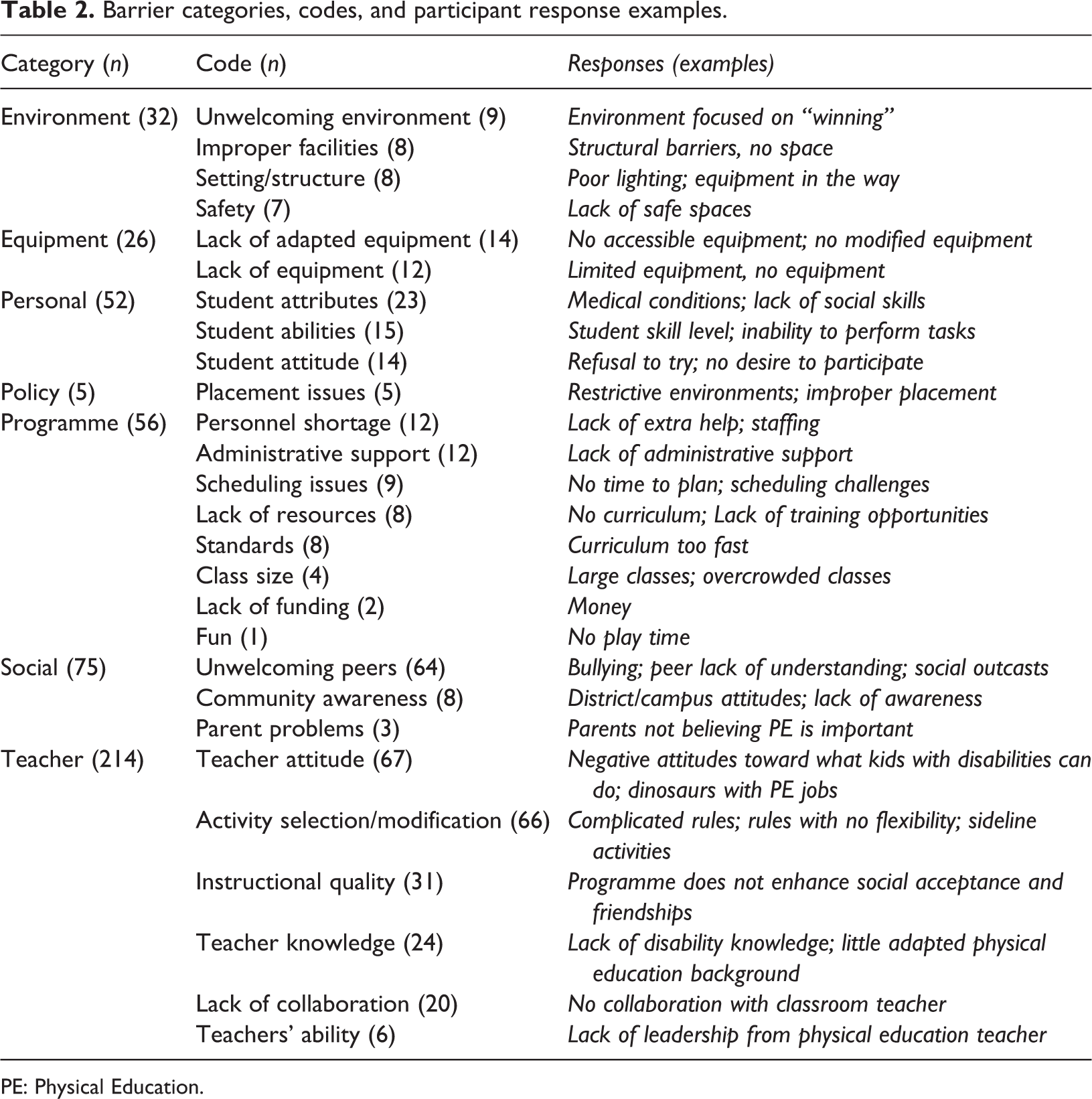
In total, the participants listed 460 barriers (4.65 per participant) and 473 facilitators (4.78 per participant), given the request was to list five barriers and facilitators. The frequency of each barrier and facilitator response category and code is displayed in Tables 2 and 3, respectively. As shown in Table 2, teacher-related barriers were the most commonly reported (n = 214, 47%). Of those, most teacher-related barriers related to teacher attitude (n = 67), activity selection/modification (n = 66), and instructional quality (n = 24). Social barriers were the second most reported category (n = 75), with unwelcoming peers accounting for the majority of codes in that category (n = 64 of 75). Policy-related barriers were the least commonly reported, which included only those related to placement issues (n = 5).
Barrier categories, codes, and participant response examples.
PE: Physical Education.
Facilitator categories, codes, and participant response examples.
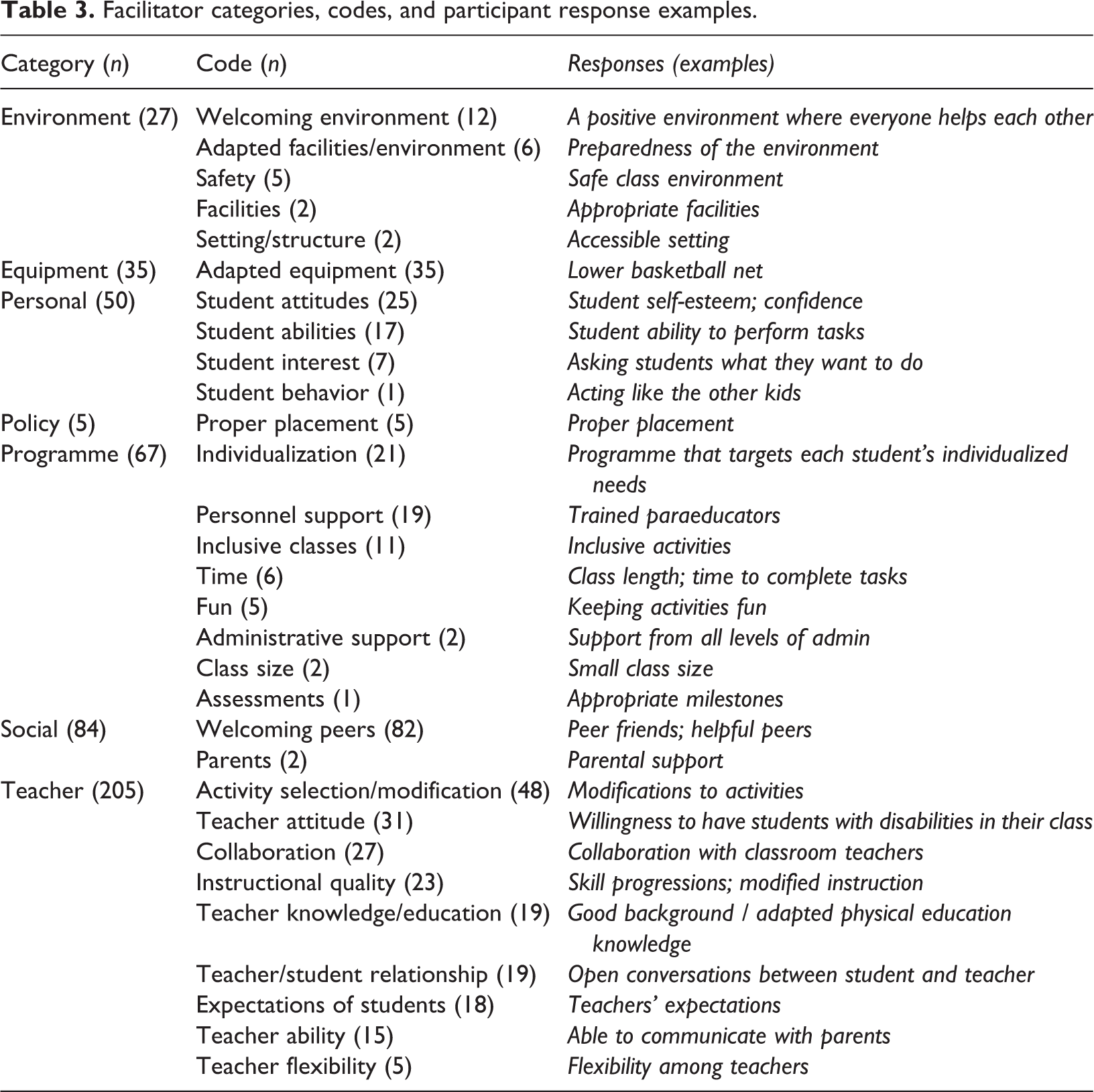
Like barriers, the most commonly reported facilitators were related to the teacher (n = 205; 43%). Of those, 48 were coded as activity selection/modification, 31 as teacher attitude, 27 as collaboration, and 23 as instructional quality. Similar again to barriers, social facilitators (n = 84; 18%) were the second most reported, with welcoming peers (n = 82; 17%) being the most commonly reported facilitator code overall. The programme-related category was the third most reported (n = 67; 14%), with individualization (n = 21) and personnel support (n = 19) reported as common codes. Like the barriers, policy-related facilitators were the least commonly reported, which included only five placement-related codes.
Discussion
The purpose of this study was to explore CAPEs’ perspectives on barriers and facilitators to students with disabilities experiencing inclusion in integrated physical education. Generally, and similar to prior research examining barriers and facilitators to accessing physical activity among people with disabilities from the perspectives of parents, children, and service providers (Haegele et al., 2018; Shields and Synnot, 2014; Shields et al., 2012), the CAPEs expressed a range of responses across the seven coding categories. The wide range of reporting in this study supports assertions that issues pertaining to the inclusiveness of integrated physical education are complex and influenced by numerous factors (Haegele, 2019; Penney et al., 2018; Spencer-Cavaliere and Watkinson, 2010). In addition, and consistent with findings from Shields and colleagues (2012), the perceived barriers and facilitators reported by the CAPEs were largely based on the same codes and categories, where its value as an enabler or preventer was based on whether that variable was either positively or negatively worded. For example, while welcoming peers was the most commonly reported facilitator among participants (n = 82), unwelcoming peers was also a highly reported barrier (n = 64), thus supporting the interrelated nature of the reported barriers and facilitators.
The most commonly reported barriers and facilitators reported by the participants in this study centralized on issues related to teachers, such as teachers’ attitudes, knowledge, collaboration, activity selection/modification, and instructional quality. Thus, it appears that CAPEs placed onus on ensuring the inclusiveness of integrated physical education classes largely on the shoulders of the teachers. This finding is largely consistent with literature examining integrated physical education classes from the perspectives of individuals with disabilities, who tend to report that physical educators’ attitudes and behaviors play a central role in constructing their perspectives toward their experiences in physical education (Coates and Vickerman, 2010; Fitzgerald, 2005; Haegele and Zhu, 2017). Interestingly, while less commonly reported in prior barriers and facilitators research (Haegele et al., 2018), teacher attitude as well as activity selection and modification codes were among the most commonly reported teacher barriers and facilitators by CAPEs in this study. This finding supports prior assertions by Haegele and colleagues (2020), who noted that physical educators’ expectations for individuals with disabilities to “fit in” to pre-existing curricula can prevent those with disabilities from engaging in class activities. According to Wilhelmsen and colleagues (2019), rather than excluding children who do not “fit in,” it is important for physical educators to explore how physical education can be altered in response to the needs and abilities of students themselves. These alterations must step beyond simple or superficial cosmetic adjustments that “check a box” to communicate the appearance of successful inclusion (Fitzgerald and Stride, 2012; Slee, 2011), and are likely to benefit from reflective and collaborative practices which take into consideration the viewpoints of those with disabilities (Vickerman and Maher, 2018).
The importance of teachers’ attitudes and behaviors (e.g. activity selection and modification) as a barrier and facilitator of providing inclusive experiences in integrated classes (Block and Obrusnikova, 2007; Morley et al., 2005) warrants the continued pursuit of training teachers to understand and implement practices that can facilitate experiences of inclusion (Coates, 2012; Taliaferro and Harris, 2014). We, again, caution against reducing inclusion to a simplistic set of strategies or inspection criteria (Atkins, 2016), which proliferate physical education texts and practice-based articles. By ascribing to these “inclusive strategies” teachers are then encouraged to make simple, observable changes, which while well intended, may unintentionally contribute to forms of exclusion and reinforce inequities (Slee and Allan, 2001). Instances like these have emerged in research examining integrated physical education from the viewpoints of those with disabilities, who report that although teachers appear to have good intentions, obvious and explicit modifications to activities can highlight inabilities of those with disabilities and contribute to social ostracization (Haegele et al., 2020). This may be most prevalent in physical education classes, where the body is central to experiences, and those with bodies who navigate physical space differently can be viewed as incapable or unwanted (Azzarito, 2009).
Rather than perpetuating the use of “inclusive strategies,” we suggest that a holistic approach to thinking about inclusion, such as the “eight P” inclusive physical education framework presented by Vickerman and Maher (2017, 2018), be introduced to teachers in an attempt to consider inclusion more broadly. Importantly, adopting a framework like this may help CAPEs and other physical educators engage in deeper reflection about what inclusion is and how instruction can be presented, rather than haphazardly adopting and implementing strategies labeled to be “inclusive,” and perhaps perpetuating forms of discrimination or exclusion (Atkins, 2016; Haegele, 2019). Given the way in which inclusion was conceptually framed within this study, as a subjective experience of those being included (Stainback and Stainback, 1996), it appears the element of partnership, which notes the importance of teachers recognizing that inclusion needs to take place within a context of consultation with students themselves (Vickerman and Maher, 2017), may be particularly salient. As such, we suggest that teachers are trained in strategies to actively communicate with students with and without disabilities to develop dynamic, collaborative curricula that meet all students’ needs.
Given this study’s focus on the central tenets of Stainback and Stainback’s (1996) interpretation of inclusion as sense of belonging, acceptance, and value, it is unsurprising that social barriers and facilitators, and more specifically welcoming and unwelcoming peers, were commonly reported by CAPEs. The assertion that welcoming peers (i.e. the most commonly reported facilitator; n = 82) can act as a facilitator of inclusion is well aligned with assumptions that social interactions and the development of friendships between students with and without disabilities in integrated contexts is a hallmark of inclusive education (Seymour et al., 2009). These types of positive, welcoming interactions have been conceptualized in the literature as providing support, being consensual, and as caring (Goodwin, 2001). On the other hand, unwelcoming peers (n = 64) was among the most common barriers reported by CAPEs in this study. This is also unsurprising, as unwelcoming interactions with peers, such as bullying tactics (e.g. name-calling, physical violence) and social isolation have emerged in research examining integrated physical education experiences from the viewpoints of individuals with disabilities (Goodwin and Watkinson, 2000; Haegele and Zhu, 2017; Healy et al., 2013). Although welcoming or unwelcoming interactions with peers was considered a social barrier within this particular study, it should be noted that these interactions may also be largely influenced by the behaviors of physical educators and CAPEs themselves. For example, in reference to generalists, Haegele (2019) noted that negative peer interactions “can be perpetuated by physical education teachers who ascribe to exclusionary practices or treat students with disabilities differently based on their disability status” (p. 390). However, among the CAPEs in this study, it is promising that they recognize the importance of welcoming or unwelcoming peers in enabling or preventing inclusive experiences for those with disabilities. This perspective may have been informed by the participants’ underlying dispositions/values and educational experiences, as recent evidence has shown that CAPEs may enter the field with more innovative teaching orientations than their generalist counterparts (Park and Curtner-Smith, 2018; Wilson and Richards, 2019). To this end, it is important to consider the role of the teacher in establishing and supporting these peer relationships.
Several categories of barriers and facilitators, including programmatic and equipment categories, that are commonly reported in prior literature (Haegele et al., 2018; Shields and Synnot, 2014), appeared to be reported less by the CAPEs in the current study. That is, programmatic codes made up only 12–14% and equipment codes made up just 6–7% of barriers and facilitators reported, respectively. While these codes may have utility in preventing or enabling individuals with disabilities to access physical activity and physical education activities (Haegele et al., 2018; Shields et al., 2012), it appears that the participants of this study did not believe that these factors are as critical as others (i.e. teacher or social factors) to ensuring the inclusiveness of these activities. Thus, it is reasonable to suggest here that even in integrated physical education classes where adapted equipment (i.e. equipment facilitator) or personnel support (i.e. programmatic facilitator) are available, inclusive experiences may not be available.
This is unsurprising, as the introduction of equipment and support personnel (i.e. teacher aides) may contribute to the ostracization of those with disabilities by communicating perceptions of inability (Evans, 2004; Fitzgerald and Kirk, 2009). That is, even though those with disabilities are in the same physical space as their peers, the reliance on additional support to engage in activities can help demonstrate that their abilities and bodies do not match up with communicated ideals of what is desired in the physical education setting (Petrie et al., 2018). This assertion is partially supported by findings by Haegele and colleagues (2019), where individuals with visual impairments reported receiving unwanted and unwarranted social attention when they received additional personnel support, which negatively informed their perspectives on the inclusiveness of their experiences. As such, perhaps the behaviors of individuals in the environment, particularly teachers and peers, are more powerful in preventing or enabling inclusive experiences for individuals with disabilities in integrated physical education classes than the resources that are available within those settings.
Limitations
Several limitations are evident in this study. First, this study utilized an exploratory data collection methodology (Shields and Synnot, 2014), rather than in-depth interviews, to understand barriers and facilitators. This may be viewed as a limitation of the study design, as little depth to responses was obtained. However, this methodology was adopted as it allowed the researchers to identify a broad range of potential barriers and facilitators that teachers perceive can influence the inclusiveness of integrated physical education experiences. Second, this study utilized broad terminology when describing “students with disabilities” and did not focus on any specific disability. Because of this, findings may not be generalizable to all individuals with each specific type of disability. Third, the survey completion rate (746 individuals received the invitation email, 187 entered the survey, and 99 completed the survey) may be viewed as a limitation. It should be noted, though, that the APENS CAPE listserv is not routinely updated with current email addresses, which may influence the number of completed responses among those who received the invitation email. Finally, as feelings of inclusion are subjective experiences that must be excavated from within, and because the study of inclusion should not be reduced to a set of observable criteria (Atkins, 2016; Stainback and Stainback, 1996), it is important to note that these barriers and facilitators reported in this study do not guarantee feelings of inclusion among students with disabilities. Rather, the reported barriers and facilitators are more simply a representation of what teachers believe can enable or prevent feelings associated with inclusion among children with disabilities. It is critically important that research consumers keep this distinction in mind when interpreting the results of this study. That is, this study asked teachers to report on what they believed facilitated or prevented students from experiencing these feelings associated with inclusion, which should not be conflated with students’ views about their personal, subjective experiences. Future research may adopt similar methodologies with students with disabilities as participants to gain further understanding of what factors enable and prevent feelings of acceptance, value, and belonging (Stainback and Stainback, 1996) within integrated physical education contexts.
Conclusions
There is limited research on the barriers and facilitators to inclusion in integrated physical education. While a substantial research body has examined teachers’ attitudes toward teaching students with disabilities in integrated settings (Block and Obrusnikova, 2007; Qi and Ha, 2012; Wilhelmsen and Sorenson, 2017), this study, to our knowledge, is the only such investigation that has asked CAPEs to think about and report factors that they believe can enable or prevent students with disabilities from feeling included within integrated physical education classes. CAPEs reported a wide range of barriers and facilitators that are similar to and different from those reported in previous research, highlighting the significance of conducting the present research pertaining to the inclusion experiences of integrated physical education. While these concepts of integration and inclusion may sometimes operate in parallel, given this study’s findings and the larger body of empirical evidence, we would caution against arbitrarily conflating the two terms. Instead, the assumption that “inclusion is working” should be scrutinized as we seek greater understanding of what does and does not foster feelings of inclusion among students with disabilities.
Footnotes
Declaration of conflicting interests
The author(s) declared no potential conflicts of interest with respect to the research, authorship, and/or publication of this article.
Funding
The author(s) disclosed receipt of the following financial support for the research, authorship, and/or publication of this article: The development of this manuscript was partially supported by a grant from the US Department of Education (H325H190001). However, the contents do not necessarily represent the policy of the US Department of Education, and you should not assume endorsement by the Federal Government.
