







Abstract
The purpose of this study was to explore the co-construction of an action research (AR) experience between a teacher educator and pre-service teachers (PSTs). Participants were six PSTs and a teacher educator who supervised their school placement. The teacher educator introduced the PSTs to, and facilitated them through, the AR process while creating an environment in which participation, co-construction, and shared investment were key elements across the group. A critical friend assisted the teacher educator to facilitate the PSTs’ experience of AR. Data included (i) audio-taped weekly discussions between the teacher educator and PSTs, (ii) the teacher educator's field notes, (iii) audio-recorded weekly discussions between the teacher educator and critical friend, and (iv) semi-structured post-interviews with PSTs and the teacher educator. Data were analysed qualitatively using the constant comparison approach. Results indicated that the three crucial aspects of a co-constructed AR experience were: centrality of the critical friend, the teacher educator sharing her experiences of AR with PSTs, and creating of a collaborative and supportive learning environment across AR cycles. In conclusion, this study indicates that there needs to be a shift in the understanding of how best to support a shared learning space where we can discuss and encourage each other in co-constructive ways.
Keywords
Introduction
Action research (AR) is recognized as one way to investigate and improve teaching and learning (Kirk, 1986; McNiff, 2002; Tinning, 1992; Ulvik and Riese, 2015), aiming to improve teachers’ practices and, consequently, school students’ learning (Casey and Dyson, 2010; Farias et al., 2018). AR is intended to promote the personal and professional growth of practitioners as they construct and generate knowledge about their own situations (McNiff, 2002). Ulvik and Riese (2015) consider AR as a tool for professional development when sufficient time and space are provided to make it possible for deep reflection. While much of the teacher education literature explores in-service teachers’ AR, minimal teacher education research examines pre-service teachers’ (PSTs’) engagement in AR as well as the relationship between the PST and teacher educator in supporting a positive disposition to AR (Faikhamta and Clarke, 2015; Ulvik and Riese, 2015).
AR and PSTs
Engaging in research during teacher education can be valuable in helping PSTs to understand school culture, translate theory into practice (Crawford-Garrett et al., 2015), develop their teaching identity (Parkison, 2009), foster a deeper sense of self-efficacy (Stevens and Kitchen, 2004), modify instruction to meet students’ needs and encourage them to participate in different learning communities (Dobber et al., 2012; Moore and Gayle, 2010). In the literature, there is a wide range of teacher-research inquiry modes including AR, participatory AR, self-study, lesson study, and practitioner research (Campbell and McNamara, 2009; Orland-Barak, 2009). There is a body of research in physical education that uses participatory AR (Goodyear et al., 2013; Luguetti et al., 2019) and self-study (Ní Chróinín et al., 2015; O’Sullivan, 2014; Ovens and Fletcher, 2014). Each of these teacher-research inquiry modes is based on creating ways of knowing and generating evidence-based practice, acknowledging that each is grounded in different ontological, epistemological, and methodological orientations (Campbell and McNamara, 2009; Orland-Barak, 2009). However, AR provides valuable opportunities for PSTs to inquire into and improve their practice, their understanding of their practice, and the situation in which their practice takes place (Amir et al., 2017; Mena-Marcos et al., 2013). Furthermore, AR encourages PSTs to become reflective practitioners. The AR process allows PSTs to experience contextual shifts and in-depth explorations in their practices, positioning them as knowledgeable practitioners and agentic actors able to design, reflect on and justify specific practices in various contexts (Crawford-Garrett et al., 2015). Much has been written about the need for PSTs to be more reflective about their practice through AR in physical education (Kirk, 1995).
AR and facilitation
There is evidence from many AR initiatives that facilitation plays a key role in supporting teachers and PSTs as both researchers and reflective practitioners (Anderson and Cook, 2020; Harvey et al., 2002; Thomas, 2008). Current research examining facilitation processes in AR tends to focus on the individual researcher's experience as a facilitator. Avgitidou (2009) conveys the role of facilitator in AR as ‘having a flexible role as facilitator, the avoidance of leading teachers’ actions and pursuing a trusting relationship among the participants in action research’ (p. 585). Anderson and Cook (2020) articulate the importance of having previous experiences as a facilitator, recognizing shared emotional labour, the importance of the iterative process of AR, and the role of collaboration, openness, and sharing among the participants in AR. Despite the accumulating evidence highlighting the significant roles of an effective facilitator in AR, there is a paucity of research that explores how to facilitate and design an effective AR experience, specifically with PSTs.
In this study, AR is considered a signature pedagogy because it provides a cyclical, systematic approach to problem-solving that encourages PSTs to (i) focus on a practical problem in their school practice, (ii) use theory and research to understand the problem, (iii) design a solution, (iv) act, (v) use data to understand its effectiveness, and (vi) decide on the next steps (Mertler, 2009; Mills, 2010).
AR as a signature pedagogy
Shulman (2005) suggests that signature pedagogies share a set of common features that may help explain the relative robustness of these approaches to teaching and learning. First, signature pedagogies are both pervasive and routine, cutting across topics and courses, programmes, and institutions. Second, they nearly always entail public student performance, encouraging PSTs to be both active and interactive. Finally, uncertainty, visibility, and accountability inevitably raise the emotional stakes of pedagogical encounters.
As Shulman (2005) explains, a signature pedagogy has three dimensions: surface structure (habits of the ‘mind’ (content)), deep structure (habits of the ‘hand’ (skills)), and an implicit structure (habits of the ‘heart’ (values)). The ‘surface structure’ of any signature pedagogy consists of the concrete, operational acts of teaching and learning. This describes the pedagogy, and this study constitutes numerous different pedagogical strategies in different AR cycles such as peer observation, videotaping of practices, survey use, task cards, and open presentation. The ‘deep structure’ refers to how to best teach to impart a certain body of knowledge and know-how. This describes what the pedagogy does in terms of learning. For example, AR allowed PSTs to think, act, and reflect on their school practice. The deep structure also related to this study would be PSTs’ selection of appropriate data collection tools to align with pedagogical problems they face in their school practice. The ‘implicit structure’, defined by Shulman (2005: 55) as ‘a moral dimension that comprises a set of beliefs about professional attitudes, values, and dispositions’, refers to the human- and belief-based aspects of teaching as a profession and identity within it. AR emerges as an approach that preserves the best aspects and values of the scientific model, while at the same time being tuned in to real-life situations, appreciating their uncertainties, complexities, and dynamic properties (Clark, 1980). An example of an implicit structure related to this study would be PSTs developing their teacher identity and challenging teachers’ professional beliefs and values by pushing their thinking about what it entails to become a teacher.
However, in reviewing the literature on the use of AR in higher education, AR studies include a lack of reporting on the AR stages or cycles that allows others to analyse the study systematically (Casey et al., 2009; Gibbs et al., 2016). These cycles are revisited in detail later on in this article.
Given the gaps in the AR literature noted above, the overall purpose of this study was to explore the co-construction of an AR experience between a teacher educator and PSTs. The focus was on how they, respectively, manoeuvred their pathways to enacting AR, as well as the extent to which the shared AR experiences contributed to extending their exposure to, and understanding of, AR.
Methodology
Research design
Context and participants
This study was conducted in the context of a four-year Bachelor of Physical Education Teacher Education programme at a university in Turkey. Participants were six PSTs (three female, three male) and a female physical education teacher educator (the first author). The physical education teacher educator was a university supervisor in the programme and was supervising PSTs’ school placement at the time of the study. During their fourth (final) year of study, the PSTs completed a 12-week school placement during one term. The teacher educator, was responsible for supervising the six PSTs. The six PSTs chose to work with the teacher educator in this study. Each week, the six PSTs undertook six hours of school placement and a two-hour formal session in the university when the teacher educator and the PSTs met as a group to reflect on, and discuss, their respective progress with AR.
AR cycles
Mertler’s (2009) AR cycles (planning, acting, developing, and reflecting) guided the phases of the study (Table 1). In this study, while PSTs undertook one complete cycle, the teacher educator undertook numerous cycles at different times throughout the AR experience.
Twelve-week action research programme for PSTs and teacher educator
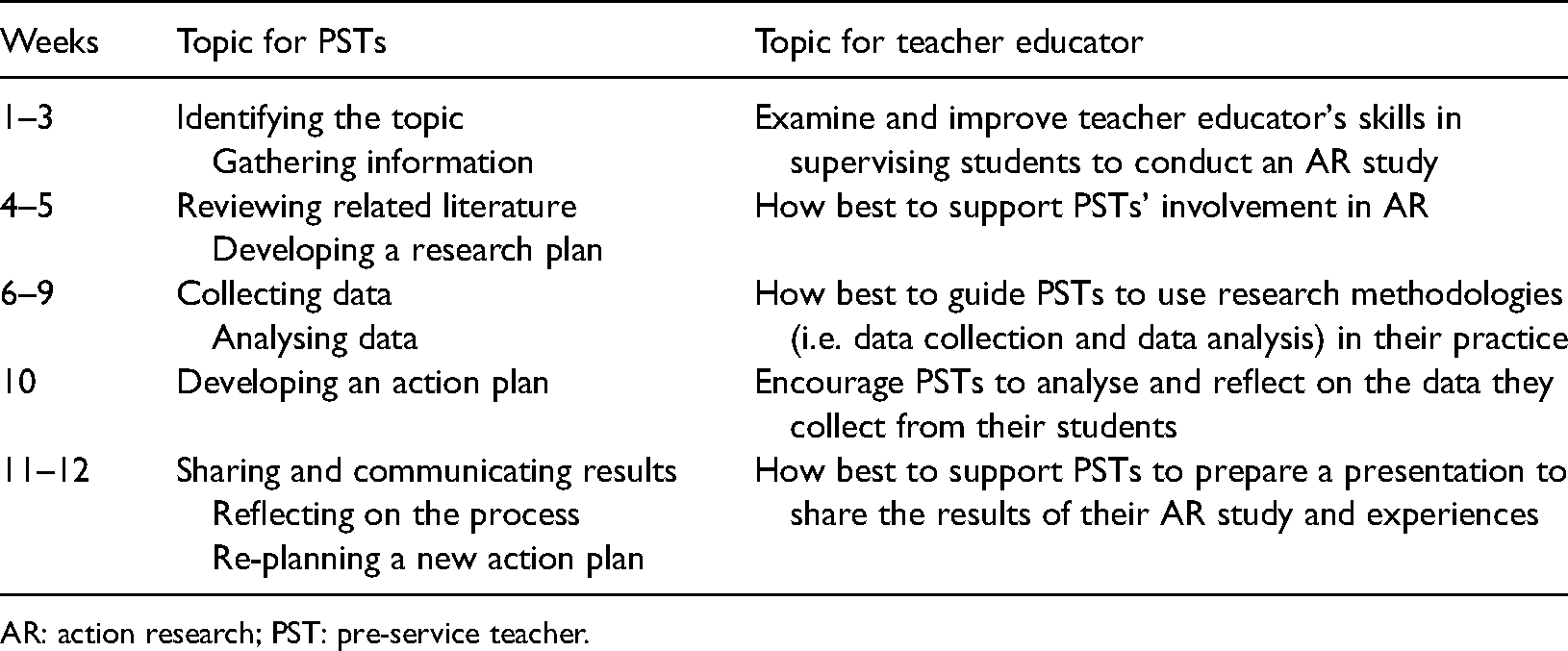
AR: action research; PST: pre-service teacher.
For the planning cycle, the teacher educator introduced the PSTs to AR and encouraged them, as the first step of AR, to identify (from reading the teaching literature and observing each other's practices) an issue in their teaching they wanted to improve or develop during their school placement. In this cycle, the teacher educator aimed to examine and improve her supervising skills to conduct an AR study and understand how best to support the PSTs’ involvement in AR.
The next AR cycle (acting) prompted the PSTs to decide collectively to focus on improving their appropriate use of task cards and to administer an open-ended questionnaire to their school students (126 students in total across all PSTs). PSTs also videotaped their practices and discussed them during the formal weekly meetings with the teacher educator. In this study, task cards were used as instructional tools that combine a picture of a skill with written instructions about how to perform the skill. PSTs used the task cards while teaching the skills related to their teaching unit. With the help of the open-ended questionnaire, PSTs received feedback from their students about how best to use task cards in their practice. They then revisited the task cards, aligning changes with the student feedback, and implementing them for the next three weeks in their class. They administered the questionnaire again four weeks after the first implementation after changing some of the questions concerning what they had learned from the previous responses. During this cycle, in her own action plan (i.e. identifying the next stage in her practice), the teacher educator focused on how best to guide the PSTs to use research methodologies in their practice and identify associated data collection and data analysis.
The AR developing cycle matched with the PSTs interrogating the school students’ responses to questionnaires. When the PSTs administered the questionnaire for a second time, they took this opportunity to develop their new action plan informed by the responses. The teacher educator encouraged the PSTs to analyse and reflect on the data they had collected from their students during this cycle.
Related to the AR reflecting cycle, PSTs reflected on what they had learned to date from working with school students, their weekly formal group meetings with the teacher educator, and how they intended to follow up on related actions to improve future school placements. During the reflecting cycle, an open invitation was issued to all students and staff at the faculty to attend an information-sharing afternoon. At this meeting, PSTs formally conveyed their experiences through a prepared presentation, shared their preliminary research reports, and sought feedback from their school placement peers and teaching staff. During this cycle, on her own action plan, the teacher educator focused on how best to support the PSTs to prepare a presentation to share the results of their AR study and experiences.
Teacher educator and critical friend roles
The teacher educator had nine years of experience as a teacher educator and was, at the time of the study, in her sixth year of working as a lecturer in the university in which the data was collected. Her teaching and research interests revolve around learning communities and communities of practice. The primary role of the teacher educator was to supervise the PSTs throughout the AR process while visiting and providing feedback during their school placement. The teacher educator had expertise in developing learning communities in physical education and had previously conducted and published research focused on in-service physical education teachers’ professional development. As an early career teacher educator, she had been supervising PSTs on school placement for three years. The teacher educator had the experience of working with AR with experienced teachers but no previous experience of working with AR with the PSTs.
The second author served as a critical friend. The critical friend was an established physical education teacher educator with 20 years of experience in delivering and researching physical education teacher education programme practices. The teacher educator and the critical friend had connected previously in numerous professional capacities, including advocating for internationalization in sport pedagogy and supporting early career scholars. Formalizing the teacher educator and critical friend relationship allowed both to share research challenges, drive continual progress in the research, and gain alternative perspectives in a supportive and intellectually safe space. In this study, the critical friend was asking critical questions, suggested new ideas, and provided alternative interpretations/perspectives. The critical friend helped the teacher educator facilitate the PSTs’ experience of AR as well as prompt the collection of evidence from the teacher educator to determine the successes and challenges she encountered in facilitating the PSTs in each AR cycle.
Data collection
PST and teacher educator weekly discussion
The weekly discussions between the six PSTs and the teacher educator that took place as part of the school placement experience were audio-recorded.
Each week's discussions revolved around three topics
(1) PSTs’ experiences at school, (2) what and how they gained from their school experiences, and (3) what to focus on the following week during school placement. There were nine meetings over 12 weeks with each meeting lasting between 90 minutes and three hours. During the weekly discussions with the PSTs, the teacher educator also shared her own AR experiences with them, reporting the nature of AR struggles and challenges she experienced. The PSTs were experiencing one complete sequential cycle of AR throughout the 12 weeks. Given that the focus of the study was to examine the PSTs’ and the teacher educator's shared experiences of enacting AR, this resulted in the teacher educator completing numerous AR cycles throughout the 12 weeks. Figure 1 illustrates these cycles with the centre of each cycle denoting the PSTs’ cycle and the outer circles denoting the corresponding AR complete cycles enacted by the teacher educator.
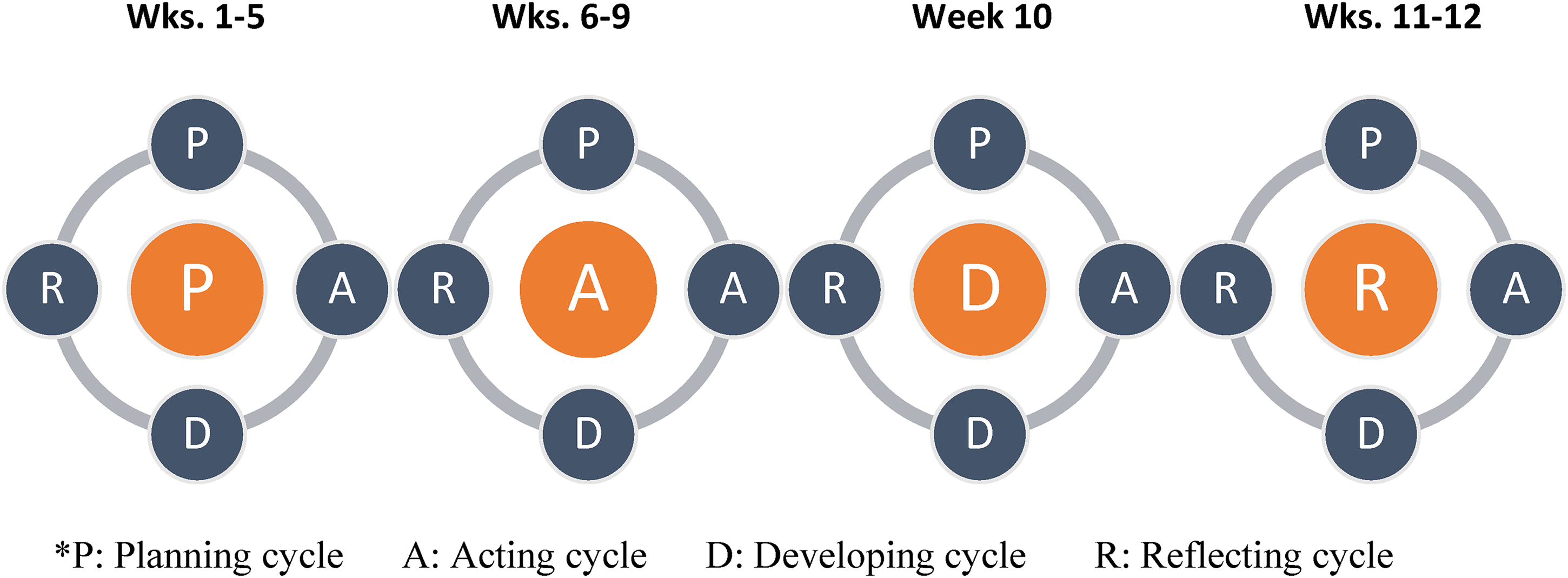
The cycles enacted by the teacher educator and pre-service teachers over 12 weeks.
Teacher educator and critical friend discussions
Online discussions between the teacher educator and critical friend were audio-recorded following the PST and teacher educator meetings. Each week's discussions revolved around three topics: (1) the teacher educator summarizing the minutes and critical incidents of the meeting with the PSTs, (2) the critical friend asking the teacher educator to focus on her own AR cycle, and (3) what to focus on at the next meeting with the PSTs. There were eight meetings over 12 weeks and each meeting lasted between 47 and 92 minutes.
Teacher educator field notes
The teacher educator wrote field notes after each discussion meeting with the PSTs and the critical friend. Directly after meeting with the PSTs, the teacher educator noted significant instances that would help inform the critical friend on the PSTs’ progress with AR. The teacher educator also used field notes to record suggestions and recommendations made by the critical friend after each online meeting and referred to these in preparation for the next meeting with the PSTs. Field notes constituted 55 pages of text.
PST and teacher educator interviews
Semi-structured interviews were conducted by the teacher educator individually with each of the six PSTs to understand their experiences of AR. The teacher educator was bilingual so was able to conduct the interviews with the PSTs in Turkish and the interview with the critical friend in English. The interview questions focused on (1) PSTs’ experiences on each AR cycle, (2) their least and most challenging experiences of the cycle, (3) what PSTs believed they had gained from the experiences of the teacher educator, and (4) to what extent the teacher educator had guided PSTs through the process. The interviews lasted between 31 and 50 minutes. A semi-structured interview was conducted by the critical friend with the teacher educator to capture and understand the teacher educator's perspectives and experiences on facilitating the PSTs’ experiences of AR. The interview lasted 35 minutes.
Ethical issues and trustworthiness
It is extremely difficult in the context of AR to disentangle the role of the researcher from that of the teacher in the higher education context. Poole and MacLean (2005) highlight two considerations: (i) the extent to which participation is truly voluntary and (ii) the maintenance of anonymity and/or confidentiality. In this study, informed consent forms were completed by the PSTs and it was emphasized to them that they had the freedom to cease participation in the research at any stage and that their names would remain anonymous. Brydon-Miller (2009) suggests that there may also be a need for a covenantal agreement between primary researchers and co-researchers in an AR project, with a mutual commitment to shared values rather than solely a contractual agreement. Therefore, in this study, the teacher educator was conscious of addressing any consequences of the potential power relationships and made the best available choices to minimize potential issues. To address these issues, while conscious of the nature of the study, the teacher educator created an environment in which participation, co-construction, and shared investment were key elements across the group. The co-construction of design and measurement tools (e.g. the teacher educator enabling PSTs to adapt their task cards to their needs), increased the PSTs’ self-confidence (this point will be addressed in the ‘Results’ section) (Wennergren, 2016).
Macintyre (2000) and Elliott (1996) advocate for triangulation to establish the integrity of the research and reduce bias. They suggested utilizing a two-pronged process to eliminate bias, with teachers and students at one level and the use of a variety of data collection methods at another. In this study, data triangulation (Patton, 2001) was achieved across multiple data sources. The field notes and weekly audios of the PST meetings encouraged the teacher educator to consider any consistency between similar points raised in both data sources. Also, the teacher educator wrote her field notes in English and shared them with her critical friend. This ensured a level of triangulation between what was noted in the field notes and the subsequent conversation between the teacher educator and critical friend through multiple data sources. Finally, the prolonged engagement in the study context (Merriam, 2009) allowed for a safe and familiar relationship between the PSTs and teacher educator.
Promoting quality AR/providing rigour in AR
Capobianco and Feldman (2006) set four conditions to promote quality AR including that (a) the collaborative AR group must function as a community of practice (Wenger, 1998), (b) the collaborative AR group must function as a knowledge-producing, epistemic community, (c) the teacher needs to have a thorough grounding in the nature of AR, and (d) the teacher needs to know appropriate research methods. In this study, a community of practice developed through the weekly PST and teacher educator meetings where shared goals, expectations, and intentions were openly discussed and reflected on. With respect to developing the epistemic community, PSTs collected and used data from their school placement students and presented the results as explained earlier. Discussions with the critical friend assisted the teacher educator's facilitation of the PSTs conducting AR. The teacher educator and critical friend shared research challenges, strived for continual progress in the study, and gained alternative perspectives in a supportive and intellectually safe space.
Data analysis
The semi-structured interviews with the PSTs and the teacher educator, audio-taped transcriptions of weekly discussions with both the PSTs and the critical friend, and the teacher educator's field notes were analysed qualitatively using the constant comparison approach (Glaser and Strauss, 2012). Before coding, all written transcripts were read several times and notes were taken. Data analysis began by capturing the important features relevant to understanding the PSTs’ and the teacher educator's experiences in each cycle. The focus was to label all captured incidents from each data source. Then, initial codes were created by grouping similar keywords, sentences, and phrases related to the experiences of the PSTs and the teacher educator. It was important to compare the initial codes and the categories and review through constant comparison more selectively and conceptually. Lastly, axial coding across all data sources was conducted to identify connections related to examining the PSTs’ engagement in AR as well as the relationship between the PST and teacher educator (Table 2).
Examples of the data analysis.
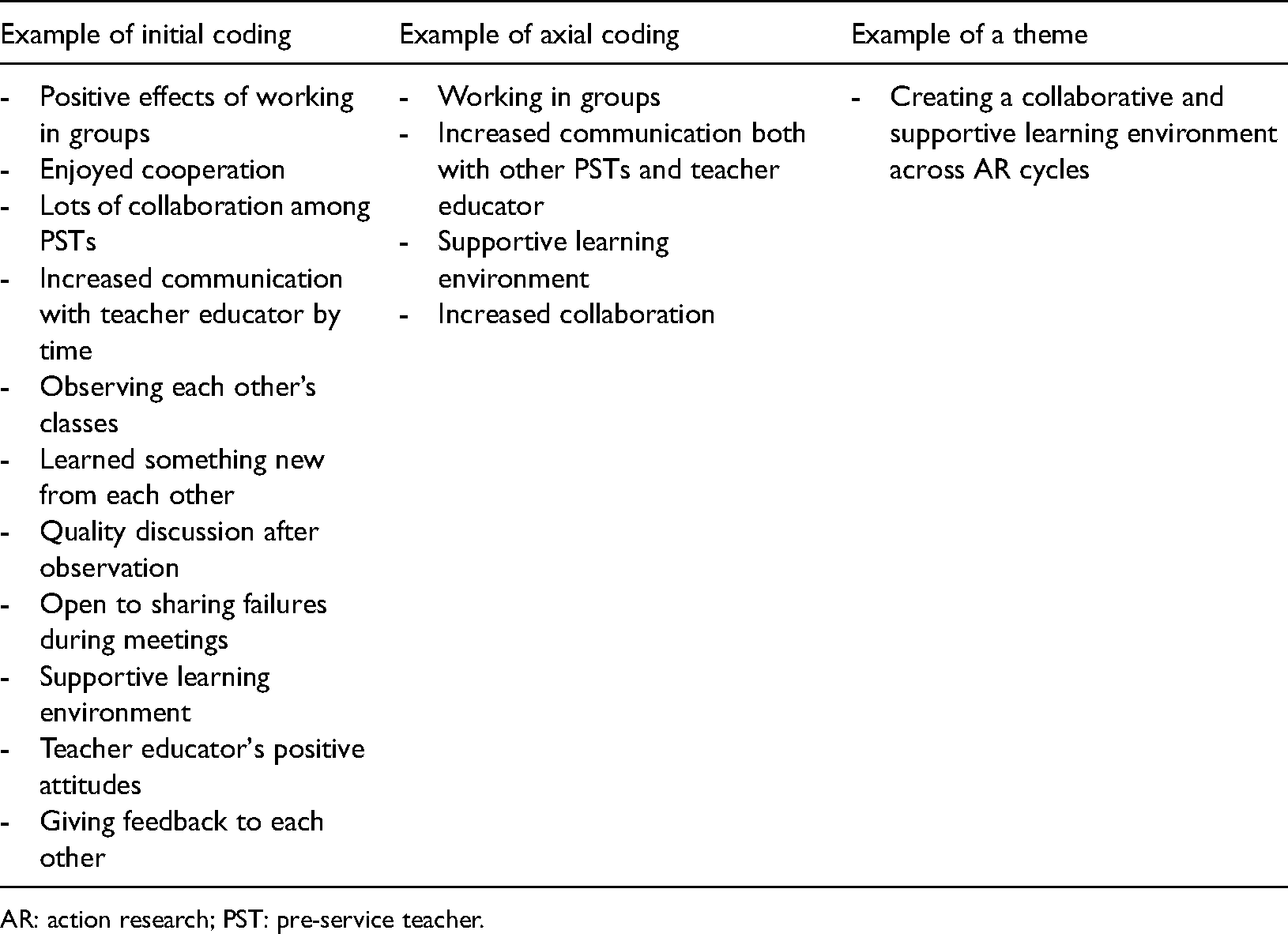
AR: action research; PST: pre-service teacher.
The first author collected and analysed the data. Regular meetings occurred between the two authors to clarify and come to a consensus on the constructed categories.
Results
Results indicated that the three crucial aspects of facilitating and designing a co-constructed AR experience were: centrality of the critical friend, the teacher educator sharing her experiences of AR with the PSTs, and creating a collaborative and supportive learning environment across AR cycles. Different pedagogical strategies (such as peer observation, videotaping of practices, survey use, task cards, and open presentation) were utilized by the teacher educator to facilitate PSTs’ experiences of AR in each cycle. How these aspects and pedagogical strategies impacted the teacher educator and the PSTs is shared in the following subsections.
The centrality of a critical friend
In this study, the critical friend guided the teacher educator by asking critical questions, suggesting new ideas, and providing alternative interpretations/perspectives throughout the process of the teacher educator facilitating the PSTs’ experience of AR in each cycle.
During the planning cycle, the critical friend aided the teacher educator to facilitate the PSTs’ experience of AR as well as prompted the collection of evidence from the teacher educator to determine the successes and challenges she encountered in facilitating the PSTs in each AR cycle. During the planning cycle, PSTs found it difficult to define what to investigate in their practice and to understand how AR could help them in this regard. After the discussion between the teacher educator and critical friend, the teacher educator noted: For this week, critical friend suggested me to put the PSTs in pairs, allow them to observe each other's practices and take notes about the challenges their peer encounters to be able to answer the question ‘What are the three biggest challenges that your partner experiences in class?’ We will discuss their answers next week in class. (Field note, after third meeting with the critical friend)
After this conversation, the teacher educator used peer observation and videotaping of the PSTs’ own practices as strategies that helped them to recognize the challenges they encountered in their classes.
In the acting cycle (weeks 6–9) PSTs decided to focus on improving their use of task cards. In one of the meetings with the teacher educator, they decided to construct an open-ended questionnaire to collect school students’ opinions about the task cards. The questions related to the task card included: ‘Did you use the task card before in any of your lessons? How did the task cards encourage you to learn a new skill? What are the advantages and disadvantages of using task cards in PE?’
After the PSTs received feedback from their students, they revised the task cards, aligning changes with the student feedback and implementing the reconfigured task card for the next three weeks in their class. Three weeks later they administered the questionnaire again and changed some of the questions with respect to what they had learned since the previous administration of the questionnaire. At this point, the critical friend suggested that the teacher educator focus the discussion on why the PSTs have similar or different experiences with task cards: You might try to get them to focus on the context and why they are having similar or different experiences with the task cards. Is it their own dispositions or context of the class? (Teacher educator and critical friend discussions, week 6)
In the next meeting with the PSTs, the teacher educator initiated a discussion about how the responses from their students were differentiated. The PSTs had come to appreciate that they each had different experiences that were dependent on the specific group of students they were teaching. PSTs articulated the importance of collecting data from their students: I really enjoyed reading my students’ responses. I realized what their needs are. I edited the task cards in relation to their responses, added more photos/pictures, made clearer explanations about the skills. Honestly I wouldn't expect them to be that much aware of what I am doing. They seem like they don't have an interest in the task card, but they do. Their answers also increased my awareness about that. (Interview, Hasan, male PST)
The teacher educator articulated the importance of having a critical friend by explaining that the critical friend helped her to facilitate the PSTs’ experience of AR and to focus on her own AR while facilitating their engagement in AR: Working with a critical friend was very important for me. There were so many challenges not only for my students but also for me. Without you [pointing out the critical friend] I would probably lose my way in this study. In each week and each cycle you helped me to focus on how to facilitate students on their AR experience. You helped me by suggesting strategies to work with students. Also, our weekly discussions helped me to focus on the success and challenges of my own AR experience (Teacher educator, interview).
The dialogue between the teacher educator and critical friend resulted in the teacher educator acknowledging the importance of a critical friend (who asks critical questions, suggests new ideas, and provides alternatives) while creating a co-constructive AR experience with the PSTs. Moreover, with the help of the critical friend, the teacher educator intended to create a more meaningful and safer learning environment among the PSTs.
The teacher educator shared her experiences of AR with PSTs
It is important to remember that while the PSTs experienced one complete cycle of AR over the 12-week period, the teacher educator experienced numerous cycles of AR as she considered how best to facilitate the PSTs’ involvement in AR through planning, acting, developing, and reflecting cycles.
Through the facilitation of the PSTs’ AR experiences, the teacher educator created an authentic and honest examination of her leadership by sharing her successful and less successful stories about her enactment of the AR cycles. In the planning cycle, after the discussion with the critical friend, the teacher educator shared her experiences of AR with PSTs: Critical friend: You know we spoke about the AR cycle, it might be quite useful if you can map where you are on it and explain why you are there and they [the PSTs] map on a weekly basis where they are as well. You are all going through the AR cycle together but it is slightly different for you and them. All of you have that illustration or diagram. This is where I am. I have moved from planning to acting and here is why. This is what I am trying to do in my acting stage.
Teacher educator: Yes, I agree. I will first share mine as an example at the meeting. Then I will prepare a worksheet. I will put AR cycles on an A4 paper on a weekly basis. We will all come back to the table with it. We will illustrate on the same diagram where we are and why we are there. (Teacher educator and critical friend discussions, week 4)
The teacher educator started to share more of her own examples of AR at the weekly discussion with PSTs: My action plan for the last two weeks was to find a pedagogical strategy for you [PSTs] to make you realize your challenge in your practice. I searched the literature, asked my critical friend to help me and I decided to put you in pairs and let you observe each other's practice. It was my action plan for last week and it worked. Now I will make a reflection on the consequences if that action will come up with a new action plan for the next cycle. (Fifth-week meeting with PSTs)
The teacher educator noted how important it was to share her own experiences about AR with PSTs: I discovered each cycle with them [PSTs]. There are many things I could not expect at the beginning. I was also open to sharing my failures and success stories about my AR cycles. Therefore, they [PSTs] become more open and would say yes it was a problem for us as well. (Teacher educator, interview)
The teacher educator shared her own experiences with AR at the weekly discussion with the PSTs in week 10: Teacher educator: My action plan for this cycle [developing cycle] was encouraging you to analyse and reflect on the data you collected from your students. I decided to make school visits and observe your practice which I believe gave me an idea of how to help you to analyse your students’ data. Do you think that worked?
Sanem: I think it did. After you observed our classes, you were more aware of our students’ needs and expectations. Your guidance helped me how to analyse my students’ responses. (Tenth-week meeting with PSTs).
PSTs also stated that their understanding and engagement with AR increased over time: Sometimes we were losing our way on action research, we were discussing what are we doing now. But at that moment you reminded us to focus on our aim in that cycle. You were giving your example [teacher educator's action research] and explaining how to reflect and solve your own problem in your case. That helps me a lot. (Interview, Selin, female PST)
The teacher educator sharing her AR experiences with the PSTs in a bid to facilitate the PSTs’ AR study created a sense of collaborative inquiry with the teacher educator and the PSTs’ engagement in the same endeavour. This enhanced the PSTs’ understanding and engagement with the AR cycles.
Creating a collaborative and supportive learning environment across AR cycles
PSTs learned to conduct AR by creating a collaborative and supportive learning environment across AR cycles, systematically engaging in the process, communicating effectively with themselves and the teacher educator, and collaboratively sharing the different dilemmas they experienced during the development of this new knowledge. One of the PSTs shared the importance of working collaboratively: I believe working and discussing with the group is more effective and advantageous. Everybody has something to say at the meetings and personally I am learning a lot from my friends’ experiences. At the beginning we found it hard to share what to say but with your [teacher educator] guidance through the weeks and cycles I didn't realize how fast time passed at the meeting. (Interview, Nadir, male PST)
At the beginning of the planning cycle, as the PSTs’ experiences became more personalized, the weekly discussions between the PSTs and teacher educator shifted to being more reciprocal with PSTs choosing to share their successes, frustrations, and disappointments. The teacher educator noted such a shift: The last two meetings were more multi-directional among PSTs. They give feedback to each other and feel more secure to discuss about their failures and success stories. (Field note, week 8)
The PSTs viewed AR as important for their career. As they became confident with AR and understood how to conduct it, they were more eager to use these skills in their professional lives as teachers: Conducting action research from beginning to end was a challenge for us, but I am glad we did it. I learned a lot and I am sure I will use these techniques in my professional life in the future. (Interview, Selin, female PST)
They also agreed that conducting meaningful AR requires a great deal of cooperation. PSTs were able to share their ideas, problems, and issues not only in the formal discussion meetings with the teacher educator, but also in their school contexts: I went to school to observe the PSTs’ lessons this week. I liked to see how they came together and discussed the problems they face during their practice and tried to find a solution collaboratively. (Teacher educator and critical friend discussions, week 8)
In the reflecting cycle (weeks 11–12), PSTs conveyed their experiences through an open formal presentation, shared their preliminary research reports, and sought feedback from their school placement peers and teaching supervisors. They each collaboratively shared their own experiences from conducting an AR study during their school placement. They explained how and why their examples had changed throughout the weeks, how AR helped them to address challenges and how their reflections informed new action plans. While the PSTs admitted that this cycle was initially intimidating for them, consulting and discussing with the teacher educator and their peers about AR increased their self-confidence as they gained a better understanding of AR: I will be honest but at the beginning I was not sure about doing an action research study. I was thinking neither I nor my students are ready for this, I was anxious about it. But after the presentation, after we got very positive feedback from our peers and the teachers, I said I am glad we did it… I was thinking I might use action research when I become a teacher, but now I believe I will definitely use this. (Interview, Sanem, female PST)
I realized that kind of important thing that we are trying to do in the last weeks. I was worried about how to convey what we had learned to an audience. But your [teacher educator] guidance and help throughout the research was enormous, you made us believe in ourselves. I was happy at the end and I felt more confident in and after the presentation. Because I feel like I know what I am doing… (Interview, Hande, female PST).
Creating a collaborative and supportive learning environment with the PSTs by engaging them in AR cycles was an important element of designing a co-constructed AR experience. In doing so, it was obvious that conducting a meaningful AR experience required significant cooperation where the PSTs were able to communicate effectively with each other and the teacher educator.
Discussion
Results indicated that the three crucial aspects of a co-constructed AR experience were: centrality of the critical friend, the teacher educator sharing her experiences of AR with PSTs, and creating of a collaborative and supportive learning environment across AR cycles. Three main discussion points arise from this study.
MacPhail et al. (2014) stated that a teacher educator's professional learning and modelling of the development of learning skills have the potential to influence dispositions towards continued professional learning. While the importance of modelling is supported (Loughran and Russell, 2002; Lunenberg et al., 2007), PSTs do not necessarily learn a great deal from modelling the behaviour demonstrated by their teacher educators when they are not prompted to recognize such behaviour (Wubbels et al., 1997). Teacher educators need to be experienced and effective in modelling the development of learning skills to positively affect PSTs’ dispositions (Swennen et al., 2008). Supporting this, studies have noted that facilitators who are actively participating in the AR process, while facilitating the AR process of others, result in AR participants experiencing a sense of collaboration and, in turn, heightened participation (Anderson and Cook, 2020; Choy et al., 2016). It was evident in this study that when the teacher educator shared her own experiences of AR with PSTs (by creating an authentic and honest examination of leadership) at the same time as PSTs were engaging with AR, mutual understanding and engagement with the AR process was enhanced.
PSTs reflected that they began to understand AR as a systematic inquiry in attempting to seek ways to improve school placement. Based on our study, PSTs require facilitation on how to more effectively recognize and plan to address issues in their teaching, utilizing additional sources. Revisiting Shulman's (2005) notion of the surface structure of signature pedagogy, the use of peer observation and videotaping of PSTs’ teaching has the potential to alert them to issues they may not have otherwise been aware of. During facilitation, the teacher educator led by example in seeking feedback from PSTs on their teaching, as well as seeking peer observation from colleagues and sharing recordings of their teaching for discussion.
Gibbs et al. (2016) concluded that the effectiveness of teaching and learning strategies to improve student engagement in higher education can be interactive and a two-way process (combined with the two-way engagement of student and academic) that helps to encourage deeper learning. The literature suggests that students’ engagement in learning does not necessarily result in higher achievement. Rather, in a combined two-way engagement, the teaching ability of the PSTs and their learning can be improved. In this study, PSTs were able to receive ideas from others, and share their success, disappointments, and frustrations not only in the meetings with the teacher educator but also during enactment in their school contexts. By framing this with the notion of the deep structure of the signature pedagogy (Shulman, 2005), PSTs pushed their thinking about what it entails to become a reflective practitioner by learning to reflect on their practice and collect data from their students to redesign their practices. This study reinforces the need for PSTs to be taught how best to engage with AR. This includes how to most effectively engage with each other, and the teacher educator, in order to enhance understanding and engagement of AR and its associated enactment.
In physical education settings, PSTs’ collaborative discussions and reflections provided evidence that participating in AR enabled PSTs to appreciate the process of critical reflection on their practice. This experience helped PSTs develop research skills that they could use to understand problems, develop interventions, and collect data for evidence (Mertler, 2009; Mills, 2010). PSTs selected appropriate data collection tools, aligned with the pedagogical problems they faced in their school placement, to find solutions to those specific problems. It is important to keep in mind that, in this study, the ability to promote reflection was limited by the duration of the school placement. A further challenge would be to designate AR as a research methodology throughout the physical education teacher education programme, with the aim of encouraging PSTs to provide a more realistic and meaningful model that promotes reflection and a culture of shared learning over time (Harford and MacRuairc, 2008). This would, in turn, promote ‘teacher as researcher’/‘practitioner-researcher’ and address the increasing interest in research-informed teaching and teaching-informed research (MacPhail and Tannehill, 2012).
Conclusion and implications
This study presents the experiences of six PSTs and a teacher educator in a physical education teacher education programme as they explored the co-construction of an AR experience. The results of this study contribute to the existing literature in three ways. First, although much of the literature on teacher education explores in-service teachers’ and teacher educators’ AR (Casey et al., 2009; Ulvik and Riese, 2015), this study contends that PSTs’ engagement with AR appears to be heightened when the teacher educator aligns and shares their corresponding experience of AR with PSTs. An implication that arises from this finding is that if teacher educators are genuinely concerned with introducing PSTs to a meaningful AR experience, they should strive to model and share best AR practice. This positive experience, in turn, may encourage PSTs to systematically explore their own practice as inquiry practitioners. Second, in reviewing the literature on the use of AR in higher education, studies tend not to focus on the facilitation of the AR stages. This study has attempted to address this omission by investigating the design and facilitation of a co-constructed AR experience in a physical education teacher education programme. A related implication is that teacher educators consider the importance of mapping the design and facilitation of AR for all involved in the process. Finally, in the majority of AR literature, the results heavily rely on teacher or PST and student reflections, highly dependent on personal social values, experiences, and beliefs (Adler, 2011; Donche and Van Petergem, 2004). In this study, having a critical friend aided the teacher educator on a weekly basis to facilitate the PSTs’ experience, and focus on her own AR as a teacher educator, ensuring a critical evaluation of the intervention and methodology of the study.
It is intended that this study encourages teacher educators to consider how best to share their assumptions about their own teaching with PSTs, with a view to co-constructing the design and facilitation of AR between teacher educators and PSTs. For some colleagues, this will mean challenging embedded practices where teacher educators share little of their learning pathway with PSTs. For others, it will extend an already collective vision of working together by adding a research focus to the partnership. There needs to be a shift in our understanding of how best to support a shared learning space where we can discuss and encourage each other in co-constructive ways.
Footnotes
Declaration of conflicting interests
The authors declared no potential conflicts of interest with respect to the research, authorship, and/or publication of this article.
Funding
The authors received no financial support for the research, authorship, and/or publication of this article.
