







Abstract
Extensive empirical evidence exists for how Sport Education (SE: Siedentop et al., 2020) can deliver valued student educational outcomes, yet there remains a dearth of knowledge of how in-service teachers implement the model in practice. The purpose of this study was to examine how the stages of occupational socialization predicted teachers’ reported implementation of the structural features of SE. An SE use and occupational socialization survey was developed and completed by 65 experienced teachers who had received training on using SE during their undergraduate physical education teacher education program. Respondents reported three versions of SE implementation: (a) full, (b) modified, and (c) light, with the majority of teachers reporting using either a full or modified version of SE. Professional socialization (physical education teacher education programming) was the only significant predictor of teachers’ model use. The SE features typically implemented were formal competition, team affiliation, and seasons. The more student-centered features of student roles, record keeping, and a culminating event were less frequently used during practice. Professional socialization remains the most powerful predicted on in-service teachers’ use of SE during their professional practice. Physical education teacher education programs are encouraged to explore methods to facilitate pre-service teachers’ learning of how to implement the student-centered features of SE, as this learning will likely translate into pedagogical practice in schools.
Keywords
Introduction
Sport Education (SE) has drawn considerable interest from physical educators and teacher educators across the globe (Curtner-Smith et al., 2008; Kirk, 2013). This growing interest has stemmed from SE's provision of more “authentic, educationally rich sport experiences in the context of school physical education” (Siedentop, 2002, p. 409). The primary outcomes of SE include developing competent, enthusiastic, and literate sportspeople by providing students an opportunity to experience a more authentic sport culture in physical education (Siedentop et al., 2020). Moreover, when implemented fully this pedagogical model has the potential to enhance student learning in the psychomotor, cognitive, and affective domains (Hastie & Wallhead, 2016).
Although extensive empirical evidence exists for SE's potential in delivering on valued educational outcomes, there remains limited knowledge of how in-service physical education teachers enact the model during their professional practice (Harvey et al., 2020). Teachers who use pedagogical models within their practice (e.g. SE, Teaching Games for Understanding, Outdoor Education) in schools have generally experienced formalized training during either their physical education teacher education (PETE) programs or a professional development initiative (Casey, 2014). Research from teacher preparation programs has indicated that pre-service teachers (PTs) are attracted to using SE because it aligns with their sporting socialization experiences (Curtner-Smith and Sofo, 2004), is student-centered, and has the potential for community building in physical education (Braga and Liversedge, 2017). Furthermore, in-service teachers have suggested specific pedagogical strengths of SE such as enhancing personal and social development, inclusion, and student motivation (Harvey et al., 2020).
Despite these positive reactions to the model, the complexity of the shift towards more student-centered pedagogies associated with SE can cause struggles for PTs in learning to effectively teach with the model (McCaughtry et al., 2004; Parker & Curtner-Smith, 2005). A recent review by Silva, Farias and Mesquita (2021) summarized these challenges as: (a) teacher-related (i.e. pervasive beliefs, occupational socialization, managerial- and instruction-related); (b) student-related (i.e. student resistance to engaged participation in student-centered models); and (c) external (i.e. context- and environment-related). Despite this growing body of knowledge on how PTs learn to teach SE during PETE (e.g. Hordvik et al., 2019), there remains scant attention to how this learning transfers into the implementation of the model in schools. This knowledge is important, as despite the advocacy efforts for the veracity of models-based practice in delivering a more student-centered learning experience, there is concern that teachers do not use models effectively during their professional practice (Casey, 2014).
Curtner-Smith and colleagues (2008) examined how beginning teachers employed the pedagogical features of SE during their curricular practice. Their findings indicated the model was being delivered in one of three different ways: “full version, watered-down, and cafeteria style” (Curtner-Smith et al., 2008, p.102). The full version was described as being congruent with Siedentop and associates’ (1994) intentions: the use of seasons, team affiliation, record keeping, organized competition, culminating events, and role responsibilities. The watered-down version represented a (mis)interpreted iteration of SE that was structured around a seasonal competition format with team consistency, record keeping, and some use of student role responsibilities implemented to afford a structured management system. Lastly, the cafeteria style involved teachers selecting specific features of SE within what appeared to be well-taught traditional sporting units (Curtner-Smith et al., 2008). This study also revealed findings about the effects of acculturation, professional socialization and organizational socialization on beginning teachers’ delivery of SE. The authors suggested that recruits enter PETE with one of three orientations: hard-core coaching, moderate coaching, or teaching. Hard-core and moderate coaching orientations are defined as being totally committed to sport coaching and not totally committed to sport coaching. A teaching orientation is described as prioritizing teaching physical education and viewing coaching as a career contingency (Curtner-Smith et al., 2008). As recruits progressed through their teacher preparation programs, they experienced low- or high-quality SE preparation that influenced their delivery of the model. Moreover, the custodial or innovative culture of the school contexts in which the beginning teachers started their professional practice impacted how the model was enacted. Custodial school cultures refer to an ideology that supports the use of established, traditional, and often poor pedagogies and models of instruction (Curtner-Smith, 2017). Innovative cultures offer a contrary ideology that encourages the use of pedagogical models (Curtner-Smith et al., 2008).
A more recent study conducted by Gutiérrez and colleagues (2022) examined 199 Spanish in-service teachers’ reported use of SE and perceived feature implementation. Almost 65% of the teachers reported that they were frequent users of SE in both elementary and secondary contexts. Moreover, findings of the study suggested that a high percentage of teachers did not implement some of the essential features of SE during practice, such as persistent teams, roles, and extended units. Spanish educational contexts and a teacher reluctance to delegate responsibilities through student roles were reasons for not including these specific features. These studies highlight the potential of occupational socialization as a theoretical lens to better understand the influence of teacher education and the contextual factors of schools on how and why in-service teachers choose to implement features of a student-centered pedagogical model, such as SE, during their professional practice. Previous research has used the lens of occupational socialization to examine how teachers implement pedagogical models including SE (Curtner-Smith et al., 2008; Stran and Curtner-Smith, 2009), Teaching Games for Understanding (Chung and Cruz, 2008; Vollmer and Curtner-Smith, 2016) and Outdoor Adventure (Zmudy et al., 2009) within their school contexts.
Occupational socialization framework
Occupational socialization (Lawson, 1986) is defined as “all kinds of socialization that initially influence persons to enter the field of physical education and later are responsible for their perceptions and actions as teacher educators and teachers” (p. 107). Research that has used occupational socialization has assisted in clarifying why physical education recruits are led into the profession and socialized into the role of the educator (Richards et al., 2013). In using occupational socialization theory, scholars (Dewar and Lawson, 1984; Stran and Curtner-Smith, 2009) have noted that the socialization process progresses through three distinct stages: acculturation, professional socialization and organizational socialization. Previous studies have revealed findings related to teachers’ practice within schools, and specifically how these stages influence both beginning and experienced teachers’ orientations and professional pedagogical practices (e.g. Curtner-Smith et al., 2020).
Acculturation
Acculturation is described as the influence and shaping process that prospective physical education teachers experience prior to entering their formal teacher preparation programs. Key people, contexts, and cultures influence beliefs and values about the subject and profession throughout this time (Stran and Curtner-Smith, 2009). Current evidence suggests that this stage is “the most potent type of socialization experienced by PE teachers” (Curtner-Smith et al., 2008, p. 99). Lortie (1975) summed up this influence by noting that PETE recruits experience an apprenticeship of observation of more than 13,000 hours within the contexts of schools. Furthermore, stemming from an individual's apprenticeship, it has been hypothesized that acculturation will produce two types of recruits who enter PETE (Lawson, 1983a, 1983b). A continuum likely ranging from highly teaching oriented to highly coaching oriented has been distinguished (Curtner-Smith et al., 2008; Richards et al., 2013), with the center of the continuum expressing an equal interest in both teaching and coaching (Richards et al., 2014).
Those recruits described as having a high coaching orientation are less likely to incorporate and adopt a PETE program's values and practices, use PETE as an avenue to their coaching career aspirations and view their physical education teaching role as a required chore (Curtner-Smith et al., 2008). Individuals with this orientation tend to be males who participated in high levels of school sport, and attended schools where sport was prioritized over physical education (Curtner-Smith, 2001; Curtner-Smith et al., 2008). Conversely, a prospective educator holding a teaching orientation has been described as being likely and eager to adopt the values and beliefs promoted by PETE faculty and look at coaching sport as a career contingency that is supplementary to teaching physical education (Curtner-Smith et al., 2008). While these individuals recognize that coaching may be required as part of their employment, it is viewed as a minor role and much less important aspect of their profession (Harvey et al., 2018). Furthermore, these individuals tend to be females who are interested in or participated in non-traditional sports and attended schools with high quality physical education programs (Curtner-Smith, 2001; Curtner-Smith et al., 2008). In summary, coaching oriented recruits are more likely to disagree with the perspectives of PETE faculty who emphasize quality teaching and adopt an innovative approach, while teaching oriented recruits are more likely to see teaching as their primary role and to embrace innovative orientations (Curtner-Smith, 2001; Curtner-Smith et al., 2008).
Professional socialization
Professional socialization is the impact that a PETE program has on PTs and is “the process by which teachers acquire and maintain the values, sensitivities, skills, and knowledge that are deemed ideal for physical education teaching” (Lawson, 1983a, p. 4). Prospective physical educators are more inspired to embrace best practices when faculty members do not coach and demonstrate a teaching orientation, are perceived as credible, thoroughly supervise field-based experiences, confront acculturation beliefs that do not align with PETE program values, and engage in a shared technical culture (Curtner-Smith, 2001; Stran and Curtner-Smith, 2009). A shared technical culture refers to faculty agreeing on professional ideology through the skills and knowledge needed for effective teaching (Lortie, 1975).
Although there are numerous encouraging aspects of professional socialization, there are potential pitfalls that may inhibit the professional growth of beginning physical education teachers. According to previous research, PETE may be one of the weakest forms of socialization experienced by physical educators and “have little to no impact on pre-service teachers’ fixed values and behaviors regarding PE” (Curtner-Smith et al., 2008, p. 100). In these cases, instead of PETE altering pre-service teachers’ fixed ideas, coursework is used to verify them (Doolittle et al., 1993). Additionally, others have suggested that the lack of impact from PETE programs comes from features they do not provide, such as an understanding of workplace culture and knowledge about the non-instructional features of teachers’ work (Kelchtermans and Ballet, 2002).
Organizational socialization
Organizational socialization refers to the influence that the workplace or school environment has on a teacher's professional teaching practice. Teachers form a culture within the school setting that helps shape their actions and behaviors, and orientations toward teaching (Feiman-Nemser and Folden, 1984). The transition from PETE to professional practice can be challenging for some beginning teachers. The teaching profession has not historically had any formal mechanisms through which to induct its new members (Lortie, 1975). The lack of assistance transitioning into school settings paired with expectations placed on new teachers causes some to experience a difficult transition characterized by frustration and dissatisfaction (Stroot and Ko, 2006).
Researchers have proposed two concepts that potentially hinder the positive influence of PETE on future educators, namely “reality shock” and the “washout effect” (Richards et al., 2014, p. 29). Both occur within the school setting once graduates enter the professional field, with the washout effect seen as a progression of reality shock. Reality shock refers to beginning teachers being faced with a limited support network in taking on similar responsibilities as an experienced teacher. Evidence suggests that this absence of supervision, support, accountability, and the realization of unfamiliarity with school procedures can washout the implementation of learned PETE practices (Richards et al., 2014). This process of washout is not an all or nothing process, with teachers selecting specific teaching strategies to retain from their professional preparation programs (Blankenship and Coleman, 2009). The washout effect is less likely to impact beginning teacher professional practice if colleagues support the application of what they learned in PETE (Richards et al., 2014). Additionally, if a PETE program was unsuccessful in infusing best practices, values, and beliefs into teacher graduates, it may not be the washout effect that is present, but instead an individual's pre-existing beliefs and true outlook on teaching physical education (Lawson, 1983a). Previous research has revealed that reality shock can be reduced through induction assistance and mentoring, adequate preparation from teacher education programs, and when the setting in which novice teachers are placed is aligned with the values that were present in PETE (Napper-Owen and Phillips, 1995).
To better prepare and support new teachers’ induction into the workplace and their delivery of SE, requires an understanding of the socializing stages that are shaping their specific pedagogical practices. Occupational socialization provides an appropriate framework to examine these stages; however, there remains a dearth of knowledge of how experienced in-service teachers, who were educated on SE during their PETE program, report using SE. Therefore, the purpose of this study was to begin to address this void and examine how occupational socialization stages predicted in-service physical education teachers reported use of SE during their teaching. Previous research that has examined teachers’ use of SE and the perceived influence of occupational socialization have generally adopted qualitative approaches with the use of small sample teacher interviews (e.g. Curtner-Smith et al., 2008). There remains a paucity of valid and reliable instruments to examine a broader spectrum of teachers’ reported use of the SE features and how occupational socialization stages predict their use. The Sport Education Occupational Socialization Survey (SEOSS) instrument was developed as part of the study to address this void. Following the development of the survey instrument, the following specific research questions guided data analysis: (1) what features and versions of SE do in-service teachers report as consistently implementing in their school physical education curriculum; (2) how do the occupational socialization stages of acculturation, professional socialization, and organizational socialization predict in-service teachers’ use of SE; and (3) what factors are important to in-service teachers’ effective use of SE in schools?
Method
Research design and participants
To provide more generalizable findings to the primary research questions addressed, a large sample cross-sectional survey research design was adopted. The survey instrument was developed and administered to former PETE graduates from a Mountain West University in the USA. An updated graduate list (since 2005) included 156 in-service physical education teachers who were asked to participate in the study. These graduates included 61 Pre K-5, 42 middle school, 39 high school, 7 K-8 and 7 K-12 physical education teachers. All invited participants experienced a progressive SE curriculum during their PETE program. During the early years of the four-year PETE program PTs experienced multiple movement courses taught using the framework of SE. Movement coursework included students being provided the opportunity to engage in an SE season while learning a variety of activity skills and tactical frameworks. PTs then engaged in early field experiences within secondary school contexts where they delivered SE seasons to classes of middle and high school students across a variety of individual and team sports. Throughout the secondary field experiences, PTs were assessed on critical teaching behaviors associated with the implementation of the key structural features of SE. A total of 65 teachers (41.6% response rate) fully completed the SEOSS survey. Of the 65 respondents, 49 responded “yes” to currently using the SE model in their teaching, while 16 responded that they did not currently use SE. All 49 respondents who reported using SE taught in public schools across the Mountain West of the USA with 16 participants at the elementary level, 22 at the secondary level, and 11 teaching across the K-12 level. K-12 teaching experience varied across the group, with 22 teachers having taught between 1–5 years, 17 between 6–10 years, and 10 between 11–15 years.
Procedures
Upon approval from the University's Institutional Review Board, the teachers were emailed a link supported by Qualtrics that included a description of the study, an informed consent form, and the SEOSS. Reminders were sent out every two weeks for two months with randomly drawn gift card rewards used to promote participant survey response rates.
Instrument development and data collection methodologies
Construction of SEOSS pool items and expert appraisal
The development of the SEOSS followed classical survey instrument development. The initial stages of the survey instrument development included construction of pool items and expert appraisal. The initial SEOSS was developed from a review of literature that examined pedagogical benchmarks associated with delivery of the structural features of SE (Ko et al., 2006) and factors that are associated with the three occupational socialization stages and SE (e.g. Curtner-Smith, 2001; Curtner-Smith et al., 2008; Stran and Curtner-Smith, 2009). The SEOSS included five sections: SE structural features, acculturation, professional socialization, organizational socialization, and demographics. The first section was developed to capture teachers’ perceptions of their use of the pedagogies associated with the structural features of the SE model (season, festivity, affiliation, formal competition, record keeping, culminating event, student responsibility). The recommended use of multiple items was followed to measure the same construct in order to adequately explore the construct and perform appropriate psychometric tests (Hair et al., 2018). Consequently, an initial pool of 18 items that focused on teachers’ reported implementation of the key features of SE was developed (e.g. I promote team affiliation during my Sport Education seasons through students being on the same teams for the entire season). The second section, acculturation, initially included 16 items related to participants’ sport and physical education experiences prior to entering the PETE program and was separated into two subscales representing Curtner-Smith and colleagues’ (2008) conceptualization of coaching and teaching orientations. Examples of items representing a coaching orientation included “being able to coach competitive sports was an important reason for me becoming a physical education teacher” and a teaching orientation, “I entered the PETE program knowing that teaching a quality physical education program was more important to me than coaching competitive sports”. The third section, professional socialization, included 12 items related to the influence of PETE on their current use of SE (e.g. During my PETE program I had an adequate amount of opportunities to learn about SE through coursework that included lectures, discussions, and assignments). The fourth section, organizational socialization, included 11 items related to how the participant's school organizational context including school culture, faculty support, accountability, and student responsivity (e.g. I would describe the culture of my school as being open to new ideas and innovative in teaching practices) may have impacted their use of SE in physical education. The final section, demographics, included eight items related to their current teaching location, years of teaching experience, grade levels currently taught and socioeconomic status (SES) of their student populations. Responses to all items in the survey were measured on a seven-point Likert Scale ranging from 1 (very strongly disagree) to 7 (very strongly agree).
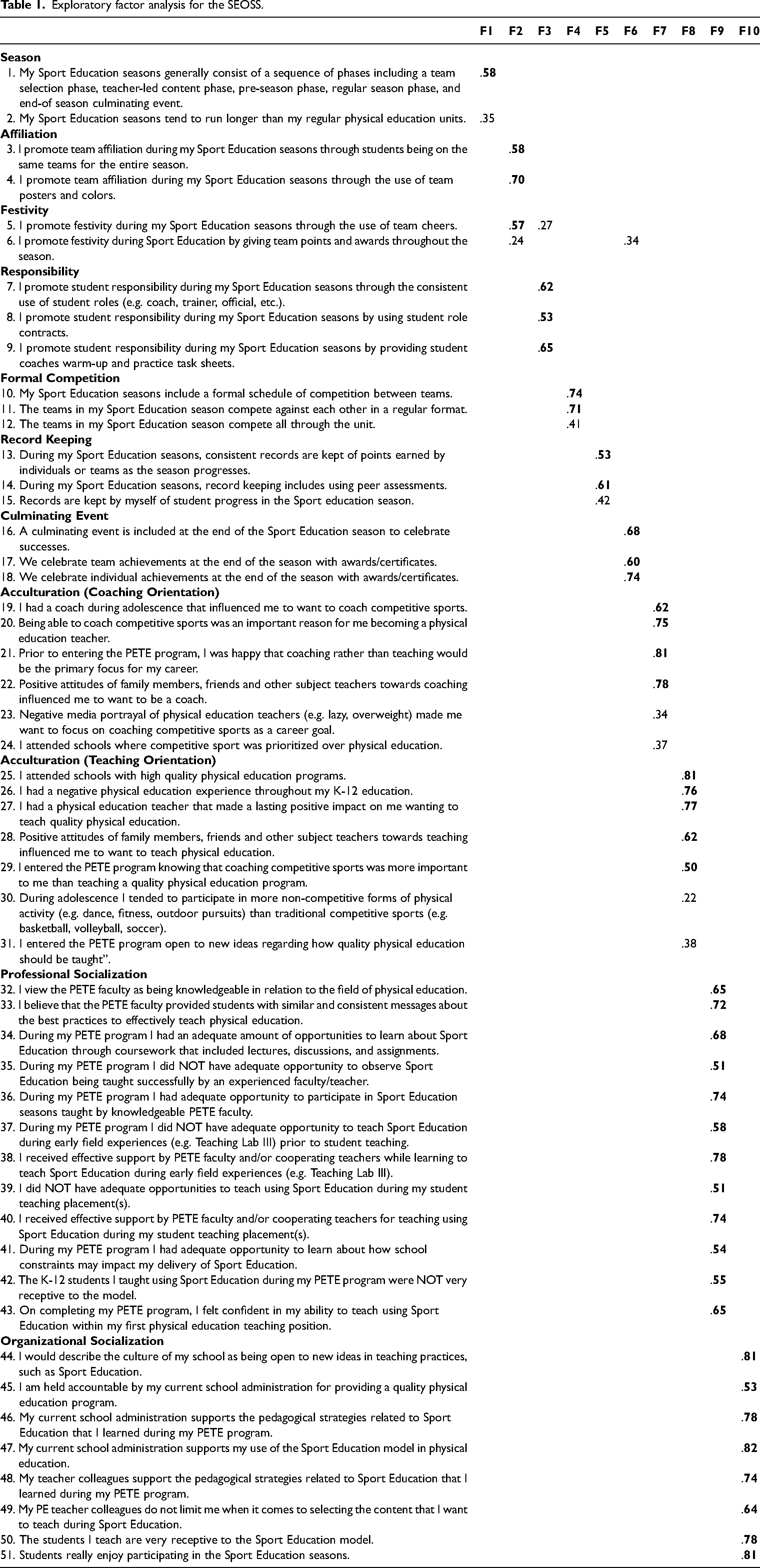
The initial version of the SEOSS was sent to two experts in the field of PETE who had extensive experience researching SE and occupational socialization. These experts assessed and judged the content of each section of the survey. During this initial content validity phase each expert provided feedback on the level of alignment of each item with the intended phenomenon, importance of each item, and the clarity of its structure. Several items were edited or removed from each section and the adapted version of SEOSS was then sent to a sample of three physical education teachers across the K-12 range (one at the elementary level, one at the middle school level, one at the high school level) to determine its face validity. The researchers asked participants to identify items they considered to be repetitive, as well as those items that they perceived as confusing. Minor changes to the wording of two items were made. Table 1 shows the items included for each of the constructs in the version of the SEOSS sent to study participants.
Exploratory factor analysis for the SEOSS.
SEOSS construct validity and reliability
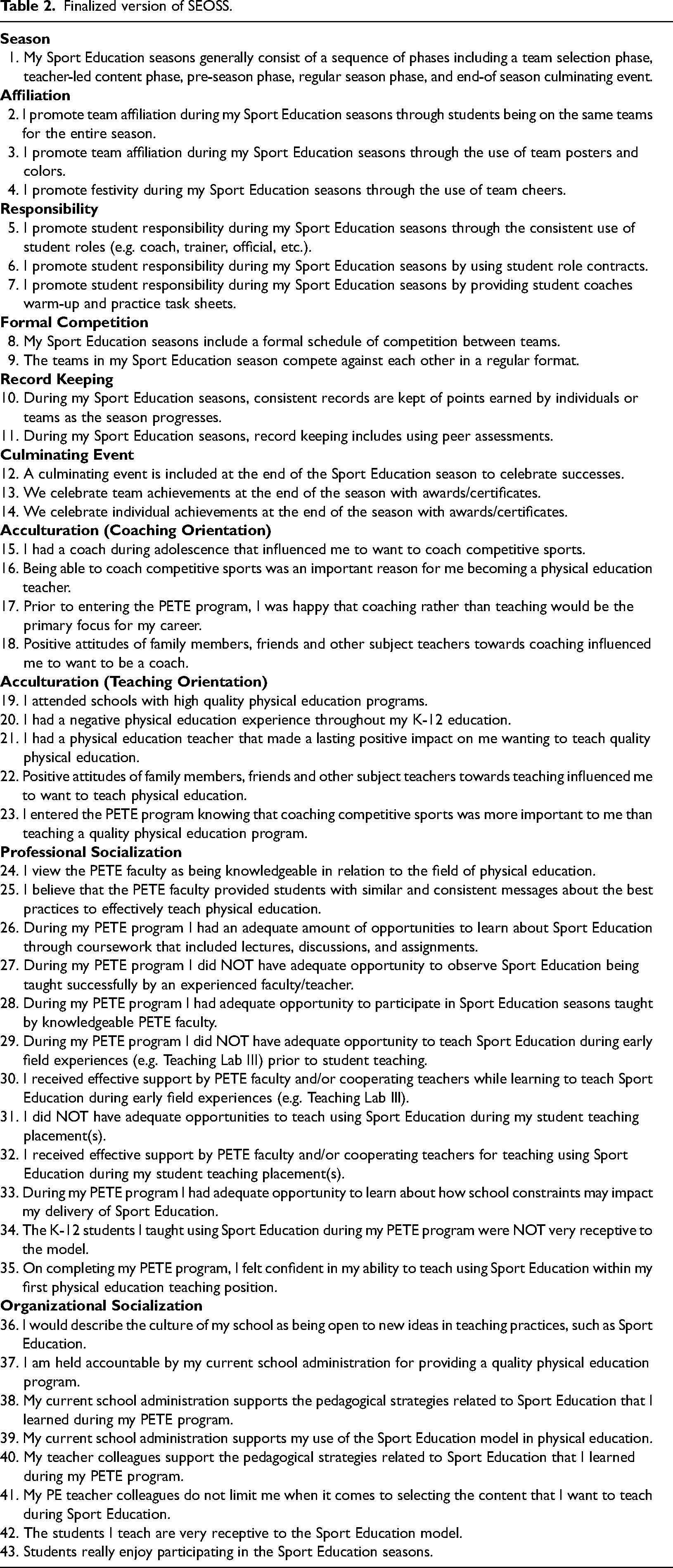
To determine initial construct validity of the SEOSS an exploratory factor analysis (EFA) was performed using the principal components method with the varimax orthogonal rotation (Hair et al., 2018). This technique tends to maximize larger coefficients to obtain construct profiles that are more easily associated with a concrete subset of items and to help facilitate interpretation of the factors obtained. This analysis was performed separately on the pre-determined set of six SE features and four occupational socialization factors included in the instrument. The criterion factor loading of higher than .50 with a secondary factor loading of not above .30 was considered acceptable (Hair et al., 2018). The EFA revealed a solution comprising of ten factors, which accounted for 58.3% of the total variance in the items. Table 1 presents the factor loading of each of the items for each factor. Items were included in subsequent analyses if they had a primary factor loading higher than .50 on the factor aiming to measure. The SE “festivity” factor was removed from subsequent analyses as one of the items loaded more coherently on the “affiliation” and the other did not load sufficiently on any SE factors. The SE factor of a “season” was reduced to a single item, which has psychometric limitations. The final SEOSS instrument used for subsequent analyses consisted of 43 items (Table 2).
Finalized version of SEOSS.
Data analyses
Data were initially screened for outliers and distribution assumptions were examined. Internal consistency estimates and descriptive statistics were computed for all variables. Descriptive statistics for each SE feature were then used to initially cluster each participant into groups depicting different versions of reported model use. Curtner-Smith and colleagues (2008) suggested that there exists three versions of SE used by in-service teachers that are discriminated by the number of structural features implemented. A “full” version SE user was categorized by scoring a mean of above 5.0 (agreement) on all SE features. “Modified” SE users were grouped by scoring greater than or equal to a mean of 5.0 (agreement) on at least four of the features and “light” users scoring greater than or equal to a mean of 5.0 on three or fewer of the SE features respectively. As SE features were significantly correlated with each other a multivariate analysis of variance (MANOVA) test with post-hoc Tukey univariate analysis was used to examine possible differences in feature use across the three SE version groups.
Investigation of how occupational socialization stages predicted teachers’ reported use of SE was a major aim of this study. Simple correlations were calculated as a means to explore the basic associations between total SE use and the stages of occupational socialization of acculturation (e.g. coaching orientation, teaching orientation), professional socialization and organizational socialization. A backward hierarchical regression was conducted to further examine the relationships among the variables. Occupation socialization factors were used as predictor variables in the model and mean total SE feature use as the outcome variable. Standardized β coefficients were used as indicators of significant predictors with a p value < .05.
Results
Teachers’ reported use of SE features
Reliabilities, means and standard deviations for all SE features and occupational socialization factors are presented in Table 3. Cronbach alpha values for each of the reported SE features and occupational socialization factors revealed acceptable reliabilities (>.70, Nunally, 1978) for seven of the eight factor subscales. All reported SE features had mean scores above the mid-point of their scales. Of the SE features, season structure, formal competition and team affiliation had the highest mean scores while teachers’ use of student responsibility, record keeping, and a culminating event had mean scores below the mid-point range.
Descriptive statistics, internal consistency and simple correlations of study variables (N = 49).
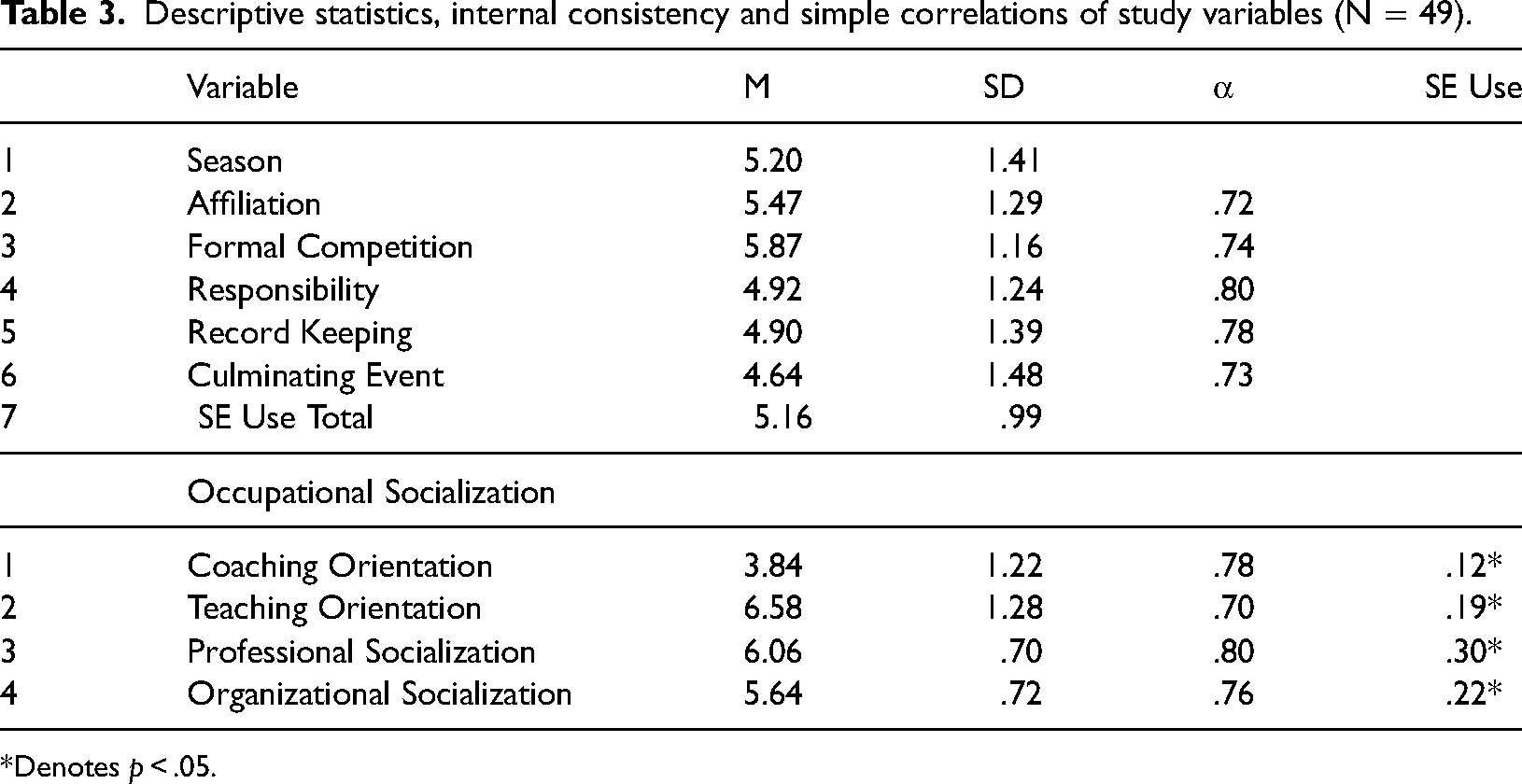
*Denotes p < .05.
Results of the initial cluster groups of SE feature use revealed a total of 10 “full” SE users, 27 “modified” SE users, and 12 “light” users of the model. Participant demographics for the three version groups are displayed in Table 4. “Full” users comprised mostly teachers teaching at the secondary or K-12 level with an equal distribution of teachers across the ranges of 1–5, 6–10, and 11–15 years of teaching experience. “Modified” SE users included predominantly teachers at either the secondary or elementary level with more of these teachers clustered in the 1–5 years of teaching experience range. “Light” SE users were equally distributed across the two school levels and generally had 10 or fewer years of teaching experience.
Participant demographics for different versions of SE users.
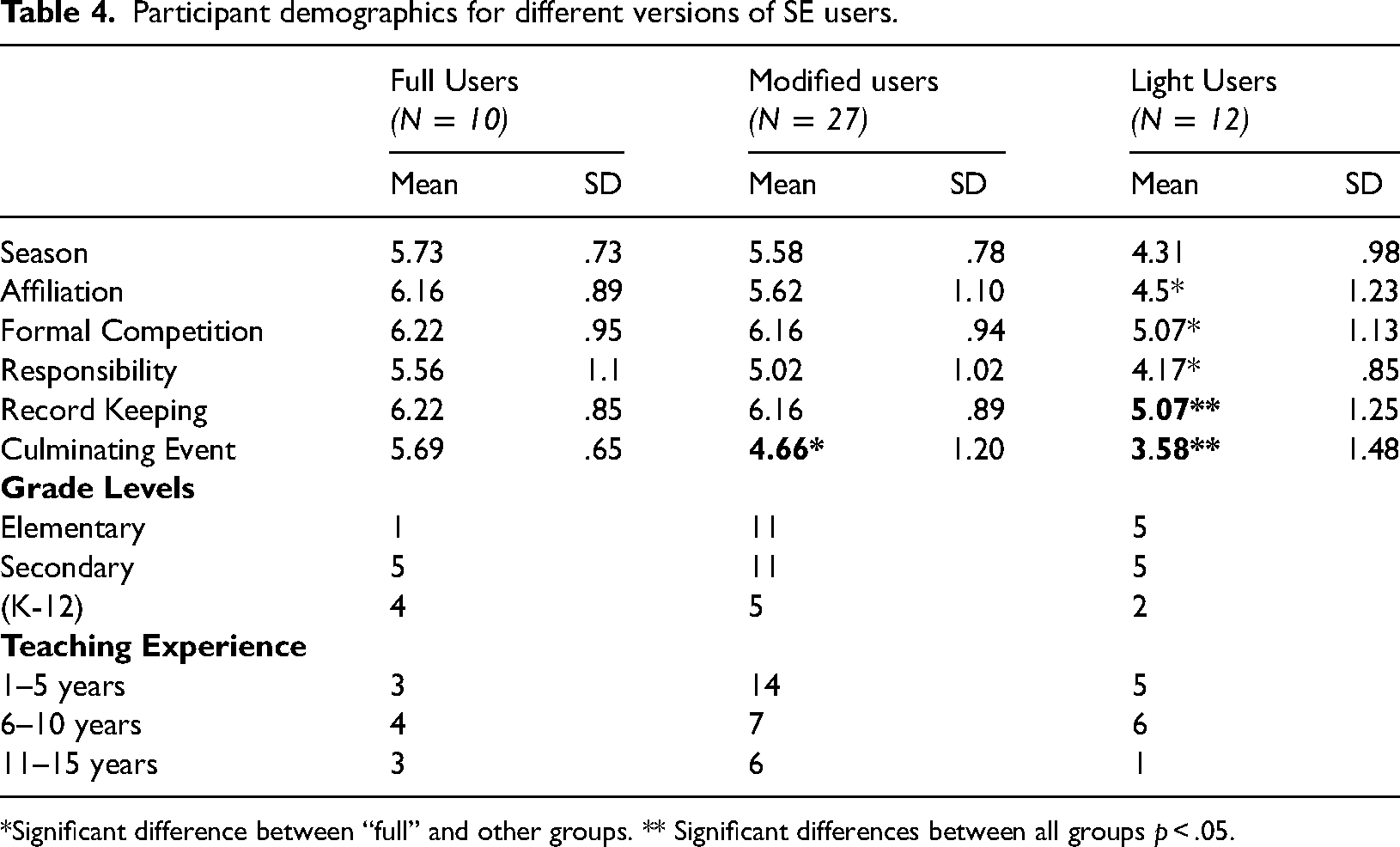
*Significant difference between “full” and other groups. ** Significant differences between all groups p < .05.
Assumption tests for the MANOVA examining SE version group mean differences in SE feature use were met, and there was a significant group effect (Wilks’ λ = 0.52, p < 0.01, η2 = .28). Table 4 shows mean scores for each SE feature across the three cluster groups. Follow-up univariate tests identified significant mean differences between the “full” use group and the “modified” use group on culminating event (F(2, 49) = 1.03, p < 0.05, η2 = .08). The “modified” version group had significantly higher mean values than the “light” use group on the SE features of season (F(2, 49) = 1.28, p < 0.05, η2 = .17), team affiliation (F(2, 49) = 1.12, p < 0.05, η2 = .18), formal competition (F(2, 49) = 1.08, p < 0.05, η2 = .25) and record keeping (F(2, 49) = 1.53, p < 0.01, η2 = .30). The “full” version group had significantly higher mean scores on all reported SE features than the “light” SE use group including for season (F(2, 49) = 1.51, p < 0.05, η2 = .21), team affiliation (F(2, 49) = 1.85, p < 0.05, η2 = .30), formal competition (F(2, 49) = 1.18, p < 0.05, η2 = .27), responsibility (F(2, 49) = 1.72, p < 0.05, η2 = .31), record keeping (F(2, 49) = 1.95, p < 0.01, η2 = .30) and culminating event (F(2, 49) = 2.35, p < 0.05, η2 = .40). It should be noted that although there was statistical significance, many of the difference effect sizes were in the small to medium range (Cohen, 1992).
Occupational socialization
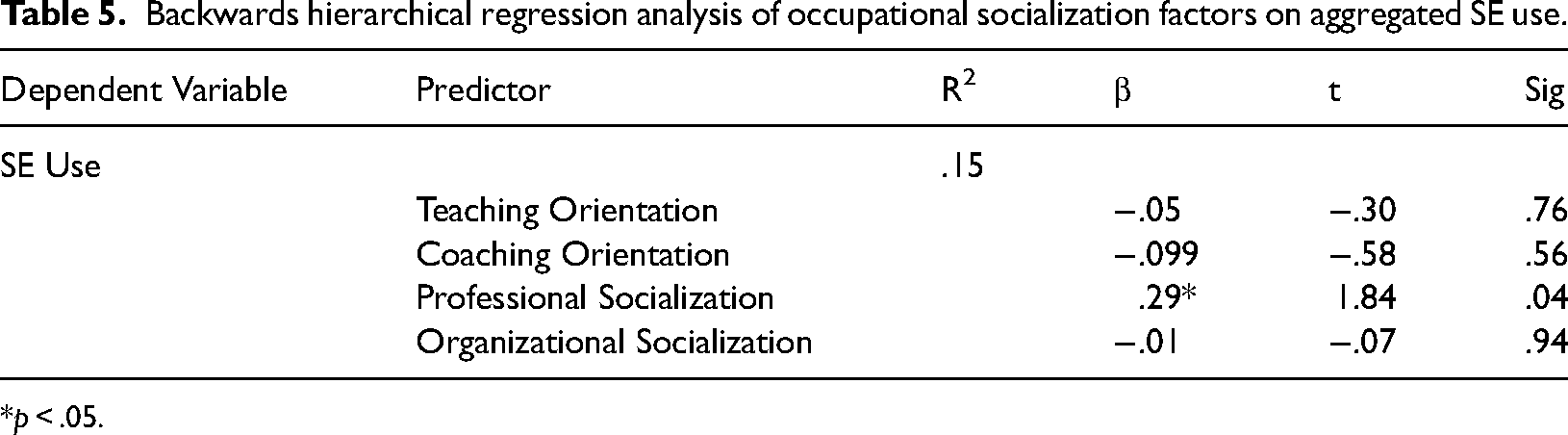
Descriptive statistics for the occupational socialization stages and correlations between these variables and total SE use are provided in Table 3. Teachers reported the highest scores for teacher orientation and professional socialization. Mean scores for reported coaching orientation was less than the mid-point of the scale. The four occupational socialization constructs had significant, positive correlations with total SE feature use ranging from 0.12 to 0.30. The strongest correlation was between SE use and professional socialization (r = 0.30), while the weakest correlation was between SE use and coaching orientation (r = 0.12). Significant correlation coefficients between aggregated SE feature use and occupational socialization factors provide support for the use of hierarchical regression analyses. Results of the backward hierarchical regression analysis of occupational socialization factor on SE model use are depicted in Table 5. The regression model predicting total SE use produced a significant model (F(1, 49) = 82.70, p < 0.01, R2 = .15). For teachers who reported using the SE model in their teaching, professional socialization was the only independent variable that elicited a significant β coefficient (.29).
Backwards hierarchical regression analysis of occupational socialization factors on aggregated SE use.
*p < .05.
Discussion
This study represents the first time a quantitative research design has been used to examine a larger sample of in-service teachers’ reported use of SE and the various occupational socialization stages that predicted this feature use. Specifically, the study examined the relationship between current use of SE features and occupational socialization stages among 49 in-service physical education teachers who had been trained to use SE within their PETE preparation program.
Teachers’ reported use of SE
Findings of the study suggest that the majority of in-service teachers reported implementing a version of SE that included many of its structural features. This finding is encouraging in light of recent occupational socialization literature, which has suggested that many beginning teachers suffer reality shock and washout of their teaching practices as they move from teacher preparation programs to school contexts (Richards et al., 2013). Analysis of the teachers’ reported implementation of specific features of the model revealed that users clustered into three main groups, namely “full”, “modified”, and “light” users. The “full’ SE use group of teachers reported consistently delivering the pedagogies associated with all of the key features of the model. The existence of this group indicates the potential of a well-designed PETE program to be a catalyst for the direct transfer of student-centered pedagogical strategies taught in teacher preparation to school-based practice. This finding also lends credence to the supposition that effective teacher preparation programs are the training ground for teachers’ professional practice. “Full” SE users were distributed across the range of years of teaching experience; however, all of them taught within the secondary teaching context. The specific focus of the PETE program experienced by these in-service teachers may explain this contextual nuance. Although the program emphasized a progressive K-12 SE learning experience, the early field experiences where the PTs practiced using the model in schools were predominantly with secondary aged students. For example, during the secondary methods practicum, PTs were required to deliver four consecutive SE seasons in either a middle or high school context, which included assessment of their implementation of the benchmarks associated with each structural feature. This experience may have influenced the teachers’ perception that SE is most appropriate within secondary contexts. Hordvik and colleagues (2019) have emphasized the importance of this experiential learning phase in developing the necessary skills, knowledge and confidence for teachers to deliver SE.
The majority of in-service teachers reported using a “modified” version of SE. These teachers taught across the elementary and secondary contexts with more than half of them classified as beginning teachers in that they had fewer than five or fewer years of teaching experience in schools. Analyses across these groups revealed that the structural features of SE implemented included a season format, formal competition, team affiliation, record keeping, and student responsibility. The primary SE feature that “modified” users tended to omit from their implementation of the model was a culminating event. This characteristic version of SE resonates with previous research conducted with beginning teachers who were classified as using a “watered down” version of the model (Stran and Curtner-Smith, 2009). These users “organized around formal competition and put on teams primarily because they perceived doing so was a good management strategy and had the roles of coach and captain being reserved for the best athletes” (Stran and Curtner-Smith, 2009, p.102). Many of these teachers retained features connected to a more traditional teacher-directed approach to presenting sports in physical education. The pedagogical skills required to deliver these specific features entail the teacher creating persisting teams within a seasonal structure (e.g. pre-season, regular season, post-season, etc.), organizing and keeping records of formal play (e.g. double-elimination tournament, round robin, etc.), and the teacher giving some, but potentially limited, student responsibility for teaching their peers. The “modified” SE version reported by these in-service teachers seemed to be more sophisticated in its implementation of some of the more student-centered features of the model including role responsibilities. Teachers reported shifting to a more facilitation role with the use of task sheets and accountabilities for student role performance. The shift towards the implementation of more student-centered pedagogies has been shown to be constrained by limited or negative previous experiences with student-centered tasks, or the challenges of a custodial school environment (Richards et al., 2014). In the case of these more experienced in-service teachers, they seem to have grown in their knowledge and comfort of how to use and adapt the student roles within their specific curricular contexts (Curtner-Smith et al., 2020). This sophistication did not seem to extend to a willingness to embrace some of the organizational components of establishing a culminating event. Recent literature has suggested that some of the features of an SE season, such as a culminating event, may require significant teacher investment in preparation, which may be viewed as beyond the scope of the teacher's expectations for teaching (Wallhead et al., 2020).
The “light” SE users in this study demonstrated similar characteristics to Curtner-Smith and colleagues’ (2008) “cafeteria” approach that beginning teachers employed in their use of SE. Within the “light” versions of the model, teachers selected specific features of SE within what appeared to be well-taught traditional sporting units. This version of SE included establishing a formal competition structure and keeping records of these events. This version represents a significant washout of the model features as the teachers moved from their professional preparation program to the organizational context of schools. Research has indicated that washout is not an all or nothing process, as some particular strategies are nurtured and some may be discarded (Blankenship and Coleman, 2009; Graber, 1998). For these “light” SE users, the nurtured features were ones that connected with their previous approaches of teaching sports in physical education and provide evidence that one or more occupational socialization stages can manifest a limited adoption of SE.
Occupational socialization
The teachers’ reported use of the SE model suggests that there were positive aspects of occupational socialization that facilitated transfer of SE from PETE to their professional practice. In the current study, acculturation was represented by separate coaching and teaching orientation subscales. Findings revealed that the teachers reflected that they had low levels of coaching orientation and higher levels of teaching orientation as they entered into the PETE program. This finding connects with Curtner-Smith and colleagues’ (2008) proposition that recruits with a moderate coaching or a teaching orientation will deliver SE to some extent (e.g. full version, watered-down or cafeteria versions) if they experience high quality SE preparation during their PETE program.
Findings of the regression analyses revealed that professional socialization was the only stage of occupational socialization that was a direct predictor of teachers’ level of use of SE. This finding contradicts Curtner-Smith and colleagues’ (2008) suggestion that, “research indicates that PETE is generally the weakest form of socialization experienced by PE teachers. Many programs appear to have no influence on their charges’ values and behaviors at all and some confirm faulty beliefs with which recruits enter” (p. 100). Participants reflected that their PETE learning of SE through coursework, early field experiences (EFEs), student teaching, and interactions with colleagues and faculty members was the most influential phase of socialization on their use of SE in their professional practice. The lack of direct prediction of current use of SE from either coaching or teaching orientations suggests that these acculturation factors may have indirect or distal influence on current teacher practice. Many of the participants reported a higher teaching orientation coming into the PETE program and it seems logical to assert that this orientation profile may have provided the necessary platform for effective professional learning during PETE, but was not a direct predictor of current teaching practices. For these teachers, their experiences and interactions within PETE provided a greater influence on their daily decisions for if and how they would use the SE model.
Graber (1996) investigated a high impact teacher education program and found nine program features that were associated with students appearing to retain key facets of the PETE program. Those facets included: (a) thematic approach, (b) cohort groups, (c) constant programmatic reinforcement, (d) professional development courses, (e) professional conduct expectations, (f) progressive and compatible internships, (g) awareness of studentship, (h) faculty consensus, and (i) political involvement. Findings of the current study suggest the SE component of the PETE program aligned with some of these highly impactful features including cohort groups, faculty consensus and a thematic approach that provided students with a progressive curriculum focused on the delivery of SE in schools. Furthermore, these results support Curtner-Smith and colleagues’ (2008) proposal that if a recruit enters PETE with a teaching orientation, experiences high quality SE in PETE, and teaches in an innovative school culture, then that individual will likely teach fuller versions of the model.
Results also suggest that teaching responsibilities and other organizational socialization agencies did not directly predict teachers’ reported use of SE. Participants generally reported having a positive organizational socialization environment, which may have been in school contexts that did not necessarily constrain their choice of how they used SE in practice (Richards et al., 2014). In other words, the school and its active socializing agencies were not perceived as barriers to their implementation of many of the structural features of SE. These findings support contemporary viewpoints on occupational socialization, that it is a dialectic process, meaning that teachers and various socializing agents exert a reciprocal influence upon each other's beliefs and actions (Richards et al., 2014; Schempp and Graber, 1992). The results of this dialectic influence among these in-service teachers was variable and dependent on the relative match (or mismatch) of their beliefs about teaching and their experiences during PETE.
Conclusion
The findings of this study indicate that the majority of teacher respondents, who had been educated on SE within their PETE program, delivered the model to some degree within their professional contexts. Furthermore, this study provided further validation that different versions of SE manifest in practice. These versions have similar characteristics to Curtner-Smith and associates’ (2008) “full”, “watered-down”, and “cafeteria-style” iterations of SE. Of note was the significant influence of professional socialization and their experiences of a PETE program that focused on a progressive SE learning experience on their current use of the model. Despite acculturation orientations not being direct predictors of teacher practice, all SE users reported a similar profile of low levels of coaching orientation and high levels of teaching orientation prior to entering the PETE program. This finding suggests that this profile may be a distal, but potentially potent, factor in how teachers learn a pedagogical model during PETE and apply it in their professional practice. Agencies of organizational socialization did not directly predict teachers’ level of use of SE, suggesting that the school setting and/or socializing agents within their schools were not insurmountable barriers to the implementation of the model.
This study extends previous literature on in-service physical education teachers’ use of pedagogical models during their professional practice. Specifically, the current study represents the first time a survey instrument has been developed to evaluate teachers’ use of the features of SE and the stages of occupational socialization. The developed SEOSS instrument may lend itself to future research as a potential instrument to assess teachers’ use of SE and the components of occupational socialization. The findings of the study provide some potentially important implications for PETE faculty. The key finding that professional socialization was the most influential and only predictor of reported SE use is significant because it suggests that high-quality PETE can facilitate transfer of pedagogical practice. PETE faculty should explore different strategies and methods to facilitate PT learning, understanding, and implementation of the student-centered features of SE, particularly ones that tend to get washed out within iterations of the model in practice.
Limitations and recommendations
Despite the potential importance of the study in adding to the extant literature in how in-service teachers transfer their learning of pedagogical models from PETE to professional practice, a number of potential limitations should be acknowledged. One limitation was the 42% survey response rate from the potential teacher sample. This response rate may have influenced the type of SE users who responded to the survey with non-responders potentially not using the model or using it differently. Furthermore, the acculturation orientation of the respondents may have differed from the general orientation of non-responders. A second limitation was the exploratory nature of the validity and reliability of the SEOSS survey instrument. The finalized instrument did not manifest a “festivity” SE construct which has been described as an immutable feature of SE. Further, the development of more robust, multi-item latent constructs to assess SE use warrants further investigation. Future studies are also needed to confirm the validity and reliability of this initial survey instrument with a larger sample of in-service physical education teachers. A third limitation occurred in the choice to use a cross-sectional self-report survey design. Survey responses cannot guarantee fidelity of implementation of reported model features and future studies are needed that build on these findings and explore how the reported model use is enacted during teaching. Most importantly, there is a need to examine how these versions of SE align with proposed student learning outcomes such as competence, literacy and enthusiasm.
Footnotes
Declaration of conflicting interests
The author(s) declared no potential conflicts of interest with respect to the research, authorship, and/or publication of this article.
Funding
The author(s) received no financial support for the research, authorship, and/or publication of this article
