







Abstract
Physical education (PE) offers an optimal setting for promoting higher moderate-to-vigorous physical activity (MVPA) and reducing sedentary behaviour (SB). This study examines the MVPA and SB among elementary schoolchildren during an obstacle course-based PE lesson and compares it to a traditional PE lesson, with the same students participating in both conditions. Moreover, it explores how gender, age and intrinsic motivation for PE relate to time spent in MVPA and SB during PE. A sample of 251 children within 24 classes in grades 1, 3 and 5 participated in this study. ActiGraph GT3x accelerometers monitored their PA during PE, while the Behavioral Regulations in Physical Education Questionnaire assessed their motivation for PE. Multi-level regression analyses indicated that MVPA was significantly higher (p < 0.001) and SB was significantly lower (p < 0.001) during an obstacle course-based PE lesson compared to the traditional PE lesson. Boys exhibited higher MVPA (p < 0.001) and lower SB (p < 0.001) than girls, with no notable grade differences. Intrinsic motivation was positively associated with MVPA (p = 0.04). These findings suggest that children displayed higher MVPA and lower SB during the obstacle course-based PE lesson when compared to their traditional PE lesson. It could be a practical and effective strategy for improving PA behaviours, though future interventions should explore long-term impact, sustainability, and how class factors such as classroom management and teacher behaviours relate to MVPA and SB.
Keywords
Introduction
The content, teaching approaches and organisation of physical education (PE) classes are key to ensuring adequate opportunities for motor skill development and boosting children's physical activity (PA) levels (Clark, 2005). Recognising the existing concern regarding insufficient PA levels in children and adolescents, international guidelines recommend that 5- to 17-year-olds accumulate at least 60 minutes of daily, moderate-to-vigorous PA (MVPA) (WHO, 2020). This MVPA is defined as ‘any bodily movement produced by skeletal muscles that requires energy expenditure greater than three metabolic equivalents’ (i.e. 3 kcal/kg/hour) (Caspersen et al., 1985). However, in several European countries, a large proportion of children fail to meet the recommended 60 minutes of daily MVPA (Van Hecke et al., 2016). In Flanders in particular, very few (<20%) children and youth aged 5–17 years meet these guidelines (Aubert et al., 2018). These percentages underscore the need for initiatives aiming to promote MVPA levels in children.
While PE classes are crucial for promoting PA by providing children with the necessary skills, knowledge and attitudes needed to lead a physically active life (Hills et al., 2015; Pate et al., 2006), it seems that the optimal balance between motor skills and PA, demonstrations, equipment organisation, group dynamics and corrective feedback to meet the PA recommendations has not been found yet (Hollis et al., 2016; Trost, 2004). Pate et al. (2006) suggest schools should ensure every child engages in at least 30 minutes of MVPA during the school day, including time spent actively in PE classes. Expert panels in both the United States and the United Kingdom have advised that the primary objective for physical educators is to ensure that children are actively participating in MVPA for a minimum of 50% of the PE class time (Harris, 2015; Lee, 2011). They state that this could be attained with efficacious planning, coherent management and organisation of students and equipment (Harris, 2015). Moreover, they also highlight the risks associated with excessive sedentary behaviour (SB). In addition to promoting MVPA, minimising SB is crucial (Harris, 2015; WHO, 2020). SB is defined as ‘any waking behaviour while in a sitting, reclining, or lying posture with low energy expenditure’ (WHO, 2020). It is strongly recommended to limit or reduce this behaviour, as doing so should lead to an increase in light-intensity PA (LPA) (Harris, 2015) and provide health benefits (WHO, 2020).
Several studies investigated MVPA levels during PE, ranging from 28.89% to 57.60% of MVPA, depending on the measurement method (e.g. accelerometers versus direct observation) (Cardon et al., 2004; Cheval et al., 2016; Fairclough and Stratton, 2006; Hollis et al., 2016). However, these studies only focused on the MVPA of children during elementary school PE but not on SB. Moreover, a systematic review by Egan et al. (2019) examining SB throughout the whole school day revealed that none of the six studies focusing on PE reported sedentary data for time spent in PE classes. Additionally, Mooses et al. (2017) and Salin et al. (2019) highlighted that among 7- to 12-year-olds, only one-third of PE time was spent in MVPA, with another third in SB and the remainder in LPA (Mooses et al., 2017). Similarly, 11-year-olds spent 23.3% of PE time in MVPA, 39.3% in LPA and 37.0% in SB (Salin et al., 2019). Given that curricular PE can serve as a platform within schools to influence movement behaviours, including the need to reduce SB (Wong et al., 2021), there is a pressing need for further research on appropriate school-based PE interventions targeting PA and SB among school-aged children. This dual focus can identify areas where PE classes may be failing to engage children fully and offer insights into optimising PE class design to reduce SB. Therefore, the current study can contribute to a more comprehensive understanding of the role PE can play in fostering movement behaviours in children. Specifically, it examined whether the degree of engagement in MVPA was higher and SB was lower when children participated in an obstacle course-based PE program specifically designed to enhance elementary school children's motor competence and autonomous motivation, compared with their participation in traditional PE (van Hyfte et al., 2025; under revision). In addition, it examined whether children's MVPA and sedentary levels during PE were related to gender, age (inter-grade differences) and intrinsic motivation for PE.
A child's intrinsic motivation level, which involves engaging in activity for inherent satisfaction rather than external rewards (Deci and Ryan, 2000), is a crucial correlate of their PA participation (Boiché et al., 2020; Carriedo et al., 2023; Escriva-Boulley et al., 2018; Juwono and Szabo, 2020; Pulido et al., 2021). Self-determination theory (SDT) offers a valuable framework for understanding how motivation relates to PA behaviours in PE classes. According to SDT, children are more likely to persist in activities driven by intrinsic motivation rather than those influenced by external pressure or rewards. When children's basic psychological needs for autonomy (i.e. feeling in control of one's actions), competence (i.e. feeling capable and effective) and relatedness (i.e. feeling connected to and accepted by others) are met, motivation becomes more self-determined (Deci and Ryan, 2000), leading to lower SB during active PE periods (Boiché et al., 2020). An autonomy-supportive environment in PE, based on SDT, fosters engagement and motivation (Carriedo et al., 2023; Escriva-Boulley et al., 2018; Juwono and Szabo, 2020), which plays a key role in regulating children's behaviours and reducing SB (Boiché et al., 2020; Pulido et al., 2021). Research aimed at boosting MVPA and motivation has shown that offering children choices in PE classes is an effective strategy that also reduces SB (Lonsdale et al., 2013b). More recent research by Menescardi et al. (2022) identified a direct positive pathway from intrinsic motivation to PA in 8- to 12-year-olds. However, intrinsic motivation for PE tends to decline in the elementary years (Chanal et al., 2019), highlighting the need for PE programs that explicitly address children's intrinsic motivation to sustain MVPA and limit SB.
Successful outcomes were observed from interventions designed to increase PA during PE, where an increase in children's MVPA time ranging from 10% to 14.30% was reported (Fairclough and Stratton, 2006; Hollis et al., 2016; Verstraete et al., 2007; Wong et al., 2021). A common feature among these interventions was the involvement of specialist PE teachers, expert instructors or class teachers who had undergone relevant training to use the programs. These interventions incorporated high-intensity activities (i.e. fitness infusion) or physically active games (Wong et al., 2021), along with modified curricula focusing on enjoyable and motivating PE lessons. Additionally, these teachers received in-service training, often based upon the framework of SDT (Escriva-Boulley et al., 2018; Juwono and Szabo, 2020; Wong et al., 2021).
Apart from the nature of the PE lesson, certain individual factors like gender and age are known to significantly contribute to variability in children's MVPA levels. Boys generally exhibited higher activity levels than girls (Cheval et al., 2016; Escriva-Boulley et al., 2018; Fairclough and Stratton, 2006), while findings on age-related differences were mixed. Johnson et al. (2017) reported increases in MVPA across grades, while Cheval et al. (2016) observed decreases. Fairclough and Stratton (2006) identified a trend towards increased activity, though this was not consistently supported across all studies. This variability in findings across different grades in elementary school suggests the need for further investigation.
Given that PE plays a crucial role in relation to children's movement behaviours, further research investigating how MVPA, SB and movement skill competence evolve when exposed to theory-based interventions, is needed (Lai et al., 2014). As such, we developed and implemented an obstacle course-based PE curriculum (van Hyfte et al., 2021). A logic model outlines the theoretical framework, key components and expected pathways through which the obstacle course-based PE program was designed to enhance motor competence, foster autonomous motivation, increase MVPA and reduce SB (see Figure 1).
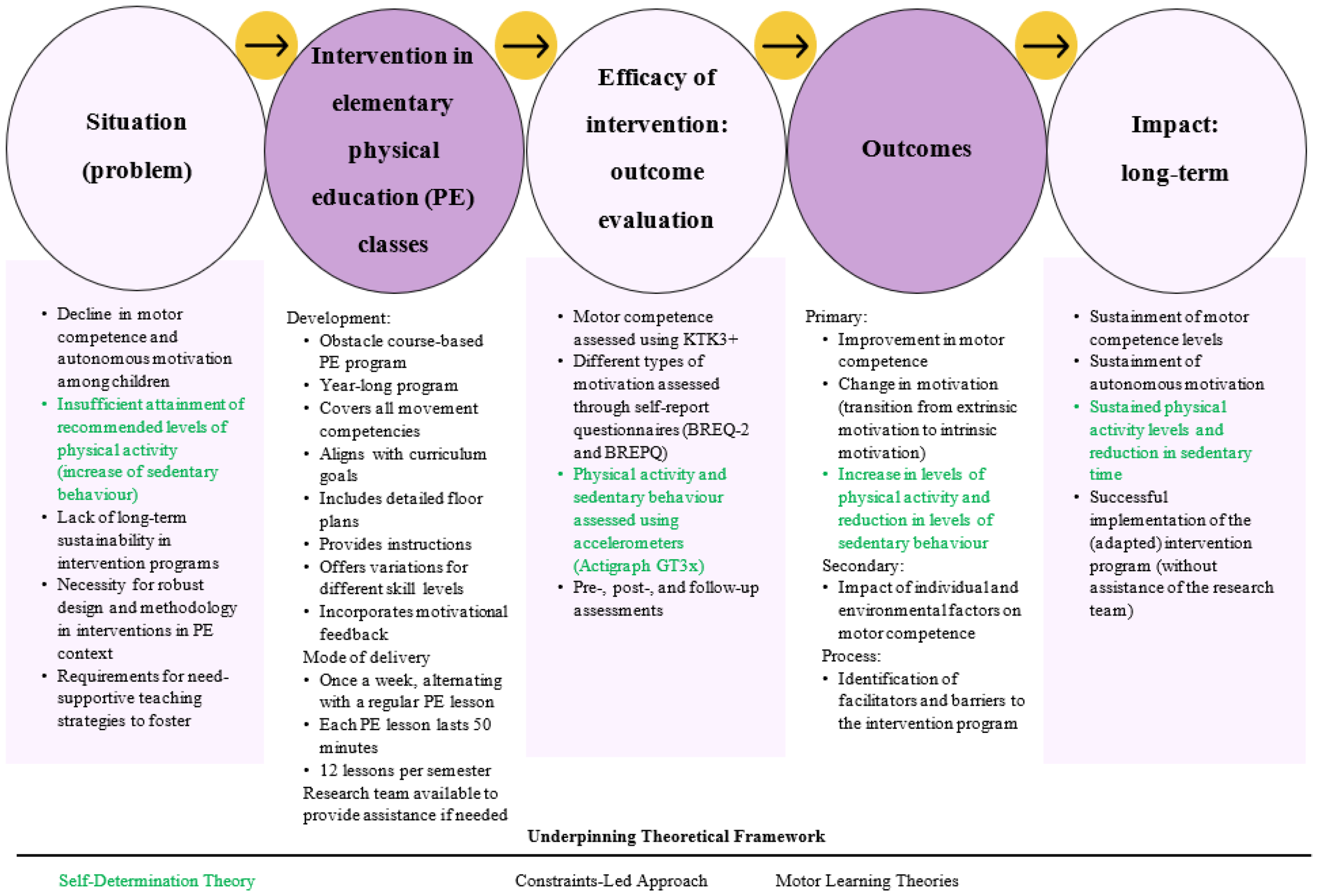
Logic model of the obstacle course-based physical education program.
Building on the previous study (van Hyfte et al., 2021) and ongoing research (van Hyfte et al., 2025; under revision), this study addressed a gap in the literature regarding the limited reporting of SB data in the context of PE classes (Egan et al., 2019). Additionally, it tackled the ongoing challenge of finding the optimal equilibrium between motor skill development and meeting the recommended guideline of 50% of PE class time spent in MVPA (Hollis et al., 2016; Trost, 2004). By doing so, this theory-based intervention program aimed to increase MVPA levels and reduce SB in PE lessons. Therefore, the main purpose of this study was to examine differences in MVPA levels and SB between an obstacle course-based PE program and a traditional PE program, with the same children participating in both. It was hypothesised that children following the obstacle course-based lesson would spend more time in MVPA and would demonstrate lower levels of SB than children following the traditional PE lesson. This hypothesis was based on the curriculum concept and didactical principles (van Hyfte et al., 2021), which are rooted in SDT, emphasising fostering intrinsic motivation through a need-supportive environment to increase MVPA (Boiché et al., 2020; Carriedo et al., 2023; Escriva-Boulley et al., 2018). As PA behaviour seems to vary based on child characteristics such as gender and age (Cheval et al., 2016; Fairclough and Stratton, 2006), we further aimed to explore gender and age (inter-grade) differences in relation to MVPA and SB. Finally, we aimed to explore whether the intensity of children's participation in PE lessons was associated with their intrinsic motivation for PE. It was hypothesised that higher levels of intrinsic motivation for PE would be positively associated with MVPA and negatively associated with SB, given that intrinsic motivation is an important predictor of PA (Boiché et al., 2020; Menescardi et al., 2022; Pulido et al., 2021).
Methods
Setting and participants
A total of 274 children participated in both an obstacle course-based PE lesson and a traditional PE lesson, including 131 girls (47.81%) and 143 boys (52.19%) from 15 schools. 1 Data was collected from 89 children (32.48%) from the first grade (ngirls = 36 (40.45%), nboys = 53 (59.55%)), 90 children (32.85%) from the third grade (ngirls = 43 (47.78%), nboys = 47 (52.22%)), and 95 children (34.67%) from the fifth grade (ngirls = 52 (54.74%), nboys = 43 (45.26%)), spread over 24 classes. While information was gathered from all the 274 children participating in the study, only those who wore the accelerometer in both conditions (i.e. obstacle course-based PE program and traditional program) were included in the analysis (N = 251). The remaining 23 children, who wore the accelerometer only once, were excluded due to missing data (N = 23). At the start of the study, the mean age of the first graders was 6.33 ± 0.41 years, of the third graders was 8.54 ± 0.51 years, and of the fifth graders was 10.48 ± 0.52 years. On average, there were 20.46 ± 3.66 children per class (20.67 ± 4.52 children in the first grade, 18.63 ± 2.88 children in the third grade and 22.29 ± 2.33 children in the fifth grade). The study involved 15 PE teachers, all of whom held a bachelor's degree. The teachers’ ages ranged from 26 to 58 years, with a mean age of 36.94 ± 8.49 years. Of the teachers, 80% were male, and their mean teaching experience was 11.14 ± 7.74 years, ranging from 1 to 25 years. Both the school principals and the PE teachers, along with the parents of the participating children, completed a written informed consent form. The study was approved by the ethical committee of Ghent University (EC: 2020/78).
PE program: obstacle course-based PE program versus traditional program
In Flanders, two 50-minute PE lessons per week are compulsory for all children between the ages of 6 and 18 years and are mostly led by qualified teachers (Overheid, 2023b). Within this limited lesson time, teachers are tasked with the achievement of multiple objectives, as described in the compulsory PE curriculum in Flanders (Overheid, 2023a). These multiple objectives encompass the development and mastery of fundamental movement skills, fostering a healthy and active lifestyle, and nurturing cognitive and social skills, along with the necessary attitudes towards PA to promote overall well-being. In traditional PE, teachers have the autonomy to guide children towards these objectives; thus, the learning content is determined by the teacher. It is structured around 10 learning lines, as outlined in the Flemish curriculum (Overheid, 2023a) (i.e. balancing, climbing, hanging, rotating, jumping, running, throwing and catching, sports and games, rhythmic and expressive movement, and swimming). Each lesson typically focuses on a single learning line. In contrast, our obstacle course-based PE program incorporated three learning lines per lesson, with three separate zones designed to target different movement skills. For example, zone 1 was the obstacle course zone, which focused on learning line A (e.g. running and running jumps) and was prominently featured in each lesson. The obstacle course itself was constructed based on a theoretical framework (see Figure 1), as detailed in van Hyfte et al. (2025; under revision). It provided a dynamic movement landscape where children navigated through various movement stages, encouraging active engagement with attention to fostering autonomy and competence. Additionally, zone 2 was a (sports play) game zone with focus on learning line B (e.g. goal-oriented game ‘throw and hit’), where games were selected to ensure all children could participate. Finally, zone 3 was another movement skill zone focusing on learning line C (e.g. climbing) to develop various movement skills. The fitness component was higher in one lesson (zone) than in another depending on the subject (main goal) offered. A detailed description of the program can be found in van Hyfte et al. (2021). Differentiation was provided in grades 1, 3 and 5 to challenge each child during the obstacle course-based PE lessons. For example, younger children were provided with simpler versions of the obstacle course or games, while older children faced more complex tasks requiring higher levels of skill and coordination. Each lesson featured a general introduction, a floor plan, indications of the goals from the Flemish education network, a description of the sports equipment, and detailed instructions to be given by the teacher accompanied by motivational feedback. Additionally, variations and rules for each part of the lesson were provided, along with warm-up and cool-down routines, similar to traditional PE lessons. Instructional strategies aimed to minimise interruptions to teaching time, with all instructions being given before each lesson. Children were organised into small groups (approximately eight children per group), spending 10 minutes in each zone before transitioning to the next. Transitions were timed to maximise activity. Teachers were instructed to prompt children to move immediately upon signal, avoid queuing by allowing all children to participate simultaneously and apply didactical principles (e.g. adjusting the size of the playing area and modifying team sizes) to optimise teaching efficiency (Harris, 2015). Assistance from the research team was not needed to implement the curriculum, as the principles and approach were thoroughly outlined in a manual provided for the teachers. The intervention program consisted of 12 lessons provided to the intervention group's PE teachers to implement once a week, alternating with one traditional (non-obstacle course) lesson.
Procedure
The study was conducted during elementary school PE sessions during the COVID-19 pandemic, which involved numerous restrictions (e.g. during some lessons children had to wear a mask) and lockdowns. The intervention followed the Flemish education system's school calendar, running from September 2021 to June 2022. Implementation began at the start of the school year. Between December 2021 and April 2022, each school was visited twice to measure the activity levels of the same children: once during an obstacle course-based PE lesson and once during a traditional PE lesson without an obstacle course.
PA measurement
To assess children's PA levels, ActiGraph GT3x accelerometers were utilised. The ActiGraph GT3x accelerometer is a reliable and valid instrument for measuring the duration, frequency and intensity of PA in children (Evenson et al., 2008; Trost et al., 2006). This triaxial accelerometer is omnidirectional and sensitive to movements in all three perpendicular directions (axes), ensuring accurate and consistent measurements. The available accelerometers (n = 15 in total) were randomly assigned to children present on study days, ensuring equal distribution by gender. Whenever possible, the same children wore the accelerometer during the second visit. Children wore the accelerometer on the right hip using an elastic belt, applied by the researcher at the start of the lesson (after changing clothes, just before the teacher's instruction began). Immediately after the lesson, the accelerometers were collected, and the children individually completed a motivation questionnaire supervised by a research assistant, which took approximately 10 minutes. The ActiGraph GT3x accelerometer records the amplitude and frequency of movement at fixed intervals, known as ‘epochs’, which were set at 1-second intervals. This epoch length is considered the most suitable for detecting short bursts of intense PA, as most bouts in the light-to-vigorous intensity range last only a few seconds. Compared with longer epoch intervals, more periods of activity in the lower (SB) and higher-end (MVPA) of the intensity spectrum might be lost (Aadland et al., 2020; Evenson et al., 2008). Using ActiLife software v.6.13.5, the collected accelerometer data was downloaded, and these epoch lengths were converted into ‘activity counts’. Subsequently, these activity counts were interpreted to determine the time spent in SB and MVPA using specific cut-off points. The cut-off points for PA in youth (6–16 years), as defined by Evenson et al. (2008), were applied to estimate the time spent in SB (<100 counts per minute) and MVPA (>2.296 counts per minute). To determine the percentage of time spent in MVPA during the PE lesson, the raw time scores were converted into a percentage by dividing them by the actual lesson time. This actual lesson time excluded periods spent walking or driving to the gym and changing clothes. This approach facilitates comparison between classes based on percentages. The same calculation method was employed to determine the time spent in SB.
Motivation for PE measurement
Children's intrinsic motivation for PE was assessed using the Behavioral Regulations in Physical Education Questionnaire (BRPEQ), which was validated in previous research in the context of PE (Aelterman et al., 2012) and is an adapted version of the Behavioral Regulations in Exercise Questionnaire (BREQ-II) (Markland and Tobin, 2004). The items related to intrinsic motivation start with the stems ‘I participated in the last PE class because…’, ‘I found this PE class enjoyable…’, ‘I derived enjoyment from this PE class…’ and ‘I found this PE class fun’. Children responded to each of the items via a 5-point Likert scale ranging from 1 (not at all true for me) to 5 (very true for me).
Adherence to the obstacle course-based PE program
To assess the lesson content and monitor teachers’ adherence to the obstacle course-based PE program, lessons were video-recorded by the research team using digital camcorders. To capture a wide view of the ongoing class, the camcorder was positioned on a fixed spot in the gymnasium, while teachers were equipped with small microphones affixed to their shirts. Nine out of 15 (i.e. 60%) videotapes were observed and assessed by the first author. The observation recorded whether the teacher accurately followed the program specifications as outlined in the procedure. Compliance was coded using a binary system (e.g. ‘yes’ or ‘no’) based on observed adherence to the guidelines (Field, 2024). The fidelity check evaluated the presence of key aspects of the obstacle course, including (a) three zones, (b) a pathway with a return route, (c) a minimum of six obstacles to overcome, (d) two turning points to reduce speed and (e) continuous child activity without waiting for the previous child to start. No systematic fidelity check was conducted for the traditional PE lessons.
Data analysis
To account for the hierarchy in the data, multi-level analyses were employed with pupils at the first (N = 251) level, nested within classes (N = 24) at the second level and classes nested in schools (N = 15) at the third level. To examine differences in MVPA and SB in the obstacle course-based program compared to the traditional program, two sets of analyses were performed with MVPA and SB as two different dependent variables. In all multi-level regression models the variance partition coefficients and intraclass correlation coefficients for each model were calculated to quantify the extent to which data at a lower level were correlated and to assess the influence of higher-level units on the overall variation in our outcome (dependent) variable (Leckie, 2013; Lüdtke et al., 2009). Building the model with a multi-level structure with three layers resulted in a significant fit (two-level model χ2(0) = 43.037; p < 0.001), whereas the three-level structure yielded a comparable level of significance (χ2(0) = 0.173; p < 0.001). First, to assess the extent of the variation in the percentage of lesson time spent in MVPA attributable to different levels (children, class and schools), a three-level null model (M0) was initially estimated, incorporating only an intercept without explanatory variables. Subsequently, predictors were added to this null model in a stepwise manner. In the first model (M1), the condition was included as a predictor, with the traditional PE program serving as the reference category (Model 1). Thereafter, gender and grades were introduced both separately into the model with girls as the reference category in Model 2, and grade 1 and grade 3 as reference categories in Models 3a and 3b, respectively. Additionally, in Model 4, intrinsic motivation was entered as a predictor, grand-mean centred (i.e. around the overall mean) to evaluate its relationship with MVPA (Brincks et al., 2017; Lüdtke et al., 2009). Grade 1 served as the reference category in all a-Models (3a and 4a), while grade 3 was the reference category in all b-Models (3b and 4b). The same multi-level analysis was conducted with time spent in SB as the dependent variable. Given that PE lessons involve engagement across different subcomponents of the PA intensity continuum, a supplementary multi-level analysis incorporating LPA as a dependent variable was constructed. This analysis aimed to elucidate the distribution of time spent in LPA, enabling a comprehensive examination of SB, LPA and MVPA levels across the two conditions (i.e. obstacle course PE lesson versus traditional PE lesson). The significance level was set at p < 0.05 for all analyses, and MLwiN version 3.02 software (Charlton et al., 2017) was used for all statistical procedures. A fidelity check analysis was conducted by calculating the mean percentage of adherence from the observed videotapes, representing the proportion of lessons in which the teachers complied with the key aspects of the program, coded using a binary system (Field, 2024).
Results
The distribution of time spent in SB, LPA and MVPA between the two conditions is illustrated in Figure 2. No significant differences in LPA were found between the two conditions (p = 0.281). The average actual PE lesson time (i.e. lesson time excluding transition periods) was 38.27 ± 8.47 minutes. Additionally, the overall mean intrinsic motivation score was 4.26 ± 0.90 (on a 5-point Likert scale).
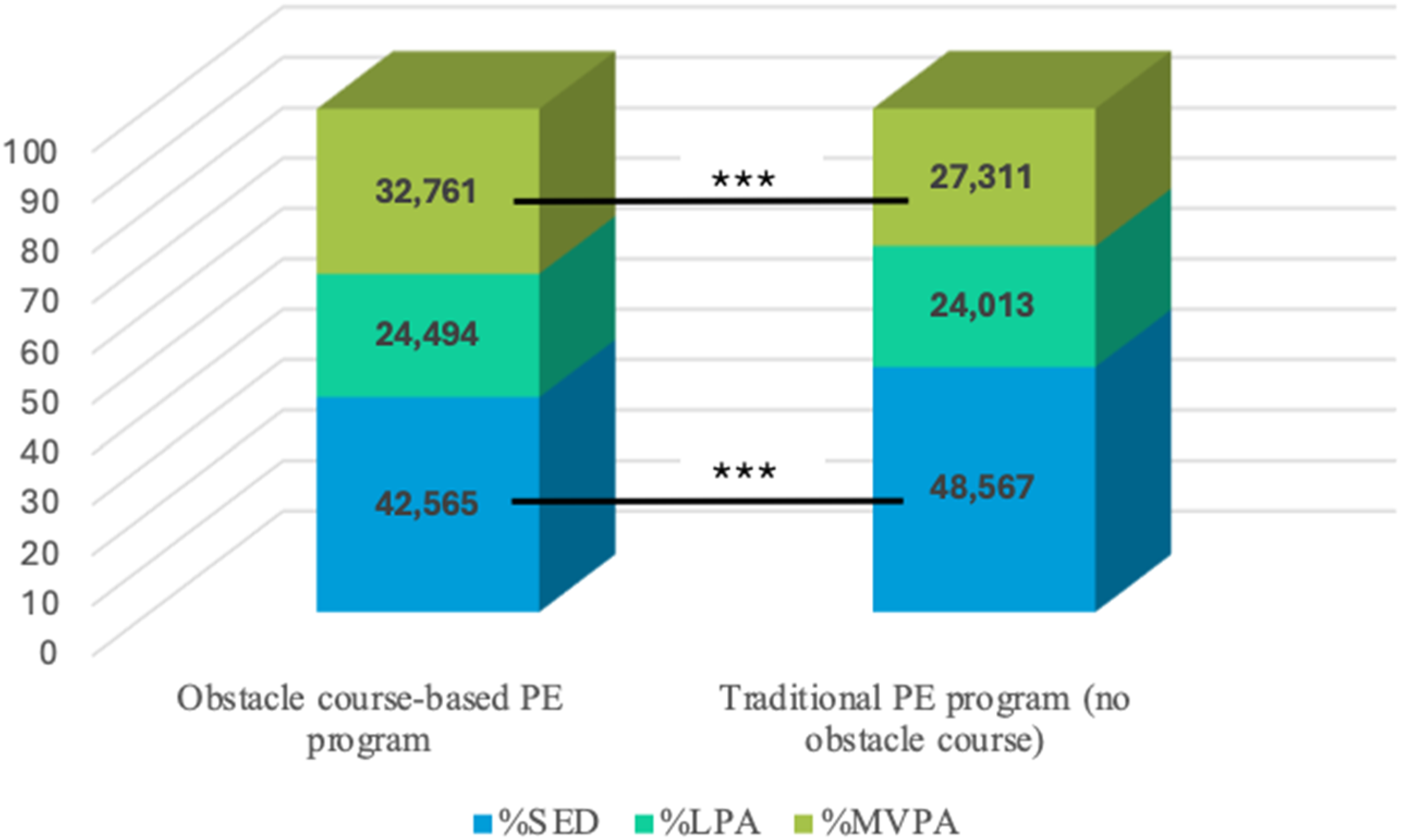
Representation of the different subcomponents of the physical activity intensity continuum in both conditions.
MVPA
The primary outcomes regarding the percentage of lesson time spent in MVPA are detailed in Table 1. The null model revealed that 82.65% of the variability was accounted for by pupil differences (p < 0.001) and 14.89% was accounted for by class differences (p < 0.05), whereas school-level differences were not significant (2.45%, p = 0.18). On average, children spent 30.05% (±0.83) of the lesson time in MVPA, which equates to approximately 11.50 minutes, with barely any children achieving the recommended amount of MVPA during the PE lesson (1.69% of the girls and 1.50% of the boys). Regarding the primary aim of the study, children in the obstacle course condition spent a significantly higher percentage of time in MVPA (b = +5.450 ± 0.63, p < 0.001; 32.76%, equivalent to 12.54 minutes) compared to the traditional program (27.31%, equivalent to 10.45 minutes), as shown in Figure 2. To further explore gender and age differences, the effect of gender was examined and found to be significant (p < 0.001), with boys demonstrating significantly higher MVPA levels (b = +2.615 ± 0.065; 28.53%) compared to girls (25.92%). The addition of grade in Model 3 did not improve the model (χ2(4) = 2.208; p = 0.697), indicating no significant difference in MVPA among the different grades. Concerning the third aim of the study, the addition of intrinsic motivation in Model 4 did not improve the model (χ2(5) = 4.212; p = 0.519). However, a small but significant positive relation was found between children's intrinsic motivation and children's MVPA during PE classes (b = 0.759 ± 0.037; p = 0.04).
Multi-level model of the percentage of PE lesson time spent in MVPA.
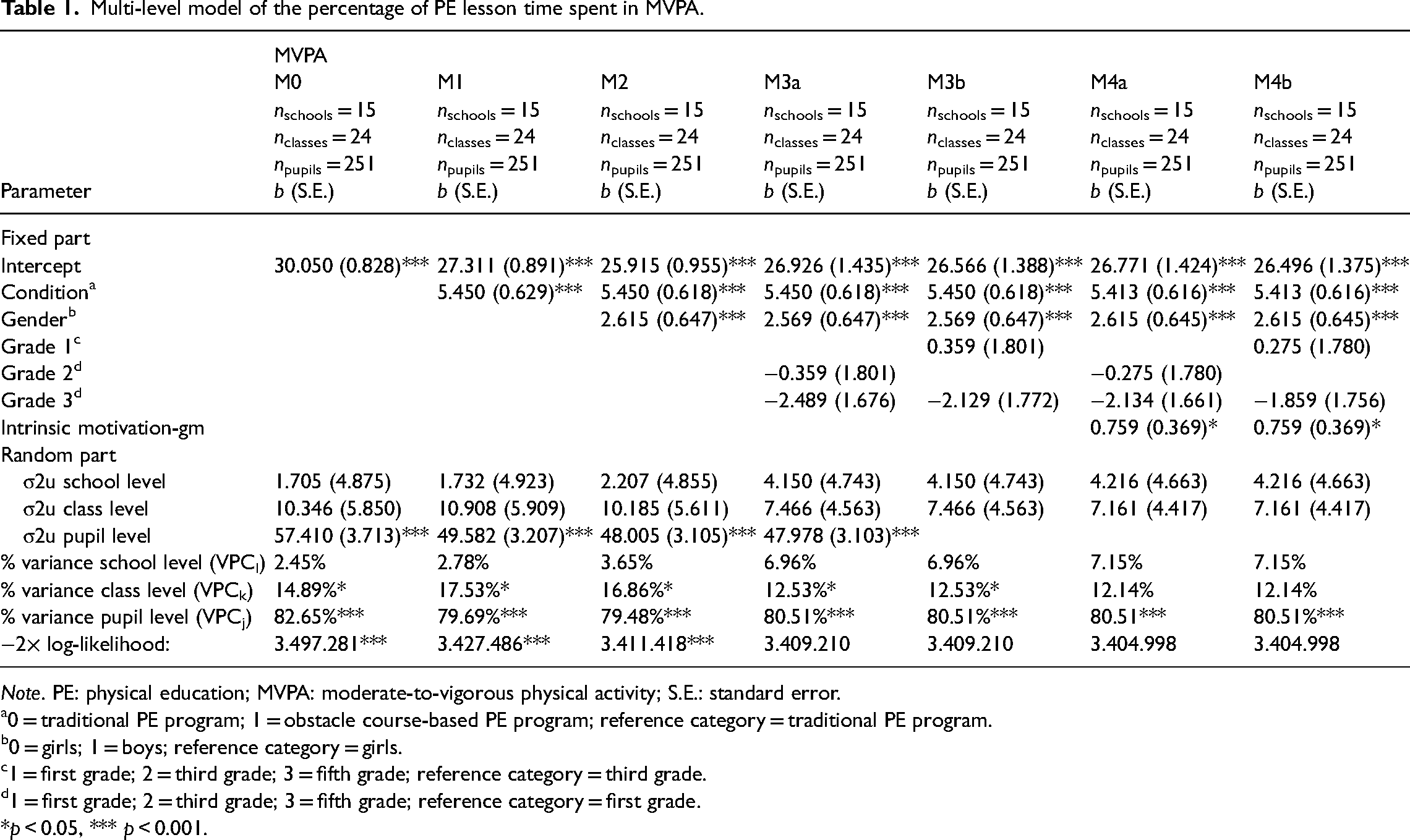
Note. PE: physical education; MVPA: moderate-to-vigorous physical activity; S.E.: standard error.
0 = traditional PE program; 1 = obstacle course-based PE program; reference category = traditional PE program.
0 = girls; 1 = boys; reference category = girls.
1 = first grade; 2 = third grade; 3 = fifth grade; reference category = third grade.
1 = first grade; 2 = third grade; 3 = fifth grade; reference category = first grade.
*p < 0.05, *** p < 0.001.
SB
The findings regarding time spent in SB are outlined in Table 2. The three-level null model for SB revealed an intercept of 45.55 ± 1.11, representing the average % time spent in SB for all children, irrespective of the type of PE lesson. Pupil-level factors accounted for 82.45% of the variance in SB (p < 0.001), while variance at the class and school levels was not significant, revealing that neither class nor school influenced children's SB. In the first model, the predictor condition entered and was found to be significantly related to children's SB. The SB of the children in the obstacle course-based PE program was significantly lower (b = −6.002 ± 0.78; p < 0.001; 42.57%, equivalent to 16.29 minutes) compared to that of children in the traditional program (48.57%, equivalent to 18.59 minutes), as shown in Figure 2. Pupil-level factors accounted for 80.1% of the variability in time spent in SB. In the subsequent model (Model 2), gender was entered as a predictor, resulting in a highly significant model fit (χ2(2) = 21.933; p = 1.271 × 10⁻⁵). Upon closer examination, a main effect of gender was found, revealing that boys were significantly less sedentary than girls (46.82% versus 50.60% of lesson time spent in SB, p < 0.001), with pupil-level variance explaining 79.36% (p < 0.001). The addition of grade in Model 3 did not improve the model fit (χ2(4) = 1.23; p = 0.873), indicating that time spent in SB did not significantly differ between the grades. Similarly, the inclusion of intrinsic motivation did not improve the model fit (χ2(5) = 0.924; p = 0.968), nor did it reveal a main effect of intrinsic motivation. In all models, pupil-level factors accounted for the variance in SB (p < 0.001), and whereas variance at the school level was not significant in Models 1 and 2, it became significant (p < 0.05) in Models 3 and 4.
Multi-level model of the percentage of PE lesson time spent in SED.
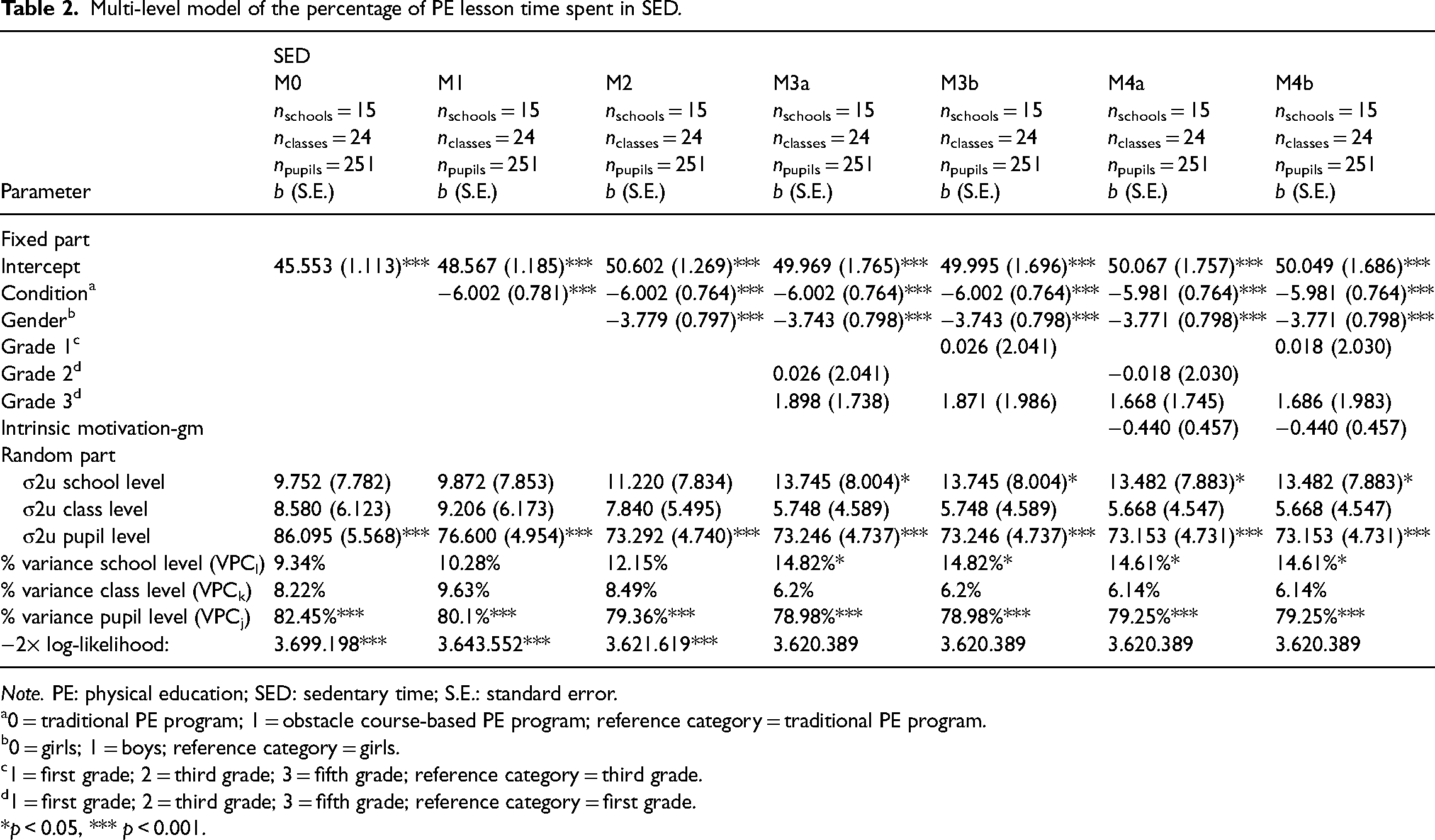
Note. PE: physical education; SED: sedentary time; S.E.: standard error.
0 = traditional PE program; 1 = obstacle course-based PE program; reference category = traditional PE program.
0 = girls; 1 = boys; reference category = girls.
1 = first grade; 2 = third grade; 3 = fifth grade; reference category = third grade.
1 = first grade; 2 = third grade; 3 = fifth grade; reference category = first grade.
*p < 0.05, *** p < 0.001.
Adherence to the obstacle course-based PE program
In 100% of the cases, the lessons were structured into three distinct zones, featuring a pathway with a return route and two turning points. In 89% of the cases, at least six obstacles were included in the course. However, the rule of continuous activity was adhered to in only 44.44% of the cases. In the remaining instances, the teachers made modifications to this rule. In addition, approximately half of the PE teachers gave excessive instruction during the obstacle course lesson, providing detailed explanations on movement execution and specific actions for each obstacle individually, rather than giving more general guidance as prescribed in the curriculum.
Discussion
Low PA levels in children constitute a global health concern (WHO, 2020). PE classes constitute one of the many factors that may contribute to children's PA (Hills et al., 2015; Wong et al., 2021). However, research indicates that it is not so straightforward to increase MVPA through PE, as PE teachers need to find the balance between motor skill development and PA promotion, providing demonstrations, managing equipment and group dynamics. Many PE lessons therefore do not meet recommended guidelines (50% of PE class time spent in MVPA) to enhance PA (Hollis et al., 2016; Trost, 2004), and reducing sedentary time in PE classes remains challenging (Wong et al., 2021). Therefore, the purpose of this study was to examine whether children's MVPA and SB levels were different during an obstacle course-based PE lesson when compared to a traditional PE lesson. Furthermore, we investigated whether differences in gender, grade and intrinsic motivation towards PE were related to variances in MVPA and SB.
Consistent with previous accelerometer-based studies that reported 28.89% (Cheval et al., 2016) and 32.60% (Hollis et al., 2016) of class time spent in MVPA, we observed that children engaged in MVPA for an average of 30.05% of the PE lesson (irrespective of the nature of the lesson). The MVPA level of 30.05% is below the recommended 50% engagement in MVPA during PE class time (Harris, 2015; Lee, 2011), with SB remaining high at 45.53%.
Regarding the difference between both types of PE lessons, the results suggest that MVPA levels were higher and SB was lower during the obstacle course-based PE lesson when compared to the regular PE lesson. In addition, since no significant differences were observed in LPA, this finding suggests a direct relationship between variations in MVPA and SB.
The obstacle course-based PE program aimed at enhancing children's motor competence and autonomous motivation (van Hyfte et al., 2025; under revision), while incorporating multiple objectives (Overheid, 2023a), as outlined in the logic model (see Figure 1). Additionally, attention was given to the adaptation of the PE curriculum, where organisation, management and instruction were considered. Regarding instruction time, efforts were made to keep it as minimal as possible. As for organisation, no time was lost reorganising materials during the lesson, as the setup allowed for continuous use. In terms of management, children were encouraged to participate in PE classes in smaller groups, with brief breaks in between transitioning from one zone to another. The implementation of these didactical principles may have further contributed to the increase in MVPA, aligning with Lonsdale et al. (2013a) who reported effective intervention strategies incorporating these principles and a decrease in SB. As such, it is encouraging that MVPA levels reached at least the level of a regular PE lesson. Differences in MVPA levels observed in the obstacle course lesson when compared to a traditional lesson were of medium effect size (Cohen's d = 0.70), which aligns with findings from existing literature (Fairclough and Stratton, 2006; Hollis et al., 2016; Juwono and Szabo, 2020; Lonsdale et al., 2013a; Wong et al., 2021). Notably, Fairclough and Stratton's (2006) review reported a larger average effect size of 0.80 across 27 analyses of PE interventions aimed at increasing PA. In contrast, the differences found in our study were less pronounced than in those studies that implemented health-related curricula, with a focus on high-intensity activities, skill-fitness activities, or physically active games (Fairclough and Stratton, 2006; Hollis et al., 2016; Juwono and Szabo, 2020; Lonsdale et al., 2013a; Wong et al., 2021). In the obstacle course-based PE program, fitness activities were not emphasised. This approach, which did not specifically include the elements mentioned in previous research, may explain the more modest association observed in the effect size. However, even small increases in MVPA during PE classes can have meaningful implications for long-term PA levels, particularly when implemented consistently or in combination with other strategies. Our study shows that even one session per week is positively related to MVPA levels, and while an increase of 2.09 minutes per lesson may seem modest, achieving this without compromising other PE objectives is a clear gain. Moreover, research highlights that small increases in MVPA throughout the school day, such as during PE lessons, recess, after-school activities and active transport to school, can accumulate a meaningful increase in daily PA levels (Fairclough and Stratton, 2006; Pulido Sanchez and Iglesias Gallego, 2021; Slingerland, 2014; Van Acker, 2012; Vanluyten et al., 2024). This aligns with the whole-school approach, where PE classes, in combination with other school-based PA opportunities, can potentially contribute significantly to children's overall PA levels.
Furthermore, both PE programs included a variety of activities, encompassing ball games, fitness activities, movement activities, dance and gymnastics, rope climbing, high jumping, etc. Therefore, unlike other studies (Aelterman et al., 2012; Fairclough and Stratton, 2006; Van Doren et al., 2021), the specific lesson topics were not examined separately. However, the obstacle course-based PE program distinguished itself by focusing on three distinct zones, each featuring a different activity. This highlights the need to consider not only the content of the obstacle course-based PE program but also how the lesson was organised and implemented.
Although the program was carefully designed and well-prepared in terms of instruction, management and organisation, video analyses revealed that, in practice, teachers made adaptations in both management and instructional delivery. This has important implications for understanding how teachers interpret and implement structured PE interventions and how these modifications may affect children's PA levels during lessons. For instance, teachers altered management structures by requiring children to wait until the previous child had completed a section of the obstacle course before starting. This directly contradicted the manual's guidance and may have resulted in a reduction of MVPA and an increase in SB.
These instructional deviations align with the broader literature on teacher behaviour in PE. Teachers’ decisions, such as providing excessive instructions beyond the original plan, may have inadvertently reduced PA levels by interrupting the flow of the lesson and limiting children's autonomy on how to navigate the obstacle course (Carriedo et al., 2023; Tian and Shen, 2023; Van Doren et al., 2021). While such guidance was likely intended to support motor skill development, it may have hindered engagement and motivation (Escriva-Boulley et al., 2018; Tian and Shen, 2023). Stylianou et al. (2016) highlighted that teachers’ adaptations to PE curricula, particularly in terms of instruction time and PA promotion strategies, could significantly influence student engagement. Similarly, Kloeppel et al. (2013) identified key fidelity dimensions, such as adherence to instructional structure, delivery quality and participant responsiveness. Although our study did not explicitly quantify fidelity using these specific criteria, the observed deviations suggest that instructional modifications, such as prolonged explanations, led to less active time during PE lessons, contradicting the guidelines outlined in the teachers’ manual and lesson sheets.
To optimise the effectiveness of PE programs, interventions should not only focus on increasing MVPA but also on reducing SB through structured lesson organisation, teacher motivational behaviours and active classroom management (Ahmadi et al., 2023; Carriedo et al., 2023; Juwono and Szabo, 2020). Simple adjustments, such as incorporating movement during instructional periods and content that discourages SB, could further enhance MVPA levels (Salin et al., 2019). Given the observed variability at both the pupil and class level, a tailored approach that accommodates different teacher styles and classroom contexts may be more effective than a one-size-fits-all approach. This aligns with the notion that fidelity to a structured curriculum alone does not guarantee increased PA (Stylianou et al., 2016). Factors beyond adherence, such as instructional style, lesson execution and student engagement strategies, also play a crucial role. Teacher-led modifications, while well-intentioned, may therefore have influenced PA outcomes, contributing to the variability found at the class level.
Furthermore, this approach aligns with the principles of SDT, which advocates for giving children more autonomy and choice in how they engage in activities to increase their intrinsic motivation (Deci and Ryan, 2000). Although our intervention program was conceptually based on SDT, and the effectiveness of SDT-based interventions is well-established (Carriedo et al., 2023; Escriva-Boulley et al., 2018; Juwono and Szabo, 2020), deviations in implementation, particularly in relation to fostering autonomy and minimising SB, may have compromised its impact. Kloeppel et al. (2013) noted that fidelity challenges often arise due to a combination of teacher autonomy, professional development experiences and continuous support. Even when trained in a structured curriculum, teachers may modify lesson delivery according to their personal teaching styles or the perceived classroom needs. In our study, excessive instruction, likely influenced by classroom management and safety concerns, may have unintentionally reduced the amount of time available for PA and increased sedentary time (Carriedo et al., 2023; Van Doren et al., 2021). Given the substantial variability observed, it is likely that factors beyond the lesson structure played a role in the outcomes. These findings underscore the need to consider not only how PE programs are designed but also their implementation in real-world settings.
Third, our study showed that, irrespective of the type of PE program, boys exhibited significantly higher MVPA levels and lower levels of SB compared to girls. These findings align with the review of Fairclough and Stratton (2006), and the percentage of MVPA in boys (28.53%) and girls (25.92%) in our study is comparable to the findings reported by Cheval et al. (2016), who observed percentages of 32.02% and 27.78%, respectively. Since the activities in both PE programs varied similarly and the specific type of PE activity was not examined, it is not feasible to establish a relationship between gender-specific activity levels and the type of PE activities undertaken; however, this factor may have an influential role (Fairclough and Stratton, 2006). In addition, considering that boys and girls were offered the same learning environment and movement tasks, it is possible that beliefs in ability, expectations of success, preferences, learning styles and perceptions of competence can also contribute to differences in PA responses between genders (Cárcamo et al., 2021; Fairclough and Stratton, 2006; Weiller and Doyle, 2000). While our study identified significant gender-related differences, the broader range of factors, as mentioned above, that could explain these differences in depth was not specifically examined within the scope of this study. As aforementioned, the content of the PE lessons and the teachers’ style and beliefs may also influence children's perceptions, attitudes and engagement in PE, with boys and girls perceiving and responding to these factors differently, which may have contributed to the variability found at the class level (Cárcamo et al., 2021; Weiller and Doyle, 2000).
Fourth, there were no significant differences in MVPA or SB across different age groups. These findings corroborate the research conducted by McKenzie et al. (2003), who likewise reported analogous results across different grades in elementary schools. However, other studies have found differing patterns of MVPA across age groups, with some reporting increases (Fairclough and Stratton, 2006; Johnson et al., 2017) and others decreases (Cheval et al., 2016). A potential explanation could be that improved motor skills in older children may enable more active participation in PE (Fairclough and Stratton, 2006), while on the other hand, younger children might need more instruction and guidance, which could limit the time they spend in MVPA during PE (Johnson et al., 2017). Despite this, younger children often display higher energy levels, resulting in more frequent bursts of MVPA (Cheval et al., 2016), even if the total time spent in activity is reduced by instructional practices. At the same time, as children grow older, individual factors such as perceived competence, sex, and teacher style may impact their PA behaviours (Cheval et al., 2016). While we did not directly measure these factors or their interplay, it could be that the structure of our PE programs may not adequately account for these age-related differences, which could help explain the similar levels of MVPA observed across age groups despite potential variations in these factors.
Fifth, this study revealed a significant positive relationship between children's intrinsic motivation for PE and their MVPA levels during PE, irrespective of the program condition. This finding is crucial because it suggests that children who are more intrinsically motivated are likely to engage in higher levels of MVPA. Intrinsic motivation, a key component of SDT (Deci and Ryan, 2000), is widely recognised as a powerful predictor of PA behaviours (Menescardi et al., 2022; Owen et al., 2014). The mean intrinsic motivation scores, based on a 5-point Likert scale, were high in both PE programs (4.29 ± 0.86 for the obstacle course-based PE program and 4.24 ± 0.95 for the traditional PE program), indicating that children found the activities exciting, enjoyable and challenging. This personal intrinsic motivation likely contributed to greater effort and intensity during PE, which, in turn, was associated with higher levels of MVPA. This brings attention to an essential insight: while the design of a PE program is important, the degree to which children are intrinsically motivated to participate appears to play a role in determining the success of these programs in increasing the MVPA level (Boiché et al., 2020; Carriedo et al., 2023; Escriva-Boulley et al., 2018; Van Doren et al., 2021). Furthermore, the variability observed at the class level may be assigned to class motivation, which is influenced by the teachers’ motivation style (Van Doren et al., 2021). Previous studies have emphasised the role of teachers in shaping class-wide motivation, suggesting that autonomy-supportive teaching can positively influence children's intrinsic motivation and, by extension, their PA levels (Boiché et al., 2020; Carriedo et al., 2023; Escriva-Boulley et al., 2018; Van Doren et al., 2021). This is especially critical for younger children, as creating a motivating climate in elementary school could help counteract the decline in PE motivation that typically occurs in secondary school or even earlier in elementary school (Chanal et al., 2019). However, while the data suggests that teachers’ motivation style might benefit the overall class motivation, the exact mechanisms behind this relationship remain unclear in this study.
Limitations and future directions
A notable strength of our study is the development of a curriculum that includes learning lines and curriculum objectives while also focusing on organisation and management, all guided by an underlying philosophy (van Hyfte et al., 2021). This approach aligns with interventions showing long-term benefits for both teachers and children (McKenzie et al., 2003), though they included teacher training, which our study did not emphasise. The lack of teacher training, particularly professional development for effective intervention implementation, is a limitation. Our findings underscore the need for explicit training to align instructional practices with the intended curriculum, and to ensure fidelity to the intervention in enhancing children's MVPA levels and reducing SB. However, it is important to note that not all SB is inherently negative. Some forms of SB, such as those used for feedback, instruction and observation, are valuable in PE lessons. Future studies should distinguish between different types of SB (e.g. productive versus non-productive) to provide a more nuanced understanding of their relationship with learning and PA outcomes. Additionally, future efforts should incorporate professional development courses to equip teachers with autonomy-supportive pedagogies (Escriva-Boulley et al., 2018; Juwono and Szabo, 2020; Wong et al., 2021). Such training should focus on delivering autonomy-supportive environments and motivational feedback, as described in the curriculum, to maintain intervention integrity and promote student autonomy, potentially sustaining higher levels of engagement in MVPA. While our study used accelerometers to measure MVPA reliably, data collection was limited to one obstacle course-based PE lesson and one traditional PE lesson within the same schools. Longitudinal research is needed to assess the sustainability and long-term effects of the obstacle course-based PE program, including interaction effects between the condition and intrinsic motivation on MVPA and SB (Boiché et al., 2020). Furthermore, future research would benefit from a clearer distinction between traditional lessons and those delivered by teachers not exposed to the obstacle course-based PE program, including studies conducted in control schools. This approach would allow for a more comprehensive understanding of the effects of the obstacle course-based program and better isolate its association with PA levels. Such research would also provide deeper insights into how the curriculum and ongoing teacher support relate to MVPA over time. Future training should actively encourage feedback from both teachers and children, as voluntary feedback in this study was limited. Incorporating their perspectives could identify and improve the relevance and effectiveness of the program. As a final point, given the variation observed at the class level, it is evident that teachers influence children's behaviour during PE classes. Factors such as their motivational techniques and feedback delivery, which are inherent to their teaching styles, might contribute to the quality of the educational environment (Rink and Hall, 2008) and potentially relate to children's self-determination and PA levels during PE classes (Erwin et al., 2013). However, our study did not assess teaching styles. Future research should explore the relationships of teachers’ styles with children's motivation based on the classification system of need-supportive teacher behaviour developed in a recent study by Ahmadi et al. (2023), as well as their relationship with MVPA levels and SB during PE.
Conclusion
Creating environments in PE classes that foster MVPA and reduce sedentary time remains a challenge. Our obstacle course-based PE program yielded promising results, with higher MVPA levels and lower SB among elementary school children compared to the traditional PE program. Nonetheless, the percentage of time spent in SB remains high, underscoring the need for comprehensive interventions that focus not only on promoting MVPA but also on reducing SB. Gender differences were clear, with boys displaying higher activity levels and lower SB than girls. No significant differences emerged across different grades. Notably, intrinsic motivation was found to be a significant correlate of MVPA levels, with children with higher levels of intrinsic motivation engaging in more MVPA. Longitudinal studies are essential to assess the sustained effectiveness of interventions over time. The lack of emphasis on teacher training in our intervention highlights the need for targeted professional development to align instructional practices with the intended curriculum. Additionally, incorporating assessments of teaching styles and encouraging feedback from both teachers and students could provide insights into barriers and enhance the relevance and impact of the program.
Footnotes
Acknowledgements
The authors express their gratitude to the children, school principals and PE teachers for their valuable participation and support in the study.
Declaration of conflicting interests
The authors declared no potential conflicts of interest with respect to the research, authorship, and/or publication of this article.
Funding
The authors disclosed receipt of the following financial support for the research, authorship, and/or publication of this article: This research was funded by the Research Centre for Learning in Diversity, HOGENT University of Applied Sciences and Arts, Ghent, Belgium (BC/B//2019/ONDZ/77149) and supported by the Research Foundation Flanders (FWO), Belgium. The first author is the recipient of a special PhD fellowship from the Flemish Fund for Scientific Research (project number: 1900524N).
