







Abstract
In response to a national vision and the global demands for more future-oriented education systems, China launched a new round of curriculum reform in 2022. This paper examines how China, which has the world's largest public education system, seeks to enhance health outcomes through competence-based curriculum reform. The reform of physical education (PE) focuses on the integrated development of motor ability, healthy behaviour, and sports morality. Drawing on Kelly's (2009) theoretical work on curriculum and employing interpretive policy analysis ( Yanow, 2011), this study compares the 2011 and 2022 PE and health curricula, exploring the rationale behind these reforms, the conceptualisation of health, and the implications for teaching and assessment. Findings reveal that while the 2022 reform incorporates global principles of developmentalism, it remains deeply rooted in China's long-standing examination-oriented education system. Rather than replicating models used in other nations, the reform foregrounds a localisation strategy that merges international discourse with instrumental approaches tailored to the Chinese context. Although this balance between content and objectives supports curriculum enactment, it also restricts the role of school PE in promoting health and limits the full impact of core competences. Policy making in China provides a valuable insight into the structural tensions inherent in competence-based curriculum reform. As nations around the world (e.g. Australia, Japan, Norway and Scotland) continue to engage in curriculum reform ( Organisation for Economic Co-operation and Development, 2020), these findings may encourage stakeholders to reconsider how the relationship between PE and health is framed and translated into curriculum policy.
Introduction
Nations around the world (e.g. Australia, Japan, Norway, and Scotland) continue to engage in the Organisation for Economic Co-operation and Development’s (OECD's) Future of Education and Skills 2030/2040 programme. This initiative reflects a wider global trend of shifting from syllabus-based towards competence-oriented curricula, with increasing emphasis on wellbeing and transferable capacities (OECD, 2020). Within this broader trend, in 2022, China launched a significant and comprehensive reform of national compulsory education. This reform encompassed the revision of curricula across all 16 subjects, including, but not limited to, Chinese, mathematics, English, and physical education (PE). The overarching objective of China's education reform has been to establish a compulsory education curriculum system that reflects both Chinese distinctiveness and international trends. To achieve this goal, the Communist Party of China (CPC) and the State Council (2014) explicitly stipulated that each subject should be guided by its own discipline-specific set of core competences, which has become the institutional foundation of the current reform. This political directive has profoundly influenced the newly revised PE and health (PE&H) curriculum (Ministry of Education [MoE], 2022a).
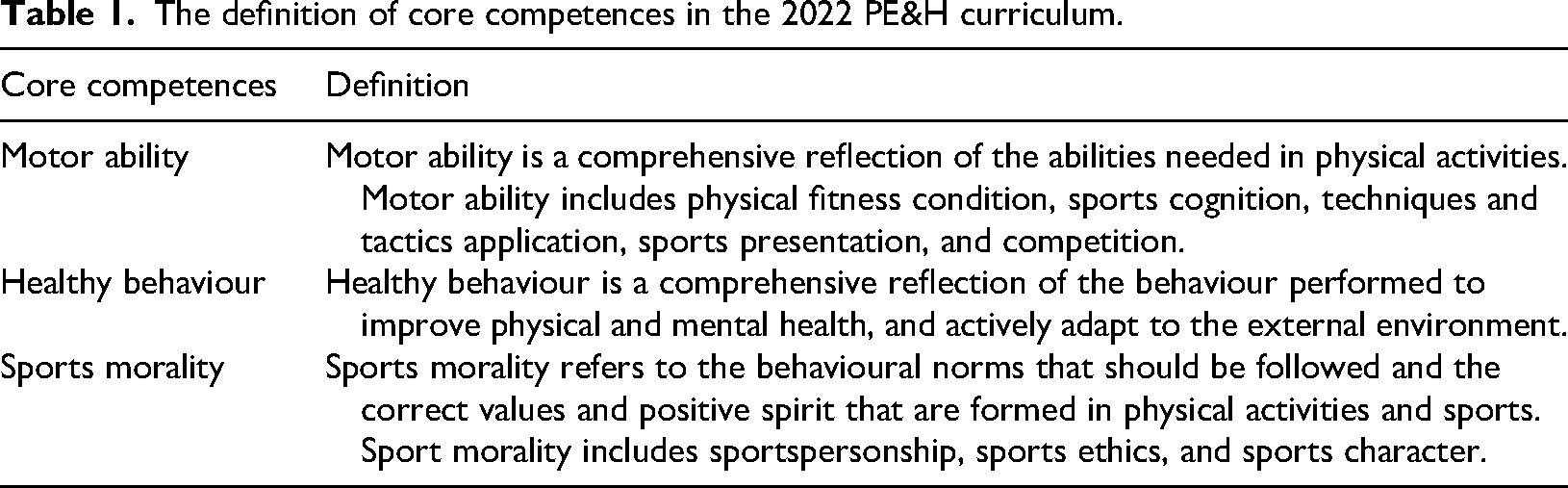
While continuing to uphold the principle of ‘Health First’, the new PE&H curriculum places greater emphasis on integrating PE with health education and identifies three core competences: motor ability, healthy behaviour, and sports morality (see Table 1). Motor ability reflects national priorities to improve students’ physical fitness amid ongoing policy initiatives and persistent concerns such as obesity and myopia (CPC and the State Council, 2007, 2016; State Council, 2019; MoE, 2019). Healthy behaviour aligns with both international health-oriented discourses in PE and China's ‘Healthy China 2030’ agenda (MoE, 2019). Sports morality gains renewed prominence under the broader policy emphasis on moral education and ‘fostering virtue through education (Li de shu ren, 立德树人)’ (Xi, 2016), positioning PE as a key site for shaping students’ values.
The definition of core competences in the 2022 PE&H curriculum.
The introduction of core competences represents a substantial shift in curriculum objectives, content, and assessment. This paper examines the changes through an analysis of the previous (2011) and current (2022) iterations of the PE&H curriculum in China. Specifically, it addresses the rationale for the changes, how the concept of health is represented and the implications of adopting core competences for teaching and assessment. Therefore, our analysis aims to enrich the body of knowledge on policy making and curriculum change in PE in China. It also contributes to international debates on competence-oriented reform by showing how such reforms are articulated within the Chinese PE&H curriculum and by highlighting the potential dangers of an instrumental view of health and PE's role in the curriculum. The next section situates the 2011 and the 2022 PE&H curricula within the broader historical and policy evolution of Chinese curriculum reform. We then introduce Kelly’s (2009) concepts of curriculum planning as our theoretical framework and outline our use of interpretive policy analysis (IPA) before presenting the findings and discussion.
The trajectory of China's curriculum reform
1949–2000: Soviet-influenced, syllabus-based curriculum policy
The trajectory of Chinese education policy reform has been shaped by processes of policy borrowing and learning. Tan (2015) noted that after the establishment of the People's Republic of China in 1949, China began borrowing policy from the Soviet Union, and this influenced all areas of society and has had an enduring impact on the education system. From 1949 to 1978, the educational approaches and teaching materials were based on the Soviet model, resulting in a detailed syllabus for PE (Yin et al., 2017). After the launch of reform and opening-up in 1978, China endeavoured to align with the imperatives of internationalisation and globalisation. In 1992, under the global trend of curriculum-based reforms (Sahlberg, 2023), China began combining teaching plans and syllabuses into one curriculum. In 1999, under the slogan of ‘quality education’, China's curriculum reform introduced sweeping changes to the curriculum, pedagogy, and assessment methods. This reform embraced a holistic view of education rooted in a learner-centred approach and aimed to challenge the dominance of teacher-led examination-oriented education. As discussed by You (2018), the education system in China has its foundations in Confucianism and has been shaped by the requirement to memorise vast amounts of knowledge, which is then assessed in government-mandated examinations. This has led to teachers predominantly lecturing to students and approaches to teaching which have been restricted to attainment in examinations. In an attempt to reform education and improve global competitiveness, Tan and Chua (2014) and You (2020) noted that East Asian systems have strived to emulate their ‘advanced’ Western counterparts.
2001–2021: globalisation, curriculum-based education reform
In 2001, the MoE issued the Outline of the Curriculum Reform for Compulsory Education (Trial), marking the shift from a syllabus-based approach to a curriculum standard-based approach. In the same year, China embarked on quality education-based curriculum reform. This initiative is regarded as a ‘watershed’ moment in the reform process, as the curriculum philosophy and overall design began to align with international educational trends. He (2015) pointed out that Chinese education in the early twenty-first century was characterised by the straightforward transplantation and replication of pedagogical ideas, theories, and various practices from abroad. One example of this trend was the move towards decentralisation and the adoption of a new three-level curriculum management system (central, local, and school), which replaced the previously centralised model with one in which responsibilities were shared. This restructuring sought to promote school decentralisation, teacher autonomy, and student-centric teaching, aiming to empower local governments and teachers’ decision-making to positively influence students’ learning (Meng et al., 2021). Between 2001 and 2021, reform in the PE curriculum can be divided into two phases (see Table 2 for details).
Changes to the title and names of curriculum documents 2001–2021.
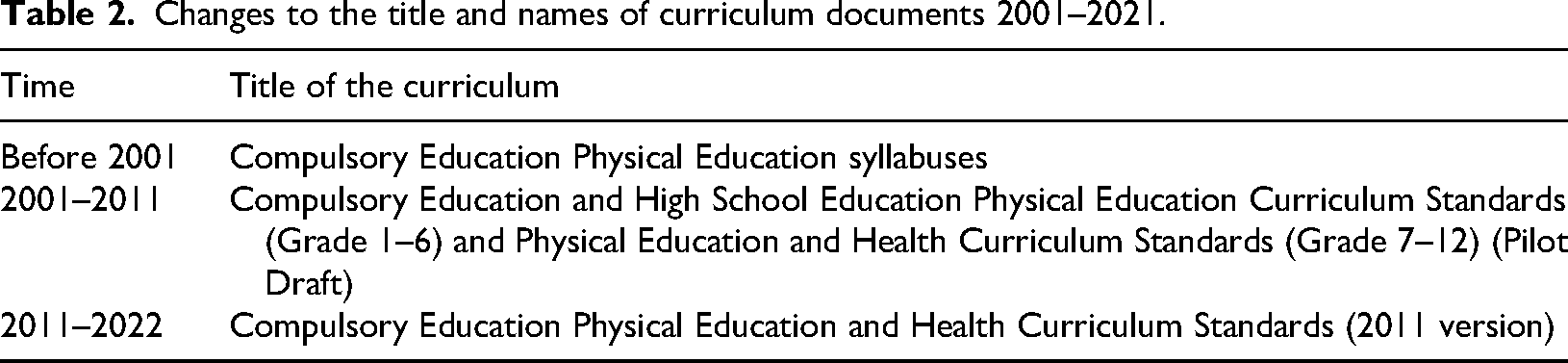
During this phase, curriculum objectives evolved from the traditional focus on 双基 (Shuang ji, including basic knowledge and basic skills) to a more comprehensive three-dimensional framework encompassing knowledge and skills, processes and methods, and emotional attitudes and values. For the subject of PE, the ‘Health First’ principle serves as a guiding philosophy that emphasises lifelong physical activity, and aims to support the development of healthy lifestyles and cultivate students’ intrinsic motivation to engage in physical activity beyond the school setting. This curriculum included for the first time the concept of ‘health education’ and explicitly increased the integration between the previously discrete disciplines of education and health (MoE, 2001). The subsequent stage of China's curriculum reform, spanning from 2011 to 2022, aimed at refining the curriculum by emphasising student-centred pedagogy and inquiry-based teaching. The course names for the primary and secondary stages of PE were unified and became Compulsory Education Physical Education and Health Curriculum Standards (MoE, 2011). The inclusion of ‘health’ reshaped the curriculum content, and PE teachers were expected to help students develop healthy lifestyles through the teaching of sports knowledge and skills.
2022–present: internationalisation with local adaptation
In recent years, following the Chinese government's pronouncements on the Chinese Dream (2012) and Cultural Confidence (2014), there has been an increasing emphasis on localisation within educational reform. Compared with the earlier phase characterised by policy borrowing, the 2022 curriculum reform reflects a strategic shift towards localisation and policy making for China. Unlike governance models in many Western nations, which are generally aligned with democratic processes and underpinned by principles of federalism or confederation, China operates within a hierarchical and centralised political system. In this system, the central government retains macro-level control over policy direction, while local governments implement policy within this framework and play a significant role in its interpretation and enactment (Mok and Han, 2017). Within this new round of curriculum reform, core competences have become the central principle and are regarded as a key initiative to advance educational transformation and ensure the international competitiveness of China's education system (MoE, 2022b). Core competences are defined as the ‘necessary character and key abilities that students should possess in order to meet the needs of lifelong and social development’ (Core Competence Research Group, 2016: 1). As Young (1999) noted, curricula reflect particular views about society and its future, and for 16 subjects the new curriculum comprises a total of 61 core competences which have been created in direct response to Xi's (2016) questions, ‘What kind of people to cultivate, how to cultivate them’. The three core competences of the 2022 PE&H curriculum, motor ability, healthy behaviour, and sports morality, aim to align with international trends in health education while simultaneously addressing the diverse needs of key stakeholders, including students, parents, and teachers, and reflecting the shared values of Chinese society (MoE, 2022b). In the following sections, we set out our theoretical framework, which draws on Kelly's (2009) work on curriculum, and then explain how IPA (Yanow, 2011) informs our analysis of policy documents, before presenting our findings and discussion.
Theoretical framework: Kelly's concepts of curriculum planning
To critically examine the changes between the 2011 and the 2022 PE&H curriculum, this study draws on three of the key concepts of curriculum planning articulated by Kelly (2009): content, objectives, and process.
Content as a guiding curriculum concept
The philosophical stance of a content-based curriculum is based on an absolutist epistemology, which considers knowledge to be independent of the knower (Kelly, 2009). In other words, education is seen to derive its intrinsic value from knowledge itself rather than from the ways in which learners engage with it. From this perspective, students are positioned primarily as recipients of knowledge, responsible for mastering what is prescribed for them. However, most societies are dynamic rather than static entities, leading to the continuous change, evolution, and development of knowledge. Given the impossibility of teaching the entire spectrum of human knowledge, curriculum planning necessarily involves selecting which knowledge to include. Therefore, ‘by whom’ and ‘for whom’ questions dominate the selection of content for curriculum planning. Kelly (2009) has demonstrated that much curriculum content selection is done for political ends, which he refers to as instrumental or utilitarian selection. As a result, content-based curricula have been criticised for promoting didactic teaching and passive learning (Pring, 1976). While these critiques challenge the dominance of content-based curricula, Young's (1999) concept of ‘powerful knowledge’ offers a nuanced reconstruction rather than a rejection of disciplinary knowledge. He argues that access to systematic, conceptual knowledge is essential for educational justice, particularly for disadvantaged groups. From this point of view, content selection is not merely a political or instrumental act but also has ethical implications. Young (1999) underscores the importance of preserving disciplinary integrity in content-heavy curricula, thereby framing content selection as both a political and moral enterprise.
Objectives as a guiding curriculum concept
When objectives guide the development of a curriculum, educational goals are divided into different levels and are instrumental in nature (Kelly, 2009). The use of objectives is informed by behaviourism and seeks to reduce education to an observable scientific activity, and like industrial production processes, views education as something that can be controlled and as having a linear, upward trajectory to achieve predetermined goals. Objectives-led educational planning focuses on altering student behaviour, and the success of the curriculum is measured by assessing behavioural change. Kelly's (2009) analysis indicated that when objectives guide the planned curriculum, the three ‘Ts’ dominate: Targets, Tables (specifying content), and Tests. Moreover, when targets/objectives are tied to testing and test results are used to evaluate schools, this approach encourages a narrow, restrictive view of curriculum, in which ‘coaching for the test’ becomes prevalent (Torrance, 1997: 328).
Process as a guiding curriculum concept
Process-based curricula are based on intrinsic principles and procedures rather than extrinsic goals. While a process-led concept allows educators to set educational goals or objectives, it does not regard these goals or objectives as an essential part of an externally imposed educational process (Kelly, 2009). Furthermore, it does not mandate that educators use a progressive, predetermined approach to achieving these goals (Kelly, 2009). The core of a process approach lies in viewing individuals as active agents and places a strong emphasis on teacher agency and student participation in meaning-making. Stenhouse's (1975) advocacy for placing trust in teachers’ professional judgement and in the value of students’ exploratory learning has had an enduring impact. His work highlighted the value of open-ended inquiry and viewed a curriculum as a process rather than a means to meet a limited set of predetermined outcomes. More recently, Priestley et al. (2015) argued that teachers should be understood as situated, reflective professionals with the capacity to shape curriculum in context, rather than as mere implementers of top-down mandates. Therefore, when process guides curriculum planning, outcomes and objectives are not ignored, but educators’ attention is directed to the principles that underpin the curriculum and ultimately to the process of fostering human development (Kelly, 2009).
In summary, by distinguishing between content-, objectives- and process-based approaches, Kelly's perspective allows for a critical analysis of how different models of education are prioritised, integrated, or contested in policy texts. Kelly (2009: 114) stated: These models are based on quite different views of the purposes of schooling, quite different concepts of education, knowledge, society and, indeed, humanity, and, as a consequence, quite different notions of the role of subject-content in the curriculum and the basis for selecting this, as well as offering quite different schemes for educational practice. It is important that anyone undertaking curriculum planning should be absolutely clear about the fundamental conceptual and, most importantly, ideological differences between them.
Methodology for IPA
The analysis presented in this paper is structured around three interrelated questions: what is the nature of the two curricula? How is the concept of health presented in the 2011 and the 2022 PE&H curricula? How is the shift to a competence-based framework reflected in statements about teaching and assessment? These questions are designed to reveal not only the discursive construction of key concepts, particularly core competences and health, but also how curriculum intentions are articulated in statements about pedagogy and assessment. To address these questions, we employed Yanow's (2011) framework of IPA to examine how the reform of China's PE&H curriculum has been conceptualised in the policy making process. Grounded in interpretive philosophy, IPA holds that knowledge is not a universal truth, but a socially constructed entity shaped by historical, contextual, and dynamic factors (Yanow, 2011). More specifically, IPA emphasises the analysis of policy texts and associated ‘artefacts’, including language, objects, and acts, to understand how meaning is constructed and how policy intentions are conveyed (Yanow, 2011). Accordingly, the central concern of this study is not to assess whether a policy is ‘right’ or ‘wrong’, but rather to explore what the policy means and how such meaning is produced and conceptualised. This interpretive perspective is particularly well-suited to the complex context of curriculum reform in China, where the paradigmatic shift from ‘process’ to ‘competence’ signals not merely a change in content but a deeper transformation in educational philosophy and societal expectations.
Before conducting the IPA, clear criteria for data selection were established in line with the research questions. The sources of analysis consisted of three policy texts. The two PE&H curriculum standards – Compulsory Education Physical Education and Health Curriculum (2011 version) and Compulsory Education Physical Education and Health Curriculum (2022 version) – served as the primary texts for comparison (MoE, 2011; MoE, 2022a), while the accompanying interpretation document, Interpretation of Physical Education and Health Curriculum (2022) in Compulsory Education, was included as a supplementary source to provide additional context and support for the analysis (MoE, 2022b). Linguistic meaning is central to interpretive analysis; the authors engaged in extensive discussions throughout the translation process. The second author, a native Chinese speaker, translated the curriculum documents and relevant extracts, which were then shared with the first author. These English translations were then reviewed and discussed by both authors to ensure semantic accuracy and fidelity to the original texts. As there is no official English translation of the compulsory education PE&H curriculum, we referred to the officially published English version of the senior high school Physical Education and Health Curriculum Standards (ages 16–18), as many key terms, curricular concepts, and aspects of the curriculum framework are consistent across the two educational stages.
In line with the IPA framework, the analytical process consisted of two key stages. Stage 1 involved identifying policy artefacts, uncovering relevant discourses/communities, and detecting underlying conflicts (Yanow, 2011). This stage was conducted through close and iterative reading, as well as comparative analysis of the curriculum standards. We identified a policy artefact if it met the following criteria. First, if it appeared repeatedly across the policy texts and was explicitly defined and elaborated. Second, if it functioned as a structuring element within the curriculum, organising and connecting key components such as curriculum aims, content, pedagogy, and assessment. Third, if it captured the major differences between the 2011 and 2022 curricula and served as a key lens through which to understand the shifting meanings underpinning the current reform. Based on these criteria, core competences and health were determined to be the two central policy artefacts.
Specifically, core competences constitute the overarching orientation of the current curriculum reform. The MoE (2022a: 3) explicitly states, in outlining the major changes of the 2022 curriculum standards, that ‘guided by the overarching educational goals, the curriculum should translate the Party's educational policy into core competences’. This indicates that core competences are not merely an additional or rhetorical concept, but a central organising principle that underpins the entire curriculum framework, and is embedded in curriculum aims, content design, pedagogical expectations, and assessment requirements. Health represents another key dimension of change in the reform of the 2022 PE&H curriculum. Although the integration of PE and health was already emphasised in the 2011 curriculum, health was an implicit expectation, without a clearly defined structural role. In the 2022 curriculum, however, the policy status of health has become more prominent. It is more explicitly articulated and systematically incorporated into curriculum aims, structural organisation, content, and assessment frameworks. In this sense, health is no longer treated as an implicit value underpinning PE but increasingly functions as an independent and structuring dimension of the curriculum.
Stage 2, then, centred on these two constructs, aiming to identify and interpret their discursive evolution and the policy intentions embedded within these conceptual shifts. Kelly (2009: 29) advocated for the analysis of the concepts underpinning curriculum and stated: In any curriculum debate, therefore, a major concern must be with an analysis of what these concepts may mean, what, in the context of any particular debate or policy pronouncement, they are intended to mean, and, crucially, what, in that particular context, they actually do mean. In any curriculum planning conceptual clarity is a sine qua non of effective practice.
Findings and discussion
The three research questions guided our analysis of curriculum reform in China. By integrating IPA's emphasis on policy making with Kelly's analytical models (objectives, content, and process), we examined both the explicit and implicit policy shifts underlying the curriculum texts. In the following sections, we present and discuss our findings in relation to the nature of the curriculum, the concept of health, and the framing of teaching and assessment.
The nature of the curriculum – developmentalism vs instrumentalism
The development of various aspects of Chinese education unfolds within the globalised context of cultural amalgamation between China and the West. The following are statements about the nature of the PE&H curriculum, the first from 2011 and the latter from 2022: …a curriculum that mainly aims to improve students’ health and develop their lifelong PE awareness and ability. (MoE, 2011: 2) …a curriculum that mainly aims to cultivate the subject core competences in PE&H of compulsory education students and improve their physical and mental health. (MoE, 2022a: 1)
Comparison of the principles of the 2011 and 2022 PE&H curricula.
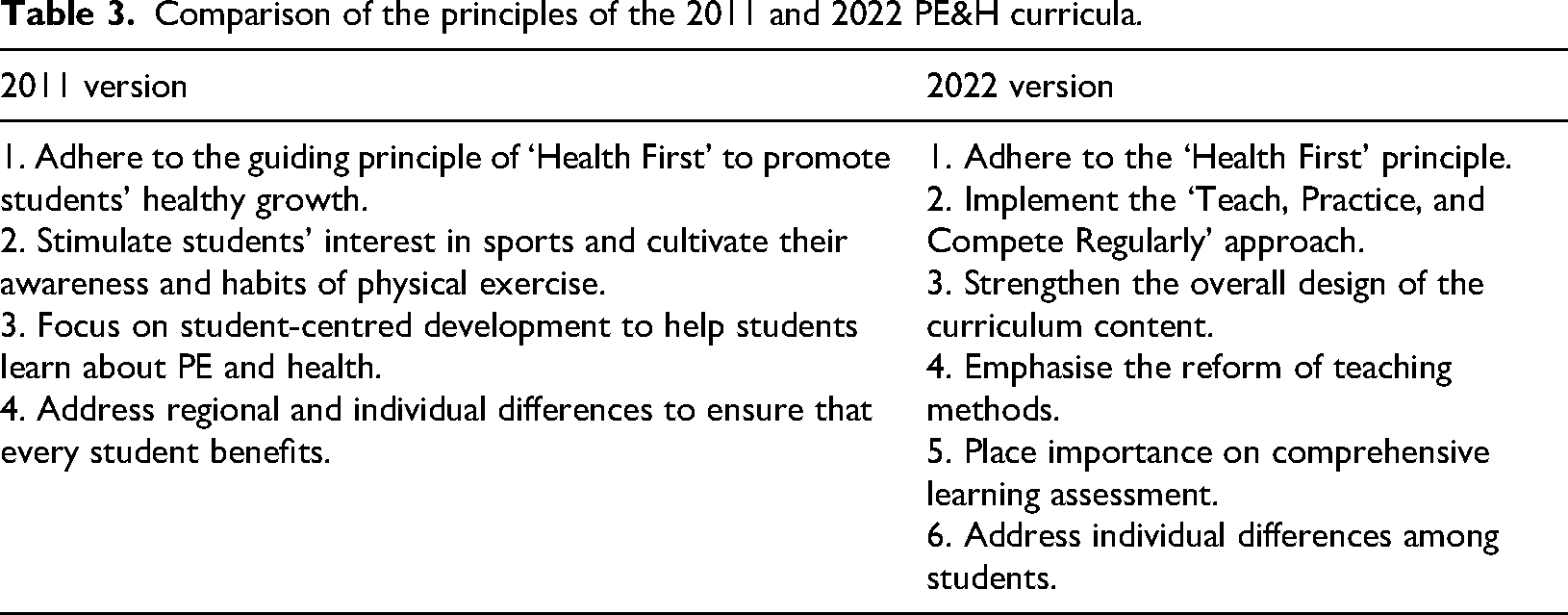
As shown in Table 3, the statements of the four principles of the 2011 curriculum consistently place students as the subject, highlighting the curriculum's focus on students and emphasising the importance of a ‘student-centred development’ approach. This shift reflects the historical context of moving away from the traditional ‘teacher-centred’ model, aligning with broader reforms of the time. Between 2000 and 2011, China experienced a significant period of social transformation, marked by the establishment of a socialist market economy and its accession to the World Trade Organisation (Wei, 2016). The profound impact of these social changes stemming from economic reforms significantly influenced educational policies. During this period, there was a substantial reliance on imported knowledge across various disciplines, including policy studies, education, and sports science, reflecting a broader trend of policy borrowing. He (2015) suggests that China's education policy borrows from foreign policies in two ways: one involves the direct adoption of specific educational policies, while the other, although not directly mirroring existing Western policies, engages in policy reform or formulation influenced by Western educational theories, policy science knowledge, and national educational strategies. In the 2011 curriculum, student-centredness, quality-oriented education, and a holistic view of health were the dominant ideologies, reflecting He's (2015) latter category of policy borrowing. The 2011 PE&H curriculum, as shown in Table 3, embodied the ‘Health First’ values and aimed to promote lifelong physical activity. It focused on stimulating students’ interest in sports and cultivating their awareness and habits of physical exercise. This approach encouraged teachers to prioritise developing students’ understanding over merely delivering predetermined content. The curriculum content was intended to support students’ development, serving as guiding principles for teaching practice rather than as fixed objectives (Kelly, 2009).
Many studies indicated that the 2011 curriculum reform did not achieve its desired outcomes (Dong and Lv, 2020; Jin, 2013; Meng et al., 2021). The ongoing tension between internationalisation and localisation has also contributed to the reform's unsatisfactory outcomes. When elements of modern Western scientific culture are introduced into China, they often struggle to take root in the local cultural context, largely because they are imposed rather than organically integrated (Meng et al., 2021). With the rapid pace of societal change, a gap has emerged between many policies and the practical guidance they require. Decades of policy learning have made Chinese policymakers realise that developmentalist curricular models may struggle to overcome the long-standing tradition of teaching to the test. Consequently, a key feature of the 2022 curriculum reform is the shift in focus within Chinese education policy. Rather than simply importing or replicating ‘foreign’ ideas, policymakers are increasingly inclined to develop localised education policies tailored to the unique conditions of Chinese education. In this new wave of educational reform, the trend of borrowing education policies from the West appears to have been reversed. The 2022 curriculum places greater emphasis on building a curriculum centred on core competences. As shown in Table 3, while ‘Health First’ remains central to the curriculum, as in the pre-2011 approach, there is a return to a focus on sports ability and skills. It requires teachers to regularly teach sports skills, practice techniques, and engage in competition, moving away from the previous emphasis on fostering interest and awareness in sports. On this basis, the new curriculum has objectives, content, and assessment criteria focused on core competences. This represents a departure from the holistic view of health in 2011, and the curriculum is now presented in statements reflecting a narrower focus on health behaviours. The following section will provide a more detailed analysis of these changes.
The concept of health – holistic view of health vs health behaviour
To address increasing concerns about student health, a key aspect of the reform of China's PE&H curriculum has been the closer integration of PE and health education. This shift aligns with well-documented trends in PE reforms, which increasingly draw on health-related discourses (e.g. Cale and Harris, 2013; Fitzpatrick and Burrows, 2017; Kilgour et al., 2015; Kirk, 2019). Discernible differences can be observed between the two curriculum reforms, despite both following the principle of ‘Health First’, as the statements below indicate: Based on the holistic view of health and the characteristics of the PE discipline, and drawing on international experience in the development of PE curriculum, the PE&H curriculum sets out a system of curriculum objectives as well as curriculum content in the four areas of sports participation, sports skill, physical health, and mental health and social adaptation. (MoE, 2011: 4) …adhere to the guiding philosophy of ‘Health First’. It emphasises the core competences for Chinese students’ development, attaching importance to nurturing the body and mind, the integration of PE and health education… (MoE, 2022a: 2)
Comparison of health education content in the 2011 and 2022 PE&H curricula.
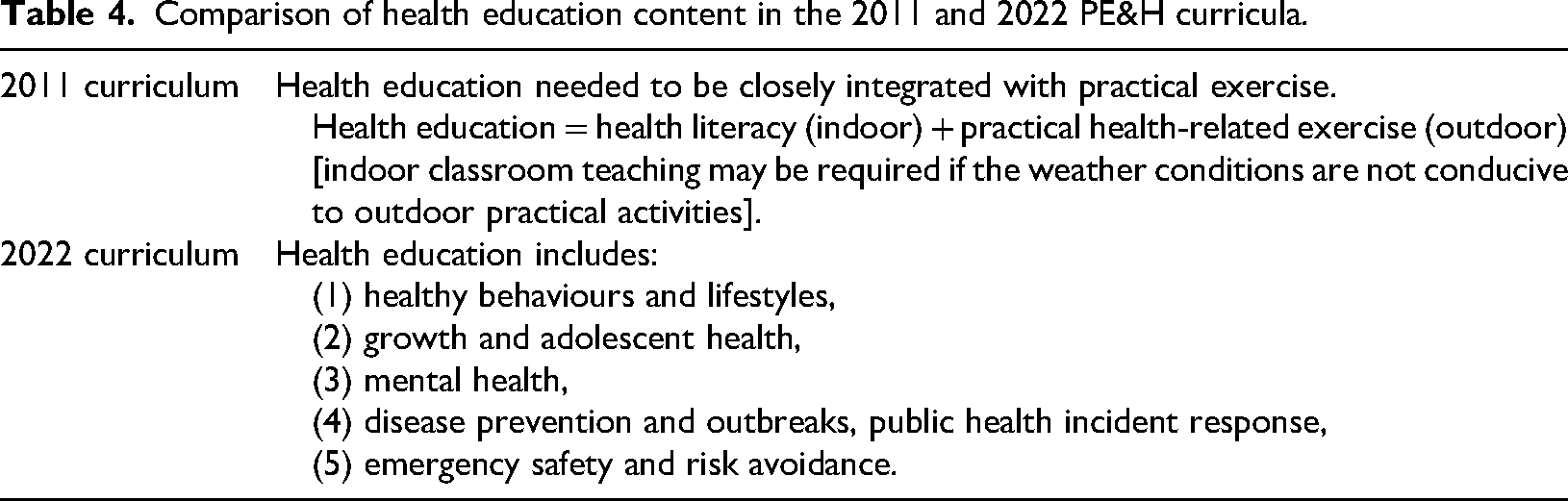
Kelly (2009) argues that curricula based on the process model often provide generalised guidance rather than explicit instructions. For example, the 2011 curriculum stated that ‘health education needed to be closely integrated with practical exercise’; however, while there may have been an intention to blur the boundaries between health education and PE, the absence of clear statements about the content of health education made this task particularly problematic for teachers (Meng et al., 2021). In Xiong's (2021) analysis, the health education section of the 2011 curriculum was idealistic. As Kelly (2009) noted, the effectiveness of a developmental curriculum model relies on the quality of teaching provided by teachers. Therefore, curriculum enactment requires teachers to have the knowledge, understanding and capacity to translate the aims, principles, and content into learning experiences. Meng et al. (2021) highlighted that, as PE teacher education focused on physical exercise and movement education, teachers did not have the depth of knowledge about health to help them understand how to combine PE with health education. As a result, while the teachers sought to provide meaningful and worthwhile experiences for students, they did not fully embrace the aspirations of a ‘Health First’ curriculum.
To address the ambiguity of health education, the 2022 curriculum introduces the core competence of ‘healthy behaviour’, transitioning from fragmented knowledge and skills to systematic health literacy development. For the first time, health education appears as stand-alone content in the PE&H curriculum. As shown in Table 4, the 2022 curriculum clearly divides content into sections with the aim of ensuring greater clarity and an increased likelihood that the core competences will be a feature of classes. Compared to earlier versions, the 2022 PE&H curriculum introduces a more focused and practical approach to health education, dividing the content into general health education and PE-related health education. Ma et al.'s (2024) analysis noted that 79.31% of this content falls under general health education, covering topics like disease prevention, outbreak response, and public health incidents, integrating subjects such as science, biology, and labour. The significant emphasis on general health reflects national priorities for interdisciplinary integration. However, this shift raises concerns about whether it aligns with the core objectives and essence of school PE. Additionally, PE teachers’ limited expertise in health education, combined with a broad curriculum, may pose challenges to effective implementation (Meng et al., 2025; Wang and Lv, 2023). Unlike the 2011 curriculum, which integrated health literacy and outdoor practical health-related exercises (MoE, 2011), the new curriculum does not emphasise incorporating health elements throughout practical teaching. Instead, it clearly expects PE teachers to implement a teaching model of ‘health knowledge + basic motor ability + basic sports skills’ (CPC and the State Council, 2020). Despite the new curriculum's intention to integrate PE and health education, the approach appears more fragmented and separate. As the health element in the curriculum shifted from ambiguity to clarity, the PE&H curriculum has evolved from a developmental to an instrumental approach.
Assessment and teaching – promoting education vs controlling curriculum
In the PE&H curriculum, assessment plays a crucial role in teaching and learning. The 2011 curriculum, rooted in developmentalist ideology, emphasised supportive education principles without setting specific evaluation requirements. Instead, it provided guidelines to consider during assessment. Lingard (2010) observed that local efforts to implement educational change, whether through the adoption or adaptation of foreign policies, are always shaped by contextual histories, politics, and cultures. Although the state aims to shift from examination-oriented to quality-oriented education, the former remains deeply rooted in public attitudes and behaviour (Meng et al., 2021). This persistence is primarily due to the examination-driven culture, where stakeholders prioritise students’ performance in the physical fitness examination, and these results are used to secure admission to prestigious high schools (Guo et al., 2019). As a result, implementing quality education was overshadowed by the enduring focus on the outcome of examinations based on physical tests, and as noted by Lu (2020), the aims of these reforms were not fully realised. While there were changes to the PE examination, which afforded students an element of choice, as Meng et al. (2021) highlighted, the content of the assessments did not change and therefore did not align with curriculum content and assessment processes.
In order to change physical fitness examination-oriented PE, the new curriculum introduces the concept of academic achievement to link instructional practices to curriculum goals: Academic achievement is the student's academic performance after completing the courses of the subject. Based on the subject's core competences and their performance level and combined with the curriculum content, the academic achievement standards provide an overall characterisation of students’ academic performance. According to the key characteristics of academic performance at different levels, academic achievement is divided into distinct standards, which describe the specific learning outcomes expected at each level. (MoE, 2022a: 107)
In the 2022 curriculum, there is a specific statement about activity levels for school students at the compulsory stage. To address concerns about low levels of physical activity and concerns about health in China, the statement below represents a significant departure from content found in international policy on health promotion (World Health Organization, 2020): PE teachers should set up exercise loads scientifically in the class. The density of group exercise in each class should be no less than 75%, and the density of individual exercise should be no less than 50%, and each class should achieve a medium-high intensity of exercise. The average heart rate of all students in the class should be in principle 140–160 beats/minute. Each class should have about 10 minutes of physical training that reflects variety, compensation2, fun and integration. (MoE, 2022a: 124)
To enhance students’ physical fitness and address these issues, the new curriculum holds PE teachers accountable for students’ exercise levels. According to the MoE (2022a), each 40-minute class should include 30 minutes of medium-high intensity exercise, with an average heart rate maintained at 140–160 beats per minute. Ji (2023: 368), the head of the 2022 PE&H curriculum development and revision team, stated that ‘140 beats per minute is the minimum requirement for the new PE&H curriculum, and failure to meet this minimum cannot be regarded as a high-quality PE class’. Exercise load has thus become one of the criteria for the quality of PE classes, reflecting an instrumental and bureaucratic model of accountability. This aligns with the core competence of ‘healthy behaviour’; however, the measures of external accountability remain unclear, and whether the MoE will require data on the achievement of ‘scientific’ exercise loads is not set out in these curriculum documents. As Kelly (2009) warns, a curriculum model which stresses the achievement of pre-specified performances and target setting leads to an objectives-based curriculum planning model, implying that teachers are technicians responsible for delivering a curriculum with objectives and targets determined by others. Therefore, focusing on outcomes like exercise intensity and heart rate for PE class is not well aligned with the broader aspirations of learning about health and a holistic approach to educational development.
The 2022 curriculum emphasises the measurability and superiority of scientific processes in achieving health, reflecting a prescriptive and deterministic approach to health-enhancing physical exercise. While the promotion of activity levels to effect physiological changes during classes may have well-intentioned outcomes (Kohl and Cook, 2013), such an approach oversimplifies the complexity of decades of research in paediatric exercise science, potentially leading to a narrow view of health. Ji’s (2015: 79) analysis of the nature and purpose of the PE&H curriculum in China shows that the curriculum addressed a range of concerns related to physical and mental health and explicitly aimed to improve students’ physical appearance by reducing the prevalence of body types deemed undesirable, such as ‘short and fat’ or ‘tall and thin’. However, such a perspective stigmatises conditions such as obesity, depression, and, in the Chinese context, myopia, which has frequently been associated with insufficient outdoor activity and exercise among students. It also reflects a reductive view of health, in which bodily conditions are interpreted through a simplistic healthy/unhealthy binary, rather than as part of a broader health continuum (Antonovsky, 1979). Within a performative instrumental culture where ‘health’ is equated with the pursuit of the ‘perfect body’ (Rich and Evans, 2008), comparison, measurement, and assessment are the primary means of defining body image and evaluating health. Therefore, successful health education is judged not by knowledge, understanding, and capabilities but on a narrowly defined set of standardised physical tests. In this environment, obese or physically inactive students may inappropriately be perceived as weak, gluttonous, and lazy, leading to discrimination and exclusion from certain physical activities (Wright and Dean, 2007). There are inherent risks for students when an education system and teaching imply that bodies should be graded on a single measure and that students are morally obligated to control health factors such as body size and shape (Cale and Harris, 2013; Rich and Evans, 2008). In summary, our findings indicate that changes to assessment and the introduction of measurable evaluation standards represent increased control over the curriculum, reflecting an instrumentalist approach to education which is closely aligned with China's system of examinations and may well limit the opportunities for PE to achieve improvements for all students’ ‘physical and mental health’.
Conclusion
Drawing on Kelly's (2009) theoretical work on curriculum and employing IPA (Yanow, 2011), this study compared the 2011 and 2022 PE&H curricula, exploring the rationale behind these reforms, the conceptualisation of health, and the implications for teaching and assessment. Our analysis suggests that the 2011 curriculum aimed to incorporate principles of developmentalism, but the transfer of policy ideas originally developed in Western contexts into China's distinct cultural and institutional context was not aligned with the aspirations of holistic education. The 2022 reform represented a significant shift in approach, moving away from adopting Western educational models and towards developing localised policies suited to China's unique educational context. The OECD (2020) report also frames core competences as a means of improving educational outcomes. Against this backdrop, the 2022 curriculum reform centres on core competences, with curriculum objectives aimed at cultivating well-rounded individuals and addressing the question of ‘what kind of people to cultivate’ (Xi, 2016). Therefore, we have critically examined how educational values are articulated, prioritised, and potentially constrained within the policy texts for the new curriculum. Our analysis suggests that the rationale for the instrumentalist approach articulated in the 2022 curriculum is intended to provide a clearer set of guiding principles and integrate PE and health education. However, the introduction of core competences has led to a separation of knowledge about health from the practice of PE, and the teaching recommendations centred on students’ physical activity levels during PE lessons do not align with broader aspirations for learning health knowledge and holistic education. Therefore, the way health is conceptualised within the curriculum remains in tension with the stated aims.
These findings highlight the complex interplay between existing cultures, institutional practices, and policy goals, which continues to shape the implementation of educational reform in context-specific ways. Kelly (2009) and Young (1999) noted that the formation of a curriculum involves inherent political, educational, and ethical tensions, and that the specific barriers to effective enactment may be rooted in structures beyond the curriculum itself. In particular, the reform focused primarily on curriculum and the introduction of core competences across all subject areas, while largely overlooking the examination system and the frameworks for teacher education and professional development needed to align policy and practice more closely. As Meng et al. (2021) suggest, a disconnection between curricular aspirations and the broader conditions needed to support them may contribute to suboptimal outcomes in practice. This study's findings resonate with broader international experiences. For instance, as Priestley and Humes (2010) have observed in the Scottish context, when policymakers blend curriculum models to achieve desired outcomes, tensions during enactment limit the likelihood of positive educational experiences and outcomes. Our analysis supports these insights, suggesting that such tensions reflect a more general difficulty in aligning policy intentions with conceptual clarity in curriculum development (Kelly, 2009).
Given the complexity of Chinese curriculum reform, situated within a dense network of meanings shaped by various stakeholders, it is understandable that the reform itself demonstrates a propensity for pragmatism. This pragmatism reflects a tendency to retain elements perceived as functioning effectively or serving broader social and political purposes, even when they are not strictly educational. As Kelly (2009) notes, these may include mechanisms of accountability that persist despite contradictions with curricular ideals. This in part explains why, despite two periods of curriculum reform, standardised tests in all subject areas endure, and rather than decoupling the curriculum from inappropriate means of assessing the three core competences, within PE&H, physical tests have increased prominence. Despite the instrumental nature of the reform, it remains fundamentally aspirational and rooted in a vision of the potential capabilities and future achievements of young people through PE. It is therefore important for researchers to conduct studies across the primary and secondary sectors and in contrasting contexts (e.g. urban and inland/rural settings) to examine the experiences of PE teachers and students as they interpret and respond to the new curriculum. These would enable an assessment of how core competences in the 2022 PE&H curriculum have been enacted and could provide insights to inform subsequent iterations and reforms of the curriculum in China.
Footnotes
Acknowledgements
We wish to express our sincere thanks to the anonymous reviewers and to the editorial team for their valuable suggestions to improve the clarity and quality of the article.

Funding
The authors disclosed receipt of the following financial support for the research, authorship, and/or publication of this article: This work was supported by the Ministry of Education in China Project of Humanities and Social Sciences [number 24YJCZH213]; Postgraduate Education Innovation Program of Shanxi Province [number 2025JG013].
Declaration of conflicting interests
The authors declared no potential conflicts of interest with respect to the research, authorship, and/or publication of this article.