






Abstract
In this study, we conducted a needs assessment to inform professional development (PD) aimed at reducing weight stigma and creating weight-inclusive climates in physical education (PE). A total of 217 physical educators (PE majors, PE teachers, and PE teacher education faculty) completed the Fat Attitudes Assessment Toolkit (FAAT) and 199 also responded to open-ended questions about weight inclusivity. Results showed participants had moderate to high fat acceptance (M = 5.07) and high attribution complexity (M = 5.87). Although these scores suggest improved attitudes compared to previous studies, qualitative responses revealed persistent weight-centric orientations. Over half of participants (56.8%) maintained problem-focused PE role conceptions (solving obesity or including students while acknowledging weight concerns), whereas 40.7% endorsed supporting or transforming approaches; the remaining responses were coded as ambiguous or unknown. This divergence between fat acceptance scores and PE role conceptions highlights the complexity of addressing weight stigma in PE. Therefore, PD should be differentiated: educators maintaining weight-centric PE role conceptions need training on weight controllability and stigma harms, while those with wellbeing-focused orientations are ready for critical pedagogy and advocacy education.
Introduction
Few fat 1 kids enjoy physical education in school. Uniforms that do not fit, activities that have not been modified for fat bodies, taunting from peers and anti-fat bias from teachers, all of these result in a hostile environment that removes the joy associated with movement and exercise for fat kids. This is further reinforced as they are taught that physical movement is meant to produce weight loss rather than being allowed to enjoy physical movement for enjoyment's sake. (Pausé, 2019: 662)
This quote from scholar and fat activist Dr Cat Pausé (2019) illustrates the experiences of higher-weight children in physical education (PE), and they are overwhelmingly negative. The hostile environment described by Pausé (2019) is pervaded by weight stigma, which marginalizes young people in larger bodies and drives them away from a positive relationship with movement and their bodies (Dark, 2019; Hand et al., 2017; Sykes and McPhail, 2008; Tinning, 2020). Weight stigma can be defined as “the social rejection and devaluation that accrues to those who do not comply with prevailing social norms of adequate body weight and shape” (Tomiyama et al., 2018: 1). Young people in larger bodies experience discrimination and stigmatizing events across healthcare, family, and education settings (Puhl and Latner, 2007; Puhl and Lessard, 2020). Further, researchers have documented adverse outcomes associated with weight stigma in youth, including psychological distress, poor academic performance, social isolation, maladaptive eating behaviors, and physical activity avoidance (Hand et al., 2017; Puhl and Latner, 2007; Puhl and Lessard, 2020; Warnick et al., 2022).
In PE, where developing lifelong physical activity habits is a key goal, weight stigma poses a barrier to inclusivity and student wellbeing (Lucibello et al., 2023). Weight stigma manifests in PE through multiple pathways including restrictive dress codes that fail to accommodate diverse body types (Cale and Harris, 2013), inadequate measures to address weight-based bullying and harassment (Peterson et al., 2012; Sykes and McPhail, 2008), curricula that reinforce narrow health ideals (Dark, 2019; Evans et al., 2004), fitness assessments and grading practices that disadvantage students in larger bodies (Sykes and McPhail, 2008), and interactions that stereotype higher-weight students as less capable (Li et al., 2012; Tinning, 2020; Trout and Graber, 2009). These manifestations create environments where students in larger bodies experience exclusion and surveillance, undermining PE goals.
Physical educators, 2 despite intending to promote physical activity and health, might unconsciously perpetuate weight stigma by holding anti-fat bias. Anti-fat bias among physical educators—implicit or explicit beliefs associating larger bodies with laziness, demotivation, and lack of discipline—is ubiquitous (Rukavina, 2021; Tingle et al., 2023; Varea and Underwood, 2016). Researchers have documented anti-fat biases among those professionals across career stages (Fontana et al., 2013, 2017; Greenleaf et al., 2008; Greenleaf and Weiller, 2005; O'Brien et al., 2007; Peters and Jones, 2010). For example, Carmona-Márquez et al. (2021) found that 67% of PE teachers automatically associated fatness with laziness. Studies also found PE teachers had lower expectations for higher-weight children (Lynagh et al., 2015) and graded larger-bodied students worse on identical exercises (Glock and Schuchart, 2021). Zuest et al. (2025) documented in a literature review that all 19 studies reported some measure of anti-fat biases among physical educators.
These biases have implications for student wellbeing, as research shows that body dissatisfaction in PE is linked to lower perceptions of physical competence (Kerner et al., 2018). Despite evidence of bias and its harmful effects, recent research suggests that physical educators’ perspectives on weight-related issues may be more complex than these bias studies indicate. Barker et al. (2021) examined how physical educators construct their professional identities in relation to weight and obesity discourse, identifying three distinct identities: the caring practitioner (focused on inclusion regardless of body size), the activity luminary (emphasizing inspiration toward lifelong activity), and the body rationalist (challenging unrealistic body ideals). While these identities appeared more inclusive than traditional approaches, they contained elements unsympathetic to individuals in larger bodies, suggesting that even well-intentioned educators may perpetuate weight stigma. For example, the caring practitioner, despite genuine inclusive intentions, engaged in “weight blindness” that avoided addressing underlying causes of body-related shame while inadvertently positioning students in larger bodies at the bottom of presumed ability hierarchies. The activity luminary linked higher weight to reduced motor competence and questioned the inspirational capacity of educators in larger bodies. The body rationalist deflected examination of PE’s own contribution to reproducing anti-fat norms by positioning the problem solely within external media influences.
The widespread presence of anti-fat bias among physical educators, combined with the complexity revealed in how educators construct their professional identities around weight, necessitates critical examination of the methods used to assess their attitudes. Weight stigma researchers, including Cain et al. (2021, 2022), have pointed out limitations in traditional measures of fat attitudes. Many of these instruments were developed in the late 1900s when anti-fat discourse was dominant, focusing primarily on negative perceptions and stereotypes. Examples include the Anti-fat Attitudes Scale (Morrison and O'Connor, 1999), the Anti-fat Attitudes Test (Lewis et al., 1997), and the Attitudes Toward Obese Persons Scale and Beliefs About Obese Persons Scale (Allison et al., 1991). These scales emphasize negative attitudes toward fat people, limiting our ability to understand positive changes from interventions, while their stigmatizing language may reinforce the very attitudes they aim to measure (Cain et al., 2021, 2022). Accordingly, there is a growing need to assess physical educators’ attitudes toward fatness using tools that are more contemporary, nuanced, and stigma-informed.
Returning to weight stigma in the context of PE, despite the pervasiveness of anti-fat bias among physical educators, few interventions have attempted to improve their attitudes toward fat individuals (Rukavina et al., 2008, 2010; Tingstrom and Nagel, 2017). These interventions, ranging from service learning and curricula to brief awareness programs, showed varying improvement. Rukavina et al. (2008, 2010) incorporated lectures, group activities, and empathy-building exercises with PE and kinesiology students, reporting small to moderate reductions in explicit weight bias, especially regarding blame and character stereotypes. Tingstrom and Nagel's (2017) 1-hour obesity awareness program for preservice PE teachers produced immediate reductions in anti-fat attitudes.
However, this body of work reveals key limitations: interventions have relied on outdated, stigmatizing instruments that fail to capture contemporary perspectives; they have focused primarily on preservice teachers in university settings rather than in-service educators; and none have been grounded in educators’ own identified needs regarding body weight in PE. To address these gaps, we conducted a needs assessment with two goals: (a) to examine physical educators’ current attitudes toward fatness using a contemporary, stigma-informed measure, and (b) to explore their professional development (PD) needs regarding weight inclusivity by analyzing how they conceive of PE’s role in relation to body weight—that is, their PE role conceptions. We define PE role conceptions as individuals’ understandings of PE’s purpose and function as a subject in relation to body weight, which we examined using Quennerstedt et al.'s (2021) framework. These insights can provide a foundation for developing PD as an anti-fat bias intervention that supports weight-inclusive PE environments. Such environments shift focus away from weight management and obesity prevention toward body acceptance and the intrinsic pleasure of movement, allowing students to participate meaningfully in stigma-free PE classes regardless of body size (Alberga et al., 2025; Alberga and Russell-Mayhew, 2016; Rukavina, 2021; Tinning, 2020). Therefore, this study contributes to the field in two ways. First, it is among the first needs assessments to examine physical educators’ fat attitudes across multiple career stages using a contemporary, stigma-informed instrument. Second, it examines PE role conceptions alongside fat attitudes to capture a dimension of professional thinking that traditional bias studies have not addressed.
Theoretical frameworks
Attribution theory
Attribution theory examines how people explain events and how explanations shape attitudes and behaviors (Weiner, 1986). In weight stigma research, attributions about whether fatness results from personal choices or uncontrollable factors are linked to bias expression (Wijayatunga et al., 2019). Weiner’s framework includes three dimensions: locus of causality (internal vs. external causes), stability (changeable vs. fixed over time), and controllability (whether individuals can control the cause). Research shows that attributing fatness to internal, controllable causes (e.g. eating habits) increases anti-fat bias, while attributing it to uncontrollable factors (e.g. genetics, structural barriers) reduces bias (Durso and Latner, 2008; Wijayatunga et al., 2019). This framework guided our analysis of participants’ attributions about fatness and their PD needs.
Discourses of PE and body weight
We drew on Quennerstedt et al.'s (2021) framework to explore how physical educators conceptualize PE’s role in relation to body weight. In a review of 45 studies, Quennerstedt et al. (2021) examined how discourses about body weight shape PE teaching. Their analysis identified three dominant discourses (risk, critical obesity, and pluralistic), each offering a different view of PE’s purpose, content, and structure. Building on this analysis, the authors outlined five roles that PE may assume in relation to body weight: solving, including, rejecting, supporting, and transforming (see Table 1 for their descriptions). These roles represent distinct orientations: some emphasize medicalized approaches focused on weight loss and behavior change, while others reflect socially critical and inclusive perspectives that prioritize wellbeing, equity, and student voice. We applied this framework to categorize participants’ responses and interpret how role conceptions signal PD priorities.
Roles of physical education in relation to body weight (summary based on Quennerstedt et al., 2021).
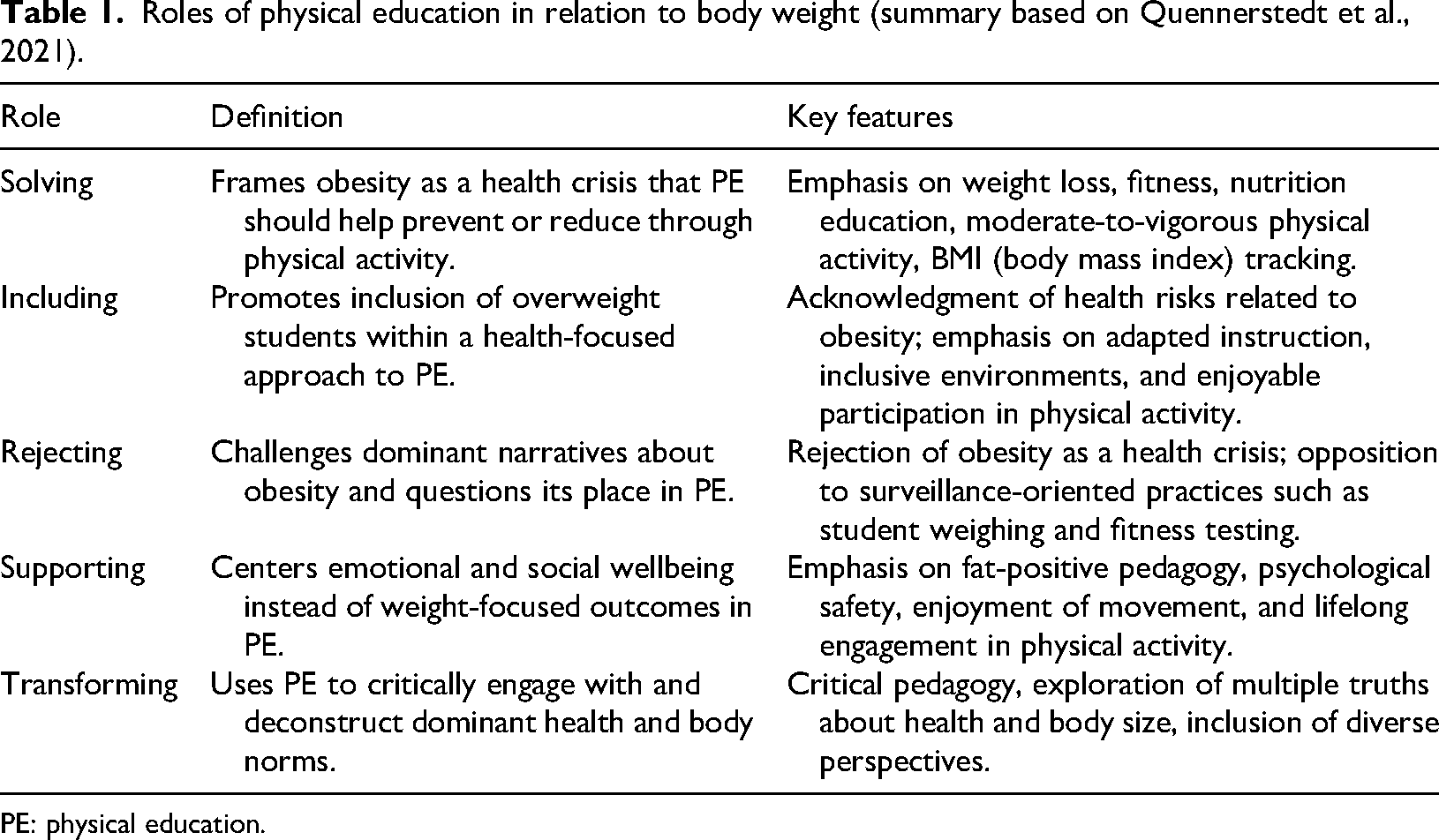
PE: physical education.
These two theoretical frameworks are conceptually linked. Attribution theory explains the cognitive mechanism through which fat attitudes are shaped: how individuals attribute the causes of fatness, whether to individual choices or to uncontrollable structural factors, influences both their bias expression and how they conceive of PE’s purpose in relation to body weight. Together, these frameworks allow us to examine not only what participants believe about fatness, but also how those beliefs translate into PE practice, both of which are essential for designing targeted PD.
Method
Participants
A total of 217 physical educators participated in this study (133 women, 80 men, two preferred not to say, one non-binary, and one other). The sample included PE majors (n = 100), PE teachers (n = 42), and PE teacher education (PETE) faculty (n = 71); four participants did not report their professional position and were excluded from professional position comparisons. Their ages ranged from 18 to 58 (M = 35.18; SD = 15.30). Most participants identified as White (75.1%), with 24.9% from diverse racial/ethnic backgrounds including Latinx/Hispanic (9.2%), African American (4.1%), Asian (4.1%), multiracial (3.2%), and other/preferred not to report (4.1%).
Data sources
We conducted a cross-sectional survey with mixed-methods components (Capili, 2021; Creswell and Plano Clark, 2018) administered through Qualtrics (2020). The survey combined quantitative measures and qualitative items to provide a more comprehensive understanding of participants’ perspectives. Data sources included demographic information, responses to the Fat Attitudes Assessment Toolkit (FAAT; Cain et al., 2022), and answers to three open-ended questions about PD needs related to weight inclusivity in PE.
Demographics. The survey asked participants to report their gender, age, race, current professional position in PE, years of experience, state of employment, and weight change desire (lose, maintain, or gain weight).
FAAT. Cain et al. (2022) developed the FAAT to address limitations of earlier weight bias measures by using fat-neutral language and assessing a broader, multidimensional range of contemporary attitudes and beliefs about fatness. The 49 items are rated on a 7-point Likert scale (1 = strongly disagree to 7 = strongly agree) and averaged within nine subscales: empathy, activism orientation, size acceptance, attractiveness, critical health, general complexity, socioeconomic complexity, responsibility, and body acceptance. Responsibility items are reverse-coded so that higher scores indicate lower personal blame. Sample items include: “Weight-based discrimination negatively impacts on wellbeing” (empathy), “If I were single, I would go out with a fat person” (attractiveness), and “Body weight isn’t a reliable indicator of health” (critical health). In addition to subscales, two composites can be calculated: fat acceptance (empathy, activism orientation, size acceptance, attractiveness, critical health) and attribution complexity (general and socioeconomic complexity), which reflects the degree to which individuals recognize that fatness results from multiple factors beyond personal control, including genetics, socioeconomic conditions, and structural barriers. In this study, Cronbach’s α ranged from .78 to .94 across subscales, demonstrating strong internal consistency.
Open-ended questions. We asked participants three open-ended questions to gauge their needs regarding a PD program addressing weight inclusivity in PE: (a) If an online training were developed aimed at reducing weight stigma in PE, what are the most important topics to address?, (b) What knowledge and skills would you like to develop to create weight-inclusive climates in PE?, and (c) What barriers do you anticipate facing to create a weight-inclusive climate in PE?
Procedures
Upon Institutional Review Board approval, we used purposive sampling (Baumgartner et al., 2021) to recruit physical educators at various career stages. Recruitment included outreach to faculty listed in a national directory of PETE programs, who shared invitations with their networks and students; contact with state Department of Education leaders who forwarded invitations to PE teachers; and flyer distribution at the 2023 SHAPE America National Convention. Participants provided informed consent electronically before beginning the survey and were offered the option to enter a draw for one of 50 $25 Amazon.com gift cards.
Data analysis
FAAT. We used SPSS (version 28) to analyze demographic data and responses to the FAAT questionnaire. We first calculated the mean age of participants and reported frequencies for race, gender, and professional position. We then calculated the mean and standard deviation for the two FAAT composite scores: fat acceptance and attribution complexity, based on the average scores of the relevant items. To examine group differences, we compared composite scores by gender, professional position (PE majors, PE teachers, or PETE faculty), and weight change desire (lose, maintain, or gain weight). We used independent samples t-tests for gender comparisons, given that the non-binary category included only one participant. We used one-way ANOVAs with Tukey post-hoc tests to compare means across the professional position and weight change groups.
Open-ended questions. Of the 217 participants in the study, 199 provided responses to at least one open-ended question. We analyzed these responses using deductive content analysis (Elo and Kyngäs, 2008; Saldaña, 2011), guided by Quennerstedt et al.'s (2021) framework on PE’s role regarding body weight. This framework outlines five roles: solving, including, rejecting, supporting, and transforming. When responses did not clearly align with one of these roles, we used two additional codes: ambiguous and unknown. We developed a detailed codebook based on the framework’s definitions, outlining key characteristics and distinctions between categories to support consistent coding. Because most responses were brief, we applied codes directly from the predetermined categories. Coding was conducted using MAXQDA Analytics Pro (Version 24.8; VERBI Software, 2025). Two researchers independently coded all responses, then met to compare decisions, resolve discrepancies, and reach consensus.
To supplement our analysis, we used artificial intelligence (AI) to review coded segments. We developed a custom GPT in ChatGPT (OpenAI, 2025), uploading our codebook and coded data. The AI was instructed to flag segments where codes might not fit or where alternative categorizations could be considered. The AI served as an additional reviewer but did not re-code the data (Christou, 2023). Both researchers reviewed all flagged segments and made final coding decisions based on the original framework. We obtained IRB approval through an amendment to disclose this AI verification step. To protect participant privacy, all data were de-identified before uploading, and we used an enterprise version of ChatGPT with institutional privacy protections that prevent data storage, reuse, or training by the AI system (Naeem et al., 2025).
Results
Fat acceptance
The sample averaged 5.07 (SD = 1.05) in fat acceptance, indicating moderate to high fat acceptance. Women scored significantly higher (M = 5.35, SD = 0.88) than men (M = 4.64, SD = 1.08), t(210) = 5.23, p < .001, with a medium to large effect size, d = .74. However, fat acceptance scores did not differ significantly by professional position, F(2, 209) = 1.14, p = .321, η2 = .01, with PE majors (M = 4.97, SD = 1.18), PE teachers (M = 5.25, SD = 0.87), and PETE faculty (M = 5.11, SD = 0.94) scoring similarly. Participants wanting to lose weight scored highest in fat acceptance (M = 5.31, SD = 0.87), followed by those wanting to maintain (M = 4.92, SD = 0.95) and gain weight (M = 4.16, SD = 1.66). These differences were statistically significant, F(2, 212) = 11.12, p < .001, with a medium effect size, η2 = .10. All between-group post-hoc analyses were significant, showing that all groups had significantly different fat acceptance mean scores.
Attribution complexity
The sample averaged 5.87 (SD = 1.08) in attribution complexity, indicating high attribution complexity. Similar to fat acceptance, women scored significantly higher (M = 6.05, SD = 0.91) than men (M = 5.65, SD = 1.13), t(139.41) = 2.67, p = .008, with a medium effect size, d = .40. Attribution complexity scores did not differ significantly by professional position, F(2, 210) = 1.76, p = .174, η2 = .02, with PE majors (M = 5.72, SD = 1.23), PE teachers (M = 5.89, SD = 0.94), and PETE faculty (M = 6.03, SD = 0.92) scoring similarly. Participants wanting to lose weight scored highest (M = 6.05, SD = 0.89), followed by those wanting to maintain (M = 5.77, SD = 0.98) and gain weight (M = 5.17, SD = 1.80). These differences were statistically significant, F(2, 213) = 5.97, p = .003, with a small effect size, η2 = .05. However, only the difference between those wanting to lose versus gain weight was significant in post-hoc analyses.
Open-ended questions
We analyzed responses from 199 participants, applying Quennerstedt et al.'s (2021) framework on PE's role regarding body weight. We applied four of the five roles (solving, including, supporting, and transforming), plus ambiguous and unknown codes. No responses aligned with the rejecting role.
Solving. We used the code solving (n = 51, 25.6%) for responses framing obesity as a health problem requiring PE intervention through behavior change. Participants emphasized structured routines, nutrition education, and fitness instruction. One described “education of lifestyle choices related to nutrition and exercise” (P109 3 ), while another focused on “healthy nutrition, different forms of exercise, [and] how to lose weight effectively” (P122). Others linked PE to broader health habits like “eating healthy, exercising, and sleeping” (P17). Some expressed concern that inclusive approaches might undermine health messages. One wrote, “Weight control, I do not think we should promote inclusivity for fat people as it is unhealthy” (P12). Another stated, “I will treat all students with the same respect … That doesn’t mean I should lie to them and tell them it’s healthy to be overweight” (P1). These responses reflect viewing PE as preventing obesity through structured education and lifestyle change.
Including. Including (n = 62, 31.2%) was the most frequent code, reflecting responses emphasizing making PE inclusive for students of all sizes. Participants described modifying activities to support participation and reduce embarrassment. One suggested “how to create a positive and accepting environment in a physical education class to include students of all sizes in activities without them being bullied and/or feeling embarrassed” (P69), while another described “modifications for physical activities so they are developmentally appropriate to include those suffering from obesity and being overweight” (P130). Many emphasized thoughtful instructional adaptation, such as “how to provide modifications without pointing out that they are because of size/weight” (P162). However, a closer examination revealed an underlying weight-centric framing in several responses, suggesting inclusion was conceptualized as accommodation for a weight-related problem rather than an affirmation of body diversity. One participant stated, “I think it’s important to NOT fat shame anyone, but to encourage active lifestyles while NOT promoting fatness … I fear that creating weight inclusivity will encourage fatness” (P61). Similarly, another participant noted, “I do agree that all kids should be accepted no matter what size or shape they are … However, I don’t want to normalize being overweight as a physical education teacher” (P18).
Supporting. We used supporting (n = 46, 23.1%) to code responses rejecting deficit-based views of fatness and emphasizing emotional wellbeing and body confidence. Participants stressed that body weight does not determine health or ability. One wrote, “That body weight does not indicate how healthy or physically active a person is” (P62), while another shared, “Showing that ‘fat people’ can be healthy and size doesn’t define ability or health 100% of the time” (P49). Participants described PE as fostering enjoyment and self-worth. One wrote, “Movement is for joy” (P149), and another noted, “Focusing on the student and not the body … everyone can move, we just have to be creative in how we motivate people to do it” (P186). Others emphasized emotional safety: “feel comfortable in your own body” (P116) and “acceptance of who you are and embrace your figure” (P102). These responses reflect PE grounded in care, harm reduction, and affirmation of diverse bodies.
Transforming. The code transforming (n = 35, 17.6%) described responses questioning underlying discourses and systems shaping understandings of bodies, health, and physical activity. Participants called for structural change and rethinking PE assumptions. One urged “critique and problematize fitness tests” (P151), while another emphasized “re-teach BMI and its ineffectiveness” (P125). Others advocated “challenge the ‘obesity’ lens” and examine “socially constructed perceptions of body size” (P139). Many described PE as centering advocacy and critical thinking. One called for a “forward thinking model of PE” (P108) moving away from traditional sport and appearance-based goals. Others emphasized “representation through images, advocacy” (P129) and “inclusive curricula for everybody” (P203). These responses reflect PE that supports students while encouraging critical thinking about how health, weight, and bodies are defined.
Ambiguous and unknown. In a few cases (n = 5, 2.5%), we coded responses as ambiguous when participants used general terms like “acceptance” without sufficient context, or unknown when responses were unrelated to the study’s focus.
Discussion
The purpose of this mixed-methods study was to examine physical educators’ attitudes toward fatness using a contemporary, stigma-informed measure and to identify their PD needs regarding weight inclusivity by analyzing how they conceptualized PE’s role in relation to body weight. Using the FAAT instrument and open-ended questions, we found both encouraging shifts in attitudes toward fatness and clear differentiation in PD priorities that can inform targeted interventions for creating weight-inclusive PE environments.
Goal (a): Attitudes toward fatness
Previous researchers documented the pervasiveness of anti-fat bias among physical educators, though the various instruments used in those studies had significant limitations. In the present study, using a more contemporary, comprehensive, and validated instrument (FAAT; Cain et al., 2022), we found that participants had moderate to high fat acceptance and high attribution complexity (recognition that multiple factors beyond personal control contribute to body weight). The high attribution complexity scores align with attribution theory’s prediction that understanding uncontrollable causes of fatness reduces bias (Weiner, 1986). These encouraging findings, which contrast with prior research documenting consistent anti-fat bias, may reflect both methodological and temporal improvements.
The methodological improvement offered by the FAAT likely contributed to these more favorable findings. The FAAT incorporates fat-neutral language and is more expansive than previous instruments, assessing nine distinct dimensions including empathy, activism orientation, size acceptance, attractiveness, and critical health perspectives. Unlike earlier measures that focused primarily on negative appraisals of fatness, the FAAT examines both negative and positive attitudes toward fat people, providing a more nuanced assessment. Additionally, while previous instruments were developed in the 1990s when anti-fat rhetoric was normative, the FAAT reflects contemporary discourse that includes fat-positive perspectives (Cain et al., 2022). Thus, using this contemporary measure is an important methodological refinement, as it captures holistic attitudes toward fatness, including positive ones.
Beyond methodological improvements, there may have been actual improvements in physical educators’ attitudes toward fatness. In a recent scoping review, Zuest et al. (2025) identified 19 studies published between 1985 and 2021, with all studies demonstrating some measure of anti-fat bias. For example, Fontana et al. (2013, 2017) consistently found neutral explicit attitudes but strong implicit anti-fat bias among PE teachers, majors, and professors using the Anti-Fat Attitudes Scale and Implicit Attitudes Test. However, recent studies using the FAAT with exercise professionals reported moderate to high baseline fat acceptance scores prior to intervention (Fogaça et al., 2024; Zuest et al., 2024), a pattern consistent with the scores found in the present study. This suggests a potential positive shift in the field, one that warrants further investigation through longitudinal and intervention-based research.
There may be several reasons for the positive results observed among participants in this study. First, considering that fat acceptance scores were moderate to high and attribution complexity scores were high, it appears participants may be better informed about the multifactorial nature of body size, recognizing that weight is influenced by genetics, co-existing conditions, and social determinants of health rather than solely by individual choices. Another possible explanation is social desirability bias—participants may have responded in socially acceptable ways, reflecting norms that discourage physical educators from displaying weight biases. Despite high FAAT scores, participants’ responses to open-ended questions suggest many physical educators continue to hold negative attitudes about fatness, including weight-centric approaches and a narrow view of weight attribution. For instance, over a quarter responded with solving remarks, suggesting weight is solely within individual control, and several explicitly expressed concern that weight-inclusive approaches would normalize or encourage fatness.
Physical educators who view body weight as controllable and thinness as achievable through adequate exercise negate the complexity of weight attribution and therefore perpetuate weight stigma. This is particularly concerning in PE settings, where such beliefs can directly shape students’ movement experiences. Given that weight stigma is associated with physical activity avoidance (Lessard et al., 2021; Thedinga et al., 2021), educators who hold these views may inadvertently drive the very students they aim to help away from physical activity altogether. The high attribution complexity found in our sample suggests a foundation for effective PD; educators who already recognize weight’s complex causation may be more receptive to weight-inclusive pedagogies than those holding simplistic controllability beliefs. Interventions aimed at reducing anti-fat bias and creating weight-inclusive climates remain important across all exercise-related professions, with physical educators being especially critical given their opportunity to shape children’s early views of movement and their bodies.
Another finding from this study is the link between participants’ weight change desire and their attitudes toward fatness. Those who wanted to lose weight had higher fat acceptance scores than those wanting to maintain or gain weight, and higher attribution complexity scores than those wanting to gain weight. This may suggest that those pursuing weight loss have a greater understanding of the difficulty of losing and sustaining weight loss. From an attribution theory perspective, personal experience with weight loss challenges may shift attributions from internal controllable (personal choice) to more complex causal explanations involving stability and uncontrollability dimensions. Interestingly, Lee et al. (2023) found that campus recreation leaders who reported a desire to lose weight held more negative attitudes toward the Health at Every Size® (HAES®) paradigm (Association for Size Diversity and Health [ASDAH], 2026). Professionals who supported the HAES® approach promoted size acceptance and recognized that weight was largely attributed to factors outside of an individual’s control. The contrasting findings in Lee et al.’s study suggest complex relationships between personal weight experiences and professional attitudes that warrant further investigation.
Goal (b): PE role conceptions regarding body weight
Through the open-ended responses, we found participants had mixed PE role conceptions in addressing students’ weight. Responses were distributed among four roles, with “including all students regardless of body size” being the most common response, and “transforming PE practices” being the least chosen response. Notably, no participants endorsed the rejecting role, suggesting that completely dismissing obesity discourse remains uncommon in PE, even among those critical of weight-centric approaches. Over half of the participants maintained problem-focused orientations toward weight, whether through direct solutions or inclusive approaches. However, this represents a shift from previous research where solving obesity was the traditionally dominant viewpoint (Fontana et al., 2013, 2017). That a little under half of the participants endorsed non-problem-focused PE role conceptions suggests that alternative perspectives on PE’s purpose regarding weight are gaining traction, indicating that the “obesity as a public health crisis” discourse is currently being contested. These role conceptions inform differentiated PD priorities: educators holding solving role conceptions need foundational training on weight science complexity and weight stigma harms; those with including role conceptions need support in examining the weight-centric assumptions that underlie their inclusive practices and shifting toward genuine body diversity affirmation; while those who endorse supporting and transforming role conceptions are ready for advanced training in critical pedagogy and systemic advocacy skills.
The diversity in PE role conceptions found in our study aligns with research on PE teachers’ professional identities. Barker et al. (2021) identified three professional identities among Swedish PE teachers regarding weight-related issues: the caring practitioner, activity luminary, and body rationalist. The including conception observed among our participants closely mirrors their “caring practitioner” identity, as both emphasize participation for all students regardless of body size while still acknowledging health concerns related to weight. The supporting conception reflects aspects of their “body rationalist” identity, which challenges dominant health narratives and emphasizes emotional wellbeing over weight management. However, Barker et al.’s critical analysis revealed that even well-intentioned approaches can inadvertently marginalize students in larger bodies, suggesting that PD must address not only educators’ explicit attitudes but also the unintended consequences of seemingly inclusive practices.
Despite more favorable attitudes toward fatness, anti-fat perspectives remain present in this study’s sample. Over half of the participants still held problem-focused PE role conceptions, viewing PE’s purpose as solving obesity or including all students while maintaining weight-focused concerns. The coexistence of moderate to high fat acceptance scores with weight-centric PE role conceptions reveals the complexity that attribution theory predicts: physical educators may score high on fat acceptance while still holding weight-centric PE role conceptions if their views about PE’s purpose have not shifted alongside their personal attitudes. This tension between personal attitudes and PE role conceptions represents a critical opportunity for PD interventions targeting anti-fat bias given that PE role conceptions are not fixed. Because they are shaped by the attributional frameworks educators hold about fatness, they are open to change through PD that both challenges weight-centric attributions and builds awareness of the discourses operating in PE. This has direct implications for intervention design: PD aimed at shifting solving conceptions toward supporting or transforming ones should address not only educators’ knowledge of weight science, but also the underlying attributional assumptions that anchor those conceptions.
Supporting this need for change, research consistently shows that behavioral interventions to prevent obesity among young people have failed, with recent systematic reviews demonstrating that activity-based interventions have little to no effect on children’s BMI (Spiga et al., 2024a; 2024b). Since weight-centric approaches can perpetuate weight stigma and hinder children's participation and enjoyment of physical activity (Warnick et al., 2022), PD should prioritize informing physical educators about the limitations of weight-centric health promotion approaches and the harmful effects of stigmatizing beliefs about weight.
It is encouraging that close to half of the respondents drew from perspectives that move beyond viewing obesity as the primary problem, holding PE role conceptions of supporting student wellbeing or transforming PE practices. This shift may reflect the growing body of research demonstrating the limitations of promoting weight management through diet and exercise interventions, as well as exposure to fat scholarship and advocacy organizations such as ASDAH and the National Association to Advance Fat Acceptance (2025). Quennerstedt et al. (2021) proposed that physical educators’ diverse perspectives regarding PE's role can coexist as long as the focus remains on engaging students in meaningful physical movement rather than using PE as a tool for weight management. Therefore, PD grounded in weight-inclusive principles should address multiple components: building educators’ awareness of their own anti-fat bias and weight-centric attributions (Wijayatunga et al., 2019; Zuest et al., 2022), equipping them with strategies for differentiated and developmentally appropriate instruction (Rukavina, 2021), fostering safe and caring climates that prioritize belonging and emotional safety (Tinning, 2020), promoting physical activity for its intrinsic value rather than weight management (Alberga et al., 2025; Alberga and Russell-Mayhew, 2016; Pausé, 2019), and developing critical pedagogical skills to challenge dominant obesity discourses with students (Quennerstedt et al., 2021; Tinning, 2020). Such PD would be valuable for any educator or practitioner seeking to create more inclusive PE environments.
Conclusion and limitations
This study provides encouraging findings that physical educators’ attitudes toward fatness may be more positive and nuanced than previously documented. Using the contemporary FAAT instrument, we found moderate to high fat acceptance and high attribution complexity among PE majors, PE teachers, and PETE faculty, suggesting a potential shift from the consistently documented anti-fat bias in previous research. Our exploration of PE role conceptions revealed important diversity, with over half of the participants still viewing obesity as a health problem requiring intervention, while close to half endorsed PE role conceptions that move beyond weight-focused paradigms. These mixed perspectives have critical implications for PD, suggesting that interventions must be tailored to educators’ diverse needs and should emphasize weight-inclusive pedagogical strategies that prioritize student engagement and meaningful movement experiences over weight management objectives.
Several limitations should be considered when interpreting these findings. Our sampling approach may have introduced selection bias, with educators who are more aware of weight bias issues potentially being more likely to participate. Furthermore, the sample was predominantly composed of PE majors and PETE faculty, with in-service PE teachers representing the smallest subgroup (n = 42), which may limit generalizability to real-world PE settings. Our sample was predominantly from the United States and largely White, limiting generalizability to other contexts. Previous research shows that perceptions of body shape and size are culturally informed; for example, Western cultures tend to prefer thinness more than non-Western cultures (Abdoli et al., 2024). In fact, scholars argue that anti-fat bias stems from anti-Black attitudes and racialized beliefs about the body (Harrison, 2021; Strings, 2019). Thus, gaining perspectives from a diverse sample is necessary to provide further nuance and understanding of physical educators’ attitudes toward fat bodies. The study relied on self-reported attitudes and was cross-sectional, preventing causal conclusions about attitude changes over time. Although the FAAT is a contemporary and comprehensive instrument, it only measures explicit attitudes and does not capture implicit attitudes toward fatness. Previous research suggests that changing implicit attitudes is much harder than changing explicit attitudes (Schneider et al., 2024); thus, future studies should include measures of implicit biases and target the reduction of implicit biases in their interventions. Additionally, our open-ended responses were brief and may not have captured the full complexity of participants’ perspectives. Despite these limitations, this study provides important insights into the evolving landscape of physical educators’ attitudes toward fatness and offers a foundation for developing more effective approaches to creating weight-inclusive PE environments.
Footnotes

Ethical approval and informed consent
This study was approved by the Towson University Institutional Review Board (IRB #1954), Physical Educators’ Attitudes Towards Fatness: A Needs Assessment, on 8 March 2023. All participants provided written informed consent prior to beginning the study.
Funding
This study did not receive specific funding. It was supported in part by remaining funds from the National Association for Kinesiology in Higher Education Hellison Interdisciplinary Grant (2021), awarded to Dr Luciana Zuest for the project Development of a Health at Every Size®-based Intervention for Fitness Professionals, with permission from the funder.
Declaration of conflicting interests
The authors declared no potential conflicts of interest with respect to the research, authorship, and/or publication of this article.
Data availability statement
The data that support the findings of this study are not publicly available due to participant confidentiality and Institutional Review Board restrictions. Data are stored on a two-factor, password-protected computer in the principal investigator’s office at Towson University and may be available from the corresponding author upon reasonable request and with appropriate institutional approval.