






Abstract
Previous research has presented contrasting notions of the potential impact of physical education teacher education (PETE) on professional teaching practice. Despite growing scholarship on PETE, work is needed to better understand how PETE can matter to would-be physical education (PE) teachers and teaching in the subject. This article aims to provide insights into when and how PETE matters to further understand how programmes can prepare preservice teachers (PSTs) for their future profession. The article draws on data from two larger research projects and nine doctoral projects conducted in Sweden from 2018 to 2024. We revisit this collective dataset through a reanalysis of all the original data across the projects, complemented by a two-day collaborative analysis workshop involving all researchers to explore when and how PETE matters throughout teacher education during campus-based courses, in the transitions between campus and school-based experiences, and in the shift from teacher education into the initial years of teaching. This iterative analytical process enabled the identification of four categories of when PETE mattered: (i) when knowledge in movement and movement cultures was taught, (ii) when coherence was accommodated, (iii) when opportunities for student subjectification were provided, and (iv) when PETE constituted a driving force for educational change. In contrast to studies that question the impact of PETE, we have pointed to instances when PETE mattered and how. The article shows various ways PETE can prepare PSTs for their upcoming professional lives as teachers and be a proactive part of driving PE as a subject area forward.
Introduction
Findings from physical education teacher education (PETE) research offer contrasting claims about the impact of PETE, while tending to point out its insufficiency. This depends, for instance, on the impact of preservice teachers’ (PSTs’) previous experiences of sport, or the content and structure of the PETE programmes (Adamakis and Zounhia, 2016; Macken et al., 2020; Ward et al., 2024). However, in stark contrast, other scholars argue that PETE substantially impacts teachers’ future teaching practice (e.g. Birkelund et al., 2024; Tinning, 2023). This is even more evident in teacher education research more generally, where issues such as how teacher education can change students’ beliefs and values have been highlighted as essential contributions of teacher education (e.g. Darling-Hammond, 2023; Flores, 2023). This research also highlights a lack of studies on how teacher education can influence PSTs’ teaching practice. Hence, what we know less about is how teacher education, and in our case, PETE, matters for PSTs during their teacher education, in the transitions that occur between campus-based teacher education and school-based teacher education, and from teacher education to the initial years of teaching. As Cochran-Smith et al. (2015: 117) argue: ‘we need more research that goes beyond assuming that changing teacher candidates’ beliefs necessarily leads to different behaviours and actions in their classrooms’.
Consequently, to add to the knowledge base regarding these crucial transitions in becoming a teacher, this article discusses and empirically illustrates different transitions from when students start teacher education to the beginning of their teaching career. We draw on data from 11 research projects in Sweden that addressed PETE in different ways and the relationship between PETE and the induction of new teachers in physical education (PE). Our study revisits the collective data across all these projects through a joint in-depth analysis with the aim of exploring when and how PETE made a difference or had significance. The analysis focuses on PSTs’ teacher education during campus-based courses, in the transitions between campus and school-based experiences, and in the shift from teacher education into the initial years of teaching. By referring to PETE, we mean initial teacher education and subject-specific studies, as this is how teacher education in Sweden is organised.
Background
Since the 1980s, research studies have made contrasting claims about the impact of PETE. Collectively, these studies offer a nuanced account of PETE's impact. While some highlight its influence on PSTs’ knowledge and professional development, others emphasise the limitations of PETE in providing any lasting change. In what follows, we delineate these contrasting accounts to unpack the varied ways in which impact has been conceptualised.
Several studies reveal that PETE insufficiently provides PSTs with opportunities to prepare for their future profession (MacPhail and Hartley, 2016; Pike and Fletcher, 2014). During the time before entering PETE, a phase described as acculturation (Lawson, 1983), the potential future PE teacher learns about the profession from individuals such as teachers and coaches, as well as from personal school and sports experiences (McEntyre and Richards, 2023; Richards et al., 2014). This is a period during which they construct common sense, or a ‘subjective warrant’ about what it means to be a PE teacher (Lawson, 1983: 3). Lawson (1983: 7) adds that the subjective warrant is built on ‘personal biography, the effects of significant others, societal influences, and direct experiences in schools’. The primary factor shaping future PE teachers is their ‘apprenticeship of observation’ (Lortie, 1975: 62) acquired during their own schooling, through which they develop perceptions of teachers’ roles in general and PE teachers specifically. In other words, the warrant is formed through dominant societal meanings. They can lead young people to become attracted to a career in PE if, for example, they enjoy sports, being active, or working with children.
According to Richards et al. (2014), when entering a teacher education programme, a phase described as professional socialisation (Lawson, 1983) occurs, during which PSTs acquire the values, skills, sensitivities, and knowledge regarded as ideal for PE teaching. However, PETE is sometimes found not to challenge students’ ideas and experiences of what it means to be a PE teacher, nor their conceptions of the subject to any great extent (Larsson et al., 2018; Lawson, 1983). Svendsen and Svendsen (2016) note that it is a challenge for PETE to strengthen the capacity for PSTs to resist reproducing the dominant discourse of sport in the subject. Hence, there is a risk that students unreflectively reproduce teaching traditions associated with sport in PE, often involving overarching principles that privilege sports skills and physical exercise. If these principles are highlighted in PETE, students will likely continue to appraise skills and exercises typically found in sports clubs, swimming pools, or fitness centres in their future profession as in-service teachers. Furthermore, PSTs appear to enter PETE with limited movement knowledge, and opportunities to develop this knowledge during PETE seem restricted (Tsuda et al., 2023; Ward et al., 2024).
During the transition from teacher education to professional practice in schools, newly qualified teachers sometimes find themselves ‘lost at sea’ (Kauffman et al., 2002: 281). At this point, the teacher has entered what can be referred to as the phase of organisational socialisation (Lawson, 1983). This socialisation phase involves processes where the teacher acquires knowledge and skills valued and rewarded by the organisation. Entry into schools may be challenging for newly qualified PE teachers (Birkelund et al., 2024; Lortie, 1975; Richards and Templin, 2011). PETE programmes should prepare PSTs for the realities of school life, including experiences of marginalisation and isolation (Richards et al., 2014). Programmes should also prevent PSTs from abandoning the perspectives and pedagogical practices they learned during PETE when they begin teaching in schools (McEntyre and Richards, 2023).
Besides the inefficacy of PETE being reported during the last four decades, research has also highlighted its impact. Lawson (1983) argues that, although the acculturation phase is potent, teacher education is the most essential step for future PE teachers to learn about their profession. Lawson (1983: 13) notes that, during professional socialisation, PSTs can replace their subjective warrants with a new self-image ‘forged out of new ideological commitments and newly acquired knowledge and skill’. PSTs can perceive their PETE programmes as preparing them to have an impact on their pupils when entering the school context and to become valued members of the school culture (Birkelund et al., 2024; Richards and Templin, 2011).
Although beginning teachers might experience pupil resistance and isolation from colleagues, they are not only shaped by their educational practice; they also actively shape it (MacPhail and Hartley, 2016; Richards et al., 2014). They can challenge the status quo of the school workplace they enter after graduation, for example, when both the newly qualified teacher and the school demonstrate innovative orientations towards PE. Moreover, school field experiences during PETE seem to positively impact PSTs’ beliefs about good teaching practices (Adamakis and Zounhia, 2016; Curtner-Smith, 2008). In line with these observations, McEntyre and Richards (2023) suggest early field experiences in PETE can create an environment that facilitates change in the beliefs PSTs acquired during the acculturation phase. Furthermore, Hemphill et al. (2015) found that constructivist case-based learning in PETE promotes critical thinking and encourages PSTs to re-examine prior views of teaching and learning.
To increase the impact of PETE, MacPhail and Hartley (2016) suggest incorporating beginning and experienced teachers’ accounts of socialisation into PETE curricula to better prepare PSTs for school-based challenges. Richards (2015) further argues that for PETE programmes to have an impact, they ought to qualify PSTs with new knowledge and skills needed to teach PE effectively and to equip them with ways to navigate the sociopolitical contexts of schools.
Based on the above research, there are contrasting views on whether and how PETE affects PSTs and, in the long run, their professional teaching practice. Despite the recent development of research on the impact of PETE on PSTs, additional work is needed to better understand how PETE potentially matter for PSTs and their future PE teaching (Birkelund et al., 2024; Richards et al., 2014). Accordingly, this article aims to provide critical insights into instances when and how PETE matters.
Methodology
The PETE context and the project design
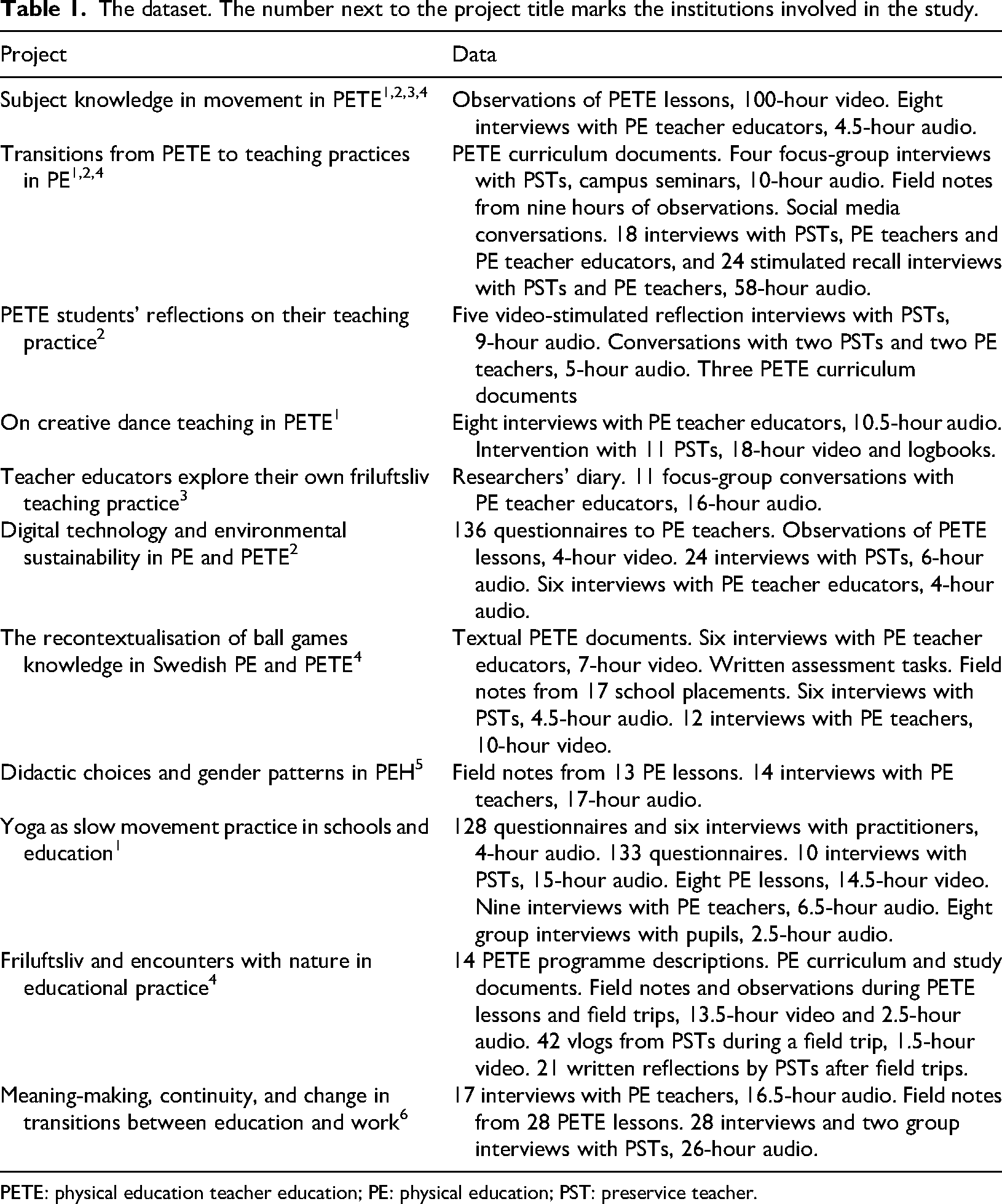
In this study, we draw on results and reanalyses of data generated from 11 different research projects on PETE in Sweden that explored campus-based education, school placement, and/or the transition from teacher education to the profession (see the dataset in Table 1). The projects represent six of the eight PETE institutions in Sweden. All these universities offer PETE programmes with a similar, nationally mandated structure, comprising three semesters of general teacher education (e.g. learning theory, special education, education and democracy, curriculum theory and educational policy, assessment and grading, and school placement), four semesters of PE (e.g. PE didactics, health and wellbeing, exercise science, research methods and thesis), and two to three semesters of studying another school subject (e.g. Mathematics, English, Biology or Social studies). The programmes include approximately 20 weeks of school placements. Apart from a few discrepancies, PETE in Sweden consists of teacher education programmes designed for future PE teachers in secondary and upper-secondary schools, even though many of these PE teachers also teach in primary schools. 1
The dataset. The number next to the project title marks the institutions involved in the study.
PETE: physical education teacher education; PE: physical education; PST: preservice teacher.
The dataset was drawn from two larger research projects and nine doctoral projects all funded by the Swedish Research Council and conducted between 2018 and 2024. The two larger research projects are a longitudinal project studying transitions from PETE to teaching practices in school PE, and a project exploring knowledge in movement within PETE. The nine doctoral projects explored teaching, learning and content in PE in teacher education and in schools from different perspectives. The projects include PETE and school PE studies, ranging from movement practices, such as games, outdoor activities, dance, and gymnastics, to pedagogical approaches, such as Assessment for Learning (AfL). The dataset accordingly entails studies of when PETE matters for PSTs within teacher education, in transitions between campus-based PETE and school placements, and in transitions from PETE to PE practice (see Table 1).
Data generation and analysis
Initially, the researchers individually scanned all data from their respective research projects to identify data related to the aim of our collective analysis. All projects are framed within a Scandinavian didaktik research tradition (Quennerstedt, 2019). Here, interest lies in questions like: ‘what, how and why, in terms of what and how teachers teach, what and how students learn and why this content or teaching is taught or learned’ (Quennerstedt and Larsson, 2015: 567). From this perspective, we formulated six jointly agreed-upon analytical questions about curriculum content and learning content, educational purposes, pedagogical discourses, and relations between different areas of PETE (campus-based and school-based) and teaching practices in school PE. Each researcher used the questions for an initial in-depth reanalysis of their respective dataset to identify instances when PETE seemed to matter and how:
What appears to be the purpose of the explored educational practice? What is the curriculum content and/or the intended learning content (i.e. what the students are expected to learn)? What is taken for granted about PE and teaching PE (by students, teachers, in the enacted content)? What relations are students making in the practices to content, context, and previous experiences? How do different ideas and/or discourses and/or experiences in these practices affect PETE students in different areas of PETE (campus-based, school-based)? How have different ideas and/or discourses and/or experiences within PETE affected the PSTs when they become PE teachers in school?
Depending on the data of each project (see Table 1), not all six analytical questions were applicable. However, taken together, the analytical questions served to identify instances in each project where PETE mattered.
In a second step, as part of the reanalysis, a two-day analytical workshop was conducted, where all researchers met to collaborate on a joint in-depth analysis of all data, posing new questions about how and when PETE matters during PSTs’ teacher education throughout campus-based courses, in the transitions between campus and school-based experiences, and in the shift from teacher education into the initial years of teaching. Here, the 13 researchers shared their respective data on the six analytical questions across three groups with different focuses: campus-based PETE (n = 5), school-based PETE (n = 3), and teaching practices in school PE (n = 5). During the analytical group work, the researchers identified and discussed common themes, such as the educational potential of different movement cultures in campus-based PETE. In total, 13 written documents (one by each researcher from their initial in-depth analysis of their respective dataset), three written documents and three audio recordings from the collaborative analysis, and two written documents by the three project leaders (Christopher, Mikael and Håkan) were produced during the workshop. As part of the workshop, we used a deliberative strategy involving ‘intelligent deliberation and balanced consideration of alternatives through mutual communication’ (Goodyear et al., 2019: 508). Importantly, the deliberative strategy was not a process designed to approach an essential truth. Still, it was a procedure to achieve the highest possible rigour and trustworthiness in our analysis. During the process, all involved researchers participated in discussing, reflecting on, and evaluating different alternatives, arguments, and analyses of results.
The results following the workshop were further analysed in-depth by the three project leaders. Here, following the advice of Smith and Phoenix (2018), a process of familiarisation was initiated. This initial step involved reading and listening to the entire dataset from the analytical workshop while identifying patterns and labelling categories related to how, when, and for what PETE matters, as well as what matters in PETE. The themes identified during the groupwork, such as the educational potential of specific movement cultures, were further elaborated and organised in comprehensive categories (Smith and Phoenix, 2018). For example, the category Teaching knowledge in movement and movement cultures connects to instances where PE teacher educators contributed by recontextualising knowledge in movement for general educational purposes and clarifying the educational potential of movement cultures for the PSTs. The category Accommodating coherence was identified through data showing when PSTs experienced coherence between campus studies and school placements. Providing opportunities for student subjectification relates to the data showing when PETE, in various ways, provided opportunities for PSTs’ professional subjectification. Lastly, Constituting a driving force for educational change was identified through data pointing to instances where PETE offered possibilities for a modernisation of PE by including new perspectives, pedagogical approaches, and movement cultures. Then, data from the 11 research projects relating to each category were identified and categorised into subcategories, such as the educational potential of movement cultures of yoga-based practices and friluftsliv relating to campus-based PETE, which formed the subcategory Broadening movement cultures. Finally, following the strategy of Goodyear et al. (2019), the categories and subcategories were considered and discussed again amongst all authors, in view of the purpose of the paper, i.e. the question of when PETE matters and how.
Findings: When PETE matters
The reanalysis of all generated data from the various projects yielded four comprehensive categories. The categories represent instances in our data where we analytically identified ways in which actions and experiences of teacher educators and PSTs, as well as events in PE, seemed to matter, i.e. made a difference or had significance, during campus-based courses, in the transitions between campus and school-based experiences, and in the shift from teacher education into the initial years of teaching. Hence, PETE mattered when: (i) knowledge in movement and movement cultures was taught, (ii) coherence was accommodated, (iii) opportunities for student subjectification were provided, and (iv) it constituted a driving force for educational change (also see Figure 1). Below, we present the results of our analysis and demonstrate occasions identified in our comprehensive dataset of when PETE matters. Each category is first described, followed by subcategories of how PETE matters, with the occasions illustrated by two examples from the data per subcategory.
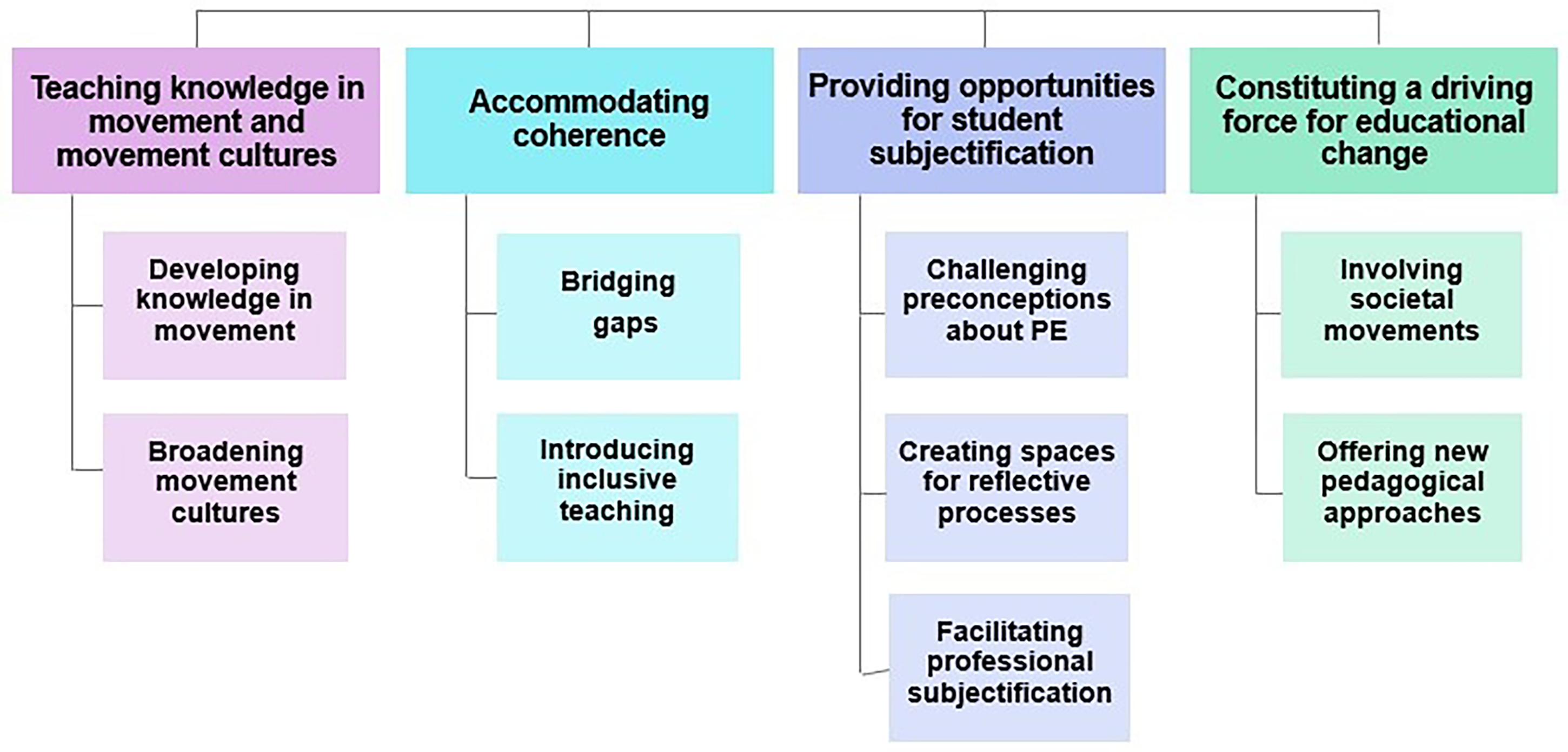
Four comprehensive categories of when PETE matters.
Teaching knowledge in movement and movement cultures
Teaching knowledge in movement and movement cultures concerns how PETE matters by impacting PSTs’ movement capabilities in terms of what to know and what to be able to do. Across 10 of our projects, instances were identified when PE teacher educators contributed to PETE mattering in terms of (i) developing PSTs’ knowledge in movement, and (ii) broadening the PSTs’ encounters with movement cultures. The teacher educators offered various ways to teach movement, recontextualise knowledge in movement for educational purposes and clarify the educational potential of different movement cultures. The empirical evidence shows instances of not only how teacher educators sought to influence PSTs, but also how (at least some of) the latter were affected by the teaching.
Developing knowledge in movement
In many countries, PE in schools aims, among other things, to develop pupils’ movement capabilities. Therefore, PSTs need to be educated in a wide range of movement practices, focusing on how learning of movement capabilities is nurtured within these practices. Across two-thirds of our research projects, instances were identified when broader and richer conceptualisations of content were recontextualised in PETE courses so that PSTs could develop knowledge in movement in a general sense.
Along with teaching ball games or gymnastics, one example of how PETE provided opportunities for PSTs to learn movement that often lay outside their common range was identified in the area of dance. This example was identified in two projects on subject knowledge in movement and creative dance teaching in PETE, where we could observe how PSTs practised making sense of moving in non-predetermined ways and appreciating the expressive dimension of movement during dance lessons. This knowledge in movement contributed to broadening – and contrasting – the PSTs’ previous knowledge of moving in predetermined ways and their appreciation of functional aspects of movement. Dispositions involving exploration and experimentation with creative movement patterns were nurtured among the PSTs with the help of knowledgeable PE teacher educators, a specific movement framework (Laban Movement Analysis) and learner-centred pedagogies. Another example of when PETE provided ways for PSTs to learn versatile movement capabilities was identified in the area of gymnastics. Gymnastics is often associated with an approach described as performing the correct technique. In such teaching, the teacher assumes the role of an instructor of the correct technique and the PSTs (and pupils in PE) the role of performers of this technique. This illustrates a narrow view of gymnastics content. However, our analysis shows examples of how gymnastics content was presented more openly and richly. PSTs were offered tasks to explore different ways of, for example, rotating in order to discover the meaning of rotation and how different material and social aspects affected that meaning. In this way, rotation became a phenomenon that PSTs were to explore, rather than perform according to a predetermined technique.
Broadening movement cultures
PE teaching is sometimes criticised for excessively focusing on a relatively narrow set of movement activities imbued with similarly narrow performance standards (Kirk, 2010). Thus, there is good reason for PETE to introduce a broadening of movement cultures for PSTs, so they are not limited to a narrow teaching content when teaching PE in schools. In seven of the 11 projects, teacher educators’ teaching practices were seen to contribute to broadening the scope of movement cultures with which PSTs were familiar.
Our reanalyses found that PSTs were often unaccustomed to movement practices that required mindful awareness. For example, by introducing yoga-based practices, PETE acquainted PSTs with a movement culture that was relatively unfamiliar to them, one based on a different logic compared to many other physical activities. In our reanalysis, we identified how yoga-based practices helped PSTs make careful pedagogical considerations in terms of physical activity and the use of alternative movement practices and teaching methods. PSTs expressed that yoga-based practices during their PETE programme facilitated a mindful awareness they could bring to school contexts to notice things they had not seen before. Furthermore, many PSTs have limited prior experiences of friluftsliv 2 (outdoor education). Our reanalysis of three projects involving friluftsliv reveals a tension between what PSTs experienced from a participant perspective, focused on experiencing outdoor life, and a teacher perspective, oriented towards their future teaching practice. This tension sometimes results in situations where the participant’s perspective becomes dominant, and the educational purpose risks being overshadowed. However, data from one of the projects show that PSTs’ reflections on their becomings as teachers made them aware of the educative potential of their experiences of friluftsliv. Thus, the PSTs were able to make their personal experiences of friluftsliv relatable to their future teaching practices.
Accommodating coherence
This category concerns how PETE prepares future PE teachers for their profession. Teacher educators teaching content together with organisational structures in PETE can accommodate valuable coherence between campus studies, school placements, and teaching in schools by (i) bridging gaps, and (ii) introducing inclusive teaching to PSTs.
Bridging gaps
Previous studies suggest that PSTs sometimes experience weak links between subject studies, pedagogical studies, and school placements, making teacher education appear fragmented (Moura et al., 2022; Westerlund and Eliasson, 2022). Concerning this overall picture, we identified occasions in 10 of our projects in which PSTs identified clear links between different parts of teacher education and between teacher education and professional practice.
One example of accommodating coherence through bridging gaps between different parts of teacher education and teaching in schools was the inclusion of elements of AfL in campus-based studies. Our reanalysis of data from two projects on the transition from PETE to PE and PSTs’ reflections on their teaching practice reveals that, during campus studies, PSTs regarded AfL as an ideal way of teaching, clearly aligning with what research regards as best practice. For instance, PSTs considered it meaningful to share learning intentions and provide feedback to pupils to promote learning. They also noticed how activating pupils as learning resources for one another was relevant to teaching. However, in school-based studies, most PSTs found AfL challenging to apply in school PE because of constraints such as supervisors’ contrasting beliefs, a strong focus on assessment of learning and on grading due to a current accountability discourse. Through assignments that included using AfL during school placements, PETE provided opportunities for PSTs to practice what they had learned. When AfL was used coherently throughout PETE, PSTs sometimes learned to use pedagogical approaches as a lesson structure through communicating goals, promoting pupil ownership of learning, and facilitating reflection and discussions for pupils’ learning. Another example of coherence in PETE is the bridging of gaps between theory and practice. This was the case when PETE, as our reanalysis of one of the projects shows, offered PSTs spaces for critical reflection on issues such as digital technology in friluftsliv. In the outdoors, PSTs used both analogue and digital technologies to navigate unfamiliar environments. Teaching that included discussions about the advantages and disadvantages of different technology use provided the PSTs with opportunities to reflect on them critically in relation to teaching PE in school.
Introducing inclusive teaching
Inclusion is an aspect of coherence that previous research has identified as particularly challenging for PSTs and PE teachers (Larsson et al., 2018), and the teaching practice in schools is sometimes criticised for excluding some pupils and failing to provide learning opportunities. In seven of our projects, we identified instances where PETE successfully challenged exclusionary teaching practices and acted inclusively, thereby building coherence between PETE and PE practice in terms of inclusivity. In our reanalysis, we observed instances where PETE provided future teachers with the tools and knowledge to design activities that offer various entry points for pupils with diverse abilities, experiences, and interests. Instead of relying on traditional competitive activities, teacher educators introduced cooperative and non-competitive practices where PSTs worked together towards shared goals.
One example in our analysis is a project in the area of ball games. The example concerns inclusive teaching in PETE and how it influenced PSTs, prompting them to implement these practices during school placement and when they were beginning teachers teaching PE. In a Swedish context, ball games are often taught in ways that tend to privilege pupils with prior knowledge outside of school and favour boys over girls. However, our analyses reveal how ideas and teaching strategies for inclusive ball games teaching were transferred from the university to the school placement. Adapting teaching to pupils with different experiences of ball games and problematising competitiveness were essential aspects of this process. The beginning teachers’ practices were characterised by small-sided games, a combination of technical and tactical approaches and a focus on cooperation rather than competition. The two aspects of inclusive teaching and managing competition permeated the teacher educators’ descriptions of legitimate pedagogical content knowledge in a Swedish PE context, indicating that PETE had impacted the beginning teachers’ practices. Another example of how inclusive teaching was introduced in PETE and remained with PSTs over time was when teaching friluftsliv during school-based studies. Our reanalysis of two projects on teaching friluftsliv revealed that by teaching PSTs content they believed was useful in schools, for instance, by highlighting place-based pedagogies in teaching, PETE opened up new avenues for them to explore in their future teaching. Allowing PSTs to experience and acknowledge learning opportunities in environments near and far from school was shown to be a precondition for them to teach and expand traditions of friluftsliv in schools. In one of the projects, it became clear that PE teacher educators who emphasised inclusive teaching felt a need to reshape the oftentimes exclusive tradition of friluftsliv. Our data also showed that a prerequisite for such a change was that teacher educators met and discussed teaching traditions in order to explore and scrutinise their teaching practices. By scrutinising their own friluftsliv practices, they shed light on unspoken teaching traditions and facilitated a more reflexive approach as they prepared PSTs to teach friluftsliv inclusively.
Providing opportunities for student subjectification
This category concerns a process Biesta (2020) refers to as subjectification. In this sense, PETE provides ways for PSTs to become autonomous in their thinking and acting by educating them to become independent teachers in the future. Across all 11 projects, examples were identified when PSTs’ taken-for-granted preconceptions about what PE is and can be were disputed, enabling them to develop professional subjectivity as active and reflexive subjects. This was done through (i) PE teacher educators challenging PSTs’ preconceptions about PE, (ii) teacher educators creating spaces for PSTs’ reflective processes, and (iii) teacher educators facilitating PSTs’ professional subjectification.
Challenging preconceptions about PE
Previous studies highlight how PSTs often undergo PETE without significantly altering their preconceptions about the meaning and purpose of PE (Larsson et al., 2018). If PETE does not offer PSTs opportunities to challenge their preconceptions, it often contributes to reproducing what is already taken for granted.
An example from our reanalysis of two projects on subject knowledge in movement in PETE, where changes in PSTs’ preconceptions about PE occurred, was when teacher educators taught PSTs in the area of dance. When encountering dance, PSTs’ expectations about PE involving functional movements and fitness are often questioned. Our reanalysis showed that many PSTs seemed to expect that PE was predominantly guided by overarching principles focusing on the correctness of technique and functional movements, as indicated earlier in the category Developing knowledge in movement. Our data revealed that dance in PETE often concerns communication and meaning-making in movement, as well as experiencing movements, which stood in contrast to the function of movements. In this way, PSTs could gain experiences of PE beyond what they might expect during PETE. Another example of when PETE challenged PSTs’ preconceptions was when it enabled insights into new, inclusive ways to teach ball games. In our reanalysis of two projects including ball games knowledge, teacher educators and PSTs constructed an agreement that good pedagogical practice is based on inclusivity during PETE. Interestingly, the pedagogical competence that PSTs developed during PETE in the area of ball games involved disrupting the taken-for-grantedness of established pedagogies. Our analysis revealed that when the PSTs began teaching PE in schools, they used concepts and ideas from PETE. However, they also made pedagogical judgements concerning specific groups of pupils. The latter indicated that they had learned to use different pedagogical keys depending on the group of pupils they taught. It further suggests that PETE can make the PSTs aware of heretofore unreflective reproduction of teaching traditions in PE, whereby they can become increasingly reflexive professional subjects.
Creating spaces for reflective processes
Spaces for reflection are significant for PSTs’ opportunities for subjectification (Esser-Noethlichs et al., 2024), and in teacher education, PSTs are often given these opportunities. Our analysis showed that PSTs sometimes experienced reflection-for-the-sake-of-reflection or groundless reflection, which does not necessarily lead to new insights and learning. To counteract this tendency, we identified in the data how it is essential that opportunities for reflection are well prepared and that the issues discussed are relevant to PSTs. The analysis also indicated that occasions when PSTs could critically reflect on essential issues, potentially leading to opportunities for subjectification, occurred regularly.
One example is when existential reflections were conducted during and after PSTs’ school placements. This example was identified in the reanalysis of PSTs’ reflections on their teaching practice during school placement. These more existential reflections were particularly evident when PSTs were invited to write essays that identified, analysed, and discussed a problem, dilemma, or challenge in their own teaching, followed up during campus studies seminars. This process helped them break out of their old selves to become new professionals. Here, reflection enabled PSTs to come forward as professional subjects by providing opportunities to reflect on their existence in and through teaching situations they had experienced. As PE teacher educators instructed the PSTs to apply what they had learned through their existential reflections, the teacher educators seemed to help the PSTs utilise their knowledge more wisely and responsibly in relation to future teaching situations. In another example, following the reanalysis of two projects on the teaching of friluftsliv, systematic reflection processes constituted a crucial pedagogical opportunity related to becoming a teacher. This mainly involved reflections in which PSTs paid attention to authentic situations during camps and outdoor trips as essential experiences for their future teaching. Here, PE teacher educators created valuable spaces for reflection, both to account for what friluftsliv can mean for PSTs’ learning processes and to reflect on how authentic situations relate to their future teaching in schools. Working with systematic processes of reflection entailed teacher educators guiding and supporting PSTs in relating moments they experienced during camps to their becoming teachers.
Facilitating professional subjectification
PETE is also, at times, perceived as offering opportunities for PSTs to form a personal opinion, for example, about good (inclusive) teaching. The opportunities for PSTs to take a personal position on educational and teaching-related matters connect to subjectification. Examples of when PSTs were offered possibilities for professional subjectification, whereby they were allowed to become more autonomous in their thinking and acting as would-be teachers, were identified in eight of our projects.
One example of professional subjectification in PETE identified in the reanalysis of PSTs’ reflections on their teaching practice was when supervising teachers engaged in what can be called restrained and constructive acts of pointing during school placement. This example shows how acts of pointing, such as asking questions about teaching on strategically selected occasions, (re)directed PSTs’ focus towards aspects of their teaching that had previously received little attention. Thoughtful acts of pointing enabled PSTs during school placements to direct pupils’ attention to meaningful aspects of teaching situations, stimulate educative interactions and relevant feedback, and adapt teaching to specific groups or individual pupils. Subjectivity development was then supported by educators, i.e. both teacher educators and supervisors from school-based studies, who introduced PSTs to different possible ways of implementing various pedagogical ideas rather than prescribing which alternatives were more correct. Another example is when PE teacher educators enabled transformative learning moments. This was identified in our reanalysis of a project examining meaning-making during transitions from teacher education to working as a teacher. Here, PE teacher educators supported PSTs in connecting emotional encounters during visits to special needs schools with theoretical knowledge regarding teaching and learning. A reanalysis of statements by PSTs during school placement and by newly qualified teachers revealed that through this supportive process, teacher educators facilitated PSTs’ contextualisation of the knowledge, skills, and judgement prioritised in teacher education as essential for developing democratic and inclusive teachers. Reflecting on these transformative learning experiences, PSTs recognised that challenging questions from significant others created reflective spaces that enabled them to continuously and critically shape their professional identities.
Constituting a driving force for educational change
This category concerns how the teaching practices of PE teacher educators constitute a driving force for educational change. Across five of our projects, examples were identified when PETE mattered to PSTs during campus-based courses and in relation to the teacher profession. This was done by (i) involving societal movements, and (ii) offering new pedagogical approaches.
Involving societal movements
Kirk (2010) argued that PE is trapped in an outdated version of itself and is in danger of becoming increasingly irrelevant to young people's lives. PETE has a particular responsibility in this process as it drives educational change (Aasland et al., 2025). One way to better relate to young people's lives is for PETE to establish clear links with contemporary societal movements, as our analysis identified in four of the projects.
For example, our reanalysis of a project on digital technology and environmental sustainability in PE and PETE reflected broader educational trends. Here, PETE was seen to be where these trends are first explored and adapted to the context of PE. PETE introduced and equipped future teachers with the skills to incorporate digital technologies and environmental sustainability issues into their future PE teaching. This was evident in how PSTs critically engaged with and reflected upon digital mapping tools alongside traditional methods during outdoor education sessions. Some PSTs even opted to rely solely on digital tools, highlighting their utility for navigation as well as the challenges posed by technical failures such as battery depletion or poor signal reception. By introducing broader educational trends to PSTs, PETE can function as a catalyst for innovative and adaptive educational approaches. Another example of integrating new societal movements into PE, following our reanalysis of one of our projects, was the introduction of yoga-based practices to PSTs during PETE. These practices require a tempo significantly slower than what is usually associated with PE. Demands of the current high-speed society are, in a sense, reflected in teaching and educational contexts. The acceleration of technology, social change, and the pace of life risks producing a specific fast pedagogy. Our data show that, as slow and conscious movements were introduced in PETE, they sometimes generated heightened awareness and presence among PSTs. This involved developing ways for PSTs to listen and attend more carefully in movement.
Offering new pedagogical approaches
Subject knowledge alone is insufficient for teaching to meet the needs and conditions of all PSTs (Backman and Barker, 2020). Teachers must also be equipped with pedagogical knowledge. When pedagogical knowledge is presented in PETE, PSTs sometimes experience it as theoretical and detached. Therefore, it is perceived as challenging for PSTs to apply in the context of school placements and when they begin their professional practice. However, three of our projects provide examples of when PETE enabled specific pedagogical approaches that impacted PSTs during their teacher education.
One example, revealed in two of our projects, of when and how PE teacher educators offered new pedagogical approaches was when teaching created what can be called magic moments for PSTs. This aspect of how teacher educators offered new pedagogical approaches was identified in three projects focusing on subject knowledge in movement and creative dance, as well as friluftsliv teaching in PETE. The PSTs’ experiences of a magic moment consisted of creating and managing educative moments related to, for example, embodiment or movement. These were moments where content with a specific meaning was communicated with a special intensity between the participants, implying that the PSTs discovered something important. This was explicitly observed when PSTs practised dance and experienced friluftsliv in the outdoors. In the context of dance, teaching offered magic moments when the PE teacher educator guided movement experiences and challenged PSTs’ movement habits through exploratory dance composition tasks. In the teaching area of friluftsliv, PSTs frequently encountered unique experiences in which magic moments occurred during relational encounters with the surrounding nature. For example, this happened when PSTs experienced intense emotional nature experiences, such as being overwhelmed by a scenic view or waking up to the rising sun under a bare sky. In this way, our analysis suggests that significant and affective encounters with nature during PETE have the potential to be educative, supporting PSTs in creating similar situations outdoors for pupils in schools. Our analysis further suggests that such encounters in PETE can become educative for PSTs when teacher educators support reflection on their affective experiences.
While the previous example illustrates how PETE can matter for students during their professional socialisation, the following example shows how PETE can matter for the PE teaching profession. The example derives from a reanalysis of a project on transitions from PETE to PE, focusing on Movement Composition, an exploratory group assignment in PETE integrating gymnastics and dance. This approach, based on didaktik theory, is one that, in our data, affected PSTs in ways that remained relevant for both becoming and experienced teachers. It involved creative, collaborative, and student-centred learning tasks while integrating Laban Movement Analysis to intersect movement and theory. The assignments entailed aspects of creativity and movement, and longer periods were allocated to groups of PSTs to create and reflect on their own and other students’ group assignments. Our analysis showed that some PE teachers still used movement composition in school PE after 20 years of teaching, due to its adaptability, usefulness, and the positive learning experiences associated with it during PETE.
Concluding discussion
In this article, using the collective data from several research projects in Sweden and a joint in-depth analysis, we have discussed when PETE matters and provided illustrations of how PETE matters. In this way, we confirm several studies highlighting various aspects of impactful PETE (e.g. Adamakis and Zounhia, 2016; Birkelund et al., 2024; Hemphill et al., 2015; MacPhail and Hartley, 2016), while at the same time filling a gap regarding the impact of teacher education and the work of teacher educators.
First, PETE matters for PSTs when PE teacher educators contribute to developing their knowledge in movement and broadening their encounters with different movement cultures. This teaching involves recontextualising knowledge for general educational purposes, rather than specialist educational purposes, such as competitive ones, which are often the focus in sports clubs and other movement practices (cf. Larsson et al., 2018; McEntyre and Richards, 2023). Essentially, the recontextualisation is tacit, making it challenging for PSTs to observe and discuss. Hence, in line with the review from Hordvik and Beni (2024), it is when the recontextualisation of knowledge in movement is verbalised that it can be reflected on and problematised in relation to the teaching and learning of movement. This entails using unspoken or tacit content in an educative way, rather than leaving the content of teaching as indeterminate situations for PSTs to manage on their own (see also Richards, 2015). Furthermore, consistent with previous research (e.g. Larsson et al., 2018; MacPhail and Lawson, 2020), most PSTs in our studies were more experienced in movement cultures such as competitive sports and ball games, but less so in acrobatics, creative dance, and friluftsliv. So, in our analysis, we found that PE teacher educators may play a crucial role in broadening PSTs’ movement capabilities, which are important assets provided during PETE. When teaching introduces PSTs to different movement cultures, it can counteract a broader societal trend in which young people's movement repertoires are becoming increasingly narrow (Larsson et al., 2018).
Second, and as also recognised by, for example, Birkelund et al. (2024) and MacPhail and Hartley (2016), PETE can bridge gaps between the different parts of teacher education and teaching PE in schools when accommodating coherence. Coherence can then impact PSTs’ beliefs about good PE teaching and, as in Hemphill et al.'s (2015) study of case-based learning, enable authentic, affective, and reflexive teaching situations with pupils that support PSTs’ processing of experience (see also Hordvik and Beni, 2024). Furthermore, PETE can challenge reproductive and unequal teaching practices in PE, as issues of adaptation and inclusive teaching are highly valued by teacher educators and PSTs. These values are essential in the transition from PETE to PE, especially given the educational content in PE that is criticised for being exclusive and failing to offer reasonable opportunities for learning for all.
Third, PETE matters when PE teacher educators challenge PSTs’ preconceptions about PE, when they create spaces for PSTs’ reflective processes, and provide opportunities for student subjectification. This aligns with MacPhail and Lawson's (2020) call to continually challenge taken-for-granted assumptions about teaching and learning in PE, thereby creating spaces for what can be called existential reflection and restrained, constructive acts of pointing (Johansson, 2023). These acts of pointing entail treating PSTs as autonomous future teachers with the freedom to test and take responsibility for their pedagogical decisions and judgements, and pointing to opportunities for PSTs to reflect on their pedagogical choices. Opportunities for subjectification are important for PSTs to develop their professional judgements as part of becoming PE teachers. Hence, they create their experiences as teacher subjects and not as passive objects of educational interventions.
In the transition between a university context and a school context, PSTs encounter complex and challenging situations that require them to navigate new professional and pedagogical demands (e.g. Richards, 2015). In this scenario, PETE programmes can matter as they prepare teachers to make an impact on their pupils when entering the school context by creating spaces for reflection on the why(s), what(s), and how(s) of teaching and learning in PE practice. For example, for novel pedagogical ideas to be meaningful for PSTs, PETE must help address future teachers’ problems in practice. Our data indicate that teacher educators may play a crucial role in this process by acting as role models for professional practice. Content and teaching choices in subject didactics courses, together with teacher educators’ embodiment of critically reflective and knowledgeable PE teaching, help bridge PSTs’ prior PE experiences and their development of broader professional judgement. However, the role of teacher educators as models has been extensively discussed in previous research, particularly concerning concepts such as occupational socialisation and phenomena like wash-out (e.g. Ferry and Westerlund, 2023). This highlights a tension between what Biesta (2020) terms socialisation, i.e. adapting to societal norms, and subjectification, such as developing critical thinking. PSTs and PE teachers must navigate this tension as they integrate into the societal context of their workplaces while critically evaluating their own practice. Hence, as Richards (2015) also argues, teacher education should provide tools that enable PSTs to balance these demands effectively.
Finally, the teaching practices of PE teacher educators offer opportunities for educational change by introducing PSTs to broader societal challenges that are increasingly shaping educational priorities. When incorporating societal movements into established curricula, such as sustainability or digitalisation, PETE, as called for by MacPhail and Lawson (2020), offers opportunities to experiment with new ideas and practices that can later be transferred to school-based teaching. Furthermore, the work of teacher educators matters for future PE teaching by providing PSTs with profound impressions, enjoyment, and positive learning experiences of new pedagogical approaches. As also highlighted by Lorente-Catalán and Kirk (2013), these experiences can shape PSTs’ future teaching in PE by fostering their ownership of their continual professional learning. Through positive experiences of alternative pedagogical and assessment practices during PETE, PE teachers can become competent users of such practices. As our analysis shows, this can help them overcome barriers such as colleagues’ contrasting beliefs, pupils’ resistance, and dominant PE traditions (Richards et al. 2014).
In conclusion, and in contrast to studies questioning the impact of PETE (e.g. Macken et al., 2020; Ward et al., 2024), this article points to instances when PETE mattered and how. However, this does not mean that PETE always matters in these ways. Our 11 projects also include findings in which PETE does not appear to matter. We have highlighted the potential of PETE mattering for PSTs in teaching knowledge in movement and movement culture, in accommodating coherence, in providing opportunities for subjectification, and in constituting a driving force for educational change. While this article does not account for differences across teachers’ career stages, it nonetheless positions PETE as an important site for professional formation in the ongoing development of PE teachers.
Footnotes
ORCID iDs

Funding
The authors disclosed receipt of the following financial support for the research, authorship, and/or publication of this article: This work was supported by the Vetenskapsrådet (Grant Nos. 2017-03685, 2021-03830 and 218-03626).
Declaration of conflicting interests
The authors declared no potential conflicts of interest with respect to the research, authorship, and/or publication of this article.