







Abstract
There have been many calls for systems-informed approaches to evaluation. Population health interventions, which often focus on improving the upstream determinants of health through large-scale change, seem well-suited to systems-informed approaches to evaluation. The purported benefits and appropriateness of taking a systems-based approach to population health intervention evaluation have been extensively discussed, and there is a growing, but still limited, number of applied case studies that operationalised these calls. Here, we reflect on insights gained from recent experiences across three evaluation case studies of: a late-night levy to support local policing (UK), the tiered soft drinks industry levy (UK) and a value-based tax on sugar-sweetened beverages (Barbados). Building on theoretical work in this area, we illustrate through applied examples how a systems-informed approach can help to cast a wider net for potential impacts, be integrated with an effectiveness perspective to produce deeper insights and support greater engagement with non-linearity.
Introduction
There have been many calls for systems-informed approaches to evaluation, both within the population health field and beyond (Barbrook-Johnson et al., 2021; Gates et al., 2021; Rutter et al., 2017; Skivington et al., 2021). Systems thinking emphasises the importance of dynamic change, non-linearity, feedback loops, adaptation and emergence (Meadows and Wright, 2009). Systems-informed approaches to evaluation may entail using systems tools and methods, such as causal loop diagramming, system dynamics modelling and agent-based modelling, and conceptualising interventions as events within systems (Gates et al., 2021; Hawe et al., 2009; McGill et al., 2021).
Persistently high global rates of non-communicable diseases underscore the need for population health interventions (PHIs), which focus on improving the upstream determinants of health through large-scale change (alongside other types of interventions (Sniehotta et al., 2017)). Since PHIs operate on a scale that makes it challenging to assess using randomised control trials (RCTs) (Craig et al., 2025; Rutter et al., 2017), evaluation teams (including ourselves) tend to use natural experimental evaluations to quantify the impact of such PHIs and assess the effectiveness-oriented question: ‘To what extent does the intervention produce the intended outcomes in real world settings?’ (Skivington et al., 2021). However, answering this question rigorously and well does not necessarily shed light onto why and how an intervention may have operated, nor how and in what ways the system and intervention may have adapted to one another.
This is a major potential shortcoming of an effectiveness-only evaluation perspective for PHIs, particularly since we expect system adaptations to occur following the implementation of (by definition) large-scale policy and infrastructure PHIs. Understanding the range and nature of such adaptations would help to improve and strengthen interventions over time (Hawe and Potvin, 2009; Ogilvie et al., 2019).
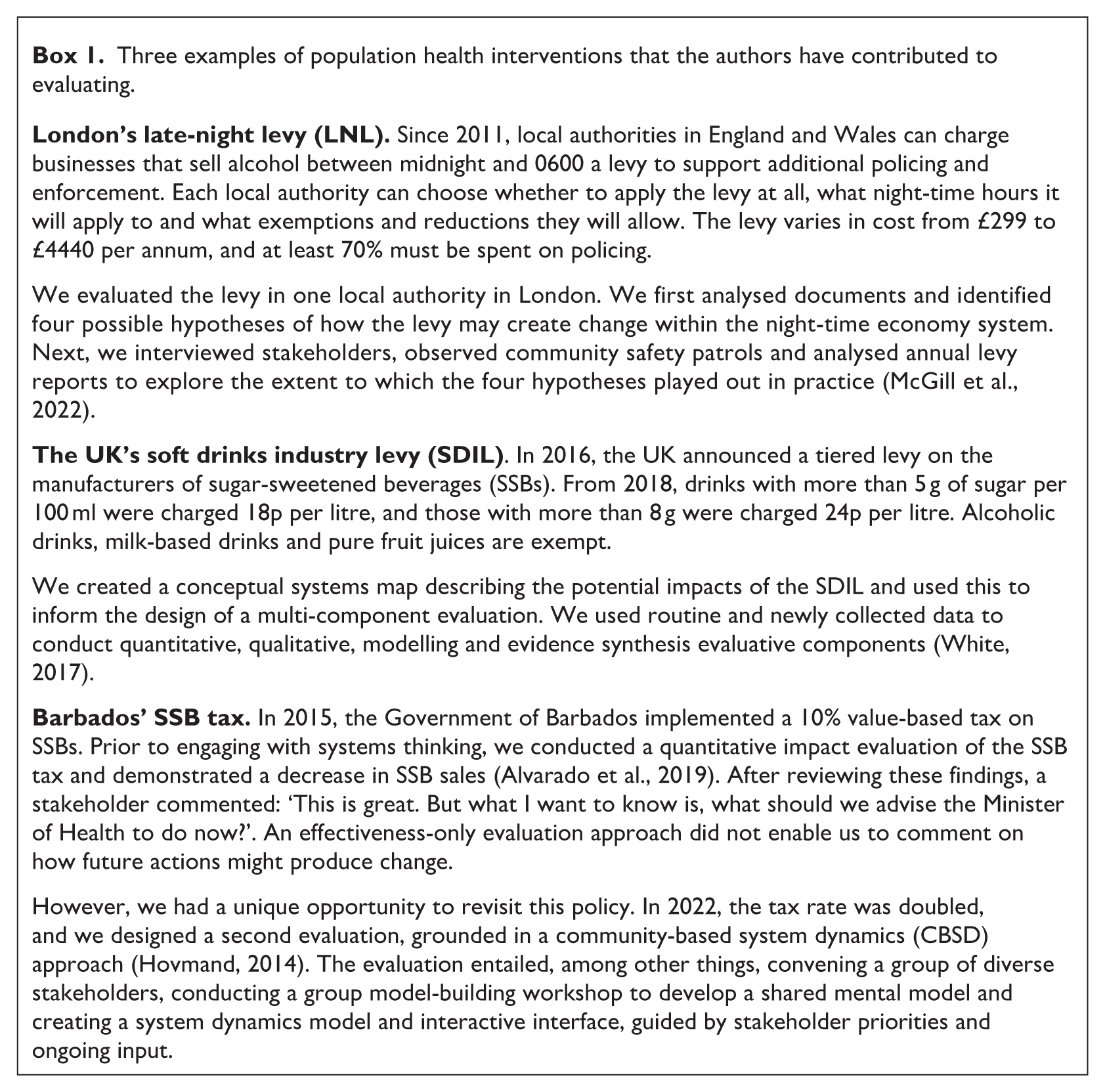
Over the past decade, we have led and engaged in systems-informed evaluations of three PHIs (Box 1). Here, we reflect on insights gained from recent experiences across three case studies: a late-night levy (LNL) to support local policing (UK), a tiered soft drinks industry levy (UK) and a value-based tax on sugar-sweetened beverages (Barbados). We aim to illustrate through applied examples how a systems-informed approach can enrich population health evaluations. We hope that these reflections are of value particularly to those at the beginning of their own systems thinking journey as they move from the theoretical literature to conducting systems-informed evaluations.
Three examples of population health interventions that the authors have contributed to evaluating.
A systems-informed approach can help to cast a wider net for potential impacts
In all three evaluations (Box 1), we developed theories of change embedded in systems maps and used these to guide analyses beyond the primary intended pathway of change (a ‘systems framing’ approach, as described in McGill et al. (2021). This helped us to identify a wide range of potential impacts, as well as pathways to these impacts.
For example, we developed a conceptual systems map of the SDIL’s potential impacts through consultations with key stakeholders and a Delphi process (White, 2017). Within this map, we included elements we had expected to evaluate, such as price, reformulation, purchasing, consumption and health. However, the map also helped us broaden our scope to include assessing changes in how SSB companies presented themselves in the media, soft drink business turnover and public acceptability.
If systems-informed approaches help us to cast a wider net, the width of the net depends largely on the diversity of perspectives represented. For example, the LNL was designed to reduce the social impacts of acute alcohol intoxication such as injuries, noise and other antisocial behaviour. However, we also considered the views of local business owners who identified potential indirect harms from the levy on the local Business Improvement District. As a result, we broadened our theory of change. This potential impact would not have been considered relevant if we had remained focused solely on the outcomes the intervention designers sought to influence.
While a systems thinking approach encourages evaluators to forefront the identification and analysis of multiple impacts, other approaches and methods (e.g. comprehensive theories of change, not limited to single pathways) may achieve similar aims.
Systems-informed and effectiveness perspectives can be integrated to strengthen an evaluation
In the second evaluation of the Barbados SSB tax, we moved back and forth between a systems and effectiveness perspective (Skivington et al., 2021) and found that this was both feasible and enriching. For example, we were able to use a causal loop diagram developed in the early stages of the evaluation to surface possible explanations for a puzzling finding in our quantitative impact evaluation. Later, we used findings from the impact evaluation to calibrate a system dynamics model (SDM), which prompted us to add new model structure and hypothesise about an additional system adaptation.
Going beyond the traditional (in population health) effectiveness evaluation by situating the perceived primary outcome within a broader context of multiple intended and unintended impacts, systems adaptations and feedback loops produce deeper insights. At the same time, some evaluation users (e.g. technical officers in ministries of health and finance) told us that to be most useful, a systems-informed evaluation should be delivered alongside an impact evaluation, as this is the dominant type of evidence policymakers expect when assessing PHIs.
Our experience echoes arguments made by others regarding the relationship between taking a systems perspective and an effectiveness one (Hawe et al., 2004), as well as Moore et al.’s call to use systems thinking to both shape evaluation questions and interpret evaluation process and outcome data (Moore et al., 2019).
A systems-informed approach supports embracing non-linearity
Systems-informed approaches to evaluation uniquely, we think, emphasise the importance of feedback loops and non-linearity. This can be represented either qualitatively (e.g. causal loop diagramming) or quantitatively (e.g. system dynamics modelling).
We identified several reinforcing feedback loops in our evaluation of the LNL. One example was the development of cooperative relationships between police, community safety patrol officers and licenced venue operators. Key to this cooperative relationship was the sharing of information about late-night venues and patrons, which was used to inform future targeting of levy resources. This reciprocal information sharing built trust between systems actors, which in turn increased the ability of levy resources to be used effectively.
System dynamics modelling can be used to operationalise and visualise potential feedback loops further. For example, in the Barbados SSB tax evaluation, we developed an SDM to represent the links between SSB taxation, SSB consumption, diabetes rates, tax revenue and industry responses. The system structure that most closely aligned with observed trends in SSB sales included an industry learning feedback loop, where industry responses grew stronger and more effective over time. This insight had not been previously articulated but resonated strongly with stakeholders and led to rich discussions about ‘what next?’ from both civil society and government perspectives.
Conclusion
We suggest that systems-informed evaluation of PHIs can help to cast a wider net for potential impacts, be integrated with effectiveness approaches and facilitate greater engagement with non-linearity. While our experience has been focused on PHIs, some of these reflections may also be relevant to evaluations of other types of interventions, such as health interventions operating at the individual level (Sniehotta et al., 2017), or policy and infrastructure interventions focused on climate mitigation and adaptation (Benton et al., 2025). We look forward to seeing how the broader conversation in this area continues to evolve.
Footnotes
Acknowledgements
We are grateful to Matt Egan and Martin White who provided critical feedback on a previous version of the manuscript.
ORCID iDs

Ethical considerations
Not applicable. This manuscript does not report on or involve the use of any animal or human data or tissue.
Consent to participate
Not applicable.
Consent for publication
Not applicable. This manuscript does not contain any individual person’s data in any form.
Author contributions
The idea for this manuscript evolved from a session that the authors organised and delivered at the 15th European Evaluation Biennial Conference in Rimini, Italy, in September 2024. MA conceived the idea for the session and the manuscript and convened the authors. All authors engaged in a series of discussions that led to the ideas included. MA led writing with contributions from all other authors. All authors read and approved the final manuscript.
Funding
The authors disclosed receipt of the following financial support for the research, authorship, and/or publication of this article: MA was supported by the Wellcome Trust (grant number 218629/Z/19/Z). MA and JA were supported by the Medical Research Council (grant number MC_UU_00006/7). EM was supported by the National Institute for Health and Care Research (NIHR) School for Public Health Research (SPHR) (Grant Reference Number NIHR 204000). The views expressed are those of the author and not necessarily those of the NIHR or the Department of Health and Social Care.
Declaration of conflicting interests
The authors declared no potential conflicts of interest with respect to the research, authorship, and/or publication of this article.
Data availability statement
Data sharing is not applicable to this article as no datasets were generated or analysed during the current study.