







Abstract
For decades the literature of place branding reflects a picture of separation between country branding, city branding and region branding. Many researchers tend to perceive these three concepts as three different concepts that have no conception and should be addressed in different forms of strategies. Practically, it appeared that country branding, city branding and region branding processes are integral parts which in some instances can not be separated. The purpose of this conceptual paper is to describe a new approach of re-branding countries strategy in accordance to two dimensions: the geography of the country vs. the range of ethnic groups in the country. These two dimensions create four types of positioning strategies that reflect the tight linkage between country branding, city branding and region branding. Each of these positioning strategies is discussed and examples to this linkage are provided.
Introduction
The realm of place branding engages many practitioners the world over who are tasked with improving the images of countries, cities, and regions for different kinds of audiences such as tourists, citizens, investors, governments, and the media. While in the past, this process characterized only developed countries, today, many emerging and also developing countries allocate significant budgets in order to create a more positive and attractive images. Despite the surge in interest among academics, research on place branding still remains a complicated and somewhat confused construct (Fan, 2006). The purpose of this article is to suggest both a new approach to the strategy of rebranding countries and to explore the nature of the linkage between country, city, and region branding concepts so as to provide decision makers with the most correct and applicable country branding strategies. This new approach is based on the idea that any rebranding process of a country should be done from the perspective of visitors and tourists and not from the perspective of the marketers and decision makers. The proposed model focuses on two dimensions: the country’s geography and the population–nationality that are relevant (of interest) to tourists, and at the same time, applicable to marketers when rebranding countries.
Evolution of place branding
In many countries, mandatory product labeling requires marketers to disclose a product’s country of origin (COO). This legal requirement prompted market researchers and practitioners to study consumer attitudes toward foreign products, which has resulted in almost four decades of extensive investigation of the so-called COO effect (Kotler and Gertner, 2011: 38). Research has shown that products bearing “Made in Japan” (cars, cameras, and consumer electronics), “Made in France” (wines, perfume, and clothing), or “Made in Italy” (furniture, shoes, and sports cars) labels are commonly regarded as high quality, due to the reputation of these countries as first-rate manufacturers and exporters (Jaffe and Nebenzahl, 2001). Studies such as that of Johansson et al. (1994) demonstrated that Russian products have a negative perceived quality and the study by Khachaturian and Morganosky (1990), which showed that Costa Rica and China have the most negative perceived quality, were the trigger for the evolution of the field of place marketing/image.
Place marketing/image is derived from a location’s geography, history, art, music, famous citizens, and other features (Kotler and Gertner, 2002). Basically, today it seems that governments (countries), municipalities (cities), and councils (regions) everywhere are racing to brand their assets in order to attain a competitive edge over their competitors. If in the past, a country’s, city’s, or region’s main assets were the products created in its environs, nowadays the assets are the country, city, or region itself. Accordingly, governments, municipalities, and regional councils invest great effort in creating a real, competitive advantage over other countries, cities, and regions (Kotler et al., 1997), promoting their superiority in terms of tourism and location (to attract factories, companies, and talented people) and finding markets for their exports (Gilmore, 2001).
Branding campaigns designed to attract tourists comprise the bulk of these efforts (Szondi, 2007). Countries such as Thailand (Nuttavuthisit, 2007), Costa Rica, Moldova (Florek and Conejo, 2007), Ireland (Gould and Skinner, 2007; O’Leary and Deegan, 2003), Turkey (Kemming and Sandikci, 2007), Spain (Gilmore, 2001), Britain (Gilmore, 2001; Hall, 2004), Yugoslavia (Hall, 2002), Australia (Morgan and Pritchard, 1999), and New Zealand (Morgan et al., 2003) have undergone processes aimed at rebranding themselves and promoting a positive tourist-oriented image. Some campaigns were a result of a global economic crisis, for example, the case of branding India (“Incredible India”—affordable and beautiful), which appeared to be a very successful process in terms of American tourists (Bandyopadhyay and Morais, 2005) or in response to being seen as a terror-ridden country as in the case of Russia (Wills and Moore, 2008). These countries realized that acquiring a new image was crucial in order to leverage their assets.
In addition to countries branding or rebranding themselves, cities all over the globe have also opted to undertake the process. Cities such as Glasgow (Daskou et al., 2004), Manchester (Ward, 2000), Bradford (Trueman et al., 2004), London (Anholt, 2006a, 2006b; Hopper, 2003), Denver (Jaffe and Nebenzahl, 2006: 166), Beijing (Zhang and Xiaobin, 2009), Amsterdam (Kavaratzis and Ashworth, 2006), Montréal (Rantisi and Leslie, 2006), and many more have already completed the design of their new look and successfully reinforced their positive image in the minds of millions of foreign tourists. Targeting domestic tourism until conditions improve during periods of terror, as was the case of Jerusalem, for example, is a proven successful alternative to targeting foreign tourism (Mitki et al., 2011). The economies of some cities such as Barcelona, Venice, and Bangkok are based mainly on tourism. The phenomenon of city branding is very powerful in Western Europe. In Germany, for example, 70% of German cities already work according to a place-marketing concept and 10% plan to do so in the near future (Grabow et al., 2006). Moreover, regions such as Wales (Pritchard and Morgan, 1998), Western Australia (Crockett and Wood, 2000), and Florida (Brayshaw, 1995) have also been branded.
Country branding versus city branding versus region branding
According to Caldwell and Freire (2004), people perceive countries, regions, and cities in different ways. Countries are so functionally diverse that they are perceived in terms of the representational parts of their brand identity, whereas regions and cities, being smaller in scale, are perceived more from a functional point of view. Despite these differences, marketing a place (country, region, or city) depends mostly on understanding how people perceive one another. Moreover, though the process of rebranding a country, region, and city is considered to be complex, it appears that branding a city is a much more involved process than branding countries or regions (Hankinson, 2001). Since cities lack the ability to identify themselves with well-known core competencies, mainly human assets such as politicians, mayors, artists, and celebrities (Gilmore, 2001), thereby making it difficult for cities to become individual objects of attraction in their own right. This major problem is even more acute for marketers dealing with small cities and with cities that are not perceived as especially attractive. Yet, according to Savitch and Kantor (1995), megacities can compete effectively against much larger units, even countries and regions, for the limited pool of foreign direct investment (FDI) capital (e.g. New York, Paris, and London have larger populations than many countries and regions).
A significant challenge confronting marketers attempting to attract FDI to a country, according to Papadopoulos and Heslop (2002), is the potential conflict between different levels of government within the country that is being marketed. Provincial or state governments may have goals and programs that diverge from those of the national government. O’Shaughnessy and O’Shaughnessy (2000) claimed that branding a country will involve more variables than branding a region of the same country. Countries have certain attributes that a region within this same country does not have. In addition, Anholt (2002) referred to the differences between countries and their regions from the perspective of the way they are perceived in different countries. In other words, the way citizens of different countries perceive a particular country can differ widely, but views across a wide spectrum of nationalities regarding a region tend to be more stable and are, therefore, easier to manage.
Models of country branding strategies
In the past marketers and mainly advertisers used to brand a country by inventing catchy slogans such as “Spain—Everything Under the Sun,” “Flanders—Europe’s Best Business Location,” and “Scotland—Silicon Glen,” or using visual images or symbols such as the Eiffel Tower for France, Big Ben for England, Red Square for Russia, the Statue of Liberty for the United States, and the Christ the Redeemer Statue for Brazil (Kotler and Gertner, 2011: 42).
Over the years, marketers have succeeded in creating a mixture of country marketing tools in order to brand nations for the long term rather than for the short term. One of the first country marketing models was based on Gardner and Levy’s (1955) definition that any product brand has two dimensions of attributes: tangible and intangible characteristics. Just as they choose any other product, consumers (tourists) also choose countries on the basis of attributes such as climate, scenery, amenities, and culture (Coshall, 2000). Country branding, therefore, can be characterized as having two dimensions: representational (attributes linked to the individual’s way of self-expression, analogous to intangible characteristics) and functional (utilitarian aspects of the destinations—sun, reefs, sky, culture, and so on, analogous to tangible characteristics). On the basis of Gardner and Levy’s definition, Gilmore (2001) created the positioning diamond model, which has four essential factors that need to be considered for any country branding process: macrotrends (socioeconomic trends, political and legal status, emerging industries, population trends, and cultural and lifestyle trends), target audiences (stakeholders), competitors (similar countries, in the eyes of tourists), and core competencies (the physical and human assets of the country). Another well-known model is the hexagon of competitive identity model developed by Anholt (2002), which combines six channels or areas of activity that countries generally undertake: tourism promotion, exported products and services, regional government policy decisions, the way the country solicits inward investment, cultural activities and achievements, and the people of the country themselves. Another more updated model, which is based on Anholt’s model, is Morgan et al.’s (2011) “virtuous circle of creative country reputation,” which contains six elements—country tone (its ambience, the attitude of its people, its heritage, and narratives), traditions (the collective authenticity), tolerance (social responsibility, ethical practice, and sustainable ways of living), talent (the characteristics of the human capital), transformability (adopting advanced ways of living), and testimonies (the reputation of the country based on stories).
Nevertheless, these country branding models are very limited in their abilities to cope with different kinds of country positioning, and especially lack the ability to cope with the integral connection that exists between a country, a city, and a region within the country or surrounding a specific city, in a comprehensive country branding process. It is important to note that given that countries differ from each other, some will find the process of coordinating national, regional, and local destination branding aspects to be more complicated, while others will find it essential to their rebranding positioning. The latter countries are more internationally oriented and attract more varied audiences.
“Country–city–region matrix positioning” model
The proposed country–city–region matrix positioning model leverages the interconnection of these three concepts and enables marketers to understand when these concepts affect each other and which one of these concepts is more meaningful, and accordingly should be stressed, in the comprehensive country branding process. Since each country has, on the one hand, its own uniqueness and strengths, and on the other hand, its own weaknesses, it is impossible to ensure that each country will—at the end of the rebranding process—achieve the same results in terms of equity. Therefore, it is essential to assess each country’s potential in terms of national, regional, and local assets (tangible and intangible). Countries characterized by more tangible and intangible national assets are more likely to successfully brand themselves as opposed to those that have only tangible and intangible regional or local assets. Accordingly, although marketers tend to differentiate between national, regional, and local branding processes and refer to them as three separate processes that are independent of each other, this model shows that in reality these concepts are interdependent and impact on each other. In some instances, a country cannot be rebranded without referring to its main regions or main cities.
The matrix presented in Figure 1 reflects a new approach for marketers involved in country branding. This matrix enables marketers to rebrand a country such that it is more attractive for tourists, and at the same time, it may leverage the country’s reputation, so that other audiences are also attracted. Whereas the literature ignores the necessity of marketers to refer to a country’s geography and the population–nationality mix, this new matrix shows that the combination of these two critical dimensions should be taken into account when dealing with country branding. The idea behind this new approach is based on the fact that these two dimensions can define in the most accurate way the real market positioning potential of each country.
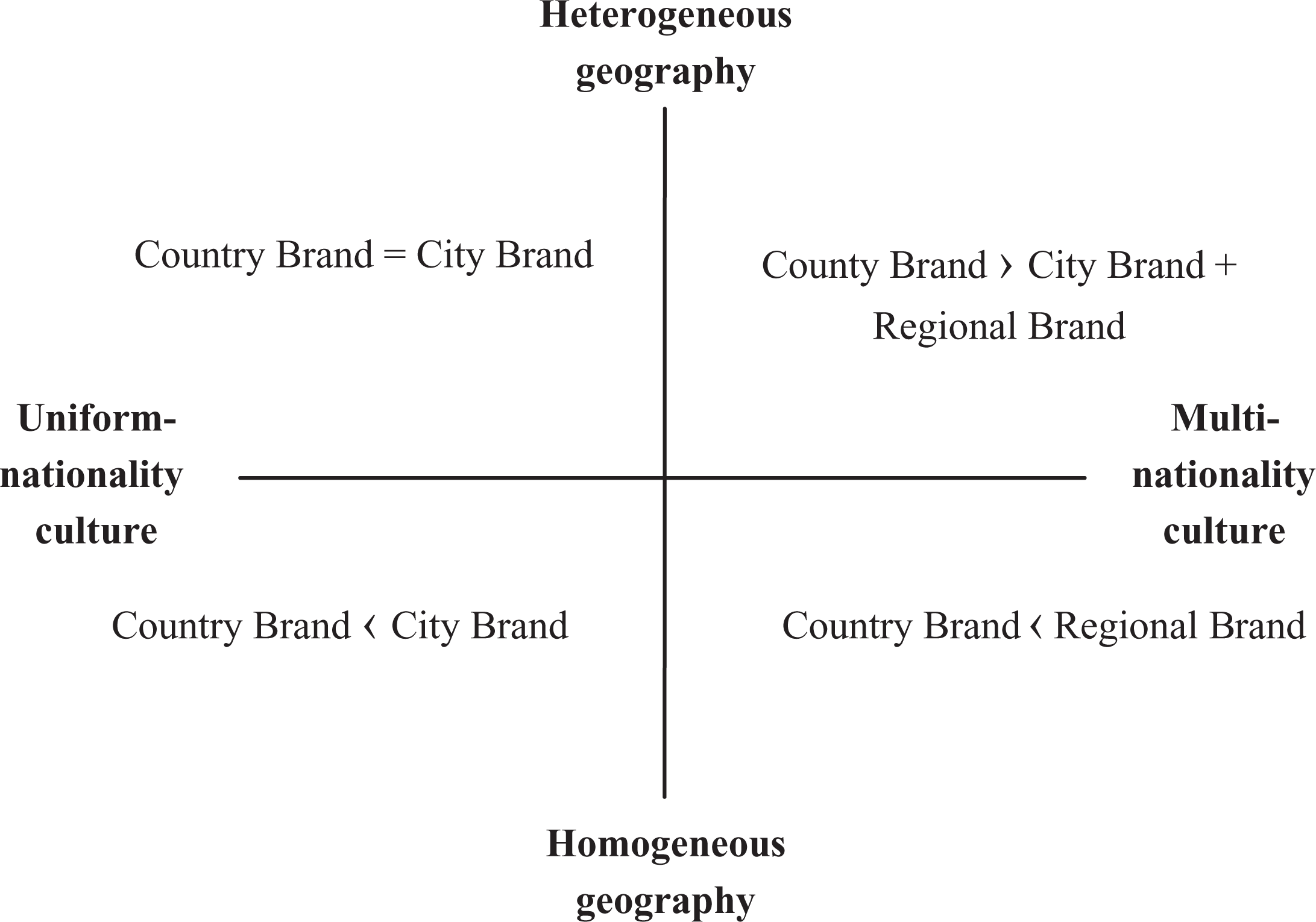
Country–city–region matrix positioning.
The significance of this approach is that it takes advantage of the way tourists’ tend to make decisions regarding traveling. Other country branding strategy models are too all-encompassing and contain too many factors to be considered in practice—and which tourists do not necessarily weigh up when deciding to visit a country. It is essential to work from the perception of the tourists and understand the most meaningful aspects that they consider when deciding where to travel. According to Krishnan (1996), any attempt to position a brand in consumers’ minds based on more than two or three associations is an unreasonable approach, since people will not be able in the future to recall it, in a world of endless brands. According to Woratschek and Horbel (2005) and Ng et al. (2007), a country’s geography and the population–nationality are the most relevant dimensions in the perception of tourists planning a vacation.
The first dimension—the geography of the country—refers to the types of different physical areas such as sea, deserts, mountains, forests, lakes, and different climates such as snowy, warm, humid, and chilly. This dimension assists marketers in defining the potential of the country to be branded and to whom it should be appeal. Since tourists in general are interested in traveling to countries with a rich topography and geographic variety (Woratschek and Horbel, 2005), it is essential to define, first and foremost, the topographic diversity, and obviously, the more types of topography the country has, the greater its branding potential. The second dimension, which is the range of ethnic groups or nationalities subsumed under the country’s national flag, refers to the potential human characteristics each country offers tourists. Since tourists in general are more interested in traveling to a country characterized by rich cultures (Ng et al., 2007), it is essential to define the country’s cultural diversity. Therefore, the more cultures the country offers, the greater its branding potential. Any attempt to build a country branding strategy lacking these two dimensions reduces the effectiveness and potency of the strategy. This new concept of country–city–region matrix positioning enables marketers to use one of four types of positioning strategies when branding a country.
The first positioning strategy is the heterogeneous–geography–multinationality culture approach. This positioning strategy is best used when dealing with countries that have a heterogeneous topography in which many nationalities live. Examples of these countries are Spain, Israel, and the United States. Marketers charged with branding these kinds of countries should focus on many attractive regions and cities all over the country, which, on one hand, differ from each other in terms of topography, and on the other hand, offer visitors a chance to meet a range of cultures. Any attempt to market these countries to tourists by selling a trip to the country as a visit to only a few interesting cities or regions instead of a “one package infinite vistas all over the country deal” will be missing an opportunity to create a real advantage over other similar countries. The idea behind this branding strategy is that the country brand is larger than the city brand plus the region brand taken together (country brand > city brand + region brand).
Spain, for example, for many years has been marketed as a country that everyone should visit it, but practically speaking, the millions of tourists from all over the world who come to the country prefer to visit very specific cities (such as Barcelona and/or Madrid) or regions (Valencia and/or Andalusia), rather than tour the entire country. In order to market Spain for tourists as a country offering a multiplicity of tourist attractions such as history, art, culture, music, food, sport (first dimension), and varied landscapes (mountains, beaches) (second dimension), marketers should determine the Spanish cities and regions that contain these two dimensions. After focusing on these cities and regions, Spain should be marketed to tourists as a country, which in order to feel it and enjoy it, all these places must be visited—otherwise, the visitor has not seen the “real” Spain. By implementing this strategy, countries such as Spain will enjoy more tourists traveling all over the country and staying in the country for longer periods. The statement “I visited Barcelona—I visited Spain,” which many tourists tend to say, is a misleading marketing strategy that must be corrected.
Similar to Spain, Israel is another country that suffers from the same problem despite its small size. Most tourists visit only one city—Jerusalem, and by doing so miss the enormous tourist opportunities that this country has to offer in terms of wide topographies and multiculturalism. In contrast, the United States is a very successful example of a country that was branded well, and therefore, tourists tend to travel all over it (the East coast and the West coast). Cities such as New York, Niagara Falls, Washington, Miami, Los Angeles, and Las Vegas are must-visit places/cities/regions when visiting the United States. Because of the branding strategy that American marketers have used for years, tourists who visit only one coast, or even one city, feel that their trip to the United States was incomplete.
The second positioning strategy is the heterogeneous–geography–uniform–nationality culture approach. This positioning strategy is most suited to countries that have a heterogeneous topography, that is, fewer more distinctive ethnic groups. Examples of these countries are Australia and Japan. Marketers who deal with branding these kinds of countries should not market these countries as a “full range one package country deal.” Tourists may find this strategy misleading if they feel that many of the cities or regions that they visited were essentially similar in nature or not interesting, resulting in the country brand losing its equity. Accordingly, marketers should focus only on the most unique cities, which have their own distinctive characteristics in terms of landscape. The idea behind this branding strategy is that the country brand is equal to the city (or cities) brand (country brand = city brand). In order to implement this strategy properly, marketers should build a few powerful city brands that will be perceived as part of the country brand. This branding strategy will ensure more tourists visit the country, on one hand, and that these tourists will be more satisfied, on the other hand, because their expectations will have been met.
Japan is an example of a country that has been branded effectively. The focus of its branding campaigns has been on only a few cities, each with its own uniqueness, instead of on many cities or regions throughout the country. The city of Hiroshima, for example, has become a real city brand and almost synonymous with Japan. As long as marketers of these kinds of countries concentrate on conveying the message that visiting a few select cities is almost tantamount to touring the entire country, the greater the prospect that these countries will succeed in being effectively branded.
The third positioning strategy is the homogeneous–geography–multinationality culture approach. This positioning strategy is appropriate for countries with a uniform topography but with many nationalities. Examples of these types of countries are Ethiopia, Nigeria, and Jordan. Marketers who brand such countries should focus on a few select regions that reflect the country’s different cultures and market them as the main selling point. The idea behind this branding strategy is to create a region brand that is more powerful than the country brand (country brand < region brand).
Accordingly, examining the case of Nigeria in terms of the proposed model, the mistakes made by its marketers become obvious. Their branding strategy erred by trying to make Nigeria’s unique selling point its being the second largest and second most powerful country on the African continent. Its marketers should have worked to convince tourists from all over the world to visit Nigeria in order to be exposed to different cultures in several regions of the country—cultures that do not exist elsewhere in any country in the world. By not doing this, the marketers limited their abilities to attract more tourists to this multicultural country, since the brand Nigeria itself does not convey a message about the vast multinationality cultures the country has. In contrast, a branding positioning that would include, for example, the Mina region (around two hours from the Nigerian capital of Abuja), where many African tribes live side by side, should highlight the tourism added-value of different types of lifestyle, traditions, and culture.
The fourth positioning strategy is the homogeneous–geography–uniform–nationality culture approach. This positioning strategy is suitable for countries that are homogeneous in terms of topography and have only a few nationalities. Examples of these countries are Lithuania, Denmark, and Portugal. Marketers who deal with the branding process of these kinds of countries should focus on the main capital cities rather on the country itself. Any attempt to market these countries to tourists by selling the country as a “one package country deal” will fail since these countries lack the ability to create a real advantage over other competitive countries in terms of landscape variety and multicultural atmosphere. Marketers should adopt the branding strategy that perceives the city brand as more powerful than the country brand (country brand < city brand). Lithuania’s branding strategy (“Lithuania—Europe’s bravest nation”) will not succeed until marketers replace it with a new strategy that convinces tourists to visit Vilnius (the capital) and cities around it, rather than Lithuania. This requires first and foremost investing a great deal of effort in branding Vilnius as a unique city that has a lot to offer in terms of culture, history, and entertainment. When people in Europe, first, and then people all over the world perceive Vilnius as a unique capital city such as Prague (Czech republic) and Budapest (Hungary), Lithuania will enjoy an unceasing stream of tourists throughout almost the entire year who will be convinced that having seen Vilnius, they have seen the real Lithuania.
Practical implications
Although place branding researchers and practitioners tend to see three different and distinct concepts in “country branding,” “city branding,” and “region branding,” the above-proposed model describes a new approach for country branding that amalgamates these three concepts. In order to rebrand a country, marketers should define their country according to the country’s topography and its range of ethnic groups and cultures (Table 1).
Country branding strategies
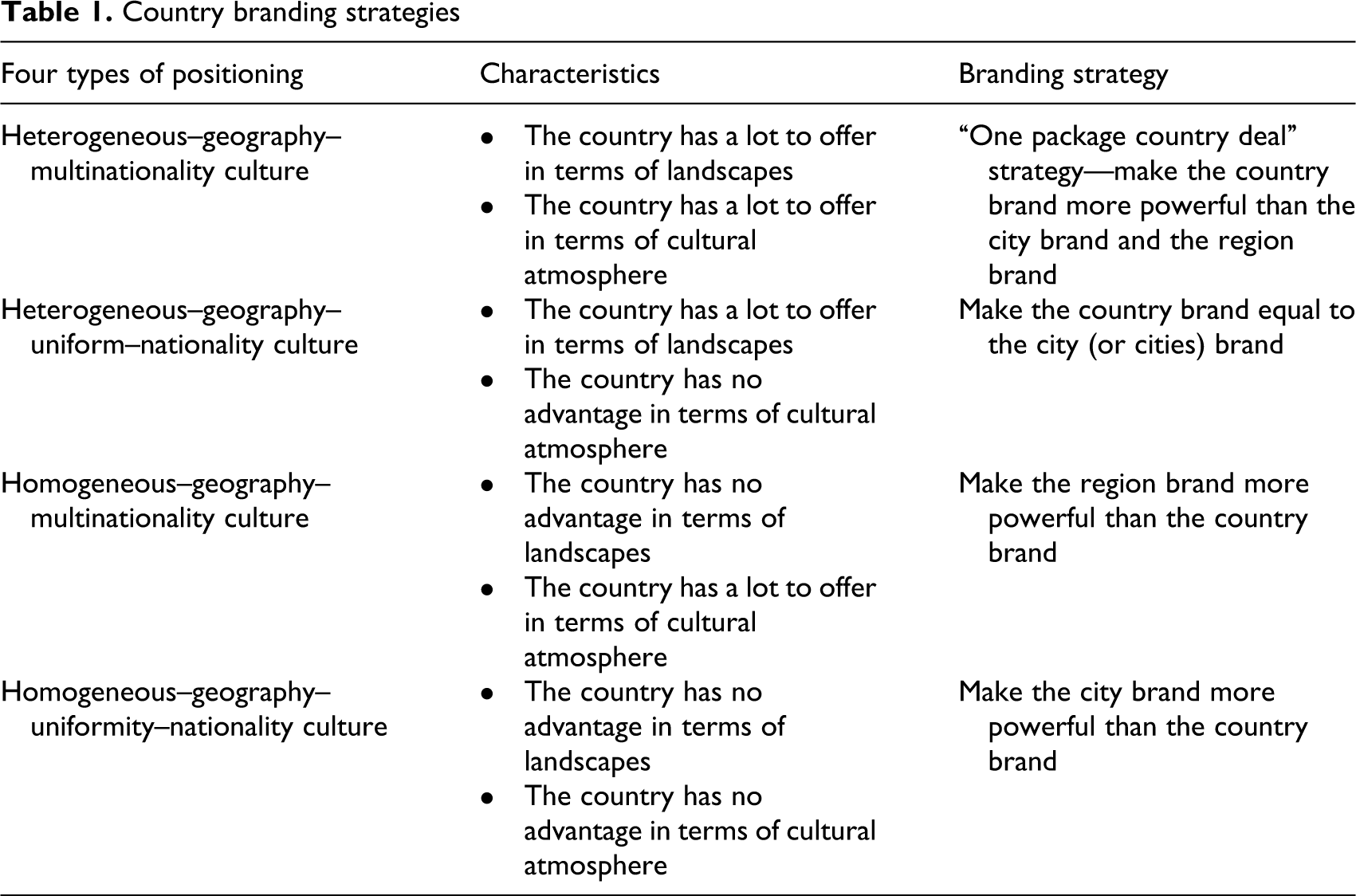
This model enables marketers to identify the most appropriate branding strategy for their country. The branding strategy of a country that is identified as heterogeneous–geography–multinationality culture should be to create a powerful country brand that is derived from many powerful city and region brands that act as magnets drawing tourists to visit the entire country and not simply parts of it. Brazil is an example of a country that has implemented this type of branding strategy successfully, convincing tourists to take advantage of its multifaceted attractions.
The branding strategy of a country that is identified as having a heterogeneous–geography–uniform–nationality culture should be based on the equation that the country brand equals the city (or cities) brand. Therefore, in order to implement this strategy, marketers should identify a few unique cities and or regions that can attract tourists to visit the country mainly to see these specific places. Korea is an example of a country that has succeeded because it implemented this strategy and markets its most unique sites.
The branding strategy of a country that is identified as having a homogeneous–geography–multinationality culture should be based on the equation that the region brand is more powerful than the country brand, and therefore, tourists must be drawn to visit specific regions that have a very powerful image and not the country itself, which suffers from a general negative image. Jordan, by marketing the Petra region (which appeals mainly to adventure-seeking tourists), rather than the entire state, is an example of how to implement this strategy.
The branding strategy of a country that is identified as having a homogeneous–geography–uniform–nationality culture should be based on the equation that the capital city brand is much more powerful than the country brand. Cardiff (Wales) is an example that reflects the use of this strategy, which has succeeded in attracting tourists every year to visit this city that do not travel to the rest of the country.
The above discussion is a new study of the linkage between country, city, and region branding. Even though marketers leverage this linkage in their strategic campaigns, it is unclear whether they do so consciously and with an understanding of its implications. It is essential to deepen the research on this subject so that the connection among these three branding concepts—which is inseparable—is developed in practice and to the advantage of all concerned.
Footnotes
This research received no specific grant from any funding agency in the public, commercial, or not-for-profit sectors.