







Abstract
Previous researchers have studied the consumption values of Chinese consumers; however, limited studies focused on the consumption behaviour of Chinese corporate travellers. This study explores the consumption behaviour of Mainland Chinese corporate travellers at leisure. Participant observation of 12 travel groups indicates that tourism is seen as a reflection of modern lifestyle and understood in the narrow sense of material consumption and modern developments in the society. The findings demonstrate how Chinese corporate travellers embrace aspects of materialistic consumerism that not only offers luxury and status recognition but also reflects a particular form of collective gaze that constantly searches for modern development.
Keywords
Introduction
While previous investigators have examined the consumption values of Chinese consumers, few studies have focused on the consumption behaviour of Chinese corporate travellers. Like Mainland Chinese tourist travel, government and business travel is increasing; and in the last two decades, a number of investigators have given attention to Chinese tourism and tourists (Cai et al., 1999; Ryan and Mo, 2001; Yoo et al., 2004; Zhang and Lam, 1999). However, the literature on Chinese outbound tourism has yet to address the significance of the corporate market segment and to examine its way of consuming tourism experiences. This neglect is surprising, as Chinese corporate travellers’ consumption behaviour presents a significant issue for the international tourism sector because of the number of travellers involved, the expectations for growth in the market, and the segment’s potential for economic impact.
This study examines Mainland Chinese corporate travellers’ consumption of tourism experiences in Australia. Each year from 2001 to 2010, over 5 million government/business travellers travelled overseas, with the annual number increasing by 258,000 during the decade (National Bureau of Statistics of China, 2010). In Australia, the number of arrivals for business purposes constitutes over 16% of the total number of arrivals from Mainland China (Tourism Research Australia, 2011), with corporate travellers having a significant economic influence. The itineraries of corporate group tours involve multiple destinations, and group members stay at four- and five-star hotels, dine extravagantly, and travel in style. Of the Mainland Chinese tourist segments visiting Australia, corporate travellers have the highest expenditure per visitor (Tourism Research Australia, 2011), in part because expenses are often paid for by governmental departments or private businesses since the reasons for travel are business related, such as attending meetings, trade fairs, and conferences, visiting clients and factories, and enjoying incentive trips.
Clearly Mainland Chinese corporate travel represents a sizeable market segment whose consumption patterns are of interest, yet it remains an under-studied area in English-language tourism literature (Kwek and Lee, 2010). With numbers in arrivals expected to grow (Tourism Research Australia, 2011), understanding how these corporate travellers consume tourism can better assist and support inbound tour operators, tourism retailers, local restaurants, and hotel operators catering to this specific target market plan, design, and market their vacation products. In this study, Mainland Chinese corporate travellers comprise government and business tourists whose main trip purpose is work (Cai et al., 2001; Jang et al., 2003).
Understanding who Mainland Chinese corporate travellers are, what they do in their leisure time overseas, and how they consume tourism experiences is especially important as an aspect of contemporary consumerism. A central characteristic of this understanding is the recognition that, rather than being a series of discrete events, consumer consumption is a process in which social relations, structures, and practices play out in everyday life (Douglas and Isherwood, 1996; Kim, 2008; Woodward, 2007). Consumerism in China is presently undergoing a dynamic revolution (Chao and Myers, 1998; Ho, 1997; Wang et al., 2000b), manifesting a unique embracing of Western ideologies, lifestyle, and products (Arlt, 2006; Bao et al., 2003; Tai and Tam, 1996; Wang et al., 2000a). This dramatic transformation opens the way for marketers of vacation travel to promote modern lifestyle and tourism choices that Chinese consumers crave for.
Although corporate travel relates primarily to business, this form of travel blurs the distinction between pure business travel and conventional leisure travel, as corporate travel involves participation in leisure activities when work is completed (Swarbrooke and Horner, 2001). For example, Chinese corporate travel is often organised by travel agencies that place travellers in groups with tour itineraries that include extensive sightseeing and shopping (Bailey, 1998).
As the greater expenditures for corporate travel indicate shopping, accommodations, dining, and other tourism consumption experiences may reveal the underlying social structure of the Chinese society and draw attention to status symbols, class division, and social norms and relationships. These social meanings influence the way travellers assign meanings to their tourism consumption experiences, particularly in a high-context and collectivistic culture such as China (Yau, 1994; 2000). However, despite the growth of tourism consumption among Mainland Chinese tourists and corporate travellers, tourism research has not yet traced the ways in which individuals create meaning in these tourism exchanges (Morgan and Pritchard, 2005), especially with respect to Chinese corporate travellers.
Closely related to the creation of social meaning through tourism consumption is the notion of tourist gaze (Urry, 1995). Tourist gaze is a socially structured way in which a tourist sees experiences and assigns meaning to places and images in relation to opposite, non-tourist forms of social experience and consciousness. Each individual’s gaze is thus unique, because it is differentiated by society, social group, and historical period. While the notion of tourist gaze is important, limited research has examined the ways Chinese tourists exercise their gaze (Chan, 2006; Ong and du Cros, 2012).
Through application of the concept of tourist gaze, this study explores the meanings Chinese corporate travellers attach to their touring experiences and demonstrates how these travellers understand tourism in the sense of material consumption. With the aim of providing insights into the consumption practices of Mainland Chinese corporate travellers, this study argues that conspicuous consumption moulds and directs tourist behaviour, specifically by patterning the ways of consuming and gazing among Chinese corporate travellers.
This article proceeds as follows. The next section explores current literature on the consumer behaviour of the Chinese people and the concept of tourist gaze. The subsequent section describes and justifies the participant observation methodology in the current study. The third section presents the findings, with the final section comprising discussion, implications, and limitations.
Literature review
Transformation of Chinese consumerism
Previous investigators have established that the ways individuals experience leisure can contribute to understanding associated occurrences in society, such as social class distinction (Veblen, 1953), shopping and social identity (Miller et al., 1998), and the tourist experience (McCabe, 2002). These studies have demonstrated that closely observing individuals participating in leisure activities can provide social scientists with insight into the everyday life of a society. Tourist behaviour reflects and magnifies the concerns of everyday life, which ‘provides a framework for understanding changes in society’ (McCabe, 2002: 63). As a sociocultural phenomenon of the modern world, tourism is closely interconnected with wider social and cultural changes and developments in both the home and host countries.
In a highly collectivistic society like China, the emphasis on human relatedness and connectedness is often reflected through the construction of social order, whereby individuals view themselves in relation to significant ‘others’ (Chu, 1985), and the focus on collective identity and maintenance of social group esteem takes precedence over individualistic identity (Triandis, 1989; 1995). Therefore, individuals in collectivistic societies are concerned with where they are positioned in the social hierarchy and how others perceive them. Inevitably, Chinese consumption behaviours tend to be influenced by members of individuals’ social networks and demonstrate both in-group membership and group distinction (Li and Su, 2006). The need to subscribe to societal demands as well as to maintain ‘a particular appearance of things’ about oneself has led to increased interest in luxury-branded goods.
These cultural factors take on added importance, as consumerism in China undergoes a major transformation. In the absence of state-regulated labour and the factors that previously inhibited the growth of consumerism, attitudes toward work and income have begun to change. The open-door policy of the late 1970s launched a range of policies that led to remarkable social and economic changes in the major cities of China. These policies focused particularly on entrepreneurship (Zhang, 2002), consumption, and the accumulation of individual wealth (Farquhar, 2002; Yang, 2000) and resulted in the emergence of a middle class, as many Chinese aspired to a better life (Chao and Myers, 1998; Gamble, 2001).
Increased income levels led to demand for household and luxury items, not only those produced domestically but also those that were more expensive, imported, and internationally known. Indeed, the rapid economic growth in China since 1992 has vastly increased the variety of products available for local consumption, prompting local adages reflecting the power of the consumer, such as ‘the consumer is god’ (Ho, 1997), and the maxim that ‘when one eats, one wants the food to be nutritious; when one wears clothes, one wants a more comfortable fit; when one uses merchandise, one wants the highest quality’ (Chao and Myers, 1998: 365).
As the notion of a consumer society has gradually come to dominate the Chinese market, interest in well-established foreign-made goods has increased. A combination of factors, including years of material deprivation, recent exposure to Western influences, and the emphasis on face in Chinese societies, has created and encouraged the pursuit of hedonic consumption (Wang et al., 2000a). Weary of the poor quality of goods made in China, many Chinese consumers have turned to prominent international brand names for quality and peace of mind (Ho, 1997) and are adopting the perception, common in developing countries (Wang and Chen, 2004), that imported goods are of better quality and are fitting status symbols. As many Chinese consumers are motivated by the desire to impress others with their economic wealth, they prefer to purchase the more expensive and exclusive imported products.
This practice of luxury consumption (Wong and Ahuvia, 1998), or conspicuous consumption (Piron, 2000), refers to consumers’ willingness to pay a higher price for a functionally equivalent good (Bagwell and Bernheim, 1996). Depending on their use, goods and services acquire social meanings, and when they are used as a form of communication their consumption has the power to socially include and exclude (Douglas and Isherwood, 1996). Goods and services are thus a way for society to systematically mark rituals and reflect social integration. Consumption is a dynamic process, within which meanings are constantly being redefined and negotiated, and consumption of tourism must be studied in the context of a changing global environment and cannot be ‘separated from the social relations in which [it is] embedded’ (Urry, 1995: 129).
In their pursuit of social status, Chinese people have placed significant emphasis on Western symbols of modernity (Yan and Santos, 2009), such as air conditioning and refrigeration (Ho and Ng, 2008). As Chinese consumers attempt to make up for lost time, possessing such commodities suggests the individual is part of modern living in China (Chao and Myers, 1998). The emphasis on wealth therefore makes status-oriented purchases important, as consumption and purchases are competitively motivated to achieve higher social status. Luxury items – including international travel – are generally purchased for status rather than because of consumer sophistication and taste (Blok, 2002).
In the last two decades, the numbers of Mainland Chinese participating in outbound tourism have increased significantly. Besides travelling within Asia to popular destinations such as Hong Kong, Thailand, Singapore, Malaysia, Vietnam, and Laos, a growing number of Chinese tourists are venturing into Western countries like France, Italy, Germany, Australia, and New Zealand (Arlt, 2006; Chan, 2006). Arrivals into Australia by Mainland Chinese tourists, which grew by 24% from 2009 to 2010, are expected to continue to be Australia’s most valuable inbound market – presently worth $3.1 billion, with the Chinese tourist spending on average of $7,886 per trip (Tourism Research Australia, 2011). Tourism is thus becoming a widely accepted activity and is often used as a marker of prosperity in modern Chinese living. These prior studies suggest that prevailing social norms can be expected to have a major impact on how Mainland Chinese corporate travellers consume tourism experiences.
The notion of tourist gaze
The concept of tourist gaze provides a useful framework for exploring tourist experiences of Mainland Chinese corporate travellers (Urry, 1992; 2002). The tourist gaze is a socially structured way in which a tourist views experiences and assigns meaning to places, among other things (Lee, 2001). The tourist constructs the meanings of tourist places in relation to non-tourist forms of social experience and consciousness, and each individual’s gaze is differentiated by society and shaped by normal practices that are apparent in everyday life:
By considering the typical objects of the tourist gaze, one can use these as to make sense of elements of the wider society with which they are contrasted …. Thus rather than being a trivial subject tourism is significant in its ability to reveal aspects of normal practices which might otherwise remain opaque (Urry, 1990: 2).
Not only is the gaze constructed through signs, but the whole system of tourism is a collection of signs. In a competitive industry such as tourism, industry professionals are constantly attempting ‘to reproduce ever-new objects of the tourist gaze’ (Urry, 1990: 133) to attract tourists, and tourists must be taught ‘how, when and where to gaze’ (Urry, 1990: 9). To create an object worthy of the tourist gaze, destination marketers must be able to construct images of distinctiveness from selected aspects of the destination’s architectural, historical, social, and behavioural dimensions (Meethan, 1996). Even though these images might not be the true representation of the destination (because they involve unreal and inauthentic elements), they become symbolic and are deemed authentic and real by tourists (Edwards, 1996). 1
Implicit in the study of the tourist gaze is the use of visual images in marketing the tourism destination. Tourism is distinctively visual, with images in marketing materials performing an important role of communication between the destination image and the tourist (MacKay and Fesenmaier, 1997). Marketing materials are critical representations of place–product relationships in the imagined cultural geography of the consumer, with tourist brochures being the most common and effective materials that act to ‘woo, seduce, inform, project and sell in one operation’ (Dann, 1993: 893). Tourism destination images communicate the created experience to the potential tourist.
However, recent works on tourist gaze have argued that the nature of the gaze should be studied in conjunction with the performance turn (Edensor, 2000; Perkins and Thorns, 2001; Larsen and Urry, 2011). The performance turn stipulates that ‘tourists are not only audiences but also performers within complex networks of other tourists and tourist brokers’ (Larsen and Urry, 2011: 112). Tourism experiences involve not only the physical body but also gender, age, sex, and ethnicity (Crouch, 2002). Therefore, tourism experiences engage a variety of senses that together produce a distinctive and unique experience (Rodaway, 1994) and also include active bodily involvement and physical activity (Larsen and Urry, 2011). The tourist gaze is no longer just ‘travelling eyes’ but is ‘embodied, multi-sensuous, collaborative and technologized doings and enactments’ (Larsen, 2008: 26) framed by social rules, styles, and power relations (Larsen and Urry, 2011).
This study argues that performances are fundamental to the notion of the tourist gaze. Central to this argument is that this embodied way of seeing is also context specific bounded by the sociocultural, economic, and political frameworks within which tourists live. While Chinese tourism has received much research attention in the last decade, not much work has explored how the underlying societal values influence the ways in which Chinese tourists consume tourism experiences. This study addresses this neglect by examining the intertwined concepts of consumption (which involves both body and senses) and tourist gaze to demonstrate how the wider patterns of Chinese societal values shape leisure activities such as tourism, especially with respect to the Mainland Chinese corporate traveller.
Thus, using the Gold Coast, Australia, as the context for the study, this research investigates the tourist behaviour of Mainland Chinese corporate travellers during the leisure component of their trips, examining these tourists’ ways of consuming and gazing. Specific questions the study addresses are:
Research Question 1: How does tourism consumption of the corporate traveller function in the Chinese sociocultural context?
Research Question 2: Do Chinese corporate travellers on the Gold Coast, Australia, exhibit a unique tourist gaze?
Methodology
To address the research questions, this study adopted an interpretive, qualitative research paradigm that was informed by social constructionism ideologies. Interpretive research ‘looks for culturally derived and historically situated interpretations of the social life-world’ (Crotty, 1998: 67). In adopting a social constructionism ideology, this study acknowledges that reality is constructed and as such, reality and truth are coproduced by the researcher and the participants being investigated (Denzin and Lincoln, 1998). Consequently, social constructionism assumes an ontology that recognises multiple realities and is informed through consensus, and a subjective epistemology that accepts researchers as part of the research setting and strategy.
Specifically, the social constructionism lens enabled the researchers to better understand how Mainland Chinese corporate travellers in a tour group construct and deconstruct social meanings of tourism consumption and gazing. The study relied on the qualitative methodologies of participant observation and interviews.
Participant observation is used to collect detailed information about participants engaged in activities that reflect complex social phenomena (Carson et al., 2011). Instead of asking people to comment about what they do or how they think, qualitative researchers observe people’s behaviour in real time either from a distance or by engaging with the participants in a role of observer-as-participant. Focussing on naturally occurring behaviours, the researcher collects observational data that reflect participants’ internalised cultural norms and values (Silverman, 2001). Acting as observer-as-participant, the first author engaged with the research participants by participating as a tour member and serving as an assistant to the tour guide when the need arose. This participation allowed the researcher to develop rapport with the participants and opened the way for interviews with the travellers and the tour guides that were used to confirm or further illustrate the observed phenomena.
Data collection involved fieldwork observations of 12 fully guided tours of the Gold Coast, Australia. Participants were 86 Mainland Chinese nationals visiting Australia on a corporate/leisure trip, who had chosen the Gold Coast for the leisure segment of their trip. The smallest group had 2 members, while the largest had 16. The length of participants’ stay on the Gold Coast varied from 1 to 3 nights, which constrained the researcher’s observational time to 1 or 2 full days with each group.
Compared to the mass tourist from Mainland China, the corporate traveller is more likely to be well travelled and better educated and to possess higher disposable income. Corporate travellers come from a variety of professions, but participants in this study were primarily government officials, private business personnel, and incentive corporate travellers. Incentive corporate travellers may be suppliers and buyers or high-achieving executives for whom the trip is a reward. As corporate travel is usually internally funded by the participant’s unit, department, or organisation or is externally sponsored by private businesses, the travel purpose is typically business oriented. While both mass tourists and corporate tourists tend to travel in groups, the funding for corporate travel leads to a higher quality of accommodation, meals, and transport. In addition, the brief length of the trip, flexibility of the tour itineraries, and smaller group size are characteristics of corporate travel. Table 1 presents demographics of participants in the 12 groups in this study.
Participant demographics.
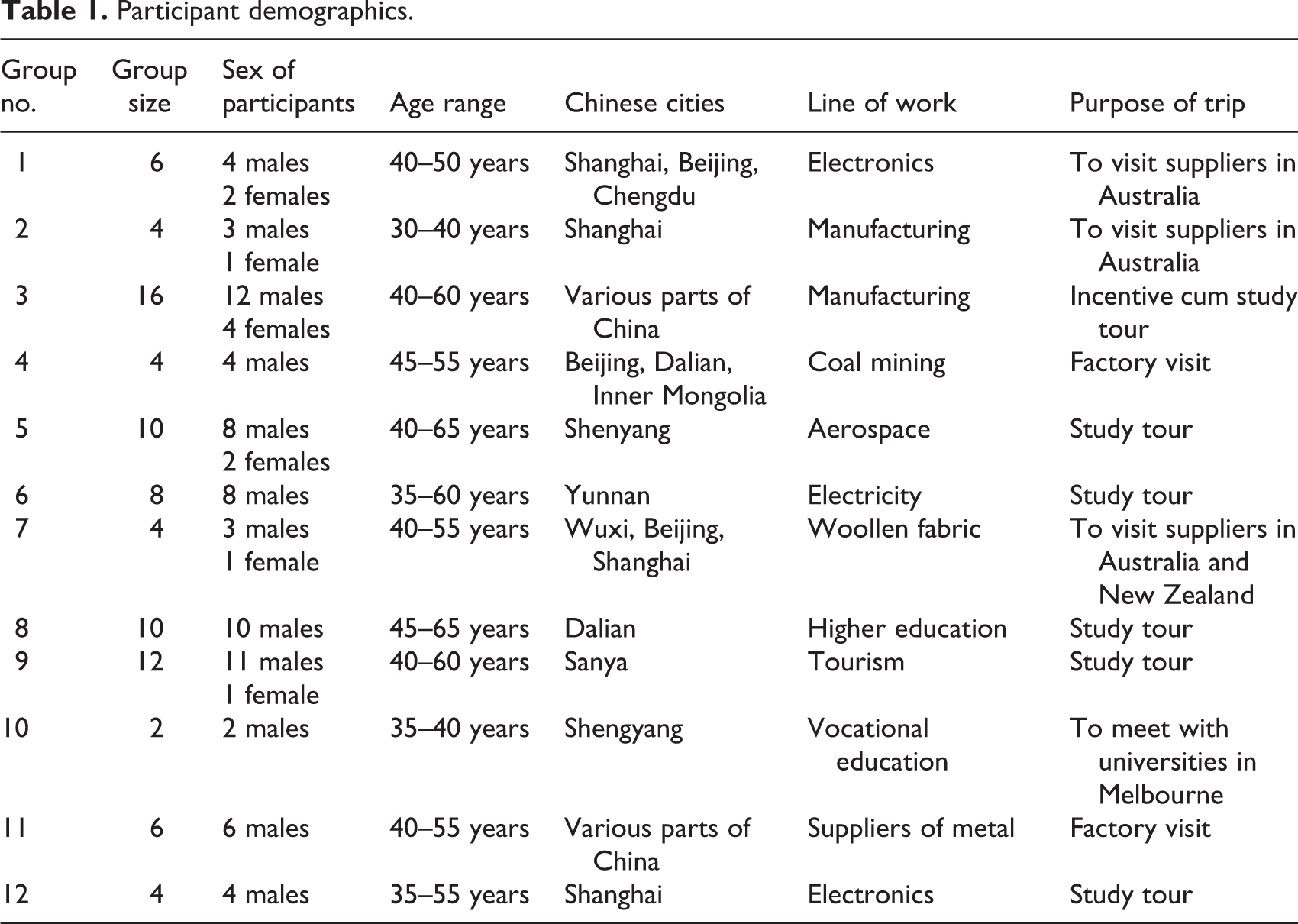
As Table 1 shows, all the tour groups observed were travelling for reasons related to their work. Of the participants, 75 were male, a number proportionately consistent with prior research investigating Mainland Chinese corporate travellers (Jang et al., 2003). Ages ranged from 30 to 65 years, and a majority of participants resided in major capital cities in China. Most participants were middle to top management executives, with several top government officials also participating.
Aimed at understanding the touring experiences of Mainland Chinese corporate travellers at leisure, the research observations focussed on the experiences and activities of tour members. Unstructured and informal conversations were held throughout the participant-observation fieldwork. Since the stay on the Gold Coast constituted the ‘rest and relaxation’ part of the travellers’ itinerary, the techniques adopted for interviewing participants favoured informal interviews and conversations. This approach tended to make participants more relaxed and more willing to engage in conversation. Informal forms of interviewing also have the advantage of being fluid and allowing in-depth probing into a given concept (Cohen, 1984).
To initiate the conversations, the researcher (the first author) asked participants whether this was their first trip overseas and if not, where else they had been and what their experiences were. During shopping excursions, conversations with the participants were initiated by asking who they were buying for. To gain insight into participants’ touring behaviour as well as to encourage them to speak freely, the researcher shared her experiences and knowledge with the tour members as a way to establish rapport. These interviews were usually conducted during the time spent waiting for other members of the group (particularly at designated shopping outlets), the time travelling on the coach, and the time before, during, and after a meal.
Observations were recorded throughout the fieldwork process (Palmer, 2001; Carson et al., 2001). In initial field trips, the presence of a tape recorder tended to reduce the spontaneity of responses, and participants appeared uncomfortable. To put the participants at ease and encourage spontaneity, the principal researcher engaged the participants in casual conversations with no notebook or tape recorder. Note writing was left to those times when the tour participants were having a rest on the coach. Discourses with the corporate travellers and clarifications with the tour guides were undertaken throughout the day. In addition, six in-depth interviews were conducted concurrently with fieldwork observation. Because Chinese societies place high emphasis on hierarchical structures, selection of participants for in-depth interviews was based on the roles they played within the group setting (examples of roles include leader, an organiser, treasurer, and senior and junior members) to obtain a broader range of perspectives. In addition, the researcher held numerous discussions with the tour guides and these provided perspectives from service providers.
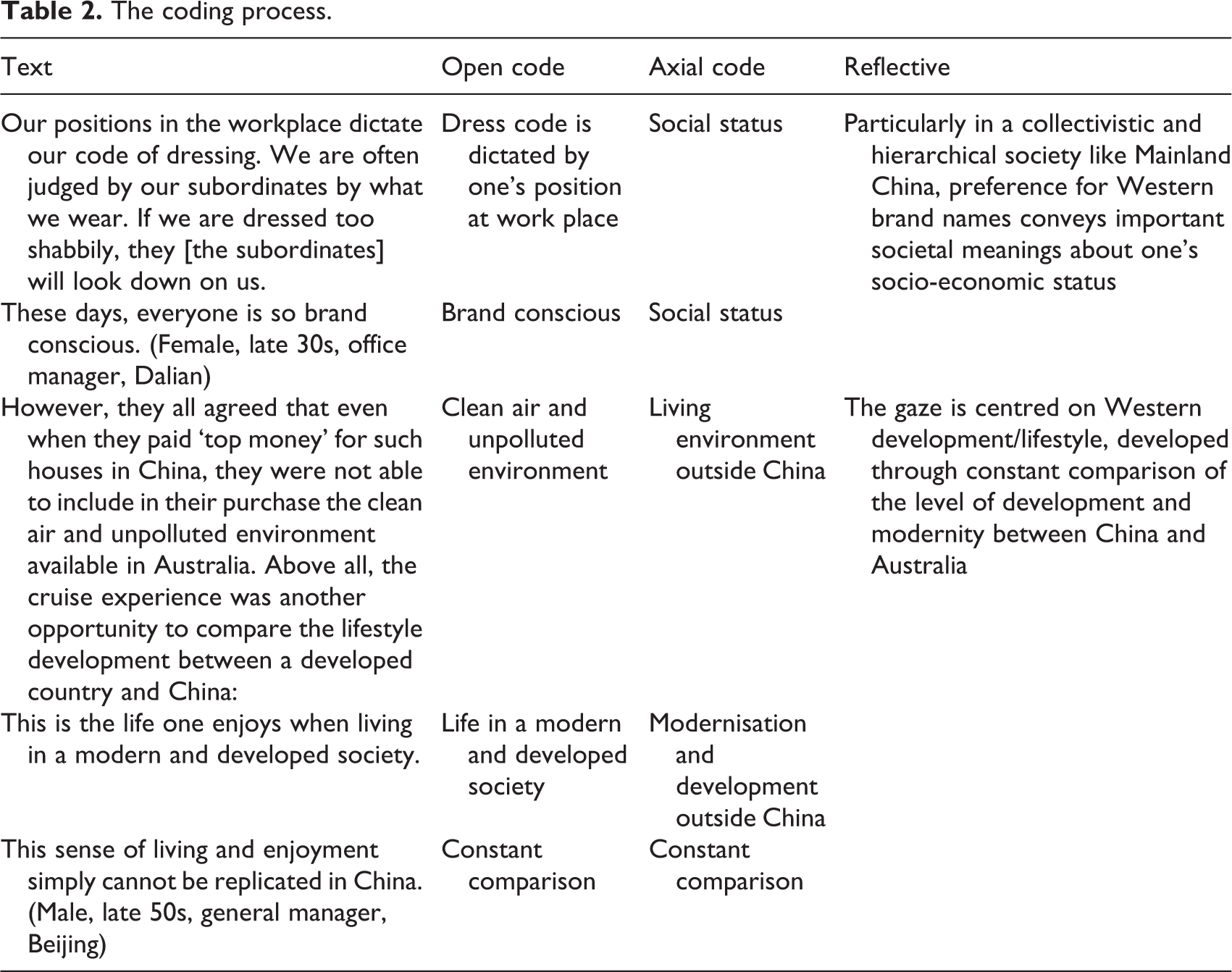
Content analysis, both manual and using NVivo (Patton, 2002), was used to identify, categorise, and code patterns in the materials collected. Observations noted in the researcher’s fieldwork journal were coded simultaneously and continuously throughout the duration of the fieldwork (Palmer, 2001). From the beginning of the fieldwork, analysis was conducted simultaneously alongside the observations and interviews (Green et al., 2007; Holloway and Wheeler, 2002). Open, axial, and reflective coding were used to interpret the empirical materials (Neuman, 2003). The purpose of coding is to systematically reduce the materials collected as well as analytically categorise the materials into themes. Open coding is the initial stage of analysing empirical materials. In this phase, the researcher labels particular behaviours and actions found in the data and compares them with others to decide which of them belong together (Harry et al., 2005). In axial coding, the focus is on the initially coded themes rather than the raw materials (Neuman, 2003). The researcher begins with an organised set of open codes and starts ‘to group these discrete codes according to conceptual categories that reflect commonalities among codes’ (Harry et al., 2005: 3). Final interpretation of the materials was grounded in thematic analysis and constant comparison, with emergent themes established through a process of reflective coding. Table 2 illustrates the coding process. The themes emerging from this process included the preference for Western brand names and a unique tourist gaze that favours Western development.
The coding process.
The backgrounds of both researchers were well suited to the nature and purpose of this study. The principal investigator, who took the role of participant observer and conducted the in-depth interviews, originates from Singapore, has a Chinese ethnic background, speaks Mandarin as a second language, and has worked frequently as a freelance tour guide for Mainland Chinese tour groups in Australia. Overall, the principal researcher was well received by the participants and interactions with them involved a mutual exchange of information. Tour members were curious about and interested in the Australian culture and the experiences of Chinese people residing in Australia, and as the principal researcher was an overseas Chinese who has resided in Australia for over 10 years, and is a university teacher, tour members perceived her as an appropriate source for the type of information they wanted. The second author is a tourism researcher educated in both South Korea and Australia and has research expertise in East Asian cultural philosophies in tourism studies. The second author contributed to the design of the research and interpretation of the findings within the tourism studies context.
Study findings
Two themes emerged from the analysis of the participant observations. First, the shopping behaviour revealed the preference for Western brand names. Second, the collective gaze of the Chinese tourists revealed a tendency to favour Western development, reflecting a search for a particular form of modern development that they perceive to be lacking in their home country.
Preference for Western brand names
A recurring theme was the link between social status, buying power, and association with Western thought. Consistent with prior research (Wang and Chen, 2004; Wang et al., 2000), the data set made clear that to climb the social ladder, one must be dressed in well-known designer labels, schooled in Western beliefs, and, if possible, invested in Western property markets. Only through association with the more developed West can a person truly rise above peers. Like the consumption of luxury goods, the act of travelling overseas – particularly to a Western country – conveys societal meanings about wealth and social class, affording the ability to position oneself vertically within the socio-economic hierarchy.
When purchasing gifts for themselves and their immediate family, tour participants preferred well-known luxury-branded goods. Preferred brands included Omega and Rolex when shopping for upmarket watches and brands like Prada, Christian Dior, and Louis Vuitton when buying leather goods. When questioned about the importance of using and wearing these branded goods, tour participants explained that while they had the financial means to indulge in these luxury products, they were also pressured by social norms to conform to role expectations in terms of how they dressed and presented themselves, especially in a workplace environment. Those in executive and managerial positions must dress appropriately or face discrimination and disrespect:
Our positions in the workplace dictate our code of dressing. We are often judged by our subordinates by what we wear. If we are dressed too shabbily, they [the subordinates] will look down on us. These days, everyone is so brand conscious. (Female, late 30s, office manager, Dalian) If I were just a lowly office clerk, nobody would care what I wore. But as the head of my department, dressing appropriately reflects my position in the workplace and acts as a form of respect to others. Dressing well also gives others a good impression of oneself. The Chinese have a saying, ‘To receive the worship of mankind, even Buddha needs to dress ostentatiously’. When I am at home, I wear whatever is most comfortable. (Male, early 40s, head of department, Beijing)
The display of wealth by an individual is interpreted by others as a sign of success, while the inability to display wealth is considered to indicate failure. A tour guide reflected on the relationship between the prevailing sociocultural context and one’s economic status:
To be rich is still a relatively new concept to the Chinese people who have been living in poverty for decades. It hasn’t been an easy route to success. Overseas travels [and] purchase of well-known branded luxury goods are just ways to display their wealth and achievement. If you’ve got money, you must wear branded goods. For many of these newly rich, their mentality is such that if a product is Western and expensive, it must be good. In most cases, they do not have clear understanding of the product, only recognition of the brand. To conform to societal expectations of being rich, the Chinese people are simply chasing after branded goods to reflect their social status. (Male, mid-40s, tour guide for 25 years)
In further amplification of the preference for upscale Western goods, the tour guide commented that taking corporate travellers to local shopping centres was pointless, because most retail shops in Australia carry products imported from China. Tour members’ reaction would likely be, ‘We come from China – why come to Australia to buy Chinese goods?’ In fact, the corporate traveller participants often commented that foreign-made goods had a longer lifespan than Chinese-made goods, especially goods like cameras and watches. The tour guide offered an additional reason for shunning Chinese-made goods: they were considered cheap, and offering cheap Chinese-made goods as gifts carried a social stigma of being petty, stingy, and insincere.
In summary, the activities of shopping and purchasing of souvenirs reflect the intricacies of social and cultural complexities in Chinese society as well as how these sociocultural values continue to influence tourism behaviour. Souvenir shopping acts as a means for remembering the trip, but the display of wealth through the purchase of luxury goods is a way for tour participants to publicise their success. Purchasing and using Western-made goods also appear to indicate that a person is moving ahead of his/her time, unlike most people in China.
Corporate travellers’ gaze at leisure: favouring Western development/lifestyle
The second theme emerging from the participant observation was a distinctive Chinese gaze. Almost every tour group showed a strong interest in Australian real estate, even though the viewing of residential houses is not a typical tourist activity. In particular, these corporate travellers wanted to see how Australian people lived, especially those who were in the upper middle to high income brackets, because this would allow them to make comparisons between their own housing and that of people living in a developed country like Australia. They were not interested in viewing housing targeted at the middle and lower income groups.
To cater to this interest, the tour company incorporated the viewing of houses into the Gold Coast tour itinerary. When on the river cruises, tour participants would gaze in admiration at some of the most impressive and magnificent houses fronting the river. Continuing along the scenic river, members of the tour groups discussed the beautiful houses they had just seen, fascinated and inspired by the sight of these magnificent homes situated by the river. Most of the chatter centred on the pricing of these mansions and on comparing these prices to those in Mainland China. Many participants thought the prices of these houses were much lower than those of a similar standard in China. However, they all agreed that even when they paid ‘top money’ for such houses in China, they were not able to include in their purchase the clean air and unpolluted environment available in Australia. Above all, the cruise experience was another opportunity to compare the lifestyle development between a developed country and China:
This is the life one enjoys when living in a modern and developed society. This sense of living and enjoyment simply cannot be replicated in China. (Male, late 50s, general manager, Beijing) It’s not just the beautiful scenery and the clean air, but the general feeling about this country … people is so friendly here, they greet you even though they don’t know you. If you do that in China, people will think you are crazy or up to no good. In general, the people here are very courteous and well mannered; they patiently queue in line and wait for their turn. In China, people are too busy with making a living, and they have no time for courtesy; cutting queues is a way of life. (Female, early 40s, office manager, Shanghai) It must be so nice to live overseas, especially in such a well-developed country like Australia. Unlike China, everything you see here is so modern and the citizens here live a relatively comfortable life. There is a huge proportion of Chinese population who are still living under 2000 RMB a year. If only China was as developed …. (Male, mid-40s, marketing manager, Chengdu) Chinese people have a history of fixation with owning land. All Chinese people dream of owning their own houses and becoming a rich landlord. What is better than becoming a landlord and collecting rent when you are old? If you have money, you must invest it because when the economy is bad, your money becomes small [loses value] and worthless. But with real estate, the value increases with time. Just look at all the wealthy people in the world – their money is mostly invested in fixed assets like houses, land, and buildings. (Male, late 40s, office manager, Xiamen)
In sum, although viewing real estate is not a typical tourist activity, these travellers’ interest in real estate resulted from historical and socio-economic forces prevalent in Chinese society and produced a unique Chinese tourist gaze. As observations on the field trips showed, tour members were keen to compare the prices of real estate in Australia with those at home. Through this price comparison, they were able to evaluate the level of development of their home country in comparison with Australia, drawing the conclusion that Australia and Australians possess the characteristics of modernity, such as economic affluence and social and political stability.
Discussion, limitations, and conclusion
While research has established that economic and sociocultural occurrences influence the way individuals experience leisure (Chua, 2000; MacCannell, 1976), few studies have focussed on how societal values affect the way Mainland Chinese consume and experience tourism. In particular, the affluent corporate traveller segment has been neglected. This study enhances the current understanding of Mainland Chinese corporate travellers’ societal values, including the growth of conspicuous consumption in China and its influence on Chinese tourists’ gaze. The results of this study are consistent with a broad range of literature and suggest that the consumption of tourism by Chinese corporate travellers is not only tourism at a basic level but more importantly a way to learn modern ways of life and advance one’s social status. The results of this study offer two key insights with respect to marketing vacation travel to Mainland Chinese corporate travellers.
First, foreign travel and the concomitant opportunities it offers for purchase of Western luxury goods hold great importance for being seen as moving up the social ladder. In China, as in many developing countries, consumers perceive imported goods as being of better quality and as being status symbols (Ho, 1997; Wang and Chen, 2004). In particular, social and political conditions in Chinese society have created and encouraged the pursuit of conspicuous consumption (Wang et al., 2000). As the notion of a consumer society gradually dominates the Chinese market, the interest in well-established, foreign-made goods increases.
As the current study demonstrates, this emphasis occurs especially in the corporate travel context. These travellers exhibited great concern for the expressive or emotional value of a product, and their purchasing behaviours were predominantly driven by attributes such as brand image, design, appearance, and packaging. In shopping not only for themselves but for gifts for others, they chose products more for their symbolic or expressive value than for their functional value. This finding affirms earlier suggestions that luxury items in China are generally purchased for status rather than because of consumer sophistication and taste (Blok, 2002).
While tour members observed in this research practised conspicuous consumption to achieve higher social status, none of the findings revealed that the consumption of these luxury goods resulted from individuals’ personal tastes. In Western cultures, conspicuous consumption of luxury goods often reflects an individual’s personal preference (Veblen, 1953) as well as serving to define one’s social position (Bourdieu, 1984). In contrast, this study found that conspicuous consumption of Western luxury goods by Mainland Chinese corporate travellers has little to do with personal taste but very much to do with the ability to participate in ‘modern’ activity and with a significant need by individuals to subscribe to societal demands. The use of luxury goods as gifts, as well as the perceived superiority of Western culture, may continue to grow as the Chinese population becomes more affluent and more exposed to Western influences. The findings of this study have demonstrated that Mainland Chinese corporate travellers’ preference for Western-made luxury goods and services form part of the cultural reproduction of social relations. Future studies may build on the present study to develop a deeper and more comprehensive understanding of this lucrative market.
A second insight from this study is that Mainland Chinese corporate travellers have a collective curiosity that searches for signs of Western modernity and development. The corporate travellers observed in this study actively sought modern development, especially with respect to real estate. This study confirms that the travellers considered development in China to be inadequate and inauthentic (Chan, 2006), as was frequently reflected in participants’ comparisons of what they were experiencing in Australia with what they knew in China, ‘being shaped by a heavy developmentalist mentality, the gaze of the Chinese tourists acts like a torch light searching for signs and representations of development and underdevelopment’ (Chan, 2006: 201).
Mainland Chinese travellers’ touring experiences were characterised by constant comparisons between the socio-economic and political development in Mainland China and Australia. These comparisons covered everything, from food, shopping, places, people, and culture to the way of life of the two countries. Being open and exposed to the Western context, even for a relatively short period, allowed these Chinese travellers to evaluate the level of development in China against that of another nation.
Overall, this study illustrates the relationship between tourism and the sociocultural structures of Chinese society. As income levels in Mainland China continue to increase and business structures are globalised, tourism becomes a platform for Mainland Chinese corporate travellers to display their newly found wealth and social status. Tourism is also an avenue for evaluating the level of development within China and comparing it to the outside world. The ways in which corporate travellers see and engage in tourism are sanctioned by the wider context of social and cultural forces.
A number of implications for industry and academia flow from this research. From a broader perspective, Asia in general plays an important role in the Australian economy. Australia has benefited from the people flows in the region, with Asian visitors contributing approximately 40% of visitor arrivals (Australian Government, 2012). In particular, the China inbound market in Australia is worth $3.26 billion in 2010, with a potential to contribute $7 to $9 billion annually (Tourism Australia, 2011). The findings of this study illustrate the importance of intercultural understandings for Australia and other Western countries to continue to attract Chinese business travellers. Only through developing an improved knowledge of Chinese cultural traits and values, including Chinese business culture and etiquette, can tourism destination marketers better tailor their marketing strategies and messages to attract this unique and lucrative group of travellers.
For Mainland Chinese corporate travellers, tourism is an indicator of modern life and affluence (Wang, 2000), and the ability to participate in tourism as well as travelling overseas for work is evidence of social and economic status and well-being. Mainland Chinese corporate travellers’ preference for Western luxury goods offers a substantial market opportunity for retailers in host countries. Further, corporate travellers’ high interest in the Western lifestyle, as reflected in development and upscale residential areas in particular, provides opportunities for tour operators and property agents in Australia to consider a joint marketing campaign aimed at capturing this potential real-estate interest. Therefore, intercultural education is necessary. Tourism workers must understand the intricacies of Chinese culture. Ability to apply this cultural knowledge in tourism interactions will inevitably build trust and hence improve the tourism experience – particularly how social and cultural values influence the choice and selection of destination activities and shopping. Knowledge and understanding are especially important for industry practitioners so as to better design and create custom tourism services and activities to suit Chinese corporate travellers.
A limitation of this study is its focus on corporate travellers touring in Australia. Further research could examine the behaviour of corporate travellers in other Western countries and compare the findings with the results of this study. A further comparison might extend to the behavioural characteristics of corporate travellers travelling on package group tours and others travelling in other types of groups or independently. In particular, further research into travellers’ perceptions and meanings is warranted. An extension of this study might explore the relationship between consumption and the gaze using a mixed methods approach.
In sum, the current study suggests that the Chinese corporate travellers’ touring experiences reflect a search for a Chinese form of modern lifestyle. That reflection entails distinct Chinese ways of gazing and conspicuous consumption. Unlike the conspicuous consumption practised in Western cultures, Chinese corporate travellers’ preference for imported luxury status goods is driven mainly by the need to maintain and increase one’s social face, conform to role expectations, and subscribe to societal demands (Douglas and Isherwood, 1996; Wong and Ahuvia, 1998). Particularly for Chinese consumers, travelling abroad to spend money can be very enjoyable and exotic, offering the opportunity to demonstrate their achievement (Wang et al., 2010).
Footnotes
Funding
This research acknowledges the support given by the Centre for Tourism, Sport and Services Research in the development of the article.