






Abstract
The purpose of the current study was to investigate the influence of Bollywood movies on destination image, tourist activity, and purchasing behaviors of Indian viewers. Surveys were administered in a face-to-face format in New Delhi, India, to a convenience sample of over 600 respondents. Factor analysis and structural equation modeling were employed to test the hypotheses and explore causal relationships. Findings identified a profile of Bollywood movies viewers, sources of information used to determine destination choice, and the level of involvement among viewers in foreign travel. Additionally, this study explored the relationships between Bollywood movies and tourist motivations and the propensity to participate in activities featured. Findings indicated that engagement in Bollywood movies has a positive impact on both hedonic and utilitarian involvement factors and that utilitarian involvement positively impacts destination awareness. Furthermore, destination awareness has a positive impact on tourist activity but not consumption behaviors at a destination. However, activity behavior does positively influence tourist consumption behavior.
Keywords
Introduction
Audiences have been captivated by motion pictures since the late 1800s when the Lumiere brothers first mesmerized the world through film. Although it is not the primary intention of films to induce viewers to visit film locations as tourists, movies have the tendency to enhance viewer awareness, destination appeal, and potential profitability of a location through their use of fantasy and imagery of the story line (Bolan et al., 2011). The Indian film industry, most commonly referred to as “Bollywood,” due to its origins in what was formerly known as Bombay, celebrated its 100th year of film production in 2012. Annually, Bollywood produces over 1000 movies, making it one of the largest film industries worldwide that grosses over US$72 billion (Desai, 2005; Lovgren, 2004; Minocha and Stonehouse, 2006). It is currently ranked as the world’s largest movie industry in terms of the number of employees and the volume of motion pictures produced (Dwyer, 2006) and is continually growing, increasing 58% between 2001 and 2005 (Lorenzen and Täube, 2008). The Bollywood movie-making process has undergone a thematic shift since the late 1980s, improving the overall quality of the films produced in India. Most films have a few sequences shot in foreign countries at trendy or scenic locations to provide an experience of a dreamworld, with actors donning expensive and flashy designer clothing and toting modern gadgets (Kaur, 2002). This change in theme or movie-making process has fascinated Indian viewers, the Indian diaspora worldwide, and even local residents in Africa, Australia, Southeast Asia, the United Kingdom, and the United States, where these movies are regularly screened in theaters (Minocha and Stonehouse, 2006).
Due to rapid economic growth within the country, India has seen a boom in its 300 million strong middle class (Rempel, 2007) as well as the strength of their purchasing power. This economic expansion has impacted all sectors of the Indian economy, including international tourism to Europe and other worldwide destinations. Evidence of this phenomenon is seen in the recent surge of tourists from India to Spain after the cinematic release of Zindagi Na Milegi Dobara, featuring various Spanish backdrops. Six months after its release in Indian theaters, the Spanish tourism board reported a 32% increase in traffic from India (Harjani, 2011). Bollywood director Yash Chopra similarly spurred Indian tourism to Switzerland, commonly featuring Swiss backgrounds and idealizing the mountainous country as a romantic location. Subsequently, Switzerland has seen an increase in Indian tourists by about 30% (Dubey, 2008).
Film tourism, as stated by Hudson and Ritchie (2006) is a ‘growing phenomenon worldwide, fueled by both the growth of the entertainment industry and the increase in international travel’ (p. 387). Prior studies have noted that films can produce travel motivation among viewers and the locations shown in films impact the choice of destination when selecting where to travel (Bandyopadhyay, 2008; Bubsy and Klug, 2001; Spears et al., 2012; Young and Young, 2008).
Outbound travel from India has increased at a dramatic rate, consequent to the liberalization of the Indian economy. Given that the population of India is over one billion, the economic impact of travel and tourism by Indians is significant. Movies work as a marketing channel and impact their viewers in significant ways. In fact, the UK tourism industry and several other National Tourism Organizations have already started inviting Bollywood movie producers to their countries for purposes of filming; ultimately, to project their image to this vast and fast growing market (UK film industry, 2005). Therefore, it is a topic of interest to investigate the relationships between viewing Bollywood movies and their impact on tourism. However, there is very little research on this topic. The purpose of this study is to address this gap in the tourism literature.
Literature review
Movies and tourism
Media-induced travel through film and television (TV) is a recent concept under exploration in the tourism industry (O’Connor et al., 2008). Although some studies indicated that media-induced tourism has been in existence since before the 1970s, it is still not widely known or well recognized around the world. In 2008, Lin and Huang suggested that ‘travel destinations are affected by numerous factors, such as mass media advertisement, promotions by travel agencies and airlines, peer travel experiences, personal preference, etc.’ (p. 223). Previous studies have shown that in the past, people traveled to see historical places or the places they read about in novels (Buchmann, 2006; Jewell and McKinnon, 2008; O’Connor et al., 2008). With advancements in technology, movies have replaced novels and books to a greater extent and motivated audiences more than any other media or source of information. This requires tourism to be categorized into several components or labels, ‘movie-induced tourism’ among them.
Many researchers have found that movies play a crucial role in tourist’s destination choice (Gammack, 2005; Jewell and McKinnon, 2008; Shani et al., 2008). ‘Destination, landscapes, events and their contained cultures can be significant factors in the communication of tourism’ (Crouch, 2007: 72). Therefore, it could be stated that movies affect not only individual’s destination choice but also the tourism industry. O’Connor et al. (2008) stated that ‘substantiations from around the world confirm the power of film and TV in inspiring tourism demand in showcasing destinations; hence many destinations have to deal with a dramatic invasion of tourists as a result of film-induced tourism’ (p. 424). The author explained that ‘film-induced tourism is partially based on tourist demands to escape reality to a better world represented in films’ (p. 434). Therefore, tourist marketers should make a careful selection of movie scripts in order to portray the exact destination image.
Movies as travel motivation
VisitBritain (2006) estimated that around one in five of Britain’s international visitors are inspired to visit the United Kingdom by the images they see in movies or on TV. It is envisaged that the promotion of the Harry Potter sites will increase visits to Britain and raise the value of the GBP£74 billion visitor economy (p. 159).
Singh and Best (2004) stated that even though there is not an established method to measure movie-induced tourism, ‘the influence of film on tourism has been evident at film sites globally mainly through referring to changes in visitor numbers following a movies’ release’ (p. 101). The concept behind this study was to look at movie-induced tourism prompted by The Lord of the Rings movies. The authors found that the main motivation to visit Hobbiton (movie set/backdrop) was to experience the natural scenery of that place, this indicated that the travelers motivated by a movie expects to see the views/sceneries as shown in the movies.
Bollywood and travel motivations
In India, the credit for launching film tourism goes to Yash Chopra who has repeatedly used United Kingdom and Switzerland as the backdrop for his films. These films are also credited with increasing Indian tourists in Switzerland by almost 30% (Dubey, 2008). In fact, the Swiss government honored filmmaker Yash Chopra for promoting the country via his films. Mohammad (2007) revealed that during 1960s, a movie named Sangam directed by Raj Kapoor, for the first time ‘presented the overseas as a tourist site, as spaces of pleasure and consumption for the Indian elite, in most films the distant spaces lying outside of the territorial boundaries of the nation’ (p. 1023). This indicated that movie-induced tourism was developed in India long before the Yash Chopra’s era. The major blockbusters of Bollywood shot at foreign locations during the 1960s were Sangam, Love in Tokyo, An Evening in Paris, Night in London, Around the World, and Spy in Rome (Miglani, 2006). However, in earlier films, Kashmir, in India, was a favored shooting location for Indian filmmakers. During the 1980s, an increase in terrorist activity limited production in Kashmir.
Today almost every Bollywood movie or song/dance sequence is filmed abroad. Bollywood filmmakers generally believe that the selection of a scenic location contributes to their film’s success. The biggest blockbusters of Bollywood, which have made an impact on viewers include Silsila, Chandani, Lamhe, Dilwale Dulhaniya Le Jayenge (United Kingdom and Switzerland), Kabhi Khushi Kabhi Gham, Kal (United Kingdom), Cheeni Kum (United Kingdom), Kal Ho Na Ho, Kabhi Alvida Na Kehna (the United States), Don (Malaysia), Salaam Namaste (Australia), and Fanaa (Poland).
Chrisafis (2002) reported that more than US$210 million dollars is spent each year by more than 200,000 Indian tourists traveling and is growing at 13% annually. The author quoted a statement by Subramaniam (British Tourist Authority, BTA manager) ‘… for Indian film enthusiasts, visiting British locations where Indian stars have made films is akin to a pilgrimage’ and mentions that ‘visitors from India want to follow a Bollywood trail’. With the global reach of Bollywood, it is evident that not only Indians could be attracted to these destinations but so could people from many different countries where Bollywood movies are watched. Kishwar (2004) reported that TV channels in Indonesia, Singapore, Thailand, Malaysia, Egypt, Algeria, Morocco, and many other African and Asian countries show almost half-a-dozen Hindi films a day.
Another major attraction and integral part of Bollywood movies are songs. Almost every movie in Bollywood has song sequences and dance numbers that have a major contribution to its earnings/profit and are the major deciding factors in determining whether the movie will be a hit or a flop. In most movies, songs are shot at a scenic destination abroad even though the rest of the parts are filmed in India. This creates an appeal to the movies and plays a major role in attracting viewers. The movie sound track CDs, music videos, and even remixed versions of songs of the movies released in India as well as abroad are major pull factors to attract viewers to the theater (Padmanabhan, 2010).
Engagement with movies and impact on tourism motivations
Hudson and Ritchie (2006) framed their study with push and pull motivators as main pillars. Their research emphasized that these two factors are stimulated by these possible factors, namely, destination marketing activities, film-specific factors, and the destination attributes. The type of medium that is used to draw a tourist to a location can have a significant impact on their decision. Previous research has shown that film is a successful medium for tourism if the story line and site are closely interrelated and the film involves the audience in the story giving them an emotional experience, which they link with the location. Further exposure can be given by repeat viewing that results in: greater familiarity, attachment and identification, all of which may result in a desire to visit looking for the sites, people, experiences and fantasies portrayed by the film because “the exposure a film gives a city, province or country is an advertisement viewed by potentially millions of people, an audience that could not be reached through specifically targeted tourism promotions.” (Hudson and Ritchie, 2006: 394)
Involvement
Involvement can be defined as ‘a motivational and goal directed emotional state that determines the personal relevance of a purchase decision to a buyer’ (Brennan and Mavondo, 2000). As it has significant influences on consumer decision making, it is a critical element of describing and valuing different dimensions of the evaluation of a product or service (Chang et al., 2004; Cohen and Goldberg, 1970). Zaichkowsky (1985) subdivided involvement into three separate categories, namely, personal, physical, and situational. Focusing on the element of personal involvement, or the ‘needs, values, and interests’ of the purchaser, the involvement construct can help illustrate the level of engagement a consumer has in a given activity.
Peters (2005) noted that involvement is best regarded as the function of subject, object, and situation. Furthermore, Peters (2005) considered personal involvement as a reflex of strong motivation in high personal perceived relevance in relation to a product or service, measured on a scale ranging from high to low. Many shopping papers have broken down involvement into three categories, namely, high, medium, and low (Josiam et al., 2004: Kinley et al., 2010). Kinard and Capella (2006) stated that more involved consumers perceive stronger benefits than less involved consumers, despite the type of service received, further suggesting that consumers perceive greater relational benefits when participating in a high contact service relationship with customized service rather than a more standardized, moderate contact service.
The involvement construct has been widely studied in numerous areas of consumer behavior, including tourism (Clements and Josiam, 1995; Josiam et al., 1999, 2004, 2012; Kinley et al., 2010). Clements and Josiam (1995) revealed that highly involved students traveled move during spring break than students who were in the low involvement categories. Beldona et al. (2010) conducted research on variety-seeking food consumption behaviors and found that those consumers who were highly involved were more likely to be described as authenticity seekers, more engaging, and more aware, while those reporting low involvement were described as less likely to take risks and lacked curiosity. Although a few studies have been conducted using the involvement construct with relationship to movies and tourism, no current study has measured consumer involvement in international tourism and how involvement with foreign travel may serve as a moderator of destination awareness, tourist activities, and tourist behaviors.
Need for the study
The global tourism industry is an extremely competitive environment with direct impacts on a destinations economic vitality and sustainability. Destination marketing organizations (DMOs) and destination marketing companies (DMCs) are continually trying to better understand why tourists are motivated to travel to one destination over another, what activities they look for and what products they shop for at the destination.
Outbound tourism from India is growing at an exponential rate. DMOs need to work hard to capture this fast-growing emerging market. Therefore, it is reasonable to conclude that destination marketers (DMOs and DMCs) need to understand those factors that motivate Indians to travel to their specific locations in order to promote and enhance a destinations unique selling proposition. As noted earlier, Indians are motivated by the foreign locations they see in Bollywood movies. In light of the economic significance of tourism in many destinations, it would be logical to identify those relationships that exist between Bollywood movies and tourism.
Unfortunately, the impact of Bollywood movies on tourism has not been examined by any other study. This study addresses this major gap in the ‘movies and tourism’ literature, by utilizing structural equation modeling to gain a deeper understanding of this phenomenon.
The following hypotheses are based upon the proposed research model:
Methodology
As the current research is an exploratory study, to gain a better understanding of the combined influence of Bollywood movies on Indian consumers, a questionnaire was developed based on previous studies that included involvement, movie-induced tourism, impacts of movie-induced tourism on host destinations, and tourism motivations. Furthermore, interviews and panel discussions with topic and tourism content specialists were conducted to identify additional survey items. Several questions were included regarding movie-viewing preference, viewing lifestyle, sources used to get information about travel destinations, level of engagement with Bollywood movies, involvement with foreign travel, propensity to participate in activities at destinations featured in Bollywood movies, and motivations of viewers to purchase products shown in Bollywood movies programs.
Data were analyzed using SPSS Version 21 (IBM) and LISREL Version 8.72, and construct validity was assessed using exploratory factor analysis (Cronbach and Meehl, 1955). Internal reliability was assessed using Cronbach’s standardized α (Cronbach, 1951). Confirmatory factor analysis was used to evaluate measurement properties, including reliability and validity of the measures. To test hypotheses and explore the causal relationships, a structural equation model (SEM) was used consisting of both the measurement and structural model.
Instrument
A questionnaire was developed based on previous research involving the impact of films and TV on tourism. Questions asked included those regarding preference of Indian TV and film, involvement level with regard to international travel and tourism, choice of destination based on films seen, and participation in activities at tourist destinations motivated by Bollywood film scenes. The population of this study consists of people of India who watch Bollywood films and TV shows.
The involvement construct was originally developed by Zaichkowsky (1985) and consisted of 20 bipolar scaled questions. Josiam et al. (2004) condensed the scale from 20 items to 10 bipolar scaled items in a study about involvement and the tourist shopper. This study modified the scale used by Josiam et al. (2004) and reformatted it into an agreement scale (for easier understanding by Indian respondents), listing each item on a 5-point Likert scale from 1 (strongly disagree) to 5 (strongly agree). All respondents were asked to indicate their personal involvement levels with foreign travel for each of the 10 items on the scale.
Survey administration was completed using a convenience sample, with participation being voluntary, confidential, and anonymous. No incentives or compensation was given for participation in the study. The survey was conducted in India in the national capital region of New Delhi. Respondents were approached by postgraduate students at metro stations and malls and invited to participate in the study. Respondents were screened to be over age 18 and for ability to complete a written survey in English.
Findings
A total of 670 completed surveys were used for SEM analysis. The demographic profile of the sample indicated an average age of 28.74 years, but there was a relatively large variation (SD = 8.29) found among respondents. Most respondents were male (59.0%), single (57.8%), and spoke Hindi—the national language of India (68.7%). Approximately a third of the participants were nonstudents who are employed full-time, while another third were unemployed or students. Over half reported an annual income of between 55,000 Indian Rupees (INR) and 115,000 INR. About 30% of the respondents had attended and graduated from college and over 50% indicated that they had attained a postgraduate certificate or higher (see Table 1). About half of respondents indicated that they had traveled abroad at some point in their life. The sample demographics reflect the urban, English-speaking, upper middle class of the Indian population who have the means and ability to travel to international destinations.
Demographic characteristics of the sample.
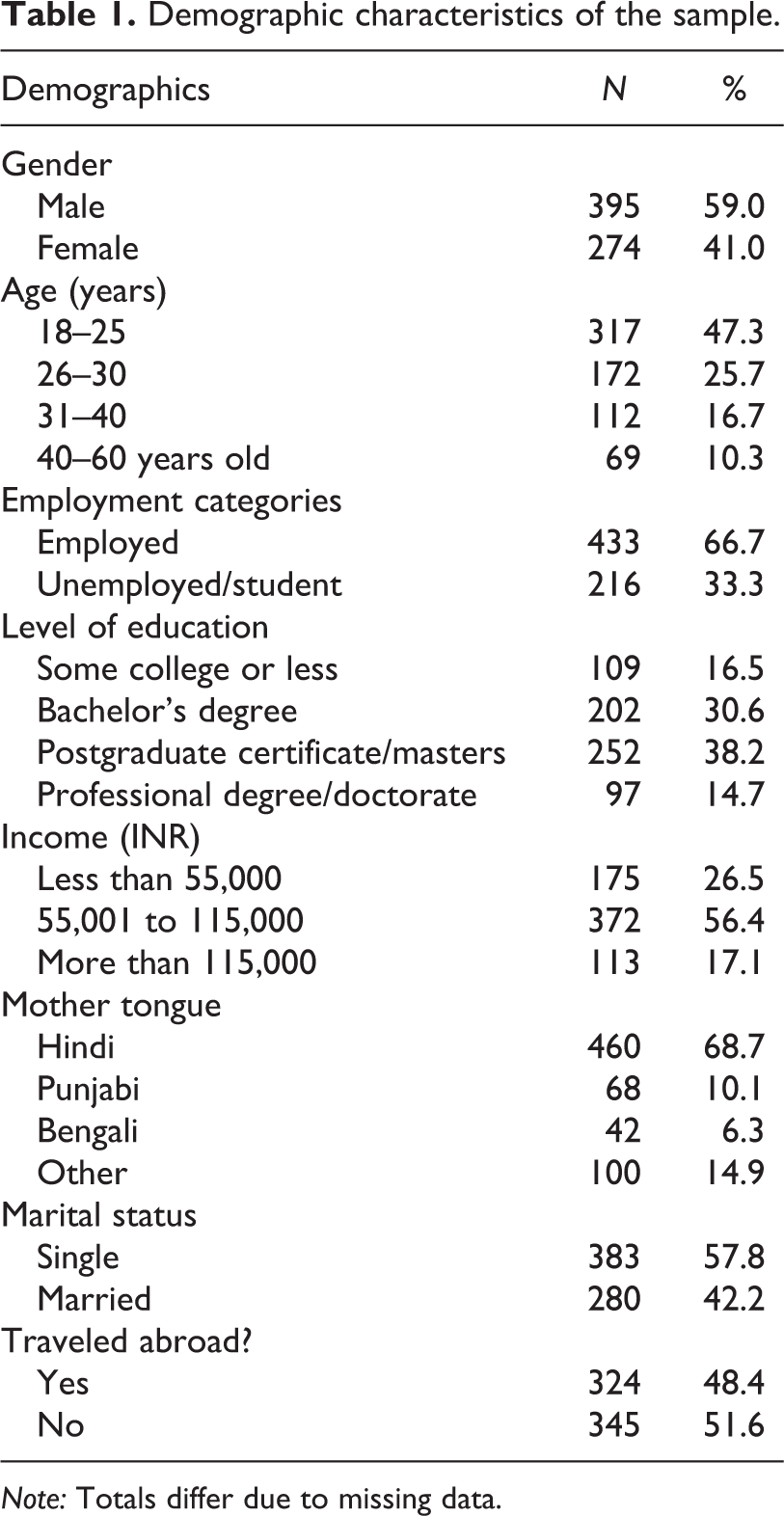
Note: Totals differ due to missing data.
Movie engagement
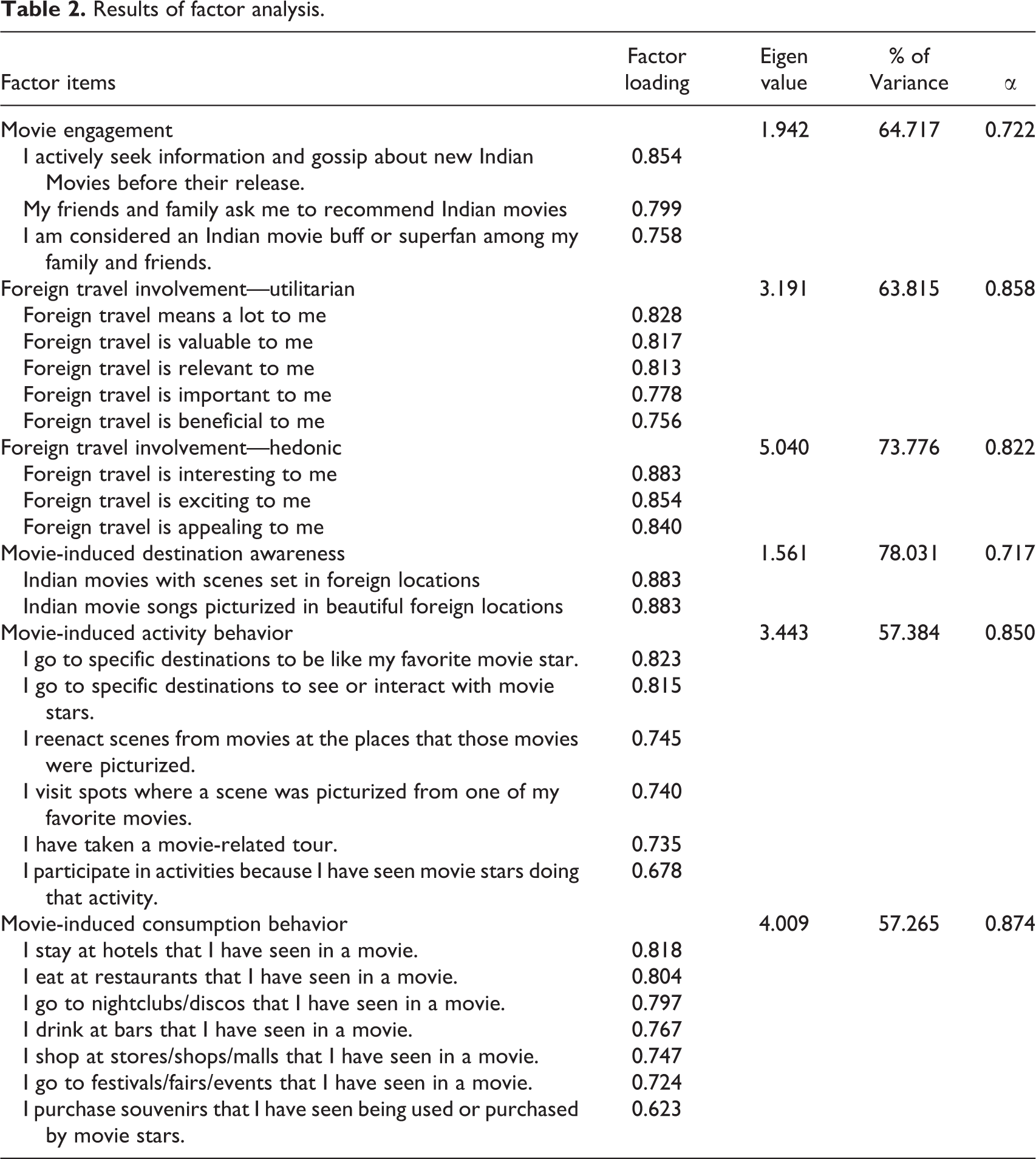
The exploratory factor analysis of this scale revealed that movie engagement (Cronbach’s α = 0.722) was found to be unidimensional, explaining 64.72% of the variance (see Table 2).
Results of factor analysis.
Foreign travel involvement
The exploratory factor analysis of this scale revealed two resulting factors, namely, foreign travel involvement—utilitarian (Cronbach’s α = 0.858) and foreign travel involvement—hedonic (Cronbach’s α = 0.822) that explained 63.815% and 73.776% of the variance, respectively (see Table 2).
Movie-induced destination awareness
The exploratory factor analysis of this scale also revealed that media-induced destination awareness was unidimensional (Cronbach’s α = 0.717), explaining 78.031% of the variance (see Table 2).
Movie-induced behavior
The exploratory factor analysis of this scale revealed two factors, subsequently labeled movie-induced tourist activity behavior (Cronbach’s α = 0.850) and movie-induced tourist consumption behavior (Cronbach’s α = 0.874) that explained 57.384% and 57.265% of the variance, respectively (see Table 2).
Measurement model and structural model testing
The full LISREL model consisted of the measurement model and structural model. The theoretical model consists of one exogenous variable (movie engagement) and three endogenous constructs (foreign travel involvement, movie-induced destination awareness, and media-induced behavior; see Figure 1).

Proposed model of the impact of Bollywood media on tourist activity, purchasing behavior, and destination image.
Hypotheses testing
SEM analysis
The causal model testing was conducted using LISREL Version 8.72 with maximum likelihood estimation method. Fit statistics including χ 2, goodness-of-fit index (GFI), adjusted goodness-of-fit index (AGFI), and root mean square error of approximation (RMSEA) assessed model fit. A χ 2 test assesses the adequacy of a hypothesized model to reflect variance and covariance of the data. For the statistical significance of parameter estimates, t values were used.
Generally, fit statistics greater than or equal to 0.90 for GFI and AFGI indicate a good model fit (Bagozzi and Yi, 1988; Hair et al., 1998). The results for the conceptual model revealed good overall fit for the proposed model, χ 2 = 876.21 (df = 212, p = 0.00000), GFI was 0.90, and AGFI was 0.86. A parameter estimate t value greater than 2.00 was considered an indicator of statistical significance (Byrne, 1998). Figure 2 displays the results of the causal model analysis, including significant standardized path coefficients and t values for each relationship as well as squared multiple correlations (R 2) for each endogenous construct. It illustrates an adjusted model in which all insignificant pathways have been removed.
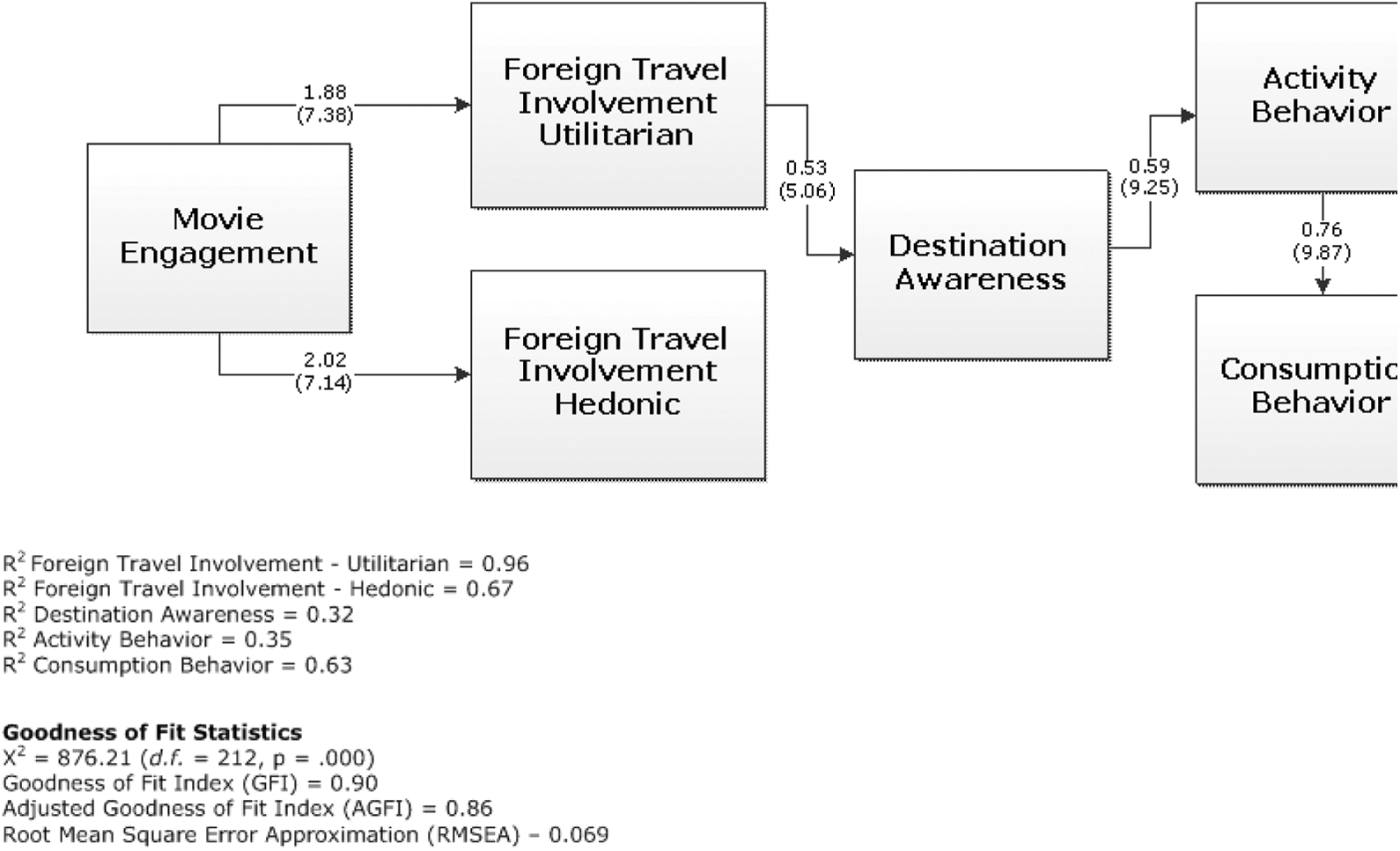
Adjusted Structural Equation Model. Only significant paths are illustrated in the figure.
The model was generally well supported and most pathways were found significant through modeling testing. However, H2b was found to be nonsignificant through structural equation modeling, as was H3a. It is likely that H2b is unsupported because the hedonic aspects of foreign travel allow for fantasy and escapism through film (Macionis and Sparks, 2006), potentially negating the need to develop an awareness of a destination. Furthermore, it is likely that H3a is unsupported because a tourist’s primary motivation to travel to a destination often centers around the culture and natural environment and after they are already pulled into a specific destination, they can then engage in consumption behaviors at that location, such as eating at a specific restaurant seen in a movie or drinking at a bar featured in a movie (Spears et al., 2012).
Discussion of results
Findings in this study indicate that engagement with Bollywood movies does have a positive impact on foreign travel involvement of Indians. Thus, it can be inferred that respondents noting higher levels of engagement also were more likely to indicate higher levels for both hedonic and utilitarian involvement in foreign travel. Results also indicate that utilitarian foreign travel involvement impacts destination awareness. The more involved a Bollywood movie viewer is with the utilitarian aspects of foreign travel, the more aware that the viewer is of a specific destination. It is then critical for destination marketers to target viewers who indicate higher levels of foreign travel involvement and are thusly, more aware of the destination being featured in films. Media does matter, and images portrayed in the media can deeply influence a Bollywood film viewer’s awareness of a foreign destination (Bollywood gives a boost to tourism in Britain, 2008). As noted earlier, it is Bollywood movies that have brought the world to Indians.
Furthermore, the results of this analysis suggest that destination awareness positively affects activity behaviors of tourists. Once influenced to travel to a destination seen in a Bollywood film, it is suggested that the more destination awareness a viewer has, the more likely they are to partake in activity behaviors at a specific destination, such as visiting set locations and reenacting scenes from Bollywood films. No relationship was found between destination awareness and consumption behavior. It is important for destination marketers to draw a Bollywood viewer to a destination through the promotion of activities at the destination, enhancing destination awareness and influencing viewers to participate in the activity behaviors seen within the films instead of consumption activities, as noted by Tagliabue (2010).
Lastly, activity behaviors positively influence consumption behaviors at a destination. Perhaps this is because consumers are likely drawn to a location for nonconsumption purposes such as the scenery or the culture, and then once at a destination, viewers enhance their experience with the destination through consumption behaviors.
Implications and recommendations
Overall, this study has successfully predicted the causal relationships among movie engagement, involvement, destination awareness, and tourist activity and consumption behaviors. These findings further suggest a need to determine acceptable marketing techniques and approaches to prominently feature foreign destinations in Bollywood movies. Bollywood films are viewed by millions in India and across the world and are a powerful source of information. However, to date, the power of Bollywood films as a source of travel motivation has been understudied in the tourism marketing field. This research provides justification to destination marketers and media organizations to utilize the full potential of Bollywood movies to reach billions of people. Because tourism-related behaviors vary among individuals, movie engagement and involvement with travel can be viewed as critical measures for analyzing consumer behavior in relation to tourism.
Study limitations and suggestions for future studies
These findings may not be generalizable to the study population because the sample was restricted to a convenience sample in one city in India. Future studies should be expanded to include multiple cities and should seek to obtain a much larger sample, using random sampling techniques. Additionally, future studies could ask respondents more specific questions that could be used to verify media influence on their actual purchase and activity behavior.
Footnotes
Funding
This research received no specific grant from any funding agency in the public, commercial, or not-for-profit sectors.