






Abstract
While a plethora of studies exist identifying tourism segments, limited attention has been directed towards consideration of segment validation. Practically, such an assessment involves carefully thinking about appropriateness of segment selection. Failing to consider whether targeting segments is appropriate based on key criteria limits marketing potential as resources can be wasted targeting differences which are not meaningful. This article involves an assessment of segments using Kotler’s (1988) four criteria to ascertain whether pursuit of different segments is warranted. A total of 2500 winter Northern Norway vacationers’ data was analysed using TwoStep cluster analysis. Two segments were identified but close inspection of the segments using targeting criteria indicated the segments were not actionable. Managerial and research implications are outlined in addition to a research agenda to advance segmentation science.
Keywords
Introduction
Conan Doyle in his Sherlock Holmes novel, A Scandal in Bohemia (1891), famously stated ‘I have no data yet. It is a capital mistake to theorize before one has data. Insensibly one begins to twist facts to suit theories, instead of theories to suit facts’. While fictional and written in the 19th century, this quote maybe relevant for destination marketers. Dolnicar et al. (2014) recently argued that market segmentation is one of the most frequently published concepts within tourism literature. With the plethora of statistical packages available to segment vacationers based on well-cited or slightly modified tourism questionnaires (Crompton, 1979; Dann, 1981; Yuan and McDonald, 1990) or mined databases (Bloom, 2004; Liao et al., 2010), market segmentation’s ability to provide market intelligence on the behaviour of homogenous groups of vacationers that exist in heterogeneous markets is well documented. To date, the utility of employing theory in segmentation research has only recently emerged (see Schuster et al. (2015) who used the theory of planned behaviour to segment a market for physical activity promotion). Moreover, consideration of the practical implications of derived segments has been largely ignored in segmentation research despite our understanding that segments need to be measurable, substantial, accessible and actionable (Kotler, 1988). In the absence of theoretical and practical considerations, data-driven segmentation studies may be of limited use.
As noted by Dolnicar and Ring (2014), developing and gaining marketing knowledge represents a key concern and priority in tourism. Although market segmentation will enable a researcher to understand how vacationers are or are not distinct based on variables such as their motivation to travel or the activities that they wish to experience, the assessment of the usefulness of the market segments must remain a central strategic concern for researchers and practitioners alike (Loker and Perdue, 1992; Uysal et al., 2011). A review of the literature highlights a lack of attention to assessing derived segments (e.g. Alexandris et al., 2009; Tsiotsou, 2006).
Destination marketers need to first identify whether segments can be distinguished and second determine whether it is reasonable and practical to meet the unique needs and wants of different segments. In the event that differential targeting of segments is warranted, competitive strategies can be formulated (Ahmed et al., 1997) and specific markets can then be targeted based on their profitability (Jang et al., 2004; Perdue, 1996), and/or the likelihood of frequenting a destination over a sustained period of time (Spotts and Mahoney, 1991). These target segments then become the basis for image and positioning strategies that will be marketed by destination marketers across potentially different promotional mediums (Pike, 2008) delivering to the unique needs and wants of segments. Alternatively, if identified segments are not substantial, accessible or actionable, a ‘one size that fits all’ approach can be employed.
While several seminal papers (Crompton, 1983; McQueen and Miller, 1985; Perdue, 1996) clearly outline the importance of targeting vacationers post-segmentation analysis based on key marketing criterion, only a small percentage of recent studies focus explicitly on targeting (e.g. Jang et al., 2004; Spotts and Mahoney, 1991; Weaver, 2015). To date, the dominant focus in the segmentation literature has been on segmenting vacationers based on data-driven techniques such as cluster analysis (McKercher et al., 2002; Pesonen and Tuohino, 2015) with no or limited consideration of targeting identified. The following paper contributes to tourism and segmentation research by providing a guide for researchers to assess the managerial relevance of identified segments using Kotler (1988) four key assessment criteria to segment. The case of Northern Norway is used to illustrate.
Literature review
Target marketing
Smith (1956) introduced market segmentation as a form of managerial strategy. Since then, many seminal articles have been written in fields such as tourism (Leisen, 2001; Loker and Perdue, 1992), events (Formica and Uysal, 1998; Saleh and Ryan, 1993) and hotel management (Chu and Choi, 2000; Mueller and Kaufmann, 2001). Market segmentation has been employed because it first enables a base for target marketing, second facilitates the development of effective marketing mixes to target specific segments, third offers product and service differentiation options and fourth contributes to identifying external opportunities and threats (Tsiotsou, 2006). Segmentation is universally recognized, and it is widely understood there is no correct approach to segmentation (e.g. Beane and Ennis, 1987). When segmenting vacationers, either a priori or posteriori segmentation approaches can be applied which can encompass common sense and/or data-driven segmentation (Dolnicar, 2004). Many different segmentation analytical techniques have been employed such as neutral networking (Mazanec, 1992), biclustering (Dolnicar et al., 2012) and latent class analysis (Alegre et al., 2011). For a systematic review of segmentation approaches applied within tourism, see Dolnicar (2004).
Viable consumers that can be effectively served need to be grouped into segments that require specific products or services and marketing actions (Ahmed et al., 1997; Buhalis, 2000). This will guide positioning strategies and provide potential competitive advantage through maximizing the usage of financial, physical and human resources (Crouch and Ritchie, 1999). Employing market aggregation, that is, the undifferentiated approach where all consumers are treated as the same, is criticized for wasting resources and not optimizing satisfaction within heterogeneous markets (Koc and Altinay, 2007). Conversely, while total market disaggregation where each consumer is considered uniquely can offer the potential vacationer with the benefit of a memorable, personalized customized experience, this would present a challenge for destination marketers based on available resources (Pike, 2008). Therefore, grouping consumers into segments offers one means to more economically cater to differences within heterogeneous markets (Heath and Wall, 1992).
The first step in the segmentation process involves selecting the segmentation approach (see Dietrich et al. (2016) for a summary of segmentation method approaches). Tkaczynski et al. (2009) in an extensive review of tourism segmentation assessed segmentation base use. The authors identified a broad range of measures that have been used by tourism researchers across each of the four segmentation bases, namely, demographic, geographic, psychographic and/or behavioural bases.
Once the segmentation method has been applied and the segments derived following analysis, the researcher needs to assess the managerial usefulness of the segments. For segmentation to be purposeful, segments need to be measurable, substantial, accessible and actionable (Kotler, 1988). The four criteria proposed by Kotler (1988) which need to be assessed are discussed in turn.
Measurability
Measurability, that is, the degree to which the size and purchasing power of all segments can be measured, is the most commonly met assumption for segmentation in tourism research. Consider, Tkaczynski et al. (2009), who summarized 119 segmentation studies that used 22 different measures across four segmentation bases. While an extensive array of segmentation studies have been undertaken to date, it is important to consider whether key measurement assumptions have been met. For example, Dolnicar et al. (2014) critiqued the validity and usability of data-driven segmentation where researchers employ data sets that do not have at least 70 cases per variable. Of further concern, in an assessment of measurement, the researcher or practitioner needs to assess whether validation processes have been used prior to presentation of the final cluster solution for quantitative clustering techniques. Given that the quantitative clustering techniques always deliver a solution (e.g. Dolnicar and Lazarevski, 2009), researchers must employ techniques to ensure segments derived can be replicated. Validation procedures are reported in the current study.
Substantiality
A market segment’s substantiality depends on both the size and the purchase volume of the specific segments (Spotts and Mahoney, 1991). The segment must be large enough to warrant special attention (Mills et al., 1986) to ensure sufficient return on investment can be derived. It is not surprising then, that many papers have examined the expenditure levels of vacationer segments (Mok and Iverson, 2000; Shani et al., 2010). While Henderson’s (1970) growth-share matrix would suggest that destination marketers target segments that are the largest and also have the highest growth rate, several points need to be considered. First, while vacationers with high expenditure patterns would appear most beneficial to destination marketers (Spotts and Mahoney, 1991), the literature (e.g. Carmichael and Smith, 2004; Tkaczynski et al., 2010) has determined that vacationer segments with the highest income do not always spend the most. Consequently, a profitability analysis would need to be employed to identify whether the largest segment/s will provide return on investment to a destination and whether the destination marketer has the capability to effectively serve this segment (Jang et al., 2004). Second, a segment/s needs to remain profitable over a lengthy period of time. Studies (e.g. Jang et al., 2004; Reisinger and Turner, 2002) have segmented Japanese vacationers based on their continual travel to Hawaii. Alternatively, the shopping satisfaction of mainland Chinese vacationers to Hong Kong is frequently documented (Choi et al., 2008; Qu and Li, 1997). Each of these segments would appear to be sustainable. Third, while a specific segment might have growth potential, destination marketers need to identify whether segment/s to be targeted are congruent to the current organizational focus. The largest segment might not match the current strategy employed by destination marketers (Kotler et al., 2010; Tkaczynski et al., 2010) such as a youth market at a family-orientated destination, so researchers need to determine the relevance of segments when designing marketing campaigns.
Accessibility
When allocating resources to target segments, destination marketers need to ensure that the segments are accessible and can be served effectively (Kotler, 1988; Mills et al., 1986). Here, additional bases to motivations and activities are required by destination marketers to access and satisfy target markets in a meaningful way (Moscardo et al., 2001). Loker and Perdue (1992) measured trip planning sources and the geographic concentration of market segments to non-residents summer segments to North Carolina in the United States. The authors concluded that the most successful marketers were those that used multiple forms of media that was impersonal and geographically concentrated in specific areas. Perdue (1996) determined that geographically proximal markets were more accessible and that the availability of transportation from long distance travel for skiing resorts in Colorado, the United States, would improve the appeal of destination visitation for long-haul travellers.
Destination marketers’ ability to access potentially profitable segments has been complicated by the recent advances of social media. While technology advances enable marketers to access global markets and interact directly with vacationers, electronic word-of-mouth through impersonal sources consistently ranks highly if not the most important information source in influencing vacationer purchase decisions (Bronner and de Hoog, 2011; Gretzel and Yoo, 2008). It is seen as a credible and trustworthy source particularly when coming from an experienced personal source such as family or friends (Allsop et al., 2007). Ring et al. (2016) segmented vacationers based on their word-of-mouth behaviour and determined that segments differed in the content shared and the channel used. The authors argued that the heterogeneous behaviour of vacationers complicates the ability to access and serve potential vacationers that might have little or no interaction with tourism providers before, during or after their vacation.
Actionability
The degree to which effective programs can be formulated for attracting and serving segments represents the final criterion for target marketing (Kotler et al., 2010). Destination marketers might identify multiple market segments that are potentially profitable, measurable and accessible, but financial and human resource limitations (e.g. the small size of the Destination Marketing Organization) may limit the organization’s ability to successfully market segments through appropriate marketing and communication material. However, if resources are available, marketing campaigns focusing on a key positioning message to profitable, measurable and accessible segment/s can be designed and promoted by destination marketers in media such as brochures, television campaigns and newspaper advertisements to entice vacationer segments to experience a destination’s offerings (Kotler et al., 2010).
Actionability is illustrated in McQueen and Miller (1985) with their suggestion to promote the key message of the Tasmanian experience, a nature-orientated vacation, for first-time domestic vacationers to the state of Tasmania in Australia. The authors concluded that the media investment to attract this segment largely based in Victoria, Australia, would eventually be compensated through repeat visitation. Loker and Perdue (1992) identified six rural segments to North Carolina, the United States, but prioritized the pure excitement seekers as it was deemed most profitable, accessible and reachable. This segment travelled to sightsee and employed multiple impersonal, information sources when seeking to purchase a vacation. Tkaczynski et al. (2010) identified that one of the three segments, the Wealthy Traveller segment, should be the target segment for the nature-based destination of the Fraser Coast in Australia for three reasons. First, it was the largest in size and spent the most. Second, vacationers travelled from key domestic source markets such as New South Wales and Queensland where promotional marketing campaigns were directed at the time. Third, vacationers travelled to rest and relax and to experience fun through activities such as visiting Fraser Island and whale watching which were the region’s key competitive attributes promoted in marketing material.
Northern Norway
The present study focused on Northern Norway during the winter season. This arctic region has traditionally attracted vacationers during the winter to experience the Northern Lights and to participate in a broad array of activities including (but not limited to) dog-sledding, ice fishing, cross-country skiing and fishing (Northern Norway, 2014). While it was estimated that a total of 150,000 inbound vacationers visited Norway for recreational purposes during the period from January to March 2014, remaining competitive during the winter season has been traditionally problematic for Northern Norway. First, there is limited sunlight during this season. Second, there are limited and less accessible skiing resorts in comparison to competing European and North American Alpine regions. Third, summer tourism activities such as experiencing the midnight sun, cruising the fjords and visiting the North Cape have been dominant attractions that drive visitation through the warmer season (Visit Norway, 2014).
Lately, winter tourism has been a priority for Northern Norway destination marketers and stakeholders. In particular, the British market has been a focus of marketing strategies. While this key source market experienced significant growth (19%) in 2012 from the previous calendar year, the number of British vacationers visiting Norway declined slightly (1%) to 508,070 in 2013. This decline, however, is significantly lower than rates experienced by the other key source markets such as Germany (14%), the Netherlands (14%) and Denmark (13%) over the same period. Consequently, the British market is perceived to be a strong source market for Northern Norway (Innovation Norway, 2013).
Methodology
A self-administered questionnaire was developed by industry representatives and consultants to identify the characteristics of vacationers that had visited Northern Norway during winter. Items represented key winter-based activities and other classifying variables frequently employed in the literature (Mehmetoglu, 2007; Prebensen and Tkaczynski, 2012) and were characteristic of the vacationers that Northern Norway destination marketers aim to attract during winter.
In total, 29 items were included. Seventeen activity items were designed in a binary ‘yes’ or ‘no’ format to identify whether respondents participated in an activity rather than the extent to which they did so (Dolnicar, 2004). The behavioural items of transportation mode, information sources and accommodation type were designed as multicategorical to identify whether vacationers used more than one option. Multiple Northern Norway winter activities can be experienced in locations such as the Lofoten Islands and North Cape, which require vacationers to extensively travel and potentially reside in different accommodation locations throughout their vacation. Prior to analysis, these variables were recategorized to represent popular multiple categories (e.g. hotel and the Hurtigruten for accommodation). Length of stay and expenditure were designed as metric and all other items were categorical. All expenditure was modified from respondents’ usual currency to Norwegian Krone prior to analysis. Professional translators translated the questions into English, German and Japanese. In total, 2500 valid surveys were collected by administrators on site at four airports in Northern Norway between January and March 2014. A total of 86 cases per measure (2500/29) was achieved, exceeding the cut off as recommended by Dolnicar et al. (2014).
TwoStep cluster analysis using the log-likelihood measure in IBM PASW version 21.0 was employed. A four-phase process was employed to validate the model. First, the Bayesian information criterion (BIC) for statistical inference was required to be at or above 0.0. Second, in employing the input (predictor) importance to determine the importance of variables in a cluster, variables deemed highly important needed to be at or above 0.8 (Norusis, 2011). Third, χ 2 and t-tests were run to identify whether statistical differences existed between the segments based on the categorical and continuous variables. Fourth, the model was required to be randomly split in two. Similarities across the combined and two split models such as number, size and characteristics of the three models would validate a cluster solution (Tabachnick and Fidell, 2012).
Results
In a similar procedure to the literature (e.g. Rundle-Thiele et al., 2013; Tkaczynski et al., 2015), all variables were analysed simultaneously in TwoStep cluster analysis. Four clusters were initially produced with a BIC measure of 0.1 which is poor. As a high percentage of respondents (almost 70%) did not answer the expenditure question, the solution was invalid as the solution would have had fewer than 70 cases per variable (Dolnicar et al., 2014). Thus, despite this variable being frequently employed for profitability segmentation studies (Jang et al., 2004; Spotts and Mahoney, 1991), expenditure was deleted for validation purposes. Several activities were rarely chosen by respondents (fewer than 3%) and invalidated the solution. To counteract this issue, these infrequently chosen variables were grouped under the variables other attractions or cultural events which represented the activity. In total, 10 activities were cluster analysed.
When the segmentation was rerun, the BIC measure remained the same (0.1). The model was validated when split, but did little to distinguish between the four segments derived. Accommodation type, transport in and to Northern Norway had the highest cluster importance. Variation existed in these variables based on whether vacationers arrived stayed or departed or stayed on a Norwegian cruise ship (e.g. the Hurtigruten) or not. In addition, the majority of respondents in all segments were British, aged between 18 and 60 and had not previously holidayed in Northern Norway. Personal sources were the main information source employed by respondents in the four segments. For all segments, gender was relatively equal and returning to Northern Norway for a vacation represented a lukewarm response (maybe). Activity variation was also minimal with the Northern Lights (0.09) being the most popular attraction for three segments and experiencing the Sami culture (0.56) most important for the smallest segment.
As the study failed to provide market segments that were appropriate for target market purposes, an alternative approach was employed. In a similar process to literature (e.g. Andreu et al., 2005; McKercher et al., 2002), the 17 activities were first cluster analysed. Either χ 2 or t-tests was then conducted on the remaining 12 items (categorical or continuous) to identify whether significant differences existed between the activity segments.
Initially, two segments were identified with a BIC measure of 0.4. This indicated that the within-cluster distance and the between-cluster distance for the two segments were fair. This measure is higher than the initial study and other studies that have employed TwoStep cluster analysis for activity participation (Rundle-Thiele et al., 2013; Tkaczynski et al., 2015). Based on the validity, further analysis was warranted. The variable Visiting Friends and Relatives was highly insignificant (<0.0) in cluster formation and was therefore removed from the analysis as it did not contribute to within-cluster differentiation (Norusis, 2011). The model was rerun with the item removed and two valid segments were identified. The BIC measure was again fair (0.4) and all activity items had input (predictor) importance levels which were higher than 0.0, therefore, contributing to some variation within segments. When the data set was randomly split into half, the same BIC measure and number of segments were determined. As this activity-orientated cluster analysis produced greater validity with minimal manipulation from the researchers, it was deemed as most appropriate for this study.
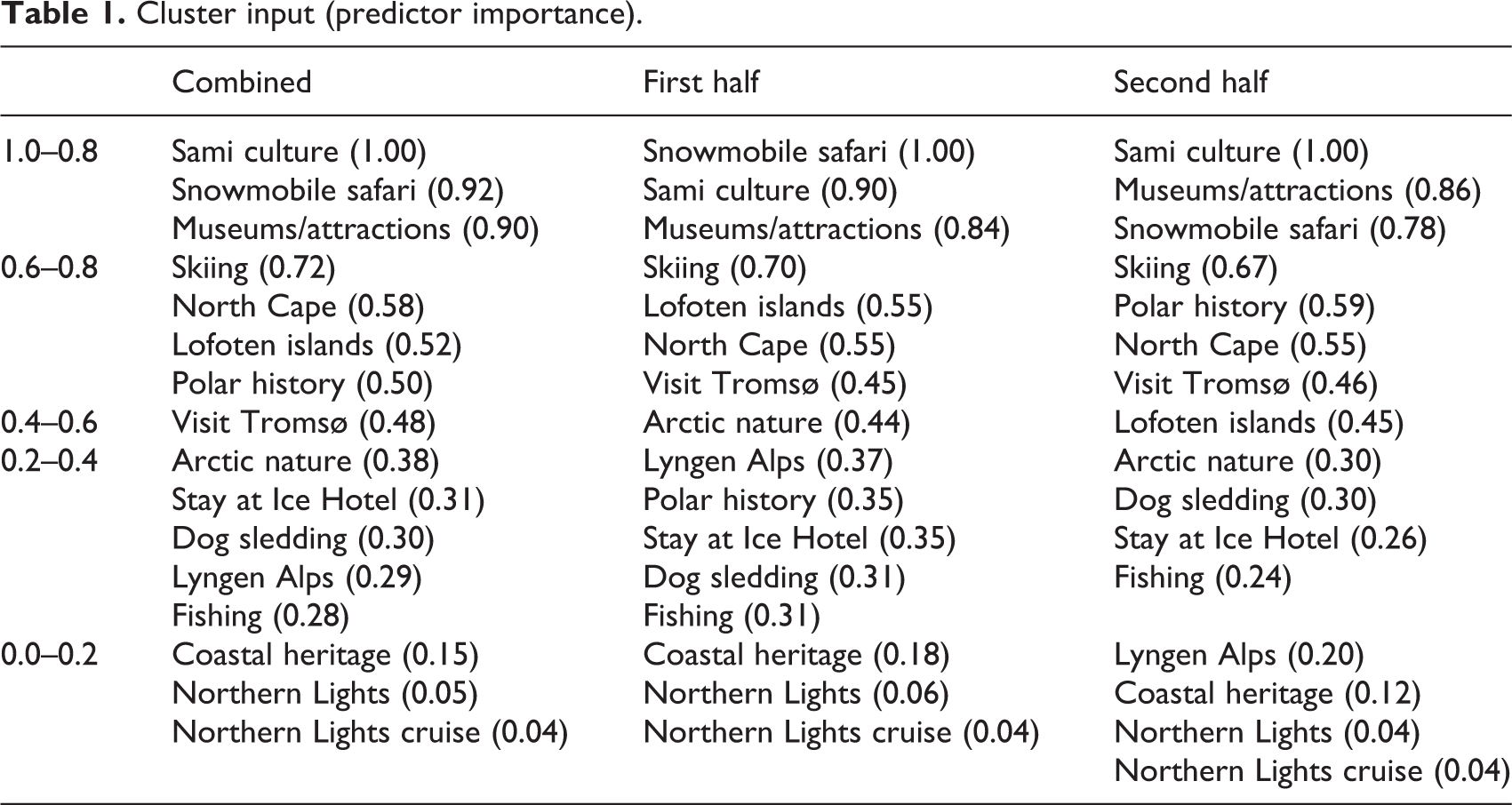
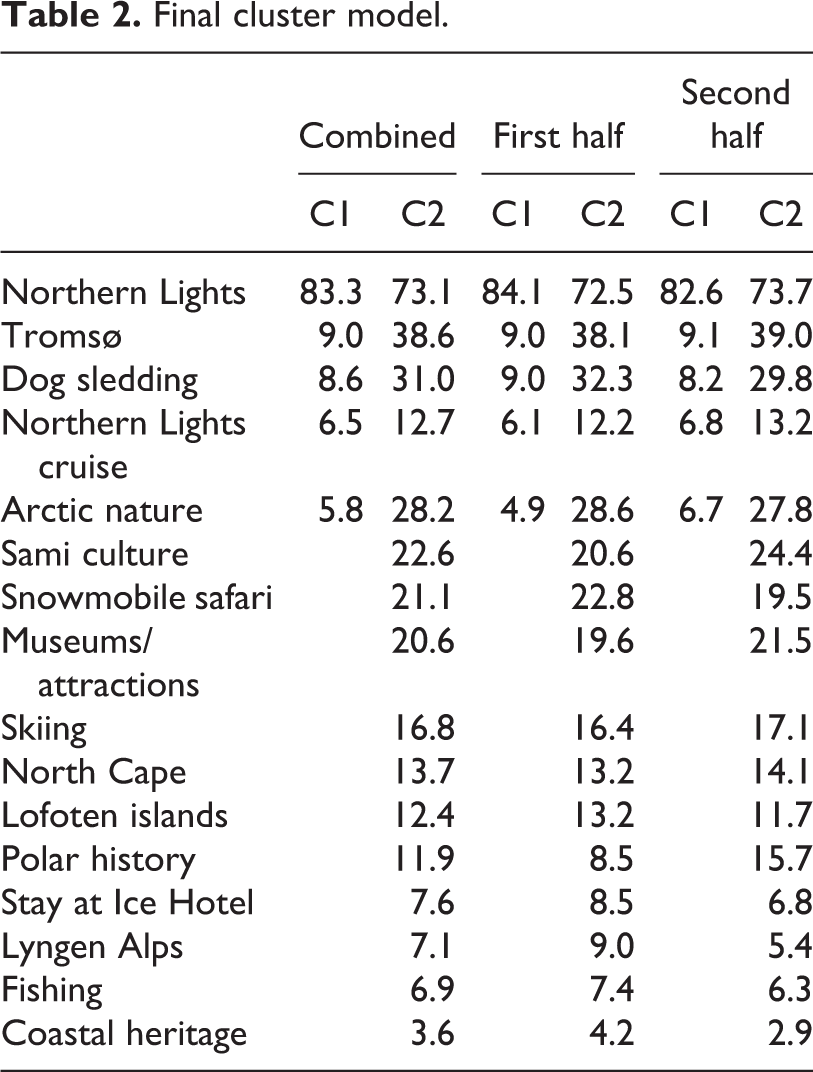
There were very minor differences in importance levels between the three models (see Table 1). It was concluded that the Sami culture, snowmobile safari and museums/attractions were the most important in differentiating the clusters, whereas the two Northern Lights activities were the least relevant. The segments varied in the activities that they experienced (Table 2). Segment 1 was the largest (84.8%) and over four-fifths (83.3%) participated in the Northern Lights. While segment 2 was smaller, respondents within this segment participated in multiple activities (n = 3.28). Almost three-quarters (73.1%) of this segment experienced the Northern Lights and participated most frequently in activities such as visiting Tromsø and dog sledding. While length of stay, age and expenditure (p > 0.05) were insignificant between segments, significant differences were identified between all other variables (see Table 3).
Cluster input (predictor importance).
Final cluster model.
Classification differences between activity segments.

NS: not significant.
*<0.01; **<0.05.
Apart from the fact that the first segment was mostly female, purchased more packaged tours and were less likely to return to Northern Norway and that the second segment had marginally larger past experience, differences were minimal between segments. Respondents were mostly British arrived by plane, stayed for five days in a hotel and departed by bus. Most vacations had not previously visited Northern Norway and used personal sources to gather information about their vacation.
Target market validation
Measurability
Two valid, measurable segments that were differentiated based on their activities experienced and several profiling characteristics were identified from this study. This, therefore, fulfilled Kotler (1988) measurability criterion (see Table 4). However, on close examination, the segment differences were minimal. While the sample size was above the required level of 1190 (17 variables × 70 cases) for data-driven segmentation (Dolnicar et al., 2014), the large sample size of 2500 showcased significant differences in the p value which were of limited value from a managerial standpoint (e.g. Sullivan and Feinn, 2012). Consequently, while big data sets can deliver valid and reliable results (Dolnicar et al., 2014), consideration must also be concurrently given to managerial usefulness of the segmentation solution derived. Evidence in the current study indicates that simply identifying segments as typically occurs in tourism studies (Andreu et al., 2005; McKercher et al., 2002) is not sufficient.
Target marketing criteria.

Sustainability
The first segment represented a large percentage (over 80%) of vacationers (see Table 4). However, its differentiation (Hlavacek and Reddy, 1985) from the second segment was marginal. Both segments rated the major attraction, Northern Lights, extremely highly. However, the second segment could be marginally differentiated based on their secondary cultural winter-based activity experience consumption. Many of the more culturally orientated nature-based activities were based in Tromsø such as museums/attractions and polar history, which could have indicated why the second segment chose to experience these activities and to spend time visiting what is available within the city, whereas the first segment focused predominantly on the Northern Lights. The British market was also the dominant category for both segments. While differences among segments based on their demographic, geographic and behavioural differences were similarly identified within the literature (e.g. Matzler et al., 2008; McKercher et al., 2002), the fact that prevailing categories were identified would suggest only a small number of variables (e.g. origin and transport) would be required to measure vacationers for future visitation to Norway. Through continuing the current promotional focus to Britain and other popular European countries such as Germany and Sweden, there is high potential that vacationers from these geographic markets would visit and revisit Norway which produces a potential return on investment, particularly when this market is growing in potential for Northern Norway.
Accessibility
This study identified two segments that were accessible and could be served effectively through targeted marketing campaigns (see Table 4). The two segments are geographically proximal (European) and arrive in Northern Norway via plane which is the most accessible form of transportation to this region. As Britain has been targeted as a source market in recent promotional campaigns, it appears that these vacationers are responsive to the current promotional mediums such as television, social media and Northern Norway websites. As vacationers in these two segments stayed predominantly in hotels and travelled within the Northern Norway region via bus or car, they can be further targeted through current focused marketing campaigns (e.g. Hunting the Northern Lights) with continual support from transport and accommodation providers. Continually promoting the other options available in Northern Norway in hotel rooms, information kiosks and transportation locations such as airports and bus stops could potentially increase visitation in the future. This is particularly relevant considering that a high percentage will not return to Northern Norway, potentially because the Northern Lights might represent a ‘once in a lifetime experience’ (Prebensen et al., 2012).
Actionability
While the ‘one size fits all’ strategy has been criticized within the tourism literature (King, 2010; Whitford and Ruhanen, 2010), the results of the current study suggest that the Northern Norway destination marketers should not apply a full-scale segmentation approach to profile Northern Norway vacationers. While these organizations have invested in winter tourism and have subsequently experienced a return on investment through visitation from key source European markets, the results of this study would tend to suggest that tailored marketing programs for these two segments are not effectively differentiated (Dolnicar and Lazarevski, 2009). Research findings would tend to suggest that Norwegian destination marketers continue to promote the current focus on winter-based activities in all marketing material with only small modifications in source countries to cater for potential small cultural or ethnic differences.
Discussion
The current study contributes to tourism and segmentation research presenting and outlining a framework that can be used by researchers and practitioners alike to assess whether segments derived are managerially useful. This process can answer the question of whether destination marketers should or should not employ market segmentation to target vacationers. The importance of segmentation is widely known and a considerable body of evidence relating to segmentation best practice exists (Dolnicar, 2004; Karlsson, 2015), yet limited attention had been directed towards targeting decisions. In addition to their identification, qualification and attractiveness (Hlavacek and Reddy, 1985), segments need to be assessed for their viability based on specific criteria to ensure suboptimal segments are not targeted (Dolnicar and Lazarevski, 2009).
This research provides a guide for researchers to assess the managerial relevance of identified segments using four key assessment criteria as first proposed by Kotler (1988), namely, measurability, accessibility, sustainability and actionability. Two segments were identified and validated using TwoStep cluster analysis. However, after assessing the measurability, substantiality, accessibility and actionability of the segments, it is argued that these segments are not essentially different and differential delivery is not recommended in the current study. The framework presented and outlined in the current study can be used by researchers and practitioners alike to assess whether segments derived are managerially useful offering a unique methodological contribution to tourism literature.
Conclusions, limitations and opportunities for future research
This study contributed to the literature examining segments in a Northern Norway context finding that winter vacationers are essentially homogeneous. While the statistics indicate clear segments and differences between the segments, application of Kotler’s (1988) four attributes of measurable, sustainable, accessible and actionable indicates limited utility of differentiating marketing between segments identified. As a consequence, the answer to the question proposed ‘to segment or not?’ requires careful application of decision criteria and careful thought from researchers and practitioners before usage. With the plethora of tourism segmentation studies aiming to differentiate vacationers based on specific criterion and quantitative methodologies, this study identifies that methods need to be used in conjunction with targeting criterion if meaningful segments are to be derived. Employing scales and techniques similar to other studies may be useful for replication purposes, but it might have limited managerial application.
While studies have frequently applied segmentation variables to profile vacationers (Tkaczynski et al., 2009), they have not reported consideration of Kotler’s (1988) four attributes. The results of this study suggest that items continually applied in segmentation studies (e.g. age or gender) which have been deemed significant may in fact be largely irrelevant when simultaneously analysed with other segmentation variables. Further, by applying Kotler’s (1988) four attributes, the results of this study indicate that Norwegian tourism marketers would not benefit from segmenting the British market.
Future research within the context of larger tourism destinations is recommended to advance segmentation theory. A longitudinal research design is recommended to measure visitor numbers over time to assess communication campaign effectiveness based on the strategy applied. Drawing on the contribution of the present study, an experimental research design is also recommended across multiple sites permitting a range of targeting judgements to be assessed (e.g. a site where multiple segments should be targeted, another where only one segment is deemed worth targeting and a final site where no segmentation is warranted). First, segments would need to be derived and be assessed within each tourism context to understand whether segments exist. Next, the targeting criteria of measurability, sustainability, accessibility and actionability would be judged and a decision on which segments (or not) to target would be made. An experimental design would then be applied within each tourism destination participating in the study. This would involve applying a targeted marketing campaign in one region/city within the larger destination frame and a one size fits all communication campaign in another region/city. A comparison of visitor numbers pre- and post-communication campaign would then be undertaken for each region/city to examine the effectiveness of the communication approaches (targeted versus one size fits all). Such a research design would permit an assessment of the effectiveness of the different approaches to be undertaken.
This research has determined that vacationers to Northern Norway experience the Northern Lights. While this is hardly surprising, it has determined that secondary attractions such as dog sledding and experiencing the Arctic Nature have largely been ignored by vacationers. While destination marketers will aim to differentiate their destination to appeal to a wider cohort of vacationers in an attempt to satisfy a wider group and to make them stay longer, this study suggests that the majority of resources should be allocated to continually promoting the Northern Lights.
While the tourism marketing literature (Dolnicar et al., 2014; Dolnicar and Ring, 2014) has called for large sample sizes to provide reliable and valid data for market segmentation purposes, this study produced a high non-response rate for expenditure items. In addition, while the sample size of 2500 indicated that many of the categorical items were significant, when analysing at a deeper level, it can be determined that these differences were minor. This suggests that researchers that are aiming to employ online or on-site questionnaires to collect a large sample size in a relatively short period of time to validate their segment solution (Tabachnick and Fidell, 2012) might face methodological issues of critical concern. Expenditure is an important item for target marketing (Jang et al., 2004; Mok and Iverson, 2000) and if a high percentage of respondents do not answer this question, the applicability of the research for marketing purposes is limited. To cater for this issue, this item can be designed as ‘forced/compulsory’ for an online questionnaire. Alternatively, when providing a self-administered questionnaire to vacationers, this item can be placed at the start of the questionnaire as an introductory option or explained by the data collector that a monetary question is provided for information purposes.
Footnotes
Declaration of conflicting interests
The author(s) declared no potential conflicts of interest with respect to the research: authorship, and/or publication of this article.
Funding
The author(s) received no financial support for the research, authorship, and/or publication of this article.