






Abstract
This study introduces consumer socialization agency (CSA; i.e. the act of influencing another about consumption) as the reason why consumers learn through peer communication on social media tourism sites. Based on an online panel of 193 US consumers, the study investigated how a personal connection to a tourism site (i.e. customer engagement [CE]) and a connection with peers on social media (i.e. peer group identification) drives CSA about tourism, which, subsequently, influences learning about tourism-related consumption decisions (i.e. peer communication). Our model establishes that identification with peers on social media and CE with tourism sites are antecedents to consumer socialization. Consumers need to feel engaged with tourism social media sites to participate in socialization and feel connected to their peers on social media in general. Consumer socialization, or the willingness to teach/influence tourism-related skills to friends, influences the willingness to learn new tourism consumer skills, including tourism-related decision-making. We propose that for a tourism site to be successful, it must enable social exchange of knowledge and ideas (through enabling consumer socialization), not just individual user experience.
Keywords
Introduction and background
Social media is fundamentally changing the way consumers communicate, collaborate, and create (Aral et al., 2013). Social media enables consumers to build relationships and to expand their skills, knowledge, and attitudes through social interaction (Ellison et al., 2007; Hill et al., 2015). In the modern media landscape, a large proportion of travelers are influenced by social media (Cabiddu et al., 2014; Hede and Kellett, 2012; Pabel and Prideaux, 2015). Data from Nielsen (2016) suggest that 69% of online consumers use social media discussions to help make purchase decisions. In Australia, for example, companies in the tourism industry have the fastest growth in Facebook fans—reaching higher numbers of fans than any other industry (Carroll, 2015). Tourism-related social media are also becoming widespread. TripAdvisor is currently the largest travel community in the world, reaching 350 million unique monthly visitors and 320 million reviews and opinions covering more than 6.2 million accommodations, restaurants, and attractions worldwide (TripAdvisor, 2016).
Social media allow tourism service providers to pursue a variety of customer engagement (CE) strategies (i.e. “interactive customer experiences”; Brodie et al., 2013; Cabiddu et al., 2014; Hvass and Munar, 2012; Lim et al., 2012). The importance of social media for CE in the tourism context has been widely acknowledged (Cabiddu et al., 2014; Chan and Guillet, 2011; Park and Allen, 2013; Wei et al., 2013). However, the CE approach only considers commercial reasons as to why consumers interact and contribute on social media. Although consumers may at times use social media to engage with brands and businesses, this does not compare to the amount of time spent on the main functions of social media, that is, socializing with friends, as well as searching for and sharing information (Sensis, 2016).
Tourism activities are a natural part of social leisure pursuits, which consumers frequently discuss with friends and family on social media (Bakshy et al., 2011; Lim et al., 2012). The main social media sites, such as Facebook and Twitter, emphasize self-presentation, or disclosure, combined with social elements (Kaplan and Haenlein, 2010). This sets the scene for consumers to exchange skills, knowledge, and attitudes regarding their holiday plans and experiences. Thus, there is a need to better place the CE concept within the wider “social” usage of social media and not just business/brand to consumer relationships.
We argue and provide evidence that social media activities related to consumption decisions are rooted in consumer socialization; the process by which consumers develop their skills, knowledge, and attitudes related to decisions in the marketplace (Moschis, 1987; Ward, 1974; Watne et al., 2011). The interactive and collaborative nature of social media offers an opportunity for businesses to engage with customers and, consequently, accelerate consumer socialization processes between consumers, influencing communication between peers that encourages their decision-making processes. Specifically, we provide evidence to suggest that tourism sites should encourage the formation of communities on their site, which will, ultimately, drive individuals to share knowledge, skills, and attitudes related to tourism activities such as finding desired accommodation, tours, or dining options. As such, we focus on how consumer socialization theory can be used to better understand how and why consumers interact in relation to tourism decisions on social media. We extend the current theoretical understanding by incorporating a consumer socialization lens to illustrate how consumers influence their friends and how they learn from their peer groups on social media.
Literature review
Consumer socialization
Consumer socialization, rooted in social learning theory (Bandura, 1977; Brim, 1966), focuses on social learning processes related to how individuals function in their surrounding environment (Moschis and Churchill, 1978; Ward, 1974). The consumer socialization approach suggests that consumption is learned through social interaction with external sources, commonly referred to as “socialization agents” (Chan and McNeal, 2006; John, 1999), which transmit norms, attitudes, motivations, and behaviors to learners (Aleti Watne et al., 2014; Köhler et al., 2011; Wang et al., 2012). Agents of socialization are people and groups that influence a change in learners’ self-concepts, emotions, attitudes, and behavior (Bandura, 1969, 1977). Through socialization, consumers learn consumption-related skills, knowledge, and attitudes to improve how they function in the marketplace (Moschis, 1987).
Due to the simultaneous and ongoing availability and presence of friends, businesses, and peers, social media offers a unique channel for consumers to extend their skills and knowledge in their particular areas of interest. Through social media, consumers have the opportunity to model the behavior of others (vicarious learning), to receive feedback (reinforcement) on their own behavior, and to participate in social interaction (cf Bandura’s (1969, 1977) social learning theory). We introduce a consumer socialization theory approach that seeks to understand how and why consumers are using tourism social media in order to share and obtain new information.
In their general and more generic consumer socialization model, Bellenger and Moschis (1982) proposed that the antecedents to consumer socialization relate to “experiential variables” as well as “social structure” variables. Building on this, we argue that the antecedents to the consumer socialization process about tourism through social media is related to CE with their favorite social tourism site (i.e. experiential variable), as well as how consumers identify with their peers on social media (i.e. social structure variable). A greater level of engagement with a website means that the consumer will have a high level of attention and interaction with the site, as well as a willingness to learn more through it (So et al., 2014). As such, we argue that CE is analogous with Bellenger and Moschis’ (1982) “experiential variable.” Finally, we argue that the way in which consumers relate to or identify with others on social media (i.e. peer group identification) is akin to the social structure they build on the platform, that is, Bellenger and Moschis’ (1982) “social variable.” Figure 1 illustrates these relationships.
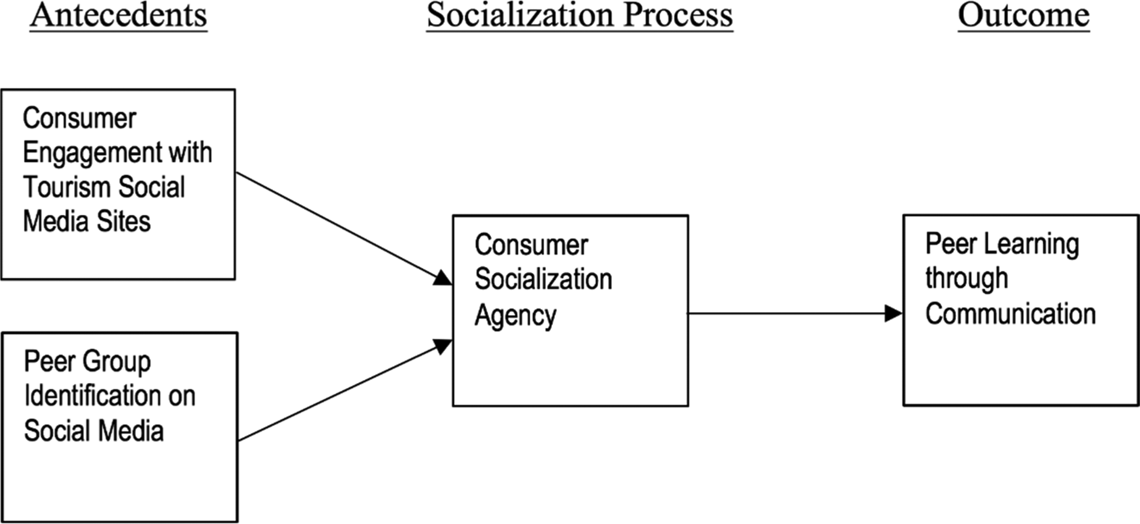
A conceptual model of consumer socialization via social media tourism sites.
The socialization process (which relates to Bellenger and Moschis’ (1982) agent–learner relationships) is here investigated through the concept of consumer socialization agency (CSA) (Aleti Watne et al., 2014). It is proposed that CSA will lead to greater learning properties in consumers from their peers about tourism through social media. Learning is always the outcome of consumer socialization processes (Ekström, 2006; John, 1999; Moschis and Churchill, 1978). In the following sections, we build on and further investigate the proposed relationships in our proposed conceptual framework.
Consumer socialization agency
A consumer’s willingness to act as a socialization agent within close relationships is conceptualized as “CSA” (Aleti Watne et al., 2014). CSA is the act of influencing another about consumption within a close social context. That is, a consumer who offers CSA concurs that he/she has a direct influence on the purchase decisions of the consumer that is offered CSA. Further, these interactions are not based on the sender/receiver model of communication; they are conceived as gift/acceptance (Aleti Watne et al., 2014). That is, consumption knowledge is offered as a gift to the learner and the learner accepts the gift from the agent. Previous research has investigated CSA in family settings (Aleti et al., 2015; Aleti Watne et al., 2013, 2014; Watne and Brennan, 2011; Watne et al., 2011), with both parents and children as socialization agents. Here, we extend the conceptualization to include CSA between friends in a social media environment.
CSA differs from related constructs such as word-of-mouth (WOM), or e-WOM, because of its relational, strong-tie component. e-WOM is any positive or negative comment made by anyone about a product or service that is available for others to view online (Minazzi, 2015). Through social media application, consumers can obtain tourism information and advice from weak ties, fleeting ties, as well as complete strangers (Dickinson et al., 2016). When it comes to e-WOM through social media tourism sites, consumers often expect a certain amount of “fake reviews” they need to filter out (Minazzi, 2015). Thus, e-WOM does not require ongoing commitment of consumers or a need to build reciprocal credit. CSA, on the other hand, is entirely reliant on strong ties. From its roots in family decision-making, CSA investigates active components of learning properties within close relationships (Aleti Watne et al., 2014).
In the virtual world, consumer behavior is interactive and experiential and is largely driven by consumers’ need for socialization and information (Brodie et al., 2013). Wang et al. (2012) conclude that learning from peers and discussion about purchase decisions through social media has a positive impact on purchase intentions. Peer communication on social media is associated with learning about consumption, such as brand preferences, involvement, or purchase intentions (Wang et al., 2012). Interactions with peers are fundamental human acts; consumers tend to interact with peers about consumption matters, which greatly influence their attitudes toward products and services (Churchill and Moschis, 1979; Parker et al., 2014). This indicates that social interaction with peers online is part of the consumer socialization process, as consumers learn from their peers (Wang et al., 2012). However, it is not known whether discussing with, and learning from, peers is related to the extent to which consumers would actively act as an agent of socialization for their friends. That is, it is not known whether consumers who teach new skills to their friends are more likely to learn from peers on social media.
On tourism social media sites, such as Airbnb, TripAdvisor, Lonely Planet, or WAYN, consumers are likely to both search for information and network with others (Bruns and Burgess, 2012; Hede and Kellett, 2012). This indicates that consumers are willing to influence (i.e. CSA), as well as be influenced (i.e. peer learning through communication), when it comes to sharing knowledge about tourism decisions. As a result, we suggest that learning about tourism-related information from peers is influenced by interactions as an agent, or influencer, of the tourism-related decision-making of friends. As such, we propose the following hypothesis:
Customer engagement
CE is underpinned in the relationship-marketing domain and in service-dominant logic (Brodie et al., 2013; Vivek et al., 2012). As Gummerus et al. (2012) specify, engagement behaviors include all consumer-to-organization interactions and consumer-to-consumer (C2C) communications about an organization. Engaging with customers and, consequently, building interactive, two-way relationships with customers can foster a range of relational benefits with tourism sites, such as trust, satisfaction, commitment, and loyalty (Baek et al., 2012; Brodie et al., 2013; Hollebeek, 2011; van Doorn et al., 2010). Although it may be conceptually convenient to collectively examine consumer-to-organization and C2C together when discussing engagement, it is potentially removed from actual consumer experiences. For example, on a social tourism site such as TripAdvisor or Booking.com, most consumers are able to distinguish between what they learn from friends, peers, or other users on the site and the promotional information they receive from businesses. It appears inaccurate to assume that consumers seek interaction from businesses in the same way as from their peers.
In a recent tourism study, So et al. (2014: 310–311) defined CE as “a customers’ personal connection to a brand as manifested in cognitive, affective, and behavioral actions outside of the purchase situation.” Their engagement construct consisted of five dimensions: identification, enthusiasm, attention, absorption, and interaction. The first four dimensions were based on affect and cognition, while the last dimension was based on behavioral manifestations (e.g. writing reviews). Results of their study found evidence to suggest that the five dimensions of CE together had a strong positive relationship with loyalty. We propose that there is a positive relationship between CE and CSA. In Bellenger and Moschis’s (1982) consumer socialization model, they identify experiential variables as antecedents to agent–learner relationships (i.e. socialization agency). As identification, enthusiasm, attention, absorption, and interaction (So et al., 2014) are arguably related to deeply felt experiences, we propose that it acts as an antecedent to CSA.
Additionally, the relationship between CE with tourism sites and CSA may be understood in terms of uses and gratifications theory, which, in the context of social media usage, posits that users choose and use media in response to specific needs and desired gratifications. Mkono and Tribe’s (2016) research identifies that a reviewer wants to be read by others and they want to influence. Wanting to influence others is akin to offering socialization agency; it relates to sharing expertise and seeking to influence the consumer behavior of others (Bodkin et al., 2013). This behavior is common in tourism, where peer-to-peer recommendation is a significant predictor of consumer behavior (Pabel and Prideaux, 2015).
We propose that engagement with the tourism social media site will encourage consumers to offer CSA to their friends. Furthermore, with CSA suggested to influence learning from peers through communication (as consumers are both influencers and learners in knowledge sharing regarding tourism decisions), we propose that CSA is the mechanism that influences the relationship between CE and learning from peers through communication. In other words, engagement with the tourism site results in learning about tourism-related information through interactions, while playing the role of a socialization agent, or influencer, of tourism-related decisions. As such, the following hypotheses are put forth:
Peer group identification
Although CE with a tourism website could explain some of the variation in how consumers teach skills and knowledge about tourism to their peers, consumer socialization also depends on social-structural variables (Aleti Watne et al., 2014; Carlson et al., 2011). In consumer socialization, new behaviors or attitudes result from learning acquired through interactions between the consumer and socialization agents (Wang et al., 2012). This is again dependent on the social environment that surrounds consumers (Moschis, 2007; Nanda et al., 2007). The presence of peers and the feeling of connection with them online is instrumental for exchange of behaviors or attitudes to take place (Lee and Conroy, 2005). Such peer interaction may be a function of fulfilling a social need for exchange of ideas with like-minded people.
Consumers are driven by a need to socialize, share, and explore through social media (Hvass and Munar, 2012; Lee et al., 2012; Lim et al., 2012). In accordance with Wang et al. (2012), both the willingness to communicate with and learn from peers about consumption-related matters are connected to how well consumers identify with their online peer groups. This echoes the findings of Sarkar et al. (2013) who found that satisfaction in socializing via social media increased the eco-tourist’s intention to contribute their knowledge to others. Bellenger and Moschis’ (1982) suggest that consumer learning involves a social process, suggesting that CSA positively influences the learning process. More specifically, we suggest that the act of influencing others fosters peer communication processes, that is, learning through peer communication.
We suggest that peer identification will encourage tourism consumers to act as socialization agents for their friends. With socialization agency suggested as a crucial factor within the peer communication, or knowledge acquisition/decision-making process, we propose that CSA is the mechanism that influences the relationship between peer identification and learning from peers through communication. In other words, a feeling of connection with peers on a tourism site results in learning about tourism-related information through interactions via socialization agency (i.e. when consumers actively act as influencers for their friends). The following hypotheses are proposed:
Method
We examine the effect of CE and peer identification on CSA and subsequent learning from peers through communication. We argued that offering CSA (teaching friends) acts as the mechanism under which engagement with the brand and identification with the friend group enhances the social learning process, that is, individual learning from friends.
A sample of 193 members of the US general public (97 males, 96 females; Agemean = 36.28) were recruited through MTurk in May 2015, following data cleaning as a result of missing responses (total number of participants initially recruited equaled 200). MTurk is Amazon’s crowdsourcing employment website where anonymous participants find and complete human intelligence tasks (HITs) posted by employers. Previous research has found convenience samples drawn from MTurk (Landers and Behrend, 2015) offer external validity in terms of the representativeness of the population and generalizability of the findings (Buhrmester et al., 2011; Paolacci et al., 2010). Only respondents located in the United States were eligible to complete the survey (this was verified by internet protocol (IP) geolocation), and respondents were compensated $1.50.
Employing G*Power, it was determined that this sample exceeded that required to achieve statistical power (linear multiple regression) of 0.95, with an a priori alpha level of 0.05 and estimated medium effect size (F = 0.15; i.e. n > 119). First, participants were asked about their use of tourism-related sites. They were then asked to select their favorite tourism-related site and were advised that the questionnaire then consequently related to the site they had nominated. Drawing from measures employed by Wang et al. (2012), participants were then asked to rate their extent of learning from peers through communication on five-point Likert-type scales (1 = Strongly disagree and 5 = Strongly agree; Cronbach α = 0.96; item example; “my peers encourage me to make tourism decisions”). Next, participants were then asked to rate, on five-point Likert-type scales, their CE (measures taken from So et al. (2014); Cronbach α = 0.91; item example; “when someone praises [insert tourism site], it feels like a personal compliment,” “I am passionate about [insert tourism site],” “I concentrate a lot on [insert tourism site],” “In my interaction with [insert tourism site], I am immersed,” “I am someone who enjoys interaction with like-minded other in [insert tourism site’s] community”). Finally, peer group identification (items taken from Wang et al. (2012); Cronbach α = 0.91; item example; “I am very attached to the peer group on social media”) and CSA (items adapted from Aleti Watne et al. (2014) to tourism decisions; Cronbach α = 0.97; item example; “I influence my friends to make the right tourism decision”) were measured. Details of the items in the scales and Cronbach’s α values are listed in Appendix 1. Finally, simple demographic information was obtained.
Results
Participants self-selected 88% tourism-related sites that allowed for social interaction through logging in and writing a review, and interacting with other reviews by liking or indicating that the review was helpful or useful. Predominantly TripAdvisor (29%), Expedia (19%), and Priceline (14%) were selected. The other 12% of favorite tourism-related sites included those that allowed for little interaction, however, these tourism-related sites also had associated Facebook sites that allowed for interaction in an online community, such as Kayak (9%).
To examine whether CSA is the process (M) under which CE (X) with the tourism site and identification with the peer group (X) influences learning from peers through communication about tourism (Y), Preacher et al.’s (2007) PROCESS macro bootstrapping procedure (n = 10,000, model 4; mediation model) was employed. Two separate mediation models were run for the influence of (i) CE (see Figure 2) and (ii) peer group identification on CSA (see Figure 3), and subsequently on peer learning through communication. Preacher et al.’s (2007) mediation procedure was used as an alternative to the causal steps approach to mediation analysis proposed by Baron and Kenny (1986) (undertaken using structural equation modeling), which has been recently criticized, predominantly due to the approach being among the lowest in power to detect the effect of the mediator on the relationship between the independent variable and dependent variable, and because the existence of an indirect effect is inferred logically by the outcome of a set of hypothesis tests (see Hayes, 2009, for a detailed discussion). Alternatively, PROCESS quantifies the indirect effect rather than inferring its existence from a set of tests on their constituent paths (Hayes, 2009). Descriptive statistics are reported in Table 1.
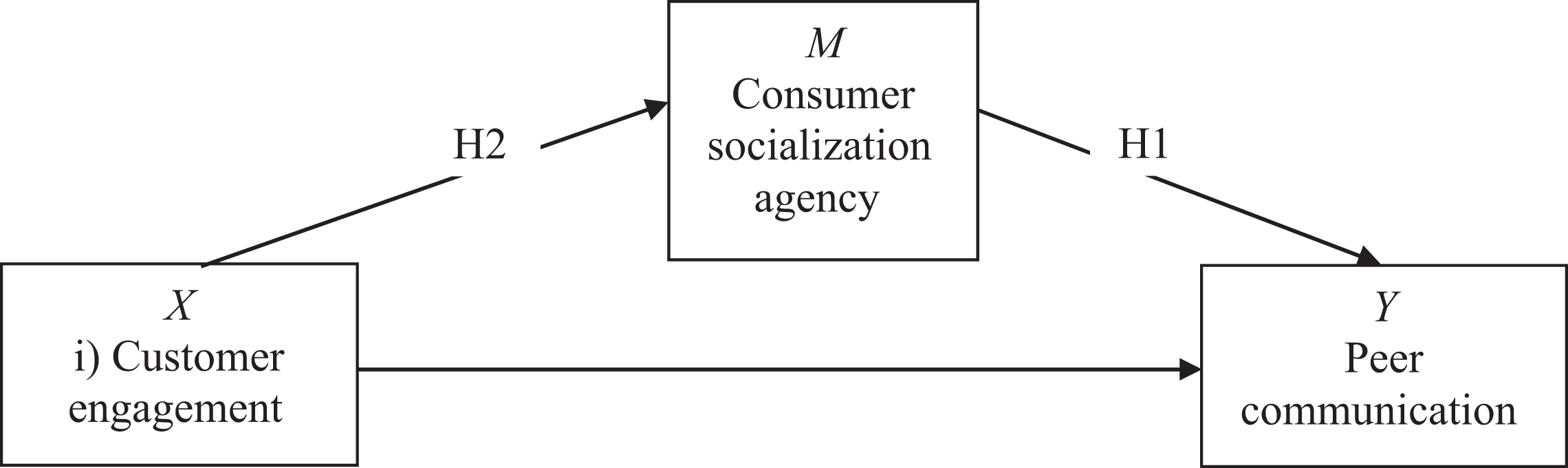
Preacher et al. (2007) model 4 (customer engagement mediation model).
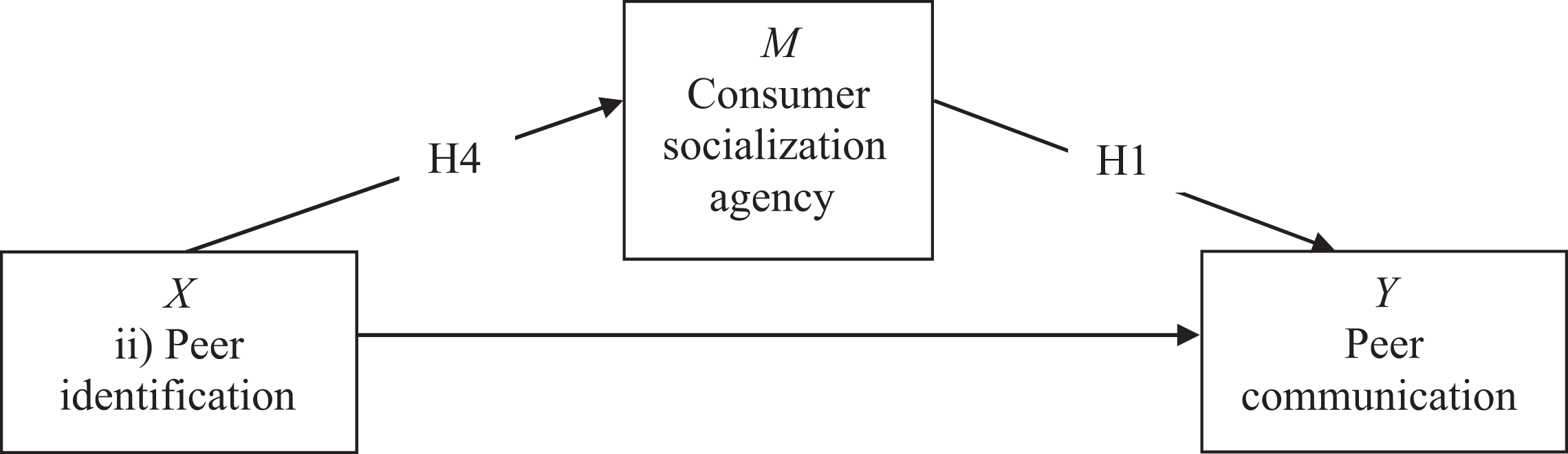
Preacher et al. (2007) model 4 (peer identification mediation model).
Descriptive statistics.
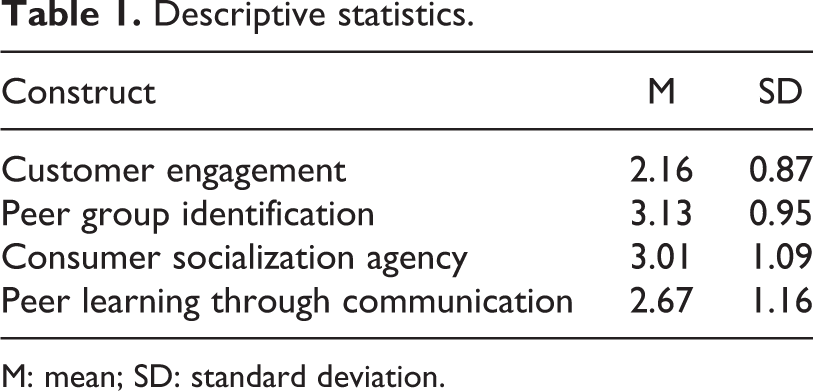
M: mean; SD: standard deviation.
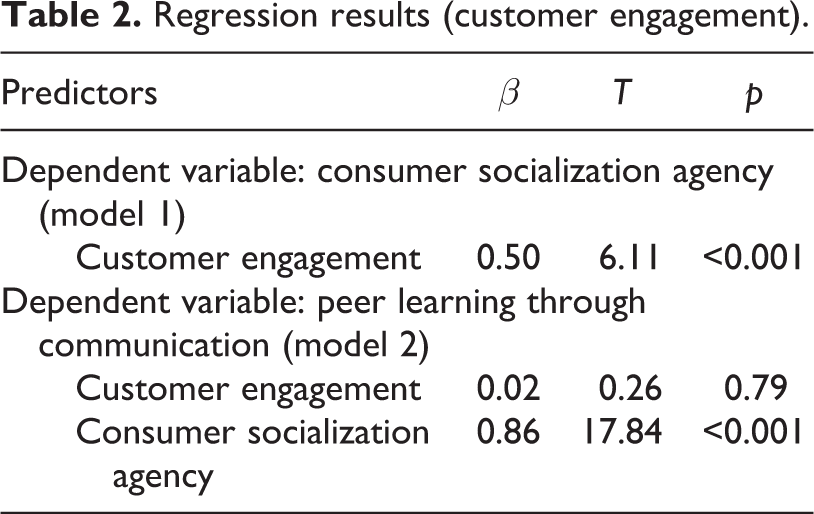
Significant results were demonstrated across all models, with both CE and peer group identification found to be significant predictors of CSA (supporting hypotheses 2 and 4). Results also indicate that CSA is a significant predictor of learning from peers through communication (supporting hypothesis 1). The regression results are presented in Tables 2 and 3. As the 95% bootstrapped confidence interval (CI) for the indirect effect of CE (β = 0.37, 95% CI = 0.28–0.58) and peer group identification (β = 0.46, 95% CI = 0.34–0.58) did not include zero, hypotheses 3 and 5 are supported. In addition, the effect size for the strength of the indirect effect of the independent variables, X, on outcome, Y, through a mediator, M, is large for the (i) CE model (κ 2 = 0.39) and (ii) peer group identification model (κ 2 = 0.41). Overall, Preacher et al.’s (2007) PROCESS mediation analysis procedure provides evidence of the mediating role of CSA between (i) CE and (ii) peer group identification on peer communication.
Regression results (customer engagement).
Regression results (peer group identification).
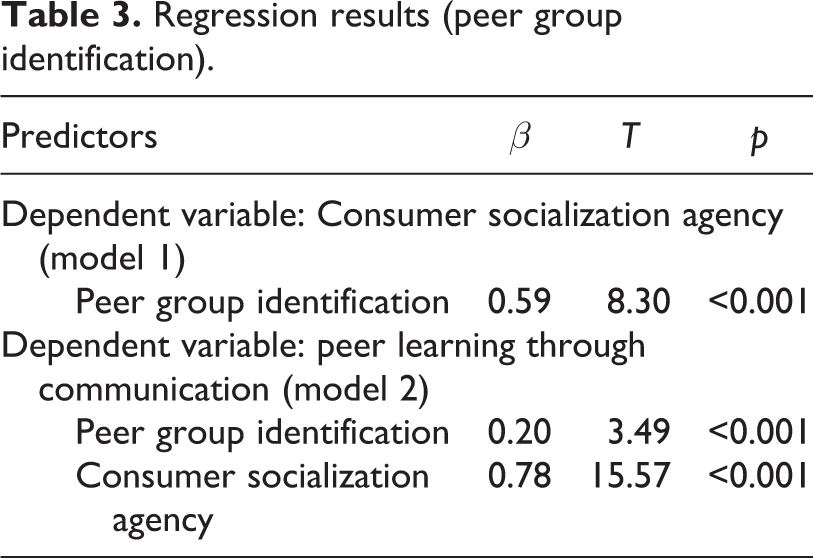
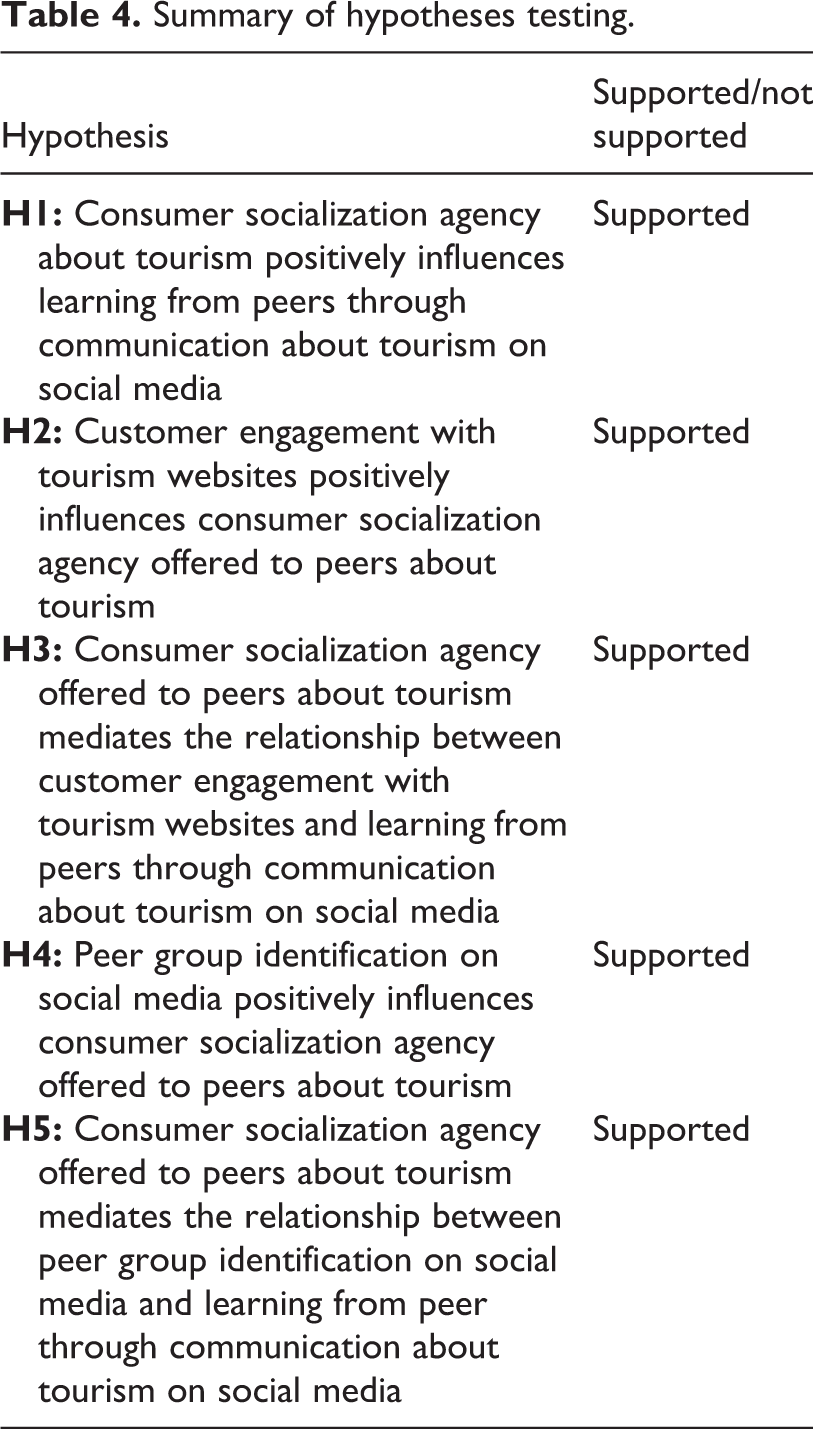
The results indicate that offering CSA about tourism is a function of social attributes and engagement with a tourism site. In other words, a customer’s engagement with the tourism site and their identification with the group on social media influences whether they will act as an agent, offering advice to assist friends in their tourism-related decisions. Identification with peers on social media and engagement with the social media site itself is related to the way consumers influence and educate their friends through consumer socialization. CSA plays an important role in driving learning from peers through communication, which encourages their tourism-related decision-making (see Table 4).
Summary of hypotheses testing.
Discussion and conclusion
We find that CSA about tourism positively influences learning from peers through communication about tourism on social media (hypothesis 1). CSA is the act of influencing others in close relationships about consumption within social contexts (Aleti Watne et al., 2014). Peer communication is fundamental to social media and is important when it occurs around products, services, or brands, where previous research has found a positive relationship with purchase intention (Churchill and Moschis, 1979; Parker et al., 2014; Wang et al., 2012). Our study goes further and illustrates that individuals who are agents of socialization for their friends are more likely to learn from peers through communication on social media.
CSA is a central construct in our study. We find that, in tourism, it is positively influenced by CE (hypothesis 2) and that it mediates the relationship between CE and learning from peers through communication (hypothesis 3). As individuals identify with, enthuse around, give attention to, are absorbed in, and interact with a tourism brand; they are then more likely to socialize with friends and influence them about this brand (Aleti Watne et al., 2014; So et al., 2014). More powerful is that CE cannot lead to learning from peers through communication around the tourism brand, without mediation by CSA. Learning from peers is related to purchase intention (Wang et al., 2012), and thus it is important to understand the antecedents to consumer learning from peers. CE alone is not enough; it requires CSA.
CE has been said to relate to behavioral outcomes such as purchases. As argued by Malthouse et al. (2016), outcomes though engagement is only achieved with active involvement from customers—in their case, the production of user-generated content. Here, we demonstrate that engagement does lead to learning from peers directly. Learning only takes place when consumers offer socialization agency to friends—which also suggests active involvement. Further, CSA has previously been suggested as a reciprocal construct. That is, the role of agent and learner can overlap (Aleti et al., 2015). Here, we confirm that active socialization agents are also willing learners.
Another antecedent to CSA is peer group identification (hypothesis 4). The relationship between peer group identification and learning from peers through communication is also mediated by CSA (hypothesis 5). On social media, individuals identify themselves through membership of groups of like-minded people (Lee et al., 2012). This is the underpinning for all behavior on social media (Carlson et al., 2011; Lee and Conroy, 2005). It follows that peer group identification on social media will positively influence CSA (Wang et al., 2012). Moreover, it is significant that the relationship between peer group identification and learning from peers through communication is not a direct one; it requires CSA. Previous research on CSA has only considered families. Families share relational bounds and, as such, identify with each other. It is clear here that for CSA to occur between non-related consumers via social media, they need to feel a certain level of identification with these groups.
It is also important to mention that CSA in this study relates to transferring skills and knowledge to friends. Friendships are more intimate than peer group connections. As such, it is interesting that consumers who offer CSA to their friends are also more open to learn from peers. This is perhaps a result of increased confidence from the act of offering CSA. Having an impact on friends through the socialization agency offered may empower consumers to listen more closely to what their peers say on social media. New knowledge gained may in turn be used to further CSA offered back to their friends. This points out the importance of stimulate consumer socialization as it is likely to result in continues process of social learning.
Implications
This research contributes to theory by building on the consumer socialization research of Wang et al. (2012), through its application in a tourism context. We also include CE as a key antecedent in the socialization process. So et al. (2014) developed a CE measure specific to the tourism context, which we have demonstrated to be fundamental in consumer socialization about tourism. Finally, our model was centered on the CSA construct developed by Aleti Watne et al. (2014). The agent perceives learners to willingly change their behavior as a result of CSA. Socialization agency is the key term in our study, where CSA is the act of actively influencing friends. This extends Aleti Watne et al.’s (2014) focus on CSA in a family setting.
For tourism managers, the implications are clear. It must be an aim that consumers learn from one another through communicating on social media. The whole premise of social media, such as TripAdvisor and Airbnb, is that consumer ratings and reviews help other consumers to learn about the products, services, and brands on offer that lead to purchase decisions. Achieving such peer learning requires tourism managers to understand the consumer socialization process on social media. To facilitate CSA, where consumers actively socialize with their friends around tourism decisions, sites such as Booking.com and Expedia must provide a platform for CE and peer group identification if they want consumers to learn from their sites. Learning may not be a necessity for all tourism cites, but consumers do spend more time on sites in which they are more engaged.
Engagement is through identification, enthusiasm, attention, absorption, and interaction. As one example, tourism sites need to offer dynamic content that is personalized to the individual consumer based on their past behavior. This is possible without requiring log-in through a content management system. They may also provide educational content around traveling, such as guides, updates, and content generated from other travelers. Peer group identification may be achieved by letting consumers read ratings and reviews from, and even join groups with like-minded or similarly profiled consumers. TripAdvisor already does something along these lines, allowing consumers to read reviews from “young couples,” “families,” or “singles.” In contrast, Booking.com tries to segment and group users based on their behavior on the website.
There are several avenues for future research to build on this study’s contribution to the use of social media in tourism. First, research could investigate the influence of socialization on these tourism sites on purchase intention. Second, control variables such as brand awareness, attitude, or experience may be useful additions to the socialization model. Third, we suggest that self-disclosure theory may be an appropriate parallel theoretical underpinning, where issues around trust and privacy drive consumers’ decisions around online behavior. Fourth, research that investigates the organizational perspective on the socialization process on social media is required to provide a holistic understanding of the role of social media in tourism. Finally, this study applied contemporary tourism and marketing constructs to a social media tourism site context. The findings are specific to and not generalizable beyond this context. Future research could test the model in other related contexts such as online retail, social product review sites, online brand communities, or social media restaurant sites.
Footnotes
Declaration of conflicting interests
The author(s) declared no potential conflicts of interest with respect to the research, authorship, and/or publication of this article.
Funding
The author(s) disclosed receipt of the following financial support for the research, authorship, and/or publication of this article: This research was funded by BHP Billiton Distinguished Research Award.