







Abstract
In advertising, sex has been ascribed a major role, but mostly in a one-dimensional, uniform, and ageist manner framing sexuality as the privilege of younger people. This has traditionally strengthened stereotyping discourses of older adults as ‘asexual’. However, in recent years, counter narratives emphasizing sex as an integral part of active, healthy, and successful aging have gained momentum. Using the promotional video ‘Do it Forever’ as a relevant case, this article analyzes representations of older adults’ sexualities in vacation marketing and points to how advertising is not ‘innocent’, but discursively positions older adults’ sexualities within an antiaging culture which positions older adults as ‘sexy olders’ in sharp opposition to the discourse of ‘asexsual old age’, potentially leaving older adults with little room to construct (a)sexual identities in-between the two strong and oppositional discourses.
Introduction
Although a bit of a cliché, we all know the phrase ‘sex sells’ and the use of sex in advertising goes back a long time—at least to 1871, when Pearl Tobacco featured a naked women on the cover of cigarette packages. Sex is also used in vacation marketing and the Danish travel agency Spies has launched three videos—‘Do it for Denmark’, ‘Do it for mum’, and ‘Do it forever’—that present sex as an important part of holidays, hereby linking Spies and Spies’ holidays products directly, and very explicitly, with sex. The first two videos promote Spies’ brand by pointing to declining birth rates as a problem and suggest that taking a holiday will make people have sex and hence ‘make babies’, herewith discursively linking sex and holidays to reproduction. The third video also links holidays with sex, but does so by emphasizing older adults’ sexualities, hereby breaking away from the master narrative of the first two videos that target younger adults and relate sex to reproduction. The opening phrase in the third video (available at https://www.youtube.com/watch?v=ZHNBVzYk5gA) is: ‘Is sex the key to eternal life?’ and it markets Spies’ sand, sea, and sun destinations to the so-called ‘silver segment’, urging this segment to go on holiday to have sex in order to boost the immune system, strengthen the heart, generally increase health, and extend life expectancy. The video further argues that sex is critical to active, positive, and healthy aging—or perhaps even the key to eternal life.
With the ‘Do it Forever’ video, Spies makes the advertising industry’s ‘portrayals of the new anti-ageist, positive senior as an independent, healthy, sexy, flexi-retired “citizen”’ (Katz and Marshall, 2003: 5) part of the discursive representations of older adults in vacation marketing. To address age directly and portray older adults’ sexualities are relatively new phenomena within advertising and marketing, as ‘until recently, advertisers have often sought to avoid addressing age’ (Gram and Smed, 2011: 2). By focusing on older adults’ sexualities, the ‘Do it forever’ video introduces a new format for vacation marketing by combining two contemporary, but in vacation marketing hitherto largely detached, themes; that is, the increased interest in the ‘silver segment’ spurred by the emergence of the ‘aging society’ and the use of sex as a promotional tool.
This article presents a case study that, as all single case studies, emphasizes the study of the particular as it uses the Spies video as a critical case to analyze the relations between vacation marketing and more general discourses on aging and older adults’ sexuality. The single case study presented is ‘essentially merely a means of describing the relationships that exist in a particular situation’ (Galliers, 1992: 154); in our case the relationships between representations of older adults and their sexualities in the particular context of one promotional video. The case is not chosen because it is exemplary or representative for vacation marketing, but because it is an atypical and anomalous case due to its combination of representations of vacations, older adults, and sexuality. Furthermore, the article does not attempt to evaluate or assess whether the video is a ‘success’ or whether its representation of older adults and aging sexualities are ‘fair’. Instead, the aim of this article is to analyze the relations between vacation marketing and more general discourses on aging and sexuality. In doing so, we accentuate that vacation marketing is not an innocent endeavor, but actively contributes to the wider web of meanings that dominant discourses and societies at large are made of and made sense of.
Literature review
Although the Spies video is an atypical piece of vacation marketing as it portrays and casts older adults in certain sexual roles, Spies is not the first vacation marketer to take an interest in older adults. Since the late 1980s, both tourism researchers and practitioners have become increasingly interested in senior travelers. This growing interest is a result of a series of trends pointing to the senior market becoming an increasingly profitable segment. Such trends include, among others, increased life spans; baby boomers becoming ‘the old generation’ (Jang and Wu, 2006); older adults having more leisure time and increased time flexibility after retirement (Jang and Wu, 2006); having higher disposable incomes (Jang and Wu, 2006; Romsa and Blenman, 1989); being more experienced travelers; being more likely to travel ‘off season’ (Nikitina and Vorontsova, 2015); improved physical health of older adults; traveling being seen as an integral part of life, or even a human right, more than a luxury; perceptions of what it means to be ‘old’ changing; and social norms of active aging and healthy aging becoming increasingly popular in Western societies.
Taking the above trends into account, what it means to be an older adult tourist or senior traveler in 2018 may fundamentally differ from what it meant to be so in 2008, 1998, or 1988. Discussing this issue, Nikitina and Vorontsova (2015: 847) conclude that ‘in today’s society, there is a tendency for older people generally to not correspond to the prevailing image of the elderly’. In the same vein, Alén et al. (2016) argue that older adults today differ from earlier generations in terms of lifestyles and attitudes, hereby questioning the contemporary relevance of findings such as Romsa and Blenman’s (1989) suggestion that ‘the elderly’ tend to seek less stressful modes of transportation and vacation habitats. Nevertheless, public discourses as well as academic literature on senior tourists oftentimes use stereotypes to discursively position these seniors in certain ways and there is a tendency to treat all older, typically 60+ to 65+, tourists as if it makes sense to address them as one segment. Although Alén et al. (2016: 303) acknowledge that tourism actors have difficulties understanding older tourists because their ‘behavior is different from that of older people in the past’, along with many other researchers (e.g. Baltes and Mayer, 1999; Horneman et al., 2002; Jang and Wu, 2006; Nikitina and Vorontsova, 2015; Patterson, 2006; You and O’Leary, 1999; Zimmer et al., 1995) they aim to identity the main characteristics of the senior tourists and travelers. Although we use the generalizing notion ‘older adults’ in this article, we only do so in relation to how they are portrayed in a specific piece of vacation marketing as we do not wish to join the chorus that reduces this large group of people to a homogenous segment.
The ‘Do it Forever’ video not only portrays and directly targets senior travelers, but does so by discursively presenting and constructing senior travelers and their sexualities. Obviously, many different theoretical perspectives could be used to analyze this video but in this article, we emphasize representations of older adults as tourists as well as representations of sexuality anchored in the two dominant discourses of older adults’ sexualities. Furthermore, as the ‘Do it Forever’ video is deeply anchored in a heterosexual scripting of sexuality, the article only covers sexualities framed within the context of heteronormative, nuclear relationships and does not address the vast amount of literature that deals with, for example, older adults’ homosexualities or single older adults’ sexualities. Moreover, a deliberate choice was made to analyze the video from a sexual perspective, excluding analysis from a feminist perspective or based on a sexist angle. There is no doubt that an analysis digging deeper into sexism in the form of presentations of potentially male-chauvinist or degrading behavior based on traditional stereotypes of gender roles could have been interesting, but this perspective is not pursued as the purpose of the article is to analyze the relations between vacation marketing and more general discourses on aging and sexuality, not to analyze the occurrences of sexism or to make a contribution to gender studies at large.
Although aging is an inevitable part of life, ‘old age’ is socially constructed, and consequently a contestable and negotiable concept that is informed by public and media-induced discourses, including those introduced by vacation marketing. Katz and Marshall (2003: 3) opine that positive ideals of aging emphasizing independence, well-being, and mobility are currently replacing negative stereotypes of decline and dependency; making them conclude that these changes intertwine with ‘market and lifestyle industries’’ creation of ‘an idealized culture of “ageless” consumers and active populations’. Drawing in, exploring and contesting these ideals of aging, the theoretical building blocks upon which our analysis is based not only include studies of senior travelers but also more general studies on aging and older adults’ sexualities. Therefore, the first part of this section reviews some of the most influential studies of senior travelers. Thereafter, we review central studies of older adults, aging, and sexuality and dig into the two dominant discourses of aging sexualities: that is, aging naturally leads to sexual decline versus sex being an integral part of active aging—or even feeding into the myth of non-aging.
The silver traveler
During the last couple of decades, quite a number of studies on ‘silver travelers’ have been published (e.g. Alén et al., 2016; Baltes and Mayer, 1999; Fleischer and Pizam, 2002; Gram and Smed, 2011; Horneman et al., 2002; Jang and Wu, 2006; Nikitina and Vorontsova, 2015; Patterson, 2006; Romsa and Blenman, 1989; Schröder and Widmann, 2007; Shoemaker, 1989; Wu, 2003; You and O’Leary, 1999; Zimmer et al., 1995). However, most of these, predominantly quantitative, studies investigate all senior travelers as if they constitute a homogenous segment. For example, ages 65 and older are oftentimes referred to as ‘the third age’ (Nikitina and Vorontsova, 2015) and Romsa and Blenman (1989) write about the elderly German tourists and point to them as ‘this segment of the population’. As another example, Nikitina and Vorontsova’s (2015) survey of 65+ Russian tourists suggests that even though the majority of these tourists want to live active lives, they also enact a series of barriers to traveling including transportation difficulties (40%), believing that travel has an age limit (60%) and health issues (20%). Based on an extensive literature review, Alén et al. (2016) conclude that the majority of studies on senior traveling focus on motivations and behaviors. Other studies focus on perceived barriers to traveling (Zimmer et al., 1995) and a number of quantitative studies statistically investigate the relationships between (1) senior travelers’ age, marital status, health, income, educational level, work situation, and state of health and (2) decision/tendency/intention to travel while other studies investigate push and pull factors as well as characteristics of seniors’ trips (see Alén et al., 2016 for a full review).
Hamilton and Hamaguchi (2015: 706) remind us that ‘age is more complex than a simple biological category’ and therefore, researchers should not focus on chronological age, but focus on ‘the life experiences that give age meaning’ (Eckert, 1997: 167). Morgan et al., (2015: 1) show how social tourism presents older adults not only with anxious anticipation but also with ‘occasions for escape, respite, companionship, and reminiscence and for renegotiation of self-identity following spousal bereavement’. This exemplifies how it is not chronological age, but the experience of spousal bereavement that informs the wants, worries, and inclusion in/exclusion from tourism of older adults. As modern chronological and generational boundaries are becoming blurred and indeterminate (Katz and Marshall, 2003) and as people often feel younger or older than their chronological age (Boden and Bielby, 1986), it is difficult to define the ‘cut-off age’ for the elderly market (Gunter, 1998; Lazer, 1986), but many studies use ages 55 to 65 as the cutoff as this is the age where people ‘start to become old’ (Alén et al., 2016; Patterson, 2006). Katz and Marshall (2003: 6) argue that many different industries target the ‘growing and so-called “ageless” senior markets (usually pegged at 55+)’. Defining older tourists is further complicated by the marketing literature’s referral to the senior market as ‘the new aging’, presenting ‘the post-human body and its life in postmodern life in time-fuzzy, demographic profiles’ (Katz and Marshall, 2003: 8). This establishes linkages between consumerism, successful aging and physical health and older consumers being targeted not on the basis of their actual age, but their experienced/perceived age (which is usually younger; Flanagan, 1994). As a consequence, age is not only a matter of biological or chronological age but also a matter of functional health and social age (Counts and Counts, 1985). Regardless of the definitions of older adults in terms of age, to explicitly target this ‘segment’, addressing aging directly and portraying older adults in marketing is a newer phenomenon, as ‘until recently, advertisers have often sought to avoid addressing age, emphasizing the importance of appealing to the “cognitive” (psychological) rather than the “chronological” (biological) age’ (Gram and Smed, 2011: 2). Furthermore, around 20 years ago, media researchers pointed to older adults becoming more visible in media presentations, albeit such visibility was with a focus on ‘the youthful and well-kept look’ (Carrigan and Szmigin, 2000). This may relate to the issue that targeting senior tourists may be especially challenging as ‘consumers of older ages do not like to be told about their age’ (Nikitina and Vorontsova, 2015: 848).
Instead of defining senior tourists by means of age, it might make more sense to look at relevant cohorts, such as when Alén et al. (2016) argue that the baby boom generation at present are aged 55+ and share a wider experience with tourism than the generations before them. In the same vein, Jang and Wu (2006: 306) argue that ‘the most rapid growth in the senior population will start after 2010, when the large post World War II baby boomers begin to reach age 65’. Several studies (e.g. Fleischer and Pizam, 2002; Horneman et al., 2002) point to both rest/relaxation and physical exercise/fitness being important travel motivations for senior travelers, and Horneman et al. (2002) conclude that senior travelers’ motivations shift toward more active pursuits with a strong focus on health and fitness. In the same vein, based on qualitative interviews with 63 Danish and German senior travelers, Gram and Smed (2011) suggest that many study participants ‘stressed that they were actually more active now when on holiday than they used to be’ (p. 4) and that they instead of having to satisfy their children’s needs or ‘laying on the beach for hours they want to walk, ride bikes and go sightseeing’ (p. 6.). On the other hand, Romsa and Blenman (1989: 180) opined that ‘the more delicate physical conditions of the elderly would set constraints with regard to the choice of holiday destinations’, making older adults more likely to choose domestic holidays and destinations. These considerations made Romsa and Blenman (1989: 181) conclude that ‘taking a vacation as a leisure or recreational experience declines with age’.
Whereas the older studies referred to above paint a picture of senior travelers as becoming less active with age, newer studies point to them becoming more active with age. However, Hamilton and Hamaguchi (2015: 707) point to the ‘extreme heterogeneity of the older segments of the population’, which leads them to conclude that ‘elderly people can be expected […] to differ greatly from each other in terms of physical health, attitudes toward self and others, communicative needs, memory, judgment, and reasoning’. In order to address these heterogeneities, it may make sense to distinguish between, for example, the ‘younger elderly’ (aged 60 to 70) and the ‘old elderly’ (aged 75 onward) or young-old, old-old, and oldest-old (Hamilton and Hamaguchi, 2015). But regardless of exactly how the so-called senior segment is divided into different groups, it does seem problematic to define people aged 65, 85, and 100, respectively, as if they are part of one overall segment (Baltes and Mayer, 1999), while we would hesitate to define people aged, for example, 15, 35, and 50 as a meaningful segment.
Overall, most research on senior travelers do not do much to advance understandings of these people beyond statistical generalizations and rather shallow descriptions. There are some exceptions, though, that try to advance understandings of senior travelers beyond seeing them as a segment. For example, You and O’Leary (1999) divided older UK travelers into ‘passive visitors’, the ‘enthusiastic go-getters’, and the ‘culture hounds’ and Shoemaker (1989) divided senior travelers into ‘family travelers’, ‘active resters’, and the ‘older set’ and concluded that the senior market is not one homogeneous group but comprised many submarkets. In the same vein, although insisting on treating the senior market as one market, Jang and Wu (2006) conclude that healthy seniors are more likely to be motivated by push factors than less healthy seniors. Furthermore, Nikitina and Vorontsova’s (2015) survey of Russians aged 65 and older points to the heterogeneity of senior travelers through the identification of respondents’ varied hobbies, including more active hobbies such as physical education and sports (14%), excursions (12%), hiking (31%), gardening (37%), and socializing with friends (46%). Finally, Wu’s (2003) and Schröder and Widmann’s (2007) studies show that older tourists have very heterogeneous preferences, travel patterns, and purchasing behavior. Therefore, it seems that research that goes beyond the discursive positions of older travelers as either people with delicate mental and physical conditions that exclude them from engaging in tourism or as healthy, active, and ‘ageless’ tourists is needed if we wish to better understand what it means to be an older tourist in 2018. Although this article does not provide any answers to this grand question, by analyzing the ‘Do it Forever’ video, it does, in its humble way, contribute to the largely unknown territories of vacation marketing as discursive representations that do their part to define and construct what it means to be an older tourist.
Sexuality of older adults
Eckert (1984: 229) urges researchers to be aware of the difficulties of doing intergenerational research as ‘the elderly, being the farthest from the experience of the young and middle-aged researchers comprise the age group that is most subject to stereotyping’. The extent of such stereotyping made Trethewey (2001) point to aging as decline as the dominant master narrative of aging and she further points to ageism as an issue as concerning as sexism and racism. One of the aspects of life in regard to which discursive stereotyping of older adults is most evident is the topic of sexuality. When it comes to discourses on aging and sexuality, two very strong discourses exist, constructing two oppositional master narratives of older adults’ sexualities. Such strong master narratives and dominant discourses may have implications for the creation and reproduction of inequalities and representations of older adults and their sexualities as they ‘play a critical role in shaping the sexual lives of older adults’ (Scherrer, 2009: 5). The strength of the two oppositional discourses made Hinchliff and Gott (2008: 79) conclude that ‘discourses of aging circulating in western societies construct sexual activity to people at midlife and beyond as unimportant or very important, there is no in-between’.
The first discourse is that of asexual old age, that inscribes itself in the general discourse of aging as decline and as a process of desexualization, defining sex as becoming increasingly irrelevant for people as they grow older. Moreover, it is based on strong ties between sexuality and reproduction, consequently casting those ‘too old’ to engage in sex for reproductive reasons as asexual (Hinchliff and Gott, 2008). Katz and Marshall (2003: 4) describe this discourse as assuming that sexual decline is ‘an inevitable and universal consequence of growing older, thus, ageing individuals were expected to adjust to it gracefully and to appreciate the special moral benefits of postsexual maturity’. In the same vein, Hinchliff and Gott (2008: 66) point to ‘the asexual old age, borne out of the notion that sexual activity is the province of the young’. There are some notable gender differences with regard to the ‘asexual old age’ discourse. For aging men, the asexual discourse can be traced back to 1901, when Stall pointed to the virtues and benefits of post-reproductive, post-sexual life for men. Stall’s idea of ‘graceful’ decline made Katz and Marshall (2003) point to sexual decline as being historically associated with impotence, and Marshall (2006) reminds us that historically, expert discourses defined declining virility as a natural consequence of aging. With regard to women and the discourse of asexual old age, Trethewey’s (2001) study of midlife professional women led her to conclude that the master narrative of aging is decline and Dinnerstein and Weitz (1994: 19) concluded that: ‘While on men, grey hair, wrinkles, and even a widening waist signify experience, wisdom, maturity, and sometimes sexiness…on women they denote decline and asexuality’. Trethewey (2001: 198) argues that, for women, aging means ‘losing their familiar and youthful faces and bodies and their sexuality’, ‘losing the burdensome, sexual harassment, sexual objectification, and sexual tension’, and ‘“erasure” and pathologizing of their sexuality’ (p. 200). Hunter and O’Dea (1997: 214) conclude that the combined discourses of gender and aging ‘devalue older women’ and Hinchliff and Gott (2008: 68) follow up on this conclusion by arguing that around menopause, women are seen to ‘lose their sexual desire and cease to view sexual activity as important’.
The second discourse is that of the sexy older, which is deeply anchored in the discourses of healthy, active, and positive aging. Furthermore, rather ironically, in ‘challenging the stereotype of the asexual age a new one has been created: that one must be sexually active in order to remain healthy in the context of advancing age’, consequently developing what Gott (2005: 27) coined ‘the myth of the sexy oldie’. The discourse of the sexy older hereby qualifies as a counter-position that is reinforced particularly by arguments about sex—according to Katz and Marshall (2003: 4) ‘narrowly defined in terms of heterosexual intercourse’—leading to healthier and longer living as well as positive and successful aging. This discourse is deeply grounded in dominant ideologies that ‘teach us to dread aging’ (Trethewey, 2001: 192) as well as in ideas about ‘the entrepreneurial self’ and the responsibility to assemble a successful lifestyle, including successful aging (Miller and Rose, 1990). Rose (2001) points to demands for individuals to ‘improve themselves’ and to enact health as an obligation to optimize one’s corporeality. Furthermore, Katz and Marshall (2003: 4) argue that health promotion and marketing discourses urge ‘individuals to take responsibility for their sexual well-being as part of their commitment to the collective health of the aging population’. This position is anchored in what Katz and Marshall (2003: 12) denote as the existence of ‘a recent cultural-scientific conviction that lifelong sexual function is a primary component of achieving successful aging in general’. Furthermore, Scherrer’s (2009) analysis of discursive portrayals of aging and sexuality in gerontological literature pointed to extensive assertion of sexualities of older adults, indicating that sexuality is important and relevant to the lives of older adults. Such assertion is cast in stark contrast to the stereotype about asexuality in older adults, making Katz and Marshall (2003: 7) conclude that ‘asserting one’s sexuality is a natural, necessary component for healthy aging’. Such assertions are further supported by therapeutic research suggesting that to cease having sex would ‘hasten aging in itself’.
There are some noteworthy gender differences within the sexy older discourse. Although few researchers have explored this discourse from a female perspective, Clarke (2006: 139) addresses this issue and concludes that changes in the construction of older women’s sexuality have made it ‘socially acceptable for women to be more open with their partners about their own sexual needs and desires’. More researchers have studied this discourse from a male perspective, probably due to the advancements in urological research and how this changed impotence from an inevitable consequence of aging to a sexual dysfunction and thus a treatable, physiological problem (Katz and Marshall, 2003). Urological research hereby contests the idea that sexual decline is a mark of normal aging that naturally follows in tandem with growing older (Haber, 1983). Marshall (2006: 345) concludes that ‘while it was once assumed that sexual function and virility declined with age, the sexual capacities of the ageing body have more recently been aligned to new performative standards, particularly for men’. This ‘new culture of virility’ fundamentally changes both scientific and cultural narratives of older men’s sexualities to narratives of masculinity and potency. Continued sexual functionality is hereby seen as a ‘marker of successful aging’ inscribed in ‘the contemporary bodily configuration, still in the making, of the virile, sexually-fit aging male’ (Marshall, 2006: 346). Furthermore, Calasanti and King (2005) argue that, in today’s society, sexual functioning is used to reconstruct manhood as ‘ageless’ and Marshall (2006: 355) points to health promotion discourses ‘equating the loss of erectile power with the end of life itself’, hereby propagating the message ‘to the extent men can demonstrate their virility, they can still be men’ (Calasanti and King, 2005: 16).
To conclude this introduction to discursive representations of older adults’ sexualities, Table 1 summarizes the key issues that characterize these discourses.
Dominant discourses of older adults’ sexuality.
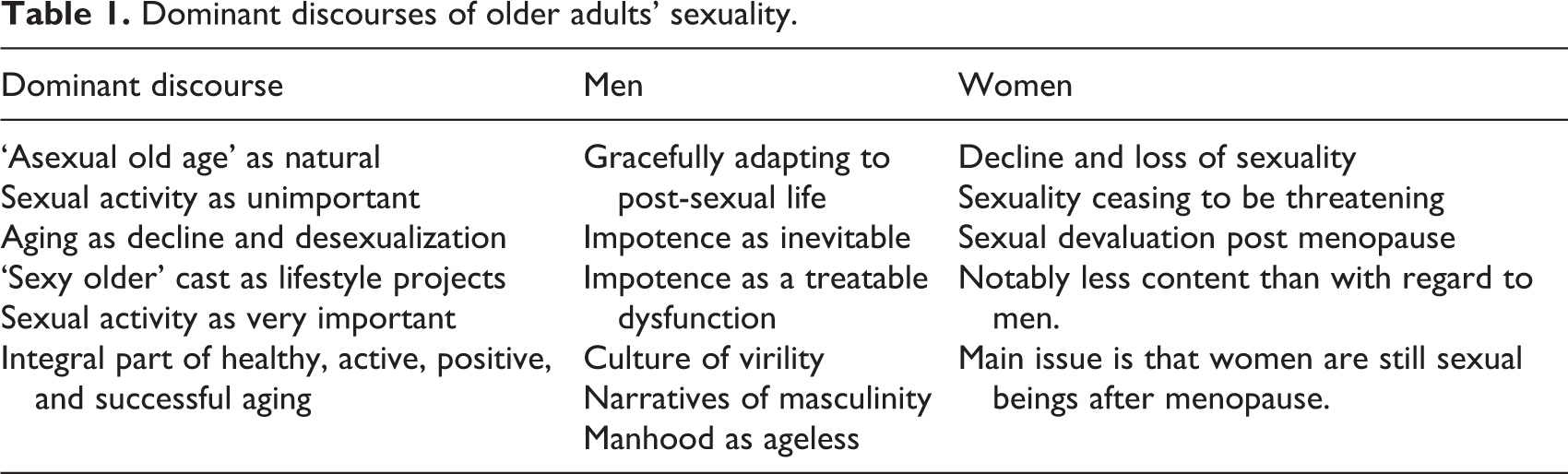
The dominant discourses of older adults’ sexualities presented above are characterized by oppositional properties and Hinchliff and Gott (2008: 67) opine that ‘the discourses associated with both the asexual old age and the “sexy oldie” stereotypes thus serve to disempower older people by constructing sex in a strict oppositional way which limits alternative choices’. The two discourses are characterized not only by polarity, but by being so oppositional that there are no competing discourses or counter narratives to be found in-between these two extreme positions. As older adults have to construct and negotiate sexual identities within the scope of the contrasting discourses that cast them as either ‘asexual’ or ‘very sexual’, the analysis of the ‘Do it Forever’ video investigates whether this piece of vacation marketing reproduces oppositional discourses that delimit older adults from framing their sexualities in alternative ways.
Hamilton and Hamaguchi (2015: 719) remind us that ‘we need to take care not to lose sight of the human beings who are at the center of our research’. This entails that it is highly problematic to reduce a large (and growing) part of the population to general positions, such as the ones deeply anchored in the two oppositional discourses on aging sexualities. Dominant discourses, whether introduced by a promotional video or by researchers, are not innocent, but construct and define what it means to age, and which ideals of aging sexualities older adults have to juggle or even struggle with. Therefore, our analysis digs into representations of older adults and their sexualities in the Spies video—a piece of vacation marketing that, stereotypical or not, nevertheless constructs discursive representations of older tourists as sexual or asexual beings (or somewhere in-between).
Spies’ ‘Do it Forever’ campaign is a funny and rather ‘catchy’ tourism ad that builds its story line around older adults’ vacations as well as their sexualities, and therefore, this case is particularly interesting in order to investigate how the combined issue of aging and sexuality is presented within vacation marketing. With the video, Spies joins the chorus of marketing material that portrays and constructs older adults’ sexualities as well as acceptable roles for them as tourists. With regard to acceptable touristic roles, the video taps into discursive positions of senior tourists as people with delicate mental and physical conditions that exclude them from engaging in tourism and/or as healthy, active, and ageless people, who actively engage in tourism. In the same vein, our literature review identified two strong and oppositional discursive representations of older adults’ sexualities that shape two oppositional master narratives of aging sexualities: The portrayals of (1) ‘asexual old age’ imbued with notions of aging as decline and processes of desexualization and (2) the ‘sexy older adult’ deeply anchored in discourses of healthy, active, and positive aging. In the ‘Findings’ section, we analyze how the video is positioned with regard to these two sets of oppositional discourses. By doing so, the article attempts to answer the following questions: Does the video present older adults as passive or active tourists and which narratives of tourism and traveling does the video induce? Does the video present older adults as ‘asexual’ or ‘sexual’ beings? Does it do so in a predominantly stereotypical manner? Does the video reinforce the polarity of dominant discourses on senior travelers and aging sexualities? Or does the video explore positions in-between such discursive polarities? And finally, depending on the answering of these questions, what impacts may the video have in terms of empowering or depowering aging adults?
Methodology
The analysis of the Spies video presented in this article contains both a first-order analysis (which is available as Online Supplementary Material) and a second-order analysis inspired by semiotics, rhetorics, and discourse analysis. Inspired by Kvale (1997), the second-order analysis focuses on ad hoc meaning condensation and condensate meanings by investigating verbal and nonverbal signs as well as other tools used to underline and reinforce positional strategies. Based on Peirce’s (1934) recommendations, the analysis covers both verbal/textual and nonverbal/non-textual systems of signification. Furthermore, the works of Barthes (1977, 1993) are applied to cover different orders of signification in the form of first-order significations (denotations in the form of definitional, obvious, or commonsense meanings of signs) and higher order significations (connotations referring to sociocultural and personal associations to signs). Barthes (1977: 45) labels second-order significations ‘myths’, which are ‘the dominant ideologies of our time and serve the ideological function of naturalization’ that make dominant cultural values, attitudes, and beliefs seem natural, self-evident, and obvious reflections of the way things ‘are’. We use Barthes’ work in the same way as Uzzell (1984: 87), emphasizing the myths the video enables by focusing not only on the tangible qualities presented in the video but also how these qualities contribute to potential identities by focusing the higher order analysis on the two sets of oppositional discourses that were presented in the ‘Literature review’ section, emphasizing how the video enables, or hinders, older adults’ opportunities to ‘create a bricolage of his own fantasies and meanings, and by doing so, to create him/herself’. As signs are ‘always polysemic, that is, there are always several equally valid ways of interpreting any sign’ (Gottdiener, 2001: 10), signs are ‘read’ and ‘their meaning interpreted in terms of cultural codes which we have to learn in order to make sense of the signs around us’ (Hackley, 2003: 166). Cultural codes make signs polysemic and therefore, the researcher doing semiotic analysis has to be extremely careful not to take his/her own cultural codes and translations for granted, but always must scrutinize which cultural codes (s)he draws into the analysis when trying to derive meaning from relationships between objects, signs, and interpretants. In order to prevent the female, Western authors’ cultural codes and interpretants to overshadow the analysis of the video, the authors first analyzed the video individually, then compared their findings, and finally discussed their interpretations with other researchers. Furthermore, the choice to let the higher order analysis be structured by searches for representations of the two sets of oppositional discourses on senior travelers and aging adults’ sexualities is informed by the wish to reduce the reliance on the authors’ own interpretants. In practice, this means that the analysis is a process of condensation that, during the first-order analysis, draws heavily on immediate signs and interpretations of signs in the video material, while the higher order analysis structures orders of signification by means of the dominant discourses introduced as the theoretical building blocks. However, as this method of analysis takes cues from semiotics, the analysis is informed by interpretive methodologies relying on subjective measures in order to extract significance and meaningfulness.
Findings
The Online Supplementary Material available for this article contains a simplified version of the first-order/descriptive analysis of the ‘Do it Forever’ video. The video first introduces the problem of older adults having too little sex and argues that this negatively influences health in various ways. The video hereafter presents the solution in the form of a holiday, as people have more sex when on holiday. The video ends with the messages ‘You don’t stop having sex because you get old, you get old because you stop having sex’ and ‘Do it for Denmark, do it Forever’. Throughout the video, the audience follows the main characters Karen and Jørgen. Karen and Jørgen are a grey-haired, tanned, and, for their age (around 60), very fit Caucasian/Europoid couple with some, but not many, wrinkles—characters aligning with what Katz and Marshall (2003) called portrayals of seniors as independent, healthy, sexy, and generally active. Below we present the key results of the higher order analysis in terms of discursive positioning of senior travelers and their sexualities, emphasizing the parts of the video, in which Karen and Jørgen are the main characters—hence excluding parts of the ending of the video and ‘flashback’ scenes focusing on younger versions of the couple.
In terms of Romsa and Blenman’s (1989) portrayals of older travelers as either people with delicate mental and physical conditions or healthy, active, and ageless, the main characters are predominantly cast as able-bodied and active travelers visiting not a crowded all-inclusive resort, but an exotic, luxurious, and isolated island resort, where Karen and Jørgen are the only tourists to be seen. Throughout the video there are only two situations, in which the couple is presented as inactive and/or having delicate physical conditions: First, in the introductory scene where they are laying in a very tidy bed in their bedroom back home, wearing nightwear and watching something on their respective iPads and second, a scene where they are running at the beach, but he comes to a short halt because of his aching back. In contrast, there are many scenes and situations in which the couple is portrayed as active and healthy. Furthermore, some of these scenes cast the couple as what Shoemaker (1989) labels active resters and You and O’Leary (1999) referred to as enthusiastic go-getters—such as when they arrive at the island resort by water plane, swim in the ocean, and ride water boards, as well as when Jørgen succeeds in spearfishing. In other scenes, the couple is portrayed as engaging in various traditional tourist activities; that is, the two of them sitting under a palm tree; walking, running, and flirting on the beach; speedily returning to their cabin hand in hand; Karen lying at the beach reading a book or asleep in a hammock; and a waiter bringing a drink. But regardless of whether the couple is being portrayed as engaging in rest/relaxation or physical exercise/activity (Horneman et al., 2002), common denominators across these scenes are that the couple, in sharp contrast to the opening scene, in their bed at home, is portrayed as well-kept and youthful (Carrigan and Szmigin, 2000), fully immersed in the roles as tourists and as a couple—often touching each other, occasionally in rather suggestive ways. Furthermore, the couple corresponds with the time-fuzzy, demographic profiles, which Katz and Marshall (2003) label marketing’s ‘new ageing’, being generally functional and healthy—apart from Jørgen’s slight back pain. The couple also reinforces Counts and Counts’ (1985) take on social age as the couple acts as ‘any’ heterosexual and monogamous couple would on a romantic holiday. The casting of the couple furthermore resembles stereotypic presentations of the ‘young-old’ (Hamilton and Hamaguchi, 2015) and reinforces narratives of romantic holidays giving age meaning for older adults (Eckert, 1997). Finally, the couple is discursively positioned as actively and bodily engaging not only with each other but also with the destination setting, hereby very actively and corporeally participating in tourism (Obrador-Pons, 2003).
With regard to portrayals of older adults’ sexualities, the video contains far more examples of the ‘sexy older’ discourse than the ‘asexual old age’ discourse. The most prominent portrayal of asexual old age is the aforementioned opening scene where the couple lies in their bed at home. This is accompanied by logos- and ethos-oriented voice-overs in the form of ‘people have far less sex after they have children’; ‘reduced sex continues throughout life and this affects health and life expectancy negatively’; and ‘once they couldn’t keep their hands off each other, but then something happened’. Apart from the opening scene and accompanying voice-overs, pointers to the ‘asexual’ discourse are few and rather subtle. One example is when Jørgen ‘claps Karen’s bottom’ and she is first surprised, then smiles happily, indicating that she had not anticipated this kind of sexual attention, but nevertheless appreciates it. The second pointer is a scene where the couple is in the pool and Jørgen moves close up to Karen from behind; as their bodies touch each other, she is again happily surprised, indicative of him having, and her feeling, an erection. Both of these scenes point to male-initiated, sexual-laden physical contact as unexpected but appreciated, hereby pointing to Karen expecting Jørgen to be asexual in his physical intimacy with her and consequently indicating an everyday life characterized by him not being ‘potent’ or initiating sexual contact, and her not expecting to be the subject of sexual initiatives. However, pointers to the asexual discourse are few and the video portrays the couple as anything but characterized by ‘post-sexual maturity’ (Katz and Marshall, 2003), in the scenes emphasized above even directly opposing the discourse of declining virility and impotence for men (Stall, 1901) as well as the discourse of elimination of sexual attention and erasure of sexuality for women as they age (Trethewey, 2001).
Whereas examples of older adults as ‘asexual’ are few and rather indirect, there are far more portrayals of the couple as sexy older and these also tend to be more explicit as well as oftentimes accompanied by voice-overs, graphs, and so on. For example, in one scene Jørgen peels a banana and Karen eats it while a graph shows that people have more sex when on holiday. As another example, one scene starts with Karen lying on the beach, reading a book while Jørgen is spearfishing. After he has caught a fish, they look at each other (both seeing a younger version of the other) and hereafter, they speedily walk hand in hand to their cabin. Hereafter follows a climax scene starting off with quick glimpses of the bed, hands, an exploding coconut, wiggling toes, a geyser erupting, and sunscreen splashed on a human back and ending with a slower section showing Jørgen putting sunscreen on Karen’s back while they are having a romantic moment at the beach. This climax scene is filled with references to ‘ideal’ heterosexual intercourse with the ultimate climax being represented by ‘eruptions’ indicative of ejaculation. Furthermore, these scenes are supported by logos- and ethos-oriented voice-overs arguing, for example, that exotic holidays increase chances of sex (in this video set within monogamous, heterosexual relationships) by 102%; that regularly having sex strengthens the heart and extends lives up to 8 years; and that ‘you don’t stop having sex because you get older, you get old because you stop having sex’—all messages clearly pointing to heteronormative sexual activity being very important, as well as an integral part of healthy, active, positive, and successful aging. A few of the discursive representations of sexual activity as being positive and important are gender-specific. For example, the incident where Jørgen ‘claps Karen’s bottom’ and the scene in the pool affirm a culture of virility and an ageless narrative of masculine sexuality, supported by a voice-over pointing to D vitamin from the sun increasing male potency. These two scenes hereby resonate what Marshall (2006) coined to be the ‘new performative standard for men’ in the form of the ‘virile, sexually-fit ageing male’. As another example, the very first scene where grey-haired Karen is introduced, is one in which she takes off her tank top, looks into the camera, and bites her lip in a rather sexual manner, quite explicitly countering Dinnerstein and Weitz’s (1994: 19) argument that grey hair and wrinkles, on women, denote decline and asexuality. In the same vein, the happily-surprised body language performed by Karen after Jørgen has ‘clapped her bottom’ represents her as a woman appreciating sexual attention and reinforces assertions of sexuality (Scherrer, 2009). The portraying of Karen as being a sexual being, and of her heterosexual partner appreciating this, is also reinforced by a voice-over claiming women’s sex drive increases by 14% if they sleep one extra hour, which is accompanied by a scene where Karen takes a nap in a hammock while Jørgen kindly instructs a waiter not to disturb her.
Discussion and conclusions
The story line in the “Do it Forever” video casts older adults’ continued engagement in heterosexual and monogamous sex as part of the entrepreneurial self’s responsibility to assemble a successful lifestyle (Miller and Rose, 1990). Hereby, the video reinforces the demand for older adults to ‘improve themselves’ and enact health as an obligation to optimize one’s corporeality. The health promotion and marketing discourses’ urge for ‘individuals to take responsibility for their sexual well-being as part of their commitment to the collective health of the aging population’ (Marshall and Katz, 2003: 4) is reinforced by the video’s call for older adults to achieve lifelong sexual functioning and satisfaction. However, whereas these discourses have traditionally been activated to promote products such as Viagra and estrogen treatments, Spies extends the consumption-scape accompanying the calls for taking responsibility for one’s sexual well-being as we grow older to also include vacations. The wide array of products aging consumers can buy in order to successfully take on the ‘project’ of being ‘sexy’ and hereby healthy throughout life now also includes holidays.
As Scherrer (2009) reminds us, any text on aging sexualities—be it a promotional video for a travel agency or an academic journal article such as this one—reinforces certain discourses and positions sexualities (or lack of sexuality) of older adults in certain ways. The Spies video asserts aging sexualities and positions lack of sexuality in negative terms, pointing to it as unhealthy, negatively effecting life expectations and making people ‘get old’. However, when aging sexualities are asserted ‘those with little or no interest in sexual experiences or relationships are rendered discursively invisible’ (Scherrer, 2009: 10). The Spies video inscribes itself in an active/healthy sexuality discourse that positions itself in sharp contrast to the counter narrative that casts aging adults as asexual; hereby silencing and potentially constraining older adult sexualities located in-between these two extreme positions. Older adults’ sexualities are hereby represented as ‘either or’ orientations (Trethewey, 2001: 187) potentially restraining formulation of ‘alternative narratives and asserting more enabling identities’. The polarity of the two discourses on older adults’ sexualities—the one Spies inscribes itself into and the other that Spies positions itself in contrast to—may reinforce ‘hegemonic struggles, out of which (contested) identity emerges’ (Trethewey, 2001: 188), making it difficult for aging adults to define their (sexual) identities and position themselves as adults neither ‘too sexy’, nor ‘too asexual’. Marshall (2006: 353) argues that ‘marketing the new virility has revived some very old configurations of masculinity’, while women have been bombarded with the ‘feminine forever message’, and the analysis presented in this article suggests that these configurations of ageless masculinity and femininity also are part of the discourses vacation marketers actively use to form bonds with older adults.
As Scherrer (2009: 8) argues, ‘older adults’ abilities to express a sexual self are culturally and socially constrained’ and Katz and Marshall (2003: 9) argue that, as sexual dysfunction became ‘fixable’, individuals were subjected to discourses emphasizing ‘new regimes of bodily discipline and physical activity that must start early in the life-course’. Entertaining as it is, the Do it Forever video does contribute, in its own small way, to older adults’ opportunities to construct and express sexual, or asexual, selves. Vacation marketing is not ‘innocent’, nor value-free, but defines and inscribes itself into certain ways of seeing tourists, hereby contributing to constructions of who tourists are by prescribing certain ways of doing tourism and being tourists. As a result, the analysis of vacation marketing (including the analysis of the ‘Do it Forever’ video presented in this article) not only sheds light on vacation marketing practices, it also sensitizes, nuances, and extends our understandings of what a tourist ‘is’, and ‘is not’, and how it relates to the wider fabrics of society and human being. The Spies video inscribes itself in the ‘sexy older’ discourse and is replete with expectations for older adults to be active tourists—including being sexually active in a heterosexual and monogamous manner. Katz and Marshall (2003: 5) opine that the sexy older discourse entails that ‘older adults must cope with the impossible burden of growing older without aging, with a fundamental part of this burden attributed to the maintenance of sexual functionality and “fitness”’. The aim of this article is not to suggest whether it is an ‘impossible burden’ to grow older, but the Spies video is part of a wider marketing and advertising landscape that portrays sexuality and sexual performance as rather detached from limitations of aging bodies as well as imperative in order to achieve ‘good life’. In this sense, the video weakens the ‘asexual old age’ discourse and strengthens the ‘sexy older’ discourse. The purpose of this article is not to make any value-laden judgments of these two discourses. However, Katz (2001: 27) points to the problem that the discourse of successful and positive aging reinforces ideas of positive aging being equivalent to not aging and that the ideals of positive aging and anti-ageism ‘have come to be used to promote a widespread anti-aging culture, one that translates their radical appeal into commercial capital’. Hereby, a critical aspect of being an older adult becomes the ability to take charge of one’s health, ‘including one’s sexual health—by adopting particular sorts of lifestyles, and by the consumption of appropriate forms of expertise and products’ (Marshall, 2006: 356). With the ‘Do it Forever’ video, Spies extends the consumption of appropriate forms of products to also include holidays, reinforcing the discourses of healthy aging and sexuality as intertwined with consumerism and reconstructing bodies as consumption-based lifestyle projects. By the 1990s, sexual disorders were transformed to ‘technical fixes’, a transformation ‘seized upon by marketing campaigns that could now add sexual function products to their lifestyle profiles of aging consumers’ (Katz and Marshall, 2003: 7). With the ‘Do it Forever’ video, a travel agency does its part to add holidays to the list of ‘sexual function products’ that provides technical fixes for older adults, who wish to assemble lifestyles in accordance with the ideals of ‘active aging’, ‘sexy aging’, and ‘doing it forever’.
Supplemental material
Supplemental Material, first_order_analysis_do_it_forever_(1)_Supplement - ‘Do it Forever’: Discursive representations of older adults and sexualities in vacation marketing
Supplemental Material, first_order_analysis_do_it_forever_(1)_Supplement for ‘Do it Forever’: Discursive representations of older adults and sexualities in vacation marketing by Bodil Stilling Blichfeldt and Karina M Smed in Journal of Vacation Marketing
Footnotes
Declaration of conflicting interests
The author(s) declared no potential conflicts of interest with respect to the research, authorship, and/or publication of this article.
Funding
The author(s) received no financial support for the research, authorship, and/or publication of this article.
Supplemental material
Supplementary material for this article is available online.
References
Supplementary Material
Please find the following supplemental material available below.
For Open Access articles published under a Creative Commons License, all supplemental material carries the same license as the article it is associated with.
For non-Open Access articles published, all supplemental material carries a non-exclusive license, and permission requests for re-use of supplemental material or any part of supplemental material shall be sent directly to the copyright owner as specified in the copyright notice associated with the article.
