







Abstract
The functional value experience of family tourism has often been paid attention both by tourists themselves and the tourism industry, but the individual value experience of parents in family tourism has been neglected. Family tourism shifts the scenario of interpersonal interaction between families from home, the conventional environment, to a non-conventional one. This change in the interactive situation will inevitably bring about changes in interpersonal interaction behavior and individual perception, especially to tourists who take on the role of parents in a nuclear family. This study enriches the examination of the family tourism experience by exploring the interpersonal interaction, existential authenticity travel experiences, and quality of tourist experience perceived by parents in family tourism. The main findings are: 1) In the non-conventional environment of tourism, effective interaction between tourists and their families helps to improve tourists’ emotional experience and satisfaction; 2) Three aspects of existential authenticity are the internal causes of the impact of interpersonal interaction on emotional experience and satisfaction; 3) Differences in parental roles make important discrepancies between men and women’s perception of family tourism experiences. This study provides insights to understanding the family tourism market and brings valuable findings to the area of family tourism marketing and management.
Keywords
Introduction
In the tourism market, family tourism is one of the most important and fast-growing sectors, which takes up around 30% of the total leisure travel market (Schänzel et al., 2012). Actually, the significance and positive value of family tourism for family units have long been examined by researchers. Numerous studies have proven that family tourism reinforces family bonds, stimulates communication within the family, enhances the health of the family, strengthens marriages, increases overall family happiness and so forth (Backer and King, 2016; Durko and Petrick, 2013; Zabriskie and McCormick, 2001). However, more and more researchers realize that although family tourism is a period of life in an unusual environment, it is ‘actually part of daily life’ (Hall and Holdsworth, 2016) and does not only involve beautiful and harmonious moments (Fu et al., 2021; Hall and Holdsworth, 2016; Johns and Gyimothy, 2002; Obrador, 2012). It is nonetheless incredible that no matter what kind of tension and conflict are generated, family tourists strive to show love and solidarity in front of others (Obrador, 2012), since in many circumstances, tourists themselves have expectations and desires for enjoyable, peaceful family tourism. It can be seen that tourists in family tourism face a struggle between their internal emotions and external socio-cultural pressures (Otnes et al., 1997). Although tourists strive to turn bad experiences into good ones (Otnes et al., 1997; Penz and Hogg, 2011) and to show a congenial state of tourism as far as is possible, their individual experiences do exist and may furtherly influence their perceptions of family tourism products. It is, therefore, crucial for the tourism industry and service suppliers to better understand parents’ individual experiences in family tourism.
Since the interpersonal interaction between family members is an eternal factor in family lives and is intertwined with the experience of tourism products in the whole process of family tourism, we first researched the close correlations between interpersonal interaction and tourists’ satisfaction and emotional experience in family tourism. Furthermore, we found that the three aspects of existential authenticity experience actually have intermediary effects between interpersonal interaction and tourists’ satisfaction about tourist products, interpersonal interaction and tourists’ emotional experience. This paper not only brings focus to the psychological aspect of the formation of the tourist experience instead of the external material point of view, but also raises special attention to the imbalance between female and male experience. Through the findings, this study reveals a clearer picture and a deeper understanding of the family tourism experience and offers suggestions to its marketing implications.
Literature review
Interpersonal interaction between travel companions
Different from the interaction between tourists and local people or other casual tourists, the interactions of travel companions are more frequent(Lin et al., 2019) and have more influence on tourists subjective feelings(Chen et al., 2017). Some scholars researched stranger travel compaions’ interpersonal interaction, and mainly foucusd on group tour experiences (Chen et al., 2017; Holloway, 1981; Peng, 2013) and cruise travel experiences (Huang and Hsu, 2010; Papathanasis, 2012). When traveling in a group, tourists are sometimes immersed in a bubble formed by other tourists, and cruise tourists are thought to be a ‘short-lived society’ (Yarnal et al., 2005), interactions of travel companions are found to have a significant influence on their experiences. Huang and Hsu (2010) used the Semantic Differential Scale to measure different dimensions of tourists’ interactions. Among them, there is a set of semantic scales specifically used to measure the subjective feelings brought about by the interaction between tourists to the tourists themselves, which is known as ‘interaction valence’. Since interaction is an important determinant for backpacking, interaction with fellow backpackers is found to be essential in the formation of best backpacking (Loker-Murphy and Pearce, 1995; Murphy, 2001; Sørensen, 2003). In addition, tourists attending conference are found to be driven by interaction with other tourists (Wei et al., 2017). Except for the directed interaction, Adam (2021) found that negative interpersonal non-directed tourist to tourist interaction can have a negative influence on tourist satisfaction. Furthermore, interactions can also influence tourist post consumption behavior, or ‘loyalty’ to the site negatively (Lin et al., 2020).
Refering to the non-stranger travel companions’ interaction, the researchers paid more attention on the interpersonal conflicts, which may occur at various stages of travel planning, decision-making, and travel experience among couples, friends, relatives, spouses, or other intimate travel companions (Chesworth, 2003; Connell and Meyer, 2004; Decrop, 2005; Heimtun, 2011; Heimtun and Jordan, 2011; Huang and Liu, 2016). It is responsible that family members can be seen as a close unit for travel experience, the interaction between family members is likely to be more frequent than the average tourist interaction. However, there are few studies on the impact of this interactive relationship on the travel experience of family members. In Gram’s (2005) study, the qualitative research on the relationship between family members in family tourism, interviews were conducted among parents and children, including tourists’ interactions with children, with other family members, between children (for family with more than one child), and within other family members. These interactions and relationships between different members may affect tourists’ travel experience. The influence created by interpersonal interaction within non-strangers such as family can be with more complexity across differenct interaction senarios.
Authentic travel experience
Authenticity is a core concept in travel experience and motivation. Scholars have proposed objective authenticity (Boorstin, 1964), which exists in tourism attractions and is observed and discovered by tourists; constructive authenticity (Cohen, 1979) in which tourists participate and make subjective judgments on objective tourism attractions (Cohen, 1979); and existential authenticity which tourists perceive during the process of self-perception and when in contact with local hosts and other tourists (Wang, 1999). While objective authenticity and constructive authenticity are mainly based on tourist attractions, exsistential authenticity is closer to what this paper would like to focus on, which is the internal and affective experience tourists gain from tourism activities.
Existential authenticity is an important concept in psychological research. Psychologists have interpreted it from different perspectives. Sheldon et al. (1997) focuses on the spontaneity and self-control of behavior; Harter (2002) stresses the consistency of individual behavior and the true self, as well as the consistency of the way to express oneself and one’s inner thoughts and feelings; Lopez and Rice (2006) further interpret authenticity as a relationship schema, under which the individuals in the relationship tend to focus more on accurately communicating real self-experience with each other and less on personal discomfort, disapproval from partners or unstable relationships that may follow. Originating from person-centered psychology, authenticity is futher thought to involve three aspects, which were named as self-alienation, authentic living and accepting external influence by Wood et al. (2008). Since perfect congruence between these aspects of experience is never possible, ‘self-alienation’ involves the subjective experience of not understanding oneself or feeling disconnected from the true self. ‘Authentic living’ refers to being loyal to oneself in most cases and living according to one’s own values and beliefs. ‘Accepting external influence’ involves the extent to which one accepts the influence of other people and the belief that one has to conform to the expectations of others.
Existential authenticity in tourism research first originated from researchers questioning objective authenticity and constructive authenticity (Hughes, 1995; Turner and Manning, 1988). It also comes from the discovery in tourism activities that ‘tourism creates an environment and condition for people, makes people face another possibility that relates to the world and others, and enables people to live and understand themselves in other ways’ (Neumann, 1992: 183). Moreover, some researchers point out that, ‘tourism is a simpler, freer, more spontaneous, more authentic or less serious, less practical, and more romantic way of living than daily life; it can make people stay away from or surpass daily life’ (Wang, 1999: 360), in which especially the surpassing of the ‘rational order dominated by the mainstream system of modernity that has been formed in daily life’ makes it easier for tourists to realize or reach their true selves (Wang, 1999: 361). Some special tourism are found to be more possible to create environment favorable to liberation and acting out one’s authentic self (Fu, 2019; Kirillova et al., 2017a), like nostalgic tourism (Wang, 1999), volunteer tourism (e.g. Kontogeorgopoulos, 2017), ‘pilgrimage’ (e.g. Andriotis, 2011), carnival festivals (Kim and Jamal, 2007), backpacking (e.g. Zhu, 2018), heritage tourism (Bryce et al., 2015; Yi et al., 2017) . Shepherd (2015) further found the realization of one’s authentic self easily takes place in an environment which reflects the individual’s interest, culture, or heritage.
Obviously, although tourism is thought to be catalyst for existential authenticity (Brown, 2013; Wang, 1999), not all tourism activity is found to be extraordinary and liminal (e.g. Shepherd, 2015). However, researchers paid more attention on the special characterstics of specific tourism rather than general demand of tourists for existential authenticity and the effects of non-authenticity on tourism experience. Except for the type of tourism experiences, Kirillova et al. (2017b) found that travel party size, tourist gender, age, and educational level significantly affect tourist existential authenticity. Wang(1999) believed that tourists can easily obtain the peak experience with family members during family tourism. Nonetheless, some researchers found that in order to maintain the image perceived by people outside the family, tourists tend to regard the tourism scenario as a ‘stage’ to show love, solidarity and tenderness (Obrador, 2012). These true feelings and conflicts which are hidden and their effects need to be further researched.
Tourism experience quality
Before the concept of travel experience was widely applied, the quality of travel experience appeared most of the time as the quality of travel products. This originated not only from the research perspective of serving marketing management, but also from the researchers’ rational assumptions about tourists, that is, tourists evaluate the quality of a product by comparing their expectations with actual benefits (Eagly and Chaiken, 1993). Therefore, many studies have explored the impact of various factors and dimensions of tourism products and services on tourists from the perspective of tourism supply. The same situation exists in the field of family tourism, accommodation facilities and services, local transportation services, cleanliness and tidiness, friendliness and customer care, destination facilities and services, price, communication and destination airport services (Kozak and Duman, 2012) as well as other external factors have been identified and examined by researchers. When their expectations on these factors are fulfilled, satisfaction is achieved, and vice versa, there will be dissatisfaction (Hughes, 1991; Van Raaij, 1986). Furthermore, research also shows that there is a strong link between satisfaction with tourist’s intent to revisit and recommend (Ozturk and Gogtas, 2016).
However, this approach has been criticized by other scholars, because the theory does not explore the symbolic and emotional values of tourism, which are beyond the satisfaction for tourist attractions (Colton, 1987). Although in the process of traveling, tourists will be in a state of passively accepting external stimuli, they are also actively making self-understanding and cognition of the surrounding environment (Wang, 1999). At the same time, tourists’ perception of tourism experience is not only produced by a series of elements provided by tourism destinations or tourism suppliers. On the contrary, this perception is a complete process that includes their personal emotional experience. In order to obtain a more comprehensive understanding of the various factors affecting the quality of travel experience developed, researchers began to measure it from the perspective of the implicit psychology of tourists (Xie, 2017). It is found that no matter what motivation or needs tourists hold when they travel, their final experience results may be displayed as emotional ‘waves’ or ‘steady-state points’ (Vittersø et al., 2000; Xie, 2017). The better tourists’ psychological state fits those characteristics, the higher the quality of the travel experience they receive. Some scales for measuring the state of customer’s emotion were developed and were applied in measuring tourists’s experience quality, like the scale of PAD (Pleasure, Arousal and Dominance) (Mehrabian and Russell, 1974), Flow State Scale (Jackson and Marsh, 1996), Flow-simplex Semantic Differential Scale (Vittersø et al., 2000). It can be seen that, other than tourist satisfaction from the supplier’s perspective, more and more attention has been given to the emotional or affective experience quality, the puzzle that makes the picture of experience quality more complete.
Research methods
Mixed methods
This study adopted a sequential mixed-methods approach with a qualitative phase followed by a quantitative phase of data collection and analysis to expand on the initial findings (Creswell et al., 2003; So et al., 2018; Tashakkori and Teddlie, 2003).The qualitative method was used to explore the true feelings of parents in family tourism and identify the underlying factors that influenced the quality of tourists’ family tourism experience. This exploratory phase of research help form a series of research hypothesis to be tested later in the quantitative phase.
Qualitative method and hypothesis
The main technique selected for obtaining qualitative data is semi-structured intervews with open-ended questions. All the interviewees were tourists who had 5–10 days travel with family members (2 with parents and kids, 3 with spouse and kids, and 2 with kids and other people) within 3 months. The duration of the interviews ranged from 20 to 50 min with an average of approximately 30 minutes. The questions were: ‘How was your travel experience with your family?’, ‘How was the interaction with family during this travel?’ and ‘Do you really enjoy this travle, and why?’ The interviews were analyzed separately by two authors. In this phase, themes and underlying interactions were derived based on the meaning captured in the data. According to our qualitative findings and the results of the previous studies, we form main hypothesis.
The positive impact of interpersonal interaction between strangers during their travel experiences has been proved by many studies (Chen et al., 2017; Holloway, 1981; Huang and Hsu, 2010; Murphy, 2001; Papathanasis, 2012; Peng, 2013). In the interviews, we found that tourists also placed great emphasis on the interactions between family members. On the one hand, they hope to keep good interactions with other family members during travel so they always do something different from ordinary life, like ‘control my temper’, ‘prepar specil activities’, ‘make decisions together’. On the other hand, once the interactions faced difficultites, they felt frustrated. ‘I really worried that bad interactions would destroy the perfect travel experiences’. ‘I wished I had not criticised them (kids)’. ‘That is a destination I dream of, but I had no energy to experience its beauty’. The interpersonal interaction is likely to have impacts both on tourists’ ‘emothional experience’ and ‘satisfaction’ about tourist products. Therefore, it can be proposed that: H1: Positive interpersonal interaction between tourists and their families has a significant positive impact on tourists’ satisfaction. H2: Positive interpersonal interaction between tourists and their families has a significant positive impact on tourists’ emotional experience.
From the point of existential philosophy, because conventional life provides a sense of numbness made by familiarity, people tend to avoid the challenge of seeking their true self; whereas in the context of tourism, tourists leave their usual living environment, which mitigates the stability and sense of comfort, allowing them to face the challenges and opportunities of seeking authenticity (Brown, 2013). It is worth noting that in the context of family tourism, the demands of the tourists themselves might not always be in line with, if not opposite, that of the whole family (Otnes et al., 1997; Penz and Hogg, 2011), which inevitably makes the challenges and opportunities for tourists seeking authenticity more explicit. The interviews found that there can be many interpersonal conflicts between families revealed in family travel. Although some are implicit, compared with explicit conflicts they can have an even greater impact, especially at the emotional level. Furthermore, these contradictory perceptions often lies in their feeling of ‘self-alienation’. ‘Travel is even more tiring than home, my role is a nanny…family members were very happy, but I didn’t relax at all. I hope to come again by myself, or with my girlfriends’. ‘I wished that I had not arranged this trip’. ‘It was hard for me to immerse myself in this journey……I was not excited at all’. Actually, Their efforts for positive interaction with family members often means ‘accepting external (family members) influence’ or ignoring ‘authentic performing’. ‘In order to make the trip as perfect as possible, I often suppressed my emotions…but in fact, I wasn’t fulfilled’. Thus, this study puts forward the hypothesis that tourists’ perception of different aspects of the existential authenticity experience will have an intermediary effects between interpersonal interaction and tourists’ satisfaction about tourist products, interpersonal interaction and the emotional experience,: H3: Interpersonal interactions in family tourism have a significant negative impact on tourists’ self-alienation. H4: Interpersonal interactions in family tourism have a significant positive impact on the authentic performing of tourists. H5: Interpersonal interactions in family tourism have a significant negative impact on the accepting of external influence of tourists. H6: Self-alienation experience in family tourism has a significant negative impact on tourists’ satisfaction. H7: Authentic performing in family tourism has a significant positive effect on tourists’ satisfaction. H8: Accepting external influence in family tourism has a significant negative impact on tourists’ satisfaction. H9: Self-alienation in family tourism has a significant negative impact on tourists’ emotional experience. H10: Authentic performing in family tourism has a significant positive effect on tourists’ emotional experience. H11: Accepting external influence in family tourism has a significant negative impact on tourists’ emotional experience.
Quantitative method
Measurement of variables
Since this study focuses on the effect and value of interaction, rather than the frequency and method of interaction, the set of semantic scales for ‘interaction valence’ developed by Huang and Hsu (2010) is used here to measure the interpersonal interactions between family members, which includes ‘harmonious-incompatible’, ‘warm-indifferent’, ‘fun-dull’, ‘equal-unequal’ and ‘cooperative-competitive’. Based on the scales developed by Wood et al. (2008), the expression of the scales for self-alienation, authentic performing, and accepting external influence has been adapted to be suitable in family tourism. Based on the literature review, the measurement of tourist satisfaction consists of the overall satisfaction, intention to recommend and intention to revisit (Ozturk and Gogtas, 2016). In the measurement of emotional experience, a Flow-simplex Semantic Differential Scale (Vittersø et al., 2000) is adopted, which consists items of boring-interesting, relaxing-nervous, pleasant-unpleasant, meaningful-meaningless, and challenging-non-challenging.
Data collection
The research sample of this paper mainly focuses on the people with children in the family, that is, the family tourism experience quality of the parents. It was required that they all had the experience of traveling with their children. From 11 March to 1 April, 2019, in a duration of 20 days, the questionnaire was distributed online through the Questionnaire Star. For the collection of samples, it was ensured as much as possible that there was a balance in gender, age and other demographic features. In the end, a total number of 355 questionnaires was retrieved. A preliminary screening of the questionnaire was conducted, and those questionnaires with obvious contradictions in the answers, too many intermediate or repetitive values, were deleted. At last, 307 valid questionnaires were obtained, with an effective retrieving rate of 86.48%.
Results
Descriptive statistical analysis results
In the sample of this study, women account for most of the proportion, reaching 69% of the total sample, with a number of 212. From the age point of view, the majority is in the 35–44 age group, accounting for more than half, reaching 51.2%, followed by the age group of 45–55 years old, accounting for about one-fifth of the sample. There are around 16% of participants that are in the age of 25–34. Only 3 samples are over 55 years old. In terms of education level, most of the respondents have an undergraduate education, followed by a high school/secondary school or vocational education. The proportion of masters, doctors and above is relatively small. In terms of marital status, people with a marriage of 10–15 years account for about one-third of the total. Additionally, 30% of the sample have a marriage of less than 10 years, and 37 samples have been married for more than 20 years, which accounts for 22.0% of the total.
When it comes to the tourism characteristics of the sample in this study, more than half of the families had only one child in the travel (59.6%), whereas there were still 114 families with 2–3 children participating in the tourism process, accounting for 37.10% of the total; These children are generally in primary school, accounting for more than half of the total, followed by the proportion of the ones from kindergartens, universities and high schools. Regarding the composition of other family members participating in travel, the vast majority of respondents traveled with their spouses, accounting for 63.5%, followed by the number of people traveling with their parents (106 people, 34.5%). Only a small percentage of respondents traveled with other relatives or had no other travel companions. In terms of the form of travel, many respondents were self-guided tours by individual families (44.3%), the second was self-guided tours of accompanied families (42.0%), and the number of families that traveled with agencies was very limited (8.1%).
According to the report of Talking Data (2017), female participates more in family tourism, which matches the higher percentage of female in this sample. The report further demonstrates that there are around 75% of family tourists that are 25–45 years old, which also corresponds well with the 67% of sample in the age group of 25–44. Overall, the sample covers a considerate range of tourists with various characteristics, which are in line with the market of family tourism in China Therefore, the sample is reasonably distributed and ready for further analysis.
Reliability and validity test
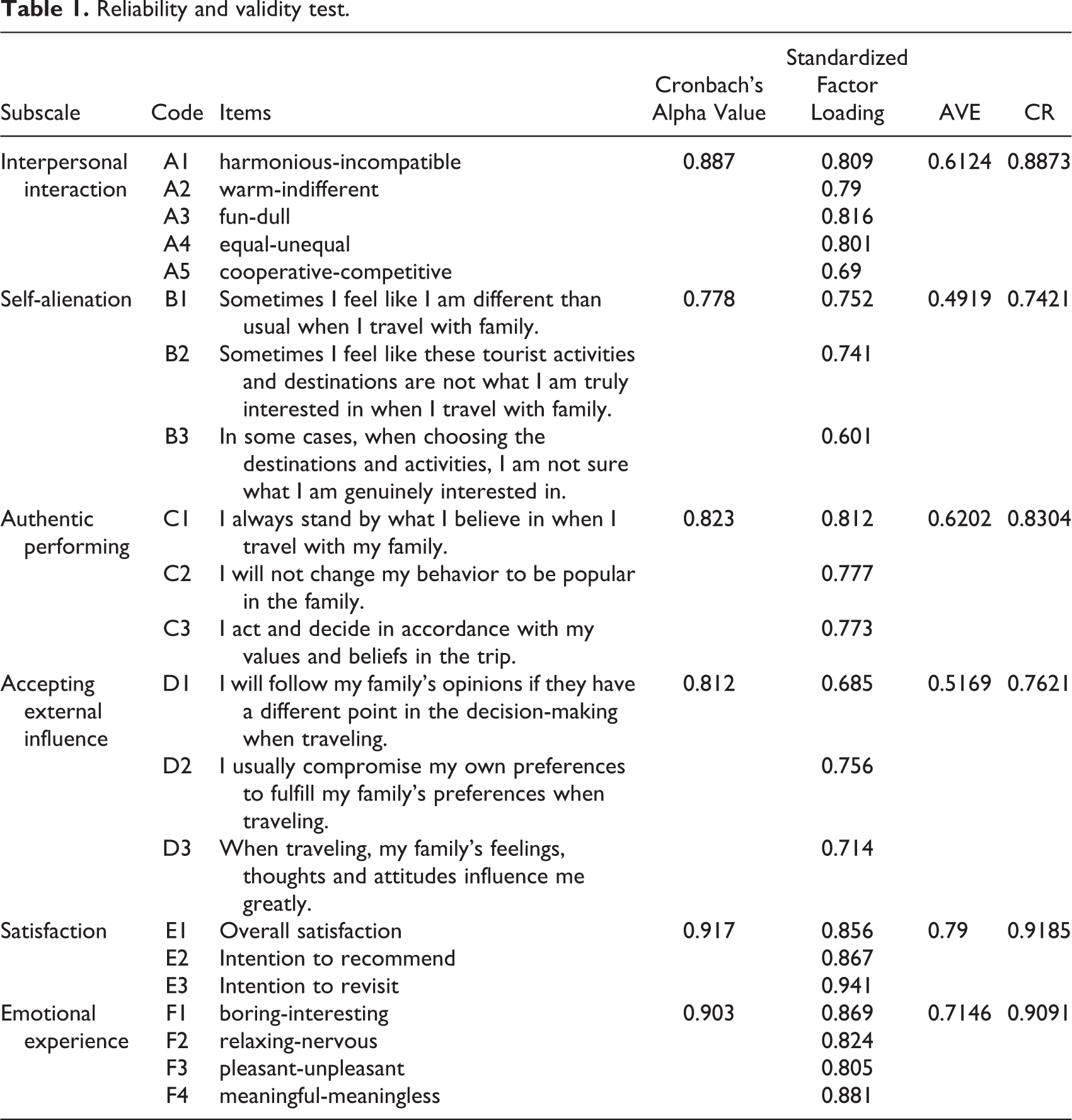
After the preliminary reliability analysis by SPSS, an item with a lower reliability was eliminated, which concludes the final reliability as shown in Table 1. The Cronbach’s Alpha value of each latent variable is above 0.7, showing a fair consistency. AMOS24.0 was used for further evaluation on the model, and items with smaller loadings were eliminated. The standardized loading of each item factor reaches the standard requirement, which is greater than 0.5, and the combined reliability (CR) of the items of each latent variable are all above 0.7. The AVE is basically above 0.5, and the convergence validity is robust.
Reliability and validity test.
The impact of gender on latent variables
The differences of tourism behavior between fathers and mothers have already been analyzed in some studies. We further detected some differences in the independent sample T test of gender for each latent variable. The Levin variance equality test showed a significance greater than 0.05, indicating that these variables have homogeneity of variance, and the T test results should be read assuming equal variances. It can be seen from the T test results that gender has a significant difference between the self-alienation (sig = .013) and the authentic performing (sig = .01) of tourists in family tourism. In the self-alienation variable, men feel a sense of self-alienation more than women; in the authentic performing variable, men also show a higher level than women. In other variables, there is no significant difference between men and women. It can be seen that men in family tourism have higher self-awareness than women. Although men act more authentically than women, they still feel more alienation. This discovery has enriched the perception of the differences in the roles of men and women in family tourism. Bittman and Wajcman (2000) found that women spend much of their energy looking after their children, and their leisure activities are more likely to be interfered with; while men play more with children and enjoy more ‘pure’ leisure time. Davidson (1996) and Deem (1992) also found that women and men differ greatly in their perception of family vacations. Fathers usually see family vacations as a way for them to relax and play with their children, an important way to stimulate their relationships with their children. However, for mothers, such family tourism has become a kind of burden, because mothers often have to undertake the preparation and planning work during the tour, and they need to take care of their children more during it. This study found that behind the differences in the behavior of men and women in family leisure activities was the difference in their inner perception of self.
Hypothesis testing
Based on the reliability and validity tests, the maximum likelihood estimation method was used to estimate the model. According to the results calculated by AMOS 24.0, the ratio of chi-square to degree of freedom CMIN/DF = 3.771 (1 < 1.673 < 5). RMSEA = 0.0552 (less than 0.08), IFI = 0.877, TLI = 0.853, CFI = 0.976, all close to 0.9. The index of PNFI = 0.708 (greater than 0.5). From the results it can be concluded that although not all the figures are desirable to the standards, considering that this research model is more complex and the path is exploratory, it can be regarded that the overall fitting of the model can meet the requirements. In addition, according to the research, when the sample size is small, it is more accurate to use a more stable CFI to evaluate the model. From the perspective of CFI, the fitting of this model is considerable.
The results of the path analysis are shown in Table 2 and Figure 1. Both H1 and H2 are supported, interpersonal interaction has significant positive impacts on both satisfaction and emotional experience. H4, H7 and H10 are supported, interpersonal interaction has a positive impact on authentic performing, and authentice performing has positive impacts on both satisfaction and emotional experience. H3 is not supported. However, the significant relations are proved, and the positive impacts are found. H6 and H9 are supported, self-alienation has negative impacts on both satisfaction and emotional experience. H5, H8 and H11 are all not supported, interpersonal interaction does not have negative impact on accepting external influence, and accepting external influence does not have negative impacts on both satisfaction and emotional experience. However, the positive relations are proved.
Hypothesis evaluation.
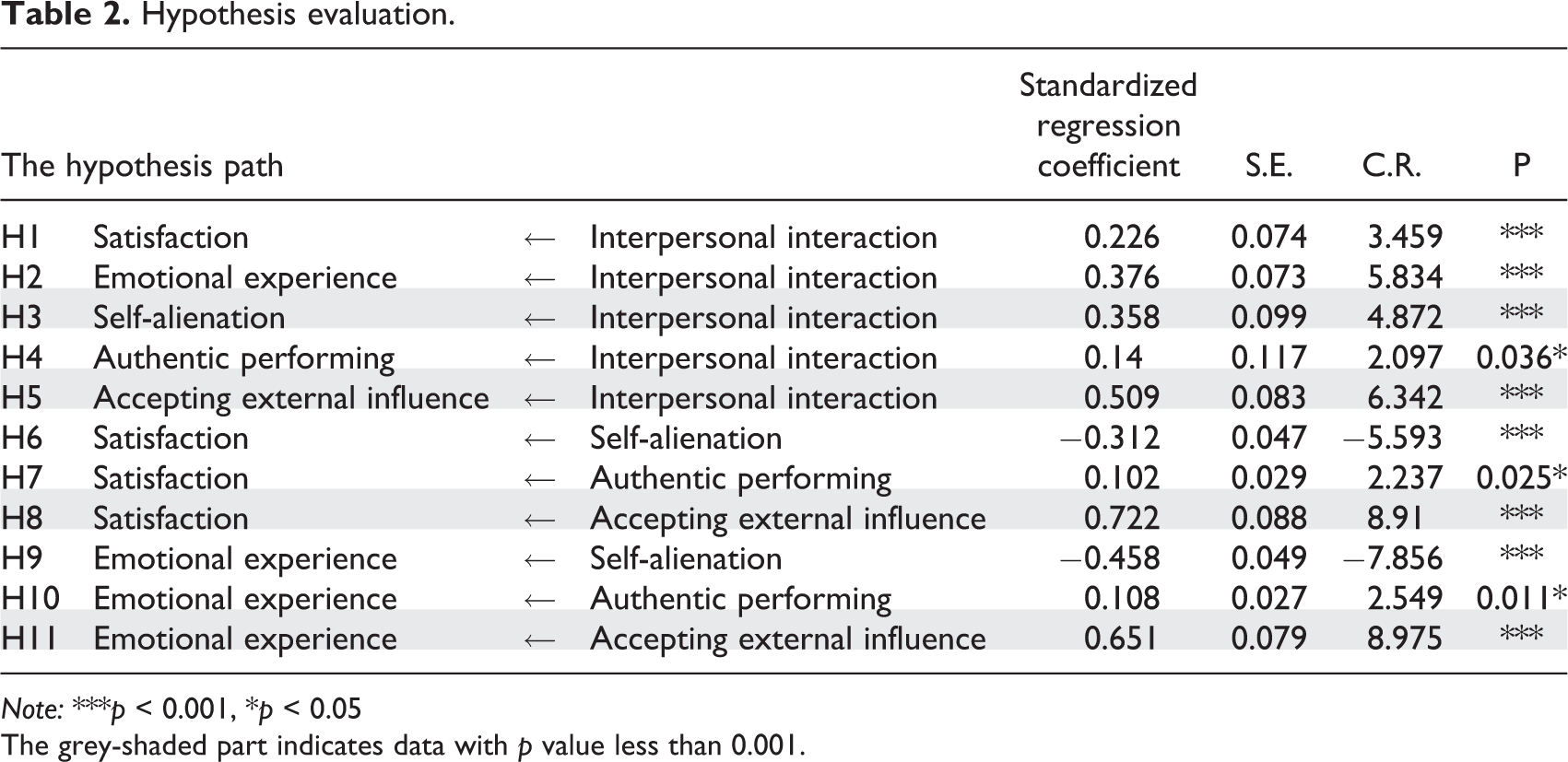
Note: ***p < 0.001, *p < 0.05
The grey-shaded part indicates data with p value less than 0.001.
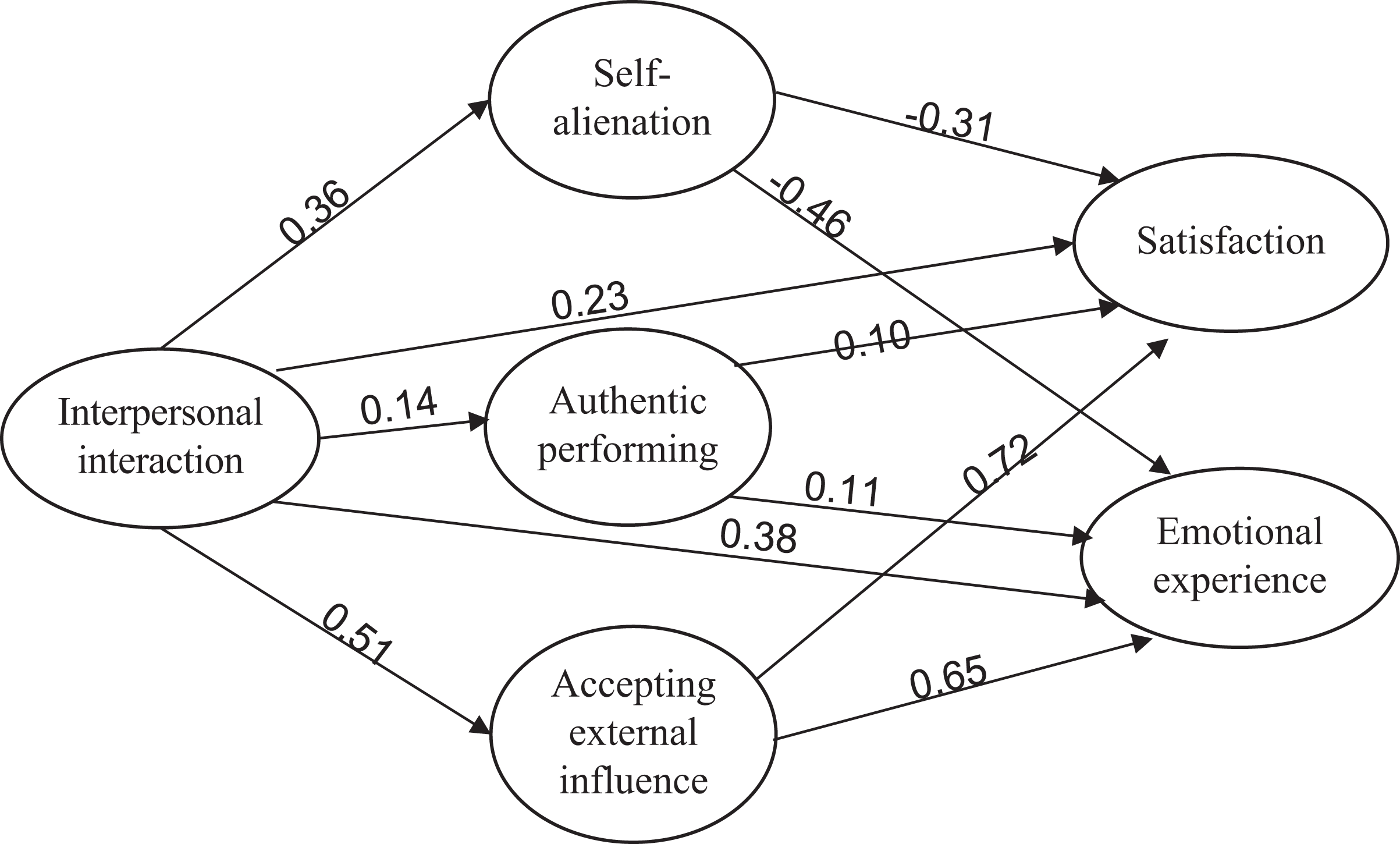
Results of the model.
Discussion
This study found that in the process of family tourism, while interpersonal interaction affects tourists’ emotional experience and satisfaction about tourist products, it also influences tourists’ self-alienation, authentic performing and accepting external influence, which all lead to an impact on tourists’ emotional experience and satisfaction. Existential authenticity experience is the internal reason why interpersonal interaction in family tourism has an impact on the quality of tourists’ travel experience. On one hand, in the context of tourism, tourists are more likely to realize their true selves (Wang, 1999), since traveling keeps people away from their daily lives, which not only means changes in the objective environment but also a surpassing of the conventional norms, in which people can reach the threshold of ‘unstructured’ (Turner, 1984), which provides tourists with the conditions to perceive the true self and makes them more willing to do so. On the other hand, in the context of family tourism, tourists have not completely surpassed daily life; family structure and family order still exist, and will continue to have an effect on tourists, and even put forward higher requirements. The travel scenario may be used as a stage to show love, solidarity and tenderness (Obrador, 2012) in order to present a well-formed family structure and order to others. In this case, tourists cannot use the situation to release their true selves, but perceive even more challenges than normal. Therefore, unlike other social connection functions such as ‘cultivating self-confidence, reducing stress, and increasing inclusiveness’ (Pearce, 2012) brought by other interpersonal interactions, what lies behind interpersonal interaction among family members is the authenticity experience of tourists. This study finds that it is the tourist’s existential authenticity that actually affects tourists’ emotional experience and satisfaction. The weaker the self-alienation and the stronger the authentic performing is, the higher the quality of family tourism experience.
According to person-centered psychology, accepting external influences appears as a negative aspects of existential authenticity, but in Wood’s research, it is also found that ‘people with strong authenticity tend to be more outgoing and easygoing, concentrated, open, less neurotic’. However, from the empirical results of this study, the relations between accepting external influences and interpersonal interaction and emotional experience or satisfaction all show consistency with the authentic performing, which indicate that in the family tourism situation, accepting family influence is also a manifestation of authenticity, reflecting a positive emotion of parents in the family. Nonetheless, family tourists always recognize themselves in different roles which contain their individual role and the family role. When accepting the family role, the interaction is positive and there tends to be stronger authentic performing, and the accepting of family members’ influence will also evolve into a part of authenticity. However, the individual role continues to always exist, which will remind tourists to pay attention to their needs. Thus, when tourists interact well with their families, they can also feel alienated because their individual role might be compromised, leading to a negative impact on emotional experience and reducing satisfaction.
This study found that among the three aspects of tourists’ existential authenticity (self-alienation, authentic performing, accepting external influences), self-alienation and authentic performing show significant difference in different genders, indicating a higher level of men in these two indicators. This may be explained by the different roles men and women bear in the family, which continue to exist even when traveling. Compared with men, women bring their practice of connecting themselves with the family from daily life into family tourism; therefore, although tourism situations give them a stronger self-perception, female tourists will still be in pursuit of multiple goals in relation to the self, family, and children in the process of family tourism. On the contrary, family tourism for men may be a different way of connecting to family from their daily life. They can be very aware of the functional role of traveling with their family and distinguish more clearly the differences between their own requirements and their family’s, therefore recognizing better the authentic performing in the family role and the alienation in the individual role.
Conclusion
Theoretical implication
This paper finds that referring to the quality of family tourism, both emotional experience and satisfaction are all related to the interpersonal interaction among family members, and that it is very important that the tourists’ perceptions of different aspects of the existential authenticity experience have intermediary effects. Tourism changes the usual environment of the tourists and strengthens the situation for them to obtain existential authenticity. However, it also depends on the family scenario constructed by the tourists and family members. When parents further extend or even strengthen their daily family roles in family tourism, they may have difficulty obtaining a positive authentic experience.
Moreover, under the impact of the COVID-19 Pandemic, most parents are forced to stay home and take care of domestic responsibilities, which takes up time needed for work and relaxation. Therefore, parents may develop a stronger desire for or awareness of their individual experience in tourism. What is worth noticing is that women usually take over most of the unpaid work at home, and this is likely to be exacerbated by the quarantine (Manzo and Minello, 2020; UN, 2020). Thus, it is also necessary to examine again the different experiences and needs women have in family tourism after the pandemic. In this light, data collected and analysis done for this study can serve as comparison research for the impact of the COVID-19 Pandemic.
Practical implication
This research not only enriches the studies on the family tourism experience, but also brings new perspectives to the tourism industry. Firstly, parents’ emotional and authentic experiences in family tourism should be paid more attention by the tourism industry. Family tourism has already become and will continue to be an important part of tourism markets. Previously, the needs of the children have been the focus of the family tourism industry, while the needs of parents were neglected. However, this research found that in addition to the children’s tourist experience and parents’ tourism evaluation based on their children’s experience, there is also the individual experience of parents in experiencing family tourism. As more and more young parents pursue their own needs, products and services should be designed with the consideration of parents’ needs. Based on the analysis of this study, emotional experience and satisfaction will be improved when parents’ individual roles and family roles are realized. Just like the findings (Mikkelsen and Blichfeldt, 2015) for the importance of children’s own time, ‘family time’ and parents’ ‘own time’ as interdependent entities that allow for the balancing of social identities (pursued through family time) and more individual interests (pursued through own time). In this light, for example, interactive and explorative programs that require cooperation between parents and children can be ideal for both enhancing family bonds and entertaining parents, which lead to the satisfaction of different roles of the tourists. Moreover, female tourists in the family should receive more support during the activities. For example, essential facilities such as nursery rooms shall be provided for mothers on tourist sites to ease the pressure of childcare for infants. Designated space with trained staff to guide and take care of children can be designed for stressed parents to unload their responsibilities for one moment to recover and retake their authenticity as individuals. All these improvements are likely to promote a parents’ authenticity experience that leads to a higher quality of the overall travel experience.
Secondly, young parents’ needs for their own tourism deserves much more attention. As more and more Generation Y and even Generation Z become parents, more parents will be more aware of their requirements for existential authenticity. Therefore, for these parents, the improvement of family tourism may be not enough to obtain existential authenticity. Tourism products designed especially for parents to help them escape family roles and focus on the individual role will be welcome. For instance, adventure travel experience through activities like hiking and treasure hunting might satisfy the desire of young parents, instead of conventional family vacation activities consisting of merely sightseeing.
Additionally, innovative family tourism marketing campaigns that target new generations and address both parents and children’s needs are likely to attract emerging markets. Online channels such as social media and travel websites may serve as effective agencies to stimulate tourist motivations for these young parents, since they are more exposed under this scenario.
Last but not least, with the changing and shifting of gender roles in the family, fathers and mothers tend to share household responsibilities in a more equal way. Fathers may share more childcare responsibilities than before. More and more women are favoring physically intensive leisure activities (Roster, 2007). Therefore, tourism activities should be designed to fulfill the active engagement and enjoyment for all the members, without depending on gender stereotypes.
Limitations and future research ways
When it comes to the limitation and implementation of this study, there are two main aspects. First, it could be interesting to analyze the impact of the role of tourists in family tourism. In our study, most of the family tourism was self-guided tours, which means some family members are major organizers or key decision makers, but some are just major participants. Since different roles carry different responsibilities, it may influence the perception of the existential authenticity experience. The second limitation has to do with the sample. It might be more desirable if the size of the sample can be expanded more, and focused on specific types of family, since the structure of the family might also influence the final result. Last but not least, it is worthwhile to examine further the gender perspectives of the family tourism experience, so as to understand and address different needs of mothers and fathers. Researchers can also further focus on experiences of parents coming from different educational backgrounds, with different occupations and so forth. Moreover, it appears even more urgent in the light of the increased gender inequalities resulting from the current COVID-19 Pandemic. A better design of the family tourism experience can potentially help tourists relax and recover after the pandemic.
Footnotes
Declaration of conflicting interests
The author(s) declared no potential conflicts of interest with respect to the research, authorship, and/or publication of this article.
Funding
The author(s) disclosed receipt of the following financial support for the research, authorship, and/or publication of this article: The research was supported by the Fundamental Researh Funds for the Central Universities (No. 63172082).
